




Abstract
Observers of Ethiopia’s entry into export-oriented global value chains generally agree that social upgrading is crucial if these chains’ largely female workforce is to reap the benefits of participation. They disagree, however, on the extent to which a ‘business case’ can be made to involve in this upgrading the managers who link frontline workers to international buyers. This article takes a novel approach to these questions by directly asking these managers and those who advise them on human resources how they understand the well-being of their frontline workers. Drawing on 37 qualitative semi-structured interviews, we find great variation in the extent to which such actors are interested in pursuing worker well-being and social upgrading beyond basic compliance. This is indeed due in part to the sectoral dynamics that have shaped managers’ views of what constitutes a profitable labour regime but also by sociocultural factors that include managers’ own national contexts, gender and class.
I. Introduction
In its bid to become the ‘China of Africa’ (EIC, 2022) and affect rapid export-oriented industrialization, Ethiopia has sought to position itself as the new global frontier of low-wage labour. This strategy has led to the country’s insertion into two global value chains (GVCs): horticulture (cut flowers in particular) and apparel. Within a decade of their establishment, the two export sectors were earning almost half a billion dollars in foreign revenue annually (EHPEA, 2023c; Seleshie, 2022) and contributing to Ethiopia’s status as one of the continent’s top destinations for foreign direct investment (FDI) (UNCTAD, 2022: 16). Buy a men’s shirt from Tommy Hilfiger or a rose from Interflora, and there is a decent chance that your purchase will have passed through the hands of some of the approximately 62,000 workers in the country’s foreign-owned apparel firms (ILO, 2020: 2) or the 200,000 workers in its export-oriented horticultural farms (EHPEA, 2023c). The vast majority of workers are young women from rural areas experiencing wage labour for the first time (Oqubay, 2015; Oya and Schaefer, 2021).
The nature of the rapid transformation that these workers have experienced is the subject of much public and academic debate. Through the lens of social upgrading, the literature on GVCs has become increasingly interested in understanding the extent to which workers’ participation in these chains enhances the quality of their employment and thereby improves their broader social rights and entitlements (Barrientos et al., 2011: 7). In a country with high levels of poverty, unemployment and gender inequality (UNDP, 2022), the potential benefits are significant; according to some policymakers and scholars, certain segments of Ethiopian GVCs are beginning to pay a social dividend (Oqubay, 2015; Staritz et al., 2016). Others are more cautious, pointing to extremely low wages, tensions with managers, health and safety concerns and a lack of upskilling and labour rights (Barrett and Baumann-Pauly, 2019; Mengistie et al., 2017). There is also concern around the precarity of this employment: Covid-19, civil war and the United States’ abrupt annulment of duty-free access for Ethiopian imports have all seriously jeopardized the growth of these chains in the past three years (Wilkins, 2022). Participants in this debate agree that social upgrading is important but disagree on whether it is feasible and occurring in practice.
This article takes a novel approach to these problems by asking how the managers who link Ethiopian female workers to GVCs understand the well-being of their frontline workers. Our rationale for this focus is twofold. First, firm managers are a group often neglected in the literature on social upgrading, despite the central role they play in governing the supply side of GVCs. Most studies into the lives of workers producing for GVCs have either used objective measures of working conditions such as workplace surveys, checklists and external reports to identify discrepancies with international standards and certification schemes or have employed a political economy perspective to analyse the interactions between key actors, such as firms, labour unions and governments (Staelens et al., 2014). A smaller number of studies have qualitatively elicited stakeholders’ lived experiences in their own words, and workers have here (understandably) been the key respondents (Hale and Opondo, 2005; Said-Allsopp and Tallontire, 2015).
What is particularly lacking are first-person accounts of managerial experiences, values and attitudes towards social upgrading. As Blowfield and Frynas (2005) note, it is often assumed that managers are interested in improving working conditions only in the face of pressure from buyers, and then only if they can see the ‘business case’, that is, if they do not fear that their already-thin profits will decline. But managers live and work more closely with the frontline workforce than do buyers and consumers; in many cases, they are drawn from the local population itself. It is not clear to what extent they see the mixture of worker opportunities and precarities chronicled in the literature as problematic, what their points of departure and comparison are, or what improvements they themselves assume to be possible. It is firm managers who are primarily tasked with implementing changes on the work floor. And because the territorial expansion of GVCs pushes factory and farm managers to turn to external consultants, government bodies and employers’ associations for advice and logistical support (Freidberg, 2017; Gibbon and Ponte, 2008), the group of people involved more indirectly in ‘managing’ the firms involved in supply chains continues to grow. Understanding how managers and their advisors think about the lives of their workers is therefore vital to understanding how they perceive stubborn problems such as low wages, workplace harassment and employee dissatisfaction and the extent to which a better business case really does hold the key to providing a solution.
Our second rationale—and reason for focusing on well-being—is that a study of managerial perceptions should not restrict itself to asking managers only about working conditions, perceived job satisfaction or labour rights. At the frontiers of GVCs, the changes that workers must confront are so far-reaching and rapid that asking managers to reflect only on static and bounded material conditions in the workplace would obscure important managerial justifications and rationales. Instead, the more expansive and maximalist notion of worker well-being allowed us to ask managers about all facets of workers’ lives. Our conceptualization views well-being as processual and relational; it is therefore dynamic and in flux, as well as constructed with others (Gough and McGregor, 2007; White, 2015). Such an approach to well-being asks managers to reflect on how their relationships with workers fit into the other relationships in workers’ lives and how workers’ lives change with employment.
This article draws on 37 qualitative semi-structured interviews comprising mid-level and senior managers in foreign-owned enterprises, as well as those who advise them on human resources. 1 We find great variation in the extent to which managers are interested in pursuing worker well-being and social upgrading beyond basic compliance. This is indeed due in part to the sectoral dynamics that have shaped managers’ views of what constitutes a profitable labour regime. But focusing solely on this aspect neglects key sociocultural factors such as managers’ national contexts and positionalities (around gender, class and the like). To move beyond a ‘compliance culture’ to a ‘well-being culture’ at the bottom of precarious GVCs, therefore, a complex, culturally and historically informed discussion beyond the business case is needed.
II. Social Upgrading and the Role of Managers in the Academic Literature
The past two decades have witnessed the emergence and consolidation of a large literature on GVCs and their impact on countries in the Global South. The initial focus was on describing and classifying how GVCs, defined as ‘the shifting governance structures in sectors producing for global markets’ (Gereffi et al., 2005), are coordinated and managed (see also Gibbon et al., 2008; Nadvi, 2008). This empirical and theoretical approach was soon joined by a more normative set of questions around the extent to which settings marked by low wages and low-value exports could benefit economically and socially from their participation in these chains. Initially, researchers focused on ‘economic upgrading’ (Gereffi, 2019; Pahl and Timmer, 2020), but soon discussions around ‘social upgrading’ were added, as well as examinations of how these two dimensions interact (Gereffi and Lee, 2016; Barrientos et al., 2011; Bernhardt and Pollak, 2016). Much of the scholarship on social upgrading focuses on achieving ‘decent work’ for labour, defined by the International Labour Organization (ILO) as adequate working conditions, social protection, workers’ rights and social dialogue (Selwyn, 2013). Some conceptualizations also examine the impact on workers’ families and communities (Selwyn, 2013).
Several studies have added a gender dimension in recognition of the feminized nature of both this labour and the social inequality in which it is often situated (Barrientos, 2019). Development donors, national governments and regional organizations view inclusion in GVCs as key to enabling women to increase their incomes and thereby achieve social equity (Langan, 2011). Yet, even before entering formal employment, women living in rural Ethiopia must often perform a ‘double role’ as producers of food and bearers of children (Ogato et al., 2009); in GVCs they also frequently occupy lower-paying and more precarious positions than men do (Bamber and Staritz, 2016). The prevalence of sexual harassment in export industries with a predominantly female workforce is well-documented (Barrientos et al., 2019), and some studies have found similar dynamics in the sectors we discuss here (Jacobs et al., 2015). In countries with particularly high gender inequality, such as Ethiopia (UNDP, 2022: 288), the potential risks and benefits to women workers’ well-being are magnified.
There is therefore general agreement that social upgrading does not automatically follow from insertion into GVCs and that female frontline workers face specific challenges as participants. How to alleviate these challenges is less clear. The initially more descriptive concept of governance has by now been taken up by this set of concerns, with studies focusing on the impact that civil society advocacy, buyers’ corporate codes of conduct and governmental regulation can have in inducing suppliers to comply with standards (see Barrientos et al., 2019; Gereffi and Lee, 2016 for overviews of this literature). Analyses that do take the agency of supplier firms into account usually examine relationships between a variety of stakeholders (e.g., Evers et al., 2014) and debate whether compliance with labour standards increases productivity and profits, thereby persuading supplying firms that there is a ‘business case’ for social upgrading (Antolin et al., 2021: 574; Lee et al., 2016). However, suppliers are usually treated as black boxes. Where managers are asked directly for their opinions, these are usually seen as expressions of firm strategy rather than the subjective perceptions of individuals with their own assumptions about employment and employees (for exceptions see Langan, 2011; Staelens and Louche, 2017; Record et al., 2014; Tran and Jeppesen, 2016).
In short, ‘there is a clear gap in the literature regarding the perceptions of suppliers’ (Rahman and Rahman, 2020: 11), despite the ‘critical role played by managers in creating and shaping the work environment and labour dynamics’ (Staelens and Louche, 2017: 2). Buyers’ stated positions on the labour at the bottom of their GVCs may not consistently reflect sincerely held beliefs, or be implemented even to the best of buyers’ abilities. But they are plentiful and can be read as expressions of values and perceptions of the problem (usually, lack of firm-level compliance to international standards) and its solution (usually, more compliance through improved auditing) (LeBaron et al., 2017). Comparatively few such positions have been publicly articulated at the firm level.
III. Social Upgrading Through the Lens of Relational and Processual Well-Being
The above section has argued that eliciting the perceptions of the individuals engaged in overseeing the gendered workforce of labour-intensive GVCs can deepen our understanding of the barriers to social upgrading, as well as why these might persist despite the presence of international standards and the existence of a business case. This article employs a second innovation by asking managers about the well-being of their workers, and by seeing this well-being as both processual and relational.
The literature around well-being in the Global South has largely developed in parallel to the GVC scholarship surveyed above. It draws on the seminal work of Amartya Sen (1999), who argues that national development should be measured not by an increase in citizens’ access to material resources but rather by the ways in which these and other less tangible resources (such as political rights) increase people’s capabilities to act in ways that are meaningful to them and their societies. This literature is also a reaction to what proponents see as more positivist and universalist well-being approaches developed in the Global North (White, 2015: 2)
The research agenda we draw on here therefore seeks to understand the extent to which people are ‘living the good life’ in a holistic and multifaceted way (Deneulin, 2014; White, 2010). While its proponents may vary in their exact definitions, they broadly agree that well-being focuses on how people work to construct the kinds of lives they value, not just on a material and individual level but also along intangible dimensions and in concert with those around them (Copestake, 2008; Gough and McGregor, 2007; White, 2010).
Because well-being is ‘in a permanent process of construction’ with others (Gough and McGregor 2007: 333), this perspective also often highlights the processual, dynamic nature of the concept (Bevan, 2004). Schwanen and Atkinson (2015: 99) view well-being as ‘the emergent and fluctuating effects of materiality, discourse [and] practices’ and Bebbington et al. (2007: 182) point out that ‘how people invest the majority of their time and effort now may not reflect their aspirations for the future’. White (2015) visualizes relational well-being as a set of multiple processes that weave different actors into a fluid but path-dependent whole.
Turning to the case of Ethiopia and its nascent GVCs, the benefits of an interpersonal and time-sensitive approach to well-being become apparent. Although investors have not yet significantly increased levels of industrialization in Ethiopia (Desta, 2021), their enrolment of populations into new labour regimes has begun to radically remake social relationships. Those who exercise authority and power in the workplace—sometimes originating from similar cultural contexts to workers and other times hailing from radically different settings—help to create the environment within which workers pursue well-being and make decisions based on women’s perceived social status. The temporal dimension is salient, also: Ethiopian GVCs are in a state of constant upheaval, while a host of policy and NGO discourses debate the resulting long- and short-term costs and benefits.
By examining how managers think about the processual and relational well-being of their employees, this study does not seek to flatten the various aspects of social upgrading into a single definition. Nor do we wish to suggest that managers know more about worker well-being than labourers themselves do. While forthcoming articles on our project explicitly juxtapose the top-down and bottom-up perspectives, our aim here is instead to better understand managerial imaginaries and their enactment into managerial practice. We, therefore, view the perspectives presented here as a contributor to women workers’ well-being (or lack thereof), and their appraisal of the costs and benefits to workers over time as important in determining how policies created along various nodes of GVCs are negotiated on the work floor.
IV. Research Design and Methodology
This research forms part of the larger ‘Women, Well-being and Work in Ethiopia’ (3WE) project, which aims to understand the well-being of women in Ethiopia’s export-oriented horticultural and apparel sectors through a mixed methods, multistakeholder approach.
Ethiopia serves as a case study of a workforce—and a managerial force—confronted with the establishment of new, labour-intensive, export-oriented GVCs. Few countries have pursued industrialization as fervently in the 21st century as has Ethiopia. Inspired by China and South Korea’s example of rapid structural transformation and workforce mobilization, successive ruling parties have liberalized key sectors of the hitherto socialist economy since 2007 (Fourie, 2015). One such sector is export-oriented manufacturing, which the government hoped to grow by building over a dozen Industrial Parks (IPs) which would host FDI secured by granting financial incentives to investors (Oqubay, 2015). Another is agro-processing, also driven by FDI and intended to move the country from its reliance on small-scale subsistence agriculture. Today, Ethiopia has 13 government-owned IPs spread around the country, as well as one owned by Chinese investors. The IPs are dominated by firms that produce apparel and garments for foreign markets; of the roughly 150 foreign firms present (of which around half originate from China), over half produce for this sector (Cepheus Research and Analytics, 2020: 3). Horticultural exports, in turn, remain dominated by Dutch floricultural firms operating independently in a handful of geographical hubs; these account for roughly 70% of foreign-based firms (EHPEA, 2023b). 2
While generalizability to other settings can only be undertaken with caution, GVCs are characterized by governance structures and logics of capital accumulation that transcend national boundaries. For example, the predominant female profile of the frontline workforce is not unique to Ethiopia (Barrientos et al., 2019). In addition, many of the managers interviewed for this article had previously managed factories and farms in other locales. The two focal sectors were chosen in part because they are so heavily represented in the country’s GVC participation; for Ethiopia, the Wage Indicator Foundation (2022) tracks conditions only in these two sectors. However, these sectors also constitute classic cases in the scholarly literature on GVCs in low-income countries. Our aim in this article is not to formally compare outcomes in the two sectors in question, but rather to avoid focusing only on one specific GVC, which might have very specific materialities.
This article draws on a dataset of 37 semi-structured interviews chosen through a combination of ‘heterogeneity’ and ‘emergent’ sampling (Suri, 2011). We began by consulting rosters of existing firms to arrive at a first list of potential workplaces varying by size, location and country of ownership. 3 After only one group of respondents—managers of Dutch floriculture farms—proved easily accessible through official channels, managers from other firms were approached through LinkedIn. For privacy considerations, only managers with professional profiles publicly associated with their position and firm were contacted, and each gave informed consent for the use of interview data that obscured their identities and those of their employers. Care was taken to ensure that every large but difficult-to-reach group was represented (e.g., Chinese apparel firms); we also ensured that outlier cases (e.g., horticultural farms headquartered outside the Organisation for Economic Cooperation and Development [OECD] or apparel firms headquartered in the OECD) were included, in case different dynamics emerged here (see Table 1).
Interviewees’ Sectoral and Geographical Backgrounds (Compiled by Authors).a
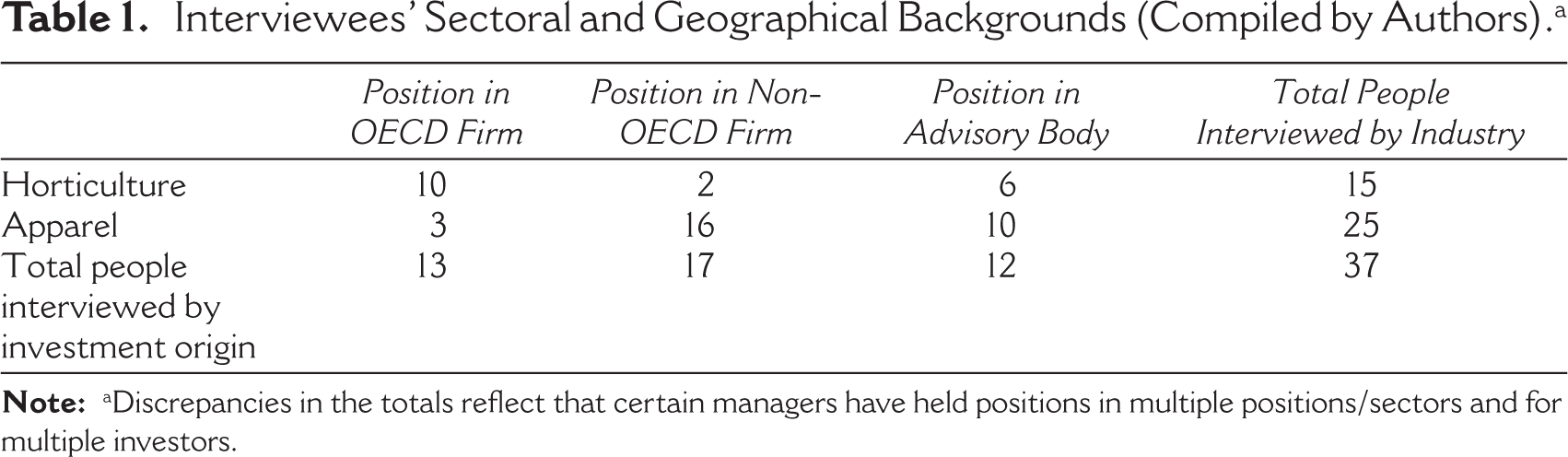
Finally, after interviewed managers repeatedly referred to certain official advisory bodies and private consultants as particularly knowledgeable and/or influential, we decided to include a group of these actors in our sample. Depending on the specific roles played by each of these advisors, their responses were sometimes used to elicit perceptions of managerial discourses, while at other select times—when such actors actively assisted with the establishment, expansion and revenue generation of firms—they emerged as examples of managerial discourse themselves.
Variation was also achieved by targeting managers at several levels of seniority. In both industries, it emerged that Managing Directors are almost always non-Ethiopian, while less senior managers comprise a mixture of Ethiopian and foreign managers (with the apparel industry favouring internationals more markedly). In keeping with how these GVCs have developed globally, foreign horticultural managers often hail from the Netherlands, Germany or Kenya, while foreign managers in apparel are often Chinese, South Korean, Turkish, Indian or Sri Lankan. Although no comprehensive figures exist as regards gender breakdown, it emerged during sampling that virtually all foreign managers are male; Ethiopian middle managers are more balanced in terms of gender (see Table 2). 4 Team Leaders, frontline workers who have been given a supervisory role over small groups of their peers on the work floor, were not included in our sample due to their limited power within firm hierarchies.
Gender, Nationality and Seniority of Interviewees (Compiled by Authors).a
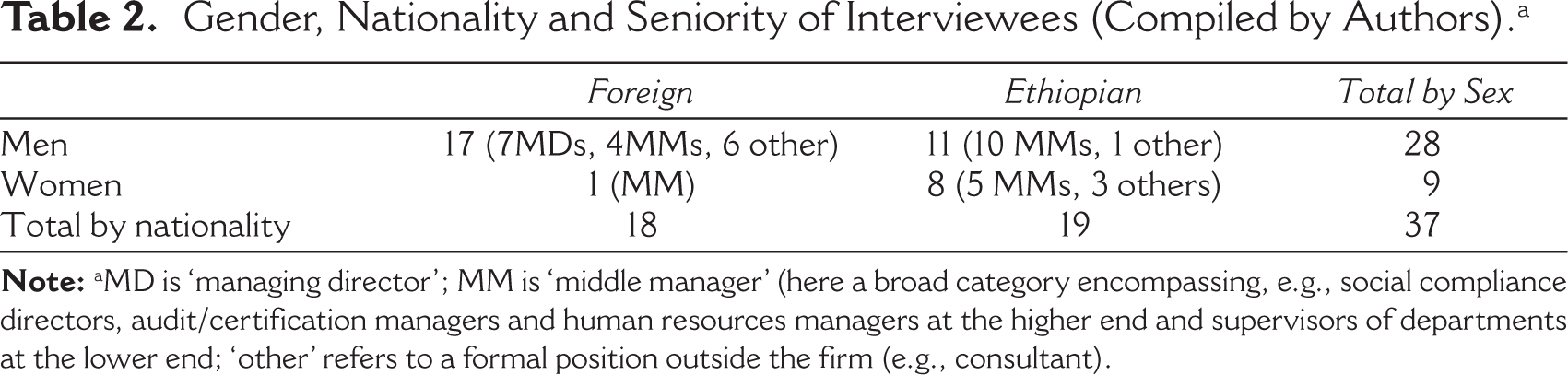
Due to the Covid-19 pandemic, physical data collection rarely proved feasible. One interview was conducted by email, 5 in person (without being recorded, on the request of the interviewee), 6 in person (and recorded) and 25 by Zoom/phone (and recorded). All but two interviews (conducted during a pilot study in May 2016) took place between March 2021 and October 2022. Ten interviews were conducted in a local language (Amharic) with respondents who preferred this, and subsequently translated. Interviews were conducted by the first author in combination with trained local interviewers.
Interviews with managers followed an iterative logic, exploring first how much consideration managers gave to women workers’ well-being. Instead of directly using the concept itself, we asked managers to describe their female workers and their lives: how satisfied and happy do they perceive these workers to be overall; what challenges and achievements might workers encounter in and outside the workplace? Then, in keeping with the processual conceptualization of well-being outlined above, we asked about perceived changes over time: what prompted women to take these jobs, were their expectations satisfied, and what might be their plans for the future? Finally, in keeping with the relational aspect, we asked managers about their own relationship with their workers, how they felt this employment might have affected workers’ relationships outside the work floor, and how workers related to each other. This flexible framework derived from the theoretical framework gave the topics that managers were eager to talk about—recruitment, training, turnover, corporate social responsibility (CSR) and non-financial benefits—new analytical depth. Interviews were manually coded and analysed in Atlas.ti, with new codes added as necessary.
V. Perceptions of Worker Well-Being Over Time
Understanding how managers think about worker well-being over time entailed asking them about workers’ quality of life before, after and during employment in the firm. Our respondents tended to see frontline workers’ lives before recruitment as rather homogenous, frequently referencing their rural, young, female, inexperienced and impoverished status. Almost every manager proffered low wages as the single largest impediment to workers’ well-being. Respondents were surprisingly aware of the financial constraints faced by their workers (‘the payment they earn is not enough to sustain their life in the city’, said one human resources manager in apparel [EM521]). But managers felt powerless to change wage structures; they also perceived a lack of alternative employment:
Having this opportunity for the workers is good, because what we have to see is what kind of life they had before they come to work at the farms. Because most of them came from the rural areas…it’s better now. At least they are in the city, they can work and then they can help themselves and then they can go to school. (EF821) At least they have a salary. Life is like this: you have bitter and sweet. Generally speaking, I think they are happy for this job. Generally speaking. (EM721)
Despite the imagined immediate consolations of a worker’s first regular wage, many managers also took a long-termist view to employment, arguing that it should not be seen in isolation but as part of a larger trajectory offering long-term opportunities for empowerment and career progression; ‘We have seen a revolution of women in Ethiopia, and this is also happening in the firm’, explained the only foreign female interviewee (IF621). Central to this view was the recognition that on-the-job training was important. Often, these took the form of specific, discrete events centred around soft skills (such as recognizing and reporting sexual harassment) that took place outside of working hours (EF722) or were difficult to obtain permission from production managers for (EM221). More continuous and work floor-based training in technical skills appeared to be extremely variable. Promotions were based in part on the extent to which women had learned these skills, and managers were increasingly keen to promote from within the existing workforce rather than to use foreign staff (IM721). Frontline workers were, however, by and large expected to demonstrate initiative in seeking out these opportunities themselves, and managers disagreed greatly on the extent to which female frontline workers were willing to do this. A German General Manager was puzzled by what he saw as ‘a national hobby to collect degrees’ (IM322) rather than seeking out on-the-job training and promotion. A Chinese General Manager feared legal reprisals for ordering workers to move to a different workstation and thereby departing from the job descriptions contained in employment contracts (IM516). More critical managers and consultants saw this lack of work floor upskilling as inherent to the production system itself:
Parents were literally saying to their daughters, ‘Okay, go and work in Hawassa [IP]. Even though you won’t make enough money to live on, we’ll send you money and you’ll stick it out in order to get the skills.’ [We told the managers] ‘Look, you don’t realize it, but this is the pact that these young employees have made to come and work here. They’ve decided to trade off low wages in return for skills…. If you want to keep them, at least live up to that side of the unwritten bargain. Train them.’ They weren’t. They were using exactly the same approach they use in other parts of the world, which is to fragment the tasks, teach people one isolated task…and just have them do that. That’s the killer because then women leave. They burn out after a while…they’ve been working on shirts for 10 years and they can’t make a shirt. (IM321) Most of the workers cannot write their names. It’s really disappointing to see them—you would feel sad to see them…. We have so many uneducated workers, but at the end, we tried and we failed. We failed to educate them, not because they don’t have the interest, because we have to make [trainings] outside their work time. They just say, ‘No…I have to go to my house, and I have to prepare food, and I have to take care of my family. I don’t have time. Instead of me, educate my children’. (EF822, horticulture) If you stay with the company for a year, you will be doing the same thing every day. (EF721, apparel)
Exacerbating this perception gap is the fact that very few managers or firms seemed to conduct exit surveys or gather information about how workers fare after resigning, despite assertions that this employment would benefit them in their future careers. Detailed turnover figures were difficult to come by in interviews (Oya and Schaefer, 2021; found up to 6% monthly turnover in some apparel firms). Employers expressed frustration at what they perceive as a lack of long-term planning among workers (‘no sense of the future’ [IM721]) and were left to speculate that women quit either when they had found a higher salary, decided to focus on childrearing or wished to become self-employed. A manager of a farm producing herbs for export cited his biggest challenge as the fact that ‘You cannot say you have really permanent people that you are working with because [most] of the time they feel they need to go and look for green pastures somewhere else’ (IM821). In most IPs, apparel firms actively collude to prevent ‘poaching’ of employees through competitive salaries, circulating photographs of former employees among each other (EM821). The result is a situation in which managers justify the long-term benefits to worker well-being by positioning these low-paid jobs either as ‘stepping stones’ or as entry points into a longer career in the firm, yet are often unable to say to what extent either of these outcomes is happening in practice—or to facilitate their outcome.
Willingness to even engage with deeper questions of workers’ life satisfaction and happiness varied greatly. Some interviewees exhibited a high degree of reflexiveness and forethought around the societal trade-offs and contradictions inherent in their firms’ participation in GVCs. One Audit Manager, for example, felt that the job presented ‘more opportunities than challenges’ but also that her own enquiries into worker well-being could only ever be inconclusive and subjective (‘You know how it is—something I like might not be suitable for someone else. I might not be able to see something someone else sees…. And I don’t believe the questionaries I used to conduct the interviews were suitable to gauge their job satisfaction’ [EF521]). On the other extreme, some managers flatten any such larger questions into simple reassurances of compliance (‘Our company abides by international standards because all our clients demand the standards’ [EM822]).
Interestingly, the largest disparity in this regard could be found among the consultants and external advisors involved in the IPs. This group included foreign business advisors who assumed that access to a salary must, by definition, leave female workers better off. ‘You look at the factory…and you’ve got—I don’t know—300 people who were receiving nothing on any sustainable regular basis, who are now receiving $200 or $300 a month, every month’, explained one European consultant for a Chinese apparel firm that has since closed. These jobs in fact pay considerably less than this figure, and low salary was cited by most managers on the ground as the single biggest problem facing workers. This group also contained government advisors who, when asked about worker well-being, simply asserted that government regulation and regular buyer audits left firms with little choice other than to comply with national law and international standards. Also among these respondents, however, were consultants who had links to civil society and had often conducted their own studies among workers. Some of these advisors had been brought in specifically to contribute to social upgrading by influential Northern buyers such as German retailer Tschibo; these enterprises explicitly wanted to set up more sustainable operations than they oversaw in their existing locations elsewhere, approaches that went beyond ‘ the standards, compliance approach and [then] a little bit of training to cover up things’ (IM421).
The most experienced external advisors often felt frustrated that their concerns about long-term costs and benefits to employees had been ignored by the government and by firms:
One of the tests of how low manufacturing wages are is the fact that you make more as a day labourer on a building site than as a manufacturing worker, and you get paid in cash [daily]…. Employers are complaining to us about this but we were saying ‘but guys, just ask yourselves—what’s the root cause of this? These are people carrying bricks, and they are making more than working at your sewing machines. There’s something wrong with your wage structure, your compensation structure’. (IM321)
Managers from different countries of origin adhered to different definitions of well-being. African (including Ethiopian) and Asian managers who viewed this employment as beneficial to women tended to emphasize the long-term benefits of cultural and structural change. Although sacrifices were required, these would be beneficial to the individual through the instilling of values such as discipline and hard work, while also benefiting the collectivity through national industrialization and structural transformation:
The workforce in Ethiopia, of course, is not competitive with the Chinese…. They have potential. They need time to be industrialized. To get used to this work, the culture, the system, to deploy all the factories. (IM721) When I think about it, it is good for the women to work instead of sitting in the house. It gives them the opportunity to communicate and share ideas with others. It also helps them to know about outside work and experience work culture. In addition, it motivates them to upgrade their educational status for promotions. (EF721) Before Bole Lemi [IP], there were farmers on this land who had been doing the same thing for 100 years. They complained when the land was taken from them. So the mentality needs to change. Farming in Ethiopia does not change lives…I want to work more than eight hours. I stay behind here after hours, to work for free and to help the managers. Working in a Chinese factory has helped to develop this culture in me…. Rights don’t create work. (EM516)
Global North employers, on the other hand, tended to take a more transactional and rationalist approach to employment, framing it as a contract freely entered into and more sensitive to criticism that a broader concern with women’s lives could be seen as meddling: ‘ I know that when they are outside of the gate, they have to be protected by the government…it’s beyond our influence’ (IM321), said one Dutch flower farm manager; another pointed to the fact that some women had been employed for over a decade as evidence of job satisfaction: ‘if you don’t like it, then you don’t do that’ (IM321). There was some disillusionment around efforts to showcase a higher sustainability standard as Northern firms:
You do all these things, but then there will be advocacy groups that will campaign on an issue which undermines your credibility, such as the wage issue. ‘These companies are only in Ethiopia because the wages are cheap. They’re awful companies, they’re the baddies’…I guess the influence by walking the talk and doing the right thing is probably a lot less than I thought it would be. (IM721)
We identified a final significant cleavage around the theme of temporality between the two sectors, which have different ‘calendars, rhythms and histories’ (Bevan, 2004). Managers in the horticultural sector saw the ebb and flow of turnover as part of the natural seasonal rhythm and therefore distinguished between temporary and permanent workers. The latter group enjoyed some of the highest levels of formal protection and opportunities for promotion among all workers concerned: managers detailed regular and complex salary negotiations with farm unions and were able to point to more sophisticated promotion and training programmes. They were also more likely to have climbed the ranks within the company themselves and to express optimism about the long-term survival of the FDI venture. Many horticultural firms are therefore able to selectively prioritize the well-being of that segment of their workforce that they view as (semi-)permanent. No such formal distinction between casual and permanent labour exists in FDI-funded apparel. The industry is less predictable, both because it is more buyer-driven and because it is newer to Ethiopia, thus managers do not know whom to ‘invest’ in and find it more difficult to predict the long-term trajectories of workers. A comparative lack of trust between labour unions and management exacerbates the problem: in the few Ips where unions are allowed, they tend to be viewed as ineffectual and unrepresentative even by managers otherwise critical of their own firms (EF721, EM821).
VI. Perceptions of Worker Well-Being and Relationships
Moving from the temporal to the relational aspects of well-being, managerial perceptions again varied considerably along certain dimensions while nevertheless also exhibiting cross-cutting commonalities. The frontline workers interviewed for our project themselves saw relationships inside and outside the workplace as intrinsic to their well-being Gudeta et al., in preparation). But very few managers proactively raised positive relationships as a potential contributor to their employees’ overall happiness, despite several mentioning that their good rapport with workers made their own lives more meaningful (‘I know how to live with the people…. When I’m here, I feel like I’m home’ [IM821]). For certain managers, compliance with buyers’ standards must stand in for even thinking about such elusive concerns at an early stage of industrialization. And because audits rarely monitor these qualitative and intersubjective elements that comprise our definition of well-being, relationships often appeared on managers’ radars only when they went wrong.
‘Going wrong’ could take many forms. Relationships between managers and frontline employees were a sensitive topic, but many admitted that language and cultural difficulties make for frequent tensions with foreign managers. These did not occur uniformly: managers who had worked for more than one set of owners (between or within companies) almost always strongly preferred the management style of one over another (‘Communication is getting better. Before it was like a war’ [EF821]). In the apparel sector, where international managers are more plentiful, less familiar with the local context and under greater pressure to meet tight production targets, tensions appeared to be more frequent. Ethiopian respondents alleged physical and verbal abuse on the part of foreign, and especially South Asian, managers (EF721, EM821). Foreign consultants, perhaps freer than managers to speak openly, reported that such events had led to violent retaliation:
What will easily happen is her brothers will be waiting for you after work. A lot of these guys got beaten up. They thought they could shout at women like they do in their home country and they found that it doesn’t work in Ethiopia, so very bad relations. (IM321) The females also attacked the…supervisors with scissors. (IM421)
Foreign managers also attested that a lack of familiarity with Ethiopian culture negatively affected their own mental health. Perceptions differed on how this might be solved, as contrasting quotes by two Chinese managers illustrate:
At first when I came here, things were a bit complicated [in] that I couldn’t adapt [to] the working culture of Ethiopians…. But, through time I have tried to talk to and train them [and] their attitude has changed gradually…I have faced so many challenges. (IM822) Everybody was struggling. We went to a new place. We had to start to learn from zero. Even I was struggling. At the time, I was struggling and I was suffering a lot…. The company was using the military system to manage the workers, very strict rules and regulations… [But] they have to follow and also try to respect and understand their culture …. Obviously, we have learned a lesson from their mistake. (IM721)
Ethiopian managers, perhaps because of a perceived similarity with workers, rarely saw their own relationships as problematic but class, ethnic and gender divisions nevertheless emerged in their testimonies, a perception shared by some foreigners. One CSR manager at a prominent apparel firm spoke of witnessing tensions between ‘very middle class, graduate staff’ and the frontline operators they were hired to manage—a tension he says resulted in a shift towards promoting more from the lowest ranks (IM721). A young, female manager from Addis Ababa recounted regularly being told ‘get out of our country—this is not your place’ in Ziway, the epicentre of the flower sector (EF821).
These ethnic divisions made certain questions around relationships between frontline employees—as well as between employees and the wider community—particularly fraught; no other topic led to as many requests to take the interview ‘off the record.’ Foreign managers perceived ethnic friction on the work floor to be a taboo subject, exacerbated by the fact that most found it difficult to differentiate between ethnicities (‘for us as management, we don’t even know who belongs to which’ [IF621]). But even Ethiopian managers worried about the effect on worker well-being: one remembered an operator in an IP being forced to leave the factory due to harassment and retaliation after her brother called her supervisor and friend an ethnic slur (EM822).
Other aspects of workers’ relationships with their peers were less contentious. Very few Ethiopian or foreign managers mentioned the positive effects of female workers and friends supporting each other in the workplace that we heard from women themselves ([names redacted], in preparation). Cracking down on sexual harassment among ‘equals’, in contrast, is seen as one of the key managerial responsibilities, perhaps because respondents know how explosive such charges can be for a company’s reputation. Although it was beyond the scope of our study to ascertain the success rates of the numerous anti-sexual harassment trainings and complaints mechanisms detailed by managers, it was striking how many interviewees alleged a wider problem of foreign and Ethiopian managers offering promotions for sexual favours; two of the Ethiopian female managers we talked to had their contracts terminated after they brought these allegations to the attention of their supervisors; one successfully sued her employer. While physical sexual coercion is therefore openly addressed in trainings and by employee-led gender committees, abuses of power are handled more opaquely. Similarly, managers find it difficult to know how to confront the sexual abuse of workers outside the workplace. One consultant was told ‘these are not our girls’ in emergency meetings with local community representatives (IM321)—a reference to many workers’ status as internal migrants.
Women’s relationships and overall well-being outside working hours still constituted something of an unknown quantity to foreign managers. These respondents understood that women faced a greater caretaking burden and more restrictive societal norms than do their male counterparts but were either reluctant to speculate how employment might play into this or—in the case of several East Asian respondents—felt that modernization involved the changing of such societal norms for the better (‘The culture of Ethiopians is to spend time with family. We need to create a culture of working and self-improvement’ [IM516]). One frustrated European consultant perceived the problem differently:
It’s very difficult to make [middle managers] understand. They say, ‘These people are so poor. When we offer overtime hours, nobody wants to do overtime hours. Why? It’s a way to earn money’…[But] you can’t ask female workers to do overtime on Sunday. You may make them work overtime hours, but the relationship is destroyed. They have to go to church. They have to go to the beauty salon. The beauty salon is such an important institution’. (IM421)
The extent to which employers were willing to adapt their policies to accommodate women’s extracurricular commitments varied, from employers who provide workers and their families with full healthcare, childcare and primary education, to those who simply refer to the statutory minimum. Horticultural firms are more likely to fall into the first category due to explicit CSR policies and commitments, whereas salaries and skills transfer are all that most apparel firms can claim to provide workers.
Ethiopian managers exhibited a more intimate knowledge of the challenges faced by female workers outside the workplace—but this applied primarily to female managers. A male Ethiopian manager might claim, for example, that ‘women by their nature are more nurturing’ and ‘they will feed their children ten times a day if there is a need, so their protection for the flower is the same’ (EM1022). Not all Ethiopian female managers saw employment as problematic, but some of the most perceptive observers of the psychosocial ramifications of this employment were Ethiopian women who had reached positions of authority:
If she was absent yesterday, rather than just immediately giving a written warning or an oral warning, ask her why she was not there yesterday. Try to make her feel like a family, try to make her feel like you care about her and that really makes a difference. When a worker feels like [her] manager really cares about her wellbeing, she will definitely start to rely on the company. (EF721) My example, however, might be a testimony of strength, might be a light to them. For instance, a woman might say, ‘[interviewee] did this and made sure she was given the respect she deserves. I should do the same.’ I don’t see and ignore things. I speak up about things that need speaking up about…. And if I need some equipment and my boss doesn’t buy it, I won’t report that he did…I don’t want someone to tell me, ‘Be quiet. You’ve already said that. It doesn’t have a solution.’ Where is the solution? Who has it? I want to know these things. The women beside me might have questions too. If we keep losing our rights, we will lose ourselves, let alone carry on being productive. (EF821)
Seeing well-being as relational, it turns out, entails not only incorporating female workers’ relationships into measures of job satisfaction and happiness. It also entails uncovering the ways in which identities intersect in helping (or hindering) an understanding of others’ situations and cultivating a recognition that workplace well-being is a joint project affecting everyone on the work floor.
VII. Conclusion
This article has sought to contribute to the scholarly understanding of social upgrading in GVCs by asking managers themselves how they think about their workers’ lives beyond static and individual measures of well-being. It found that employers generally appreciate the detrimental impact of low wages, yet feel the long-term possibilities for advancement through skills development and empowerment might serve in part to justify this deprivation. It is striking, then, how little data-gathering goes on to ascertain whether this advancement has taken place, as well as why it often seems to fail.
Managers and their advisors also feel that young, uneducated rural women face so few alternatives that any wage is better than nothing. While it is true that survey research from our and other projects has confirmed these general demographic features (Oya and Shaeffer, 2021; Staelens et al., 2014; [names redacted], in preparation), they do not paint as homogenous a picture. We uncovered significant differences in socio-economic status among workers in both sectors, for example ([names redacted], in preparation), and Oya and Schaeffer (2021) found high relative levels of education among the country’s ‘low-skilled’ apparel workers.
Our interviews also uncovered a tapestry of taboos around ethnicity and gender, unspoken assumptions about individual responsibility and agency within industrialization, and fragile relationships between managers and workers. Behind and beyond the seemingly mundane world of the greenhouse and the factory shed, these have an impact on the well-being of workers and managers alike. If not managed with sensitivity and context-specific knowledge, they have the potential to erupt into conflict.
Our maximum variation sampling strategy notwithstanding, notable were the numerous differences that we found in the perceptions and strategies of managers. Beyond wages, which tended to be relatively standard across sectors and employers, exceptions existed to virtually every problem or shortcoming that emerged in our analysis. At the same time, certain broader patterns emerged. Some were due to sectoral dynamics that had created different labour regimes. Managers in the horticultural sector, for example, have a ‘two-tier’ approach towards worker well-being (core versus temporary) that is supplemented with broader CSR initiatives targeting the larger community, while managers in apparel operate within the homogenizing, hypercompetitive and relatively isolated environment of the government’s IPs.
Some of the most significant differences we uncovered were the result of managers bringing their own cultural assumptions and historical perspectives on well-being to the workplace, with managers from newly industrialized countries such as China or Ethiopia often taking a more long-term and collectivist view to social upgrading but framing this more as survival and modernization than as well-being. Interestingly, this did not hold true for female managers, however, who almost always tend to be Ethiopian and perhaps are more easily able to imagine the experiences of frontline workers, ethnic and class divisions notwithstanding. Consultants and external advisors can play valuable roles as cultural brokers and translators, but only if they have strong ties to the local community—and only if managers and governments are willing to listen.
These findings have the potential to inform policy and practice in concrete ways. Managers should consider better data-gathering around the precise incentives and expectations of their workforce at various points in time, perhaps in partnership with researchers. There is scope for far greater levels of pre-departure and post-arrival cultural awareness training for international managers, who are often sent for their technical expertise alone. And, as challenging and sensitive as it will undoubtedly be to establish fora in which actors at different levels and even from different sectors can candidly share their experiences and values, such platforms could have tangible benefits to workplace morale. This would entail adding to existing worker and gender committees settings where managers not only respond to existing worker grievances but focus on proactively building relationships of mutual trust and cross-cultural understanding.
In the complex network of GVCs that today connect low-paid workers to consumers around the world, the sites of production themselves have often been treated as ‘black boxes’—squeezed on the one hand by logics of capitalist competition and profit maximization and on the other hand by buyers demanding ever-greater evidence of social upgrading and adherence to international employment standards. Scholars have tended to emphasize the business case as a key tool: if firms cannot be made to understand how providing decent jobs benefits the bottom line, they will invariably cut corners.
Broadening social upgrading to encompass the more expansive notion of well-being and eliciting the perceptions of managers themselves does not completely overturn the above assumptions. Perceptions of profitability do shape different industries’ differing approaches to upskilling and turnover. Managers care about compliance and economic survival, and do see these as intertwined. But the extent to which managers are willing to move from a compliance culture towards a well-being culture varies greatly, serving to nuance and trouble overly economistic assumptions. The content of the social contract that managers feel they are offering to workers and their families is not uniform, and managers are themselves workers who assess the contribution of relationships and long-term career progression towards their own well-being in diverse ways. Moving from a culture of compliance to one of social upgrading—from the business case to the social case—therefore requires both engaging with cultural expectations around progress and making invisible relationships visible. It requires seeing managers as social rather than merely economic actors and maximizing this knowledge for the benefit of Ethiopia’s new female proletariat.
Footnotes
Acknowledgements
This research was made possible by funding from the Dutch National Science Foundation (NWO) under the WOTRO Science for Global Development funding initiative (grant number W07.30318.015).
Declaration of Conflicting Interests
The authors declared no potential conflicts of interest with respect to the research, authorship and/or publication of this article.
Funding
The authors received no financial support for the research, authorship and/or publication of this article.