




Abstract
Critical development studies require not just a critical attitude, but also usable tools. This article suggests some forms of discourse analysis that can add substance to critical development studies’ aspirations and that can yet be learnt and used by students without specialist background. Central are tools for ‘making strange’ (defamiliarization), so that we view both texts and social realities in a fresh independent way and start to discern better their blindspots, and our own. The article presents accessible yet helpful forms of text analysis, argumentation analysis and content analysis that contribute in required processes of defamiliarization and reconstruction.
Introduction
Many studies have reflected on dangers of managing university education on the ‘student as customer’ model.
It distorts the traditional idea of a university as a space to challenge one’s ideas and worldview. … [Curricula become] designed to satisfy customers and meet their expectations which may not be the same as providing challenging, inconvenient and at times radical ideas that do not produce feelings of satisfaction among students. (Patel and Mun, 2017: 11)
Some recent papers consider the challenges arising specifically in international development studies. ‘A critical theory foundation … is needed to build reflective and adaptive practitioners, particularly in the context of a rapidly changing geopolitical environment’, argue Engel and Reeves (2018: 213; see also Sims, 2018). However, there are dangers of teaching blocks of critical theory in uncritical ways, as scripts to memorize and repeat. Some ‘critical’ talk becomes un-self-critical, liable to overgeneralizations, premature judgements, groupthink, self-idealization and underestimation of others. Students and practitioners require tools for thinking, investigation and dialogue, more than sets of packaged answers. Strengthening independent critical thinking is relevant for both critical creativity and employability, for being able to identify and review given roles (e.g., that of ‘customer’ in education), and for engaging in exploratory dialogues. This article seeks to present and illustrate some methods relevant for teaching and use in development studies.
Investigation of development ‘buzzwords and fuzzwords’ (Cornwall and Eade, 2010) and, more generally, close examination of concepts is often helpful. For example, modern language regarding nations and nationalism appears to have hardly existed before sixteenth-century England, and it spread only slowly to other countries during the following centuries (Greenfield, 2016). Such examples help us see how concepts are socially made and evolve. However, many development studies’ students find this type of discussion too remote, when done as an exploration in intellectual history, etymology and social semantics. One may need to link it to case-specific investigations. Unlike intellectual historians, in development studies we are typically less centrally interested in elaborating a map of past thinking and more in interpreting and responding to the meaning-making in present-day discourses. We are trying to strengthen awareness of how systems of linked concepts (one definition of ‘discourses’; Apthorpe and Gasper, 1996), including whole category systems, are employed to construct world pictures. This article focusses then on how to help development studies students begin in discourse analysis. The methods presented should be useful also for most development researchers.
The article opens with a fuller diagnosis of these challenges and requirements in critical development studies, in Section 2. Section 3 introduces the relevance of discourse analysis approaches. ‘Discourse analysis’ refers here to the broad range of approaches that examine ‘discourse’, namely (in a second definition), language use in social situations and processes (Blommaert, 2005). Section 3 also diagnoses further some obstacles to overcome: our seeing only what we expect, our overconfidence that we know already, and our formation by dominant societal ‘scripts’. The article proceeds then to present two complementary sets of tools for ‘making strange’ (defamiliarization) that help us to notice more and more carefully. Section 4 introduces formats for structured text and argumentation analyses, to investigate attempted persuasion and as a basis for other types of analysis. Section 5 outlines a pair of such types, the study of vocabulary choice and of topic choice. These forms of content analysis provide a starting-point for systematic investigation of intellectual frames. Sections 4 and 5 both give detailed examples. Section 6 connects to further methods. Section 7 has concluding reflections.
Needs in Critical Development Studies
In their overview chapter to the recent book ‘Building Development Studies for the New Millennium’ (Baud et al., 2019), a project of the European Association of Development Research and Training Institutes (EADI), Elisabetta Basile and Isa Baud conclude that: ‘The scope and seriousness of development issues—and their urgency—require ontological and epistemological reassessments of DS [Development Studies]’ (Basile and Baud, 2019: 10). They call for: first, a stronger critical thinking orientation; second, strengthening of multi-, inter- and especially trans-disciplinary work; and third, democratization in knowledge processes. Discourse analysis skills are invaluable for each of these. Critical discourse analysis gives attention to how power systems are incorporated in language and can potentially be understood and partly counteracted through language and its study (Van Dijk, 1997, 2011). If critical thinking involves only criticism and not enough thinking skill, then just like democratization without citizen skills it is a limited—and risky—good.
Regarding a critical thinking orientation, Basile and Baud use Robert Cox’s contrast between:
two theoretical approaches to social change …: problem-solving and critical thinking. … problem-solving theories take ‘the world as they find it’, where existing power relationships are the ‘framework for action’. Their aim is ‘to make these relationships and institutions work smoothly’, keeping problems under control. In contrast, critical theories question the very ‘framework for action’ that problem-solving theories take for granted…. (Basile and Baud, 2019: 10, citing Cox and Sinclair, 1996: 88–89)
But how can we identify and question frameworks when they are, precisely, taken for granted? ‘Critical thinking’ requires skills, not only good intentions and a critical stance. Interest and facility in investigating and reflecting on ideas, and on systems of words and ideas, are not automatic. Even when interest exists, it does not automatically generate facility. However, both can be fostered.
Another chapter in ‘Building Development Studies for the New Millennium’ offers insights from postcolonial studies. Referring to Edward Said’s work on Orientalism and Othering (Said, 1978), the work of many authors on subalternity, representation and hybridity, and Chakrabarty (2000) on ‘provincialization of Europe’ (viewing Europe as one peculiar locality not as the canonical universal norm), Schöneberg propounds ‘three starting points [for postcolonial development studies] …: (1) listen to and collaborate with the Subaltern; (2) provincialize Europe in knowledge production; and (3) abandon dichotomies’ (Schöneberg, 2019: 111). But again, to go beyond crude tools, such as dichotomies, requires flexible, subtle and open tools. Listening and ‘provincializing’ require skills too. Unskilled ‘provincializing’ and re-representation too often create new stereotypes. 1
For responding to these challenges, we need more and finer-toothed instruments than recitation of favoured authors or intuition alone. ‘Discourse Analysis means Doing Analysis’ (Antaki et al., 2002). Said himself, when considering how he had developed his analysis of the macro-structures of power and perception that lay in and around Jane Austen’s 1814 novel Mansfield Park, called for a combination of types of reflective reading (Said, 1994: 100–16). Mansfield Park deals with the life-trajectory and maturation of a ‘poor relation’, a girl who is allowed to come to live with her wealthy cousins in the English country estate of Mansfield Park. Her evolving relations with them and their wealthy acquaintances are described with memorable acuity. Behind the refined, elegant interactions, the ‘cultivated’ lifestyles at Mansfield Park are sustained by cultivation of another estate, a sugar plantation in the Caribbean, run with slave labour. It is mentioned but not described by Austen; it is taken for granted. ‘What assures the domestic tranquillity and attractive harmony of one [Mansfield Park] is the productivity and regulated discipline of the other’, noted Said (1994: 104). This is implicit but never explicit in the novel; for ‘where only one class is seen, no classes are seen’ (Raymond Williams; cited by Said, 1994: 100).
Said argued that:
there is no way of doing such readings as mine, no way of understanding the ‘structure of attitude and reference’ except by working through the novel. Without reading it in full, we would fail to understand the strength of that structure and the way in which it was activated and maintained in literature. But in reading it carefully, we can sense how ideas about dependent races and territories were held both by foreign-office executives, colonial bureaucrats, and military strategists and by intelligent novel-readers educating themselves in the fine points of moral evaluation, literary balance, and stylistic finish. (Said 1994: 114; italics added)
So we need to both absorb a text as a whole, closely and fully, and think beyond it, bringing in other considerations, comparisons and scenarios. ‘Reading it carefully’ means an active, questioning, comparative approach. The article looks at how to promote this.
Much work trains students to look for ‘basic discourses’, pervasive persistent systems of perception and representation (see, e.g., Frerks and Klem, 2009; Hansen, 2006). To recognize though the mixtures, variations and evolution of ways of thinking that are found in practice, and to intelligently select from, combine or diverge from standard approaches, requires skills of independent thinking. Such skills can be strengthened through content analysis of vocabulary and topic choice, as illustrated in Section 5, and more especially by the structured form of close reading and argumentation analysis presented in Section 4. These methods of textual analysis are usable without linguistics training and assist one to read with both critical distance and close attention to the text rather than to stereotyped scripts and expectations already in one’s mind. They help one to ‘defamiliarize’ (a term from art theory) or ‘make strange’ (the phrase common in anthropology): see texts afresh and ask and pursue further questions. Complementing this approach, and partly to be incorporated in it, are other tools for exploring the choices of ways of looking, for example via identifying and investigating the metaphors people resort to. Discourse analysis always also requires analysis of contexts and audiences and texts-in-context, not only text dissection. 2
The article’s approach has been developed through English-medium teaching and research in international development studies and public policy over 35 years, in the Netherlands and several other countries. 3 It has been regularly used in the past 20 years with students of the International Institute of Social Studies (ISS) in The Hague, who come from all over the world, and has been adopted too in teaching by former students. Many examples of the best student work resulting have been published (e.g. in the annual series ISS 2006–2021). Most of this experience has been at master’s level, but some has also been with doctoral and sometimes bachelor’s students.
The Importance of ‘Making Strange’ and the Role for Structured Text Analysis
Several forms of discourse analysis are accessible and useful for international development studies students. However, we also need introductory methods that operationalize discourse analysis perspectives while being absorbable and usable by average students and practitioners. Some students are uncomfortable with being asked to intellectually ‘open up’ issues, assumptions, authorities and identities. Many in development studies are put off by extensive and abstruse discourse theory, especially if it consists of diverse kinds coming from diverse disciplinary and theoretical backgrounds and with little explicit interconnection. Different authors’ approaches typically substantially overlap but are each presented under a different label and with claims to distinctiveness. Other students, plus some of the previously mentioned groups when further down the track, are interested to investigate but, on being asked to examine specific issues, texts and discourses, may rush forth with pre-set or quickly intuited judgements, or feel a lack of workable approaches which have some investigative power, do not presume major conclusions, yet do not require long specialist training in linguistics, logic or hermeneutics. The approach to text analysis and argumentation analysis presented in Section 4 offers an entry path and provides a basis and partner for other, more complex and/or more narrowly focussed, methods and approaches. Using a type of structured close reading, it builds from students’ existing skills to operationalize several principles of critical and constructive thinking while helping to unlearn some problematic habits. This strengthens an investigative style that brings an openness to discovery, through attention both to details and macro-structures. And it provides a frame-for-work that gives space for a range of specific inquiries (such as regarding categories, metaphors, assumptions and choices in framing) and helps to link them.
We have several reasons for working closely with texts in this way. Language gives vital clues, but we are in danger of missing them because of lack of curiosity plus our tacit mental ‘scripts’, including both our personal ‘scripts’ and dominant societal ‘scripts’. First, verbal language provides clues in a similar way to ‘body language’. Verbal language involves so many choices that we tend to reveal more than we intend; we typically cannot consciously control all the choices and instead draw on our habits, assumptions, stock of ideas and feelings. Close reading hunts out verbal language’s ‘body language’—the things that people may seek to hide yet nevertheless can reveal through their word choices, sequencing, omissions, repetitions, euphemisms, emphases and de-emphases (van Dijk, 2016). As with body language, we should interpret elements in context and within clusters, not in isolation, and look for patterns of congruence or dissonance (Pease and Pease, 2004). The examples in sections 4 and 5 will point to this.
Second, our minds operate in terms of familiar patterns and often see only what we expect to see. We miss errors when proof-reading our own work. So we need to ‘make strange’ when we read. In a classic experiment, the French discourse theorist Pêcheux gave two groups of students the same economics text, one that could be described as middle-of-the-road. One group was told that it was left wing and the other that it was right wing. Both groups interpreted the text so as to match the ‘frame’ they had been given (Mills, 2004: 12). Preliminary situating of a text, in terms of its authorship and historical and intellectual context, is meant to help one study and interpret it, giving one questions to ask, but not to substitute for open-minded careful interpretation. One must not declare definite conclusions about the text in advance of examining its detailed content; nor assume that an author is necessarily limited to only the ideas that one has already seen him or her using or limited to those ideas’ typical partners. ‘Package deal’ pictures of the available intellectual alternatives assert that if you use idea A, then you must also hold ideas B through Z, so that we do not even need to check what ideas you in actuality use. Such pictures assume that only a few alternative package deals are available or worth considering. Often more valid are ‘pick-and-mix’ pictures of the range of intellectual alternatives; such pictures show that more combinations of elements are possible.
Distilling advice for young researchers near the end of his career, the distinguished American sociologist Howard Becker warned likewise that a ‘major obstacle to proper description and analysis of social phenomena is that we think we know most of the answers already’ (Becker, 1998: 83). We usually have mental scripts too readily available in our minds and use these to superficially ‘explain’ cases of which we have little or no knowledge. Detailed description of an observed case ‘helps us get around [this] conventional thinking’ (Becker, 1998: 83). In the same way, detailed specification of a text’s components and the structure of its arguments help us both to clarify what are authors’ tacit assumptions and to counteract our own prejudgements.
Third, this search for an accurate, thoughtful picture of texts leads us then to think more independently in relation to existing dominant societal ‘scripts’ and power hierarchies. Becker noted that often we do not look in a careful, independent way at a situation, because we have been assured by people in power that there is no need to do so. Close attention to a text helps us to see the choices involved in making the text, the alternative choices that could have been made and their possible effects on meanings and conclusions, and the factors that may have influenced why they were not chosen. It highlights alternatives, and the roles of fields of influence and power; and thereby helps to build the power of alternatives.
One danger we face concerns reductionism regarding particular texts: over-simplification of their meanings, perhaps ignoring internal plurality and contradictions. So, close reading is a balancing factor to thinking in terms of ‘basic discourses’ and should be done in ways that help surface and test the prior presumptions of the reader too. A sister danger concerns reductionism about schools of thought, underestimating the depth of thinking behind viewpoints with which one disagrees. We flatter ourselves by underestimating others. To counter the danger of reading a text with a strong feeling of the superiority of one’s own views, Klamer and McCloskey (1989) proposed a Maxim of Presumed Seriousness (Take other writers seriously) and a Principle of Intellectual Trade (Be open to learn from others who think differently). Such principles need embodiment in working procedures. Section 4 will suggest how text and argumentation analyses can help us here: to ‘make strange’ and not re-read a pre-set mental script; and to get close but also seek the bigger picture.
Text and Argumentation Analyses Organized as Integrative Exploratory Formats
‘The understanding of understanding requires a slowing down of pace and a certain distance to the subject’ (Schmitt, 2005: 383–4).
Argumentation analysis is a major strand in discourse analysis (see e.g., Van Dijk, 1997, 2011). The approach presented here has three features. First, it adapts a widely known argumentation analysis-and-evaluation procedure designed by the Australian-American philosopher and theorist of evaluation, Michael Scriven. Scriven’s type of argumentation analysis is richer than most because it builds on prior stages of exploration of meanings in texts and is not preoccupied with logic in isolation. We convert parts of his procedure into two user-friendly worksheets: a text-analysis worksheet (to produce a ‘text-analysis table’) which leads on to, second, a worksheet to specify and test argument structure (generating an ‘argumentation-synthesis table’). For each table, a family of variants is available, according to needs.
Second, for the argumentation-synthesis table, our approach adapts the Toulmin (1958) format for examining argument structures (van Eemeren et al., 1996), which has been widely used in fields like planning and policy analysis (e.g., Dunn, 1981, 2016) and in the best-selling research methodology textbook The Craft of Research (Booth et al., 2003 [1995–2016 editions]). Booth was a famous theorist of narrative and rhetoric, who yet found that the Toulmin format was an effective thinking frame for students. This article goes further, for Toulmin’s diagram showing his set of categories and their relationships is not sufficient for describing real complex argument systems. It can though be converted into the more flexible, reliable and user-friendly synthesis-table format. When using it to describe an existing text rather than construct a new position, the synthesis table can be built from the results of a text-analysis table. Third, we connect and can also adapt the worksheet formats (especially the text-analysis table) to supplementary methods, for examination of categorization, value language, figurative language, rhetoric, implications of alternative choices, etc.
The Scriven and Toulmin Approaches
Scriven’s (1976) famous textbook gives a seven-step procedure for examining a text as a pattern of argumentation. See Table 1. The note to the table adds an elaborated version, that explains more fully the required steps.
Scriven’s Procedure for Argumentation Analysis

Scriven’s Procedure for Argumentation Analysis
0. Read and reread the whole text (at least twice), to identify segments and components (in a preliminary way).
1. Look at meanings; including by considering language choices and alternative possible formulations. Do this for the entire text before essaying further steps.
2. Identify conclusions, including unstated conclusions (with main focus on the main conclusion[s]).
3. Portray structure (components’ connections to each other, leading to the conclusion[s]). Various formats are possible. One will later revise and elaborate this attempted synthesis, especially after step 4.
4. Identify unstated assumptions, connections to ideas and situations outside the text. These connections vary from more to less definite.
5. Evaluate premises and inferences (i.e., engage in ‘criticism’ in the more neutral sense of the word).
6. Consider other relevant arguments and counterarguments.
7. Overall judgement on the text.
One must first read the text closely, divide it into sections, and reflect on the meanings they provide (step 1). Next, a preliminary identification of conclusions (step 2)—including tentatively suggesting a main conclusion and any significant intermediate or auxiliary conclusions—must come before we attempt a picture of argument structure, the picture of how a conclusion is reached (step 3). The tentative suggestion can be amended in the light of later steps. From the picture of structure, we can look in detail at individual linkages and see on what assumptions they rely (step 4).
Toulmin’s model is a way of presenting argument structure (Scriven’s step 3) in terms of some standard roles/components: claims or conclusions; for which specific grounds, or data, are provided in support; warrants—the more general and/or theoretical (and/or sometimes valuative) ideas which are used to make the logical link from grounds to claims; and qualifiers, which are limitations on the strength of the claim, reflecting the presence of counterarguments (possible rebuttals), exceptions, and so on. Grounds, warrants and rebuttals can themselves each have some proposed backing. One role of the Toulmin model is to make us think about the, often unstated, more general ideas—the warrants—upon which a claim relies. If the claim is an evaluation or prescription, then among the warrants we should look for value ideas. A second key role is to make us think about possible counterarguments (rebuttals) and limitations (qualifiers) to the claim made. (For fuller discussion of uses of the Toulmin model in fostering critical thinking, see van Eemeren et al. (1996, 2011), Gasper and George (1998), Gold et al. (2002) ).
While the Toulmin model continues to be widely popular, challenges recur in use. The model has been usually presented as a single flowchart, connecting the standard components, which can mislead readers into oversimplifications when they describe real arguments, mis-describing them by always imitating the layout of the illustrative flowchart in whichever textbook they studied. Results in the hands of ordinary users, and also of academics, can sometimes be unfortunate (Gasper and George, 1998 dissected examples of published misuse). Toulmin himself never proposed the flowchart as a template. If we combine Toulmin’s ideas with the flexible Scriven approach, and with a more helpful presentation format—not a single flowchart, but a table, with whenever necessary different rows for the different steps in an overall argument system—we can benefit from Toulmin’s insights without being trapped in the original layout.
The text-analysis table is for segment-by-segment examination of a text. In a first column one places and considers each segment. Subsequent columns provide reflections on meanings, conclusions, assumptions and possible alternative formulations. The table has various possible versions, according to the number of columns and the tasks placed in them. Choice between versions depends on the focus in a given exercise (see examples in Gasper, 2000, 2002, 2004, 2006; Gasper and Roldan, 2011; Mukhtarov et al. 2021, and in essays published in ISS, 2006–2021). For example, one can include a separate column to consider possible alternative wordings to those in the text; and this often helps for Scriven’s steps 1 (examine meanings), 2 (identify conclusions, including unstated) and 5 (identify unstated assumptions), as well as 6 (consider alternative arguments).
For the fundamental step 1, reflecting on meanings, basic advice thus includes, first, interpret meanings comparatively: that is, through comparison with what might have been said instead. This reflects ‘the contrast theory of meaning’ (Scriven): we see the significance of the formulation adopted by contrasting it with alternative formulations.Second, pay attention to praise/criticism language, including in ‘secondarily evaluative’ terms, for this can help to reveal conclusions. 4 Third, pay attention to uses of figurative language, such as metaphors, for these can help to reveal assumptions. Fourth, think about the construction of roles, including by examining uses of ‘I’, ‘you’, ‘they’, ‘it’, ‘we’, ‘us’, etc.
The text-analysis table operationalizes Gee’s (2011) ‘Making Strange Tool’, by leading us to look at everything consciously and in a fresh way. It requires us to ask for each element: What is this? And why did it need to be said? Thereby it operationalizes also Gee’s ‘Subject Tool’ (‘Why did she mention that?’). Next, why was it said in this way? What would the difference be if it were absent or were said in another way? Having a column to consider alternative possible wordings operationalizes Gee’s ‘Why This Way and Not That Way Tool’. It helps too to identify possible counterarguments.
Let us consider a simple example, using the format to explore a declaration by a government minister in Zimbabwe and its asserted systems of roles, knowledge and power: ‘My Ministry is resolved to phase out [the] haphazard and scatter-based settlement pattern prevailing throughout the country and establish properly planned villages. The households and their councillors must accept the concept of centralised villages’ (Marere, 1987). We can observe how the work format incorporates Gee’s tools. Table 2 illustrates its use to investigate meanings and to explore conclusions and assumptions.
Illustration of Use of a Text-Analysis Table
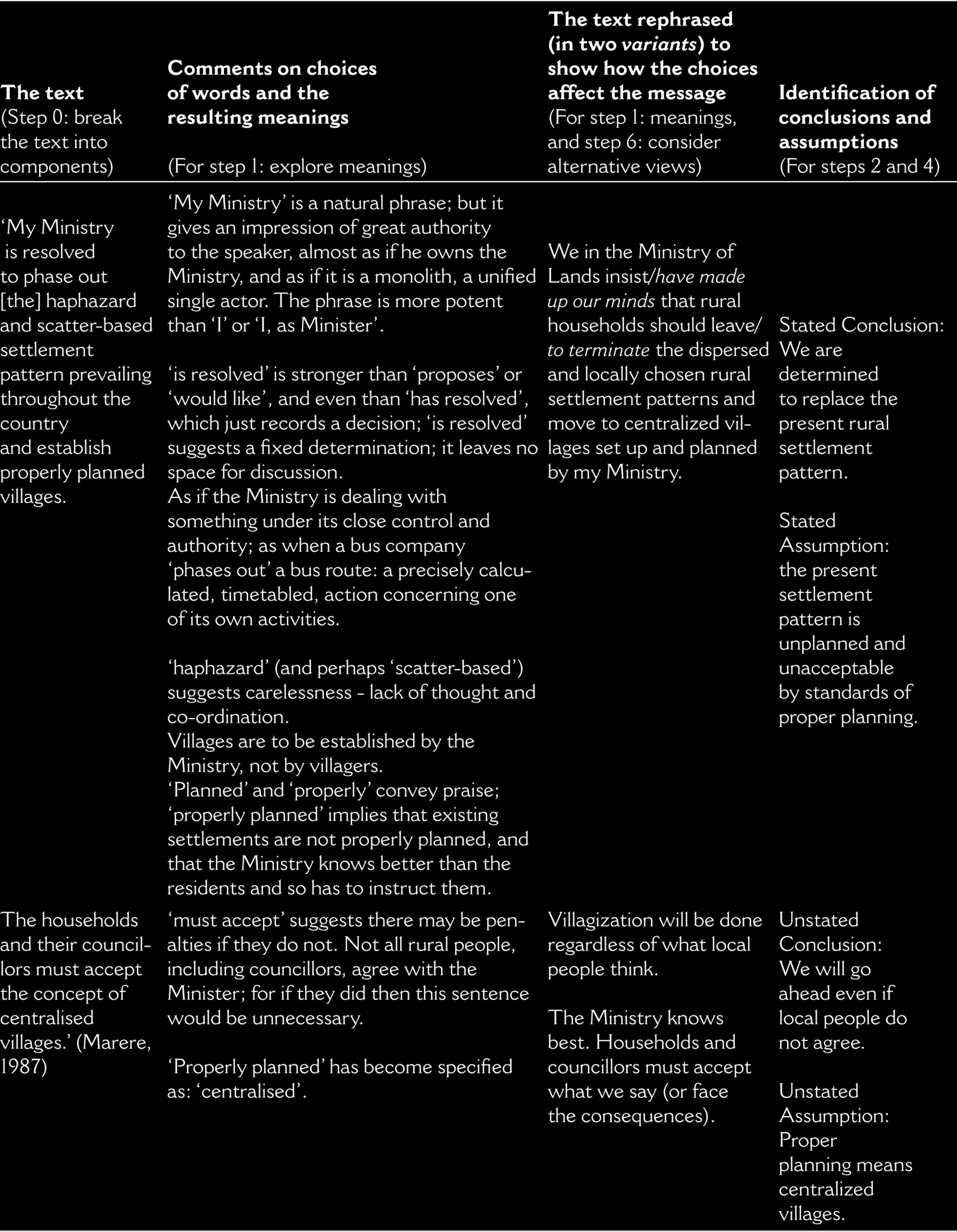
Illustration of Use of a Text-Analysis Table
The phrase ‘must accept’ (phasing out of ‘haphazard settlements’) is so peremptory that it suggests a very dominant government. However, using the ‘Subject Tool’ leads one to ask if such an instruction would be necessary if acceptance were guaranteed and resistance inconceivable. In contrast to the technocratic confidence of ‘phase out’ and ‘properly plan’ the phrase implied that many people did not agree with the policy and had not accepted it. Indeed, Zimbabwe’s authoritarian government still ultimately felt obliged to hold back from compulsory villagization, since there was little or no popular support and it could have led to major resistance. Correspondingly, the Minister’s remarks gave an unstated hint of compulsion, but not an open commitment.
The argumentation-synthesis table or logic table presents the structure of an argument or argument system, via one or more rows of the form shown in Table 3. The table is R. V. George’s modification of Toulmin’s format.
Toulmin-George Synthesis Table

A synthesis table encourages one to look for logical links, including looking for warrants; for example, the normative warrants that are required for normative conclusions. It can also help us to find and show possible ambiguities, tensions, weaknesses and inconsistencies in a text. Column 4, the ‘Unless’ column, partly matches Scriven’s step 6 (‘Consider other relevant arguments’). It covers both: (a) recognized limitations and qualifications of the argument, for example, indication of situations in which the claim does not hold good—these link to Toulmin’s ‘Qualifier’ category; and (b) counter-arguments which more strongly dispute the argument’s validity—these match his ‘Rebuttal’ category. When a text holds that its argument is still valid despite a recognized possible counterargument it employs a ‘Despite’ category. 5
If we try to represent the illustration text as an argument system, Table 4 gives one plausible version.
Illustration of Use of an Argumentation-synthesis Table
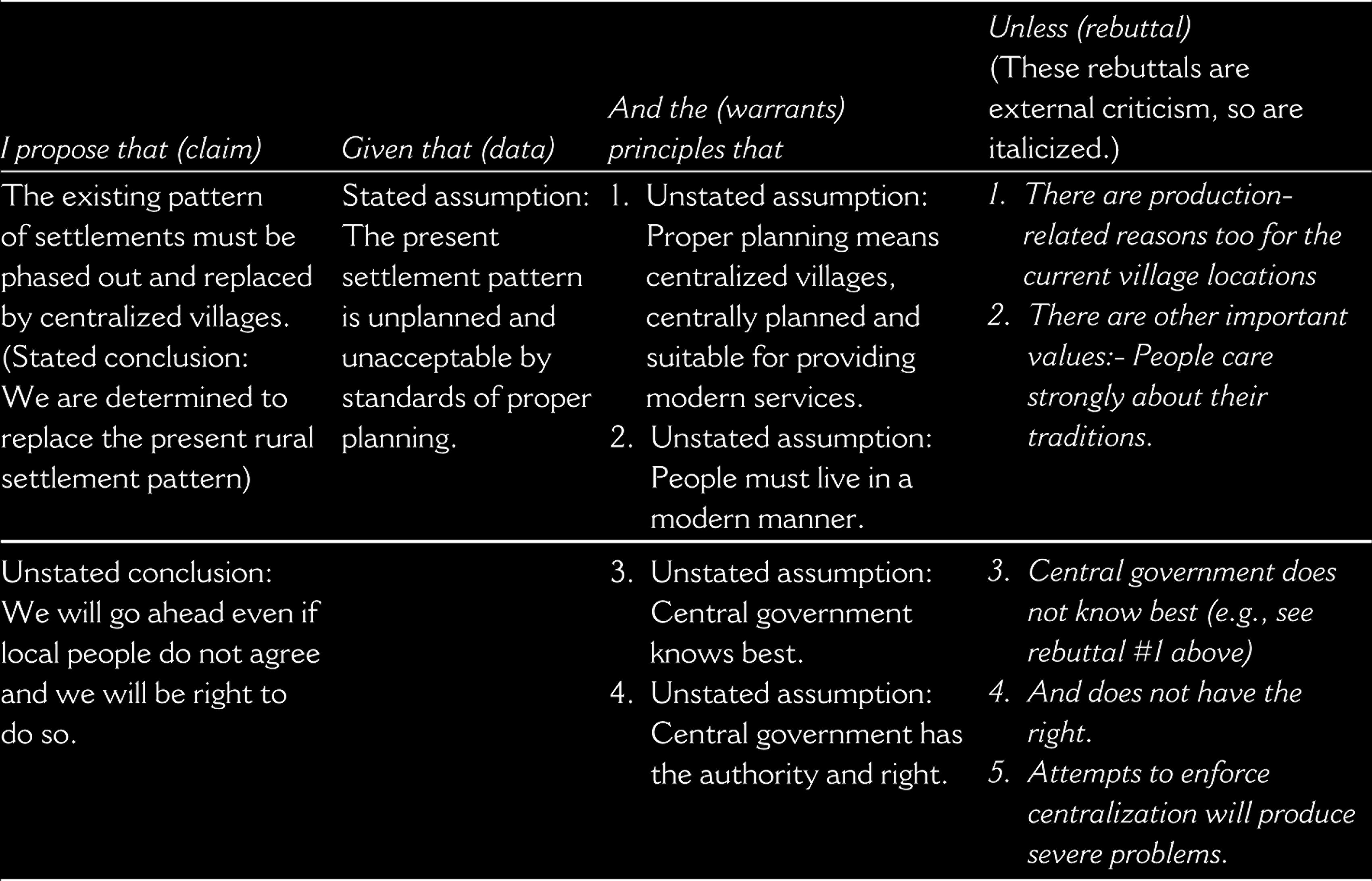
From the text-analysis table, the first claim is that people should move into centralized villages. The second, tacit but emphatic, is that government will rightly enforce this even if people disagree. Each of these claims is anatomized in a separate row in the synthesis table, unlike in attempts to squeeze everything into a single diagram. The first row’s claim is supported by the stated data and warrants 1 and 2. However it is potentially vulnerable to attacks on (a) the data and the warrants, and in addition to attacks on (b) the inference. Rebuttals 1 and 2 illustrate how a claim may not be sufficiently supported by the data and warrants even if those are valid and relevant. Those rebuttals note additional factors not covered by the text’s arguments but surfaced by this sort of investigation, using what we could call a ‘What Has Been Left Out? Tool’. Similarly, for the second claim, while some counterarguments concern the proposed warrants, rebuttal 5 like rebuttal 1 concerns factors not thought of in the Minister’s text.
Scriven’s framework, extended into these two worktables, is a gateway to interpretive and discourse analysis for students. It uses a ‘microscope’, giving close attention to details and meanings. The text-analysis table supports exploration of word choice, tropes, rhetoric, ‘voices’, categories, etc. This systematic probing of meanings then gives a more reliable basis for thinking about logic; and, in turn, that attention to interconnections deepens the discussion of meanings. The framework also uses a ‘telescope’: it explores structures (stages 3–4), the roles and linkages across a text and across textual and societal contexts. Use of a synthesis table for stages 3–6 strengthens dialectical awareness of counterarguments and the multiple voices in social contexts.
Both tables help in ‘making strange’, changing how we view materials, in order to see afresh. Such investigation typically reveals considerably more than one finds by ordinary reading. Analysis formats make one go slowly, combining keeping a mental distance from a text, to get beyond one’s preconceptions and become more likely to find the unexpected, with yet getting close to the text, not ignoring parts, and instead thinking about subtler connotations and resonances. This combination of mental distance and close involvement is essential.
Such an approach is not focused only on ‘logic’, but also its attention to logic gives it a way of thinking structurally and systematically. It helps to bring out possible ambiguities, tensions, inconsistencies and multiple messages in a text, and to think about debates and disagreements within society. There are dangers of over-interpretation, and hence needs for nuance, qualification and careful representation of these ambiguities and tensions. One can explicitly distinguish between definite implications and assumptions and, on the other hand, the possibles, the suggestions and hints. Scriven advocates use too of a principle of charity in interpretation, as both tactically wiser and intellectually more productive. Drawing instead a weak version of a position gives something much easier to deny—‘But of course we did not mean that’—even if it were an accurate description originally; whereas formulating and assessing a stronger version identifies a position’s potential, which is also where it is likely to evolve towards under pressure of debate. This section’s approach trains in giving sharp and close attention, reflecting on both surface meanings and underlying meanings and values, and finding connections and inconsistencies. As those skills become stronger, the need to use the table formats explicitly becomes less. Further, while sometimes they are feasible and very helpful for explicit use in investigation, on key materials and for generating questions and hypotheses for further work, sometimes they are not feasible and/or not necessary. There are limits to the stretches of text which can be investigated in comprehensive detail. We often need more macroscopic, less microscopic, methods. Some powerful ones are available, as illustrated in Section 5.
Content Analyses for Frame Analysis
Content analysis of word choices and topic choices is a helpful way to explore intellectual frames, including through identifying patterns of nomination and predication. Frames are idea patterns, structured systems of presences and absences, of various sorts and levels. Nomination means how a speaker or writer organizes experience and thinking through using a system of concepts and categories, which are given particular names. Analysing this involves probing the choices that underlie statements of the form, ‘This situation contains A, B and C’. Predication means attribution of sets of characteristics to these proposed elements: ‘A is p, q, r; B is s, t, u; C is v, w, x’. We want to identify the set of concepts, categories and characterizations that a speaker or writer employs (sometimes we can call it a ‘cast of characters’), and the issues that they address or imply and those that they ignore. Let us consider two examples of doing this, in ways directly accessible for students: one explores especially choice of vocabulary, the other (available online as supplementary material) examines topic choices.
Comparing Vocabularies—Climate Change in Global Development Reports
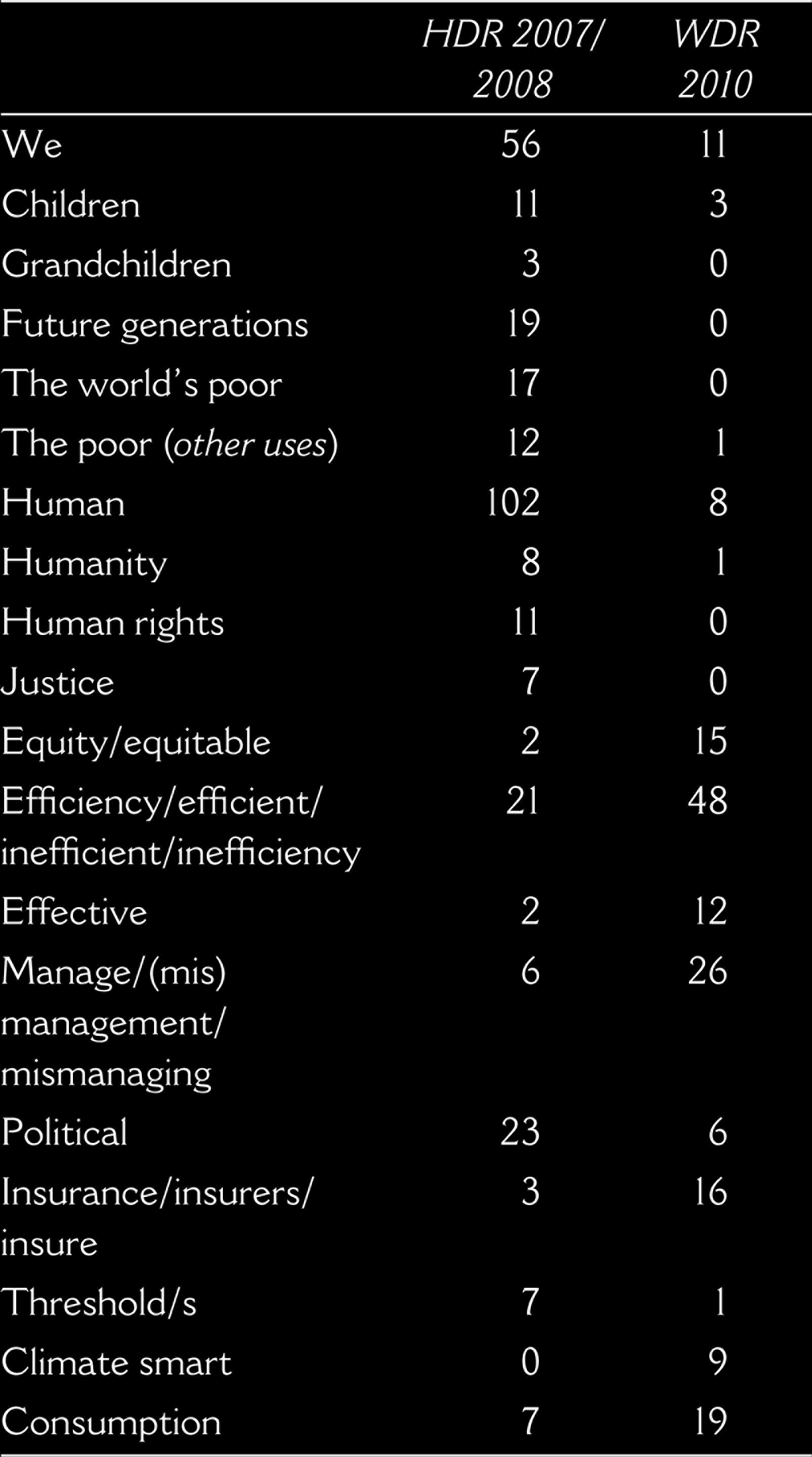
Two studies by Gasper, Portocarrero and St. Clair examined a series of flagship global development reports that dealt with climate change and its implications (Gasper et al., 2013a, 2013b). The first study compared the United Nations’ Human Development Report (HDR) 2007/2008 (UNDP, 2007) and the World Bank’s World Development Report (WDR) 2010 (World Bank, 2010), both of which were written in relation to the fateful unsuccessful 2009 world climate summit in Copenhagen. The article identified and compared the topics that the reports covered, how they discussed them, and the language that each employed. Word count analysis revealed many surprisingly sharp and partly unforeseen contrasts. It proved useful for identifying lines for further exploration, and for capturing audience attention and encouraging people to enter more complex discussions of how the various topics were treated.
Table 5 shows word counts for key terms in the two reports’ almost equal length executive summaries, which are major self-contained documents of around 11,000 words (excluding references). We see that the HDR summary made much reference to impacts on human rights, poor people, future generations, and ‘we’. The WDR summary gave little or even zero mention to those themes, even though they might seem obvious and necessary for a report on the challenges of climate change written by an intergovernmental organization with virtually universal membership. It talked instead in terms of management, efficiency, consumption, insurance and ‘climate-smart’ solutions.
Vocabularies of the Overview Chapters in HDR 2007/2008 and WDR 2010
Vocabularies of the Overview Chapters in HDR 2007/2008 and WDR 2010
Word counting reflects the theory that vocabulary choices are indeed choices and may be pointers toward mental frames. Comparisons are important though to help us interpret counts. While word counts on their own are insufficient, they form a good starting point: they often provide unexpected findings and suggest lines for inquiry; and they give a sharper impression than can unquantified commentary, so helping to gain the interest and credence of many in the audience. 6 Moretti and Pestre’s (2015) widely cited study of ‘Bankspeak’, the changing language of the World Bank, relies similarly on quantified content analysis, but as an example of ‘corpus linguistics’ work on word usage in large bodies of literature across extended periods of time. They found major linguistic shifts over time that vividly demonstrate the changing roles and ideology of the Bank. Modern computer capacities and programmes make such studies possible. Non-specialist users too can now easily run simpler word count studies of any digitalized text.
Sometimes digitalized texts are not available or different sorts of questions need to be asked. Here topic-choice analysis, rather than lexical-choice (word choice) analysis, can be feasible and helpful. This is explored in the online supplementary material (based on Gasper, 2018), a comparison of the topics considered by a set of recent authors who offer visions of India’s present and future.
Linking with Further Methods
The methods presented, for text and argumentation analysis and for content analysis of vocabulary and topic choice, give a ‘defamiliarizing’ introduction to empirical exploratory discourse analysis. Ruth Wodak’s formulation of critical discourse analysis highlights five fundamental strands in discourse: (a) nomination; (b) predication; (c) argumentation, each of which we have mentioned; (d) perspectivization (aspects of framing, defined as ‘positioning [the] speaker’s or writer’s point of view…’, Wodak, 2015: Table 1), as we saw for example in relation to Minister Marere’s statement; and (e) mitigation/intensification, the modulation of a position. Text-analysis tables provide a base for thinking carefully about each of these, and word-choice analysis and topic-choice analysis can similarly help for several of them. Having established such a base, of ‘defamiliarized’ close empirical attention, students are ready to use further methods. These can include: category and labelling analysis, for exploration of choices made in nomination and predication, the subdividing and characterizing of social realities (e.g., Moncrieffe and Eyben, 2007; Yanow, 2003); investigation of how metaphors construct mental frames, tacit systems of reference and imagination (e.g., Kornprobst, 2008; Schmitt, 2005; Stillwaggon, 2003); narrative analysis, for exploring how a story of the past and/or future is constructed in terms of a proffered cast of characters (e.g., Anderson, 1983; Wodak et al., 2009) and rhetoric analysis of how such strands are interwoven to construct, project, and ‘sell’ an overall interpretation (e.g., Gill and Whedbee, 1997; McCloskey, 1994; Perelman, 1982).
I have suggested that an appropriate entry path for most development studies students, for going beyond deconstruction of ‘buzzwords and fuzzwords’ or detection of dichotomies, is through content analysis (of word-choice and topic-choice) and especially text-and-argumentation analysis. In addition, metaphor analysis combines good accessibility with often sharp unexpected insights. These methods help one to empirically explore mental systems and identify surprises and particularities, beyond only discerning what one already expects or has been told to expect. Their open exploratory character encourages independent thinking rather than repetition of acquired notions about some ‘basic discourses’ and ‘development narratives’ (e.g., perhaps ‘neo-liberalism’) or just listing rhetorical devices. Use of, for example, the popular WPR approach (‘What is the Problem Represented to Be?’; Bacchi, 2009), becomes more effective by drawing on semantic and argumentation analyses for addressing several of its questions (1, 2 and 4; including for thinking about the unstated, the silences and alternatives) rather than relying on guesswork or repeating stock labels. Growing out of student group work, Mukhtarov et al. (2021) illustrate an investigation procedure that, starting with exploration of a policy context, then undertakes content, text-and-argumentation and metaphor analyses of an influential document, to explore its foci and assumptions, leading thereby to a grounded WPR frame-analysis and overall assessment.
The basis for these suggestions is two decades of use of these methods in teaching, in general research methods courses, dedicated discourse analysis courses, and policy analysis courses, as well as in various short course and summer-school formats (see: note 4; ISS, 2006–2021; Gasper, 2019). The main use of the techniques has been at postgraduate level, but they have also been used with later stage undergraduates. That they are workable and useful also at undergraduate level is unsurprising, for related methods are familiar in various undergraduate texts on research methods, critical thinking, communication studies, etc. (e.g., Booth et al., 2003, [1995–2016 editions]). The formulation in this article diverges substantially though from Booth et al., in ways explained earlier. In postgraduate studies, I have found no great net difference between introducing such techniques in term 1 or term 2 or term 3, year 1 or year 2. As with most techniques, there are many further ‘user manual’ type issues that arise in detailed application, for example on how to strategically use detailed micro-analysis when tackling larger texts; other papers provide further explication and illustration. 7
Conclusion: Helping ‘Make Strange’ What Really Should be Strange but Sadly Is ‘Normal’
The goal of this article has been to present and illustrate (in Sections 4–6) some methods of discourse analysis readily usable for teaching in development studies, after motivating the need for them (in Sections 2 and 3). The theme of critical discourse analysis is that systems of social exclusion and injustice are embodied in systems of language and must be contested partly through the systematic examination of language. A discourse gives a mental world; people can live within it and need special tools to question it. Even in mainstream development studies it has seemed to be taken for granted, for example, that climate change reports will talk about possible impacts on GDP but need not use the criteria of human rights nor discuss, for example, impacts on the mortality of small children, the most vulnerable group (Fløttum et al., 2016; Gasper and Rocca, 2020). Our task includes making such habits and routines seem strange. Critical reading and value-sensitive discourse analysis are central in this. They have become especially relevant in an era of massified marketized higher education.
Discourse analysis has sometimes acquired a negative reputation in development studies though, seen as too difficult, and/or as preoccupied with generalized ‘discourse theory’ rather than case realities, or only engaged in criticism and not also construction, and/or as based only on finding confirmatory instances for an interpretation rather than on comprehensive coverage. Sociolinguists often warn social scientists about casual use of textual material (the ‘Look at this quotation which illustrates my conclusion’ syndrome): failing to analyse all of a text, systematically, leading then to over-simple and often seriously misleading interpretations. Wodak warns
Usually in the social sciences, text sequences are used as illustrations, sentences are taken out of context, and specific text sequences are used to validate or reject claims without relating them to the entire textual material and without providing any explicit justification or external evidence for their selection. (Wodak, 2008: 1)
Such dangers are perhaps especially great in development studies, where the moral and political urgency of issues can sometimes lead to hasty and rigid position-taking. All these objections can be answered. Serious content analysis—including investigation of word counts and identification of the topics and attention given across a whole text, as illustrated here in Section 5—avoids Wodak’s criticism; as does close text analysis of unexpurgated texts, as introduced in Section 4.
Sociolinguists worry similarly that proposed identifications of ‘basic discourses’ and ‘interpretative repertoires’ are often too casual and arbitrary, ‘off-the-shelf’, not based in rigorous evidence and testing, and too sweeping, not sufficiently sensitive to the influences of the specific context and the stage of interaction in which a statement is made. Such mechanical analyses reflect an ‘impoverished view of human conduct’ (Wooffitt, 2005: 179), in which people are seen as simple creatures, tightly pre-programmed into a single discourse or able only to choose between a sharply limited number of discourses. The framework presented in Section 4 provides an entry to more flexible discourse analysis that is accessible for students without prior background in philosophy, linguistics or logic. While widely accessible, the framework offers significant gains in understanding even in simpler versions. It gives a purposeful structured family of activities that helps students to see roles for and connections between many component activities in interpretive analysis, such as category analysis, metaphor analysis and frame analysis. It helps to build the skill of combining alert, observant, absorbed micro-analyses with a more distanced and comparative macro-perspective. The skills contribute also to more effective writing and communication.
Together, the extended Scriven approach and some basics of content analysis provide a good entry to, and partner for, more complex approaches, including varieties of critical discourse studies and rhetoric analysis (see, e.g., Wodak and Meyer, 2016; Wodak et al., 2009). Some development studies students become lost if they directly attempt such work. To engage effectively in those endeavours, with the requisite capacity for self-criticism, requires suitable skills and attitudes. The approaches introduced here give a relevant starting point.
Supplemental Material
Supplemental material for this article is available online.
Footnotes
Declaration of Conflicting Interests
The author declared no potential conflicts of interest with respect to the research, authorship and/or publication of this article.
Funding
The author received no financial support for the research, authorship and/or publication of this article.
Notes
References
Supplementary Material
Please find the following supplemental material available below.
For Open Access articles published under a Creative Commons License, all supplemental material carries the same license as the article it is associated with.
For non-Open Access articles published, all supplemental material carries a non-exclusive license, and permission requests for re-use of supplemental material or any part of supplemental material shall be sent directly to the copyright owner as specified in the copyright notice associated with the article.
