




Abstract
The bicycle has been prescribed as an ‘intermediate mode of transport’ intended as a low-cost approach to address mobility inequality and poverty in sub-Saharan Africa. Within this framework, the bicycle is commonly intended to technologically advance head portage for those who cannot access motorized transport. The singular vision of the bicycle as a load-carrying device has sought to encourage industrious activities over alternative practices, such as play, embodied sensory experiences of mobility and conspicuous consumption for identity performance that are important aspects of youth agency. This article alternatively demonstrates the complexity of mobility and consumer behaviour among young Namibians as they negotiate multiple identities embodied in their mobility. In doing so, the article examines the limitations of youth agency expressed in play, mobility and subject formation, given the normative understandings of gender.
Introduction: The bicycle as a means for everyday utilitarian mobility
A South African newspaper, the Daily Maverick, reports cycling ‘is an increasingly fashionable mode of conveyance for a new generation of hip urban youngsters’ (Davis, 2012: n.p.). Youths’ conspicuous use of bicycles for identity performance, however, is rarely referred to among those promoting their use for development interventions. Although sometimes it is acknowledged that bicycles are used for ‘personal’ transport (Kemtsop and Starkey, 2013), for children’s play (Grieco et al., 1994; Porter et al., 2017) and to signify social prestige (Bos et al., 2003), a dominant narrative of the bicycle among development practitioners, funders and researchers, frames its use as an ‘intermediate mode of transport’ (IMT) (I.T. Transport Ltd, 1996; World Bank, 1993). That is, a utilitarian device that offers low-cost mobility improvements over head portage (Bryceson and Howe, 1993; Ellis, 1997; Howe, 1995, 2003; Kipke, 1987; Kwamusi, 2002; Mahapa, 2003; Peters, 2000; Porter et al., 2012; Rwebangira, 2001; Sieber, 1998; Starkey, 2001; Starkey and Hine, 2014; White et al., 2000).
Concerned that local governments would reject IMT, perceived as ‘a step backward to the days of bicycles’, the World Bank suggested that emphasizing IMT as the ‘missing middle’ of African transportation systems would help to overcome resistance (1993: Box A7:12, p. 213). The bicycle’s utility is subsequently imagined to overcome a ‘vacuum’ of public transport in sub-Saharan Africa (SSA) helping to mitigate uneven access to health services, education and employment (Brussel and Zuidgeest, 2012; Pochet and Cusset, 1999; Porter, 2007; Porter et al., 2012; Sietchiping et al., 2012). As part of IMT interventions, bicycles are considered to be relevant for small-scale utilitarian load-carrying, such as ‘trading in crops, beer, and other goods’ (Howe, 1995: 25), or, for reducing the burden of long-distance education trips and portage of water, fuel and food for youth (Porter et al., 2017). One such intervention is the Shova Kalula project in South Africa, which has distributed just under one million bicycles since 2001 1 (RSATD, 2014).
The narrative about the intermediate nature of the bicycle is not entirely inaccurate since the mobility aspirations of young adults are often centred towards owning and using motorized vehicles (Porter et al., 2017). A lack of provision for cycling infrastructure also signifies the bicycle’s intermediate disposition as governments have oriented transport planning towards automobility (Bos et al. 2003; Leinbach, 1995; Sietchiping et al., 2012; Vasconcellos, 2001). However, international funding actors have been significant in steering the way in which bicycles have been utilized for development interventions in SSA and subsequently limit the development subjectivities associated with them (Baker, 2018).
Aware of the bicycle’s lowly status among those aspiring for progress, the ‘intermediate’ characterization of cycling initiated by the World Bank, embeds the bicycle’s utility as an appropriate transport solution primarily for the rural poor. For example, the bicycle is grouped with other non-motorized devices used for load-carrying including hand carts, wheelbarrows and animal-drawn carts (see Bryceson and Howe, 1993). It would be used for agrarian work, household tasks, education and health trips, reducing the costly inefficiencies of moving and load-carrying by foot. The impact of these narratives is that the bicycle’s appeal to youth for identity creation, status signalling, play and recreation, has not been given as much attention as it deserves.
This article contributes to existing development literature by empirically recognizing the additional value of cycling for youths and young adults in diverse contexts of Namibia as they embody trendy and urbane identities, and incorporate play and recreation into their everyday mobility. The bicycle affords agency for young people to resist the utilitarian and familial expectations of an older generation and to instead perform, from their perspective, a positive identity that disassociates them from structured poverty. Young people purposively detach themselves from the load-carrying functions of the bicycle—necessary also in the urban realm—but most commonly affixed to the demands of rural life, agricultural underdevelopment and in Namibia, the colonial apartheid regime. The article, therefore, highlights the need for a more nuanced understanding of how mobilities interact with youth agency and conspicuous consumption as young people strive to overcome structured deprivation. This is particularly necessary because of how disparate youth agency is while mobility and play are structured by adult requirements to perform normalized gender roles.
Review of conceptual literature
Embodied and playful mobilities
Mainstream transport planning techniques referred to as ‘predict-and-provide’ (Owens, 1995) are largely based on a measurement of utility within economic theory that predicts a subject’s future choice of transport mode based on how much utility they will gain from one mode over another. The technical–rational approach, adopted throughout the world, has paid little attention to diverse representations of mobility, or how mobility is embodied and practised (Cresswell, 2010). Uteng and Lucas (2018) have recently called for more empirical evidence of diverse mobilities of the Global South that go beyond the historically normative techno-rational approach to transportation planning. This is particularly necessary in the case of young people’s mobility in SSA as children and young adults have largely been marginalized from mobility development (Porter et al., 2017).
Mobilities scholars have made headway in understanding the politics and issues of justice in the movement of people, objects, goods, practice, policy, culture and knowledge, related to wider arenas of power (see for example Adey et al., 2014; Cresswell, 2010; Sheller, 2018; Sheller and Urry, 2006). Examining the concept of embodiment in mobilities allows us to see how mobilities are ‘felt by a much more rich and differentiated bodily register than the dominating view of the instrumental rationality governing much transportation’ (Jensen, 2013: 112). The approach allows us to consider how people interact with objects through movement in meaningful ways, relating to play, resistance, belonging, empowerment or—on the other hand—experiencing oppression of their movement and, thus, autonomy.
Morhayim (2018) and Castañeda (2020) discuss the freedom and right to the city afforded by the bicycle, which provides a range of sensory and playful experiences, thus opening the discriminatory boundaries of neighbourhoods and providing an alternative means of expression. Playfulness is positioned by Vannini (2011) as a deviation from one’s usual work and social paths that suggest a freer ‘wayfaring’ style of movement. Vannini draws on an example of playing with the structured format of ferry timetables whereby travellers challenge themselves to make it to and from a destination in one day, while bounded by the strict timing of ferry crossings. Playful mobilities are spontaneous disengagements used to resist ‘a distant, inimical social world that in one way or another seems to exert a uniform pull across individual lives’ (ibid: 358).
Play has an important place in youth mobilities offering opportunities for resistance and the ‘spirited mischief and irreverence’ entailed within their agency (Jeffrey, 2012: 250). Grieco et al. (1994: 3) describe the ‘freedom of mobility provided by bicycles’ to young males in Ghana, an independence that stirs feelings of superiority over friends. In one area of the study, parents restrict children’s use of bicycles based on local negative perceptions towards cycling and its apparent affiliation with deviant behaviour. The authors suggest the pleasure and thrill of cycling in this area is derived from the ‘flouting of authority’ (p. 3) in response to a culture that ‘militates against youth viewing cycling instrumentally, that is, as a major means of transport as opposed to a mode of leisure’ (p. 5). Porter et al. (2017: 127) suggest that play, often initiated on the move, ‘occupies a specific place in children’s efforts to counteract the power and control of adults over their lives’.
While playful and embodied elements of mobility make important contributions to the agency of youths in SSA, they cannot be entirely separated from utilitarian mobilities. Studies of children’s mobility and play in low- and middle-income countries refer to the opportunity for play afforded by school and household work trips as youth utilize the little time they have away from the structures of their everyday lives controlled by parents and teachers (Katz, 2012; Porter et al. 2017; Punch, 2000). Seeking opportunities to merge play and work is necessary for girls as their play is minimized in order for them to undertake reproductive roles within the household (Grieco et al., 1994; Porter et al., 2017). By considering joyous experiences within everyday mobilities, play becomes a practice that threads through utilitarian mobility rather than occurring separately from it (Jensen, 2013; Stevens, 2007). For example, children, having secured an elders’ bicycle for an errand, often steal a moment for play (Grieco et al. 1994).
Mobilities scholarship creates an opportunity to consider additional experiences of mobility for young people beyond the utilitarian narratives that have been applied to IMT. However, the more ludic, sensual, and cosmopolitan elements of children and young adults’ mobilities in developing societies are largely under-represented (Benwell, 2009; Punch, 2003). The utilitarian discourse of cycling mobilities in SSA largely caters to adults even when referring to youth mobilities. It overlooks the significance of children to combine play and identity performativity with household work and education. Examining how mobilities are constructed and embodied can address prevailing concepts and seek more nuanced understandings of youth identity and agency in developing countries.
Consuming desirable objects to create and signal identity
The homo economicus figure of classical economic theory is assumed to be directed towards objects that satisfy a need, making consumer decisions based only on maximizing utility (Baudrillard, 1988). Just as the technical– rational approach to understanding travel behaviour loses sight of alternative embodied and ludic meanings associated with mobility, Baudrillard’s theory of consumption loses the myriad and contradictory relationships that people build with objects and is, thus, inadequate in understanding consumer behaviour (Sassatelli, 2007).
The concept of conspicuous consumption initiated by economist Veblen (1899) offers an alternative perspective. Veblen recognized that obtaining goods of a higher stratum publicly indicates a person’s rank. Those belonging to the upper tiers of society are under pressure to set themselves apart from lower classes who are equally anxious to perform a status that signals their movement towards a more affluent social group (ibid). Through conspicuous consumption people identify with and/or differentiate themselves from others. Veblen’s concept has been used to examine distinct patterns of consumption structured by social identities, such as race in South Africa (Kaus, 2013) and the United States (Lamont and Molnár, 2001), and social class in three African countries (Wijnen, 2017). These studies contend that the consumption of goods may be used to overcome race and class distinctions by sharing collective identities that reflect membership to the social classes most valued in society and demonstrate a positive image to those within or outside of their social group.
Regarding youth consumption practices, Farrugia (2016: 843) demonstrates that consumer goods are used to construct subjectivities in order to ‘locate themselves within a metropolitan existence imagined as exciting and glamorous’, particularly for those situated in rural places. Young people consume objects that symbolize a distinction between the countryside and the city, privileging the latter for its perceived progression (ibid). Farrugia suggests youth subjectivities operate in ‘hierarchies of prestige and cool that position youthfulness as an urban subjectivity and associate rurality with either rusticity or a romanticised idyll’ (ibid: 844). In short, the need for cohesion and differentiation from other people influences consumption (Veblen, 1899). This need occurs differently across social groups depending on class, race, ethnicity, contextual specificity and the desire to overcome collective experiences of deprivation relative to other social groups, places and histories.
This article offers a contribution by paying attention to the importance of consumer behaviour in forming and signalling identity for young subjects as they seek to distance themselves from past subjectivities and current oppressive structures of power. It shows how youths and young adults in contexts of development are sensitive to global and urban fashions and embrace behaviour and consumption that diverges from that which is purely utilitarian and calculative, and is instead, performed as part of their everyday mobility while simultaneously negotiating cultures and intergenerational relationships that structure their mobility practices.
Research method
Study site selection and background
The field study was carried out in Namibia for three reasons. First, the country hosts a substantial number of development initiatives that have set up retail shops selling second-hand bicycles run from shipping containers. These shops are part of an entrepreneur–philanthropy network that consists of local and international NGOs exporting and importing second-hand bicycles to SSA. This enabled the research to examine how young people have engaged with cycling interventions. Second, Namibia has a relatively recent and small uptake of bicycles as compared to other SSA countries including Uganda, Ghana, Malawi and Tanzania (Porter, 2002, 2007; Porter et al., 2017). Single-gear bikes originating from Europe and later from China and India via South Africa were purchased by White farmers to provide transport for Black farm labourers. Similar use of bicycles occurred under the apartheid regime in South Africa, which may have had resulted in lower use of bicycles and a limited cycling culture in contrast to SSA countries outside of Southern Africa (Starkey, 2016). It is reasonable to assume the apartheid regime has similarly affected the bicycle’s uptake in Namibia. This negative cultural perception of cycling has been compounded by unpopular regulations, such as mandatory helmet use and the lack of safe, appropriate, cycling infrastructure. However, the recent influence of second-hand mountain bicycles imported through international philanthropy networks and migrant Chinese retailers offers a new cycling culture that appeals to young Namibians and which has allowed them to push aside the apartheid legacy that was attached to cycling. Third, little research is published on mobility interventions in Namibia.
Research was carried out foremostly in three sites within the northern Kavango region of Namibia situated near the border with Angola; Rundu town, Mile 10 village and Bunya village. The region is selected because it is a particularly economically deprived area of Namibia. Its deprivation is the result of colonial and apartheid regimes that concentrated wealth along the nation’s early transportation network that links the capital city, the port of Walvis Bay and Lüderitz, stretching north as far as Oshakati, but not to Kavango in the east. Rundu, the main urban site of Kavango, is not connected by road to Angola and, thus, cross-border trade is limited to small-scale ferry services. The northern belt of Namibia also hosts a substantial number of local partner shops selling second-hand bicycles initiated by the NGO Bicycle Empowerment Network Namibia. In addition, four interviews were undertaken in Windhoek city, including: one retail initiative; one youth and adult cycle training and access initiative in the Katutura township of Windhoek, and two members of a cycling advocacy group located in Windhoek, one of which runs a youth BMX cycling initiative.
The development plan for transportation in Namibia is aligned with economic development, modernization and connectivity to a global, neoliberal, trade network (Government of Namibia, 2017). Indicators of mobility are measured in terms of kilometres of road, the capacity of Namibia’s port and rail network and access to information and communication technologies (ibid). In terms of access to education, Namibia’s development strategy is to continue to build hostels at remote schools in order to increase boarding facilities and thus education attainment, rather than the implementation of affordable public transportation (ibid). One local bus company serves the communities researched offering one service to and from Rundu town per day, although many travellers prefer to pay to hitch-hike in saloon cars that shuttle between towns offering a quicker and more frequent service. Unlike various other African countries, motorcycles and motorcycle taxi services are not popular, although legal, in Namibia as in South Africa (Starkey, 2016).
Data collection and analysis
Semi-structured interviews were undertaken with 48 Namibians recruited using purposive sampling from low-income households (based on visual assessment of household assets); 26 aged 18–35 years and 22 aged above 35 years and evenly split according to gender (male/female) as shown in Table 1. Interviews included map-making to sketch participants’ mobility patterns and a photo elicitation exercise during which participants were asked to comment on and thematically group images of various transportation modes. Ethnographic observations were undertaken at the three research sites over three months during which time I was living at two of the field sites (four weeks in Bunya and eight weeks in Rundu) and using a range of transport modes: walking, cycling, shared motorized taxi services and public buses. In both villages, consent was sought from the village head to undertake interview and ethnographic research. Both users and non-users of bicycles were interviewed. Approximately half of the male participants interviewed cycle daily. The majority of women interviewed were non-bicycle users; some shared their own past experiences and others shared collective knowledge of peer experiences. Very few females cycle in Kavango region and only one female participant (18–35 years) had continued to cycle into her adulthood.
Study site participant sample categorized by gender and age
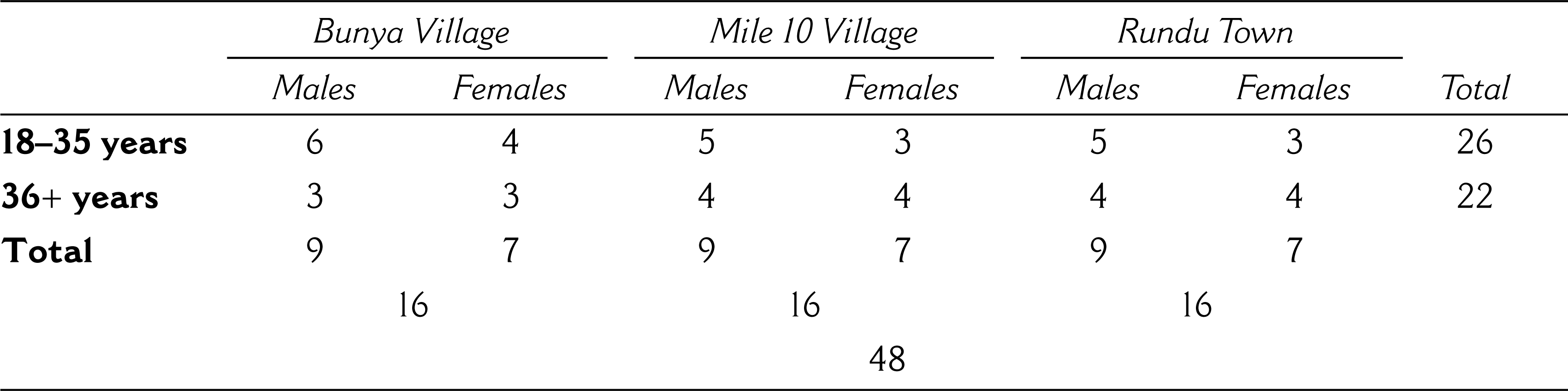
Study site participant sample categorized by gender and age
This article is the outcome of a larger study that explored the social and technical meanings inscribed to second-hand and bespoke bicycles as they are exported by NGOs for humanitarian interventions in SSA. This included 10 in-depth interviews with international NGOs and 10 interviews with staff of Namibian second-hand bicycle retail outlets (shop managers and repair mechanics) involved in exporting/importing and selling used bicycles with the objective of providing an affordable mobility solution (Baker, 2019).
A limitation of the method is that children were not interviewed because the wider research project’s initial study objectives were to examine adult use of bicycles and adult mobility more generally. The research method was assessed by a research ethics committee based on its approach to involving adult participants. The analysis is based on data collected from participants over the age of 18 years referring to children’s mobility, which means that the voices of children are not directly incorporated into the research. There is one reference to children being observed using a bicycle as part of their play. This observation occurred casually while attending to interview work and in passing while living in the communities, for which permission was granted by village heads. The research was not an ethnography involving purposive observations of child subjects. Consent was given by subjects framed for all photographic images taken and participants were aware that images would later be published in research articles, reports and presentations. In the results sections that follow, ‘young adults’ refers to those aged 18–35 years and ‘children’ will refer to those under the age of 18 years.
The data gathered from interviews and ethnography were analysed thematically and deductively as relevant to the literature and theory described. Themes were identified in alignment with the research objectives: to understand the mobility, consumption patterns and agency of low-income Namibians and to offer critique of mobility solutions constructed for development subjects by international development organizations and funders.
Play and agency
While I spent time moving through and in the field sties -either for interview research, or other purposes while living in Bunya village and Rundu town - I could see that children were playing with bicycles, including those that have no further use to their owners, and with discarded parts, such as wheel rims (Figure 1).
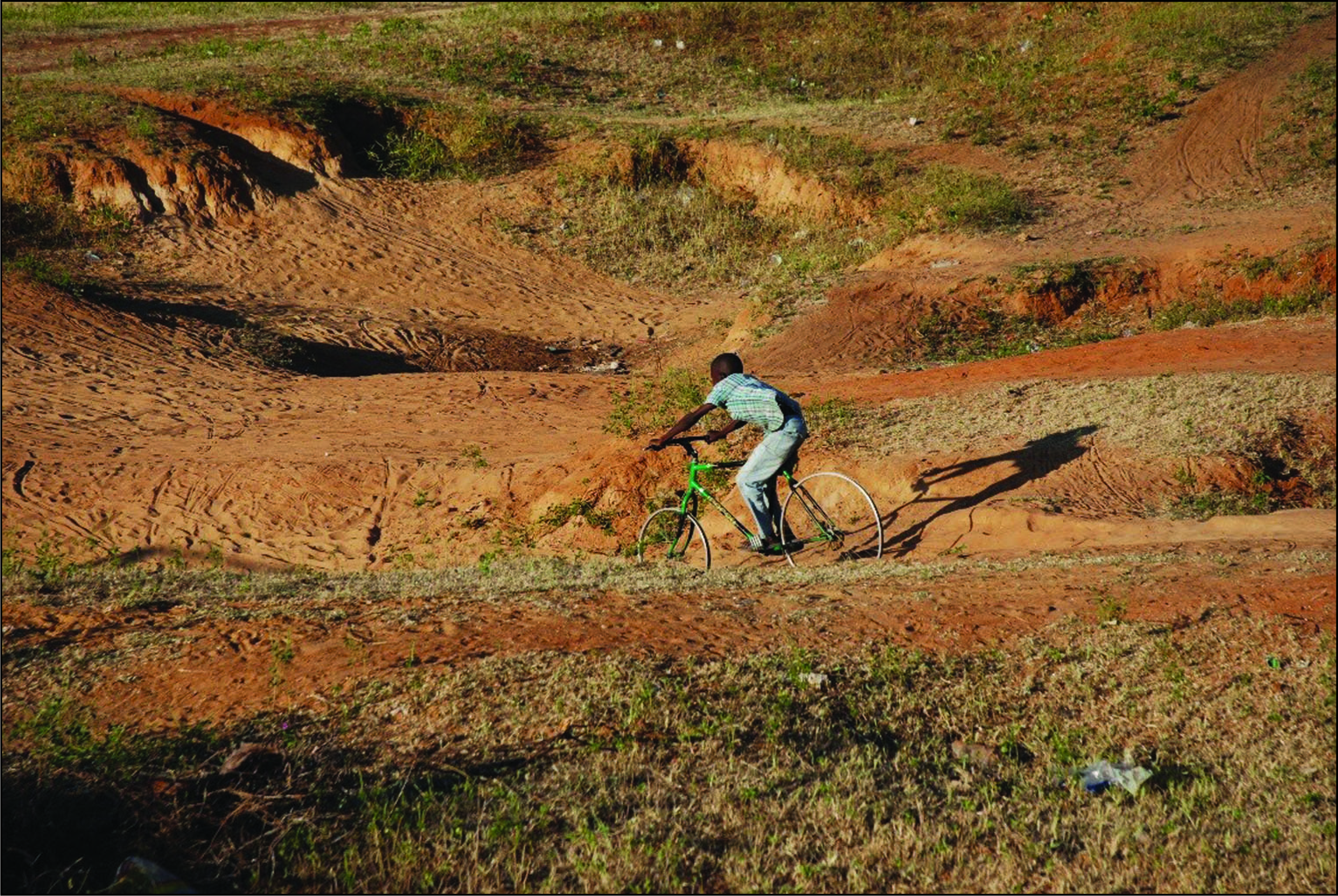
The bicycle used by this child has no gears, chain, or tyres and has odd-sized wheels put together by the second-hand bicycle shop at Mile 10. Still the child is pushing it up to a hill to ride down, over and over again, for no purpose other than to enjoy the bicycle’s movement. The child is not cycling on the usual surface materials and topography, such as level asphalt, that relationally act to stage productive mobilities (Jensen, 2013; Stevens, 2007). Rather, the eroded surface affords an opportunity for play in situ with the reconstructed bicycle. The use of the bicycle diverges from being a utilitarian transport mode in a creative and expressive way through its new owner’s bodily engagement (Stevens, 2007).
Other young (male) interview participants mentioned using bicycles to reach their local football pitch daily. The games are announced by the sound of a whistle and players quickly travel to join the game. In these instances, the bicycle is a means for boys’ recreational mobility. Girls were not observed playing football and few accounts were given referring to their use of bicycles for recreational trips, partly because their play and recreational activities take place close to home. Some male respondents talked about cycling for exercise and maintaining their health, finding pleasure in doing so; ‘sometimes if I want to exercise I just use it [the bicycle] for that’ (Male, 35 years, Bunya). This account is similar to how Berinstein and Magalhaes (2009: 102) describe play, in Tanzania, to be about ‘getting fit, strengthening the body’ and ‘waking the body up’, as well as having fun. It could be argued that using a bike for exercise is a utilitarian activity, just as play is co-opted for health, well-being and physical benefits (Sheldon and Lyubomirsky, 2009; Stevens, 2007; Sutton-Smith, 1997). However, the example is included here because the participant is enjoying the benefits of exercising using a bike, which goes beyond the utilities proposed as part of IMT interventions.
Playful and utilitarian engagement with bicycles also overlap as children learn skills for future utilitarian engagement with the bicycle through play. For example, a respondent states:
In every street almost, there will always be a bike somewhere in a house and it’s different how kids play [here]. If there’s one bike in a house, there’s at least five friends that will go try riding it. It’s always like that. So people grow knowing how to ride. (Local NGO bike shop employee, female)
Play and work are tightly bound and often indistinguishable as children experiment with social roles and cultural mobile practices (Katz, 2004). Play is shaping the children’s development and this interweaving of play and non-play is indicative of progress to their becoming mobile adults (Sutton-Smith, 1997).
The agency of children to use of bicycles, however, is controlled in a number of ways relating to how their play and mobility are structured. This is particularly the case for girls. After explaining how boys grow up learning to ride playing with their friends’ bicycles, the shop employee suggests:
It’s different with girls, with our traditions, the way we are brought up. Bikes are not very well going with girls. Just boys are pushed up with riding. (Local NGO bike shop employee, female)
Getting access to a bicycle through play with friends in the neighbourhood is an opportunity for children to learn to cycle when household financial constraints limit their personal ownership of a bicycle. However, girls’ play is more limited to the household compound, or as part of other trips for school and chores (Porter et al., 2017). The limitation of girls’ play and mobility is partly shaped by parental fear for their security because of the violence and harassment girls and women experience (ibid). One parent (female 35 years, Bunya) spoke of the threat to her girls of ‘young boys from other villages, especially if drunk’ and in response to the threat ensures her ‘children are around at home just to keep them away from dangerous places’. While mapping out her mobility patterns she flagged places where men drink alcohol as her main concern and suggested the local shebeen (bar) opening hours ought to be reduced. She limits her children’s mobility and only goes out with them after dark in her husband’s company.
Aside from concerns over their safety, girls’ play is also structured by expectations of an older generation for their mobility to be centred around domestic work and reproduction. The gendered structuring of girls’ play limits chances they have to learn to cycle comparatively to male counterparts. For many girls, playing with bicycles is not possible without the intervention of development initiatives or community groups willing to assist girls in accessing bicycles. These organizations provide opportunities for girls to confront the restriction of their playful mobility that arises from the control of parents and guardians, as well as from their fears of sexual harassment. Such initiatives are active in Windhoek, but not in Kavango region.
Children embody their youthfulness as they playfully engage with bicycles, yet while their play is controlled by adults, so too is their use of bicycles and, thus, their mobility. A mother of three children (aged 10, 8 and 14) says:
We brought the bikes for the children to learn to ride and for exercise. But I won’t let the children cycle to school. They will have too much fun with the bikes and not attend [school], or pay attention. (Bunya, 35 years)
It is common for parents in Namibia, as in South Africa (Porter et al., 2017), not to allow children too much agency over their play, limiting it to when it can be more closely supervised in proximity to home. This applies to both boys and girls. By controlling children’s play, their mobility is also limited and walking is reaffirmed as the most appropriate way to reach school.
Furthermore, the possibility for children to use bicycles playfully, or otherwise, is being shaped by the limited retail value of children’s bikes. The model of interventions in Namibia is based on facilitating bicycle access by transporting shipping containers filled with second-hand bicycles from developed countries to be sold in retail outlets in low- and middle-income countries managed as small businesses (for further details see Baker, 2019). One international NGO representative states:
Every container is going to have [only] a certain number of children’s bikes just because they’re easy to pack in the top of the container, in the small spaces, but the value that they have in the country is about half that of an adult bike.
Children’s bicycles are not requested by local retail outlets who must maximize their profits through sales of adult bicycles. Additionally, import duties on bicycles are equal per item regardless of their size. The model creates small business opportunities for retailers who are also trained as mechanics and provide the necessary maintenance infrastructure for the bicycles. However, the distribution of bicycles in this way limits children’s use of them. One NGO interviewee commented:
The space in our containers is quite precious. We want the most utility from each bike and we feel that adult or close to adult bikes are the ones that are going to provide the most utility in Africa.
Simultaneously, most NGO interviewees highlighted the importance of children using bicycles to get to and from school trips, and one states:
Those first bikes where we grab a 6-year-old and teach them to ride a bike, that’s where you really get someone who’s going to take care of the bike in the future and be a bike rider.
However, the participant continued to say ‘we don’t take any space where a big bike would fit, but in the holes, we put the small 16-inch bikes [for ages 5–7 years]’. Two NGOs, alternatively, were gifting bicycles to schoolchildren (both male and female) having raised funds to cover the charities’ expenses. Intervention sustainability is shaping the bicycle’s use predominantly for adults, but so too is impact monitoring and the technical–rational approach to evaluation. As one NGO interviewee states ‘kids playing on bikes … I think that’s a good value, but it’s not an economic gain that you can measure’.
Playful youth mobilities are not valued by the NGOs because they are required to demonstrate economic impact and other quantitative measurements of success to donors (Aveling, 2010; Reith, 2010). Furthermore, consumption of the bicycles is being understood only in terms of purchases being made based on the utility, or return value, of objects. Purchases that do not align with this categorization are considered to be frivolous.
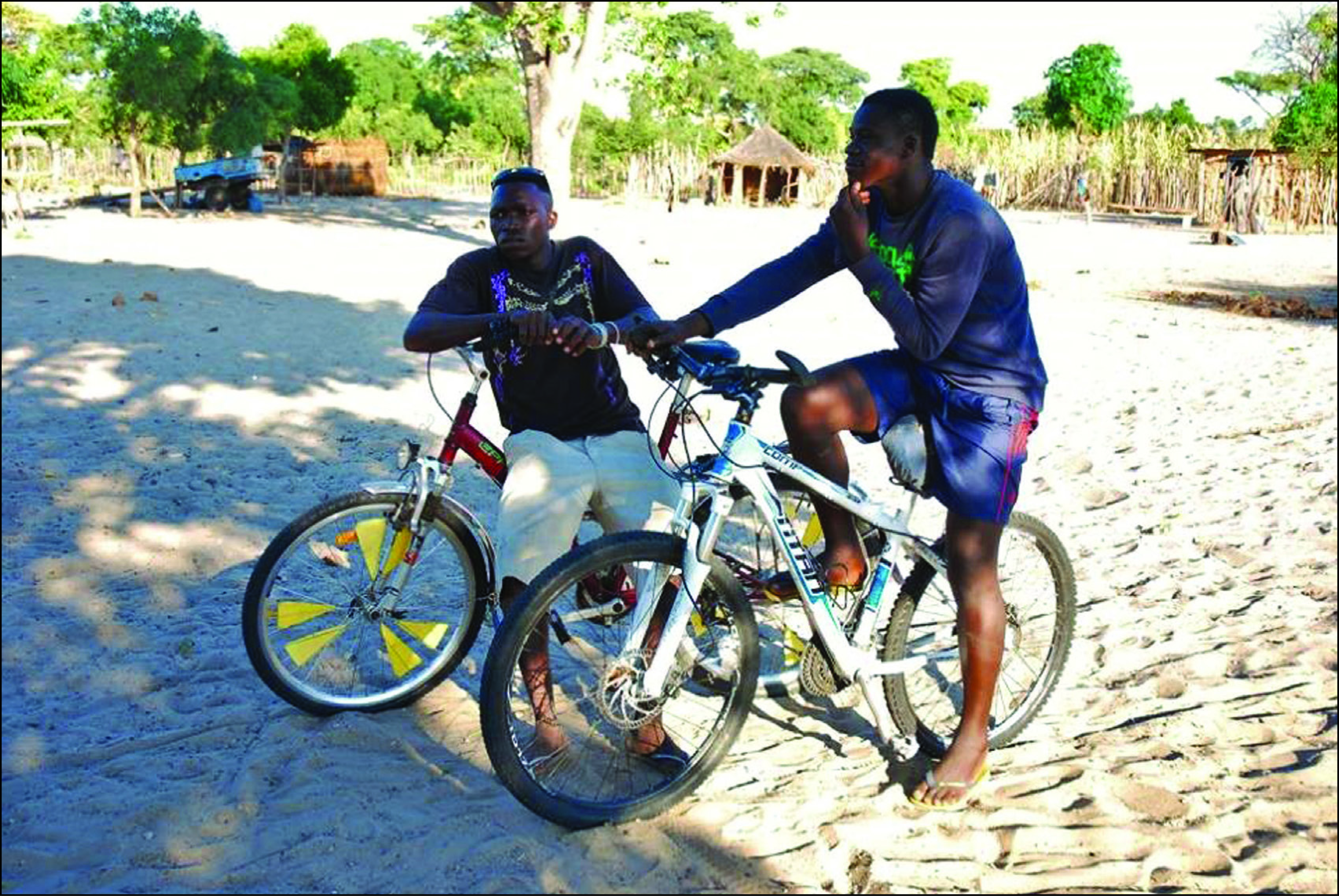
The mobility of young adults is entangled with identity performance and signalling a trendy, cosmopolitan, identity to peers. For example, the image in Figure 2, taken in Mile 10 village, shows two young men who casually pose with their bicycles.
The following interview excerpt describes the performativity young adults can achieve while cycling:
I: Why have young people swapped to the mountain bike? R: … It’s fashion, for example, they might cycle at high speed with no hands on the handle bars, chatting on their cell phone. That’s why they want these modern bikes.’ (Female, 38 years, Mile 10)
Cycling at high speed with no hands may be as much about enjoying the thrill of moving at speed and the skill enjoyed in mastering the balancing act as it is about getting somewhere fast. It could also be interpreted as an embodiment of agency as the rider resists the wider structures intended to shape productive and utilitarian mobilities, by momentarily escaping the day-to-day pressure to act responsibly through proper conduct (Castañeda 2020; Vannini, 2011). Yet, for the 38-year-old observing, this act signals an expression approximate to spectacle made possible through young mens’ conspicuous consumption of a ‘modern’ bicycle.
Older adult participants (aged over 35 years) were generally critical of younger cyclists, stating for example:
In the thoughts of the young ones, it’s all about that feel-good factor …. They are not building up plans. A mountain bicycle cannot even lift a 10kg [sack of maize meal]. (Male, 46 years, Mile 10)
Young adults, particularly young men and teenage boys who are the predominant bicycle users, are judged on their lifestyle, work, family duty and life plans when they choose to use a mountain bicycle. Older adult respondents have constructed two contrasting youth identities recognized in particular uses of the bicycle; the dutiful worker and the irrational player. The latter is discouraged by those who believe that duty is bound in future plans of productivity and domesticity, and who dismiss the value of cycling for pleasure, or a feel-good factor.
Contrary to the arguments of the elder participants, young cyclists do not lack awareness of the utilitarian functions of their bicycles. Young cyclists prefer to buy bikes from a reputable German company located in Rundu, or from the second-hand bike shops because ‘they arrive from the West’ and have a reputation for their strength and durability comparative to those imported by Chinese retailers. Young cyclists demonstrated rational aspects of their mobility through a contemporary discourse of speed, efficiency and comfort, which reflects the changes in bicycle technologies available. For example, gears are useful to work against headwinds in Namibia while riding unsheltered, straight, roads and in sandy environments.
Many young riders are required to carry loads as part of their domestic duties. This conflicts with their desire to perform a cosmopolitan and (to some extent) rebellious identity to their peers. An 18-year-old participant reveals how he must negotiate the competing forces that shape his mobility:
I: What was the purpose of him [your father] buying the bicycle? R: For fetching water. I: Do you use it to fetch water? R: Ya. You put it on the frame then hold the handlebars. I: Did you not buy a bike with a rack on the back? R: I don’t like a rack. I: Why not? R: It looks like another elder’s bike [laughing] I: Even if it’s a mountain bike with a rack on the back? [Respondent laughs] R: It doesn’t look good’ (Male, 18 years, Mile 10)
Young cyclists have devised a way to carry a water container on the top tube of a mountain bike (Figure 3). A second container can also be carried on a light-weight rack fitted to its rear. One young rider was so attentive to project the desired image he removed his rack when not in use.
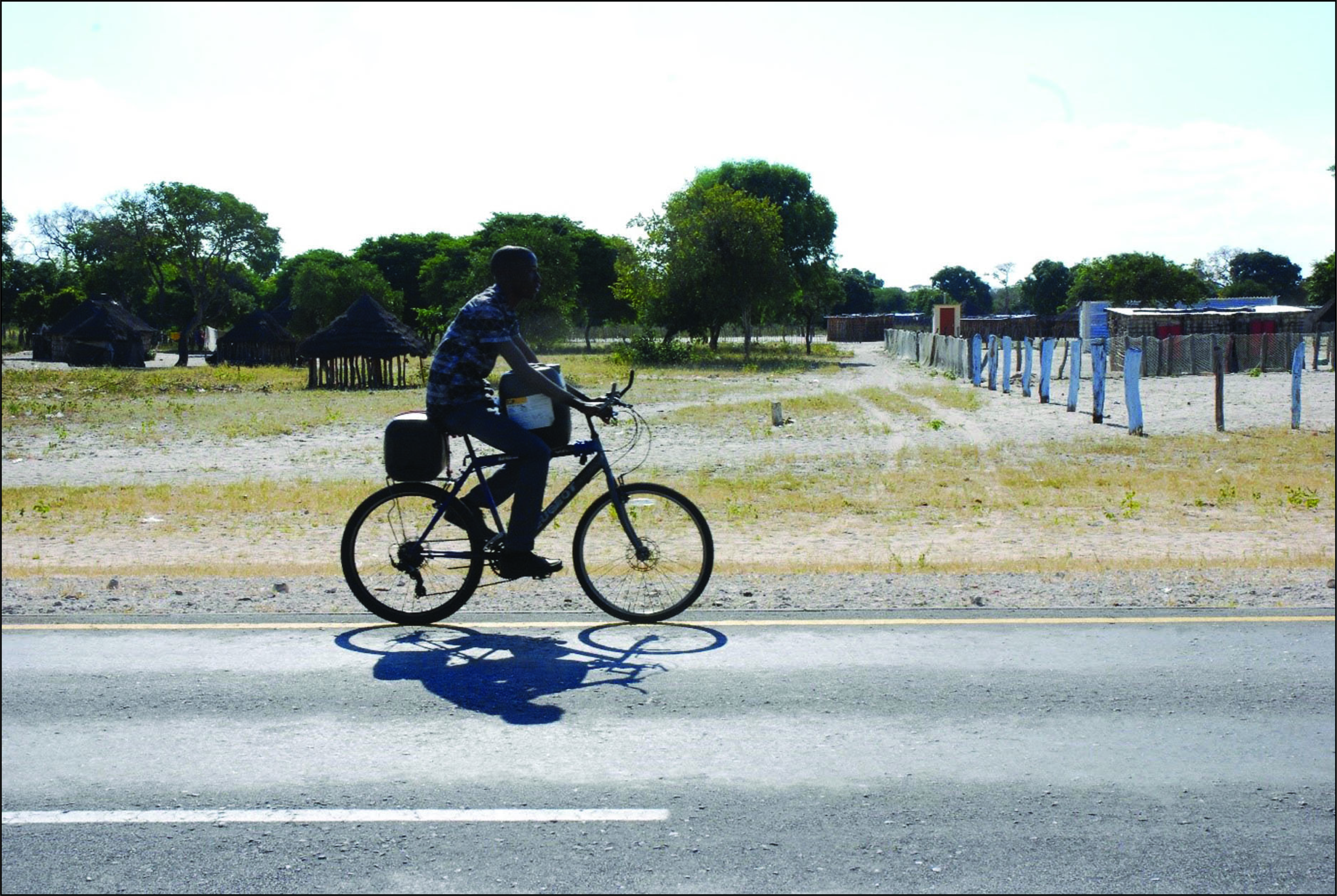
The embodied performance of carrying objects in this way (or rather choosing not to carry objects at all) is an important element of identity signalling for young Namibians. The practice opposes neoclassical theorizing of consumption that reduces people to a homo economicus subject acquiring goods based only on an instrumental decision of what to buy according to the utility of goods (Baudrillard, 1988). The young respondents are concerned with maximizing utility; however, they also desire to associate themselves with global and urban fashions, and modern representations of mobility (Farrugia, 2016).
Their consumption choices, a participant suggests, have been learnt from global fashions:
Fashion is in the world. That’s what everyone is doing in the world. But mostly it’s from the West. It’s also from them watching videos and it’s the bikes ridden in competitions. (Female, 38 years, Mile 10)
Although the young adults interviewed did not have smart phones they had been observing how other youths use mountain bikes in urban areas both locally and further afield in Windhoek where mountain biking is popular among the middle-class for recreation. I observed many households in the townships of Rundu with large televisions despite deprivation evident, for example, in the sheet metal materials used for housing. Consuming visual culture is appealing to youth and young adults and through which they develop awareness of popular material cultures beyond their local surrounds.
This awareness prompts consumer choice among young adults and youth wanting to associate themselves with the material culture they observe. During a photo elicitation exercise, both male and female participants grouped together images of people carrying loads while walking, cycling and using animal-driven transport. They grouped these mobilities according to their association with rural places. The exercise signalled that young adults want to disassociate themselves from mobilities they perceive as ‘backwards’ or a sign of underdevelopment compared with mobilities they have seen of urban and Western (global) culture (for further discussion and figures see Author, 2018). The mountain bicycle is a symbolic object that may be used to translocate young Namibian consumers, connecting them with apparently more progressive, or ‘cool’, people and places (Farrugia, 2016). It is a vehicle that mediates global culture (Lash and Lury, 2007) and enables young subjects to create an identity that is separate from the demands of adults and the poverty in which they are situated.
However, youths must negotiate forces structuring their agency to incorporate the identities they desire into their mobility. Domestic and familial obligations endure in the absence of alternative infrastructure (a household supply of water and gas fuel for cooking). The possibility to negotiate oppressive (adult) societal structures and take up cycling beyond puberty is far less for young women and girls. They commonly stated they would fall, be knocked down by a car, or mocked publicly if they were to cycle. While performing their femininity and laughing at the prospect of riding a bicycle beyond puberty, most of the young women interviewed demonstrate that their mobility embodies wider ‘social and cultural expectations’ to perform learned gender (Porter et al, 2017: 116). This is developed as girls are socialized from a young age, learning to avoid risks encountered through their mobility, such as male sexual violence, harassment, pregnancy, HIV/AIDS and incidents with motor vehicles (ibid). Their mobility is restricted to the household and to walking, which reduces opportunity to gain autonomy as they progress to adulthood. Boys, on the other hand, are given more freedom and encouragement to cycle and to be mobile and they are more confident to resist, or negotiate, demands that compete with their youthful strategies, through using mountain bicycles less suitable to carrying heavy loads.
This article has evidenced the heterogeneous social identities, desires and needs embodied within youthful mobility performances that have relevance to the meanings associated with bicycles and the ways in which they are used in Namibia. A young generation particularly want to use mountain bicycles in order to engage with global, cosmopolitan fashions and representations of modern mobility. While doing this they resist the expectations and demands imposed by adults who believe responsibility is demonstrated by using a more domestic, utilitarian bicycle designed for load carrying. Young Namibians may ultimately prefer to drive a car or motorbike. Without this option, however, the mountain bicycle is an opportunity for youth and young adults to engage with modern and playful mobility performances in a way that develops their agency and goes beyond the utilitarian concept of the bicycle as an ‘intermediate mode of transport’ initiated by the World Bank and development practitioners.
A number of philanthropy projects have encountered challenges while introducing bicycles and their carrying devices, such as cargo bicycles and ambulance stretchers, having not acknowledged the complexity of embodied mobilities that determine cycling behaviour and mobility choice in SSA (Porter, 2014; Salifu, 1994; White et al., 2000). The contribution of this research is, firstly, to demonstrate the relevance of accounting for embodied mobilities and their related conspicuous consumption as part of future transport interventions aimed at young SSA subjects. The development subject can be recognized as both a utilitarian and conspicuous consumer with autonomy to perform the subjectivities they desire in defiance of those desired by elder adults and as part of development initiatives. This could be achieved by empowering young consumers in the design process of interventions, which might better incorporate multiple competing mobility needs and desires in order to move beyond binaries of rational/irrational, economic/ludic and virtuous/frivolous mobilities and consumer behaviour.
The second contribution of the research is to demonstrate how the structuring of children’s play in Namibia is tightly entangled with the structuring of their mobility, and this relationship has not widely been recognized by development practitioners with objectives to empower youths. There are opportunities to address school policy and parenting regarding the use of bicycles for the purpose of attending school, which can enable time for play during trips to and from school, while restricting use of bicycles when children are supposed to be in classes. The structuring of children’s play continues to have implications for girls’ mobility in particular. The fear of gender violence and harassment is significantly reducing the extent to which the girls can be mobile and how they can play. Through play, youth develop skills for their future mobility, as well as their agency that enables them to deviate from wider societal structures and negotiate boundaries and obligations determined by adults: play allows children and youth to carve out opportunities for practices imbued with alternative meanings. The ability to negotiate these boundaries, however, occurs differentially on the basis of gender. This research highlights the need to reduce risk of harassment and sexual violence faced by girls and women in Namibia and other SSA contexts (Amoako-Sakyi, 2017; Memela and Maharaj, 2018; Peters, 2000; Porter et al., 2017; Vanderschuren et al., 2019; Tanzarn, 2017; Uteng, 2012). This may occur through a combination of increased securitization of public space, law enforcement, education and behavioural change campaigns aimed at removing the differentiated risks women and girls experience in their mobility.
The research also reiterates that girls’ play and women’s mobility is structured around gender norms that emphasize their reproductive and domestic roles, reducing their agency comparatively to young men and boys. The results highlight a gender disparity in youth agency that could be addressed by attending to existing societal structures of power held by parents and adults that limit girls’ and young women’s mobility and play to the home. This may be achieved by facilitating girls’ play beyond the home through secure mechanisms, such as youth activity community organizations that organize opportunities for girls to learn to cycle in a social environment. For example, a project in Katutura township is teaching mothers to cycle, as well as providing access to bicycles for both male and female teenagers. Involving parents encourages them to think critically about their daughters’ mobility and to support their diverse use of bicycles for school, play and recreation. The project facilitates a safe space for youths and particularly for girls to play, exercise and learn skills. It aims to develop the confidence and agency of girls and young women. Such interventions, however, are often organized by parents and other members of middle-income, urban, communities as observed in Windhoek. There is scope to initiate similar projects that will support low-income and/or rural communities involving schools, and youth and faith-based groups, for example.
Footnotes
Acknowledgements
Many thanks to the editor Catherine Locke and to the anonymous reviewers for their input on previous edits of this article. I would also like to acknowledge the efforts of Dr. Justin Spinney and Dr. Tom Smith for their support and mentorship throughout my doctorate research that has resulted in this article.
Declaration of Conflicting Interests
The author declared no potential conflicts of interest with respect to the research, authorship and/or publication of this article.
Funding
The author disclosed receipt of the following financial support for the research, authorship and/or publication of this article: The work was supported by the ESRC under Grant number [1369398]. Writing of this publication was supported by the UKRI GCRF grant ES/POS11055/L.