




Abstract
This article examines how board politics undermine the participatory mandate of community radio by constraining journalistic autonomy in Limpopo Province, South Africa. Focusing on selected community radio newsrooms, it asks how governance structures and board-level political and commercial interests shape editorial decisions, news agendas, and practices of self-censorship. The study adopts an integrated theoretical approach that combines the political economy of communication with field theory and professional role theory to connect structural ownership dynamics with everyday newsroom struggles over authority and voice. Using a qualitative multiple case study design, it draws on semi-structured interviews with journalists and board members, newsroom observation, and analysis of governance and editorial documents. The findings develop the notion of a governance filter to describe how board interventions privilege elite priorities, narrow the range of legitimate community voices, and discipline dissenting journalists. The article advances theory on media ownership and journalistic autonomy and offers practical insights for community radio governance, regulation, and training.
Introduction
Methodological habits in journalism and media ownership research have long privileged formal indicators such as licence category, shareholder structure, and audience reach, while treating internal governance and local power networks as secondary, thereby obscuring the organisational micro-politics through which some actors gain durable access to news agendas while others remain structurally inaudible. Building on work that shifts attention from asking only “who owns?” to examining “how control is exercised” through governance arrangements and informal power relations, this article reframes empirical tools that track governance – including board composition, disciplinary procedures and editorial policies – as constitutive elements of public sphere analysis and develops the notion of a governance filter to name the patterned ways in which board-level practices translate structural power into differentiated possibilities for journalistic voice in community radio. Using South African community stations as a strategic vantage point where formally participatory mandates coexist with precarious funding, volunteer-based newsrooms and dense local power networks, the study integrates political economy of communication, Bourdieuian field theory and journalism role theory into a single analytic lens and, through a qualitative multiple case study of three Limpopo newsrooms, examines how board politics shape editorial decisions, news agendas and practices of self-censorship, advancing portable conceptual vocabulary that treats governance indicators as theoretical operators and defines governance filters as the ensemble of rules, norms and interventions through which boards, managers and journalists negotiate the boundaries of permissible speech.
This narrows how theories of the public sphere and journalistic autonomy conceptualise voice and visibility, since it obscures the organisational micro-politics through which some actors acquire durable access to news agendas while others remain structurally inaudible (Pickard, 2020; Shoemaker and Reese, 2014). In community media, where ownership is legally vested in “the community”, standard typologies often assume a direct correspondence between formal community ownership and expanded communicative rights, with limited attention to how boards, management committees, and funders mediate that relationship in practice (Moswede, 2010; Rodny-Gumede, 2015). This article reframes empirical tools that track governance, such as board composition and disciplinary procedures, as theoretical operators within a public sphere framework attentive to situated power and methodological reflexivity (Fourie and Froneman, 2021; Karppinen, 2013).
Since the early 1990s, South African community radio has been positioned as a “third tier” with a democratic and developmental mandate, yet most stations operate with fragile funding, volunteer-heavy staffing, and minimal newsroom infrastructure. While the ideal is a fully-fledged local newsroom, in practice, news bulletins are often compiled by volunteers who rely heavily on agency copy and government hand-outs, with local content migrating into talk shows and music-driven programmes rather than formal news slots. This study deliberately focuses on three relatively better-resourced Limpopo stations where more structured news production exists, precisely because such cases make visible how governance struggles unfold when boards engage directly with newsroom routines and journalistic identities.
Literature review
Media ownership, governance, and the journalistic function
Critical work on media ownership has long argued that control over communicative infrastructures conditions what can be said, by whom, and to what effect, yet much of this scholarship has privileged concentration ratios and cross-ownership patterns over the granular mechanisms through which control is exercised in specific institutional settings (Karppinen, 2013; McChesney, 2015). Within journalism studies, the dominant concern has been whether ownership concentration and commercialisation erode the watchdog role and narrow the range of voices represented in news, with evidence that highly commercial or politically aligned owners constrain investigative reporting and promote clientelist coverage (Djankov et al., 2003; Pickard, 2020). However, these accounts often treat ownership as a static structural category and give less attention to governance arrangements such as boards, trusts, and foundations that mediate between formal ownership and everyday newsroom practice, particularly in non-profit and community media sectors (Fourie and Froneman, 2021; Zouhair and Akonteh, 2022). A growing body of work calls for a shift from “who owns” to “how control is exercised”, distinguishing formal ownership (licences, shareholding, legal status) from governance arrangements (boards, constitutions, editorial charters) and informal power relations grounded in patronage, political ties, and donor dependence (Karppinen, 2013; Napoli and Caplan, 2017). This distinction is crucial where nominally independent or community-owned outlets are de facto controlled by political parties, religious movements, business interests, or state agencies that act through governance bodies rather than direct proprietorship (Benson, 2019; Zouhair and Akonteh, 2022). Studies of trust-owned newspapers in Europe and North America demonstrate that boards can protect editorial autonomy when insulated from partisan and commercial pressures but can also act as channels for interference where governance rules are weak or informally interpreted (Benson, 2019; Pickard, 2020). In this sense, governance structures can either buffer journalists from external pressure or function as instruments of capture that reorient news agendas while preserving a formal appearance of independence. Within this literature, journalistic autonomy is increasingly conceptualised as relational and negotiated rather than binary, with attention to how ownership and governance intersect with professional role conceptions and newsroom cultures; comparative surveys indicate that journalists in politically dependent or highly commercial outlets report lower perceived autonomy and greater self-censorship yet also describe micro-resistances and boundary work aimed at preserving some editorial control (Hanitzsch et al., 2019; Mellado and Van Dalen, 2017; Shoemaker and Reese, 2014). What remains under-examined is community media governance, particularly boards of non-profit broadcasters in the global South, as sites where struggles over journalistic autonomy are institutionalised. This article contributes by foregrounding community radio boards as governance filters: configurations of formal rules and informal practices through which structural power is translated into patterned constraints and opportunities for journalists. Rather than adding another typology of ownership forms, the study aligns with calls to reconceptualise ownership as a dynamic field of relations and to treat empirical indicators of governance not as descriptive add-ons but as theoretical operators in public sphere analysis (Karppinen, 2013; Napoli and Caplan, 2017). In doing so, it extends debates on media capture and clientelism, which have focused on state and commercial dominance, to the more ambiguous terrain of community ownership where normative claims of participation coexist with asymmetric distributions of authority (Benson, 2019; Zouhair and Akonteh, 2022). The South African case, and Limpopo in particular, provides a context where community ownership, donor funding, and local political competition intersect, making it possible to examine how governance filters are assembled and contested in everyday newsroom life.
Community radio, democracy, and local power
Community radio has been widely celebrated as a medium that can deepen democracy, enhance cultural representation, and foster participatory communication, particularly in rural and marginalised settings in the global South (Carpentier et al., 2019; Myers, 2011). In South Africa, it emerged in the transition from apartheid as a third tier of broadcasting intended to counter a centralised, state-dominated media system and provide a voice to communities excluded from commercial and public service media, with policy frameworks defining stations as non-profit, community-owned and participatorily governed, obliged to broadcast in local languages and reflect geographically or interest-based constituencies (Rodny-Gumede, 2015; Teer-Tomaselli, 2001). Empirical studies across Africa complicate the assumption that this design guarantees inherent democracy and accountability by showing how community stations are embedded in dense local power networks involving political parties, traditional leaders, religious organisations and business actors, while research in South Africa highlights persistent sustainability challenges unstable funding, dependence on government advertising and donor projects, volunteer-based staffing and limited management capacity which create vulnerabilities to capture by elites who can provide resources or political protection (Bosch, 2003; Moswede, 2010; Myers, 2011; Tyali, 2021). These dynamics often play out through governance bodies, as boards dominated by local power brokers face low community participation in elections and may assume operational roles that blur the line between oversight and day-to-day management, producing a configuration in which community radio can function simultaneously as an important platform for local information and identity construction and as an instrument of factional politics or patronage (Moswede, 2010; Ndlela, 2017). Studies of rural stations in South Africa and neighbouring countries show that programming on service delivery, protest and corruption is particularly sensitive, with board members and station managers intervening to prevent coverage that could antagonise funders or political patrons, while journalists and producers draw on professional norms, regulatory frameworks and community expectations to push back by invoking the station’s mandate to serve all community members or strategically sourcing critical voices in call-in shows and talk programmes (Bosch, 2003; Carpentier et al., 2019; Myers, 2011; Rodny-Gumede, 2015). These tensions are especially acute in rural, multilingual provinces such as Limpopo, where community stations serve audiences poorly covered by national media and where local government and traditional authorities wield significant influence over public resources and symbolic recognition, yet two gaps remain: limited ethnographic research on board–newsroom relations, with governance often reduced to formal structures and legal compliance rather than analysed as a field of struggle over journalistic authority and community voice, and the under-representation of provincial contexts such as Limpopo in scholarship that privileges major urban stations or treats “rural Africa” as monolithic (Carpentier et al., 2019; Moswede, 2010; Ndlela, 2017; Rodny-Gumede, 2015; Tyali, 2021).
This underrepresentation matters because rural stations often operate under distinct conditions of infrastructural precarity, linguistic diversity, and political patronage that shape how governance and autonomy are negotiated. The present study addresses these gaps by conceptualising community radio governance as a contested field and by focusing specifically on how board politics shape journalistic autonomy in Limpopo newsrooms. It brings literature on community radio participation and sustainability into conversation with critical theories of media ownership and field theory to develop the notion of governance filters, understood as the concrete arrangements through which boards, managers, and journalists negotiate the boundaries of permissible speech. In doing so, it seeks to provincialise and yet generalise from Limpopo, showing how attention to situated governance practices in rural South African community radio can unsettle universalising assumptions about community media and extend transnational debates on media capture, autonomy, and the public role of journalism.
Theoretical framework
Integrated theoretical approach
This study develops an integrated theoretical framework that brings political economy of communication, Bourdieuian field theory, and journalism role theory into a single analytic lens to specify how board politics structure journalistic autonomy in community radio newsrooms. The framework sequences these traditions: political economy identifies the macro-structural conditions within which Limpopo community stations operate, field theory conceptualises boards and newsrooms as positions within a contested journalistic field, and role theory captures how journalists internalise, negotiate, and sometimes resist governance constraints in everyday practice. The integration is directed toward a single conceptual innovation, the notion of a governance filter, which names the patterned ways in which board-level decisions and practices translate structural power into differentiated possibilities for journalistic voice. Political economy of communication is used here not simply to restate that ownership matters, but to locate community radio within wider regimes of regulation, funding, and marketisation that set limits on what governance can be. McChesney’s work on the political economy of media demonstrates how policy, commercial pressures, and concentration shape the structural autonomy of journalism, but focuses largely on corporate news organisations in the global North (McChesney, 2008; Pickard, 2020). In the South African context, political economy analyses of broadcasting show how liberalisation, state advertising, and donor funding reconfigure incentives for public and community media, yet often treat “community” as a residual ownership category (Fourie and Froneman, 2021). By foregrounding the budgetary dependence of Limpopo community stations on municipal advertising, NGO projects, and small business sponsorships, the present framework operationalises political economy as a way to map the external power relations that boards must mediate and that underpin their capacity to reward or sanction journalists. Field theory provides the second layer, enabling a relational account of how governance and journalism interact inside organisations. Bourdieu’s conception of fields as structured spaces of positions and position-takings has been influential in journalism studies, where scholars map how news organisations compete for prestige, market share, and symbolic authority (Benson, 2006; Schlesinger, 2017). Recent work highlights internal differentiation and the importance of analysing subfields, such as local news, where specific forms of capital and hierarchies operate (Canavilhas and Sant’Anna, 2022; Hovden et al., 2023). Building on this work, the study treats each community station as a localised journalistic field in which board members, managers, and journalists occupy distinct positions with unequal economic, social, and symbolic capital. Board politics are then understood as struggles over the definition of the station’s legitimate mission, audience, and relationship to power, while newsroom practices are analysed as situated trajectories within this field.
Journalism role theory provides the third strand, supplying a vocabulary for examining how journalists and news volunteers understand and enact their obligations under governance pressure. While much role theory work assumes relatively professionalised newsroom environments, South African community radio complicates this picture: news is often produced by volunteers or loosely paid staff whose training is uneven and whose role perceptions draw as much on community expectations and regulatory discourse as on formal journalism education. Research from the Worlds of Journalism Study shows that role perceptions, such as watchdog, loyal facilitator, or service provider, vary across media systems and ownership types, and that gaps between normative roles and perceived performance widen under political or commercial interference (Hanitzsch et al., 2019; Mellado and Van Dalen, 2017). In the Limpopo stations examined here, some participants occupy hybrid identities as activists, presenters, and informal reporters, yet they still mobilise role language to justify or contest governance interventions. Bringing these situated role perceptions into the same analytic frame as field positions and structural constraints allows the study to trace how governance shapes both what participants think they ought to do and what they believe they can do in practice.
The conceptual innovation of the framework lies in the notion of a governance filter. The term designates the ensemble of formal rules, informal norms, and routine interventions through which boards and senior managers, situated within a particular political economy, select, modulate, or block potential contributions to the communicative life of the station. Governance filters operate at multiple levels: through the appointment and dismissal of editors, the approval of editorial policies, the allocation of resources to news versus entertainment, and the ad hoc re-scripting of coverage around sensitive issues. Existing media ownership debates often stop at the level of “who owns” and “how concentrated” (Djankov et al., 2003; Karppinen, 2013) or treat governance as an institutional design variable rather than as a site of ongoing struggle (Napoli and Caplan, 2017). By theorising governance filters, this study specifies the mechanisms that connect macro structures, meso-level field dynamics, and micro-level role performances in community radio newsrooms. In doing so, it extends transnational discussions of media capture, autonomy, and pluralism into the under-theorised terrain of rural African community broadcasting, while offering a portable concept that can be tested in other local and non-profit media systems.
Methodology
Research design and case selection
The study adopts a qualitative multiple case design that aligns with the integrated theoretical framework by enabling close analysis of how governance filters operate across different institutional configurations while remaining embedded in their socio-political contexts (Flyvbjerg, 2011; Yin, 2018). A qualitative case study approach is appropriate because the object of inquiry is not community radio as a category, but the relational dynamics between boards and newsrooms through which journalistic autonomy is negotiated in specific stations in Limpopo Province. The design treats each station as a localised journalistic field constituted by interactions among board members, managers, volunteers, and paid journalists, and uses cross-case comparison to identify recurring mechanisms and context-specific variations (Benson, 2006; Schlesinger, 2017).
The three Limpopo stations were not selected as statistically representative of the sector but precisely because they maintain more formalised news operations than many community stations, which enables close observation of governance–newsroom interactions that are often more diffuse in highly volunteer-driven contexts.
Limpopo is selected as a strategic site because it combines a relatively high density of community radio stations with marked rurality, multilingualism, and embeddedness in local political networks, conditions that sharpen the stakes of board-level decisions for community voice (Moswede, 2010; Tyali, 2021). Three stations were purposively selected to capture variation in licence category (geographic vs interest-based), dominant broadcast language (Sepedi, Xitsonga, Tshivenda), governance histories (including instances of board suspension or conflict), and audience profile (urban periphery vs deep rural coverage). Selection was based on publicly available regulator records, sector reports, and preliminary conversations with sector support organisations, with the aim of sampling stations where governance issues are salient but not reducible to a single crisis event (Fourie and Froneman, 2021). This strategy operationalises the theoretical interest in governance filters by ensuring that cases differ on key dimensions of governance while sharing core characteristics of community ownership and rural location.
Data collection
Data collection combined semi-structured interviews, newsroom observation, and document analysis to trace governance filters across formal rules, everyday practices, and interpretive repertoires (Hammersley and Atkinson, 2019; Kvale and Brinkmann, 2015). At each station, between 10 and 14 interviews were conducted with journalists, news editors, producers, station managers, and current or former board members, yielding a total of 36 interviews across the three cases. Participants were recruited through a mix of purposive and snowball sampling; initial contacts were made with station management and journalist associations, after which participants suggested additional interviewees who held relevant positions or had experienced board newsroom interactions. Recruitment sought diversity in gender, role, and tenure to capture different positionalities within the field. Interviews focused on perceptions of governance, experiences of interference or support, role conceptions, and strategies of negotiation or resistance. • Participants
Across the three stations, news teams consisted of a small core of stipended staff and a larger group of volunteers who contributed to bulletins and current affairs programmes. Several participants described themselves as “presenters” or “community reporters” rather than professional journalists, and only a minority had formal journalism qualifications. This staffing configuration reflects broader sectoral patterns in South African community radio, where local news production is resource-constrained and often relies on volunteers who juggle multiple roles. The analysis, therefore, treats references to “journalists” as including these hybrid roles while remaining attentive to how limited training and precarious conditions shape their autonomy.
Newsroom observation was conducted over approximately 2 weeks at each station, including attendance at editorial meetings, bulletin preparation, live news shifts, and informal interactions in the newsroom and corridors. Field notes documented how decisions were made about story selection and framing, how instructions from boards or managers were communicated and interpreted, and how journalists discussed governance issues among themselves. Although board meetings were not fully accessible for ethical and political reasons, limited observation of open segments and post-meeting debriefs with participants provided additional insight into governance dynamics.
Document analysis focused on constitutions, board terms of reference, editorial policies, licence conditions, regulator correspondence, and formal complaints lodged by community members or political actors. These documents were obtained from station offices, the regulator’s public database, and civil society organisations where available. The mixed data set operationalises the governance filter concept by allowing triangulation between what rules say, what actors report, and what can be observed in practice (Yin, 2018).
Data analysis
Analysis followed an abductive thematic strategy that moved iteratively between theoretical concepts and empirical material (Timmermans and Tavory, 2012). All interviews were audio recorded with consent, transcribed verbatim, and imported, together with field notes and documents, into NVivo for coding. Initial coding combined deductive categories derived from the theoretical framework, such as “forms of capital,” “board intervention,” “role perception,” “self-censorship,” and “resistance practices,” with inductive codes that emerged from the data, such as specific local idioms for governance and conflict. Through successive rounds of coding and memo writing, these codes were refined into themes that captured how governance filters operate, for example, “appointment and dismissal as control,” “budgetary leverage,” “procedural opacity,” and “normative appeals to community.”
The abductive logic allowed surprising patterns to reshape the theoretical articulation of governance filters, for instance, by highlighting the importance of symbolic capital attached to language and locality in board newsroom relations, which required extending the field’s theoretical vocabulary (Benson, 2006; Hanitzsch and Vos, 2017). Rigour was pursued through data triangulation across methods and participants, peer debriefing with colleagues familiar with South African community media, and, where politically safe, member checking of preliminary interpretations with anonymised interviewees (Hammersley and Atkinson, 2019). The analytic process is thus not treated as a neutral technical step but as an arena where theoretical commitments to power, autonomy, and community voice are operationalised and tested.
Ethics and positionality
The study received ethical clearance from the relevant university committee and adhered to national guidelines on research involving human participants. All interviewees provided informed consent, with the option to withdraw at any point, and pseudonyms are used for individuals and stations to protect anonymity in a context where reputational and employment risks are significant. Identifying details such as exact locations and specific programme titles are altered or aggregated where necessary to prevent deductive disclosure.
Positionality is a constitutive element of the methodology rather than an afterthought. The researcher’s prior experience in South African radio and media policy affords access and contextual knowledge but also risks normalising certain governance practices; reflexive field notes and regular discussion with external peers were used to interrogate these assumptions. Engagements with boards and managers were conducted with transparency about the critical orientation of the study, while care was taken not to use the research as a platform for factional struggles within stations. Methodological limitations include the small number of cases, constraints on observing closed board meetings, and the potential influence of the researcher’s presence on newsroom behaviour. Rather than treating these as purely technical weaknesses, the study uses them to reflect on the opacity of governance processes and on the challenges of empirically accessing governance filters in contested communicative fields.
Findings
Board composition and governance filters
Board member occupational backgrounds across three stations.
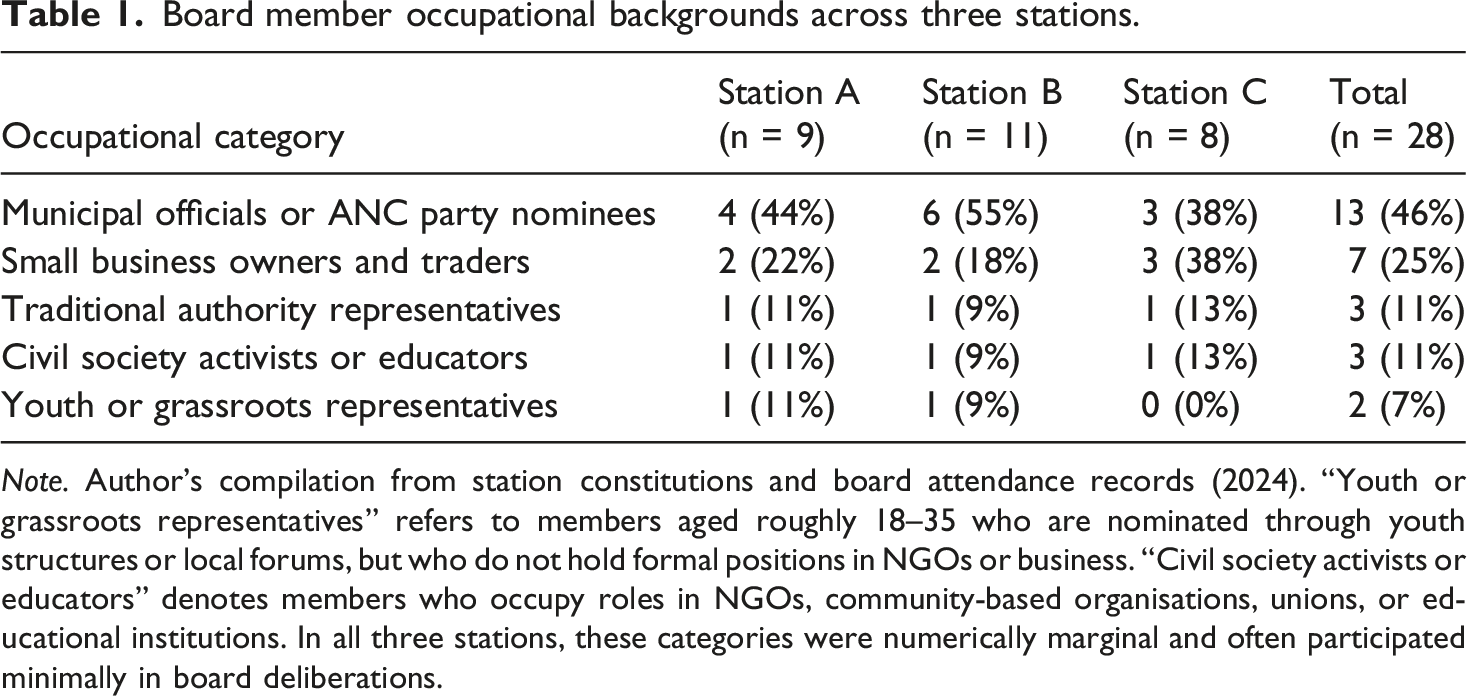
Note. Author’s compilation from station constitutions and board attendance records (2024). “Youth or grassroots representatives” refers to members aged roughly 18–35 who are nominated through youth structures or local forums, but who do not hold formal positions in NGOs or business. “Civil society activists or educators” denotes members who occupy roles in NGOs, community-based organisations, unions, or educational institutions. In all three stations, these categories were numerically marginal and often participated minimally in board deliberations.
Across all three stations, an intermediate tier of managers, typically the station manager and programming or news manager, mediated relations between the board and the broader volunteer body. Formally, governance documents positioned boards as oversight structures and managers as responsible for day-to-day operations; in practice, however, managers often acted as conduits for board preferences, relaying instructions about sensitive topics and presenters while shielding board members from confrontation with volunteers. This blurred boundary between governance and management is a key component of the governance filter, since it embeds board influence within routine managerial decisions rather than one-off interventions.
Board members justified their presence and decisions through appeal to the notion of “development” and “community,” yet the operationalisation of these terms was consistently filtered through immediate economic and political priorities (Benson, 2006; Pickard, 2020). A municipal official at Station A explained that, “The board is there to ensure the station does not become a platform for opposition parties or for complaining about the municipality” (interview, 2025).
This formulation of governance as preventative rather than enabling typifies what the study terms a governance filter: a configuration of authority aimed at narrowing the range of permissible speech by systematically privileging voices aligned with funders and political patrons.
Decision-making procedures at all three stations formally delegated editorial independence to newsroom managers, yet in practice, board approval was required for significant coverage decisions, particularly those involving local government, municipal service delivery, or traditional authority matters. One station manager reported that “The board chairperson calls me when sensitive stories are planned” (interview, 2025),
a pattern corroborated by journalist accounts. This informal veto mechanism operates through anticipatory compliance rather than explicit censorship: journalists learn which topics provoke board backlash and adjust their judgment accordingly (Mellado and Van Dalen, 2017; Shoemaker and Reese, 2014). The governance filter thus functions not as overt coercion but as a calibration of the newsroom’s sensitivity to power.
Everyday interference and negotiated autonomy
Direct evidence of board interference in news content was documented at all three stations. At Station B, a planned investigative series on informal settlement service delivery blockages was shelved after the board chairperson, a municipal councillor, called the station manager, who then instructed the journalist that, “Such stories damage the community's image and scare away investors” (interview, 2025).
The story was not formally banned but redefined as a “current affairs discussion” that would feature only officially sanctioned voices. A journalist at Station C described similar dynamics: “When we want to cover protests or complaints about the municipality, the board gets nervous. They phone to ask if we have 'balanced' the story, which means do we have the ward councillor's response even before we've broadcast anything” (interview, 2025).
At Station A, pressure was more pronounced in interactive talk slots than in bulletins. A volunteer producer recounted how a weekly call-in show on water cuts was repeatedly “toned down” after the board chairperson complained that “people must not use the radio to insult the municipality” (interview, 2025). The producer was instructed by the station manager to pre-select callers and to “balance” every complaint with an official response, effectively narrowing the range of spontaneous community voices. Such interventions illustrate how governance filters operate not only through formal news agendas but also through the informal scripting of ostensibly participatory programmes.
More insidious than these overt interventions are the mechanisms through which governance filters become internalised. When asked whether board pressure shapes coverage, 22 of 36 journalists interviewed (61%) reported regularly self-censoring to avoid conflict, whilst only 8 of 36 (22%) reported receiving explicit instructions not to cover certain topics (Hanitzsch and Vos, 2017). This gap between overt control and anticipatory compliance illustrates how governance filters operate through the structuring of possibility rather than through direct prohibition (Benson, 2006; Schlesinger, 2017). One news editor explained, “I don’t need them to tell me not to cover the mayor. I know it will cause trouble, so I just frame it differently or find another story. It’s not that I'm told to self-censor. It's that I understand the rules” (interview, 2025).
Journalists at all three stations deployed micro-level resistance strategies that are worth analysing as more than mere capitulation. Some sought to expand coverage by embedding critical content within formats considered less politically sensitive: a journalist at Station A reported inserting critical caller questions into call-in shows, reasoning that “Live broadcasting is harder for the board to control than pre-recorded news” (interview, 2024).
Others built alliances with civil society organisations to provide alternative sourcing that legitimated coverage of contentious issues, a practice that shifts the frame from “station criticism of authority” to “coverage of civil society” (Carpentier et al., 2019; Myers, 2011). These tactics represent what Hanitzsch and Vos term “role boundary work” rather than the absence of autonomy; journalists are negotiating the borders of their role performance within constraints (Hanitzsch and Vos, 2017).
Silencing, voice, and selective representation
Topic and source distribution in station news bulletins (four week sample).
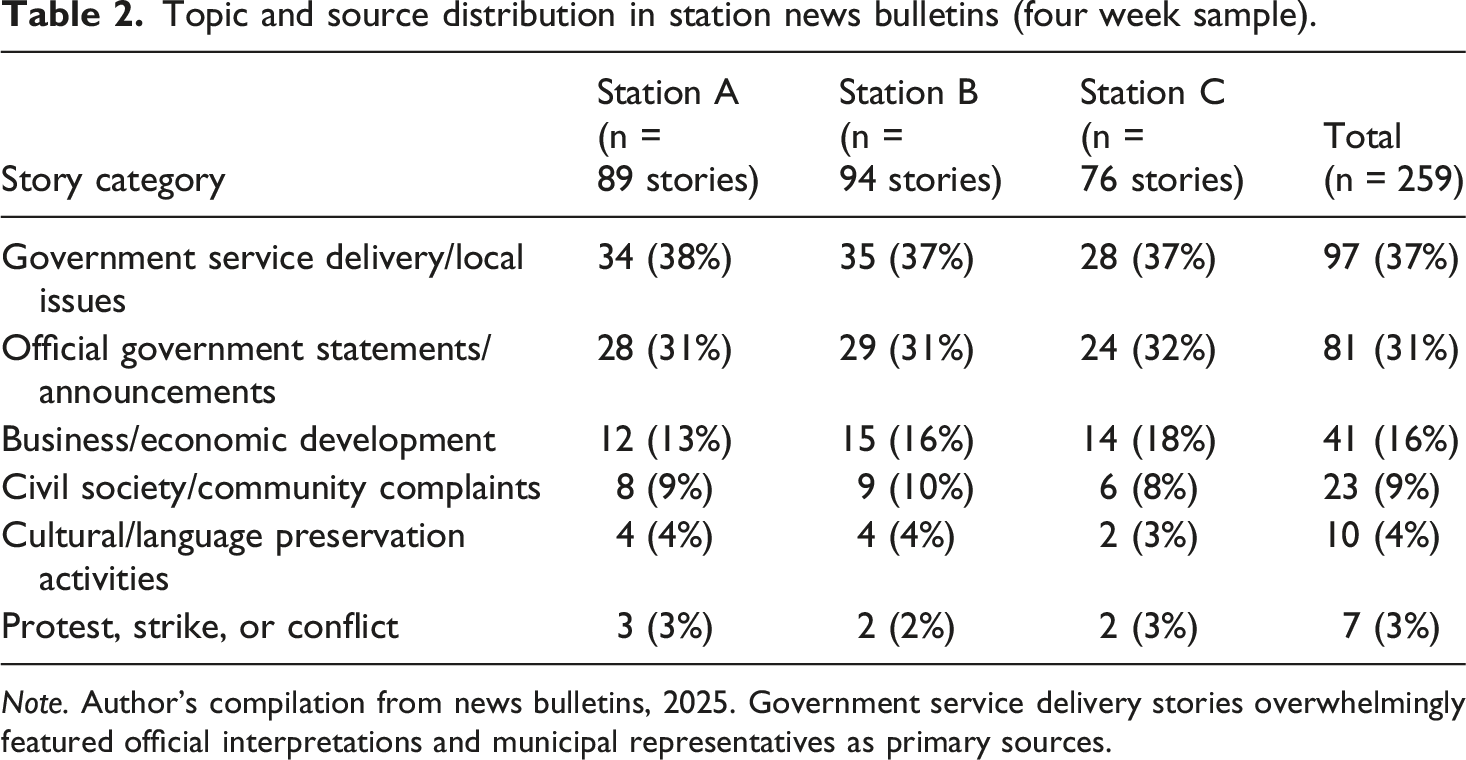
Note. Author’s compilation from news bulletins, 2025. Government service delivery stories overwhelmingly featured official interpretations and municipal representatives as primary sources.
The dominance of official voices reflected governance filter operations at the source level. Official government statements comprised 31 per cent of all stories across the three stations, whilst community complaints and protests accounted for only 9 and 3 per cent respectively. A journalist at Station B reflected on this pattern: “We get press releases from the municipality. We use them because they're free and easy. Civil society organisations have to call us. They have less access. Plus, if we use civil society material, there's a risk someone on the board will say we're pushing an agenda” (interview, 2025).
The governance filter thus operates not only through direct interference but through the material dependencies and political calculations that shape routine news sourcing practices (Mellado and Van Dalen, 2017; Tumber and Waisbord, 2004).
Stories involving local government criticism or conflict were particularly revealing of governance filter mechanisms. When a corruption allegation against a municipal official emerged, coverage differed markedly across stations. At Station A, the story was broadcast as a matter of public record, yet subsequent interviews showed that board members had discussed whether to reduce the station’s advertising sales to the municipality in retaliation. At Station B, the story was covered but framed as an “ongoing investigation” rather than as an allegation, a linguistic choice that delayed accountability and muted urgency (Hanitzsch et al., 2019). At Station C, the story appeared in the news only after civil society organisations formally requested airtime through the station’s community voice programme, translating the story from “journalism” to “representing community concerns,” a reframing that insulated the newsroom from board pressure (Carpentier et al., 2019).
Micro resistance and strategic journalism
Despite the structural constraints documented above, journalists at all three stations developed practices aimed at preserving some measure of autonomy and public accountability. These practices operated at the level of what Schlesinger terms the “field’s internal struggles” and are theoretically significant because they show autonomy as relational and contested rather than as a binary condition (Schlesinger, 2017).
Strategic language was one recurrent tactic. Journalists carefully reframed politically sensitive stories using language that appealed to board members stated commitments to development and community. One news editor at Station C described interviewing a waste management contractor faced with community complaints: “Instead of saying the contractor is corrupt, we say ‘the community has concerns about service delivery that the municipality needs to investigate.’ It’s the same information, but the language doesn't put the board on the defensive” (interview, 2025).
Such reframing is not passive compliance; it represents an active negotiation of narrative authority within constrained possibilities (Hanitzsch and Vos, 2017).
Building alliances with external actors also enabled resistance. At Station A, journalists collaborated with a non-governmental organisation focused on water provision to source and frame stories about service delivery, thereby legitimating coverage as educational content about a sectoral issue rather than as direct criticism of municipal performance. This alliance practice shifts the field of governance by introducing alternative sources of authority and legitimacy beyond the board (Benson, 2006).
A third practice involved appealing to regulatory frameworks and licensing obligations. When confronted with board pressure, some journalists invoked the broadcasting regulator’s code of conduct or the station’s community undertaking, framing editorial independence as a legal obligation rather than as a professional preference. One editor at Station B said: “When they wanted to kill a story, I told them it would be a breach of the community undertaking and the regulator could investigate. They backed off” (interview, 2025).
This appeal to external authority destabilises the board’s capacity to function as a unilateral governance filter.
These micro-level practices demonstrate that governance filters are not totalising structures but contested terrain. Yet their limited scale also underscores the structural vulnerability of community radio journalists: these tactics succeed episodically and create personal risk, and they do not alter the baseline configuration of governance that privileges official voices and constrains critical coverage (Pickard, 2020; Tumber and Waisbord, 2004).
Discussion
Revisiting the integrated framework
The findings show that board politics in Limpopo community radio stations operate as governance filters that connect structural funding and regulatory pressures to the micro-politics of news selection and voice, confirming the usefulness of the integrated political economy, field theory, and role theory framework. Boards dominated by municipal officials, business actors, and traditional authorities, combined with dependence on municipal advertising and project funding, create an environment in which critical coverage of power holders is costly, and governance bodies gain leverage over newsroom appointments and budgets (Moswede, 2010; Napoli and Caplan, 2017). Field theory clarifies how this environment is translated into a stratified institutional space in which boards hold superior economic and social capital, while journalists occupy weaker yet symbolically potent positions anchored in professional norms (Benson, 2006; Schlesinger, 2017). Within this field, governance filters materialise in informal vetoes over stories, anticipatory self-censorship and routinised privileging of official sources, which role theory would describe as forced alignment towards loyal-facilitator roles despite continued identification with watchdog ideals (Hanitzsch and Vos, 2017; Mellado and Van Dalen, 2017). This integration allows a more granular account of how autonomy is structured than approaches that focus solely on legal ownership or market concentration. Political economy explains why dependency on state and donor funding makes community stations vulnerable, but without field theory it risks flattening variation across stations and within organisations (Karppinen, 2013; Pickard, 2020). Field analysis, in turn, shows that governance filters are not monolithic: journalists deploy symbolic capital and external alliances to bargain over coverage and sometimes push back against interference, complicating narratives of simple capture (Benson, 2006; Schlesinger, 2017). Role theory adds a subjective dimension, demonstrating how journalists reconcile constraints by recalibrating role performance rather than abandoning professional self-understandings; high levels of self-reported self-censorship alongside endorsement of watchdog norms exemplify this tension (Hanitzsch et al., 2019; Hanitzsch and Vos, 2017). The governance filter concept synthesises these insights by naming the patterned, multi-level process through which board politics, structural dependence and role negotiations co-produce a selective public sphere that systematically advantages official voices over dissenting community claims.
Implications for theory
Theoretically, the study advances debates on media ownership and journalistic autonomy in three respects. First, it shifts analytic attention from formal ownership categories to governance arrangements, showing that in community media, decisive struggles over autonomy often occur at the level of boards and management committees rather than licences or share registers (Napoli and Caplan, 2017; Zouhair and Akonteh, 2022). This does not render ownership irrelevant but specifies that in non-profit, community-owned settings, ownership is enacted through governance filters that can either protect or erode public-interest journalism. Second, by grounding the analysis in newsroom ethnography and multi-method qualitative data from rural Limpopo, the study bridges structural and practice-based approaches, responding to calls in journalism studies for work that links political economy to lived professional experience in under-researched regions of the global South (Hanitzsch et al., 2019; Ndlela, 2017). The governance filter concept is generated from, and accountable to, situated African empirical material, yet articulated in a way that allows transfer to other local and non-profit media fields where boards mediate between journalists and power holders. Third, it contributes to critical and cultural theories of the public sphere and epistemic justice by showing how methodological habits that treat community radio as inherently participatory can misrecognise the patterned exclusion of certain knowledges and grievances (Karppinen, 2013; Pickard, 2020). Governance filters do not simply reduce the quantity of critical content; they shape whose experiences qualify as “community issues”, enacting localised epistemic injustice through institutional design and implying that public sphere theory must incorporate governance indicators as core analytic categories if it is to capture how communicative agency is differentially organised in peripheral media fields.
Implications for practice and policy
The findings have practical implications for community radio boards, station managers, journalists, and regulators. For boards and managers, the analysis suggests that current governance practices often undermine the very community-voice mandates that justify community licensing, by privileging political and economic elites and discouraging critical coverage of local power. Governance training that explicitly addresses journalistic autonomy, conflicts of interest, and the meaning of community representation could begin to recalibrate these practices, particularly if tied to regulatory expectations (Fourie and Froneman, 2021; Ndlela, 2017). Clearer editorial charters that delineate the limits of board involvement in content decisions, backed by internal complaints mechanisms accessible to journalists and community members, would give operational form to such training and offer modest institutional protection for newsroom independence. For regulators and support agencies, the concept of governance filters points to the need to move beyond compliance monitoring of licence conditions toward more substantive oversight of governance quality. This could include requirements for transparent board elections, quotas for civil society and youth representatives, and reporting obligations regarding board-level interventions in editorial matters, with sanctions for patterns of interference that undermine public-interest journalism (Napoli and Caplan, 2017; Rodny-Gumede, 2015). Funding models also matter: targeted subsidies or advertising allocations that bypass local political gatekeepers and reward stations for meeting clearly defined public-interest benchmarks could reduce dependence on municipal contracts that currently give boards leverage over critical coverage (Moswede, 2010; Pickard, 2020). This study has focused on governance and newsroom dynamics rather than on how audiences perceive these struggles. Future research could extend the notion of governance filters to examine how community members interpret coverage gaps, silences, and workarounds, and whether subversive practices by journalists are sufficient to sustain perceptions of community ownership despite governance interference.
For journalists and their associations, the study underscores the importance of collective strategies for negotiating governance filters, including the development of shared editorial guidelines, alliances with civil society, and strategic use of regulatory frameworks to resist illegitimate interference. At the same time, the analysis highlights limitations: micro resistance practices are fragile and unevenly distributed, and they cannot by themselves transform structural dependencies or governance cultures. Future research could therefore extend the governance filter framework to comparative studies of community and local media in other African regions and beyond, including digital-first initiatives where platform governance introduces new forms of filtering. Such work would refine the concept and test its portability, while deepening theoretical and practical understanding of how media governance structures shape the possibilities of journalism in contexts where communities formally own the microphone but do not always control who may speak.
Conclusion
The study has argued that in Limpopo community radio newsrooms, owning the microphone does not necessarily prevent the silencing of the village, because board politics function as governance filters that systematically privilege official voices and constrain critical journalism. Across three stations, boards dominated by municipal officials, business actors, and traditional authorities, combined with structural dependence on local state and project funding, created conditions in which journalists’ watchdog commitments were routinely re-channelled into cautious coverage and anticipatory self-censorship. By integrating political economy, field theory, and role theory, the study has shown that autonomy is configured at the intersection of structural dependence, stratified institutional positions, and negotiated role performances (Benson, 2006; Hanitzsch and Vos, 2017). The concept of a governance filter names this multi-level mechanism and demonstrates that in community media, decisive struggles over voice unfold not only through ownership concentration but through board-level practices that calibrate which grievances count as legitimate “community issues” and which are rendered inaudible. This reconceptualisation matters for global journalism studies because it provincialises theory from a rural South African site while offering a portable analytic lens for examining governance in other non-profit and local media systems (Hanitzsch et al., 2019; Ndlela, 2017). The analysis is limited by its focus on three stations in a single province and by incomplete access to closed board deliberations, and future research should test and refine the governance filter framework through comparative work across regions, media types, and regulatory regimes (Yin, 2018). Such work could examine, for example, how digital community platforms or hybrid online–offline outlets develop alternative governance arrangements, or how newsroom collectivisation and professional associations reshape local fields of power. For policy and practice, the findings point to the need for governance reforms, funding models and regulatory oversight that explicitly protect newsroom independence within community media, rather than assuming that formal community ownership suffices, and they invite further work on how governance filters contribute to epistemic injustice in peripheral media fields and how more egalitarian institutional designs might widen not only access to microphones but also the range of voices structurally permitted to speak. While community perceptions lie beyond the scope of this article, the findings suggest that without structural reforms to governance practices, participatory mandates risk being met only at the level of formal design rather than lived experience.
Footnotes
Acknowledgments
The author wishes to thank all participants for their collaboration and support.

Ethical consideration
The research received ethical approval, with a Research Ethics certificate provided by the University of Limpopo Ethics Committee.
Consent to participate
All participants gave voluntary, informed consent, and the study followed internationally recognised guidelines for social research ethics.
Author contributions
The author contributed substantially to the conception, study design, data analysis, and manuscript preparation for this article (The whole article).
Funding
The author received no financial support for the research, authorship, and/or publication of this article.
Declaration of conflicting interests
The author declared no potential conflicts of interest with respect to the research, authorship, and/or publication of this article.
Data Availability Statement
The data supporting the findings of this study are available from the corresponding author upon reasonable request. Data sharing complies with all ethical requirements for participant privacy and institutional review protocols.