



Abstract
Media criticism is considered important in democratic societies, as journalism constitutes a societal institution that possesses a certain power. However, news media is often criticized for being reluctant to shed critical light on peers and mediated power. Based on a combination of content analysis and qualitative close reading of legacy Norwegian news media during 2022 and 2023, this study investigates how journalistic based media criticism is carried out through the commentary genre. In the columns, four topics dominate: journalistic content, structure, press and democracy and power. Further, we find that most of the columns are addressing news media in general but also criticizing specific newsrooms and even particular journalists. Within the framework of institutional theory as well as theory of media criticism, we discuss the legitimization of metajournalistic discourse in the public sphere.
Introduction
Media criticism is included in a metajournalistic discourse shaping the public understanding of journalism (Carlson, 2016) and is regarded as necessary and important in a democratic society. Journalism is carried out within an institutional framework, where discursive work both creates and reshapes it as a societal institution (Hanitzsch and Vos, 2017), which must be subjected to criticism and debate (Carey, 1974). News media also facilitate public discourse and contribute to opinion-making (Figenschou, 2020; Wyatt, 2007) and thus possess a certain societal power. However, news media is often criticized for sin of omission, for fending off criticism and for being reluctant to carry out critical investigations of peers (Carlson, 2016; Wyatt, 2007).
According to Wyatt (2007, p. 7), media criticism, or press criticism, is “the ongoing process of exchange of debate between the press and its audience over the role and performance of the press in a democratic society”. Media criticisms can be found in various forms and venues, both from inside and outside newsrooms. Regarding the inside, media criticism is acted out both in the news coverage as well as in commentary journalism, where columnists discuss the journalistic role, power, and judgements. Regarding the outside, the digital media landscape and social media channels provide citizens with a range of possibilities for criticism and comments (Figenschou and Ihlebæk, 2019; Singer, 2015; Vos et al., 2012). Historically, media criticism has often come from the political left that has attacked legacy media for political reporting that reinforces an establishment-led agenda (Cushion, 2022). In the digital age, however, a network of far-right alternative online media has also emerged and challenged the authority of mainstream media (Figenschou and Ihlebæk, 2019; Marwick and Lewis, 2017). Public discussions about journalism may contribute to transparency and trust. However, an ever-increasing critical focus and negative attention on media practice will also tend to polarize the debate and undermine the legitimacy and democratic role of journalism (Karlsen and Steen-Johnsen, 2023; Moe et al., 2022).
While a wide range of studies are concerned with media criticism from actors outside the news media, little research has studied journalistic criticism (Rodriguez-Martinez et al., 2017, p.59). Research that addresses media criticism from inside has been scarce, scrutinizing whether journalists “turn the gaze inwards to reflect more pro-actively on the causes and consequences of their own and others reporting” (Haas, 2006: p. 351). Researchers call for studies investigating media criticism produced by journalists and newsrooms, involving textual analysis and media critical columns (Haas, 2006: p. 352). This paper seeks to fill this gap by elaborating media criticism within the commentary genre that is published on the newsroom’s own platforms. The interpretative and commentary genre is expanding in several countries (Esser and Umbricht, 2014; Fink and Schudson, 2014; Salgado and Strömback, 2012) and composes a vital part of the institutional role of journalism (Ryfe, 2016). This makes it relevant to explore regarding media criticism.
Being a democratic-corporatist media system characterized by strong development of journalistic professionalism as well as high levels of trust (Hallin and Mancini, 2009; Skogerbø et al., 2021), Norway constitutes an interesting national context in which to explore media criticism. This is not least because The Norwegian Code of Ethics is the only one in Europe “openly mentions criticism as means of improving professional practice” (Rodriguez-Martinez et al., 2017, p.59).
Based on a combination of quantitative analysis and qualitative close reading of media critical columns, the research question asked is: How is journalistic based media criticism played out in Norwegian legacy media and how does it legitimize the meta journalistic discourse in the public sphere? The empirical ground constitutes media critical columns from three news media outlets in Norway in 2022/2023. Our aim is to contribute to the understanding of media criticism within the lenses of institutional theory and how it, as an ongoing discursive action, might contribute to the legitimacy and trust that journalism as a societal institution depends upon.
Theoretical starting point
Theoretically, this study is anchored in institutional theory (Cook, 1998; Ryfe, 2016), supported by Wyatt (2007) theory of press criticism and Carlson (2016) concept of metajournalistic discourse. Institutionalism is a widely recognized approach to the study of journalism (Ryfe, 2016: p. 370), emphasizing that the news media fulfils distinct needs in society – circulating information, enabling public debate, and organizing the public sphere (Cook, 1998: p. 83). Journalistic work is carried out within an institutional framework (Hanitzsch and Vos, 2017, p.119) and Cook (1998) defines institutions as entailing social patterns of behaviour identifiable across organisations that extend over space and endure over time and preside over a societal or political sector. As such, journalism represents a societal institution with its own routinized practices and norms, playing a vital role in the public sphere. Journalism is given a specific kind of legitimacy (Berkowitz, 2009) which is rooted in the democratic and societal mission, being described in the Norwegian context as threefold: providing information, facilitating public debate, and acting as a critical watchdog in society (Kulturdepartementet, 2019). Contributing to enlightening, debate, controversy, and criticism, opinionated journalism – which is the concern of this study – composes a vital part of the institutional role of journalism (Mathisen and Morlandstø, 2023).
All societal institutions must be subjected to criticism and debate (Carey, 1974). Among scholars, there is a consensus that constructive media criticism is necessary in a democratic society (Figenschou and Ihlebæk, 2019; Svensson, 2015; Vos et al., 2012; Wyatt, 2007). Wyatt (2007) uses the term “press criticism”, which she describes as “the critical, yet noncynical act of judging the merits of the news media” (p. 6). Wyatt lists five domains of press criticism, reflecting how the criticism occurs through the press and the mediated agenda. The domains are: (1) criticism of content, which entails coverage or under-coverage of stories, the portrayal of certain groups in society and the ethical decisions that individual journalists make when producing news stories, (2) a philosophical approach to news gathering and news reporting; questioning the notion of objectivity, (3) structure: regarding such questions as press concentration, corporatization, the economic structure of news media business interests, (4) power; bringing to light questions about the amount of power wielded by the media organizations as well as individual journalists, and last (5) the press and democracy; examining how journalism fulfills its societal role. These domains help define the content of criticism and which perspectives the critics choose (p. 172). She recommends a discursive approach, where journalism serves as a communicative public sphere.
The concept of metajournalistic discourse is also of relevance here, which Carlson (2016) presents as a theoretical model of “the discursive processes that undergird understandings of journalism as a practice capable of supplying valid knowledge of events in the world” (p. 350). Through this discourse, the meanings of journalism - its definitions, boundaries and legitimacy are formed and transformed by actors inside and outside of the field, and discourse about journalism shapes the public understanding of journalism. Carlson (2016, p. 353) define the metajournalistic discourse as public expressions evaluating news texts, the practices that produce them or the conditions of their reception” and he connects the metajournalistic discourse to media self-criticism (p. 352), appearing within the textual universe of the news media. Carlson discusses two types of metajournalistic discourse; a reactive metajournalistic discourse in the form of responses to a particular story, journalist or news outlet, and a generative discourse that involves a broader consideration of contemporary journalism. These types of discourses parallel with Wyatt’s separation between criticism of content and more overarching questions about power and democracy.
Literature review
As already mentioned, Haas (2006) calls for more research about how news media self-criticism appears and she states that such self-criticism “would require journalists to reflect on how their own and others reporting is shaped, if not constrained, by the commercial interests of news media owners and advertisers, organizational pressures and work routines” (p. 351). Throughout history, criticism has had a modernizing effect on journalism, as critics can be agents of change (Cheruiyot, 2018: p. 21). However, the scholarly literature notes a reluctance within journalism to act out media criticism (Wyatt, 2007), and a tendency to fend off criticism (Carlson, 2016: p. 351). “While the press makes a business in turning the critical light on other institutions, that light dims when it comes to the press itself”, asserts Wyatt (2007, p. 2). Further she describes how criticism from within often leads to accusations of disloyalty (p. 18). Establishing a professional distance from peers might be difficult for media critics (Fengler, 2003: p. 823).
However, despite the scarcity, the scholarly field does offer some significant studies of media criticism. Thomas and Finnemans (2014) concerned were journalism about journalism, and they studied how the institution of journalism responded when facing an external threat. Analyzing British newspaper editorial commentary on the Levenson-inquiry hearing 1 , they find little self-criticism on behalf of the journalistic institution. On the contrary, the editorials defend its democratic role. The significance of the phone-hacking scandal was downplayed, and the audience were warned about the dangers of press regulation. “The public would better be served by a journalism that comes to grips with how it builds trust with audiences that no longer believe it to be an honest broker of information”, they conclude (p. 184).
In a study from Sweden, Svensson (2015) describes the critics as reflective journalists who were temporarily positioned outside, at the border of, and in the center of, the journalistic field. Svensson states that the inside critical columnists are acting in a tension between consensus and conflict, where their relation to their surroundings might be confrontational. He concludes that media criticism can be seen as an expression of critical institutionalism.
Cheruiyot (2018, 2019) has studied journalists’ perception of media critical content by interviewing journalists, media critics, and media accountability agents in Kenya and South Africa. He finds that journalists mostly received offensive, unreasonable and unfounded criticism online, which they often rejected. Journalists prefer criticism that is instructive and analytical, involving fair, civil, unemotional, and rational criticism (Cheruiyot, 2018: p. 1015). He concludes that journalistic accountability calls upon news professionals to give an account of editorial decisions, explain journalistic processes to their audiences, or offer remedies such as corrections, apologies, or clarifications (p. 1016). Cheruiyot also investigates the subjects of digital media criticism at different levels, both its form and content, professional norms and ethics, and organization, institution, and ideology.
Media criticism of traditional journalism is a strong mechanism of journalistic accountability, and meta-journalistic discourse occupies a central role in the societal construction of journalistic authority (Zelizer, 1993). However, media criticism is questioning journalistic authority (Matton, 2016; 2017) and can take on less constructive forms in terms of scepticism, hostility and mistrust (Figenschou and Ihlebæk, 2019: p. 1124; Wyatt, 2007). Populism has spawned cynical anti-press rhetoric and even attacks on legacy news media and journalists (Cheruiyot, 2019: p. 3). There will always be a dilemma between constructive media criticism and one that is destructive and cynical. Too much of the latter could tear down the trust in media as an institution, which is the case in many countries (Moe et al., 2022).
In this article, we elaborate media criticism from the inside, that is, criticism produced and published by the newsrooms. We lean on both Wyatt (2007) term press criticism as “the critical, yet noncynical act of judging the merits of the news media” (p. 6), as well as Haas (2006) understanding of self-criticism, involving both reflections about the newsrooms itself, as well as other newsrooms and peer journalists. We use the term media criticism, which we find more comprehensive than press criticism.
The Norwegian context
Despite a rather small population, the news media organizations in Norway number nearly 300, most of them local (Medietilsynet, 2023: p. 58). In addition, the media landscape involves one public and one commercial national public service broadcaster. Along with the other Nordic countries, the Norwegian media system is described as democratic corporatist, characterized by an early and strong development of journalistic professionalism and a high level of journalistic autonomy (Hallin and Mancini, 2009). Empirical trends suggest that despite several differences between countries, both public service and national newspapers enjoy a strong position among Nordic populations (Skogerbø et al., 2021: p. 21). Also, the level of trust in the news media and political institutions is substantial (p. 17).
Both readership as well as the willingness to pay for online news is generally significant in Norway (Newman et al., 2020). On rankings of freedom of expression, transparency and journalistic autonomy, Norway, in common with the other Nordic countries, ranks high (Skogerbø and Karlsen, 2021: p. 98). The management of professional ethics is characterized by self-determination, in which the journalistic acknowledgment is high. The Code of Ethics states that “It is a press obligation to shed critical light on how the media themselves exercise their role” (Article 1.4).
News media is often criticized for sin of omission, for being reluctant to shed critical light upon oneself and peers. However, in recent years, several media critical debates have appeared in the Norwegian public sphere, which have their origin in critical and investigative journalism about journalism. The so-called “Bar Vulcan” case 2 in 2019 is regarded as a watershed, where both the national broadcasters carried out investigative journalism of the methods of a leading newspaper in covering a political scandal. Later, especially the public broadcaster NRK has been subjected to critical journalism, related to methods and ethics in a documentary (“Bamsegutt” 3 ), and their cooperation with a commercial influencer (Sophie Elise 4 ). These debates might have contributed to an increased focus on media criticism within journalism.
Data and methods
The aim of this study is to examine the media criticism produced by columnists and published in Norwegian news media. To answer the research question; How is journalistic based media criticism played out in Norwegian legacy media and how does it legitimize the meta journalistic discourse in the public sphere? we have analyzed media critical columns from three news media outlets in Norway in 2022 and 2023. The research strategy is a combination of a rather simple quantitative coding to sort the material and search for significant patterns in the data (Krippendorf, 2004), and qualitative close reading, aiming to go beyond the mere countable characteristics of media criticism, the latter being the main and most comprehensive method.
The newspapers under study are Aftenposten, Medier24 and Nettavisen. Aftenposten has a regular media criticism column called Medierevisjonen. Medier24, established in 2014, represents a niche media focusing on media and journalism and Nettavisen prioritizes media criticism even though it doesn’t have a regular column. The three media companies represent some vital differences: Aftenposten is a traditional newspaper with a long-printed history and is published both in print and online. Nettavisen is a rather new online newspaper, established in 1996. Undoubtedly, Medier24 is targeted at a narrower audience than the other two and facilitates professional public debate rather than the more general, public debate. Still, a vast amount of their commentaries and columns are open and free, and the newsroom does serve as a premise supplier in the media discourse.
The study is limited to columns and opinionated journalism, leaving out regular news reporting. A significant trend of journalism in recent years has been the expansion of commentary journalism in several countries (Esser and Umbricht, 2014; Fink and Schudson, 2014; Salgado and Strömback, 2012). Thus, the commentary genre serves as a vital communicative public sphere facilitating substantial parts of the metajournalistic discourse.
The empirical data contains 85 columns published in the period between August 15th, 2022, and June 15th, 2023. By limiting the analysis to columns published in legacy media, we exclude the wide range of media criticism and debate that continuously goes on in comment fields and social media, both between journalists and between journalists and the public. Of course, these venues for criticism are of substantial value, and as Cheruiyot (2018, p. 229) observes, in digital spaces criticism of journalistic practice circulates in the same universe as journalistic texts. Still, our aim is to elaborate media criticism published in front of the audience that regularly consumes the news (Carey, 1974: p. 249), on the platforms of legacy media and that is subjected to editorial evaluation and responsibility.
In the analysis of the columns, we have identified several characteristics, such as the topics they raise, to whom the criticism is addressed, and their rhetorical style, with the overall aim of identifying some patterns in the media critic. The qualitative approach implied a thorough reading of the material, aiming to dive into the perspective of the columns and exemplify the meta journalistic discourse. When coding the topics, enabled by close reading, we applied the domains of Wyatt (2007, p. 11-15), and sorted the categories into her domains.
The two researchers in the project collected, coded and analysed the data together. A reliability test was also completed, where 20% of the material was coded by a test-coder. The reliability score is 90% which is satisfactory in relation to general reliability requirements (Krippendorf, 2004).
Findings
In the following, we will discuss our findings, but first, we will provide a brief insight into who the critics authoring the 85 analyzed columns are.
The critics
In total, these columns are authored by a total of 18 columnists. Four of them are regularly employed in the newsroom and hold positions as editors, either editor-in-chief, political editor, or debate editor. The rest are hired as external columnists. Still, they all have background in journalism in various ways: being freelance journalists, cultural critics, retired editors, former journalists, teachers in journalism school and media researchers. Thus, the media critics represent expertise; they have a wide and thorough knowledge of journalism practice and media environment. In “speaking the language” (Cheruiyot, 2019: p. 97) we might assume that their criticism is given weight: ...through their position of expertise, some critics have acquired cultural and network capital, and therefore in the eyes of journalists, their criticisms would carry more weight in comparison to other types of digital media critics (p. 98).
Being ‘insiders’ also implies criticizing one’s peers, which often leads to accusations of disloyalty, making their colleagues insecure and paranoid (Wyatt, 2007: p. 18). For the columnists, it might be challenging to shed critical light on peers and colleagues. Thus, the rhetorical style of the columns is relevant to explore. All forms of commentary journalism convey an explicit argument, as the fundamental aim of the genre is to take a stance, interpret, analyze and supply subjective assessments of contemporary society. Still, the style might differ between distinct and explicit stances and more open reflexive discussions (Mathisen and Morlandstø, 2016: p. 84). We find that out of 85 columns, 19 were placed in the open reflection category, while 66 were characterized by distinct argument. Thus, we find that the vast number of media critics are employing a style where they stand out as significant voices addressing a clearly stated object of criticism. This implies that although it can be challenging to criticize one’s own peers, the columnists do not hesitate to state clearly formulated criticism.
To whom is the criticism addressed?
Media criticism and metajournalistic discourse might concern a particular story, a journalist, a news outlet as well as a broader consideration of contemporary journalism (Carlson 2016: p. 358). We have distinguished between whether the criticism is focusing on the news media or journalism in general, or whether specific newsrooms or individual journalists are named and identified. Further, we have categorized if the criticism is addressing actors outside the newsrooms, and if these actors are individuals or more institutional actors such as organizations.
To whom the criticism is addressed.
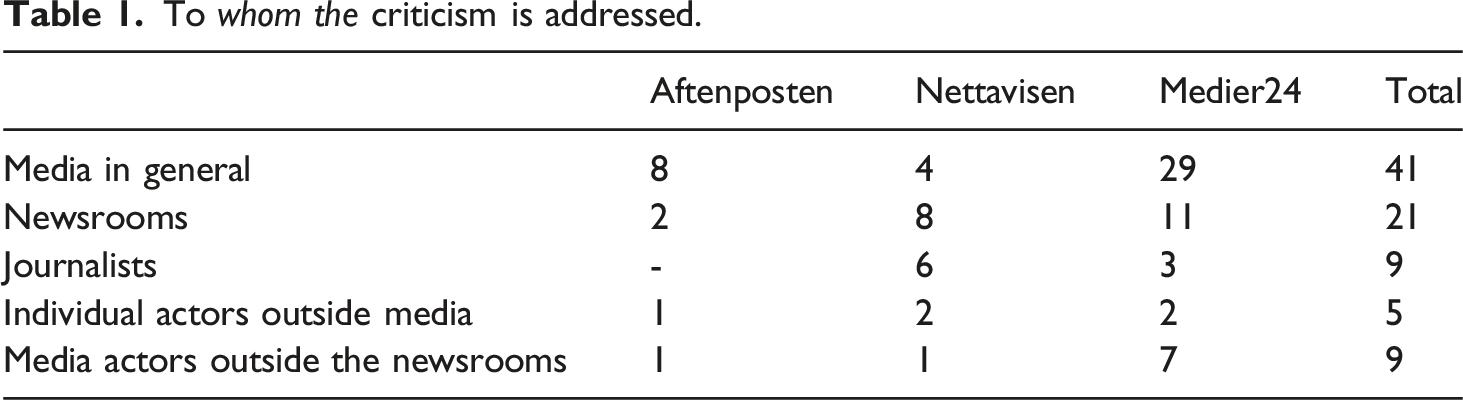
Another interesting trend worthy of notice is the share of criticism addressing media related actors outside the newsroom (9 columns). These kinds of actors might be press-organizations and media authorities, or individual actors such as societal debaters. This involves actors impinging upon external frameworks, such as authorities responsible for media policy. The category also contains a focus on practice within journalism education and press-organizations. This suggests that media critics have a broad understanding of the mediated field in their work.
The Norwegian media structure is diverse and geographically dispersed. Therefore, we have elaborated on what kind of media institutions the media critical discourse is putting on the agenda when the criticism is addressed at specific institutions or companies (21 columns in total). Here we find that national broadcasts are subjected to criticism in more than half of the columns directed towards specific newsrooms (11 columns). Even if it’s a small number of columns, it is also interesting to see that eight out of these refer to the public broadcaster, NRK. Worth noticing here is that NRK enjoys the highest share of trust from the audience (Medietilsynet, 2023: p. 124) and has the highest number of users or audiences (p. 38).
A substantial part of these columns discussing NRK’s engagement of the commercial influencer, Sophie Elise, to produce a podcast, which lead to both harsh criticism and public debate during the time our study was carried out. NRK was criticized for blurring the public service mission with the commercial interests of the influencer. An example of this criticism is this quote from the political editor of Nettavisen: The very reason why we have NRK, the state channel's ‘reason to be’, is that we need a public broadcaster that can provide us with everything that we would not otherwise get through the private or commercial channels/media. Therefore, NRK receives approximately six billion Norwegian kroner each year (…) With Sophie Elise (…) NRK goes directly into the commercial market and uses its six billion tax kroner to buy out a product that is already fully developed and in full activity on the commercial market.
5
This kind of intermingling of public service and commercial activity by a public service company is criticized by commercial media in a range of European countries for constituting unfair competitive advantage and for preventing commercial news organizations from pursuing paid subscription on the online platforms (Sjøvaag et al., 2019; Benson et al., 2017). Such criticism can be seen in relation to the increasing concentration of ownership in Norwegian media landscape. In 2020 about 60% of the newspapers in Norway were owned by the three largest media groups, Schibstedt, Amedia and Polaris (Lindén et al., 2021). These groups experience the state-owned NRK as a threat to their market positions, as we could see already in the party-press period (Bastiansen, 2001). Also, Svensson (2015) found public service was a significant topic in media criticism. Even if not included in our sampling, it should also be underlined that NRK itself covered this debate quite intensively. Among other instances, on 23 February 2023 the head of NRK was confronted with a barrage of critical questions by her own employee in the flagship debate program “Debatten” on television. 6
Next comes national news organizations, while the large number of local newspapers are under the spotlight in only three columns. In professional debate, local journalism is often criticized for referential reporting, local patriotism, and lack of critical journalism (Morlandstø and Mathisen, 2023). One might expect that this could prepare the ground for media critics discussing local journalism more often. Traditionally local journalism suffered from lower professional prestige and status than the journalism carried out in the larger newsrooms (Hovden, 2008). It is worth discussing whether the lack of focus on local journalism within media criticism might be an expression of the lower status of local journalism, where the critics do not even find it newsworthy to scrutinize and discuss, or whether the practice of local newsrooms is out of their scope.
What does the criticism address?
The topic of the media critical columns.
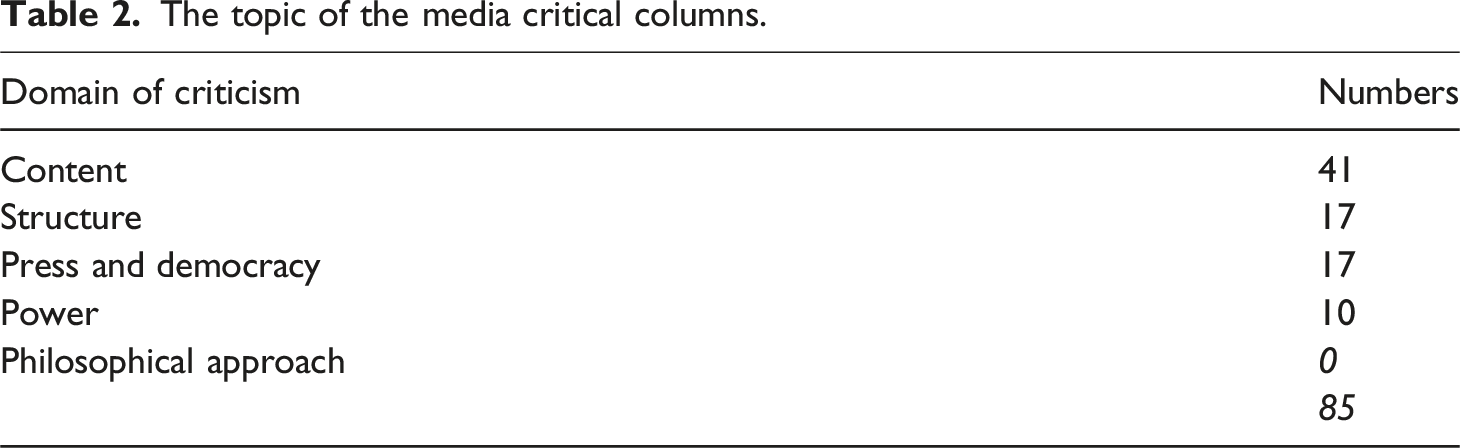
First, it is worth noticing that none of the analyzed columns is placed in the domain of philosophical approaches, which in Wyatts’ definition is scrutinizing the journalistic notion of objectivity. As the table shows, most of the media critical columns are addressing journalistic content (41 columns). Wyatt (2007, p. 12) describes this domain as involving the over- or under-coverage of certain stories, the noncontextually and ahistorical nature of stories that are created through journalistic conventions, the portrayal of certain groups in society by media, and the ethical decisions that individual journalists make when producing a news story. Following this definition, this domain embraces wide and involves both the published content and the work process and ethical decisions leading up to it.
Addressing content, the critics are concerned with how certain fields of society or issues are covered in the news. They also question how specific groups in society are presented or framed in the news, and they address what they perceive as missing coverage of issues they find important but overlooked. Among other topics, the criticism is concerned with the coverage of suicide. “I think it would be an advantage if we reported suicides more often”, writes a columnist, arguing that that reporting about the scope of suicide should be an important task for breaking news, because of its societal consequences. “Suicide isn’t a private matter, rather an example of matters that ought to be subjected to criticism which the Code of Ethics tells us to uncover and disclose” 7 she writes. Another columnist also takes part in this discussion and argues: “The most relevant question may no longer be how much the press should cover suicide, but how suicide is discussed”. 8 This example also identifies how media critical columns contribute to discourse about important issues in the public sphere.
When addressing the coverage, a vital premise in several texts also is that through its prioritizing and framing news media affects how citizens perceive the issue or case which is reported on. An example here is a columnist discussing how media dramaturgy might shape misguided perceptions of mental illness. 9 The columnist addresses his criticism against the media in general, and at the same time he gives credit to a specific podcast for giving a nuanced and balanced view of mental health. In another text he criticizes a specific NRK-program for how it viewed psychological treatment. 10
We also find several texts which are critical of journalists’ use of language, how they cover different topics and how groups of people are represented in media texts. In one of these texts the columnist criticizes two of the largest media companies in Norway for publishing false accusations against JK Rowling’s assumed ‘transphobia’. The columnist refers to several of the paragraphs in The Code of Ethics (1.2, 3.2, 4.2 and 4.3) and writes that the journalists do not tell the readers/viewers of what JK Rowling says but: “Instead, we get to know what others are saying about JK Rowling. Those who despise her and distort what she says”. 11
The journalistic content is closely connected to the journalistic work process, implying a range of professional discretions and judgments. Thus, in this domain, we also embrace columns where the media critics elaborate on how journalistic work is carried out and discuss how journalists manage their professional role in specific cases. Press ethics and integrity are essential aspects, and we find several texts where the media critics discuss relations between journalists and their sources, and how these relations impact upon how the contents are framed and angled. They address ethical aspects such as integrity and double roles, and how the journalists manage these kinds of dilemmas: “Unfortunate bindings to sources raise relevant questions about journalism” writes a columnist when criticizing a named journalist formerly employed by his own newspaper. Consequently, the columnist also turns the critical lenses towards himself as editor, and these columns also represent an example of clearly expressed self-criticism: Nettavisen often addresses criticism of others. Now we have made a mistake which justifies that the searchlight must be turned to ourselves. Unfortunately, we deserve it.
12
The same columnist also problematizes source relations within the field of politics, criticizing several named journalists for too tight connections with politicians and for repeated use of anonymous sources in political journalism. 13 Criticizing named colleagues obviously led to reactions and harm, which the columnist responds to in another text, stating that “It is about time for more of us ‘colleagues’ to criticize each other”. 14 He argues that the professional collegiality and close connections between political journalists and sources damage the climate for public debate as well as trust in legacy, editor-controlled media. He grounds his arguments in the Code of Ethics § 1.4, and underlines that the press has an obligation to throw critical light on how media exercise their role.
Source relations within the field of politics are on the agenda in several columns, and the media critics reveal diverging views on this. The context of one example is a public debate going on about journalists and politicians joining each other at afterparties after party conventions. One of the columnists defends this kind of mingling and argues that it supports insight and knowledge which in turn might stimulate critical journalism. 15
Source criticism, or more correctly, the lack of source criticism, is also prominent on the agenda. One example is when a columnist problematizes how journalists do not ask critical questions of sources who define themselves as victims. The columnist writes: “... journalists seldom pose critical questions to those raising criticism. They just follow the angry finger that points. Nor is there a tradition of carrying out independent investigations or analysis afterwards.
16
This quote might also serve as a critical discussion addressing journalistic practice in general, shedding light upon the tendency of “herd packing”. Overall, when putting source criticism on the agenda, the critics are problematizing the lack of it, and they discuss the consequences the absent source criticism has for the credibility of, and trust in, journalism. Discussing the journalistic work process also entails professional norms, and whether the work is good or bad (Cheruiyot, 2018).
17 of the columns are placed in the domain of structure. When Wyatt (2007, p. 13) explains this domain, she involves ownership, corporatization, business interest and economic structure. Here, we have sorted columns addressing more overarching perspectives such as politics, economy, ownership and management. The two most significant aspects in our data are management and work conditions, mostly slamming the absent care of employees, and media policy. Regarding the criticism of the management, the focus was, in one case, on NRK’s different politics towards regular employees on the one side, and contracted content providers on the other. The latter might also take commercial assignments, which might collide with the Code of Ethics and blur the borders of journalism. Mostly, this is related to the already mentioned Sophie Elise case in NRK.
Also, the columnists focus on working conditions for temporary workers, the elderly part of the workforce and employees with minority backgrounds. One columnist criticizes a news editor and a columnist in two large newspapers in Norway for not paying enough attention to how journalists with minority backgrounds experience their working lives. The columnist accuses another columnist of discrediting and mistrusting a journalist with a minority background and claims that the columnist generalizes a problem she has experienced. “This is a good example of how the majorities meet the minorities who finally dare to open their mouths”, the columnist writes. 17
Another structural aspect on the agenda is media policy and media support. One columnist argues for rights-based media support: “Instead of the pot being determined first and then distributed, you get a predictable rate based on circulation figures”. 18 Here, the columnist focuses on the structural framework journalism depends on and how a more predictable system would benefit smaller newsrooms.
The domain of press and democracy also counts 17 articles. Wyatt (2007, p. 15) describes this as the relationship between the press and democracy. Here, we have coded columns addressing how journalism and news media manage their societal and democratic role. Several columns are related to the public debate arena in Norwegian news media, mostly concerning the debate climate and how the media manage to moderate the debates. Regarding the first, here we find several examples where the criticism is addressed at actors outside the media, such as citizens and actors taking an active part in societal debate. For example, one distinct voice in societal debate regarding racism and the rights of indigenous people is countered for her assertion that news media give voice to racists. One of the columnists writes: It is both disturbing and sad that such a strong and vital role model conveys such intolerance of a critical public debate. (..). It’s sad that she does not like nor acknowledge what a democracy fundamentally depends upon; citizens that openly disagree and discuss, and a press seeking a wide basis of sources.
19
This criticism might stand as an example of how the media critics also addresses actors outside the media, here focusing on how distinct voices in public debate act, and what kind of public climate they contribute to. One columnist discusses freedom of speech in Norway and criticizes sources who make controversial utterances in public, but then don’t respond to journalists: “Do we want this type of argumentation to be present in the public debate in Norway”, the columnist asks? 20
Wyatt (2007, p. 15) underline that the domain press and democracy is linked to the others: “Because the generally agreed-on belief that the press plays a vital role in the successful operation of a complex, decentered democratic society, criticism is always at least implicitly, examining how the press is fulfilling this role”, she writes.
In the domain of power, we find ten columns. Wyatt (2007, p. 14) understands the domain of powers as bringing to light questions about the amount of power wielded not only by media organizations, but also by individual journalists whose jobs place them in positions of authority. In this category, we categorize columns both discussing how the public broadcast manages its societal role, as well as actions by individual journalists. One example is a media critic raising the rhetorical question whether it is possible to be a journalist and influencer at the same time. Here, several journalists, being both journalists as well as being influencers or holding political positions, are identified by names. The media critic argues that these kinds of double roles are impossible. The audience might suspect that the journalists are driven by personal and commercial motivations, which also might damage the trust in journalism.
Concluding discussion
In this paper, we have investigated media critical columns, seeking to shed light upon the research question: How is journalistic based media criticism played out in Norwegian legacy media and how does it legitimize the meta journalistic discourse in the public sphere? Our study portrays media critical columns where the dominating rhetorical style expresses distinct viewpoints and positions, while more open reflections are rarer. We find examples of quite direct and harsh criticism, addressing both named journalists and media companies. We also see that this causes reactions and accusations of disloyalty, which signals that the position of a media critical journalist might be a challenging professional role to adopt.
However, most of the criticism is addressed at the news media in general more often than specific institutions or journalists. Further, by applying Wyatts domains, we find that the dominating part of media criticism is setting aspects related to the content on the agenda, far more often than more overarching questions related to power, structure or democracy. None of the analyzed columns might be placed in the domain of a philosophical approach.
The media critical columns in our study emerge as close to journalism: the columnists most often discuss journalism as such; it’s about coverage or under-coverage of stories, portrayals of certain groups in society as well as the ethical decisions or judgements that journalists make. Our data also involves discussion of how journalists act out their professional role, especially in relations to sources, where the columnists build their arguments based on the Code of Ethics. As such, criticism often addresses bad professional behavior. The criticism entails both denunciation of journalistic role-enactment, as well as admonishment of lax professional standards and practice (Cheruiyot, 2019; Vos et al., 2012). The mediacritical practice we have studied might definitively be characterized as a reactive metajournalistic discourse, responding to specific work or stories (Carlson, 2016). The criticism undoubtedly takes distinct stances and challenges journalism, but nonetheless a substantial part of it emerges as near-sighted and close to practice, accepting the doxa of the journalistic field (Vos et al., 2012).
However, both structure and press and democracy are essential topics in the analyzed content. The sample does contain columns focusing on democracy, freedom of speech and how public discourse functions, as well as overarching frameworks such as media policy and the conditions of public debate. This emerges as a more generative metajournalistic discourse (Carlson, 2016). Vos et al. (2012) define structural and systematic criticism as one specific area, involving both technology and the economy. Even Cheruiyot (2019) identifies an institutional level of media criticism. Our findings confirm structure as a present part of the press criticism. The structural focus is on media policy and media management – the latter also involving working conditions within the newsrooms – rather than how structural framework such as finance and ownership impact journalism. Thus, the focus is more inwardly directed and narrower than the more overarching systemic criticism described by Vos et al. (2012), Cheruiyot (2019) and Wyatt (2007). As such, parts of the analyzed media criticism might be characterized as protecting journalism and professional autonomy rather than challenging it. This type of media criticism rarely questions the philosophical approach to news gathering (Wyatt, 2007), or the ideology of journalism (Cheruiyot, 2019).
Within the perspective of journalism as a societal institution, media criticism or metajournalistic discourse is essential for legitimacy and public understanding of the mediated power. Being a societal institution, journalism depends on legitimacy and trust, and professional ethics imposes on journalism a duty to shed critical light on how the media themselves exercise their role. However, as media criticism also questions journalistic authority, there will be a risk that the criticism will become destructive and cynical, and their exposures will lead to mistrust, and thus damage the democratic function of journalism. This is especially so in a digital public sphere replete with ubiquitous accusations of fake news, where citizens perceive the entry to legacy media as limited and restricted and journalists as a part of a politically correct elite. Still, meta-journalistic coverage and willingness to critically scrutinize the mediated power might contribute to transparency and thus strengthen news media as a legitimate institution acknowledged by its surroundings. Media criticism might also have a modernizing and corrective effect, contributing to changing what is perceived as deviant professional praxis, and thus to improvements. Media criticism might constantly remind journalists “to live up to the expectations of the profession which they set for themselves through journalistic discourse” (Cheruiyot, 2018: p. 229). In our study we find several examples of how media criticism related to different topics led to public debates and discourses (for instance about suicide, mental health, political journalism and minorities). An open public and metajournalistic discourse about the media itself will contribute to the societal credibility and trust that journalism depends on and will constitute the discursive process “that shapes the public understanding of journalism” (Carlson, 2016: p. 350).
Whether and how media criticism contributes to legitimation and trust, or to polarization and distrust in journalism as a societal institution is an essential overarching question which a limited study of media critical content cannot answer alone. Our study contributes insights into the priorities of media critics within the newsroom, which topics they address, and who they shed critical light upon. However, our findings open new questions as well as giving answers and underline the need for more scholarly focus on media criticism. How do journalists react and respond to criticism from colleagues? What kind of changes and internal discussions does it lead to? Further research should be conducted both within and outside newsrooms to answer these questions.
Footnotes
Declaration of conflicting interests
The authors declared no potential conflicts of interest with respect to the research, authorship, and/or publication of this article.
Funding
This study was supported by the project number: 22-850 from The Fritt Ord Foundation.
