



Abstract
News media coverage mainly focuses on problems and conflicts, resulting in unintended negative consequences for democracy and journalism itself. Constructive journalism aims to address these issues by emphasizing solution-oriented reporting. However, research on its effects remains inconsistent, mainly due to vague definitions of constructive journalism and a lack of theoretical foundation. This paper first proposes a content-centered definition of constructive journalism, suggesting three dimensions: balance, matter-of-factness, and focus on solutions. Using a series of established theories, we then present a theoretical framework that models the impacts of the content dimensions in a chain of effects from emotions to cognitive and conative variables. Our approach offers a systematic basis for future research by enabling experimental analysis of operationalizable and empirically separable content dimensions and by integrating research on constructive journalism into a variety of established media effect theories. Thus, we meet the demand for a stronger theoretical focus and aim to clarify constructive journalism’s impact on audiences.
News media coverage mainly focuses on problems, crisis, and conflicts and is therefore strongly negatively colored. This has been shown for politics in general (Lengauer et al., 2012) as well as for single socially relevant issues such as climate change (Feldman et al., 2017), migration (Maurer et al., 2022), and the COVID-19 pandemic (Reinemann et al., 2024). This focus on negativity can first be explained by journalists’ self-perceptions of their role as watchdogs and critics (Eriksson and Östman, 2013). Second, several studies show that negative information attracts the attention of recipients more than positive information and leaves a deeper and more enduring impression on individuals (Soroka et al., 2019). News media therefore also tend to report negatively because they seem to believe that this is more likely to satisfy the interests of the audience.
However, a focus on negativity has also rather negative effects on recipients’ emotions, perceptions, and behavior. Research shows that news negatively affects users’ mental health (De Hoog and Verboon, 2020), causing a rise in stress responses, anxiety levels, and depression (Bendau et al., 2021). Especially in crisis situations, problem-centered media coverage triggers fear and apathy because the problems covered seem unsolvable and individual action towards solving them appears futile (e.g., Lowe et al., 2006). Negative news leads to distrust in political leaders (Kleinnijenhuis et al., 2006) and recipients feeling disillusioned and uninterested in civic matters (Toff and Nielsen, 2022). Consequently, citizens also actively choose to avoid news completely, due to its overwhelming negativity (Villi et al., 2022).
As an alternative to the established problem-centered journalism, constructive journalism has been discussed for several years. McIntyre and Gyldensted (2017) defined constructive journalism as “an emerging form of journalism that involves applying positive psychology techniques to news processes and production in an effort to create productive and engaging coverage, while holding true to journalism’s core functions” (p. 23). Essentially, constructive journalism is about supplementing or even replacing problem-centered journalism with journalism that discusses also possible solutions to problems (e.g., Hermans and Drok, 2018; Hermans and Gyldensted, 2019). In recent years, this idea has gained considerable importance in journalism research and journalistic practice (Lough and McIntyre, 2023).
The concept is associated with high hopes for both better journalism and a better society (Haagerup, 2017). By avoiding a negativity bias it should contribute to “society’s well-being” (McIntyre and Sobel, 2018: 4). With regard to journalism, it is assumed that constructive journalism is perceived as more trustworthy, which in turn has a positive effect on media use, user engagement, and ultimately on the economic foundations of journalism (Hermans and Prins, 2022; Overgaard, 2023). However, reviewing previous research on constructive journalism, it remains largely unclear whether these intended effects actually occur because different studies come to different conclusions. Hence, this paper aims to contribute to the advancement of constructive journalism research by first systematizing the state of research on the effects of constructive journalism. Doing so, two shortcomings of previous research are identified: (a) an inconsistent understanding of what constructive journalism is and (b) the missing of a theoretical framework integrating and systematizing the various possible effects of constructive journalism. To remedy these shortcomings, we will first systematically develop a content-centered definition of constructive journalism. Second, the recent calls of several authors for a stronger theoretically embedding of the approach (McIntyre and Lough, 2023; Thier and Namkoong, 2023) is answered by structuring the various effect variables into a theoretical framework.
The effects of constructive journalism: A brief research overview
As a foundation for the theoretical considerations that follow, we begin with a brief overview about the recent state of research regarding the effects of constructive and solutions journalism. 1 A literature search applying these terms resulted in about 30 experimental studies 2 .
To provide a starting point for a theoretical framework, we make two important distinctions in organizing the diverse range of researched effects. Building upon previous analyses of media effects studies (e.g., Potter and Riddle, 2007), we first structure the research according to affective, cognitive, and conative effects. The most apparent assumption is that constructive journalism can affect recipients’ emotions (affective). Attitudinal (cognitive) and behavioral (conative) changes, however, are much more difficult to achieve (Nabi and Oliver, 2009). In the second distinction, we differentiate analytically between democracy-related and journalism-related effects. Democracy-related effects involve effects on self-efficacy, topic interest, knowledge, and behavioral intentions, such as political or social engagement. Journalism-related effects include effects on the perceptions of journalistic quality, trust in the news, media use, and reciprocity (activities such as liking and commenting on online news).
Overview of effect studies by dependent variable.
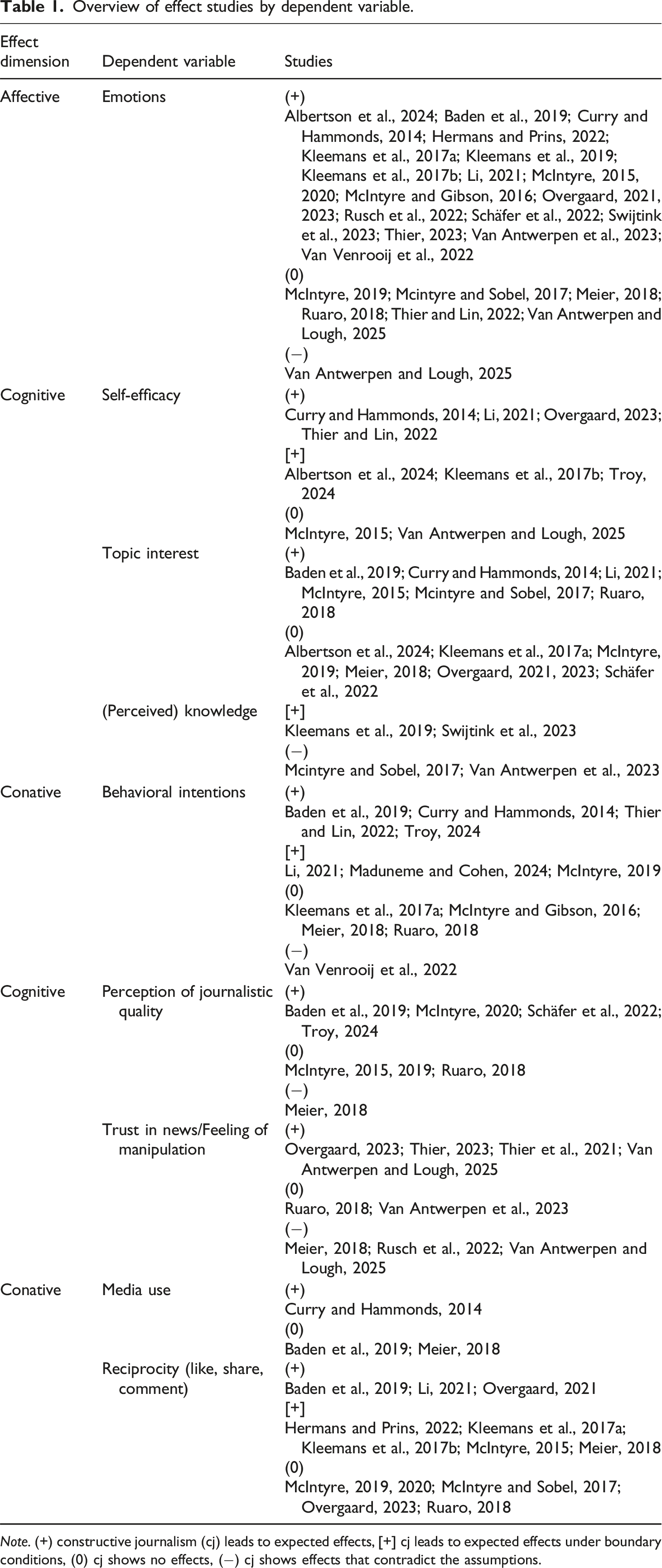
Note. (+) constructive journalism (cj) leads to expected effects, [+] cj leads to expected effects under boundary conditions, (0) cj shows no effects, (−) cj shows effects that contradict the assumptions.
Taking a closer look at the studies uncovers two shortcomings, which are in all probability largely responsible for the heterogeneous state of research. Regarding the independent variable, various ways of manipulating constructive versus non-constructive journalism are used. In most cases, solution orientation is manipulated. However, efforts to manipulate constructive journalism in a holistic way often resulted in several characteristics being manipulated simultaneously in a confounded manner (e.g., Baden et al., 2019). Some studies also deliberately manipulate the number of constructive elements in an article (Mcintyre and Sobel, 2017; Ruaro, 2018). Differences also exist regarding the article version that is compared to the constructive version. In some studies, the non-constructive articles are extremely dramatizing (e.g., “catastrophic frame”; Baden et al., 2019), so it is unclear whether, for example, the differences in the subjects’ emotions are caused by the constructive article version or by the fact known from other research contexts that dramatizing media coverage triggers negative emotions (e.g., Lang et al., 1996). In our view, the inconsistencies in the manipulation of the independent variable can largely be attributed to the lack of conceptual clarity in constructive journalism (Bro, 2023) resulting in inconsistent views of which characteristics of media coverage constitute constructive journalism. This lack of clarity also affects experimental designs, resulting in inconsistent control conditions and disagreement over suitable comparison stimuli.
Regarding the dependent variables, most studies lack a theoretical foundation (see also McIntyre and Lough, 2023; Thier and Namkoong, 2023). While many of them do not cite any theory, others make rather unspecific references to positive psychology in general (McIntyre and Lough, 2023) or broaden-and-build theory in particular (e.g., Baden et al., 2019; Hermans and Prins, 2022). Positive psychology focuses on how individuals achieve positive emotional states and the impact these states have on individuals and society, rather than concentrating on problems and illnesses (Seligman and Csikszentmihalyi, 2000). However, positive psychology itself has been criticized for its theoretical weaknesses, simplifications, and exaggerated claims (e.g., Van Zyl et al., 2024).
The lack of theory concerns, first, the boundary conditions of the effect. Moderating effects of, for example, variables like age or education have not often been tested, mainly because the frequent use of small samples, often consisting of children or students, limits the examination of moderating effects, as such samples offer little variability in relevant characteristics and lack the statistical power needed for subgroup analyses. Second, while media effects are generally considered to be indirect rather than direct (Valkenburg et al., 2016), most studies on the effects of constructive journalism assume that the effects on all dependent variables are a direct result of stimulus manipulation, neglecting the possibility of intervening relationships among these variables in their theoretical models. Only some recent studies considered at least two-stage effect processes (Overgaard, 2023; Swijtink et al., 2023; Thier and Lin, 2022). Although this is an important step forward, there is still the need to establish a theoretical framework.
Therefore, in the following, we want to propose a solution for both shortcomings by first developing a content-centered definition of constructive journalism, from which characteristics can be derived that can be manipulated in experimental studies. We then develop a theoretical framework for analyzing the effects of constructive journalism, taking into account the different dependent variables and their internal relationships, while outlining the various theoretical mechanisms that explain these effects.
Towards a content-centered definition of constructive journalism
Even though constructive journalism has been gaining in importance in both journalistic practice and academia for around 10 years, it is still not entirely clear what exactly this term is meant to mean. This begins with the distinction between the obviously related terms “constructive journalism” and “solutions journalism”. Even though this difference appears to primarily reflect a regional preference, with Europeans favoring the term “constructive” and Americans preferring “solutions” (Lough and McIntyre, 2023), some scholars understand “constructive journalism” as an umbrella term and referenced “solutions journalism” as one method alongside others for engaging in more constructive reporting (Hermans and Gyldensted, 2019; Lough and McIntyre, 2021).
If we assume that these two terms largely describe the same phenomenon, we can roughly distinguish three definitional strands in recent research. In the European journalism tradition, the Constructive Institute recently developed a definition according to which constructive journalism consists of three pillars: (1) focus on solutions, (2) cover nuances (balanced, fair, non-sensational), and (3) promote democratic conversation (Constructive Institute, 2025). In the American journalism tradition, the Solution Journalism Network’s current definition distinguishes four key elements: (1) response (focus on response to a social problem), (2) insight (what can be learned from the response?), (3) including evidence, and (4) discussing limitations (Solutions Journalism Network, 2024). Finally, a large portion of recent academic research builds on a definition from Windesheim University, which identifies at least six constructive elements: (1) focus on solutions, (2) future orientation, (3) inclusiveness and diversity, (4) empower people, (5) context and data (The Rosling), and (6) co-creation (e.g., Hermans and Gyldensted, 2019; Kibarabara, 2023; McIntyre and Gyldensted, 2018). In addition, some studies develop own definitions combining various of these elements (e.g., Hermans and Drok, 2018; McIntyre and Lough, 2021).
Although recent research undoubtedly strives to standardize these definitions, we still see two central problems. The first problem concerns distinguishing constructive journalism from (a) traditional news journalism and (b) other new forms of journalism such as peace journalism (Thier, 2016; Wenzel et al., 2018), civic or public journalism (Midberry et al., 2022; Wenzel et al., 2018), service journalism (From and Nørgaard, 2018), or investigative journalism (Wenzel et al., 2018). The question of how similar constructive journalism is to these forms of journalism especially concerns the question of whether it is viewed as a rather neutral form of journalism or a type of advocacy journalism, aiming at the effects of journalism on recipients and society (Bro, 2023). Or to put it another way: does the fact that one hopes for a better society through constructive journalism necessarily mean that journalists must actively or even in an activist manner work towards a better society? This question remains controversial (Aitamurto and Varma, 2018), although the majority of definitions of constructive journalism explicitly describe it as balanced and non-activist (e.g. Constructive Institute, 2025; Kibarabara, 2023; McIntyre and Lough, 2021).
The second problem concerns the fact that all definitions of constructive journalism somehow include expected or desired effects (“engage and facilitate debate”, Constructive Institute, 2025; “empower people”, Hermans and Gyldensted, 2019; “work against polarizing dynamics”, McIntyre and Gyldensted, 2018). This isn’t necessarily a problem in principle, but it becomes problematic when examining the effects of constructive journalism, because it is circular to include effects in the definition that are actually to be examined in the course of the study. The aim therefore should rather be to include content features in the definition that are likely to cause the desired effects.
Criteria for constructive journalism.
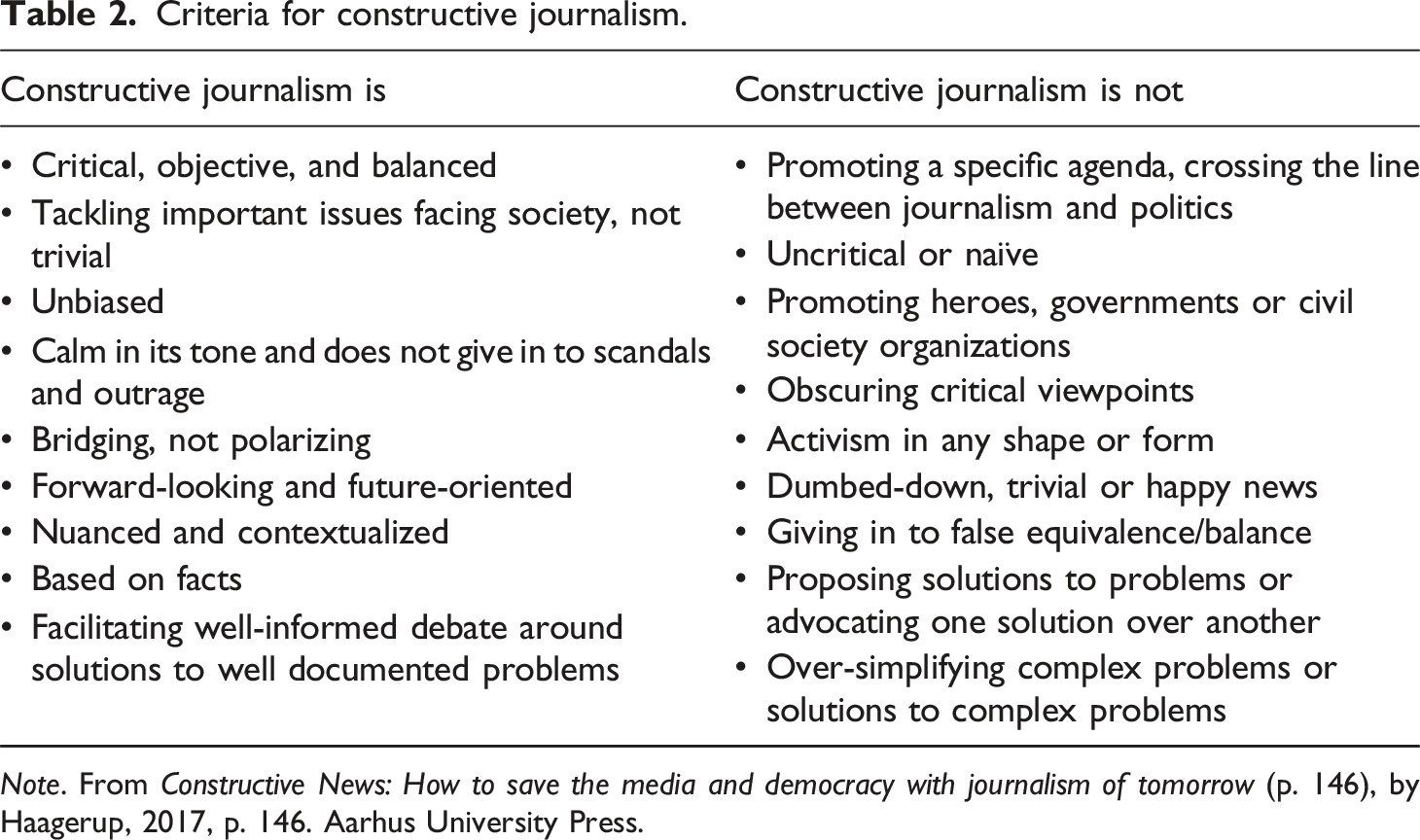
Note. From Constructive News: How to save the media and democracy with journalism of tomorrow (p. 146), by Haagerup, 2017, p. 146. Aarhus University Press.
Against the background of media quality research, three dimensions can be derived from this catalog: 1) Balance: Content characteristics like “objective”, “balanced”, “unbiased”, and “not activist” clearly refer to the news quality dimension of balance and diversity. In this sense, constructive journalism is critical, but at the same time unbiased in terms of an adequate representation of various opinions, actors and issues (Eberl et al., 2017). Thus, constructive journalism also does not blindly favor positive reporting but avoids the negativity bias of problem-centered media coverage. Constructive journalism is explicitly not activist or promoting a certain political agenda. 2) Matter-of-Factness: A second group of content characteristics defines constructive journalism as “not trivial”, “calm in its tone”, “based on facts”, and “nuanced and contextualized”. These criteria directly refer to a dimension of news quality that is usually called matter-of-factness or detachment (McQuail, 1992: 233). In this sense, constructive journalism addresses socially relevant issues, focuses on facts and rational reasoning, and refrains from scandalizing and outrage-driven reporting, such as emotive terms and exaggerations. This dimension also includes the use of evidence and facts, which form a separate dimension in other definitions of constructive journalism (“The Rosling”), because evidence and facts contribute to factual reporting. 3) Focus on solutions: The remaining characteristics define constructive journalism as “bridging”, “future-oriented”, and “(facilitating debates about) solutions”. Consequently, a focus on solutions is the third and only dimension that clearly distinguishes constructive journalism from established journalism. Constructive journalism extends the established focus beyond problems to present solutions. Because these usually involve solutions for the future, this dimension also includes future orientation.
Accordingly, based on these three dimensions, we propose the following content-centered definition of constructive journalism: Constructive journalism is a form of journalism that reports in a balanced and factual manner on socially relevant problems and solutions to solve them. It clearly separates constructive journalism from activistic and partisan forms of journalism and at the same time treats constructive and solutions journalism as two different terms for the same thing. Moreover, we believe that the focus on content characteristics brings several advantages with it: (1) The journalistic core functions are captured using established terms. (2) Using these terms links research on constructive journalism to the established dimensions of news quality. (3) All three dimensions can be clearly operationalized and consequently serve as a starting point for a theoretical effects model.
Towards a theoretical framework for analyzing the effects of constructive journalism
Recently, various authors explicitly pointed to the fact that the current state of research on the effects of constructive journalism lacks a theoretical foundation. It should “be more theoretically guided” (Thier and Namkoong, 2023: 1567) and “there is still work to be done in establishing and building theory around constructive and solutions journalism effects” (McIntyre and Lough, 2023: 17). Our goal is to develop a comprehensive and cohesive framework that assembles the diverse effects fragmented across separate studies in a coherent structure demonstrating their mutual dependencies. Following the systematization used to categorize the effects observed in existing research, we distinguish between journalism-related and democracy-related outcomes and structure our framework along affective, cognitive, and conative dimensions. Among these dimensions we propose the following interdependencies:
We assume that, first, the content characteristics (balance, matter-of-factness and focus on solutions) affect recipients’ emotional states. Unlike prior studies that mostly compare constructive with non-constructive articles, we aim to disentangle the effects across these three content dimensions. Second, the altered emotional states influence recipients’ cognitive processes, affecting variables like topic interest, knowledge about this topic, and self-efficacy (democracy-related effects), as well as quality perceptions and trust in the respective medium (journalism-related effects). Finally, these cognitive effects shape outcomes on the conative dimension, influencing recipients’ willingness to contribute to problem-solving efforts (democracy-related), as well as media use and reciprocity (journalism-related). In addition, we assume that interactions also occur among variables within the cognitive and conative dimensions. For instance, greater interest might result in increased knowledge. Finally, recipient characteristics, such as sociodemographic variables, political orientation, and personality traits, affect the outcomes discussed. Figure 1 shows the general framework. Given the diversity of variables, different theoretical mechanisms govern their interactions, varying according to the specific variables considered. As it is not feasible to account for the proposed effects using one single theory, various components from existing theories are employed and linked together to explain the assumed effects step by step. A framework for theorizing the effects of constructive journalism.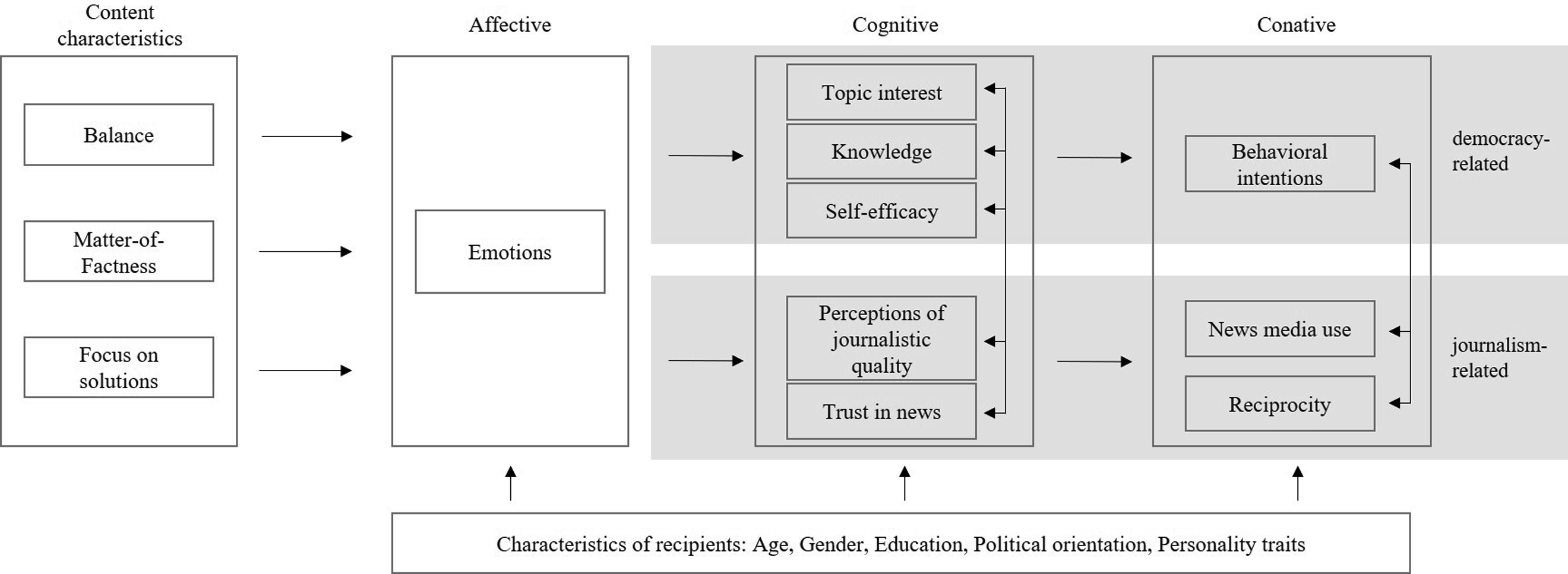
Effects of constructive journalism’s content dimensions on emotions
In the first step, our model assumes that the presence or absence of constructive journalism’s content characteristics influences recipients’ emotions, distinguishing effects across balance, matter-of-factness, and focus on solutions. Appraisal theory is currently the most influential explanation for the origin of emotions. It assumes that emotions affect cognitive processes, thus theoretically linking emotional and cognitive dimensions (see Effects of emotions on cognitive variables). According to this theory, emotions arise from a cognitive appraisal process where individuals assess environmental stimuli across various cognitive dimensions, such as goal relevance, valence, agency, and control (e.g., Scherer and Moors, 2019).
The valence of an emotion, positive or negative, is influenced by the valence of the stimulus. This theoretical relationship can also be applied to the context of news reception. Numerous studies showed that news focusing on problems, conflicts, or failures elicits negative emotions in recipients, whereas news focusing on successes, positive outcomes, and opportunities, results in more positive emotions (e.g., De Hoog and Verboon, 2020; Nabi et al., 2020). However, also in line with appraisal theory, we can assume that sensational and outrage-focused reporting adversely affects how recipients cognitively evaluate situations, making them perceive negative outcomes as more severe and likely. Previous research demonstrated that dramatizing media coverage, unlike factual and detached reporting, elicits and intensifies negative emotions (Lang et al., 1996; Otieno et al., 2013). Finally, according to the appraisal theory, biased news about political actors in partisan media coverage can cause recipients to feel anger toward these people and perceive them as a threat to their personal goals and well-being. Consequently, research examining the effects of partisan reporting revealed that consuming partisan news, pro-attitudinal as well as counter-attitudinal, is more likely to provoke negative emotions than consuming more balanced news coverage (Wojcieszak et al., 2016).
Effects of emotions on cognitive variables
In the second step, our model assumes an influence of recipients’ emotions on various cognitions. The appraisal theory posits that emotions triggered by cognitive evaluations result in physiological responses, which subsequently affect further cognitive processes (e.g., Scherer and Moors, 2019). This is supported by a large body of evidence suggesting that emotions triggered by news consumption are likely to influence the subsequent cognitive processing of the consumed news content (e.g., Nabi et al., 2020).
In line with appraisal theory, Fredrickson (1998) suggests that emotions shape cognitive processes. Her broaden-and-build theory proposes that, in contrast to negative emotions, positive emotions broaden individuals’ cognitive repertoires. Since she draws on empirical findings from educational psychology, we refer to the four-phase interest model by Hidi and Renninger (2006) to offer a more granular explanation in terms of individual variables. They propose that early stages of interest are fueled by positive feelings and consider positive affect during interaction with a topic as a foundation for triggering, developing and maintaining interest towards this topic. Educational psychology offers profound empirical evidence for the positive effect of positive emotions on interest (e.g., Pekrun et al., 2002).
Following the model, we assume that increased topic interest positively affects knowledge in that area, indicating that emotional effects can indirectly transfer to additional cognitive variables. As the interest of a person towards a topic continues to develop and strengthen, the intrinsic motivation to seek knowledge about the topic of interest increases, resulting in a higher stored knowledge compared to the earlier phases of interest (Hidi and Renninger, 2006). Consequently, a substantial body of empirical research in educational psychology (Krapp, 1999) as well as political communication research (David, 2009) supports the proposition that increased topic interest results in greater knowledge acquisition about that topic.
The established research on self-efficacy demonstrates that factors from both the emotional and cognitive dimensions jointly influence self-efficacy, which in turn functions as a key link between cognitive and conative dimensions (see effects of cognition on behavior). According to Bandura (1997: 3) “perceived self-efficacy refers to beliefs in one’s capabilities to organize and execute the courses of action required to produce given attainments”. The model of Gist and Mitchell (1992) on self-efficacy determinants suggests that greater knowledge in a specific area leads to higher self-efficacy in that domain. This positive effect was empirically validated, for example, in the context of teaching (Menon and Sadler, 2016) and entrepreneurship (Chowdhury et al., 2019). Similarly, emotional arousal can influence self-efficacy beliefs (Bandura, 1977). Negative emotions can be interpreted as a signal of lacking ability or control, reducing self-efficacy, while positive emotional experiences can enhance beliefs in one’s ability to manage a situation, fostering self-efficacy (Morris et al., 2017). This is consistent with meta-analyses on threat appeal theory, which indicate that threatening information is only effective when self-efficacy is already high (Peters et al., 2013).
Regarding journalism-related factors, recipients’ emotions influence their perceptions of media quality as well as trust in the news. The theory of affective priming proposes that positive (negative) emotions, triggered by the previously described appraisal process, automatically activate congruent information in memory, making positive (negative) information more accessible during recall (Klauer, 1997). Consequently, positive (vs negative) emotions can influence evaluations and judgements positively (vs negatively), as shown in various contexts, including news content evaluation (Gurr, 2022). Trust can be defined as a relationship characterized by a degree of uncertainty, where past experiences and positive expectations encourage a trustor to be vulnerable to a trustee (Fawzi et al., 2021). In line with discrepancy theory, trust in news media is determined by the alignment or discrepancy between recipients’ expectations and their evaluations of the perceived journalistic quality of the content (Kohring and Matthes, 2007). Hence, more positive evaluations of news media content, also activated by positive emotions, lead to greater trust in the news (Fawzi et al., 2021). Furthermore, a broad body of research suggests that political interest and political knowledge are positively associated with media trust (for an overview see Fawzi et al., 2021), indicating that there are also associations between democracy-related and journalism-related variables.
Effects of cognitions on behavior
To explain how changes in processes and states within the cognitive dimension can affect the conative dimension, we first use the Theory of Planned Behavior (Ajzen, 1991) and the Social Cognitive Theory (Bandura, 1977), both fundamental approaches to explaining human behavior. According to these frameworks, an increased self-efficacy regarding a specific behavior, driven by e.g. positive emotions or enhanced knowledge, leads to a stronger intention to perform that behavior. Studies have extensively validated this causal connection empirically (Armitage and Conner, 2001).
Acknowledging that recipients aim to maximize utility, have limited capabilities to verify media content through non-media sources, and cannot feasibly consume all available news, they predominantly engage with topics of interest from sources they trust (Strömbäck et al., 2020). Research demonstrates that topic interest and trust in the news shape patterns of news media use (e.g., Vermeer et al., 2022). Moreover, as individuals with lower levels of news media use are less likely to interact with its content, media use is a central factor for predicting reciprocity (Kalogeropoulos et al., 2017).
Effects of recipient characteristics
Media effects are not merely caused by media properties alone, but emerge from the interaction of dispositional, developmental, and social context factors with media properties (Valkenburg et al., 2016). Thus, effects of constructive journalism may be strengthened or weakened depending on individual differences, such as sociodemographic factors (age, gender, education), personality traits and political orientations. For example, need for cognition can moderate the effects of constructive journalism on cognitive processing, while empathy can moderate emotional processing (Valkenburg et al., 2016). Therefore, some effects of constructive journalism may not apply to the entire population, but only to individuals with certain characteristics.
Discussion
Traditional journalism focuses on problems and conflicts and has several unintended, negative consequences for democracy and journalism itself. Constructive journalism, as a counterpart, is associated with several hopes. Accordingly, constructive journalism should contribute to a better society with more engaged citizens (democracy-related effects) and at the same time increase trust in the news media and, as a result, news media use (journalism-related effects). However, it is still largely unclear whether these effects occur because the state of research on the effects of constructive journalism is extremely heterogeneous. We have attributed this to two causes: Firstly, there are very different ideas about what constructive journalism is or should be. This lack of a clear definition has led to very different content characteristics being manipulated in experimental studies on the effects of constructive journalism. Secondly, there is currently no theoretical framework for analyzing the effects of constructive journalism. This lack of theory has led to the fact that effect studies have mostly examined direct effects on various dependent variables, which they often have not found.
In this paper, we have tried to find a solution to both shortcomings. Regarding the definition, we argued that the effects of constructive journalism can only be meaningfully investigated if clear content characteristics for constructive journalism are defined. We have therefore proposed a content-centered definition of constructive journalism, whereby we have grouped content characteristics provided by Haagerup (2017) into three main dimensions (balance, matter-of-factness and focus on solution) leading to a definition of constructive journalism as a form of journalism that reports in a balanced and factual manner on socially relevant problems and solutions to solve them. In this sense, constructive journalism is nothing other than classic news journalism, which is supplemented with a solution-oriented approach. This means that constructive journalism is not necessarily a special form of journalism that reaches a niche audience through its own channels. Rather, it is about making traditional news journalism more constructive overall.
Regarding the theoretical framework, we structure the diverse dependent variables analyzed across multiple studies into cohesive building blocks informed by our systematization of existing research. Moreover, we argue that different theoretical mechanisms are required to explain the interactions between variables, depending on the specific ones involved. Therefore, we incorporate components from multiple existing theories, as a single theory cannot fully explain the effects. Though constructive journalism is a relatively new journalistic approach, we argue that the assumed underlying mechanisms are by no means new but can be modeled using a series of established theories.
Instead of direct effects of constructive reporting on various variables, we assume a chain of effects along emotional, cognitive, and conative dimensions divided into democracy-related and journalism-related impacts. Furthermore, we examine effects across the three defined content dimensions balance, matter-of-factness, and focus on solutions, instead of one-dimensional comparisons (constructive vs non-constructive). These characteristics first affect recipients’ emotions, which then impact cognitive variables (self-efficacy, interest, knowledge, perceptions of media quality, and trust in the news) ultimately influencing conative variables (behavioral intentions, media use, reciprocity). Moreover, we also considered relationships within the variable groups, such as the effects of self-efficacy on topic interest. Finally, we assume that recipient characteristics, such as age, education, and political orientation, influence the variables and their relationships, causing the effects to vary among recipients.
We believe that our paper contributes to the systematization of past and future research on the effects of constructive journalism in two ways. First, a definition based on clearly operationalizable and empirically separable content features, which also builds on previous research on media quality, opens up the possibility of experimentally manipulating the dimensions separately in order to examine their effects individually. For example, to isolate the effects of focus on solutions on recipients’ emotions and topic interest, the other dimensions matter-of-factness (e.g., through factual, non-emotional language) and balance (e.g., by including diverse viewpoints and actors with different perspectives, though considering the weight of evidence and consensus when doing so) should remain constant while varying the presence or absence of solutions in the article stimuli. Subsequently, path modeling can assess the proposed causal mechanism from focus on solutions to emotions, and from emotions to topic interest. By including moderator variables (e.g., political orientation), the model also accounts for individual differences among recipients. In this way, future studies should aim to specifically separate the effects of different dimensions instead of confoundingly manipulating different characteristics. Second, our theoretical framework is the first approach to address the need for a stronger theoretical focus. It disentangles the effects of clearly defined content dimensions, systematizes the diverse dependent variables scattered across different studies into a coherent structure, and offers testable theoretical mechanisms that integrate constructive journalism research into established media effects theories.
Our paper might therefore serve as the starting point of a systematic research program on the effects of constructive journalism which might not only examine the effects but also their constraints. First, content analysis should examine how traditional news media and self-proclaimed constructive formats meet and differ in content criteria for constructive journalism. These studies should also empirically verify the theory-based dimensionalization of constructive journalism, for example, using factor analysis. Second, the question of which recipients choose constructive versus problem-centered journalism requires experimental studies to simulate selection decisions realistically. For instance, the click behavior of recipients could be analyzed in mock website experiments including articles manipulated across different content dimensions. Finally, a series of experimental studies should be conducted to test the theoretical framework, manipulating the three dimensions separately, considering varying topics, and accounting for differing recipient characteristics. Instead of testing numerous dependent variables simultaneously, the focus should be on investigating theoretically relevant mechanisms. This could then also lead to an adjustment of the theoretical model, e.g. because the studies show that feedback effects also occur (behavior influences emotions, etc.).
Footnotes
Declaration of conflicting interests
The authors declared no potential conflicts of interest with respect to the research, authorship, and/or publication of this article.
Funding
The authors disclosed receipt of the following financial support for the research, authorship, and/or publication of this article: This work was supported by the German Research Foundation [grant number 512131520].
