



Abstract
The study analyzes 429 news articles from six local newspapers and interviews with 15 journalists and editors to assess the state of local science journalism in Qatar. Despite significant investments in scientific infrastructure, local science news has not kept pace, with most stories sourced from foreign agencies and lacking contextual relevance. This is due to a science-unfriendly news culture where local science is not seen as newsworthy for the largely expatriate audience, and “copy-and-paste” journalism is prevalent. The study recommends addressing structural challenges to foster a news culture that values and supports local science journalism in Qatar and beyond.
Keywords
Introduction
Scholars highlight the crucial role of science journalism and communication, especially in the Global South, for bridging the gap between science and society which matters for human progress and development (Angler, 2017; Claassen, 2011; Nguyen, 2024; Nguyen and Tran, 2019). For some scholars, science journalists act as mediators, making scientific achievements accessible to publics (Claassen, 2011; Peters, 2014). Others support science journalism as an effective way to communicate scientific discoveries, assess the risks and benefits of controversial scientific studies, and raise awareness to general audience (Appiah et al., 2012; Dutt and Garg, 2000).
Science journalism faces numerous challenges that include inconsistent practices, time and space constraints, unstable media markets, and political and cultural pressures – all especially evident in the Global South (Alhuntushi and Lugo-Ocando, 2023; Amend and Secko, 2012; El-Awady, 2009; Mellor 2023; Weaver and Willnat, 2012). Additionally, there is the issue of low local science news content, which in practice means underreporting national scientific projects and achievements, and a low degree of localization of foreign-sourced science news. A small but growing number of researchers are paying attention, but few studies have examined the problem in detail or provided in-depth understandings. This article addresses the gap, combining a quantitative content analysis of science news output and qualitative in-depth interviews with reporters and editors to investigate the state of local/localized science journalism and its sociocultural shapers in Qatar, a wealthy country in the Global South that has invested significantly in scientific research and development.
Paucity of science news in the Global South
Studies of journalism practice in the Global South indicate a common reliance on foreign news sources. This was found in India (Dutt and Garg, 2000), Peru (Takahashi and Meisner, 2013), Chile (Valderrama et al., 2014), Pakistan (Kamboh et al., 2022), Vietnam (Tran and Nguyen, 2023) and South Africa (Joubert, 2007) among others. Dutt and Garg, for example, write, the “Indian English-language press lacked specialized paraphernalia to report science news and instead found it easier to repackage the information based on the items from the foreign news agencies” (2000: 6). A study on media coverage of climate change in Nigeria and South Africa found most articles were sourced from Western wire services (Tagbo, 2010). Cross-country analyses of newspapers in Latin American countries found the same pattern (Massarani and Buys, 2007; Massarani et al., 2005).
Sourcing science news from abroad, some published verbatim and others translated into the vernacular of the local paper, is an identified issue in studies on the lack of science news localization in the Global South. Other aspects include a paucity of reporting on homegrown scientific activities and failing to contextualize foreign-sourced news. Lisbeth Fog, a Colombian freelance journalist observed that “local science rarely reaches the media” (Shanahan, 2006: 392). The study by Massarani et al. (2005) of how seven newspapers in Latin America covered scientific and technological news found that regional journalists uncritically borrowed from news agencies based in the West, in many cases reprinting them “without enough concern” for the “local reality,” and when some attempted to contextualize the stories they produced “insufficient” results (Massarani et al., 2005: 5).
Lack of local and localized science news in the Global South has consequences. Cameroonian journalist Buma Gana lamented that “we only hear of scientific research carried out in Africa from the Western media, because the studies are published first in the West” (quoted in Shanahan, 2006: 392). This can create ignorance among Africans about their own scientific activities and expertise, distorting perceptions of achievements in locally produced knowledge. Excessive reliance on foreign science news can exacerbate public health crises. In their examination of local newspapers in Pakistan during the COVID-19 pandemic, Kamboh et al. (2022) found that, “instead of generating local content (e.g. investigative stories) on the current national vaccine roll-out program in Pakistan … Urdu-language newspapers are picking, translating and reporting such content from foreign sources” (281). The authors provided examples of poorly translated articles about Moderna and AstraZeneca vaccines that, lacking context and vital details, fomented vaccine hesitancy among Pakistanis (Kamboh et al., 2022: 281–282).
Beyond immediate and episodic impact, there is concern about enduring damage to local and global development causes, including reinforcement of a neo-colonial order in science and knowledge (Nguyen, 2024). Heavy reliance on science journalism from the North is a result of a modernization project that tends to cheer-lead science. As Waisbord (2023: 5) put it, “to sing the praises of technological innovations and salute ‘developmentalist’ projects of capital, public works and lavish science centers. This is “deeply problematic” because: A journalism enraptured by “silver bullet” approaches to global problems, and perennially interested in the “next big tech” solution to intractable problems grounded in capitalistic dynamics, is misguided. It perpetuates hackneyed, deceptive narratives about science and progress, and disregards structural conditions, local priorities, accountability and historical context (Waisbord, 2023: 5–6).
External and internal factors contribute to the paucity of local science news in the Global South. Externally, the Global North is the main producer of scientific knowledge and the South is underrepresented. Most scientific research is published in Northern journals, even when consumed by readers in the Global South. This is coupled with a global news system dominated by Northern media organizations, which creates a predominantly unidirectional flow of knowledge and news from the north to countries in the Global South (Dimitrova, 2021; Slavtcheva-Petkova and Bromley, 2019). These factors reflect a structural dependency on Nothern science news in the South with important consequences.
Internally, newsrooms in the Global South do not prioritize reporting science news (Nguyen and Tran, 2019). While reasons vary, two common causes are a shortage of science journalists and a generalizable condition of under resourced “news desks” for reporting on science (Kamboh et al., 2022; Mellor, 2023; Tran and Nguyen, 2023). Newsrooms in the Global South do not typically support science news production. For example, in the Arab world, there is typically a “specialisation hierarchy within newsrooms, placing political, economic, and sports news above science news” and a disproportionately small number of science publications relative to the size of an Arabic-speaking population (Mellor, 2023: 2). These factors are compounded by “a lack of English-language skills, combined with a lack of scientific sources in Arabic” among reporters in the Arab world (El-Awady, 2009: 1057). Additionally, Global South reporters often face difficulties accessing local scientific institutions. One Egyptian journalist illustrated the issue: “As I sit at my desk in Cairo, it is easier for me to know what is happening in American universities halfway across the globe than to know what is happening within the walls of Egypt’s National Research Center just across the street” (El-Awady, 2009: 1057). According to another account, “foreign scientists respond faster than local ones, if contacted to comment on their research” (Mellor, 2023: 3). Journalists and scientists in the Global South do not cooperate well due, in part, to different perceptions of how science ought to be communicated (Jia and Liu, 2014; Ndlovu et al., 2016; Zhang et al., 2015).
Research context
Qatar, a wealthy petrostate in the Gulf, has made substantial financial investments in scientific infrastructure and research for 30 years. In 1995, the Qatari government established a now influential institution shaping higher education and scientific research: the Qatar Foundation for Education, Science, and Community Development (QF). QF started with a K-12 school (Qatar Academy) in 1996 and followed up with building a branch campus of Virginia Commonwealth University in 1998. The area where these two schools were built was expanded to become Education City (EC), a 1000-hectate complex of six American university campuses, the local Hamad Bin Khalifa University (HBKU), the Qatar National Library, and other institutions (Frank, 2006). 1 American universities include Weill Cornell Medicine-Qatar (WCMQ), Georgetown University in Qatar (GUQ), Carnegie Mellon University in Qatar (CMUQ), and Northwestern University in Qatar (NUQ).
In 2009, Qatar inaugurated the Qatar Science and Technology Park (QSTP), adjacent to Education City, that serves as an incubation facility for scientific and technological innovation with a focus on commercialization (“Qatar Opens Science Park,” 2009). QSTP’s flagship programs, XLR8 (accelerate) and ELV8 (elevate), provide mentorship and financial support for aspiring entrepreneurs to foster startups. 2 Additionally, QF established three research institutes: the Qatar Computing Research Institute (QCRI); Qatar Environment & Energy Research Institute (QEERI); and Qatar Biomedical Research Institute (QBRI), that were integrated into HBKU. Today, there is a robust research infrastructure and scientists from many disciplines and countries work for various research organizations in Qatar. The Qatar National Research Fund (QNRF) was established by Qatar Foundation in 2006 and has invested at least US$ 1.4 billion as of 2022 (QNA, 2022).
Given such vigorous investment, is Qatari news media interested in and attentive to local science developments? We provide some answers to this question based on the results of a content analysis and in-depth interviews done with QNRF funding that investigated the state of Qatari science journalism. Based on the literature review and with situated awareness of Qatar, we asked two research questions that pertain to this article: To what extent is science news local or localized? What factors explain that level of local or localized science news in Qatar?
Methods
This article is part of a broader research project that used mixed methods to investigate science journalism in Qatar. We assessed a sample of 429 news items on new scientific discoveries in Qatari print media, conducted in-depth interviews with 15 Qatar-based reporters and editors with experience in reporting science news, convened a Delphi Panel with six local scientists, and organized six focus group discussions with local audience segments. This article reports relevant findings from the content analysis and the in-depth interviews, focused on the production of science news, to address the two research questions above.
Content analysis
Distribution of sampled stories across six Qatari news titles.
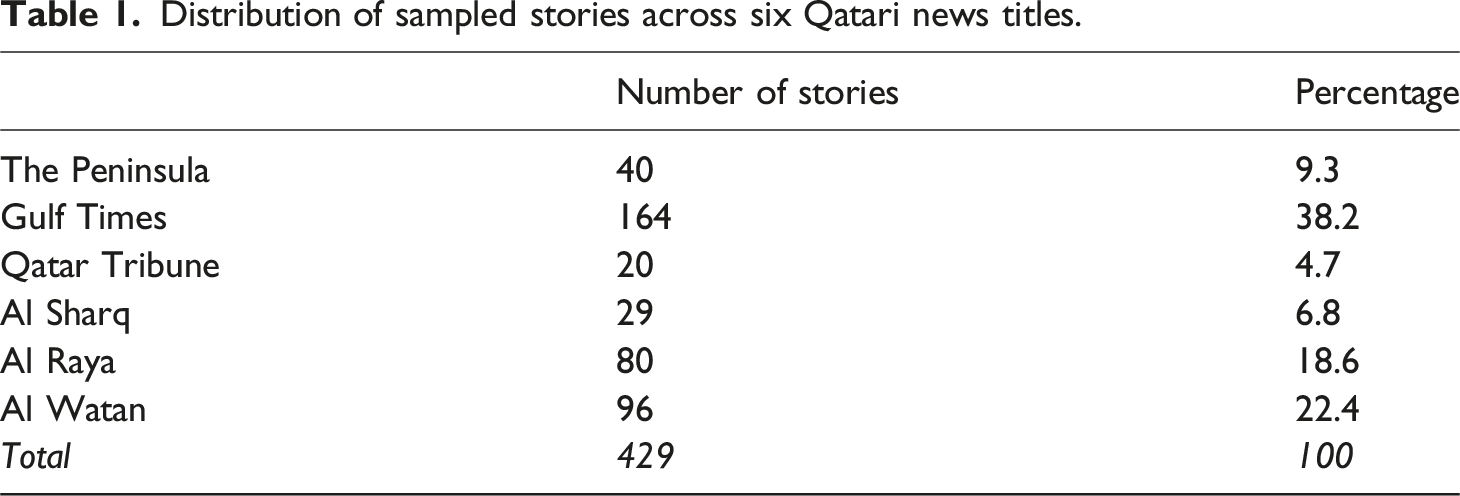
We developed a codebook for the content analysis with definitions for 24 variables pertinent to key aspects of science news content, including the original source of the news item (foreign or local), the location of the author(s) (Qatar or abroad), where the research or study was conducted, whether a story included original reporting produced by local journalists, whether the story was explicitly linked to local Qatari issues or interests, whether the overall tone was positive, negative or neutral, and so forth. In addition, we collected data representing editorial decisions such as the page on which the story appeared, the section in which it appeared, and where it was located on the page.
We recruited five NUQ student research assistants and trained them to code the content for 8% of the sample until they reached a minimum mutual agreement of 95% and an inter-coder reliability co-efficient (Krippendorff’s alpha) of at least 0.8 for all variables. The lowest Kalpha achieved was 0.81 (for story tones) and the highest was 0.92 (for story position). This range is acceptable by convention.
In-depth interviews
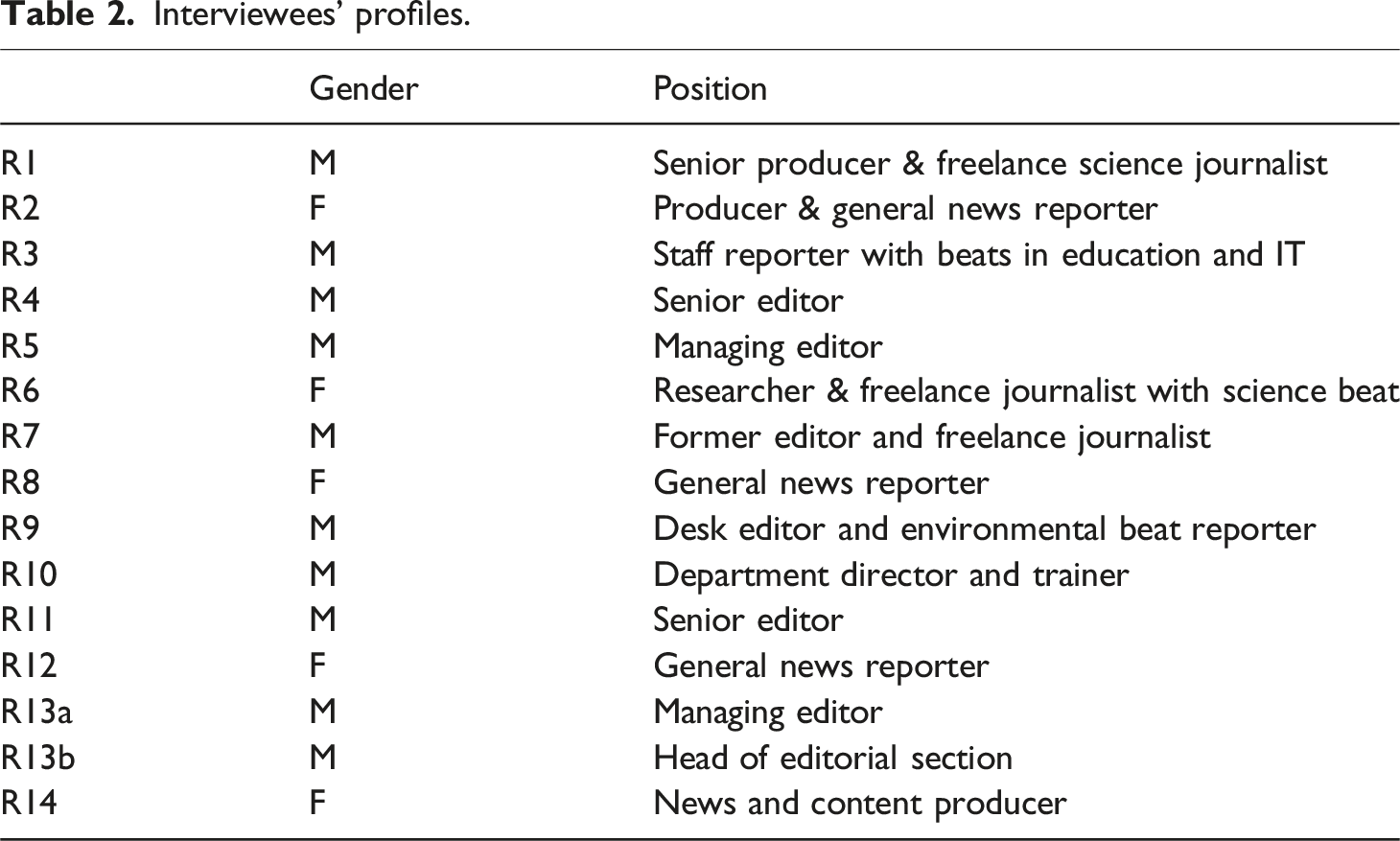
We conducted semi-structured interviews with 15 Doha-based journalists, editors, producers, and managers. We used a convenience sample derived from local contacts and the snowball technique to recruit additional respondents. We interviewed five female and ten male respondents. The imbalance reflects the general population of Qatar where males outnumber females almost 3 to 1 (Galal, 2021:128). This reality is mirrored in most newsrooms.
We initially planned to interview science reporters and their editors but quickly learned that specialist science reporting for print media was almost non-existent. We therefore interviewed journalists with some experience reporting on science topics. Only one informant (R1) self-identified as a science journalist, having developed a website with Arabic science content and holding a master’s degree in engineering. Another interviewee (R7), with a science degree, worked as a freelance writer on public health and medicine for a Qatari online outlet but did not consider herself a science journalist. The rest did not identify as science journalists, although they had covered science-related topics. We also interviewed senior and managing editors. In Qatar, many reporters and mid-level editors are expatriates while senior editors are Qatari citizens. Apart from the two mentioned, the rest had either formal or informal training in communications or journalism.
We conducted the interviews over the course of 5 months from April through August 2022. We interviewed respondents in the manner each preferred, including in-person meetings at their workplaces, at the NUQ campus, or in virtual conversations on the Zoom platform. Depending on the respondent, each interview lasted from 30 min to more than an hour. All but four interviews were done in English, with at least two of the research team members present. Four respondents preferred to speak in Arabic and were interviewed by a team member who is fluent. We recorded every interview with written permission of the respondent on the condition of anonymity. The records were anonymized and then transcribed by Intelligence Qatar (IQ), a Doha-based market research agency. For the Arabic interviews, IQ transcribed first to Arabic and then translated into English.
Interviewees’ profiles.
Results
We found a lack of local and localized science journalism in Qatar. This runs counter to the country’s investment in scientific research and ambitions to make Qatar an “international hub for cutting-edge research, innovation, and development” (QRDI, 2025). A large proportion of science news published in Qatari print media are published verbatim from foreign sources or translated from English into Arabic with very little localization. The overarching reason is the lack of a science news culture in Qatar. Local reporters and editors typically don’t consider science newsworthy enough to invest money and time producing local science journalism or for training journalists to do that. This is reinforced by a general copy-and-paste news culture among Qatar-based journalists who are primarily expatriate workers who struggle with cultural disengagement, high degrees of political control, and difficulty getting access to scientists as news sources.
News coverage of science discoveries in Qatar: the current state
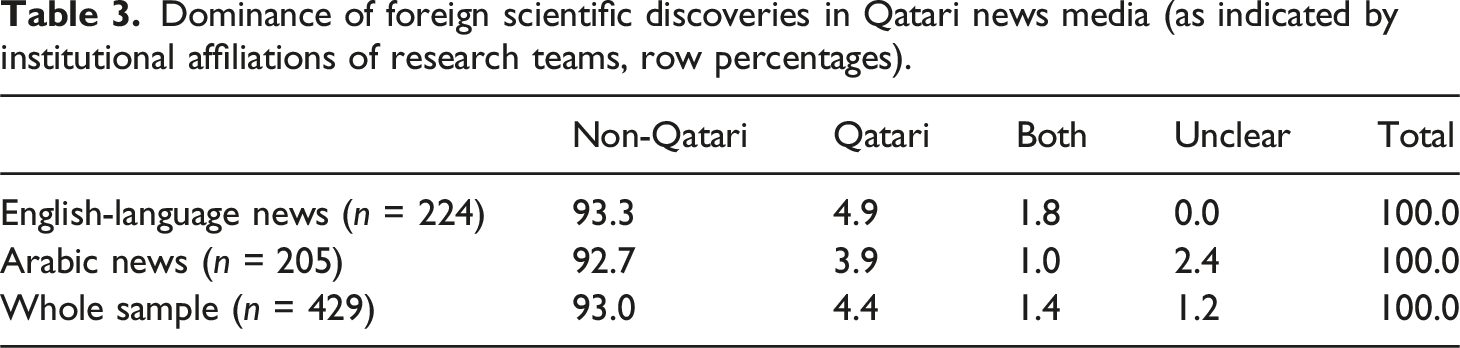
Dominance of foreign scientific discoveries in Qatari news media (as indicated by institutional affiliations of research teams, row percentages).
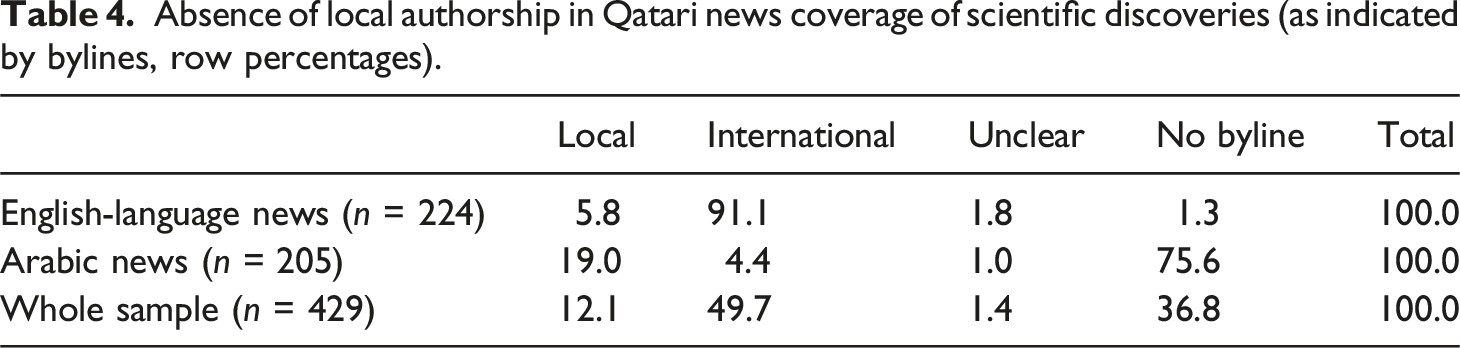
Absence of local authorship in Qatari news coverage of scientific discoveries (as indicated by bylines, row percentages).
Very low levels of original reporting (row percentages).
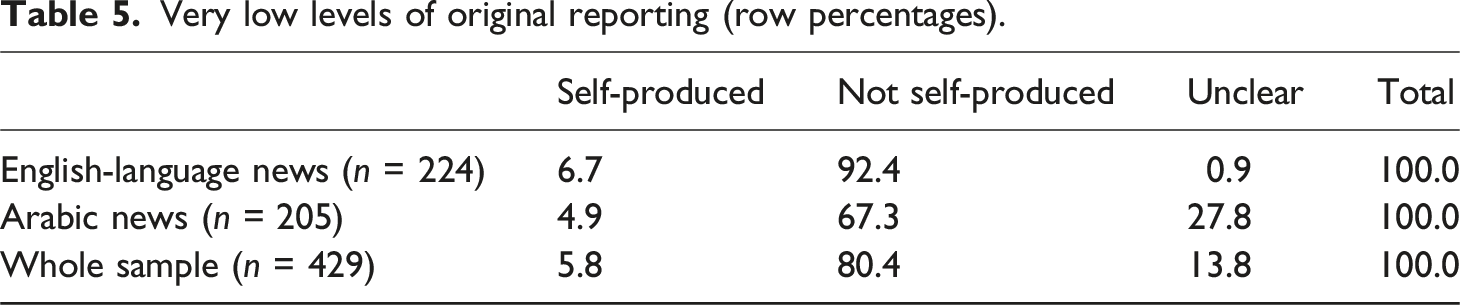
Typically, science news articles published in Qatari news media are copied verbatim from Northern/Western sources, with very little localization for people living in Qatar. As an example, one article on an increased risk of death connected to inactive lifestyles was taken from IANS London, which reported a study done by a Norwegian scientist on a group of Norwegian residents (“Sedentary Lifestyle Linked to Doubled Mortality Risk,” 2019). Although the findings may be applicable to the lifestyles of some Qatari residents, there is no mention of how or why the risk increased, or any noted connection to inactive lifestyles in Qatar. That is problematic because Qatar has promoted active lifestyles for years. It even has a national holiday promoting engagement in sports activities. Science news about health issues with direct relevance to Qatari residents – such as cancer risk due to exposure to the sun (“Exposure to Sun Can Increase Skin Cancer Risk in Athletes,” 2019), the benefits of taking vitamin C (“An Apple a Day Can Keep Pneumonia Away,” 2019), and the connection between social media and high rates of depression among girls (“Social Media Linked to Higher Risk of Depression in Girls,” 2019) were published verbatim with no effort to localize. Such stories may be “good to know,” but they beg the “so, what?” question for local audiences.
Our in-depth interviews with journalists and editors offer two main reasons explaining the lack of localization of science news in Qatar. The first and more immediate reason is a systemic indifference to science topics in Qatari newsrooms due to the perception of them as un-newsworthy for a predominantly expatriate readership. The second is rooted in the broader news culture of Qatar in which journalists, mostly “unbelonging” expats working under tight controls of the host country, (a) see chronicling local community events, routine government activities and policies as their priority function and (b) are accustomed to copy-and-paste news practices rather than original, independent or specialist news reporting. These factors combine to create a peculiar newsroom environment in Qatar.
A systemic indifference to science news
The in-depth interviews identified a systemic lack of interest and investment in science journalism by Qatari media. As one senior editor explained: “Look, science [news] is seasonal … depending on the existing issue. When it was corona, medical topics were the most demanded. Sometimes scientific explorations are the ones demanded” (R11). Another editor said science reporting “is not the focus of newspapers in Qatar,” adding: “It is not our mission to create (science) interest in the readers. … at least as we practice here.” His goal is to “catch the interest” of readers rather than generate interest, R5 said. The main duty of his newspaper was to “disseminate information.”
Despite the strong emphasis on local affairs, Qatari news media rarely cover local science or link international science to local communities. Respondents agreed that Qatari newspapers focus on practical local affairs for expatriates, such as events, achievements, community happenings, and government messages. The Arabic newspapers serve the Arabic-speaking population, while the English newspapers for the English-speaking communities. Most local content targets the multinational audience in Qatar, where only 313,000 of the 2.6 million residents in 2017 were Qatari citizens (Dudley, 2017). As a senior editor of an English-language newspaper (R4) explained: “Foreigners in particular love to learn new things in the country, such as any decision issued for passports, any decision issued by aviation, any decision issued by the Ministry of Commerce, any decision made by local authorities.” Thus, according to R4, his paper allocates “from 40% to 45%” to print government announcements and local affairs and doesn’t publish a substantial amount of international news. It focuses on breaking news rather than in-depth reporting because foreigners can get additional information from international sources, including those in their home countries. While much of what is published is clearly pro-government and lacks critical reflection, it can have public service value by informing Qatar residents on events and the actions of national leadership.
There is a broadly shared perception that readers are not interested in science. One reporter said it was rare for the newsrooms to cover science because of “honestly, the lack of audience engagement” (R2). This was echoed by another reporter: “Science as it is may not be an interesting topic for the readers. It only has a particular section of the readers [who] might be engrossed in reading science stories” (R3). Another, asserted “there is no widespread interest” in science topics, and asked rhetorically: “You talk to a hundred people in the streets, how many people know about this plan to send humans to another planet or something? How many people know that?” (R5). One editor thought that anyone interested in science will find it in specialist publications, implying that most people aren’t interested in science news and presumably don’t read such stories in the newspaper (R13b). The same editor added: “See, that is basically [the situation] in Qatar. Most of the topics [covered] are immigration related … You cannot say that people have interest for the scientific articles” (R13b).
Some respondents added another challenge: the lack of avid readers among national readers. One editor said: “The problem that we have in the Arab world, is that we cannot say that we are voracious readers, unlike Westerners” (R11). He addresses this challenge by adding “spices” (interesting elements) to make science news more appealing to readers. He considered this necessary “because the culture of reading in the Arab world is already low, you need some spices, to present in a somewhat interesting style, with readable titles, and we choose topics that touch people’s lives” (R11).
Further, there is no tradition of specialist journalism in Qatar. Qatari print outlets see themselves as “general newspapers.” This perception influences how these companies recruit, train, and retain journalists. They prefer generalists who are multi-skilled to cover many topics across platforms. “I’ve hardly met any journalists who are that specialized. It’s just not financially viable. As a journalist, when you work in an organization, they expect you to be multi-skilled now,” said R12. Another described himself “as a jack of all trades and a master of none,” saying: “We are supposed to know everything under the sky” (R13b). One rationale for generalization is ensuring flexibility in staff assignments. A senior editor explained: “There are staff for politics…for health…for education, but sometimes it happens that this reporter for education is on leave or sick, so someone else would go [to a press conference] and I give him sometimes the question to ask, if I knew who is [attending]” (R11). Few reporters in Qatar have assigned beats. As earlier noted, only one of the 15 interviewees self-identified as a science journalist.
General newsroom pressures, especially publication deadlines, presented another challenge. Recounting his experience, one freelance reporter (R7) said: In the newsroom you can't make anybody enthusiastic in anything let alone science. I have worked in a newsroom [chuckles], so it's kind of maddening in there. People just [say] ‘Okay, there’s a deadline I have to approach, I have to contact the reporter, this is getting edited.’ It's on a daily basis.
The fast pace, according R7, dampens interest and curtails opportunity to develop stories on many topics, especially those as complex as science. Tight deadlines allow little time to conduct the necessary research and write good science stories.
This is compounded by the fact that most reporters in Qatar said they lack science training and are not confident to report about it. A common rationale for specialized training is a desire to ensure the science story is professional, well-sourced and accurate, so that it does not misrepresent the research. Because reporters are not trained to meet this demand, according to R3, producing a story about science represents a burden, requiring more preparation, time and effort than other areas. R9 cited the challenging task of communicating with scientists as an example of the difficulty in producing science stories: “[Science] can be hard to understand, and many scientists aren’t necessarily great communicators. They aren’t getting better all the time. So, we have to [serve as a] conduit to make sense of what’s being researched…and it’s hard sometimes because [it] requires a lot of understanding about what’s being researched.” In a similar vein, R14, a reporter and producer, commented: It takes a lot of work. If I can do [a] piece about history or politics in two to four days, but it takes me a week and a half to do a piece on science because I am starting from scratch. I need [to] double-check everything ... And I need to consult with people. We're all helping each other, but…there's no systematic way but maybe some proper training [would help].
Another observed that not only reporters need to take the necessary training: “It’s also the editorial leads, the managers. They need to understand these kinds of news because at the end of the day they are the people who approve it” (R2). This reporter, however, did not see many editors wanting to take on such training.
In such an atmosphere, even those rare editors who appreciate the importance of science find their hands tied. R11 felt he couldn’t change a newsroom culture that is unfriendly to science: I do like science myself although my studies are in Arts majors. So, these subjects grab my attention, and I like to read scientific books [about] space and health and geology and geography .... But as I told you, I can’t impose it over others.
One way his paper covers local science news is to highlight individual achievements at various institutions in the country. “We would like to highlight the innovators you have and the talented people,” he said. These articles are rarely in-depth stories but rather human-interest pieces about innovators.
A “copy and paste” news culture by expatriate journalists
Most news in Qatar is produced by expat journalists whose constraints and challenges affect what they can and cannot report, including local science. As one editor explained, expatriates account for most journalists and line editors in Qatari newsrooms due to “the lack of Qatari national staff” (R10). This reality was reflected in the roster of respondents: there were three Qataris out of the fifteen we interviewed. The low number of Qatari journalists and editors is aggravated by low levels of interest among young Qataris to join the profession. Reportedly, even the Qatar News Agency (QNA) has trouble recruiting young Qataris to work there: “We offer them jobs at QNA and present them full bonuses. We find some responses during the [job] fair but later no one comes” (R10). This is aligned with an earlier study that found journalists in Qatari Arabic print media are citizens of neighboring Arab countries including Egypt, Sudan, Syria, Jordan, and Lebanon while the overwhelming majority of those employed by the English-language papers are from India (Kirat, 2016).
A consequence of having predominantly expat journalists in Qatar’s print media is that very little probing is done to understand and report on anything in-depth because the journalists are not embedded in Qatari society. As one explained: “You don’t belong to the place, you’re not part of the culture, you don’t know the language, so you are less inclined to get into that system [to] probe [into] and [gain] knowledge” (R7). Added to that is the heavy influence of the local religious and political climate affecting the types of content that can be published. As a senior editor, explained: We are a conservative country, and we have a code of honour for the elements of newspapers. We have red lines for us ... meaning something that does not contradict the state itself in terms of religion, meaning we are Muslims and there is no need to write something that would make noise ... it is not possible that we talk about a sensitive issue for society [that can] cause noise (R4).
The combination of self-censorship and the lack of community belonging leads to the prioritisation and predominance of “copy-and-paste” journalism practice in Qatar’s print media. For non-local content, this takes the form of publishing verbatim from foreign news agencies or only translating into Arabic. R2 said: “As a news channel, we rely so much on Reuters, AFP, and other general news agencies.” For local affairs, expat journalists rely on press releases, a practice also observed elsewhere that has been dubbed “churnalism,” i.e. churning press releases into official news. Coined by Harcup (2004) and popularized by Davies (2008), the concept of churnalism has been much discussed and debated by scholars (Fox, 2011; Lewis et al., 2008; Van Hout and Van Leuven, 2016), recently in relation to the increasing role of digital technologies in providing “new models of journalism — and its progeny churnalism” – i.e. “models that enable the recycling and repurposing of news like never before, through the aggregation of information driven by algorithms” (Johnston and Forde, 2017: 943). Churnalism is practiced in Qatar. As R1 observed: I like to call it as press release journalism. This is one of the big problems in Qatar. In general, they like to [cover] events [using] PR companies. They like press releases [sent] to newspapers. And the news journalists, they will just take the article as it is and present it that way [in their papers], post it [on] their websites, and that’s it.
Reporters in Qatar have become so accustomed to receiving and publishing press releases that it has become a default practice. As one freelance journalist said, instead of going out to find news, the media wait for sources to come to them: “They wait for a press release, or they wait for an organization to contact them. That’s when they’ll do the story … This is a sad (reality) for journalism” (R12). One managing editor confirmed the predominant practice of copying and pasting pre-packaged news. In relation to science content, he reported seeing “more press releases from Qatar Foundation and related organizations [than articles produced by his own journalists]” (R5). When probed, he added that his paper published almost all press releases with only minimal editing, such as spellings and other minor changes (R5). One reason he offered to justify the practice is that the releases “come from sources that understand what can be published in Qatar.” He was referring to cultural sensitivities that Qatari print media needs to follow, citing as an example the kind of illustration that would be deemed appropriate for an article about female reproductive disorders. Local organizations would have addressed the matter in their press releases.
This abundance of press releases in Qatar partly because there are many resourceful and powerful public relations companies and agencies in the country. Government ministries, companies, organisations, and universities regularly send press releases to the media. Even when journalists want to explore further they face hurdles. One hurdle is dealing with PR managers who exercise tight control on journalists’ access to science sources. One journalist (R1) recounted an unpleasant experience when researching a project on “AI for Arabic language speech-to-text and text-to-sound kinds of things.” Although the research was done by a public research institute in Qatar, he failed to speak with any involved scientist because his request was rejected by the PR manager. Another recounted how happy she was to find an agreeable scientist who is media savvy and “loves the media.” But even so, “they’re then suddenly muffled by someone high up” (R12). The dominance and control of PR and corporate communication agencies, and the way they condition local journalists to practice churnalism, hampers possibilities for helping audiences link complicated science stories to their local community.
One reporter (R7) was not surprised to see the lack of local perspectives in Qatari science journalism because reporters do not often ask questions at press conferences and do not see the need for science coverage to go into details. He went on to cite an example from his experience: So, when I was on the news desk of The Peninsula, we used to do stories from these announcements that the Stars of Science [competition] is starting, that they are going to announce this, announce that. They, the Qatar Foundation I believe, used to play a lot of hype to gather good publicity. We got (continuous) press releases about who came third, second and first, what were their projects and why they did it.
4
In a similar vein, R8 reported that he would “stick to the press release” because the science subject demands “too specific and detailed [writing] but does not really interest the normal (local) reader.” R1, the only self-identified science journalist in our sample, was frustrated and blunt in his criticism of the situation: I know there are a lot of science institutes that try to do something big here in Qatar. You have a lot of science institutes like HBKU; they have a huge work, they do a lot of research especially when it comes to Arabic language technology, energy and this kind of things. You have a big field to play with as a journalist. The weakness as I told you, the PR situation here, the press release … because the amount of lazy people here in Qatar is more than the lazy people anywhere.
Discussion
The study results reveal a systemic lack of local science news production and localization of foreign science news in Qatar. Local newspapers focus on official events, perceiving science news as unappealing due to a perceived low reading culture and lack of interest in the subject by the general public. Cultural, political, economic, and institutional constraints encourage churnalism as reporters rely on pre-packaged information from local organisations and foreign newswire services. Although Qatari news outlets publish local content, they rarely publish about local science developments. When they do, the reporting is typically superficial and not based on original research.
Such reporting pattern has consequences. Despite the Qatari government’s strong commitment to scientific research and innovation, Qatari citizens and residents have limited opportunities to know about Qatar’s scientific achievements. Most of what they can know is from foreign sources, and that is reported without localization in most cases. How would the Qatari population appreciate and understand the significance of useful foreign science discoveries if they are not localized by Qatari media? Many research findings such as coronavirus and climate change from elsewhere can have clear, direct implications for Qatar communities that could respond were it possible to understand the local implications with the help of journalists. The failure to produce local or localized news articles also discourages fact checking, a crucial practice for journalism in the public interest. Press releases are prone to errors and publishing them outright can perpetuate such errors, as a recent study across different newspapers in Kuwait and Saudi Arabia found (Alhuntushi and Lugo-Ocando 2023: 87).
Many of the factors that constitute the lack of local or localized science news in Qatar – such as perceived lack of audience interest and ability to deal with science topics, the consequent meagre investment in rigorous science reporting, and the general absence of specialist reporting, the rather tightly controlled access to scientists – are shared across the Global South (Nguyen and Tran, 2019; Tran and Nguyen, 2023; Massarani et al., 2005; Mellor, 2023; Waisbord, 2023). Mellor (2023), for example, identified challenges for Arab science journalists, including low newsroom interest, limited job opportunities, and few outlets willing to publish their work. These challenges are exacerbated by the digitization of media (Allan, 2011).
Science journalism is not “performed in a vacuum but as part of a broader political and cultural context” (Alhunthusi and Lugo-Ocando, 2023: 6). Journalism practice in Qatar, as everywhere, should be examined in the larger socio-political and cultural context of the country. Qatar’s media system is largely operationalized by expatriates who predominate the population. Qatari media deem reporting on local affairs is important for residents. Expatriate reporters, feeling detached from the country, are discouraged from producing in-depth news, and Qatari media law further constrains their efforts. Senior editors must follow government orders, limiting critical reporting. As observed by an Arab science journalist, media organizations in the Arab world are state-owned and consequently, “many journalists provide uncritical coverage of governmental announcements” (El-Awady, 2009: 1057). Moreover, science is not considered newsworthy, leading to minimal investment in quality science news.
Self-censorship and reliance on press releases are prevalent in Qatar, as is seen elsewhere (e.g., Lewis et al., 2008). State-owned media often provide uncritical coverage of government announcements. Despite some resistance to churnalism, Qatari newspapers remain closely tied to the government, making it difficult for journalists to access local science research and experts. This aligns with previous findings that Qatari journalists are aware of their lack of in-depth reporting and of their role as “a megaphone and a spokesperson for the government” (Kirat, 2016: 185). They are compelled to conform to “the information policy of the country, which emphasizes national unity and national development” (Kirat, 2016: 186). News production in Qatar is PR-oriented, “concentrating too much on routine government activities” and seldom employing attempts to do original reporting (Kirat, 2016: 185). This practice secures political and financial support, differing from journalism in other Arab countries like Egypt and Lebanon (Harb, 2019).
Two structural changes are needed to improve journalism in Qatar, including science reporting. First, reforming the legal and regulatory framework to encourage original reporting and critical coverage of local affairs, including science journalism. Second, prioritizing science news with investment in capacity building and infrastructure. Individual agency is limited without broader societal support. Addressing these structural issues is crucial to maximize the value of Qatar’s significant investments in scientific research and development. This will also support the national strategy of Qatarization by encouraging Qatari youth to take over professional roles currently held by expatriates. Reporting on local science is essential for national development and strategic future planning, a need shared by many countries across the Global South.
Footnotes
Acknowledgements
The authors thank the Qatar National Research Foundation for financing the study that was produced at Northwestern University in Qatar (NUQ) in partnership with Bournemouth University in the UK and for the contribution of the following team members: Professor Jairo Lugo-Ocando, Dr Sima Hamedeh (postdoctoral researcher), Ms Mariana Xavier Brito de Araujo, Ms Areesha Khan Lodhi, Mr Hakem Al Meqdad, Ms Lena Raed Nawaf Al-Homoud, and Ms Azma Hasina Mulundika (undergraduate research assistants). We also thank the administrative support of Dr Elizabeth Lance and Ms Bianca Simon of the NUQ Research Office and the invaluable support of the former NUQ Dean Dr Everett Dennis in the grant application process. Open Access funding was provided by the Qatar National Library.
Author Contributions
All authors contributed directly to the collection and analysis of the data. Dr Mohsin and Dr Nguyen were responsible for the writing of the manuscript, with critical feedback and additional arguments contributed by Dr Lowe.
Declaration of conflicting interests
The authors declared the following potential conflicts of interest with respect to the research, authorship, and/or publication of this article: None of the researchers or authors have a conflict of interest with the reported project, organizations and companies, or individual participants. There were no business-related interests, no history of formal or informal affiliation, and no ownership or investment relations.
Funding
The authors disclosed receipt of the following financial support for the research, authorship, and/or publication of this article: The research project was funded by the National Priorities Research Program-Standard’s 12th Cycle of the Qatar National Research Fund (QNRF), a member of Qatar Foundation (QF). The project (grant number: NPRP12S-0317-190381) was titled Assessing the Qatari News Media’s Capacities for Fostering Public Understanding of and Engagement with Science: Issues, Challenges, Opportunities and their Socio-political Implications. The findings reflect the work of the authors and do not necessarily reflect the views of Qatar National Research Foundation or Qatar Foundation.
Ethical consideration
The project was submitted for IRB review and was approved by the IRB panel at Northwestern University, as well as the local IRB board in Doha at Georgetown University in Qatar. Human subjects who served as respondents in the Delphi panel, interviews, and focus groups were promised anonymity, which has been respected and protected. All researchers completed the required CITI training for working with human subjects.
Consent to participate
Every invited respondent gave their consent to participate and we have their signed consent forms.

Data Availability Statement
The data were anonymized and sent to the Qatar National Research Fund in compliance with requirements for the funding QNRF provided. The submitted data has been archived.