




Abstract
Psychological research has increasingly highlighted a correlation between media representations of climate change and rising levels of ecoanxiety, particularly among younger generations. Some studies suggest that extreme media language may even contribute to post-traumatic stress, depression, or a sense of helplessness in the face of global environmental challenges. Prominent figures such as Sir Jim Skea, the current chair of the IPCC, have also warned that “apocalyptic” language in climate journalism may inadvertently promote widespread disengagement and apathy. Well-intended language choices by journalists and news providers may therefore be unwittingly contributing towards wider issues. Despite such concerns, there remains a lack of systematic research into the specific language choices employed in UK climate reporting, particularly when it comes to newspapers which adopt a campaigning stance. This article presents a corpus-based analysis of 4000 news articles published by The Guardian between 2021 and 2024, all explicitly focused on climate change. Comparing this dataset with the British National Corpus, we examine the frequency and context of what we term “catastrophic” language – lexical items semantically aligned with notions of collapse, destruction, and apocalypse. Findings indicate that such language appears in 49.7% of climate-focused Guardian articles, compared to just 6.1% of general news articles, raising important questions about the psychological and rhetorical impact of this lexical framing.
Keywords
In a widely disseminated 2021 study (Hickman et al., 2021) which collected the responses of more than 10,000 16–25-year-olds from countries spread all over the globe, researchers asked a series of questions relating to their feelings towards climate change. The findings of the study were bleak to say the least, with more than 55% answering in the affirmative when asked whether they believed “humanity was doomed” due to climate change, and almost 40% expressing that they were hesitant to have children due to their concerns. Indeed, countless news articles and academic studies in the past few years have reported and reflected on surging levels of ecoanxiety, 1 particularly in younger generations (Gregory, 2021; Poortinga, 2023; Vercammen et al., 2023; Whitlock, 2023). Recent psychological research has also repeatedly suggested a strong link between increased levels of ecoanxiety and media coverage relating to climate change, in some extreme cases even triggering post-traumatic stress disorder, anxiety and depression (Shao and Yu, 2023; Maran and Begotti, 2021; Ogunbode et al., 2021, 2022). However, as some academics have already noted (Gillings and Dayrell,2024), 2 there is currently a lack of research into the more specific types of language being used by the UK press to report on the climate crisis, particularly when it comes to news providers which take an overtly campaigning stance. Adopting a corpus-based approach in order to observe recurrent patterns and characteristics of the genre, in this study we analyse the language used within one of the UK’s largest and most widely disseminated news providers, The Guardian. The Guardian ranks – as shown in the most recent September 2024 Ofcom report – joint second as one of the most widely used websites or apps for direct-access news, reaching its highest figure in the past year since 2019 (“News Consumption in the UK 2024”. Ofcom, 2024), and also ranks in the UK top three when it comes to weekly reach (Newman, 2023). The 2024 Ofcom report also noted a profound “generational shift” in the primary method by which people obtain the news, with online news platforms replacing television for the very first time in the past year (Milmo, 2024). 3 Studies have also listed The Guardian as one of the top newspaper platforms read by Millennials and Gen Z (Majid, 2023), despite soaring amounts of young people turning to social media for their news as opposed to traditional print and online news sources (“Light-hearted news on social media drawing Gen Z away from traditional sources”. Ofcom, 2023; Eddy, 2022).4,5 In this article we examine the language of a large sample of climate change articles published by The Guardian, looking to one thousand articles published each year from January 2021 to November 2024, comparing this to a much broader corpus of news texts sourced from the British National Corpus. In so doing, the study aims to shed light on the recurrent linguistic patterns of these articles and on their use of what we here categorise as “catastrophic” language, providing insight into how this might contribute to the exponential rise in societal levels of ecoanxiety (Pearson, 2024). As a centre-left leaning newspaper which has taken a campaigning stance on climate change, 6 offering a yearly ‘climate pledge’, implementing strict rules around journalistic language and refusing to provide a platform to climate deniers (in contrast with providers such as The Daily Telegraph and Daily Mail), The Guardian serves as a useful case for examining the language employed by news providers with a reputation for and editorial commitment to informed climate coverage.
Before turning to the corpus analysis, it is worth first considering a small selection of recent headlines from The Guardian with a focus on climate and ecological crisis. In so doing we can begin to identify certain linguistic patterns and recurrent themes. Many describe how, often through the use of metaphor, the world is situated on the “verge” of some catastrophic endpoint: “‘The stakes could not be higher’: world is on edge of climate abyss, UN warns” (Carrington, 2024c); “Earth’s ‘vital signs’ show humanity’s future in the balance, say climate experts” (Carrington, 2024a); “Humanity is on the verge of ‘shattering Earth’s natural limits’, say experts in biodiversity warning” (Weston, 2024). Others describe scientists, climate experts and political leaders in despair, often focusing on the emotive aspects of their language: “‘Final warning’ on climate crisis: act now or it’s too late” (Harvey, 2023); “‘We should have better answers by now’: climate scientists baffled by unexpected pace of heating” (Watts, 2024b); “‘Hopeless and Broken’: why the world’s top climate scientists are in despair” (Carrington, 2024b). 7 References to “apocalypse” and “hellish” futures, to humanity being situated “on the brink” of some looming catastrophe, and many other cataclysmic metaphors are strikingly common across these articles: “World Facing ‘Hellish’ Climate Heating” (Carrington, 2023); “Humanity has ‘opened gates to hell’ by letting climate crisis worsen, UN secretary warns” (Milman, 2023); “Spain’s apocalyptic floods show two undeniable truths: the climate crisis is getting worse and Big Oil is killing us” (Watts, 2024a). Many headlines use collective nouns, thus implicating the reader directly, either in terms of the direct, ongoing impacts of climate change or as an active contributor to climate-related issues: “Why aren’t we more scared of the climate crisis? It’s complicated” (Mertens, 2023); “‘We can’t escape’: climate crisis is driving up cost of living in the US west” (Singh, 2023). Whilst this latter case may not seem particularly important, this kind of attention to detail is critical when considering recurrent patterns in the language of climate change articles, particularly given that recent studies have suggested that among the main causes of ecoanxiety in young people was a sense of decreased control and agency, and particularly a sense of guilt or shame when it comes to their own personal contributions and inability to enact change (Vercammen et al., 2023). Plainly there is a current very pressing need for a deeper understanding of the kinds of language being used within these kinds of articles, and how particular modes of expression may play a pivotal role in shaping wider societal perspectives on climate change. As the small selection of headlines above demonstrate, there are certain recurrent notable patterns and characteristics within many of these articles which can be immediately identified. However, corpus-based analysis can illuminate the recurrent patterns and linguistic tropes which appear on a much larger scale. This approach may also pave the way for deeper insight into the specific traits which can cause heightened levels of anxiety in readers.
An important aspect to consider when contemplating the use of certain types of journalistic language is in terms of the potential variation in terms of how catastrophic language is understood by different audiences. Interpretations of key terms and phrases may vary substantially between different social groups and generations, with some being more likely to view catastrophic headlines as being exacerbated or metaphorical (Hambrick, 2011; Poortinga et al., 2023). We might think once again, for example, on the use of the term “apocalyptic”, which can be used in a much broader sense of the word, to mean “an extremely bad future event” (Cambridge University Press, 2025), or used in a more metaphorical vein, to highlight the severity of the crisis based on the latest data. But we also have to seriously consider what this kind of language means when situated within a scientific news article in the mass media. What does it mean when such language is being used by climate scientists, prominent political leaders or UN spokespeople? How might this kind of despairing language, when uttered by a climate scientist, impact a young person’s view of the future? It is not hard to see how such language may not be exclusively read as mere metaphor or exaggeration, but for many readers may suggest a very real, imminent catastrophic end on the horizon. Indeed, when we consider the surging levels of ecoanxiety, and the amounts of young people who genuinely believe that they may be one of the last generations, as Hickman’s study so lucidly highlights (2021), the commonality of such headlines becomes much more malign, and terms like “apocalypse”, “environmental collapse” and impending “catastrophe” within an article on climate change comes to take on a very different and much more alarming meaning. Numerous recent studies have also suggested that the risk that this kind of widely disseminated rhetoric poses is not just limited to extreme levels of ecoanxiety and climate-related mental health issues, but can also in some cases result in the very opposite; in a thriving culture of climate apathy (Bickel and Preston, 2023; Tian et al., 2024). 8
The profound implications of growing climate apathy are not hard to imagine, with very real and far-reaching consequences in terms of widespread positive engagement, calls for reform, advocacy and activism, as has been repeatedly emphasised by many prominent figures in the climate change debate. Indeed, following his election as chair of the UN’s IPCC (Intergovernmental Panel on Climate Change) in mid-2023, after yet another record-breaking year of surging average global temperatures, Jim Skea was quick to highlight one of the biggest threats we are currently facing when it comes to the climate crisis: language. In a time of ever-pervasive “apocalyptic language”, Skea warned, there is a very real danger of “undermining a sense of agency” (Hannay, 2023; Lazarus, 2023; Seabrook, 2023). He suggests that this incessant bombardment by “anxiety messages could have a paralysing effect on climate action, because people just give up and say, ‘Well, the world’s going to hell anyway, so why bother about it?’”. Such warnings foreground the pivotal role played by contemporary journalism in tackling the wider crisis, and the importance of a very careful consideration of the most effective kinds of language used by individual journalists. Further, it has been suggested that fostering climate apathy has been high on the list of priorities for many major companies in recent years, particularly those whose business depends heavily on the use of fossil fuels. As Michael E. Mann describes in a recent book, these corporations often employ “PSYOP in its war on climate action. It has promoted the narrative that climate change impacts will be mild, innocuous and easily adapted to, undermining any sense of urgency, while at the same time promoting the inevitability of climate change to dampen any sense of agency” (Mann, 2021). 9
The idea that certain language can simultaneously result in a burgeoning ecoanxiety in a significant proportion of the population, but provoke substantial levels of environmental apathy and anaesthesia in others, might seem somewhat contradictory and even counterintuitive. But this makes a great deal of sense when one considers that a number of studies have also suggested that climate apathy has its roots in anxiety, and is in fact “a defence against anxiety”: “All major defence mechanisms are clearly visible in relation to climate change, focused on the two emotional threats: denying the reality of climate change (it does not exist, it is a conspiracy), or denying our losses, dependency or responsibility” (Dodds, 2021). Following this, rates of ecoanxiety may in fact be much higher, in that some people may develop a climate apathy as a direct result of heightened levels of anxiety, as a psychological coping mechanism. These kinds of insights bring into sharp focus the very real need to gain a deeper understanding of the kinds of language being used within climate-change-focused news articles on a large scale. The current study explores the use of language forms semantically related to “catastrophe” by a major UK news provider, in order to gain insight into the extent to which this kind of language is used, and in which contexts.
Methodology and findings
Corpus linguistic analysis allows for the observation of broad, whole-scale patterns in language use which are repeatedly used within a certain text type or interactional context (McEnery et al., 2024). By gathering large amounts of language data, computer software and programming languages can be used to empirically establish the use and frequency of certain linguistic forms. Some more recent corpus-based studies of language in climate journalism includes work by Gillings and Carmen Dayrell (2024), which analyses discourse fluctuation in the use of “climate change” and “global warming” in the UK press between 2003 and 2019, and research by Grundmann (2021), which underlines some of the risks and challenges when using corpus approaches to climate discourse. These studies and more have informed our own approach. The current study employs corpus analysis in order to compare the frequency of terms semantically related to “catastrophe” in a corpus of The Guardian newspaper articles explicitly focused on climate change with newspaper articles from a range of publishers covering a broad range of subjects. This approach was taken in order to examine whether catastrophic language can be considered a characteristic feature of climate change articles published by The Guardian. As it was clear that different news providers would present climate change in contrasting ways, and use catastrophic language to varying degrees, the authors chose to focus on one particular, highly influential publisher in order to gain more precise insight. Based on recurrent patterns observed in headlines and across a range of texts by this news provider, the researchers hypothesised that catastrophic themes would be prevalent in climate change articles and occur at a higher frequency compared to newspaper articles in general. To test this theory, a corpus of four million words was compiled based on Guardian Newspaper articles published between 2021 and 2024 (from here referred to as GCC24, short for Guardian Climate Corpus 2024). One thousand articles from each year were collected resulting in a rough distribution of one million tokens per year in the corpus. The articles were collected using the online media database “Lexis Nexis”. Articles containing the phrase “climate change” or “climate crisis” were selected for the corpus, with priority given to those with a higher frequency of mentions of the terms. In addition, while articles covering a range of issues were included, only articles in which the subject of climate change and/or crisis was a substantial focus were selected; meaning that those which only mentioned climate change/crisis in passing (for example, a glancing reference to climate change in an article which was primarily focused on a politician’s view on the housing crisis) were omitted. By including articles from a broad spectrum of topics (i.e. not just limited to the climate change subsection of the site), we could gain a more detailed understanding of the broader language usage surrounding climate change, a process which also reduces the chance of large amounts of articles being written by a small selection of people. In this regard, our approach differs from that of Gillings and Dayrell (2024), who used a slightly larger corpus which included all articles “irrespective of their length or the extent to which they discussed climate change” (116). Texts were cleaned using Python to remove metadata headers and repeated headlines which are present in Lexis Nexis texts before being uploaded to LancsBox X (Brezina and Platt, 2024), a powerful corpus analysis tool developed at Lancaster University. This software enables users to upload and analyse large collections of language data and carry out frequency and statistical analyses. In the current study, keyword, concordance, and collocation analysis were used to explore language use in the climate article corpus. Keyword analysis involves identifying texts which are significantly more frequent in one corpus compared to a reference corpus, concordance analysis involves the analysis of particular word forms within their immediate context, and collocation analysis is the statistical establishment of terms which frequently co-occur or have a particularly strong association based on exclusivity. The newspaper subcorpus of the British National Corpus 2014 (BNC2014) (Brezina et al., 2021) was used as a reference corpus and a representative sample of broader British Newspaper articles covering a range of topics (i.e., news articles not restricted to the theme of climate change/crisis). The BNC newspaper subcorpus consists of over 20 million tokens including both tabloids and broadsheets. This makes it an appropriate reference corpus, that is, a corpus which provides baseline frequencies for apocalyptic terms which can be used to contextualise the frequencies observed in The Guardian corpus created in the current study.
In order to examine the use of language related to catastrophe, a list of related terms was selected. The sample of catastrophic language was determined by looking to the most frequently used synonyms with “catastrophic” in numerous prominent online dictionaries and thesauri.
10
The word “catastrophic” itself comes from the merging of the Greek “kata”, meaning “down” or “downwards”, and “strophe”, meaning “to turn”, and can be defined as “a momentous tragic event ranging from extreme misfortune to utter overthrow or ruin” (Merriam-Webster, 2025) or “causing sudden and very great harm or destruction” (Cambridge University Press, 2025).
11
Indeed, it is worth noting that a large proportion of the most prominent dictionaries give definitions and sample sentences for “catastrophe” and “catastrophic” which are explicitly tied to environmental and ecological themes or climate change: “An unchecked increase in the use of fossil fuels could have catastrophic results for the planet” (Cambridge University Press, 2025); “Deforestation and erosion can lead to an ecological catastrophe” (Merriam-Webster, 2025); “causing many people to suffer. e.g., a catastrophic earthquake/flood/wildfire” (Oxford Learner’s Dictionary, 2025).
12
For the purposes of analysis, we selected 10 of the most frequent synonyms and near-synonyms with “catastrophe” for corpus analysis, then included any derivatives of these 10 key terms. These terms are as follows: (1) apocalypse/apocalyptic/apocalyptically/apocalypticism (2) calamity/calamitous (3) catastrophe/catastrophic/catastrophically (4) Collapse
13
(5) Destruct/destruction/destructive/destructively (6) Devastate/devastating/devastation (7) Dire (8) Disaster/disastrous (9) Doom, doomism, doomsday (10) Fatal/fatally/fatalism
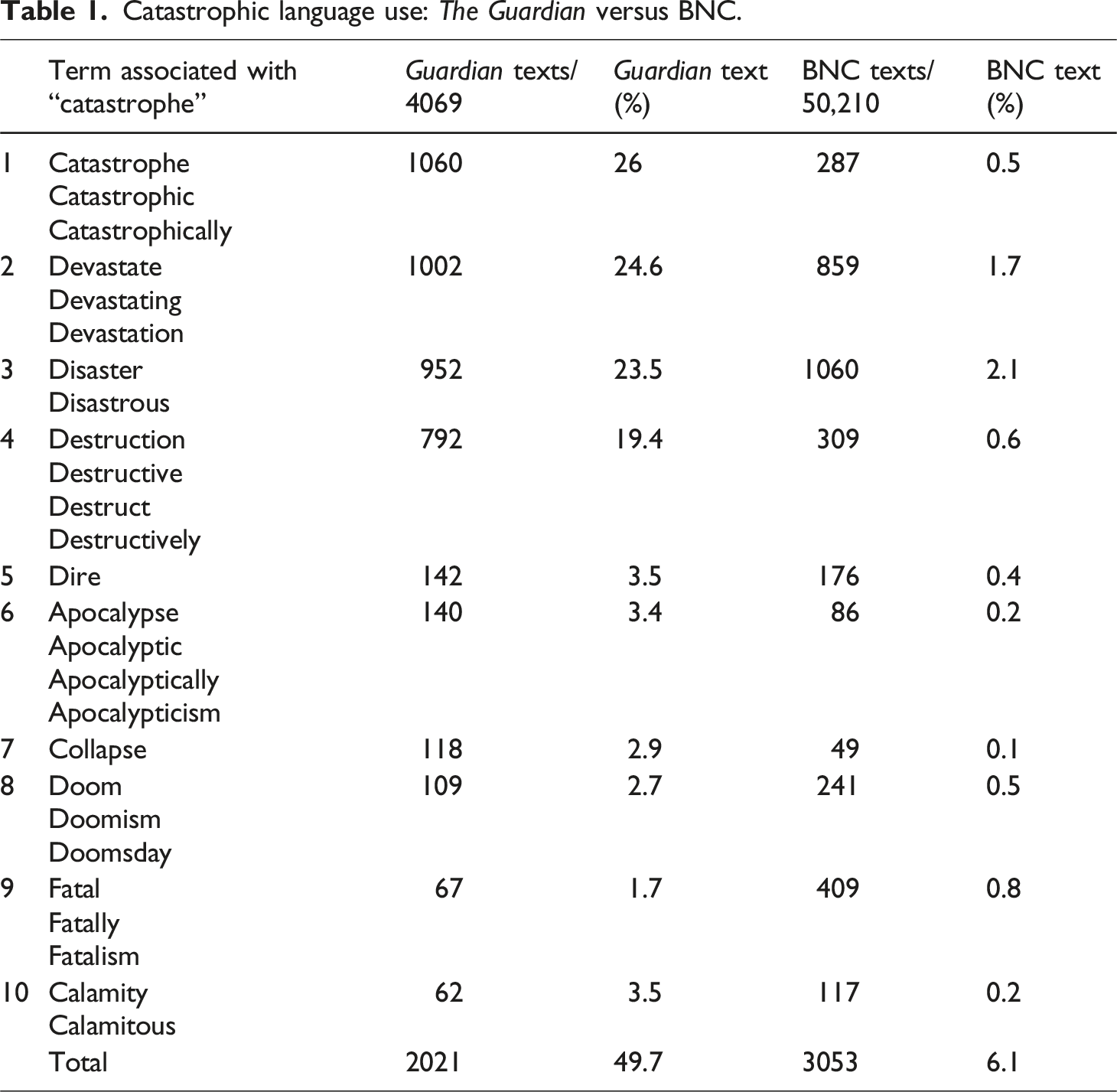
Catastrophic language use: The Guardian versus BNC.
Analysis and discussion
Corpus analysis yielded some striking results. In terms of the overall occurrence of “catastrophic” language as defined above, climate change articles published by The Guardian used this language to varying degrees in half (2021/4069 = 49.7%) of sample articles compared with just 6.1% (3053/50,210) of the more than 50,000 news articles present in the BNC. Looking to differences between instances of specific words, the results are similarly striking. More than a quarter (26%) of the climate change/crisis articles contained the terms “catastrophe”, “catastrophic”, or catastrophically”, compared to just half a percent (0.5%) of the entire BNC news corpus. Collocation analysis also shows us that the word “catastrophe” is connected with “climate” at an exponentially higher rate than any other term. Synonymous terms similarly appear at a high comparative rate, with “devastate/devastating/devastation” appearing in a quarter of articles (24.6%), “disaster/disastrous” appearing in 23.5% and instances of “destruction/destructive/destruct/destructively” appearing in almost 20% (19.4%). It is important to also make clear that this data reflects the total number of texts which contain one or more instances of the above terms, meaning that these could appear multiple times in the same article, alongside numerous other terms from the “catastrophic language” list. In other words, these terms are used in half of the total texts on climate change, but their usage within any given article can vary wildly, in many cases exceeding a dozen instances per article. These results indicate that catastrophic and apocalyptic language can be considered to be a feature of contemporary climate crisis news reporting in The Guardian newspaper. The comparatively less frequent use of this language in the BNC2014 further supports the assertion that these themes are much more strongly associated with climate crisis reporting.
In light of these findings, it is important to revisit the question of how the use of such language within prominent UK journalism can negatively impact upon wider perspectives and activistic engagement. Recent work in spheres of ecolinguistics has focused on the power of a wide variety of discourses and narratives on the environment to shape cultural perspectives and ideology, as well as have very real consequences in terms of widespread climate action (Stibbe, 2015). Arran Stibbe has written emphatically of the dangers of widespread, societal disenchantment between subject and nature (Stibbe, 2024, 99–101) through excess narratives and discourses depicting imminent, global-scale environmental catastrophe. 14 Stibbe describes how “apocalyptic narratives are common in environmental communication, though controversial. There is a debate about whether communication in apocalyptic terms, or ‘doom and gloom’ as it is often disparagingly referred to, inspires people to take action or makes them give up in the face of inevitable destruction” (Stibbe, 2024: 196). Here it is hard not to be once again reminded of Jim Skea’s repeated warnings of anxiety-inducing messages potentially causing “a paralysing effect on climate action” (Hannay, 2023; Lazarus, 2023). Following the findings of this study, which suggest that climate change articles by some prevalent UK news providers tend to use catastrophic language at a much higher rate than other forms of news article, there is clearly a very real danger of such language contributing to higher levels of societal climate apathy. Whilst the idea of using such language to underline and emphasise the current need for drastic global change is clearly intended as a positive intervention, it is also clear that there is a very real doubt about whether this kind of approach is effective or may in fact exacerbate the crisis. Indeed, in line with this, recent research has suggested that a third of young people in the UK aged 13 to 17 – purportedly fuelled by climate scepticism on YouTube 15 – believe that the language within the media when discussing climate change is exaggerated (Horton, 2024). In light of this, we looked to GCC24 and also observed a notably higher use of emotively charged, “despairing” language within climate change articles, with words such as “hopeless”, “helpless”, “troubling”, “despair”, “despondent”, “distressed”, “depressed”, “desperate”, “anguished” and “discouraged”, and their derivatives, appearing in roughly twice as many cases, compared with more general news articles. 16 If this kind of language really does have the very opposite effect on some audiences, it could be the case that there is a very real danger of the media having a profoundly negative effect on climate action, even if its underlying intention is to incite positive change. Whilst we cannot say with any certainty whether this belief is directly related to the uncommonly high levels of “catastrophic” language in articles discussing climate change, it still raises some major concerns.
Apocalyptic discourses in the UK press
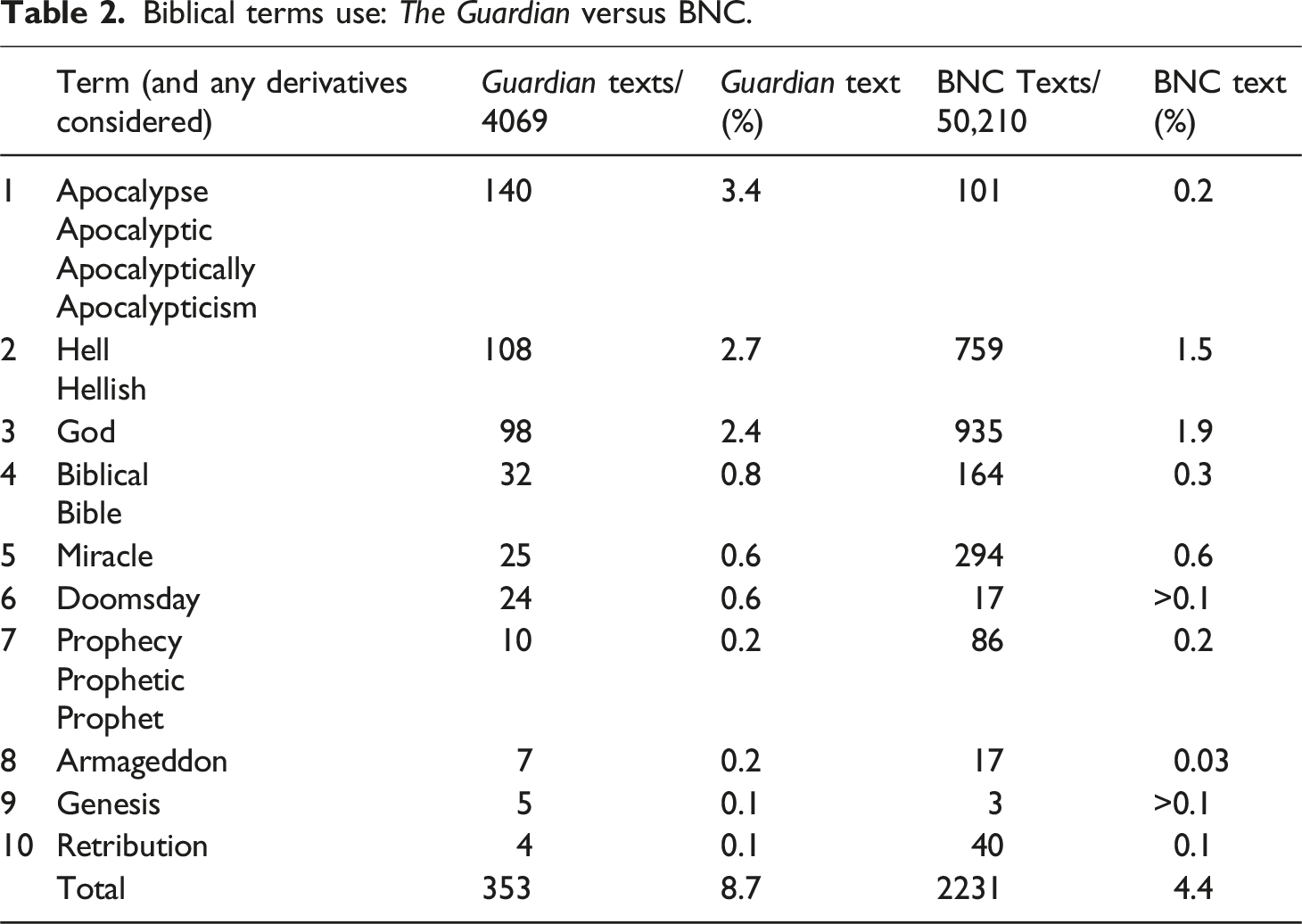
Whilst in the process of developing our initial list of catastrophic terms, it became apparent that a number of the terms could also have religious connotations. For example, the Cambridge Dictionary provides two alternative definitions of the term “apocalypse”: “a very serious event resulting in great destruction and change”, and “in the Bible, the total destruction and end of the world” (Cambridge University Press, 2025). This difference in meaning is likely to have an effect on a reader’s emotional response to the use of this terms and its synonyms. By counting frequencies of apocalyptic language alone, it would not be possible to determine whether the terms were being used in a biblical or secular sense. In order to investigate this further, we devised a further list of terms with biblical connotations which appeared frequently in both the BNC and GCC24 in order to gain further insight into the use of “apocalypse” and its derivatives. These were: apocalypse/apocalyptic/apocalyptically/apocalypticism, Armageddon, bible/biblical, doomsday, Genesis, God, hell/hellish, miracle, prophecy/prophetic/prophet, retribution. The list includes the term “apocalypse” even though it may not always be used in the biblical sense. The aim of this analysis was to gain some insight into the use of terms with potential biblical connotations in order to gauge the extent to which “apocalypse” may have been used in this sense. Widespread use of biblical terms in the corpus would indicate that terms related to apocalypse may be used in a religious sense more often, while less frequent use of biblical terms would indicate that their secular meaning was more common. In essence, if biblical terms are used at a high frequency in the corpus, this would suggest that the term “apocalypse” may also be used in the same context and thus have religious connotations. In contrast, if other biblical terms are not frequent in the corpus, this would suggest that “apocalypse” is not used in a biblical sense in the articles. However, further research would be required in order to investigate the specific meanings of apocalyptic language use in the context of climate crisis journalism.
Biblical terms use: The Guardian versus BNC.
Conclusion
Whilst corpus analysis can provide a detailed overview of the kinds of language being used across a broad spectrum of providers and texts, aligning this with psychological studies is one way of ensuring more meaningful insights. Whilst many have suggested a link between media coverage and societal levels of ecoanxiety, there is, as yet, not enough research into the particular kinds of language which may provoke adverse psychological responses in readers. Future studies should attempt to engage with reader responses, considering the effects of certain trigger words and phrases, as well as particular kinds of framing. As we have demonstrated within this study, certain campaigning providers are using particular kinds of language to a significant extent, and so it would not be too difficult to isolate certain terms and phrases so as to gain much deeper insight into the psychological effects these may have. Following this, a question which might repeatedly emerge throughout this study is: what is the alternative to using catastrophic language within climate journalism? At a time when anthropogenic interference has led to gas concentrations increasing at a rate “far faster than in any previous epoch”, and when there is “more CO2 in the air than there has been for at least three million years” (Welz, 2023: xiii), does the gravity of the environmental situation as a genuine existential threat not warrant, even necessitate, the kinds of catastrophic language we find in a great deal of contemporary climate journalism? Further, are these surging levels of ecoanxiety not a small price to pay when it comes to promoting a generation of people with a genuine sense of urgency and a desire for major, societal overhaul when it comes to climate-related issues? As noted earlier in discussion, insight into exactly which kinds of language provoke a more acute sense of ecoanxiety than others would require psychological studies involving reader responses, thereby demonstrating which words and phrases, as well as how they are framed, might contribute directly to increased levels of climate anxiety. Corpus analysis may prove a critical component for such psychological studies, providing a much more detailed understanding of the relations between wholescale media language and ecoanxiety. Perhaps the most worrying possibility is that this kind of language may only serve to pave the way for an epidemic of climate apathy in a time of increasing urgency. This study has highlighted the significant presence of catastrophic language in The Guardian’s climate reporting and raises important questions about the rhetorical strategies employed in mainstream environmental journalism. For journalism studies, this underscores the need to critically examine how linguistic framing influences audience engagement, emotional response, and trust in climate communication. As media outlets continue to play a central role in shaping the climate narrative, further interdisciplinary research is essential to balance urgency with responsibility in environmental reporting.
Footnotes
Declaration of conflicting interests
The author(s) declared no potential conflicts of interest with respect to the research, authorship, and/or publication of this article.
Funding
The author(s) received no financial support for the research, authorship, and/or publication of this article.
