




Abstract
Constructive journalism has been proposed to address concerns with news reporting, including on health topics, by increasing trust, and reducing misperceptions fostered by traditional news practices. However, integrating constructive journalism into existing practice has challenges, including limited training resources and practical guidance. Accordingly, we developed an online, self-paced (∼5 hour), health reporting-focused constructive journalism training course and evaluated it with a pre-post survey and news creation task. After the course, journalists and journalism students (N = 23) reported improvements in confidence to report constructively and on health topics, and increased intentions to use constructive techniques for future health reporting. Participants also increased their use of constructive techniques including giving greater reporting space to solutions, empowerment, and future orientation, and greater diversity of sources, but reporting on context decreased. We make practical suggestions for future constructive journalism training and invite educators and journalism professionals to use our open-source training materials.
Keywords
Introduction
Constructive journalism, an approach based in psychology and behavioural sciences, aims to reduce reporting’s negativity bias (Bro, 2023), thus improving audience mood, reducing news avoidance (McIntyre and Lough, 2023; Newman et al., 2024), and more accurately representing society by contextualising news events and presenting solutions alongside problems (Bro, 2023). Current work finds constructive techniques positively influence coverage of specific topics (Schäfer et al., 2024; Van Antwerpen et al., 2023) and are valued by audiences (Hermans and Gyldensted, 2019). However, consistent with scholarship on the difficulty of implementing journalistic innovations (Bossio and Nelson, 2021), change to practice has been slow. This slowness may partially be driven by limited publicly accessible training materials for constructive journalism, meaning even interested journalists and newsrooms may lack clarity or tools for implementation. We therefore developed and investigated a training program’s impact on journalists’ confidence, intentions, and ability to integrate recognised constructive techniques into reporting.
The training focused on health news; widely accepted to influence health professionals and the public, impacting awareness and uptake of health interventions, preventative behaviours, and treatments (Briggs and Hallin, 2016; Parrott, 1996; Picard and Yeo, 2011). Criticisms of health reporting highlight its unconstructive elements, critiquing journalists’ lack of emphasis on health (Schwitzer and Henry, 2009), accuracy concerns, the representativeness of sourcing practices, exclusion of social determinants of health, and stigmatizing health conditions, particularly mental health (Amberg and Saunders, 2020; McGinty et al., 2016; Wilson et al., 2010). Many guidelines developed to address these criticisms align with constructive journalism techniques. This paper therefore has two aims: (1) To present the constructive journalism training course, and make it available to educators and professionals, and (2) to evaluate its efficacy in a health reporting context. Together, these aims contribute to bridging the gap between research and practice within (constructive) journalism. Additionally, the work contributes to scholarship on journalism education, including the influence of ongoing professional development on journalists’ practices and role perceptions.
Non-constructive health reporting
Typical health reporting lacks accuracy and is often presented simplistically and sensationally, without appropriate nuance, complexity and context (Amberg and Saunders, 2020; Wilson et al., 2010). Critiques of sourcing practices for health stories also raise concerns about representativeness and accuracy. Reducing numbers of specialized health and medical reporters have made US journalists more reliant on public relations (PR) material, reducing story complexity (Schwitzer and Henry, 2009). Reliance on PR can also decrease accuracy where expert sources want to ‘sell’ their medical findings to journalists and over-emphasize their certainty (Entwistle and Watt, 1999). Similarly, scientists’ and journalists’ different interpretations of uncertainty impact news accuracy, with journalists criticised for placing too much certainty in scientific results or ignoring scientific findings deemed too uncertain (Peters and Dunwoody, 2016). Furthermore, where researchers, doctors and experts tend to be relied on as sources (Wilson et al., 2010), patients are less frequently included (Briggs and Hallin, 2016; Mercado-Martinez et al., 2001).
Additionally, health stories are often reported episodically without thematic links to health systems and policies (Iyengar, 1994; Major, 2018), and political debates about health policies are usually written through a political, rather than a scientific or medical frame (Briggs and Hallin, 2016). Similarly, individual or lifestyle framing often neglects the social determinants of health, including income, education, housing and working conditions, which emphasise the responsibility of politicians and community leaders, healthcare professionals and other social actors for improving population health outcomes, including equality of outcomes (Major, 2018; Wilson et al., 2010). Collectively, these critiques point to health reporting as a valuable context for implementing constructive journalism.
Constructive journalism
Constructive journalism grew out of disillusionment with traditional news practice, including how selection of topics and sources impacts audiences and their worldviews (Bro, 2019; Lough and McIntyre, 2021). The approach shares techniques with other alternative or responsible journalism practices, particularly solutions and peace journalism, which present solutions to problems, and encourage more context and less divisive and violence-oriented reporting, respectively. However, these are generally considered subsets of constructive journalism, which includes a wider array of techniques (Lough and McIntyre, 2021). Constructive journalism has its basis in the behavioural sciences, particularly positive and cognitive psychology, though started by practicing journalists Gyldensted and Haagerup, whose different approaches have led to varied definitions and implementations of the approach (Bro, 2019; McIntyre and Gyldensted, 2018). These differences largely concern constructive journalism’s approach to traditional objectivity and the ‘active’ or ‘passive’ nature of the journalist, including whether constructive journalism aims to either better portray the world and ends at journalistic and editorial choices (Haagerup) or aims to positively ‘move’ the world and is informed by news’ impact on audiences (Gyldensted). However, the approach has been working towards a more cohesive definition, with common features including an aim to counteract news reporting’s negativity bias, reporting on solutions and developments, and a strong ethos of responsible reporting; including consideration of context to improve accuracy, the responsibility of journalism’s role, and news’ impact on society (Bro, 2023).
Efforts to coalesce a common approach to constructive journalism have included the three pillars described by the Constructive Institute (n.d.), Solutions, Nuances, and Democratic Conversation. Academic work has also sought to reconcile constructive journalism’s position on objectivity, particularly considering active rather than passive objectivity, with constructive reporting improving the representativeness of news through greater inclusion of a diversity of sources, and encouraging a weight-of-evidence approach to evaluating the credibility of source information (Van Antwerpen and Fielding, 2023). Proponents and scholars have also developed six main techniques or elements, expanding on the pillars. These are: (1) solutions, in-progress and achieved, with consideration of limitations; (2) future orientation, considering potential outcomes, how they might be achieved, and potential pathways; (3) inclusiveness, diversity, and depolarising reporting, ensuring news portrays varied voices and individuals reflective of society; (4) context, particularly for long-standing problems or topics, showing change over time, and placing episodic events in broader context, such as overall rates of risk alongside statistics of risk increase; (5) empowerment, including reporting on things going well alongside problems, and asking questions that encourage discussion of solutions and resources; and (6) co-creation, working with the public and/or relevant experts and sources to develop reports (Hermans and Gyldensted, 2019). These techniques change how stories are selected, or what is considered newsworthy, particularly to highlight solutions as well as problems, and change the editorial processes and routines used to develop stories (Bro, 2023; Haagerup, 2017). Within these changes, constructive journalism is often considered a more active and reflective process, again linked to active objectivity, as while it seeks to maintain many of journalism’s traditional aims, it encourages journalists to reflect on traditional news practices that may impede accuracy, such as an unequal focus on problems, disasters and conflict and coverage that does not reflect the weight-of-evidence. While constructive journalism is increasingly used in newsrooms and formally taught in universities (Bro, 2023), there are limited publicly available training resources guiding its implementation (e.g., Constructive Institute, n.d.).
Empirical work evaluating constructive journalism’s impact on audiences has produced some promising results, particularly regarding impacts on mood, with constructive journalism regularly increasing positive and decreasing negative mood compared to traditional or negatively-framed news (McIntyre and Lough, 2023). However, other outcomes including news trust, self-efficacy, and comprehension have varied effects (Overgaard, 2021; Van Antwerpen et al., 2022; Venrooij et al., 2022). While research on constructive journalism’s audience impact is ongoing, initial evidence supports its potential to address key criticisms of news and health reporting, improving negative mood (a common reason for news avoidance; Newman et al., 2024), and reducing emphasis on negative stories that contribute to stigma and misperceptions (Ross et al., 2019). Promisingly, numerous outlets have begun implementing constructive journalism, though overcoming traditional news culture and newsroom routines continues to be challenging (Kovacevic and Perisin, 2018; Constructive Institute, n.d.), particularly without existing training.
Journalism training
Although to our knowledge no study has evaluated training in constructive journalism techniques for improving health reporting, other studies have evaluated training to improve aspects of health reporting, with mixed results. Widespread acknowledgement of reporting’s stigmatizing impact regarding people suffering mental illness and suicide ideation has led to various training programs for journalists and journalism students, many reducing stigma (Campbell et al., 2009; Corrigan et al., 2013; Pirkis et al., 2009; Stuart et al., 2011). However, there are reported limitations in drawing causal inference between training and stigma reduction (Thornicroft et al., 2013), and some findings have been mixed, like an increased number of negatively framed stories alongside increased positively framed stories after training (Stuart, 2003). As such, although research suggests training programs can positively influence reporter attitudes, more work is needed to understand how training impacts intentions and actual reporting.
Concerning constructive journalism, research on training programs and their efficacy is limited. As such, we draw on training in other forms of responsible journalism. For instance, U.S. journalism college students trained in solutions journalism, often considered a subset of constructive journalism, perceived the practice to positively influence the news media industry and culture, and improve their reporting quality, interviews, and perceptions about journalism’s positive influence on society (Lough et al., 2024). Similarly, training in solutions reporting in the US, Africa and Europe resulted in more source diversity, including non-officials and citizen voices, though the average number of sources (2.6) was not greater than those used in not-for-profit (3.7) and for-profit (3.0) newsrooms (Cox et al., 2024). Likewise, pre-post content analysis of articles written by 30 Afghan journalists found a ‘strong and impressive body of peace journalism’ was produced after peace journalism training (Lynch and Freear, 2024: p. 407). Similarly, interviews with peace journalism training participants found a course had a discernible influence on the decisions of individual journalists, particularly leading to less reliance on elite sources, and more coverage of grassroot community efforts to bring about peace (Lynch and Freear, 2024: p. 407). Collectively, this suggests training in responsible journalism can improve journalistic attitudes and practice.
This study
Constructive journalism training has potential to improve health reporting, with key criticisms such as poor representation, lack of context, and negative or sensationalised coverage directly addressed through constructive techniques, such as context, empowerment, and inclusiveness and diversity. Additionally, constructive journalism’s ethos of responsible reporting could encourage uptake of training and guidelines for reporting on health conditions. However, such benefits can only be realised if journalists and newsrooms are able and willing to implement the approach. Previous interview and survey research suggests journalists are often open to the ideas of constructive and solutions journalism, though with some reservations specific to context, the principles of journalism, or a lack of clarity on how to implement them (Kovacevic and Perisin, 2018; Lough and McIntyre, 2018; Rotmeijer, 2018; Van Antwerpen et al., 2023). Given the limited publicly accessible training materials to address this final concern, we therefore developed a short, open-access online course in constructive journalism, and aimed to evaluate its influence on journalists’ and journalism students’ attitudes, intentions, and actual reporting practice. The central aims of the study are to: (1) evaluate the training materials in influencing journalistic practice, and to invite others to use them if effective, with health reporting serving as a context for doing so; and (2) test whether a short course is sufficient to meaningfully influence journalists’ mindset towards reporting practices. We present the evaluation results here, with an open invitation to access the course by contacting the lead author.
Methods
The course
The course offers online, self-paced training which can be completed in approximately 5 hours. While usable by students, it was developed for practicing journalists and therefore primarily focuses on implementation, though also discussing the motivation for constructive reporting techniques, and constructive journalism’s evidence base to date. The course includes multiple interviews with practitioners, industry, and academic experts discussing the approach and its techniques, including how and why they would be implemented, alongside key concerns or considerations for implementing them. Examples and applications to health reporting are used to illustrate techniques and concepts. Outside of interviews, the content is primarily written and visual.
The course consists of eight modules. The first introduces the concept of constructive journalism, including the approach’s history and central tenets, and its relation to previous and contemporary journalism, journalistic objectivity, journalism’s key principles, and ethics. The following six modules work through the techniques individually: Solutions; Future Orientation; Inclusiveness and Diversity; Empowerment; Context; and Co-Creation. The modules describe each technique, provide any specific resources (like the Solutions Journalism Network), and guidance on applying the technique in practice. Each module ends with considerations for when to use the technique, including different formats or topics, and a discussion of the technique relative to objectivity and journalism’s key principles. The final module returns to constructive journalism broadly and discusses considerations for choosing techniques to implement for different stories. The final module also reviews common barriers and suggested ways to work around them when reporting constructively. The course also contains a resources module, with links and guides to information on covering specific health conditions, reporting on statistics, or implementing specific techniques. Each technique module includes an optional editing activity using a health news article, and all modules have a five-question multiple choice quiz allowing two attempts; with a certificate awarded on completion of all quizzes with full marks. Figure 1 outlines the course’s learning outcomes, modules, and use of examples. Indicative screenshot of the training course including learning outcomes and structure.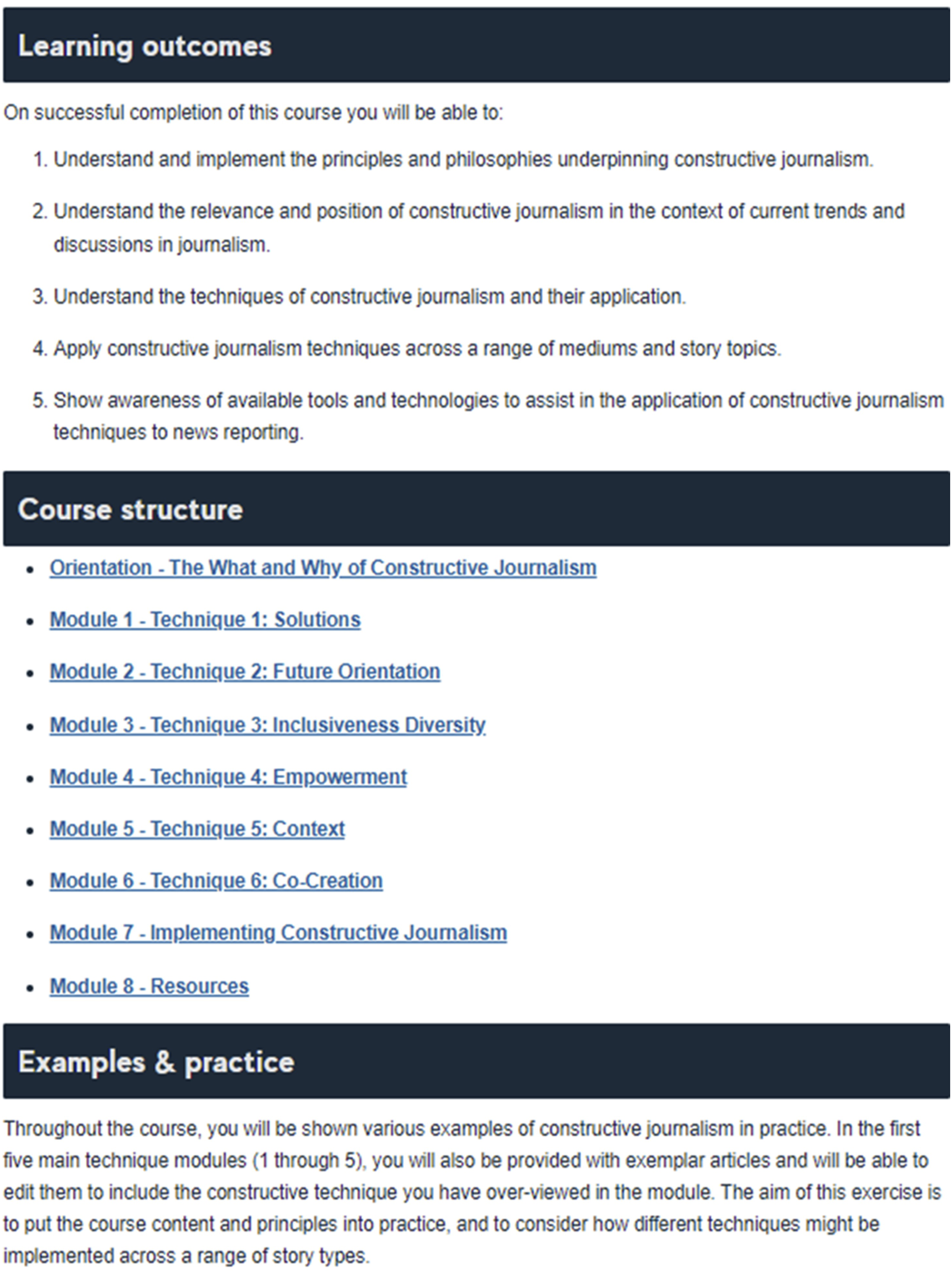
Sample
To evaluate the course, we recruited working journalists and journalism students from newsrooms, freelancers, and universities across Australia and New Zealand. We used a third-party service (Prowly) to contact journalists, editors, and news producers, emailing approximately 3000 contacts. Journalism students were recruited by emailing university program coordinators for all journalism and related courses in Australia (25 contacted, seven distributed during the recruitment period). We used snowball sampling to recruit journalists and journalism students through the researcher’s networks, advertisements at conferences, and via research participants. Participants contacted the researcher to access the training course and evaluation, and all participants received a certificate of completion and an AUD$150 gift card. We initially aimed for 30 participants based on a power analysis for a paired-samples t-test with a medium effect (d = 0.50), power level of 80% and alpha of .05; though intending to recruit as many participants as willing within the project resources. A total of 40 participants were recruited. Of these, 38 completed the pre-survey, and a total of 23 completed the full evaluation (pre and post-survey). While 25 participants completed the post-survey, two did not complete the pre-survey. Of the 23 that completed the full evaluation, nine were working journalists and 14 were journalism students. Of the 15 who completed the pre-survey only and not the full evaluation, only one participant started the training course. The 23 participants who completed the study included three males and 20 females, with most (n = 13) being between 18 and 24 years old. Recruitment was conducted on a rolling basis between 19 May 2023 and 27 April 2024.
Ethics and open science
Ethics was granted by the University Human Research Ethics Subcommittee. Participants provided consent within the first pre-survey and were free to withdraw at any time. All data was anonymous at reporting, though a separate participant key was kept to monitor participant completion of the training and evaluation.
All evaluation materials are on the Open Science Framework: https://osf.io/ert3s/?view_only=6e477d8573b6474084e391960153b3e1. Course access is available via emailed request to the corresponding author. The evaluation analysis was pre-registered: https://osf.io/cn7sv/?view_only=ad27f0a90e5345daa279e9aa480ddd2c.
Evaluation design
The course evaluation used a mixed-methods pre-post design. Participants completed a survey and news creation task before the course. Participants then completed the course at their own pace, before completing a post survey and news creation task. As we were recruiting working journalists or people trained in journalism, we aimed to keep the training and evaluation as flexible as possible to reflect how such training would be accessed and used by news professionals in ‘real-world’ settings.
Measures
Reporting intention
Reporting intentions were measured using a 14-item scale developed for the evaluation by adapting items from a similar study on severe mental illness reporting training (Ross et al., 2021), and integrating constructive journalism techniques (Hermans and Gyldensted, 2019). Participants were given the stem “When reporting on stories containing health conditions or topics, I would be likely to:” and responded to items such as “Report potential solutions or interventions for health-related problems”, on a seven-point Likert scale from 1 = Strongly disagree to 7 = Strongly agree, including three reverse-scored items (e.g., “Focus my report on opposing views or conflicting arguments about the health condition”). The scale demonstrated reasonable internal reliability and performance as a single factor, ωu = 0.75(Pre),0.70(Post).
Confidence
Confidence was measured using two single-items, one for constructive and one for health reporting; for example, “How confident would you be reporting with constructive journalism techniques on a story when it involves someone with a health condition?”, with response options from 0 = Not at all confident to 10 = Completely confident.
Course evaluation items (Post-only)
Participants responded to two items evaluating the course: “The constructive journalism training course was feasible” and “I would recommend this training course to someone else” on a five-point Likert scale from 1 = Strongly disagree to 5 = Strongly agree. Participants were asked what they found most effective and least effective in the training from a list of options (e.g., the solutions module, interviews with experts and practitioners), with unlimited selection.
Barriers (Post-only)
Participants were asked what barriers they saw in implementing constructive techniques with a list developed from previous literature, and interviews with journalists around constructive journalism (e.g., time, editors, traditional newsroom routines), with unlimited selection.
Open-ended questions
Participants were asked two open-ended questions, one about any additional resources they would like that the course was missing, and another requesting any feedback.
News creation tasks
Participants undertook a news creation task before and after the training course. These tasks were analysed to measure implementation of constructive journalism techniques. Each participant was assigned one of five health topics (severe mental illness, heart disease, cancer, substance ab (use), or obesity). Participants were instructed to write a news story of approximately 500-words on their assigned health topic using source material provided before starting the course. All source material was gathered from relevant government reports, press and policy releases, and health organizations, with materials reflecting a range of perspectives and containing information that could be framed constructively or negatively (e.g., personal stories, government policy, statistics on prevalences and consequences). Participants were asked to write a 500-word story using the same source material after completing the course. They were not instructed to use constructive techniques in either instance to avoid priming them to do so beyond their own inclination. All instructions are included on the OSF.
This process resulted in 13 participants producing 26 news stories 1 . 13 print and online news stories were also sourced from the Newsbank database using keywords aligning with the health categories and topics used by the participants, and the same date range as the source material used, as a comparison to participant stories. Where searches returned multiple articles, the article with the widest circulation was chosen. Given the potential for self-selection by journalists and students more inclined to constructive approaches, these ‘real’ articles provided a control comparison of constructive journalism techniques in existing news stories.
The 39 news stories in the categories of ‘real stories’, ‘pre-training’ and ‘post-training’ were analysed using a detailed systematic method of content analysis, involving coding each word to measure constructive journalism techniques, including reporting on solutions, reporting with a future orientation, context, empowerment and co-creation. The presence of thematic and episodic framing was also measured, using Iyengar’s (1994) definitions of episodic frames as focused on individual experiences in relation to the health issue, and thematic frames as related to society-wide or structural health issues and policies. To measure inclusiveness and diversity, each source was identified, including the number of times people and groups were mentioned (written about), or included (either through quoting or paraphrasing). Sources included and mentioned were categorised as experts (including medical professionals, scientists or health advocacy organisations), a patient or having lived experience of the health condition or illness, a demographic group (mentioned only), or from another category, including government sources.
To reduce bias, three independent coders were trained to identify constructive journalism techniques by completing the constructive journalism training modules. They were then taught by the lead researchers how to use the content analysis method to ensure consistency, and each researcher manually coded each of the 39 articles to identify use of constructive journalism techniques by number of words. The three coders were blinded to the story type (real, pre, or post). The lead researchers undertook regular comparison of the coding and, where discrepancies were found, facilitated discussions between the three coders to ensure consistency. Inter-coder reliability was evaluated using Krippendorff’s α, returning a value of 0.986 for three coders across 16 categories of data, with reliability above 0.8 considered appropriate (Hayes and Krippendorff, 2007).
Survey data analysis
Statistical analyses were conducted in R 4.0.4. Participant responses across the pre and post survey were connected by a unique identifier. McDonald’s omega from the psych package was used to check whether the behavioural intentions scale functioned as a single factor. Pre-post scores were testing using paired-samples t-tests. Effect sizes were calculated using Cohen’s d. Responses to the items related to barriers to implementation and the most and least effective aspects of the training are reported as frequencies only, to summarise the findings. Given the small sample size, no formal analysis was undertaken on the open-ended comments, but some indicative examples are reported.
Results of the evaluation
Survey
Descriptive statistics for pre and post comparison measures, and for non-completers (Pre).
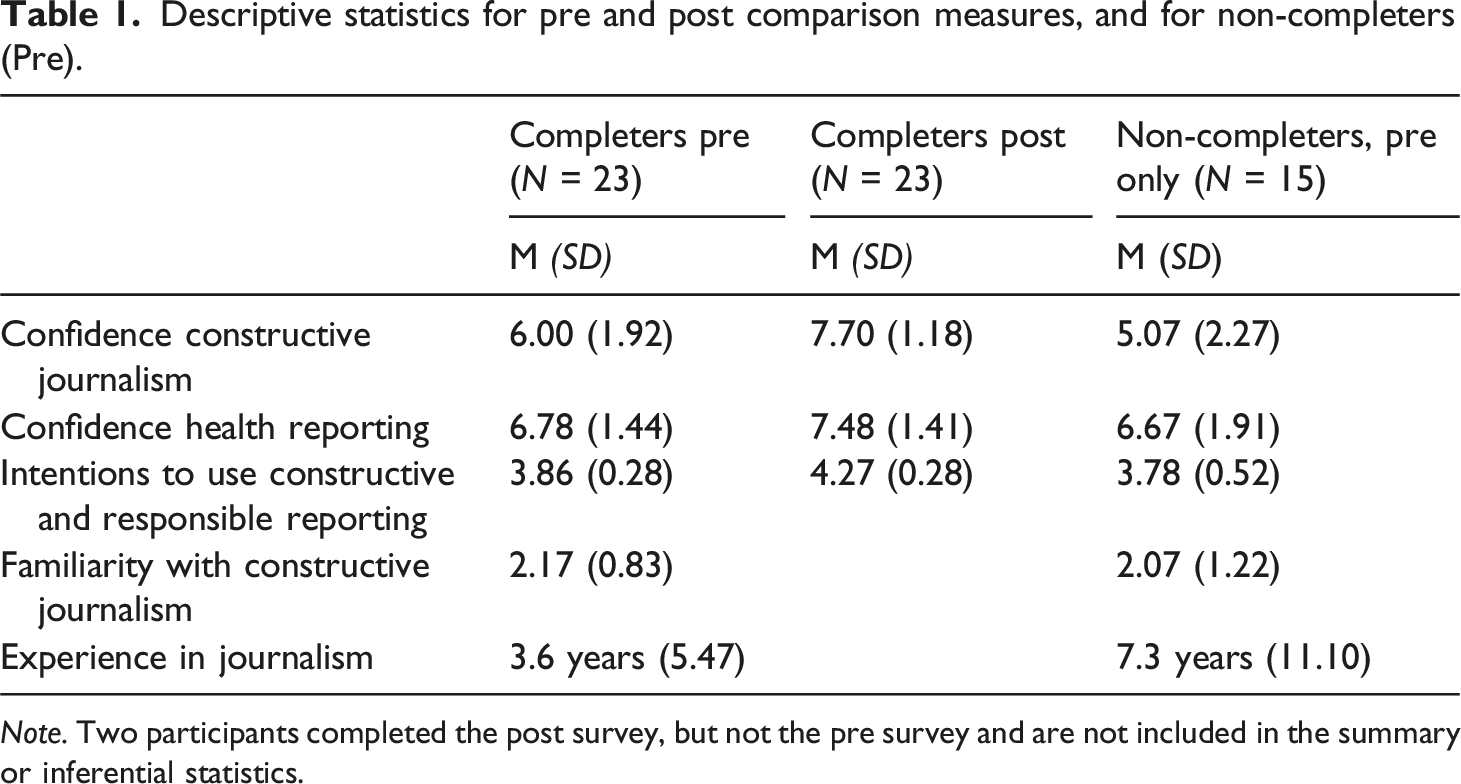
Note. Two participants completed the post survey, but not the pre survey and are not included in the summary or inferential statistics.
Attitudes and intentions
Participants reported a statistically significant and large increase in confidence to use constructive techniques (t (20) = 4.00, p < .001, d = 1.06, 95%CI = [0.77, 2.46])
2
. Participants also reported a statistically significant, small increase in confidence to report on health topics (t (22) = 2.39, p = .026, d = 0.49, 95%CI = [0.09, 1.30]). Participants reported a statistically significant, moderate increase in intentions to use constructive techniques and responsible practices when reporting on health topics (t (22) = 4.58, p < .001, d = 1.13, 95%CI = [0.17, 0.46]).
3
See Figure 2. Participants’ self-reported confidence to use constructive techniques (a) and report on health topics (b) before and after training, and intentions to use constructive techniques when reporting on health topics (c).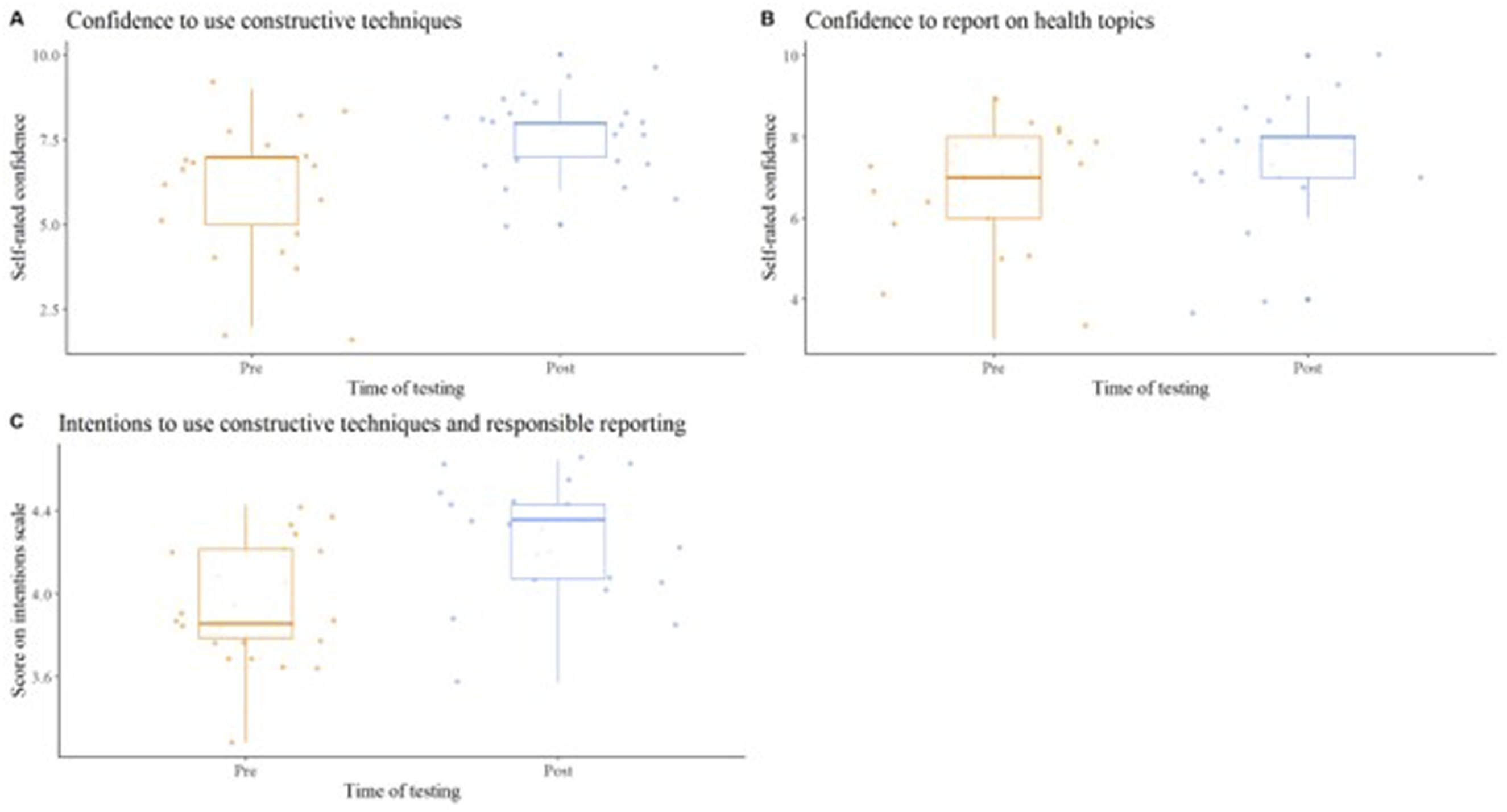
Course evaluation
Participants considered the course feasible and were willing to recommend it to someone else, with an identical mean of 4.92 (SD = 0.28) out of five, and a minimum rating of four for both items. Across the sample, the most effective course components were examples of constructive techniques (76%), and practical suggestions for implementation (72%). Guidance on reporting statistics, example interview questions, and interviews with experts were also considered effective across the sample (all 60%). The course components considered least effective were the editing activities (36%) and co-creation technique (28%). Participants also frequently reported ‘nothing’ as least effective (36%). Perceived barriers to implementing constructive journalism were most commonly reported as time (72%), followed by newsroom culture (68%), format constraints (56%) and commercial interests (52%). Just two participants (8%) reported foreseeing no barriers to using constructive journalism.
Qualitative comments
Given the small sample size, rather than formal themes, Figure 3 includes indicative comments for each open-ended question. Participants wrote positively about the course, but noted some potential areas for improvement and barriers to implementation. Indicative comments about the training course.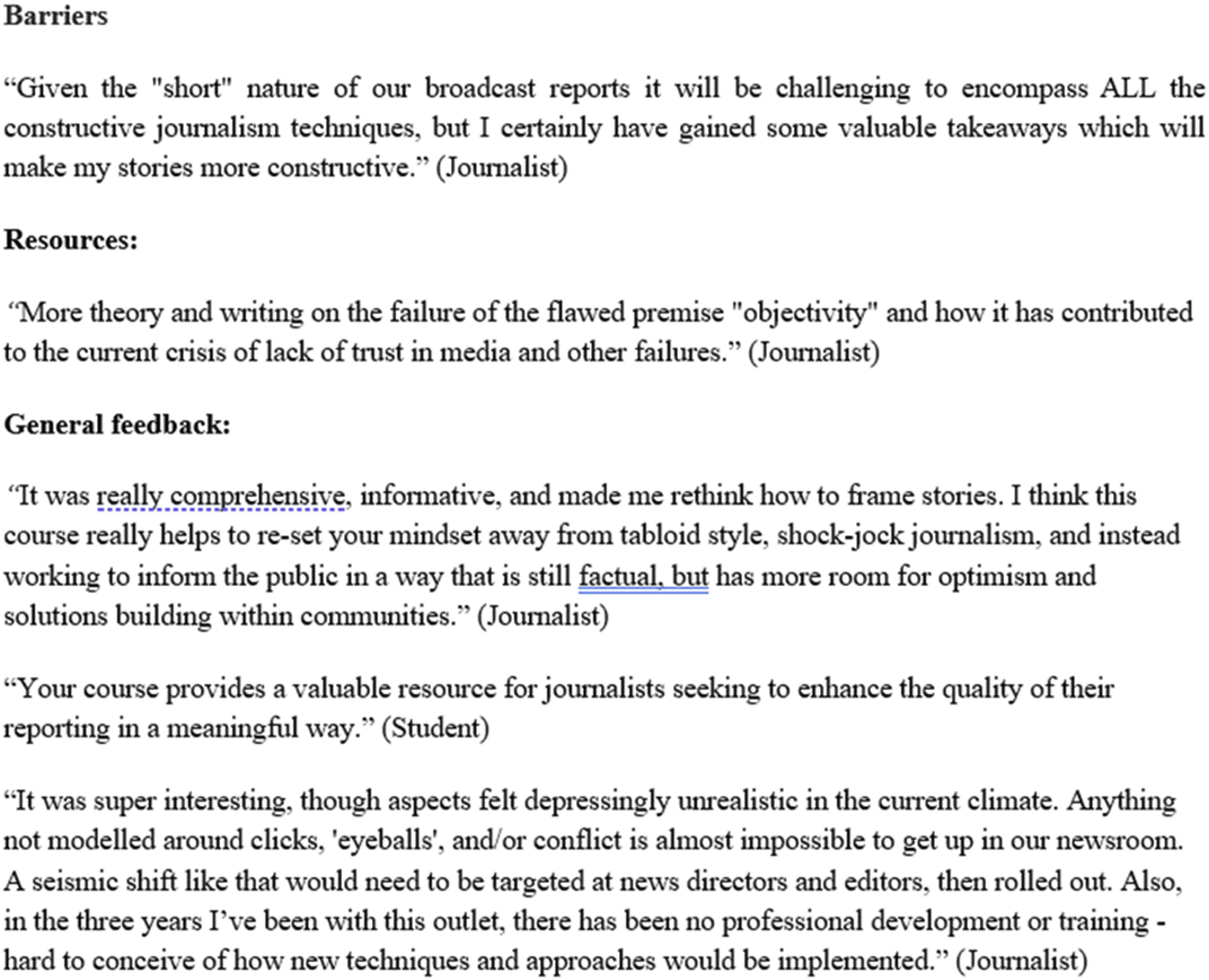
Use of constructive techniques
Content analysis revealed overall positive, yet mixed results regarding use of constructive journalism techniques after training. Participants varied in how they approached the post-writing task, ranging from writing entirely new reports incorporating additional constructive techniques, to minor edits without improving their use of constructive techniques. However, across all participants, analysis showed an average rise in inclusion of constructive journalism techniques. We ran t-tests on each outcome to test for statistical significance, while some were approaching significance, none were statistically significant (see OSF). Use of three constructive journalism techniques - solutions, empowerment and future orientation – increased from an average of 42% of words in the pre-task to 50% in the post-task. Use of these techniques were similar between the real news articles and the pre-task (43% vs 42%). During the analysis process, we decided to measure the context technique separately as coders found context difficult to identify and, in some cases, separate from other constructive techniques. Context was highest in the real news stories (41%), with an average five percent reduction in context (35% to 30%) between the pre- and post-task.
Sources were more diverse and numerous post-training, with the average number of sources included in the post-task (3.46) increasing from the pre-task (3.08) and real news stories (2.17). The number of people and organisations mentioned in stories was highest in the real news stories (3.85), followed by the pre-task (3.69), and dropping marginally in the post-task (3.54). Participants did not differ in the average number of words incorporating diverse sources between the pre and post task. However, participants were more likely than real news stories to include patients or those with lived experience, while real news stories commonly only included experts like doctors and scientists, or organisational/institutional sources, particularly government sources.
Ratios of episodic versus thematic frames were more balanced in participant stories than real stories. However, participant balance changed only slightly after training, from 33% pre to 29% post in average episodic words. Participants’ use of episodic frames often reflected the inclusion of experiences from people with lived experience.
Discussion
We developed and evaluated a short online constructive journalism course with a health reporting focus among a sample of Australasian journalists and journalism students. Given the small sample size, our evaluation is primarily used to provide initial feedback and insight into the course utility for journalism students and professionals. Overall, this evaluation suggested participants found the course valuable and feasible, that training increased their confidence and intentions to report on health stories and use constructive techniques, and influenced their reporting behaviour in a news creation task.
Participants expressed more confidence and intentions to report with constructive techniques and on health topics after the course. This is promising for practice, as behavioural intentions and self-efficacy, which share similarity to our confidence measure, are both reliable predictors of actual behaviour (Sheeran et al., 2016; Webb and Sheeran, 2006). While intentions and self-efficacy may positively predict behaviour change, they are often influenced or attenuated by other factors, including time, capacity for the behaviour, and habit (Wood and Rünger, 2016). The large effect sizes found for confidence and intentions are therefore encouraging, as stronger intentions and confidence may be particularly important where journalists (and students) are acting against habitual reporting practices.
Given the gap between intentions and behaviour, we measured changes in actual practice, which form an important, and often overlooked, part of training interventions (Ross et al., 2019). Consistent with other studies finding journalists could implement peace journalism after training (Lynch and Freear, 2024; Lynch and Tiripelli, 2022), content analysis of training participants’ pre and post writing tasks found promising evidence that training marginally increased use of constructive techniques. These differences were not statistically significant, though this may also be due to the small sample size and large measurement variance. The smaller change comparative to self-reported intentions is consistent with the intention-behaviour gap in psychological literature (Sheeran et al., 2016), and potentially reflects the task being for the course and evaluation rather than actual newsroom practice. Participants also wrote more constructively in their pre-tasks than comparative real-world articles, including being more inclusive of diverse voices, likely reflecting a degree of self-selection. Overall, our results suggest constructive journalism training leads to promising improvements in health reporting, like including more solutions, future orientation, diversity of sources and empowering content. Like other studies of journalist training, however, some results were more mixed (Stuart, 2003), including context. In part, this discrepancy on context may be due to measurement difficulty, and a tendency for participants to remove general context to make space for other constructive techniques. This was particularly evident with solutions, which often overlapped with context (our coding method only allowed one classification per sentence). This study thus provides insights into the difficulty of measuring constructive journalism, and the challenge for journalists when including multiple constructive elements in one news piece; though, as participants were instructed in the course, not all stories require all constructive techniques, with a constructive mindset also involving consideration for which techniques are most appropriate to a given story.
We considered participants inclusion of diverse sources, particularly episodically framed stories of patients, coupled with thematic framing tying patient stories to health system policies and solutions, as indicative of constructive health reporting, leading to more accurate (MacKenzie et al., 2007) and representative (Cox et al., 2024; Mercado-Martinez et al., 2001; Wilson et al., 2010) reporting. Balancing episodic and thematic reporting may also improve inclusion on the social determinants of health, tying individual conditions to structural factors, rather than focusing on individual health behaviours and consequences (Major, 2018; Wilson et al., 2010).
Participant’s greater inclusion of constructive journalism techniques and more diverse sources also suggests the training course successfully changes the mindset of journalists in reporting health news. Aligning with studies on solutions (Lough et al., 2024) and peace journalism training (Lynch and Tiripelli, 2022), this mindset change involves a more active and reflective style or reporting (Bro, 2023), which expands what is considered ‘newsworthy’ outside of traditional journalistic routines that emphasize conflict, negativity and problems (Haagerup, 2017), and takes a more ‘active’ approach to objectivity, considering how to more accurately present views, experiences, events, and evidence (Van Antwerpen and Fielding, 2023). Given the frequent gap between theory and practice, including for constructive journalism (Bro, 2023), our findings and those in solutions and peace journalism suggest training can help bridge this gap, potentially by explaining how changes to reporting can be made whilst holding true to journalism’s function. While our evaluation did not specifically measure journalists’ approaches to objectivity, changes to their practices and reporting intentions suggest they were open to adjusting their reporting mindset, with their comments often reflecting a change towards more considered journalism practice. Our findings thus suggest a short course can be sufficient to change journalists’ approaches to concepts and practices around accuracy and objectivity, including more active approaches to objectivity, consistent with constructive journalism (Van Antwerpen and Fielding, 2023). However, future research could explore this more thoroughly, testing a wider range of training programs with direct measures of journalists’ views and orientations to reporting practices, particularly their understandings of journalistic objectivity, and through qualitative discussions with trainees.
Relatedly, though participants reported finding all elements useful, examples of constructive techniques, and practical suggestions for implementing constructive journalism were considered most useful overall; suggesting a preference for implementation-related content. While this finding does not negate the importance of theoretical components of constructive journalism training, it suggests participants value concrete suggestions on using techniques, and insight from professionals and experts regarding how they inform journalistic practice. Practical tools may also be helpful in overcoming barriers to implementation, including decisions around what is considered ‘newsworthy’ or how to frame a story (Kovacevic and Perisin, 2018). Encouragingly, contrary to some past studies (e.g., Lough and McIntyre, 2018), few participants listed concerns about alignment with journalism’s aims and principles, perhaps due to explicit discussion of constructive journalism’s alignment with journalistic aims and principles throughout the course; though many of our participants were students who might be flexible about journalism’s principles and aims. Nevertheless, given the opening concerns that constructive journalism may be difficult to implement due to clashes with current newsroom culture or perceptions of journalism practice, it is promising that few participants were concerned about (mis)alignment with journalistic principles. However, participants did note concerns and barriers to implementing constructive journalism, primarily time and newsroom culture; reflective of previous work on peace, solutions and constructive journalism (e.g., Lough et al., 2024; Lough and McIntyre, 2018; Lynch and Tiripelli, 2022). These barriers are important to consider given they are likely attenuators of intention when implementing behaviour change. While the course provided suggestions for overcoming these barriers, participant feedback suggests these would still be key concerns, and something constructive journalism trainers and editors should consider.
Other learnings
Outside of our evaluation, this study provided insights for (constructive) journalism practitioners and trainers. Firstly, constructive journalism is difficult to define, and its techniques difficult to differentiate in content analyses. While difficulties with definition have been well-discussed (e.g., Bro, 2019, 2023), these discussions have largely dwelt on implementation, rather than evaluating constructive journalism use. Some studies have employed content analysis of newspapers on constructive journalism, though mainly focused on solutions and positive emotions (e.g., Zhang and Matingwina, 2016; though see Theodora and Prestianta, 2022). Our content analysis suggests a clearer definition of empowerment and how it differs from, for example, solutions, would help in training journalists, and evaluating the constructive techniques in reporting.
Secondly, while participants found the course valuable, recruitment was challenging. Despite this study’s reasonably high incentives (a certificate and $150 AUD voucher), and contacting numerous editors and journalists, we had 23 participants who completed all evaluation elements. This difficulty recruiting participants is notable given training is often suggested for reducing problematic health reporting (e.g., McGinty et al., 2016). While theoretically sound, these suggestions often fail to account for journalists’ lack of time for external and optional training, and thus need to be coupled with strategies to effectively implement such training. Given difficulty with recruitment, integration into newsrooms or university courses via in person workshops or seminars, and active support of editors and academic staff, might be more viable for future research. While the online course enabled greater flexibility, it increased the difficulty of recruiting and retaining participants, particularly within set timeframes. However, participants appreciated being able to return to the modules at a later point, which is a trade-off to consider when designing online compared to in-person training materials.
Limitations
Key limitations include the small sample size and self-report, the latter potentially subject to desirability bias or training effects (particularly as, for feasibility reasons, we had no control group); though our intentions measure had multiple reverse-coded items, which may have reduced desirable responding. Additionally, our content analysis provided a behavioural measure of participants’ reporting, though subject to the above-mentioned difficulty in defining constructive journalism techniques. Nevertheless, triangulating the content analysis and survey responses, the course appears to have positively impacted participants’ intentions, confidence, and use of constructive journalism techniques in health reporting. In future and where feasible, similar evaluations could be improved by including a control group, and follow-up participants, including surveys and evaluating their published work, to evaluate training impacts over time (e.g., Lough et al., 2024). Our story elicitation method had some limitations, as some participants only made minor changes to their stories, however, we chose this method to reduce priming relative to stricter instruction on the news creation task. Having participants edit an existing article may be more feasible for evaluating changes in future, though reducing opportunity to see how participants select topics, sources statistics, and frames.
Additionally, self-selection of the sample could bias responses towards those interested in and with time to complete constructive journalism training. However, there were no statistically significant differences across confidence or familiarity with constructive or health reporting at baseline. Non-completing participants were more likely to be working journalists, who often were unable to devote the time despite initial interest (noted in personal correspondence), and all except one stopped before accessing the course.
Conclusions
Our study suggests constructive journalism training is useful to journalists and journalism students, including in health reporting, with promising results for constructive journalism techniques to be incorporated into existing practice. Training increased intentions to engage in constructive and responsible reporting, including on health topics, and improved the use of constructive techniques in participant reports (though not statistically). However, to improve the impact of this and similar training efforts for news reporting, journalists need to be provided with time and editorial support to participate in professional development activities. Irrespective of the quality of our training materials and their impact, without this support, we risk only training those journalists who are most likely to be following or dedicating time to responsible practice, and not those who might benefit most. Nevertheless, these results suggest our online training course may be a useful resource for journalists, students, and educators interested in constructive journalism or health reporting; to which end, we invite anyone interested to contact the lead author for access.
Footnotes
Acknowledgements
We would like to acknowledge Anna Ross, Amy Morga, Anastasia Ejova, Rachel Searston, and Christopher Bean for their contribution to the course and evaluation design, and Amy Myles, Amy Brierley-Breare, and Marianne Clausen for their assistance with coding participant articles.
Declaration of conflicting interests
The author(s) declared no potential conflicts of interest with respect to the research, authorship, and/or publication of this article.
Funding
The author(s) disclosed receipt of the following financial support for the research, authorship, and/or publication of this article: Natasha van Antwerpen and Victoria Fielding were funded through a University of Adelaide FAME Accelerate grant.
Ethical Considerations
Ethics was granted by the University of Adelaide School of Psychology Human Research Ethics Subcommittee (H-2023-69). Participants provided consent within the first pre-survey and were free to withdraw from the study at any time.
