




Abstract
The COVID-19 pandemic lockdowns prompted the elevation of technology facilitated online and digital resources as vital mainstays for journalists to conduct their professional duties. The pivot towards digital and online resources, already in motion within the journalism industry, was accelerated by the changes to work and life patterns in the wake of the pandemic. The same reliance correspondingly increased the exposure journalists experience to online and digital dangers. Our research demonstrates how disruptions to work routines during and after the COVID-19 lockdowns influence behavioural shifts in journalists. We highlight three key changes: journalism is now more reliant on online and digital resources and practitioners spend more time using them; during lockdowns, the more time journalists spent online or within digitally enhanced work conditions, the more they felt entrapped, a feeling accentuated by the restricted work and life conditions; and journalists tried to mitigate these dangers by resorting to avoidance or self-censorship, removing themselves from vital news architecture informing their reporting. In conclusion we propose that more resources are needed to identify and understand these complex threats and begin to discuss effective and applicable mitigative skills.
Introduction
Journalists are frequently considered as dogged, determined – stereotyped in popular culture as prickly, solitary figures working all hours and under all conditions in order to capture the story. The journalist, playing the traditionally held role as the hero revealing the accurate ‘truth’, is prepared to put their own health, wellbeing and safety at risk. It is accurate that journalists are expected to work outside regular trading hours to meet deadlines outside working hours, as well as report from extremely dangerous situations currently like Gaza or parts of Ukraine. As such, the emotional investment that journalists commit to their work is historically a fraught area of concern for them, their managers, colleagues and even close loved ones, albeit a complex one when explored in scholarly literature. Journalism’s traditional reach for objectivity as an ideal aspiration is identified as one of the primary motivators for the lack of community dialogue on the emotional impact of journalism (Kotišová and van der Velden, 2023: 1). However, as Wahl-Jorgensen and Pantii (2021) write, during the last decade, interest within the global journalism community and researchers on the “emotional turn” in journalism practice has gained wider attention. They write: “(the) binary opposition between rationality and emotionality has obscured the fact that journalism has always been emotional” (Wahl-Jorgensen and Pantii, 2021: 1148). Related research highlights how emotions influence the journalism and the journalists creating the work (Al-Ghazzi, 2023). This affective nature of journalism promotes workspaces where the distinction between the personal and the professional is often blurred (Bélair-Gagnon et al., 2023: 2).
Two years before the outbreak of the COVID-19 pandemic, Feinstein and Storm (2017) explored how journalists who reported on the European migrant crisis 1 responded emotionally to their work. They find that one of the key threats participants described is being confronted with situations where their moral judgement and boundaries are undermined. Feinstein and Storm describe this type of scenario as a ‘moral injury’: “the injury done to a person’s conscience or moral compass by perpetrating, witnessing, or failing to prevent acts that transgress personal, moral and ethical values or codes of conduct” (Feinstein and Storm, 2017: 4–5). Journalists, therefore, may find themselves in a situation where they feel a real danger to their physical safety while also feeling that their own moral boundaries are transgressed. This trauma impact creates emotions of fear and vulnerability, while the conspicuous impact of moral injury is the feeling of guilt and shame (Norman et al., 2019: 3).
Parallel to this growing attention on how journalists respond to the inherent challenges of their work and its impact on their professional and personal personas is an exponential rise of the usage of digital and technology facilitated resources. These resources, such as social media platforms like Facebook and X (formerly known as Twitter), TikTok and YouTube, as well as online resources like video conferencing, digital archives, and artificial intelligence resources, make for instantaneous audience engagement with both the works of journalism and the journalists themselves (Wahl-Jorgensen and Pantii, 2021). Social media platforms are now considered essential reporting tools (Bruns, 2023: 1–2; Carvin, 2012) and research indicates that the increasing pivot to online resources for journalism has in turn had a transformative influence on the role of the content creator: the journalist (Sherwood and Dodd, 2022: 169). Key affordances of social media, messaging groups and user comments allow for easy anonymity for those who engage with content and the content creators, which in turn has created new digital challenges for journalists who work online.
Our research and this article are an exploration of journalism practice in its current digitally enhanced reiteration influenced by the COVID-19 restrictions. The discipline of journalism is the process of news gathering, assessing, selection, dissemination and audience engagement (Ahva, 2016: 1528). Relatedly, the article pays attention to constant changes present within the process of journalism in its current form (Smeenk et al., 2023: 214–215).
Researchers categorise exposure to online trauma threats as instances when during the act of engaging in their professional duties a journalist is exposed to potentially traumatic dangers within the online workspace (Slaughter and Newman, 2020). Some of these dangers are offline dangers translating into online spaces, such as physical threats and abuse (Chen et al., 2018: 2–3). Others, however, are hybrid versions, which exhibit unique online characteristics, such as user-generated content, trolling, doxing and cyber stalking (Carvin, 2012). As we explore these threats, their classifications remain dictated by the outward characteristic of the threat like sexualised abuse or threatening content (eSafety Commissioner, Australia, 2024). More investigations into digital and technology facilitated threats will widen the understanding of the threat characterisations.
Importantly, though, online trauma threats are potentially as dangerous and equally unrelenting as those that manifest offline, such as hazardous reporting environments (Ureta and Fernández, 2018: 877). Koenig and Lampros investigate the increasing value and meaning social media users, including journalists, attribute to social media interactions (Koenig and Lampros, 2023: 87–90). They argue that it is unreasonable to expect those consistently exposed to potentially traumatic content online or through a digital interface to not experience an emotional response (Koenig and Lampros, 2023: 90).
Lack of awareness and training, however, means that many journalists and their employers do not fully understand these dangers, their potential harmful impact or the most effective ways to manage and mitigate the risk (Index on Censorship, 2019). Initially, as these dangers became more obvious, non-engagement was considered a viable mitigative measure: for instance, ‘just staying offline’ or avoiding engagement. Yet, paradoxically, this non-engagement is considered a curtailing of the pursuit of professional journalism and potentially leads to censorship (Rees, 2020). Limiting engagement, rather than mitigating exposure to online trauma for journalists, instead leads to lack of access to crucial information architecture 2 and therefore curtails the breadth and depth of the reportage (Perera, 2022). This suggestion against non-engagement is similarly reflected in the broader understandings of the blurring of online and offline boundaries, where disengaging from social media platforms now limits the access we need to live our lives productively and meaningfully, because these online platforms are so interwoven in the fabric of everyday society (James-Garrod, 2023: 270). Previous research undertaken by the lead author, (Perera, 2022), also suggests the choice of disengagement over mitigated engagement is both an act of censorship and perpetuates a lack of awareness of potential trauma dangers on the part of the journalistic practitioners.
COVID-19 in the digital age
As the COVID-19 pandemic spread into 2020 and beyond, entire countries were forced into online work environments and restricted living conditions. At the start of April 2020, more than a third of the global population was in lockdown or experiencing restricted movement through social distancing measures (Koh, 2020). Journalists – traditionally reliant on getting as close as they can to the story and reporting ‘on the ground’ – were forced to find methods for working from remote spaces with restricted access. Often, this meant relying on social media and instant messaging communication tools while working from physical spaces meant for private interactions, such as their family homes (Tandoc et al., 2022: 1740). It is within such a context that journalism across the world attempted to live with and report on COVID-19. The new conditions journalists worked within increased the potency and frequency of the online trauma dangers they were exposed to (Quandt and Wahl-Jorgensen, 2022: 923).
Relatedly, journalism communities and academics also paid increasing attention to the impact of exposure to potential dangers within the digitised workspace (Hoak, 2023: 347). The International Centre for Journalists’ survey, reported by Posetti, Bell and Brown, (2020) found that 67% of respondents were making more use of digital tools for reporting and 38% use the same resources for audience engagement. This change in working behaviour, where journalists found themselves working alone and in isolation reporting a deadly pandemic (Hoak, 2023: 360), created a situation similar to what Feinstein and Storm find in their research into reporting during the European migrant crisis. The isolated reporting circumstances journalists faced in the peak of the pandemic in 2020 risked aggravating the dangers posed by potential moral injury such as isolation, anxiety and guilt (Feinstein and Storm, 2017).
The trend of relying on digital and online resources for their reporting by media professionals was visible before the outbreak of the pandemic, however, it accelerated considerably during 2020. The increasing dependence on digital and online resources made journalists aware of unique dangers they were exposed to within that reporting environment. Despite the advanced exposure to risk, there was no corresponding accentuation of developing mitigative skills and awareness to alleviate the increasing exposure to digital and online dangers (Pantic, 2023: 3509; Ureta and Fernández, 2018).
COVID-19 lockdowns created a situation where journalists found themselves reporting on stories with heightened physical and emotional challenges (Hoak, 2023: 347), while cut-off from communities they usually had easy access to, if not for the pandemic (Millar, 2023: 30–35). The International Centre for Journalists’ survey concludes: “More time inside social media communities means more exposure to online toxicity – in the form of ‘platform capture,’ which involves social media channels weaponized by disinformation purveyors, and increasing online violence targeting journalists” (Posetti et al., 2020: 20). As such, during the pandemic, the unavoidable reliance on digital and online resources that journalists experienced to maintain their professional commitments often evolved into situations where the professional and personal digital personas blurred into each other and enforced the cyclic sensation of what Jukes et al. (2022) call ‘living the story.’ Their research examining UK based journalists throughout lockdowns reveals that interview participants “felt that the volume of material on social media was challenging, particularly in a context of risk (assessment and focus) and precarity (health and socio-economic)” (Jukes et al., 2022: 15). The same work conditions which researchers refer to as ‘personal publics’ (Bruns, 2023: 1) accentuate the blurring of professional and personal boundaries, encouraging an overreliance on digital resources. This regularly exposes journalists to graphic and disturbing content, curtailing the potential coping strategies such as taking breaks and enforcing distance between reporting and life beyond the professional duties of journalists.
Journalists were required to work long hours, produce timely and often lifesaving public safety information, while on lockdown and working in remote workspaces and dealing with a deadly health risk and escalated mental health dangers (Hoak, 2023: 3600). Aligning with the findings of our research, Hoak also reports that high levels of work-related stress was prevalent among journalists reporting on the pandemic, and they had a lack of skills to mitigate them. The reporting space is a combination of online and offline platforms, or what Pantic defines as a unique reporting space that alternates between ‘slipper’ and ‘shoe leather’ journalism (Pantic, 2023: 3509).
Studies also explore how COVID-19 and ensuing restrictions impacted different communities (Onyeaka et al., 2021); government and citizen responses to the pandemic were varied throughout the world. Some were subject to strict containment measures (i.e. China and Singapore) while other parts of the world undertook mitigation strategies (i.e. The United States, United Kingdom, Australia) (Chen et al., 2021; Reiersen et al., 2022). Australia was one of few countries to take an ‘aggressive suppression’ approach (Adams et al., 2023: 6). These studies attest that the pandemic had far reaching impacts on different aspects of daily life; experiences of COVID-19 were not experienced equally throughout the world. In journalism the research into how COVID-19 impacted journalism has largely explored how the restrictions altered news gathering and dissemination methods (Pantic, 2023) as well as changes to work patterns and personal behaviours (Hoak, 2023). Other research explores how despite varying levels of restrictions, journalism communities in different locations complained about the difficulties of access to information while also emphasising the influence of their lived experience during their COVID-19 reportage (Perreault et al., 2021). Our work builds on the emergent research to explore more deeply the impact of a digitised workspace on journalism and the personal lives of journalists.
Post-COVID-19, journalism educators have invested more resources into understanding the characteristics and impacts of exposure to technology facilitated dangers. We are aware that the confluence of the demands of remote working, fear of contracting a fatal disease and financial uncertainty had a deep impact on emotional well-being (Feinsten and Hughes quoted in Rory Peck Trust, 2020). Feinstein and Hughes identify anxiety as the predominant emotion expressed by journalists during the lockdowns, as revealed through a survey conducted by the Reuters Institute and the University of Toronto in 2020.
The challenging reporting environment created by the pandemic resulted in exacerbating feelings of fatigue, frustration, anxiety and transgression of moral values which also manifest in journalists reporting under other potentially traumatic situations like natural disasters (Smith, 2022: 32) and prolonged political upheaval (Feinstein and Storm, 2017).
This article contributes to this pressing need to understand the current state of journalism and the new, and newly manifesting, challenges faced by journalists. We report on the three key findings of a research project seeking to understand the impact of online trauma dangers on the professional and personal lives of journalists influenced by the acute and sudden pivot to a predominantly online and digital reliant journalism workspace during and after the pandemic while facing unprecedented restrictions on their physical mobility and in-person interactions. We consider: • How did online trauma threats faced by journalists during COVID-19-imposed remote working regimes manifest themselves? • How did these threats impact on the professional and personal lives of the targeted journalists? • How did these journalists attempt to minimise the impact of online trauma threats?
The results of this research ultimately identify a trend where participants described needing to function with the personal and professional aspects of their lives overlapping within the fractured – yet interconnected – offline and online spaces of their lives. As such, we make recommendations to improve and strengthen global journalism training and support mechanisms, moving forward.
Methodology
Drawing from similar research in this area (Maguire and Delahunt, 2017: 3351), we utilised a mixed methods approach with two distinctive data collection points: an online survey of journalists and online interviews with selected journalists; and journalism and trauma experts. The survey was used to gain awareness of how journalists overall were reacting to and were impacted by the lockdowns and restrictions. The survey data was used to develop trends and themes of these impacts. They informed the conduct of the interviews. The survey provided the scaffolding for the themes, and the interviews the granular and personalised details. A similar two-step approach is in other research projects exploring journalism and trauma impact (McMahon, 2016). The two-step method allows for the construction of themes reflective of patterns existent within a wider journalism community and supplement those themes with individual lived-experiences. The participant invitations, the survey and the interviews were all conducted in English. Language did not prove an impediment as all participants used English as a primary language of communication for their journalism. Future research with non-English speaking journalism communities may reveal further valuable insights.
The methods were adopted to ensure a systematic study of the changes in behaviour and work practices in journalists engaged in reporting during the COVID-19 initiated lockdowns. The data collection was conducted by the lead author between October 19, 2020, and August 31, 2021, as part of a research higher degree. The project received ethical clearance from the Human Ethics Research Committee, Central Queensland University.
The lead author of this article identifies as an insider researcher; as a practicing journalist and journalism trainer, specialising in trauma-informed reporting. During his reporting and training career, he experienced the impact of online and offline trauma threats in his personal and professional lives. He has seen similar impact on other journalists across the world. In this case, the research is informed by his personal and professional experiences and how they influence the project (Leavy, 2020: 6), including why he was drawn to it in the first place. 3
Data collection
The two data collection modes for this project were an online survey and qualitative semi-structured interviews. Firstly, the online survey invited responses about the characteristics of online trauma threats faced by journalists and how these threats influenced changes in their behaviour. The survey was available to journalists across the world. The survey cohort is representative of experienced journalists engaged in reporting the COVID-19 in the communities they lived (Herman, 2023: 19). The participants were directly recruited by the lead author informed by their reporting portfolio, to determine if their work scope included reporting the then-ongoing COVID-19 pandemic or related issues. Journalists who met this initial screening criteria were contacted directly via e-mail. Mass mailing lists or open invitations were not used to recruit participants for the interviews or the survey.
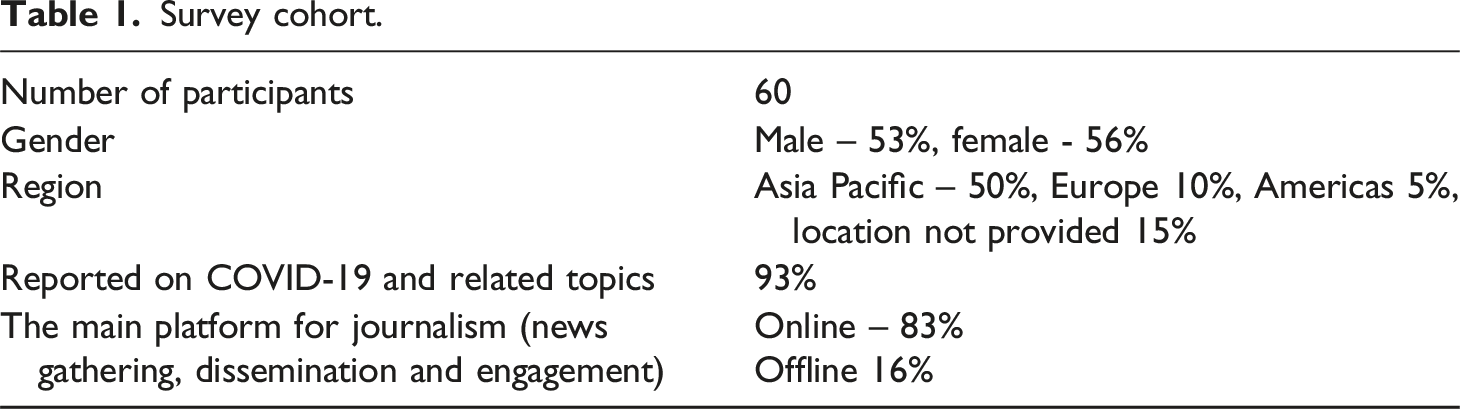
Survey cohort.
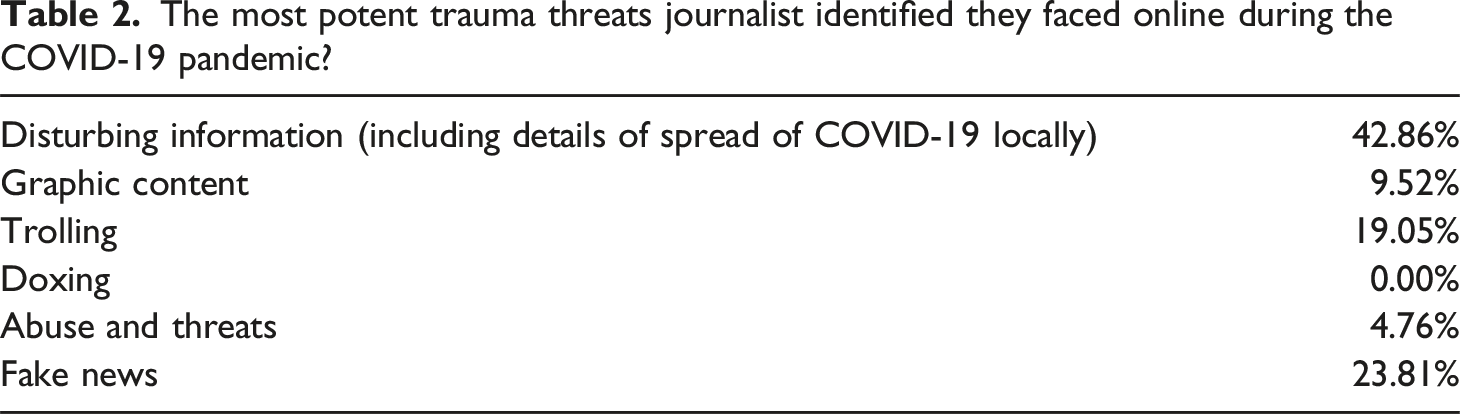
The most potent trauma threats journalist identified they faced online during the COVID-19 pandemic?
Participants were invited to express their interest in participating in a semi-structured interview. Seven online interviews were conducted with two cohorts: journalists (4), and journalism and trauma experts (3). The interviews commenced 3 months after the online survey opened. The delay was a deliberate decision to gain initial insights from the survey to guide the interviews. The interviews were conducted using Zoom at a time and location decided by the participants. All interviews were conducted in English without the intervention of interpretation or translations. The three experts interviewed for this project were identified by their name and affiliations for which they gave consent. However, personal details of the interviewed journalists (name, country of residence, nationality, city of work, work affiliation and age) were withheld to de-identify them for ethical practice. Four journalists participated in the semi-structured interviews. Two of them were based in Asia, one in Latin America and one in North America. All of them had more than 5 years’ experience in journalism. Two worked in English while the other two worked in their native languages. All four used English as a language of communication for their work.
The main content of the interviews with the journalists was designed to gain richer, deeper insights into their journalistic practice, including: the manifestations of online trauma threats; their characteristics; their impacts on professional and personal lives; and any mitigative measures participants were using or that experts recommended that interviewees were aware of. As with the survey, the participants for the interviews were selected on their reporting portfolio and their reporting during the pandemic and lockdowns.
Data analysis
The data gathered from the survey was first examined using thematic analysis to identify reoccurring themes. The predominant themes from the survey were applied to analyse the interviews with journalists and the experts using colour codes. The interviews were transcribed verbatim. At the conclusion of coding the survey and interviews, the data was analysed with the central idea at the core, how did the lockdowns impact the journalists and their work (Braun and Clarke, 2023: 428). Thematic analysis was used to first familiarise with the data and then scope for trends. The survey data was first analysed before the interview with journalists were analysed using the same process. The analysis also acknowledged the role of the lead investigator as an insider researcher (Braun et al., 2023: 431). For clarity, we have indicated de-identified participant names using pseudonyms.
The most prominent themes developed from the analysis are distilled into three key findings.
Key findings
Finding 1: Increase in time spent online and usage of online resources during and after the lockdowns
The first key finding is likely to be unsurprising: the time journalists spent online for their work increased sharply as the COVID-19 related lockdowns and restrictions came into effect. While expected, it was still important and useful to identify what these lockdown-related patterns of work looked like. As detailed earlier, online resources (including platforms and tools) were gaining importance as reporting, production, dissemination and audience engagement tools during the last two decades. The pandemic and the restrictions made this pivot more acute and faster (Perera, 2022).
Eight in every 10 journalists who took part in the survey said online resources like accessing virtual communication tools, including instant messaging platform WhatsApp, and reliance on digital data bases became the most vital reporting tool during the lockdowns. When asked what was their main platform for journalism – gathering information, dissemination, and audience engagement during the lockdown? (Q6), 80% answered that they used online resources as the main platform.
As the reliance on online resources increased, journalists were spending more time online compared to their pre-pandemic work patterns. Before the pandemic only 39% of the surveyed journalists answered that they spent more than 6 h a day online for their work. This figure recorded a rise of 30% during the lockdowns and rose to 55% overall. Before the pandemic, 9% of the surveyed journalists spent less than 2 h per day online for their work, while 20% spent less than 3 h. By the time they took the survey, all those who participated answered that they spent at least 2 h a day online for their work and 96% answered that they spent 3 h or more online for their work.
This change of time spent online is representative of the reliance on online and digital resources for journalism. As they spent more time online, this data establishes that the exposure levels to online and digital trauma dangers experienced by journalists correspondingly increased. It is important to note that these increased exposure levels took place during a time when the synchronous social and personal interaction networks journalists were used to was severely disrupted. They were also reporting on a potentially fatal long-term threat by focusing on the pandemic.
Changes were also visible in the manner journalists assessed the online dangers they faced. Before the pandemic threats like abuse and trolling are identified as the most potent dangers. The exposure to dangerous information is identified as the most potent digital danger by less than 10% of the journalists surveyed. However, that figure reaches 42% during the pandemic. Following the easing of the pandemic, 31% identify dangerous information as the most potent online trauma threat. More than 65% of the surveyed journalists identified fake news and dangerous information as the most potent online trauma dangers after the height of the pandemic.
Finding 2: Disruption of traditional safety routines prompted by the new working conditions
The intensity of the work on top of reporting a fatal pandemic under unique life conditions created personal circumstances which many participants never anticipated. One interviewee, Kavitha described her numerous phone calls to her octogenarian mother during the lockdowns: “It’s a different way to show that you love someone by staying away from them, that’s a very difficult way to show someone that you love them.” Another participant, Juana recalled how she found it difficult to adjust to the ‘slippers’ journalism (Pantic, 2023), where journalists communicate virtually with sources, from a ‘shoe-leather’ career spent focused on getting as physically close to a story as possible. “Everyone and everything [were] on Zoom and every meeting was 3 h, it was overwhelming,” she said. Similarly, another interviewee, Suren detailed how working from his home and under strict lockdowns meant he would only sleep about 3 h on some days. He said the screen became his main – and at times only – means of interaction with the outside world, both personally and professionally. He suddenly found himself caught in a digitised environment where he was subject to trolling and abuse. He was denied an easy means to create distance from the exposure because he relied so heavily on his online connectivity. Two years before the lockdowns, a prominent journalist in his country was murdered after a prolonged campaign of online hate. Unsurprisingly, his feelings of anxiety increased: “You don’t have the network of your friends and colleagues with whom you feel safe,” he said.
Before the outbreak of the pandemic, the focus on journalists’ mental well-being – especially mental well-being and online usage habits – was low. Survey participants recognised that their response to perceived use of digital technologies to perpetuate threats and violence (Bailey et al., 2021: 1) changed during, and as a result of, the pandemic and related lockdowns. Their responses to the survey attested to the awareness of the link between mental wellbeing and their online usage habits, and the impact of this online usage during the pandemic era was negative. To the question ‘how did online trauma threats impact your professional work as a journalist?’ (Q15), 56% said these threats made them anxious; 19% said they made their work more reliant on data; 17% said the threats made them nervous; and 4% felt they responded by making their work less in-depth.
As journalists became more aware of the dangers of the story they were reporting on, their reaction to the information they were consuming online also reflected linked changes. Before the pandemic, online abuse (36%) and fake content (19%) were identified as the most potent online trauma threat they faced by survey participants. Only 9% of respondents said they considered disturbing information as the most potent online trauma threat before the lockdowns. However, a significant change took place during the lockdowns about how journalists reacted to the information they consumed. The portion of journalists who identified disturbing content as the most potent online trauma threat recorded an almost fivefold increase during the lockdowns with 42% identifying them as the most potent. Others identified fake news (23%), trolling (19%), and abuse (4%). The heightened importance journalists placed on the impact of disturbing information and fake news as the most potent online trauma threats during the reporting of the pandemic has a correlation to the increasing awareness on the potential psychosocial dangers inherent in the information they consumed professionally.
To the question: how did online trauma threats impact your personal lives? (Q16), 53% said they were concerned about the safety (including mental wellbeing) of their loved ones; 29% said the threats made them anxious; and 17% said the threats made them nervous. Journalists were working in a pervasive environment of prolonged precarity and feeling anxious and nervous for long durations. They also felt they lacked effective resources and skills to create short-term or long-term relief from that environment. Answers by the respondents pointed to the inability on the part of their managers and employers to intervene effectively to ease the negative reactions expressed by the journalists. Journalists who took part in the survey expressed the opinion that the industry was not prepared to deal with an emergency of the breadth and reach of COVID-19. There was a pervasive sense of being trapped within the reporting circumstances. A survey respondent (Survey respondent 2) described the biggest change was “not being able to switch off because of the constant need to be on top of case numbers [and] deaths.” Traditional journalism practices like tight deadlines, attention to details and the competition to report stories before others made it difficult for journalists to switch off from a fast-breaking important story like the COVID-19 pandemic. Respondents described COVID-19 as an intense, fast-moving and dynamic story. There was constant emphasis it was potentially fatal and global.
Online connectivity assured a steady, constant flow of information, misinformation and disinformation. As Survey Respondent 8 said, “there was a lot of panic, a lot to cover and only a few reporters. My anxiety spiked as deaths increased and fake news seemed insurmountable, all the while healthcare workers were dying.” The screen in front of the journalists became the connection to the world. Many expressed that it also created a digital prison frame. Survey Respondent 7 described the workspace: “I was alone a lot in front of the computer. I could not move around in my city. I felt trapped, often interviewing people in very difficult situations. That made things more pronounced for me, and I couldn’t escape it by doing things I usually enjoyed as I was stuck at home.” Journalists were working and living in a hyper-active information environment, connected 24/7.
After lockdowns reduced, 31% of the journalists who answered the question: what are the most potent trauma threats you face online after the height of COVID-19 pandemic? (Q14) identified disturbing information as the most dangerous trauma threat they faced, while only 7% said it was abuse. Fake news was identified as the most potent online trauma threat after the height of the lockdowns by 34% of those who participated in the survey. As the restrictions eased, 65% of the surveyed journalists identified disturbing content and fake news as the most potent online trauma threat. Before the pandemic this figure was 27%. Participants said that the wide prevalence of fake news made them question the value of professional journalism and its impact.
The rising awareness on the dangers of online trauma threats expressed by journalists who took part in the project stands in contrast to the lack of community and industry attention to the same. “They [trauma threats] tend to get normalised in the community of journalists and make healing and seeking help a lot difficult,” Survey Respondent 16 answered.
Finding 3: Censorship and removal from online information space
Our research points to changes in how journalists interact with information when faced with online and digital trauma dangers which could significantly impact the content and quality of the reporting. While acknowledging their lack of skills to mitigate these threats, journalists began to implement changes to work patterns that they hoped would create effective safety measures against them. The commonest was to take control of their digital usage by way of avoidance. One of the interviewees said that she limited calls to 30 min. Another, Kavitha deactivated social media profiles. “I have tried to maintain a slightly more definite work leisure balance since working from home tends to make that tougher,” one survey participant answered. While others acknowledged that working from home made limiting screen dependency difficult.
The sense of community camaraderie among journalists informed the creation of safe spaces where members discussed work and life related concerns. Oftentimes, these safe spaces were unstructured and lacked any formal expertise. One of the interviewees, Juana said that she initiated regular community meetings and felt that they gave the opportunity to discuss work stresses openly and safely. The lack of this kind of safe space heightened the feeling of vulnerability experienced by participants. Two participants said that they found their interactions with their offices during lockdowns disappointing as their managers were only concerned about workflow. Both said that they created trust circles with close work colleagues to compensate for the lack of care their employers expressed.
Our research establishes that journalists view online and digital trauma dangers as an urgent concern to their communities. An overwhelming 97.6% of the survey participants agreed that more resources should be diverted to help journalists build skills to mitigate online trauma threats. Journalism experts and educators reported a sharp increase in requests by journalism communities for psychosocial safety training. Research participants were also cognisant of the lethargic reaction within the industry to recognise newer and opaque occupational hazards. Such tardiness also makes effective interventions difficult. In their responses to the question: why do you think that online trauma threats are a danger to journalists? (Q23), respondents identified that the slow on-setting nature of online trauma threats influenced a lack of attention they received in newsroom environments.
Participants also spoke of a high investment of emotional labour during the period they were reporting on the pandemic while under restrictions. One interviewee, Suren said that he had only 2 h sleep the 2 days before the interview because he was facing a deadline. In the months before the interview his efforts to get to his ancestral home and be with his family were thwarted by the sudden cancellation of flights. He celebrated his birthday with his flatmate. “It was difficult because living in a country like we are, in this onslaught on democracy and democratic rights, it does get very difficult to cope with mentally, psychologically. It’s often very overwhelming,” he said. Another interviewee said that though she shared a house with several housemates during the lockdowns, she hardly communicated at a personal level because the demands of her job were unrelenting.
The sense of entrapment participants felt during the lockdown and the pervasive nature of online and digital threats recognise the need to create an effective work-life balance. Journalists are aware that being on the job 24/7 is not a viable and safe option. When asked ‘what changes have you made to your work life since reporting on the pandemic?’ (Q20), participants identified the need to maintain boundaries. For instance, Survey Respondent 21 suggested “I have attempted to establish boundaries between work and non-work time, when possible, for example shutting down the laptop at 6 p.m. It has not always worked but the effort to keep working toward those boundaries is important.” Survey Respondent 24 focused on the need to emphasise on leisure activities, such as: “I have tried to maintain a slightly more definite work leisure balance since working from home tends to make that tougher.”
Our research establishes that the lockdowns and work from home regimes accentuated trends already in motion, like the reliance on digital and online resources, exposure to online trauma threats and related awareness.
The digital flak jacket
The lack of skills to understand and mitigate online trauma threats displayed by the journalism community continues to hamper the design, use, and implementation of effective mitigative interventions against exposure to online and technology facilitated threats. Measures like self-censorship and limiting online engagement undermine free-expression and unobstructed access to information – two key core values of journalism.
Continuing research by the lead author focusing on online and digital dangers journalists are exposed to, indicates the heavy reliance on online and digital resources, the complex and fast-evolving nature of the threats and their impact on free press, and robust democratic governing structures. As such, there are a number of important considerations for the journalism community that can inform ongoing training, research, and implementation through practice. Firstly, we emphasise the need for more concerted research and academic focus on online and digital dangers faced by journalists. Secondly, we call for greater development of, and training with, applicable skills for journalists to effectively identify, understand and mitigate online and digital dangers. While the journalism community is, by definition, responsive and reactive, there is an opportunity to more thoroughly investigate and implement research-informed training for journalists to help them prepare for these threats more readily.
We propose the development of a ‘digital flak jacket’ for journalists – tools and training which adequately prepare the journalist for work in digital spaces. The concept of the digital flak jacket requires the consideration of the individual’s complete digital usage patterns and routines and devising interventions which prompt safe and professional workspace. It equates the digital reporting space to that of a potentially hazardous reporting environment akin to reporting disasters or civil disturbances. Such reporting entails potential exposure to above average levels of danger. Before journalists embark on such assignments, special measures are put in place to assess the dangers and deploy adequate safety measures. Our recommendation is to consider enabling such skills for journalists who use digital and technology enhanced resources for their professional work. As an employer would never expect a journalist to cover a dangerous conflict area without their safety equipment – their flak jacket – so do we suggest that employers should adequately train and equip journalists engaging in online spaces.
The flak jacket emphasises the role played by emotional labour exerted by the journalists and the lived experience of the same. Another key area of note is to understand digital usage habits, both personal and professional. Digital resources afford a unique set of advantages as well as dangers depending on the context of consumption. We recommend that an effective starting point to the introduction of the digital flak jacket as a safety intervention is to initiate action among individual journalists to assess their social media profiles to determine their usage for their personal and professional interactions and engagements, and for instances when such usage blurs the boundaries.
Conclusion
COVID-19 lockdowns extending into dozens of months in some instances, provided an apt opportunity to investigate intensified practices forced on the journalism community in response to sudden societal changes. Since the easing of the COVID-19 restrictions, urgent humanitarian situations have arisen in Myanmar, Sri Lanka, Ukraine, Israel and Gaza. Journalists are likely to face similar, potentially urgent and dangerous working situations while reliant on online and technology facilitated resources. The changes to reporting climate affected after the November 2024 US Presidential Election, have increased the potential exposure to online trauma dangers faced by journalists working in the US. Emergent research on the impact of COVID-19 on journalism has built awareness on how the pandemic and related restrictions impacted the journalism community (Perreault et al., 2021). However, our research shows individual circumstances prompted divergent reactions. Interviewees Kavitha and Suren expressed their need for connection with others while reporting under strict lockdown conditions in South Asia. Juana, reporting under similar conditions, but in Latin America, expressed her desire to limit interactions, even online engagements. Sebastian, based in North America with some degree of mobility said he felt like he was in a race to outrun increasing restrictions. This research provides awareness on how large-scale disruptive events impact the current state of journalism.
The findings derived from this project align with emergent expertise on the rising importance of an emotional turn in journalism (Wahl-Jorgensen and Pantii, 2021), the affective nature of such work (Al-Ghazzi, 2023) and the lack of skills expressed by journalists to create safe online workspace (Hoak, 2023). Journalism in its current iteration functions within a workspace moving between the online and the offline (Bruns, 2023: 1), and journalists now place an increased value on their online interactions (Koenig and Lampros, 2023: 87–90). As such, our findings underline that these interactions now exert a higher degree of influence on the work and lives of journalists.
Social media and online platforms are now interwoven with life in complex patterns (James Garrod, 2023: 270). Relatedly, the online information space cannot be minimised to a perfunctory capacity. Removing yourself from the space, even temporarily, limits access to influential components within public discourse like prominent voices, what they put out in public, viral content and fake and mis-informed content. Such awareness informs what is referred to as ‘news judgement’ in journalism; the process of evaluating the importance of disseminating information or the lack of it. Events with high level impacts like the conflicts in Gaza, Israel and Ukraine, the 2022 public protests in Sri Lanka, the elections in the Philippines in 2022, all reaffirm the centrality of online, digital and technology facilitated resources in journalism.
This research builds on recent work by others including Bruns (2023), Koenig and Lampros (2023), Bélair-Gagnon et al. (2023), Hoak (2023) and Quandt and Wahl-Jorgensen (2022) focusing on the impact of COVID-19 on journalism and on trauma informed journalism practice. The results of the research help establish the importance of creating effective balances between work and personal lives of journalists. The research emphasises the expressed need among journalists for skills enhancement to effectively deal with online trauma threats. These enhancements, if they are to effectively counter these dangers, need to be professionally informed, practically applied and formulated with inputs from academic research investigations and long-term studies.
As set out by the main questions, this project investigates the manifestation and impact of online trauma threats faced by journalists during the COVID-19 imposed remote working regimes. The two main findings attest that despite the increased risk of exposure, journalists’ reliance on online and digital tools for their work increased. This shift towards digital and online work tools and exposure to potential online trauma dangers, disrupted safe work routines and workspace. The research also provides evidence that awareness of online trauma threats remained low and thus the mitigation and preventive measures deployed by journalists were not informed by research expertise.
If journalists are not equipped with current and applicable skills – their digital flak jacket – to build protocols to identify, mitigate and prevent these threats, the resultant censorship will hamper the free flow of information to the public. Journalism educators also must urgently evaluate their duty of care to invest resources to keep pace with these rapidly evolving dangers. We stress the dual need to build awareness and skills among journalists and journalism communities while investing in journalism research and the academy to stay current with the threat matrix.
Footnotes
Acknowledgements
This research received ethical clearance approval from Human Ethics Research Committee, CentralQueensland University approval number 0000022459.The authors acknowledge and express their appreciation to the supportextended by Creative Arts Research Training Academy, Central Queensland University by way of funding and resources for thechief investigator Amantha Perera.The authors gratefully acknowledge the contributions of all the research participants to theproject. Amantha Perera acknowledges and expresses his appreciation to the support extended by the Dart Centre for Journalismand Trauma, Asia Pacific and its staff for his work.
Declaration of conflicting interests
The author(s) declared no potential conflicts of interest with respect to the research, authorship, and/or publication of this article.
Funding
The author(s) received no financial support for the research, authorship, and/or publication of this article.
