




Abstract
This mixed-method study analyzes reports related to schizophrenia in Canadian news media during the calendar year 2022 (N = 237). The corpus was coded for tone, journalism sources and themes. Correlations between those elements were measured, and also compared against a baseline of random articles from the same database and time period. A variety of Welch’s t-tests suggest that news about this severe mental illness is negative in tone 63% of the time, and linked to themes of violence and criminality at twice the rate of the baseline corpus. Sources such as police, lawyers and others from the legal system dominate the articles by a wide margin in absolute and relative terms compared to the baseline. Organizational sources, such as advocacy groups, correlate to the minority of reports with a positive tone. Those living with schizophrenia or their families are quoted more frequently compared to the same kinds of voices in the baseline, but they do not result in positive tone. Political sources are under-represented in the corpus; reports related to the themes of resources and health care funding are coded at the lowest frequency. The data is considered in the context of journalism practice related to sourcing, its style guides and ethics guidance such as truth-seeking and proportionality, but also the post-structural theory of erasure as an explanatory gesture.
Introduction
The main goal of this study is to analyze journalism about schizophrenia in Canada, with a particular focus on how the tone of an article can be related to the kinds of journalism sources quoted in the articles because they are the inputs from which a reporter constructs meaning (Franklin and Carlson, 2013). A secondary aim was to situate the analysis about story choices close to the journalistic practice of sourcing to suggest how the profession could intervene in its coverage. Decades of research internationally indicate that news coverage about mental illness is negative in tone and often associated with violence (Holland, 2012). Media depictions are important because they can exert an influence on public opinion. The general public may treat those living with mental illness as dangerous instead of with generosity if that is the representation (Whitley and Berry, 2013). Canadian news articles about disorders like depression show positive elements in their coverage in comparison to severe mental illnesses (Antebi and Whitley, 2022). Schizophrenia is described as the most debilitating mental illness, affecting about 1 in 100 people (Public Health Agency of Canada, 2020). Functional recovery is possible for those with access to consistent treatment (Vita and Barlati, 2018). News about court cases in the United Kingdom drive negative coverage of mental illness (Wondemaghen, 2014). The sources that journalists choose contribute to the themes and frames found in their reporting (Dimitrova and Strömbäck, 2012; Zelizer et al., 2022). Taking up a post-structural analysis introduced in the literature review about mental illness and the news we suggest journalism gatekeeping practice can be described as a “techno-scientific” ethical practice (Anderson, 2012: 115) that may not be able to account for the minority of people living with the condition. Anticipating results, we describe that schizophrenia as a concept is “under erasure” in this context, suggesting it may be delimited by journalism decision making that will hew to a duty of care to a majority audience. To study how schizophrenia is covered in the news media, 1 year of coverage distributed online by Canadian news outlets about the topic was coded in a spreadsheet with tone, journalism sources and themes as variables. We read for three concerns: (1) The qualitative themes such as crime, rehabilitation, recovery, healthcare funding, etc. (2) The overall positive or negative tone of the articles and (3) The sources contained in the articles (i.e., the people the reporter quoted directly or paraphrased), organized into categories. These judgments were coded as variables and compared to a baseline of random articles from the same time period coded similarly. Previous research about sourcing has theorized over-reliance on some kinds of sources (Zelizer et al., 2022), so this study tests whether overweighting is statistically evident compared to a baseline. Similarly, previous research suggests overly negative tone prevails in this content. Several Welch’s t-tests were completed to suggest a statistically significant difference between the corpora. The results suggest a mostly negative tone across the coverage that is focused on violence and criminality, corroborating similar findings from previous studies. The outcome suggests that these themes are correlated with sources from the courts and police coverage appearing at double the rate of every kind of source except those living with the condition and their family members. This category of sources is overrepresented compared to the baseline yet it did not create an overall positive tone. Also, fewer politicians are involved in the corpus compared to the baseline articles. Comparatively fewer organizational sources in the schizophrenia corpus correlate to the minority of articles with positive valence. The results are also considered in the context of theories about what makes the news (Shoemaker, 2009) and professional journalism resources used in Canada that reflect journalistic role performance (Mellado, 2020). Guidelines refer to a truthful, proportionate reflection of culture and society (Kovach, 2001), “giving voice to the voiceless” (Buttry, 2016), and social justice (The Toronto Star, 2023). To our knowledge, no study considers the sources in the news about journalism as variables, how they may contribute to the tone and themes about schizophrenia, and how to account for these kinds of results within journalistic gatekeeping and standards of care.
Schizophrenia epidemiology, stigma and treatments
The rate of schizophrenia increased by an average of 3% a year between 2002 and 2016 and the current incidence is about 1 in 100, about double the global rate (Public Health Agency of Canada, 2020). Higher rates are correlated with countries with higher income disparity (Burns et al., 2014). Household poverty is associated with this condition in many countries (Hakulinen et al., 2020; Yu et al., 2020). A recent meta-study of research across 15 countries suggests about one in four men and 1 in 10 women affected by schizophrenia over 35 years were involved in violence (Whiting et al., 2022). The rate is four to five times higher than the average population recorded by Statistics Canada. At the same time, people living with this condition are also much more likely to be victims of violence than the average person (Sariaslan et al., 2020) and two to three times more likely to die early compared to the general population with higher rates of suicide included (The World Health Organization, 2022). Research also suggests schizophrenia is among the most stigmatized of mental illnesses (Valery and Prouteau, 2020). The impact of stigma for those living with this condition, according to the World Health Organization, (2022). It is intense and widespread, causing social exclusion, and impacting their relationships with others, including family and friends. This contributes to discrimination, which in turn can limit access to general health care, education, housing, and employment.
Stigma is “conceptually uncertain” and a culturally located “multifaceted process” (Holland, 2012: 1). It may obstruct recovery, care-seeking and potential support for public policy for health care (Corrigan, 2004). Yet about half of those living with schizophrenia who seek care experience functional recovery (Vita and Barlati, 2018). Recent research describes a growing array of approaches to rehabilitation and treatment (Markiewicz and Dobrowolska, 2020; Vita et al., 2021). The themes of rehabilitation, treatment, recovery, violence and criminality, and health-care funding are included as variables in the present study to be considered in the corpus in their proportionality to each other and against a baseline of articles, a concept discussed below.
Journalism gatekeeping and proportionality
Reporting about mental health and illness, and with it schizophrenia, falls into many categories of, “what makes the news.” Gatekeeping involves decisions about what is most salient given economic restraints (Adamson et al., 2016). Researchers and journalism textbooks describe this process. Multiple, daily, rapid decisions about newsworthiness relate to timeliness, proximity to the audience, “unusual nature,” and stories of “human interest… about people with special problems, achievements or experiences,” according to one textbook (Rich, 2013: 13). It also describes that conflict, impact and helpfulness can be among news values. Another textbook suggests, “journalists are less adept at reporting complex phenomena, such as the causes and consequences of crime, poverty,” and that a news organization’s selection of news will be affected by the size of the community it serves (Bender, 2011: 7). Newsmaking can be defined in terms of statistical deviance and social significance (Shoemaker, 2006, 2009). Reports are written when laws or social norms are crossed; the status quo is threatened; an event appears to fall out of what is statistically normal, for example, or when institutions such as religion, ethnicity, and language are affected, or when the well-being of citizens is at risk.
In an admission, the profession is challenged where mental illness is concerned. The majority of the publications selected in our corpus would adhere to The Canadian Press Stylebook (2023): For a profession rife with lofty goals and aphorisms — holding up a mirror to society, comforting the afflicted, holding powerful interests to account — journalism has historically failed to meet its own altruistic standards when it comes to documenting mental illness and the people impacted.
The Society of Professional Journalists’ Code of Ethics and Poynter’s Guiding Principles say that journalists should “give voice to the voiceless” (Buttry, 2016). In Canada, the largest newspaper outlet by circulation names “social justice” in its Atkinson principles (The Toronto Star, 2023). The Canadian Association of Journalists describes that its reporting should contain “no stereotyping” and that “we take particular care in crime stories” (The CAJ Ethics Advisory Committee, 2023). The Canadian Journalism Forum on Violence and Trauma, with support from the Mental Health Commission of Canada and the CBC published a set of guidelines for reporting on mental health that defines stigma and approaches for speaking with sources (The Canadian Journalism Forum on Violence and Trauma, 2014).
In 2012, summing up mental illness news and its association with violence Holland wrote, “the concern is not so much that such stories are reported but that they are reported disproportionately to other kinds of stories” (p. 221). Some professional resources describe proportionality as a rule of thumb for the numbers and variety of stories that ought to be reported on a subject (Kovach, 2001). This term was described in a textbook by Kovach and Rosensteil (2021) in circulation and re-published many times since 1939. The concept is repeated in professional resources such as the American Press Institute (Dean, 2023): Journalism is our modern cartography. It creates a map for citizens to navigate society. As with any map, its value depends on completeness and proportionality in which the significant is given greater visibility than the trivial. Keeping news in proportion is a cornerstone of truthfulness. Inflating events for sensation, neglecting others, stereotyping, or being disproportionately negative all make a less reliable map.
Ethics guidelines including the Canadian Association of Journalists’, the CBC’s Journalistic Standards and Practices or the Canadian Press Stylebook do not refer to proportionality. One analysis of international stories in an American and UK newsroom suggests news coverage was distorted and that proportionality should be considered when reporting on situations where human rights are involved (Heinze and Freedman, 2010). Overall, professional guidance describes motivation to treat mental illness with care and to present an even-handed and balanced discussion about it. These guidelines echo journalistic performance research that explores journalists’ conception of themselves as “interventionists,” keen on public duty and loyal to public causes (Mellado, 2020: 4). This study analyzes journalism about schizophrenia with the profession’s self-professed standards as part of a benchmark. To our knowledge proportionality is an under-considered and theorized concept for the analysis of news coverage. We especially take up the notion of proportionality by quantifying decisions about sources and themes relative to a baseline as a statistical study.
Mental illness, journalism and the question of sources
Despite the above professional guidance and several decades of public and globally distributed analysis, the association between stigma, mental illness and journalism endures (Corrigan et al., 2005; Subramanian, 2019; Wahl et al., 2002; Whitley and Berry, 2013). One Canadian researcher suggests that newsrooms deliberately focus on violence to attract audiences (Stuart, 2006) but a study on the web analytics from newsrooms in the country suggests this content is not read any more than average, while neutral stories about recovery are shared more (Adamson et al., 2016). The quality of media coverage in Canada varies by diagnosis, with mental illnesses such as schizophrenia identified with a negative tone and associated with violence compared to depression or anxiety (Antebi and Whitley, 2022). Sourcing is an elemental act of reporting with journalists admitting sources into their narratives based on source credibility and their familiarity with the reporter (Franklin and Carlson, 2013). Some news organizations have begun to track sources according to gender, race and equity-seeking status as a means to drive greater representation and balance (American Press, 2024; Moore, 2018). Sources contribute to themes and frames identified in news text and video (Bennett, 1990; Dimitrova and Strömbäck, 2012; Zelizer et al., 2022). Reporters impose themes on the stories by linking them to quotations from sources (Pan and Kosicki, 1993). Mental health journalism in Australia is a highly mediatized and contested field, with advocacy groups, practitioners and other stakeholders playing parts in the communication about the subject (Holland, 2018). In New Zealand, research suggests that representation would improve if stories included sources living with mental illness rather than experts (Nairn and Coverdale, 2005). One UK study suggests that media depictions of those living with mental illness reflect legal narratives in the context of criminal responsibility (Wondemaghen, 2014). Although sources were not a variable in the study, Canadian research compared the themes in videos about mental illness produced by citizen journalists living with these conditions against TV news and found violence and negative tones were mostly muted (Carmichael et al., 2019). Given the persistence of the challenge around reporting on this topic and considerable questions raised above about the vectors that sources bring to stories, this present study analyzes source choices about this subject. We organize sources into political, organizational, legal authority, and expert categories as described below in the methodology. We also pay special attention to sources who live with the illness and their families, addressed in the following section.
Journalism and schizophrenia
In a 2013 paper about media representation of mental illness in Canadian newspapers, given their results, researchers Whitley and Berry made the following recommendation about how medical personnel could advise their clients: “Clinicians may direct patients and family members to other resources for more comprehensive and accurate information about mental illness” (p. 108). In this final section, we focus on journalism sources living with schizophrenia by introducing Derrida’s theory of erasure and by considering the word Words are not just names for things and objects (which is what they also are) but words also ‘name’ or ‘stand in directly’ for (represent) what is absent.schizophrenia in our corpus. Here we deliberately inscribe on the page a word that is also struckthrough, as in the heading. The effect is to repeat the word but “with difference” (Anderson, 2012: 106) in deconstructionist theory, explained below. The editorial intervention is meant to motivate reflection, and underline tensions between what is on the page in our journalism texts, and what is not. We introduce this concept for four reasons: (1) Given the literature review, we anticipate how narrowly defined schizophrenia is in journalism texts. (2) We believe the theory helps explain repeated concerns about this coverage historically. (3) Erasure and proportionality point towards a transformational approach to decision-making in newsrooms and (4) Previous critical research about media and mental illness took up poststructuralism. We start there. Holland describes StigmaWatch, an Australian campaign to disrupt journalism and other media, which called out casual use of words like “schizophrenic, bipolar, psychotic, depression” (2012: 224). The campaign engaged in a deconstructionist approach to media coverage, taking “ownership” of the words. The intervention called out offenders and named them on a public website, aiming to limit words about mental illness to approved definitions and uses. Holland argues the campaign risked being counterproductive and possibly drove stigma. She points to Derrida’s “play of signification” describing that the meaning of words is never fixed (p. 220) and bound in “context.” We suggest Derrida’s theories, as revisited by Anderson (2012), encourage an alternative deconstructionist reading of journalism texts about mental illness, a reading that places the subject in the context of gatekeeping. To begin the discussion we define erasure (p. 100):
Erasure as a theory is applied to the analysis of the literary arts (Hosay, 2020), but also to journalism texts (Hellmich and Purse, 2018; Hennigan, 2022; Hochberg, 2015). As a heuristic, the word suggests a textual or visual approach to a story is missing context or information. To understand how erasure applies to our discussion, we trace the history and critical trajectory of the term “under erasure” to the place where Anderson, in her book Ethics Under Erasure, describes how it can apply to routine ethical decisions and, in turn, how we can apply it to gatekeeping. The concept is related to the original editorial flourish by Martin Heidegger. In his case, the philosophical concept of “Being,” theorized by René Descartes, prevailed at the time. It was encapsulated in the phrase, “I think therefore I am.” Yet for Heidegger, “Being” was more material, more physical, not merely of thought. So he wrote “Being,” (with the strikethrough), as an acknowledgment to historical systems of thought but also as a kind of protest, a way to acknowledge his context, and to shift the meaning of the word, describes Anderson (p. 93). This approach was taken up by poststructural analysis, in which cultural and historical context can be elicited for every word. It can “destabilize” certainty of meaning (Aylesworth, 2022; Anderson, 2012). Critics deride deconstruction because it challenges meaning-making; a “nihilism” is suggested, (p. 19). Yet Anderson’s re-reading of Derrida argues he was not driving “undecidability” of meaning or lack of consequence (p. 40). Moreover, she focuses on Derrida’s ethical writing. Without rejecting utilitarian and deontogical approaches to ethics altogether, his work challenges institutionalized, duty-bound decision making, preferring what Anderson calls the “ethically singular” moment to meet the needs of “the Other.” Anderson notes for example that the utilitarian rule, “the greatest good for the greatest number of people” (p. 114) can be contested as an ethical duty for minority populations that may represent ethnic or religious groups. Derrida’s writing about ethics puts under tension such universal ethical frameworks against individual decisions that we undertake everyday, many times. To carry the logic back to journalism about schizophrenia, news gatekeeping duties are broad and blunt. Editorial choices tend to be driven by an implied economic imperative for a large audience, as described above in the literature review. In this way, gatekeeping could be described as a “techno-scientific programme,” a term Derrida uses for mechanistic structures (p. 115) that fail as ethical paradigms at crucial times. In summing this section up, the moment of erasure is meant to be transformational according to Anderson. Where serious mental illness is concerned, this is arguably an overdue consideration, given that gatekeeping has yielded the same kind of results for decades. While we cannot reify an abstract theory like erasure with a quantitative method, we aim to suggest how delimited the sense of schizophrenia is in journalism by considering the elemental items of reporting. This brings us back to our coding scheme of tone and themes, but also sources. What is the impact of gatekeeping practices on sources and specifically - the so-called “Other” in this model? In the methodology, which begins below, sources living with schizophrenia and their families are variables compared against similar unaffiliated sources in a baseline of texts.
Methodology
Schizophrenia article coding variables.
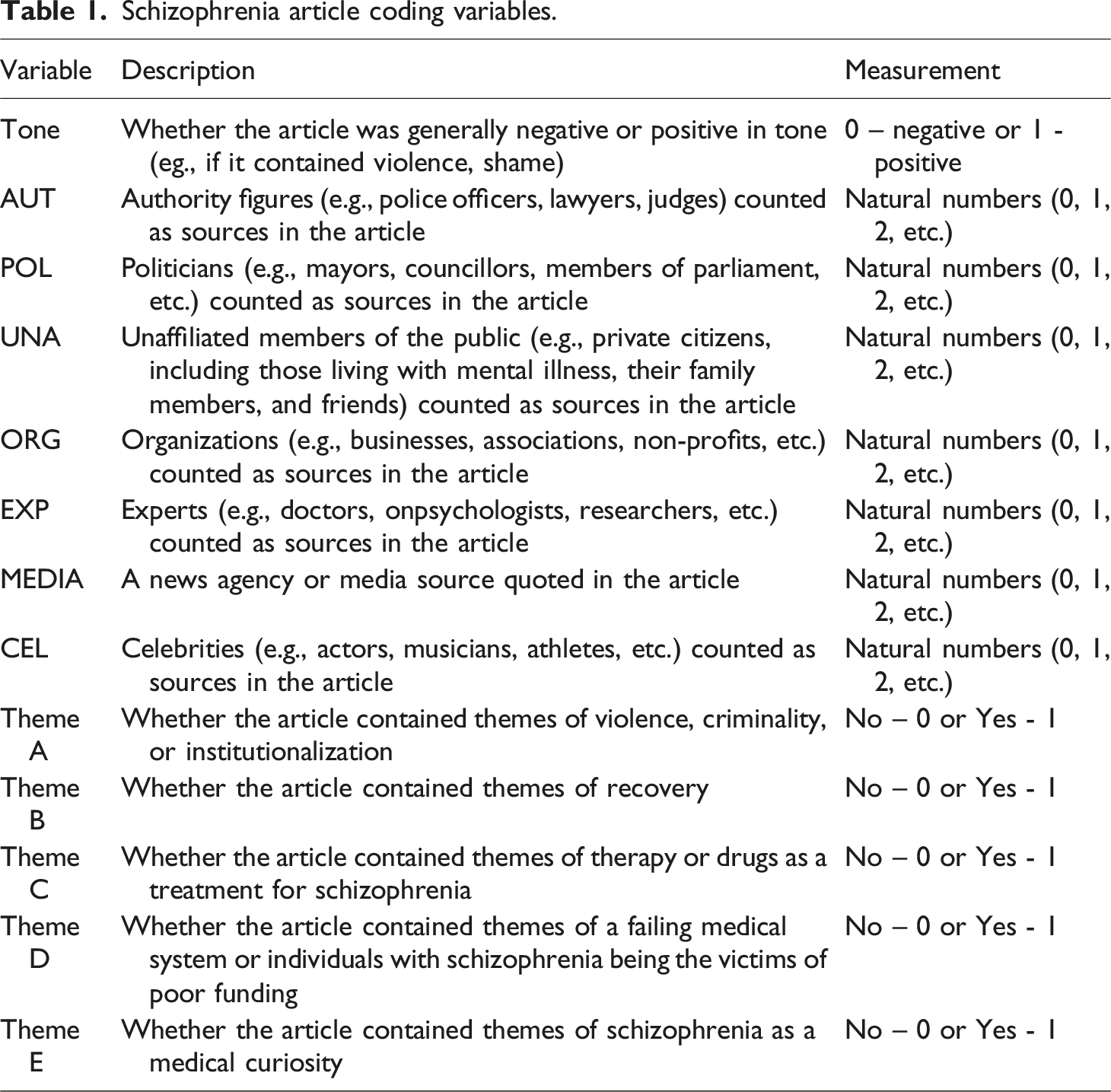
The schizophrenia news articles were retrieved, screened and coded for tone, sources and themes by the second author after training and supervision by the first author, who was involved in a similar study (Adamson et al., 2016). The random article database was coded by a researcher also after a training period with the first author and using the categories defined earlier. Interrater reliability scores were calculated following a training period using the first 10% of each article dataset. The authors and researchers discussed coding discrepancies to clarify coding methods and to agree on discrepancies. After training, individual kappa scores ranged from 0.7 to 0.9, indicating substantial agreement for all variables, with a global kappa of 0.80. Once the articles were coded, we found that the number of media sources quoted and celebrities counted as sources in the article database were negligible (11 and 12 respectively across 237 articles), so these variables were left out of the analysis. This left us with 11 unique variables.
Measures
Variables were coded in two ways. Tone and themes were coded with either 0 or 1 indicating the presence of a theme or negative or positive tone. Tone involved a judgment about whether a text referred to violence or not but it also included concepts like shame or despair. Journalism sources were counted using natural numbers (1, 2, 3, etc), with the mean representing the average number of sources per category in the database. For the themes, the mean represents the percentage of articles in the database were coded with a value of 1. Several Pearson product-moment correlation coefficients were calculated resulting in an R statistic to determine whether there was any relationship between coded content variables, tone and each of the input source types. For example, was there correlation between the tone in the article and the sources it contained; or was there a correlation between tone and themes? The standard p-value of less than 0.05 (5%) indicated statistical significance. Welch’s t-tests were used because research suggests this approach is more reliable when sample sizes are unequal and less homogeneous variance is assumed (Delacre et al., 2017).
Descriptive statistics
Descriptive statistics for coding variables.
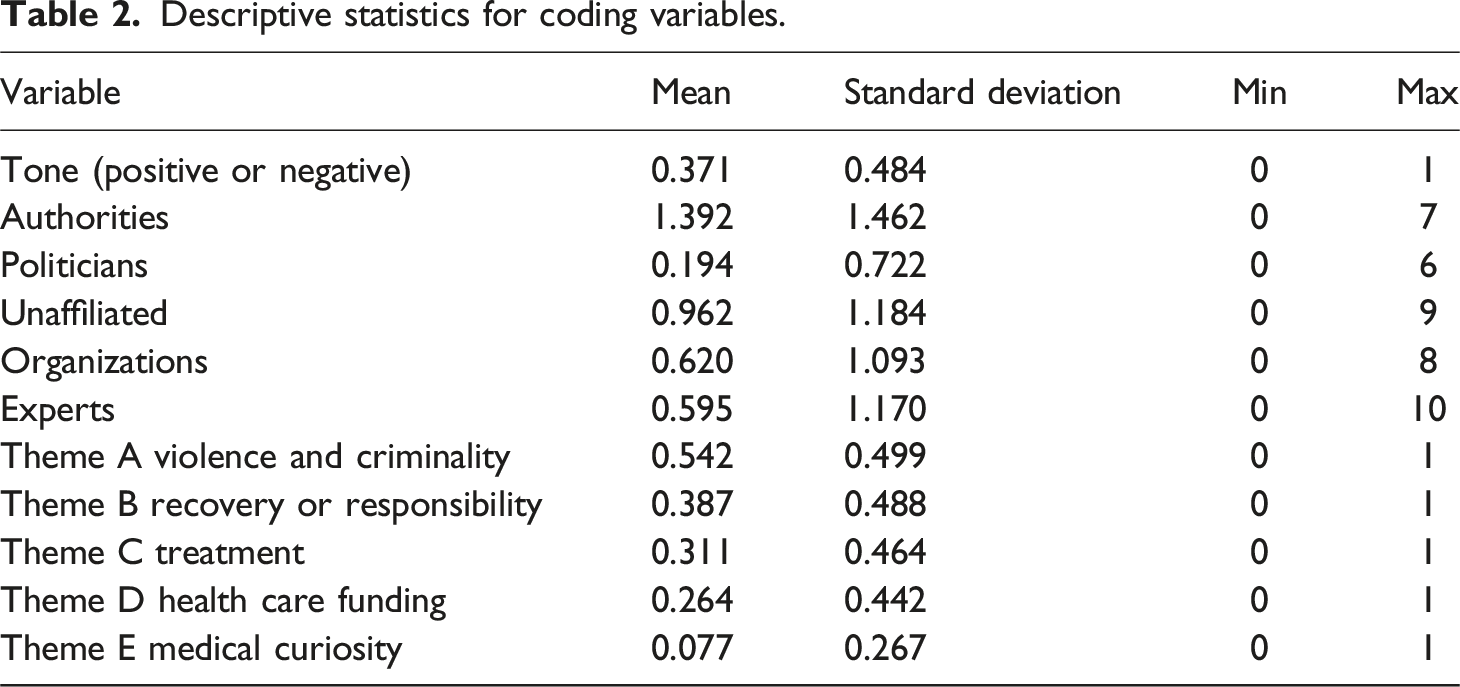
The Authority (AUT) source category has a mean of 1.392 meaning that every article in the database had an average of about 1.4 authority figures quoted either verbatim or paraphrased as a source. Other source frequencies in the articles, in order of highest to lowest mean, are Unaffiliated (0.962), Organizational (0.620), Expert (0.595), and Political (0.194) sources.
Respectively, 54.2% of articles contained themes of violence, criminality, or institutionalization; 38.7% related to themes of recovery or responsibility; 31.1% contained themes of therapy or drugs as a treatment for schizophrenia; 26.4% mentioned health-care funding or assigned blame to poor services; and 7.7% referred to schizophrenia as a medical curiosity without any kind of depth of reporting.
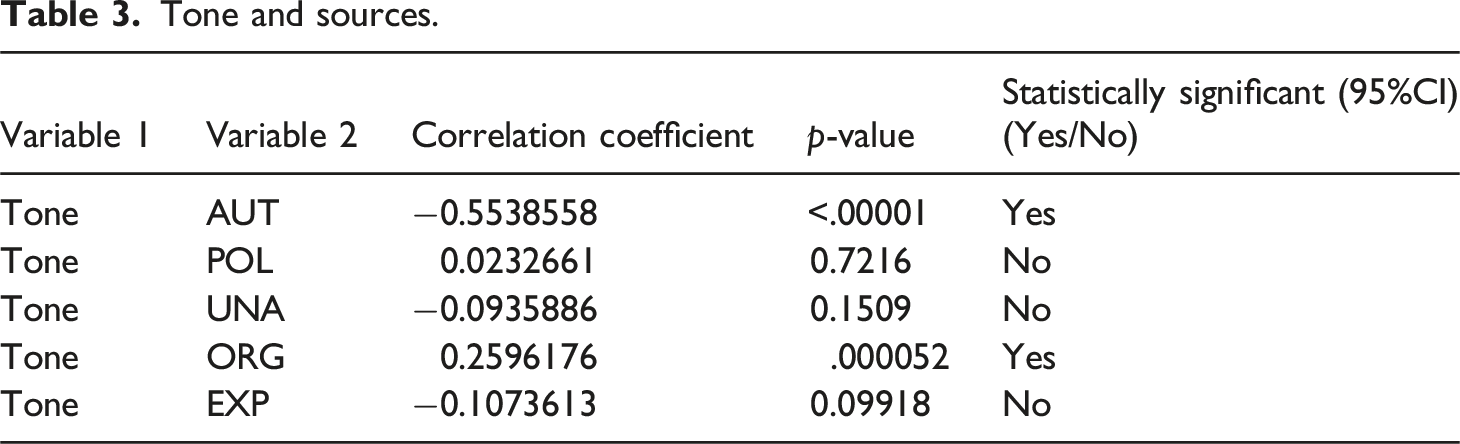
Tone and sources.
Summary of t-tests comparing schizophrenia and baseline articles.
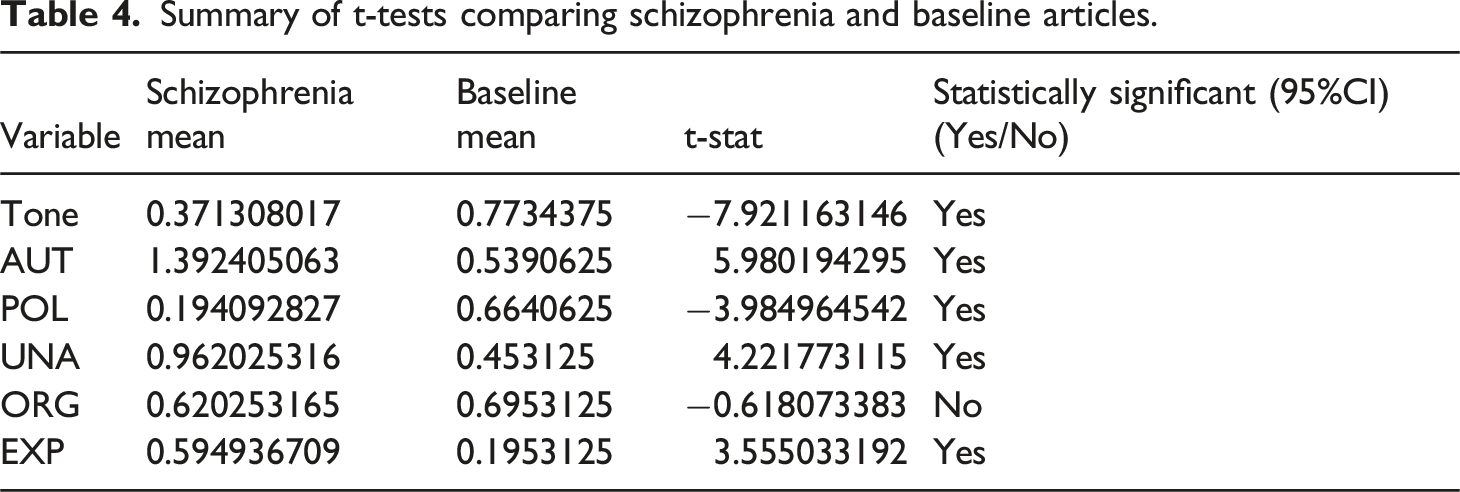
Five of the six t-tests were statistically significant. Schizophrenia articles have a positive tone 37.1% of the time, compared to 77.3% of baseline articles. According to the t test, the differences between the two means were statistically significant providing support for the hypothesis that baseline articles are more likely to have a positive tone than schizophrenia articles. Schizophrenia articles had an average of 1.39 authority figures as sources while baseline articles had an average of 0.54. This difference in means was statistically significant. Schizophrenia articles also have a higher number of unaffiliated members of the public and experts while baseline articles have a higher number of politicians as sources.
T-tests were also conducted to adjudge correlation between tone and themes. Tone has a strong negative association with themes of violence, criminality, or institutionalization. Positive tone was also strongly associated with themes of recovery or responsibility and themes of therapy or drugs as a treatment for schizophrenia. The above correlations were at the 0.0001 p-value. Tone was positively associated with the theme of schizophrenia as a medical curiosity (though somewhat weakly) and was not associated with themes of a failing medical system, or individuals with schizophrenia being the victims of poor funding at a statistically significant level.
Discussion
The overall finding is that the journalism corpus we captured in 2022 about schizophrenia portrays a skewed representation of the mental illness. The tone is predominantly negative, at 63%, with violence and criminality correlated as the dominant theme statistically. Authorities like the police and lawyers are by far the most frequent voice in this corpus.
Police, judges, attorneys, etc. are overweighted in absolute terms in the schizophrenia corpus but compared to the baseline corpus they are present at double the rate. These sources are correlated in the strongest way with negative tone that dominates the schizophrenia corpus. The baseline articles are much more likely to be positive in tone at a statistically significant level.
The Organizational source category is the only one correlated to positive tone. For example, a story in the corpus, “Bell Let’s Talk Day Includes Roundtable,” includes a spokesperson from the Canadian Mental Health Association. Yet these kinds of sources appear at half the rate of those in the Authority category.
Politicians as a category appear the least frequently of all sources in an absolute sense. This category is by far the most underrepresented with a statistical significance compared to the baseline. This suggests journalists are not serving a core function in this context: asking questions about services and funding in health care and holding power to account.
Citizen sources in the unaffiliated (UNA) category, which in this case represents those living with schizophrenia and their families, are represented at double the rate of the baseline articles. Maybe this is one of the most vexing of results because their higher relative presence is not correlated with positive tone. While these sources may speak to recovery and positive concerns in some articles, overall these voices are swamped by gatekeeping that locates their voices and perspectives in the context of police and legal proceedings. In at least one instance, family members are quoted in a court story about the shame they feel about their family member, for example.
Similarly, physicians, and other clinical experts are overpresented in the corpus compared to the baseline. These sources may be quoted in more positive stories but they do not appear frequently enough to drive statistical difference in tone because so many stories are in court rooms where the stories are grim.
Proportion, an underlying concept in this study, may be “subjective,” as Kovach and Rosenstiel describe. Yet if the metaphor above about map making is taken seriously, the body of this work is built like a homunculus, with outsized geographies in courtrooms and other areas where criminality is in question compared to smaller spaces where recovery, treatment and moments of social cohesion take place.
This kind of inquiry leads us to ask questions like, “What would proportionate coverage about this condition look like?” Would 50% of the articles related to violence and criminality be proportionate? Fewer than 62% of the articles negative tone? Why not more than 38% of the articles displaying themes of recovery and treatment? Would it be fair if the schizophrenia article tone matched the baseline articles? It drives questions about what sourcing and tone would look like for other kinds health reporting, which may focus on treatments of cancer, for example. And so on.
In this corpus, stereotypes are not avoided. Stories of the voiceless are not amplified, as imagined by guidelines and journalistic role performance. If newsrooms take seriously a duty to truth-seeking and proportionality where schizophrenia is concerned it may take a concerted intervention. Policing words may not work as Holland suggests but math may; proportionality could be genuinely applied with some thought. This could take the form of halving coverage of court cases where schizophrenia is repetitively associated with criminality and violence, for example. A reporter who chose to receive alerts from Google Scholar with schizophrenia as a search term, for example, would see ideas daily for reporting about new approaches to treatment, or fresh understandings about the condition. As this study suggests, a newsroom could monitor the sources they quote in this subject area for hints about how to change the approach.
When we write schizophrenia with a strikethrough we ask the profession to consider how different the coverage could be, and how delimited it is and has been within journalism for decades. The literature about erasure in some ways echoes the discussion about proportionality. Journalism guidelines above note “size of community” as a news value consideration but the meaning of that phrase is ambiguous. What community and for whose interests are journalists reporting? Invoking the utilitarian maxim quoted earlier, if we could say that journalism gatekeeping ethics aim to do the greatest good for the greatest number of people, then what of the interests of minority populations, vulnerable populations? What of “The Other” and “ethically singular” decisions? With what kind of frequency do newsrooms grapple with, on a case-by-case basis, this topic. And how often do they speak to those living with the condition and in what context? These are all proportionality questions that are also inspired by the discussion about Derrida’s ethics under erasure. How can gatekeeping maxims be altered to change the outcome?
Further study is needed about the nature of stigma and how journalism encodes it. One way to think about this that is not too far afield from this study relates to the psychoanalytic concepts of forgetfulness or repression. Freud’s theory of the unconscious influenced Derrida and other postmodern philosophers because ‘what is absent’ in speech or text is central to both approaches (Anderson, 2015). Derrida’s notion of erasure is conceptually similar to Freud’s notion of the uncanny, “the return of the repressed,” (Ruers, 2019). It invites reconsideration of contextual assumptions and mental heuristics. Galison (2012) writes that Freud developed his theories of the unconscious in parallel with his experience of Austrian censors. “Over and over, he registered the power of both internal and public censorship in the shared form: distortion, anticipatory deletion, softenings, even revision to hide suppression” (p. 1). In this way, journalism guidelines represent “the conscious” and they say nothing about “the unconscious.” Maybe this is simply to say that the journalism is of course mired with the same rarely uttered fears about mental illness as other professions. In another study about mental health coverage in Australia one journalist who participated in the research attributed the poor coverage of schizophrenia to its palatability. It “can be a bit ugly,” he said (Holland, 2018: 1775).
Conclusion
We have contributed to the understanding of how severe mental illness, and specifically schizophrenia, is reported in the Canadian news media. We compared the tone and the journalism sources in a corpus of articles about schizophrenia to a baseline of articles from a database during 2022. Welch’s t-tests indicated statistical significance in the differences between the corpora. The results suggest a mostly negative tone (55% of articles) across the coverage that is focused on violence and criminality 63% of the time. These findings corroborate similar findings from previous studies but what is new is the statistical significance compared to the baseline. Sources from courts and police coverage, which appear on average 1.4 times per article, are quoted at double the rate of every kind of source except those living with the condition and their family members (0.9 times). Again, this frequency was different compared to the baseline at a statistically significant level. Experts were also significantly overrepresented compared to the baseline, along with unaffiliated sources, or those living with schizophrenia in our test corpus. Neither source category was correlated positively to tone. Fewer political sources are involved in our test corpus compared to the baseline articles at a statistically significant level. Comparatively fewer organizational sources in the schizophrenia corpus correlate to the minority of articles with positive valence with stastitical significance. We considered literature about journalism practices such as sourcing and journalistic role performance. Previous research related to mental health reporting that suggests that gatekeeping in this realm has produced unrepresentative reporting for many decades. Guidance from journalism texts about proportionality suggests the profession wants to do better and an enumerative accounting is a potential solution that we describe. We also suggest the postmodern theory of erasure can have both an analytic and descriptive value that inspires action. With an eye on sourcing, newsrooms could make more finely tuned decisions rising to the level of ethics if they think less about the public interest of majority audiences. Our study is limited to 1 year of data so it is impossible to make judgments about how practices may have changed in the context of greater economic constraints on the profession in the past decade and more. One limitation is that we have not spoken to journalists about their attitudes related to schizophrenia or severe mental illness. Another limitation is that our approach did not consider that reporting about schizophrenia may be implied when more general discussions about mental illness are described in news articles. Themes about healthcare funding, social services, rehabilitation and treatment may prevail more in other subject areas. This kind of journalism would also reflect that the newsrooms engage more political and organizational sources to discuss these concerns.
Footnotes
Declaration of conflicting interests
The author(s) declared no potential conflicts of interest with respect to the research, authorship, and/or publication of this article.
Funding
The author(s) disclosed receipt of the following financial support for the research, authorship, and/or publication of this article: This work was supported by the Velma Rogers Research Chair in Journalism, Toronto Metropolitan University.
