



Abstract
The study combines domain expertise and computational community detection to uncover what role citizen journalists and social media platforms play in mediating the dynamics of conflict in Mali. Under conditions of the growing conflict in Mali, citizen journalists are opening Twitter (rebranded as X) accounts to stay updated and tweet about the ongoing socio-political tensions, chronicling life in a conflict-ravaged context. This article conceptualizes the rapid reliance on Twitter among citizen journalists consisting of bloggers, activists, government officials and NGO’s as a form of networked conflict and networked journalism. Networked journalism emerges as professional journalists adopt tools and techniques used by nonprofessionals (and vice versa) to gather and disseminate information while networked conflict involves the consequential and intricate relationship between social media and conflict in the Sahel region of Africa. Our findings show that Twitter is a source of action that promotes and mediates conflict, which exposes users to conflict-related content. The findings also show that what accounts for citizen journalism in a conflict setting is vague as those with access to Twitter and as such, the presumed ability to influence the narrative, unequivocally consider themselves citizen journalists.
Introduction
There is a broad agreement among journalism practitioners and researchers that digital Information and Communication Technology is ever expanding communication ecologies. This development jeopardizes ‘traditional journalism’ by introducing new actors on the periphery of what was traditionally and exclusively reserved for professional journalists (Cheruiyot et al., 2021). In Africa especially, the advancement of Information and Communication Technologies (ICTs), and more specifically social media (SM), has been described as revolutionary for its leapfrogging effect in the connecting citizen and professional journalistic practice (Mpofu et al., 2023; Paterson, 2015). The optimism of the first decade of this development, where digital participatory cultures would lead to more democratic societies (Jenkins et al., 2016), has however been replaced by more nuanced conclusions (Omanga et al., 2024; Srinivasan et al., 2022). Exemplary to this development is the role of social media in the spread of “fake news”, misinformation and hate speech (Gargliardone, 2019; Roberts and Karekwaivenane, 2024; Ross Arguedas et al., 2022), leading up to polarized societies and escalating conflict. The relationship between such speech on SM platforms and its influence on conflict or violence is however very difficult to prove (Dafoe and Lyall, 2015). Our study on the Malian Twittersphere and its influence on the conflict that erupted in the West African country in 2012, contributes new empirical evidence showing the increasing relationship between the ever-expanding communication ecology and conflict.
Literature review
Networked journalism
Central to our analysis are the actors in the digital communication ecology. Actors that are both human such as professional and citizen journalists and non-human, i.e. the algorithmic influence on the dynamics of platform networking (Cheruiyot et al., 2021). We concur with Budka and Brauchler (2020) that Online Social Network (OSN) is an intrinsic part of everyday life, demonstrating that each social media network in itself also plays an important but different role in directing social and political dynamics. Based on social media and actor-network theory (Spohrer, 2017), which asserts that ICTs are nonhuman actors that contribute to the creation of social situations, we try to understand how and if media technologies like Twitter are also actants. We focus on how they define practices of citizen journalists in Africa.
Citizen journalists or “tomorrow’s journalists” (Blaagaard, 2013: 1076) can no longer be ignored. Citizen journalism is a practice that sees ordinary people or non-journalists taking up reporting roles that traditionally have been carried out only by professional journalists. They are an important category of people in the digital communication ecology where they are central to the creation and dissemination of alternative, non-professional narratives (Mutsvairo and Salgado, 2020) while also steering the digital direction of online activism (Bosch, 2016). Studies on Nigerian citizen journalism show how citizen journalism is used in the prosecution of corrupt political practices (Okoro et al., 2013), or defining perceptions on violent islamist group Boko Haram (Chiluwa and Adegoke, 2013).
As such, the infusion of non-professional actors in journalism practice is threatening how journalism is practiced and perceived. Cheruiyot et al. (2021) historicize the phenomenon arguing that within African journalism there has been a long practice of collaborations among non-professionals, for instance with bards, or publishing citizen voices in print media. However, the difference may be that citizen journalists who work in a digitally networked landscape rely on each other to put the message across (Wall, 2015). This has led to some scholars calling this practice ‘network journalism’ (Bardoel and Deuze, 2001; Heinrich, 2012) while others prefer referring to it as ‘networked journalism’ (Van der Haak, 2012). In this article we showcase how citizen journalists professionally connect online to collaborate in the production of news for their audience, making them active participants in deciding what gets disseminated. Networked journalism is also vibrant across Africa (Mabweazara, 2013; Mutsvairo and Salgado, 2020). African citizen journalism research has confirmed their ability to engage in fact-checking activities (Bailla and Yachoulti, 2022), participate in health delivery campaigns (Ugbo et al., 2022) or advocate for the dissemination of news in marginalized communities (Mwaura, 2021). Our study shows that such citizen-centered journalism practices on social media, in combination with the agency of the platforms, creates information flows that may be detrimental in a conflict context.
Networked conflict
In a world where the online and offline worlds are becoming increasingly entangled, the study of social media technologies sheds light on the contemporary organization of networks and conceptualization of conflict (Asimovic et al., 2022; Zeitzoff, 2017). With the growing usage of digital media platforms, conflict has become mediatized (Budka et al., 2020; Ford and Hoskins, 2022; Zhang, 2020), meaning conflict-related practices and institutions are part of network communication through media. In such networked conflict, the way information circulates contributes to conflict dynamics. Ford and Hoskins (2022) argue that the digitization of communication ecologies has changed warfare. They introduce the concept Radical War as “… a contemporary war that is legitimized, planned, fought, experienced, remembered and forgotten in a continuous and connected way, through digitally saturated fields of perception” (Ford and Hoskins, 2022: 19). Platforms like Twitter, Facebook, and TikTok are part of the web of mediators, which afford its users with networking possibilities and strategies to narrate about conflict and war. Other authors relate the discourses on war and conflict in social media to the practice of war, the ‘weaponization of social media’ (Gray and Guay, 2019; Singer and Brooking, 2018). If indeed a weaponization of social media takes place, what then is the role of digital networked journalism, who act and how? We search for these dynamics in the Malian Twittersphere.
So far, researchers studying West Africa have confirmed the relationship between Twitter usage and conflict. In Nigeria, Chiluwa et al. (2013) show how Twitter users expressed their support or rejection towards the violent group Boko Haram. Tweets demonstrate how victims of violence used various discourses to counter political elites, discredit the government, the West, and seek justice. Schreiner (2018) shows how the context of crisis, war, and limited media freedom increased Twitter usage in Ivory Coast during the post-electoral crisis in 2010 and 2011. Ndiaye (2021) examines social media and mass mobilization referring to the example of the movement Y-en-a-marre. Lee et al. (2023) and Bello et al. (2023) look into the use of hashtags in twitter messages and how they interact with the conflicts in Anglophone Cameroon and Nigeria. Twitter has also been discussed as a platform that enhanced political participation of youth (Egbunike, 2018). We complement research on the Sahelian conflict and Twitter usage in West Africa by focusing on the role of social media interactions in the Malian conflict.
Research question
With this article we contribute to the understanding of the relationship between this communication ecology that exist between human and non-human contexts, or among professional and non-professional journalists, networked journalism, on one hand and networked conflict, on the other. We study the interaction between digital networked journalism and the Malian Twitter space and its effects on the Malian conflict guided by this research question:
How does the Malian Twittersphere and its underlying social networks of citizen journalists mediate the prevailing conflict?
Mali: Connectivity and conflict
Mali, a landlocked country in the Sahel region of Africa, has been besieged by a volatile conflict since 2012. The conflict started in the North with the Tuareg rebellion to claim independence for Azawad that then coincided with a coup d’Etat. This was the start of a period of violence in Mali (Lecocq et al., 2013; OECD/SWAC, 2022; cf. International Crisis Group ICG, 2012). The violence expanded with encounters between armed militias, such as thoseformed by locals paysans or by pastorals, who are often affiliated to Jama’at Nasr al-Islam wal Muslimin (JNIM), Al-Qaeda in the Islamic Maghreb (AQIM), and The Islamic State in the Greater Sahara (ISGS). International forces, the French and United Nations, joined the scene on invitation of the Malian government (ECFR, 2023). However, their presence did not end the spiral of violence. One of the reasons for the coup led by the Malian Armed Forces on August 18, 2020, was the growing insecurity in the country. The military government was very critical of the international forces (Le Monde Afrique, 2022). The French military forces and later also social organizations (NGOs) left Mali on instigation of the Malian government who accused the French of deliberately not ending the conflict. At the end of 2021 the Russian group Wagner joined the Malian government in their fight against Jihadism (Thompson et al., 2022). During the intensification of the conflict, the use of ICTs increased, and social media platforms became important communication vessels. On social media, users spread messages about the conflict and violence.
Mali welcomed the first companies to install mobile telephone networks in 2000. Since 2009, wireless Internet has gained ground, and Facebook has become a popular social network platform in the Malian media ecology (Keita et al., 2015). Today, in Mali, both in urban and rural areas, the use of smartphones and mobile Internet is widespread. According to Dataportal statistics 7.82 million people were connected to the Internet in Mali, a nation of over 22 million people. We chose to explore the Twittersphere because at the time when we initiated this research, the Twitter API allowed us to do research using its data. Also, because we learned from several interviews with journalists and other social media users in Mali that Twitter had become one of the main outlets for interactions associated with the conflict. We started the research in January 2022, amid a turbulent period marked by the expulsion of the French ambassador in Bamako, the capital, and the arrival in Mali of Russian-backed Wagner mercenaries.
Methods: Discovering the Malian Twitter’s network
Digital ethnography
Ethical approval for this study was sought and obtained from the research council that is funding this project. As contemporary’s world’s sociality is entangled both online and offline, ethnography should include the online world, not as a separate field, but as part of the lived world. Researching the digital field as an ethnographer demands ways of ‘hanging out’ in the digital platforms, i.e. deeply engaging and participating in the networks (Barendregt, 2021; Pink et al., 2016). This ethnographic discovery of conflict on Twitter opened our first forays into the Malian Twitter world. Our research team consisted of three anthropologists and two digital network scientists while the rest are journalism scholars. In January 2022, we began browsing through what was shared on our Twitter feed, coming across photos, videos, and short descriptive texts on the unfolding events in Mali. Clicking these, we followed retweets across a transnational network of bloggers, government officials and (inter)national media outlets. In such approaches the ethnographic knowledge of context and meaning of messages is especially important. The ethnographer becomes the domain specialist (McCue, 2014; Nguyen et al., 2019). In this first exploration of Twitter, we were especially interested in discovering the network, and secondly in understanding what the content of the messages are. For both we were searching for the link with the conflicts. The domain specialists’ knowledge of conflict events was useful in understanding the highs and lows of Twitter use. Their input in understanding the multi-layeredness of the conflict was indispensable. Also important was their ability to recognize symbols and connections in the Twitter landscape.
The ethnographic approach was a necessary basis for the construction of the Malian Twittersphere. Details on how this was done are explained in the publication of the Twitter Archive (Schroeder et al., 2023). After the computational determination of the network, we continued our ethnography to understand who the ‘Twitterers’ were and how they tweeted, who followed them and who they followed, by searching the characteristics of a sample of the twitterers. Through this manual qualitative labeling, we got an impression of the social, cultural and political settings in which people tweet. The followed accounts could be divided into four categories: ‘(inter)national media’, ‘bloggers’, ‘government’, and ‘celebrities’. (Inter)national media refer to Twitter accounts run by newspapers, journals, magazines, TV channels, and professional journalists. Bloggers refer to mostly young Malians who use social media to share factchecking articles, opinions or bloggers associations. Government refers to people who are or were working for governmental institutions and official government accounts. Celebrities refer to soccer-players, musicians, and writers who have a following larger than 1000 users. Twitter is hence a platform where (citizen) journalists operate and create their truth.
The Computational Social Network Analysis (see below) helped us discover the characteristics of the networks and the people participating in the Twitterscape (main Twitterers and the number of followers). The domain specialists analyzed these findings and did further research on who the people in the Twitterscape are by manually analyzing profiles and bio descriptions. We thus mapped broad discursive patterns and a “micro-history of a single idea”, meaning specific references and mentioning of a particular issue (Isfeldt et al., 2022). Due to this approach, we were able to characterise who Twitter users are and the topics they tweet about.
A next step in this ethnography-based approach was the understanding of the content of the messages and how they relate to the conflict. After we detected communities by computational community detection, we decided to manually control what the content of the messages in the community was. We sampled 250 people, from whom we labeled their first five tweets and their last three tweets. This labeling process started at the end of May 2022, so all the tweets were posted previously. The sample consists of active users and is slightly biased, because it includes labeled accounts we noticed to tweet about conflict on a weekly basis. We labeled a tweet as conflict-related when the maker fabricated messages to incite confusion, such as mis/disinformation or hate speech or were partial. They refer to violence, captured for instance in visuals and texts referring to violent acts such as killings, the purchase of artillery and hostages, or intercommunal tensions. Other conflict-related messages reflect on power and legitimacy by violent groups and/or the Malian government, captured in the show of military activities, ‘war ceremonies’ in the form of public appearances by leaders and ministers, but also peace narratives, such as discussions on human rights and justice, Another important conflict message refers to international keyholders such as MINUSMA, or comments on the confrontations between France and Mali, the sanctions by ECOWAS, the regional body.
Participatory action research (PAR)
As part of our mixed-method approach, we initially adopted participatory action research (PAR). PAR is defined as “scholar–activist research approach that brings together community members, activists and scholars to co-create knowledge and social change in tandem” (Cornish et al., 2023: 2). As part of PAR, we organized a research workshop in a form of a discussion forum in Bamako, March 2-4, 2022, which allowed participants an opportunity to discuss their experiences with Twitter. Ten media specialists specifically journalists, influencers, bloggers, social media activists attended the first day-long session; and on the second day, researchers from eight conflict-marred provinces discussed media behavior of people in the conflict zones. They are members of the V4TAcademy 1 project, a Malian organization that engages youth in activities such as research in conflict zones from the regions of Bankass, Douentza, Macina, Segou, Tombouctou, Gao, Niono, San, and Bougouni. PAR helped us to understand the importance of Twitter in relation to other social media platforms, and gave insight into the ‘use’ of Twitter by these citizen journalists.
Computational approach on Malian Twittersphere
To substantiate the findings of PAR, and in constant interaction with digital ethnography, we analyzed Twitter usage, both by online creators of information and their followers, with quantitative, computer based, methods (Social Network Analyses). The dataset of the Malian Twittersphere was compiled through a comprehensive, iterative process that combined manual and automated techniques. 2 We have published the network data set of Malian Twitter sphere (Schroeder et al., 2023). It contains a total of 56,505 identified Malian Twitter users, along with 10,676,046 tweets and retweets from the Malian Twitter users’ accounts. The network data set was the basis for the analysis of the characteristics of the Mali Twittersphere in relation to conflict. This allowed us to make a timeline and reconstruct the growth of the Twittersphere. The computational social network analysis helped us to understand the geographical spread of the twitter users, and their followers in Mali and in the diaspora. To understand how a network of citizen journalists who frequent Twitter, are related in networks, we performed a computational community detection of the network dataset of the Malian Twittersphere.
Discussion: The Malian Twittersphere weaponized
The results we present in this section show that Twitter is a platform that enables people to participate in conflict by producing content, and by following these producers, creating a conflict space (Ford and Hoskins, 2022). As we described the Malian conflict as a networked conflict, this is emphasized in the role of a social media platform such as Twitter. Using Twitter as a point of reference, we recognize an information ‘war’ in the digital field. Here the role of information makers is important. They are a diverse group, both professional journalists, official media outlets, but also citizens who in some cases have adopted journalistic skills such as blogging. Hence the information is created and steered (digitally, algorithmically) in the digitally networked space that does not only belong to professional journalists. While embracing the potential of citizen journalism in conflict settings, we highlight the confusion the phenomenon carries along as it is not clear who is a citizen journalist and who has the power to decide what constitutes citizen journalism. Hence there is no clear distinction between the variation in forms of information that can be facts on the conflict, but also biased interpretations of the conflict, enhancing polarization. Twitter users acting as citizen journalists have weaponized social media as tools to mediate the conflict and they do so in interaction with recognized media who also have their space on Twitter. As such, we can see that the Twittersphere invites for certain behavior in the interaction between the network dynamics and the different actors. And although indeed as was argued by Cheruiyot et al. (2021) these are continuations of historical practices, in the digital they become amplified. The results from the different methods that we used (PAR, computational analysis and digital ethnography) constitute building blocks that bring us to our conclusion that Twitter is an actant in the war.
Growth of the Twitter network in relation to conflict
In 2012, the conflict intensified, and simultaneously social media started to dominate the media landscape in Mali. Figure 1 shows the timeline of the opening date for Twitter accounts in Mali. Malians started using Twitter around 2009. Since the launch of Twitter in 2008, the amount of users steadily grew up until 2015, whereupon Twitter usage started to grow quicker. We have tried to link the growth and also the peaks in Figure 1 to the conflict events that were happening on the ground. This exercise is a first step to see how the Malian Twittersphere is related to the conflict. The distribution of the creation dates of all Malian Twitter accounts examined.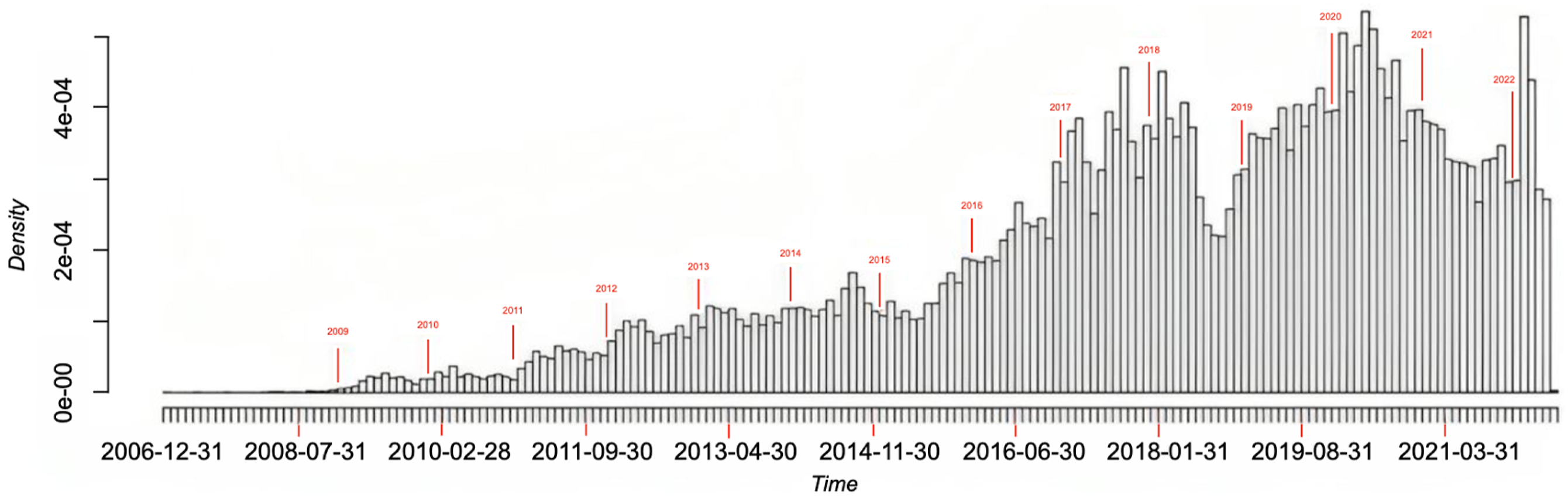
The quick growth between 2011 and 2014 can be linked to the 2012-2013 armed conflict in Mali and the presence of the French military operation Serval, from January 2013 onwards. During this period, there was an increase in intercommunal and ethnic clashes, and the situation deteriorated, disregarding the government’s attempt for a peace resolution in 2015. Simultaneously, a growing group of Malians had Internet connectivity and started to use Twitter to cover these topics.
The peak in Twitter usage from February to September 2020 links to a combination of conflict events in Mali. This includes the exceptional number of people manifesting, the death of Moussa Traoré (who was second president of Mali, 1968 till 1990, known as dictator, but re-celebrated in Mali), parliamentary elections in March and April 2020, the abduction of Soumaila Cissé (an opposition leader) on March 25 during an election campaign in the province of Niafounke and subsequent protests, the battle of Talahendak in the North at the start of June, the killing of Al-Qaeda affiliate Abdelmalik Droukdel, the protests in June for the resignation of president Keita, the violent protests in July up to August, and the resultive coup d’Etat in August 2020. We should, however, also count the COVID-19 effect on the rise in social media activity. These events were followed by Cissé’s and three others’ hostage release on October 8th in exchange for millions of euros and 100 imprisoned militant Islamists and the second democratically elected president Amadou Toumani Touré’s (2002-2012) death in December and November. These events affected the everyday lives of Malians and may have played a role in their search for online communication.
In 2021, there is a drop in the amount of active Twitter users, which may be explained by the lack of elections and fewer mass mobilizations. However, Mali was still going through a turbulent period characterized by the second coup d’État on May 24th, France’s announcement in June to withdraw Barkhane (French operation that followed Serval), the appointment of Prime Minister Choguel in June and his speech at the UN in September, the attempted assassination of president Assimi Goıta at a mosque in Bamako on July 20th, the accusation of Barkhane’s involvement in civil deaths in Bounti on January 3rd -confirmed by the MINUSMA in a report on March 30th, the death of IS affiliate Walid Abu as-Sahrawi on August 17th, the Niono agreement on March 14th, and the break of the agreement on July 19th. These events indicate that the correlation between Twitter growth and growth of conflict is not one-on-one.
However, Twitter activity rises again in the final months of 2021 and 2022. On October 12th, 2021, the French soldiers left Kidal, then Tessalit on November 16th, and Tombouctou on December 16th. Furthermore, on January 9th, 2022 ECOWAS sanctions Mali, Ibrahim Boubacar Keıta died on January 16th, the ambassador of France was dismissed on January 31st, the growing presence of Russian mercenaries and the effects of the Ukrainian war on the economic conditions fuel manifestations, attacks with many civil deaths in Moura between March 27th and 31st, in Hombori on April 19th, and an attack on Katiba Serma in April, and the clash between Barkhane, Wagner and Forces Armée Maliennes (FAMa) in Gossi on April 22nd all coincide with the growing usage of Twitter.
The results indicate that Malians open and use accounts on Twitter in times of heightened conflict. The usage of Twitter among professional and nonprofessional journalists leaves the social media platform an active source in the development of networks among Malian users keen on constantly sharing conflict-related information, including real and ‘fake news’.
The importance of Twitter in communication ecology
The results from the discussion forum brought forward a key finding that Mali is an important blogging country in Francophone West Africa. The participants concurred that in Mali blogging has partially replaced official news- and investigative journalism. Malian bloggers consider themselves citizen journalists. They see themselves not per se as less present, or less apt in gathering and disseminating news. They do not see themselves as peripheral actors as Cheruiyot et al. (2021) would see them, but instead as mainstream, challenging the long-held authority and autonomy enjoyed by professional journalists (Schapals, 2022). In this case, our study does not confirm the perspective held by many journalism scholars that these new actors would have severe implications on or for professional journalism (eg. Belair-Gagnon et al., 2019; Eldridge, 2019; Maares and Hanusch, 2023; Tandoc, 2019). In fact, nonprofessional and professional journalists work side by side in Mali, not only complementing each other’s work but also confirming the presence of Heinrich (2012)’s network journalism concept, which is based on the collaboration and cooperation of professional and non-professional journalists. The Malians are however not openly collaborating in an organized form even though the news shared by both professional and citizen journalists help mediate the conflict. In the past decade, the blogosphere has become important, and because of its independence it has allowed citizen and professional journalists space to express in comparison to writing for newspapers which are usually controlled by multinationals, politicians, or the state. In recent years many bloggers and journalists have found their way to Twitter to access and spread information. Moreover, while (web) radio, web TV, Facebook, and WhatsApp are the most trusted platforms to access information, Malians access news mostly through Facebook, WhatsApp, and since 2022, increasingly TikTok, which recent studies have associated with the appropriation of ‘fake news’ (Lan and Tung, 2024). The results of PAR revealed that social media platforms are currently at the center of the media landscape and flow of information. Confirming the presence of networked journalism (Papanagnou, 2023), radio, TV, and newspaper broadcasters often rely on social media as their main source. Therewith, social media and citizen journalism have become central in feeding newspapers and TV. Malian Twitter functions as a news source and is central to politically related communication. (Figure 2) Malian Mediascape and the information flows (based on PAR Mali, March 2022).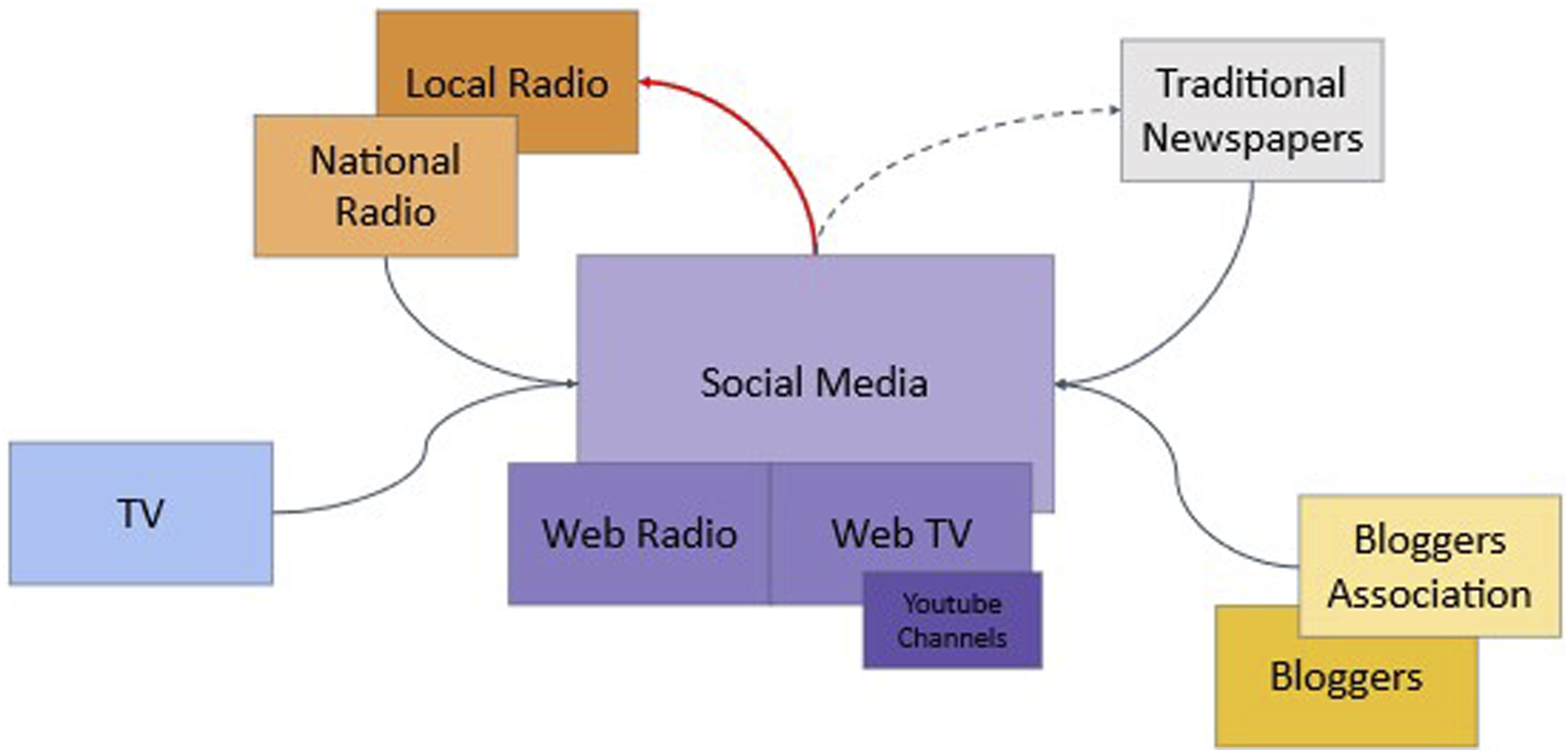
Twitter social network analysis
OSNs function as hubs for the mobilization of social relations and the emergence of new and continuation of existing forms of sociality (Budka and Brauchler, 2020). This is confirmed by the results from both the manual labelling and the computational analysis that demonstrate the complex relationship between conflict on the ground and the online space.
State-affiliate Twitter users are dominant on Twitter and garner support through their engagement in public conversations on violence and politics. The fact that conversations on conflict take place online motivates more people to open Twitter accounts and join the conversation. Additionally, we found that people who live in cities in conflict zones are more active than those who live in less violent places (see Figure 3). These findings make evident how networked conflict provides a powerful conceptual frame to understand Twitter usage in relation to conflict. Left: the distribution of the average number of tweets versus geographical locations in cities/regions outside Mali, Center: the distribution of the average number of tweets versus Geographical location in countries outside Mali. Right: the distribution of the average number of tweets versus geographical location in Mali.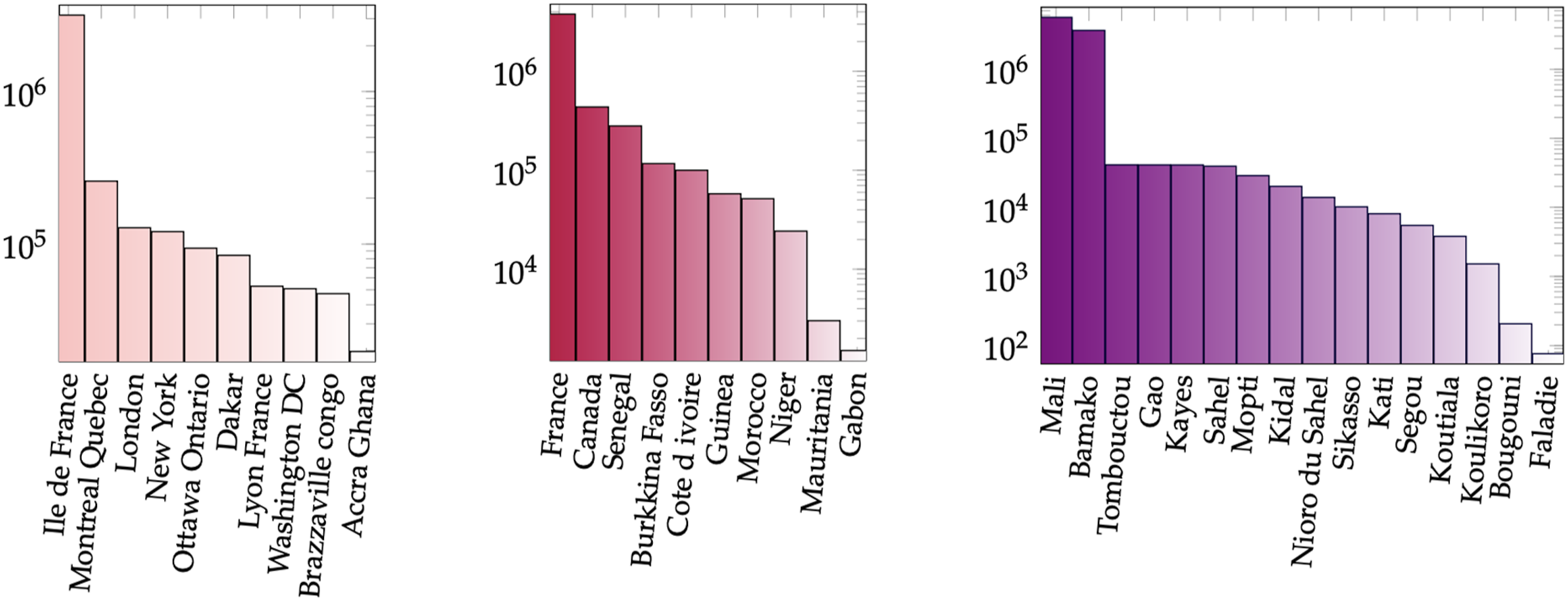
The Twitter community mainly consists of young men who consume and discuss politics through everyday interaction on Twitter. The majority of users live in urban centers where education levels are high and where violent conflict takes place in the rural surroundings. Malians who frequently tweet, retweet, and comment on Twitter are affiliated with a prominent institution, like the ministry, the military, an NGO, or an embassy. Their media literacy, usage of the French language, and affluence in politics indicate their education. In the previous section, it became clear that a large group of Malians mostly follows and consumes, and only the tip of the iceberg is prominent in pushing information themselves. These Twitter users frequently communicate about conflict with a bias that is state- supportive.
Malians recreate networks of power through following and befriending. Users can reach thousands of followers they do not necessarily know offline. The 140-character tweets are public, while at the same time, Twitter activities in the form of microblogging, direct messages, retweets, and hashtag conversations are private and selected according to personal criteria. Due to the public-private dynamic and the architecture of the online platform, the communicative spaces of Twitter are also referred to as the “personal public” (Schmidt, 2013) and “networked publics” (boyd, 2010). According to boyd, networked publics are both the spaces constructed and structured by technology and the imagined communities who feel united based on their social and cultural position, often without meeting each other physically. The unification on Twitter in Mali takes place among people who message about conflict and garner public support for the government’s actions. Networked publics thus involve networked conflict. The relationship between conflict and networks appears from the physical places people tweet from.
Tweeting from conflict-tense zones
Based on the network analysis of Malian Twitter users, we detected user locations and the locations from which people tweeted the most. Although most users only reported ‘Mali’ as their location, some specified their locations. Figure 4 indicates that the average number of tweets is big in large urban centers, such as Bamako (352,930; 2020), Sikasso (425,000; 2022), Mopti (264,000; 2021), Kayes (158,429; 2021) and Segou (156,076; 2021). Simultaneously, the graphs show that users in cities with smaller populations, such as Gao (124,689; 2021), Koutiala, and Tombouctou (54,629; 2009), are equally or more active. This high activity is especially noticeable in comparison to the number of users in the cities as shown in Figure 4. This figure shows that the number of users is much larger in Bamako and Sikasso, while the number in Koutiala, Gao, and Tombouctou are more comparable with Kayes, Mopti, and Segou despite the latter’s average larger populations. In Gao and Tombouctou, this is remarkable because people could not connect to the Internet due to the sabotage of the network since the beginning of 2021. People in Nioro du Sahel, Kati, and Kidal also tweet a lot in comparison to their user and population numbers. The high activity and relatively large user amount relate to the fact that these places are in conflict-tense zones. For example, Kidal is controlled by the Tuareg rebellion group MNLA, Nioro du Sahel in West Mali is heavy on intercommunal conflict, Kati is the city where the military stations and President Goıta lives, and Koutiala is an area where militant Islamist groups gained ground. Moreover, in Gao and Tombouctou, there is a high amount of banditry. Twitter activity thus coincides with users’ positioning in a war context. Left: the distribution of the average number of Twitter users versus geographical location in cities/regions outside Mali. Center: the distribution of the average number of Twitter users versus geographical location in countries outside Mali. Rights: the distribution of the average number of Twitter users versus geographical location in Mali.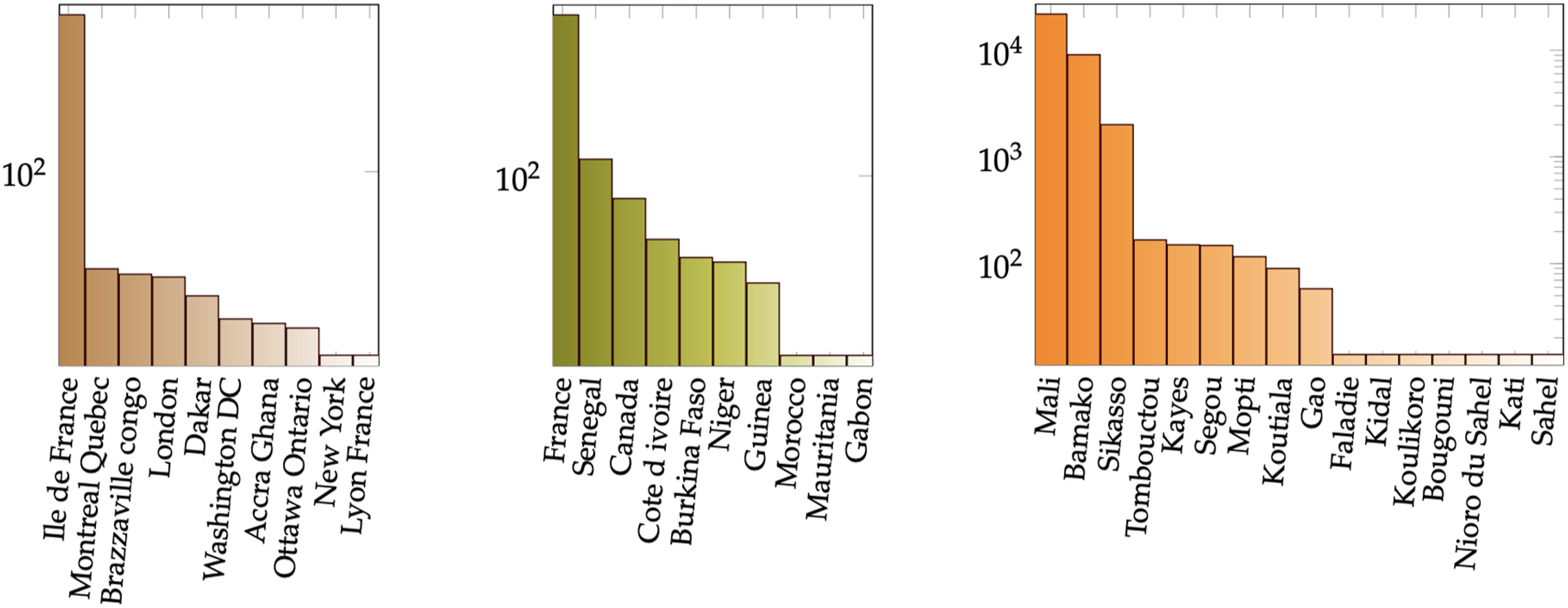
In addition to users in Mali, our dataset includes the diaspora. The majority of users outside Mali commenting on Malian issues come from France, Francophone Canada, and countries across West-Africa (see Figure 4). Despite the diaspora’s low user numbers, their tweet activity is high. Such as in France, where the number of tweets is comparable to the number of tweets from users with reported locations in Bamako.
The location analysis in relation to the frequency of tweeting shows that there is relatively more Twitter activity in conflict-ridden zones in Mali. The conflict is hybrid, meaning Twitter functions as a new space where people organize and express themselves about violent issues that happen on the ground. People in conflict zones (re-)create networks through social media. At the same time, social media has become an important vehicle for the web of relations between conflict actors. The studies on Boko Haram, on political participation of youth, cited in the introduction also reflect these tendencies. However, the finding that majority of Tweets can be labeled pro-government, and that people especially tweet from conflict dense areas is not discussed in the literature.
Communities and conflict dynamics (community detection)
Social media platforms are steered by algorithms that push people into a certain direction in their follower behavior. That means that there is a risk that also the researcher can be part of such steering. The computational analysis of communities helps to avoid such bias. The Twittersphere as a whole seems to be dominated by a big community that is centered on conflict messages. There are smaller groups, up to 148 users, with very few followers. We sampled members of these communities to learn who the communities consist of. Through this sampling, we identified variations between the large and small groups with respect to their location, topics, and actors.
In the small communities, people tweet about a variety of topics such as NGO work, sports, and love relationships, while there is little to no discussion of the conflict or institutional politics in Mali. The large community includes 479 users, and they were (inter)national media, bloggers, celebrities, or governmental accounts. It consists of Malian active users with many followers, such as Goita, FAMa, famous bloggers like Ashley Maiga and Konate Malick, as well as (inter)national media. Colonel and President Assimi Goita has 354,900 followers, and an institution like the army FAMa has 277,700 followers. This number is high for a country where approximately 56,000 people use Twitter, and there exists a correlation between activity and low follower count. People and institutions like Goıta and FAMa, who are actively involved in the makings of conflict on the ground tweet in great quantities, have a large number of followers, and create frequently shared messages. They are at the core of the Malian Twitter networks and thus play an important role in the creation of tendencies and narratives about conflicts.
The large community also consists of in-active users who do not create content but mainly amplify the messages of politicians and public figures like Goita. They follow and retweet the users with a lot of following instead of being followed. For example, among the users with a low number of friends and followers are those we identify as ‘factcheckers’. While these user accounts are less connected, they are still part of the community because they follow and retweet messages by government officials and news agencies. The interaction between users with many and those with few followers shows that the majority of sociality on Twitter in Mali is one directional, with a long string of re-tweets attached.
Conclusion
In this article, we have responded to the central question on how citizen journalists relate to the Malian Twittersphere in mediating the conflict. The different inquiries indicate that, indeed, conflict is at the center of mediated networks on Twitter in Mali. The ‘network logic’ of Twitter is clearly related to the network logic on the ground, in our case a conflict logic, which we refer to as networked conflict. This logic is not per se an orderly logic, but instead a logic that follows rhythms of political whims and wishes of its users, who may manipulate the Twittersphere to their own profit. The Twitter network is influenced by political, geographic, economic, and personal interests and is adaptive and changing to local conflict events. Moreover, (the lack of) access to digital tools, digital literacy, and political ties impacts the war in Mali today. The dominance of politicians and educated urbanites from Bamako and several bigger cities in the conflict zones and politicians indicates the Twitter network maintains privileges and hierarchies. Therewith, the usage of this platform extends existing social networks in the conflict.
Twitter is an actant in the formation of interactions in conflict. Over the past 10 years, the technological characteristics of Twitter facilitated the construction of a network that behaves, grows, and is composed in the context of conflict and emerged around the same time. (Inter)national media, government officials, celebrities, and bloggers actively participate in this network. They all consider themselves citizen journalists because not only do they gather and share news but they also factcheck and offer their opinions.
They are part of one large community where a selected group with many followers make out the dominant narratives in the Twittersphere. As allies of the authoritarian project, Twitter users are hallmarks of political power and preservers of power relations that are at the core of the organization of the conflict on the ground. As such, the Twittersphere in Mali ‘behaves’ as a ‘corporate’ social field with one big community consisting of mainly urban users who tweet about conflict events. The interactions between multiple Malian state and non-state actors, as well as internationals, show the networked conflict increasingly also takes place online. Nonetheless, several fighting parties and civilians affected by the Malian conflict are absent in this digital debate. To understand the Malian conflict communication ecology further and what role citizen journalists play, researchers should investigate what other social media platforms are used in the distribution of conflict-related content.
Footnotes
Acknowledgements
We would like to thank the anonymous reviewers for their constructive comments. Harry de Haan helped with the editing of the article. The article is based on research that was funded by the Norwegian Research Council (grant number 325123).
Declaration of conflicting interests
The author(s) declared no potential conflicts of interest with respect to the research, authorship, and/or publication of this article.
Funding
The author(s) disclosed receipt of the following financial support for the research, authorship, and/or publication of this article: This work was supported by the Norges Forskningsradet/The Research Council of Norway (grant number 325123).
ORCID iDs
Notes
Author biographies
 . She holds a BA in Arabic Language, a BA in Cultural Anthropology and a ResMA in Middle Eastern Studies. With a background in netnographic methods, she is interested in understanding the visual, sounded and textual narratives circulating in the mediaspheres of the Sahel.