




Abstract
The interaction between alternative and mainstream media is complex and often contentious. Mainstream journalists question the professionalism and political agendas of alternative media, while the latter criticize mainstream journalists for being biased and elitist. This paper investigates the positioning of alternative media in the journalistic field, both as a collective and as individual entities. Using the Strategic Action Field approach, we take an in-depth look at alternative media as challengers, approaching them as less privileged actors in the journalistic field. Through interviews with editors of alternative media in Norway, we engage with, and not merely discuss, antagonistic and agonistic actors in journalism. The study offers a nuanced understanding of how left-wing and right-wing alternative media, both collectively and individually, relate to other social actors in the field including media organizations (incumbents), press organizations and press councils (governance units), funders (state), and other alternative media (challengers). In the article, we identify three different positions, the anti-systemic, the independent and the pragmatic, pointing to different levels of knowledge of the journalistic field and strategic actions amongst alternative media.
Keywords
Introduction
The relationship between alternative media and professional journalism is multifaceted. Often, it manifests as mutual scepticism, and at times, open conflicts, and contestations. Alternative media, aiming to serve as a corrective to the mainstream, argue that professional journalists fail to uphold the normative ideals of the field (Cushion et al., 2021; Figenschou and Ihlebæk, 2019; Holt, 2020; Holt et al., 2019; Mayerhöffer, 2021). Conversely, editors and journalists from mainstream media frequently perceive alternative media as having limited professional knowledge and skills. They also express concerns about dangerous ideological or political ambitions and fear such antagonistic media actors becoming ‘parasites’ that undermine journalistic authority and professionalism (Krämer and Langmann, 2020; Von Nordheim and Kleinen-von Königslöw, 2021; Pedersen et al., 2024).
This article begins with the premise that contemporary alternative media encompasses a wide range of actors, with diverse missions, ambitions, and counter-positions (Ihlebæk et al., 2022). Hence, a nuanced analysis is necessary to understand how they perceive and position themselves within or in opposition to the field. This paper addresses the following research questions: How do alternative media position themselves towards other social actors in the journalistic field? Our goal is to offer a comprehensive analysis that delves deeper into the relational aspects between alternative media and powerful actors in journalism. By doing so, we provide a more nuanced picture concerning how the position of alternative media varies between agonism and antagonism, and how they perceive their relational opportunities and limitations within the field (see also Eldridge II, 2019).
To provide an empirically applicable, context-sensitive and actor-based analysis of the field positions of alternative media, this paper utilizes a strategic action field approach to journalism (Fligstein and McAdam, 2011, 2012, also see Ihlebæk and Figenschou 2024 for elaboration). This theory is inspired by field theory and how fields are social spaces built around specific values and practices (Benson, 2006; Benson and Neveu, 2005; Eldridge II, 2018, 2019; Hellmueller et al., 2013; Maares and Hanusch, 2023; Shoemaker and Vos, 2009; Vos, 2016; Vos et al., 2019). An important and critical aspect of a strategic action field approach is the emphasise on social actors and their relations to understand dynamics of change and stability in a field. Analytically, it distinguishes between three overarching social actors - incumbents, governance units, and challengers - each with different levels of power and access to resources. Positions of power depends on actors’ social skills to forge alliances and garner support through communicative action (Fligstein and McAdam, 2012). In the following article, we particularly focus on alternative media as “challengers”. According to the strategic action field approach, challengers wield little influence in the field, have weak alliances with other more powerful actors, and they have limited access to the field’s resources. They accept the field and the status quo, albeit with resistance or resentment, but they may also revolt and alter the power structures if the opportunity arises (Fligstein and McAdam, 2012). To succeed, they need to mobilize support for their unconventional ideas and engage in beneficial collaborations and coalitions.
Empirically, this paper is based on in-depth qualitative interviews with editors and initiators of alternative media projects in Norway. By engaging with, and not merely discussing agonistic and antagonist challengers to journalism, this study offers a nuanced understanding of how alternative media, both collectively and individually, position themselves as challengers and how they navigate within the field. We focus on how alternative media editors frame their relationships with media organizations (incumbents), press associations and press councils (governance units), funders (state), and other alternative media sites (other challengers). Additionally, by building on existing studies of the systemic conditions of alternative media (Cushion et al., 2021; Heft et al., 2020), this study reveals the scope for manoeuvre in the Nordic media system, characterized by robust alliances and centralization of resources (Ihlebæk et al., 2024; Syvertsen et al., 2014).
Alternative media as challengers in the journalistic strategic action field (JSAF)
Adopting the definition proposed by Holt et al. (2019), which defines alternative media as a “proclaimed and/or (self)-perceived corrective, opposing the overall tendency of public discourse emanating from what is perceived as the dominant mainstream media in a given system” (p. 862), a key characteristic of such media outlets is their critique of the journalistic field and the perceived need for an alternative. However, as research has documented, alternative media originates from a variety of positions and practices, which can place them closer to or further from the core of the journalistic field (Haanshuus and Ihlebæk, 2021; Ihlebæk et al., 2022; Staender et al., 2024). While some occasionally may seek toward the centre and aspire to make coalitions with powerful actors when it is deemed beneficial, others take a hostile and antagonistic position towards other social actors in the field (Atton, 2002; Brems, 2022; Cushion, 2021; Frischlich et al., 2020; Holt, 2018; Mayerhöffer, 2021; Noppari et al., 2019). Crucially, the position of alternative media is always relational and must be analysed and interpreted in the context of the professional field in which they operate.
Scholars emphasize how the journalistic field has become more manifolded and diverse, but also complex and fuzzy, because of the proliferation of actors that produce content that to varying degrees are similar to professional news (Atton, 2002; Eldridge II, 2018, 2019; Hanusch and Löhmann, 2023; Holt, 2020; Maares and Hanusch, 2023). The field, its relative autonomy and shared rules, is a result of continuous power negotiations between actors, what Bourdieu refers to as the “struggle between dominants and pretenders” (Bourdieu 1996: p. 206, see Benson, 2006). As Örnebring et al. (2018) points out the journalistic field has always been diverse: it includes it both the investigative and the celebrity reporter, the award-winning journalists and the citizen-reporter, the permanent and the freelancer - that all encompass higher or lower level of economic and cultural capital. In terms of alternative media, they are often low on both economic resources and journalistic capital, and consequently they encompass a less influential position in the field. Some scholars have approached alternative media as ‘a field of their own,’ emphasizing that Bourdieu did not include or pay attention to ‘non-professional production’ in his approach to the journalistic field (Atton and Hamilton, 2008: p. 133). They argue that alternative media should be understood in relation to social movements and civil society rather than journalism. Peeters and Maeseele (2023) are recent proponents of this position, claiming that the community-serving role and close alignment to civil society organizations and community members among alternative media, as well as their different ‘economic ethos’ and logic than commercial media organizations, position them outside the journalistic field. Another point made by Eldridge II, 2019, is that it is important to distinguish between ‘agonism’ and ‘antagonism’ to explain the relations between peripheral actors and those at the core. While agonism refers to “constructive disagreement” between parts, antagonism can be viewed as “destructive opposition” (p. 15). While it may be difficult to separate between the two, scholars should in principle, he argues, “decry those who adopt an antagonistic relationship towards the field, particularly when embedding anti-civic or anti-journalistic intentions” (p.15).
Drawing on these valuable insights, we apply a strategic action field (SAF) approach to explore in more detail the relational aspects between alternative media and other social actors in the field (Fligstein and McAdam, 2012). Instead of categorizing alternative media as insiders or outsiders, the SAF approach illuminates the relative position and agency of social actors, those at the centre and those at the periphery, by exploring them as strategic actors with specific social skills that impact their ability for success (Fligstein, 2001; Ihlebæk and Figenschou, 2024). SAF posits that skilled actors understand the positions and dynamics of the field, the opportunities the field positions offer (structure), and manage to communicate in a way that resonates with other actors’ emotions and rationality (agency) (Fligstein, 2001). Analytically, the strategic action field approach separates between three main categories of actors in a field that inhibits different positions of power. Importantly, these positions are not static and may change through disruption and contentions. Challengers, that are exemplified by alternative media in this paper, are as outlined in the introduction actors that normally wield limited power in a field. They acknowledge the field and its rules, but they often question the authority of central actors and may to varying degrees resist and act against the existing distribution of power and resources in the field (Figenschou and Ihlebæk, 2019; Fligstein and McAdam, 2012). Incumbents represent influential social actors in the field that have an interest in protecting and preserving the status quo. They have discursive power, high cultural capital and access to resources (Fligstein and McAdam, 2012). The power and position of incumbents within journalism will vary across media systems, but overall established news organizations have held privileged positions due to stable material resources (advertising, subscription, and strong owners), immaterial resources (authoritative practices, knowledge, and networks), and symbolic resources (trust and professional authority) (Brüggemann et al., 2014; Carlson, 2017; Ihlebæk and Figenschou, 2024; Reese, 2022; Shoemaker and Reese, 2014). The third social actor in a strategic action field are governance units. They are institutional back-players that act as referees or internal experts in the field, to ensure stability and order within the field and vis-à-vis other fields. They normally have close alliances and collaborations with incumbents (Fligstein and McAdam, 2012). Within journalism, the influence and position of governance units, including press councils, ombudsmen and professional associations, vary significantly across media systems, however they are increasingly important in times of disruption and crisis (Lowrey et al., 2019; Sherrill et al., 2022). Overall, governance units in journalism oversee that the core values (democracy, free speech, and diversity) and rules (press ethics) of the journalistic field are respected, and the can act as influential gatekeepers guarding access to specific material and symbolic resources (Ihlebæk and Figenschou, 2022, 2024). In addition, stable fields are dependent on support from the state (Fligstein and McAdam, 2012). In a journalistic context this is a double edge sword, as the fields’ autonomy relies heavily on being independent of state interference. However, many media systems have successfully incorporated funding mechanisms, like press subsidies, innovation support or public service broadcasting, by ensuring editorial freedom through legislation (Neff and Pickard, 2024; Sjøvaag, 2019).
The multidimensional and actor-centred framework invites comprehensive analysis of alternative media as ‘challengers’, that can help disentangle how and why alternative media challenge established actors in journalism; where and to what extent they position themselves within the professional journalistic field; and, whether ‘alternative media’ aim to and are able to collectively form ‘alternative’ strategic action field(s) of their own. The framework underlines how social actors’ positions and resources vary across media systems and invites comparative research. To illustrate the empirical relevance of the framework, we apply it to alternative media editors in Norway. The Norwegian case is selected because it represents a media system with comparatively strong established actors (incumbents and governance units) and an increasingly diverse alternative media scene.
Method and data
In this paper, we have conducted in-depth interviews with alternative media editors and senior editorial staff in the Norwegian media landscape. The Norwegian media system represents the Nordic cluster (Brüggermann et al., 2014; Syvertsen et al., 2014), within the democratic corporatist media model (Hallin and Mancini, 2004). Overall, international media system typologies find that Norway has comparatively strong and autonomous established news organizations despite digital transformations, due to influential institutional back-players (e.g., professional organizations, self-regulatory system) and an active state (expansive media policies, extensive media freedom and robust legal framework) (Ihlebæk et al., 2024). There are close alliances between incumbents and governance units in the field. The Norwegian media is characterized by a unison support for the self-regulatory system and the Norwegian Code of Ethics, 1 which outlines the social role or the press and ethical guidelines (Brurås, 2016). From 2018, only media outlets affiliated with the umbrella organization Norwegian Press Association are included in the self-regulatory system, marking the boundaries between professional news media and other content-producers (Ihlebæk and Figenschou, 2022). Furthermore, media policy initiatives include strong subsidies for private news media and public-service broadcasting to support media diversity (Sjøvaag, 2019; Sjøvaag and Pedersen, 2018; Sundet et al., 2020), and the platform-neutral, public support system remain key for of many established news media, particularly local, regional and opinion papers. The press support system is administered by the Norwegian Media Authority. The Norwegian media system, then, is characterized by an active state that supports journalism through a robust legal framework to protect for press freedom and secure editorial independence; strong subsidies for private news media; and public-service broadcasting (Brüggemann et al., 2014).
Overview of sites a
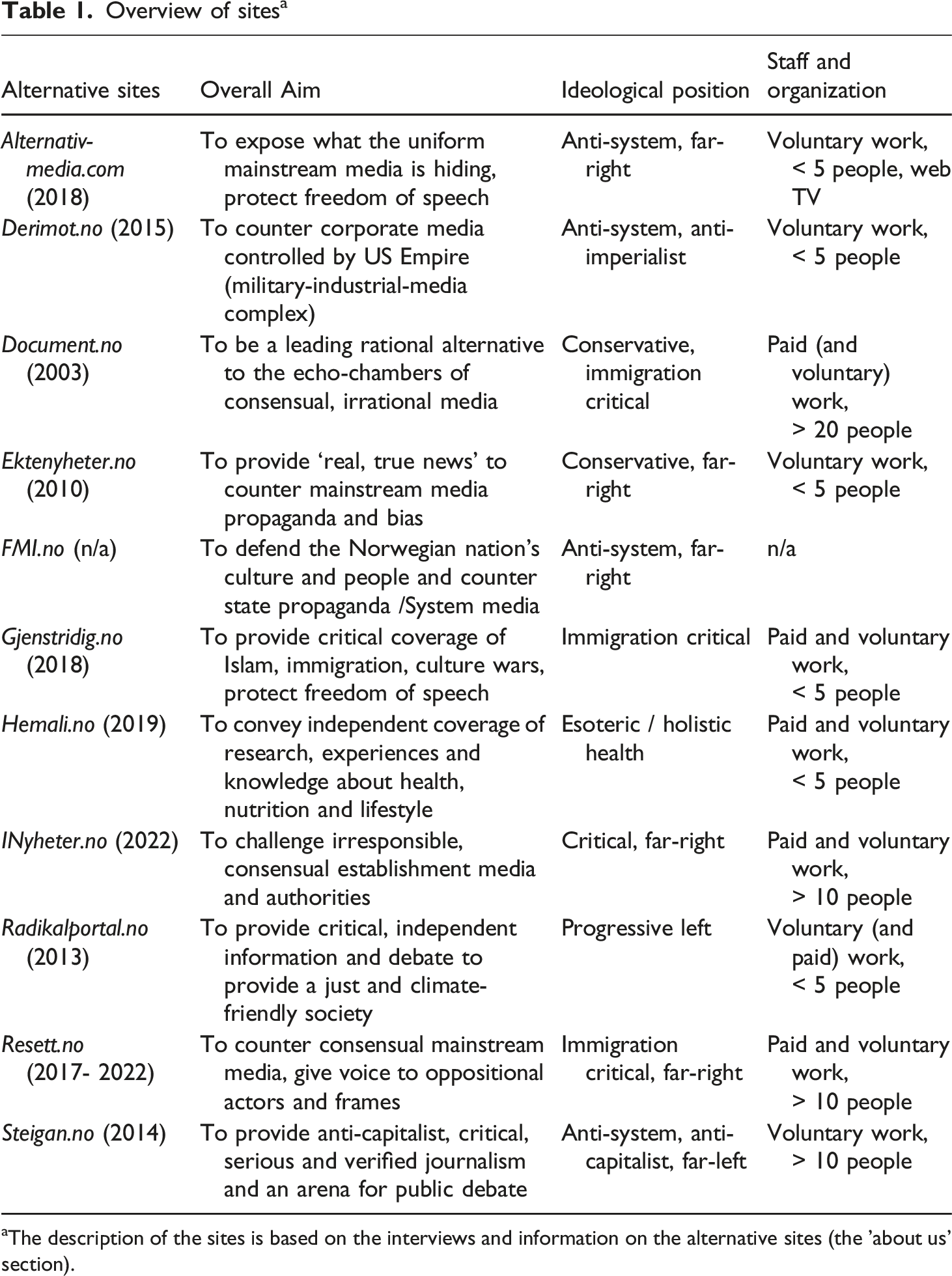
The description of the sites is based on the interviews and information on the alternative sites (the 'about us' section).
Those alternative media sites that did not respond or declined to participate did not have a specific profile that set them apart from those who participated. Of the sites studied, one was closed during the research period (Resett), and one was (temporarily) moved to Facebook (Ekte Nyheter). Further, two have close connections to pressure groups (FMI (The Popular movement against migration) and social movements (Radikal Portal) whereas the others are formally independent of social movements. The interviews lasted between 60 and 90 minutes and were conducted by both authors, face to face or digitally. All interviews were recorded and transcribed by research assistants. Some early interviews were conducted in 2019-20, although most interviews were completed in 2022-3. Regarding more general perceptions and evaluations, however, the interviews provided similar results, indicating that the aims, positions, and social skills of alternative media are not limited to specific, short-term events. The interviewed editors and senior editorial staff are ideologically driven strategic communicators, which implies that the interviews represent how they want their projects to be perceived and their self-perceptions as challengers. The project was reviewed by the Norwegian Centre for Research Data (SIKT) and adheres to ethical guidelines regarding privacy protection, confidentiality, and fair representation. The authors conducted a thematic analysis of the interviews (Braun and Clarke, 2006), identifying topics and moving back and forth between the empirical data and theoretical knowledge. The interview transcripts were coded in Nvivo (version 17.1), where initial broader thematic codes reflected the main topics in the interview guide, including organisation, professional background, accounts of marginalisation, positioning versus the journalistic institution, aim and social skills. Codes were later split or merged according to the theoretically informed codes that emerged from an abductive methodological approach (Timmermans and Tavory, 2012). The concrete coding of quotes was continually discussed and updated by the two researchers and modified in line with analytical insights. All direct quotes used in this study have been approved by the interviewees.
Interviewing antagonistic actors can be resource-demanding and challenging. It is more time-consuming than usual to recruit interviewees among people who oppose the political and media establishment. The actual interviews can also be stressful, as some of the interviewees deeply mistrust researchers. Two editors voiced strong accusations of political bias and had a confrontative, aggressive style, which left little room for follow-up questions. Many of the interviewees were generous and reflexive, though, providing unique insights into the editorial projects and self-positioning of antagonistic alternative media actors. Close-up enquiries enable insights into motivations and experiences of engagement and mobilisation that could not have been gathered by analysing alternative media content or declarations of editorial aims (Hall, 2022). To obtain insights into these projects we seek to understand their positions, analyse them in line with relevant theories, treat them in a non-judgmental way, but also ask them critical questions.
Analysis: positioning Norwegian alternative media
To illustrate the analytical relevance of employing SAF theory to outline a multidimensional approach to field positioning, we will analyse how editors of Norwegian alternative media (self)-position in relation to other challengers, incumbents, governance units, and the state.
Alternative media’s positioning versus other alternative media
Although comparatively small compared to established news organisations, alternative media initiatives in Norway have gained some influence in the hybrid media landscape and particularly on social media (Ihlebæk and Nygaard, 2021). A key question here is to what extent alternative media actors in Norway can mobilise support and create alliances behind their alternative media project amongst each other. As expected, we find that the alternative media editors do express common interest and motivation in their media criticism and their aim to balance or counter professional media’s agenda-setting power. There are some core and general arguments that unite the alternative media editors such as, ‘the mainstream media is failing’, ‘the mainstream media is elitist’, ‘the mainstream media is censoring opponents’, and ‘the mainstream media is politically biased’. In addition - and related to - media criticism, there exist a strong collective frame among the interviewees, concerned with free speech and how this fundamental right is increasingly threatened. The editors strongly identify as defenders of free speech, warn that freedom of speech is under threat due to political correctness, identity politics and repressive state policies; and, how they push the boundaries of what is legitimate to say culturally and politically. Freedom of speech as a fundamental right and ideal is of course shared with other established actors in the journalistic field, however, the challengers believe that they practice it to a greater extent in terms of what they say and who they invite to speak. Since alternative media operate more independently of field rules (e.g. professional norms and ethical codes), pushing the boundaries on free speech thus represent a shared potential: “[…] I mean that the space for what is allowed to say in time of peace never has been more limited. Even though more voices are heard, we live in a time of intolerance” (Editor 7).
With these broad and shared frames, editors, however, mobilise predominantly individually across the traditional left/right political axis. Overall, the alternative media scene is fragmented, diverged and have weak ties. The ideological crystallisation of the different alternative media projects, varying from the hostile antagonistic to the controversial agnostic, limits the room for alliances (see Table 1). In the interviews scepticism towards other alternative media actors’ projects was voiced by several, expressing resistance against being grouped together as ‘alternative media’. Adding to the fragmentation, it is a common feature amongst the alternative media projects studied, that they are established by individuals with a strong personal drive and deep convictions. Consequently, the different projects largely operate independently, and editorial initiators and leaders are characterised as uncompromising individualists hindering strong alliances. Several interviewees have been involved in alternative media initiatives that have unravelled due to internal conflicts, both in the form of disagreements with the board and the employees, and between colleagues. Alternative media has, then, in general, weak ties to other alternative media and view each other mainly as competitors rather than collaborators. Such divisions are also visible when they talk about other social actors in the field.
Alternative media actors’ positioning versus incumbents
Analysing how alternative media actors position themselves in relation to established news actors, it is not surprising, due to their position as challengers, that the interviewed editors demonstrate a unison critical stance vis-à-vis incumbents, however, ranging from deep hostility to professional disagreements. On the one pole of the continuum, we find the alternative media sites which take an uncompromising anti-systemic position. These sites combine an aggressive antagonistic voice with a poor understanding and knowledge of journalism. They do not consider editors and journalists in the established news media to be colleagues, never interact with them and do not trust them. Their characteristic of editors and journalists in the established news media are harmful and filled with contempt, for example labelling them ‘lunatics’ that should be locked up or ‘just garbage’. One interviewee state that in his view, it is his own alternative media project that represent true journalism, as incumbents are corrupted. This quote illustrates this position and demonstrate the degree of disrespect and hostility editors with an anti-system position have for Norwegian established news media: We are not ‘alternative media’, we are the true media. We are the real watchdog in this society. The public and established media, we define them as ‘system media’. They could never exist without public funding (…) They are one-sided, pure propaganda. Like I use to say - the system media are addicted, like junkies to heroin. So, that’s that, system media is public funding, it’s pure regime propaganda. (Editor 5)
Other interviewees are critical, but markedly less dogmatic. These interviewees are ambivalent to whether they consider editors and journalists in the established news media to be colleagues, as they are sceptical, but not hostile, towards them and distinguish between outlets and individuals. Some of the interviewees have studied journalism or have professional backgrounds from established news media and have knowledge about the field and how it works but are highly critical towards their former colleagues and bosses. Overall, this group of editors do not see the established media as controlled by or dictated by political or economic interests, but as indirectly socialized into politically correct, elitist, and biased news practices. These interviewees criticise incumbents for being blind to their own power, failing in their societal role and ethical responsibility, as illustrated by this statement: “They have such an enormous impact and do not manage that power very well. They do not manage it in the name of balance, diversity, and information, nor in the name of independence” (Editor 7).
On the other end of the scale, we identify interviewees who, when perceived beneficial, seek opportunities to collaborate with incumbents if possible. Alternative media editors in this position, use the established media to voice their criticism of the political and media establishment. One editor who has been involved in several right-wing alternative media initiatives, has been affiliated with one of the leading established newspapers as a regular (freelance) media critic: “I was surprised when I was asked, but I also thought it was very nice. I think I am the only person from alternative media that has, at least partly, been invited into the ‘club’” (Editor 6). Part of her motivation to accept the invitation, was to show that people engaged in alternative media are “normal, pleasant people” that do not have “swastikas tattooed on the forehead” (Editor 6). For this editor, it is a goal to engage broad, informed public debates to solve societal problems, and to do this using a combination of alternative and established media is key. The insider-move, however, received mixed responses from some of her colleagues in the alternative media field that felt she that had “crossed the line over to the enemy” (Editor 6). At the time of the interview the editor was no longer affiliated with the newspaper, but their relation ended on good terms. The story illustrates how the informant had to balance between the urge to strengthen her position as a media critic and increase her visibility and impact, but also how it endangered the relationship and social bonds with her alliances in the alternative media “field”. Navigating a partly insider, partly outsider role, however, can be a difficult terrain to navigate as they risk confusing not only their colleagues, but also their audiences about where their loyalty lies.
Alternative media actors’ positioning versus governance units
Exploring how alternative media actors position themselves towards governance units, we have focused on their relation to The Press Council, the self-regulatory system that, that oversee compliance with the Norwegian Code of Ethics, as well as the influential organization the Association of Editors. From 2018 the two have been closely interlinked in Norway, after an amendment made it a requirement to be a member of the Association of Editors to be included in the self-regulatory system (Ihlebæk and Figenschou, 2022). The Press Council and The Association of Editors represent high cultural capital in the field, and consequently they have significant symbolic power.
A minority group of editors positioned on the antagonistic side of the spectrum refuse to acknowledge the institutional rules of the journalistic field and the authority of the Norwegian self-regulatory system. They underline how indifferent they are to the ethical code and the institutional arrangement guarding it, as expressed by one editor: “we have registered there is a code and probably largely follow it, but mostly we don’t give a shit! […] We always try to push the boundaries” (Editor 5). Because these editors see the self-regulatory system as illegitimate, they disregard it when navigating ethical dilemmas and rather use ‘good manners’, ‘facts’, ‘the truth’ and ‘the law’ as their ethical compass. This quote is illustrative of this indifferent approach: “We use good manners, common sense, and the Norwegian law. […] I probably agree on everything in the code, but as a principle it is not a superior Bible for me” (Editor 1). One related and recurrent argument among editors in this group is that professional associations, like the Association of Editors, only work to secure their own interests and suppress alternative media and consequently ridicule such governance actors’ legitimacy in the journalistic field. To illustrate, one informant states that it is completely out of the question and have never been on their agenda, to approach ‘such a gang’ (Editor 5). Another interviewee underlines his fundamental disapproval and lack of trust in journalistic institutional actors with the following statement, worth quoting in some detail: The Association of Editors is a private interest organisation […] If they want to have a gentleman’s club, so be it, but they have no definition power. We could also create our own ‘editors' association’ here, say that ten of us got together, but [forming an association] would not have given us more power to define what constitutes independent media. (Editor 1)
Overall, the majority of the interviewed alternative media editors, however, express their support for the Norwegian self-regulatory system and Code of Ethics. Interviewees in this group state that the Code of Ethics is ‘in their spine’, a standard they ‘seek to meet’, a ‘necessary tool’ and ‘point of reference’. At the same time, they will breech the code if necessary to get an important story out: “The code is important for all of us, but violations will happen. We are smaller than other media and sometimes we need to push the boundaries to be heard” (Editor 6). For the interviewed alternative media editors, following the codes in practice it is also a question of resources, and several stress that they do not have the resources to follow the code systematically and thoroughly: We strive to meet the ethical code and do not publish whatsoever. We do a thorough check there and then, but we do not have the resources to go out and interview sources and cross-check information and so on… it’s more like we use the sources that we trust in general and check them against each other. (Editor 4)
Although these editors respect institutional rules, they have not tried to formally be included in the self-regulatory system nor sought membership in The Association of Editors. At the same time, the editors are often highly critical of the Press Council’s administration of the Code of Ethics and of the influence and power professional associations have over the journalistic field.
Whereas most of the interviewees’ underline that they position themselves outside of the governance units, three editors did seek insider-status by seeking membership in the Association of Editors pursuing symbolic resources. Two editors represented right-wing alternative outlets, whereas the third represented a left-wing outlet. Their membership applications were deemed controversial and led to vocal discussions in the professional Norwegian journalistic field. Further the application processes comprised a markedly more thorough evaluation and documentation than normal, as the alternative media actors had to demonstrate their loyalty to the rules of the field during the application process (see also Ihlebæk and Figenschou, 2022). Becoming a member of the association, would give the alternative media editors privileges in terms of access to court documents and cases, but also an opportunity to influence from the inside. One motivation for seeking membership in the Association of Editors is that it would enable influencing powerful actors and thereby change the journalistic field from within. One of the editors explain the motivations for applying membership the following way: “I had, what may have been, a naive intention that it would have been possible to engage in a dialogue with them, to have a critical discussion about the role of journalism in our time. There you have the bourgeoisie democrat in me, that believes the public debate is possible” (Editor 13). His application was declined, which made him argue that the requirements for being accepted was too high - “if you must compromise to be included in the ‘gentleman’s club’ then it is not worth it” (Editor 13). Another editor that was also rejected, argues that to be included in the self-regulatory system is important, because it would offer legitimacy towards the public: We receive a lot of criticism, and many people react to what we write for both good and bad reasons. It would have been an advantage for them and those people that we write about, and the people that are most hostile towards us, that their complaints had been tested by the Press Council. (Editor 11)
In other words, for this editor membership symbolizes a potential step towards professionalization. Both the rejected editors see the decision as proof of governance units being elitist, exclusive, and biased, and evidence of that ‘insiders’ are reluctant to open the field to newcomers.
One of the interviewees, representing a right-wing alternative media site, was accepted into the Association of Editors. For this editor, membership in a professional association represent a recognition of the professionalization of his alternative media outlet but has also given him the opportunity to criticize editors in the established news media from within (Editor 3). Furthermore, it gave him access to arenas and information that he would not be able to get otherwise: We can follow court cases and have access to the verdicts, and thus we can better make independent assessments if we go out with the name of the convicted person or not. We believe that some perpetrators deserve to be named in public, because their abuses are so horrific. The press must accept that we have a new type of crime that turns the conventional notion of who is weak and who is strong upside down. (Editor 3)
The editor underlines that they have kept their critical and alternative voice even though they have become more aware of their language and made some adjustments to meet the requirements from governance units. After joining the association, his outlet was criticized for their move, mainly by the readers of other alternative competitors for compromising their legitimacy.
Alternative media positioning versus state funders
Overall, alternative media editors perceive the press support system as a failure, arguing that it supports incumbents that are not competitive in the market. Stressing the necessity of financial independence and strong negative effects of the press support system for media diversity and press freedom, is an argument shared among several of the editors interviewed. How the opposition is expressed and what the opposition is based on varies substantially between different groups of alternative media. On the one hand, anti-systemic editors see the press support system as political means for corrupting and controlling the established media. This minority position argue that the established news media are so dependent on and addicted to subsidies (see above), that the rules of the field must be revolutionized, and the current media system replaced. The editors taking this anti-systemic position, warn against ownership control, power structures and hidden agendas in the international media system. It is their conviction that the media is being controlled and that these powerful structures are invisible for the public and the established media because those in power hide them. This quote, worth quoting in some length, illustrate this deep suspiciousness and perception of a grand plot: The system media receives press support to promote the political agenda of the marionettes in Parliament, who’s taking orders from the protectorate of the EU, who again receive orders from the USA and the little clique who rules the US. (Editor 5)
Another group of editors take a critical position to the press support system, arguing the need to stay outside of the system to be financially (and hence also editorially) independent. For these interviewees the decision of not applying for public support largely builds on a combination of (i) an understanding that they do not meet the formal criteria for media support and that applying or trying to meet them would be a very resource-demanding process, and (ii) a critical assessment of how the media support system is political and biased with large-scale negative consequences to current media system. If the press support system should be continued and improved, it is necessary, according to some informants, to reform it to grant public support both to established news media and alternative media. At the time of the interviews, two of the far-right alternative media outlets had applied for press support, but both were rejected, however, on different grounds. One was rejected because of technical matters (subscription) but was later granted support in 2023. The other was denied because they did not live up to necessary professional standards. In the latter case, the editor reacted to lack of transparency, clear criteria, and open evaluation, and criticised openly the protection of privileges amongst governance units.
Alternative media as individual challengers in a strong journalistic field
Alternative media’s position towards social actors in journalism.
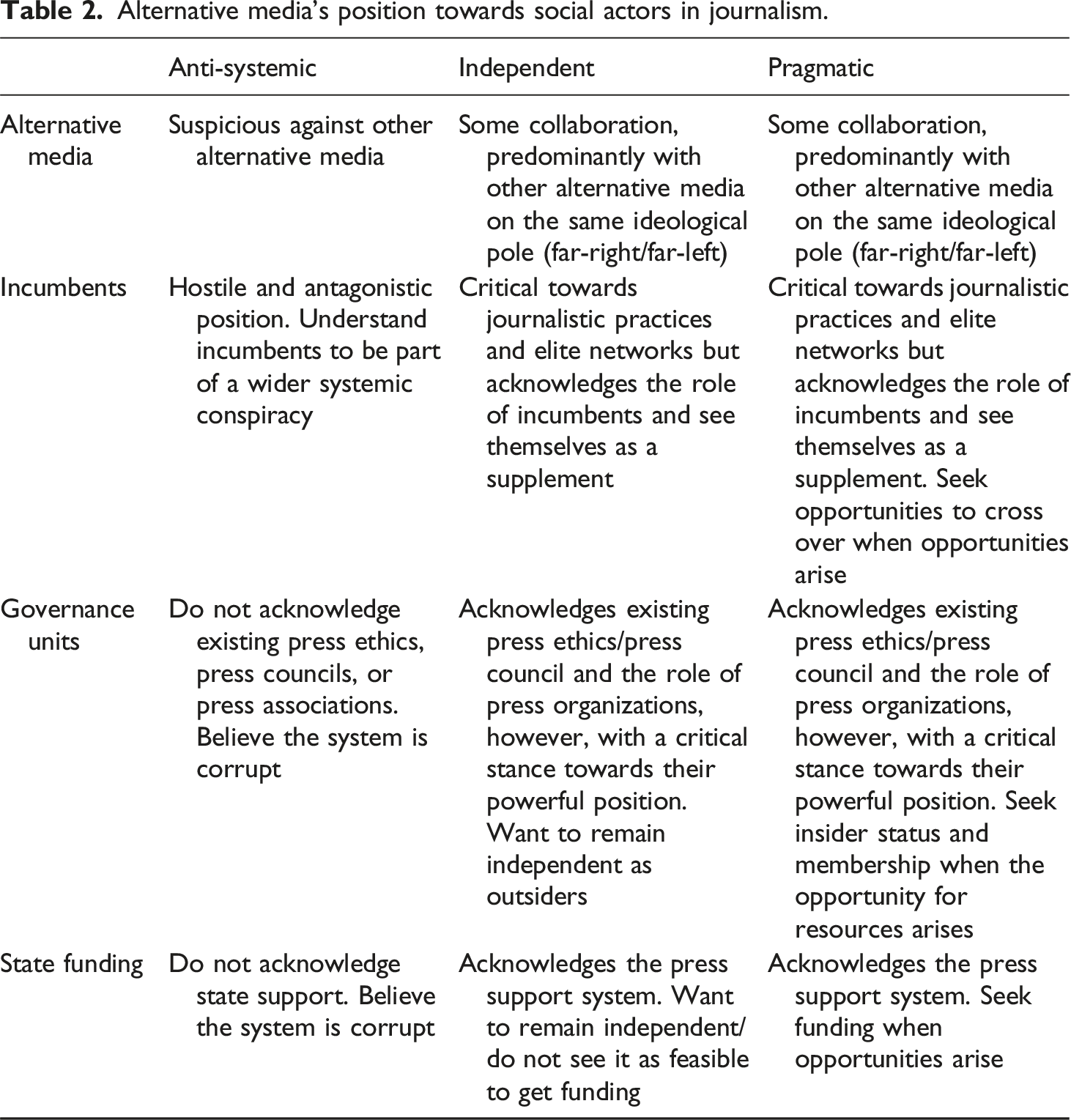
The first position is the anti-systemic, which express a hostile, antagonistic relation to all other social actors. This position is characterized by an extreme and confrontational stance, talking about other social actors in the field through strong, aggressive language and deep mistrust. They do not acknowledge the field’s right to exist, or the collective frames that unites the field, nor the role of incumbents, governance units or the state. Furthermore, they have no or weak alliances with other alternative media actors but may express support when other alternative media editors front counter-hegemonic opposition against Norwegian authorities or media. Promoting revolutionary changes, they self-willingly are placed on the outside, they have no opportunities in the field, and their relations to other actors are non-existent. Notably, at the time of this study they do not represent a real threat to the field in the Norwegian context because of their marginal position, weak ties and limited support.
The second and third position we have termed the independent and the pragmatic. These positions share many similarities: they acknowledge the field, have knowledge of how it works, and who has power and not. From these positions, alternative media are critical of how journalism is practiced and how power is executed, as well as the strong alliances between by incumbents and governance units. Their framing of - and relation to- incumbents and governance units, varies from aggressive to constructive agonism. What separates these two positions, is how the pragmatic position entails a strategic movement towards the field seeking material and symbolic resources, while the other emphasize the need to be independent. For the pragmatic position, it is necessary to identify and have knowledge of opportunities in the field, where it is possible to get access and how they may balance the somewhat paradoxical position as partly being an insider with being a credible alternative to their audiences. Moving towards the mainstream may, of course, at some point result in actors crossing the boundaries from the alternative to the professional if they adapt and adjust. This will depend on their will and skill to create stronger alliances with powerful incumbents or governance units and to communicate loyalty to the field’s rules and adjust their practices. If they don’t succeed however, it may lead to a stronger cultivation of the alternative - providing fuel to the conviction that journalism is elitist and exclusionary.
It should be noted that the boundaries between the analytical positions are not definite or static. Alternative sites can move between positions over time, due to professionalization strategies and systematic efforts to gain access to field resources and privileges. This is the case with one of the immigration-critical alternative media in our study, which have largely moved from the independent to the pragmatic position over the last 5 years. Further, alternative sites can also jump between positions more erratically, as they seek to provoke, test boundaries and gain visibility. To illustrate, one of the far-left actors with strong anti-systemic sentiments did apply for membership in the Editors’ Association, and then used this rejection as proof of a dysfunctional system. Alternative actors can also change their strategies in response to the actions of field insiders. Notably, we do not find a clear distinction between how editors on the far-left and editors on the far-right self-position, as both ideological leanings are represented by outlets in all field positions.
Finally, in this study the Norwegian media system that is characterized by strong alliances and collaboration between incumbents, governance units and the state, serves as a backdrop for identifying the manifolded relational positions of alternative media. While the ties between alternative media sites in general are fragmented and weak, it is important to be aware that the collective criticism raised by different alternative media actors can of course in sum impact the field in several ways. For instance, if they manage to convince journalists or press organisations, directly or indirectly, that their criticisms of journalistic bias or elitism are worth listening to, it can potentially lead to changes in the field. One example of how the collective criticism from alternative media have been taken up by established news organizations, have been how established Norwegian news media have become more transparent about editorial practices and priorities, to pre-empt critique and inform users (and critics) about editorial dilemmas and evaluations (Pedersen et al., 2024). Further and maybe more importantly, media criticism raised by alternative media can influence the audience, making them aware of the shortcomings and failings of professional journalism, which again can change the public’s attitudes, trust, and user patterns. In the current Norwegian media environment, however, there is little evidence that trust - or use- have been impacted in any significant way (Pedersen et al., 2024). Finally, the impact of criticism raised by both antagonistic and agonistic alternative media is of course also dependent on the wider political environment. Further research is needed to investigate the room for manoeuvre for challengers in other media systems where the positions and relations between incumbents and governance units are more fragile, and the political conditions harsher.
Footnotes
Declaration of conflicting interests
The author(s) declared no potential conflicts of interest with respect to the research, authorship, and/or publication of this article.
Funding
The author(s) disclosed receipt of the following financial support for the research, authorship, and/or publication of this article: This work was supported by the Norges Forskningsråd (295985).