



Abstract
This paper discusses the issues of safety and solidarity of journalists for journalists in a cooperative project where Ukrainian journalists fled to Kosovo at the time of war in Ukraine. Through international non-governmental mediation, several journalists have moved to Kosovo after the Russian full-scale invasion of Ukraine in 2022 to continue the work of reporting from Kosovo. This is done with the help of journalist peers in Kosovo. The political situation is not favorable for journalists in Ukraine, also considered the fact that Ukraine has not recognized Kosovo as a sovereign state, but this provides a political opportunity to extend this solidarity in political spectrum as well. Interviewed journalists claim that this “functional solidarity” is essential in media development and aid in the future and is a new way to look at safety of journalists. The altruistic solidarity of journalists for journalists also has its culprits of political consequences such as being part of political agendas to try and develop political bridges at the times of war. Findings such as willingness to extend help, planning for solidarity and joint interactions will further advance studies on safety of journalists and reflect on best practices of solidarity among journalists for the future endeavors of similar nature. The role of existing institutions such as journalist associations and international non-government organization are explored as well, defining their role in the process. Ukrainian journalists are in Kosovo to reveal this story of unusual collaboration.
Introduction: Ukraine, Kosovo and solidarity of journalists
With the Russian invasion of Crimea in 2014, the Russia-Ukraine war started to erupt until the full-scale invasion in 2022. However, already after the smaller scale war between separatists and Ukrainian forces in the Donbass region a few years earlier, many journalists in the area thought that they would be internally displaced and that the conflict will be sporadic (Freedom House, 2015). Journalists from Ukraine faced safety challenges in reporting from the war in Eastern Ukraine already years before the 2022 invasion.
In February 2022, the full-scale invasion on Ukraine escalated the war dramatically, also for the journalists. They have to adapt to new challenges and work remotely but also had to flee from major cities to escape missile attacks. Unlike with COVID-19, with lock down from an invisible enemy, the Russian missiles created a whole new set of challenges for journalists, including life threatening scenarios, not only for them individually but also for extended families. Journalists started to flee from Ukraine in search of safety and better working conditions to continue their work. However, due to war related circumstances, the news gathering practice for journalists changed from live reporting and eyewitness reporting to online sourcing the news and curating content from digital platforms.
Solidarity between journalists in Europe was needed more than ever and not only because of deterioration of the overall working conditions for journalists in Europe. One of the countries that opened up for Ukrainian journalists was Kosovo, a place that knows war and exile journalism. A Ukrainian journalist residing in Kosovo expressed the need this way: “solidarity is, first, a feeling of a friendly shoulder, support in a difficult moment. It is important that journalists have a chance to remain in the profession, to rationally use their acquired potential.” (Interview with Ukrainian Journalist in Kosovo, 2023).
This situation happened in a setting where Journalism in Europe already had been under pressure for a long time. The contextual situation in Europe is that media institutions and journalism in general is eroding from within (Reese, 2022), along with human rights, including freedom of expression which are exposed to pressures within Europe as found in the report State of Democracy, Human Rights and the Rule of Law: A democratic renewal for Europe (CoE, 2021).
The war in Ukraine created direct life threats for journalists in Ukraine. In this context, the issue of solidarity among fellow journalists in Europe was put into real practice. European colleagues and the non-governmental sector immediately reacted with preparation of programs to host Ukrainian colleagues in EU and beyond. Along with reactions against full invasion of Russia against Ukraine, Kosovo followed similarly with protests and solidarization. In the meantime, Ukraine was reported to pull out its peacekeepers from the NATO led mission in Kosovo (Reuters, 2022) and the reaction in Kosovo public was pro-Ukraine. A relationship between the two countries was formed.
Kosovar journalists organized by the Association of Journalists of Kosovo (AJK), took the initiative to host journalists extending their solidarity for colleagues, despite working in difficult conditions and thus being themselves in an unlikely position to help Ukrainian colleagues. They extended their solidarity with Ukrainian journalists by providing necessary physical and social conditions to continue their daily work - from Kosovo. A Ukrainian journalist expressed this act like this: “when the war started in Ukraine, it was journalists from Kosovo who showed solidarity with journalists from Ukraine and provided housing, work, shelter and personal friendly support to their colleagues”. (Interview with Ukrainian Journalist in Kosovo, 2023).
Solidarity works in the framework of collaboration, but neither the beneficiary nor the host have financial interests of such collaboration. Mediated by the professional non-government sector that deals with freedom of media, this solidarity is manifested with residence programs similar to Scholars at Risk Network whereby living expenses of beneficiaries of the program are funded by international organizations such as European Centre for Press and Media Freedom 1 (EFJ, 2022). Ukrainian journalists attend classes of Albanian and English Language and receive trainings on subjects of interests such as journalism and war crimes and journalism and dealing with the troubled past (Xharra, 2023).
Kosovo has become a hub for hosting journalists also from Afghanistan in a similar program. One of the initiatives for such hosting was taken from the European Centre for Press and Media Freedom (ECPMF) and the AJK to host a dozen journalists in Kosovo (EFJ, 2022b). This was done in order to enable them to work from Kosovo on newsbeats concerning war coverage of Ukraine. This immediate action might seem like a given gesture by fellow Kosovar journalists. However, Kosovo has a special relation to journalists facing war. This solidarity is based in Kosovo´s history of conflict and political development of post-conflict efforts to peace and reconciliation. Kosovo has gone through similar patterns of persecution of journalists and parallel society during the 1990s (Judah, 2002, 2008). Experiences from, war during 1998–1999 is still present in the Kosovar public sphere, including the media. Kosovo experienced NATO intervention and massive international and local efforts to rebuild media and society at large, including democratic institutions (Andresen, 2015).
The political context for the solidarity of journalists is worth exploring as the Kosovo-Ukraine relations are inexistent as Kosovo has not been recognized by Ukraine and has no diplomatic relations. Kosovo has used journalists as a public diplomacy tool to reach out to Ukraine. International media intervention is used widely in literature to link humanitarian and military intervention with new wars and international community engagement with countries in conflict. In this context, actions and interventions for media development are framed as international media support and are seen as a part of development efforts (Becker et al., 2019).
With this backdrop, the key question for this paper is to explore how journalistic solidarity is framed through statements from Ukrainian journalists who had to flee to Kosovo. and how was this solidarity used in journalism practice in the framework of safety, working conditions, news production and coping with conflict experience as a mechanism of solidarity amongst journalists An insight into on the processes, feelings and political stand on the issue of solidarity will inevitably provide a better understanding of empathy for conflict journalists and willingness to move to a another conflict country, as Ukrainian journalists did to cover own conflict and gain from the contextual experience of conflict.
Situating solidarity in safety: A literature review
Solidarity amongst journalists is not a new phenomenon. In the research strand of safety, there is a vast amount of research and literature but less so in journalist-to-journalist solidarity actions vis-à-vis safety. Throughout history, journalists have defended and protected both the profession and individuals. Solidarity amongst journalists during wars and conflicts has grown with the increase of risks and threats. But the situation where Ukrainian journalists fled to Kosovo deserves a particular attention precisely because of some surprising developments. The journalists decided to cross through the EU which is much more desirable to live, with a better living standard and move to Kosovo, one of the poorest nations in Europe.
In post-war situations, much financial aid is put into media development. Rightly, criticized by many scholars for interventionism (Benequista et al., 2022) and westernization of news values, media development and aid in post-conflict lacks original solidarity of journalists for journalists. Along with de-westernization (Estella, 2023; Glück, 2018; Wasserman and de Beer, 2009), solidarity of journalists helps understand media development and professionalization of journalists in post conflict environments.
The concept of strengthening journalism in times of war and conflict has been studied by media scholars over several decades. There is a consensus that education and practical training of journalists plays a very important role in their role performance and framing of conflict. This is shown especially when journalists’ professional identities are under pressure. Journalists show solidarity with one another in aspects of identity and in post-war societies. These identities are torn apart- or as Zandberg and Neiger (2005) speak about experience of journalists in communities that oppose each other as their sympathy shifted between grievances and ‘objective’ reporting as journalists, satisfying the “norms of the trade” (Zandberg and Neiger, 2005: 138). In war and conflicts, journalists’ professional and personal loyalties are tested.
Zandberg and Neiger’s study shows how the Israeli journalists shifted the frame of coverage from nation to profession after a few days, and remained in this constant tension: The coverage of violent conflict when the journalist is a member of one of the conflicting parties invokes a professional dilemma: the journalist’s traditional paradigm – of objectivity and neutrality – is challenged and confronted by the journalist’s patriotic sentiment and their ethnic and cultural belonging. In fact, journalists are members of two communities simultaneously: the professional community and the national one (Zandberg and Neiger, 2005: 131).
The idea of role performance and solidarity has been indirectly researched also by Skjerdal who looked at Ethiopian journalists. His findings are different from those in Israel (Zandberg and Neiger, 2005), showing that journalists in Ethiopia experience several identities simultaneously making what Skjerdal calls “competing loyalty” (Skjerdal, 2012) between professional identity and identity such as national or social belonging. Journalists that moved from Ukraine to Kosovo, face similar scenarios with competing loyalty between being professionally independent and professional and at the same time loyal to own country which is at war. Loyalty is an important aspect of values journalistic culture claims Hanitzsch also (2011) in his study of over 80 countries in the second round of Worlds of Journalism project. Results of the Worlds of Journalism project were confirmed also in 2019 (Hanitzsch et al., 2019) where loyalty is a category which is well pronounced in the values of journalist cultures across the globe. Journalistic culture was theorized in 2007 as well as a “set of ideas (values, attitudes, and beliefs), practices (of cultural production), and artifacts (cultural products, texts (Hanitzsch, 2007)” but also others who place culture of journalism in a similar framing (Gade and Lowrey, 2011; Nygren and Dobek-Ostrowska, 2015). There is a clear connection of solidarity of journalists in Kosovo with understanding practices and products of Ukrainian journalists that they hosted.
In role performance and solidarity, journalists who personally have experienced wars and this is a central to the idea of post-war and personal experiences play a major role in news production processes (Hoxha and Hanitzsch, 2018). In a previous study, Andresen (2015) looked into newsrooms and ethnographically monitored the process of news production only to find that was very much part of the narratives of everyday news framing, agenda setting and creation of collective memory. He claims that the psychological long-term effects of violence and war during the 1980s and 1990s as well as the difficult post-war situation have naturally influenced people throughout Kosovo, and as a consequence, such journalistic culture. Today, we can see this in action in the relationship between journalists from Ukraine and Kosovo.
Solidarity of journalists has been touched upon also in the context of wars in former Yugoslavia. Studies on working conditions for journalists emphasize traumatic experiences during 1990s. Kemal Kurspahic, a former editor of Bosnian daily newspaper in his book Prime Time Crime shows how Serbian president Slobodan Milosevic seized control of the media, national and local, and how local media outlets worked to turn communities against each other (Kurspahic, 2003) including journalists as well. Journalists were also forced to change their loyalty, from the profession to the nation and added new roles for journalists in transition as a result of conflict (Andresen et al., 2017). This recent history of demanding working conditions for journalists in Balkans is significant for this study as the aspects of war experiences help understand the culture of solidarity amongst journalists.
The ´passion´ to move to another conflict zone by Ukrainian journalists can also be looked upon from a “risk society” perspective. The aspects of living in high-risk society can be seen in the works of German sociologist Ulrich NGO who coined terms “risk society” and “reflexive modernization” (Beck, 1992), underlining how modern societies react and organize in response to different risks. In other words, the risk from the war in Ukraine is the vulnerability and moving to Kosovo is calculated risk by journalists to mitigate the war or deal with the troubled past in the aftermath of war. In previous studies, a particular role of journalists in dealing with the troubled past was detected in Spain, Cyprus and Kosovo (Hoxha et al., 2024).
Solidarity of international media and journalists in the Balkans has occurred also before. On the war in 1999, Ahmetasevic writes that “when the government in Belgrade decided to shut down a few of the independent media in this country, NATO allies, led by the US, created the “ring around Serbia” a project aimed at suppressing Milošević media” (Ahmetašević, 2023). She explores the international community efforts to build and develop media in post-conflict setting in former Yugoslavia from the perspective of international donors and community intervention. In Kosovo, Andresen (2015) writes that journalists, like the rest of the population, have always adjusted their lives constantly in response to multiple risks such as risk of unemployment, risk of financial problems, risk of political intimidation, risk of threats from organized crime.
Solidarity between Kosovar and Ukrainian journalists can also be framed in studies of international media development. This includes wider ideological efforts to build, support and provide training for ‘free and independent media’ in post-war societies (Kumar, 2006; Rhodes, 2007). Unlike international military interventions (Nohrstedt and Ottosen, 2014) before such as Kosovo, Iraq, Libya or Afghanistan, war in Ukraine differs because of nature of conflict and salience of conflict (Hoxha and Hanitzsch, 2018) as influence on news production and journalistic routine of production.
From journalist-to-journalist solidarity
Framing solidarity of journalists in post conflict can be a controversial issue. Whether it belongs to a strand of research on safety or international media development, it remains to be determined by the outcome of such solidarity. But it can be argued that safety and solidarity of journalists in conflict and post-conflict are two interlinked areas that play a role in journalism productions. Safety of journalists is researched from policy angle by NGOs and supra-national institutions such as Council of Europe, UNESCO, on one hand and other hand by Associations of Journalists and interest groups representing journalists, such as Reporters Without Borders, we can assume that amalgamation of policy and academia freshens the perspectives of understanding solidarity of journalists. Slavtcheva-Petkova and others in their research on safety of journalists confirm that “professional solidarity, shared values, and teamwork elevate all dimensions of safety, by supporting physical safety through training for prevention and collaboration and strengthening mental fortitude through camaraderie (Slavtcheva-Petkova et al., 2022).”
In the massive volumes of international media research literature, the term solidarity receives a growing interest and fascination. Revers writes that there is “a pervasiveness of market logics, weaker and more malleable professional boundaries, less occupational solidarity, and a more differentiated journalistic field in the United States” (Revers, 2017). In his research, he concludes that influences are defined by economic health, collectivist professional organization and influence of politics in the public service media sector. Most literature on solidarity of journalists focuses on some kind of extraordinary conditions of journalism but very little on conflict journalism. Ivanyan in a study of solidarity in Russian journalism claims that “Solidarity showed itself in the form of concern for colleagues who had lost their jobs and their source of income” (Ivanyan, 2022). In the same research, she finds that journalists attempt to monetize solidarity in a noticeable form. In addition, she finds that “Solidarity in journalism as a research topic touches on the intersectional areas of media, activism, relations with power, digital participation, and the axiology of journalism, and may appeal to researchers from various specialties (2022).” Horizontal support amongst journalists (Hallin et al., 2004) or “social capital can be defined as the level of professional solidarity shared with peers” (Ramirez, 2018: 64), solidarity is also researched as coping mechanism for journalists.
Also, despite existing evidence of solidarity being “difficult to achieve due to occupational competition” (Reich and Hanitzsch, 2013: 146), journalists in Kosovo and Ukraine do not face this occupational competition but rather are involved in what Voltmer calls “collective action” (Voltmer, 2013) by producing content jointly with Kosovar journalists. Some authors make a clear distinction also between online and offline solidarity. Varma claims that “Practices aligned with solidarity, both online and offline, would better position journalists to fulfill their public service role in diverse societies (Varma, 2021)” only to suggest that solidarity is incompatible with the raise of digital silos, exposure as well as increased polarization.
In line with the research agenda on journalistic solidarity, the body of literature on peace journalism (Aslam, 2016; Bläsi, 2004; Galtung, 2006; Hackett, 2017) advocacy journalism (Hughes et al., 2017; Kempf, 2007; Spyksma, 2019) NGO journalism or participatory and humanitarian journalism (Domingo et al., 2008), we see also an important strand of research on connective journalism which is important and contributes to framing journalistic solidarity. Connective journalism (Clark and Marchi, 2017; Yousuf and Taylor, 2017) clarifies the role of creating and sharing stories online and offline as a collective connective political action. Last but not least, research on extended roles of journalists in Balkans (Andresen et al., 2017) play around the journalistic solidarity in content production and also on culture of journalists overall. Theoretical aspects place journalists’ solidarity in conflict as a particular functional solidarity which derives from other conflict related influences in news production and understanding of similar challenges of colleagues who undergo similar political change such as war. Kosovar journalists understand Ukrainian journalists and their challenges, at least in their interpretation of invasion of Ukraine.
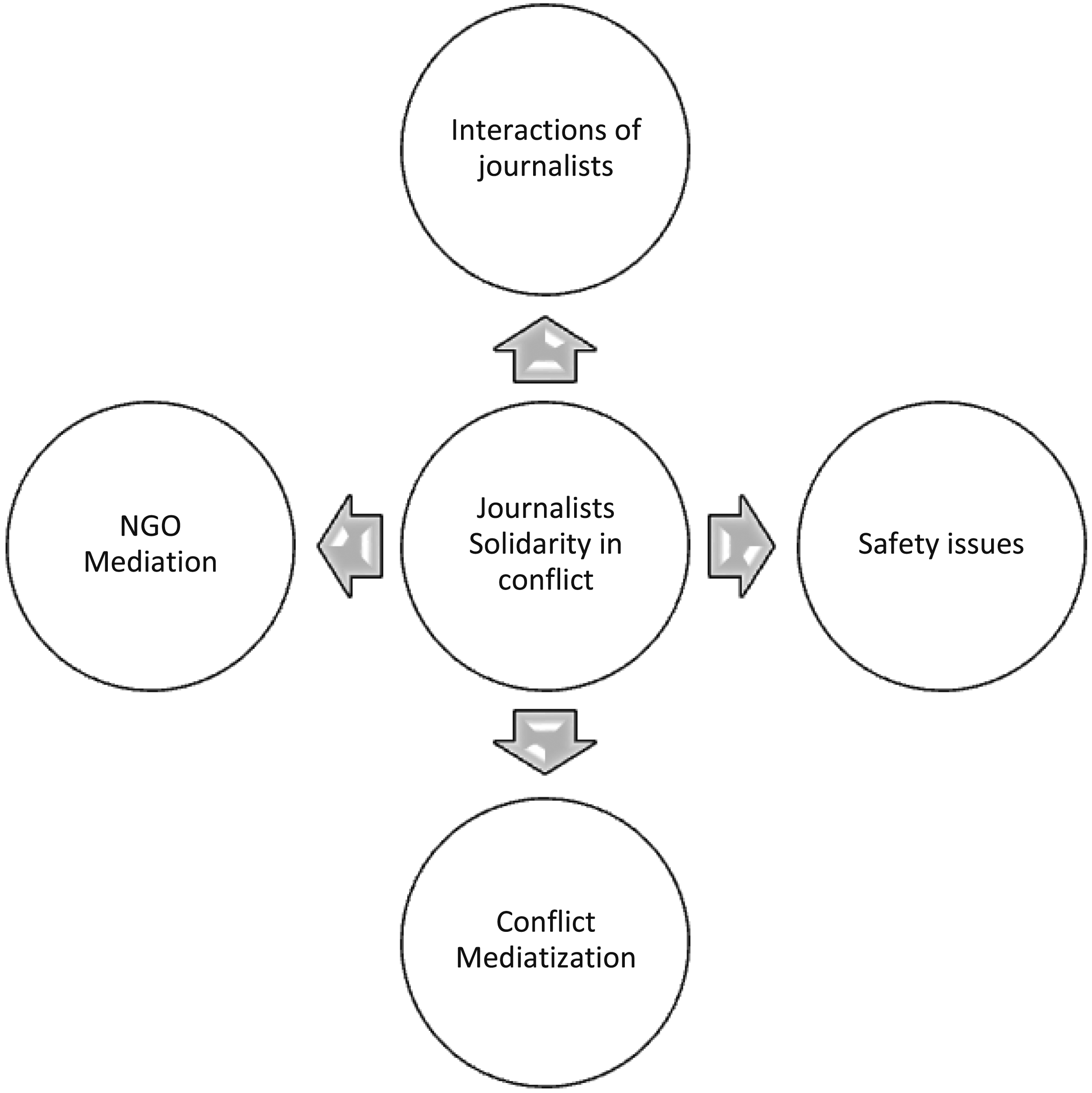
Much like news production process that has its conflict related influences different from generic influences (Hoxha and Hanitzsch, 2018) journalists` solidarity in conflict is placed in the epicenter of interactions of journalists with the `other side` of conflict (Gonen and Hoxha, 2019), safety of journalists looked from coping strategies (Hughes et al., 2021; Khalvatgar, 2019) and risk factors as well as occupational safety in relation to stress and coping as resistance, submission or avoidance (Slavtcheva-Petkova et al., 2022) and mediatization of conflict (Baugut, 2019; Maurer and Pfetsch, 2014; McQuail, 2006) and NGO work in conflict in relation to news production and influences on journalists´ work (Meyer et al., 2018). The model below explains how Ukrainian journalists´ perceive interaction of solidarity with other strands of influences in the context of Kosovo. All these interactions and influences are result of heavy intervention of NGO through mediating the collaboration between Ukrainian journalists and Kosovar journalists.
Methodology
When there is a small number of journalists studying, it can be a challenge to choose a useful methodology due to traditionally professional ideology of journalists and their bias to western roles of journalists that are embroiled in culture of journalists. Concepts of being independent, objective, neutral apply in western form of codifying professionalization of journalists and throughout the world, journalists often answer along those concepts in assumption that it is expected from them to as found through reconstructive retrospective interviewing (Hoxha and Hanitzsch, 2018). Qualitative interviews give a chance to uncover attitudes. As interviews are a suitable approach for identifying the characteristics of a journalistic practice and revealing perceived influences in the journalistic news production process (Hanitzsch, 2007, 2011).
All Ukrainian journalists who moved to Kosovo as a result of war in Ukraine were part of the organized program through ECMPF. All were asked for interviews with an in-depth interviewing technique that is based upon semi-structural questioning with open-ended questions with a modest attempt to reconstruct events of the past and overlooking the future. 11 journalists accepted the invitation and were interviewed, and one journalist kindly declined to be interviewed. Interviews were developed between October 2022 and May 2023. The sample for this study is self-imposed and purposive due to small number of Ukrainian Journalists who moved to Kosovo. Journalists who fled to Kosovo were identified through the Journalist in Residence program and met through the Kosovar Journalist Association. Interviews were conducted in person and online through semi-structured interviews. 10 Ukrainian women journalists and 1 man who were interviewed were staying in Kosovo. They were all of age, 37 to 59 years. The reason for this gender demography is that after general mobilization in Ukraine, mostly women fled the country whereas men were not given permission to leave due to war.
The sample can be described as purposive sample as the total number of journalists who fled from Ukraine to Kosovo were interviewed. The questions were prepared well in advance and tested in a neutral environment as a test interview which lasted from 25 to 35 min. Guided by a broad interview plan, all interviews contained the same topical areas to all journalists, although some questions could vary. Some of the questions addressed personal experiences and choices of the travel to Kosovo and their stance on conflicts of Ukraine and Kosovo and the rationality behind decisions to go to Kosovo. Although not the main part of this study, journalists were asked about routines, values of news and overall news production processes as well. All interviewees were given the options to anonymously answer the questions and were informed in detail with a written informed consent letter approved by the Norwegian Agency for Shared Services in Education and Research beforehand. The interviewees agreed to interviews without hesitation. Due to the sensitivity of their stories and implications that their story might have in the future, we decided to anonymize interviews as much as possible. However, these stories are unique in their own way.
Interviews, after thorough anonymization, were analyzed through MAXQDA, a software that eases the process of summarizing findings by coding parts of interviews for the same topic and enables finding differences and similarities as well as making it possible to compare cases that are built within data. For the purpose of this paper, the coding of text from interviews was done manually focusing only on issues pertaining to the research questions. Findings were organized in the same way as research questions were framed. There is a logical flow of research questions, interview questions and findings in a systematic order. This order sets findings on the basis of characteristics of solidarity, safety and interactions of journalists so it reflects upon the theoretical assumptions given in the theoretical framing of journalistic solidarity with two additional theoretical strands of safety of journalists and interactions of journalists in conflict. All interviews were transcribed directly into English.
In principle, this study explores perception of solidarity by the end users of such concept at the times of war. The Ukrainian journalists who fled from war in Kosovo with the mediation of non-governmental organizations and hosting journalists. Much of the ideological aspiration for this paper comes from also other seminal work of research on cultures of journalism by Worlds of Journalism project (Hanusch and Hanitzsch, 2017) which looks at cultures of journalism across the globe by asking questions on the self-perceptions of roles of journalists.
Findings
Among strands of policy work and academic research, solidarity is placed between work on safety, roles and performance as well as interactions of journalists. Solidarity among journalists are actions of journalists for other journalists. In conflict and post-conflict, journalists do things for each other but in the case of Ukrainian journalists who fled to Kosovo, this was facilitated by the non-governmental organizations. This makes this type of facilitated solidarity different from humanitarian work or journalistic work because it adds additional roles for journalists who operate in a proactive operation almost abandoning traditional western roles of journalists as independent, neutral, observant and watchdog gatekeepers. This mediated solidarity is part of humanitarian intervention but mostly peer to peer which involves multiparty actions between Kosovo as hosting country and Ukrainian journalists who fled in spite of aggressive invasion of the country.
Solidarity has been given to journalists in two strands of action. The first kind of solidarity is institutional whereby ECMPF and its partners prepared the ground and context for such a move of journalists together with the Association of Journalists in Kosovo. The second kind of solidarity is manifested in a private setting by journalists themselves which lead to the creation of compassionate and friendly relationships between journalists.
Journalists from Ukraine say they have willingly chosen to go through EU countries with the destination of Kosovo in order to understand conflict and prepare for the future reconstruction of Ukraine. Although they knew that they have no health insurance or welfare state in Kosovo, their decision was solely based upon the desire to understand better post-war Kosovo and apply those lessons in near future post-war Ukraine. Currently, they receive little income from the German NGO that arranged their stay in Kosovo, and they do not receive any payment from employers in Ukraine. There is no unemployment scheme or program in Kosovo that would support them or in Ukraine due to war. When they write content for media either in Ukraine or elsewhere, they receive payments as freelancers.
Interviews show that Ukrainian journalists are all satisfied with this cooperation. One of the first journalists that arrived in Kosovo said that “despite the sadness of leaving Ukraine, I feel it was the right decision to come to Kosovo because there is so much to learn and all this thanks to great colleagues who hosted us here in Kosovo. We didn’t know what to expect really.” (Interview with Ukrainian Journalist in Kosovo, 2023).
Mostly, the representation of the stories from Ukrainian journalists that moved to Kosovo can be summed through the introduction of one of the journalists: “To this day, Kyiv remains the target of Russian missile strikes. The capital works in a limited mode: people work remotely, during an air alert they are forced to stay in shelters. Due to such conditions, many mass media have stopped working, reducing employees. At the state channel, where I worked for 16 years, there was also a layoff in February 2023 - 300 workers lost their jobs during the war. I lost my job. The National Union of Journalists of Ukraine offered me, as a member of the union, to consider a proposal for cooperation - the “Residence in Kosovo” program of the Association of Journalists in Kosovo to support Ukrainian journalists during the war. The decision to participate in the program was the first step towards Kosovo” (Interview with Ukrainian Journalist in Kosovo, 2023).
The hosting journalists express their willingness to extend help for colleagues but according to one of the previously interviewed Kosovar journalists, they could “only solidarize with Ukrainian journalists on social media.” These actions of “online solidarization” (Varma, 2021) was also described as an embarrassing moment because everyone knew that there was no meaning to it. The interactions between Ukrainian journalists and Kosovar journalists are also focused on the issues at stake, the war. Here, the journalists found common ground. “Most of the talk is about the war in Ukraine now and memories of the war in Kosovo” (Interview with Ukrainian Journalist in Kosovo, 2023)
Talking about experiences, similar to those of “journalists in communities” (Zandberg and Neiger, 2005) being a journalist have created a common denominator. Sharing and exchanging experiences was the first interaction upon arrival of Ukrainian journalists in Kosovo: “In the first days of my arrival in Kosovo, we met with journalists from a local news agency. So, we talked about the events in Ukraine, about my personal experience of living through military events and the support of Ukraine from Kosovo.” (Interview with Ukrainian Journalist in Kosovo, 2023)
Hosting Ukrainian journalists was taken very seriously by the Kosovar journalists. It was important to show what Slavtcheva-Petkova calls “professional solidarity” (2022). “Local media people are very friendly and benevolent” (Interview with Ukrainian Journalist in Kosovo, 2023)
Interactions of journalists facilitated by the ECMPF have occurred through a top combined approach of initially expression of willingness to learn more about conflict and dealing with post-conflict situations while one of the journalists fled from Ukraine to Germany. As soon as moving to Kosovo, the journalists from Ukraine expressed that they wanted to go back to work. This shows the zeal to continue the work in the midst of not only war, but also in a new country and under different working conditions. “I recently arrived in Kosovo. I am currently getting to know the capital city, its traditions. And very soon I plan to return to work, now online.” (Interview with Ukrainian Journalist in Kosovo, 2023)
Another journalist describes conditions to go back to the profession of journalism as soon as they arrive in Kosovo as a result of this collaborative efforts. “Coming to Kosovo gives me the opportunity to stay in the profession. All conditions for work are created here” (Interview with Ukrainian Journalist in Kosovo, 2023)
Some of the Ukrainian journalists brought family members too and they were also welcomed. One of the journalists describes a warm welcome for her members of the family and how journalists like to include her and her son into organization of reception events, and one journalist described the atmosphere: “Friendly warmth and support is felt.” (Interview with Ukrainian Journalist in Kosovo, 2023)
The Ukrainian journalists talk about the importances of journalistic solidarity and the obstacles they face in both countries. “To solve (safety) problems, journalists need to be in solidarity with one another” (Interview with Ukrainian Journalist in Kosovo, 2023)
They also express an interest to improve relations between Ukraine and Kosovo and highlight positive perception of Kosovo among Ukrainian journalists. “I want our countries to be friends and support each other…I would like our countries to be good friends, to successfully develop bilateral relations in politics, economy, culture and sports” (Interview with Ukrainian Journalist in Kosovo, 2023).
In terms of occupational focus and areas of interest, the Ukrainian journalists are mostly interested in events back in Ukraine. This occupies most of their conversations with Kosovar colleagues. An interviewed journalist who recently moved to Kosovo, passing through EU countries, expresses eagerness to go back to work for the media and tell the story of this journalistic solidarity in Kosovo. Indirectly, this journalist hopes to improve political relations between Ukraine and Kosovo, although the thoughts are focused on their homeland: “After I moved to Kosovo, my hometown of was shelled, killing three people. In the autumn, the Russian army may again shell energy facilities to leave Ukrainians without electricity again. It is very difficult for journalists to work at such a time” (Interview with Ukrainian Journalist in Kosovo, 2023).
Another journalist was not expecting interactions. Journalists are competitive by nature and collegial interacting is not high in the agenda. But as there is no competing for news and audiences are far apart the journalist keeps updated about events in Ukraine by subscribing to news channels in Ukraine but also by receiving shared news from Kosovar colleagues. Solidarity in information sharing is something new that has not been experienced before. “We mainly discuss issues related to the war in Ukraine and the experience of the war experienced in Kosovo. Historical and cultural parallels between our nations” (Interview with Ukrainian Journalist in Kosovo, 2023).
Most Ukrainian journalists express the pleasant surprise of being hosted by Kosovo. As they did not know too much about the cultural context but were informed about the war and hostility with Serbia in Kosovo, they were eager to know more about how journalists cope with war experiences in post-conflict and how to “rebuild” in post-war Ukraine. Lessons learned from Kosovo are unique in own way but in the words of a journalist “experience of similar enemy” makes it worth learning. “I like that I live in Kosovo, remain a Ukrainian journalist and write for Ukrainian readers, both about Ukraine and about Kosovo” (Interview with Ukrainian Journalist in Kosovo, 2023).
As the war is ongoing in Ukraine, Ukrainian journalists express that programs of mediation such as the one from Kosovo are necessary means to strengthen solidarity among journalists and even in creating journalist coalitions to mitigate risks and threats and build a resilient community of journalists. Creating a safety net for journalists in conflict should be the next move for the international community or EU. Kosovar colleagues also offered a layer of protection for the Ukrainian colleagues by providing free membership at the Association of Journalists. “We received press cards of the Kosovo Journalist Organization and now we can get to any events and activities in Kosovo without any obstacles.” (Interview with Ukrainian Journalist in Kosovo, 2023).
Journalists discuss perceptions of safety, solidarity, and political relations between Ukraine and Kosovo in the context of how to build a resilient community of journalists and help other colleagues elsewhere. The importance of continuing the work in the host country as a journalist is also part of the interactions. “I write about the war in Ukraine for Ukrainian and foreign media. I also prepare journalistic materials about life in Kosovo and the help that Kosovars provide to Ukrainians. I am giving an interview for the media of Kosovo, where I explain the essence of the events in Ukraine” (Interview with Ukrainian Journalist in Kosovo, 2023).
Finally, Ukrainian journalists that reside in Kosovo under this program have found that journalist to journalist solidarity is very important and useful tool in building not only professionalization of journalists but also bridges for future collaboration. Because this solidarity is physical and with very little online interaction between Kosovar and Ukrainian journalists, one expects this to change upon the end of conflict where collaboration with Kosovar journalist looks promising in the future and once journalists return in post-war Ukraine, they report to wish to keep in touch with colleagues and perhaps also host other journalists from other troubled zones in conflict.
Discussion
Ukrainian journalists who moved to Kosovo through the ECMPF program operate in a specific context. They are part of the international humanitarian aid agenda and utilize such network to survive and plan a return to Ukraine once conditions allow. In due course, they learn what they think is important for the media agenda once they are back in Ukraine in the future.
In Kosovo, journalists have demonstrated a high degree of solidarity for their colleagues from Ukraine by providing help and support. English and Albanian language courses were organized to help journalists operate better in new environment but also internationally. Although financially, expenses were covered by the ECMPF, most of the groundwork has been done by the journalists in Kosovo. In contrary to other journalists who fled to Kosovo under similar international aid framework, Ukrainian journalist choose to go to Kosovo, and this puts them in a unique position in terms of study. Other journalists such as those who left Afghanistan, used Kosovo as a temporary solution until final destination was offered.
Ukrainian journalists also answer all the questions in the context of their specific situation. Professional biases and ideology are present but on the political agenda as well. Naturally, subject number one in conversations with journalists is war in Ukraine and what can be done about it. Journalists feel the pressure of support Ukraine in its efforts to liberate from Russia but also feel attached to the professional values of independent reporting. When discussed political situation, journalists always demonstrate high level of information about political developments in Ukraine which means they follow the conflict very closely. They also follow the political situation in Kosovo very closely especially in the northern part of Kosovo where hostilities erupt occasionally.
The Ukrainian journalists have also been part of the political agenda in Kosovo for a while. They visited the highest political institutions and were received by the President and the Prime Minister. On the Ukrainian National Day, Kosovar National Assembly held a session in honor of Ukraine and expressing support for Ukraine against Russia where journalists were guests of honor and recipients of highest prize in the Parliament of Kosovo. One of the indirect developments is the readiness to utilize their situation to improve political and diplomatic relations between Kosovo and Ukraine. All interviewed journalists expressed that Ukraine and Kosovo should improve relations and most, also expressed their hope for recognition of Kosovar statehood by the Ukrainian state. The way to “establish diplomatic relations through journalism” according to a Ukrainian journalist has become his personal agenda after being hosted in Kosovo.
Conclusions
The findings from this research show that it is evident that journalistic solidarity is needed to offer a layer of protection for journalists fleeing countries with conflict, risks and threats. This solidarity is impossible without the mediation and aid of non-governmental sectors such as associations of journalists and NGOs dealing with Human Rights and Freedom of Expression such as ECMPF. Such solidarity is essential in future planning of media development and aid as it brings journalists-for-journalists into the epicenter of such action and creates a better understanding of needs and gaps of intervention.
The abrupt changes in risk, threats and working conditions can foster new opportunities too, although there is a need for a receiving end where colleagues and the hosting society provides for this. Countries with the possibility to offer experience should step up and provide expertise and extend solidarity for journalists at risk. In professionalization and education of journalists, it is vital that such solidarity exists in order to keep the professional news production routines despite change of influences from generic influence into conflict related influences and beyond that, safety related influences.
Solidarity is a necessary long-term educational goal of journalists who choose a less economically prosperous country in exchange for valuable experience sharing and learning. Actions by journalists for journalists are two-way interaction which inter-depend upon mediation by non-governmental sectors. This mediation facilitates humanitarian, post-intervention, media development related solidarity which has influence on the physical safety of journalists, psychological safety, digital safety, and builds a coping mechanism with post-conflict trauma that might be long term.
In building capacities for journalists to deal with troubled past, solidarity of journalists offers unique expertise on subjects of memorialization of the past, transitional justice and truth commissions which expertise can only be offered by very few countries in the world such as Kosovo.
Meditation is also helped by the storytelling function of solidarity and creation of political opportunities for better public life participation for journalists in the host countries by indirectly being representative of their country thus finding themselves into a public diplomacy position of making political agendas. Finally, identifying with `common enemy` has its roots in both political safety and physical safety but above all, on roots of why solidarity is needed in the first place. Being adversary to aggression is precepted by journalists as being on the right side of history.
Footnotes
Declaration of conflicting interests
The author(s) declared no potential conflicts of interest with respect to the research, authorship, and/or publication of this article.
Funding
The author(s) disclosed receipt of the following financial support for the research, authorship, and/or publication of this article: This work was supported by the Universitetet i Agder.
