




Abstract
The accountability interview in which a public figure is held to account for their statements or actions is a well-established armature in the delivery of broadcast news. In its broadcast canonical form it relies on questioning as an instrument for addressing issues of knowledge, responsibility, and the rightness of actions of those with public standing. However, shifts in questioning techniques have accelerated a movement towards argument in the context of the broadcast accountability interview and a corresponding loosening of its interview structure. Indeed, there are signs of a growing tendency for the interview framework itself to be questioned by interviewees. This article examines what is at stake in these changes and asks if the accountability interview in an era of heightened conflict remains fit for purpose or is facing a kind of legitimation crisis.
Keywords
Introduction
This article examines some of the discursive properties of the news interview in UK public service broadcasting during 2022-2024 with a view to assessing the degree to which it continues to serve as an instrument of accountability in the public sphere. The article first outlines some general features of accountability in a democratic society, and it then relates these to a particular form of news interview which has become known and delineated as the accountability news interview. It will review key properties of this kind of interview insofar as they constitute a normative order of discourse. The realization of this normative order, however, may take different forms; and some forms actually contain the potential to undermine this normative order, especially when they facilitate argument, and the transition from interview into assertoric argumentative sequences. Sequences of this kind have recently been overtaken by a more fundamental challenge in which normative order of the interview is reflexively, directly and fundamentally questioned and rejected. The article, therefore, seeks to trace a progression from forms of adversarial questioning that rely on declarative statement with tag, to declarative statement, to assertoric sequences, to cases where the Interviewee questions and refuses the norms of the interview. In the light of this progression, in which the terminus ad quem is fundamentally to reject the norms of the interview, doubts are raised about the continuing effectivity of the accountability news interview as an instrument of public accountability.
Questions of accountability
The last decade has seen major crises across a range of public bodies and societal institutions in the UK: for instance, multiple miscarriages of justice followed on the introduction of an IT system by the Post Office in which several hundred sub-postmasters were wrongly accused of fraud; a council high-rise housing scheme suffered a catastrophic fire causing the deaths of 72 residents; the Metropolitan Police Force – the largest in the UK - was found to be institutionally racist and misogynistic; and excess mortality rates were attributed to several NHS maternity units. These – and other cases – clearly foregrounded issues of accountability, transparency and responsibility. Several major public inquiries are in train, or only recently concluded: the Grenfell Tower Inquiry; the UK COVID-19 Inquiry; the Ockenden Review into Maternity Services; the Baroness Casey Review into the Metropolitan Police; the Infected Blood Inquiry; and the Post Office Horizon IT Inquiry. Against this background, questions of accountability have increasingly become part of public discussion and debate. Indeed, news items in mainstream UK news media that feature questions of accountability - and its failure – have increased more than fourfold over the last ten years (and by more than a factor of 10 over the last two decades) as can be seen in Figure 1: UK news items featuring accountability and its failure: 1980-2023. (Figure derived from LexisNexis data.)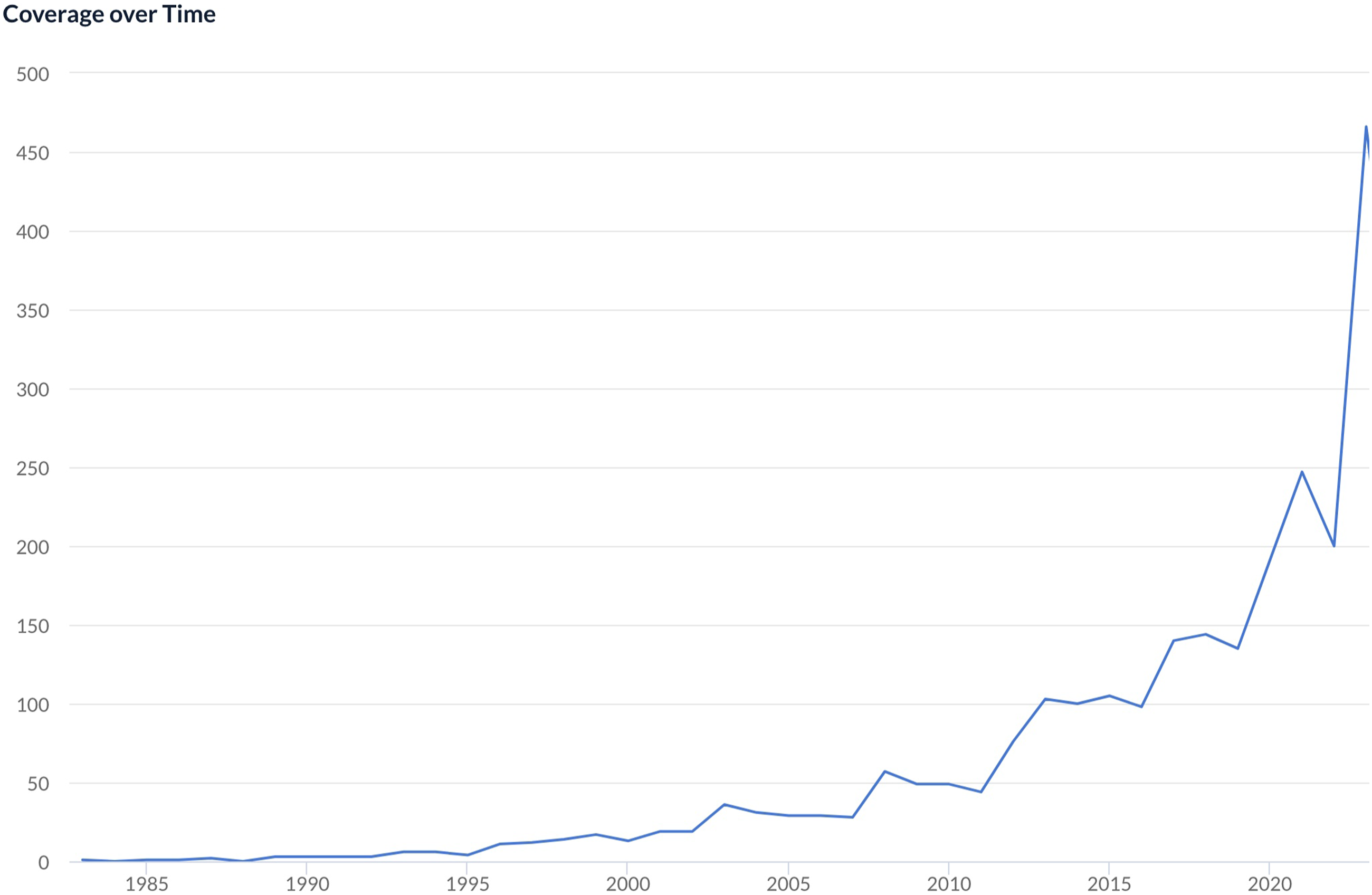
Political science has a long-standing interest in accountability. A representative definition is offered by Bovens about the concept of accountability – its meaning, function, and scope: Accountability is a relationship between an actor and a forum, in which the actor has an obligation to explain and to justify his or her conduct, the forum can pose questions and pass judgement, and the actor may face consequences. –Bovens, 2007: 450.
Accountability as a social relation. From Bovens, 2007: 452.
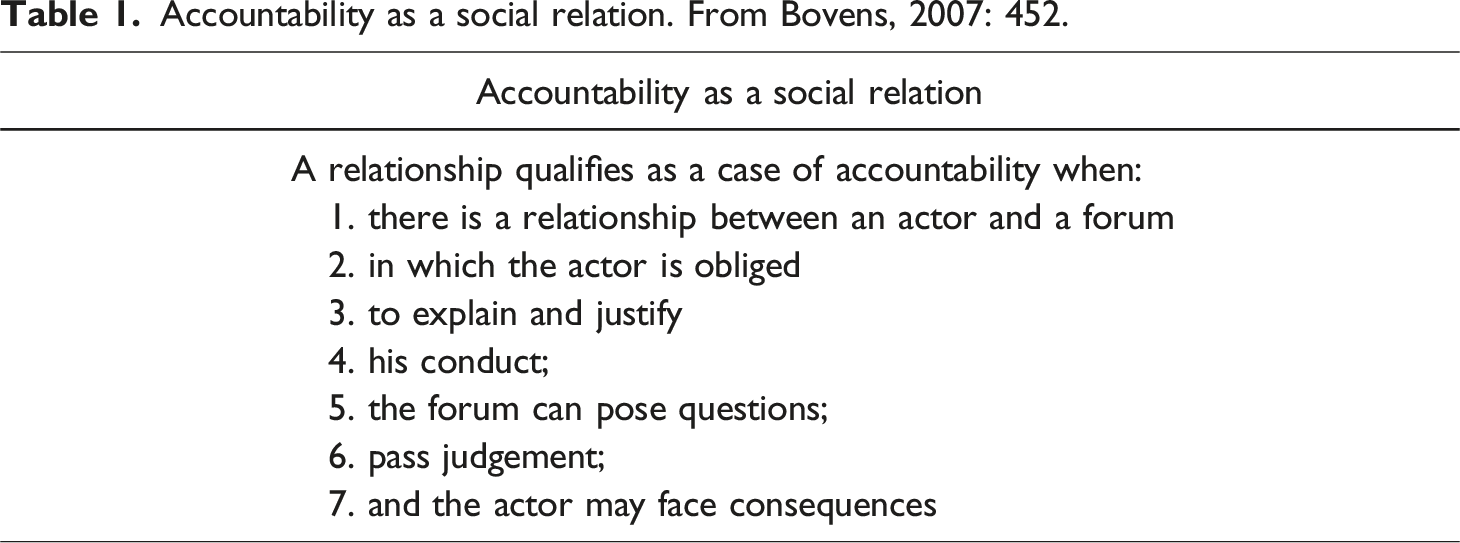
A crucial role is attributed in Bovens’s account to forums that are constitutive of one side of an accountability relationship in which they pose questions and pass judgement. But the process of doing so is not explicated. Indeed, inasmuch as forums are discussed at all, the main emphasis falls on them as formal bodies (rather like the Inquiries and Reviews mentioned above) such as Parliaments, Chambers of Audit, Offices of Budget Responsibility, Cabinets, Commissions and other statutory instruments. Although accountability is considered important “to provide a democratic means to monitor and control government conduct, [and] for preventing the development of concentrations of power” (462), and indeed is considered “an essential condition for the democratic process, as it provides the people’s representation and the votes with the information needed for judging the propriety and effectiveness of the conduct of government” (463), almost no attention is given at all to the role of the media, except to say that “media, interest groups and citizens are all adopting an increasingly more critical attitude to government.” (464) This is against a background in which: “Respect for authority is fast dwindling and the confidence in public institutions is under pressure in a number of Western countries.” (Bovens, 2007: 464.) But although “In many countries, the media are fast gaining power” they do so only “as informal forums for political accountability.” P.455.
This would seem drastically to understate the role of mass media in post-Enlightenment democratic societies in – to use Habermas’s phrase “the structural transformation of the public sphere.”
There is however a parallel but separate development in media and communication studies, where a great deal of attention has been given to a particular variant of the news interview – the accountability interview.
General characteristics of the accountability news interview
Montgomery defines the broadcast accountability news interview in the following way: In news interviews of this type the emphasis falls upon calling a public figure to account in relation to an issue or event of the moment either for their own deeds or words or for the actions/statements of the institution with which they are associated. While the interviewer seeks to query the basis of a statement or action, typically the interviewee seeks to justify it. Interviewees are public figures in the sense that they hold institutional positions and by their official status are treated as ‘‘having some locus’’ on the matter at hand. However, perhaps the clearest examples of this kind of interview involve politicians being interviewed in relation to a relevant current news event or topic. –Montgomery, 2007: 148
Other characteristics help to define it. Firstly, the encounter takes place in public; and the very fact of being broadcast to a large audience makes the interview a public rather than private matter. (Heritage, 1985) The public nature of the accountability interview also entails that it occurs ‘on the record’: whatever is said is susceptible to scrutiny, inspection, parsing and quotation.
Secondly, the interactional roles of Interviewer and Interviewee in the accountability interview carry other kinds of role and position with them. Thus, the Interviewer speaks in more than a personal capacity but as a member of broadcasting institution (Sky News, for example, or Channel 4 News, or BBC News) and, as such, will be expected to conform to certain kinds of institutional (and journalistic) requirement (to avoid transparent bias, for instance, and to maintain the appearance of impartiality) (Clayman and Heritage, 2002). In addition, however, and perhaps most significantly, Interviewers in accountability interviews, speak on behalf of an audience or public, effectively projecting themselves as ‘tribunes of the people’ or even ‘public inquisitors’ (See, for example, Clayman, 2002; Higgins, 2010; Hutchby 2017). Theirs is an ‘institutional voice’ (Lerman, 1983).
Conversely, the Interviewee also is there in an institutional capacity as a senior office holder or representative of a public body – a major company, for instance, or a trades union, a utility, or an arm of government. (Montgomery, 2007, 2008) In this role they are held to have responsibility for the actions or statements of their institution, and to be answerable for them. And in answering for their institution, they are expected to be able to account for their actions, strictly to ‘be accountable’: as such, they can be expected to explain, and more crucially to justify and defend. (Andone, 2013)
The normative order of the accountability news interview
These broad considerations are instantiated in practice through particular generic constraints, which have received much attention in the literature from the overlapping perspectives of discourse analysis and conversational analysis (see Clayman and Heritage, 2002; Heritage and Greatbatch; Hutchby, 2011, 2017, 2022a; Montgomery, 2007, 2008) A central feature of these accounts is their specification of the news interview as based upon the normative pre-allocation of turn-types and speaking roles: the Interviewer asks questions and the Interviewee answers them. It is, for instance, highly unusual – a breach of the normative constraints of the interview - for the Interviewee to ask questions and for the Interviewer to answer them. The distribution of turn-types is thus asymmetrical.
As a normative order Clayman and Heritage describe it thus: In the news interview…the participants are fundamentally constrained. Interviewers restrict themselves to questioning and interviewees restrict themselves to answering interviewer questions, or at least responding to them. This constraint shapes the form taken by the participants’ talk and the order in which they talk to the following pattern: IR: Question IE: Answer IR: Question IE: Answer This form of turn-taking involves what Atkinson and Drew (1979)have called “turn-type preallocation” in which the activities of asking and answering (or responding to) questions are pre-allocated to the roles of interviewer and interviewee. (Clayman and Heritage 2002: 97-98)
The constraints of this normative order are described by them in further detail: the participants – interviewers and and interviewees – refrain from a wide variety of actions that they are free to do in the give and take of ordinary conversation. If interviewers retrict themselves to asking questions, then they cannot – at least overtly - express opinions, or argue with, debate, or criticize the interviewee’s positions nor, conversely, agree with, support, or defend them. Correspondingly, if interviewees restrict themselves to answers (or responses) to questions, then they cannot ask questions (of interviewers or other interviewees), nor make unsolicited comments on previous remarks, initiate changes of topic, or divert the discussion into criticisms of the interviewer or the broadcasting organization. (op.cit. p.98)
Evolution within and challenges to the normative order of the accountability interview
Exactly how this normative order is realized, however, remains open to variation and development. Hutchby for instance observes that “as well as evolving through time, the political interview is diversifying in form” (2022b: 27) He further notes that: following the mid to late twentieth century development of more adversarial and probing formats,in more recent decades the conventional and adversarial interview formats…have been joined by still more aggressive and tendentious styles of interviewing.” (Hutchby 2022b: 39.)
Heritage, for instance, notes the emergence in the news interview of a particular kind of question design, the negative interrogative, as in “Isn’t it unjust to allow this to go untaxed”, which he argues is more than a neutral polar question but can act as a statement of opinion rather than as a question in search of information. Indeed, Clayman and Heritage track this form in Presidential press conferences to argue that there has been a changing tenor of questioning over time observing an increasing and interlocking ‘structure of assertiveness’ on the part of journalists. (2013, 496).
Montgomery (2011) analyzes increasing instability around the canonical norms of the political accountability interview with an increasing lapse into patterns of Assertion – Counter assertion instead of Q + A, an observation picked up by Hutchby who suggests that the question-answer sequence of the standard news interview may shift not just into assertoric forms of questioning but into full-blown assertoric sequences: the exchange of assertion and counter-assertion that is one of the basic grounds of mundane argument.” (2022b: 28)
In this article we will examine the implications of these developments as they obtain in current public service broadcasting in the UK, during the period 2022-2023. In doing so we will note examples of conducive or assertive questioning of the kind explored by Heritage (2002) and further by Heritage and Clayman (2013). Inasmuch, however, as this kind of increasingly adversarial questioning relies on declarative (statement) + tag, it is a small step for interviewers to build their questioning move on statements without the tag (and without formal interrogative marking). We will show how this kind of move lends itself easily to the formation of the kind of full-blown assertoric sequences analysed by Montgomery (2011) and further noted by Hutchby (2022b). In the account that follows, therefore, increasingly adversarial and assertive questioning lays the groundwork for a challenge to, and a partial breakdown of, the normative order of the accountability interview. But, crucially, however, the article will also present and analyse examples that amount to a more fundamental breakdown in the normative order of the accountability news interview, where many of the exclusions described by Clayman and Heritage become centre stage in a fashion that calls the very legitimacy of the journalistic accountability interview into question.
The method of inquiry relies on techniques of discourse analysis applied to the close study of broadcast talk or mediated verbal interaction in the journalistic context, as developed in Montgomery 2007, 2008, 2011. The ultimate focus, however, is on what the close study of patterns of verbal interaction in a specific institutional context can suggest about the prevailing social order and the role of journalism within it. As Fairclough and Wodak put it: describing discourse as social practice implies a dialectical relationship between a particular discursive event and the situation(s), institution(s), and social structure(s) which frame it. A dialectical relationship is a two-way relationship: the discursive event is shaped by situations, institutions and social structures, but it also shapes them. (Fairclough and Wodak, 1997: p.258)
Data for this study is drawn from UK public service news broadcasting (BBC Radio 4, BBC One, BBC Two, Channel 4, Sky News) almost exclusively during a twelve-month period in 2022-2023.
Adversarialism versus neutralism in the accountability interview
The normative order of the accountability interview is underpinned by two contradictory pressures – not only adversarialism, but also neutralism. Requirements about objectivity and impartiality in news broadcasting obtain in many democratic jurisdictions including both U.K. the U.S. and the protocols surrounding it have clear consequences for the conduct of news interviews. In particular the concept of formal neutralism may be seen as directly affected by the existence these codes. This applies especially to the accountability interview in which the interviewer (and thereby the news institution) must take care to avoid the appearance of identifying with contested cultural, ideological or political positions. Neutralism in this sense does not mean that the interviewer or institution has no position or viewpoint, merely that any such position – if held at all - should not be openly espoused – a constraint that applies all the more so to those public service broadcasters where there is an explicit requirement for balance and impartiality. Television and radio in the UK is licensed by an independent regulator, OfCom, and governed by a broadcasting code which states that
“News, in whatever form, must be reported with due accuracy and presented with due impartiality.”
At the same time this requirement can conflict with the basic purpose of the accountability interview as we have described it above: to hold public figures to account. And in holding interviewees to account for their words or actions Interviewers inevitably may adopt an adversarial posture. Clayman and Heritage sum up this tension underlying the accountability interview neatly as follows: How do interviewers manage to assert themselves in an adversarial manner while maintaining a formally impartial or neutralistic posture?
This kind of tension may become particularly acute at times of heightened political and sociocultural conflict, not to mention the rise of fake news and the effect on public discourse of post-truth performative politics. (see Montgomery 2017, 2020). It is under these kinds of pressures that the effort to maintain a neutralistic posture in broadcast news interviews faces serious challenges.
Changing forms of questioning in the accountability interview: from neutralism to assertiveness
Questioning in news interviews, as Heritage and Roth observe, handles the main interactional and institutional tasks charged to modern news interviewers. First and most centrally interviewers are obliged to elicit interviewees’ information and opinions for the benefit of overhearers (Heritage, 1985; Heritage and Greatbatch, 1991). Second, in most Western societies at least, interviewers are specifically not authorized to argue with, debate, or criticize the interviewee’s point of view nor conversely to agree with, support, or defend it. Instead, interviewers must maintain what Heritage and Greatbatch (1991) termed a neutralistic posture. –Heritage and Roth, 1995, pp.1-2
Questions, in principle, do not necessarily commit an interviewer to a particular point of view (though they can admittedly be used to advance an agenda); and for this reason they can facilitate the maintenance of a neutralistic posture on the part of the interviewer.
As noted previously, however, questions can take a variety of forms. Perhaps the mainstay of question design in broadcast news interviewing is the use of a question Wh-word such as Who, When, Why, coupled with interrogative syntax, a combination which aims primarily at seeking information. etc.) This question-type (even allowing for its capacity to embody a presupposition) can be seen as broadly neutralistic: although the question projects pressure on the interviewee to supply information it does not set tight limits on what information might be supplied in answer.
If these can be considered relatively open as questions, increasingly common, however, in the realization of Questions are closed forms based upon the selection of some form of Polar Interrogative, of a type which can be seen in the following extract, where BBC’s Martha Kearney (

The use of the Polar Interrogative invites a yes/no response, but, rather than neutrally seeking information, the question projects pressure on the interviewee to agree with the presupposition of the question (that Brexit has affected our low growth)
In the data a common way of increasing the pressure exerted by the polar interrogative is by framing it negatively, as in Ex 3 below - again from Kearney interviewing Glen, in this case about a long running strike of junior doctors.

In these cases it is noticeable that the Interviewee avoids the yes/no polarity in his reply beginning his response with well. A particular and increasingly common variant of the polar question in the UK accountability interview takes the form of a Declarative + Negative Tag, as in the following, where the questioning turn terminates with doesn’t it, hasn’t it.


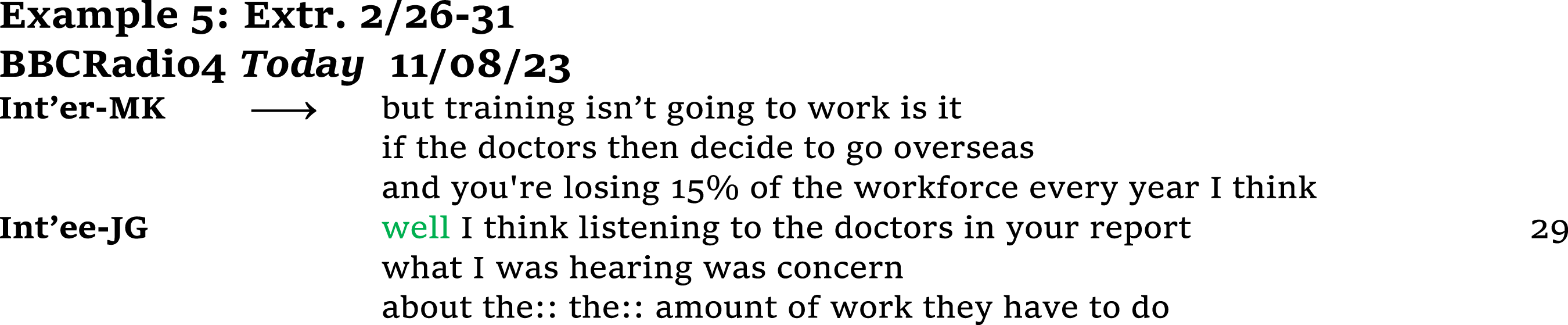
Thus, Questions realized by Declarative + Tag do two things differently from Information Questions. A Declarative + Tag question (such as “it involves people being poorer doesn’t it”, (Ex.4)) sets up a clear expectation for the polarity of the Interviewee’s response. In this case a negative tag in the Question projects a positive response of agreement (such as, “Yes, it does involve people being poorer”). But the choice of Declarative + Tag also provides the Interviewer with scope to embed an unwelcome proposition in the Question while simultaneously projecting a preference for the Interviewee to agree with it. This is particularly so with the polar interrogatives involving negation either in the tag (as in “it involves people being poorer doesn’t it”) or in the main clause (as in “but training isn’t going to work is it”).
Indeed, they can be characterized as Closed Questions rather than relatively open Information Questions of the WH-type. In practice, Interviewees almost invariably resist the closing down preference of Declarative + Tag. But in doing so they have to engage in discursive work to avoid the projected response of the Question: indeed, typically they avoid confirming the expectations offered by the Interviewer, by prefacing their reply with the discourse marker “well”, serving to mitigate their action of disagreeing or disaligning with the assertion embedded in the question. (See the Interviewees’ initial turn component in examples 2-6 above).
In this way interviewers can seem to preserve the neutralistic posture required of them by journalistic codes that restricts them to questioning. But the use of the polar interrogative – particularly negative interrogatives – enables them nonetheless to assert unwelcome propositions that the interviewee will inevitably wish to disalign from. The greater assertiveness of declarative + tag – especially with negation - thus provides a powerful route to square the circle for interviewers of how to assert themselves in an adversarial manner while maintaining a formally impartial or neutralistic posture.
Departures from the canonical form of the accountability interview: the shift from adversarial but formally neutral questioning to argument
As we have seen, the use of Declarative + Tag as a form of assertive questioning within the constraints of the canonical form of the accountability interview explicitly projects a discursive space in which the Interviewee is required to align or dis-align with the proposition embedded in the Interviewer’s question. It is, however, but a small step for the Interviewer simply to assert the proposition without benefit of an explicitly interrogative component. Here is Interviewer Martha Kearney from Radio 4’s Today Programme with the then Chief Secretary to the Treasury, John Glen:
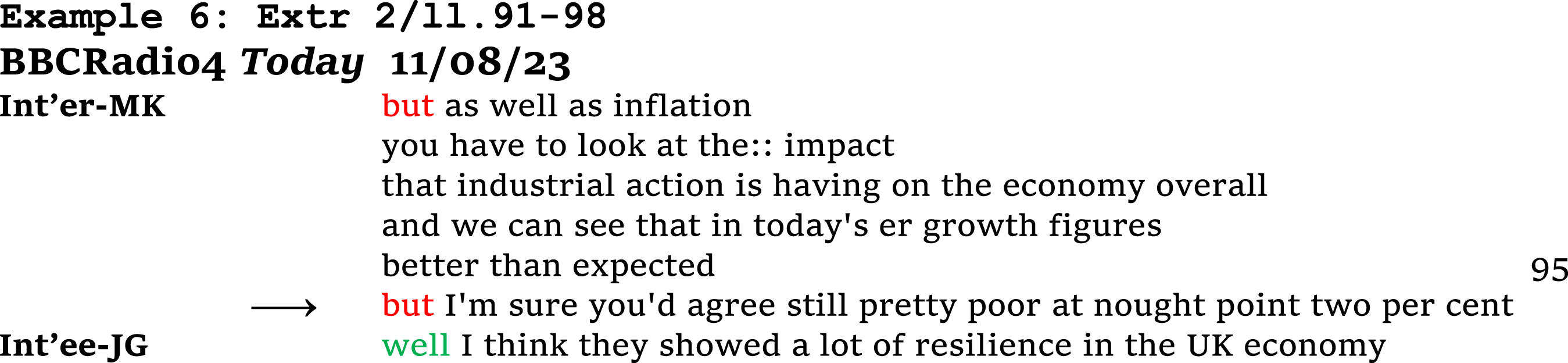
Effectively this exchange takes the form, not so much of Question and Answer, but of Assertion (the growth figures are still pretty poor at nought point two per cent) and Counter-Assertion (they showed a lot of resilience in the UK economy). Later in the same interview the interviewer’s “we’re not doing ..well” is countered by the interviewee’s “well .. the IMF have upgraded the UK economy”:

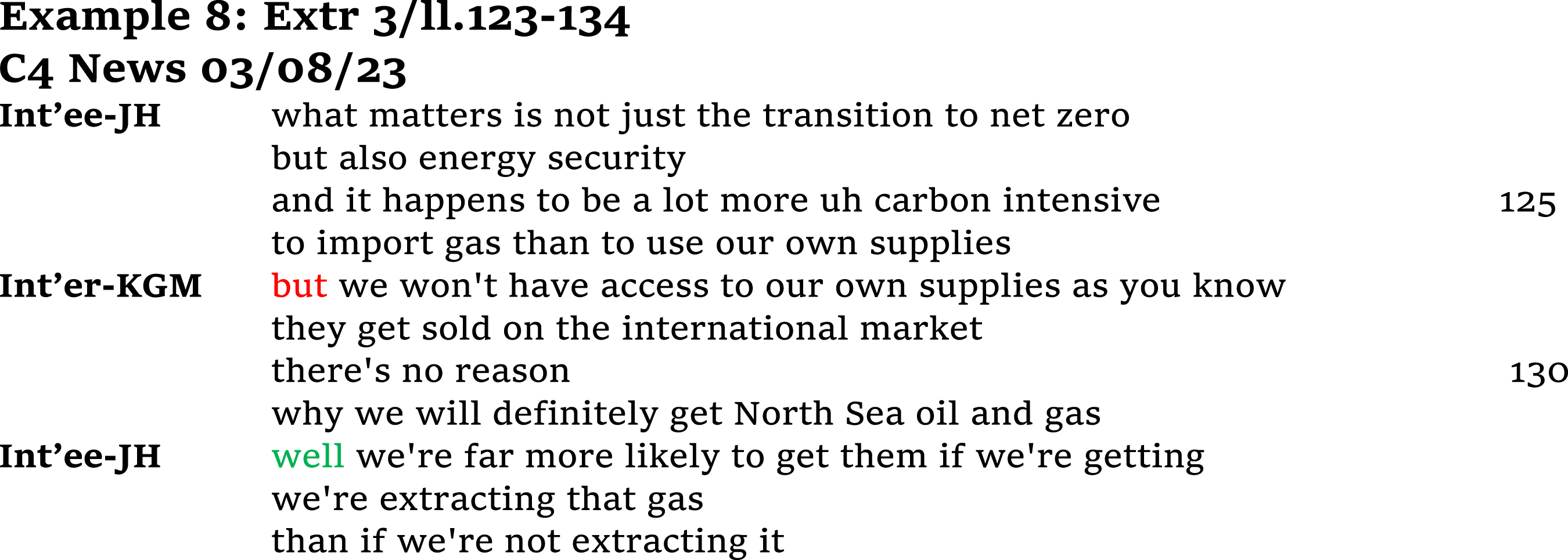
In this way accountability interviews may slip from the assertiveness of the polar interrogatives within the canonical structure of a series of Q-A adjacency pairs into recursive sequences of Assertion – Counter-Assertion – Counter-Assertion, as in the following example from a Channel 4 News interview by Krishnan Guru-Murthy with the then UK Chancellor, Jeremy Hunt about the government’s decision to grant new oil and gas drilling licences in the North Sea:
Or earlier in the same interview where they touch on the effect of Brexit on employment:
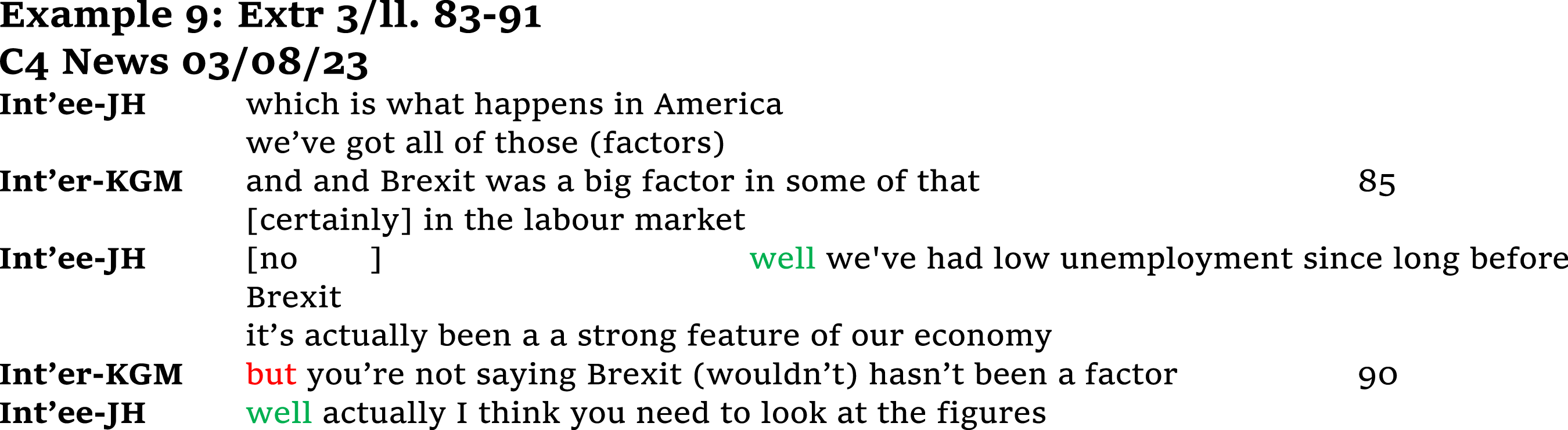
In each case the interviewer’s turns assert a proposition that is unwelcome to the interviewer without benefit of interrogative syntax:

In response to unwelcome (hostile?) propositions the interviewee elects to rebut them with a counter assertion. It is difficult to describe these sequences occurring within the overall frame of the accountability interview other than as a form of argument. As such, they amount to an evolution or flexing of the limits of the accountability interview in a process, however, that poses challenges to its very normative order.
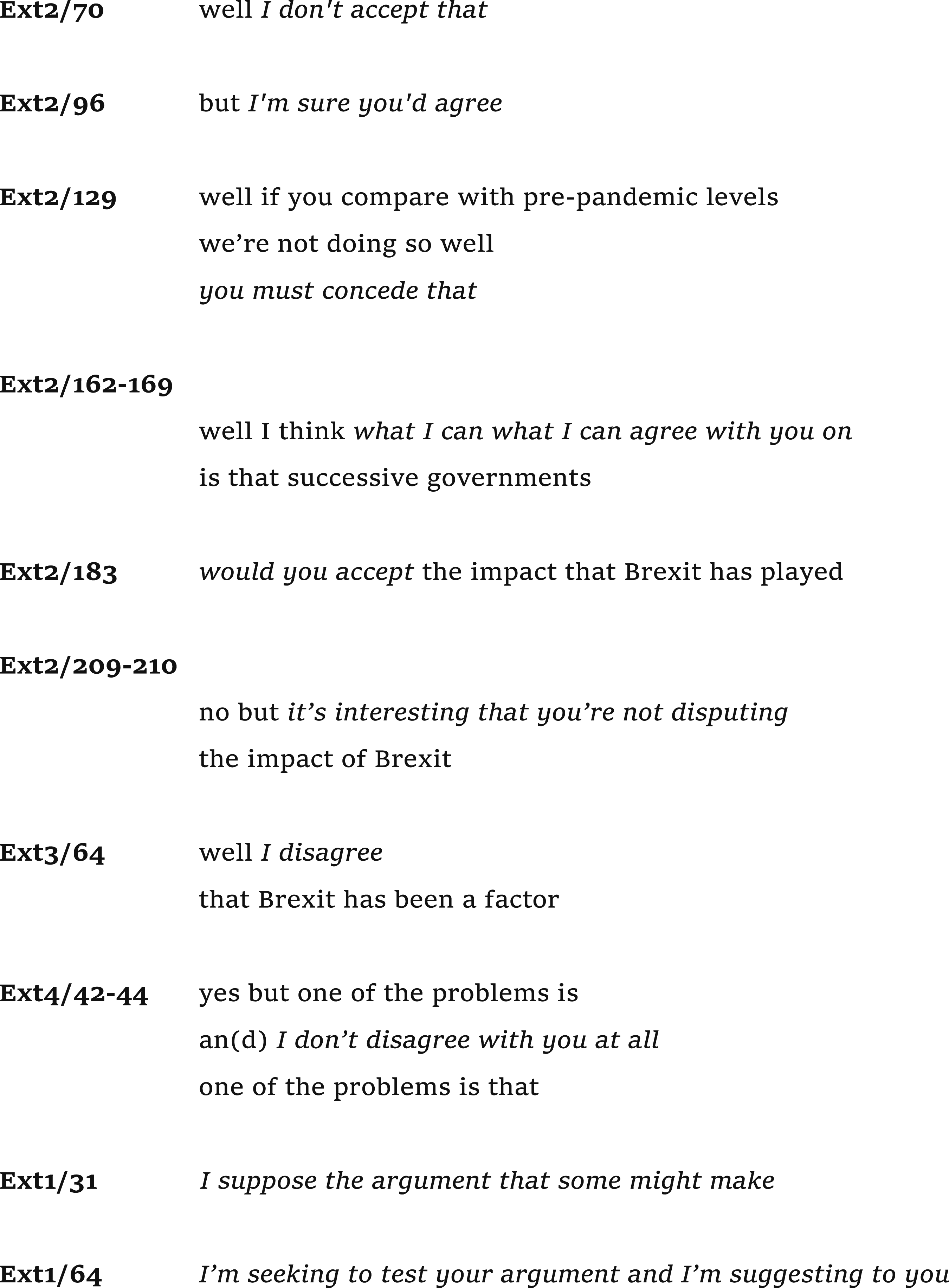
It is noticeable that these shifts provoke attempts by participants to clarify their ‘footing’ (Goffman, 1981) within the shifting sands of the discourse by resorting to metadiscourse, using metadiscursive terms such as argument, dispute, concede, and agree, to define the altered basis on which the discourse is working.
Direct challenges to the normative order of the accountability interview: from argument to antagonism
The replacement of Question and Answer exchanges with a looser sructure of Assertion and Counter Assertion may be seen as stretching the limits of the accountability interview. For one thing, the pattern of Assertion and Counter Assertion is prone to indefinite recursion where roles become blurred: the asymmetrical pre-allocation of turn types – Interviewer Question, Interviewee Answer – is replaced by the more symmetrical and looser interactional structure of argument.
However, the normative order of the accountability interview can be tested in more extreme ways in which the frame of the accountability interview is fundamentally broken. Here for example is the BBC’s political editor Chris Mason (BBC political editor) interviewing Sebastian Gorka (an adviser or surrogate to former President Trump) about a recent federal indictment against Trump. Mason lists the alleged offences that make up the indictment as a statement of fact rather than a question. Gorka responds “yeah but it’s all garbage”
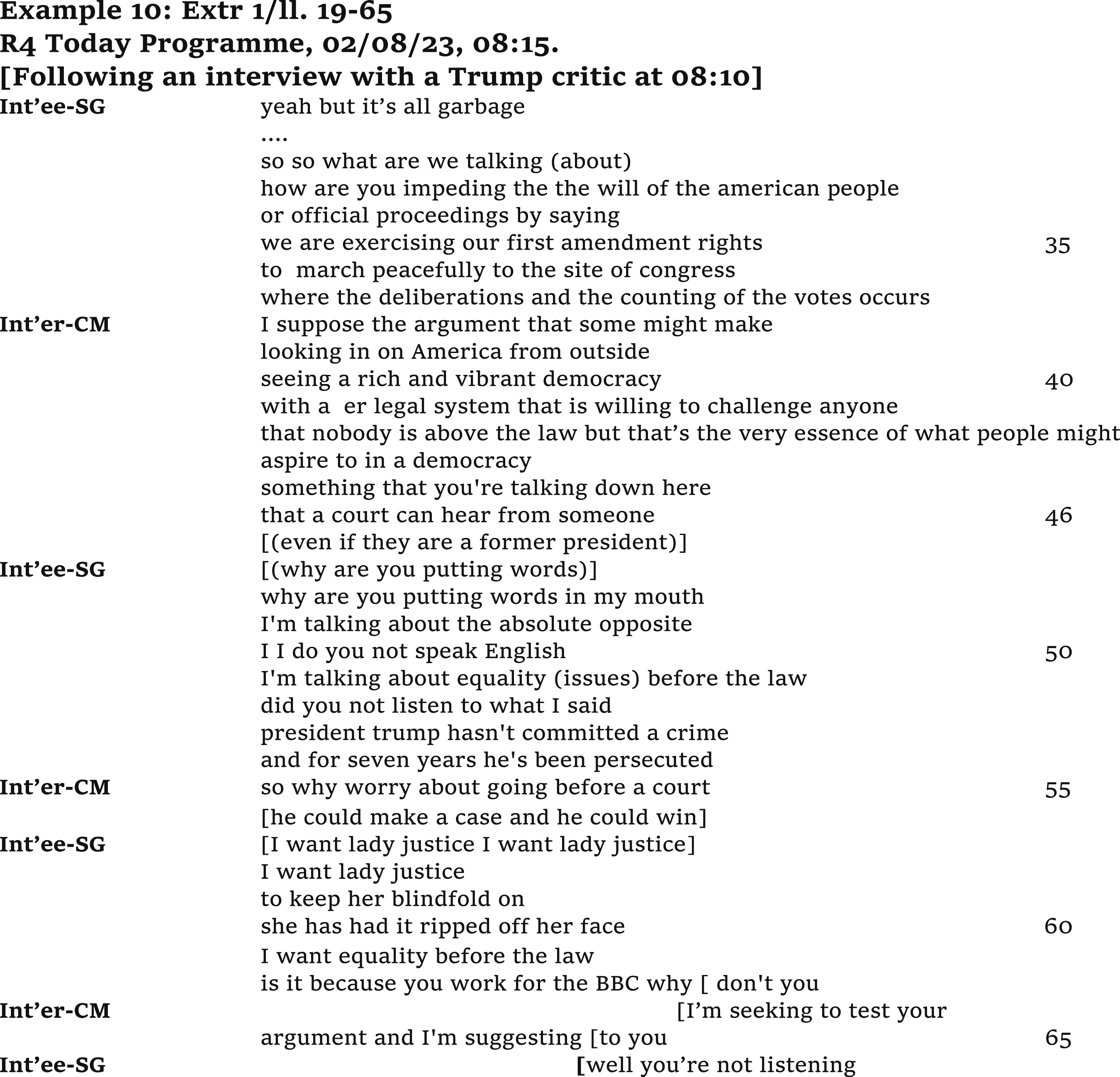
In this extract the normative order of the interview breaks down at its most basic level with a reversal of the pre-allocated roles of Interviewer and Interviewee. Here, on several occasions the Interviewee poses questions to the Interviewer:
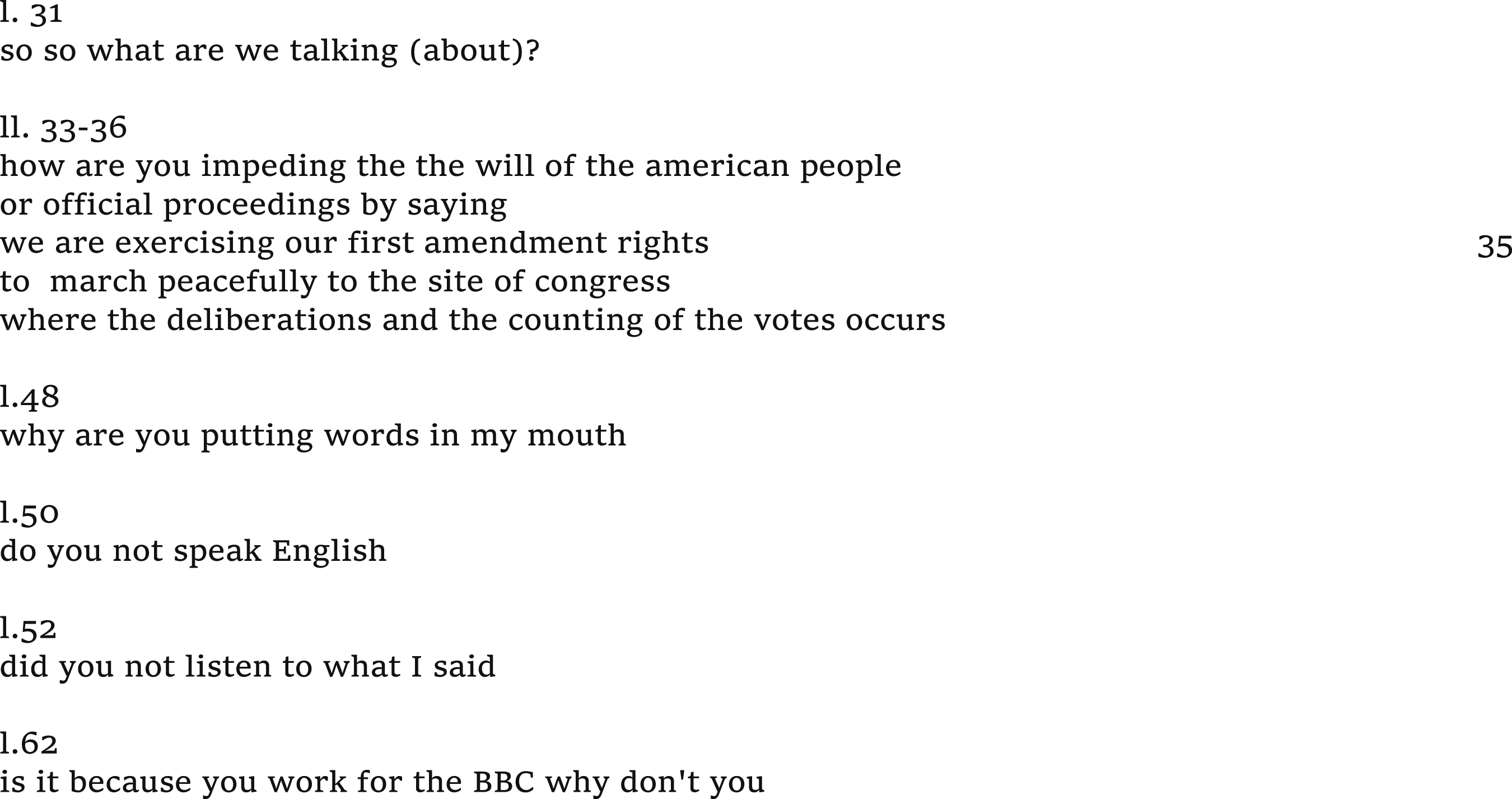
These can hardly be treated as rhetorical questions requiring no answer from the interviewer. For one thing the Interviewer’s next turn seems to recognize that a question has been put, even if the interviewer resists answering directly. Instead, the Interviewee behaves in ways that correspond precisely to those interactional moves described by Clayman and Heritage as excluded from the canonical form of the accountability news interview: if interviewees restrict themselves to answers (or responses) to questions, then they cannot ask questions (of interviewers or other interviewees), nor make unsolicited comments on previous remarks, initiate changes of topic, or divert the discussion into criticisms of the interviewer or the broadcasting organization.
This kind of extreme challenge to the normative order of the accountability interview may be even more evident in the following exchanges from an interview between the BBC’s Orla Guerin and the President of Azerbaijan, Ilham Aliyev. She asks him if the Armenians in Nagorno-Karabakh will have the full range of human rights which the people of Azerbaijan currently lack? He replies with a question:
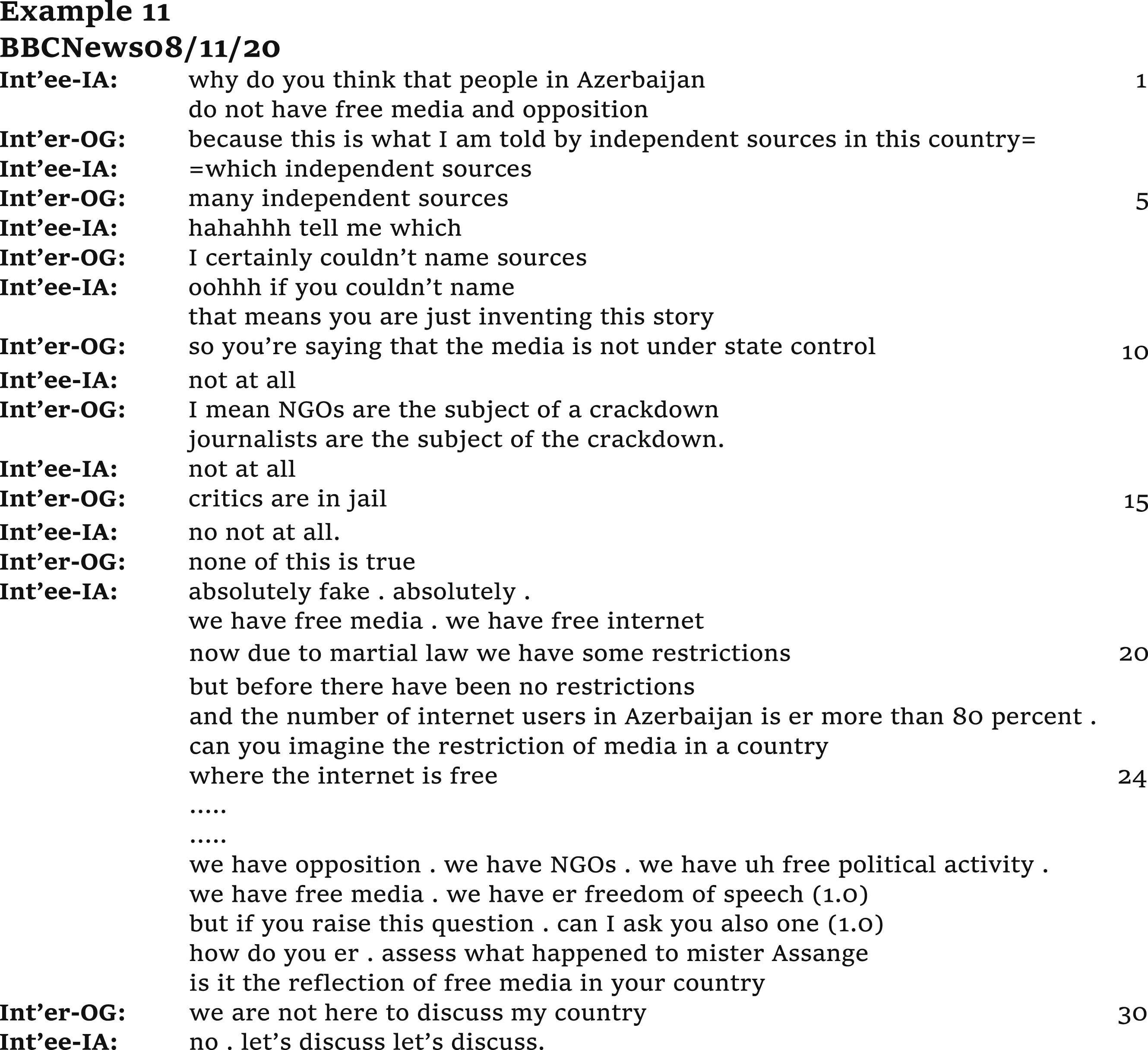
In the opening exchanges of this example (ll. 1-7) the Interviewee asks three questions (at ll. 1,3,and 6), each of which is answered by the Interviewer. He asks further questions near the end of the extract (ll. 27-29): but if you raise this question . can I ask you also one (1.0) how do you er . assess what happened to mister Assange is it the reflection of free media in your country
The interviewer this time attempts to deflect the question: “We are not here to discuss my country”, prompting the riposte “No let’s discuss, let’s discuss” in a move to shift the exchange onto a radically different footing, from interview to discussion.
Both examples 11 and 12 involve attempts to interview principals about ‘non-domestic’ political events. The following interview, however, takes place within the UK domestic scene between Kay Burley (
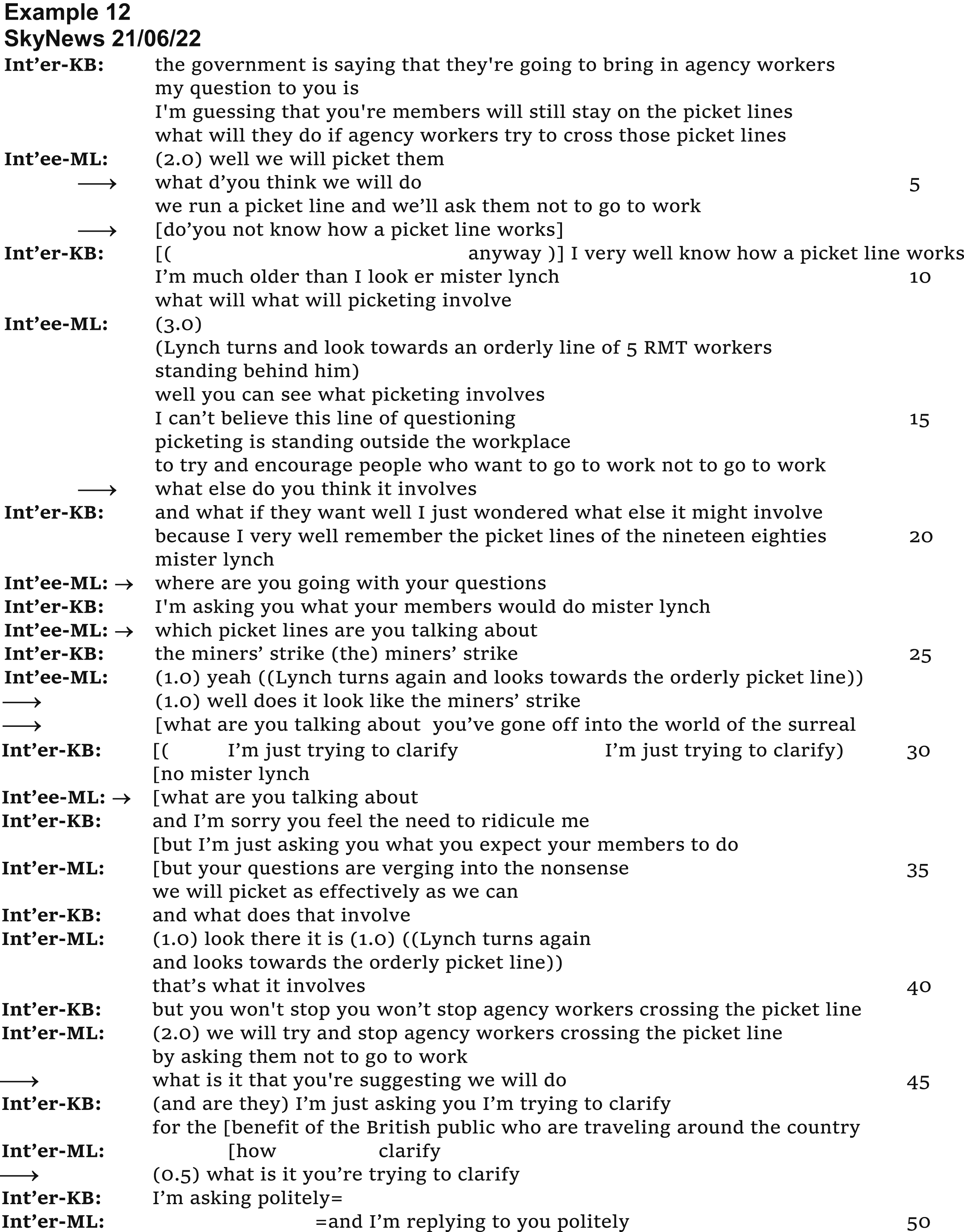
Here the Interviewee clearly resists a line of questioning being developed by the Interviewer – that picketing might involve actions reminiscent of the miners’ strikes in the 1980s (see ll. 22-30) when clashes took place between police and miners, and between picketing miners and those trying to cross the picket lines. The interview itself takes place by live feed across two separate locations on split screen. The interviewee Mick Lynch is shown on separate occasions turning in his position to look towards the picket line thereby indicating that the picketing behind him is in fact taking place peacefully. In addition, in a series of questions he calls the interviewer’s line of interrogation into doubt: l.5 what d’you think we will do l.7 do’you not know how a picket line works l.18 what else do you think it involves l.22 where are you going with your questions l.24 which picket lines are you talking about l.27 well does it look like the miners’ strike l.29 what are you talking about l.45 what is it that you’re suggesting we will do
In this way the normative order of the canonical accountability interview is fundamentally undermined. It is noticeable also that in this case the turn-taking system is under pressure: there are complex cases of overlapping turns in contradistinction to the interrelated notions of ‘one speaker at a time’ and ‘speaker change recurs’.
Conclusions
The accountability interview has earned a privileged status within the discursive economy of news and current affairs, tending to be quoted in the press and recycled on social media. In part this is because of the perception that, in the accountability interview, power in the form of the executive is confronted by the public in the form of the journalist performing the role of ‘tribune of the people’ (Clayman, 2002; Higgins, 2010; Hutchby, 2017).
Indeed, the accountability interview mainly operates on the premise that the person being interviewed has something to hide, or at least to withold (hence the doyen of BBC’s late night interviewing Jeremy Paxman’s of-quoted question that informed his adversarial interviewing style, ‘why is this lying bastard lying to me?’) (see, e.g., Burley, 2023); and the task of the journalistic interviewer is to expose it. In this way the accountability interview operates under the guise of having ‘real-world’ consequences in which the mask of power will be pulled away by forensic questioning, so that a lie, or a contradiction in public statements, or a failure of policy will be highlighted. Conversely, however, and crucially, in these circumstances the orientation of the Interviewee is to avoid anything that could be construed as a damaging admission.
We have examined the canonical pattern of the accountability interview, resting as it does upon the pre-allocation of turns in which the Interviewer asks Questions and the Interviewee answers them. We have shown, however, the emergence of an alternative pattern in the accountability interview stemming in part from the increasing adoption of a particular kind of Question – viz. the Declarative + Tag, in which a proposition is offered in the declarative clause, and the following Tag invites the recipient to agree or disagree. Indeed, these may be described as closed, coercive, or conducive questions (Kortum, 2013), i.e. they narrow the range of relevant responses. Given the widespread perception both in academic research and among the general public that politicians in accountability interviews ‘do not answer the question’ (see Bull, 1994, 1998, 2000; Bull and Mayer, 1993; Harris, 1991 etc.), these closed questions from Interviewers may be seen as a deliberate effort on their part to limit an Interviewee’s scope for evasion. At the same time, however, in order to avoid self-incrimination in answering the question, Interviewees routinely resort to contesting its embedded proposition. This in turn, as we have seen, gives rise to sequences of contested assertions much more akin to argument than to interview where participants compete not only for turns but over rival versions of the truth.
At stake, may be a matter of disagreement over moral positions. And as Alasdair McIntyre has commented: The most striking feature of contemporary moral utterance is that so much of it is used to express disagreements; and the most striking feature of the debates in which these disagreements are expressed is their interminable character. (McIntyre 2007: 6)
Even to the extent, he further adds, that: “There seems to be no rational way of securing moral agreement within our culture.” Often, however, as in the examples above, the disagreement operates at the level of competing definitions of reality, as in the following example where the same figures can be “pretty poor” for one participant and “show a lot of resilience” for the other:

In a time when the political-economic struggle over resources and their distribution becomes translated into struggles over values – culture wars, freedom of speech, cancel culture – it is tempting to see the increasingly argumentative character of the broadcast accountability interview as the beginnings of a specialized form of legitimation crisis (see Habermas, 1988) especially in those instances when the organizing, canonical frame of the interview, as we have seen above in examples 10-12, breaks down altogether.
For the accountability interview in its canonical form promises to make public figures answerable to a public by calling them to account. But if instead of questions and answers we encounter potentially interminable arguments then the underlying rationale of the accountability interview begins to wear thin. And it is a short step, not just from interview to argument, but ultimately to the rejection of the organizational frame of the interview and their canonical norms in their entirety. The pre-allocation of roles gets reversed and even the underlying realia of the encounter becomes a matter of dispute, as for instance in this exchange between Mick Lynch and Kay Burley:
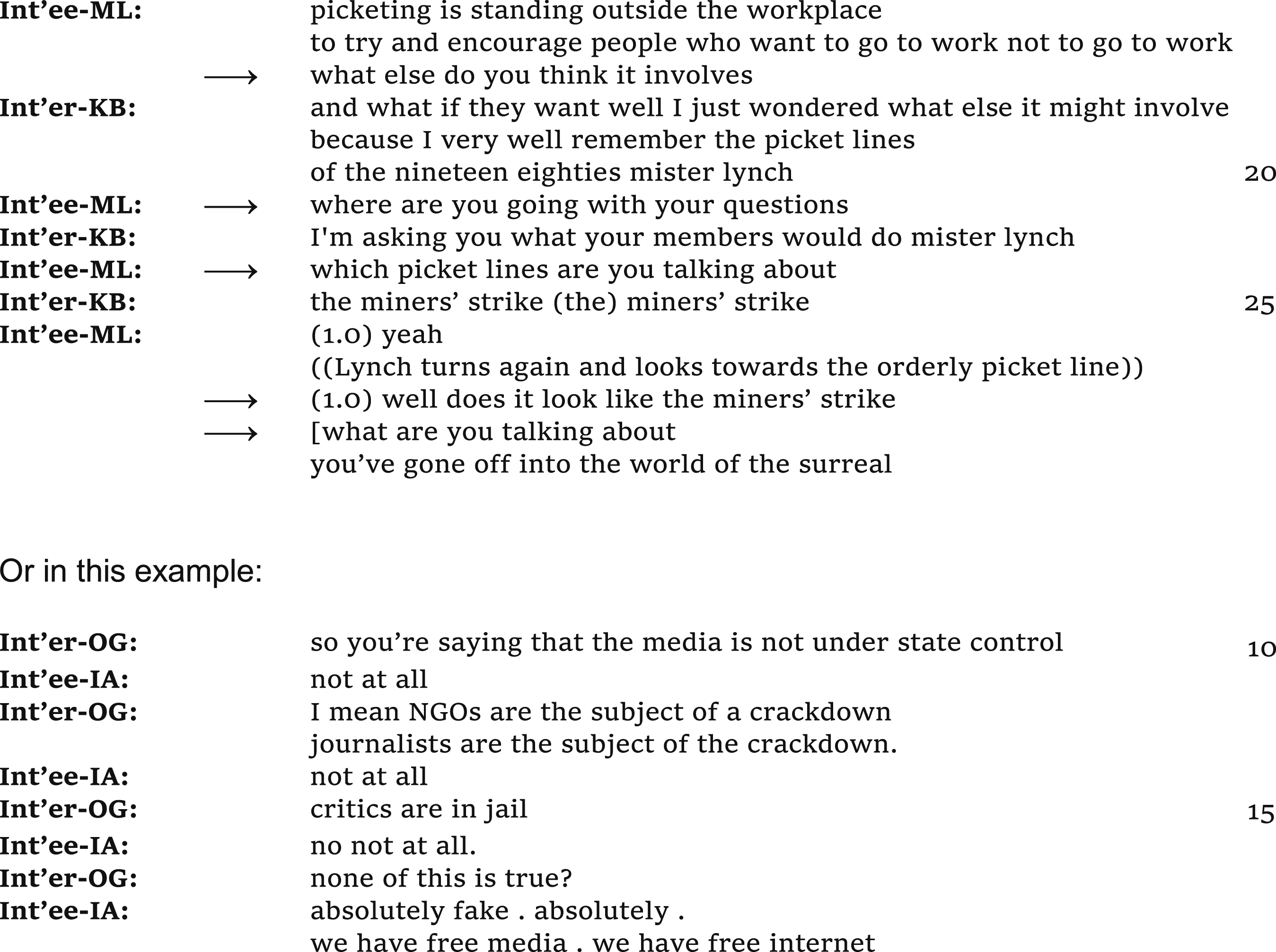
And so we are faced with a curious paradox: that attempts to deliver public accountability in the present time in various ways have become more honoured in the breach than in the observance. Indeed, in the case of the broadcast accountability interview, it might be argued that attempts to flex its normative order so as to close down evasion and achieve accountability are fated to end up like Xeno’s paradox – stretching the format of the interview apparently in the right direction but without ultimately arriving at the infinitely-deferred, desired result. In short, the broadcast interview is evolving in ways not exactly fit for its accountability purpose.
Footnotes
Acknowledgements
I would like to thank Andrew Tolson for his careful comments and insights on an early draft of this article and other members of the Ross Priory International Seminar on Broadcast Talk who responded when it was first delivered.
Declaration of conflicting interests
The author(s) declared no potential conflicts of interest with respect to the research, authorship, and/or publication of this article.
Funding
The author(s) received no financial support for the research, authorship, and/or publication of this article.
