




Abstract
Research suggests that the relationship between journalism and its audience is changing. As online platforms and various organisations participate in the production of information content audience expectations of what constitute news and who produces it is changing. They often seek various resources to meet their information needs, widening the gap between audiences’ and journalists’ perceptions about the role of news. This paper presents findings from a survey of n = 2266 multicultural audiences and n = 196 journalists in Australia to explore this gap. While audiences and journalists were similar in their views about traditional news values such as accuracy and timeliness, gaps emerged in their perceptions of reporting on issues of diversity. Audiences value the importance of diversity in reporting but journalists may consider it as one of the many competing priorities in their practice.
Introduction
In recent years, the role of journalism in mediating the relationship between audiences and information has dramatically changed. As the financial model of professional journalism has shifted towards digital advertising, many organisations have seen a decrease in the time and resources available for reporting activities. As such, journalists now frequently note increased responsibilities, less time for basic reporting tasks, and workforce reductions (Fisher et al., 2024). Simultaneously, the news media have switched to a 24-h cycle of coverage and the rise of digital tools such as social media and audience analytics has seen a renewed focus on audience responsiveness, competitiveness, and interactivity between journalists and the public (Cohen, 2019; Cohen et al., 2019; Hesmondhalgh, 2018).
Events such as the Covid-19 pandemic have also demonstrated how vital news media can be to civic and public health outcomes in culturally and linguistically diverse audiences. Australia’s population is becoming increasingly diverse with half (48%) the population having at least one parent born overseas and one-third (28%) born overseas (Australian Bureau of Statistics, 2021). In light of this, scholarship has focused on the growing culture gap between professional journalism and the audience it seeks to report for and on. Professional journalism in Australia continues to see low participation among residents from culturally diverse and Indigenous Australian backgrounds (McGuinness et al., 2023). And there is evidence to suggest this lack of representativeness may impact on audience perceptions of trust in news (Park et al., 2021).
This gap may result from evolving audience expectations. Contemporary news audiences are increasingly driven by what news means for and to them, and to their groups and communities and the issues they care about, rather than merely being concerned with being informed or fulfilling their civic responsibilities. This trend is particularly pronounced among young audiences (Clark and Marchi, 2017; Notley and Dezuanni, 2022). This emphasises the significance of understanding audiences’ expectations of journalists’ public service roles as well as their perspectives on journalistic functions in broader contexts.
A growing number of researchers are now acknowledging the importance of examining the differences in perceptions of the role of news between journalists and audiences. This study aims to contribute to our understanding of audience perception through a comparative analysis of the disparity in journalists’ and audiences’ perspectives of the values, qualities, and performance of news media and its reporting on diverse audiences and issues. The investigation is based on two surveys of Australian residents and journalists conducted in 2022. This paper will discuss how respondents’ perceptions of news can be explored as a way of conceptualising connectedness between news audiences and news media as a communication resource.
Journalism values and professional identity
There is a longstanding set of professional journalistic norms such as truth, independence, giving voice to the voiceless, and monitoring power (Kovach and Rosenstiel, 2021). Traditionally, journalism has laid claim to professional legitimacy by claiming objectivity, impartiality and balance as foundational ideologies. Lewis, for example, contends that in the twentieth century, ‘journalists fashioned themselves as fact-based, ethical, autonomous, and neutral observers’ (2019: 3). Alamo-Pastrana and Hoynes, after a brief discussion of the history of professional journalism, stated that ‘[t]he foundation of professional journalism – the source of self-confidence among reporters and the roots of public trust in the news – was the commitment to the practice of objective reporting’ (2020: 73). Others have noted verification (Hermida, 2015) and the “wall” between the editorial side of a news organisation and business activities as fundamental norms in journalism (Briggs, 2011; Cornia et al., 2020; DeMasi, 2013). McQuail and Deuze (2020) note five elements in the occupational ideology of journalism: public service, objectivity, autonomy, immediacy and ethics. These traditional values and norms have legitimised journalists as the ‘gatekeepers’ of the news that audiences see, hear and read (Fisher, 2018; Vos et al., 2019). Furthermore, within the news industry itself there is a hierarchy of news (Banjac and Hanusch, 2022; Robertson, 2023), where some forms, such as ‘hard news’ (politics, the economy) are seen as more legitimate than others, the so-called ‘soft news,’ or lifestyle journalism. Other hierarchies include the differences between opinion/commentary and straight news (Robertson, 2023: 386), where straight news is considered to be legitimate. As Robertson has noted, if opinions are included in a news story, it has been viewed as a lesser form of journalism: ‘Among individuals across the political spectrum there is a view that news-ness is diminished when journalists’ opinions are included in stories’ (2023: 386). Boczkowski and Mitchelstein (2013) suggest that due to professional norms, journalists prefer public affairs topics and consider it as the core of their identity. News is produced within this context of journalistic practice, one that is shaped by subject selection, organisation and dissemination according to the professional norms (Pompper and Hoffman, 2021).
However, with the rise of digital and social media, and the increase in content and the audience’s ability to interact with and choose that content, it has been recognised that journalism’s gatekeeping role is diminishing (Fisher, 2018; Vos, 2020). It has also been recognised that forms such as soft news and opinion are becoming increasingly acceptable in the news ecosystem, particularly by audiences but also, tellingly, by major news organisations. As an example, News Corp recently updated its editorial policy to allow journalists to mix news and comment, a move that is in conflict with the Australian Press Council statement of general principle (Muller, 2023). Given the social and commercial pressures on journalism in Australia, it is likely that both journalists’ and audiences’ perceptions of news are changing. The perceptual relationship between journalists and their audience has great potential to influence the communication they produce (Coddington et al., 2021).
Diversity in the news
Another factor that may relate to journalists’ professional identity is the changing demographics of their audience. Over many years, research has shown that Australian newsrooms lack diversity in both content and representation (Arvanitakis et al., 2020; Bahfen and Wake, 2011; Forde, 2005; Hanusch, 2016; Ho, 1990; Phillips, 2011; Phillips and Tapsall, 2007; Rodrigues et al., 2021). Substantial literature on ethno-racial minority representation in the Australian news media (Jakubowicz et al., 1994; Nolan et al., 2011; Phillips, 2009, 2011; Phillips and Tapsall, 2007; Thomas et al., 2019) reveal that the news speaks from a White perspective and to a primarily White audience. They often marginalise ethno-racially diverse individuals by portraying them as deviant, lacking agency, inherently violent and dangerous, or resistant to assimilation—a pattern of framing that Phillips and Tapsall (2007) describe as ‘mad,’ ‘bad,’ ‘sad’ or ‘other’ (p. 15). This paper seeks to ask questions about the degree to which this poor representation may be associated with differing perspectives between audiences and the news media that serve them. Given that news—and particularly locally and ethnically specific news—is related to civic outcomes for migrant communities, there is a need for researchers to explore this in more depth.
There has been a growing attention to diversity in media for the past few years (Hendrickx et al., 2022). Van der Wurff (2011) defines diversity as ‘the heterogeneity of media content on one or more dimensions’ (p. 330), encompassing two aspects in news media: representational diversity involving who we see, read, and hear, and content diversity, involving what we see, read, and hear. Diversity in news has been extensively examined from a production perspective where newsroom personnel are the primary participants (c.f. Alamo-Pastrana and Hoynes, 2020; Aujla-Sidhu, 2020; Budarick, 2017; Lück et al., 2022) but has been neglected from an audience perspective (van der Wurff, 2011). In other research, Shumow and Vigon (2016) analysed news articles from U.S. Spanish-language media outlets, Rodrigues et al. (2021) examined reporting of high-profile events in Australia that had a multicultural component, and Coffey (2013) conducted a content analysis of on-air television personnel to see if it represented the diversity in the community the station served. Phillips and Tapsall (2007) also examined television to see how disadvantaged minority groups were reported on in Australian news and current affairs. However, the research does not demonstrate audience perspectives and, as emphasised by Napoli, it is as important to have a ‘diversity of exposure’ (2011: 246) where there is ‘a focus on the nature of the content and sources actually consumed by media users, as opposed to the traditional emphasis on the diversity of sources and content available to media users’ (2011: 246, emphasis in original). Napoli expands on the value of a broader exposure to news: A common assumption among policymakers and researchers has been that increasing diversity of content promotes diversity of exposure. As audiences have a greater array of sources and content options to choose from, they presumably take advantage of this greater selection and expand their horizons. […] Diversity of ideas and diversity of viewpoints have long been identified as central inputs for achieving an informed citizenry and a well-functioning democracy. (2011: 248)
It is understood that local and ethnic media, for example, play a key role for minority groups: enabling minority producers to deliver content for minority audiences; representing marginalised communities; providing opportunities for participation; creating opportunities for ethnic communities to express cultural and political dialogues; and providing relevant information for diverse communities (Aujla-Sidhu, 2020). In Australia, ethnic community radio maintains diverse cultures and languages, networks and community connections, plays specialist ethnic music, and provides information that is relevant from Australia, their home country and other places internationally (Meadows et al., 2008). However, regardless of how important diverse representation is, what has also been noted is that ‘[s]cholars throughout the Western world have consistently found media representations of ethno-cultural minorities to be problematic’ (Clark, 2014: 2).
An examination of how the Arabic-speaking diaspora in the United Kingdom use different news channels found that a high percentage watch Al-Jazeera, particularly first-generation immigrants. Reasons for this are ‘the quality of the transmission, good programmes, and the daring coverage of hot and current issues in the Arab world, related to freedom of expression, human rights, democracy and the Palestinian struggle’ (Miladi, 2006: 950). However, this study found that the key reason is because the Western news media is seen as inaccurate and biased (Miladi, 2006). In Australian research, Rodrigues and Paradies (2018) found that Australians born overseas tend to rely on unconventional news sources more frequently and trust social media for news slightly more than those born in Australia. Echoing Miladi’s observations, Rodrigues and Paradies (2017) also highlighted that Australians born overseas are turning away from mainstream commercial media outlets due to perceived “bias” in how these outlets cover current national events and topics.
Perception gaps between news producers and consumers
Journalism as a profession has long grappled with the tension between giving audiences ‘what they want’ and ‘what they need.’ On the one hand, newsrooms continue to look to the audience for feedback on the types of news and reporting styles they are most interested in (Christin, 2020; Ferrer-Conill and Tandoc, 2018), and on the other, journalists strive to serve the public through authoritative and neutral reporting of current events (Alamo-Pastrana and Hoynes, 2020; McQuail and Deuze, 2020). The commercial realities of most news production require that journalists produce news that audiences desire to consume, but the occupational ideology of news (McQuail and Deuze, 2020) proposes that the value of news lies in journalists being able to independently intuit what is and isn’t a legitimate news story or important for the audience to know (Tiffen, 1989). The practice of journalism as a kind of beneficent gatekeeping of information extends to the stratification of news topics into ‘hard’ and ‘soft’ categories (Banjac and Hanusch, 2022; Robertson, 2023). But critically, it also lends itself to journalists distancing themselves from their own personal identity in the work; their ethnicity, religious or cultural beliefs, personal connections to their community, etc.
With the advent of digital and social media, and the increase in content and the audience’s ability to interact with and choose that content, it has been recognised that journalism’s gatekeeping role is diminishing (Fisher, 2018; Vos, 2020). As Banjac and Hanusch (2022) suggest, audiences now want access to news that is important to them, rather than passively accepting what they are given. They also want to be able to engage with journalists and express their own opinion, all while being entertained. Vos et al. (2019) also discovered that audiences prefer a higher level of engagement, entertainment, and opinion. In the United States, genres such as political satire are increasingly seen as a news form (Armstrong et al., 2015) and a trusted news source (Edgerly and Vraga, 2020). The notion of objectivity is seen as less important: ‘With the explosion of cable news pundit shows and satirical news shows, and the growth of news analysis in mainstream media, it may follow that consumers do not demand objectivity in news content’ (Armstrong et al., 2015: 94).
The relationship between audiences’ expectations of journalism and journalists’ perceptions of their own performance is an emerging area of study. As Abdenour et al. (2021) show in the U.S. context, there is a disparity between what journalists and audiences expect of news production, with audiences being much more in favour of adversarial role performance such as political agenda setting and challenging government and businesses. This study notes that political ideology, levels of news consumption and education levels are all mediating factors. In Austria, a similar study conducted by Riedl and Eberl (2022) found, in contrast, a consensus between journalists’ and audiences’ views in the relative importance of being a detached observer, providing information for political decision-making, and entertaining in the context of role performance. Some studies have sought to address how diversity and representation are factors considered by both groups. A study of German journalists’ and audiences’ views conducted by Loosen et al. (2020) found that audiences and journalists assigned a similar level of importance to the ‘activist notion of promoting tolerance and cultural diversity’ (p. 1751) as compared with other more normative roles such as being a detached observer. However, what they describe as ‘classic’ journalistic tasks such as providing analysis and ‘reporting things as they are’ were rated the highest in importance by both groups. The authors also found variations in perceived importance by gender, education level and preferred medium for news. As these studies show, there is considerable variation in the gap between journalists’ and audiences’ perceptions of role performance at the country level, as well as between demographic levels within each country.
As multi-country studies such as those conducted by Mellado et al. (2024) show, media systems and professional cultures differ widely from country to country. Mellado’s study of journalistic role performance across 37 countries groups Australia with other liberal media systems such as Ireland, South Korea, and the United States, in that journalists in these markets are less likely to play the loyal-facilitator role in supporting the government and other elites. Hanitzsch et al.’s (2019) study suggests similarly that Australian journalists place a higher emphasis on monitorial roles—including providing political information and monitoring and scrutinising politics—than interventionist roles such as setting the political agenda and influencing public opinion. Studies of Australian news audiences—some of which focus on particular mediums or locations for news (i.e. Hess et al., 2023)—suggest that news audiences generally prefer that journalists remain impartial instead of advocating (Park et al., 2021) and that on social media they should refrain from expressing their opinions (Park et al., 2022). This suggests a preference for normative role performance as opposed to a more interventionist or monitorial role. However as made clear by Hess et al. (2023) and Fisher et al. (2024) this is contingent on geographic and demographic factors as well.
Limited research has addressed both audiences’ and journalists’ perceptions in Australia in the same study. Additionally, few of these studies, with the exception of Loosen et al. (2020) have approached cultural or ethno-racial diversity and representation as a consideration for either journalists or audiences in terms of journalistic role performance.
Studies that have explored the views of journalists and audiences separately have found difference between the two perspectives. Tsfati et al. (2006), for example, found discrepancies between the importance of the value of verification and interpretation (journalists) versus neutrality and public interest (audience). Gil de Zúñiga and Hinsley (2013), conducting similar research in the US, discovered that, for journalists, choosing the story, disseminating information quickly and objectivity were the most important whereas for the audience, objectivity rated last. According to Gil de Zúñiga and Hinsley (2013), while audiences in the US value speed, accuracy and objectivity in news, they are also more likely to perceive journalists as biased and, thus, less trustworthy, less objective, and less accurate. In a similar study, Vos et al. (2019) compared US journalists’ and audiences’ perceptions of journalistic roles and also found significant differences; in 19 out of the 20 role perceptions provided to the participants, from detached observer, provide analysis, scrutinise leaders, influence public opinion, to name a few, the perceived importance was different between the two cohorts. In other words, ‘citizens’ views on journalistic roles do in fact challenge rather than preserve existing notions of journalistic capital’ (Vos et al., 2019). As a side note, journalists are also more positive about their own work than the general public (Gil de Zúñiga and Hinsley, 2013; Vos et al., 2019; Wilnat et al., 2019). While journalists believe they are doing a good job upholding their public service role, audiences consistently rate journalists low on trust. Roy Morgan’s Image of Professions Survey 2021 rated Australian newspaper journalists at 15% and TV reporters at 11% (Roy Morgan, 2021).
Research questions
In light of the changing nature of the relationship between journalism and its audience, this paper asks questions about whether this is influencing of the level of agreement about the performance of journalism, and the perceptual relationship between these two groups. There is a lack of research in an Australian context that compares how journalists and audiences perceive the value of news, and how their perceptions differ. Additionally, differing perceptions of the importance of diversity and representation in journalistic role performance have been understudied.
The aim of this research is to answer the following research questions: RQ1: To what extent is there (in)congruence between audiences and journalist’s perceptions of journalism’s values, qualities, performance? RQ2: To what extent is there (in)congruence between audiences and journalist’s perceptions of diversity?
Methodology
Data collection
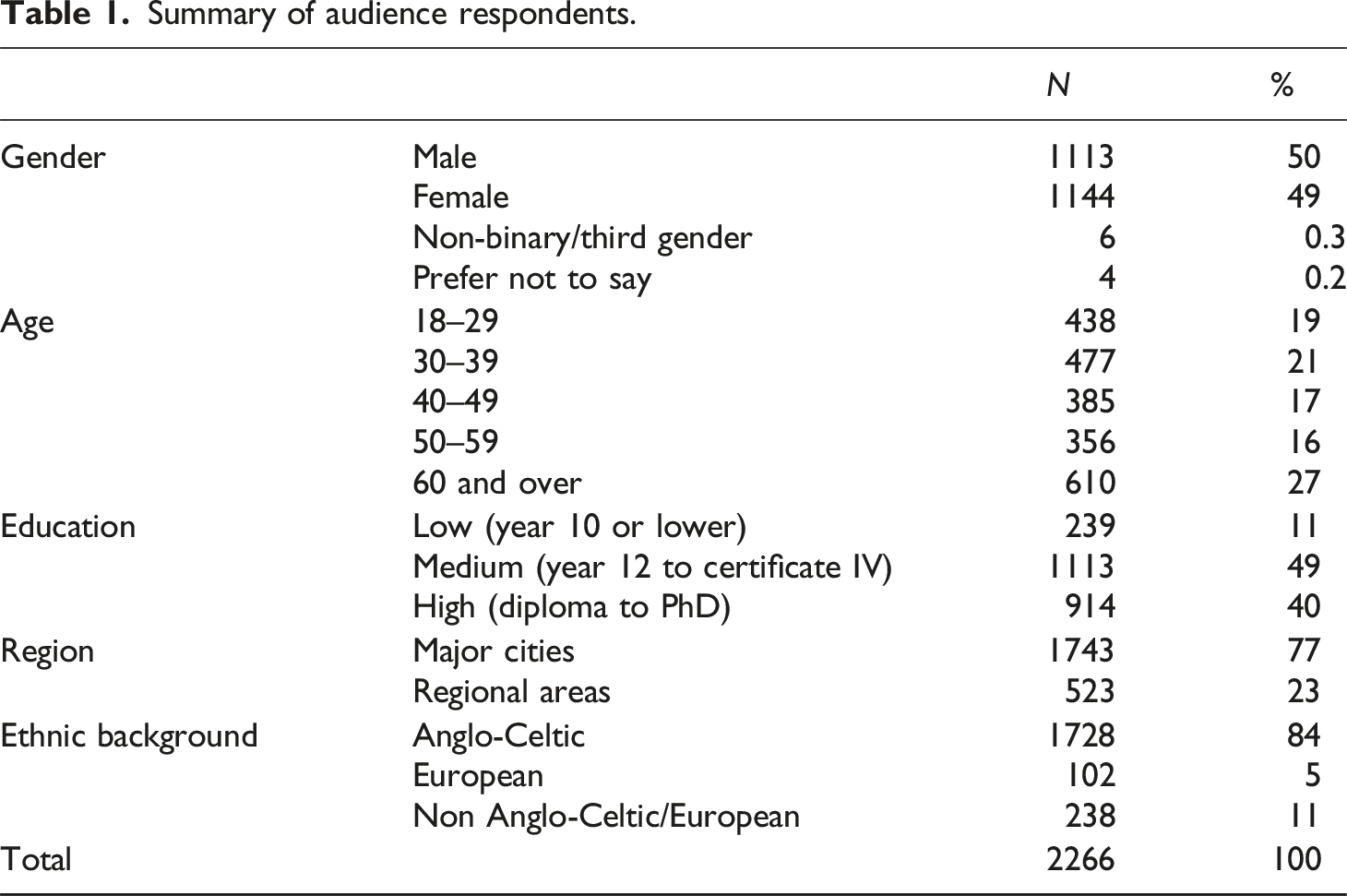
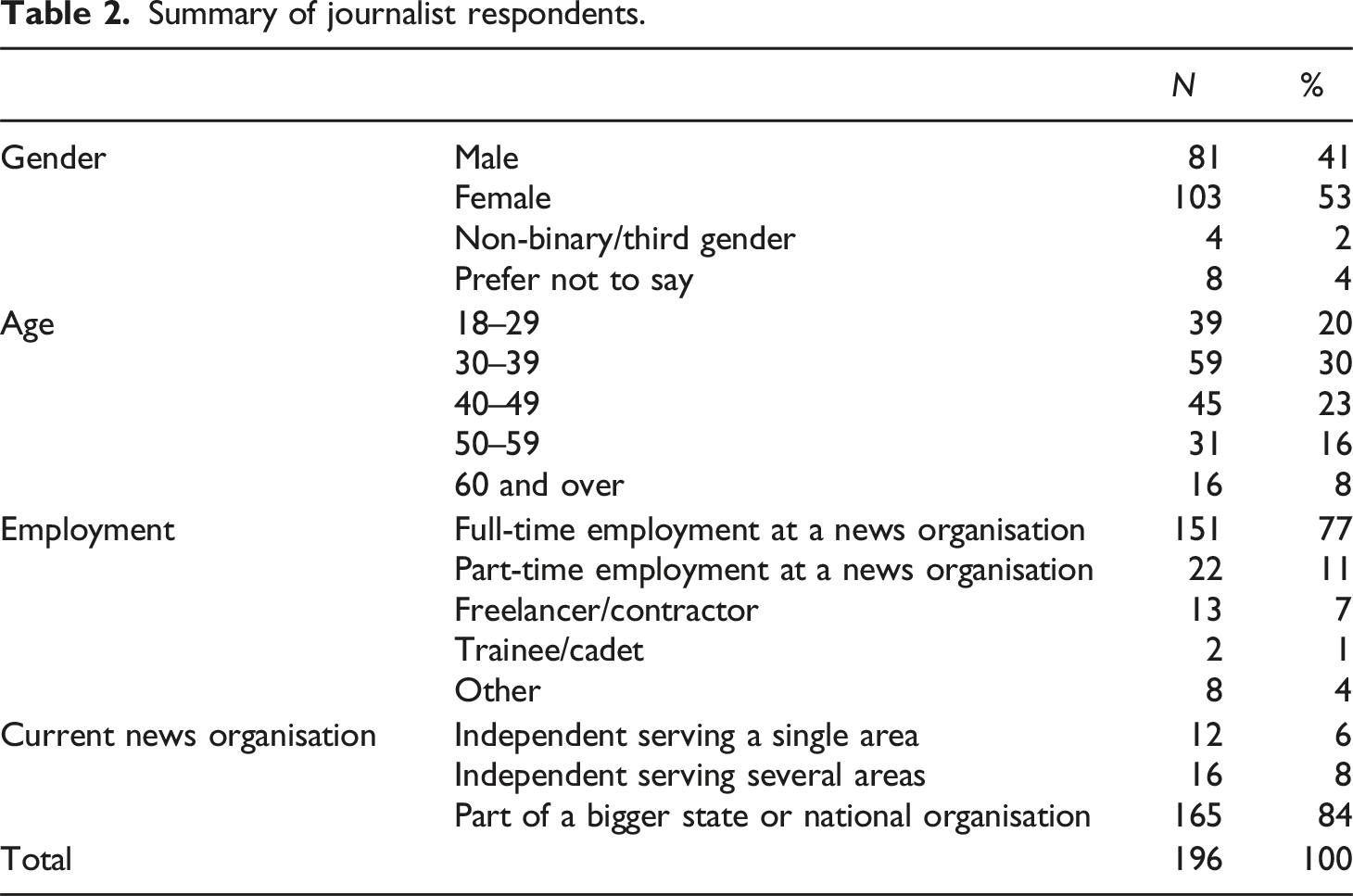
To explore differences in perceptions of news media performance between audiences and journalists, this study used data from two surveys that allow comparison. Online surveys of Australian adults and journalists were conducted between August and September 2022.
Summary of audience respondents.
Summary of journalist respondents.
Variables
In developing the questionnaire and variables for this study we have drawn on existing studies that compare journalists’ and audiences’ views on role performance as well as critical literature that has substantively discussed the representation of ethno-racial minority groups in Australian news media (c.f. Arvanitakis et al., 2020; Jakubowicz et al., 1994; Nolan et al., 2011; Phillips, 2009, 2011; Phillips and Tapsall, 2007; Thomas et al., 2019).
Dependent variable: congruence in journalistic values
The main variable to compare between audiences and journalists is their evaluation of journalistic values. The questions corresponding to this variable are derived from previous research by Pew Research Centre comparing journalists’ and audiences’ views of news role performance in the U.S. context (Gottfried et al., 2022). However, the question battery was modified to better assess perception of performance on diversity related roles, as well as more normative tasks such as ensuring accuracy and covering important stories. We asked respondents to evaluate to what extent most news organisations in Australia do a good or bad job at: reporting the news accurately, covering the most important stories of the day, giving voice to the underrepresented, providing enough coverage relevant to all genders, providing enough coverage relevant to all ethnic groups, reporting on stories fairly based on the gender of those involved, and reporting on stories fairly based on ethnic or cultural background of those involved. The items were measured on a four-point scale: 1 = very bad, 2 = somewhat bad, 3 = somewhat good, 4 = very good. This same set of questions was asked to journalist participants.
Congruence in diversity in news media
We also asked both audience members and journalists to what extent they agree or disagree with the statements about journalistic performance on a range of diversity types including diversity of sexual orientations, diversity of people with disability, indigenous diversity, religious diversity, diverse language groups, diversity from less advantaged backgrounds (i.e. low education/income), diversity from rural or regional areas, age diversity and diversity of nationality/country of origin. The questions corresponding to this variable were derived from work on a pilot study addressing diversity in the context of news production and consumption (Park et al., 2023b). The items were measured on a four-point scale: 1 = very bad, 2 = somewhat bad, 3 = somewhat good, 4 = very good.
Statistical analyses
To examine the gap in perceptions of news media performance between journalists’ views and the audiences’ views, independent sample t-tests were performed.
Findings
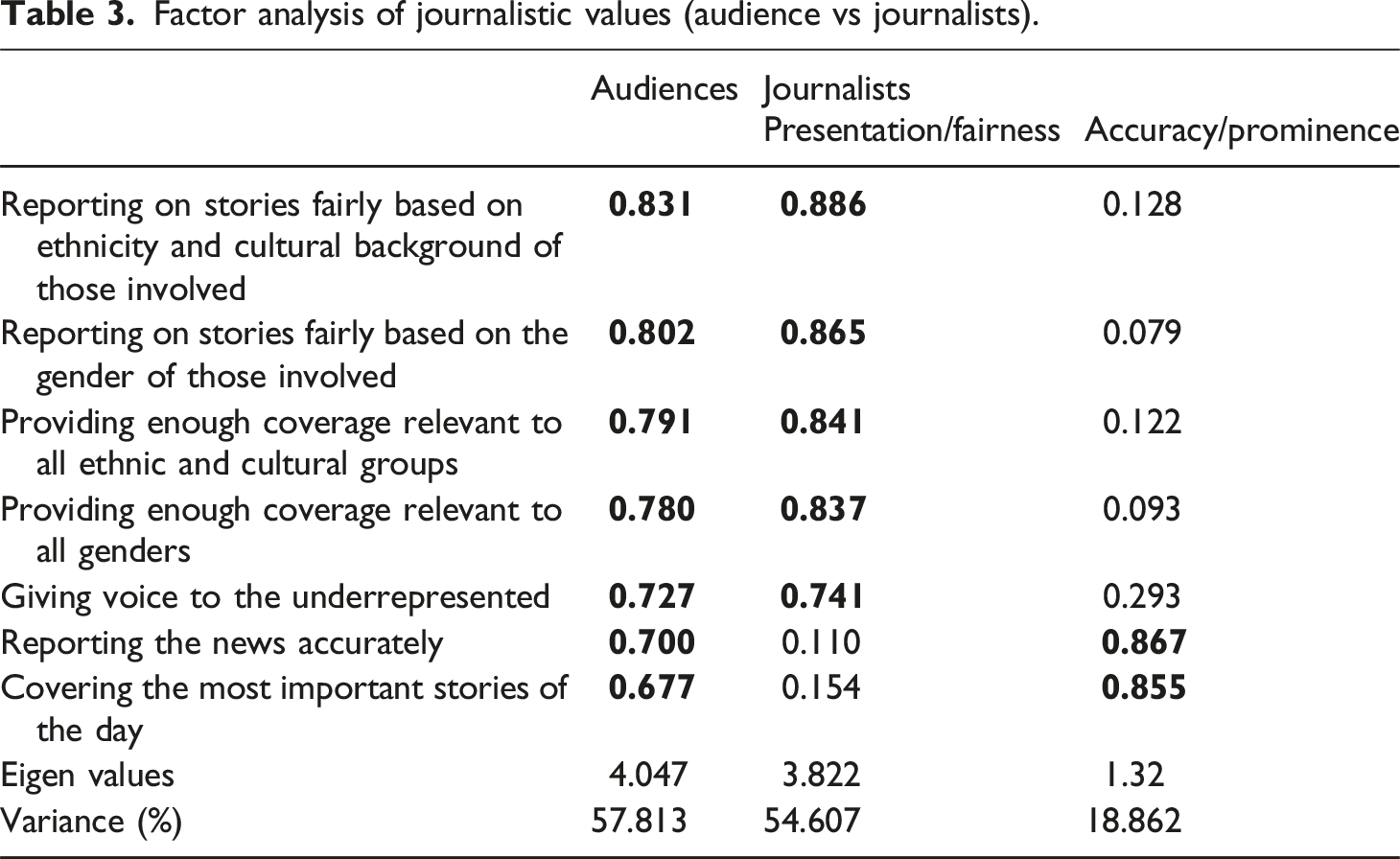
Factor analysis of journalistic values (audience vs journalists).
Gap in the view about news media performance.
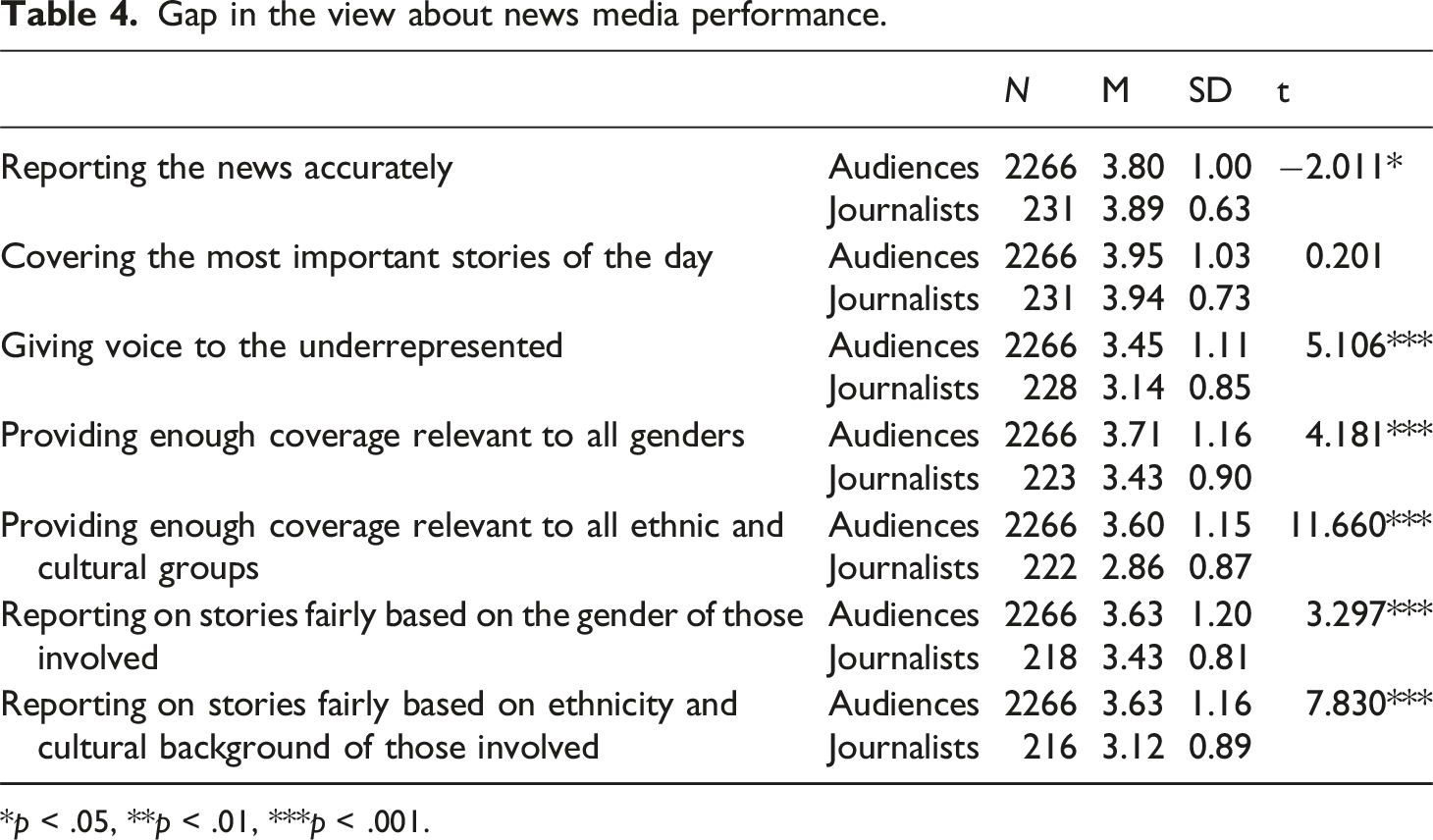
*p < .05, **p < .01, ***p < .001.
Gap in the view about news media diversity.
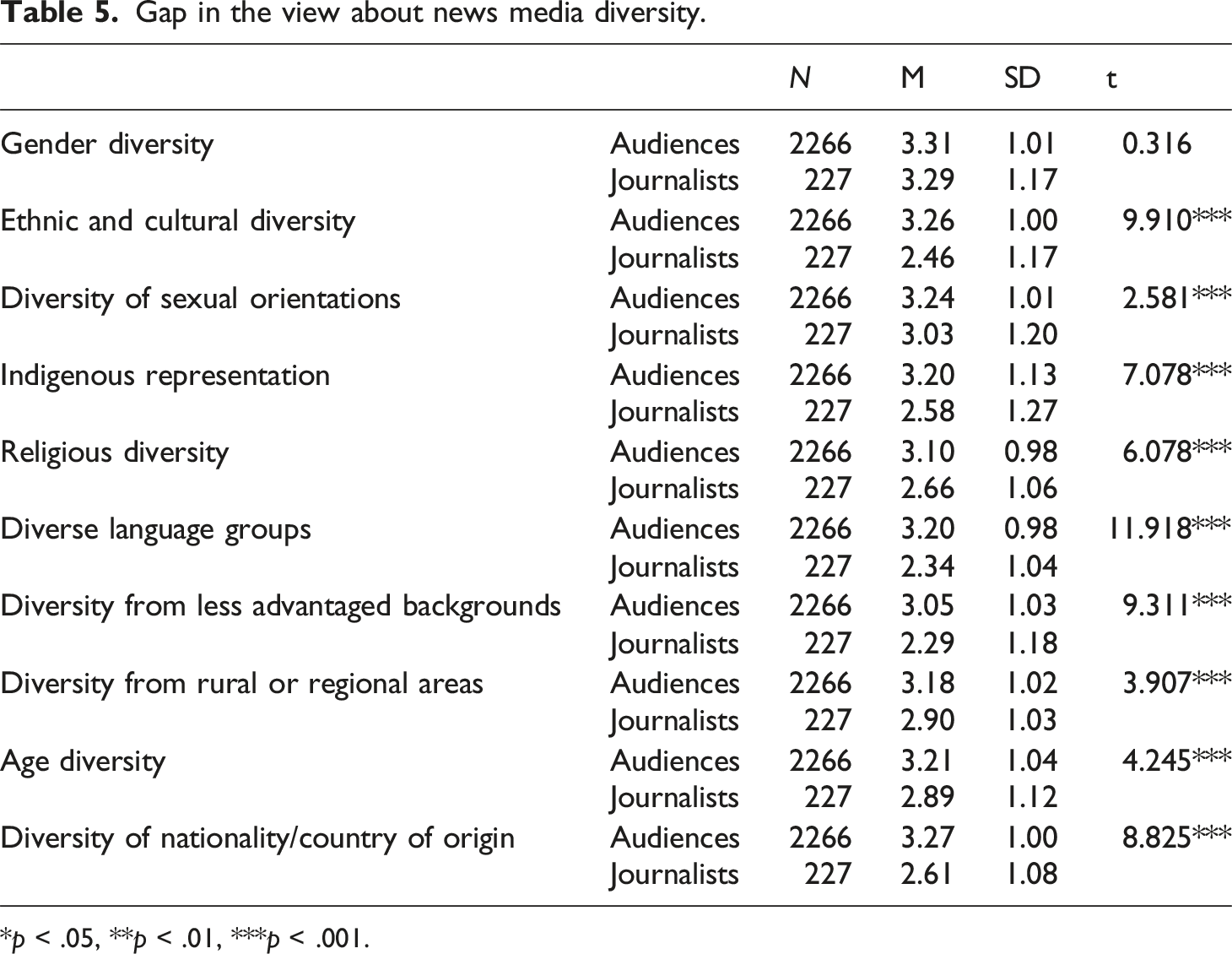
*p < .05, **p < .01, ***p < .001.
Discussion and conclusion
The findings of this study show that the audiences’ perception of news media coverage of diverse groups differs from that of journalists. The data suggest that news audiences express a higher level of agreement towards news media performance than journalists; and that this is evidenced by more positive perceptions of a range of factors. Except for ‘coverage of the most important stories,’ community members expressed more positive views about the performance of news media on all other factors.
Overall, journalists expressed a slightly more nuanced view of the performance of news media when compared to audiences. Audience perceptions of journalistic values across the underlying variables could be unified into a single factor. Journalists, however, differed in their views to the extent to which accuracy/prominence and presentation/fairness resolved into separate factors. These findings are somewhat unsurprising, given research that shows journalists and the public differ in their perception of journalistic roles and functions (Gil de Zúñiga and Hinsley, 2013; Willnat et al., 2019).
Audiences are more likely than journalists to say that news organisations in Australia do a good job of giving voice to the underrepresented, providing adequate coverage relevant to people of different genders, and reporting fairly on those of different genders, ethnic or cultural backgrounds. They are also more likely to rate news media higher in performance on issues relevant to a range of different diverse groups. That audiences are more positive about news media’s performance is surprising given that a range of studies suggest the opposite to be true; that journalists are generally more positive about their performance than audiences (Gil de Zúñiga and Hinsley, 2013; Gottfried et al., 2022; Vos et al., 2019; Willnat et al., 2019). It is worth noting that in this study journalists rated the highest performance score on news prominence, which pertains to covering the most important stories of the day. Audiences similarly rated this aspect as having the highest performance level. This observation is in line with findings from Gottfried et al. (2022), who demonstrate that journalists tend to be more inclined to believe that news organisations excel in covering the most critical stories of the day compared to other dimensions of media performance.
Journalists are more self-reflective in their coverage of diverse audiences as an area that they feel a need to improve. We explored disparities in how audience members and journalists assess news media performance, particularly in relation to coverage of diverse groups. The public consistently assigned notably higher scores than journalists. Significant differences were observed when evaluating the coverage of cultural diversity and diverse language groups, in contrast to other forms of diversity. Journalists assessed their performance notably lower in reporting diverse ethnic and cultural groups in comparison to the evaluations offered by their audiences. However, concerning gender diversity reporting, journalists’ assessments aligned closely with those of the community, reflecting similarly high scores. This implies that while journalists may have room for improvement in their coverage of diverse ethnic and cultural groups, their efforts in reporting on gender diversity are more in line with public expectations.
That journalists and audience members do not see eye-to-eye on the performance of news media is unsurprising to a certain degree. However, it is notable that journalists in this study perceived almost all measures of performance to be lower than audience members did. A prominent exception being coverage of the most important issues, which journalists and audience members generally agreed upon as being quite good. Journalists also appeared to be comparatively critical of their own industry with regard to its coverage of diverse groups, including those from different ethnic or cultural backgrounds, and Indigenous Australians. These gaps in perception were also quite large on many indicators.
It’s possible these diverging views reflect journalists’ predisposition towards independence (McQuail and Deuze, 2020); in particular the attitude that it is not enough to simply give audiences ‘what they want.’ In this regard, perceived lower performance in reporting on diverse issues and groups could be seen as disconnected from journalists’ perceptions of their audience. It is difficult to conclude from the data from this study alone, but it could be the case that on issues of diversity journalists are not satisfied with audience satisfaction alone. This suggests that on diversity journalists are perhaps uniquely disoriented from their audience’s perceptions and beliefs. Or at the very least, they hold themselves to a different standard than the audience.
This interpretation is somewhat reinforced by the data resulting from factor analyses. For audience members there was a good degree of collinearity between perceptions of accuracy in news, coverage of the most important issues, and fair and adequate coverage of different genders and ethnic backgrounds. In other words, audience members appear to possibly conflate both diversity and traditional journalistic performance as both contributing to ‘good journalism.’ Revealingly, however, journalists appeared to treat accuracy and coverage of the most important issues as a separate factor to adequate and fair coverage of different genders and ethnic backgrounds. This data suggests that the journalists we surveyed might treat issues of diversity and representation as separate from traditional professional ideals.
This perceptual gap suggests that for audiences ‘good journalism’ and ‘diverse journalism’ are to a certain degree concomitant. Whereas for journalists ‘good journalism,’ ‘good accuracy and coverage,’ and ‘good diversity,’ are likely separated concerns with their own attendant requirements and goals. This nuanced understanding could lead to potential conflicts in prioritising the separated aspects of diversity when covering certain events and issues, as journalists already do so when gauging the importance of other competing priorities in news coverage (Banjac and Hanusch, 2022; Robertson, 2023; Tiffen, 1989). Diversity therefore represents another competing priority for journalists who, arguably, are at a low point in terms of their capacity to juggle the demands of idealised performance and commercial or material realities (Cohen, 2019; Cohen et al., 2019; Hesmondhalgh, 2018).
But another alternative interpretation of the data is that it partly reflects the effects of those commercial and material realities on diminished morale. In this interpretation, journalists’ perceptions of diversity and journalistic performance overall could be related to widespread dissatisfaction with successive waves of job losses and centralisation (Ricketson et al., 2019; Zion et al., 2022), and the perceived impact this has had on performance. A limitation of this survey is that it asked largely self-report questions about the industry in the abstract, as such it’s difficult to separate out respondents’ views on performance as they relate to industry, organisational, or individual levels. As such, some degree of care is needed in interpreting these findings.
Nevertheless, our findings suggest that journalists and audiences perceive their connectedness to news media in different ways, this has implications for any model of interconnectedness between audiences, media, and communication resources. This study highlights the importance of diversity in news production and consumption as measures of journalistic performance. Australian media is facing criticism for failing to reflect the diversity of the communities they serve and, crucially, the individuals they cover in their reporting (Park et al., 2023a). The representation of diversity by journalists and news media is an increasingly important discourse in Australia, as it is elsewhere.
While the findings provide valuable insights, there are some methodological limitations to consider. We did not specify individual news organisations but instead asked respondents about their general perceptions about most news organisations. We understand that the wording of the question is limited in measuring the audience’s perception, which could differ based on their news repertoires that may include mainstream news media and/or local and hyperlocal news media. This differentiation should be addressed in future studies. In addition, this study did not examine to what extent journalistic performance across a range of diversity types was perceived by audiences from different backgrounds, such as gender, age, and ethnicity, and journalists from different types of media organizations. These should be considered in future investigations.
Footnotes
Declaration of conflicting interests
The author(s) declared no potential conflicts of interest with respect to the research, authorship, and/or publication of this article.
Funding
The author(s) disclosed receipt of the following financial support for the research, authorship, and/or publication of this article: This work was supported by Google News Initiative, Australia.
