




Abstract
In the early 2020s, climate change and environmental challenges became increasingly important issues in the Russian political discourse. This was followed by growing media interest in environmental and climate reporting. This article explores how environmental journalists in Russian media outlets make sense of and discursively frame the environmental agenda. Based on in-depth interviews with environmental journalists working in the Russian media inside the country and in exile, we explore the role of the environmental agenda in a authoritarian regime such as Russia’s. The research reveals the forces shaping the environmental agenda and journalists’ perceptions of it. Drawing on theoretical perspectives on the politicization and depoliticization of the environmental debate, we explain how the prevailing forces shaping the environmental agenda lead to the depoliticization of environmental beats. As a result, some topics are treated as purely scientific problems that do not affect society or the state at large. On the other hand, regional environmental issues that do not affect state security issues allow for freer and more investigative reporting.
Keywords
Introduction
The growing awareness of climate and ecological issues in political discourse affects the visibility of these topics in the media. In late 2019, climate change and environmental challenges became increasingly important issues in Russian political discourse. Even though Russia is highly dependent on fossil-fuel exports, and its leadership had long voiced cynical opinions towards global warming (Martus, 2021), it has now acknowledged that Russia is particularly vulnerable to climate change and that it needs to participate in international efforts to mitigate its impact (Beuerle, 2023).
Consequently, the number of articles covering environmental and climate issues has been increasing over the years in national (Poberezhskaya, 2018b) and regional media outlets (Ermolaeva et al., 2020), in blogs (Poberezhskaya, 2018a), and in social media (Poupin, 2021). Concurrently, there has been increasing activity among high-profile grassroots environmental movements and growing ESG (Environmental, Social, and Governance) reporting among Russian businesses. These and other topics have prompted professional journalists and a wide range of media outlets to engage with the environmental agenda.
Previous research has addressed the process of politicization of the environmental agenda, where media coverage of the issues reflects political interests and opinions (Chinn et al., 2020; Hart and Feldman, 2014). Despite the well-studied dependence of environmental media coverage on political agendas in democracies (Boykoff et al., 2015; Brüggemann, 2017), knowledge of environmental journalism in non-democratic countries beyond the Western world remains insufficient. Nevertheless, evidence shows that authoritarian regimes have different environmental, political and economic needs than democracies, and tend to tightly control public environmental communication (Ashe and Poberezhskaya, 2022). To address this research gap, this article explores the forces and logics that shape environmental journalists 1 in their work in the context of the Russian media model, which is characterized by a high level of state interference and pressure, and the simultaneous commercialization and datafication of newsrooms (Kiriya, 2019; Wijermars and Lehtisaari, 2019). Exploring how media professionals make sense of their work, we study how and why environmental agenda is getting simultaneously politicized in some areas and depoliticized in others.
The article is structured as follows. In the next section, we discuss the “environmental turn” in Russia. We then describe the Russian media model and the role of the environmental agenda within it. In the theoretical part, we introduce the concepts of politicization and depoliticization to build a framework for studying the (de)politicization of the environmental media agenda in authoritarian regimes. Then we describe our research methodology and empirical data. We present the research findings in the results section and conclude the article with a discussion and conclusions.
The “environmental turn” in Russian society
A number of events and developments in Russian society in the late 2010s and early 2020s provide evidence that environmental issues were gaining more attention in the years preceding Russia’s full-scale invasion of Ukraine in February 2022.
First, some of the main civil environmental movements grew substantially, and achieved their goals. The best-known case is the movement that started in 2018 to oppose the construction of a new waste landfill near the town of Shies in the Arkhangelsk region, located in the far north. The proposed landfill was intended to be a waste disposal site for Moscow. The huge grassroots resistance that grew nationwide – even internationally –resulted in a court decision to ban the landfill in 2020 (Gorbacheva, 2023). While there was nothing new in organizing environmental protests in Russia, 2 this and other examples (Bronnikov and Gorbachev, 2020) stand out in that they cleverly used social media to grow in scale and ultimately succeed in influencing political decision-making.
Second, the Russian state has actively highlighted ecological issues during the last few years. At the federal level, 2017 was declared the year of ecology by presidential decree (Kremlin, 2016). The stated goal was to draw attention to environmental problems and improve environmental security. This was followed by the launch of a federal-level ecology project in 2019–2024, initiated by another presidential decree. The project aims to reduce the number of environmentally hazardous dumps, reform waste management, improve air quality, improve water quality in the Volga and other rivers, preserve Lake Baikal and other lakes, preserve forests, and open new nature parks.
Third, environmental premises have been actively discussed in the sphere of Russian business as companies have been actively working to improve their ESG ratings to attract foreign investments (Zhukova, 2021). In 2021, Russia also adopted legislation ‘On limitations of greenhouse gases’ (GHGs), which concerns the reporting of corporate GHG emissions (Pravitel’stvo Rossii, 2021a), duly operationalizing business ecological responsibility.
Finally, as part of the trend of more robust environmental policies, the Russian political discourse on climate change changed dramatically in 2020–2021 (Poberezhskaya, 2021). Until then, climate change had been on the periphery in the Russian public discourse due to authoritarian conditions in the media, politics, economy, and civil society (Poberezhskaya, 2018a). In the early 2020s, the idea of climate change being a serious threat to Russia’s future, and the need for action gained more attention (Gustafson, 2021: 17–24). This shift was particularly evident in the run-up to the UN Climate Change Conference in Glasgow in November 2021, where Russia announced its intention to adopt more ambitious climate targets and published a strategy to reduce greenhouse emissions with the aim of achieving carbon neutrality by 2060 (Pravitel’stvo Rossii, 2021b). The strategy was submitted to the UN Framework Convention on Climate Change in September 2022. However, it leans heavily on the increased absorptive capacity of managed ecosystems rather than on cutting carbon emissions. Moreover, a road map for a concrete plan on how to implement the strategy has still not been introduced.
Previous research shows that changes in Russian climate and environmental policy have directly affected both the manner and the extent of media coverage of climate change (Tynkkynen, 2010). It is to be expected that the recent “environmental turn” in the Russian social and political discourse has also affected environmental reporting in the Russian media.
Environmental journalism in restricted media regimes
Environmental journalism has always been discussed as a distinctive and highly challenging journalistic practice. Historically struggling between journalistic objectivity and environmental advocacy, environmental journalists often aim to mitigate environmental problems rather than simply report them (Tandoc and Takahashi, 2014; Tong, 2017).
The media ecosystem surrounding environmental journalism is changing, with economic conditions becoming more demanding, more communicators joining the debate, and social media changing the affordances of communication (Schäfer and Painter, 2021). Some authors consider environmental journalism as part of knowledge-based journalism, which can help correct the distortions and exaggerations of bloggers and advocates (Nisbet and Fahy, 2015). Still, there is evidence that journalists are still more likely to use official political sources in stories about the environment, while neglecting scientific sources (Figueroa, 2020). Another challenge is the precarious position of environmental journalism compared to other, more widely read professional beats (Tandoc and Takahashi, 2014). Therefore, in addition to rivalry with non-legacy communicators, environmental journalists must find creative solutions for their reports to make it past editors and into the hands of audiences (Gibson et al., 2016).
The extensive and comprehensive studies on media coverage of environmental issues usually concern the democratic countries of the Global North (Schäfer and Painter, 2021), while non-democratic countries, characterized by unfree media, remain under-researched. The most discussed case of autocracies so far is China (De Burgh and Zeng, 2012; Geall, 2018; Tong, 2017). China’s environmental investigative journalism enjoys a higher degree of autonomy than investigative journalism on other topics, such as social and political issues (De Burgh and Zeng, 2012). Yet, there are reporting restrictions, resulting from conventional government propaganda and the public relations strategies of commercial organizations. Consequently, environmental journalists must engage in a so-called ‘balancing act’, reporting on important environmental issues that interest readers, but exercising caution in their reporting (Tong, 2017: 775).
China’s alternative model of environmental governance – authoritarian environmentalism – is used by policymakers to legitimize authoritarian rule and assume global leadership in environmental protection. It impacts how Chinese news media, under tight state control, cover environmental issues and climate change (Guo et al., 2023). Research demonstrates growing official orientation and heavy reliance on government sources and suppressing alternative voices (Guo et al., 2023). Conceptualising the Chinese case as “the authoritarian version of politicized climate change”, authors address the shift in media framing of climate change from crisis with a scientific foundation to “a political goal to achieve for the good of the government’s image” (Guo et al., 2023: 514).
The development of environmental journalism in Russia partly reflects the global trends, as well as the peculiarities of China and other countries with oppressed media regimes. The Russian media have undergone a transition from the liberal media environment of the 1990s to state capture under Putin’s regime, with all major news outlets now owned either directly or indirectly by the state (Kiriya, 2019). The contemporary media model is described as a hybrid, where some elements (e.g., the advertising-based revenue model for many media outlets, private ownership of media capital, news journalism) are imported from the West, while others (e.g., state control over news media, instrumentalization of media for government policy promotion, limited public sphere) are ‘indigenous’ to Russia (Kiriya, 2019). The position of environmental journalism in this media model remains under-researched.
Ashe and Poberezhskaya (2022) note the lack of censorship concerning reporting on anthropogenic climate change, but confirm that the media closely follow the state’s position on the topic. Davydova (2020) argues the same for the environmental agenda: since environmental reporting was until recently considered unimportant and somewhat marginal, it was not subject to any serious administrative pressure or censorship. Media coverage of environmental and climate issues started to change rapidly in the turn of the 2020s, along with the increasing interest of politicians in the environmental agenda (see previous section). Yagodin (2021) mentions that fossil-fuel companies in Russia not only pay taxes to support state-owned media but also own many news outlets, which may influence editorial policies. As such, the position of environmental and climate journalism within the Russian media model is ambiguous. Enjoying comparatively higher freedom in terms of critical coverage of peripheral environmental issues, environmental journalism is becoming more politically engaged and controlled when it comes to Russia’s political agenda, and the work of international and domestic environmental NGOs. Depending on whether framed as political or not, environmental beats may be covered in different ways, shaping the overall environmental agenda of the Russian media.
In the next section we turn to discussing the theoretical perspective of (de)politicization of the environmental agenda.
Politicization and depoliticization of the environmental agenda
The terms politicization and depoliticization have been widely used in political science and sociology to describe the process of bringing issues into the public sphere or removing them from it, usually in the context of a liberal democratic environment. Schmidt-Gleim (2021: 90) defines politicization as “bringing an issue into the public sphere, assembling citizens and bringing antagonisms to the fore”, while Wiesner (2021) defines it broadly as the act of marking or naming something as political. For Hay (2007: 81), politicization means the movement of issues from the non-political arena of “fate and necessity” to the political arena of “deliberation and contingency”, where “action and change are possible”. Hay (2007: 77) leans towards a definition of politics as “the capacity for agency and deliberation in situations of genuine collective and social choice”. Drawing on these definitions, politicization happens when ordinary people engage in decision-making.
Rancière (1997) argues that civil rights movements, such as the widespread environmental movement, have politicized issues since the late 1960s by making them the subject of popular discussion. Thus, politicization was a means of furthering democratization. He further states that, along with the end of the Cold War, the 1990s saw the beginning of a period of depoliticization, of ‘post-politics’, where people are indifferent towards politics. Depoliticization means the denial of political choice, delegating decision-making to experts, and disengaging the public from politics, the “narrowing of the boundaries of democratic policies” (Flinders and Wood 2014: 135). As citizens became passive, governments and elites started to represent business interests and technocracy (Crouch, 2004: 4). Wiesner (2021: 22) describes depoliticization as “taking away or hiding the controversialness, excluding possible actors and denouncing the fact that something is political”. Thus, depoliticization refers to the process of removing an issue from the public sphere and making it a matter of technical or administrative decision-making, where citizens have little or no influence.
Politicization has traditionally been discussed in the context of democratic institutions, but recent debates have looked at a new phase where public participation in politics is again increasing, leading to protest movements that seek to overthrow democracy itself (Schmidt-Gleim, 2021). This wave of repoliticization has shown that politicization does not necessarily go hand in hand with democracy.
How can journalists contribute to the (de)politicization of environmental issues? The public learns about societally significant scientific issues largely through traditional news reporting. Journalists can bring environmental concerns into the public sphere, or they can remove them from it, duly shaping environmental decision-making. Framing also matters: by contextualizing and critically evaluating expert knowledge, environmental journalists can encourage public discussion that connects deeply rooted ideological differences and foster the exploration of a wider range of policy choices and technological solutions (Nisbet and Fahy, 2015).
Since environmental journalism was formed in the 1960s, it has dealt with contentious issues where facts are disputed, expert opinions are questioned, and uncertainty is increased, which makes it a pioneer for a ‘post-truth’ or ‘post-fact’ era (Fahy 2018). According to Chinn et al. (2020), the main journalistic norms that contribute to politicized coverage are personalization, dramatization, and conflict. Following the interpretation that the inclusion of political figures in climate change news suggests that the issue is politicized, they note that in the US media, climate coverage became increasingly controversial and politicized toward the end of the 2010s. This implies that political figures are now highlighted more frequently, while scientific experts are less prominent, which could weaken the public’s determination to tackle climate change. Molder and Calice (2023) suggest that decreased media attention of wildfires and hurricanes in U.S. news coverage may lead to reduced support in climate policy action. Substantial targeting of politicians, partisans and country actors in Twitter has been seen as evidence of high level of politicization of climate change (Chen et al., 2023).
Politicization of environmental agenda in authoritarian regimes differs from the respective process in democracies. The same feature of politicization, for instance, personalisation instead of intensifying public debates on the issue as in democracies (Chinn et al., 2020), decreases available public voice and follows to the depoliticization of the topic (Guo et al., 2023). Moreover, climate change coverage in Chinese media serve to reinforce the legitimacy of authoritarian governance and to enhance the image of top leadership, rather than motivate citizens and stakeholders to engage in environmental actions (Guo et al., 2023). (De)politicization of environmental journalism has not been studied in the Russian context so far, but the research of science journalists covering COVID-19 pandemic revealed evidence of politicization of reporting when even journalists working for state-owned media were not prone to promote pro-state narratives directly (Litvinenko et al., 2022).
Below we further explore the (de)politicization of the environmental agenda in Russian media.
Methodology and data
We conducted 18 semi-structured in-depth interviews with journalists engaging with the environmental and climate agenda, working either currently or previously (before February 2022) in Russian media outlets. Respondents were enlisted using a snowball sampling technique to identify the type of media orientation (pro-state, oppositional), ownership structure (state-owned and commercial), and niches in environmental journalism (Davydova 2020). The represented media include 4 business media, 4 opposition media, 3 state-owned news agencies and newspapers, 2 niche online media, 2 freelancers for various media, 1 commercial news agency, 1 regional newspaper and NGO, and 1 pro-state newspaper.
We conducted the interviews online via Zoom and Telegram in Russian, and the recordings were transcribed. The interview guide included the following themes: role of environmental agenda in the newsroom, practices and routines of journalistic work, political aspects of the environmental agenda, and respondents’ personal attitude to environmental and climate issues.
The semi-structured nature of the interviews allowed for a degree of flexibility, to expand on the interviewees’ responses and raise issues specific to their work. Interviews lasted between 49 and 165 min, with the average being 81 and the median 70 min. The first 16 interviews were conducted between January and April 2022, and the last two in May and June 2023. Many respondents wished to remain anonymous. To guarantee anonymity, we do not publish the names of the media the respondents worked for. For the same reason, the transcripts are not publicly available.
The goal of the analysis was to identify the key themes in the responses. To achieve this, we employed the multistep approach developed by Kvale (1996). First, we carefully read each interview to get a sense of its depth and comprehensiveness, noting important topics contained therein. We then determined condensed meaning units with respect to the respondents’ perspectives and viewpoints. We identified connections and patterns in the meaning units across the conversations to identify the dominant themes in the respondents’ narratives. Finally, the essential themes were tied together into descriptive statements to inform our understanding of the politicization of the environmental agenda in the Russian media.
Results
Environmental journalism in Russian newsrooms
According to our respondents, environmental reporting became inevitable for newsrooms in recent years. One respondent described the launch of a new media outlet: “They [the project creators] immediately realized that there would be a separate ‘Ecology’ section, as it’s not possible to create a new media in 2021 without it” (R5, commercial online media). At least three factors motivated the recent rapid proliferation of environmental journalism in newsrooms.
First, journalists working for business media or in economic departments mentioned political and business activities that fuelled the newsworthiness of the environmental and climate agenda. These arguments stress out the significant role of the “green” investments and policies (e.g., the EU’s Carbon Border Adjustment Mechanism, CBAM) in pushing environmental and climate agenda to Russian business and politics: And that’s why it’s also some kind of cancel culture on the part of investment funds that have started to take their money out of ecologically unfriendly projects. On the other hand, the CBAM has made the climate agenda particularly relevant. If people used to look at Greta Thunberg’s statements out of interest, out of cultural or social curiosity, that changed when the climate agenda started to be expressed in terms of money… (R5, commercial online media)
Second factor – public calls – were considered as less influential and related mainly to the upper middle class posing questions regarding the quality of life (air quality, waste sorting, etc.). Respondents explained this by the fact that most of the Russian population still has low living standards, which makes social issues (healthcare, education, consumer prices, etc.) more urgent.
The third factor is related to the peculiarities of the journalistic profession in Russia. The rapid growth in environmental issues in newsrooms contributed to the involvement of new professionals in this type of journalism. In our sample, approximately half of our respondents started to work on the topic within the last 2 years. They came mainly from a socio-political or business reporting background and described their path to environmental journalism as accidental. Having no personal interest or activism background (contrary to the group of “long-term” environmental journalists), they covered such issues as oil spills or environmental protests and soon found themselves caught up in the beats. Their motivation stemmed from the image of environmental journalism as a niche where more independent reporting was possible, even during the invasion of Ukraine. The feeling of greater freedom served as a driving force for professionals to cover these beats, rather than an innate interest in environmental issues per se.
Journalistic perception of environmental agenda under external and internal pressures
The matrix of environmental topics.
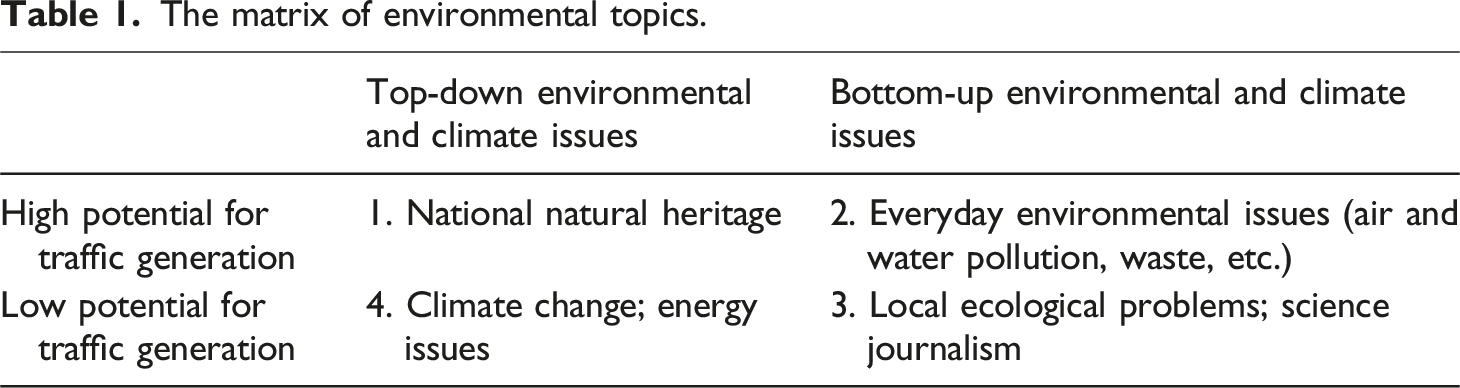
The If a text is about Baikal, it is likely to be significant for everyone, as Baikal is a part of the heritage of every Russian and every person in the world. Everyone is interested in what’s happening to Baikal, and whether it will remain beautiful and clean. […] The Volga touches everyone’s interests in one way or another. There’s a cultural code in our heads that the Volga is the mother of all rivers. Writing about the fact that it has turned into a chain of lakes and is dying is very readable and comes across at once. (R13, pro-state newspaper and online media)
Although national natural heritage sites enjoy popularity among readers, they are too sensitive a topic to allow their environmental problems to be freely addressed, especially when international organizations are involved. One respondent talked about a story they had written about a visit by a UNESCO delegation to Baikal to assess whether the lake was being properly protected, but the newsroom chose not to publish the story: I made the usual selection of experts and reviewed the event, but it was not even taken up on the website. […] Why not? Maybe because in Russia, you can’t write that there’s something wrong with Baikal? (R6, state-owned news agency)
The importance for statecraft and often symbolic load of these topics lead to their depoliticization in media coverage. The journalists discuss them as important to be covered but do not consider they have professional freedom to provide opinions or voices significantly different from top-down official narratives.
The And every time I wrote about this, the next day there were articles in Telegram channels and media outlets claiming that I, and the media I represent, are corrupt. […] Every time I write about these plants, the company calls my editor and does everything it can to persuade them not to write about it, which makes me fear that there will be some problems for me. (R3, online and newspaper business media)
Importantly, despite pressure and threats, journalists continue to cover and investigate the topics in this quadrant. As in China, where environmental reporting enjoys higher autonomy than social or political beats (De Burgh and Zeng, 2012), everyday environmental issues in Russia are one of the few spheres where journalists feel that they have the professional agency and freedom to report critically on problems. The criticism is usually directed at regional and local authorities and companies – an accepted level of criticism within the Russian media model that does not challenge the status quo of the regime in general (Schimpfossl and Yablokov, 2014).
The
These topics have potential to become very politicized as with Shies waste landfill construction, when local protests became an environmental movement on a national scale (Chmel et al., 2020), or remain depoliticized topics interesting for a small group of local people.
Science journalism on environmental issues also falls into this quadrant, as it only attracts niche readers. ‘Science journalism’ in this context does not encompass all popularization of science, but refers instead to reporting on scientific advances in areas that cannot be detached from the scientific realm, and that will therefore be unlikely to be of interest or even understandable to most readers. For instance, respondents often found it challenging to find newsworthiness in climate change topics to make the beat interesting for a wider audience: A topic that’s not very interesting – some scientific things related to climate. These are very complicated scientific studies. I can’t imagine how to present them to readers. There are dozens of scenarios with different probabilities, and scientists have reservations after every word about whether things are ‘possible’, ‘probable’, or ‘can be’. […] So, this isn’t a topic that’s journalistically interesting. (R7, commercial news agency)
Given growing governmental attempts to take control over science communication in Russia (Borissova and Malkov, 2020), science journalism either transforms from a soft news beat to one that deals with highly politicized events (Borissova Saleh, 2024) or is getting even more depoliticized and detached from public discussions or debates.
The Well, I see it through the way these articles [on climate change] are read and discussed. For instance, my editor wants us to write more about the climate. He loves this topic. But I can see by the articles that are read to the end, by the number of people who read them, that people neither understand climate nor any of the problems in this sphere. I have a feeling that when the [international] climate debate started, Russia was not ready for it, because people are still not even ready to sort their waste. (R3, business media)
Energy issues tend to work in a top-down fashion, because the transition to renewable energy sources is considered important. However, as one respondent noted, this has not led to the public being interested in it, due to the complexity of the energy sector. Another noted: It seems to me that the attitude towards this topic [of energy transition] is that there’s a general feeling that it’s something so unreal and distant from us that it’s very naive to even talk about it. (R2, opposition online media)
Finally, there is a belief that the transition to ‘green energy’ is a Western collusion against Russia, whose economy depends on the export of fossil fuels and would be severely affected by increasing prevalence of renewable energy. This anti-Russian conspiracy theory is significant both societally and politically because it is widespread in Russia and visible from public opinion polls to the Kremlin’s statements (Korppoo, 2022). The respondent mentioned this as a reason why the audience might not be interested in energy transition: I think this is a very political issue in Russia. It seems to me […] that the plans to switch to a green economy in Russia have been perceived as intrigue or collusion against Russia, rather than as an opportunity for the country to create its own internal green economy. (R12, regional newspaper and NGO)
Topics in this quadrant tend to be depoliticized because of the lack of the public request for these discussions. It means that as in quadrant 1, journalists cover the issues following the official discourse but are not interested to dig deeper into them due to low audience interest.
The future of environmental journalism in Russia
Russia’s invasion of Ukraine marked the beginning of a new form of media regime in Russia. During the interviews we conducted within 2 months of the invasion, respondents expressed confusion and the lack of a vision about their future work. A common theme was the possible decrease in environmental issues in the political and business discourse and the consequent winding down of environmental media projects and newsroom initiatives. One respondent from a niche media suggested that the environment “will be second or even more likely third [on the media agenda]. Because … the very first will be political justification for what is happening, and the second will be the social well-being of citizens”. According to this respondent, under the current political and economic circumstances, the environmental agenda will become even more marginal as people will mainly be interested in problems of survival.
Another change addressed was the further depoliticization of the environmental agenda and the rotation of many topics to the third quadrant of the matrix as niche scientific affairs. Along with further tightening of control over the media and the impossibility of expressing any criticism, environmental news will become more decontextualized and irrelevant to the audience.
Depoliticization also serves as a safe strategy for journalists who want to remain in the profession. A respondent from а pro-state media touched on their own distancing from political issues in ecology, stating: “… serious restrictions on political journalism in the country. This is my self-censorship, based on my understanding of what is happening” (R13).
Others were more optimistic and ready to take the risk, which suggests that the environmental agenda still provides space for critical reporting: To be honest, I don’t expect any criminal charges for working for X, because I don’t think the environmental agenda to date is such a sensitive topic that the authorities will imprison people for it. They’ll prohibit, block, and stigmatize now for sure, but imprisonment for reporting on a major oil spill or the threat to the Zaporizhzhia nuclear plant – I don’t think we’ve reached that point yet. (R18, niche environmental media)
The massive exodus of media outlets and professionals, and the emergence of a community of Russian journalists in exile, will also affect environmental reporting. Exile journalism differs from ‘normative journalism’ in terms of financing sources, journalistic practices, and the understanding of professional roles and goals (Badran, 2020; Cook, 2016). Most Russian media in exile focus on coverage of the Russo-Ukrainian war and its consequences. However, they focus more on the social consequences and political causes of the war, while environmental issues are less visible on their agenda.
Discussion and conclusions: (De)politicization of the environmental agenda in Russia
Environmental journalism is globally characterised by strong politicization of the beats when the growth in journalistic coverage is triggered by political events rather than events related to environmental disasters or the consequences of climate change (Brüggemann, 2017). Developing further the emerging discussion on the politicization of environmental and climate debates in authoritarianism (Guo et al., 2023), our research demonstrates how two driving forces – industrial pressure and political pressure – influence journalists’ perceptions of the formation of the environmental agenda in the media. Journalists navigate between these two forces, selecting items to report on. Industrial pressure, manifested in a metrics-driven culture and platformization of the media, influences how Russian environmental journalists prioritize topics they consider potentially interesting and readable by users. It affects the selection of topics, for instance when journalists deprioritize energy issues or the consequences of the climate crisis because they do not know how to connect the beat with the needs or interests of ordinary people.
Political pressure shapes the way journalists make sense of the significance of the topic, depending on its visibility in official public discourse. Navigating the rules of the Russian media model, environmental journalists, despite having greater autonomy than other specialist reporters, must closely follow the state’s position on the topics (Ashe and Poberezhskaya, 2022). As such, being voiced by state officials, the topics gain visibility in the media since journalists incorporate them into the agenda.
The Russian journalistic culture, characterized by significant restrictions on journalistic freedom and self-censorship, leads to another layer of distortion of the agenda – the depoliticization of some topics and the simultaneous politicization of others. This research revealed that, for journalists, the most controversial topics, where they feel they have the agency to drive the discussion forward through investigative reporting or by giving a voice to different actors, lie in spheres that are not prioritized by the federal authorities. These are mainly internal environmental issues (quadrant 2 of the matrix). Journalists consider these issues as most ‘alive’, as they offer the possibility of expressing different opinions and positions, but also of as influencing the policymaking process through media coverage. We regard this process as politicization, which we understand as the process of bringing a topic into the public debate for consensus-building (Schmidt-Gleim, 2021). Within this sphere, journalists feel that “action and change is possible” (Hay, 2007: 81) and that they have agency and can criticize even sensitive topics, such as the construction of new waste incinerations plants.
Politicization of certain topics is also supported by the journalists’ perception of environmental journalism as a “safer” space compared to other beats. There is a long tradition of environmental or eco-activism and citizen mobilization during the late Soviet (Dawson, 1996), post-Soviet (Henry, 2011), and current period in Russia (Tulaeva and Nemirovskaya, 2024). This legacy contributes to the tradition of acceptable criticism for certain topics, which discursively constructs the perception of environmental issues as more open for public and media discussions.
Issues on the top-down political agenda (quadrants 1 & 4) are being depoliticized by journalists. Topics such as climate change, energy issues, and natural heritage are used by politicians at the federal level as a part of national statecraft and framed as national security issues (Martus, 2021). As such, any criticism or alternative positions would be seen as criticism of the regime, which narrows “the boundaries of democratic policies” (Flinders and Wood, 2014: 135). As a result, journalists tend to see these topics as ‘non-political’ – not as issues to be debated by “bringing antagonisms to the fore” (Schmidt-Gleim, 2021: 90), but ones whose controversialness should be hidden (Wiesner, 2021: 22). Evidence of their depoliticized character is that within newsrooms, energy issues are often covered by economic or financial departments, while climate issues fall under the science journalism section, as many of our respondents mentioned.
Moreover, depoliticization of the environmental agenda is part of the coping strategy of environmental journalists under the current circumstances of tough repressions regarding the media sphere in today’s Russia. Removal of the political character of the beat and exclusion of any controversialness that would require public discussion help environmental journalists to cover issues without the risk of being perceived as political actors or critics. Many journalists, especially those who continue working in Russia (and not in exile), tend to cover environmental issues as scientific issues rather than political ones.
This study investigates how environmental journalists make sense of their work and agenda-setting. However, their evidence and reflections might differ from what they do in practice. That would need a separate study concentrating on content analysis, which has not been the focus of the current study. Future research should focus on analysing media materials to determine how journalists’ perceptions of the environmental agenda and its formation impact journalistic news reporting and how (de)politicization of environmental issues is visible in actual media content.
Footnotes
Declaration of conflicting interests
The author(s) declared no potential conflicts of interest with respect to the research, authorship, and/or publication of this article.
Funding
The author(s) disclosed receipt of the following financial support for the research, authorship, and/or publication of this article: This work is part of the research project “FLOWISION: Best from both worlds – enhancing energy transition in Russia and Finland by making resource flows visible”, which is supported by the Kone Foundation.
