



Abstract
Improvements in the quality of news portrayals of mental illness and suicide can be attributed to the introduction of media guidelines, particularly the Mindframe guidelines in Australia. However, based on reports about problematic media content, there remains scope for improvement. This study sought to further investigate the experiences of Australian news media professionals in reporting on mental illness and suicide, including their experiences of using the Mindframe guidelines and developing news stories about people with lived experience. We conducted semi-structured interviews with 12 media professionals, including junior reporters, senior reporters, and news editors. Media professionals had an average of 10.1 years’ (SD = 9.4) experience and represented a range of work experiences. Three key themes were generated from participant responses about their experiences reporting on mental illness and suicide: 1. Awareness of responsible reporting guidelines and how to proactively increase this; 2. Newsroom processes, values and subjectivity in applying guidelines; and 3. The importance and challenge in sharing lived experience stories, and improving support for covering these stories. Further resources and education are needed across newsrooms and universities to increase awareness and use of the Mindframe guidelines, and ultimately improve the quality of Australian media portrayals of mental illness and suicide. Editors and managers should be targeted with this training to best influence organisational change. Media professionals require additional preparation and support to develop lived experience stories, particularly in working with people bereaved by suicide to ensure this is a safe engagement for both parties.
Background
Media guidelines aim to improve the quality of news portrayals
Safe and responsible media coverage of mental illness and suicide is important to ensure it does not perpetuate stigma and promote suicide contagion (Niederkrotenthaler et al., 2020; Ross et al., 2019). To encourage portrayals that are responsible and promote public understanding, media guidelines have been developed in numerous countries worldwide that describe how to safely report on mental illness and suicide in the media. Overall, the guidelines have been found to effectively influence media portrayals (Maiorano et al., 2017). Implemented through training for media professionals and journalism students, Australia’s Mindframe guidelines have been found to significantly improve the quality of news portrayals of suicide to be more consistent with the guidelines (Pirkis et al., 2009). Similar improvements have also been observed in New Zealand, Canada, England, Ireland, Austria, and Switzerland following the introduction of media guidelines and other anti-stigma initiatives, where analyses of news reports revealed overall improvements in the quality (in terms of better alignment with media guidelines) of portrayals of mental illness and suicide (Hildersley et al., 2020; Maiorano et al., 2017; Rhydderch et al., 2016; Whitley and Wang, 2017).
In Australia, the StigmaWatch program run by the mental health NGO SANE uses the Mindframe guidelines for responsible reporting on suicide and mental ill-health (Everymind, 2020) to monitor and respond to harmful, inaccurate or stigmatising media coverage. The StigmaWatch program was established by SANE in 1997 to receive and directly respond to reports of media coverage that does not align with the Mindframe guidelines (SANE, 2024). Despite improvements in the overall quality of Australian news portrayals of mental illness and suicide, 700 reports of media coverage that were not aligned with media guidelines were reported to StigmaWatch over a 5-year period (Ross et al., 2023a). Most commonly these concerned problematic coverage of suicide, with the method or location included, use of sensationalist, trivialising or stigmatising language, helpline information not included, and mental illness causally linked to violence. These reports were actioned by the StigmaWatch team, who contacted the respective journalists and news editors with recommended content adaptations. This resulted in less than half (44.3%, n = 310) of the problematic media items modified to align with Mindframe guidance (Ross et al., 2023a). Little is known about the reasons for newsroom decisions not to make modifications following contact from StigmaWatch, with modification requests with negative outcomes receiving no response or a refusal to make the requested modification due to lack of agreement with the request.
News professionals’ experiences of using the guidelines
Despite the Mindframe guidelines being a regulatory tool (rather than enforceable), research demonstrates that media professionals understand the importance of reporting on these topics in a sensitive and safe way (Holland, 2018; O’ Brien, 2021; Ross et al., 2022; Skehan, 2019). Most news organisations have adopted Mindframe’s guidance into their own publication policies (Skehan et al., 2020) and the guidelines for reporting on suicide have also been incorporated into the Australian Press Council’s Advisory Guidelines (2024), which are binding to member organisations. In research interviews, media professionals expressed their beliefs in the importance of the community learning about suicide through the media, which can increase awareness and understanding of the extent of such issues (Skehan, 2019). Media professionals also reported having a responsibility to educate the community on important public health issues (Skehan, 2019). Samples of Australian media professionals have expressed positive attitudes towards having guidelines to support responsible portrayals (Ross et al., 2022; Skehan, 2019), with survey findings emphasising that their views align with most of the guideline statements (Skehan, 2019). This could be partly attributed to the extensive reach of Mindframe training, which has been incorporated into university curricula to encourage responsible early habits and the adoption of important social values to inform their reporting on suicide and mental illness (Skehan et al., 2009).
The practical realities and professional news values that can constrain media reporting are also a key influence on the uptake of media guidelines. News stories about suicide and mental illness are often considered to be of high public interest and “newsworthy”. Newsroom culture influences how these stories are framed (Pirkis et al., 2009; Ross et al., 2022), with news production shaped by a range of factors including organisational values and processes, commercialisation, and political alignment (Hanitzsch et al., 2010). In newsrooms where funding is reliant on advertising, editorial decisions are influenced by the need to publish attention-grabbing headlines and stories to attract more readers, rather than considerations for responsible and balanced portrayals (Legg and Kerwin, 2018). An evaluation of reports to StigmaWatch about Australian media reporting that did not align with Mindframe guidelines found a large proportion of these were from commercial news organisations (Ross et al., 2023a).
It is also possible that stigma towards people with mental illness among media professionals may be contributing to problematic portrayals. While there is limited evidence regarding stigmatising beliefs held by Australian media professionals, a survey of undergraduate journalism students found they held moderate stigmatising attitudes (Burns et al., 2022). This may have implications for their work, with lower stigmatising attitudes associated with better use of suicide reporting guidelines (Skehan, 2019).
Outside of the guidelines, there is limited research exploring the experiences of media professionals in reporting on mental illness and suicide. Interviews with Australian journalists have focused on attitudes towards and implementation of media guidelines (Holland, 2018; Ross et al., 2022; Skehan, 2019). The key challenges in developing news stories on mental illness and suicide were recently explored in interviews with Irish journalists, which also included the interpretation and implementation of media guidelines (O’ Brien, 2021).
The current study
Australia’s government-funded Mindframe program is considered world-leading due to their proactive approach to guideline dissemination for responsible reporting on suicide and mental ill-health to media professionals and students through their collaborations with media organisations and universities (Bohanna and Wang, 2012). However news portrayals containing harmful and stigmatising content are still occurring and scope remains for improvement in these portrayals. It is therefore important to gain an understanding of Australian media professionals’ experiences of reporting on mental illness and suicide to inform approaches that better support and influence responsible reporting practices. This study aimed to investigate news media professionals’ awareness of, attitudes towards, and experiences using the Mindframe guidelines and engaging with the StigmaWatch program. This study also sought to further understand other influences on reporting on mental illness and suicide, as well as experiences in developing stories about people with lived experience.
Methods
Participants
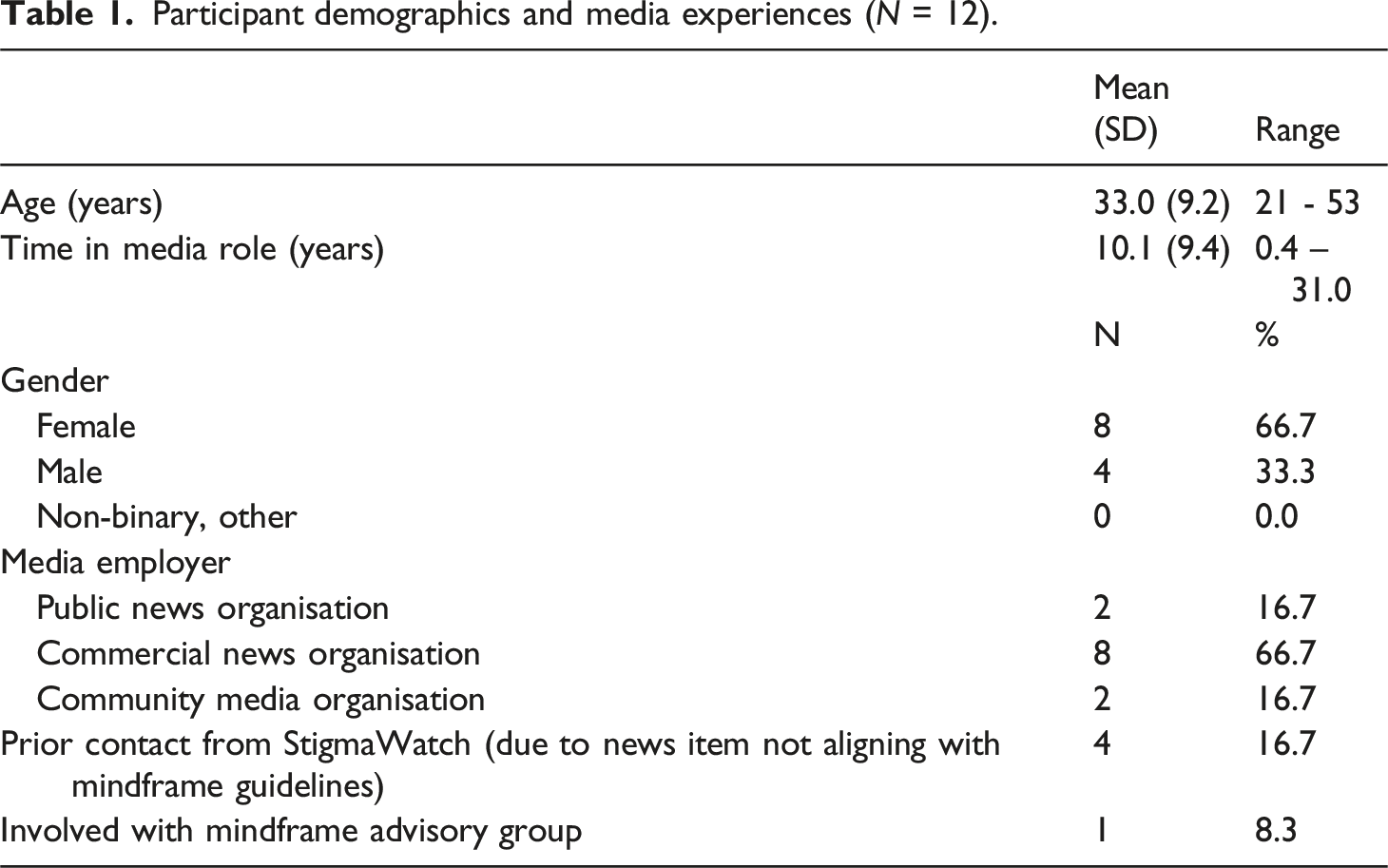
Participant demographics and media experiences (N = 12).
Procedure
The research team comprised industry experts and researchers with a specific interest in improving the quality of media reporting of mental illness and suicide. This research aligns with their work roles of engaging with media professionals to encourage media reporting that aligns with the Mindframe guidelines, and undertaking research on further mitigating media-based stigma. The research team have professional backgrounds in public health and media and communications, and their shared motivation towards researching this topic is to reduce harmful elements in news coverage to improve public health outcomes. This research was approached and conducted from a public health lens, with the aim to better understand experiences of reporting on mental illness and suicide to inform translatable findings to better enable the work of both the Mindframe and StigmaWatch programs.
The interviews were conducted via videoconferencing platform Zoom by the lead researcher (AR). The interviewer was a female Research Fellow (PhD, MPsych) with substantial research experience investigating media portrayals of mental illness and suicide, including experience undertaking interviews with media professionals. Participants were not known to the researchers prior to undertaking the study. At the beginning of each interview, the interviewer informed participants that the purpose of undertaking the study was to learn about their experiences in reporting on mental illness and suicide, their experiences receiving support in reporting on these topics, and any additional supports that would assist them in reporting on these topics. Participants were also informed that the researchers were collaborating with SANE and Mindframe in undertaking this study, and that the findings would inform their work. To encourage honest responses, participants were assured that their quotes would be reported anonymously and the details of their work experiences and workplaces would not be published to minimise any risk of identification.
Interview duration ranged from 27 to 83 min (mean = 46 min). The interview questions focused on: • Attitudes towards, awareness of, and experiences using the Mindframe guidelines and engaging with StigmaWatch; • Challenges in responsibly reporting on mental illness and suicide, and suggestions for improving the quality of media coverage on these topics, and; • Experiences reporting on lived experience stories.
The full interview guide is included in the online supplemental material. Ethics approval was obtained from the University of Melbourne’s Human Research Ethics Committee (HREC#: 23811).
Data analysis
All interviews were audio recorded and transcribed using Otter AI. The transcripts were analysed using inductive thematic analysis (Braun and Clarke, 2006, 2019) with a methodological underpinning in grounded theory (Charmaz, 2017; Charmaz and Thornberg, 2020) to identify patterns and generate themes in participant responses. Data were analysed using Nvivo software (V20). The primary coder (KD) inductively coded the transcripts, with initial codes generated from the data. Patterns within the codes were then identified and collapsed into themes. This formed the initial coding framework, which reflected the overarching themes and ideas in participant responses. An iterative process was used by the two researchers (KD, AR) to review and refine the themes to minimise overlap across themes and ensure these were distinct. All researchers reviewed and agreed on the final coding framework. Participants were provided with an overview of the key findings to ensure accurate interpretation of their responses.
Findings
Following interviews with 12 news media professionals, three key themes were generated relating to participants’ experiences in reporting on mental illness and suicide. These were: awareness of responsible reporting guidelines and how to proactively increase this; newsroom processes, values and subjectivity in applying guidelines; the importance and challenge in sharing lived experience stories, and improving support for covering these stories.
Most aware of the mindframe guidelines and all familiar with some guidance
All participants expressed favourable attitudes towards the Mindframe guidelines and the StigmaWatch program, demonstrating an appreciation of their purpose. When asked about policies and guidelines for media reporting on mental illness and suicide in Australia, seven participants (60%) reported being explicitly aware of the Mindframe media guidelines. They described learning about the guidelines in their newsrooms through their colleagues or managers/editors, Mindframe training delivered in their newsroom, through their journalism studies at university, or through contact with mental health organisations.
The other five participants (40%) could describe some of the recommendations for responsible reporting on suicide, while reporting not being explicitly aware of the Mindframe guidelines document itself. They described learning about these considerations in reporting on suicide and mental illness through their newsrooms’ processes, such as learning from editors or from colleagues who had written about suicide previously, or from looking at stories that had been published about suicide. They also described having a lack of understanding recommended practices for reporting on mental illness, as described by Media Professional 8: “I know like the general sort of principles of not describing in detail about how someone's taken their life. Also including links to Lifeline or other sort of help lines and that sort of thing… I'm not really well informed on it..”
Three participants mentioned court reporting in the context of news coverage of people with a mental illness. All three expressed some understanding of the Mindframe guidance around balancing portrayals of people with a mental illness and not conflating mental illness with violent behaviour. Media professional 4 noted the importance to “Avoid overly stigmatizing sort of phrases like… psychotic or listing the mental health illness as the reason for the criminal offending” while Media professional 8 emphasised the importance of being “aware in terms of the impact that [media portrayals] can have on people” and “being fair and accurate… like [describing] the reasons mitigating and aggravating factors and why someone might have done something… it's important include those details … [and] to not portray them in an unfair sort of way.” - Media professional 8
In contrast, considerations in how alcohol and other drug (AOD) use and mental illness should be portrayed in court reporting was described as being somewhat different to other types of news coverage, with the relevance of the Mindframe guidelines being less apparent at times. One participant described this distinction as being more difficult in court reporting where the use of AOD was raised as a relevant factor in a person’s criminal behaviour: “I think it was like [headline containing the term “meth addict”]. So nothing factually wrong there. And even though I was like, ‘Look, that feels like a bit of a harsh headline’. It wasn't something I was going to fight super hard, especially when it comes to court reporting.” – Media professional 4
Most participants (n = 8) reported to not have been contacted by StigmaWatch previously, and of these, three reported to be aware of the StigmaWatch program. The four participants who had previous contact with StigmaWatch due to their news story not aligning with the Mindframe guidelines described their experiences to be quite positive, supportive and informative. Media professional 1 described that the communication “is always effective and conveys the points well, and email is a good way to do that” with Media professional 5 agreeing that email is “a good way of reaching out... [saying] ‘We saw this, is there any way we can change it?’”. Concise and timely communication from the StigmaWatch team to convey what was problematic, why it is harmful, and how to modify this, was valued and considered to be the most effective approach to working with media professionals to influence modifications.
Proactively increasing awareness of the mindframe guidelines to improve reporting quality
Proactively ensuring that media professionals are aware of the Mindframe guidelines was described as the best approach to ensuring adherence with them. Other studies have also identified limited awareness of media guidelines to be a barrier to their use (Beam et al., 2018; Collings and Kemp, 2010). Educating media professionals on the guidelines prior to starting work in a newsroom was considered by participants to be the most effective approach. The importance of teaching the guidelines at a “grassroots” university-level was emphasised because “how you learn about certain things from the start is how you’re going to repeat it later” (Media professional 4). Strategies that were suggested to increase guideline awareness included incorporating them into newsroom onboarding as “when we start the job, that’s a good time to let everyone know that these guidelines exist, and we expect you to follow them” (Media professional 2). Regular professional development training and refresher training was also acknowledged as important to reinforce understanding of their guidance: “You need a refresher every now and then; humans forget things so quickly, so it needs to be pushed into our brains” (Media Professional 9).
In learning about the Mindframe guidelines, emphasising their purpose and the importance of following their guidance was discussed as being a useful approach to increase uptake among media professionals. Learning from examples of reporting that didn’t align with the Mindframe guidelines and the potential harms from this type of coverage was suggested as a way to emphasise the importance of using the guidelines: “Telling people what the consequences are, or what could potentially go wrong is probably the biggest way to get them to take notice if they're … based on real world examples” (Media professional 3).
Newsroom values and processes, and subjectivity influence uptake of media guidelines
Clashes with newsroom values and processes were cited as the biggest challenges to reporting consistently with Mindframe guidelines. These barriers were more commonly mentioned by participants working in commercial newsrooms (6/8 participants) compared to non-commercial newsrooms (2/4 participants). Participants described that developing stories with high news value is an important part of their roles. Developing news stories that are interesting and relatable to broad news audiences was emphasised as being an important part of news production, and may at times contradict Mindframe guidance on how a particular story should be covered. “We, as reporters, often are asked to sort of sit in the middle between what makes sense to the layperson … And, you know, and makes it interesting enough for them to want to read, compelling enough for them to care about.” – Media Professional 12
Clashes with stories having “high news value” applies to coverage of suicide attempts of high-profile people, and the urge to include details about the method or location due to the high levels of public interest in these incidents. “You could use an example of [prominent sportsperson] and he tried to take his own life… And that’s an example of- it's pretty extraordinary, the news value of reporting that is, well, there's no other way to describe how he was injured. Like, that has to be included.” – Media professional 8
Newsroom processes were also cited as barriers to following Mindframe guidance, with news outlets often in fierce competition against each other to attract and maintain news audiences: “Being the first news outlet to break the news; it's just all about competing against other news outlets... And you want to beat them, because you know that readers want to get the news first, they want to know that information the quickest. So if you get it the quickest, they'll go to you.” – Media professional 9
While not deliberate, participants also acknowledged that sometimes mistakes were made or that the guidelines, or colleagues with better understanding of the guidelines, were unable to be consulted prior to publication at times due to time constraints and pressure to quickly get news stories published: “A lot of things do slip through the cracks… we're writing a lot more stories than ever before. And even well-meaning people will make mistakes or not be informed, perhaps by the sort of best practices” (Media professional 11).
Subjectivity in applying some of the principles in the Mindframe guidelines was also raised as a barrier to reporting consistently with them. This was noted when reporting factually on events that are considered high public interest, with Media professional 6 stating “We don't want to cause harm, but saying that, that we need to report what's happening… if we're telling the facts, then then that's what we're here to do” but also described the importance of telling the facts in a sensitive way. A level of subjectivity in applying the guidelines when reporting direct quotes was also highlighted, with Media professional 1 describing that:
“Sometimes it's something as simple as a quote taken directly from a privileged setting in a court, for example… And that's a really difficult line to draw, I think, because when you're dealing with publicly available and factual information in a privileged setting.”
These findings are consistent with previous studies, with news professionals describing clashes with news values, time constraints, and subjectivity in their interpretation as barriers to consistently following guidelines (Machlin et al., 2012; O’ Brien, 2021; Ross et al., 2022; Skehan, 2019). The work of Mindframe and StigmaWatch continues to be paramount in overcoming these barriers through early education, supporting their interpretation and appealing to newsroom leaders’ sense of social responsibility towards responsible reporting on mental illness and suicide.
Organisation-wide approach to improve reporting on mental illness and suicide
Participants reported that change in how mental illness and suicide are reported needs to be organisation wide, using a top-down approach to have the most impact, due to the editorial influence that newsroom leaders have over their publications. “If something's coming from above, and they're telling us to take note, we will take note, because that's what we have to do…” (Media professional 6). Leadership championing of responsible reporting of mental illness and suicide was considered the most effective approach to creating this change, by “targeting newsroom leaders or media leaders, editors, people who obviously want to do the right thing, generally… And saying, ‘This is why it's important that your reporters do this’. And then they can sort of filter down.” (Media professional 11). Providing assistance to news organisations to develop their own internal policies for reporting on mental illness and suicide was also suggested as a way to support change in newsrooms while factoring possible constraints in expertise and resourcing.
Talking to colleagues about how to report on certain topics was also described as a safe way to learn within the newsroom, and having a newsroom culture that encourages and is supportive of these types of conversations was also considered important. “Those off-the-cuff kind of cultural conversations are the best way for change to happen, I think, because they're coming from your peers... [it] can feel like less judgement” (Media professional 5). The availability of a formal contact within newsrooms with particular expertise and experience in reporting on suicide and mental illness was also considered a useful approach to support journalists in reporting on these topics. As Media professional 1 described, “One thing that we hope will assist in this regard and is that where we have… set up some specialist reporting areas...” which has the additional benefit to “hopefully assists the networking of being able to speak to people with the lived experience in these particular areas.”
Sharing lived experience stories important but challenging
Participants widely expressed the importance of sharing lived experience stories due to the benefits this can create. Giving people with lived experience a platform from which to share their perspectives and to create broader societal awareness of lived experiences were key motivators for developing such stories. As Media professional 7 described, “Mental health reporting is you're getting someone's voice out there for them.”, with Media professional 9 adding, “I wanted to give them a platform to speak. And that's what gave me the confidence to contact them and then do the interview and write the story...”.
They also expressed a strong understanding of the need to engage with people with lived experience of mental illness or suicide in a sensitive and empathic way due to the highly personal nature of the story they were sharing. They described tailoring their approach to engaging with people with lived experience, emphasising the importance of building trust, ensuring they provide a thorough explanation in obtaining informed consent, respecting their readiness to share their story, and allowing a pre-publication check where possible. “It's just really having that respect and compassion for everyone you approach. You might not know their full story, but if you know that they've got mental health issues, or they've lost someone who has committed suicide … you're doing your job, but you're also you're trying to put yourself in their shoes, like how would they feel?” – Media Professional 7
Participants described encountering numerous challenges in their work to develop and publish stories about suicide, including the experiences of people bereaved by suicide. These included the emotional and mental health impacts of covering traumatic stories, managing the power imbalance with the bereaved person, the need to subjectively apply the Mindframe guidelines at times, juggling editorial pressures against their own ethical beliefs, and navigating working relationships with people bereaved by suicide. These findings are consistent with the experiences of Irish journalists, who also acknowledged their social responsibility in preventing suicide contagion, and described experiencing dilemmas in balancing public and private interests when covering suicides (O’ Brien, 2021).
Particularly in working with people who had been bereaved by suicide, participants across all career stages described that hearing and reporting on their lived experiences can impact them emotionally as well as impact their mental health in the longer term. “There's journalists I've spoken to that breakdown after they reported on it. And it really shows you that it's real, like this stuff is happening. And when you get that first-hand experience of actually talking to someone that's got those issues, or dealing with mental health or feeling suicidal- it's quite tough.” – Media professional 7
They also described a lack of awareness of the potential mental health impacts this can have on themselves through vicarious exposure to trauma, as well as limited resources and supports available to media professionals in supporting their own mental health while covering suicide incidents. “The stuff that we hear a lot of the time can also have an impact on ourselves. And I think there's not a lot of resources for journalists, especially… journalists that deal with car crashes and suicides and a lot of other really horrific stuff... that's also something that impacts behind the scenes in terms of people's mental health.” – Media professional 11
The vulnerability of people recently bereaved by suicide in sharing their stories with the media was acknowledged by participants. The power imbalance this creates was commonly acknowledged, with Media professional 7 stating “I was nervous because I didn't want people to think I was taking advantage of their trauma … and just think that I'm exploiting what they're going through for a story, because that's like the last thing I would ever want anyone to think”. A lack of guidance and support in how to best navigate this power imbalance was also noted, with Media professional 10 elaborating: “I think that's an extra element in this relationship where you're working with someone who's experiencing a lot of emotional pain, and is really vulnerable… There's a lot of stuff that happens around that, it's much more complex, a lot more traumatic, a lot more difficult to navigate... And that's the stuff we get less help with.”
Participants also described the need to be flexible in how they apply Mindframe guidelines when quoting people who have been bereaved by suicide, being mindful of the impact on both news audiences and the bereaved person. While others in prior studies have described the guidelines to be somewhat “restrictive” of media coverage (Holland, 2018; Skehan, 2019), participants in the current study described a need to flexibly apply the guidelines at times, particularly in relation to their use of direct quotes and the inclusion of suicide method or location details when these were considered to be of high public interest. In particular, they mentioned that they needed to weigh up the potential harm from sharing the bereaved person’s experiences in their own words, if the language used doesn’t align with Mindframe guidance, compared to the potential harm and disempowerment from telling people with lived experience to use certain language in sharing their story. “They have put their trust in you, they've told you their story… I cannot tell you the number of [people bereaved by suicide] I've interviewed that have said, ‘committed suicide’ throughout. And that's their story; that's their quote, they own that. And then here we are in a position being told we need to change what they say. Like it's not legitimate, like they're not politically correct enough. And that's a difficult space to navigate as well… We need to really think carefully about whose story it is we're telling and who the words belong to, and what right we really have to change it, if that's their direct quote.” - Media professional 10
Participants also described an ethical dilemma they commonly faced in interviewing family members who were bereaved by suicide. Participants described a sense of urgency from their editors to ‘break’ stories about suicide by being the first news organisation to report on it. However, this editorial pressure was often viewed by participants as being somewhat unethical and inconsiderate towards a family who are grieving and might not be ready to talk to the media: “They might not feel ready to talk to it, and part of our job is to be persistent, which is what I think, is a challenge.” (Media professional 7). This was described as creating an ethical dilemma for media professionals caught between doing what they are told by their employer and doing what feels right to them. As Media professional 4 elaborated:
“I'm trying to manage the expectations of [my] bosses and let them know, ‘…I'm going to need a little bit of time, we're going to need a little bit of space here’. But then also not coming across to the family [bereaved by suicide] as ‘we just want this because it will sell well.’ ”
Participants described occasionally experiencing difficulties in navigating professional relationships with people bereaved by suicide. This was mainly around balancing professional boundaries with showing appropriate empathy throughout the process of developing and then publishing their story. As Media professional 7 described, “I had to remain professional, but also sympathetic. And that’s what was a real challenge.” Media professional 10 further described the longer-term implications:
“It’s impossible not to develop a relationship with [
persons bereaved by suicide
], and then how you navigate that moving forward? And you know, how do you keep professional boundaries, but at the same time, give them the empathy that they're looking for in a friend as well?”
In addressing the power imbalance between media and lived experience, the need to support people who have been bereaved by suicide when interacting with the media has also been raised in prior research (O’ Brien, 2021; Skehan et al., 2013). Based on experiences described in the current study, people who have been bereaved by suicide are often approached directly by media, unlike people with lived experience of mental illness, who are often supported in their media engagements. This is due to media requests often coming via a mental health organisation and advocates with lived experience having been provided with media training (for example, Ross et al., 2023b).
More preparation and support needed for reporting on suicide and mental illness
While noting they often received valuable support from their colleagues and managers, participants described frequently feeling unprepared and wanting more support in their work reporting on suicide and working with people with lived experience of suicide and mental illness. They described feeling largely unprepared when they started covering these types of stories when they were new to their media roles. Participants across all career stages reflected that they would have benefited from better preparation, including awareness of what to expect when covering suicide-related stories. Media professional 4 suggested that a discussion with experienced journalists during their training about “this is what can happen and [approaching people recently bereaved by suicide is something] you might have to deal with” would have been useful. Lack of preparation and skills for interacting with vulnerable sources was also acknowledged by Australian journalists in an earlier study (Skehan, 2019), with the current findings suggesting that such supports and training are still needed.
Participants also described that better awareness of and more open and ongoing conversations about the emotional and mental health impacts from covering traumatic incidents, such as suicide, would be helpful, as well as an improved understanding of the importance of self-care and seeking support: “I think that also would feed into newsroom cultures, to sort of like ‘we're writing about this, we've got to do it ethically. But we also consider ourselves; let's talk about this conversation more broadly, in the future without it being stigmatised.’” – Media professional 11
The cumulative and negative impacts of exposure to trauma on media professionals’ mental health has been widely acknowledged in the research literature (for example Seely, 2019). A supportive newsroom culture that encourages self-care and help seeking can better prepare and also protect against these negative impacts from exposure to a range of traumatic events, not just suicide. Conversations about responsible reporting on mental illness and suicide could also be expected to foster broader conversations about mental health and self-care, as encouraged in the Mindframe training (Everymind, 2020).
Participants across all career stages also described that media professionals broadly would benefit from further guidance in how to work empathetically with people with lived experience of suicide or mental illness while maintaining professional relationships to ensure the media engagement is a better experience for both parties. “It's not trained very well… it's very ad hoc according to the organisations and where you learn from … I'm constantly thinking about, like, informed consent… and I feel like I'm managing people a lot to be like, ‘you don't have to, you don't have to tell us absolutely everything’ you know, and other people will try and get out everything, and some of the stuff that's more salacious and completely unnecessary for a story.” – Media professional 12
Participants suggested that an out-of-hours contact would be useful for support in dealing with issues related to reporting on suicide and mental illness. As their work hours and contacts with people with lived experience may not always align with their manager or colleagues, their usual supports may not be immediately available to discuss any issues. As Media professional 10 noted, “Having supports for reporters where you can call to say, ‘How do I deal with this?’… Someone that you can seek advice from and say, ‘How do I best deal with this without compounding their pain?’”. It was also noted that assistance provided through employee counselling programs can be useful for their own mental health support but may not be the most appropriate source of support when seeking guidance on reporting or relational issues with people with lived experience.
Discussion
This study sought to investigate the experiences of Australian news media professionals in reporting on mental illness and suicide. All participants shared positive attitudes towards responsible reporting of mental illness and suicide and were supportive of the existence of initiatives that encourage this. All participants demonstrated at least some understanding of Mindframe’s guidance for responsible reporting on suicide, which suggests that media professionals are familiar with the content of the Mindframe guidelines even if they are not able to recall their name. Awareness about guidelines for responsible portrayals of mental illness was more limited, particularly in relation to court reporting and AOD. Lower awareness of the Mindframe guidelines has implications for media professionals who would like additional support and advice in developing stories about suicide and mental illness, as they may not be aware of the individualised guidance Mindframe also offer. Encouraging media professionals to adopt responsible reporting habits and important social values early in their careers to inform their reporting is a vital role of Mindframe.
Clashes with news values and newsroom processes were cited again as the main barriers to reporting consistently with the Mindframe guidelines. As described in the current study, these are most likely to impact reporting in commercial newsrooms where there is increased pressure to be the first to break news and write attention-grabbing stories to draw in news audiences. However, as also discussed in the current study, there is also room for news stories about mental illness and suicide to be covered sensitively, and for news values to be balanced with social responsibilities in news production. Given the strong evidence surrounding the potential harms from irresponsible reporting (Niederkrotenthaler et al., 2020; Ross et al., 2019), while news organisations have a duty to cover such stories they also have responsibility to portray these stories in a way that prevents further harm (McIntyre et al., 2018). While there are times when the guidelines may need to be applied with some flexibility due to competing news values, such as when covering lived experience stories or stories involving high profile people, this flexibility needs to be guided by professional judgement and balanced against potential public harm (Pirkis et al., 2009).
An organisation-wide approach was also highlighted as necessary for newsrooms to adopt the Mindframe guidelines into their overall reporting style and to encourage responsible portrayals within their news culture. This is consistent with literature that recognises journalists are enculturated into journalism norms through communities of practice, where transformation is entwined in collaboration and learning together, stemming from evolving resource development and sharing within networks (Brookes and Waller, 2023). Using examples of media coverage that does not align with Mindframe guidance was raised as a further strategy that may encourage improved reporting practices. However, it is important for this feedback to be about trends in reporting and to not publicly single out individual journalists or stories, which could drive bias and discourage engagement. Regularly sharing the overall trends in reports of stigmatising media content actioned by StigmaWatch could provide a reminder of responsible reporting practices.
Implications for practice
These findings emphasise the need for more proactive upstream approaches to increase awareness of the Mindframe guidelines. Despite substantial traction already achieved in use of and training on the Mindframe guidelines (Pirkis et al., 2009; Skehan et al., 2006, 2009, 2020), there remains additional scope for Mindframe and StigmaWatch to continue working with the news media industry and journalism educators to increase awareness of and understanding about the importance of responsibly portraying suicide and mental illness and the supports available to them in developing these stories. While Mindframe regularly provide guest lectures and materials for universities, this does not guarantee this information will still be retained by students when they start working in newsrooms, nor do all journalists have a career pathway that includes university. Therefore Mindframe training should be included in newsroom onboarding with regular refresher training. Everymind are working to increase guideline reach and expand the delivery of their training in universities and newsrooms, including through developing online learning modules.
The importance of sharing stories about people’s lived experiences of mental illness and suicide was also highlighted in this study. However media professionals described feeling underprepared for reporting on suicide, experiencing difficulties in navigating working relationships while being empathetic towards people with lived experience, as well as with managing the emotional and mental health impacts alongside managing editorial pressures. Additional supports and resources should also be made available to help media professionals in navigating the challenges in reporting on suicide. This includes developing and implementing best practice guidance for media professionals on empathically and professionally working with people with lived experience of suicide and mental illness. This should expand on existing resources to cover a wider range of topics, including informed consent processes, understanding grief in people bereaved by suicide, engaging empathetically while maintaining appropriate professional boundaries. Further guidance is also needed for media professionals on the processes for setting up the media engagement to ensure it is a supportive experience for people with lived experience (for example, Ross et al., 2023b)), as well as on supporting their own mental health and prioritising self-care while reporting on suicide and mental illness.
Strengths and limitations
A key strength of this study is that the findings draw on a range of experiences from the perspectives of people working across a variety of media roles, from those early in their careers to those who are very established, including junior reporters all the way through to senior editors. The findings from this study can inform approaches to proactively engage media professionals in education initiatives to ensure better quality reporting on mental illness and suicide that is consistent with the Mindframe guidelines.
It is also important to consider these findings in light of the limitations of this study. The views held by media professionals in this sample were unlikely to be representative of all media professionals. For example, unfavourable views were expressed in a recent opinion piece following contact from StigmaWatch (Penberthy, 2023). By contrast, all participants in the current study agreed on the importance of responsibly reporting on mental illness and suicide in the media. While aiming to recruit a sample of journalists who had a range of attitudes towards responsible portrayals of mental illness and suicide, this did not eventuate through our recruitment processes.
Recommendations for future research
Future research should involve the use of novel strategies to capture a broader range of perspectives from media professionals who aren’t really interested in the Mindframe guidelines, which may help to shed light on additional barriers and enablers. Other research methodologies, such as anonymous surveys, could also be more conducive to sharing a broader range of perspectives, as it may reduce the perceived risk of judgement from others. Future research should gain a better understanding of preparation and support needs for reporting on suicide, as this was not a focus of the interview questions in the current study.
Conclusions
This study further confirmed that most media professionals are motivated to report responsibly and understand their responsibility to reduce any harm when reporting on mental illness and suicide. While there is good awareness of the Mindframe guidelines among Australian news professionals, findings showed there is scope for this to be improved. Further education is needed in newsrooms and universities to increase this, and newsroom managers and editors should be targeted to best influence organisational change. Better preparation and additional support would equip media professionals to cover lived experience stories, particularly the experiences of people bereaved by suicide.
Supplemental Material
Supplemental Material - Experiences reporting on mental illness and suicide: Findings from interviews with Australian news professionals
Supplemental Material for Experiences reporting on mental illness and suicide: Findings from interviews with Australian news professionals by Anna M Ross, Kara Dickson, Amy J Morgan, Elizabeth Paton, Gayle McNaught, Nicola J Reavley in Journalism.
Footnotes
Acknowledgements
The researchers wish to thank the participants for their time and contributions to this research.
Declaration of conflicting interests
The author(s) declared the following potential conflicts of interest with respect to the research, authorship, and/or publication of this article: Nicola Reavley is affiliated with SANE through the Anne Deveson Research Centre; however, she is not an employee of SANE and does not receive any potential financial benefit from the research. Elizabeth Paton is an employee of Everymind and leads the Mindframe program, and Gayle McNaught is an employee of SANE Australia and leads the StigmaWatch program. Neither receive any potential financial benefit from the research, neither does Everymind and SANE. To remove any potential conflict of interest, data analysis was overseen by Anna Ross and Kara Dickson.
Funding
The author(s) disclosed receipt of the following financial support for the research, authorship, and/or publication of this article: This research was supported and funded by SANE StigmaWatch and Mindframe, an Everymind program.

Supplemental Material
Supplemental material for this article is available online.
Author biographies
References
Supplementary Material
Please find the following supplemental material available below.
For Open Access articles published under a Creative Commons License, all supplemental material carries the same license as the article it is associated with.
For non-Open Access articles published, all supplemental material carries a non-exclusive license, and permission requests for re-use of supplemental material or any part of supplemental material shall be sent directly to the copyright owner as specified in the copyright notice associated with the article.
