



Abstract
In today’s post-truth world, news users grapple with the tension between growing distrust in news institutions and the need for “true” information. Based on a mixed-methods study conducted in Turkey, this paper examines strategies developed by news users to establish trust in media tools in the context of the COVID-19 pandemic and populist polarization. We first collected data with a nationally representative survey (N = 1089). Then, 30 media users filled out media diaries for 1 week. We interviewed diary participants at the end of the week. We also conducted a four-week-long participant observation in three locations. Based on this data, we argue that users build trust in news stories by attributing a sense of immediacy to specific media, namely television and search engines. This immediacy arises from people’s desire to scrutinize the accuracy of news stories in Turkey’s highly polarized media environment. We term this ascribed meaning of transparency the imagined affordance of immediacy, asserting that immediacy is crucial for forming trust in the post-truth era. Contrary to suggestions that news trust is diminishing in the post-truth era, our paper highlights citizens’ creative strategies to reestablish trust in contemporary news media.
Introduction
In today’s post-truth world, public trust in the institutions of democracy, including the news media, has taken on new forms that require a fresh understanding of how citizens conceive trust as a component of the public culture. News users worldwide struggle to navigate the tension between increasing distrust in news institutions and the urge to receive “true” information (Dahlgren, 2018; Waisbord, 2018). Kozinets et al. (2020: 131) coin the term “post-trust,” highlighting that trust is seldom absolute or enduring during the post-truth era. The significance of trust may be eclipsed by the pursuit of short-term utilitarian gains or exchanges, especially in conflict-ridden contexts of populism and polarization, which are critical dynamics aggravating the conditions of the post-truth era. In this paper, we examine how news users conceptualize and establish trust in news as well as the strategies they have developed to operationalize trust in media tools in a media environment that is tense and marked by conflict and extreme polarization. Focusing on Turkey, a case where media polarization has paralleled a dramatic democratic backslide within the last decade (Yeşil, 2021; Över, 2021), we question how news users articulate trust in the information they access via diverse media in the context of the COVID-19 pandemic. We unpack the novel forms trust takes when people are highly skeptical of the mediated pandemic information in a post-truth context characterized by magnified political polarization and institutional erosion under authoritarianism. We argue that news users overcome this sharp skepticism and establish trust in news stories, as well as diverse information sources, by attributing a sense of immediacy to specific media tools, namely television and search engines. This sense of immediacy results from news users’ desire to investigate the veracity of news stories in a highly polarized media environment. Our participants highlight television and search engines as tools that allow them to validate information, and in doing so, they attribute to these outlets the capacity to convey information transparently. We refer to this attributed meaning of transparency as the imagined affordance of immediacy and assert that immediacy is essential for forming trust in the post-truth era.
Contrary to the prevailing notion that trust in media is diminishing in the post-truth era, our study offers a different perspective based on the context in Turkey. It underscores that trust has not diminished but has taken on a new form. In settings where the truth is elusive and frequently contested, news users have exhibited remarkable creativity in developing strategies to rebuild their trust in news media. By ascribing the capability to convey transparent information to specific media, individuals navigate the complex and polarized world of information in Turkey. Our research expands the scholarly discussions about the interaction among trust, news media, and post-truth by suggesting that even in environments where the concept of truth is contested, individuals are actively working to regain a sense of trust within the context of news media.
In the following discussion, we present our responses to two research questions: 1) What strategies have news users developed to establish trust in news amidst the post-truth context of the COVID-19 pandemic and populist polarization? 2) What are the novel forms trust takes among people highly skeptical of information from diverse media in post-truth environments?
News trust
The literature on trust in the news media is extensive and dynamic. Nevertheless, this literature has certain conceptual and operational ambiguities and assumptions (cf. Strömbäck et al., 2020; Tsfati and Cappella, 2003). A lack of a comprehensive theoretical framework leads to confusion surrounding the concepts of trust, credibility, believability, and confidence (Pjesivac et al., 2016: 324; Fawzi et al., 2021). The absence of operational definitions for news trust adds to the complexity (Strömbäck et al., 2020). Many studies refer to news trust as a relationship involving a trustor, the one placing trust, and a trustee, the entity being trusted (cf. Tsfati and Cappella, 2003: 505). Others often used news trust interchangeably with news or source credibility without a clear definition of its empirical dimensions, creating conceptual ambiguity. This terminological inconsistency has led to varying and conflicting conclusions throughout the literature.
In this paper, we align with recent studies that challenge the prevailing notion of trust in the news media as a static and global outcome of the relationship between a trustor and a trustee. For example, Moran and Nechushtai’s work (2023) advances beyond this understanding by reimagining news trust as an infrastructural capacity. In this view, trust becomes a pivotal component of the sociotechnical and physical infrastructure that underpins news funding, production, circulation, and audience measurement (Moran and Nechushtai, 2023:3). Consequently, trust is integral to the entire news media ecosystem, and any trust-related issue is viewed as an “infrastructural breakdown” (Moran and Nechushtai, 2023:3). In simpler terms, the continuity of news circulation and the survival of news institutions hinge on news users’ ability to develop a degree of trust. Without this trust, the news media would collapse, much like a destroyed bridge halts traffic flow.
If trust is indeed an essential component of news media, it is imperative to explain how people continue to establish trust in the information they receive through news media in an era of post-truth challenges. We contend that addressing this question necessitates focusing on the contextual factors influencing the emergence of trust in different countries—a perspective notably absent in much of the news trust literature. Western cases have largely dominated scholarly discussions on news trust, with an emphasis on quantitative methods, particularly survey studies. The USA has featured prominently in these studies (Suiter and Fletcher, 2020: 486). Although there have been limited instances of comparative and longitudinal studies of public confidence in news media (Fletcher and Park, 2017), which have provided insights into contextual factors like polarization, these aspects have not been fully explored as elements of trust within the discussion. Similarly, Suiter & Fletcher’s study, which also utilized survey data from Reuters, analyzed the impact of polarization on news trust but did not delve deeply into the various contextual conditions.
However, social and historical contexts are crucial determinants of news trust. (Dis)trusting news media can carry different connotations in distinct social, political, or cultural contexts. While our qualitative data with participants in Turkey reveal a distrust in social media as a news source, Hermida et al. (2012) point out that in Canada, news users utilize social media to filter news stories. Therefore, we propose that the initial and most significant step in comprehending the context-specific complexity of trust is to place the research alongside news consumers (cf. Bozdağ and Koçer, 2022; Koçer and Bozdağ, 2020; Koçer et al., 2022). This perspective enables us to answer questions like how a situated news consumer defines news trust and how (dis)trust in news media manifests in daily life. Recent studies have started bridging this gap by exploring how news consumers perceive trust. For instance, Knudsen et al. (2022) analyzed how news readers define trust in their own words using an open-ended survey question. Through structural topic modeling (STM) analysis of 1,500 written responses, they uncovered distinct topical categories prevalent in respondents’ definitions of news trust.
Approaching news trust from a user-centric perspective, Swart and Broersma (2022: 396) argue that “to fully understand how users deal with the complexity of trust in digital environments, we should not start from the ideals of informed citizenship but from people’s actual practices and experiences instead.” Through interviews with 55 young people in the Netherlands, Swart and Broersma identify “a taxonomy of tactics” employed by news consumers to assess the reliability of political news. This taxonomy highlights young individuals’ diverse approaches and methods when navigating the complex news landscape. Tactics such as relying on intuition or evaluating sources based on tone or familiarity indicate that users' approaches to assessing reliability are typically not explicit or thorough evaluations, but instead can be described as implicit, practical, and often partially intuitive solutions. These tools assist users in navigating the expectations of being well-informed citizens while also managing the realities of their daily lives (2021: 412). Users frequently utilize more practical shortcuts to approximate the reliability of news rather than critically analyzing it by comparing and verifying sources. These include emotional and intuitive strategies based on implicit knowledge. Swart and Broersma’s study shows that, rather than beginning with the ideals of informed citizenry, we should begin with people’s actual practices and experiences to comprehend how users deal with trust in digital contexts.
Echoing this suggestion, the primary contribution of our study is to highlight the imagined affordance of immediacy and the ability of news verification as crucial components of news trust. The specific political context of Turkey—populist polarization of the news environment—is the primary factor that renders immediacy and verification essential elements of trust. Users in Turkey establish trust in news stories by associating a sense of immediacy with television and search engines. Our participants attribute an affordance of immediacy to these outlets because they believe that television and search engines enable them to investigate news stories that they find suspicious. As news readers are entangled in the dichotomy between pro-government and oppositional news outlets, they perceive mediation as synonymous with politics, thus equating it with potential misinformation. Instead of considering information from either side of the news spectrum as objective, they feel the need to take an extra step and verify the stories themselves. In a sense, they transcend the dichotomy between oppositional and pro-government media by imagining another duality: mediation versus immediacy. Although mediation is an inescapable aspect of communication, news readers, to counter politically driven mediation, imagine television and search engines as tools providing direct and transparent access to reality.
Here, we do not suggest that the post-truth era signifies a radical rupture in how people establish trust in news. Caroline Fisher (2016), who reviews the literature on news trust spanning 80 years, suggests that news trust does not have a general scholarly definition. We interpret the absence of an agreed-upon definition of news trust as indicative of the significant variation in the strategies people use to establish trust in news across different contexts and time periods before the post-truth era. Rather than comparing the formation of news trust before and during the post-truth era, our analysis contributes to this diversity by demonstrating how the unique features of a post-truth environment, characterized by populist polarization, affect the emergence of new forms of trust in relation to both emerging and legacy media. We examine the concept of the imagined affordance of immediacy as one of the most prominent strategies for establishing news trust in Turkey.
The context and methodology
This article is based on a mixed-methods study conducted within the context of Turkey, marked by the Covid-19 pandemic. The Turkish case is unique due to its distinctive media ecology (Akser and Baybars-Hawks, 2012; Yeşil, 2016) and serves as a symptom of the global rise of populist politics (Block and Negrine, 2017; Howard and Waisbord, 2021). The COVID-19 pandemic has brought to the forefront several critical issues in the structure of Turkish media, including partisanship, polarization, state control, and public mistrust. Furthermore, the recent surge in authoritarianism in Turkey is deeply rooted in the country’s Republican history, and this influence continues to permeate the contemporary media landscape. For a considerable time, Turkey’s news media has been subject to political control in various ways, primarily due to its role in advancing the economic interests of political parties and corporate circles.
The Justice and Development Party (AKP) has monopolized media outlets to influence public opinion since coming to power in 2002. This has resulted in a polarized media landscape, particularly since the Gezi Park protests in 2013 (Bulut and Yörük, 2017). This transformation has been described by some journalists as the complete disappearance of the category of mainstream media (Över, 2021). The AKP, as a pro-Islamist party, facilitated the acquisition of media institutions by pro-AKP businessmen, who purchased media complexes formerly owned by more Kemalist-secular leaning groups. Journalists working for these media networks openly expressed their loyalty to the AKP, leading to the emergence of “pro-government” or “partisan (yandaş)” media outlets. Oppositional journalists increasingly faced allegations of involvement in terrorist activities due to their criticism of the government’s anti-democratic policies. This restructuring of media ownership based on political and economic interests, official and unofficial censorship mechanisms, and punitive measures created a severely polarized media environment (Kırdemir, 2020; Över, 2021).
Turkey went through the COVID-19 pandemic in this highly divisive setting. Political polarization and low trust in the news media created an environment where false information and manipulation could easily propagate (cf. McCoy et al., 2018). Research also shows that media institutions have been among the least trusted in Turkey (Aydin et al., 2021). Turkish news outlets were rife with fabrications and conspiracies during the COVID outbreak. They provided platforms for partisan commentaries that aimed to attract viewers by exploiting their anxieties. Individual users were both targets and purveyors of misleading COVID-19 information on social media (Kırdemir, 2020). The trust issue in the news media, present since the Gezi Park protests, worsened during the pandemic.
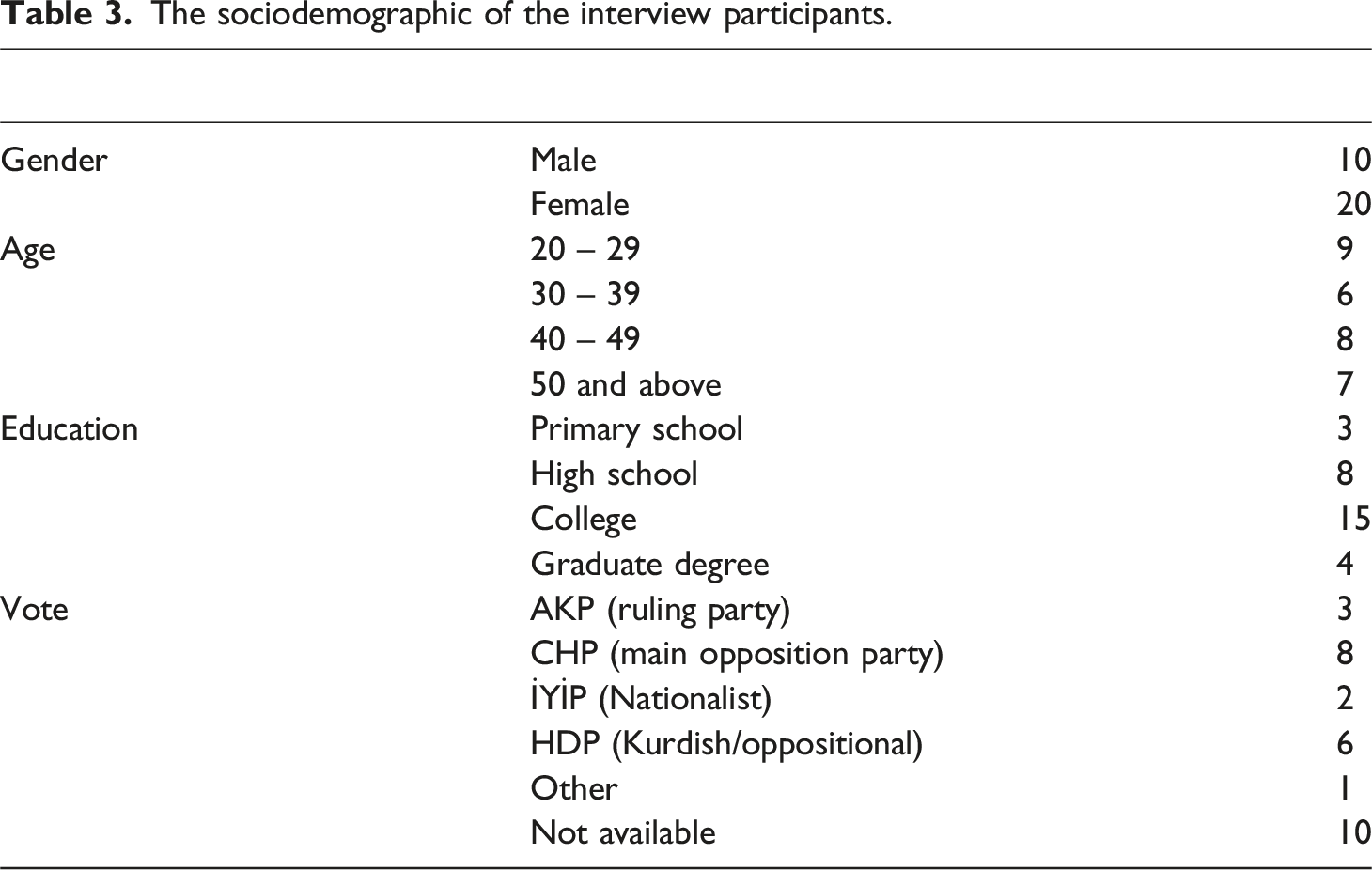
Our data was collected within this complex context between July 2020 and December 2020. We employed a mixed-methods approach, including surveys, media diaries, semi-structured interviews, and team participant observation. A nationally representative survey consisting of 53 questions was conducted with 1089 media users inquiring about their information access, trust, sharing habits, and verification practices in the pandemic context. Additionally, we utilized media diaries with 30 participants recruited through snowball sampling, who maintained these diaries over a week. Through these diaries, participants documented their daily habits regarding accessing pandemic-related news, sharing information, and discerning accurate and inaccurate content. At the end of 1 week, we conducted semi-structured interviews with the diary participants to explore their information engagement and perceptions further.
To gain firsthand insights into how news users engaged with COVID-19-related information, the research team embarked on a 4-week participant observation study in Samsun, Manisa, and Istanbul. This approach yielded a unique data set, capturing direct experiences and interactions, which would have been hard to obtain through self-reported methods. Our choice of observation sites was informed by the research team’s access to these areas during the pandemic. These social circles represented various socioeconomic statuses, educational backgrounds, and ideologies. Observing a diverse set of media users in their daily settings enriched the findings derived from surveys, diaries, and interviews, as the team could observe mechanisms of news trust in the flow of daily life. The participants in our observation study did not complete media diaries or participate in the interviews but completed the national survey. Our data analysis involved using SPSS for the survey data and Atlas. ti for the qualitative data.
Drawing on this data, we suggest that trust in the media, far from being eroded, has given rise to innovative approaches aimed at filling the trust void created by the challenges of the post-truth era. One of these strategies involves attributing a sense of immediacy to specific media platforms, especially television and search engines. This attribution responds to the deep-seated desire for access to accurate information within a politically polarized landscape filled with misinformation. By ascribing the capability to convey transparent information to these particular media tools, individuals create a means to investigate the accuracy of news stories. Television and search engines emerge as trusted tools that offer a semblance of transparency amid the cacophony of conflicting narratives.
Imagined affordance of immediacy in news trust
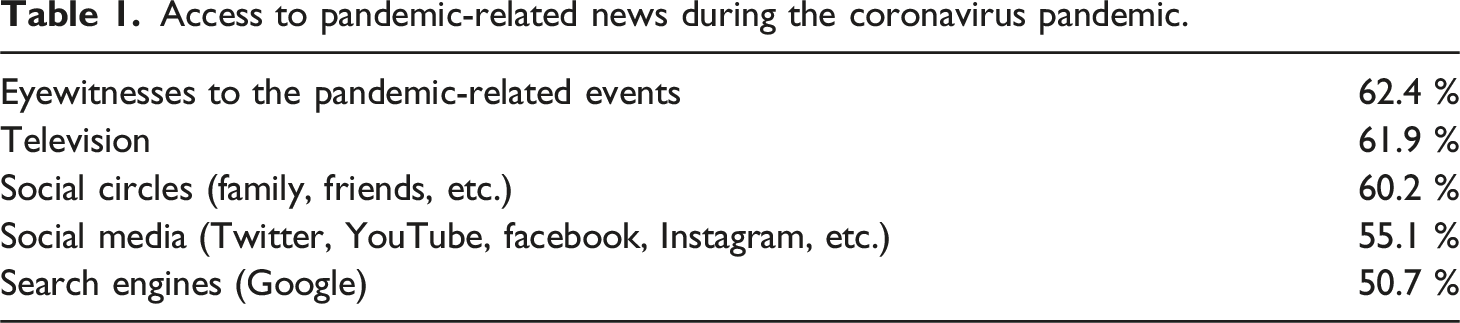
Access to pandemic-related news during the coronavirus pandemic.
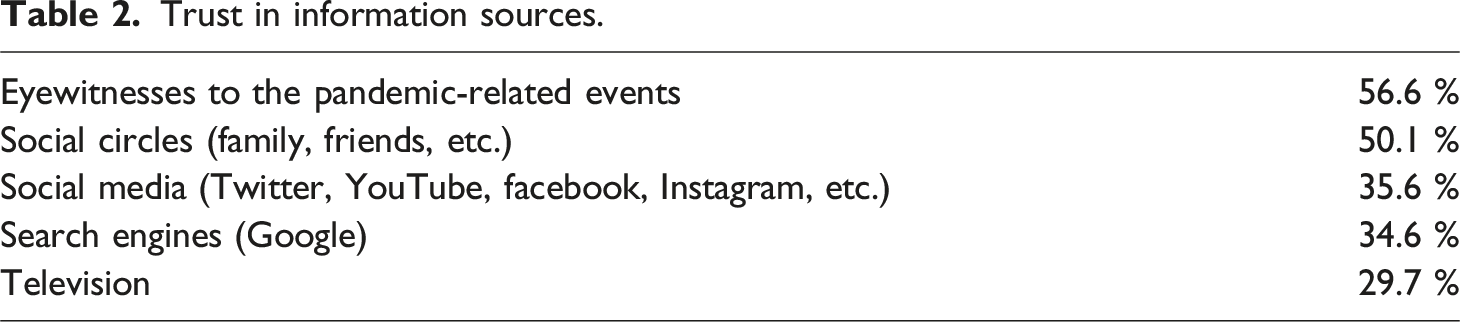
Trust in information sources.
The sociodemographic of the interview participants.
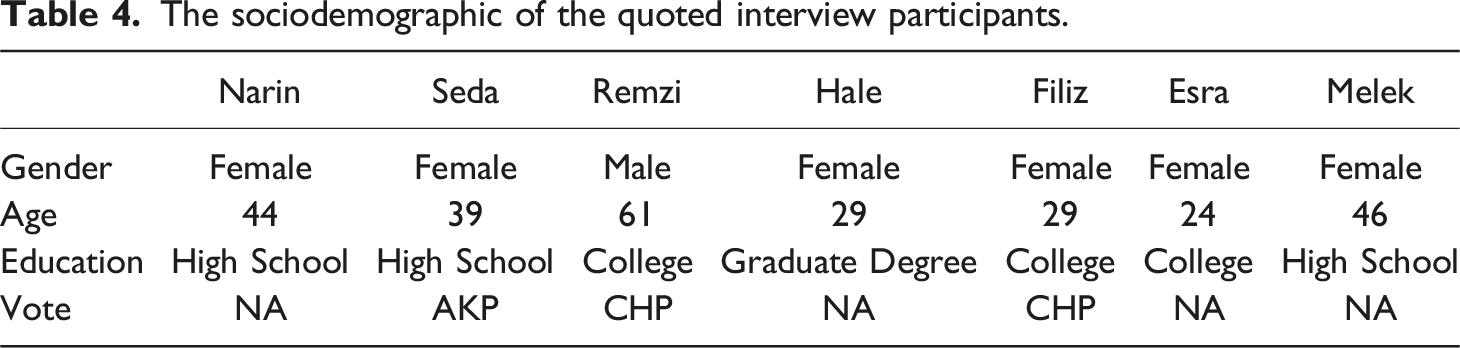
The sociodemographic of the quoted interview participants.
Besides acquaintances and eyewitnesses, our survey revealed a preference for social media platforms like Twitter and WhatsApp, TV, and search engines like Google for pandemic information. When asked about their trust in these outlets, most respondents reported high trust in their social circles, social media, search engines, and television, compared to more conventional media sources like newspapers.
However, our qualitative data, obtained through media diaries, interviews, and participant observation, added complexity to this list of preferred media sources for information access and the relative level of public trust in these outlets. Qualitative data revealed that news users considered television and search engines more trustworthy due to their belief that these tools offer a direct and transparent connection to reality, enabling the dissemination of accurate news. All of our diary/interview participants stated unequivocally that social media is a source of information about pandemics. Nevertheless, 26 out of 30 participants acknowledged that they would use immediate social network verification, such as asking a close friend or family member, to process the information they obtain online. Of the 30 participants, 19 would use television to check the pandemic-related information they get from social media. 14 out of 30 participants said they would use Google to verify the accuracy of the material. Notably, users attributed accuracy to the news obtained via television and search engines and trusted these outlets to validate information from other sources. Therefore, in addition to immediate social circles such as friends and family, television and search engines were viewed as robust tools for providing immediacy.
We draw on Nagy and Neff (2015) concept of imagined affordance to conceptualize the immediacy of television and search engines as a process emerging from users’ perceptions, attitudes, and expectations that go beyond the actual materiality and functionality of media. Nagy and Neff emphasize that users may have certain expectations about communication technologies that shape how they interact with them and the actions they consider feasible. These expectations are not rigidly encoded into the tools' design but become part of users’ perceptions of available actions.
The transparent connection with reality attributed to television and search engines is, in William Mazzarella’s (2006) words, an imagined “fantasy,” as mediation is an inherent aspect of media technologies. Mediation is not confined to media alone but is also the cornerstone of what we refer to as culture (Miller and Heather, 2012: 24), underpinning the foundation of all social life (Mazzarella, 2006: 476). Immediacy makes mediation imperceptible through the authorized perspectives of what media are expected to do, or not do, within broader practices of mediation (Meyer, 2011: 32). When specific media obscure their presence in the mediation process, the concept of immediacy emerges as an imagined affordance within these media. (Eisenlohr, 2009: 9). Rather than being determined by the specific technological features of a particular medium, this erasure is authorized by social, cultural, and political processes (Larkin, 2008; Meyer, 2011; Miller and Heather, 2012).
What makes the eradication of mediation an imperative? Mazzarella (2006) characterizes the “politics of immediation” as the pursuit of “transparency pushed to its limits,” aiming for a state of “perfect invisibility.” This perfect invisibility becomes imperative when politics comes to symbolize the imperfections that are intrinsic to mediation (Mazarrela, 2006; Özkan 2021). In a highly polarized political environment, news audiences in Turkey attribute immediacy to information they receive from their social circles, television, and search engines since politics in Turkey pejoratively symbolizes the flaws in mediation that are inherent in populist polarization. Through the “fantasy of immediation,” news audiences perceive television and search engines, as well as their acquaintances, as “frictionless social mechanisms.”
Users attribute immediacy to television as a tool to access information by virtue of its capacity to allow investigation. That capacity equips the users with a sense of empowerment in the face of a conflict-ridden media environment. Numerous research participants express critical reflections on the deterioration of mainstream journalism in Turkey—also noted by international media monitoring organizations (RSF, 2022). For instance, in our interview, Narin, a 44-year-old woman residing in Istanbul, points to her consumption of “all sides” as an indicator of her news literacy: In our house, Fox TV and ATV, generally all channels are on. We listen to them all. [We] receive news that we believe in, that we trust, [and also] that is questionable. Our point of view is not, how should I put it, not stuck on some channels. We try to look at many channels objectively. We know how to say wrong is wrong, we don't blindly say this is right, we watch, we follow [different sources].
Fox TV, presented as an ostensibly oppositional channel, and ATV, a prominent pro-government outlet, represent two opposing poles. Narin’s approach to consuming both is her way of asserting a degree of objectivity and distance from the partisan politics in Turkey’s media. Her statement simultaneously reflects on Turkish media politics and offers self-reflection on her role as a news consumer who is in dire need to investigate her news sources within this highly politicized environment.
Esra, a 24-year-old university graduate in Kahramanmaraş, articulates her lack of trust in news outlets in similar ways. She mentions that she maintains equal suspicions about the news stories she comes across on both pro-government and state-critical television networks. What’s noteworthy is that, despite her distrust in news from all sides, she tries not to label television as a source of misinformation: I get suspicious about anything I see on A Haber (pro-government outlet). Or when I watch Fox TV (state-critical outlet) I wonder if it is true or they talk about it to criticize [the government], so I am very picky when I am choosing what to watch on television. In fact, we do not have this problem a lot on television but even if this is the case, when we watch [television] there is this “I wonder if” question that we have in the background. Maybe most of the news stories are true and yet we have a disbelief inside that makes us think “probably this is not true” or “they are exaggerating it” or “they do not tell the truth.”
In Esra’s account, one can observe the tension between the “imperfections of mediation” and the purity attributed to immediation. On one hand, Esra describes her lack of trust in all media outlets, regardless of their political leanings, simply because their broadcast policies align with a certain political stance. Broadcasting based on a specific political side represents the “friction” of mediation, causing her ongoing doubts with questions like, “I wonder if.” On the other hand, she attempts to exempt television from this questioning process for a brief moment when she says, “We do not have this problem a lot on television.” This moment is her effort to rescue the medium of television from politics, even though suspicion ultimately characterizes her overall sentiment. Esra relies on television as a dependable source because she often grapples with “I wonder if” questions that arise when she encounters conflicting information from various media outlets.
Other participants agree with Esra that television is reliable, noting its capacity for investigation, hence immediation. For example, Melek, a 46-year-old homemaker in Manisa, outlines three distinct ways to verify information: searching on Google, looking for it in the evening news on TV, and asking her acquaintances. She considers sources like “Facebook, WhatsApp, Instagram” to convey “exaggerated and less convincing” news, emphasizing that “true, serious things come from television.” To Melek, her immediate social network almost parallels the immediacy she attributes to Google and television. She also trusts the health minister, Fahrettin Koca, whom she usually watches on television. When asked if she trusts Koca’s statements when she comes across them on social media, she highlights that if the statements were shared on social media as if they “came out of Fahrettin Koca’s mouth,” she trusts them. For Melek, social media has the potential to not convey the original statements. When considered alongside her preference for following Koca on television, her approach to television as a medium capable of relaying statements as they come out of speakers’ mouths becomes evident. The phrase “as it is coming from someone’s mouth” underscores television’s capacity for immediation that transcends ideological mediations distorting reality.
The fact that on television the words they hear come directly from the mouths of politicians and experts also informs television’s capacity for immediation. For example, Remzi, a 61-year-old retired man, uses television to follow the opinions of the physicians he trusts and takes notes for future reference. He follows a well-known physician, Osman Müftüoğlu, who appears on Fox TV, a state-critical network. Similarly, Melek recalls an incident in which she tried a suggestion of a health expert she watched on television to alleviate her son’s breathing difficulty. Her son was amazed by the result as he could breathe much more easily. The programs conducted with experts play an important role in creating the perception of television as a current flowing by itself, conveying the most useful and trusted information. In several instances, the participants qualify their distrust in information accessed via social media platforms with the statement, “If this was true, it would have been reported in the evening news.”
Television emerges as a medium capable of immediation, also due to its position as the taken-for-granted fixture in almost every living room, constantly “on.” Hale, a 29-year-old graduate student living in Istanbul, followed the news about the pandemic on television and “left the TV on” all day. If something significant occurred, she would then pay attention to the broadcasts. Similarly, Esra followed the news about the coronavirus when they “went to [their] in-laws who watched the evening news that regularly reported on the virus.” In both Hale and Esra’s descriptions, television emerges as a source of information simply because it is already present. It can be turned on and left there to fade into the background as it doesn’t always demand one’s attention. However, it can also invite people to pay attention when necessary. Its status as an object that is “simply there” partially explains why Esra includes it in her list of news sources.
Search engines appear to possess a potential for immediacy like the social circles and television as people search for contested information on platforms like Google. In addition to asking around in her close social circle and checking the news on TV, Melek searches for particular information on Google, where she is granted the autonomy to explore numerous sources of information. She further denotes that she accesses real, serious news on television or via Google. In fact, Google provides her with even greater autonomy as she needs to go online to search for information, which in turn empowers Melek to exercise her agency by carefully selecting and vetting news sources to validate the information in question. This validation process is contingent upon the user’s, in this case Melek’s, investigative abilities, as well as her final assessment of the credibility and reliability of the chosen information sources.
Google lays endless resources down for the user to compare. The user forms a valid narrative by either relying on or dismissing specific information within the search engine. These evaluations often overlook the user’s own ideological inclinations and biases. Moreover, the impact of search algorithms on accessing information resources is often overlooked. As a result, there is a tendency to assume an allegedly immediate path to the truth. Search engines seemingly enable users to curate their information journey, offering a space where they can navigate the complex landscape of conflicting narratives. By allowing users to make choices among multiple sources, search engines empower individuals to form their own perspectives of what they consider to be the truth. This process, though, may inadvertently be influenced by their personal ideologies and the infrastructure of a search engine, underscoring the nuanced interplay between agency, information validation, and the quest for truth in a conflict-ridden media environment.
Because of this attributed capacity for immediacy, laying out information “as it is” for the arbitration of the users, television and search engines empower the audience to make their own observations about a news story. In other words, television and search engines assist news users in satisfying their urge to investigate the veracity of information they receive through the news media. For example, Remzi, who prefers to get his news from the state-critical Fox TV, usually conducts his research to verify information by comparing multiple sources. He reads scientific and technological periodicals, follows experts on television, and, as a social worker, consults his friends to confirm a story. Television enables him to utilize his observation skills, honed through years of working closely with people. When asked what makes him suspicious of media content, he responds: Let’s say the minister of health is making a statement and he is a bit stressed. Since I read some psychology and worked with people for years, I can tell from his expression, his reading style that he is stressed. Also, the inconsistencies between different forms of data provided by Turkish Medical Association (government-critical professional chamber) makes it obvious that he has to make a statement like this. We sense that he is obliged to make a particular announcement. Maybe he would not prefer to make that statement but what he says does not sound very consistent.
Remzi approaches the health minister’s statements with a viewpoint he has developed through his investigations. He refers to the data provided by the Turkish Medical Association, a professional chamber of physicians who have been vocal critics of the government’s COVID-19 policies. He also draws on his experience as a social worker to understand people’s psychology. Remzi sees television as a visual platform where he can read the health minister’s facial expressions, leading to the disappearance of mediation for him. The camera and other material infrastructure that bring the health minister to Remzi’s living room fade away as he searches for clues to verify what he has learned from his investigations, which include reading alternative reports of state-critical organizations.
Users need to verify information they receive from social media outlets. For example, Melek validates the information she obtains from Facebook or WhatsApp by searching for it on Google or watching the evening news on TV. Hale similarly refers to her need for investigating stories that she especially sees on Twitter: I cannot say I believe in things that I see on Twitter. But if it is something needing verification, I ask friends whose parents are physicians, or I have friends working at newspapers. I ask them.
Esra also verifies the accuracy of a claim by consulting her close circle. She mentions that she first asks her partner and then conducts an online search. She examines the data provided by the health ministry. “This is all I can do right now,” she remarks, “because there are no books about [the pandemic] yet.” She also recollects a news story about France that spurred her into an extensive investigation mode: There was this news in France. The number of deaths increased to such high numbers that bodies were put in the garbage bags and left at a corner. When I saw this news, for example, I was not sure at first. Can something like this happen in a developed country such as France? I looked into this myself but could not arrive at a definite conclusion. I searched the number of deaths, what they do with the bodies but could not find anything significant.
Similarly, Filiz, a lawyer in Manisa, one of our participant observation sites, provides a specific example of using search engines to access trusted information about COVID-19: I used to search Google to decide which medicine to give my kid for fever, Calpol or Ibufen, to better protect her from Covid. You can give either for fever. But what if she (the kid) gets the virus and how are we going to know which medicine is better with corona until we get to see our doctor? I look for the answer via routine Google search.
During participant observation, we noted Filiz frequently checking COVID-19 information from her social media accounts or clients, immediately searching it on Google. In such an instance, Filiz learned from a client planning a wedding that weddings were banned by the government due to the pandemic. When asked for more information, Filiz reached into her purse, saying, “Hold on a minute,” and handed her phone to the researcher. On the phone was a news item from Sözcü newspaper, reached out through a Google search with the question of “Are weddings banned?” Tapping into Google, another research participant Seda also explains her fact-checking steps in detail: Let’s say I heard some news. First thing I do is to check the accurate sources. For instance, I look at twitter accounts of the politicians. And you know when you write it on Google, you always get something about the level of accuracy there. I certainly look from there (Google). I would not believe blindly, you know...
The need to become investigators, as shaped in a populist context of misinformation, is partially the “social process through which” certain media tools become so entangled with what they contribute to media that they are not visible as distinct entities (Meyer, 2011:26). In a media environment where networks and journalists openly align with political groups, heightened awareness of mediation prompts people to hone their investigative skills and develop a verification method to fact-check suspicious information. Asking trusted friends or acquaintances who might have medical or professional expertise is one step in this method. Using search engines like Google is another. With its feed bringing related sources one after the other, Google allows people to compare information in ways that enable them to form an opinion. Television becomes a part of this investigation toolkit as a device that can be “always on” effortlessly, resembling a current flowing by itself with the capacity to relay information “as it is.”
Conclusion
The challenge of misinformation and the decline in trust in democratic institutions, including the news media, is a global issue. Populist polarization makes it especially difficult for media users to access accurate information, a problem worsened in crises like the pandemic. Studies, including longitudinal and comparative ones (Aydin et al., 2021), reveal a diminishing public trust in news media. The concept of “post-trust” (Kozinets et al., 2020) implies that traditional notions of trust have lost relevance in an era marked by misinformation and polarization. However, our research challenges this notion by revealing that trust has not become obsolete; instead, it has transformed and adapted to the evolving media landscape. In this post-truth environment, trust takes on new forms, essential for understanding how individuals navigate the complex, polarized world of media information. Our mixed-methods approach emphasizes the importance of closely examining the practices and strategies used by media users to evaluate information. Rather than dismissing trust, our research highlights the need to acknowledge and explore the dynamic and evolving nature of trust in the context of contemporary news media. These emerging forms of trust provide insight into how individuals actively work to regain trust, even in environments where the concept of truth itself may be elusive or hotly debated. We align with recent research that challenges the conventional understanding of news media trust as a static, universal outcome of the trustor-trustee relationship. Addressing trust in the post-truth era requires considering often overlooked contextual factors. Our paper highlights the significance of social and historical contexts in shaping news trust, recognizing that (dis)trusting news media holds varying meanings in different cultural, political, and social contexts. Recent studies have explored how news readers define trust and the role of polarization in perceptions of misinformation and mistrust. This context-specific complexity of trust leads us to investigate the strategies employed by news users in Turkey, a context marked by severe polarization. We specifically examine the concept of the imagined affordance of immediacy as a prominent strategy for building news trust in Turkey.
This study reveals that most news users accessed Covid-19 information during the pandemic through their social networks, primarily friends, family, and eyewitnesses. Trust in Covid-19 information was notably higher when obtained from close social circles, while skepticism arose when information came from outside these networks. The majority of participants turned to their social circles for advice when encountering dubious information. Additionally, the study found that people relied on various sources, such as social media, television, and search engines, for pandemic information access. Respondents exhibited higher trust in their social circles, search engines, social media, and television than traditional media outlets such as newspapers. On the other hand, television and search engines stand out in respondents’ narratives. Incorporating Nagy and Neff’s concept of imagined affordance (2015), this paper explores how television and search engines offer users a sense of immediacy. Users perceive these media tools as having a direct and transparent connection to reality, making them trustworthy for disseminating accurate news and validating information from other sources. Despite media’s inherent mediation, users attribute transparency to television and search engines, allowing them to erase the mediation process, a concept Mazzarella (2006) calls the “fantasy of immediation.” In a polarized political environment, Turkish news audiences consider these tools as frictionless social mechanisms, underscoring their role as trusted sources.
Scholars analyzing immediacy highlight that “the rise of digital technologies has created the illusion” among users that “pre-digital worlds” were less mediated (Miller and Heather, 2012: 14). However, the distinction between digital and pre-digital (or analog) disappears in our participants’ attribution of immediacy and mediation as they list both Google and television as media capable of immediation, constituting important components of their investigation toolkit. As digital media has been an essential part of people’s media routines in the last decades, we may now be at a time when digital and pre-digital are no longer distinct categories determining people’s constructions of immediacy. Instead, the need for immediacy, shaped in a context of media polarization, leads people to group the digital platforms—Google—with non-digital media devices—television. Anxieties, suspicions, or excitements shaped around digital media due to its position as a new technology of the contemporary moment (Gitelman, 2006; Larkin, 2008; Lauer, 2011) may be giving way to an approach that considers it a taken-for-granted part of a complex media environment. The fact that our respondents easily categorize search engines with television as capacious tools of immediation is a sign of this shifting position of digital media.
The significance of this research extends beyond its immediate findings to underscore the role of mixed-methods approaches in the study of trust, misinformation, and the processes of verification within the contemporary media landscape. Integrating both quantitative and qualitative data collection techniques, particularly qualitative methods, proves indispensable in capturing the complex and often subtle practices and perceptions of media users navigating a polarized information environment.
Our focus on users’ agency in creating and employing various strategies for information verification also highlights the critical importance of recognizing and supporting the proactive roles that individuals can play in mitigating the effects of post-truth conditions. Understanding how users actively seek to verify information, discern truth, and build trust in their sources reveals potential pathways for empowering news consumers. This insight has significant implications for policymakers, educators, and media practitioners, suggesting that understanding individuals' verification tendencies first and fostering an environment that supports critical engagement with media content are essential steps in increasing societal resilience against misinformation.
Recognizing the agency of users in navigating the complex media landscape not only challenges the narrative of passive media consumption but also highlights the need for policies that bolster critical media literacy and enhance active participation in the verification process to build resilience both at the individual and societal levels. This nuanced understanding of user agency and verification strategies is a crucial contribution to efforts aimed at building more informed, resilient communities in the face of the ongoing challenges posed by the post-truth era.
The inclination of news consumers to attribute immediacy to specific outlets for verifying information underscores the necessity of fostering a more collaborative news environment between journalists and their audiences. During its heyday, professional journalists were skeptical of citizen journalism (Boyer, 2013). However, our study reveals that news consumers are particularly keen on verifying stories, especially in politically polarized contexts. Websites designed to display news verification steps and workshops organized to educate news consumers about journalistic production processes are just a few examples of such collaboration. If trust increasingly hinges on the ability to verify information, then it becomes essential for journalists and their audiences to collaborate in its production.
Footnotes
Declaration of conflicting interests
The author(s) declared no potential conflicts of interest with respect to the research, authorship, and/or publication of this article.
Funding
The author(s) disclosed receipt of the following financial support for the research, authorship, and/or publication of this article: This work was supported by the Scientific and Technological Research Council of Turkey (TUBITAK) (120K658).
Author biographies
 ), a research initiative investigating media and misinformation in Turkey with a user-centric approach.