




Abstract
During a team press conference in August 2021, then-Green Bay Packers Quarterback Aaron Rodgers claimed he had been ‘immunized,’ which implied he had taken a COVID-19 vaccine. He later admitted he was not vaccinated and sparked a debate in the news and popular media. This study builds on the epistemology of ignorance, science controversy, sports mythmaking, and fake news to explore news coverage of professional athletes, the COVID-19 pandemic, and vaccination. Thematic discourse analysis helped position the narratives built around Aaron Rodgers’ statements, attitudes, and behaviors on the continuum between vaccine hesitancy and discursive manipulation. The findings reveal evolving perspectives of social issues related to managing social responsibility of professional athletes and call for sharper interrogations of the dynamics of power, privilege, and agency among key opinion leaders at the intersection of sports, journalism, and society.
Introduction
During the summer of 2021, most professional sports leagues implemented vaccination policies for professional athletes, administrative personnel, and league staff to protect the health and well-being of all constituents. Such policies promoted high vaccination rates and low rates of COVID-19 transmission, with the National Football League (NFL) reporting vaccination rates above 90% for players and staff (Goodbread, 2021). Although most NFL athletes and the sports industry used these policies to resume competition in front of live audiences, a vocal minority opposed vaccinations. Influential opinion leaders such as JC Tretter, President of the NFL Player Association, discounted even discussing, let alone mandating vaccination for players (Delis, 2021; Tennery, 2021). In other sports, professional athletes such as Kyrie Irving (basketball) and Novak Djokovic (tennis) positioned themselves as anti-vaccination activist victims: they sat out games, paid fines, and stood their ground against fans and professional leagues. In the NFL, Denzel Perryman vocally opposed vaccination as an expression of personal freedom, though eventually, the “outcast” restrictions imposed on unvaccinated players made him change his mind (Holder and Jones, 2021). Green Bay Packers quarterback Aaron Rodgers faced growing pressure as journalists and fans continued to interrogate his vaccination status, given his position on “bodily autonomy” (cited in Li, 2021) in the context of COVID-19 vaccination requirements.
When pressed to state his vaccination status in the August 2021 press conference, Rodgers stated, “Yeah, … I’ve been immunized” (Demovsky, 2021, para. 5). He deliberately selected the term immunized instead of vaccinated. Colloquially, the words immunized and vaccinated are interchangeable; however, from a policy perspective, the slight difference in meaning was significant. His version of immunization followed the advice of fringe health professionals whose treatment recommendations bypassed vaccination and, as such, the NFL medical governing bodies considered it inadequate. In short, Rodgers refused to get vaccinated and misled the public by manipulating medical terms while ostensibly promoting respect for everyone’s personal decisions and privately constructing his statements to keep him under the radar—a textbook example of a manipulative ignorance tactic (Proctor and Schiebinger, 2008). One year later, Rodgers discussed his plan on the popular nonconformist podcast The Joe Rogan Experience. White House officials had already scrutinized this show for promoting false information throughout the COVID-19 pandemic (bbc.com, April 2021). On August 27, 2022, Rodgers said the following: “I’ve been ready the entire time for this question and had thought about how I wanted to answer it… I’m going to say I’ve been immunized […], and if there's a follow-up, then talk about my process. But I thought there’s a possibility that I say I’m immunized, maybe they understand what that means, maybe they don’t. Maybe they follow up. They didn’t follow up.” (Episode 94)
Rodgers believed he was allergic to ingredients in the mRNA vaccination options, which he claimed he learned after taking a diluted version of the virus orally for 2 months. Rodgers later clarified that he had taken Ivermectin, a drug commonly used as a dewormer for horses. Rodgers identified as a critical thinker, not an anti-vax-flat-earther, and discounted his critics as part of the woke mob trying to cancel him (Li, 2021). In this context, the narratives that shaped the news media discourse require exploring the perspectives of native, selective, and manipulative ignorance, scientific controversy and fake news, and privilege and agency in professional sports communication.
Sports and social discourse
Sports play a crucial role in deeply set values and beliefs for individuals who otherwise feel alienated from dominant doctrines (Rowe, 2003; Serazio, 2019) and often define and reinforce conceptions of hegemonic masculinity (Davison and Frank, 2007; Griffin, 1993) and white privilege (Gomer and Ossei-Owusu, 2022; Messner, 1995). There is growing interest in connecting athlete voices to social justice problems affecting broad social segments (Schwab, 2018). As celebrities, sports figures influence discourses of social issues regardless of their desire for or avoidance of power in the public arena (Brown et al., 2003; Vilceanu and Richmond, 2022). Previous literature investigating the concerns and beliefs about COVID-19 vaccines among elite athletes revealed deep connections with their social environments, coaches, and relatives (Sobierajski et al., 2022).
Throughout the COVID-19 pandemic (2020–2022) and while COVID-19 vaccines were still in the testing phase, professional athletes found (or were pushed into) new platforms to speak publicly about strategies to maintain physical and mental health in the challenging new reality (Kitching et al., 2021). During the early quarantine period, the hygiene hypothesis regulated responsible behavior (Finlay et al., 2021): maintaining social distancing, keeping up with good personal hygiene, and wearing masks. Athletes became role models for creating new routines to combat detraining or deconditioning effects (Girardi et al., 2020). LeBron James (basketball) or Sasha DiGiulian (climbing) gained new notoriety for sharing how they adapted their home environment to create fully outfitted at-home gyms, often with no-nonsense, bare-basics or repurposed equipment and creative routines within the constraints of social isolation (Lanzoni and Almond, 2020). All this fell reasonably within athletes’ expertise and as professional and personal role models.
However, professional athletes were not included among the front liners when Pfizer and Moderna received Emergency User Authorization (EUA) for COVID-19 vaccines in December 2020 (US FDA, EUA)--a strategy that might be considered a significant flaw in the overall COVID-19 vaccination campaign (Vera, 2021) and a missed opportunity to take advantage of the influencer capabilities of professional athletes as role models for fans of all ages. Officially, athletes faced serious career consequences if they refused vaccination or tested positive before game day (Traub, 2023).
Vaccine hesitancy and selective ignorance
Reports on vaccine hesitancy published by the Strategic Advisory Group of Experts on Immunization (WHO, 2020) emphasized the dual nature of vaccination campaigns, where individual- and community-level arguments, attitudes, and behaviors operated in the continuum between full or selective acceptance and complete refusal of all vaccines. Conversely, isolated pockets or subgroups can activate anti-vaccination movements, sustained through a rhetoric of doubt and substituting scientific evidence and facts with personal experience and opinions--an unfortunate example of the globalization effects when the Internet supports the dissemination of personal stories with little interest in fact-checking (Kata, 2010). Individuals who refused to get vaccinated thus doubted vaccine efficacy and disease severity, transferring their trust away from professional staff (medical professionals, teachers, government sources) and toward alternative medicine professionals or anti-vaccination organizations and campaigns, such as the National Vaccine Information Center (Salmon et al., 2005).
In their study on agnotology, Proctor and Schiebinger (2008) focused on the active construction of ignorance as a strategic ploy whereby fake knowledge is deliberately made, maintained, or manipulated for strategic purposes. Parallel to ignorance as a strategic ploy, the term scientific controversy (Ceccarelli, 2011) describes a tactic to manipulate both public opinion and public policy by using selective arguments and confirmatory bias to frame scientific knowledge into narratives representative of deeply held political, religious, or philosophical beliefs.
Inoculation theory and vaccine discourse
In the COVID-19 context, inoculation became a medical and discursive tactic. Compton and his team (2021) found new ground in exploring rhetorical counter-attitudinal messages at the frontier of contested science, misinformation, and conspiracy theories. The lack of immediately available vaccines and the high contagion and mortality rates lent credence to the loud voices inveigled in ignorance and self-serving judgments (Huang et al., 2021). Even former President Donald Trump insisted that the pandemic was an exaggeration and frequently dismissed or detracted information from the Centers for Disease Control (Mangan, 2020). The public was encouraged to seek a new normal (CDC, 2021) and return to traditional values by spending quality time with family, abstaining from attending events, and self-isolating during periods of sickness (Manuti et al., 2022). Opinion leaders moderated this new normal and communicated their ideas to the broadest possible audience, inadvertently increasing vaccine hesitancy, as well as infection and mortality rates in groups sharing specific socio-demographic characteristics such as older age, lower education, or lower income, or city-living men, or members of the African American community (CDC, 2023; Kricorian et al., 2022).
Blurring boundaries and materialistic manipulation
One of the biggest challenges COVID-19 posed for the discourse on health and medicine was the blurring of boundaries between authority and authoritarianism (Mortensen and Kristensen, 2023). With the proliferation of unvetted information readily available, individuals who previously presented an objectively high risk for severe symptoms if they contracted COVID-19 often implemented at-home remedies and self-identified as low-risk (Equils et al., 2023). Throughout 2020, many commercial organizations defined the COVID-19 pandemic as a crisis to be managed through wellbeing and technology (Carnevale and Hatak, 2020), redirecting the lack of control over the outcome of the pandemic to the self-agency consumer control provided in deliberate purchasing of various products from the wellbeing and technology industries. Public opinion was under pressure from pre-existing vaccine hesitancy, profiting opportunities for pharmaceutical companies, and overall mistrust of the industry, government, and public health experts (Eykelenboom et al., 2019).
Before vaccines became available to the public, the prevalence of fake news, misinformation, and conspiracy theories had led to the emergence of the term “infodemic” when Tedros Adhanom Ghebreyesus, then-Director-General of the World Health Organization (WHO) declared at the Munich Security Conference in 2020 that “we’re not just fighting a pandemic; we’re fighting an infodemic” (cited in The Lancet Infectious Diseases, 2020). Tensions between political leaders, medical leaders, and motivated rebel influencers created an environment where popularity equated to expertise for audiences at various literacy levels. Overall, the public and media worldwide needed help to make sense of the barrage of information (Naeem et al., 2021).
As tentatively optimistic content became available about vaccines, officials and policymakers’ fight against vaccine hesitancy and anti-vaccination campaigns often invoked medical racism arguments (Diamond et al., 2022; Gravlee, 2020; Sabatello et al., 2021). At the same time, conspiracy theories aimed to usurp credibility in the work of scientists and public health organizations (Lewandowsky et al., 2022). During the COVID-19 global pandemic, experts often skimmed mainstream media articles (Alvero, 2022), which led to expert uncertainty in exploring the bases and consequences of manufacturing controversy and influencing public discourse (Kjeldsen et al., 2022).
Sports, journalism, and vaccine resistance
Myths primarily build community through storytelling to affirm logic or purpose (Billings et al., 2017). In sports, myths recreate and reinforce notions of hegemonic masculinity through digital and non-digital expression and discourse (Foote et al., 2017) within reiterative circles of perceived authority and expectations (English et al., 2022; Perreault and Bell, 2022; Reed, 2018). When reporting beyond game-related material, journalists help combat ignorance (selective and ploy) about inequality, player rights, fan relations, and institutional greed (Tumber and Waisbord, 2019). They also create or augment myths and narratives about current events (Radford, 2010) by reflecting latent socio-political realities and shared cultural messages (Leak, 1994).
Athletes, often considered moral heroes, may garner unearned positions of noble authority (Hartman, 2008), excellence, and overall status as social role models (Reid, 2017). As more professional athletes enter the melee of socio-political activism, sports journalists observe and report on sports stories within the social, information, and organizational structures surrounding athletes and issues (Broussard, 2020). However, as previously seen in the Hong Kong tweet incident, political and economic interests often limit professional athletes’ ability or willingness to voice personal opinions (Vilceanu and Richmond, 2022).
In theory and practice, the watchdog position of journalism requires a commitment to integrity, truth, and objectivity, often seen as foundational independence from outside influences (Ryan, 2001). Journalists create and relay stories about individuals and organizations in positions of power in various social contexts (Norris, 2004). Beyond the simple relay of empirical facts, journalists ask questions to uncover the truth, becoming essential voices in a functional democracy and critically examining myths. The notion of accountability within public discourse and social affairs both creates and augments narratives.
COVID-19 news reporting challenged journalists to share important news about the global pandemic while fighting off fake news (Perreault and Perreault, 2021) on both personal and professional levels. Assessment and prioritization of various types of cultural and social capital challenged their professional career and the management of their relationships with key actors within the sports (players and coaches), organizational structures within media outlets, and broader political circles and affiliations (Broussard, 2020).
Regarding the NFL’s vaccination policies (NFL 2020, NFL NFLPA 2020), journalists were one of the few discursive forces that could have held the NFL players and the league accountable for establishing, enforcing, and communicating COVID-19 policies. Alas, the “use of colorful, entertaining styles of writing” is still a vital component of the “modern sports jargon,” and “hero creation” in “symbolizing America” is still performed through a deliberate focus on the pathos and mythmaking and a hesitancy to cover “hard-hitting subjects” (Reed, 2018: p. 3).
This study explored the narrative threads indicative of the roles of news media in addressing ignorance, controversy, and fake news in the case of Aaron Rodgers’ “Yeah, … I’ve been immunized” incident. Discursive thematic analysis identified and mapped news media narratives along two key dimensions: type of agnotology arguments (native, selective, strategic manipulation) and type of journalism practices (objectivity, exceptionality, fake news) in the three research questions.
Which discursive themes dominated news coverage of Aaron Rodgers’ attitudes and behaviors regarding COVID-19 vaccination?
How did coverage narratives vary for specific publications over time?
How did the three types of ignorance (native, selective, or manipulative) shape news coverage of Aaron Rodgers’ statement, “Yeah, I’ve been immunized”?
Methodology
The dataset for this study selected news articles published in English-language US newspapers (excluding editorials, reports, letters to the editor, and other formats) between March 2020 when WHO declared the COVID-19 pandemic (WHO, 2020) and April 2023 when CDC declared the end of the pandemic (CDC, 2023).
To be included in the dataset, stories included the following keywords: COVID, Aaron Rodgers, and some vaccine variant (or vaccinated, unvaccinated, vaccine, anti-vaccine, anti-vaccination) or immunization (or immunize, immunized). Manual screening eliminated repeat stories from paper versus online editions; stories carried almost verbatim in multiple sources, repeated newswires, and publications that included fewer than ten stories.
The final set included 292 unique stories from six newspapers: two national (USA Today N = 126 and Wall Street Journal N = 14, total 48%), two leading regional (Boston Globe N = 32 and Chicago Tribune N = 18, total 17%), and two local (Green Bay Press Gazette N = 55 and Wisconsin State Journal N = 47, total 35%). For data processing, a spreadsheet captured all stories with title, full text, publication name, publication type (national, regional, or local), and publication date. Two check words ensured each story referenced “Aaron Rodgers” and “COVID.”
This study employed semantic network analysis (SNA), a method initially used by Doerfel (1998) and further developed extensively as natural language processing software applications became widely used (Christensen and Kennett, 2021). Aided by SNA software, this study explored the dynamic relations between prevalence, proximity, and power among words, actors, and themes. The broader purpose is to employ nodal words, phrases, and the cultural or historical context to interpret and articulate central ideas, narratives, and identities (Laclau and Mouffe, 1985).
Top 15 keywords in each thematic cluster.
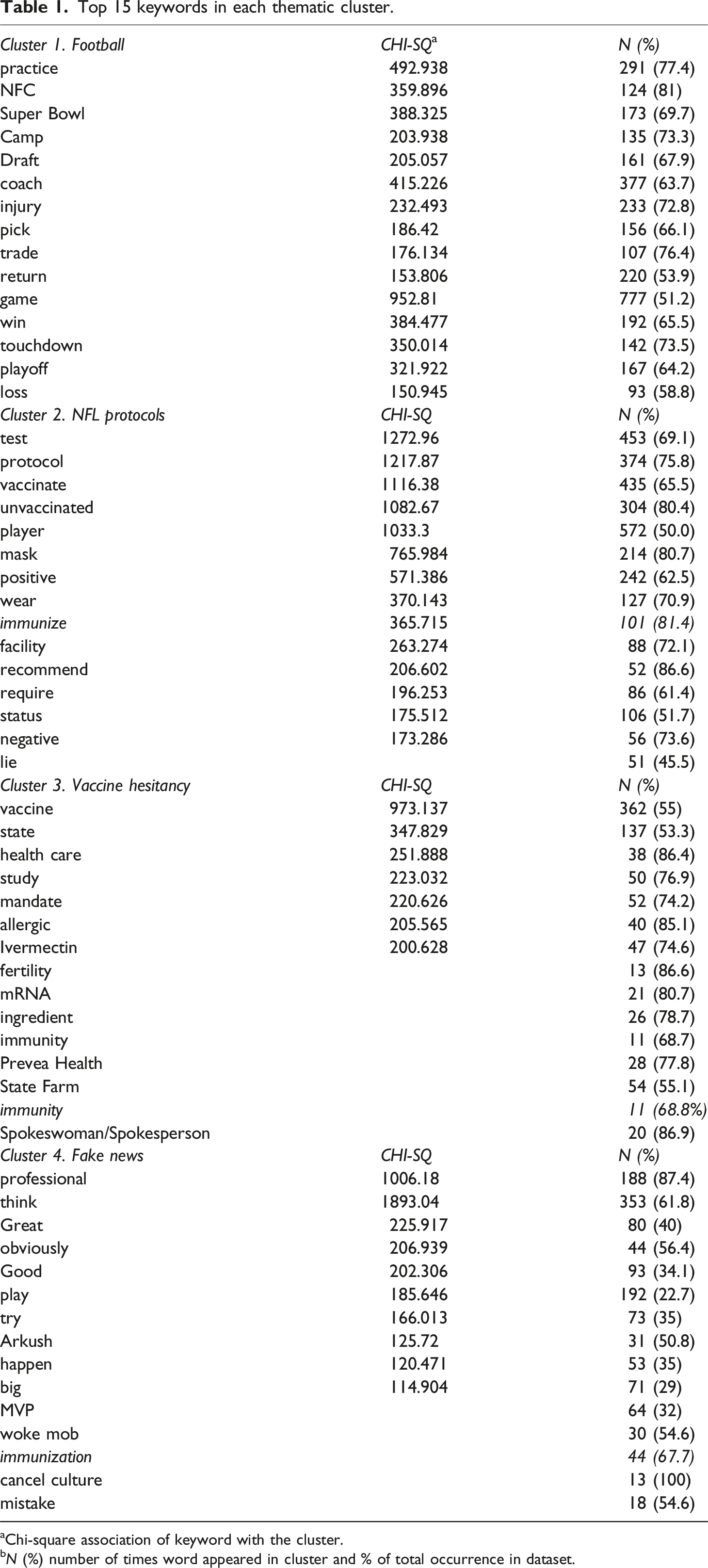
aChi-square association of keyword with the cluster.
bN (%) number of times word appeared in cluster and % of total occurrence in dataset.
Findings
Aaron Rodgers’s COVID-19 saga evolved along the main narratives corresponding to his dual identity in the news media: first, as a four-time MVP awardee and one of the most successful quarterbacks in American football, and second, as an athlete who lied about his vaccination status and got caught in the limelight after testing positive for COVID-19 during the National Football League Championship.
Of the 292 stories included in this study, about 9% were published before he tested positive for COVID-19 (Feb 2020 – Oct 2021, N = 26). Rodgers was mentioned a handful of times each month due to his self-isolation and contrary behavior during the pre-season training camp. About 40% of all stories (115) were published during the breaking news period in November 2021, and the post-incident month (Dec 2021) included 36 stories (12%). The remaining 14 months (Jan 2022 – Apr 2023) included about one story each month (46, 16%), except for November 2021 (N = 21), when news media focused on Rodgers’ plans to resign with the Green Bay Packers or go to another team.
As expected, the overall narratives centered on football and COVID-19, with other thematic clusters shaping the focus of this study. The Super Bowl and the NFL Draft dominated football coverage. COVID-19 appeared in stories negotiating the meaning and value of NFL protocols and in moral considerations regarding Rodgers’ use of equivocation, vaccination versus vaccine hesitancy, and the MVP debate where Arkush attempted to sway MVP votes away from Rodgers in Spring 2022, after the immunized debacle (Table 1).
Football is enough: Ignoring the controversy
The narratives in this first cluster included mostly facts and commentary regarding teams’ and athletes’ performance in the football season and events. Game stats on wins, losses, and athlete performance appeared alongside the NFL Draft, player trading, salary caps, contracts, and injury news. Aaron Rodgers was mentioned mostly through objective details on his game stats and ranking in the NFL quarterback ratings for interceptions and touchdowns. Quotes from his press conference appearances avoided references to his personal or professional life off the field: “Rodgers spoke about wanting to recognize the ‘good old days’ … and acknowledged how special this season has been while playing with three of his closest friends” (Wisconsin State Journal, Jan. 2022).
The Super Bowl discourse focused on reporting or predicting team ranking and performance throughout the championship: “This is the 11th season since the Packers won a Super Bowl with Rodgers at quarterback, and they are 7–8 in playoff games during that span” (Green Bay Press Gazette, Jan. 2022). Most stories speculated on the impact of sports injuries and COVID-19-listed athletes on the fate of the teams for that season. Local media emphasized the pressure on Rodgers to lead his team to another Super Bowl trophy as a possible last dance and a means to punctuate his career (Green Bay Press Gazette, January 2022). Meanwhile, regional newspapers had questioned Rodgers’ loyalty and value to the Packers by intimating that (Packers’ President/CEO) “Murphy must be having second thoughts about not trading Rodgers before the draft … Rodgers has been nothing but a giant headache” (Boston Globe, Nov. 2021).
Coach Matt LaFleur’s name appeared in statements about injuries and recovery athletes experienced during various stages of the football season. Some briefly mentioned Aaron Rodgers’ inability to play while quarantining after testing positive in early November 2021 or while he was waiting out his recovery from a toe fracture in December 2021. In this cluster, however, football was the dominant theme, and COVID-19 was selectively ignored in all media types (national, regional, and local).
Unvaccinated players: NFL and ignoring the health protocols
The second cluster presented stories reporting on the NFL’s COVID-19 protocols, emphasizing the benefits of player vaccination for players, teams, and fans in various narratives. For example, national media (USA Today and Wall Street Journal) tended to present the health protocols (testing, wearing a mask) in neutral terms: Under protocols, … approved by the NFL and NFL Players Association … unvaccinated players are subject to more stringent rules than vaccinated players … required to wear masks at all times when inside the Club facility, including while working out in the weight room, … daily PCR testing.” and “ Unvaccinated players who don't abide by the league’s protocols are subject to fines, and even possible suspension. (USA Today, Nov. 2021)
Conversely, local media (Wisconsin State Journal and Green Bay Packers Gazette) often made their disdain for such protocols known, selecting facts whimsically and alluding to scientific controversy when rejecting the rules. “According to the NFL’s COVID-19 protocols, it is far better for an individual on the team to be vaccinated than not to be. Vaccinated players don’t get quarantined if they test positive for COVID-19. Vaccinated players are not high-risk close contacts for other teammates. It does not matter if the rules are based on science or based on voodoo, they are still the rules. (Wisconsin State Journal, Nov. 2021)
Preferential treatment in athlete coverage becomes evident with pejorative usage of the racist element invoked by using the word “voodoo.” After Rodgers tested positive for COVID-19, the Green Bay Press Gazette was quick to speculate or “raise the likelihood” that inside linebacker De'Vondre Campbell, who tested positive for COVID just before bye week in late November, could have been unvaccinated--because only unvaccinated players were tested that week (Green Bay Press Gazette, Dec. 2021). It is worth noting that the newspaper had not made such inferences before the Rodgers incident and that Campbell is an African American athlete. This discursive thread resonates with previous research on news media discourse allowing privilege narratives to white male professional athletes (Leonard, 2017), particularly in situations where they assumed advocacy positions relative to international affairs (Vilceanu and Richmond, 2022) or race (Rosenbaum, 2019), sexual orientation (Griffin, 1993, 2012), and gender inequality (Cooky and Antunovic, 2020).
By December 2021, some COVID-19 testing terminology made it into mainstream media with blatantly wrong wording. Proctor and Schiebinger’s (2008) first type of ignorance, where journalists did not know or did not understand the terminology, entered the testing and vaccination discourse: The NFL changed its health and safety protocols last week to allow vaccinated players to make a quicker return to play. Under the new guidelines, vaccinated players can clear protocols as soon as the day after they test positive for the virus so long as they are asymptomatic and their viral load is above a certain benchmark. [author emphasis] (USA Today, December 22, 2021)
The correct phrasing would have been “viral load is below a certain benchmark,” or the “cycle threshold (CT value) is above a certain benchmark,” indicating a lower possibility of spreading the virus for the person recovering from a COVID-19 infection. Along with reinventing sports reporting within the complex health protocols, journalists struggled with mostly native (honest) ignorance in incorporating new language into reporting pandemic sports (Gentile et al., 2021).
Personal choice: Vaccine hesitancy and manipulative ignorance
The third cluster emerged as a distinctive topic after Aaron Rodgers tested positive for COVID-19 in early November. In a move of logical filibuster or selective ignorance (type two in Proctor and Schiebinger, 2008), Rodgers anchored his sweeping anti-vaccine position in the handful of breakthrough COVID-19 infections (vaccinated players contracting COVID-19) and a small number of instances where blood clot issues were associated with the Johnson & Johnson vaccine (none among athletes), or unspecified allergies to components in the mRNA vaccines. Rodgers contested the entire science and measurement of COVID-19 testing, vaccination, and quarantining after failing to obtain a medical exemption for COVID-19 vaccination based on research he conducted himself.
After antibody testing determined his status was still unvaccinated, Rodgers suddenly presented the appearance of a vaccinated player by not testing daily, not wearing a mask during press conferences, not isolating himself during team meetings, and possibly participating in commercial or promotional shoots with his State Farm sponsor. Because a broader truth was counterproductive to his goals, he used a handful of data points that had loud support among anti-vaccination groups (perceived inconsistency in the effectiveness of vaccines, permission to return for asymptomatic players regardless of their COVID-19 test status) in a blatant example of manipulative ignorance.
In the aftermath, some reporters and commentators gave credence to Rodgers’ behavior (vaccine refusal) and belief in the false equivalency of effectiveness for homeopathic and alternative treatments instead of the COVID-19 vaccine. For context, in November 2021, President Biden Biden’s vaccine requirement for larger businesses was “temporarily halted” as the “5th US Circuit Court of Appeals granted an emergency stay” and extended the deadline for worker vaccination into January 2022 (USA Today, Nov. 2021).
Some local media published extensive excerpts from Rodgers’ statements on The McAfee Show as a nod to objectivity: “Health is not a one size fits all for everybody” (in Wisconsin State Journal, Nov. 2021). Even in stories that ostensibly take the side of “Aaron Rodgers knows better,” the average reader might struggle to unravel the convoluted arguments that wrap little bits of truth into blatant lies: We all should've been a little hesitant when Trump in 2020 was championing these vaccines that were coming so quick, what did the left say? Don’t trust the vaccine, don't get the vaccine, you’re going to die from the vaccine. And then what happened? Biden wins, and everything flips. (Wood, Green Bay Press Gazette, November 6, 2021).
The NFL and the regional and national newspapers invalidated Rodgers’ claims that he had submitted a 500-page document to the NFL explaining his homeopathic treatments and asking for an exemption from the COVID-19 vaccine. Here, the narrative is mainly factual and relatively free of interpretation: His decision to not receive one of the three vaccines approved in the US was based on extensive research about what was best for his body. He claimed that he was allergic to the two mRNA vaccines, from Pfizer and Moderna, and did not trust the one-shot vaccine from Johnson & Johnson. He did not specify his allergy (Beaton & Cohen, Wall Street Journal, November 5, 2021).
Initially, Rodgers’ beliefs about vaccines versus alternative treatments might have qualified as selective ignorance. However, his strategy of using the term “immunized” for his regiment of ingesting various substances he believed would boost his immune system in a press conference to answer the question of whether he was vaccinated is a textbook example of manipulation. In his podcast interview, Rodgers stated that he had “an allergy to an ingredient that’s in the mRNA vaccines,” most likely inferring the Polyethylene glycol (or PEG) known to trigger very rare but severe allergic reactions. Without proof of said allergy, he picked the small details that helped him make a big statement explaining his vaccine refusal.
This is where he crossed from misunderstanding complex science into misrepresentation and misdirection. In the words of Olson, whose opinion was published in the Wisconsin State Journal on November 6: “No, he didn't lie - he purposely misled us. That in itself was deceitful […] Everyone is complicit here […] today, a fifth-grader knows… the vaccine […] it’s been tested for over a year and a half and proved safe and effective.”
Two of Rodgers’ sponsors, Prevea Health and State Farm, emerged from the vaccine hesitancy discourse on different sides. The former immediately discontinued the partnership with Rodgers, who had acted as a spokesperson for some of the Wisconsin initiatives for over ten years, and the company continued to promote vaccination as a public health policy (Arseneau in USA Today, November 6, 2021). Most news media repeated this news with slight variation. Meanwhile, State Farm got lambasted for choosing “to equivocate with what apparently is a calculated business decision” and “singular focus on its bottom line, … a far less courageous and principled company” and their spokeswoman’s statement that while State Farm does not “support some of the statements that he has made,” they “respect his right to have his personal point of view” in the name of “both sides” of the argument (Brennan in USA Today Online, November 8, 2021).
Individual agency: Fake news and mythmaking
This fourth cluster was the most negative in its coverage of both Rodgers and sports podcaster and NFL MVP voter Hub Arkush, who publicly campaigned that Rodgers should not win the MVP title in 2022 because of his massive lie regarding COVID-19 vaccination. The term agency in this context refers to the ways in which public figures and journalists reconcile their understanding and responsibilities. Individually, the term agency indicates humans’ ability to juggle reflection, experiences, and norms when interpreting and directing their lives (Doris, 2015). Within the public sphere, agency lives at the intersection of deliberative democracy as a requirement and filter of language games (Habermas, 2007), communicative rationality (Rienstra and Hook, 2006), and social movements (Edwards, 2004).
When Arkush called Rodgers a “bad guy” who “carried himself” in an “inappropriate way” (in Wisconsin State Journal, Nov. 2021), Rodgers called Arkush “a bum … an absolute bum… [who] doesn't know me. I don’t know who he is.” (USA Today, Jan. 2022). Discursive agendas are evident in this cluster: Arkush was upholding the practices of professional journalism, reminding the voters (other journalists) that the MVP title carries obligations of morality in addition to the recognition of exceptional athletic abilities: “I don’t think a bad guy can be the most valuable guy at the same time.” In broader terms, Arkush also questioned the meaning of the MVP designation: Does it refer to “strictly on the field,” and does it include any actions or consistent behavior that might have indirectly hurt the team (USA Today, Jan. 2022)?
Throughout the incident and subsequent period, Rodgers and his team representatives acted as if the immunization dispute had not happened. Even references to Rodgers’ “lengthy public comments” in the Pat McAfee podcast after Rodgers tested positive for COVID were normalized or glossed over by Coach LaFleur as “[not] a distraction to the team… [the team] do a great job worrying about playing football.” (Wisconsin State Journal, November 2021).
Manipulating the focus of the conversation, Rodgers emphasized that having decided that he would not vote him for MVP before the season began essentially disqualified Arkush’s vote (Chicago Tribune, Jan. 2022). More importantly, Rodgers implied that Arkush was no better than a regular paparazzi when he said, “Nobody knew who he was, probably, until yesterday’s comments” (USA Today, Jan. 2022). Compartmentalizing MVP as strictly about football performance on the field, Rodgers claimed the higher ground with the other voters: “If voters want to use the offseason, or don’t like my stance on being unvaccinated, that’s their prerogative.” (USA Today, Jan. 2022). Rodgers once again framed any criticism as a distraction from football is enough and used a very skilled discursive manipulation of the term unvaccinated—a term he never used to describe his vaccination status prior to being proven a liar about the issue after he tested positive for COVID-19.
Discussion
The present study contributed new insights into the dynamics of ignorance, objectivity, and privilege in news media reporting of and within manipulative communication tactics related to vaccine hesitancy. This research illustrates the journalistic themes of famous sports figures on public health and social policies and the dual function of sports journalists tasked with reporting on game-related sports news while explaining how sports impact broader societal issues. Thematic analysis identified four clusters: ignoring the controversy, ignoring the health protocols, vaccine hesitancy and manipulative ignorance, and fake news and mythmaking.
Inherent to discussing vaccination status among celebrity athletes are issues of power, privilege, and truth claims with the potential of meaningful societal impacts. After Rodgers’ lie was exposed, the news media narratives revealed the tensions between the authority, which relies on prescribed metrics and methodology, and the authoritative, which instrumentalizes power to amplify fringe attitudes and open all knowledge up for debate. Public voices struggled with agnotology and fake knowledge as disruptors of authority during the COVID-19 pandemic. The realities of the COVID-19 pandemic magnified each position, compounding excessive media consumption, physical isolation, fear, and uncertainty.
As seen in previous research of journalistic patterns, news coverage of the Rodgers incident fell strongly along adversarial parameters (Reed, 2018), with stories often expressing skepticism about any form of administration—be it at the level of team management, league management, or even the Center for Diseases Control (CDC). The Rodgers incident pushed sports journalists outside their comfort zone, “football is enough.” The lack of deep knowledge about COVID-19 and the mRNA vaccines hit hard across all the digital communication channels, undermining most efforts to create attention-grabbing, human-interest, informed stories—compounding the personal crisis of living during the COVID-19 pandemic and the preexisting professional crisis in a media industry that challenged the standards and practices of sports journalists (McEnnis, 2021). “Unvaccinated players” revealed significant differences in the coping strategies, with journalists toeing the official vaccination line in national newspapers and openly opposing it in the smaller newspapers.
Perhaps the most problematic finding resides in “personal choice” and the post-reveal news coverage. The surprising lack of condemnation toward Rodgers’ lie from the team, management, or league indicates the growing savviness and power of the NFL’s in-house media (English et al., 2022). The incredible success of the manipulative ignorance tactics draws attention to the degree to which journalists now rely on organization-provided content, heavy with promotion and careful to avoid potentially conflict-generating truths, thus blurring the lines between journalists-led media inquiry and public relations-led media strategies.
Finally, the brief yet intense spat between Rodgers and Arkush revealed the explosive potential of evolving media and technologies. This incident should have been a clear-cut discussion about the impact of egregious lies, symbol status, and eventual legacy once Rodgers inevitably retired. Instead, it became a brawl that negated the watchdog role and emphasized the uncontested loyalty and cheerleader role of sports journalists (English et al., 2022) as fans of both the sport of football and specific professional athletes. Usage of peripheral digital media (Rojas-Torrijos and Nölleke, 2023) such as podcasting, blogs, and other social media allowed professional athletes, unaffiliated media producers, and algorithmic promotion of messages to irrevocably alter the patterns of sense-making (Perreault and Bell, 2022; Rojas-Torrijos and Nölleke, 2023). Careful selection and categorization of information, exploiting the boundaries of selective and manipulative ignorance, challenged the definitions and rules for truth, the MVP Award, and the roles and responsibilities of sports journalists and professional athletes.
As the landscape of sports reporting continues to evolve beyond game-related context, journalists must understand their role in creating salient themes in public discourse. The Rodgers “immunization” incident illustrates the complex relationships between athletes, journalists, and public opinion beyond football.
Limitations and future research
In retrospect, everyone should have been more circumspect when the language of vaccination changed to immunization—and maybe these patterns were observed overtly in forums explicitly opposing vaccination. The allowances provided to Rodgers speak of the privilege granted with minimal application of journalistic standards in the news coverage of this incident. Future research should explore communication tactics within platforms where persuasion, rather than objectivity, represented the goal, thus deconstructing the interplay of different types of ignorance, privilege, and agency in the anti-vaccination discourse.
Footnotes
Declaration of conflicting interests
The author(s) declared no potential conflicts of interest with respect to the research, authorship, and/or publication of this article.
Funding
The author(s) received no financial support for the research, authorship, and/or publication of this article.
