




Abstract
This study examines journalism’s role in bridging divides by presenting diverse perspectives in societal debates. While prior research has emphasized the significance of diverse news content, this study investigates how audiences perceive and value such diversity and its impact on their attitudes. Through an online experiment in the Flemish (Belgian) context, it was found that actor diversity is more noticeable, yet increasing diversity in actors and viewpoints does not enhance a news item’s perceived credibility. Moreover, although people are influenced in the direction of the viewpoint provided in a one-sided article, it appears that when a diversity of viewpoints is presented, people tend to primarily consider those opinions that already align with their pre-existing viewpoints. By gaining a deeper understanding of how audiences receive news coverage, journalists can critically evaluate the voices they present and contribute to a more diverse public debate.
In recent years, democracies all over the world have been moving toward increased political polarization (Carothers and O’Donohue, 2019; McCoy et al., 2018). The role of journalism in helping bridge political divides and the need for news media to present diverse voices in societal debates are often discussed in this regard. A core democratic function of news media is keeping the public informed about what is going on in society (Gans, 2004). This, in turn, helps citizens develop informed opinions on political issues and participate in democracy. Due to its democratic function, news media are expected to inform the public on matters of public policy by presenting debates, offering alternatives, and providing a platform for a diverse range of voices in the news (McNair, 2009; Schultz, 1998; Thompson, 1995). The diversity of news content has garnered substantial attention in academic research, societal debates, and policymaking. However, for content diversity to fulfill its democratic role, citizens must be not only exposed to it but also ‘receive’ it. This study seeks to investigate whether audience members notice when news media incorporate diversity and whether it affects their perceptions and judgments of the news item and the issues covered.
In existing empirical research, news diversity as received by audiences is often neglected at the advantage of more comprehensive analyses centered around the supply side of news content (Hendrickx et al., 2022). A large part of the literature analyzes the diversity of news content, often referred to as “internal news diversity” (Van Cuilenburg, 1999). To date, extant research has conceptualized and analyzed both the diversity of actors (e.g., Beckers and Van Aelst, 2019; Bennett, 1990; Benson, 2009) and the diversity of viewpoints (e.g., Masini and Van Aelst, 2017; Voakes et al., 1996) in the news. These studies conclude that some news topics are covered in a more diverse way than others, but that elite voices dominate such discussions and that issues are often presented in a one-sided manner. Another strand of studies looks at the broader diversity of news supply in the media landscape (“external diversity”), focusing on the diversity of news outlets and the influence it has on content diversity (Beckers et al., 2019; Boczkowski and De Santos, 2007; Hendrickx, 2020). Here, it is often observed that a more diverse news supply does not necessarily lead to more diverse content, as many outlets tend to offer considerably similar content in terms of actors and viewpoints. All these studies seem to agree, though, that more news diversity is beneficial for society as a whole.
However, the long-held view that citizens will automatically have a more varied media diet and more diverse viewpoints if only media offer diverse content is no longer taken for granted (Van der Wurff, 2011). Referred to as “exposure diversity,” a growing number of studies consider how audiences receive diversity in the news (e.g., Van Rees and Van Eijck, 2003; Webster and Ksiazek, 2012). However, most of these studies focus on the diversity of the news supply, i.e., the number of news outlets present in a media market. Despite the proliferation of (online) media outlets and expanded opportunities for diverse media consumption, audiences remain fragmented, often choosing to follow only a limited number of outlets (Van Rees and Van Eijck, 2003; Webster and Ksiazek, 2012). Based on these findings, it would appear that most people prefer not to consume diverse news outlets. However, despite the finding that many people stick to their preferred medium, this does not mean they do not value diversity. In Europe, public service media, designed for internal diversity, consistently rank among the most trusted (EBU, 2022). Rather than reading both right-wing and left-wing sites, for instance, some might prefer outlets that offer high diversity within their content, highlighting relevant positions from both sides.
Less is known about the influence of this content diversity within news content on audiences. Does a more ‘diverse’ news story in terms of actors and viewpoints lead to more diverse and nuanced attitudes towards that story? And do people even notice the presence of content diversity in news stories to begin with? In an online experiment conducted in Belgium, involving 987 adult participants, the aim is to examine how actor and viewpoint diversity in two news issues affect audiences’ perceptions of the news item and their perspectives on the news issue itself.
News diversity
Traditionally, research on news diversity has primarily focused on the supply side of the news. News content diversity, often referred to as ‘internal news diversity’ (Van Cuilenburg, 1999), has been a recurring theme in news media research. News content diversity encompasses various characteristics, including diversity in topics (Abdulla, 2017), frames (Voakes et al., 1996), sources (Voakes et al., 1996), stories (Beckers et al., 2019), and geographical representation (e.g., foreign vs domestic; Abdulla, 2017). In political news coverage, emphasis is often placed on the diversity of viewpoints and actors, as these elements are frequently associated with journalistic quality. The presence of multiple voices in news media is considered critical for a healthy democracy (Hansen, 1991; McNair, 2009; McQuail, 1992). It is important to distinguish between actor diversity and viewpoint diversity, as some studies (e.g., Voakes et al., 1996) have shown that higher actor diversity does not necessarily lead to a greater variety of perspectives. Conversely, other research (Masini and Van Aelst, 2017) has identified a correlation between actor and viewpoint diversity.
Regarding actor diversity, many studies have focused on the distribution of actors in terms of affiliation or status (e.g., elite vs non-elite), employing differing numbers of categories (Beckers and Van Aelst, 2019; Benson, 2009; Vandenberghe et al., 2015). Almost consistently, these studies conclude that it are mostly elite sources, particularly political actors, that receive the bulk of the attention across media outlets and systems. Another core dimension of news content diversity is viewpoint diversity. Logically, achieving a plurality of perspectives requires a diversity of viewpoints in the news. Voakes et al. (1996, p. 585) provided an encompassing explanation of viewpoint diversity as the spectrum of “concepts, perspectives, attributions, opinions, or frames within a news offering.” Griswold (1999) considered viewpoint diversity to be more important than actor diversity, as it is ultimately the diversity of viewpoints that ensures the democratic benefit of content diversity, offering readers a multitude of perspectives on a given topic. Several studies have investigated viewpoint diversity in the news, examining frame diversity (Hanitzsch and Mellado, 2011; Van Gorp, 2005) or political viewpoints and/or slant (e.g., Hayes and Guardino, 2010; Ho and Quinn, 2008).
While numerous studies have traditionally focused on diversity within news content as provided by journalists, recent scholarship, influenced by Napoli (1999), has expanded the understanding of news diversity beyond content alone. Napoli proposed a comprehensive classification of news diversity, encompassing ownership, source, content, and exposure diversity. This framework has served as inspiration for similar categorizations of news diversity along various dimensions. For instance, Sjøvaag (2016) proposed organizational, structural, production, output, and reception diversity, while Hendrickx et al. (2022) outlined diversity in terms of ownership, brand, production, content, and consumption. All of these models share the underlying idea that news content diversity is an integral component of a broader, multifaceted framework. They are built on the premise that multiple factors, including the composition of the media system, market dynamics, organizational influences, and editorial decisions, can collectively shape news diversity in diverse and complex ways. This includes the consideration of how audiences interact with news content and use it to shape their own viewpoints on critical issues.
Indeed, for a diverse news supply to have a democratic effect, audiences must receive it to begin with. It is through the consumption of diverse ideas, sources, and perspectives that citizens can make well-informed decisions in democratic societies (Sunstein, 1993). From this perspective, the marketplace ideal is not fulfilled solely through the provision of a variety of content but also necessitates that citizens are exposed to diverse perspectives and content. Several scholars have developed conceptualizations to understand how audiences engage with news diversity, using terms like exposure diversity (Napoli, 1999), reception diversity (Sjøvaag, 2016), consumption diversity (Hendrickx et al., 2022), or diversity as received (McQuail, 1992). However, in most cases, their focus has been on the diversity of the news supply (‘external diversity’), studying the choices individuals make regarding which outlets to consume. This has recently gained academic traction in the context of digitization, with a particular focus on algorithmic news recommender systems. These systems play a significant role in shaping the news consumption patterns of individuals, with people consuming news items from a larger variety of news outlets, and articles appearing higher in search results often having a higher readership (Hendrickx et al., 2021; Loecherbach et al., 2021; Mattis et al., 2021).
Relatively fewer studies have examined diversity within news content or whether people are even aware of the presence or absence of diversity in news content; i.e., do they perceive a diverse news item to be more diverse? An exception is a study by Urban and Schweiger (2013) on news quality perceptions, which found that people perceived a high-quality news item containing different viewpoints and actors at the same time to be more diverse than a low-quality news item containing fewer viewpoints and actors. Hendrickx and colleagues (2024) found similar results regarding viewpoint diversity. However, their study did not take actor diversity into account. Given the limited research on diversity perceptions that disentangles the influence of actor and viewpoint diversity, a first research question is proposed.
Are people aware of the presence of news content diversity in terms of actor and viewpoint diversity?
Credibility perceptions
The trust citizens place in traditional news media is closely linked to their engagement with these media outlets (Kalogeropoulos et al., 2019). A common categorization scheme divides credibility into three primary domains: source, medium, and message (Metzger et al., 2003). In these domains, credibility is typically assessed in terms of attributes such as accuracy, trustworthiness, impartiality, and objectivity (Henke et al., 2019). Interpreting these concepts in different ways can affect whether content diversity would be considered beneficial or not. For accurate reporting, diverse viewpoints may not always be necessary. A narrow interpretation of objectivity as just separating facts from opinions might make diversity not always crucial. However, impartiality often seems to require diversity, assuming legitimacy among various parties.
On the one hand, there are reasons to expect that audiences will perceive diverse news items as credible. Diverse viewpoints are a main principle of “objective” journalism (Schultz, 1998), which is generally perceived as higher quality by audiences. It is also emphasized as a central journalistic principle in various editorial guidelines and media policies (Klimkiewicz, 2009). On the other hand, audiences might find one-sided stories more comprehensible and less complex (Benson, 2009), and therefore more attractive, especially when they align with their own views on the topic (Hendrickx et al., 2024; Metzger et al., 2020). Indeed, empirical research finds that despite an increase in (online) media outlets and greater opportunities to consume a diverse media diet, people tend to opt for a limited set of outlets (Van Rees and Van Eijck, 2003; Webster and Ksiazek, 2012), indicating that people do not automatically appreciate more diverse content.
Most studies indicate a positive effect of news content diversity on audiences’ credibility perceptions. For instance, Metzger et al. (2020) found that people attributed greater credibility to news stories when presented with a balanced set of viewpoints on political issues, using an online experiment. Choi and colleagues (2021), through a multi-method study combining a large survey with various types of news content analysis, discovered that it is not the linguistic or formal characteristics of a news item but news values (including diversity) that are the strongest predictors of news quality evaluation by audiences. Similarly, other empirical studies have suggested that citing scientific sources and using statistical information (Henke et al., 2019), as well as quoting both official and non-official actors in reporting, can enhance the perceived credibility of news reporting (Cozma, 2006).
People will perceive the diverse actor conditions to be more credible than the one-actor and control conditions
People will perceive the diverse viewpoint conditions to be more credible than the one-sided and control conditions
Attitudinal change
From a normative perspective, journalists ought to strive for diversity in the content they produce because, in a democracy, citizens need access and active exposure to a wide range of news and information (Schultz, 1998; Thompson, 1995). To accommodate competing interests within the democratic process, there need to be spaces in which citizens can be exposed to the views of their fellow citizens, and often these spaces are news media (Keane, 1991).
In the landscape of research on how individuals’ viewpoints are influenced by diversity within news content, one of the few studies is that of Van der Wurff (2011), which investigated how Dutch and Irish citizens engage with diversity when presented with news content centered around European integration. Notably, van der Wurff found that factors such as interest and familiarity with the subject matter emerged as stronger predictors of having diverse perspectives than media exposure to those perspectives.
Most research specifically focused on the influence of actual news content diversity on audience perceptions measures the impact at an aggregate rather than individual level. For instance, Van der Wurff (2011) explored the connection between media consumption and viewpoint diversity by surveying participants about their media consumption habits and the various perspectives they encountered. Huang (2009) compared a content analysis of media frames with the frames audience members held, revealing that media frame diversity corresponds to audience frame diversity at an aggregate level. In a study examining the relationship between diversity in the media agenda and the public’s agenda on an aggregate level, Peter and De Vreese (2003) found a positive relationship between the diversity of television news agenda and public agenda diversity in Denmark.
While these studies provide valuable insights, they do not establish causal effects of news content diversity on viewpoint diversity. Nonetheless, they do suggest a connection between the diversity of the news content supply and audience viewpoints. Thus, the following hypotheses are proposed:
People exposed to diverse viewpoints in a news item will have more nuanced attitudes toward the news issue as compared to people exposed to a one-sided news item
The combined presence of high actor and viewpoint diversity in a news item will exert a stronger influence on individuals’ attitudinal changes towards the news issue compared to news items characterized by high diversity in either actors or viewpoints alone.
As mentioned before, people tend to expose themselves to news content that aligns with their own pre-existing views (Metzger et al., 2020). The theoretical foundations hereof lie in selective exposure theory, which posits that individuals actively choose information that aligns with their existing beliefs and attitudes (Stroud, 2008). Moreover, this can be linked to “confirmation bias” (Nickerson, 1998), which describes the cognitive process that occurs after information is encountered. Here, even when exposed to diverse information, people often give more weight to and are influenced more by information that reinforces their existing point of view while downplaying or dismissing contradictory information (Sude and Knobloch-Westerwick, 2022). These two separate processes both can come into play when it comes to consuming (diverse) news content and might even result in a reinforcement pattern.
Building upon these theories, this study incorporates political orientation as a key moderator in the relationship between viewpoint diversity and attitudinal change. Political orientation is recognized as a fundamental factor influencing information processing and decision-making on political topics (Hahnel et al., 2020). Given the focus on socio-economic and sociocultural political issues, this study explores how political orientation moderates the impact of news content diversity, specifically in terms of actor and viewpoint diversity, on people’s attitudes.
What is the moderating role of people’s political orientation in how news content diversity influences people’s attitudes toward the news issue?
Methodology
To test the influence of news content diversity on diversity perceptions, news item credibility, and attitudes towards the issue, an online survey experiment was conducted in Flanders, Belgium. The experiment has a 2 (news issue: socio-economic, sociocultural) by 3 (viewpoint diversity: low viewpoint diversity in favor; low viewpoint diversity against; balanced viewpoint diversity) by 3 (actor diversity: expert; civil society actor; diverse actors) experimental design, supplemented by a control condition containing only the basic news item without quoted actors or viewpoints.
Experimental conditions.
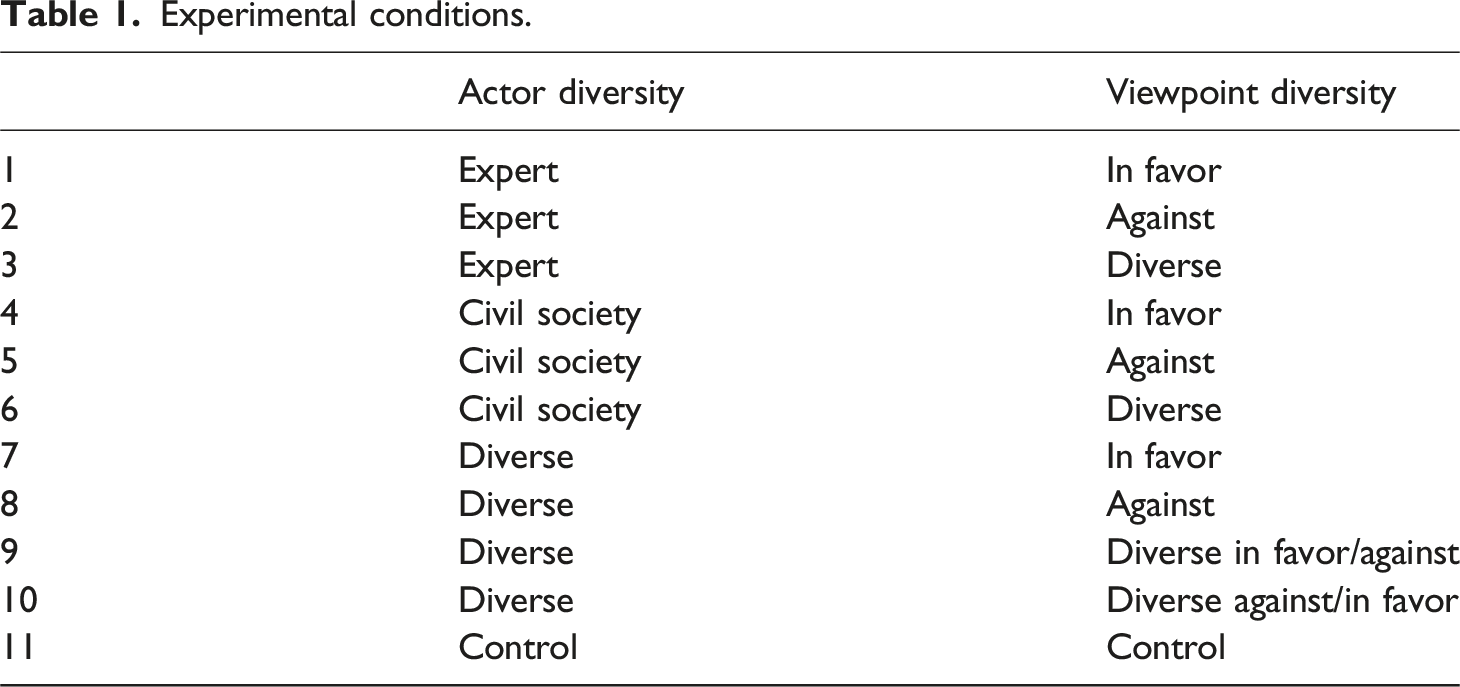
In the conditions with low actor diversity, either an expert (“expert e-commerce” for the socio-economic issue and “immigration expert from university” for the sociocultural issue, respectively) or a representative of a civil society organization (a representative of a consumer organization or representative of civil society organization that protests for or against the issue, respectively). In the conditions with high actor diversity, both the expert and the civil society actor were quoted.
The conditions with low viewpoint diversity contained only a viewpoint in favor or against, regardless of the number of actors (so in the diverse actor conditions, both actors gave the same viewpoint). In the diverse viewpoint condition, either one actor gave two different viewpoints, or different actors gave different viewpoints. The condition with diverse actors (both an expert and a civil society actor) and diverse viewpoints (in favor and against in one item), consisted of two versions, one in which the expert gave the opinion in favor, one in which the civil society actor did. For the analyses, these two conditions were taken together as the diverse condition. Table 1 lists all the different conditions.
This experiment was conducted in the Flemish context, which is known for its overall relatively high levels of trust in the mainstream news media (Picone, 2023) and a strong position of the public service broadcaster. It is characterized by high levels of journalistic professionalism (Hallin and Mancini, 2004). Study participants were recruited using Dynata, a survey distribution service, which uses quota sampling to produce a sample that is representative of the Flemish population in terms of age, gender, and level of education. Following IRB approval, the study was fielded from February 10–28, 2023. In total, 1321 people finished the survey. Speeders, respondents who spent less than 25% of the time it takes to complete the survey on average (less than 384 s) finishing the full survey, were removed. Consequently, all respondents finishing the survey in less than 384 s were removed. Moreover, participants who spent less than 22 s on the page with the experimental stimuli were excluded from the analysis. A total of 987 respondents were included in the final study. There were on average 45 people per experimental condition (SD = 3.8), with a minimum of 37 and a maximum of 50.
56.4% of the participants identified as female, 43.5% as male, and 0.1% as other. The average age was 51 years old (SD = 17.92). 2.1% of participants had no education, 5.0% completed primary school, 56.5% completed secondary school, 25.8% held a higher education non-university degree, and 10.5% attained a university degree. In terms of their political alignment on a left-right scale (“In politics, people sometimes talk of “left” and “right”. Where would you place yourself on this scale, where 0 means left and 10 means right?”). The average was 5.47 (SD = 2.16), so our respondents overall were slightly right-leaning. In Figure 1, the distribution of participants based on their political alignment is visualized. Political orientation of participants on left(0)-right(10) scale.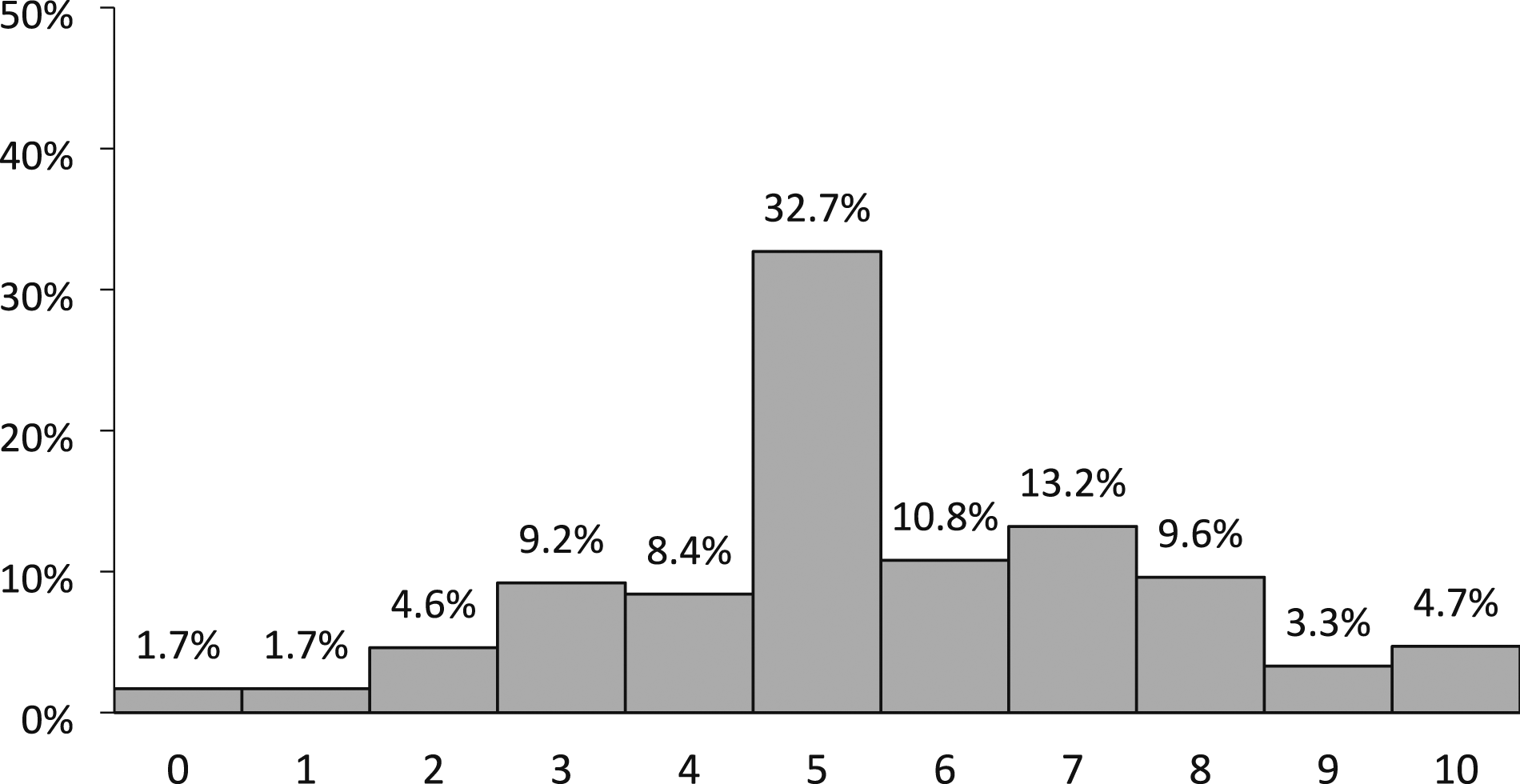
Randomization checks were conducted to check if participants were randomly divided across conditions. Randomization was successful for age (F (10, 974) = 1.33, p = .212, gender (X2 (1, N = 104) = 1.7, p > .05) level of education (X2 (20, N = 987) = 18.10, p = .581), and political orientation (F (10, 976) = 2.46, p = .861.
Dependent variables
After exposure to the experimental stimulus article, participants’ personal attitudes towards the issues were surveyed by asking: “We are interested in your personal attitude regarding higher parcel shipping costs. What is your preference?” The response options ranged from ‘The shipping costs for online orders should not increase (1)’ to ‘The shipping costs for online orders may increase (7)’ for the socio-economic issue. For the sociocultural issue, we asked: “We are interested in your personal attitude regarding more investments in asylum centers. What is your preference?” with response options ranging from ‘No expansion of asylum centers (1)’ to ‘Expansion of asylum centers (7)’.
To measure the credibility of the news item, a scale based on Gaziano and McGrath (1986) was employed. Participants were asked for their opinion on the news item they had just read, using statements such as “The news item was believable,” “The news item was balanced,” “The news item contained reliable information,” “The news item was accurate,” “The news item reported honestly on the subject,” and “The news item was understandable.” Participants responded on a 7-point scale ranging from ‘strongly disagree’ to ‘strongly agree’. Using the same question format, perceptions of diversity were also assessed using three items: “The news item contained various points of view,” “The news item included a diversity of actors,” and “The news item presented different voices in the debate.” These items were also measured on a 7-point scale going from ‘strongly disagree’ to ‘strongly agree’.
Results
Do people notice diversity?
Our first analysis to test whether audiences in the first place notice diversity, consisted of a two-way independent ANOVA with the experimental manipulations (actor and viewpoint diversity) as independent variables, and diversity perceptions as dependent variable, followed by Bonferroni post-hoc tests.
Analysis of variance with diversity perceptions as dependent variable.
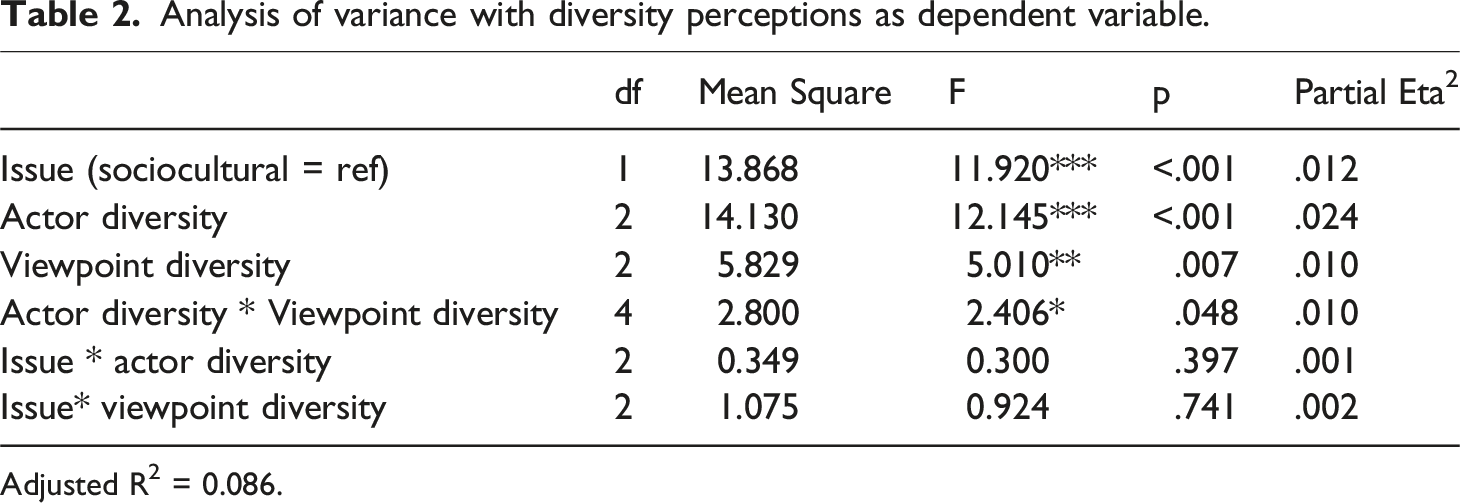
Adjusted R2 = 0.086.
Regarding viewpoint diversity, all news items containing viewpoints (both the one-sided and the diverse ones) were perceived to be significantly more diverse than the control condition (M = 3.87, SD = 1.03). Moreover, news items containing more than one viewpoint—regardless of the number of actors giving these viewpoints—were perceived to be more diverse (M = 4.60, SD = 1.10) than the news item with a viewpoint in favor of the issues (M = 4.26, SD = 1.13), but no significant difference was found with the conditions against (M = 4.53, SD = 1.13).
Regarding news issue (F(1, 970) = 11.920, p < .001, partial η2 = .012), the socio-economic news item on delivery services overall was perceived to be more diverse (M = 4.60, SD = 1.12) than the sociocultural news item about immigration (M = 4.26, SD = 1.11). However, the direction of the effects of actor and viewpoint diversity moved in the same direction, as none of the interaction effects reached significance.
A significant interaction effect between actor and viewpoint diversity was found, though (F(4, 970) = 2.406, p = .048, partial η2 = .010), which is visualized in Figure 2. For the news articles with low actor diversity that only contain an expert or civil society actor, there is no difference between the condition with a viewpoint in favor, against, or the diverse condition. It thus seems that it are mostly the traits of the actors that steer perceptions of diversity here. In the case of diverse actors, when both actors express an opinion in favor, people perceive it as less diverse than the other conditions containing diverse actors. No difference is found between the conditions in which the two actors present viewpoints against and the conditions in which the two actors present two different viewpoints. Both are perceived as the most diverse of all experimental conditions by the participants. This difference between the one-sided article in favor, and the one-sided article against is interesting. As the two actors both being critical of the basic premise of the proposed policy in the article is seen as more ‘diverse’ than when both actors give a viewpoint in line with the base-rate article. It seems that people seem to perceive that true diversity in reporting emerges only when multiple voices are present, and at least one of them adopts a critical stance toward an issue. Interaction effect of actor diversity and viewpoint diversity on diversity perceptions.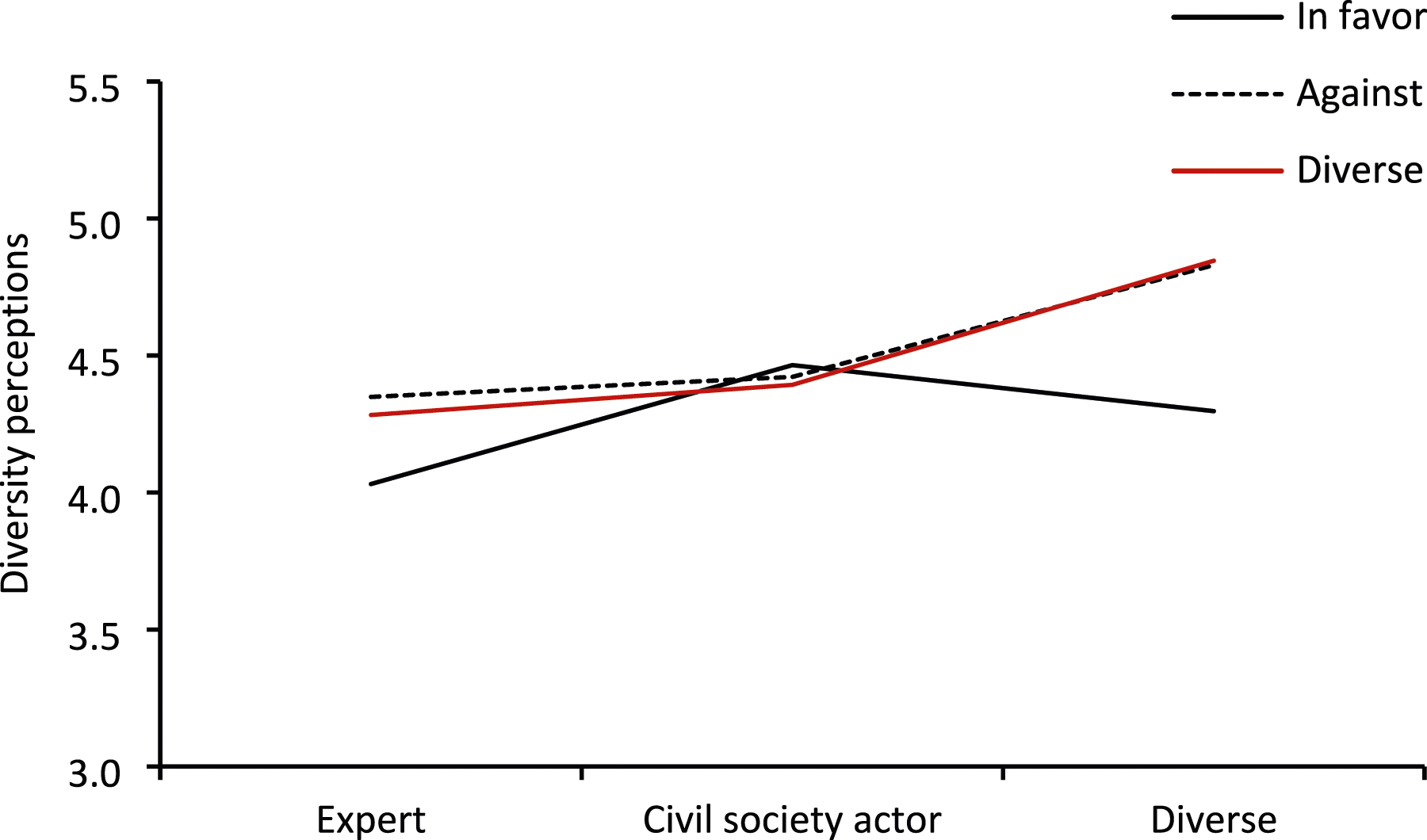
Do people find diverse news more credible?
Analysis of variance with perceived news item credibility as dependent variable.
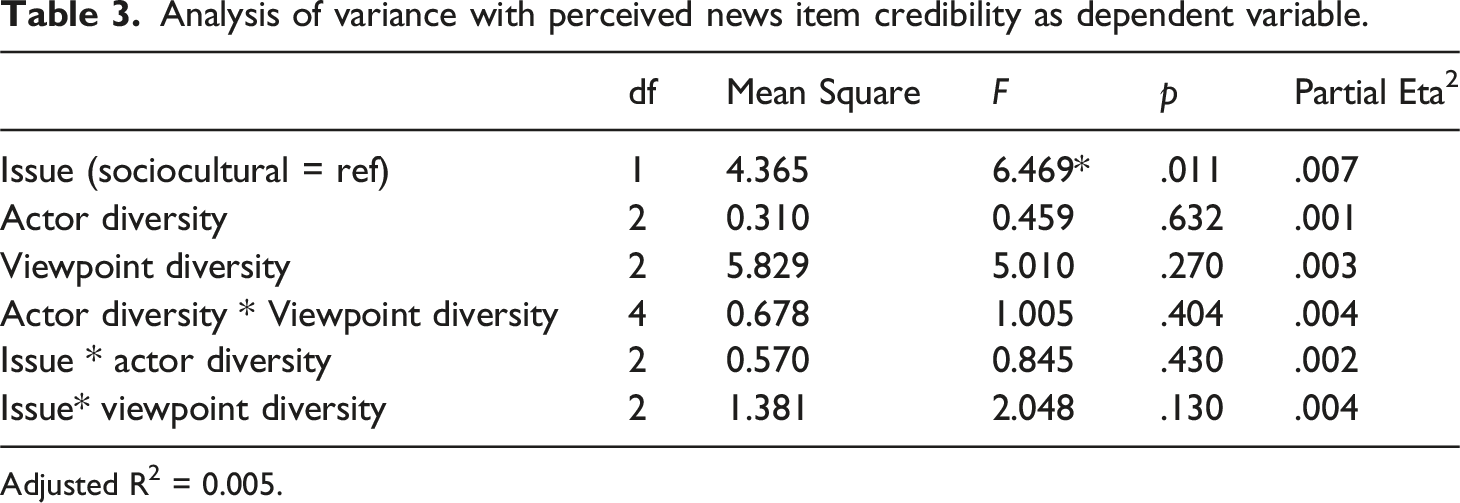
Adjusted R2 = 0.005.
Are people influenced by diversity?
Analysis of variance with attitudes towards the issue as dependent variable.
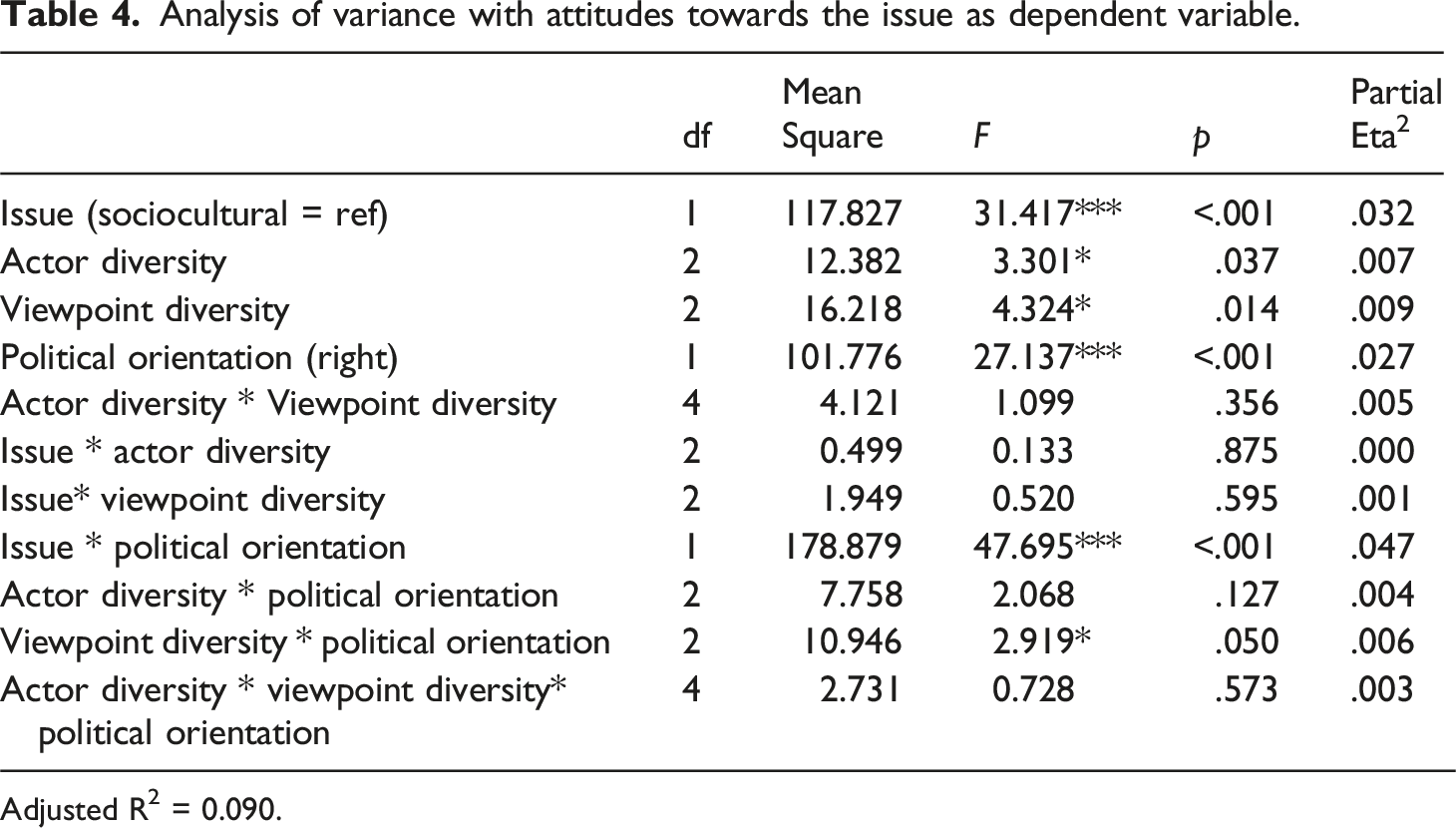
Adjusted R2 = 0.090.
Even though individuals perceived the news item with multiple actors as being most diverse (as indicated in Table 1), actor diversity in itself seems to affect people’s opinions on the issue, with people in the diverse actor condition being less supportive overall (M = 3.27, SD = 2.01) than participants in the one-actor (MExpert = 3.49, SDExpert = 2.07; MCivil society = 3.68, SDCivil society = 2.03) or control conditions (M = 3.54, SD = 1.98); F(2, 960) = 3.301, p = .037, partial η2 = .007. There is also a main effect of viewpoint diversity; F(2, 960) = 4.324, p = .014, partial η2 = .009. People tended to become more supportive after reading an article in favor of the issue (M = 3.72, SD = 2.06), more opposed after reading an opposing article (M = 3.12, SD = 1.96), and adopted, on average, a position in-between the previous two when exposed to a balanced perspective (M = 3.53, SD = 1.98), which did not differ significantly from the control condition (M = 3.54, SD = 1.98), according to Bonferroni-adjusted post hoc tests. Particularly, the condition opposing the issue had a strong influence and differed from the other conditions. An interaction effect between actor and viewpoint diversity was not found, and we did not establish the cumulative effect of actor and viewpoint diversity on attitudinal change as formulated in H2b.
The strong effect size for political orientation warrants further investigation into the role of political orientation. Indeed, a significant interaction effect between political orientation and viewpoint diversity is found; F(2, 960) = 2.919, p = .050, partial η2 = .006. As visualized in Figure 3, for all conditions, a more right-leaning political orientation resulted in less supportive attitudes toward the issue. However, this effect was even stronger for the diverse viewpoint condition. It appears that when different viewpoints are presented, people tend to primarily consider those opinions that already align with their own political orientation. Hence, although the main effect for viewpoint diversity seemed to indicate support for H2a, with people ending up with more nuanced attitudes toward the issue after exposure to the diverse condition as compared to the one-sided conditions, this interaction effect demonstrates that reality is more complex. Interaction effect between viewpoint diversity and political orientation with attitudes towards the issue as dependent variable.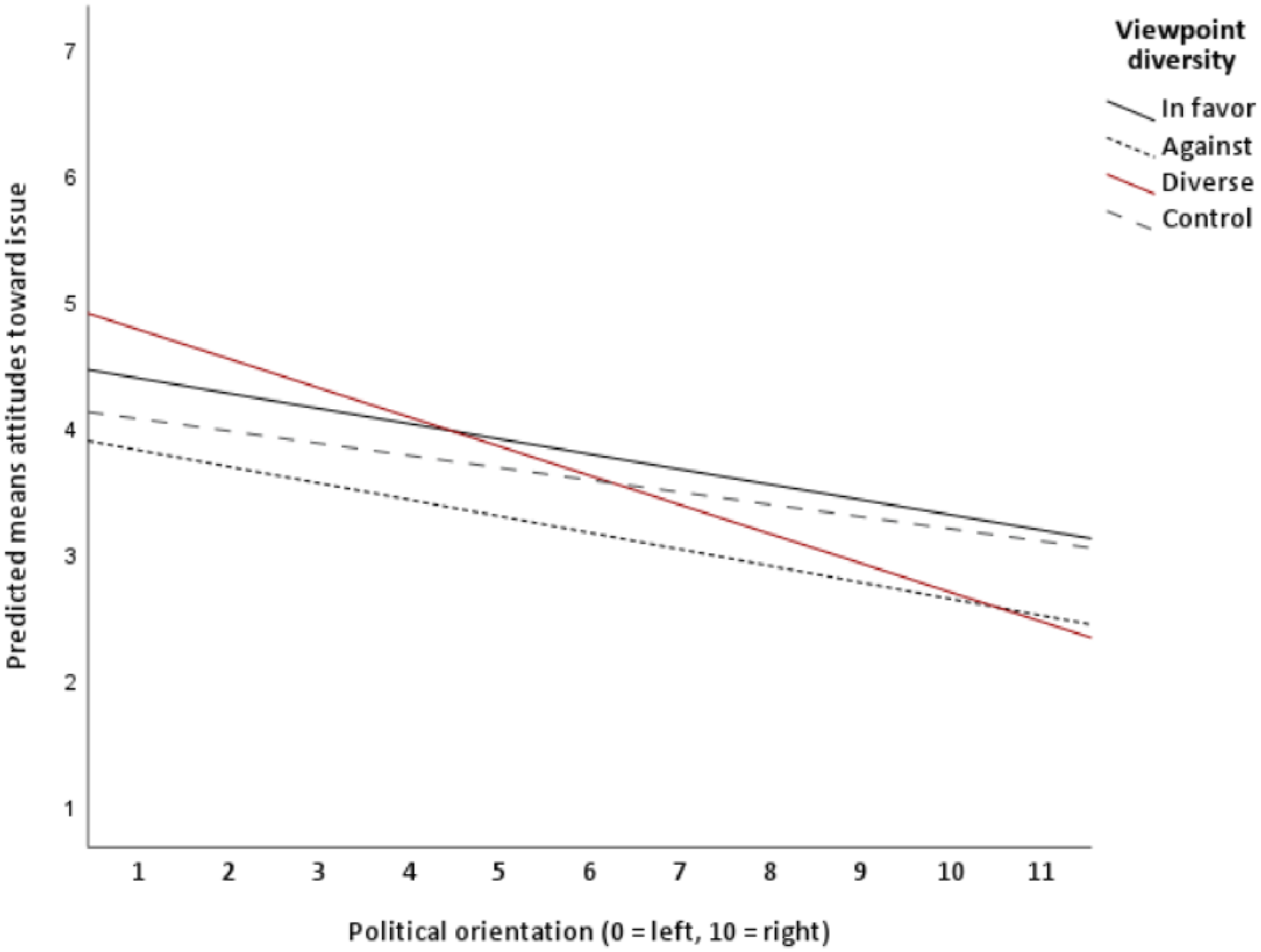
Regarding the specific news issues, individuals across conditions leaned more towards support for the discussed issue after reading the socio-economic article on delivery services (M = 3.59, SD = 2.04) than after reading the sociocultural article on immigration (M = 3.33, SD = 2.01); F(1, 960) = 31.417, p = <.001, partial η2 = .032. The effects of actor and viewpoint diversity moved in the same direction for both issues, with none of the interaction effects reaching significance.
Discussion
A pluralistic media landscape, representing various actors and viewpoints, remains a fundamental principle in democracies (Mattis et al., 2021; Napoli, 2011). While numerous studies investigate whether individuals access a range of news sources (e.g., Van Rees and Van Eijck, 2003; Webster and Ksiazek, 2012), limited research explores how audiences receive diversity within news content. This study addresses that gap by using an experimental approach to examine how audiences perceive and are influenced by the diversity of viewpoints and actors in news content. It aims to understand how such diversity affects perceptions of diversity, the credibility of the news, and individuals’ attitudes.
The findings indicate that while audiences perceive content with diverse actors and viewpoints as more diverse, they may not always equate it with higher credibility. Previous research (e.g., Cozma, 2006; Henke et al., 2019) suggests that increasing viewpoint diversity in news content boosts its perceived credibility. However, our findings reveal a more nuanced reality. Although people may recognize diversity, simply increasing the number of viewpoints or actors in news content does not necessarily enhance its perceived credibility.
Moreover, while news items with high levels of actor diversity are most notably perceived as diverse, people do not seem to specifically notice viewpoint diversity. However, these viewpoints significantly influence people’s attitudes toward the issue. Individuals became more supportive after reading a favorable article, more opposed after encountering an opposing viewpoint, and adopted an average position between the two when exposed to diverse perspectives. Political orientation significantly affected attitudes, with individuals holding more right-leaning views more likely to oppose both issues. This effect was amplified in the presence of diverse viewpoints, suggesting that when exposed to differing opinions, people often gravitate toward viewpoints that align with their pre-existing beliefs, reinforcing their attitudes. These findings align with the literature on “confirmation bias” (Nickerson, 1998), which states that people often give more weight to information that supports their existing views while downplaying or dismissing contradictory information (Sude and Knobloch-Westerwick, 2022).
Hence, diverse news content does not necessarily make people’s attitudes more nuanced. However, a single exposure to a counterargument is unlikely to immediately shift people toward a middle position. Over time, comprehension of both sides in political debates might guide people away from polarized extremes toward more moderate views. Additionally, in the Western understanding of journalism, it is not necessarily the role of news to influence people’s judgments. Instead, facilitating the recognition of diverse perspectives, even those diverging from one’s own, without also influencing a specific viewpoint, aligns more with the idea of “the free marketplace of ideas” rather than promoting distinct attitudinal changes (Strömbäck, 2005).
These findings have several implications for newsrooms. Journalists should try to feature a wide range of actors and viewpoints in their reporting, especially on more controversial or morally loaded issues. For these topics, it is crucial to stimulate critical thinking and a deeper understanding of the various perspectives. This involves not only covering diverse sources but also including underrepresented voices. While participants were better at identifying actor diversity, diverse viewpoints had the most significant influence on attitudes. Journalists should be aware of confirmation bias, as presenting diverse content may not always lead to more nuanced viewpoints among audiences. Additionally, simply adding more actors or viewpoints does not automatically enhance a news item’s perceived quality or credibility. Instead, journalists should focus on the quality and depth of information when presenting diverse viewpoints, which may enhance credibility and impact, potentially mitigating confirmation bias.
Our experimental design has several limitations that warrant acknowledgment and could be addressed in future research. Participants noticed actor diversity when assessing the diversity of an item, but it did not seem to influence their subsequent perceptions or the impact of the article. This may be attributed to the non-visual nature of our article, where limited information was provided about the actors. Future research could explore how visual and contextual attributes of actors embodying viewpoints in the news affect audience perceptions. Another limitation is that our ‘diverse’ viewpoint conditions for both issues consist of two opposing viewpoints in one news story. In reality, viewpoint diversity is often more nuanced, involving different frames within one item (Huang, 2009) or presenting diversity across multiple news items. Moreover, striving for balance in each news item may not always align with journalists’ objectives or be deemed desirable. This approach can lead to a scenario referred to as 'false equivalency’ of opinions (Jamieson and Waldman, 2003), where opposing viewpoints may not accurately represent public opinion in certain cases. It would be interesting to investigate how more nuanced manipulations of diversity, such as frame diversity, influence audiences.
In summary, this study contributes to journalism studies by enhancing our understanding of how journalists can deliver more multiperspectival news. By better understanding their audiences, journalists can critically assess which voices they present and how they can contribute to a more diverse public debate. In times of increased political polarization, the need for journalism to provide diverse, inclusive, and informed coverage that also reaches and informs citizens might have never been more important than it is today.
Supplemental Material
Supplemental Material - Diverse news, diverse perceptions? Investigating the effects of actor and viewpoint diversity in news content on audience perceptions and opinions
Supplemental Material for Diverse news, diverse perceptions? Investigating the effects of actor and viewpoint diversity in news content on audience perceptions and opinions in Kathleen Beckers in Journalism
Footnotes
Declaration of conflicting interests
The author(s) declared no potential conflicts of interest with respect to the research, authorship, and/or publication of this article.
Funding
The author(s) disclosed receipt of the following financial support for the research, authorship, and/or publication of this article: This work was supported by the Bijzonder Onderzoeksfonds UAntwerpen (FFB210065).

Supplemental Material
Supplemental material for this article is available online.
Author biography
References
Supplementary Material
Please find the following supplemental material available below.
For Open Access articles published under a Creative Commons License, all supplemental material carries the same license as the article it is associated with.
For non-Open Access articles published, all supplemental material carries a non-exclusive license, and permission requests for re-use of supplemental material or any part of supplemental material shall be sent directly to the copyright owner as specified in the copyright notice associated with the article.
