




Abstract
Taking the case of Belgian (Flemish) celebrity news, we discuss the impact of digitization of the news media ecology on the epistemology of celebrity journalism. Theoretically, the epistemology of celebrity journalism is considered as a set of practices, through which knowledge is acquired, claimed and justified, that are shaped by the specifics of the media ecology and the celebrity culture and industry. Empirically, we analyze media celebrity coverage in two celebrity magazines and one website, owned by DPG Media and sharing a converged newsroom. Quantitative content analysis and expert interviews reveal that, while digitization somewhat affects the ways in which journalists acquire, claim and justify their knowledge, celebrity news epistemology is mostly affected by the distinction between local and global celebrities, mostly through direct versus indirect access.
The digital celebrity news ecology: Cause for celebration?
This contribution analyzes the impact of digitization on the epistemology of celebrity journalism. It takes the case of Flanders, the Dutch-speaking Northern part of Belgium, the seven million-inhabitants region which is characterized by its own small but vibrant celebrity culture (Van Den Bulck, 2018) and a highly concentrated and converged media ecology (Hendrickx and Van Remoortere, 2023; Picone and Donders, 2020). The manuscript focuses on celebrity news “produced by journalists based on newsroom decisions and published in entertainment and mainstream media” (Jerslev and Mortensen, 2022: 337). We study three Dutch language print and online (celebrity) news outlets owned by the same international media corporation. Through a content analysis and expert interviews, we aim to understand how the epistemology of celebrity news is impacted by the digitization of celebrity culture and of media ecology and by specifics of celebrity journalism in a small language and geographical area. A far cry from the global dominance of large (predominantly English language) celebrity news outlets, the case represents other smaller celebrity cultures and media ecologies around the world.
Celebrity news is the bread and butter of specialized celebrity news outlets and general interest news media. Celebrity constitutes an established news selection criterion (Harcup and O’Neill, 2001), especially in a digital news ecology because of its fit with high-speed, short-term news cycles, its relationship with press-released news (Rojek et al., 2007), its cross-media promotional affordances (O’Neill, 2012), its entertainment-based content (Turner, 2014) and high click-bait potential (Kalsnes and Larsson, 2018). Still, sections of journalism scholars, professionals and audiences negatively appreciate celebrity news as an oxymoron, criticism strengthened by digitization-related changes in news media structures, including ownership consolidation (Hendrickx, 2020), business models (de-Lima-Santos et al., 2022), convergence of news production (Larrondo et al., 2016), and disruptions in news distribution (Santana and Dozier, 2019), all interrelated (Kuiken et al., 2017).
Criticism of celebrity news and journalism in a digitized media ecology focuses on two aspects: newsworthiness, or celebrity news’ perceived banality as “most trivial”, pitted against “real news” considered as “geared towards public service and the great good” (Dubied and Hanitzsch, 2014: 138); and trustworthiness, or celebrity news’ perceived lack of veracity that does not live up to the epistemology of “true” journalism. While the former has been refuted in journalism studies (Reinemann et al., 2012) and celebrity studies (Van Den Bulck, 2018), the epistemology of celebrity news and journalism has received less attention. Journalistic epistemology concerns “how journalists know what they know—and why that matters for the knowledge practices and products in which they are engaged” (Lewis and Westlund, 2015: 452). Celebrity news’ knowledge production tends to be perceived as based in rumor and gossip rather than “hard facts” and “good journalistic routines”. We revisit these assumptions by focusing on celebrity journalism in a small celebrity culture and highly concentrated and converged news media ecology.
To this end, we construct a theoretical framework that situates celebrity news and journalism as the result of the characteristics of celebrity and of local celebrity cultures and media ecosystems amidst ongoing digitization. We discuss their impact on the epistemology of celebrity news and journalism. Next, we present a case study of celebrity news from three outlets owned by Belgian media corporation DPG Media: print celebrity magazines Story and Dag Allemaal, and HLN.be, the online portal of newspaper Het Laatste Nieuws. While a single case study is limited in scope, it allows for detailed de- and re-construction that ensures in-depth analysis of a particular issue that has not received much academic attention (Flyvbjerg, 2006). Finally, our conclusion evaluates the findings in light of the impact of digitization on the epistemology of local celebrity journalism.
Theoretical framework
(Local) Celebrity news and journalism in the digital era
Research into celebrity news and journalism tends to focus on “big” celebrity cultures and media with global reach like those from the US and the UK (O’Neill, 2012) and on specific subgenres of celebrity news like paparazzi-photography based news (e.g., Mortensen and Jerslev, 2014) and aggressive celebrity gossip websites like TMZ (e.g., Kalika and Ferrucci, 2019). However, these are not necessarily indicative of celebrity coverage in most cultures and media landscapes or of all journalistic sub-genres. For instance, different from the US and UK, many European media scenes have no tabloid press. Therefore, we build a theoretical framework that understands epistemology of celebrity news as shaped by the characteristics of the culture and industry of its subject, celebrity, while accounting for the specifics of the local context and digitization-driven changes in small media ecologies.
Celebrity is a construct, resulting from a particular (if evolving) set of structurally interrelated actors: the person aiming to become/remain well-known, their entourage, the media and audiences (Turner, 2004). These actors have partly overlapping, partly conflicting goals, making celebrity culture, industry and journalism, “the scene of constant battles for control” (Gamson, 1994: 85). The relationships have undergone many changes over the years, including the erosion of the Hollywood studios’ strictly controlled star system and the rise of social media providing new means of interaction with and by audiences. Throughout, celebrity remains based on well-knownness or recognizability, i.e., “the experience of being recognized by far more people than one can recognize back” (Ferris, 2010: 393), celebrity is (re)constructed in and through media coverage (Driessens, 2018). The “unavailability” of celebrity is one of its original characteristics, and the near-yet-far aura a main pulling power (Van Den Bulck, 2018). Thus, while media attention is crucial to celebrities, they want to carefully manipulate this communication. The result is a news production mode that for much of its output remains dependent on prepackaged input from publicity and promotion industries (Turner, 2014). Journalists acknowledge celebrity as news value but dislike being used as a publicity tool. PR events and interviews allow for news production as “a process of access/observation” (Lewis and Westlund, 2015: 453) but undermine journalists’ editorial independence (Jackson and Moloney, 2016).
These general celebrity-media relationships are affected by the specifics of a particular celebrity culture and media ecosystem. Counterflows notwithstanding, global celebrity culture is dominated by representatives of Anglo-Saxon celebrity culture (Van Den Bulck, 2018), with the US celebrity as “the foot soldier of globalization” (Turner et al., 2004: 176). Digital technologies and converging modes of delivery ensure quick, global distribution of news about these celebrities (Driessens, 2018). Simultaneously, there are flourishing small celebrity cultures like the Flemish, inhabited by local stars that originate from specific cultures within linguistic and geographical boundaries and from local versions of global media formats (Dhoest, 2005). To capture the phenomenon of celebrity in these small geographically and/or culturally specific markets, Ferris (2010) uses the term local celebrity, and extends Hill’s (2003) idea of a category of celebrity that is “a more narrow-cast version of celebrity, in which people are treated as famous only by and for their fan audiences” at local, regional, even national levels. They are similar to global celebrities in that they “are seen, recognized, and followed by more people than they can keep track of, and […] hence experience relational dynamics similar to those of global, mass culture celebrities” (Ferris: 393), while easier for audiences, journalists to access, interact with, or obtain information about “which may alter some of the relational asymmetries associated with global celebrity” (p. 394).
From a celebrity industry perspective, local celebrities and local news outlets are in a codependent relationship. Local celebrities fit the proximity news value (Harcup & O’Neill, 2001), so local journalists have an interest in nourishing good working relationships with local celebrities for access and (local) scoops they will never obtain from global celebrities. Local celebrities need local media for coverage that global media will not afford them. As a result, local media pay ample attention to home celebrities (Hirdman, 2017).
Celebrity-media relationships are affected, second, by digitization. Social media especially have created a sense of celebrities as direct sources of news, a shift from once highly controlled access. This is obvious in the boom in digital celebrities like influencers, whose fame originates from “direct” communication with audiences through social media accounts, becoming a potential news source for celebrity journalists. Celebrities whose fame originates outside the digital world also use social media to “make official statements, clapback at haters, troll, post personal images, interact with fans, and celebritize issues important to them” (Blumell and Hellmueller, 2019: 5). This creates a sense of authenticity and closeness (Marwick and Boyd, 2011), despite remaining highly controlled (Thomas, 2014). Digitization also allows for fans to communicate (sometimes with but mostly) about their object of fandom. As (Price and Robinson, 2017: 649) explain, “fans are practitioners of new forms of information consumption and production, showing sophisticated activities of information organization and dissemination”.
In turn, digitization has accelerated media convergence and concentration, together creating a perfect storm. Occurring in and across markets, it accelerates the convergence of news organizations and flows, altering (tacit) norms and routines (Myllylahti, 2017) have witnessed intense newsroom convergence, that is, the integration of various newsrooms based on content types, for example, radio, television and online beats coordinated from one central desk (Larrondo et al., 2016). This results in diminished content diversity and increased content recuperation/repurposing (Hendrickx and Van Remoortere, 2021; Vogler et al., 2020) across newsrooms.
Flemish celebrity journalism provides a relevant case of the impact of digitization and of the specifics of ‘local’ celebrity journalism. DPG Media, the result of a 2018 media merger of two competing media companies, is Flanders’ largest private media corporation, owning the main commercial television networks, the biggest newspaper in print circulation and online reach and nearly all celebrity news outlets, next to international holdings. We focus on three DPG Media-owned outlets: printed celebrity magazine Story, launched in 1975 by a now defunct media corporation (822,000 weekly readers (CIM, 2022)); printed celebrity magazine Dag Allemaal (“Hello Everybody”), launched in 1984 by DPG Media’s predecessor as a Story rival and currently Flanders most read celebrity news outlet (1.7 million weekly readers (CIM, 2022)); and HLN.be, the online portal of newspaper Het Laatste Nieuws (“The Latest News”), by far Flanders’ most visited (2 million daily reach, (dpgmediagroup.com)) news website/app. 1 Decades-long rivals, Story and Dag Allemaal came under one ownership in 2015 when DPG Media’s predecessor acquired Story. In 2019, DPG media merged all celebrity news production into one integrated newsroom working for all three outlets (Hendrickx and Picone, 2022). Thus, our first research question is: How do media convergence and concentration affect Flemish celebrity news?
Epistemology of celebrity journalism
To understand the impact of this context on the epistemology of celebrity news and journalism, we start from the observation that different news genres, or different ways of meaningfully communicating and knowing about the world, make different knowledge claims (Matheson and Wahl-Jorgensen, 2020: 301). The diversified growth of digital journalism has strengthened the appreciation of a plurality of journalistic epistemologies (Ekström et al., 2021), acknowledged early on in the analysis of Deuze (2005: 868) on the professional ideology of celebrity news journalists. He concluded that, with their hard news colleagues, they: share notions of ethical sensibilities, servicing the public, editorial autonomy and public credibility in order to position themselves as a distinctive genre. The differences between the applications of journalism’s ideological values are embedded in the respective meanings these concepts have.
Other scholars, too, have expanded the academic debate on the variety of epistemologies in contemporary journalism studies. Ward (2018) discusses five eras from the 17th century until the present day and holds the view that the latter one “consists of constructionist, context-specific epistemologies” (2018: 72) that “prompt people to make claims to knowledge in different “knowledge production” areas, from the laboratory to the newsroom” (2018: 66). Digitisation is highlighted as one of the key contributors to this fifth and current era of journalism epistemologies precisely because of how the rise of the Internet and social media have provided journalists and ordinary citizens with new ways of acquiring and sharing knowledge. It has also been argued that journalism’s different forms and genres each warrant their own distinct epistemological thinking, with disparate articulations of truth claims as well as audiences’ acceptance or rejection thereof (Ekström and Westlund, 2019). We link this more overtly to celebrity journalism in the ensuing sections of our theoretical framework.
Rumor and gossip: News about global and local celebrities
How celebrity news journalists “know what they know”, is determined, first, by a core characteristic of its subject. The relative “unavailability” of celebrities, especially those with global renown and near-yet-far persona, requires journalists to rely on indirect contacts, secondary and unofficial sources. This feeds criticism that much of celebrity news is gossip and rumor and, therefore, epistemologically juxtaposed to news as “authoritative, accurate and verified knowledge” based on “neutrality, objectivity, fact-checking, and transparency” (Ekström and Westlund, 2019: 2). However, this overlooks, on the one hand, the diversity of celebrity news in different genres, from well-researched celebrity profiles, and interviews to short celebrity gossip clickbait pieces across a range of outlets with different goals, business models and journalistic values. On the other hand, the criticism ignores that gossip and rumor are employed by journalists across genres as a form of fact finding and checking. Adkins (1996: vii) maintains that gossip and rumor act “as a (necessary) counterweight to more official information, and can’t be considered apart from official knowledge. We use gossip and rumor, along with more orthodox sources of information, to formulate our understanding of ourselves and the world around us”.
One well-established way journalists overcome the lack of direct celebrity access is to rely on visual material provided by paparazzi, today a well-organized industry (Blumell and Hellmueller, 2019; McNamara, 2015). Characterized by lower technical standards than polished PR photographs, these images show the unexpected and the transient, allowing journalists to unearth the “real”, authentic celebrity behind the image, not unlike in other news genres (Ekström and Westlund, 2019). This focus on intimacy and the “real” celebrity rather than distance is part of a wider journalistic trend towards tabloidization and personalization.
The limited direct, highly constructed and promotional nature of access and the resulting need to rely on gossip and rumor, have created particular source-journalist relationships. Often, celebrity news journalists build a network of sources with informal access to celebrities (“a source close to”) (Meyers, 2009), allowing the journalist/outlet to establish authority in the absence of direct contact (Carlson, 2017). Claims may be “unauthorized” or “unconfirmed”, despite a journalist’s efforts (“the celebrity did not respond to our request for confirmation”), but can nevertheless be accurate and resulting from fact and multiple source checking. Still, celebrity news may struggle with source transparency. Sources are often anonymous (“a friend of the family”) and/or not systematically attributed to particular information in news stories. Nor are checking details always disclosed. However, similar shortcomings occur in other news genres (Shapiro et al., 2013). Perceived credibility, finally, can also be affected by presentational style. Celebrity writing often appears ambiguous and sensationalist, for instance by using conditional tense (“might”, “would”, “could”) or by presenting rumor/gossip as facts (Shapiro, 2010: 157).
Importantly, how celebrity journalists know what they know can differ when it concerns global versus more approachable-knowable local celebrities. The epistemology of local celebrity news can be expected to have a bigger focus on factuality and accuracy through direct sourcing, with celebrity interviews as important “proof” of truth claims even though, as Driessens (2015) highlights, the veracity of claims in celebrity interviews can be hard to assess, given that celebrities tend to be well-trained in interviews. Local celebrity news truth claims are further impacted by other characteristics of the local media culture and industry. For instance, Flemish celebrity news has been shown to be quite courteous towards its local celebrities, avoiding paparazzi photos or purely hear-say stories (Van Den Bulck and Claessens, 2014), while neighbor The Netherlands, that shares the same language and some celebrities, has a stronger tabloid-style magazine culture and celebrity journalists that consider themselves hard-hitting (Deuze, 2005). As global stars have little need or interest to talk to local news outlets directly, the latter can be expected to derive information about global celebrities from secondary celebrity sources like (American) global celebrity magazines, celebrity news sites or (British) tabloid papers (Blumell and Hellmueller, 2019). Here, the local journalist’s expert knowledge of the veracity and authority of other celebrity news media as news sources is key and will be reflected in the articulated knowledge and truth claims (identified sources, type of proof). This culminates in our second research question: How does the difference in having access to local vs global celebrities affect the originality of news content?
Digitization impacting celebrity news epistemology
The epistemology of celebrity news and journalism is impacted, second, by digitization in several ways. The proliferation of social media platforms enables journalists, celebrities and ordinary citizens to source, produce and diffuse news. Karlsson and Sjøvaag (2016) argue that digitization and convergence push ontological alterations to the fluidity and ephemerality of what constitutes news production and content, impacting its epistemology. Celebrities direct communication through their social media accounts and fans’ posting detailed knowledge of and personal experiences with celebrities can undermine the authority of celebrity journalists (Carlson, 2017). However, digital convergence allows for easy recycling and exchanging of content across platforms: a tweet or Instagram post of a celebrity, can become a journalist’s main source of reporting and is easily embedded in online news articles (Hermida, 2013; Oschatz et al., 2022). Analysis of celebrity news website JustJared revealed that news items referencing celebrity tweets overwhelmingly mention these as authentic, direct information sources, and a majority of items used celebrity tweets to create a feeling of closeness to the celebrity (Van den Bulck et al., 2014). Likewise, celebrity journalists can present (easily accessible) digital communication of fans as a reliable source. Finally, digitization can affect epistemology through the impact of newsroom convergence. Ownership concentration and the resulting newsroom convergence allow for easy sharing and repurposing of existing content, in some cases amongst former rival news outlets. This may reduce the need for speed and scoops, competitive media market phenomena that undermine rigorous fact checking and multiple sourcing. However, it can affect news epistemology in other ways, including self-referencing of sister-outlets as external sources. Thus, recent waves of media convergence and concentration are intricately connected to and can alter the epistemology of (celebrity) news.
Taking the case of three celebrity news outlets of Flemish media corporation DPG Media, we propose our third and final research question: How has digitization impacted the epistemology of Flemish celebrity news?
Methodological framework
Content analysis
We composed a data set of articles published in January 2018 and January 2023 in magazines Dag Allemaal and Story and on news site HLN.be. For the weekly magazines, we selected five editions in January 2018 and five in January 2023 on Tuesday, the day of release, and all celebrity-related articles on the HLN.be homepage published on the same Tuesdays, to ensure validity and comparability. The 5-year interval allows to observe any impact of changes in media ownership and convergence and of social media user-generated content on the epistemology of celebrity news. The 2018 magazine articles were accessed through physical magazine copies archived in the Belgian Royal Library, the 2023 magazine articles through BelgaPress, Belgium’s official print media repository. HLN.be articles were accessed using The Wayback Machine, a digital copy of the Web maintained by American nonprofit Internet Archive. We acknowledge issues with studying archived websites (Brügger, 2009) but follow prior scholarly analyses (Bowyer, 2021; Murphy et al., 2007). We only considered articles featuring at least two paragraphs, one picture and one celebrity.
Data set (N = 299) by year and news outlet (Authors).
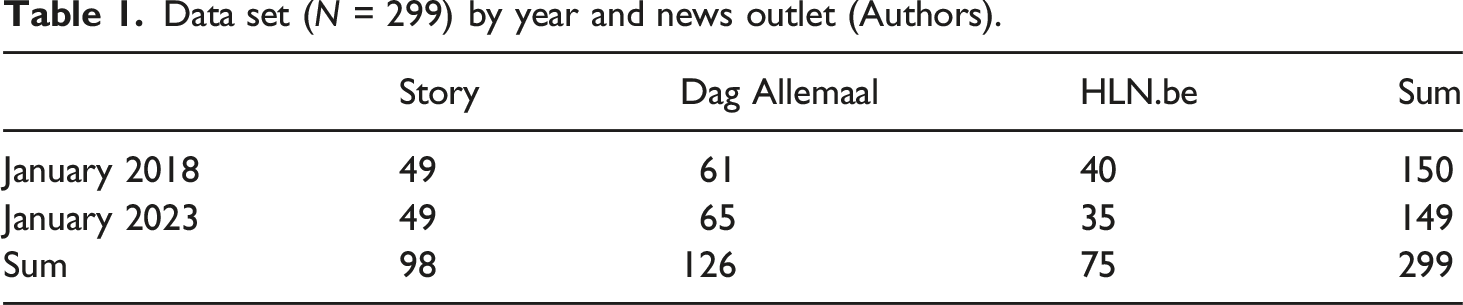
Our coding scheme focuses on textual indications of production routines and practices through which knowledge is acquired, claimed and justified. The codebook was developed based on the theoretical framework and on coding from earlier Flemish-based celebrity news research (Van Den Bulck et al., 2017), extended with codes regarding epistemic truth claims.
For each item (article), the scheme included variables for item identification, celebrity identification (name) and demographics (gender, nationality, professional domain). For items containing multiple celebrities, the first three mentioned were coded. Remaining variables focused on journalistic aspects. One set probed originality, substance and newsworthiness: whether exclusive/scoop, article length (# of paragraphs), use of photo, video, audio, screenshots or social media links as truth claims. Each was identified as official, paparazzi, user-generated or celebrity-generated. Another cluster coded veracity, that is claims regarding conformity to facts: could factual accuracy be verified in the text, presence of ambiguity through use of anonymous sources, explicit mention of terms like “rumor” and “suspicions”, conditional tense and writing style (sensationalist, ironic, neutral). A final set focused on transparency: number of sources referenced, type of sources (own reporting, second hand from own or third media, celebrity as source), indications of source verification, sources cited, was the article signed and was it partly/entirely identical to an item in one of the other outlets.
Most variables were nominal, so great care was taken to appoint values in a reliable, consistent manner. The authors tested (and adjusted) the original codebook with a data subset. To guide coding decisions, all categories of all variables were described in detail, including examples. All data were coded by one author and 10% also by the other author, showing Krippendorff’s alpha intercoder reliability between 0.8 and one for all nominal variables, indicating substantial to perfect agreement (De Swert, 2012). We add our detailed codebook including Krippendorff’s alpha’s to the appendices of this manuscript.
Contextualisation
We contextualize the content analysis findings with insights from two expert interviews with employees of DPG Media’s joint celebrity newsroom: the converged newsroom senior manager and an editor for HLN.be, both female, long-term DPG Media employees. They were probed on epistemological considerations with regards to how they know what they know, how it affects their decision to publish, and which consideration they make in coming to those conclusions, next to wider celebrity news production issues. Interviews were carried out by the authors with each employee separately over Microsoft Teams (total length: 94 min). Recordings were transcribed and coded iteratively to retrieve recurring patterns (Tracy, 2019). Quotes are used with interviewees’ explicit permission. We acknowledge the limits of just two interviews, but emphasize the unique perspective of members of a merged newsroom in a small, highly concentrated and non-English media market.
Research findings
DPG Media’s celebrity universe and truth claims
We coded 397 celebrities across 299 articles, several (local and global) names appearing repeatedly across years and outlets. We found no discernible difference in celebrities’ gender across the years and outlets, with female (N = 202) slightly outnumbering male (N = 195) celebrities, and no instances of they/them or other genders mentioned. Dag Allemaal featured considerably more male than female celebrities (84 vs 68), while this was inverted in Story (43 vs 60) and nearly identical on HLN.be (35 vs 38).
Analyzing celebrities’ primary activity, the majority of items deal with television and radio personalities (N = 152), while musicians, royals and movie stars appear in 54, 40 and 39 instances respectively with athletes, politicians, celebrities’ children/partners rarely appearing. Our sample contained no digital celebrities like influencers, suggesting that, in this small media market, journalists remain focused on celebrities from legacy media and celebrity domains. It further indicates cross-media promotion (Panis, 2015), as DPG Media is the largest private broadcast company in Flanders. That said, 2018 to 2023 showed a drop in the dominance of radio/television personalities, from 46 to 32% of all coded celebrity domains, correlating with increased attention to cinema and royal celebrities.
Articles made limited use of celebrity-generated content (e.g., from celebrities’ social media accounts) as direct source, with no occurrences in Dag Allemaal or Story. Some articles referenced “as [name celebrity] posted on social media”, but never as primary source nor with “proof” (e.g., screenshot). Our interviewees confirm that, rather than considering celebrities’ social media posts as undermining their journalistic authority, they consider these as additional tools for news sourcing and fact checking, especially with regards to global celebrities: “Social media posts by celebrities have become very important too, as in many cases they now constitute sources for reporting directly. We also put those as sources as they come from the celebrity directly and personally.” (Online editor)
The 2023 celebrity reporting on HLN.be did include daily articles devoted to Flemish celebrities’ Instagram posts, suggesting an evolution to increased attention to celebrities’ online communication, which makes for cheaply and easily produced clickbait.
Different from what the literature suggests, fan posts on social media and other audience information, according to our interviewees, are considered mostly as indicative that something is going on, rather than as news to be taken at face value. As the online editor explained: “We have an online page where readers can submit stories. Most often, these include deaths of celebrities. We always make sure to check with relatives, friends and managers as this is of course a very touchy subject”. Exception, again, is the 2023 celebrity reporting on HLN.be which had several articles rehashing user comments on viral posts of local and global celebrities. Regardless, just under one-third of all coded 2023 HLN.be articles contained screenshots or embedded celebrities’ social media posts. For non-local celebrities, instead, the magazines used excerpts from celebrity interviews in other magazines as primary sources (see further).
Visuals used as truth claims in print and online articles mostly consist of materials bought from photo agencies or, mostly for local celebrities, produced by the outlets’ photographers. On HLN.be, videos featured four times in 2018 and 19 in 2023, indicating a pivot towards video content, ranging from compilations of celebrities’ social media videos to trailers.
Overall, and answering RQ3, we find that these results suggest a pre-digital epistemology with especially printed celebrity news relying on traditional, longer-standing relationships with celebrities from legacy media and on non-digital sources.
Global versus local: Rumor doesn’t have it
Looking into RQ2, we find that our sampled celebrities were predominantly Belgian (N = 278), leaving American (N = 49), British (N = 29), Dutch (N = 22) and other European nationalities (N = 17) far behind, yet the local dominance decreased between 2018 and 2023. This suggests improved access to information on global celebrities through online websites like TMZ and celebrities’ social media accounts, and increased “second hand” churnalism style reporting. Still, the outlets showed interesting differences: Dag Allemaal covered almost solely Belgian celebrities (125 (82%) of 152 celebrities), compared to Story (61 (59%) of 103) and HLN.be (45 (62%) of 73). One explanation is the increased diversification of the profile and target audience of former rival magazines Dag Allemaal and Story, by 2023 produced in the same (unified) newsroom, with Story focusing more overtly on royals and foreign celebrities. This ties in with the impact of media concentration and convergence (see further).
Originality of articles was analyzed by distinguishing between “scoops” or exclusive features versus stories based on secondary sources. Scoops were identified through terms like “Exclusive”, “Cover story” or “Scoop”, introductory phrases like “[name celebrity] only tells [pronoun] story here!” or, in most cases, identification of a journalist connected to the outlet and pictures taken specifically for the article. The latter mostly occurred alongside in-depth interviews with local celebrities. Of all 299 articles, 112 were scoops and virtually all concerned Belgian celebrities, except for three Dutch celebrities, famous in Flanders thanks to shared language and cultural history.
These findings were corroborated by both interviewees, elaborating especially on the difficulties in reaching celebrities from beyond the local culture, especially British and North American stars with global renown. DPG Media journalists have the occasional but very rare opportunity to interview global celebrities, for example, when they pass through Belgium on a concert or promotional tour, confirming that, for global celebrities, ensuring a celebrity’s first hand accounts remains dependent on gatekeeping from publicity and promotion industries. Otherwise, Flemish celebrity journalists mostly rely on other media’s reporting to source their celebrity news from abroad, especially global celebrities. In those cases, the epistemological foundations are largely transposed to leading (American) outlets such as TMZ, Page Six, People, Variety and Hollywood Reporter. Among the DPG Media celebrity newsroom, they enjoy popularity and trustworthiness, and effectively act as the most recurring sources for most global celebrity-related reporting. At the same time, the celebrity journalists will make sure to check the original sources where possible: Our source verification practices are very diverse, especially when it comes to breaking celebrity news. It all comes down to which platform reports first and whether or not other trustworthy outlets report on the same news. When we see an interesting report by a less reputable outlet, we may try to trace back the information to the original sources they mention.
These comments confirm the quantitative content analysis’s finding that factual accuracy and transparency is ensured in most articles.
This is even more so, according to the interviewees, when reporting on local celebrities with whom the newsroom and journalists frequently have personal professional relationships. Both interviewees independently indicated adhering to the journalistic rigor of having two independent sources before ‘breaking’ news online, even if it means being behind rivals. Interestingly, they admitted that when there were no official source confirmations, they are influenced by reports from other leading outlets seen as justification for them running a story. Our content analysis and interviews revealed that using rumors and hearsay as foundations for reporting, a practice notably more common in British tabloids, is not at all commonplace in the Flemish celebrity news ecology. Interestingly, the traditional authority of legacy, especially public service, media, remains strong in the digitized (celebrity) media ecology, as the online editor confirmed about double checking potential news: “We also look at how and if the competition brings the news. If [Flemish public broadcaster] VRT reports something, it immediately seems more trustworthy, so then we are more likely to also bring the news”. These findings indicate foregrounding diverse sources and fact-checking principles in celebrity journalism as much as in other types of reporting.
Almost all print articles (45 in Dag Allemaal, 40 in Story) were (self-declared) scoops while HLN.be had only six articles identified as scoops, related to its focus on topical, “breaking” (celebrity) news. It suggests that (for the newsroom) print magazines remain the primary outlets for original news about local celebrities, their main advantage in fighting the competition of instant, global, online celebrity news. Scoops underscore the importance of direct access (or not) to celebrities: with hardly any access to global celebrities, local outlets aim to preserve good working relations with local celebrities for scoops This constitutes an intricate ecosystem where both parties need each other to survive, as previous scholarship suggested (Van Den Bulck et al., 2017).
Unlike other celebrity cultures (Deuze, 2005), our dataset reveals virtually no ambiguity nor overt sensationalist writing as articles mostly adhere to a neutral style for local and global celebrity coverage. We found just a few cases of conditional tense. However, in almost one-third of articles featuring global celebrities, factual accuracy could not be confirmed due to a lack of identified sources and less than half of all foreign celebrity articles contained indications of direct contact. For instance, a 2018 two-page article in Story on the career of Australian actress Cate Blanchett featured various quotes by the actress but made just one mention of The Times as source, without clarifying if all quotes originate from that secondary publication. Likewise, accompanying pictures had no source indication. Regardless, the article had a self-assured air, using no conditional clauses.
Convergence and concentration
Next we analyzed how convergence and concentration of ownership and newsrooms affected repositioning of these outlets to attract different audience segments (RQ1). Our data reveal that, between 2018 and 2023, Dag Allemaal increasingly featured local celebrities, making it their unique selling point, while Story increased attention to foreign celebrities and national and international royals. DPG Media’s longer-standing strategy to use HLN.be as its single online content hub means that Story and Dag Allemaal’s content is integrated into HLN.be, made more easy by the unified newsroom. So, HLN.be was found to repurpose print content nearly verbatim, often with a different, more clickbait friendly headline and, in 2023, behind a paywall. While in 2018 Dag Allemaal and Story regularly repurposed each other’s content, abridged and/or with different headlines or pictures, 2023 showed no more overlap, while magazines-HLN.be overlap increased combined with a sharp drop in unique HLN.be contributions. The online recycling of print scoops helps print magazines to maintain their reputation as truth claims for quality celebrity journalism in a digitized news ecology. For instance, a HLN.be repurposing of an exclusive Dag Allemaal interview with the ex-wife of a Flemish celebrity, uses the same picture and part of the original headline quote and lead. HLN.be explicitly mentions Dag Allemaal as its source, yet labels the article as an HLN + article, that is,, only accessible for paying HLN subscribers suggesting exclusive information. This fits a trend of recycling content across platforms of the same media group, decreasing overall news diversity (Hendrickx and Ranaivoson, 2019).
Our expert interviews provide important contextualization in this regard. While DPG Media dominates the Flemish celebrity news market, the converged newsroom is highly aware of the remaining competitors, as one interviewee confirms: “Dag Allemaal and Story come out every Tuesday. Already on Sunday, I select the content we will post on HLN.be on Tuesday morning, as we know our competitors will write about the juiciest gossip anyway” (Manager). These decisions are based not just on intricate agreements between outlets of the same brand but also between outlets and local celebrities, resulting in a daily balancing act. Partly because of past rivalry, Story and Dag Allemaal did not always maintain good working relationships with some celebrities who hold a lingering resentment against one of the outlets, converged newsroom notwithstanding, and these celebrities: set rules about where content can or cannot be repurposed that we must abide by to maintain access to them. This week we have a feature interview with [name of local celebrity] in Story, but [they] will not let us publish it on HLN.be. (Manager)
Both interviewees highlight that the converged newsroom constitutes a leading example towards news outlet integration and converging content. Our content analysis data confirm that articles become more prone to being repurposed across titles, albeit a one-way street from magazine articles to HLN.be paywalled content. The manager emphasized that in this repurposing, they “always credit the original magazine as the source of all HLN.be celebrity content”. (Manager)
However, the interviews revealed remaining differences between the outlets, occasionally obfuscating the process of repurposing content seamlessly across titles and platforms. The reasons are partly technical as “all journalists should be able to transpose their print content to HLN.be, but in practice there are different lay-out systems which makes copy-pasting a lot more difficult” (Manager), partly style, as “there is also a difference in linguistic style and register between the magazines and website, which requires us to make content ‘HLN.be proof’” (Manager) but importantly also an issue of personal and organization traditions: Especially older journalists, who have written for magazines for decades, make sure to stay close to only their own outlet and are less inclined to write for others, although this is partly because editors used to remain less likely to ask them. Indirectly, this sometimes causes practical troubles. (Manager)
Finally, DPG Media’s presence in the Netherlands, which shares the Dutch language with Flanders and where it owns leading celebrity magazines and online news portals, results in repurposed content across borders. In spite of acknowledged style differences between the Dutch and Flemish celebrity cultures (Deuze, 2005), Dutch articles about Dutch celebrities with a fan-base in Flanders are readily recycled with no additional fact-checking. This proves that, even in local celebrity cultures and media ecologies, regional cross-border media ownership pushes the transborder repurposing of news content. Our structural collaboration with AD [Algemeen Dagblad, Dutch newspaper resembling HLN.be in style and target audience] allows us to copy each other’s articles. Lately, we have also been repurposing articles from the Dutch Story [Dutch magazine with same name but different contents, style and journalists]. This is not structural yet, but we can always request to copy an article and in most cases this is granted. (Online editor)
This affects the epistemology of celebrity journalism: rather than using foreign sources as foundations for own reporting, their own reporting is replaced by repurposed foreign content because of shared ownership, an issue for future research.
Conclusion: Near, far, wherever you are
This contribution used a case study of Flemish celebrity journalism to analyze textual indications of production routines and practices, revealing the epistemology of celebrity news in a digitized media ecology. In particular, we analyzed how celebrity journalism’s epistemology is affected by the characteristics of celebrity and the specifics of the media ecology in a small, language specific celebrity culture and a media ecology affected by advanced digitization.
First, we argued theoretically and found in our case study that the epistemology of celebrity journalism is firmly rooted in the central characteristic of celebrity as “near-yet-far”, the result of carefully negotiated and controlled relationships between celebrities, their entourage, media and audiences, gatekeeping access. For global celebrities, we found the continued dependence on the promotional industries and international news outlets (Turner, 2014). Yet, different from what past criticism suggested, there is no systematic epistemology of rumor and gossip. Rather, the data reveal an adherence to indicating and checking sources. Especially when reporting on local celebrities, the content analysis and interviews suggest traditional journalistic rigor of two independent sources. While the literature suggests that digitization increases availability of sources with more direct access like specialized websites (TMZ) and celebrities’ social media accounts, our results paint a more nuanced picture. The local celebrity news outlets in our sample acknowledge little use of celebrity social media accounts as direct, primary sources of information. This seems affected by the characteristics of the particular media outlets. Published just once a week, celebrity print magazines have a slower news pace. Unable to compete with daily news outlets or instant media platforms for “breaking celebrity news”, their content can focus on more in-depth, multi-sourced and fact-checked content about local, more accessible celebrities. These magazines do not have to rely on digital source access through celebrities’ social media sites. Conversely, in need of constant updates, website HLN.be turns to daily overviews of Flemish celebrities social media pages, the result of “direct” access but without any additional sourcing. This confirms earlier research (Van Den Bulck et al., 2017) which found that celebrity news in Flemish dailies (both elite and popular), much more than celebrity magazines, resort to churnalism regarding (global) celebrities to attract readers both in print and online (clickbait).
Second, the crucial role of access in celebrity journalists’ approach to what counts as knowledge is confirmed through the obvious distinction between reporting on local and global celebrities. Mutually dependent for audience attention, local celebrities and outlets balance the, at times contentious, relationships to ensure extensive and exclusive coverage, with a focus on celebrity interviews and multiple sourcing. It allows a local celebrity to stand out amidst a sea of more glamorous and/or scandalous global celebrities while it allows local magazines to have exclusives/scoops and to speak with an authoritative voice. When writing about global celebrities, Flemish celebrity journalists appear to adhere to a different understanding of what constitutes their knowledge and more readily rely on other celebrity news outlets considered to have better access to those stars (Blumell and Hellmueller, 2019). Global celebrity news articles tend to be sourced opaquely and rarely feature direct contact with the celebrity. As such, the criticisms regarding celebrity news contributing to digital churnalism and clickbait (e.g.Bechmann, 2018) cannot be generalized. In local celebrity and media cultures, that fits predominantly the reporting on global celebrities.
Third, concentration and convergence impact the epistemology of celebrity news in its knowledge power and validity. Despite diversification patterns between brands, concentrated ownership leads to overall depreciation of the relevance for individual outlets, here in favor of digital general news brand HLN.be. Our interviewees confirm that this results from the converged celebrity newsroom that reduces not just competition but also scoops and unique contributions. The enduring attention to local celebrities from radio/television, too, is at least partly the result of cross-promotion between different media under the DPG Media umbrella (Goyvaerts et al., 2024).
Overall, while digitization certainly impacts celebrity news’ epistemology, our data suggest incremental changes over time while confirming long-established routines and practices in the knowledge production regarding celebrities. It further shows that celebrity reporting uses journalistic principles (e.g., at least two sources) similar to other news genes and that, particularly with regards to local celebrities, direct access to the celebrity adds a layer to how and why the celebrity journalists know what they know. As such, it confirms Ferris’ (2010) observation that celebrity in small geographically and/or culturally specific markets show characteristics of Hill’s (2003) notion of local celebrity. They are more-narrow cast versions of celebrity that experience the same relational dynamics as global celebrities, while more easily accessible to (audiences and) journalists, affecting the epistemology of local celebrity news.
A single case study of one specific celebrity culture in a small and highly concentrated media market in Flanders, can only say so much. Yet, it is exactly these limitations that give meaning to the detailed analysis that a case study allows. In this case, it confirms the need to look beyond global celebrity culture and media for a more nuanced understanding of the epistemology of celebrity news. It draws attention to the importance of studying local celebrity and media cultures and industries to understand how digitization trends, observed in high profile cases (in terms of celebrity and digital innovation), work on a day-to-day basis in a local context. As a genre, celebrity news retains a strong foothold in legacy media that remain coveted outlets for celebrities to be seen, for news industries to survive and for audiences to get their latest celebrity news.
Supplemental Material
Supplemental Material - Rumor has it: Epistemology of celebrity journalism in the flemish digital media ecology
Supplemental Material for Rumor has it: Epistemology of celebrity journalism in the flemish digital media ecology by Jonathan Hendrickx, and Hilde Van den Bulck in Journalism
Footnotes
Declaration of conflicting interests
The author(s) declared no potential conflicts of interest with respect to the research, authorship, and/or publication of this article.
Funding
The author(s) received no financial support for the research, authorship, and/or publication of this article.

Supplemental Material
Supplemental material for this article is available online.
Note
Author biographies
References
Supplementary Material
Please find the following supplemental material available below.
For Open Access articles published under a Creative Commons License, all supplemental material carries the same license as the article it is associated with.
For non-Open Access articles published, all supplemental material carries a non-exclusive license, and permission requests for re-use of supplemental material or any part of supplemental material shall be sent directly to the copyright owner as specified in the copyright notice associated with the article.
