




Abstract
This study examines the suspected transmission of political pressure through management to journalists in public service media, where independence is crucial for fulfilling its democratic mission. Such interference is often covert and performed without hard evidence, making it difficult to prove. To provide insight into these practices, this study explores the case of RTVS, the public service broadcaster in Slovakia, during a conflict that arose after the appointment of a new director general in 2017. Using semi-structured interviews with journalists and managers (N = 16), it introduces an inductively developed classification scheme for internal interference and examines the context and conditions under which the journalists considered it to be politically motivated and as an illegitimate encroachment on their autonomy. The study shows that perceived internal interference by management takes two forms: interference in editorial content at various levels (and through multiple tools and means) and the use of disciplinary mechanisms. When journalists experience internal interference with a possible political background, trust in their superiors and the perception of their motives are crucial factors influencing their reactions and interpretation of the situation. However, for a variety of reasons that the study analyzes in detail, the RTVS journalists distrusted their superiors' moral integrity, professional skills, and political independence, which resulted in the departure of a large part of the TV newsroom. The article concludes with suggestions for methodological implications for further research on perceived interference.
Keywords
Introduction
Autonomy is one of the cornerstones of journalism, without which it would cease to exist as a profession (Freidson, 1994). However, while some encroachments on journalistic autonomy are direct and obvious (e.g., an angry phone call from a politician demanding that an article is not published; an attempt at bribery; threats of violence), others, especially if they come from managers and editors within the media organization, are more difficult to assess. How do journalists judge whether the actions of their superiors constitute inappropriate attempts to interfere with their autonomy? What forms can such internal interference take?
This study explores the journalists’ perspective of the suspected transmission of political pressures within a public service media (PSM) organization from management to the journalists. It draws on the case study of Radio and Television Slovakia (RTVS), the public broadcaster in Slovakia, at a time of editorial conflict that arose after the election of a new director general in 2017, which led to the departure of roughly two-thirds of the TV newsroom. Based on semi-structured interviews with RTVS journalists and managers (N = 16), the study aims to investigate the forms and types of interference experienced by journalists from their superiors, and to examine how journalists assess whether such interference is politically motivated and constitutes an unacceptable encroachment on their autonomy.
When it comes to the scholarship on journalistic autonomy, several authors (Örnebring et al., 2016; Reich and Hanitzsch, 2013) pointed out that research attention has been predominantly paid to external autonomy (i.e., the autonomy vis-a-vis other societal institutions like the state or the market) while internal autonomy (i.e., the degree of control journalists have over their own work within media organizations) has been less intensely studied. However, journalism is practiced within the boundaries of media organizations (Sjøvaag, 2013), so this is where most of the struggle for autonomy takes place (Hanitzsch and Mellado, 2011).
This study addresses this research gap and contributes to the scholarship on journalistic autonomy and interference in several ways. It adds to the scarce literature on internal autonomy and newsroom control that used a qualitative approach (García-de-Madariaga Miranda et al., 2022; Goyanes and Cañedo, 2023; Goyanes and Rodríguez-Castro, 2019; Goyanes et al., 2021; Waschková Císařová and Kotišová, 2022). It offers a deeper understanding of the significant, but difficult-to-study, phenomenon of internal interference, which affects journalists regardless of region or media system. It develops an empirically informed classification scheme (Marradi, 1990) for the perceived internal interference, and it systematizes the practices that editors and managers use to impose their will over journalists and media content. Moreover, it goes beyond the existing literature by exploring the context and the conditions under which journalists interpret the actions of their superiors as journalistically unjustified, possibly motivated by outside forces (notably by the political field), and therefore deemed unacceptable. Furthermore, this case study zeroes in on public service media which is a specific area more prone to political pressures than commercial media (Goyanes and Demeter, 2020).
Literature review
Autonomy and interference
Journalistic autonomy can be understood as the “latitude that a practitioner has in carrying out his or her occupational duties” (Weaver et al., 2007: 70). Journalistic autonomy is threatened by interference, which could be defined as threats or inducements that cause or attempt to cause journalists to act in a particular fashion (Hanretty, 2011: 5).
From the viewpoint of rank-and-file journalists within the journalistic field (Bourdieu, 1996), and in line with the distinction suggested by Nygren et al. (2015), two main sources of interference are identified (Figure 1). First, interference can be external and come from the macro-level (i.e., wider social field), most notably the political and economic fields. Second, it can be internal and come from within the journalistic field, from the mezzo-level (e.g., editors and managers). Internal interference can stem from the systems of editorial control and from legitimate disputes about how best to do journalistic work. This type can be journalistically motivated, and, therefore, legitimate. But the interference of superiors can also be motivated by non-journalistic interests, such as the interests of the politicians, owners, and advertisers. In such cases, external interference does not come directly from the macro level, but it is mediated via the mezzo level of managers and editors who serve as a transmission belt (Örnebring et al., 2016). Such interference is also referred to as mixed interference (Hiltunen, 2022). It can be difficult, and sometimes even impossible, for journalists to find the true motivation of their superiors; they can usually only guess the extent to which internal interference they are experiencing may exhibit characteristics of mixed interference. Types of perceived interference in journalistic autonomy from the perspective of journalists.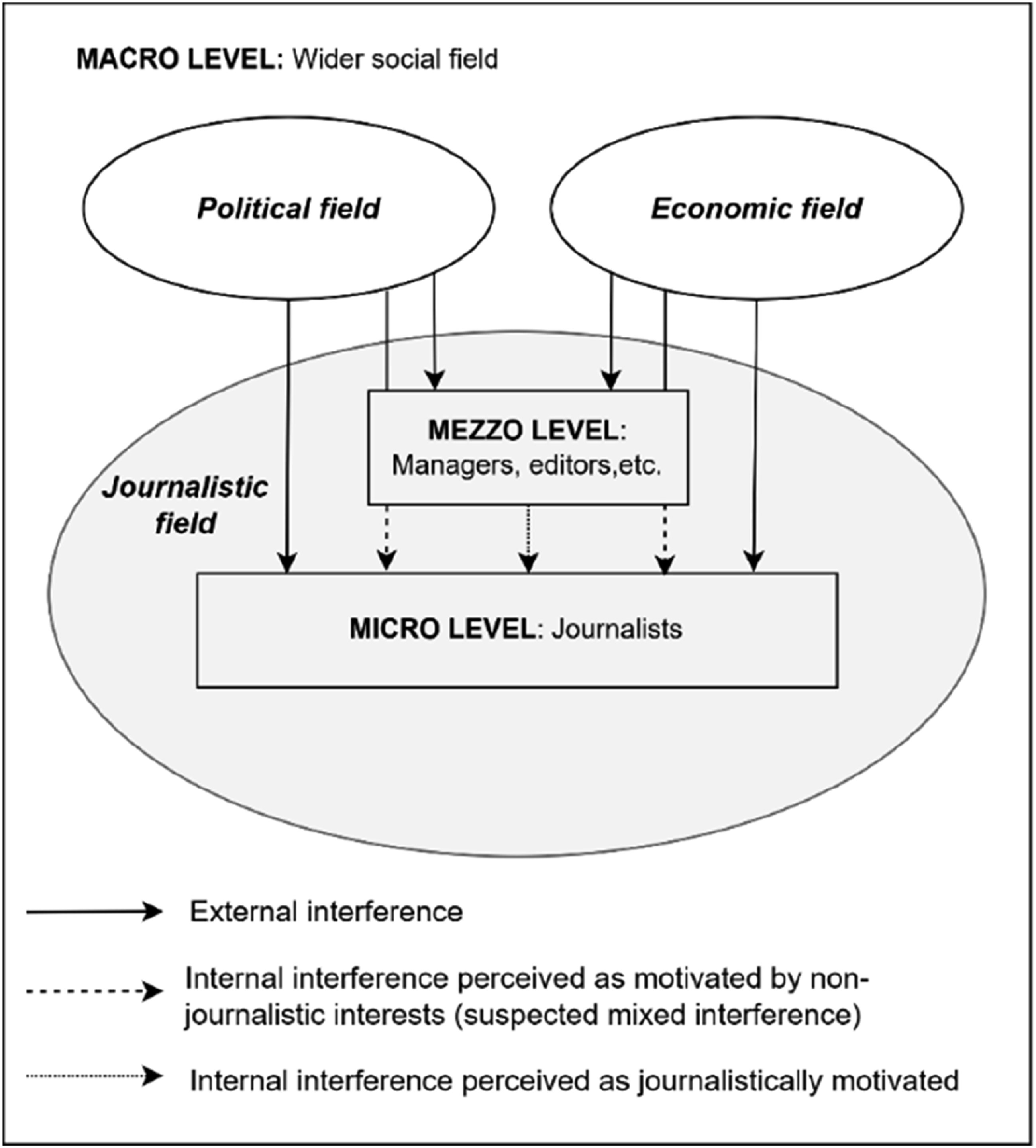
Researching journalistic autonomy and interference
Encroachments on journalistic autonomy at the newsroom level, especially in the case of public service media, are surprisingly under-researched. Most studies adopt a quantitative approach and focus on perceived autonomy or influences without specifying the concrete manifestations of the interference (Ahva et al., 2017; Hanitzsch and Mellado, 2011; Maurer, 2019; Reich and Hanitzsch, 2013). More detailed measures of perceived autonomy, or the lack thereof, typically focus on: (a) the freedom to select news stories; (b) the freedom to decide which aspects of a story should be emphasized and how it should be framed; (c) the freedom to choose sources; (d) the frequency of editorial interventions; and (e) the actual publication of news stories (Hughes et al., 2017; Mellado and Humanes, 2012; Nygren and Degtereva, 2012; Örnebring et al., 2016; Skovsgaard, 2014).
Fewer studies examined autonomy and internal interference with a qualitative inductive approach. Some explored social control in the newsroom and the enforcement of an editorial policy that reflected the political orientation (Breed, 1955; Sigelman, 1973) or profit motivation (Bunce, 2017) of the media organization. Others examined newsroom conflicts in general (Goyanes and Cañedo, 2023); the perceived influence of commercial pressures within newsrooms (Goyanes and Rodríguez-Castro, 2019); the interference of political pressure in the news production process (García-de-Madariaga Miranda et al., 2022; Goyanes et al., 2021); or the erosion of perceived workplace autonomy after the purchase of a given media outlet by a major political and business actor (Waschková Císarová and Kotišová, 2022).
These studies show that editorial interference in the content manifests itself in four major areas: (a) the selection of news stories; (b) the decision about their placement; (c) the selection of information; and (d) the choice of framing and the aspects of the story that should be emphasized (Breed, 1955; García-de-Madariaga Miranda et al., 2022; Goyanes et al., 2021; Waschková Císarová and Kotišová, 2022). In the case of indirect political pressure mediated by newsroom management, the strategy is to emphasize the news stories and information that are favorable to the selected political actor or ideology; to omit or downplay the unfavorable information; and to emphasize the information that puts opponents in a bad light (Goyanes et al., 2021; Waschková Císarová and Kotišová, 2022).
When journalists do not fully follow editorial policy and ignore suggestions from the higher echelons, different tools of organizational control come into play. They range from withholding praise to reprimands, a reduction of salary or bonuses, demotion, an assignment to night or weekend shifts, to the cancelation of contract, or dismissal (Breed, 1955; Bunce, 2017; García-de-Madariaga Miranda et al., 2022; Goyanes et al., 2021). In the long term, compliance is achieved by appointing like-minded managers, followed by the hiring and promotion of “appropriate” journalists and the adjustment or departure of opposing journalists (Breed, 1955; Bunce, 2017; Goyanes et al., 2021; García-de-Madariaga Miranda et al., 2022; Waschková Císarová and Kotišová, 2022).
To summarize, while previous research describes what practices and incidents journalists perceive as unacceptable violations of their autonomy, it does not thoroughly explore why and on what basis journalists had reached this conclusion. This is where the present study steps in.
Political pressure and public service media in the CEE region and Slovakia
While autonomy is essential for journalists and the media at large, this is especially true for PSM. For them to fulfill their mission, they must be politically and economically independent (Hanretty, 2011). However, PSM worldwide are tempting prey for ruling politicians. They must — with varying degrees of success — resist the attempts to subjugate them (Karppinen and Moe, 2016). In some regions, such as CEE, political pressure is more frequent and pronounced (Bajomi-Lazar, 2013; Milosavljević and Poler, 2018). This may be related to, among other factors, a challenging transformation from a state-controlled broadcaster, the lack of a public service media tradition, and a weak culture of journalistic independence (Milosavljević and Poler, 2018).
These common shortcomings also apply to RTVS, the Slovak public broadcaster. Political pressure is exerted through two main mechanisms: funding and personnel matters. First, politicians keep RTVS underfunded and dependent on the state. The license fee, which was the main source of RTVS’s income, had not been increased since 2003 when, at the end of 2022, the parliament suddenly abolished it without prior discussion and introduced funding from the state budget. Second, politicians also control personnel matters: the director general of RTVS is elected by a simple majority of votes in the parliament.
In 2017, the parliament elected Jaroslav Rezník as the director general. He was believed to have links to the Slovak National Party (SNS), one of the then coalition parties that helped push through his nomination. This was followed by a change of key managers in the news and journalism sections. After a few months, a newsroom conflict between some journalists and the new leadership broke out (see Urbániková, 2021; Urbániková, 2023 for the details). It resulted in the voluntary and involuntary departure of more than 30 reporters and editors who complained of “creeping political pressure” (Jančáriková, 2018). None of the journalists mentioned any direct interference from outside the journalistic field. However, they objected to the internal interference that came from their superiors. This leads to two questions that this study aims to answer: (1) What forms and types of internal interference did journalists working at RTVS experience from their superiors? (2) How and on what basis did the journalists assess whether the internal interference was politically motivated and whether it constituted an unacceptable encroachment on their professional autonomy?
Method and data
To learn more about the mechanisms of internal interference and its interpretation from the perspective of journalists, this paper uses a case study approach, “an empirical method that investigates a contemporary phenomenon (the ‘case’) in-depth and within its real-world context” (Yin, 2018: 15). The case is the newsroom conflict at RTVS; it started soon after the election of a new director general in 2017, who changed the key top and middle managers and prompted a significant fluctuation in employees, both voluntary and involuntary, in the following months. Even though the qualitative method of semi-structured interviews does not allow to determine whether political pressure actually occurred at RTVS, it is a suitable method for exploring perceptions and interpretations.
Based on pre-research (a review of publicly available information about the conflict supplemented by two initial informal interviews with two RTVS reporters conducted by the author), the key groups of actors with different positions within the RTVS newsroom and/or with different views on the conflict were identified. Purposive sampling was then used to ensure that the participants were recruited from all relevant opinion groups, and, where possible, to maximize the diversity in the sample from the viewpoint of gender, age, position, and length of work experience. Between July 2018 and September 2019, 16 semi-structured interviews with the main actors of the conflict were conducted 1 : the journalists who resigned in protest (4 participants); the journalists whose contracts were not prolonged by the new management (1); the journalists who decided to stay at their jobs (5; although, one of them resigned shortly after the interview); the newly appointed managers (i.e., those who oversaw rank-and-file reporters) (4); and members of the previous management who resigned (2). The interviews with the managers served to provide better insight and understanding of the context, and to check whether both sides agreed on the facts of the conflict and the main dividing lines. The years of experience of the five female and 11 male participants ranged from 3 years to more than 20. With one exception (a rank-and-file reporter), none of the addressed participants declined the invitation to participate in the study.
The participants were informed in advance about the topic of the study, and their informed consent was obtained. The interview guide covered two main areas. First, it asked the participants to narrate the course of events from the appointment of the new director general in July 2017 to the present, describe the course of the conflict, and identify its sources. Second, it included questions about how participants perceived and defined the PSM mission and objectivity, and how they believed these concepts were perceived by other actors in the conflict. To ensure anonymity in the following text, they were assigned a code (from P1 to P16). The interviews were recorded, anonymized, transcribed verbatim, and coded in Atlas.ti software. Thematic analysis, “a method for identifying, analyzing and reporting patterns (themes) within data” (Braun and Clarke, 2006: 79), was used to analyze the data. After the first round of inductive coding and the development of the basic structure of the themes, the second round of coding verified the content of the themes and their correspondence with the coded excerpts. The third round then focused on the relationships between the themes.
Results
The Anatomy of perceived internal interference
The interviews revealed that what journalists perceive as internal interference from their superiors can take two main forms (Figure 2). First, the superiors may try to interfere in the editorial content, in which case they risk potential opposition from the journalists. Second, interference can be indirect, via disciplinary mechanisms. In this case, the superiors try to make the journalists act in line with their expectations. If successful, the journalists themselves learn what to do and what not to do, and potentially contested and time-consuming interference in the editorial content becomes obsolete. Classification scheme for the possible forms of perceived internal interference from the perspective of journalists.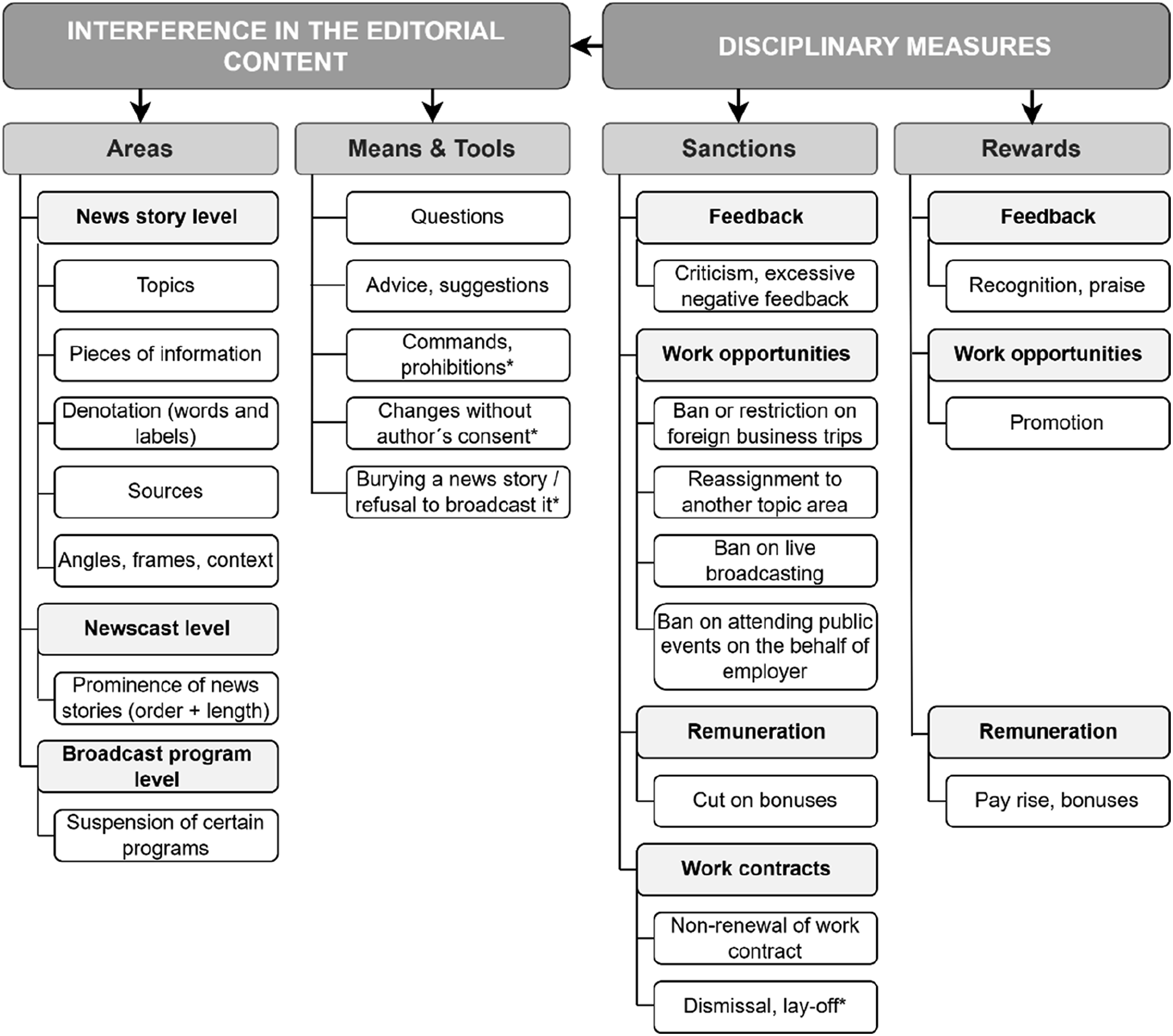
Interference in the editorial content
The interviews reveal that interference in the editorial content can occur at three levels. First, at the level of individual news stories, the superiors may try to influence the selection of topics; particular pieces of information; terms and labels used to denote events (e.g., the RTVS managers disputed the term “annexation”, which journalists used to denote Russia’s seizure of Crimea); sources; and angles/frames/context. Mechanisms of both inclusion and exclusion may be in place. The superiors can aim at influencing what to publish (e.g., as in the case of RTVS, they may instruct the journalists to cover a foreign state visit by a domestic politician which some journalists consider unimportant; or require quoting a source that journalists consider to have little expertise and credibility) and what to suppress and exclude. Second, at the newscast level, the superiors can try to influence the prominence of news stories (e.g., their order and length). Third, at the broadcast program level, interference can take the form of program suspension or discontinuation (e.g., the new RTVS management decided to halt its only investigative program, The Reporters, without providing a convincing explanation).
The management can use several means to interfere in the editorial content. To start with the least pervasive ones, questions (e.g., why a particular source was quoted) can sometimes be enough to let journalists know what their superiors find problematic or what they wish to see in a news story. Next, interference can take the form of advice or suggestions, which may be effective, particularly in the case of less experienced journalists. Finally, the most invasive tools are direct commands and prohibitions, changing content without the author’s consent, and burying a news story or refusing to broadcast it. However, it must be stressed that none of the interviewed journalists (either publicly or in anonymous interviews) reported that RTVS management used any of the last three tools. Journalists mentioned them only when explaining that such actions did not occur and some also referred to these tools when describing the threshold beyond which they would consider internal interference unacceptable.
Disciplinary mechanisms
Interference can also take a more indirect form of disciplinary mechanisms aimed at journalists. If the tools mentioned above are not effective enough, and the superiors prefer to avoid the direct forms of interference, they may try to interfere in journalistic autonomy by disciplining the journalists. Both rewards (i.e., praise, promotion, pay raise, bonuses) for loyal employees and sanctions for rebellious employees can be used to achieve this goal.
Interviews showed that the sanctions, in particular, were perceived as a powerful tool for internal interference. The participants complained about ex-post criticism (e.g., for the choice of source quoted) and excessive negative feedback related to already broadcast news stories during daily newsroom meetings. Several journalists pointed out that excessive criticism brought them to the brink of self-censorship: “Whether you want to or not, you can’t work under this psychological pressure in the long term because you start self-censoring to avoid unnecessary conflicts” (P1, an ex-RTVS reporter). In addition, journalists described that the new management used critical email feedback from some audience members as supporting arguments. They forced selected journalists to respond to them, even if the criticism was hateful, not factual, or openly vulgar.
Another disciplinary mechanism described by the participants was restricting work opportunities, which was directed at specific rebellious reporters. This included a selective ban on foreign business trips; involuntary reassignment to another topic area (i.e., from politics to culture, which the management later claimed to be “a joke”); a ban on live broadcasting; and a ban on attending public events as a public representative of RTVS. In addition, several reporters mentioned that those who opposed the new management experienced a reduction or non-award of bonuses, which otherwise constituted a significant part of their income.
Finally, the most extreme disciplinary mechanisms was non-renewal of work contracts. Even though no one was formally dismissed, the new management took advantage of the fact that several RTVS reporters were technically self-employed contractors (even though they worked exclusively for RTVS and had been part of the editorial staff for several years) and ended the contracts of four reporters who were among the signatories of a critical open letter and who openly confronted and criticized their superiors during editorial meetings. 2
Over the line? When internal interference becomes an unacceptable encroachment on journalistic autonomy
The instances of internal interference described in the previous section do not automatically constitute an inappropriate encroachment on journalistic autonomy. For example, an internal editorial discussion about which topics to cover and which sources to quote is a standard part of the news construction phase. The same can be true for the critical ex-post assessment of news stories at editorial meetings and the use of disciplinary mechanisms. Why and under what conditions do journalists interpret internal interference as illegitimate?
The case study of RTVS shows that when journalists experience internal interference, but have no evidence of inappropriate motivation on the part of their superiors, trust is key to the interpretation of the situation. Journalists must have sufficient trust that the conflicts are caused by legitimate motives and that the management is able and willing to insulate them from external interference rather than being a conduit. The interviews revealed that this trust was missing in the case of RTVS. For several reasons, the journalists did not trust the moral integrity of their new superiors, their professional skills, and their political independence (Figure 3). The sources of journalists’ distrust of the new RTVS management.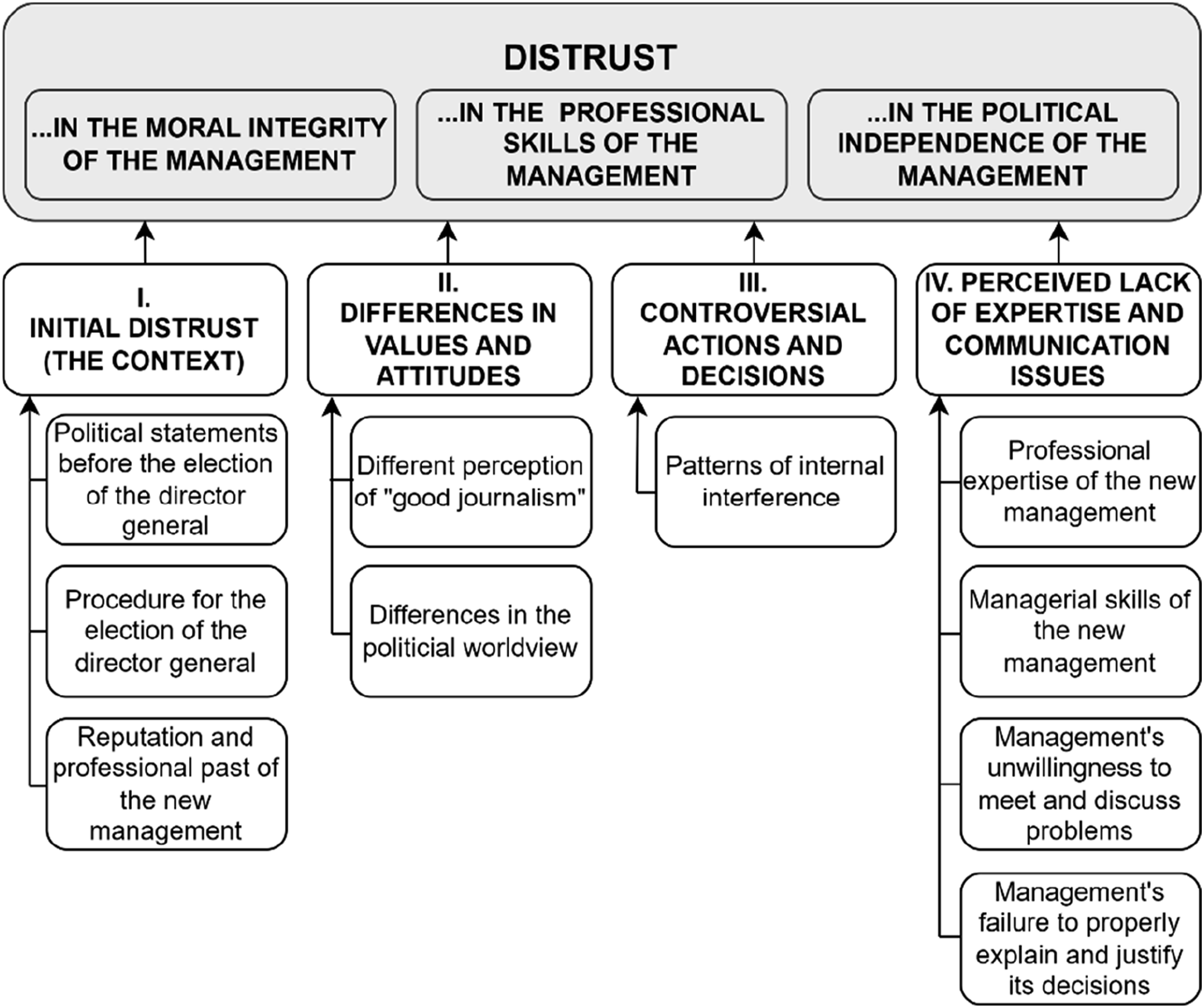
Initial distrust
First, from the outset, some of the staff felt initial distrust of the new management. This stemmed from a broader context. The fact that MPs directly elect the director general undermines public and journalistic trust in his or her independence. Moreover, before the 2017 election, ruling politicians made no secret in their public statements that they wanted a change in the leadership of RTVS and accused RTVS of being anti-government and biased (Benedikovičová, 2016). In addition, some journalists were suspicious of Jaroslav Rezník, the new director general, because of his professional history and reputation, as well as his alleged ties to the Slovak National Party, which helped push his nomination. For instance, when he served as director general of the public service newswire (TASR), its news service was criticized for publishing a disproportionate amount of news about the SNS, which was not even a parliamentary party at the time (Transparency International Slovakia, 2015).
The initial distrust was exacerbated when Rezník appointed three former press officers from ministries and state organizations to be the top managers directly responsible for TV and radio news and current affairs without acknowledging that this could be a conflict of interest: The main issue we all had with Jaroslav Rezník's arrival was the individuals he selected as managers. […] I, and many others, advocate the principle that if a person starts as a journalist, they should not transition to become a spokesperson or enter politics. Once such a transition occurs, they have crossed over to the other side of the shore and should remain there. P2, an ex-RTVS reporter
Differences in values and attitudes
Second, the opposing journalists and the new management differed in their values and attitudes. Not only did they have different views on what “good journalism” is, but they also differed in their political worldviews. The differences in journalism culture concerned two areas: the notion of public service (e.g., whether RTVS should automatically report on foreign state visits of the Speaker of Parliament, coincidentally also the chairman of the SNS, as a part of its public service remit) and the notion of objectivity, which translated into arguments about which sources to cite (see Urbániková, 2023 for more details). According to the opposing journalists, the new management demanded that they include as many different views as possible, regardless of their relevance, rather than trying to get to the root of the matter themselves: “[We were arguing] whether, when five political scientists share their opinions on a particular topic, it’s necessary to seek out a sixth one just for the sake of having an opposing view. That was their fake artificial objectivity” (P15, an ex-RTVS reporter). According to the new management, the opposing journalists were too one-sided and, at times, failed to give space to opposite views.
To further illustrate the dispute, when anti-government demonstrations were held in 2018 after the murder of investigative journalist Ján Kuciak and his fiancée, the superiors demanded that journalists to find and quote random people in the streets who did not participate in the demonstrations as part of their coverage of the protest (i.e., to give space to the “opposite side”). Or, in the case of a news story that concerned the warnings of international organizations that Russia was waging a hybrid war with a substantial impact on CEE countries, the management demanded that the journalist give space to the official Russian side (without specifying who that might be).
The two sides of the conflict also differed in their political worldviews. The interviews revealed that, in the eyes of the opposing journalists, some of the new managers had nationalistic and pro-Russian inclinations, while the new managers saw the opposing journalists as right-of-center liberals. Differences in political worldview would not necessarily be a problem, but, along with other factors, they narrowed the scope for what both sides would still consider a subject of legitimate disagreement. Using the conceptualization proposed by Hallin (1986), the two sides disagreed on the topics and opinions that still belong to the sphere of legitimate controversy and what already belongs to the sphere of deviance, which falls outside the bounds of legitimate debate and where the rules of objectivity do not apply. In other words, if the two sides come from too different value bases (in the sense of a broader worldview orientation, e.g., pro-Russian or pro-Western), it is hardly surprising that they disagree on which opinions need to be balanced and which are no longer opinions but facts, and on which views and sources are legitimate enough and should be reflected in the broadcast.
Controversial actions and decisions
The third source of distrust from the journalists’ point of view was the controversial actions and decisions of the new leadership. According to the opposing journalists, the cases of internal interference followed two interrelated patterns. The editorial disputes mostly concerned topics related to the SNS and its representatives and the topics related to Russia (at the same time, the SNS itself is known for its affinity towards Russia): “[…] later on it turned out that he [the new manager] is extremely sensitive on issues related to Russia, information warfare and defense, and things related to Russia and the ministries that the SNS is in charge of” (P10, a RTVS reporter). Some reporters mentioned that they noticed the tendency to give more space and more favorable coverage to persons and issues related to the SNS, to tone down criticism of them and to soften the critical tone towards Russia. When the management was not satisfied with their coverage of these “sensitive” topics, it used some of the disciplinary mechanisms described in the previous section (most often withholding salary bonuses), sometimes even admitting a connection to a particular story. As some of the journalists explained, they had no evidence, but the overall pattern seemed clear: “[…] the whole problem is that Rezník was simply given a political mandate to ensure that RTVS news did not bite the government” (P15, an ex-RTVS reporter).
Perceived lack of expertise and communication issues
Fourth, the opposing journalists questioned the professional expertise and leadership skills of the new management: “[The new management] was not able to effectively manage a team, both in terms of communication and from a professional point of view” (P10, a RTVS reporter). Several pointed out that the new management’s conception of journalism, and their knowledge of the technical processes, were outdated because they had worked as journalists 10 to 20 years before and had been spokespersons and press officers since then. In the eyes of the opposing journalists, the new managers also lacked the ability to lead the team and provide a vision. In addition, from their point of view, the situation was not helped by the fact that the new director general refused to communicate with them and that their superiors were unable to explain their controversial actions and decisions convincingly.
The outcome: journalists’ distrust of RTVS management
As a result, the reporters did not trust the moral integrity of their new superiors, their professional skills, and their political independence. Doubts were expressed both by those who left or were forced to leave, and by those who stayed at RTVS. In terms of moral integrity, one participant described Jaroslav Rezník as “a man who changes his opinions as needed” (P15, an ex-RTVS reporter); another considered the new managers “mere executors of power” (P16, an ex-RTVS reporter); and yet another described the conflict as “a clash of two moral-value worlds” (P11, an RTVS reporter). This was compounded by distrust in the professional abilities of RTVS management. As one journalist said, “I didn’t respect those people professionally. I didn’t feel that I could learn anything from them” (P15, an ex-RTVS reporter). Finally, the reporters also lacked trust in the political independence of RTVS management. They described, for example, that “there is political pressure, certainly...to be milder, especially towards the SNS. Not in the sense of not criticizing them, but to do it more mildly” (P6, an RTVS reporter), and assumed that the director general “came with a political assignment to make the news more pro-government and less critical” (P15, an ex-RTVS reporter).
The RTVS managers, on the other side, described the conflict as a “misunderstanding” (P14; an RTVS manager) and as a “power conflict” (P3; an RTVS manager) in which the reporters wanted to get rid of the new management and choose their own bosses. They accused the reporters of trying to politicize their disagreements and of inflating and misinterpreting the incidents.
Thus, both sides of the conflict blamed each other for bias, a lack of professionalism, and political motivation. Almost all the participants stated that the arguments and the tense atmosphere made regular work in the newsroom impossible. Some even described how the situation had a negative impact on their mental and physical well-being. Eventually, in April 2018, four reporters did not have their contracts renewed, and in May 2018, 12 others quit in protest. In addition to the distrust of the management, the participants also cited the fear of emerging self-censorship and the declining quality of reporting, with which they did not want to be professionally associated, as reasons. They described that the outgoing reporters were replaced with less experienced and more loyal ones who did what was needed. From their point of view, the result was low-quality and superficial reporting where reporters merely “hold the microphone to individual sources and then piece it together” (P7, an RTVS reporter).
Conclusion
Politically connoted changes in top management and suspected political pressure are not uncommon in public service media (Nissen, 2016), regardless of where they are located and which media model they belong to. The same applies to organizational pressure and internal interference, which are universal and timeless themes in journalism. Thus, despite being a single case study, the story of RTVS has general implications.
This study shows that internal interference can take two main forms: interference in the editorial content (at the level of news stories, newscast level, and broadcast program level) and disciplinary mechanisms (sanctions and rewards in feedback, work opportunities, remuneration, and work contracts). These are used to make journalists act in line with management expectations, so that interference in the editorial content becomes unnecessary.
The inductively developed classification scheme systematizes the forms of internal interference and adds to the existing literature (Breed, 1955; García-de-Madariaga Miranda et al., 2022; Goyanes et al., 2021; Waschková Císarová and Kotišová, 2022) several new areas where internal interference can occur (e.g., denotation of events, program suspension) and the means and tools used to achieve it (e.g., questions, advice, commands, prohibitions, burying a news story). Regarding disciplinary mechanisms, the tools identified were mostly in line with previous research on interference (Breed, 1955; Bunce, 2017; Goyanes et al., 2021; García-de-Madariaga Miranda et al., 2022; Waschková Císarová and Kotišová, 2022). The exception was the sudden non-renewal of some reporters' contracts, where the management took advantage of the peculiar Slovak system in which even long-standing staff members can be formally self-employed. A similar practice of non-standard contractual relations and the resulting vulnerability has already been described in the context of the Spanish public-service RTVE (Toledano et al., 2022). All in all, the personnel changes that began at RTVS after the election of the new director general eventually led to the replacement of opposing rebellious staff with new and loyal employees, which prevented further conflicts (cf. Sigelman, 1973).
The RTVS case also shows that, when journalists encounter internal interference, their trust in the management is crucial for their interpretation of the situation. Thus, trust between rank-and-file reporters and their superiors is important not only for the resilience of journalists to external interference, as described by Hiltunen (2022), but also for their handling of internal interference. In the case of RTVS, from the journalists’ point of view, the management not only did not function as an “editorial defense shield” (Revers, 2017); it was perceived as a lever for external political interference.
The distrust of the opposing journalists towards the new management concerned their moral integrity, professional skills, and political independence. It had several roots. First, from the beginning, journalists approached the new leadership with initial distrust caused by the context of the case (i.e., the election system in which the director general is elected directly in the parliament; the statements of the political representatives who openly called for change in the leadership of RTVS). Second, the two sides differed in their political worldviews and perception of “good journalism”, which narrowed the scope of topics and opinions they considered to be the subjects of legitimate disagreement (Hallin, 1986). This builds on previous research that shows that journalists enjoy more workplace autonomy if they share with management political views (Ceron et al., 2019) and professional journalistic values (Örnebring et al., 2016). Third, the opposing journalists spotted certain patterns in the controversial actions and decisions of the management. These mostly concerned the topics related to the SNS (the party that helped push through the nomination of the director general), its representatives, and interests. From the journalists' point of view, the aim was to provide more coverage of selected actors and topics, produce stories favorable to them, and mitigate criticism. Fourth, in the eyes of the opposing journalists, the new management failed to explain and justify its actions and decisions convincingly, refused to communicate, and lacked professional expertise and leadership skills. This corroborates the findings of the study by Goyanes and Cañedo (2023), which emphasizes the crucial role of communication in managing and resolving newsroom conflicts.
As a result of the combination of these factors, many journalists interpreted the management’s actions as an unacceptable interference upon their autonomy. They perceived it not only as journalistically unjustified, which was mainly the consequence of not sharing professional norms and values — that in itself would have been a strong enough reason for many to leave — but also as likely politically motivated, although they admitted that they could not prove the latter. Returning to the framework presented in Figure 1, this means that, from the journalists’ perspective, the mezzo-level (i.e., RTVS management) transmitted external political pressure into the organization, or at least voluntarily acted in accordance with the presumed interests of the leading political actors. Thus, in their view, the perceived internal interference had the nature of mixed interference.
To conclude the story of RTVS, Jaroslav Rezník’s mandate expired in 2022. The parliament resulting from the 2020 elections selected Ľuboš Machaj as the new director general. The new director general has no known links to specific political parties and after his election, the situation at RTVS has stabilized. However, in autumn 2023, early parliamentary elections were held, which were won by Robert Fico’s Smer-SD party. The new government reduced the RTVS budget and announced plans to dissolve RTVS. They proposed replacing it with a new organization, the Slovak Television and Radio (STVR), which would maintain the same mission, remit, and tasks. This move would provide an opportunity to replace the current director general with a new appointee (Reuters, 2024). This shows that political pressure on RTVS is far from over.
In a broader context, the risk of PSM being used as a tool in political power struggles is nothing new not only in the CEE region (Jakubowicz, 2008), but also, for instance, in Southern European countries belonging to the pluralist polarized model (Hallin and Mancini, 2004). The case of RTVS is a further manifestation of this climate, albeit so far milder than, for example, the PSM in neighboring Poland or Hungary. Here, the governments have effectively turned the PSM into state media: they changed media laws and appointed loyal figures as directors general (e.g., a former politician from the ruling party); this was followed by the mass forced and voluntary departures of staff and, subsequently, a noticeable bias within the media content in favor of the ruling parties (Coynash, 2019; Dzięciołowski, 2017; Polyák, 2015). Thus, there is no doubt about the direct political pressure and interference. However, the described case of RTVS was much less clear-cut and obvious, which, in terms of the independence of PSM, brings Slovakia closer to countries like Spain (see, e.g., García-de-Madariaga Miranda et al., 2022) than to countries like Poland or Hungary. The journalists could only assume the extent to which internal interference from their superiors was politically motivated. This made it difficult for RTVS journalists to explain to the public and to gain public support; this further underlines the intricacy of internal interference within a media organization.
Finally, what are the implications for further exploration of journalistic autonomy and interference? First, autonomy and perceived interference are not only situational and context-dependent (Kotisova and Císařová, 2023; Sjøvaag, 2013) but also significantly subjective. Thus, while a quantitative examination of journalists' general sense of autonomy and perceived pressure is undoubtedly useful (Maurer, 2019; Reich and Hanitzsch, 2013), focusing on the incidence of specific forms of interference (e.g., Hiltunen, 2022; Hughes et al., 2017; Örnebring et al., 2016) could lead to more valid, reliable, and comparable results. Future studies could consider how journalists interpret individual incidents and whether they consider the restrictions on their freedom and autonomy to be legitimate.
Moreover, frequency should not be automatically used as an indicator of the significance of interference, because, under certain conditions, one or just a few incidents may be sufficient to warrant a strong defensive response. This study also shows that the experience does not even have to be personal. Some of the journalists who left in protest mentioned that they did not encounter a case of internal interference but assumed that this was just because they did not work on topics that were sensitive and important to the management. They stated that seeing how the management treated their colleagues, particularly the most vocal rebels, was enough. Thus, the absence of personal experience of interference is not sufficient for a sense of autonomy. All this makes further exploration of interference and autonomy both intriguing and challenging.
Footnotes
Acknowledgements
The author would like to thank the four anonymous reviewers for their helpful comments, which contributed to improving the manuscript, as well as Ilmari Hiltunen, Marko Milosavljević, and Gunnar Nygren for their constructive feedback on an earlier draft. Additionally, gratitude is extended to Jaromír Volek for assisting with conducting the interview, and to the research participants for sharing their perspectives and dedicating their valuable time to this study.
Declaration of conflicting interests
The author declared no potential conflicts of interest with respect to the research, authorship, and/or publication of this article.
Funding
The author disclosed receipt of the following financial support for the research, authorship, and/or publication of this article: This work was supported by the Czech Science Foundation, Grant No. GA22-30563S.
