



Abstract
It is widely acknowledged that broadcast programmes are produced to serve the public’s interest. Presenting the programmes in a neutral and objective fashion, and engaging the audience in forming opinions, are common ways of achieving this. However, studies have suggested that there is a departure from these practices when the object of broadcast becomes societal problems such as racism. This case study examines how a presenter responds to a caller’s abuse in two live radio shows, and how she sets out a programme - and a new conversation - using her personal experience of racism/xenophobia. Using conversation analysis and discursive psychology, we studied the situated use of language and the actions being brought about. We found that the presenter assesses the caller’s abuse by rudeness on the spot, formulating the call as disruptive to an ongoing conversation. On the following day, the presenter revisits, and topicalises, this call as xenophobia and racism. Our analysis revealed that the presenter’s shift in evaluating this call is grounded in, and licensed by, her drawing on and cultivating a sympathetic listenership, characterising the call as race-driven, and formulating her personal experience as of public’s concern. Our findings spotlight the presenter’s orientation to her moral accountability in talking about racism, and the potential of broadcast in leading conversations on anti-racism.
A broadcast interviewer is expected to deliver a program in a neutral and objective manner (Clayman and Heritage, 2002; Heritage and Greatbatch, 1991; Rendle-Short, 2007; Scannell, 2007), and in the service of the public (Irvine, 2000; Scannell, 2000). On occasion the broadcast interviewer may set these practices aside. One occasion is when race-related affairs become the subjects of broadcast (Rafaely, 2021; Whitehead, 2018; Xie, 2023, 2024).
Discourse and conversation analytic studies have shown that talking about racism is a delicate business across interactional settings (Durrheim et al., 2015; Stokoe, 2015; Stokoe and Edwards, 2007; Zhang, 2023; inter alia). The stake is higher when the talk takes place publicly, in broadcast programmes (Xie, 2024; Xie et al., 2021). Interviewers play a crucial role in manoeuvring the broadcast talk on and about racism. Existing research flags their orientation to the moral responsibility as they, for instance, sanction hearably racist expressions (Whitehead, 2015, 2018), or collaborate with the interviewees/victims to talk their experiences of racism into being and produce a newsworthy story (Rafaely, 2021; Xie, 2023, 2024). Building on and expanding the current knowledge, we present a case study to explore how a broadcast interviewer deals with her personal experience of racism on the spot, and in retrospect, in live phone-in radio shows.
Below we outline briefly the contributions of discourse and conversation analytic research that lay the foundation for this case study.
Doing broadcast talk
This case study is guided by conversation analysis (CA; Sacks, 1992) and discursive psychology (DP; Edwards and Potter, 1992), wherein talk – in various forms – is the key object of enquiry. CA and DP see talk as the building block for organising social interactions, and the arena wherein myriad social actions are accomplished. The social actions can be as mundane as greeting or offering/accepting/rejecting a dinner offer, or as contentious as holding a politician to account. CA and DP research is hence inductive. The analysis is grounded in what is actually said (or written), and how the interlocutors manage their talks in an unfolding interaction. Starting with, and dissecting, the moment-by-moment unfolding talk, CA and DP scholars prioritise the interlocutors’ agenda, and are able to uncover issues that the interlocutors treat as important, and thereby manage, as they go about their everyday lives (Potter, 2010).
Broadcast talk is a rich and accessible material for CA and DP researchers. One strand of inquiry has focused on turn-taking in broadcast talks. Dissecting the talk turn-by-turn, CA scholars have discovered how the interviewers practice and achieve neutralism. For instance, studies show that by systematically adopting a neutral footing, such as using ‘we’ in lieu of ‘I’, the interviewer’s statement is delivered ‘as an object that is issued on behalf of others’ (Heritage and Greatbatch, 1991, p. 76; see also Clayman, 1992, 2006). Similarly, by invoking the public in their question turns, such as by saying ‘for those people who watching the programme’ (Clayman, 2006, p. 223; see also Clayman, 1992, 2013; Heritage and Clayman, 2010), the interviewer’s question is designed to be heard as voicing for the public, as opposed to their personal opinions.
Evidence also highlights the interviewee’s joint orientation to, and thereby collaborative accomplishment of, neutralism in broadcast interviews. For instance, by waiting for the interviewer to complete their question turn, and by returning the interviewer’s turn with an account, explanation, or information, the interviewee rectifies the interviewer’s institutional category as an information-seeker and thereby revives the interviewer’s neutral stance (Clayman, 2013; Heritage and Clayman, 2010; Heritage and Greatbatch, 1991).
Another strand of CA and DP research attended to the subject of broadcast. Drawing on radio phone-in shows, studies revealed that although programmes are designed to promote argumentative debate and strong opinions (Cameron and Hills, 1990; Hester and Fitzgerald, 1999; Hutchby, 1996), some issues are treated as indisputable. Racism is one. For instance, Burford-Rice and Augoustinos (2018) showed that speakers repair their racist slurs. By denying racism, or apologising in the immediate next turn, the speakers treat their speech as problematic, if not hearably racist (see also Bolden et al., 2022). It is through these repairs that the speakers frame what they just said as accidental mistakes, or mishaps that do not reflect their character or intention. A potential accusation of their speech as racially driven is pre-emptively fended off. Their culpability is in turn mitigated.
Radio presenters are also found to challenge and sanction callers who make hearably racist statements. This is shown by Kevin Whitehead (2011, 2012, 2013, 2015, 2018, 2019, 2020), whose work draws on recordings of roughly 120 hours of radio phone-in programmes in post-apartheid South Africa. Whitehead’s findings show that sanctioning racist expression is an intricate business. Instead of directly accusing a caller for racism, a host incorporates assessments such as ‘generalising’ or ‘you’re just incorrect’ (Whitehead, 2018: p. 294) to disagree with the caller. The host can also display a resistance to align with a hearably prejudiced expression by not taking a turn when a caller’s account reaches a possible turn completion (Whitehead, 2015). Whitehead’s investigations, along with much DP and CA research, reflect that whilst there is a norm against racism (Billig, 1988) in modern society, it is met by a norm against accusing racism (Durrheim et al., 2015).
These CA and DP investigations bring to light that broadcast programmes are treated as a discursive space wherein expressions of racism are unacceptable and sanctionable. By challenging or not aligning with expressions of racism (Whitehead, 2012, 2013, 2015, 2018), broadcasters orient to, and put into practice, their interactional and institutional responsibility to police opinions and discourse that can be heard as racist.
This is further supported by the latest studies that examine how people retrospectively account for their experiences of racism in broadcast interviews. Rafaely (2021) studied one South-African news interview wherein a Ugandan climate activist, Vanessa Nakate, was interviewed about her experience of being ‘cropped out’ in a photograph reported in a US news article. As Rafaely observed, Ms Nakate’s does not explicitly accuse the press that cropped her out of the photograph of racism in her initial accounts. The interviewer helped by inviting Ms Nakate to consider the incident as racially motivated. Xie (2023, 2024) examined instances wherein victims of racism are invited to speak about their experiences in broadcast interviews. Her investigations also spotlighted the collaborative role of the interviewers in helping the interviewees (who are also victims of racism) to report their experiences of racism retrospectively. It is through such media coverage, and co-management of the accounts, that an auspicious environment to report racism is built and fostered at both an institutional and interactional level (Xie, 2024). Sanctioning racism is thus worked up, and treated, as a broadcastable matter.
The current investigation focuses on one radio presenter. We ask two research questions: (1) how does the presenter respond to a caller’s abuse, on the spot and on the following day; (2) how does the presenter set out a new programme using her personal experience of racism/xenophobia, and hence lead a conversation with listeners and potential callers. Our inquiry is partly intrigued by the radio station’s own agenda and interest in these discursive moments. As these segments of the shows were video-recorded and shared on the radio station’s social media (see the next section for more information). This suggests that the radio station treats these talks as watchable and clickable (Richard Fitzgerald, 2023, personal communication). Indeed, both videos sparked heated discussion on Twitter (now X). Understanding what is actually said in these two shows will give us insights into the legacy of broadcast talk within and beyond live shows. Guided by conversation analysis and discursive psychology, we will examine the talk as it unfolds and find out the situated functions of utterances. We will show how the presenter manages, and overcomes, the delicacies of reporting racism from reporting to rallying call, and presenting a personal experience as a matter of public concern. 1
Methods
Data
Two videos were sourced from LBC’s official YouTube channel. LBC, short for Leading Britain’s Conversation (once known as the London Broadcasting Company), is Britain’s biggest commercial talk radio station (Chignell, 2007, 2011). Today its programmes run digitally and globally 24/7. As of February 2024, ‘LBC sticks with three million weekly listeners’ (Martin, 2024). LBC programmes are normally hosted by a presenter every 3 hours. Most of these shows consist of speaking with callers or interviewing guests on a headline topic.
Xie became aware of both videos on 29 August 2022, as they appeared in her Twitter feeds (she follows LBC). One video clip shows how the presenter, Sangita Myska, 2 receive and handles a problematic call during her show on 28 August. This caller questions Myska’s right to comment on issues such as free school meals on ‘UK radio’ and ‘UK TV’, and asks Myska to ‘shut up’ (detailed transcript is presented below in the Analysis). The other clip shows Myska’s opening talk on 29 August, as she addresses the problematic call in retrospect.
Xie then sought the full video clips on YouTube by searching ‘Sengita Myska LBC’. Both videos appeared at the top of the search result. One video is entitled 'This is my country': Sangita Myska's awe-inspiring response to LBC caller's bigotry, and the other 'I'm of this country': Sangita Myska's powerful reflection on what bigoted LBC caller said to her.
Analytic procedure
Informed by conversation analysis and discursive psychology, our analyses begin at transcribing. To capture and reproduce the speaker’s actions, Jeffersonian transcription system (Hepburn, 2004; Jefferson, 2004) was applied. This transcription system allows us to recreate how words are uttered (e.g., by annotating the speed, loudness, intonation, and so on of the speech) and the interaction between speakers (e.g., by marking over-lapping talks or measuring the length of a pause between and within conversational turns).
Specifically, we paid attention to the sequential organisation of the talks (e.g., the order of which people take turns, and of which things are said), the resources being incorporated (e.g., membership categories, assessments, etc.), and what action is being delivered (e.g., dis/agreeing, blaming, etc.). Our observations also took into account the institutional context in which the talk is situated, that is, in radio phone-in programs. The talk is thus inspected as being produced for an overhearing audience, as opposed to a private conversation (Hutchby, 1991).
We shared our initial observations at data sessions, which is an important procedure for CA and DP analysts to validate their analysis (Wiggins and Potter, 2017).
Analysis
In this section, we present transcripts of segments of the programmes and take readers through our observations. We will first show and compare how the presenter responds to the abuse on the spot and revisits the incident on the following day. We will then focus on the opening speech on the second day, tracking how the presenter’s talk unfolds, and exploring the functions that her talk serves in legitimising her revisiting the call, characterising and assessing the call negatively, and constructing her story as worthy of the public’s concern.
Responding to and assessing a problematic call
The extract below displays the beginning and climax of the conversation between this caller and Myska, and Myska’s response to the caller.
Extract 1. Sangita Myska’s response to a caller’s abuse on the spot
Accessed on 29 August 2022, https://youtu.be/NpNszhlJLdQ
Segments displayed: 00’00”–00’08”, 00’32”–01’30”, 02’24” −02’49”
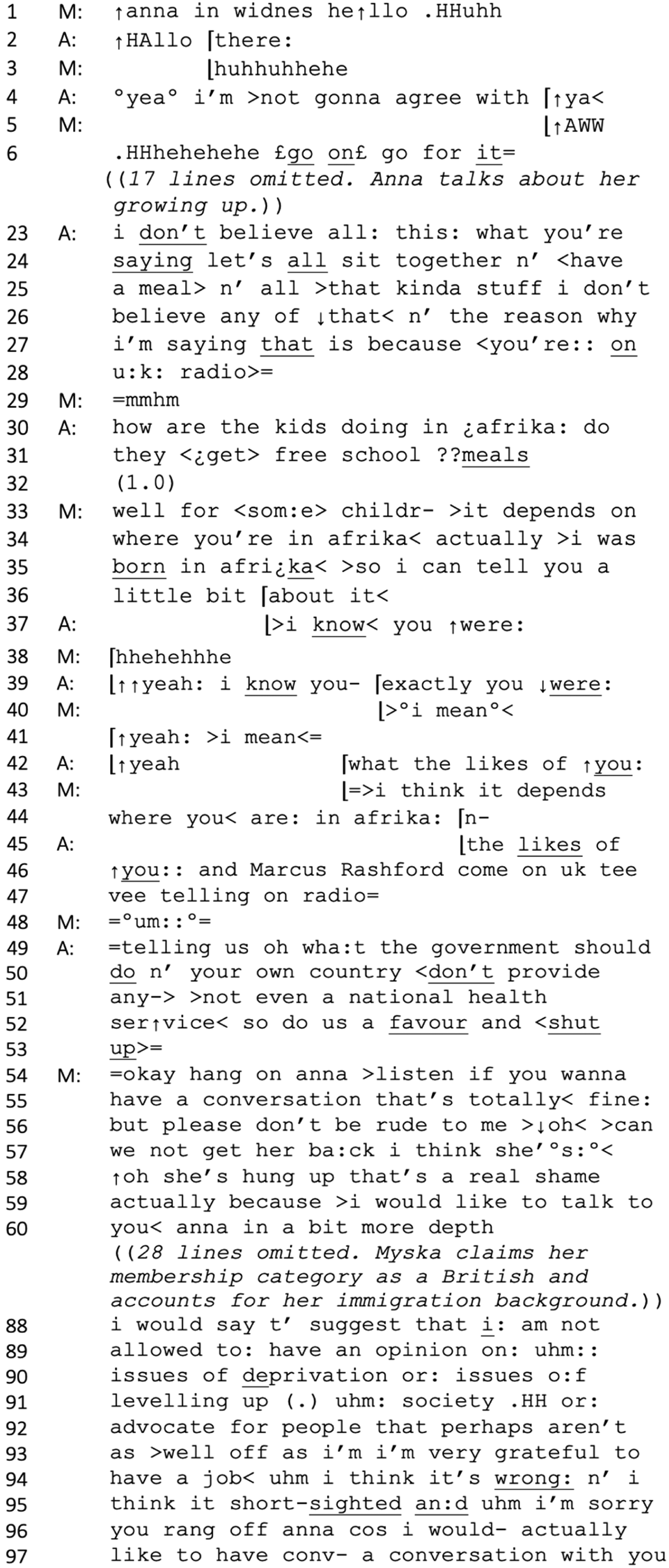
A disagreement is declared and underway from the outset of this call (L4).
3
The caller, Anna, invokes and frames Myska’s ethnic origin as the grounds of her disagreement. This is first observed as Anna makes relevant ‘the kids in Afrika’ (L30) in her accounts. After Myska avows her place of birth (‘I was
The caller’s abuse deserves a thorough investigation of its own. Our interest here is Myska’s response to Anna’s directive (‘do us a favour and <shut up>’, L52-53), which is delivered against the backdrop of presenting a radio talk show (Hester and Fitzgerald, 1999; Hutchby, 1996). This is observable as Myska takes the next turn immediately, annotated by the ‘ = ’ sign. Beginning her turn with ‘okay’ (L54), Myska marks this moment as an appropriate point for her to interrupt. Along with a request, ‘hang on anna’ (L54), Anna’s speech just now is constructed as interruptible, and needing mediation from Myska. Myska’s mediation also directs the listeners to a potential trouble in this conversation (Sacks et al., 1974).
Myska next assesses and characterises Anna’s call. She achieves this by, first, stating, ‘>listen if you wanna have a conversation that’s totally< fine: but’ (L54-56). In this request, Myska packages what she is doing here, on air, as ‘have a conversation’. Juxtaposed with a positive evaluation, ‘totally< fine:’, having a conversation is constituted as an expected, therefore acceptable, activity on the programme. The use of extreme case formulation ‘totally’ (Pomerantz, 2021) and the stretched utterance of ‘fine:’ emphasise this construction. Nevertheless, formulated as a conditional statement (i.e., begins with ‘if’), and succeeded by a contrast marker ‘but’, listeners are invited to hear what Anna just said as the opposite of having a conversation, and as not ‘fine:’.
Second, Myska makes a request, ‘please don’t be rude to me’ (L56). Embedded in this request is Myska’s orientation to her institutional task right here and now, that is, speaking to both this caller as well as the overhearing LBC listeners (see Hutchby, 1991). This is evident as Myska uses ‘please’ to initiate her request, displaying her orientation to the use of broadcastable or appropriate language during the show. By requesting Anna, ‘don’t be rude to me’, listeners are invited to judge what Anna just said by politeness. This assessment-laden request in turn serves to legitimise Myska’s interruption and mediation of Anna’s call. It is through this request that Myska’s ongoing engagement with Anna in this phone call is enacted. Myska’s statement in lines 58-60, 'that's a real shame actually because>i would like to talk to you< anna', reinforces her treating this 'conversation' as ongoing. At the same time, Anna’s departure from this call is portrayed as unexpected, and therefore problematic. Anna’s reason for leaving is called into question.
This way of assessing Anna’s call is observable again in lines 88-97. Here, Myska first reformulates her sense-making of Anna’s call, ‘t’ suggest that
It is on the basis of having constituted and enacted having-a-conversation in this programme that Myska assesses Anna’s call, ‘I think it’s wrong: n’ I think it short-sighted’ (L94-95). The subject-side assessments (‘I think’) allow Myska to produce these assessments as her opinions, whilst the object-side assessments package these as observable and shareable by many people (Edwards and Potter, 2017; Potter et al., 2020). The combined use of subject-side and object-side assessments thus move the issue from the protagonist, Myska, to the general public, whilst inviting affiliation from the listeners (Potter et al., 2020). Moreover, the fusion of these assessments, according to Potter and his colleagues (2020), serves to conclude and summarise the speaker’s speech. Indeed, after producing these assessments, Myska recycles the formulation, ‘have conv-a conversation with you’ (L97-98), and highlights again Anna’s accountable, premature and regrettable departure from this conversation (‘i’m sorry you rang off anna’, L96).
On the second day, the 29 August 2022, Myska returns to Anna’s call. Extract 2 below displays a segment of her opening talk, wherein she assesses Anna’s call from the day before.
Extract 2. Sangita Myska’s opening speech on 29 August 2022
Accessed on 29 August 2022, https://youtu.be/oWpA8JuDxWA
Segments displayed: 00’37” – 00’51”

In alignment with her assessment the day before (‘please don’t be rude to me’, ‘it’s wrong and it short-sighted’), Myska assesses Anna’s call negatively here (‘a
Shifting the objects of her assessment from a caller (and her problematic call) to Myska’s personal experience, and upgrading her assessment from ‘rudeness’ to ‘xenophobia’, are bold and risky moves. On the one hand, Myska’s ostensibly inconsistent assessments of Anna’s call, and reporting a personal experience, could be seen as violations to the expected journalistic practice of neutralism. One prevalent agenda is to report and cover newsworthy events that are of the public’s interest (Clayman, 2006; Irvine, 2000; Montgomery, 2008, 2010; Scannell and Cardiff, 1991), or ‘for-anyone-as-someone’ (Scannell, 2000). On the other, naming ‘xenophobia’ is a precarious and challenging business. As many discursive psychologists and conversation analysts have demonstrated, the notions of racism, prejudice, and their variants, are contestable across cultural and discursive environments (Augoustinos and Every, 2007; Durrheim, 2012; Durrheim and Dixon, 2000, 2004; Wetherell and Potter, 1992; inter alia). This is especially prominent when an individual talks about their own experiences. Their character and motive are at stake (Whitehead, 2009; Xie, 2024). This orientation is enacted and observable in Myska’s broken-up and breathy utterances (e.g., her audible inhalations ‘.HHH’ and ‘.hhh’, and exhalation ‘HHHHhow’). Despite Myska’s ‘risky move’ to topicalise Anna’s call as xenophobia, and to talk about her personal experience in a live radio phone-in programme, her speech received praises and support from social media users. In the following section, we will zoom in on Myska’s opening talk on the second day, and look for the resources that she incorporates to legitimise this ‘risky move’.
Turning a personal experience of racism into a broadcastable matter
In this section, we will explore what Myska does on the second day, and how, that licenses her to change, and elevate, her comments and assessments about Anna’s call. Extract 3(a) below exhibits segments of Myska’s speech, as she introduces the topic and agenda for her show today and accounts for what happened off-air.
Extract 3(a). Sangita Myska’s opening speech on 29 August 2022
Segment displayed: 00’15”–01’49”
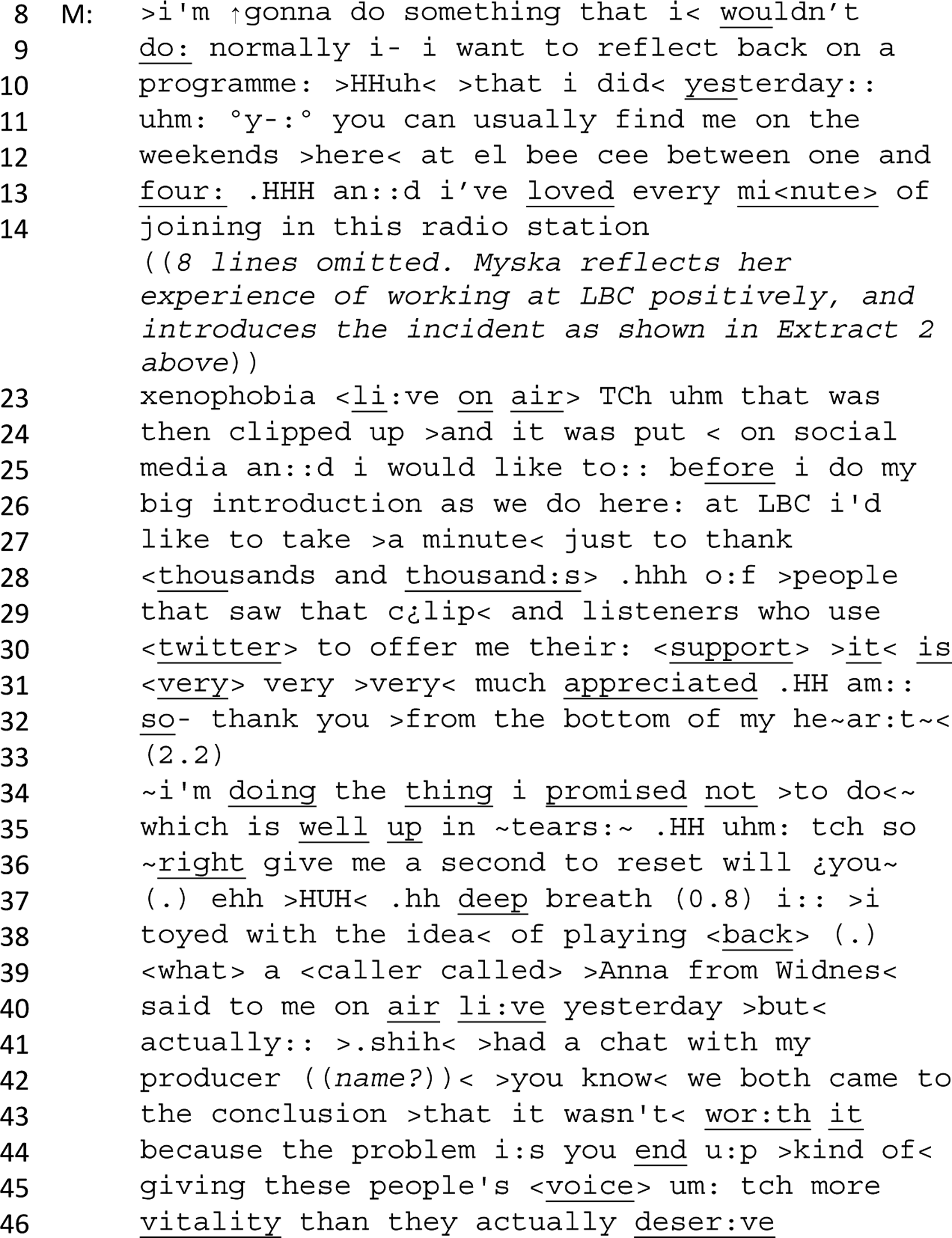
The first business that Myska attends to and accomplishes, after introducing and topicalising the problem, is to construct this ‘
The second, and a pivotal, business that Myska accomplishes is to invoke and fortify a sympathetic listenership. This is observable as Myska cuts herself off (‘i would like to:: before I do my big introduction’, L25-26) and inserts an acknowledgement (L27-32). As she utters her acknowledgment, she invokes ‘<
Myska’s talk here unveils her orientation to, and management of, the delicacy of talking about a personal experience of racism in a live radio programme. As outlined in the introduction, news presenters collaborate with their interviewees by building and fostering an auspicious environment for reporting experiences of racism (Xie, 2023, 2024). In this case, Myska is both a victim and a presenter of a phone-in programme. Myska therefore has to introduce her experience, topicalise it as xenophobia or racism, and work it up as newsworthy single-handedly. Myska’s talk in lines 23-32 is thus pivotal in ‘‘personaliz[ing]’ the relationship between the content of radio […] programmes and their effect on listeners’ (Scannell and Cardiff, 1991, p. 4), which grants her the ticket to talk about her experience of racism on a live radio show.
In addition to topicalising Anna’s call from yesterday as xenophobia, Myska also evaluates Anna’s call as unworthy of ‘<
It is on the basis of having worked up a sympathetic listenership that Myska ‘recap what happened’ (L53), as shown below.
Extract 3(b). Recapping what happened
Segment displayed: 01’58”–03’47”
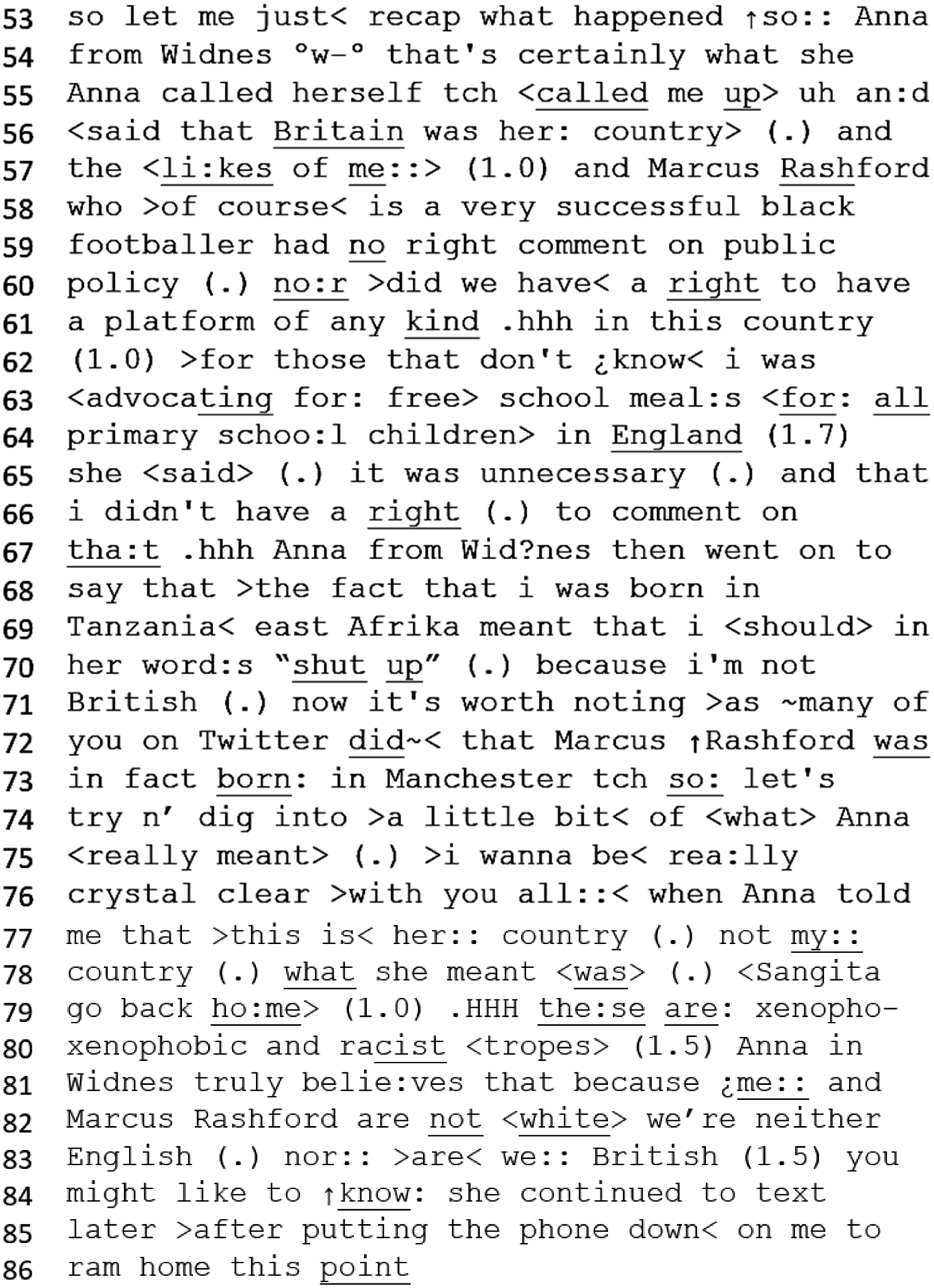
This ‘recap’ licenses Myska to make another ‘risky move’ in lines 74-86. Her talk here is risky in two aspects. First, Myska dissects, ‘<what> Anna <really meant>’ (L74-75), ‘
This leads us to the last, but not least, significant business that Myska manages and accomplishes in her opening talk, which is to transform her personal experience into a topic ‘for-anyone-as-someone’ (Scannell, 2000). To complicate this further, Myska needs to turn her experience, and a problem, that is ‘characterized by structural relationships of inequality and oppression (such as poverty, racism, […] involve segments of the population defined by category membership’ (Schegloff, 2005: p. 449), into a topic of which all ‘segments of the population’ could potentially give an opinion on (see Fitzgerald and Housley, 2002). This is achieved through Myska’s laying out her sense-making of why Anna called.
Extract 3(c). Myska accounts for Anna’s call
Segment displayed: 03’48”–05’04”
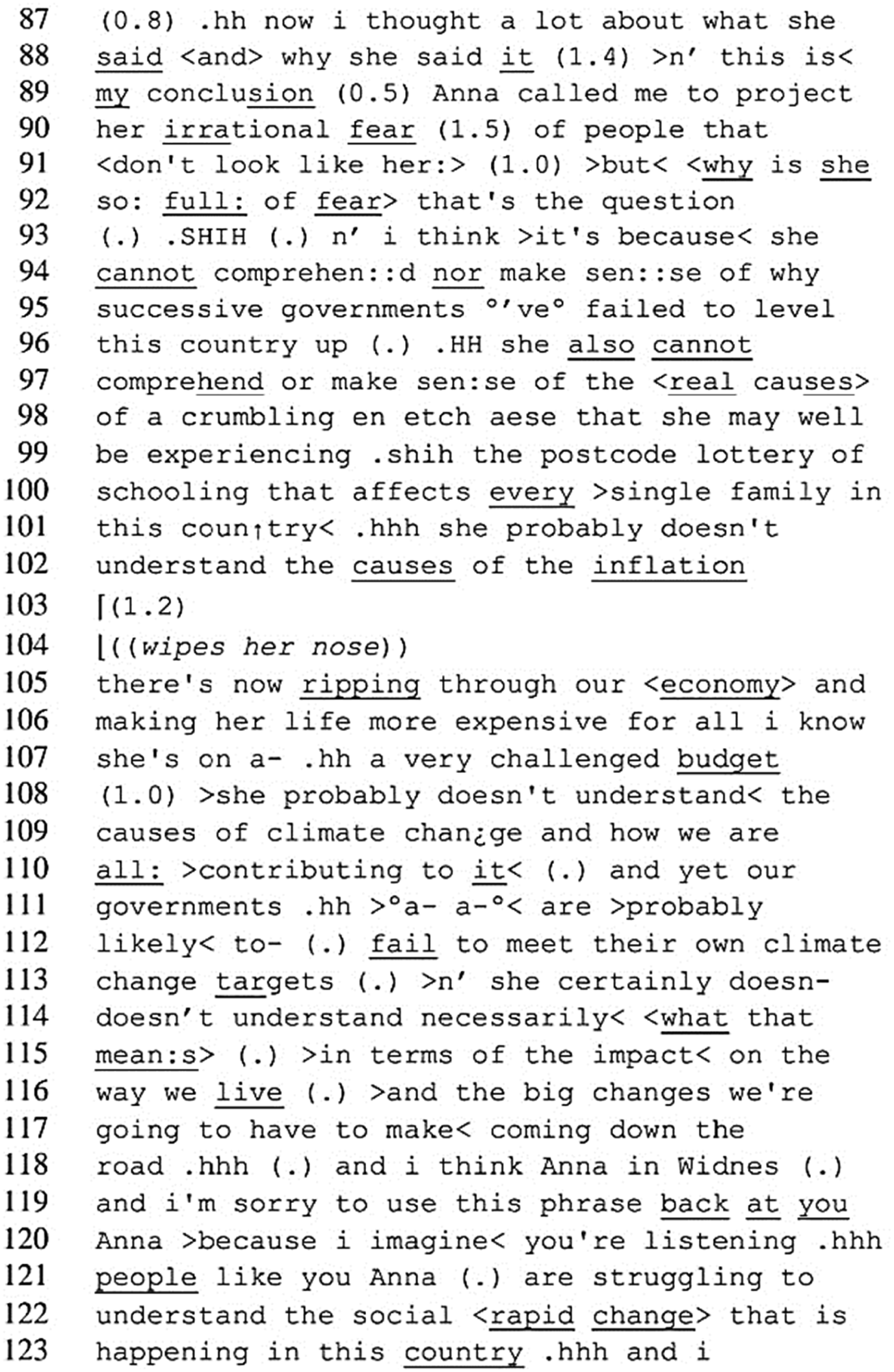
As shown in Extract 3(c) above, Myska accounts for Anna’s motive to call, through which she produces a lay (social) psychological explanation for xenophobia/racism. She accomplishes three important actions in this part of her speech. First, Myska explains Anna’s action on the grounds of ‘irrational fear’ (L89-90). This formulation projects, and invites the listeners to look for, the opposite, that is, rational reasonings. Indeed, in Myska’s following speech, she lists a number of reasons for ‘<
In laying out these (possible) reasons, whilst upgrading the epistemic strength (i.e., from a hedged ‘i think >it’s because<’ (L92-93), to ‘she probably doesn’t understand’ (L100-101, L105-106), to ‘she certainly doesn’t understand’ (L110-111)), Myska provides the listeners and listener-to-turn-callers with a pool of resources to hear Myska’s speech in a certain direction. That is, listeners are invited to judge Anna’s character and her call as irrational. Furthermore, this list makes available, and thereby recyclable, discursive resources for listeners and callers to use, tweak with, and dis/agree with in the subsequent conversations.
A second and intertwined action that Myska accomplishes in this speech is to artfully transform her personal experience of racism to a public concern. This is observable as Myska invokes the membership category, ‘people that <don't look like her:>’, and frames them as the target of Anna’s call (L89-91). In doing so, Myska shifts the target of Anna’s abuse from herself, and Marcus Rashford, to a wider community. Making available ‘look’, or the visible means by which people could be recognisable and recognised, Anna’s action is constituted as driven by race, or a (mis)recognition of people’s race categories (Xie et al., 2021).
Last but not least, Myska’s speech, especially the ways in which she dissects Anna’s phone call, index (and invite) agreement and affiliation as the preferred responses from listeners and potential callers. On the one hand, agreement is preferred in interactions (Pomerantz, 2021). On the other, by agreeing with Myska’s assessments, a listener would align their opinions and stance with that of Myska’s, instead of Anna’s or ‘
Concluding Remarks
In this study, we examined how a radio presenter responds to a caller’s abuse, and transforms her personal experience into a broadcastable matter. Our analysis brings to light Myska’s orientation to the possible reception of her talk, and her cultivation of an auspicious environment to host a public conversation on and about race/racism on a phone-in radio. We summarise the main findings below and discuss their implications.
We observed that, on the spot, Myska assesses the caller’s abuse by the routine practice of doing a radio phone-in show. By requesting the caller, ‘please don’t be rude to me’, Myska formulates the caller’s abuse as a violation of having a conversation. On the second day, in the opening talk of a new programme, Myska re-assesses the call and topicalises it as xenophobia and racism. This twist of assessment appears to depart from the expected journalistic practice of presenting news and stories neutrally and objectively (Clayman, 1992, 2006; Heritage and Clayman, 2010; Heritage and Greatbatch, 1991). Delving into Myska’s opening speech on the second day, we discovered that Myska incorporates and manoeuvres a variety of discursive resources, which in turn license her to launch this twist in her judgements and cover her own experience of racism/xenophobia.
One resource that Myska constructs and manoeuvres in her talk is the listenership. As we demonstrated, Myska creates and cultivates a sympathetic community by invoking ‘thousands and thousands of people’, and describes what they did (e.g., ‘used twitter to offer me their support’). By acknowledging these listeners and thanking them for their support, Myska’s returning to this abusive call, or covering her personal experience in a radio phone-in show, is framed as a response to the community’s interest. In other words, she is addressing her experience in the service of the public. She is in turn inoculated from being heard as personally invested in pursuing this agenda live on air.
Second, Myska makes available explanatory resources for the listeners to hear and (re)judge Anna’s call as xenophobia and racism. This is observable as Myska recaps Anna’s call, and lays out the motives underlying Anna’s call. Making available these resources allow the listeners, and listeners-to-turn-callers, to recycle and mobilise in their subsequent calls, and negotiate their opinions. We also demonstrated that Myska’s ‘recap’ and her explanatory resources are done in such a way that invite alignment and affiliation from the listeners. Myska accomplishes this by invoking the category ‘people like you Anna’, and characterising them as irrational, if not racially motivated, in making sense of societal problems. ‘People-like-Anna’ is thus mobilised as a topic-opinion-relevant category (Fitzgerald and Housley, 2002), wherein agreeing with Anna (and what she said) would cast a listener/caller as a co-incumbent, as ‘people-like-Anna’. At play in this categorisation is the moral order (Jayyusi, 1984, 1991) of racism/anti-racism, wherein anti-racism is projected as the preferred stance. Making available these resources thus license Myska to invite affiliation from the listeners and potential callers. An auspicious environment for having a conversation about racism is fostered.
Myska’s delicate work, on forging an auspicious environment for a conversation on and about racism, unveils her orientation to, and management of, the possible reception and continuity of her talk on (and perhaps off) the radio. Her speech is not delivered as a monologue. It is, in CA terms, the first pair-part of an adjacency pair (Sacks, 1992). It serves as the first-turn, or start, of a conversation. More crucially, it invites potential callers to contribute to the second pair-part, and in a way that would affiliate with, and thereby legitimise, Myska’s agenda and moral assessment. 5
Myska’s talk in both programmes reflect the complexity of identifying and dealing with racism, as well as the intricacy of accounting for a personal experience of racism/xenophobia. These are complicated by the platform in which the talk is held, that is, live radio, and that the presenter herself was targeted. This is evident as Myska circumvents the reporting of her personal experience, and transforms it into a topic worthy of discussion on the radio. Nonetheless, Myska’s talk implicates her recognition, and manoeuvre of, broadcast discourse in activating and mobilising people’s shared concern and moral stance toward societal issues. Her personal experience is used, and treated as useable, as a specimen to lead a conversation about racism. This implies, and amplifies, the institutional and moral duty that the presenter orients to. By setting up her talk to invite the listeners to recognise and assess Anna’s call as ‘wrong’, ‘xenophobic’, and ‘racist’, the listeners are encouraged to condemn Anna’s call or even adopt an anti-racism stance. Due to the absence of the conversations between Myska and fellow callers, 6 this argument is restricted. Future studies can explore how the conversations continued beyond airtime by drawing on posts and comments on social media.
Our case study presents a real-life example of how a radio presenter, and a phone-in radio programme, could be the driving forces in manoeuvring the discourse and moral assessment, and in leading reflective conversations on and about racism. Out of many things that could be covered on the radio, Myska and the LBC production team chose to revisit a problematic call and make a new programme (and conversation) out of it. After all media discourse can reach the public at large (Van Dijk, 1992, 2012), and the ‘immediacy’ of radio programmes can ‘influence, contribute to or set the early news and political agenda’ (Fitzgerald and Housley, 2007, p. 160). Moreover, our analysis spotlights the legacy and recyclability of radio talk. In setting out a conversation informed by her personal experience, Myska acknowledges the existing (and positive) receptions of her talk from the day before. A contemporary phone-in radio does more than ‘‘speaking’ to the listener’ (Irvine, 2000, p. 39). It leads, and can potentially shape, public discourse and opinions on societal issues.
Footnotes
Acknowledgements
We would like to thank colleagues and members of the Ross Priory Broadcast Talk Group, for their comments and feedback at the 31st Ross Priory International Seminar On Broadcast Talk. We are also grateful for members of the Scottish Ethnomethodology Discourse Interaction & Text for sharing their observations with us at data sessions.
Declaration of conflicting interests
The author(s) declared no potential conflicts of interest with respect to the research, authorship, and/or publication of this article.
Funding
The author(s) received no financial support for the research, authorship, and/or publication of this article.
