



Abstract
In the modern hybrid media landscape, the relations between journalists and politicians in arenas such as the broadcast news interview can seem less stable. Politicians and their advisors seem increasingly confident in identifying when and how to engage with political interviewers while journalists, in response, feel under pressure to intensify their role as scrutineering tribunes of the people. In such an environment, the normative interactional boundaries of the news interview itself can come under pressure from both sides, and even be breached. This article discusses the phenomenon of ‘going meta’ – occasions in which participants break out of the interview’s interactionally managed frame, and render topical the very practices that, ordinarily, constitute and reproduce the rules of that frame. Going meta is a practice that simultaneously breaches the ‘rules’ of the interview, and invokes the same rules in the construction of complaints about the behaviour of a coparticipant. The analysis shows how interview participants use going meta to raise questions of objectivity, truth, and the interests of ‘the people’, often in moments of heightened conflict talk.
Introduction
It has long been acknowledged that the broadcast news interview is an evolving form of discourse. Early accounts of how news interview practices evolved through the 20th century described a shift from more deferential to more adversarial interviewing techniques; the role of the interviewer changing from neutral questioner to active investigator (Schudson, 1994). To begin with, power lay primarily with the politician, who could choose whether or not to engage in the ‘game’, and with what level of seriousness. As more probing adversarial techniques were developed, the balance of power tipped towards the journalist. While politicians became more evasive (Bull, 2008; Greatbatch, 1986; Harris, 1991), news interviewers succeeded in being probing and challenging (Clayman and Heritage, 2002), while remaining at least rhetorically within the journalistic conventions of impartiality (Clayman, 1992; Heritage, 1985). A high point in this shift is found in the ‘accountability interview’ (Montgomery, 2011), in which politicians are subjected to highly interrogative forms of questioning around actions treated as controversial within the public sphere.
Recent studies suggest that for the 21st century political interview, a key development is the emergence of increasing non-neutralism: the role of the interviewer oscillating between investigator and inquisitor, question-master and arbiter of the truth (Ekström and Tolson, 2017; Hutchby, 2022; Montgomery, 2007). The accountability interview itself forms part of this more radical shift, acting as a kind of intermediate form between adversarial interviewing and the more overtly opinionated, often belligerent hybrid political interview (HPI), in which interviewers play fast and loose with the conventions of neutralism and are comfortable taking up stances in overt opposition to the interviewee, resulting in a form of talk somewhere between ‘interview’ and ‘argument’.
One strand of research into hybrid interview formats has focused on the non-mainstream outlets of cable news and other less regulated forms of news broadcasting, particularly in the USA (Hutchby, 2011, 2013, 2017). More recent studies have expanded this work into other broadcast cultures and national contexts (Kantara, 2017, 2018, 2022). A further strand of research has examined hybrid interviews where politicians appear in non-news media formats such as celebrity talk shows (Baym, 2013; Ekström, 2011; Loeb, 2017).
In the UK, the trend towards non-neutralism has been accelerated by the emergence, in recent years, of more opinionated or politically aligned broadcast news outlets modelled on US cable news. This includes the largely conservative GB News, the more radical leftist Novara Media, and other opinion-based channels like Talk TV. There is also an increasing number of podcasters who, like their US counterparts, specialise in interviews on controversial ‘culture wars’ topics, beginning from a particular, often extreme political standpoint.
Thus we can see a growth in tendencies towards hybrid interview forms across platforms and on an international level (Mast et al., 2017), as the increasingly opinionated nature of public discourse feeds into changes in the discourse of news broadcasting and influences both journalists and politicians in their conduct of the political interview.
In this article, I examine some of the ways in which politicians can seem increasingly confident in identifying and taking on the news media’s ‘agendas’, leading to them more readily challenging the conduct of interviewers as neutralistic managers of question-answer exchanges. Interviewers respond by doubling down on their responsibility to subject the politician to scrutiny, including ‘calling out’ the politician’s ‘lies’ or evasions, and indeed abandoning the conventional neutralistic role of the news interviewer to adopt positions of epistemic authority over what ‘the facts’, in fact, are. This can lead to the interview ‘going meta’, as participants complain about adherence to normative rules of conduct, or reflexively call into question the nature of the interview itself.
Going meta
By ‘going meta’, I refer to occasions in which participants break out of the interview’s normative, interactionally managed frame (Greatbatch, 1988), and render topical the very practices that, ordinarily, constitute and reproduce the rules of that frame. The analysis shows how politicans and journalists engage in such reflexive moves and use the construction of complaints about a coparticipant’s conduct of their role as ‘interviewer’ or ‘interviewee’ to extend a spate of conflict talk and, in some cases, raise wider questions of objectivity, truth, and the interests of ‘the people’.
In communication studies, terms such as metacommunication (Bateson, 1972), metapragmatics (Verschueren, 1999) or metadiscourse (Billig, 2001) have been applied, in various settings, to describe reflexive frame-breaks in which communication practices become the subject of communication itself. For example, Simons (1994) used the term ‘going meta’ in an analysis of political debates to describe ‘reflexive reframings [which] break with routines by making prior communications the subject of communication’ (Simons, 1994: 428).
Describing the phenomenon as going meta is to emphasise its active nature. That is, we are not dealing with the kind of implicit, ‘given/given off’ metacommunicative signals that are central to the work of Bateson (1972) or Goffman (1956), for example. Specifically, I use the term going meta to refer to occasions where interview participants intentionally break frame during the interview itself, and topicalise the normative rules by claiming a co-participant’s breach of them. This not only involves the interview’s question-answer turn-taking structure, but also the conventions of neutralism that have evolved to manage the production of adversarial as well as non-adversarial interviews.
Data
The data consist of extracts from a corpus of combative news interviews recorded and transcribed at various points over the last 15 years, in an ongoing project tracing changes in Anglo-American broadcast interview discourse. The interviews derive from an eclectic range of media outlets, from mainstream British TV and radio news channels such as the BBC, ITN and Channel 4 News; American cable news channels such as Fox News; YouTube videos of news interviews from a wider range of English-speaking countries including Australia and New Zealand; to more recent British non-mainstream channels such as GB News and Talk TV. All of the extracts discussed below are from programmes originally broadcast in recent years (2018–2023), apart from extract (1), which shows an early example of going meta, having been broadcast in 1977, and extract (4), from 2009. All transcripts are my own, produced according to the established conventions of conversation analysis.
A common feature in the present data is that going meta occurs in a contentious context between interviewer (IR) and interviewee (IE), and part of its interactional effect is to foreground, heighten, or sustain the combative nature of the exchange. There are a number of ways in which these episodes are initiated, whether by the IE or the IR, as well as variations the specific interactional work they do in relation to the interview as a managed talk-event. The analysis focuses first of all on a set of examples showing how going meta is involved in complaints about conduct in relation to normative interview roles. In the second part of the analysis I discuss an extended example in which the practices of going meta render the interview itself into a subject of contestation – a meta-interview.
Complaints about conduct in relation to normative interview roles
At the root of many going meta episodes is an attempt by one participant to imply, state or further pursue a complaint about the conduct of the other in respect of the normative expectations of their role. In other words, participants going meta in this way bring to the interactional surface the normally tacit behavioural practices and constraints that constitute the ‘seen but unnoticed’ rules (Garfinkel, 1967) of the interview as an interactionally accomplished event. These complaints often additionally involve virtuous displays of adherence, or attempted adherence, to the normative role of interviewer or interviewee, in contrast to the belligerence, interruptiveness, or otherwise rule-breaching behaviour of a co-participant.
This is illustrated by our first set of examples. Extract (1) is taken from the BBC’s long-running business news show The Money Programme. The episode features an interview with business tycoon – and later, politician and founder of the Eurosceptic Referendum Party – Sir James Goldsmith. Unusually for a televised interview on a serious news programme, from the outset and throughout, Goldsmith makes it clear that he intends to argue with the co-interviewers (journalists Hugh Stevenson and James Bellini) about what he considers the misrepresentation of his business dealings in a documentary broadcast in the previous week’s slot. Goldsmith’s conduct during the interview generated controversy at the time, and it remains one of the most belligerent and argumentative interview appearances to be broadcast on British TV.
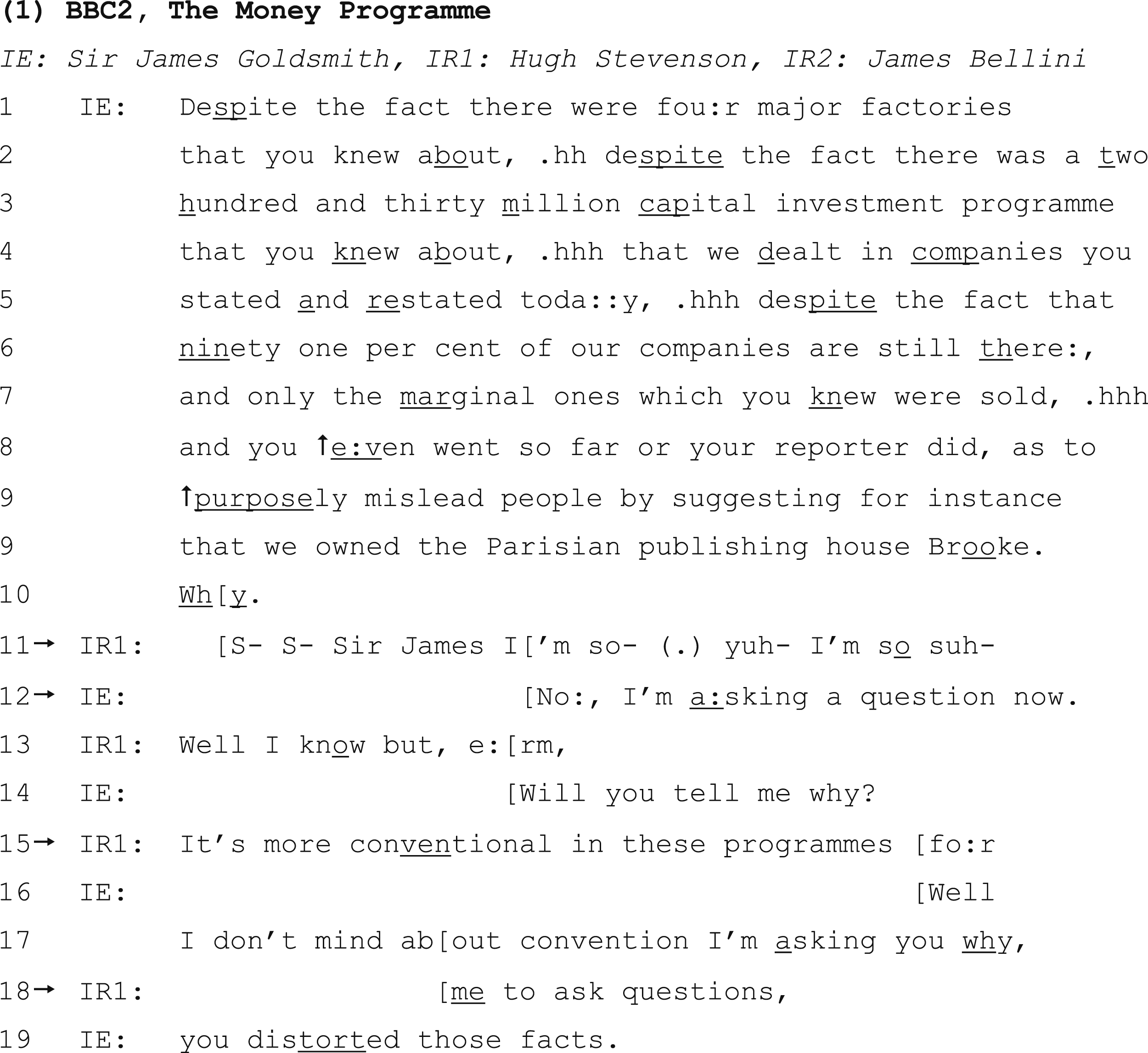
This extract comes some 12 min into the 30 minute-long interview; yet even at this stage, there are numerous signs in the IE’s talk that he is engaged in moving outside the normative structures of the interviewee role. Although typically expected to restrict themselves to answering the questions put to them by IRs, albeit at length and with attendant detail (Harris, 1991), the IE here instead issues a litany of complaints about the prior reporting of his business dealings, which had portrayed him as an asset-stripper. In lines 1-7 he claims there were a number of examples of sound management that were known about but not reported upon, including the fact that ‘ninety one percent’ of the companies he owns had not been sold off (i.e. asset-stripped). Finally, in complaining about false reporting over a French publishing house, he abandons the IE role altogether and issues an overarching question to the IR: ‘Why.’
In response, the IR goes meta. Between lines 11–16, he abandons the interviewer role in order to instruct the IE on the very normative rule – the ‘conventional’ expectation that the IR be the one to restrict himself to asking questions – which the IE is now in breach of. However, rather than allowing the IR the free floorspace in which to articulate that complaint, the IE repeatedly interjects (lines 12, 14 and 17) with turns in which he too goes meta – for instance by stating that he is ‘asking a question now’, and then overtly dismissing the ‘convention’ that it is the task of the IR, not the IE, to put questions.
This, then, is an example of the going meta strategy arising in the context of, and contributing to the extension of, a dispute about the objectivity of reporting the IE’s business dealings, which ends up highlighting the interview as an interactional event governed by tacit rules of conduct which the participants are aware of, and manage on a turn-by-turn basis, but in the ordinary run of things refrain from mentioning.
Similar features can be found in the next extract – although in this case it is the IE who goes meta to complain about the IR’s conduct. Whereas, in extract (1), the IR’s going meta move was prompted by the IE moving outside interview norms by posing questions, here the IE’s meta-complaint is a response to the IR, in HPI fashion (Hutchby, 2011), moving beyond the conventions of his role by issuing statements and evaluations in the place of questions.
The extract takes place in the context of a multi-party interview involving former cabinet minister Lord Michael Heseltine and two interviewers, journalist Isabel Oakeshott and businessman-politician Richard Tice, for the recently established hybrid interview channel Talk TV. There are two other interviewees present in the studio, although they do not contribute to this segment. The topic under discussion is the question of whether the UK, having voted to leave the European Union, should now rejoin because Brexit has been ‘a disaster’, according to Heseltine, a long-standing Remain supporter. Under Talk TV’s remit, the IRs are able to adopt their own position on this question, which in this instance is that Brexit has not yet been given enough time to work and when it does, it will prove a success (Tice was a leading figure in the Leave campaign, and is also leader of minor political party Reform UK, formerly the Brexit Party).
However, during an exchange between Tice and Heseltine about how the re-joining might be negotiated, Heseltine abandons the topic in order to go meta and issue complaints about the IRs’ management of the occasion as ‘an interview’; in particlar, their interruptions and unwillingness to hear ‘the truth’:
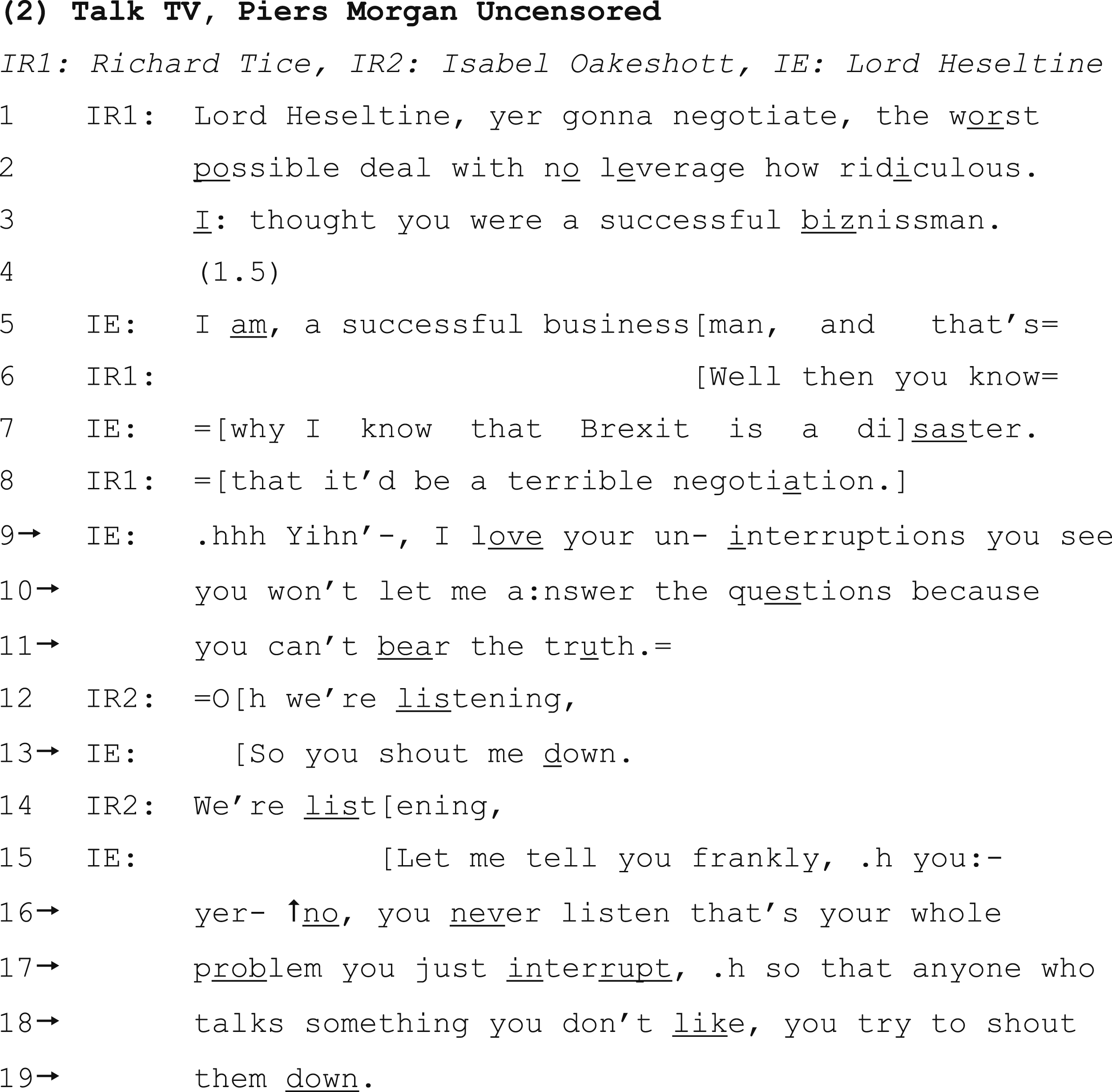
As noted, in typical HPI fashion, IR1’s initial turns here are not formed up either as questions or as prefatory to questions (lines 1-3; 5-7). Instead they constitute an evaluative statement calling into question the IE’s ability, even as a ‘successful businessman’, to negotiate business deals; and by extension, a Brexit deal. In line 5, the IE embarks on a response; and at its earliest transition-relevance point (following his confirmation, ‘I am a successful businessman’), IR1 comes in with a follow-up to his initial claim about negotiating the ‘worst possible deal’ (line 6). At the same time, however, the IE seeks to hold the floor to produce his own follow-up, a justification of his position on Brexit (‘and that’s why I know…’). Thus, the two end up talking in overlap in lines 6–8.
It is unclear to what extent this can be considered an instance of ‘interruption’ (Hutchby, 1992). In Jefferson’s (1986) account of ‘latency’ in overlap onset, speakers may start a turn slightly early, in anticipation of a transition-relevance point, or slightly late, just after the other speaker has elected to carry on with a further turn-construction unit. Either way, the start-up can appear to be interruptive, although it was not the second speaker’s intention to interrupt.
Nevertheless, as we see, the IE treats IR1’s turn as an intentional, and aggressive, interruption, leading him to go meta with a complaint that, through their ‘interruptions’, the IRs stop him from answering their questions because, he posits, they ‘can’t bear the truth’. Despite IR2’s objections (lines 12 and 14) that ‘we’re listening,’ the IE continues to go meta, complaining that the IRs ‘never listen’ but only ‘shout down’ those expressing views that they ‘don’t like’.
Slightly later in the exchange, a similar pattern emerges:
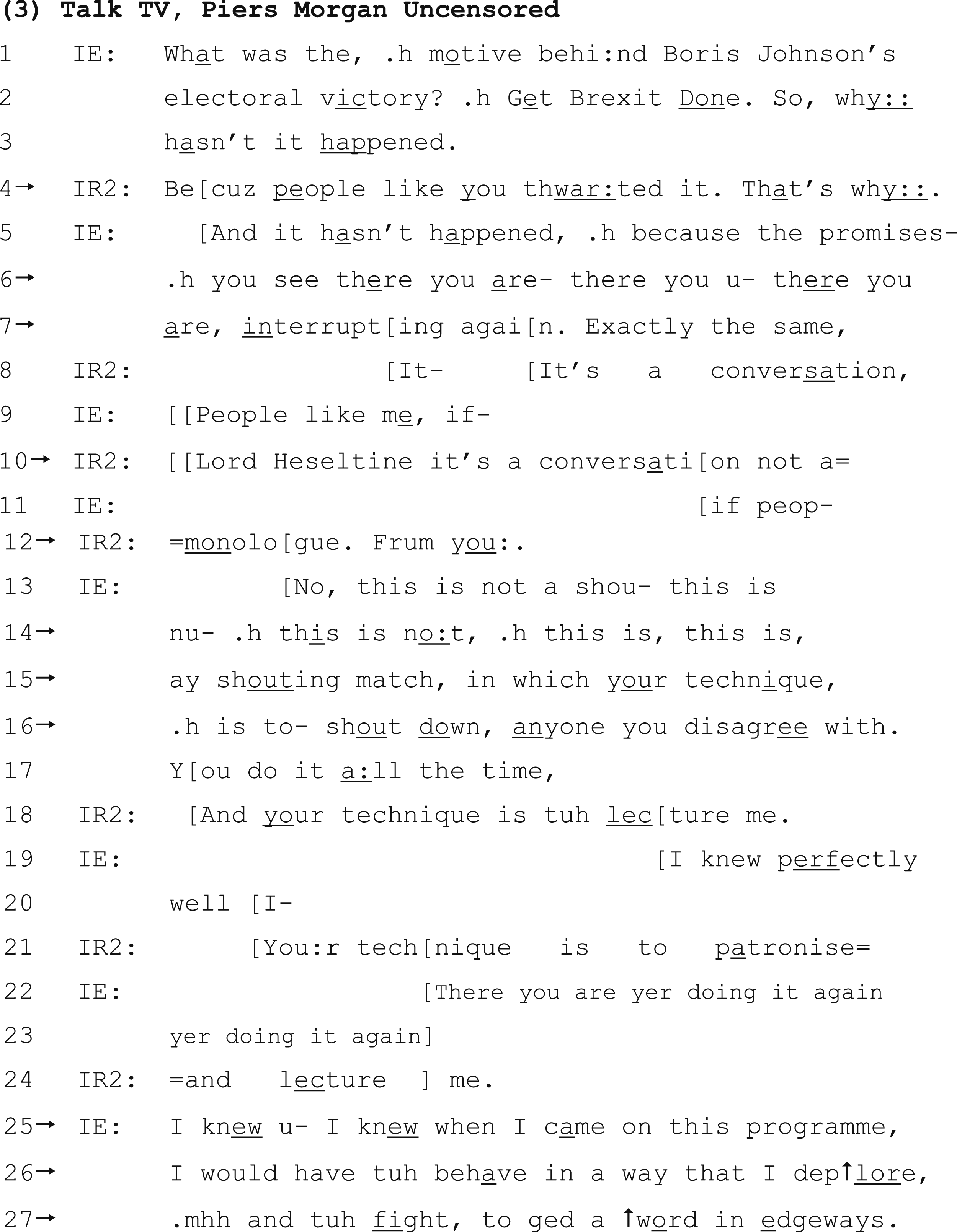
The IE attempts to return to his main topic, the question of why Boris Johnson’s claim to Get Brexit Done ‘hasn’t happened’. A moment later it becomes clear that he intends this as a rhetorical question to which he will propose the answer (line 5). In the interim, however, IR2 has come in with her own quite different answer to the question: ‘Becuz people like you thwar:ted it. That’s why::’. This non-neutral, non-questioning response provides the IE with grounds to re-state his claim that the IRs are interrupting him (lines 6-7).
What follows is a meta-dispute between IR2 and the IE over what kind of interaction they are, or should be, engaging in. IR2 adopts the virtuous stance of defending the interview as an interview – or in her words, a ‘conversation not a monologue’ (lines 10–12). The IE responds by returning to his earlier claim that what they are engaging in is a ‘shouting match’; then finally rounds off this meta episode with a claim that the IRs’ own interruptive belligerence has forced him to engage in a kind of behaviour he ‘deplores’, such as adopting similar tactics to theirs and fighting ‘to ged a ↑word in edgeways’.
Alongside the aforementioned complaints about ‘proper’ interview conduct, running through these exchanges at various levels are questions of objectivity, truth, and factuality. At the heart of Goldsmith’s dispute with the interviewers (extract (1)), which he will later go on to state in explicit terms, is that in the previous week’s feature they lied about him and about how his companies operate. He comes to the interview prepared, with sheafs of paper containing transcripts, quotes and other bits of data. In extract (2), the issue is more explicit, in Heseltine’s assertions that the IRs ‘won’t let me a:nswer the questions because you can’t bear the truth’.
Still more explicitly, the following extract features an IE-initiated going meta episode in the context of a long exchange during which the IR adopts hybrid interview practices to accuse the IE, head of the US government’s finance committee, of misleading people about investment opportunities in the lead-in to the 2007/8 banking crisis. His accusations reach a climax in a demand that the IE ‘↑SAY the TRUTH’ (line 25).
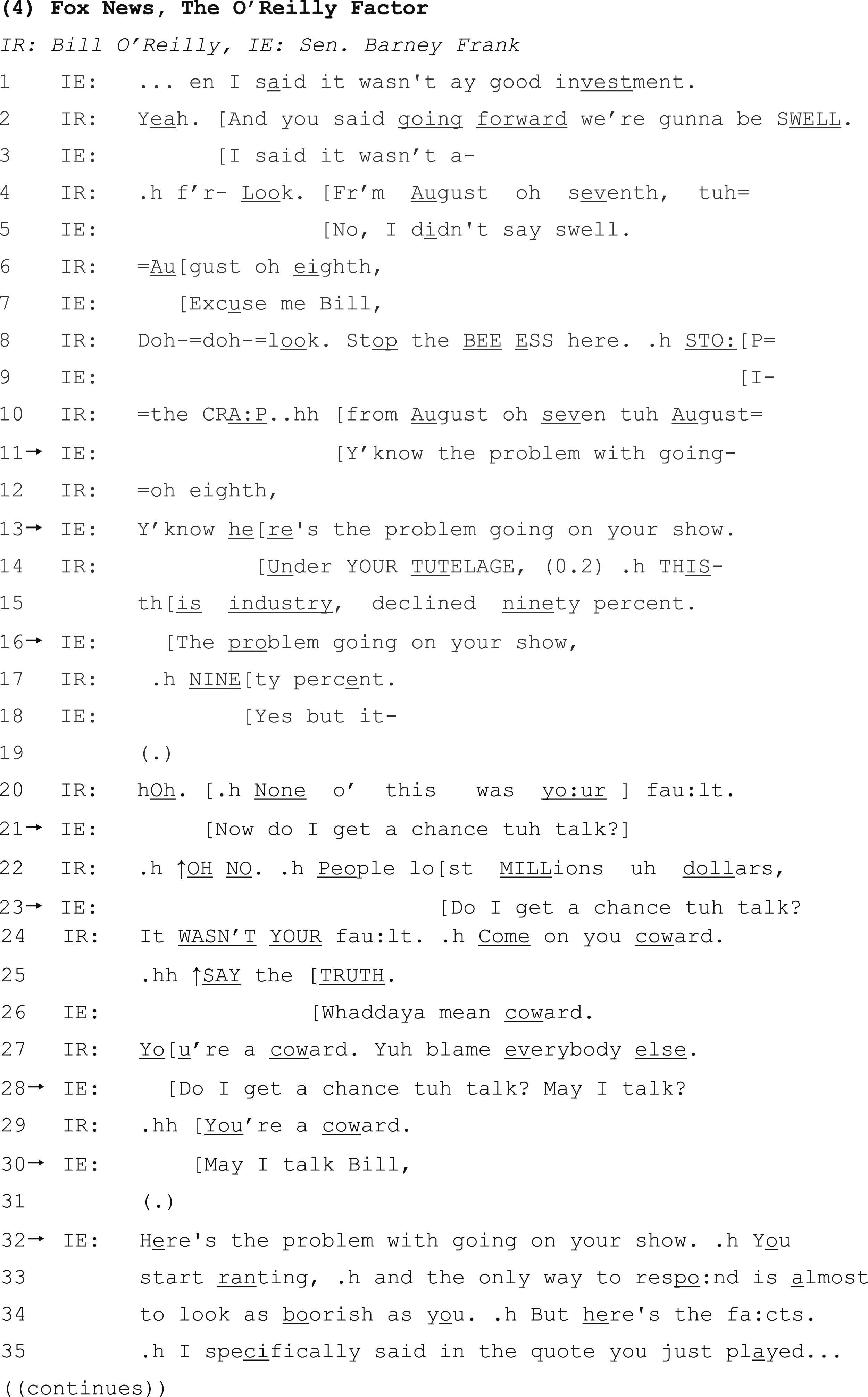
The first half of this extract is a good example of how going meta episodes tend to emerge in response to spates of disputatious or belligerent talk. Between lines 1-18, the IR takes increasingly aggressive issue with official statements made prior to the banking crash by the IE, and replayed for the audience’s benefit at the start of the interview, about the investment potential in government-backed US banks. He cites the IE (inaccurately, on the evidence of the tape playback) as saying that ‘going forward we’re gunna be SWELL’ (line 2). In numerous overlapping and incomplete utterances (lines 3, 5, 7) the IE unsuccessfully attempts to argue against this characterisation of his statements. Eventually, in line 11, and again in lines 13 and 17, he abandons these attempts and goes meta, choosing instead to build a complaint around the ‘problem with going on (this) show’.
In the second half of the extract, the IE persists in going meta, but changes his focus to invoke the rules of the interview in the course of complaining about the IR’s conduct of it. He adopts the role, not of ‘aggrieved questioner’ as in extract (1), but of ‘innocent victim’ of what he describes in line 33 as the IR’s ‘ranting’. On five occasions, the IE requests the opportunity to ‘talk’: from ‘Now do I get a chance tuh talk?’ (line 21), through lines 23 and 28, to ‘May I talk Bill,’ (line 30). In each of these utterances, he goes meta to highlight the IR’s present breaching of both the most basic rules of the news interview – that is, (a) IRs should restrict themselves to asking questions, and (b) IEs should restrict themselves to answering those questions. Each of his attempts to be allowed to talk are produced in overlap with the IR’s continuation of his list of accusations, insults and blame allocations. In so doing, the IE simultaneously requests his right to a turn at talk, and foregrounds the IR’s continuing refusal to accord that right. Finally, once the micropause in line 12 grants him the space to take a turn, the IE continues his meta-talk by producing a formal description of the breakdown in interview conventions, in which the IR’s ‘ranting’ only serves to encourage the IE to engage in the same belligerent behaviour.
This first set of extracts illustrates three ways in which going meta can be brought into play in the construction of complaints about live broadcast interview conduct. The common thread between them is that they each take place in the context of disputatious or combative interaction. In addition, they each involve some form of ‘virtuous display’, usually by the initiator, of seeking to abide by the normative rules of interview conduct, in the face of the interlocutor’s unreasonable behaviour in breach of those rules.
Extract (1) showed how going meta can be used by an IR in an attempt to re-establish the interview’s normative grounds in the face of the IE’s aggressive inversion of the turn-taking rules. Extracts (2) and (3) showed the IE going meta to call into question the IRs’ motives, claiming that they consistently interrupt and shout down anyone with whom they disagree, rather than conducting a genuine neutralistic interview. Lastly, extract (4) showed the IE going meta in the face of a belligerent, personalised assault from the IR, in which he highlights the IR’s refusal to treat him as a bona fide interviewee by requesting the right to take up his role as ‘answerer’ and referring to the IR’s behaviour as ‘ranting’.
Going meta to create a meta-interview
This section considers an extended case of going meta, drawn from an interview for British television’s Channel 4 News (which, along with the BBC and ITN, is one of the UK’s most important mainstream free-to-air news organisations). It features the journalist Ciaran Jenkins and the politician Michael Gove, then environment minister in Boris Johnson’s Conservative government. It takes place in the context of two issues in the headlines at the time (October 2019): (a) a debate over whether the UK should hold a second Brexit referendum (something which, supported by many who voted Remain in the original referendum, did not transpire), and (b) a government announcement of plans to build forty brand new hospitals in order to relieve pressures on the National Health Service (a claim challenged on financial grounds by the Labour opposition). The interview was filmed on location, in a farmyard to which the minister is evidently making some form of official visit.
As this interview proceeds, the IE persistently goes meta by raising a series of questions around the relationship between the IR’s turns at talk and objective interviewing. On this occasion, the IR also goes meta to argue that his practice is indeed consistent with objective news interviewing. Consequently, the whole question of neutrality versus non-neutrality, including agenda-driven questions, ‘truth’, ideology and what is in the best interests of ‘the people’ becomes the reflexive subject of the interview itself.
Extract (5) shows the interview’s opening question and answer exchange, in which these themes are already adumbrated.
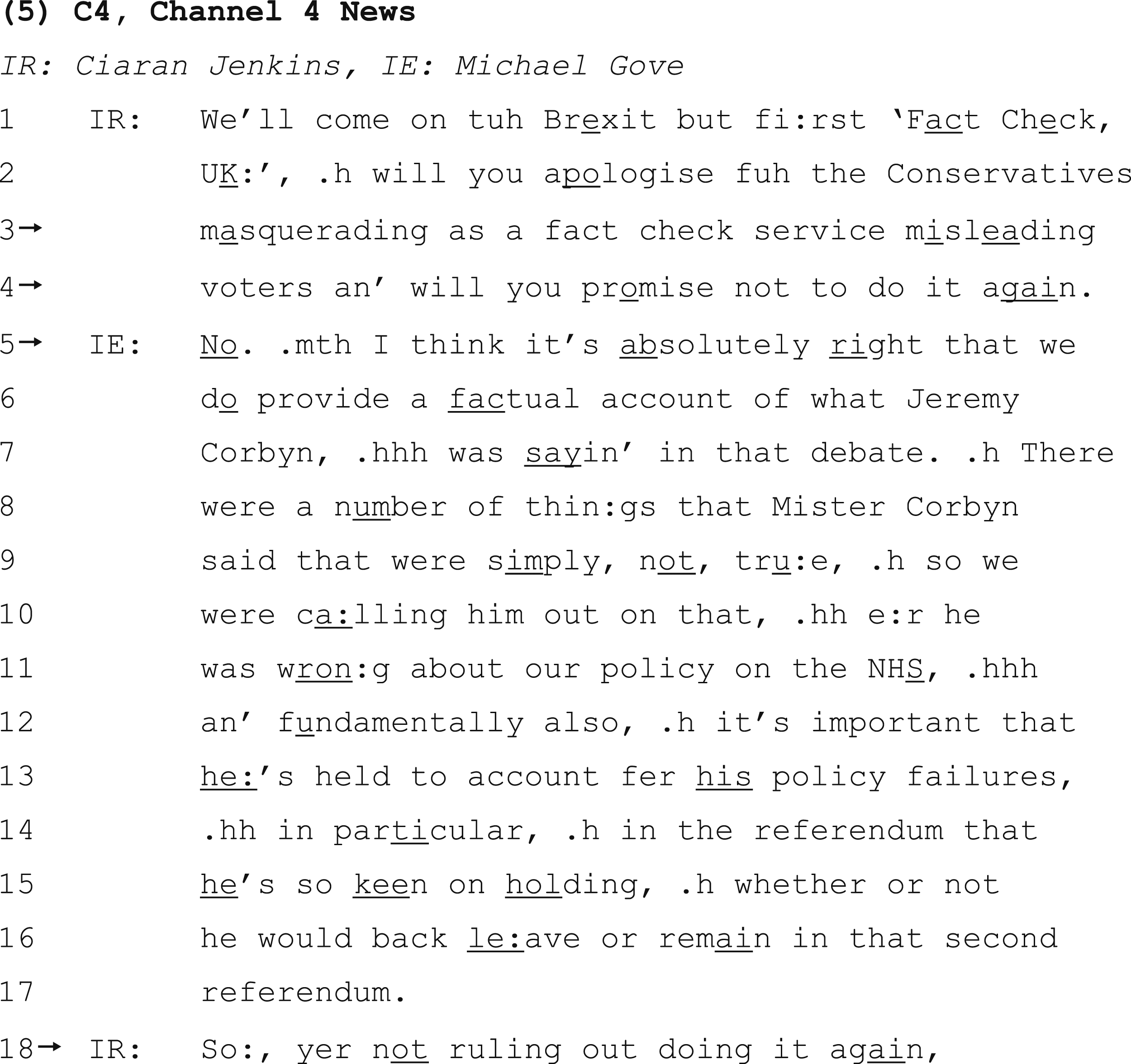
The IR’s first question uses a technique often deployed in ‘accountability’ interviews (Montgomery, 2011): embedding a proposition which implies misdemeanour on the IE’s part, and asking him or her to ‘apologise’ for it. The proposition embedded here is that the Conservative Party, through launching their website ‘Fact Check UK’, have ‘masqueraded’ as an independent fact-check website and therefore ‘misled’ the general public. In addition to asking the IE to apologise for that, the IR engages in a kind of infantilisation of the misdemeanour by asking the IE to ‘promise not to do it again’.
The IE’s response is a decisive ‘No’, followed by an account highlighting the necessity of ‘calling out’ untruths in the statements of Jeremy Corbyn, then leader of the Labour Party. In spite of the length and detail of this accompanying account, any aspect of which could be picked up in a follow-up question, the IR responds by formulating (Heritage, 1985) the overall gist of the IE’s turn as ‘not ruling out doing it again’, that is, an implicit admission that the Conservative Party may indeed ‘mislead’ the British public on future occasions.
At the very beginning of the interview, therefore, we find two of the features central to episodes of going meta – journalistic non-neutrality and bullish certainty from politicians. As the interview proceeds, these themes only become more pronounced.
In extract (6), the IR begins a new line of questioning about the government’s recently announced major investment in new hospitals across the country. Prime minister Boris Johnson has stated that he plans to build forty new hospitals in the next few years; however the Labour opposition claim that the government’s investment plans only include six new hospitals. The IR begins by putting this discrepancy to the IE:
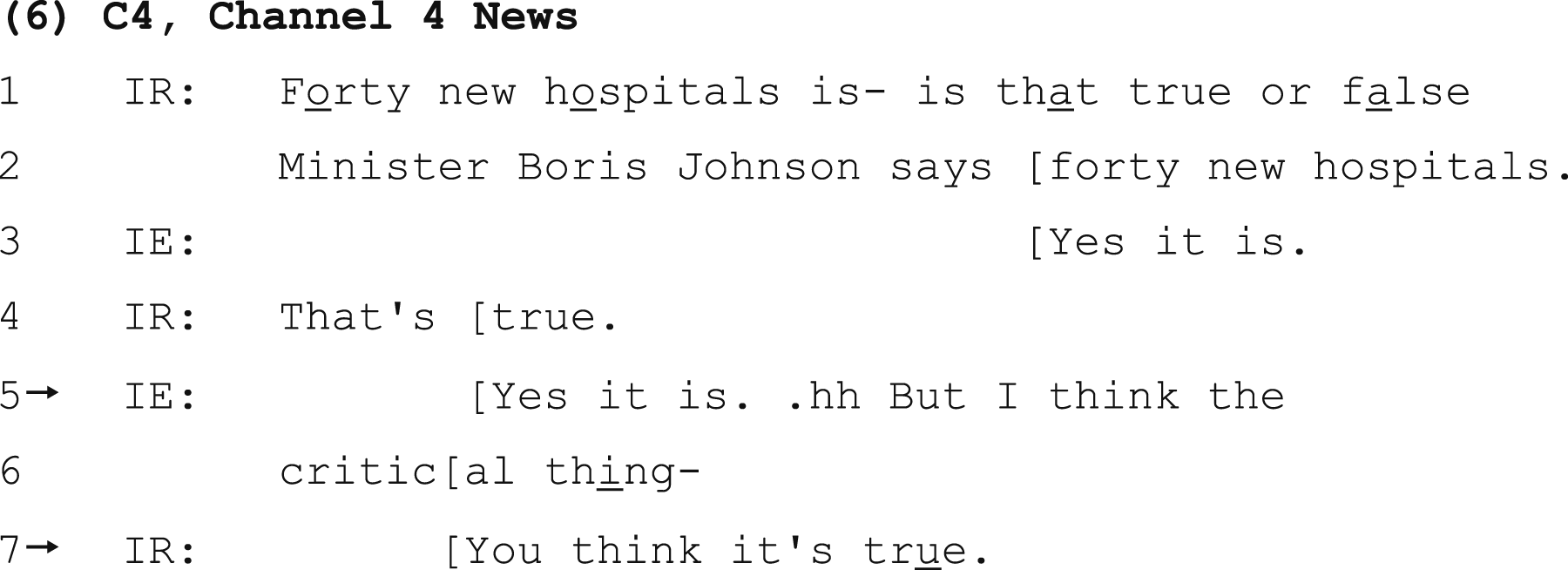
Again, there are signs of disjuncture between IR and IE in the way this sequence unfolds. As in extract (5), the IE produces what appears to be a straight answer to the question, confirming that the prime minister’s claim is true. In this case, however, there is no associated account. The answer is produced only as a bare affirmation that the claim about forty new hospitals is true. This type of answer breaches one of the normative expectations for news interviews. As Harris (1991: 82) puts it, ‘in the context of a political interview we expect politicians to elaborate, even when asked questions which request a “yes/no” response.’ Thus, even in the shape of the bare-bones response he gives to the IR, there begin to appear signs from the IE of unwillingness to cooperate in treating this exchange as an ordinary interview.
The next two utterances (lines 5–6, and line 7) turn out to set the tone for the rest of this six-minute exchange. First, the IE, having repeated his bare bones answer, ‘Yes it is’, to the initial question, embarks on a next turn component prefaced with a disjuncture marker, ‘But…’. That next component, ‘I think the critical thing’, proposes that whatever it is the two of them have been doing up to this point is not ‘the critical thing’, and that what the IE is going to say next will suggest what in fact ‘the critical thing’ is. As we will see, it acts as some kind of adumbration of a going meta move on the IE’s part.
Meanwhile, the IR continues in accountability interview mode by again producing a formulation, ‘You think it’s true’ (line 7). Once more, the formulation does more than impartially summarizing the gist of the IE’s answer. By saying ‘You think it’s true’ the IR recasts the claim to truth in a sceptical light, implicitly suggesting that, in his and possibly also others’ estimation, the forty new hospitals claim is most likely not true.
The following extract follows on from extract (6). It is here that we find first the IE, then in response the IR, going meta to proffer opposing views on the kind of activity they take themselves to be engaging in.
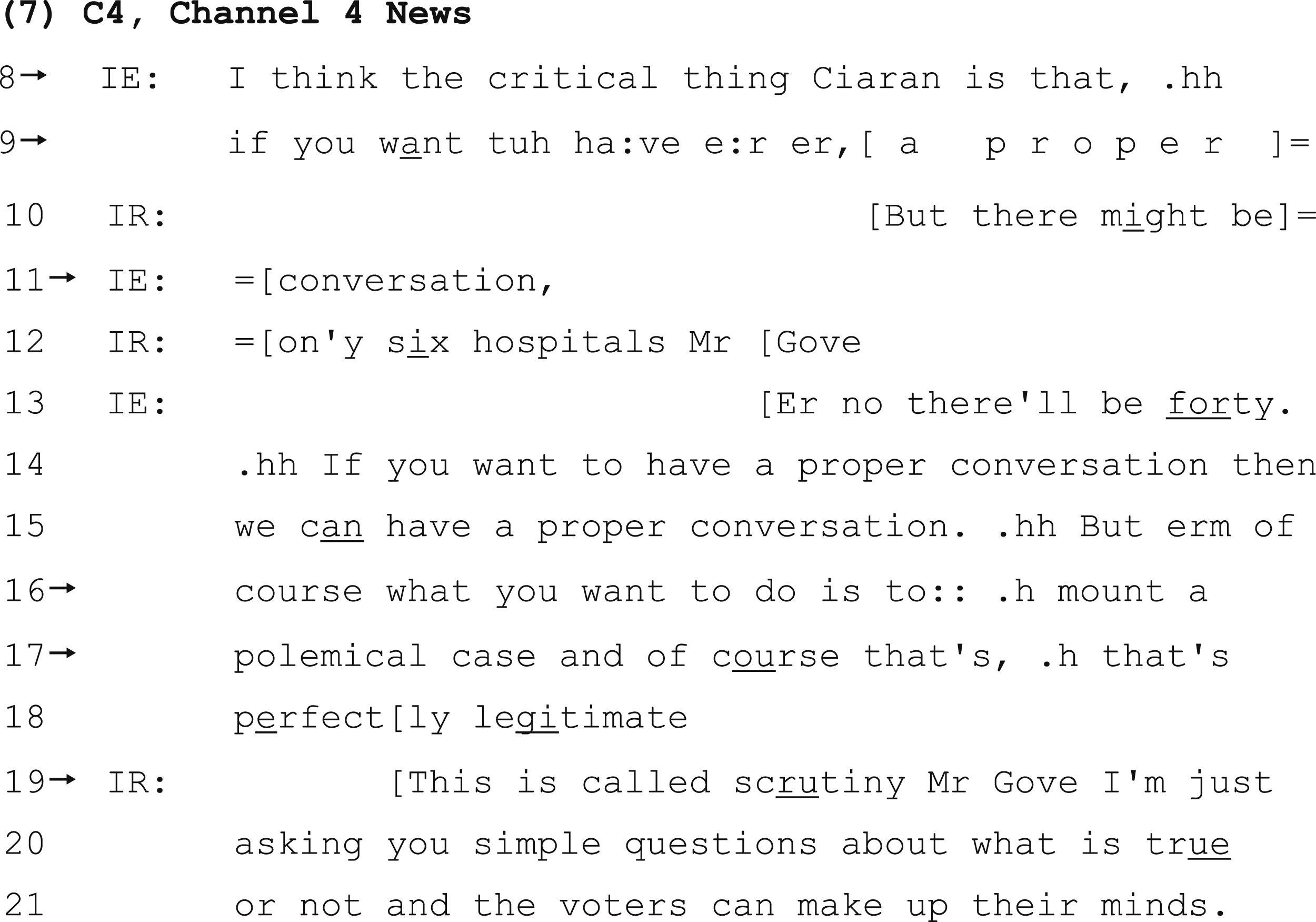
As the IR persists with his question about the number of new hospitals (lines 10–12), leading the IE to briefly reiterate his earlier commitment to the truth of the ‘forty’ claim (line 13), the IE is also busy developing his meta move. Beginning at line 8, then restarting in lines 14–17, he goes meta with a turn that, rather than being a response to any particular question put by the IR, proposes to instruct the IR about what kind of agenda underpins his chosen questions and about what kind of interactional activity he takes it is in play here. The IE distinguishes between having a ‘proper conversation’ (recall the use of the term ‘conversation’ in extract (3) above), and mounting ‘a polemical case,’ which is what he suggests the IR is doing.
In response, the IR too goes meta, abandoning for the moment his role of questioner, and seeking to defend his line of questioning in journalistic terms, as ‘scrutiny.’ At this point (lines 22–25) we find the first of what will become numerous acts of ‘speaking for the people’ in this exchange. By asking ‘simple questions about what is true or not’ the IR presents himself, not as an ideologically driven polemicist, but as the objective scrutineer seeking truth in the interests of the general public, so that ‘the voters can make up their minds’.
As the exchange proceeds, the IE develops his theme further, while the IR maintains his own position focussing on mattters of ‘truth’ and ‘objectivity’.
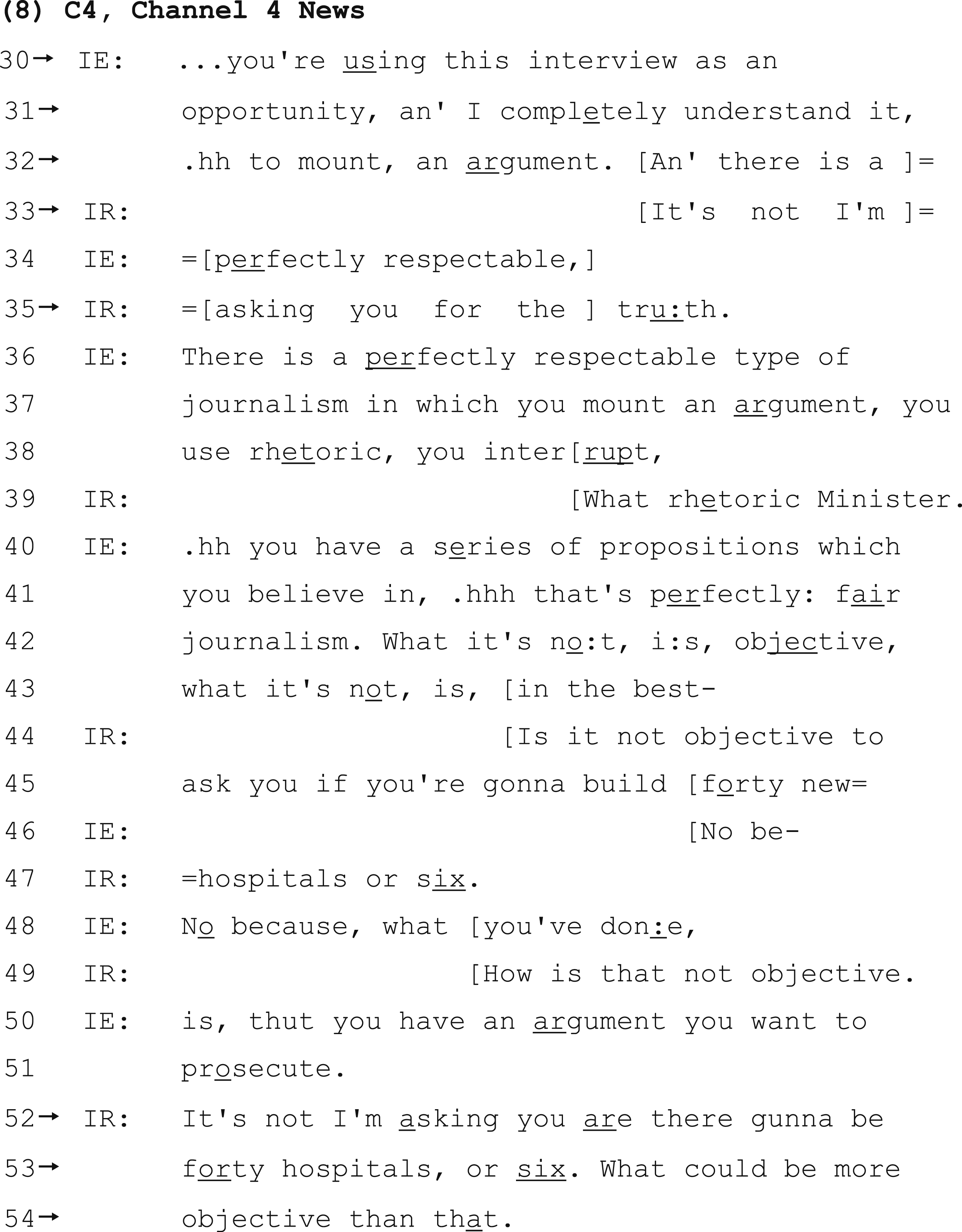
At this point the interview as a whole becomes a meta-interview; that is to say, an exchange of turns whose topic is the interview itself. The IE uses his turns to develop a standpoint from which to instruct the IR on his own approach to interviewing. In lines 30-32 he proposes that the IR is ‘using’ the interview itself as a vehicle to ‘mount an argument’. In response, the IR uses his turns to assert that his approach is intended, in standard news interview fashion, to ask the IE ‘for the tru:th’ (line 35).
As the exchange continues, the IE persists in his instructive talk, claiming that the IR is engaged in a type of aggressive interview practice in which ‘you mount an argument, you use rhetoric, you interrupt…’ (lines 36-38), which he considers to be ‘fair journalism’, although not ‘objective’. The IR maintains his own line, namely that he is asking ‘objective’ questions in search of the truth. In fact, the objectivity of his question is emphasised in the very wording of his repetition of it (lines 52–54): ‘I'm asking you are there gunna be forty hospitals, or six. What could be more objective than that.’
Here it may be worth pointing out that, while it may have got lost in the preceding bustle of disputatious talk, the IE has already provided an unequivocal answer to this ‘objective’ question. Recall that in extracts (6) and (7), the IE answered the either/or question by stating that it was ‘true’ that there would be ‘forty’ new hospitals. The IR’s persistent lack of recognition of this answer, illustrated by lines 52–54 in extract (8), as well as the sceptical rejoinder commented on above (extract (6) line 7), suggests that there may be some legitimate grounds for the IE’s complaint about the non-neutral line of questioning being pursued.
In our final extract, we see a combination of the main themes remarked upon so far. That is, first, the IE’s critique that the IR is ‘putting forward a particular point of view’ versus the IR’s insistence that he is seeking ‘simple facts, the simple truth’. Second, various claims to be representing the interests of ‘the people’. The noteworthy addition is that, while it is fairly common for such claims to tribuneship to be made among adversarial news interviewers (Clayman, 2002), it is less common to find interviewees doing so. But in this extract, by bringing into play the overhearing audience, the IE stakes his own competing claim to tribuneship, with the clear implication that his stance has the best interests of ‘the people’ in mind.
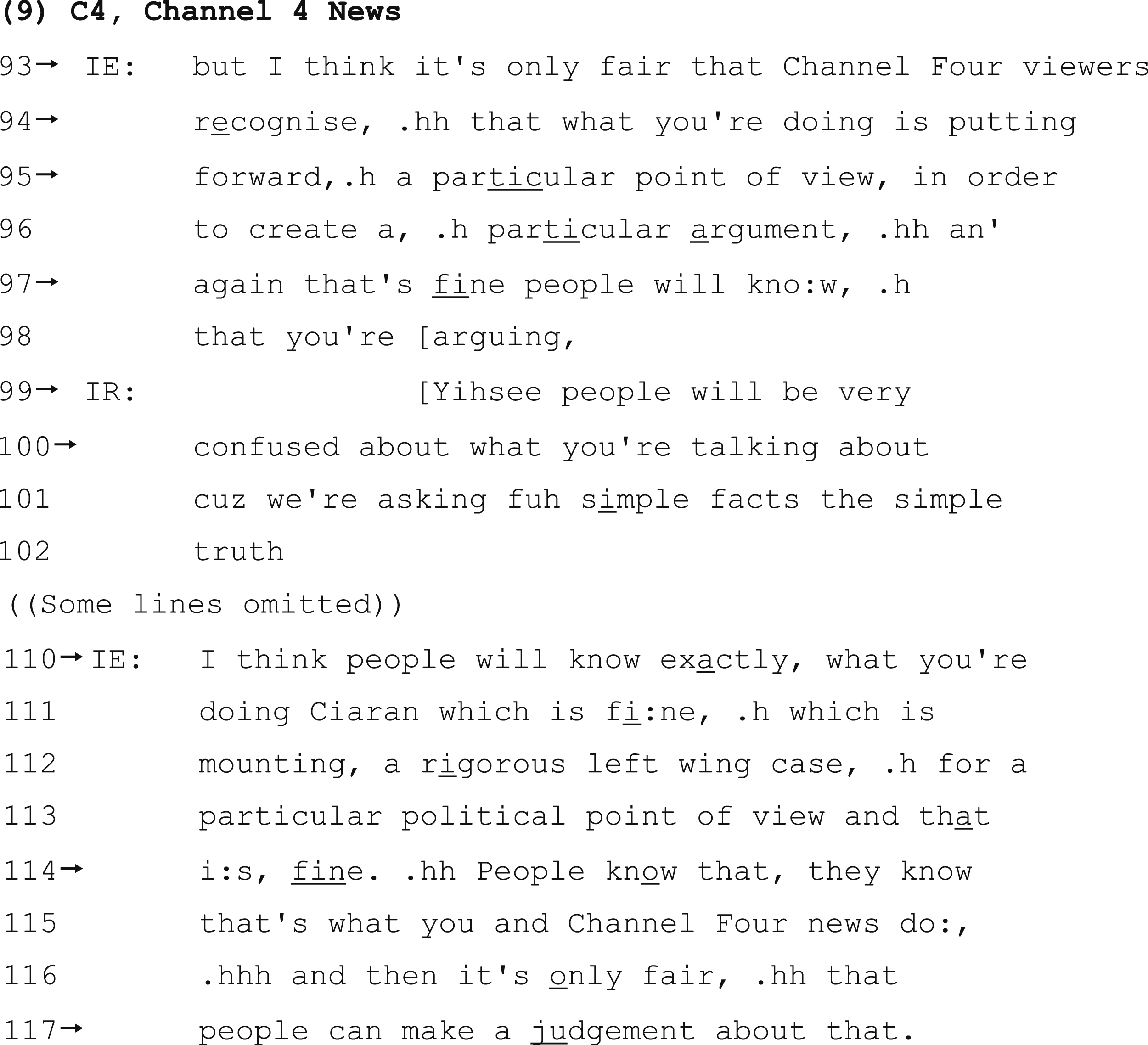
In the arrowed lines here, the IE upgrades his attack on the ‘polemical’ nature of the IR’s questioning, stating that it is important that ‘people know’ that what he is up is ‘mounting a rigorous left wing case for a particular point of view’, so that they can ‘make a judgement’ about it. He first of all refers only to ‘Channel Four viewers’ (line 93); but later, in lines 114–111, expands this constituency, claiming that ‘people’ in general know that this is what Channel 4 News does. Meanwhile, the IR again abandons his stance as questioner (lines 99–102, 118–120) in order to establish his own tribuneship of the ‘people’ who will in turn be ‘confused’ by the IE’s behaviour, since all ‘we’re’ doing (that is, Channel 4 News) is ‘asking fuh simple facts the simple truth.’
In its entirety this interview is nine minutes long, but for the bulk of it, some 6 minutes, the IE and IR engage in the exchange of meta statements, accusations and rebuttals illustrated by the above set of extracts. In its way, it is the perfect example of how going meta can be deployed by a politician in order to invert – or attempt to invert – the conventional discursive power relations of the news interview, in which the topic and the line of questioning are under the control of the interviewer; while in response, the IR seeks to defend his behaviour as a truth-seeking tribune of the people.
Conclusion
This article has focused on the practice of going meta during live broadcast interviews. Going meta is presented in terms of moving outside the framework of speaking conventions that are normally oriented to in defining the situation as ‘an interview’, in order to comment upon, problematise, or otherwise complain about behaviour that challenges that normative framework. Episodes of going meta, whether initiated by interviewees or by interviewers, generally occur during disputatious or combative phases of talk, and are designed to foreground some non-normative aspect of a co-participant’s behaviour – such as an IE seeking to pose a question, interruptive turn-taking by IRs, or wholesale attempts to challenge the grounds of the interview.
Going meta is not a completely new phenomenon, whether in the news interview or elsewhere in political discourse (Simons, 1994). One possibility, however, is that in the increasingly opinionated environment of the hybrid media system, in which epistemological contestation becomes more routine over matters that were previously more consensual, such as ‘truth’, ‘facts’ or ‘objectivity’, such complaints as we have explored in this paper could become more commonplace. As many of the excerpts analysed above demonstrate, politicians and their advisors seem increasingly confident in identifying when and how to engage with and ‘take on’ political interviewers; journalists themselves have pointed to what they see as greater levels of self-assurance, even hubris, among politicians regarding their duty to be held accountable through serious media scrutiny (Waterson, 2019).
As this process unfolds in the continuing evolution of the broadcast news interview, and politicians become more ready to challenge the conduct of interviewers as neutralistic managers of question-answer exchanges, journalists have begun to respond in a number of ways that take them beyond the constraints of neutralism: by reasserting their right to subject the IE to scrutiny, further intensifying their role as ‘tribunes of the people’, or by ‘calling out’ the politician’s ‘lies’ or evasions.
A good example of this journalistic response occurred in 2020, when New Zealand journalist Tova O’Brien interviewed right-wing politician Jami-Lee Ross. After blatantly accusing Ross and his party of ‘peddling misinformation’ about the Covid-19 pandemic, she had refused him permission to further elaborate on the topic. In response to his objection to being ‘shut down’ in this way, O’Brien told him, ‘if you’re gunna come on the show and say things which’re just factually incorrect I can do that actually’. The clip went viral on the internet; so much so that later, O’Brien produced an article for The Guardian discussing her ‘feral’ interview with Ross. ‘Journalists all over the world have been calling out lies relating to Covid-19,’ she wrote, ‘especially when they’re adopted by powerful figures attempting to legitimise falsehoods.’ She concluded by proposing a model of journalism that goes beyond what Schudson (2001) called the profession’s objectivity norm: ‘Sometimes balanced reporting isn’t just about providing both sides of the story. It is simply about the facts – the truth’ (O’Brien, 2020: 1).
In this overall context, episodes of going meta can be seen as just one kind of indicator of the intensifying struggle for power over the epistemic territory of the interview that has always, to some degree, been present: that is, the right to speak authoritatively, in the interests of ‘the people’, or with reference to ‘the truth’, on the issues in play. It is a struggle that seems set to continue.
Footnotes
Declaration of conflicting interests
The author(s) declared no potential conflicts of interest with respect to the research, authorship, and/or publication of this article.
Funding
The author(s) received no financial support for the research, authorship, and/or publication of this article.
