




Abstract
Previous studies over the past 23 years have illustrated how the journalistic field has embraced innovative processes. While some of these processes were fully developed at that time, others were still in the process of development or implementation. An ad hoc analysis sheet was designed using innovation categories, where each item is assigned a score based on the level of innovation, ranging from low to high. This methodological instrument is proposed for the analysis of high innovation in news websites and it is applied to narratives, data journalism, audience involvement, co-creation, verification, ethics, corporate information and content distribution in the most widely consumed news sites across Europe, the Americas, Asia Pacific and Africa. What is discovered is that there are no more evolved trends in some regions than in others. Nevertheless, European and American sites offer a broader range of options compared to their African and Asian counterparts.
Introduction
The transformation of the communicative ecosystem in the digital society has forced the media into a process of constant adaptation, one that continues to set trends today. While digital native media aim for consolidation –something that many have already achieved–, social networks are furthering their development after having experienced a vast expansion. This growth has altered the identity of social networks to the extent that many can be viewed as platforms that operate as service ecosystems (Alaimo et al., 2020).
This ongoing reorganization process brings challenges for well-established journalistic forces, as well as for new arrivals. To deal with the rise of new contemporary platforms (Cozzolino et al., 2021), strategies are implemented that combine competitiveness and cooperation. In an ecosystem where the media structure has changed significantly, digital applications, social media platforms and artificial intelligence are shaping media use and production (Krumsvik et al., 2019; Liu et al., 2020).
In this context, what emerges is a conglomerate of media outlets that are increasingly shaped by the rise of information technologies (Humprecht et al., 2022) and that operate in a scenario characterized by the convergence of two types of currency: money and attention (Manzerolle and Wiseman, 2016). This has led to a societal model marked by platformization (Van Dijk, Poell & De Waal, 2018) and communication through mobile devices (Huh, 2020).
The Internet has become the omnipresent digital environment in which people communicate, search for information and make decisions (Kozyreva et al., 2020). The current model of mediated communication is characterized by a generalized dependence on technologies, which has increased during the pandemic (Nguyen et al., 2020). This trend seems to be shaping the immediate futures of the people and groups that organize themselves through digital information networks, which predominate as communication channels (Milenkova and Lendzhova, 2021).
It is in this scenario where digitization fuels profound transformations of journalistic routines and practices (Lecheler and Kruikemeier, 2016), and where the audience, with their potential to actively take action, gains prominence within emerging models (Nelson, 2019). This active audience actually participates in the news industry. Therefore, it is necessary for journalists to have training that qualifies them to perform diligent verification processes and the preparation of stories relevant to people's lives (Deuze, 2019), without forgetting that professionals who practice digital journalism, as in the past, must comply with professional deontological standards (Bachmann et al., 2022).
The current communication landscape is so complex that no one is immune to misinformation (Saling et al., 2021). This makes it necessary to review the normative arguments about journalism and democracy, as well as their viability under radically new conditions (Waisbord, 2018). The cultivation of quality ethical journalism is vital for the proper functioning of societies in the digital age (Esser and Neuberger, 2019), although the quality of the media’s work continues to be called into question.
Updated journalistic practices improve the quality of current news products. Knowledge of the ins and outs of these new practices, as well as the importance of the meaning of journalistic culture as a symbolic field for society (Anderson, 2020), should shed light on the trends, the paths that need to be explored, the gains made, and the pending challenges. The innovations of recent years, largely driven by technology (Walsh and Berry, 2021) and which mainly affect information and content, audiences, methods and resources and communication companies (Lopezosa et al., 2021). This upheaval has opened many doors to help ensure the future of journalism through experimentation with modern forms of journalistic practice.
Especially after the COVID-19 pandemic, newsroom practices have undergone significant changes, influenced by factors such as remote work, collaborative efforts and other factors. The digital transformation of legacy media has been accelerated (García-Avilés et al., 2022), since the pandemic brought about new opportunities to explore innovation and transformative changes in news work, particularly during coverage (Konow-Lund et al., 2022). Moreover, the past decade has witnessed a surge in the establishment of newsroom innovation labs, aimed at modernizing journalistic workflows (Cools et al., 2022). These initiatives reflect a growing recognition of the need to continue satisfying increasingly demanding audiences (Goggin, 2020).
Does high innovation really exist in journalism?
An essential hallmark of innovation is that the idea, practice, or object is perceived as new, so that innovation always implies a new source of knowledge. This links innovation to persuasion and makes the product more attractive to the user (Rogers, 2003). Media innovation can be defined as an interwoven and interdependent process of innovation in both media technologies and media practices (Bruns, 2014). The complex power relations or the ethical imperatives are important to study media innovations (Ní Bhroin and Milan, 2020), but analyzing media innovation also implies seeing significant changes in production and technological development (Krumsvik et al., 2019).
In recent years, a multitude of new, innovative approaches to journalistic practices have emerged. These include narrative models (multimedia, immersive journalism…), strategies related to audience involvement (citizen journalism, co-creation and newsgames) and data journalism (Esser and Neuberger, 2019; Lawrence et al., 2018). Some methods, like multimedia journalism or the cross-media and cross-promotion of content on social networks, are already fully established in their own right. Others, like immersive journalism, 360 video or robot journalism –linked to artificial intelligence–, are yet to be utilized to the same extent (Liu et al., 2020; Lopezosa et al., 2021).
After more than 28 years, digital journalism has proven its worth in the professional and academic settings (Salaverría, 2019). In the era of mobile media (Bui and Moran, 2020), digital journalism continues to explore new ground to reach users in networked societies. This is a challenge that professionals face by being attentive to their audiences (Swart et al., 2022), through co-creation initiatives (Sixto-García et al., Rodríguez-Vázquez & Soengas-Pérez, 2022) and by experimenting with transformed narratives, both inherited and digital native. Genres and content, with their different ways of using current technologies, are among the most researched areas in the field of journalistic innovation (García-Avilés, 2021). These areas provide opportunities to experiment, both in the MediaLab and in the newsrooms with prototypes of news products (Boyles, 2020).
The impact of technology on journalism has been apparent since the beginning of the third millennium (Pavlik, 2000). Innovation processes centered around adapting to these new journalistic practices. Journalists were required to have digital skills to perform new tasks (Reyes-de-Cóar et al., 2022). Newsrooms also incorporated technologists (engineers responsible for the socio-technological changes within journalism) who were integrated into journalistic production processes (Lischka et al., 2022). Together, these multidisciplinary teams created in some newsrooms, and the hybrid profiles of modern professionals, delivered impactful stories. This was especially true in the field of data journalism, which took on new forms and demonstrated the strengths and weaknesses of the overlap between journalistic and non-journalistic roles in the newsrooms (De Lima-Santos, 2022).
This shifting landscape challenges pre-held assumptions of mainstream journalism and explores new avenues, ranging from financial models to corporate information and sustainability considerations. It is in these areas where digital journalism has proven most valuable, even when having to operate within a framework of significant experimentation. At the beginning of the second decade of the millennium, it was already evident that, within the framework of environmental journalism (Hermida, 2010), new thinking was transforming how journalists went about their work. In recent years, this has become even more so the case as journalistic companies have adapted to social media (Hermida and Mellado, 2020). Platforms like X, Facebook and Instagram, already fully integrated into everyday journalistic communication (Brems et al., 2017), and other more innovative ones such as TikTok, invite the media to interact with the youth via briefer, more visual and dynamic narratives (Vázquez-Herrero et al., 2022a). Much of the innovation in the media is promoted by journalists who lead the process of change in newsrooms (García-Avilés et al., 2019).
Long formats, the visualization of information and data, make up the recipe for innovation in digital journalism as far as better understanding the impact that journalism has on the public, and in stimulating new ways of thinking that further maximize journalism’s strengths (Van Krieken and Sanders, 2019). Total journalism takes advantage of all innovations and incorporates users and engages them. It is hoped that this will lead to even better ways to tell the stories that citizens need the most in their daily lives (Vázquez-Herrero et al., 2022b). Although it is still a work in progress, it has garnered the attention of many media outlets, journalists, experts in other disciplines, and indeed many citizens.
Journalists, who have always defined themselves as the qualified and authorized narrators of events, are now aware of the fact that certain traditions have been left behind, and that the arrival of new actors, from bloggers as first intruders (Eldridge, 2018) to active audiences (Masip et al., 2019), have established new approaches to production (Banjac and Hanusch, 2022). Sharing, clicking and linking, practices that are now mainstream (Costera and Groot, 2014), have laid the foundations for updated storytelling, although today the trend towards passive consumption prevails (Pantic, 2020). Digital native media are undergoing processes of adaptation and reinvention hand in hand with narratives and formats, incorporating user participation and redefining journalistic narratives (Sixto-García et al., 2023).
The trends of the third decade of the millennium seem to show a lot of experimentation in attempts to implement high innovation models. Digital media explore new fields and laboratory prototypes for journalism where the only limit is the extent to which they are accepted by users (García-Orosa et al., 2020). But what distinguishes innovation from high innovation? Is the innovation that the current media are applying truly innovative?
More than 20 years have passed since Christensen (1997) coined the concept of disruptive innovation to explain that organizations that propose simple solutions displace more powerful ones. From 2000 to 2020, research on innovation in journalism was a diverse and thriving field (García-Avilés, 2021) and some innovations have substantially influenced the organization of society, such as fact-checking, although others are still far from being widely adopted in the industry (Carvajal et al., 2022). At this moment we can differentiate between innovation (or innovative practices that are already consolidated in the industry to a certain extent) and high innovation, determined by the technological pressures that the technological field exerts on journalism today (Wu et al., 2019). This is the case when we refer to automated processes without human intervention (Johnson, 2023) or to a cocreated product by users. Innovation is more open when common challenges are addressed, regardless of the field of study (Iversen & Hydle, 2023). In this sense, this research is made necessary by the need to investigate the most innovative innovation practices within the most successful news websites in the world –those that are most popular among the public–:
What high innovation practices are being implemented in the most consumed news websites?
Are these innovations really innovative?
Sample and methodology
Most consumed online media in the countries with the highest Internet penetration.
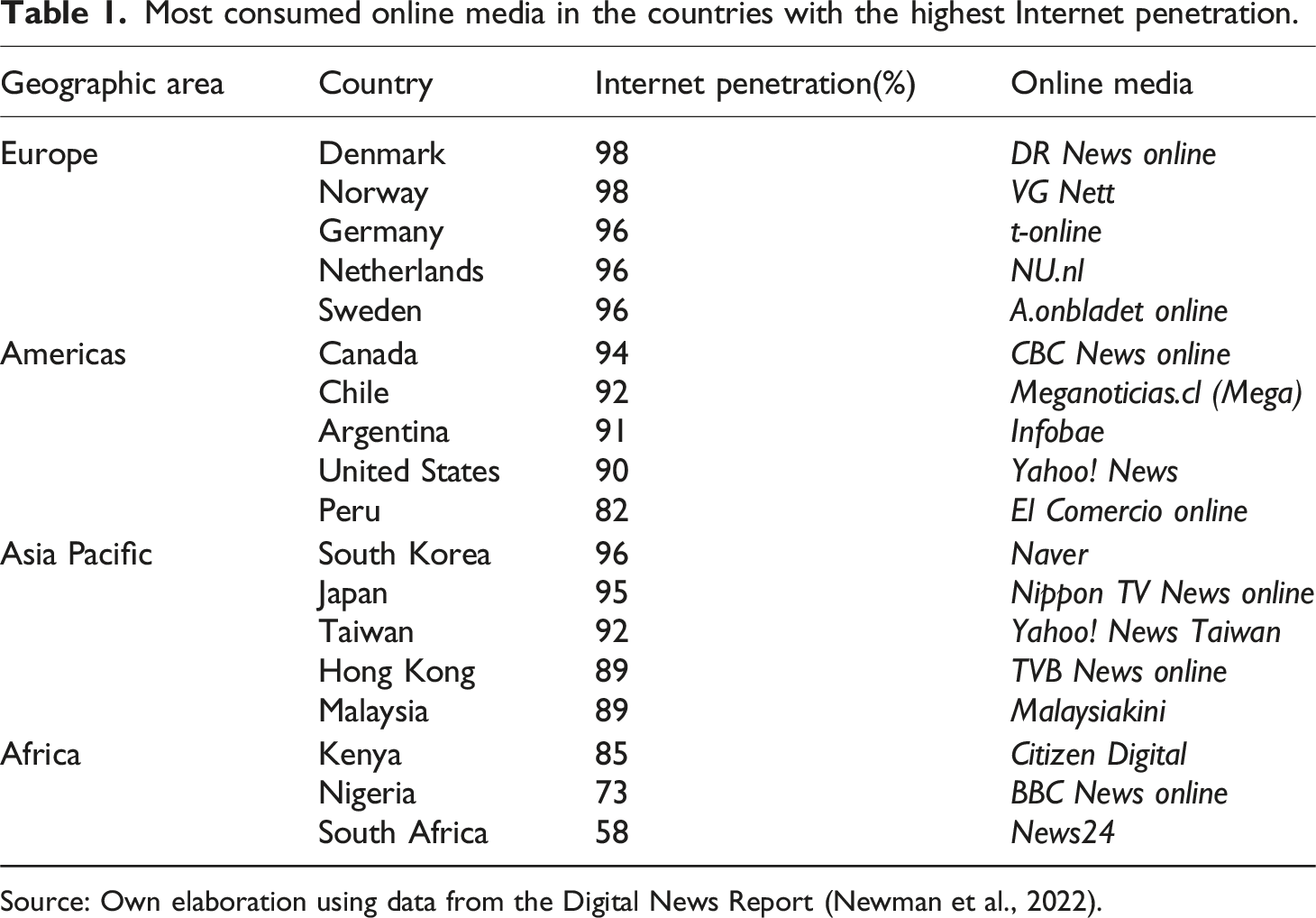
Source: Own elaboration using data from the Digital News Report (Newman et al., 2022).
Based on the review of the literature, an analysis sheet was prepared (Bardin, 2011) in which all the modalities of high innovation that are practiced in the media industry today were incorporated. It was divided into eight parts:
Narratives
Options were considered that ranged from the suggestion or recommendation of topics, to high innovation through immersive journalism, instant narratives and robot journalism linked to artificial intelligence.
Data journalism
In this section, the use of big data for the production of news, the use of statistics for data processing or that the media have a laboratory are valued.
Audience involvement
The different ways that the public can exercise citizen participation through forums, suggestion boxes and polls are analyzed.
Co-creation
Co-creation transcends citizen participation. Thus, it is necessary to differentiate both types of innovation. In the case of co-creation, the participation of the public in the creation, development and marketing of the products is valued, as well as the facilities for sending co-creations and encryption guarantees.
Verification and transparency
On the one hand, transparency practices as part of the operation of the media outlets. On the other, the dissemination of information linked to investigative journalism, as well as verification and fact-checking exercise are taken into account.
Visibility of journalistic deontological standards
The actions implemented to give visibility to the good practices implemented by the media are evaluated. These include rectifications, accessibility to the code of ethics and membership commitments.
Corporate information
Innovation means that the media also act with social responsibility, so it is important to determine the transmission models for corporate information and media literacy practices.
Content distribution
Multiplatform dissemination is already a widely practiced technique. Therefore, it is necessary to assess whether content distribution occurs in different platforms, whether belonging to the same communication group or through external media, via mostly social networks and instant messaging applications (cross-media), and if this content is promoted within media under the same ownership (cross-promotion).
It is important to note that only those items that demonstrate true innovation are included in the analysis sheet. Multimedia journalism does not feature because it is already implemented by all media and is a fully established practice that does not imply a high level of innovation. The same is true of infographics and information visualization. In cross-media dissemination, only the most pioneering networks such as TikTok or Twitch are considered highly innovative, so distribution on consolidated networks such as X, Facebook or Instagram is not valued. Similarly, that the user can share news on WhatsApp does not entail innovation according to our criteria, even though the automatic distribution carried out through Line is considered innovative. YouTube channels are also considered highly innovative because they require the adaptation of the news to a longer audiovisual format. Both in this case and in the other avant-garde social networks, they are only counted if the corporate website offers widgets.
Analysis sheet with categories, items and scores.
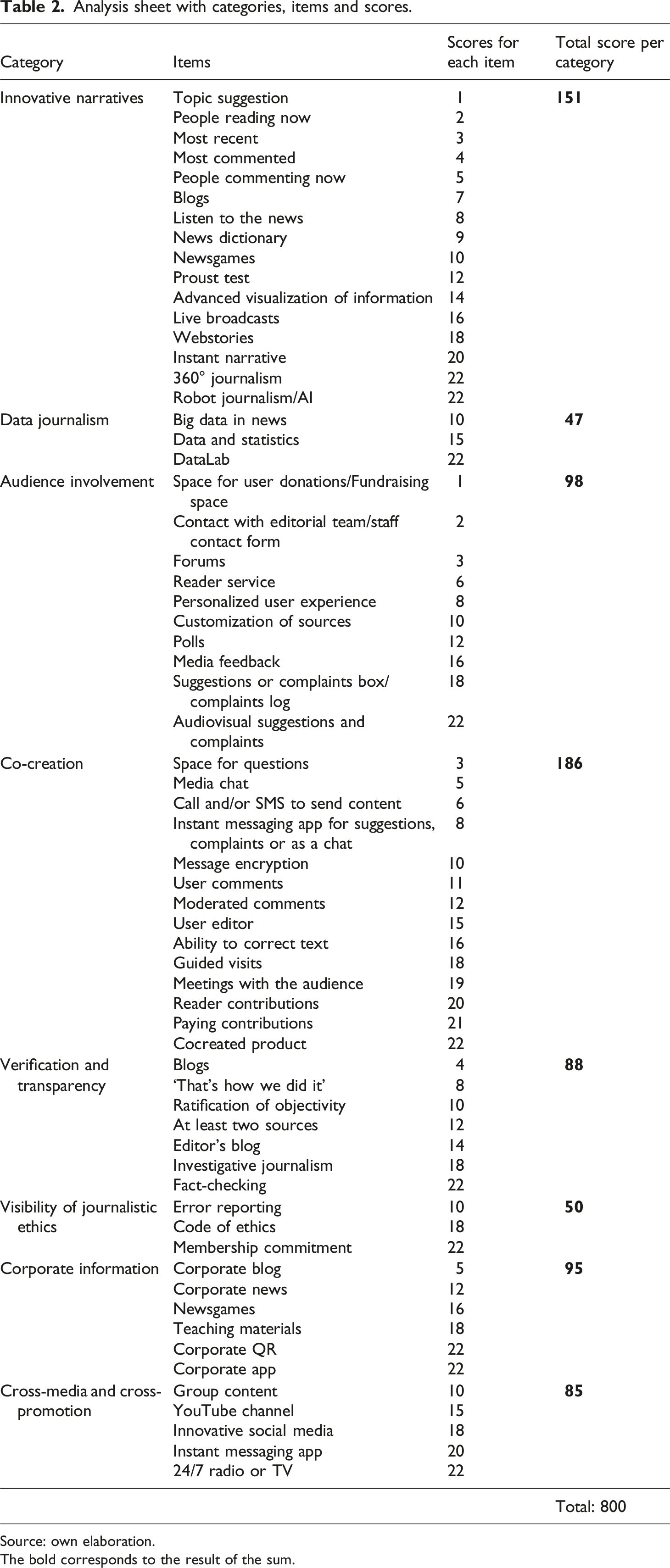
Source: own elaboration.
The bold corresponds to the result of the sum.
In the hypothetical scenario in which a media outlet exercises all of the above items, it would obtain 800 points. With that being said, it must be taken into account that high scoring items and low scoring items rarely appear together within the same media, despite the fact that an item with a higher score never invalidates one of lower rank as they, in fact, complement each other. As the number of items is different in each category and, therefore, the sum of the scores is also different, to obtain a proportional percentage representation of each category (1/8 = 12.5% of the set), the rule of three was used. In this way, the innovation factor in each category is comparable with the rest and with the entirety of the categories.
Due to the number of items included, when extracting the scores corresponding to each media outlet in particular (×/800), a correction factor FAC = 800/8 was applied to amend the reading based on the technical standards established for the correct calculation according to the measurement sheets. The scale of values to determine the degree of high innovation is as follows: - 200 points or more: extraordinary. - 150 points or more: very high. - 100 points or more: high. - Between 75 and 99 points: average. - Between 50 and 74 points: Low. - 49 points or less: Very low.
Once the methodological instrument was configured, an exploratory search was carried out of the official websites that registered constant frequency of access during the first half of 2022 (at least one weekly access for each case). As most of the categories refer to items linked to web design and information visualization, the parameters of frequency and periodicity were discarded. These would only have been useful when analyzing the number of fact-checking practices, so that all those cases in which there was at least one significant example during the analysis period could have been counted.
Results
Innovation by categories in each media outlet, including resulting score.

Source: own elaboration.
Innovative narratives
Narratives is the category where the highest-level innovation is noted. All of the geographical areas, aside from Africa, contain several media outlets (DR News, VG Nett, t-online, NU.nl, A.onbladet, Meganoticias.cl, El Comercio or Yahoo! News Taiwan) that incorporate instant narratives on their websites. These narratives include a timeline that is updated every few minutes and that allows the reader to be up to date with the latest news. Although this is not robot journalism in the strictest sense, it does show signs of automation.
The webstories proposal of the Argentine Infobae is also very significant, showing an adaptation of social network stories to the web. Outside of media like Yahoo! News United States or News24, 360° journalism is not yet a common narrative model, although live broadcasts are frequent in the four geographical areas. This implies the more pronounced development of more traditional multimedia journalism as opposed to live multimedia journalism. Only the South African News24 attained a score in the advanced visualization of information, despite the fact that all the media use infographic techniques. This is because only News24 surpasses that which is already the regular standards of digital journalism.
On the other hand, other narrative models that do not entail such an advanced development of innovation are common throughout the world, such as the suggestion of topics to the reader, sometimes with live feedback from the number of people who read or comment on that piece of news. Also worth mentioning is the South Korean Naver’s coffee shop format in which they select the content and offer the possibility of listening to the news instead of reading it or using news quizzes. The Proust test, a set of questions provided by the French writer Marcel Proust and often used in modern interviews, is only used by El Comercio de Peru.
Data journalism
There are only four examples of media outlets that practice data journalism to a significant extent using the interpretation of data for the production of news. Furthermore, there are no examples of data narration with statistical interpretation. Only the Asian Naver has a DataLab: that is, a center that interprets big data prior to its journalistic application.
Audience involvement
The vast majority of the most read sites in the world offer spaces for public participation. The most used models range from the most basic such as spaces for donations (Malaysiakini), emails or links to contact staff directly (VG Nett, Yahoo! News USA or Nippon TV), through to customer service (t-online), customization of feedback sources and reports (Yahoo! News USA), polls (News 24 or Yahoo! News Taiwan), mailboxes (CBC News), suggestions’ mailboxes (A. onbladet) and audiovisual suggestions (VG Nett). TVB News online from Hong Kong is the only media outlet that does not offer alternatives neither for citizen participation nor for co-creation.
Co-creation
The public being able to co-create journalistic products is a highly innovative process. There is evidence of basic practices, such as enabling a WhatsApp number to send user generated content (Citizen Digital), the creation of an app for complaints (Meganoticias.ch) and the guarantee of anonymity and encryption for messages sent by citizens (A.onbladet). There are also intermediate level ideas, such as the possibility to comment on news with editorial moderation, as is the case with BBC News in Nigeria.
Highly innovative concepts are apparent in the co-creation analysis. For example, the direct creation of obituaries in Kenya's Citizen Digital, direct contributions and co-created products in UN.nl, and payment for content offered by the Scandinavians A.onbladet and VG Nett. DR News has a user editor and organizes meetings and guided tours that allow for public-newsroom interaction.
Verification and transparency
The transparency of the media and, above all, the visibility of this transparency within the web architecture is shown through editorial explanations that guarantee the objectivity of the information. This is apparent in TVB News and in t-online, editorial posts on how journalistic stories are produced (DR News), as well as in the confirmation of having used at least two sources in the preparation of the stories as occurs in A.onbladet. The Canadian CBC News even has an Editor’s blog for accountability.
Information verification is another requirement in terms of transparency. The process guarantees the reader that the information they consume is real and was dissected according to purely journalistic criteria. It is surprising, however, that only two media outlets have dedicated significant sections to investigative journalism, as is the case with CBC investiga (Canada) or Megainvestiga (Chile), while only a few media host fact-checking spaces on their websites (again, CBC and Meganoticias, and El Comercio, BBC News Nigeria and News24).
The visibility of journalistic deontology
A media outlet cannot be labelled as innovative simply because it has a code of ethics. Rather, these deontological guidelines must be clearly visible and easily accessible for the reader. The same is true regarding membership commitments to journalistic organizations, professional bodies and user organizations. When examining innovation in deontological guidelines, spaces are identified that display the rectifications made by the media (Naver, VG Nett or CBC News), signifying that the error correction policies contained in the codes are more than just well intentioned, but tangible and real.
The visibility of the rules of conduct scores highly in the Danish DR News, in the Asian TVB News and in the African BBC News (albeit in the last case because the user is directed to the self-regulation systems of the BBC group). What also stands out is the innovative approach in the visibility of the membership commitments of CBC News and A.onbladet to the Ombudsman.
Corporate information visibility
Sometimes it seems that corporate information is offered on news sites to be consumed by the media itself rather than by the user. The ways of presenting this information and the resources offered by corporations are innovative practices that must be valued. For example, BBC News online has a corporate blog, while NU.nl produces corporate news and has a game that centers on the medium itself.
Other media go further and prepare teaching materials, several of them linked to media and digital literacy, as is the case with Citizen Digital. DR News and Naver score highest in corporate information innovation by creating an app and a QR to provide the user with data about the organization.
Cross-media and cross-promotion
That a medium is engaged in cross-media distribution with other media, or that it advertises through cross-promotional content from another media outlet belonging to the same communication group, is also innovation. However, when this distribution is carried out through traditional social networks, it does not signify a high level of innovation because it is a common practice across all the world's media. In order to be considered innovative, more avant-garde networks must be enabled and promoted on the web, such as Meganoticias.cl, which has TikTok, Spotify and Twitch, or Nippon TV, which has and advertises TikTok.
For cross-media techniques to be considered innovative, the media outlet must have at least a YouTube channel enabled. The widget also has to be included on the corporate website, as can be seen in the Swedish A.onbladet, the Canadian CBC News, the Argentine Infobae and in the Chilean Mega. Yahoo! News Taiwan and Nippon TV News also perform innovative distribution by using the Line instant messaging application.
The web distribution of content produced by other media belonging to the same business group is the criteria that receives the lowest rating, both because it is already a well-established practice, and because it is a technique limited to media that belong to a multiplatform publishing group (keeping in mind the weighing factor and the complementary nature of the analysis items). Nonetheless, the web broadcasting of 24-h television (Nippon TV News) or television and radio (Citizen Digital) does demonstrate innovation, despite the fact that it doesn’t occur in digital native newspapers, but on television network websites.
Scores and percentage of innovation by media, category and group.
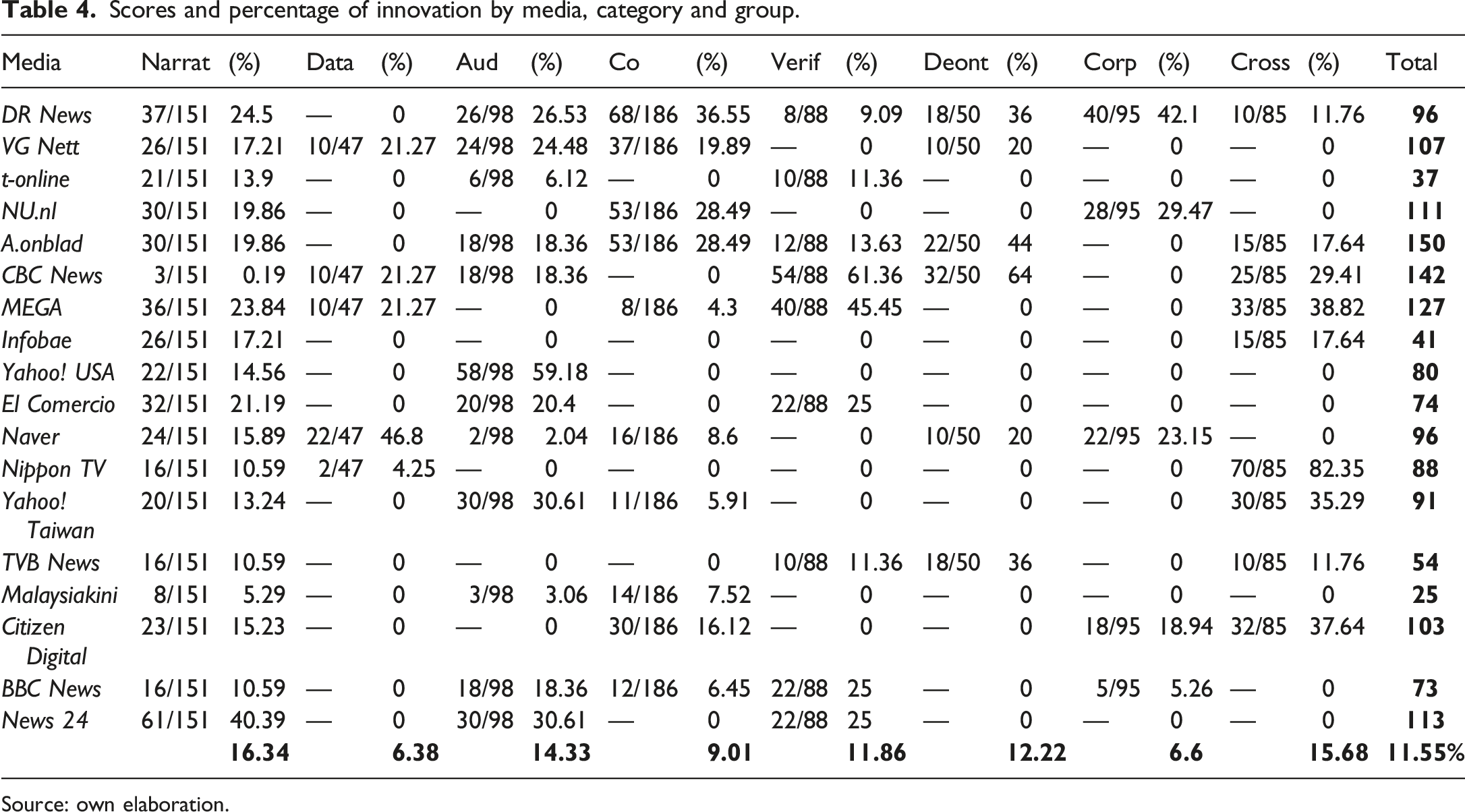
Source: own elaboration.
When applying Bonferroni Correction these are the variables that confirm the validity of the data: Alpha (0.16), R (8), r (0), and Df (0). With no correction the chance of finding one or more significant differences in eight tests = 0.7521 (75.21%).
Discussion and conclusions
Based on the theories of disruptive innovation (Christensen, 1997) and the diffusion of innovations (Rogers, 2003), this study finds (RQ2) that news sites are innovating the most in their narratives (16.34%), followed by cross-media and cross-content distribution (15.68%) and audience involvement formulas (14.33%). These three categories provide formulas for storytelling and involving the public in the discourse. With that in mind, the results seem to coincide with what some previous studies have already put forward regarding how new narrative models are redefining journalism (Sixto-García et al., 2023; Swart et al., 2022). An African news outlet, News24, is found to be the most innovative when it comes to narratives, despite the fact that African media are the only ones that do not make use of instant narrative, the narrative technique that is found to predominate globally. In the distribution of content, no geographical differences are evident. For audience involvement, the news site Yahoo! stands out in both the United States and Taiwan.
Although journalistic deontological standards are part of the foundation of journalistic practice (Bachmann et al., 2022; Ní Bhroin and Milan, 2020), few media outlets exercise them in a way that can be considered innovative. Nonetheless, those media outlets that are successful in doing so achieve outstanding results. The same is true with the criteria of transparency, accountability and verification of information (Deuze, 2019), where two American media outlets, CBC News and Mega, rank the highest for fact-checking and investigative journalism.
Co-creation as an innovative practice is still yet to be fully developed (9.01%), as another previous study had already shown (Sixto-García et al., 2022). However, it is shown on this occasion that there is a specific region in Europe, the Scandinavian countries, where co-creation is much more developed than in the rest of the world. There is also a lack of recorded cases regarding innovation for corporate information (Hermida and Mellado, 2020), though those that are evident are highly innovative. The most surprising finding is the apparent lack of evidence of this practice in American media. Despite the theoretical and conceptual relevance of data journalism (De Lima-Santos, 2022), it is striking that it appears relegated to the last position (6.38%) and not conducted by any African media.
Aside from the exceptions mentioned above, there are no significant differences between the various geographical areas in the evolution of high innovation categories analyzed here. Publicly owned media such as CBC News and DR News do not operate much differently than their private counterparts, nor is there much difference in terms of innovation between digital native media when compared with traditional online sites, or news websites.
That the global results are always below 20% makes it possible to identify a degree of high innovation that is still incipient. Nonetheless, applying the weighing factor FAC = 800/8 again confirms how the narratives, the distribution, the involvement of audiences and web visibility of journalistic deontological standards are the nutrients that fuel journalism modern adaptations and that secure public interest. Regarding the news sites’ performance across all the categories of innovation listed here, only the Swedish A.onbladet online reaches 150 points in the analysis sheet (Table 4), which is equivalent to a very high degree of innovation. It is followed by two American media (CBC News and Mega) and two European ones (NU.nl and VG Nett), all of whom surpass 100 points (high degree of innovation). From this is can be concluded that it is in America and Europe where innovation is most pronounced within journalistic sites. That only one African medium exceeds 100 points (Citizen Digital), and that no Asian attained a score of 100, supports this conclusion.
The primary limitation of this study is that only the media referenced by Reuters Institute are analyzed. Consequently, the development of innovative innovation techniques in these sites is still in an embryonic phase (RQ1), so that it cannot be concluded that there is a total journalism (Vázquez-Herrero et al., 2022b) that is making use of all the potential that high innovation can provide. Future research should aim to examine the evolution of this situation and determine whether specific categories have made significant progress in any region of the world. Furthermore, it should seek to identify if the differences between America and Europe, and the rest of the world, still persist. This study contributes to the understanding of the state of innovation in the media, thereby contributing to the development of the aforementioned innovation theories. In terms of journalistic practice, this research highlights how news sites are gradually incorporating highly innovative approaches to cater to the needs of audiences who are increasingly demanding, technologically adept and more familiar with new ways of consuming information.
Footnotes
Author’s note
All authors have agreed to the submission and this article is not currently being considered for publication by any other print or electronic journal.
Declaration of conflicting interests
The author(s) declared no potential conflicts of interest with respect to the research, authorship, and/or publication of this article.
Funding
The author(s) disclosed receipt of the following financial support for the research, authorship, and/or publication of this article: This work was supported by two funding sources: 1. Ministry of Science, Innovation and Universities (Spain), and co-financed by the European Regional Development Fund (ERDF) [PID2021-122534OB-C21. Digital native media in Spain: Strategies, competencies, social involvement and (re)definition of practices in journalistic production and dissemination]. 2. Project IBERIFIER - Iberian Digital media Research and Fact-Checking Hub, action number 2020-EU-IA-0252. Co-financed by the Connecting Europe Facility of the European Union (CEF-TC-2020-2).
