



Abstract
Financing high-quality journalistic reporting is becoming increasingly difficult worldwide and economic pressure has intensified in the wake of the COVID-19 pandemic. While numerous alternative funding possibilities are discussed, ranging from membership models to government funding, they should not compromise the highest possible independence of journalism – a premise that also applies to scientific research. Here, the state is involved in funding, but peer review models reduce funding bias. However, systematic approaches as to how established funding models in research could be transferred to journalism are lacking. We attempt such a systematic transfer using the example of the German Research Foundation (Deutsche Forschungsgemeinschaft, DFG). The transfer, based on an analysis of the complex DFG funding structures, was validated in 10 interviews with experts from science, journalism and foundations. Building on this, we developed a concept for a German Journalism Foundation (Deutsche Journalismus-gemeinschaft, DJG), which awards funding to journalists and cooperative projects based on a peer review process. The funding priorities of the proposed organization range from infrastructure support to grants for investigative skills. Thus, unlike other models, it does not focus on funding specific topics in media coverage, but on areas such as innovation support, technology implementation and training. Although the model was designed for Germany, such a systematic transfer could also be tested for other countries.
Keywords
Introduction
Functioning mass media is of fundamental public interest in democratic societies (Neff and Pickard, 2021; McQuail, 1992: 3) and journalism as well as science are considered essential pillars in a democracy (Acatech – National Academy of Science and Engineering et al., 2014; Jarren, 2021). However, whereas funding of science has faced a rather stable trend in recent years (Federal Ministry of Education and Research, 2020: 6), independent journalism is facing increasing pressure. In the US, newspaper revenues started to collapse over a decade ago (Evans, 2021). According to the Pew Research Center (2020), traditional newspapers in the US lost 36,000 jobs between 2008 and 2019. Similar trends can be observed across other countries (Fry, 2017). Structurally, the funding crisis of journalism in democracies of the West is due to market changes resulting from the digital transformation of the media: The classic advertising model has long been considered broken (Nielsen, 2020: 331–334). Although the industry has been investing in the development of digital payment models, the successes have remained low, with exception to a small number of richer Western countries such as Norway and Sweden (Newman, 2023: 18; Chyi and Ng, 2020; O`Brien, 2022). The pandemic has further reinforced this development (Posetti et al., 2020). But a loss of journalism comes at high cost for democracy, resulting in lower voter turnout (Kuebler and Goodman, 2018) and diminished political accountability (Gao et al., 2020; Snyder and Stroemberg, 2010). Hence, it seems urgent to propose new financing models in order to strengthen journalism 1 (and thus democracy).
Experts are searching for innovative ways to finance and promote journalism: for example, new private journalistic entrepreneurship (Singer and Broersma, 2019), non-profit journalism (Deutscher Bundestag, 2020) or foundation-financed journalism (Nisbet et al., 2018). In 2017, the public funding of journalistic information media in Austria, Denmark, Sweden, the Netherlands and Norway was compared – with the conclusion, that the press and media funding in these countries consists of diverse forms and instruments. “However, it is not only a question of finding individual new instruments, rather a concept is required that does justice to the technical developments and the changes for and in society associated with them” (Deutscher Bundestag, 2017: 26–27). Against this backdrop, we try to address some of the complex contexts of journalism funding in the 2020s, before we present a proposal for additional new funding mechanisms.
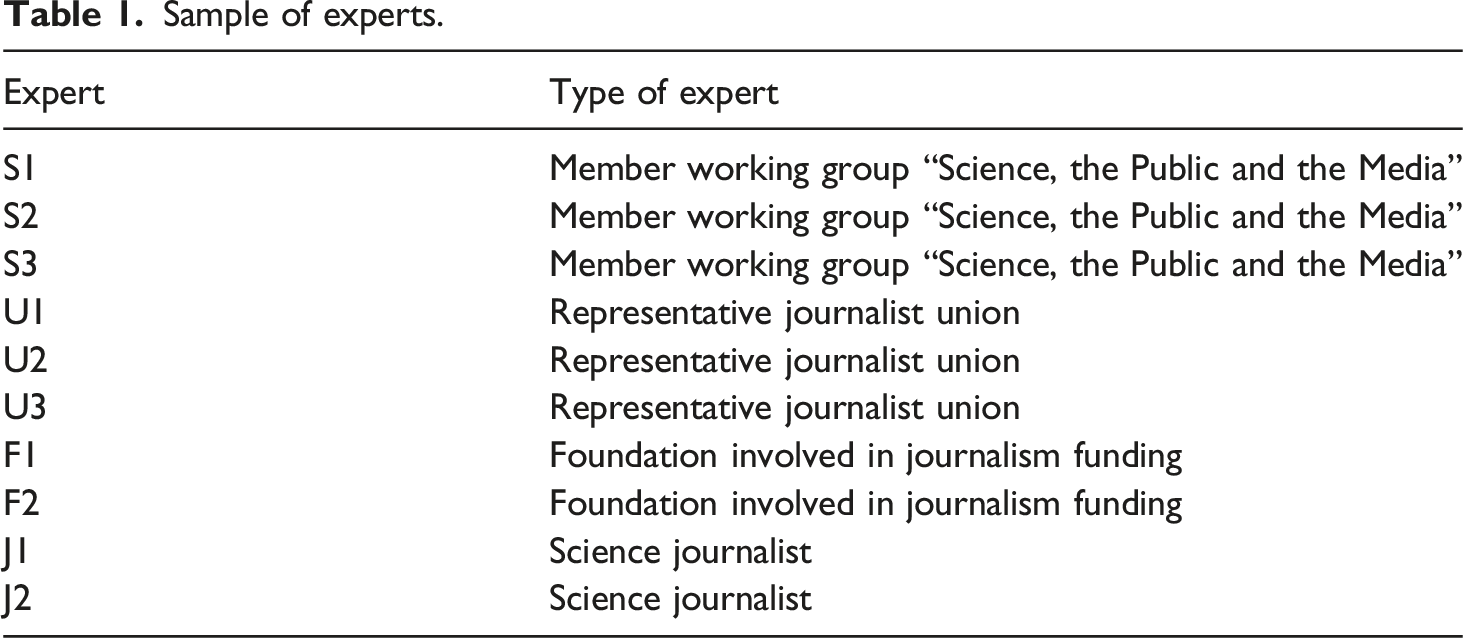
The principle of research funding could be a new way of funding journalism and the transfer of research funding concepts to journalism has already been discussed in the past (Acatech – National Academy of Science and Engineering et al., 2017; EMEK, 2014; Wormer, 2016), but a systematic proposal that turns this idea into a comprehensive model is missing. We used the example of the German Research Foundation (Deutsche Forschungsgemeinschaft, DFG) as the most important research funding institution in Germany to elaborate organizational processes, the funding programs and the financing. The analysis of the DFG structures served as basis for a questionnaire, on which we conducted 10 interviews with experts from science, journalism and foundations. We asked the interviewees to assess whether and which of those aspects could be suitable for journalism and why. Finally, we discussed the results of the case analysis as well as the expert interviews and developed a concept for a corresponding organization of funding journalism.
Financing journalism
Changes in the political economy of the media and the need for a supplementary funding model for journalism
The decline of the commercial funding model of independent journalism in the course of the digitalization is accompanied in many countries by increasing pressure on the democratic performance of the respective media systems (cf. Rolnik et al., 2019). Even in Western democracies, the logic of surveillance capitalism practiced by powerful social media and platform corporations (cf. Zuboff, 2019) promotes the danger of affective political polarization and manipulative disinformation that threatens the functioning of a democratic public sphere (cf. Gora and De Wilde, 2022). 2
As Humprecht et al. (2020) show, the degree of democratic resilience of the media system depends on the political economy of journalism. 3 Accordingly, democratic resilience is rated as relatively low in polarized-pluralistic media systems and comparatively high in democratic-corporatist ones and additionally in the hybrid models of the UK, Ireland and Canada (Humprecht et al. 2020: 503–511).
As particularly susceptible to democracy-endangering information pollution, Humprecht et al. (2020: 506) identify the US. Pickard (2020: 161–167) attributes a particular lack of democratic resilience to US-journalism caused by the „ravages of a dying commercial media system“ (p: 161). As a result of his analysis of „commercial journalism´s collapse“ (p: 164) he advocates the establishment of a completely „new public media system“ as an entire new journalism funding model whose „solid foundation“ would necessarily require “tens of billions of US dollars” (p: 167). 4
The study results of Humprecht et al. (2020: 505–506) suggest that countries with polarized-pluralist media systems would also require fundamental revisions and new constructions of their entire journalism and media systems models in order to sufficiently guarantee democratic resilience again.
However, the concern of our proposal is considerably more modest, because we only aim to consider a new supplementary funding model for those better-off countries, whose media systems may still claim a comparatively high democratic resilience. Such a supplementary model is neither meant to re- nor to displace the existing funding models of journalism which are still (at least partially) working in those countries. Instead of turning around the structure of the media market, it should rather aim to sketch out an efficient way of compensating for the deterioration in democratic performance of journalism.
Since countries with democratic-corporatist media systems can also be characterized as „media supportive“ (Humprecht, 2020: 505, 507) there has been an ongoing debate on the question how to compensate for these losses of journalistic capacity effectively and efficiently. However, a critical assessment based on media economics literature reveals that the proposals so far have been caught in a dilemma.
Funding models for distressed journalism between Scylla and Charybdis
As Nielsen (2017) has argued, the economic decline of independent commercial journalism harbors a double danger for the democratic functionality of journalism: firstly, independent journalism is losing resources; secondly, the motivation and possibility of abusing the media is increasing (“media capture”, cf. Stiglitz, 2017). According to Nielsen (2017: 34), „[…] this development means that countries with […] relatively independent private media that maintain a degree of journalistic autonomy in part through their profitability – like the United States and parts of Western Europe – are likely to see a twenty-first century resurgence of more captive, politically instrumentalized news media.“ Therefore, it seems that journalism is on a difficult transformational ride between Scylla and Charybdis: there is the risk of economic capsizing, as well as the danger of editorial journalistic independence being hijacked by the external financiers.
Research on foundation funding shows that even ‘benevolent’ media patronage limits the independence of journalistic media (cf. e.g. Konieczna, 2022). Two major studies have shown, foundations not only tend to influence thematic priorities (cf. Scott et al., 2019), but also interfere in editorial independence: According to Ferrucci and Nelson (2019), foundations act like “the new advertisers” for whom – at least so far – there are no longer firewalls to prevent direct intervention in journalistic decisions.
Meanwhile, the big tech companies Google and Meta have become international ‘super-patrons’ of distressed journalism. Several critical analyses of their funding programs see a strategic form of media capture (cf. esp. Papaevangelou, 2023; Bell, 2021): the funding programs were carefully designed to flank the elaborate political lobbying of the corporations in various countries and thus to safeguard the intended “regulatory capture” of politics vis-à-vis journalism and the public.
As studies by Dragomir (2018, 2019) have shown, it is particularly troubling when governments use state subsidies as instruments of power for an overarching political “media capture”, which in turn is intended to enable an exploitative “state capture” for the benefit of the government. As the relevant political science explanations of “democratic backsliding” (Mechkova et al., 2017) suggest, targeted media conquest strategies of the respective populist governments are regularly at the beginning of corresponding autocratization processes.
The presented research shows the dilemma of Scylla and Charybdis: the economic crisis weakens independent journalism. For this very reason, there is a danger of media capture by all conceivable new donors. The question is whether there are state-supported funding models that could solve this dilemma (Murschetz, 2020).
Authors who advocate new forms of state support for journalism like to point to Western European countries that have intensively relied on direct and indirect state media support. At the same time, they traditionally lead the media freedom rankings – which of course contradicts a serious media capture problem (Andersson, 2023: 109–110, 123).
For the Scandinavian and Western Europe countries, whose media systems can be assigned to the democratic-corporatist model, Value Added Tax (VAT) reductions for newspaper publishers represent the most prominent form of subsidization beyond the funding of public service broadcasting. The value of this indirect form of subsidy typically dwarfs the total value of other press and journalism subsidies, giving it a strong media policy dominance within the state funding of private media (Allern and Pollak, 2019: 1434; Nielsen, 2014: 129–130).
VAT privilege has also provided the largest publishers with considerable windfall effects and has strengthened their considerable economies of competitive advantages (cf. Allern and Pollack, 2019: 1435). Given the magnitude of these effects, many researchers have wondered why these subsidies have hardly been criticized in media policy and why no empirical cost-benefit analyses are available (cf. Murschetz, 2020: 8; Ots and Picard, 2018; Kind and Møen, 2015).
Although indirect media subsidies via VAT privileges is compatible with a strong independence of the media Nielsen (2014) and Puppis et al. (2020) classify this model as a “frozen” political instrument that cannot adequately address the journalism crisis in the digital transformation.
Based on an econometric analysis Kind and Møen (2015) argue, that it would be more efficient to promote democratically relevant journalism through a direct subsidy of the investment costs for eligible journalistic services and projects. Puppis et al. (2020: 417–422) hold that this should apply in the age of digital transformation and the associated crisis in journalism. In the media subsidies of the Scandinavian countries, Puppis et al. (2020: 418) see at least first positive approaches in newly introduced programs for direct journalism support, but they still more or less follow a watering can principle of funding. 5
However, it remains the question of how such programs can be designed in a way that the credibility of journalism is not endangered. Direct funding, which should also cover the online sector and new forms of providers in order to be effective, must be selective and tie this selectivity to quality criteria. The respective political debates in the Scandinavian countries show the difficulties (Allern and Pollack, 2019).
In summary, the dilemma between the quality-oriented effectiveness of funding models and the best possible safeguarding of the editorial independence of the media forms a core theoretical problem of media regulation research today. In this paper, we explore whether a complementary financing model could provide an approach to overcoming this dilemma.
Our proposal: Peer-based research funding as a model for supplementary journalism funding
The requirements described above bear a high similarity to research funding (Benner and Soerlin, 2007; Wissenschaftsrat, 2003) where mechanisms for ensuring quality and diversity have been established. One basic element to ensure a quality-oriented decision as independently as possible from funders are review panels. “Peer review is at the heart of the processes […] of all of science. It is the method by which grants are allocated, papers published, academics promoted, and Nobel prizes won”, as the former chief executive of the BMJ Publishing Group, Richard Smith (2006: 178), analyses. He admits that perfect independence does not exist but he describes the system as “the least worst we have”. Reinhart and Schendzielorz (2021: 3) describe peer review as a “success story” that works despite deficits. Because of the broad experience with its capabilities and possible flaws a highly differentiated science funding structure based on peer review is a promising starting point to further develop the preconditions for funding journalism.
This new model of multi-level journalism funding could award money to journalistic projects of excellence following a peer review process. The structure of the organization as well as the peer review process would ensure a comparatively independent funding mechanism, which would allow individual journalists, editorial teams and cooperative projects from all media types to apply for projects in areas which are often cut, as they are time-consuming and expensive, such as “investigative journalism” or “fact checking”. Thus, our proposed model would foster areas in which the media is struggling.
Method
As the most important research funding institution in Germany the DFG is very differentiated concerning the funding structure and the scientific community itself administers it (Powell, 2000: 6). We elaborated the structures and mechanisms of the DFG and designed a questionnaire, conducted interviews with experts and asked the interviewees to assess whether and which mechanisms of the DFG could be suitable for journalism. Finally, we discussed the results of the case analysis as well as the expert interviews and developed a concept for an organization.
Case study
The DFG is an association under private law and can only act through its statutory bodies. Its purpose is “[…] to select the best projects by researchers at universities and research institutions on a competitive basis and to finance these projects” (DFG, 2018). Members of the DFG are universities, non-university research institutions, scientific associations and the Academies of Sciences and Humanities (DFG, 2018). The DFG receives most of its financial resources, currently nearly 3.5 billion euros, from the federal government (69%) and the German states (20%) (DFG, 2021a). The DFG funds individual researchers as well as research groups and each funding instrument can be grouped within seven categories, the so-called “funding focus” with prices being an additional eighth group (DFG, 2021b, see supplementary material). Literature and numerous research papers about DFG are available, allowing an extensive analysis (e.g. Olbrecht, 2013; Hornborstel and Olbrecht, 2007; Wissenschaftsrat, 2003).
Expert interviews
Sample of experts.
Questionnaire and coding
As outlined before, important challenges for journalism funding include (organizational) independence, diversity of funding areas and programs, quality assessment of the projects and funding. Therefore, these aspects were important components and were the four main parts of the interviews.
We evaluated the qualitative expert interviews with the structuring qualitative content analysis (Kuckartz, 2016). The category system was created a priori and then inductively (Kuckartz, 2016: 63). To help structure and sort the coded parts into themes (and make them trackable), we used the qualitative research software MAXQDA2018.
Results of the expert interviews
Organization
When asked, which form of organization the experts would prefer to fund journalism, they agreed that it should be an institution under private law. In general, the experts consider both the establishment of an association as well as a foundation (cf. Benson, 2018). In addition, experts S1, F1 and U1 name the endowment as another suitable form of organization (cf. Pickard et al., 2009: 22–24).
When asked, who they think could be member of a possible association of private law, expert S3 pointed out, that the journalists themselves should have to be entrusted with the allocation of money. However, the expert pointed out that there is no official register for journalists in Germany, so that it is not clear who could be included in such a process. Expert U1 suggests already existing unions as a prerequisite for membership, although he sees it as problematic that each of them have a different understanding of journalism. Thus, the existing structures would have to be exposed to “processes of change and dynamics” (U1). The option of a more superordinate membership structure, similar to the DFG, is endorsed by experts U3, U2 and F2. Expert S3 opposes such an overarching structure, since publishers and associations alike would pursue self-interests against which journalists should be protected.
Funding areas
Funding areas mentioned by the experts.
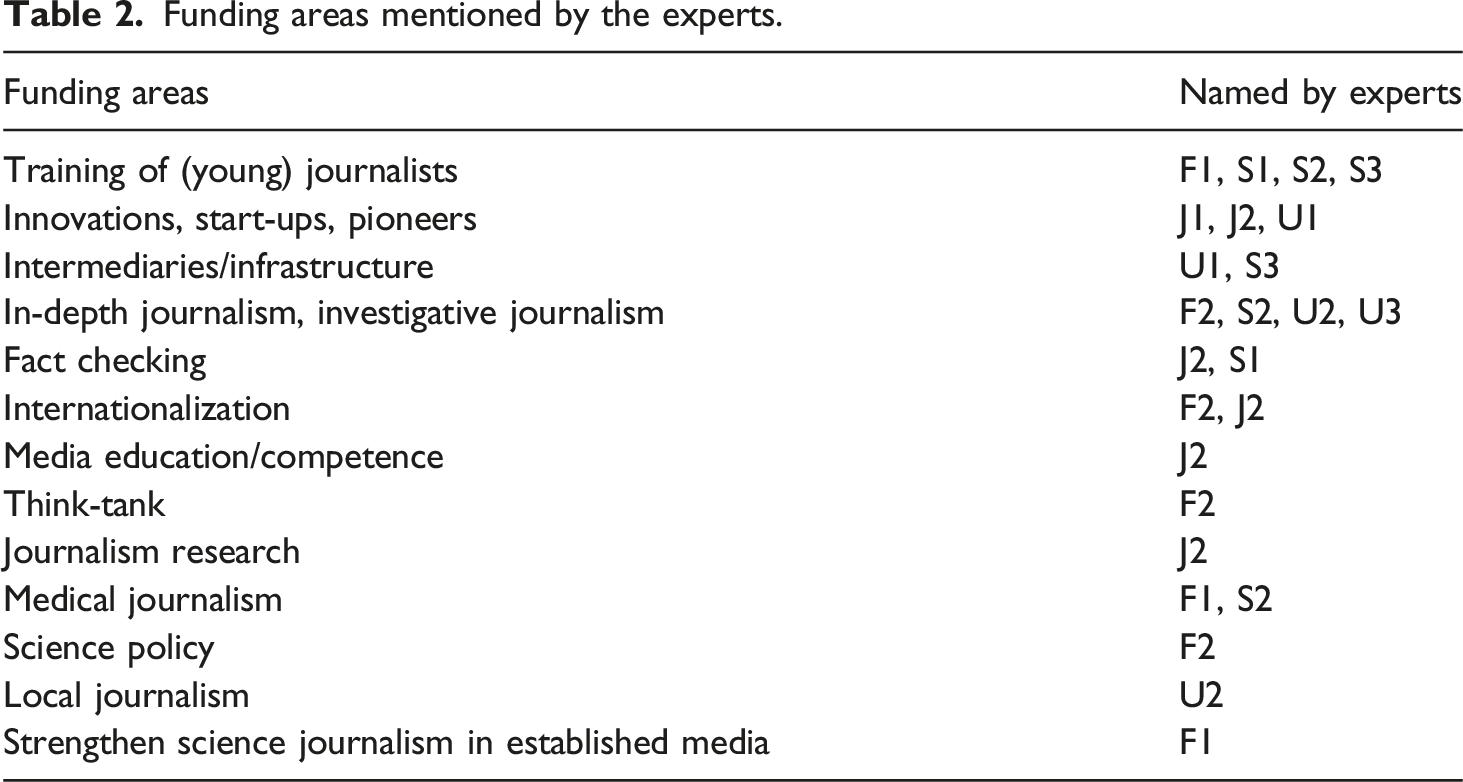
Four experts (F2, S2, U2 and U3) name investigative, research-intensive journalism or in-depth journalism as a particularly important area (cf. Padania, 2019). Fact checking is another aspect which two experts (S1 and J2) consider (cf. Luengo and García-Marín, 2020; Mena, 2019). Twice, internationalization and the promotion of international cooperation are mentioned as areas worthy of support (J2 and F2), once journalism research (J2) and once the promotion of media education (J2). Expert F2 also argues that there should be a think tank that could reflect on the future of journalism. In general, the experts advise against funding special thematic formats and contributions regarding specific disciplines. Expert S3 for example says, that this could be a problematic intervention in the thematic independence of journalism.
Selection process
One of the key questions is how projects should be selected for potential funding. In principle, the experts think, that the selection could be based on a peer review procedure. The problem of peer review, however, is the question of how to ensure that one gets “highly qualified reviewers who work according to criteria”, says expert J1. Expert F1 compares this to science, where the reviewers also use the applicants’ publication lists and previous education for evaluation. In journalism, “[…] one would have to apply other parameters when reviewing a funding application for journalism.”
Expert S3 sees a fundamental problem for such a process in journalism in the lack of a peer culture: “Journalism does not have a peer culture; it is not a classic profession, like doctors or lawyers, where you can clearly say that they belong to the community. […] People who work freelance are just as much part of journalism as bloggers, according to European law. […] That means you need criteria to know who belongs to the peers.”
Funding
The DFG receives the majority of its money from the federal government and the 16 German states. When asked how a funding model for journalism could look like, the experts had varying opinions. Overall, six (U3, S1, F1, J1, F2 and U1) experts believe, that state or public donors could be a possible source (cf. Murschetz, 2020; Stonbely et al., 2020). In their view it could be possible, because the organization should promote innovation, technology and structural change rather than journalistic topics and contributions. Therefore, the journalistic freedom would not be threatened. Furthermore, the experts frequently mention the governance structure, which could preserve the independence. Experts U2 and J2 see state funding as problematic and cite the lack of neutrality as reason. Expert U2 is in favor of mixed financing, for example by private donors and foundations.
The working group “Science, the Public and the Media” also suggested using funds from public broadcasting fees to co-finance foundations that are independent of the state and which could initiate funding measures (Acatech – National Academy of Science and Engineering et al., 2017: 8). Experts S1, F1 and U1 support this idea.
Concept of “Deutsche Journalismusgemeinschaft (DJG)”
The interviews revealed that the experts see the need for additional funding of journalism and that it should promote journalism on a structural level. The experts express concerns about financing and a lack of a peer review culture in journalism.
Based on the answers, we will compare the outlined challenges with the DFG and examine whether it structures could be transferred to a similar organization for journalism. In reference to the DFG, we call the potential organization “Journalismus- gemeinschaft (DJG)”.
Purpose and funding areas
As mentioned before, the main task of the DFG is to select the best projects by researchers. Key objectives of the DFG are also the advancement of early career researchers and to promote interdisciplinary cooperation. Based on the expert interviews and current literature (Buschow and Wellbrock, 2020; Wellbrock, 2021), the purpose of a German DJG could be transferred as to select and finance the best projects by journalists on a competitive basis. Key objectives of the DJG could be to support innovations in journalism, to train (young) journalists, to fund projects regarding investigative or in-depth journalism as well as fact checking or infrastructure for journalism. Therefore, regarding our interviews the following key funding areas could be considered for a DJG: “innovations and start-ups”, “infrastructure and technology funding”, “training”, “in-depth journalism, investigative and research-intensive journalism” and “fact-checking”. The funding streams would only focus on overarching themes, allowing many projects to be able to apply.
Similar to the DFG funding portfolio (DFG, 2021b), these proposed programs could be divided into the two funding areas “individual funding” and “coordinated programs”. Individual funding would aim at journalists who submit applications for projects. Coordinated programs would include projects by national or international (editorial) teams. Looking at the DFG, further comparisons are easily possible: a funding program for start-ups and innovations in journalism could be oriented on the ‘Reinhard Koselleck program’ of DFG. It enables to pursue innovative, higher-risk projects for 5 years. The aim of the New Instrumentation for Research’ program of DFG is to fund the development of novel instrumentation for basic research. New infrastructures and technology in journalism (e.g. communication bots) could be compared to such a funding instrument. Several programs of the DFG, such as the Emmy Noether Program’, give early career researchers the chance to qualify for a professorship. It would have to be discussed, how a support for young journalists could usefully supplement already existing training opportunities in the context of journalism schools, degree courses, and traineeships. One area could be in creating greater diversity in newsrooms (cf. Borchardt et al. 2019).
Organization
As mentioned before, the DFG is a self-governing association under private law. Jarren (2015) and Kiefer (2011) have repeatedly criticized that journalists have failed to institutionalize and professionalize the profession with regards to enforceable quality standards. Furthermore, a majority of our experts expressed that an association could be a suitable way to fund journalism. We therefore propose the association under private law as a legal form for a DJG. This could be a low-threshold approach to help journalists break away from socio-cultural dependencies of employers and to organize themselves in a new structure.
In Germany, two bodies are prescribed in the law for registered associations: The executive board and the general meeting (BMJV, 2016). The general meeting determines the principles for the work of the association. As explained above, members of the DFG are universities, other research institutions, academies and scientific associations. A transfer is limited here in journalism: many journalists work as freelancers and would not be represented within such a superordinate structure. Besides them, media houses, journalistic teams or individual editorial offices could be considered as members. Criteria as to who could become a member would have to be defined, for example, a self-declaration in which journalists adhere to (professional) ethical standards as well as a proof of journalistic work.
Further statutory bodies
Several additional statutory bodies in the DFG help keep it running, for example, the Senate and the Joint Committee. The Senate “is […] responsible for all important decisions relating to research funding prior to the final funding decision […]“ (DFG, 2021c). The Joint Committee is responsible for the financial support. In a DJG, it would make sense to establish at least one of those bodies.
Review boards could be established for the overarching funding areas, which would take on similar tasks as the DFG’s review boards – namely quality assessment of the review process and its standards.
Further statutory bodies could be an advisory board to support the strategic and conceptual orientation of the association. The advisory board could also function as a think tank and identify emerging fields in journalism, as proposed by expert F2.
Review process
As proposed by the experts and as it is done by DFG, all funding proposals submitted to the DJG would be reviewed and selected within a framework. A mix of methods could be used: the review for individual funding could take place in the form of written statements. In the coordinated programs, as with the DFG, the funding decision could be made in a group after a presentation of the projects by the applicants. As recommended by the experts in the interviews, the review groups should be interdisciplinary and could include people who are not journalists themselves, like personalities from foundations and NGOs as well as communication scientists.
Criteria for the selection of reviewers should be defined in order to ensure a high-quality procedure. It was also pointed out in the expert interviews, that clear criteria for the evaluation of applications in the DJG should be established. Furthermore, existing criteria from journalism quality research in general (Meier, 2019) or even special fields (Roegener and Wormer, 2017) could be applied as an evaluation framework.
Applicants
Numerous paths lead into journalism, which are not legitimized by specific qualifications of schools or universities (John, 2013; Hooffacker and Meier, 2017: 175–177). Therefore, a DJG would have to select alternative measures to decide, who is eligible for application, via a certification or registration procedure (John, 2013), in which applicants commit themselves e.g. to adhering to the journalistic principles of the German Press Code. Furthermore, there should be a catalogue of measures in cases of misconduct. As mentioned before, besides individual journalists, journalistic networks (e.g. investigative consortiums similar to the ICIJ) could be applicants (in the coordinated programs).
Funding
The reallocation of funds from public media, direct financing through the federal government and the states or combined with financing through foundations and private donors were the three proposed financing strategies mentioned by the experts. Here, we propose the option of mixed financing (reducing the dependence on one source), which would enable the federal government, the states or foundations to become involved. The funds should be transferred to the DJG without demands, which means that the funders, just as with the DFG, refrain from imposing conditions and leave it up to the organization to distribute them appropriately. In accordance with the above stated goal of compensating for the deterioration in democratic performance of journalism due to the reduced resources by the structural economic crisis of market financed journalism, the maximum financing amount can be estimated. One possible – first – approach, would be to convert the direct subsidies from the Scandinavian countries, which are, after all, meant so serve the same compensatory purpose, 6 in a per capita calculation to Germany. The estimated sum could be used as a reference point for a more targeted funding in the DJG framework, instead of awarding subsidies following the watering can principle as is the case in the Scandinavian countries. In total, this would mean an amount of approximately 700 Mio Euro per year, which is in the same range of the annual VAT-reduction for newspapers in Germany. 7 Of course, this is a maximum amount, which in perspective could only be reached after a transition period. Until then, the DJG system could be built up successively with smaller amounts of funding, starting in the order of tens of millions of euros per year.
Discussion and limitations
In this paper, we propose a model of multi-level journalism funding, which could award funding to individual journalists, editorial teams, but also to cooperative projects or (media) infrastructure, following a peer review process and oriented on the DFG-model for research funding.
We are aware of the criticism of the DFG system itself (Horstkotte, 2011; Luebbert, 2006; Wiarda, 2018). Nevertheless, it is still regarded as one of the best possible models to maintain independence for research funding and it has proven to be functional (Benner and Soerlin, 2007; Wissenschaftsrat, 2003). Based on the case study and the expert interviews, we believe that a DJG developed from this model can prove to be an instrument for journalism funding – by ensuring that the necessary requirements such as highest possible independence, quality driven selection of projects, diversity and sustainable funding are met. In this way, the case study also addresses a possible overcoming of the theoretical dilemma of successful additional subsidies for qualified journalism – an advantage that other funding models do not offer, as the literature on media regulation outlined earlier show.
One of the biggest practical problems raised by the experts in our explorative study was the definition of peers for the review process. We are aware that this problem needs to be solved in further discussions as the question of suitable peers also affects other funding decisions, e.g. foundations awarding journalism prizes with a jury. Most of these selection processes are already in place and are widely accepted. Analyzing such selection processes could help find a solution for the construction of a proposed DJG.
A further impediment is the structure of the German media policy, where many responsibilities are in the hands of the German states rather than the federal government. This structure will complicate necessary policy decisions to make the model become reality. However, the mixed central-federal structure should be retained in the proposed model to reduce the risk of one-sided political influence. Again, the model of the DFG can be a role model here, because its funding comes by both the states and the federal government. As proposed by our experts, additional endowments from foundations could play a greater role in the future and a number of German foundations have (at least in principle) recognized the importance of media funding. The final funding structure would have to be preceded by discussions in society and politics, which have at least partly started (SPD-Bundestagsfraktion, 2019; Bundesrat, 2019). Publishers also need to be convinced that an open, application-based model in addition to continuing funding streams will not distort economic competition. To reinforce the debate, foundations and journalism scholars should intensify their efforts to bring the different stakeholders together, e.g. in a regular think tank as proposed in our interviews. A regular exchange network between journalism associations and various foundations discussing such possibilities already exists – and is currently being consolidated in certain projects (e.g. Publix in Berlin).
The outline of the organization described in this paper is intended to strengthen such processes and to serve as a first basis for further research. It is also meant to encourage comparisons with other academic funding organizations as possible funding models for journalism. We are aware of the fact that we cannot propose a universal solution. The value of our proposal lies in the blueprint idea of transferring a specific and proven multi-layered funding system from science funding to journalism funding which could also be tested in a similar way for other countries.
Supplemental Material
Supplemental Material - Peer-based research funding as a model for journalism funding
Supplemental Material for Peer-based research funding as a model for journalism funding by Maria Latos and Holger Wormer in Journalism.
Footnotes
Declaration of conflicting interests
The author(s) declared no potential conflicts of interest with respect to the research, authorship, and/or publication of this article.
Funding
The author(s) received no financial support for the research, authorship, and/or publication of this article.

Supplemental Material
Supplemental material for this article is available online.
Notes
Author biographies
References
Supplementary Material
Please find the following supplemental material available below.
For Open Access articles published under a Creative Commons License, all supplemental material carries the same license as the article it is associated with.
For non-Open Access articles published, all supplemental material carries a non-exclusive license, and permission requests for re-use of supplemental material or any part of supplemental material shall be sent directly to the copyright owner as specified in the copyright notice associated with the article.
