




Abstract
The implications of the COVID-19 pandemic for newsrooms across the world range from severe economic hardship to increased threats to press freedom. The “perfect storm” that engulfed the media and journalists globally has threatened and continues to challenge their existence, and the core of their mission to serve the public interest. This study maps the impact of external political, economic, legal and societal factors on journalistic freedom and the way(s) news organizations and journalists operate in times of global crisis in four Southern European countries. It provides a fuller cross-national perspective on the complex relationship between media, journalism and politics in countries with existing democratic deficits. Findings are based on 32 semi-structured interviews with journalists working in four Southern European countries, namely Bulgaria, Greece, Cyprus and Malta, conducted in 2022. We find increased economic challenges to their fragile media markets, high level of state intervention, political parallelism in coverage of the pandemic and beyond, and numerous threats to the autonomy of journalists that hamper journalism and question its development in the future. The study’s implications are relevant to different contexts, particularly in countries where journalism and media face similar challenges.
Introduction
The COVID-19 crisis affected newsrooms globally, bringing economic hardship to independent national and local outlets (Finneman and Thomas, 2022), media closures, pay cuts, job losses, poor working conditions for reporters (Matsilele et al., 2022), new threats to press freedom due to government restrictions limiting access of journalists to sources and information (Perreault et al., 2022) and increased violence and online abuse of journalists (Posetti et al., 2021). This has threatened the journalists’ mission to serve the public interest through holding power to account. The media in Southern European countries that are a subject of this study – Bulgaria, Cyprus, Greece and Malta – were no exception. While single-country studies on the pandemic’s impact on journalism and newsroom practices are abundant (e.g., Chibuwe, et al., 2022) comparative research is rare. This study aims to address a large gap in comparative research in Southern Europe and begin mapping the long-term impact of the pandemic on news organizations in the region. The finding of this research add to the growing body of work that examines violations to media freedom worldwide aimed at silencing independent voices and preventing media workers from doing their jobs. The COVID-19 pandemic has underlined once again the important role of journalists who worked on the frontlines in providing accurate and truthful reporting. Nevertheless, emerging evidence from the literature is showing new challenges for their practice that warrant further in-depth investigation by scholars.
The article addresses the following research questions in order to investigate the impact of the pandemic on journalism: RQ1) What pandemic and post-pandemic developments in journalistic freedom can be observed in Bulgaria, Cyprus, Greece and Malta and how are these shaped by contextual factors in these countries? RQ2) How has journalism practice and the operation of news media organizations been affected by the pandemic and its continued aftermath?
Since this study is focused on press freedom developments during and post COVID-19 we utilize the definition of press freedom introduced by RSF in 2022. RSF defines press freedom as “the ability of journalists as individuals and collectives to select, produce, and disseminate news in the public interest independent of political, economic, legal, and social interference and in the absence of threats to their physical and mental safety” (RSF, 2022). We argue that examining press freedom developments in times of global crisis within the economic, political, sociocultural, legal and safety context sheds further light on the complex relationship between journalism, media and politics in four understudied Southern European countries. In order to address the research questions, drawing from the first-hand accounts of journalists “on the frontline” during the pandemic and post-COVID, was deemed an essential method for data collection. We conducted thirty two semi-structured interviews with working journalists, applying deductive thematic analysis that identified a number of challenges subsumed under three main themes in our findings, namely economic and financial pressure, government and other restrictions to practice as well as legal and safety issues that can impact the ability of journalists to collect, produce and disseminate information. We begin by providing an overview of the context and media systems in which journalists and media in the four countries operate. We deem this important as our first research question is linked to contextual factors and the analysis of our findings initiates from structural variables in media systems theories (e.g., level of state intervention that can impact press freedom). We then aim to contextualize threats to press freedom, followed by a justification of our methodological approach, findings and conclusion.
Characteristics and challenges to Southern European media systems
This study aimed to analyze and compare how the pandemic crisis has impacted media freedom and journalistic practice in each country. Thus Hallin and Mincini’s (2004) four main variables (the degree of state intervention in the media, the extent of political parallelism, the growth of media markets and professionalization of journalism) are useful in gaining a broad understanding of the context and conditions in which journalism in our countries operates as well as factors that shape journalism in these countries before considering how the global pandemic has affected press freedom and journalism practice.
State intervention takes various forms that can impact on press freedom, such as public security laws in Council of Europe member states (Clark and Grech, 2017). Public service media directly funded by the state, as seen in Mediterranean countries like Greece and Cyprus, represents a direct form of state intervention. Bulgaria is also a notable example of instrumentalization of the public broadcasting service by the government (Dobek-Ostrowska, 2015). Types of state interventionism include measures that directly support pro-government private media and measures restricting critical media (Bruggemann et al., 2014). More recently, state intervention is notable in regulatory frameworks that potentially threaten press freedom, such as Article 191 in the Greek Penal Code penalizing publishing of false news (Papadopoulou, 2022).
Political parallelism pertains to the level of media partisanship and the degree to which the party system is mirrored in the media. The media history of Mediterranean countries such as Greece and Cyprus has led to notably greater levels of political parallelism compared to Northern Europe (Hallin and Mancini, 2004). A distinct example is the case of Malta but in Bulgaria too the majority of privately owned media are closely affiliated with political and economic actors, and tend to serve their political and business agendas (Trifonova Price, 2018).
The development of media markets refers to historical evolutions and socio-political contexts that affect the media, as well as descriptions of the structures and operations, with emphasis on strong or weak mass circulation media (Hallin and Mancini, 2004). In the countries under study, media markets have followed different paths, mainly affected by the socio-political evolutions taking place. For example, in Greece and Cyprus media markets are highly concentrated while in Bulgaria market reforms were delayed for several years after the start of democratization in 1989, impacted by the remaining networks of the old communist elites and widespread corruption, including in the media sector (Pfetsch and Voltmer, 2012).
Professionalization includes autonomy and a clear set of professional norms oriented towards public service, but it is much lower if the media are used for political and other purposes. In Bulgaria, Greece and Cyprus low levels of professionalization is considered one of the main reasons for the instrumentalization of media entities especially by political and economic actors aiming to promote their own interests; in fact state owned, public media in those countries have historically been instrumentalized by all governments in office (Maniou, 2017; Papathanassopoulos et al., 2021; Maniou and Ketteni, 2022; Maniou and Moutselos, 2023). In Malta, widespread political party media ownership, has hampered the autonomous growth of the journalistic profession and led to fragile self-accountability structures with the exception of the broadcasting sector, which is bound by strong regulation (Borg and Lauri, 2017). Hallin and Mancini’s structural variables have only narrowly acknowledged important dimensions of media systems such as challenges to press freedom (Norris, 2009) so we focus on these next in more depth.
Contextual threats to media freedom and pluralism
Pressures and threats targeting journalists take different forms, such as physical, psychological, political, economic, technological, judicial, gender and identity-based intimidation (Clark and Horsley, 2020; Graber, 2017). Research has shown that press freedom faced serious challenges in all four countries even prior to the global pandemic. For instance, in Greece a strand of literature has documented the devastating impact of media concentration on independent journalism as well as the chilling effect of legal harassment against media professionals (e.g., Papadopoulou, 2022; Papathanassopoulos et al., 2021). Maltese journalists were also facing serious obstacles in their work already, due to unsatisfactory working conditions and their union’s inability to safeguard editorial independence (MPM, 2017). In Bulgaria research has long documented the close inter-elite relationships that involve media owners, editors and journalists and media's dependence on private sponsorship (Trifonova Price, 2019). In Cyprus, the broadcasting sector was immediately affected by the 2008/09 economic crisis that forced television channels to decrease their workforce and limit or cut back internal production programs (Maniou, 2017). In this article we focus on issues that relate to our research aims, namely to establish how the global pandemic has affected journalism practice in four countries with already existing threats to press freedom.
Economic and sociocultural context
The 2008/09 global financial crisis, in combination with the competition from digital native players and social media platforms, has left most media outlets in all four countries in a state of survival mode. To this end, many media outlets have resorted to pay cuts and dismissals and have grown even more dependent on state support. This trend intensified during the first months of COVID-19 as more than 65% of journalists worldwide suffered pay cuts, job losses and worsening job conditions (IFJ, 2020). In Bulgaria and Malta, the loss of income from advertising in the early stages of the crisis made their situation more precarious, forcing them to exist on even tighter budgets (Trifonova Price and Antonova, 2022; Vassallo, 2022). Emerging evidence shows that while some governments across Europe stepped up to save companies and workplaces, for example in Cyprus (Christophorou and Karides, 2022), in the case of Greece these funds were allocated in a biased manner, lacking transparency and fairness (Papadopoulou and Maniou, 2021). In Malta, COVID-19 support was reportedly opaque while aid packages were believed to have been given disproportionately to media houses owned by political parties (Vassallo, 2022). In Bulgaria, there were no support schemes for the news media in particular, in the context of COVID-19, and only a limited number of media companies managed to develop alternative sources of revenue (Spassov et al., 2022).
Political context
Pre-pandemic threats to media pluralism, emerging from the lack of transparency in media ownership, highly concentrated markets, poor economic sustainability of the media industry, and from the influence of commercial interests on editorial content are well documented for Bulgaria, Cyprus, Greece, Malta (MPM, 2022). The picture is quite bleak for Malta where the two leading political parties both own multiple media companies (Vassallo, 2022). Recent studies have shown that state and other authorities globally have used the pandemic as a justification to suppress critical journalism (Papadopoulou and Maniou, 2021). Essentially, and as noted earlier, COVID-19 provided a convenient excuse for states to usher in a range of reporting restrictions on a sliding scale of severity – from limiting access to data, sources and information critical to public safety during consequent waves of the virus (Bernadas and Ilagan, 2020; Santos and Mare, 2021), right through to punitive government legislation and even death threats against journalists.
Legal and safety context
Legal threats have been used routinely as the weapon of choice to silence media and journalists long before the pandemic. For example, while Cyprus and Malta have decriminalized defamation, it still remains a crime, punishable by imprisonment in Greece and by fines in Bulgaria. The criminalization of defamation, as well the increase in abusive use of strategic lawsuits against public participation (SLAPPs) with exorbitant claims for damages, have a chilling effect on freedom of expression. According to MPM (2022) since the pandemic, a growing number of SLAPPs was reported in Europe, including Bulgaria, Malta and Greece but there is gap in research on how this has affected journalism practice. Even in a decriminalized context, defamation legislation that is overly protective of reputational interests may have a silencing effect (Clark and Horsley, 2020). Globally, there is a growing number of attacks and threats to journalists, because of their work, both off and online. For example, incidents of arbitrary arrest or imprisonment of journalists, as a result of their profession, continued in Bulgaria and Greece where veteran crime journalist Giorgos Karaivaz, was ambushed and killed in 2021 outside his house in Athens (Papadopoulou, 2022). Online violations of freedom of expression have also intensified in frequency and severity over the past decade. Journalists, and especially women journalists are targeted more often, subjected to hate speech, threatened implicitly or explicitly with violence, are subject to surveillance, email hacking, doxing, Denial of Service (DoS) attacks, cyberbullying, public threats on social media platforms or via private messages (Posetti et al., 2021). By all accounts, the threats to press freedom and journalism discussed here can have a negative impact on the ability of journalists to select, produce, and disseminate news in the public interest and recent developments should be examined more closely by scholars as this study aims to do.
Method
Geographically, countries in the European South haven been classified in the Mediterranean or “polarized pluralist” media system discussed in a number of seminal studies (e.g., Hallin and Mancini, 2004; Esser and Umbricht, 2013). Bulgaria is a former communist state usually measured up against other post-communist countries in the “hybrid media systems” that are defined as combining elements from Hallin and Mancini’s (2004) liberal media system and the polarized pluralist media system (Dobek-Ostrowska, 2015). Bulgaria has also been classified in the South and East European model and compared with Greece and Italy based on clusters of structural variables (e.g., Peruškoet al., 2013) so this study follows in the steps of previous studies that use the concept of hybridity to compare media systems that present mixed characteristics (e.g., Humprecht et al., 2022) and hybridity is understood as “hybrid combinations of media systems with democratic and undemocratic institutions and practices” (Perusko, 2021: 37). Other studies have noted hybridity of media systems as a result of failed post-socialist and post-authoritarian transformation in media systems (e.g., Peruško et al., 2021), which can impact media freedom. Our research design was guided by a contextual constructivist paradigm that supports an understanding that meaning is rooted in culture (Geertz, 1973). Our aim was to investigate the media environment during and post COVID-19 in Bulgaria, Cyprus, Greece and Malta through an in-depth exploration of the perceptions and interpretations of journalists. To this end we conducted 32 qualitative interviews between May and August 2022. Using semi structured interviews allows for a high degree of flexibility, gives an opportunity for deep understanding, reflection and explanation and insight into interviewees’ lived experiences (Adams, 2015). The interviews were conducted in the native languages of the interviewees and were audio recorded and transcribed for analysis. Excerpts appearing in the article were translated into English.
Thematic map.
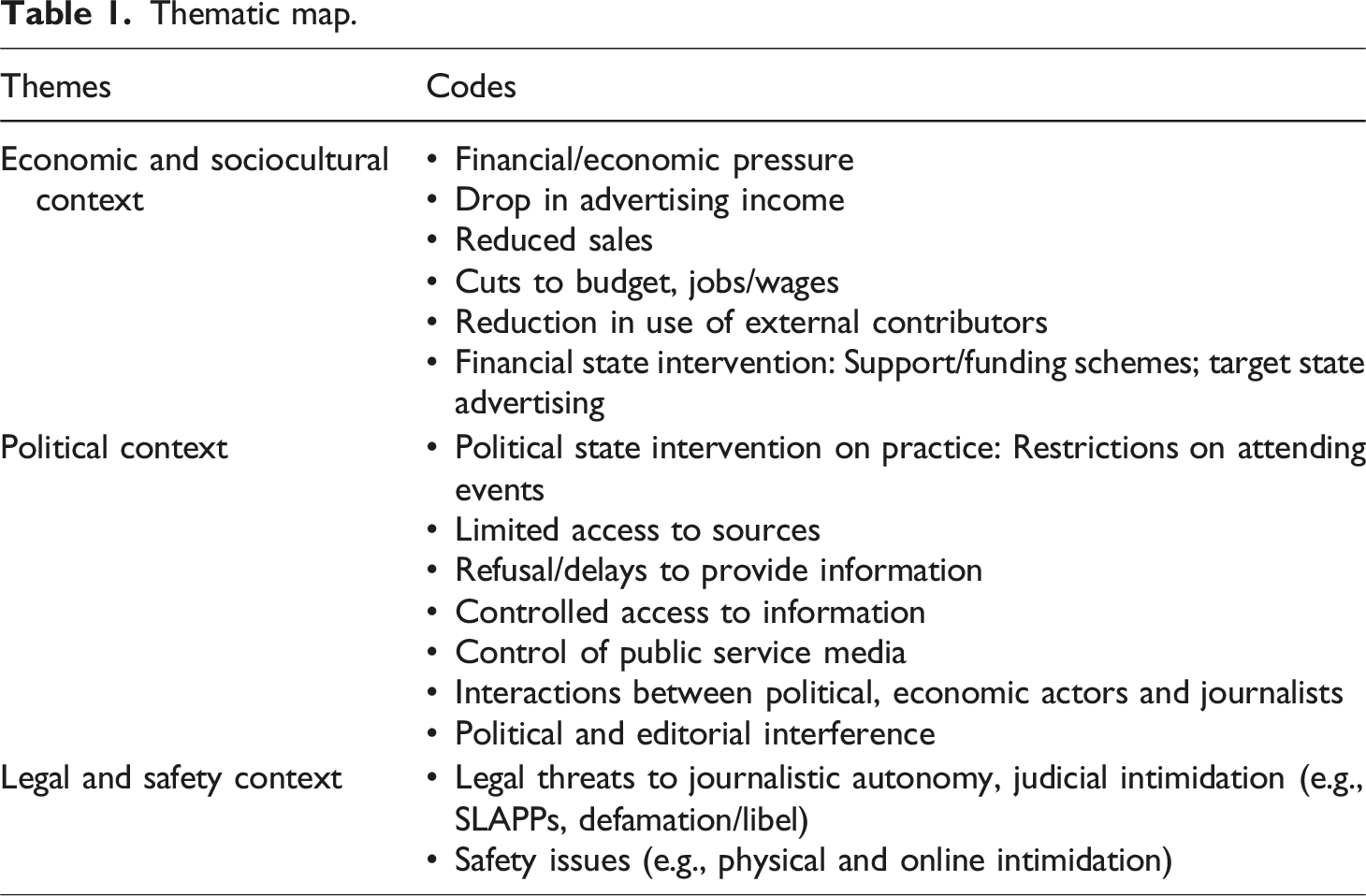
While qualitative research with small samples may not be generalizable, it still offers in-depth theoretical insights (Corbin and Strauss, 2008). Purposive sampling was used to recruit the sample of eight journalists from each country resulting in a diverse sample of 13 reporters, 14 editors/sub editors, and 5 presenters/producers from some of the main national, independent and public service media outlets in each country, including newspapers/online media outlets and broadcasters who could share detailed, first-hand experiences of the crisis and its continued manifestations. Saturation is an important consideration in qualitative research with small samples and is put forward as a mark of rigor (Morse et al., 2002). Various types of saturation have been proposed for qualitative research methodologies (Saunders et al., 2017). In this research, given the deductive approach to data collection and analysis, wherein empirical evidence is sought in order to support existing explanation, a model of saturation termed ‘a priori thematic saturation’ was adopted. The deductive approach used pre-established themes to code the data and saturation here refers to the degree to which these are sufficiently represented through excerpts from the interviews (Saunders et al., 2017). The data collected from the 32 participants is deemed sufficient to allow for eliciting the required evidence to support the pre-determined theoretical constructs. The participants were guaranteed voluntary participation and withdrawal from the project at any stage. Data is fully anonymized throughout the article to protect the identities of all interviewees due to the sensitivity of the topics; and the participants are identified as follows: Bulgaria BG1 to BG8; Cyprus CY1 to CY8; Greece GR1 to GR8 Malta MT1 to MT8. 1
Findings and discussion
Economic and sociocultural context
Research on the impact of the pandemic on media and journalism has already demonstrated that many media outlets in Europe and across the world have struggled to survive financially from the start of coronavirus restrictions (e.g., Finneman and Thomas, 2022). This was a major concern for our interviewees from privately owned media in all four countries. The first months of lockdown were particularly challenging across the board due to the drastic drop of print sales caused by lockdown restrictions and plummeting advertising revenues. In Bulgaria, privately owned media lost a significant chunk of their income from print sales and advertising which the interviewees described as a “brutal blow” to operations while the state did “absolutely nothing to support the media” (BG1). What was an already established practice, namely non-transparent state financial mechanisms aimed at buying loyalty and “supporting” friendly media outlets, has continued throughout the height of the pandemic and beyond, according to interviewees. As noted earlier, in Greece, the government took swift measures to support the news industry, especially after the effects of austerity on the media industry after the economic crisis (Papathanassopoulos et al., 2021; Kostopoulos, 2020). However, as one Greek journalist explained: “although on a theoretical level this was considered a positive initiative, this decision soon turned into a scandal. The government funded many media that didn’t even exist whereas it completely excluded other outlets with the alleged excuse that they were spreading fake news about the coronavirus” (GR3).
The funds were distributed in a highly partisan way and were not aiming to help the media recover from the pandemic but to favor specific pro-government outlets to keep on supporting the government’s strategy to tackle the virus. In Bulgaria and Greece, previous iterature has long pointed to a symbiotic relationship between media and the state with political, and economic favors exchanged for favorable coverage (Dobek-Ostrowska, 2015; Papadopoulou, 2019; Trifonova Price, 2019). Even though such “entanglement” has been in place for long, it was the 2009-2010 economic crisis that really brought to light the interdependency of the media with political elites, fueling distrust, and even hostility, towards mainstream journalism, as it was heavily criticized for serving solely the role of government-sponsored propaganda (Papadopoulou, 2020; Selva, 2020). In Cyprus, although print media faced significant difficulties due to drop in print sales, there was no specific government plan to support the press and all media entities joined the national economic support plan for reinforcing the industry during 2020 (the plan covered part of the employees’ salaries in the broader private sector). In Malta, in May 2022 the government committed itself to providing assistance to the press, announcing a €500,000 fund to support print journalism. However, similarly to Bulgaria and Greece, the support for print media was criticized by media houses, citing lack of transparency and even being described as drinking from “a poisoned chalice” (Welch, 2020). As one interviewee notes “when you look at the grants, most of it is going to the political party media.” (MT1)
Political parallelism, characteristic of the Maltese media landscape, needs to be considered in view of Malta’s small size, the consequent particularities of close social relations on the island as well as the two-party political scenario that has characterized the island for decades.
Interviewees from Greece and Bulgaria noted that although the pandemic had an important economic impact on the country’s media industry it did not lead to any major wage cuts or dismissals. The situation was different in Malta and Cyprus where interviewees reported some cuts in wages as explained by these interviewees: “We instituted a 20% pay-cut across the board and the higher-paid got a bigger pay cut. So, in our case it was progressive and we got rid of certain print extras.” (MT7). “Because then we had to take a cut in our salaries, I took a 10-20% cut in my salary last year for doing the same job with more stress. Everyone else’s overtime was slashed. There were no weekend or Sunday rates.” (MT2) “The most stressful was the need to cut off personnel. There was a period of great uncertainty, and we suffer until today from salary cuts. At the same time, the workload has significantly increased.” (CY1)
The interviewees from the Bulgarian public service broadcasters, Bulgarian National Radio and Bulgarian National TV, did not report a drop in income as both are financed by the state budget, while those who work for the media outlets owned by foreign companies continued to fund their operations as normal without cutting staff or reducing pay. In Greece, for those journalists working in public media, and thus funded by the government, the pandemic did not pose any serious economic challenges. The dominant view is of tightening of media budgets which particularly affected freelance contributors who were regularly used before the pandemic in private media in all four countries. All interviewees reported “no funds to pay contributors” (BG3) and letting go of people “whose livelihood did not depend exclusively on journalism” (MT7). In Malta some media organizations tried to cope with this challenge by stepping up their advertising sales in order to safeguard wages and keep paying staff as well as external contributors.
Two years after the first lockdown, some participants expressed cautious optimism and hope for stability: “At the moment we have no financial problems, we don't get money from anyone and we don't need it, the money that comes from normal advertisers, it's enough” (BG8). Still, despite some return of advertising revenue, the economic uncertainty brought on by the pandemic has impacted media operations in all four countries. The economic and sociocultural challenges were exacerbated further by the political context.
Political context
Prior to the pandemic, the media and journalists in all four countries experienced several restrictions to press freedom (e.g., Trifonova Price, 2022; Papadopoulou and Maniou, 2021). The comparative analysis of the interviews with journalists from the four countries confirms that the pandemic was used by their governments as a pretext to further curb press freedom and restrict vital access to sources and information. While none of the participants stated explicit and straightforward interference by government or media owners, such as directly censoring or banning content, respondents described various mechanisms utilized to limit the scope of reporting and make access to important information and data extremely difficult. The pattern that emerged indicates that only select media were allowed to attend official briefings at the height of the crisis, or given limited access to these, which hampered their ability to ask questions and hold power to account: “So journalists couldn't ask questions because most of the official press conferences either didn’t accept journalists or a limited number of journalists from friendly media were invited. We asked many times, can we come to a press conference, but it turns out that they invited 3-4 journalists to ask convenient questions.” (BG8) “We are participating in media events and we are not ‘allowed’ to ask questions […] Then why did they invite journalists? […] In several cases, they announced that only the public television channel would be allowed to participate in person. But the public television channel is by definition ‘close’ to the government… For me the pandemic was the perfect opportunity to hide ‘difficult/annoying’ issues behind excuses for safety protocols.” (CY5). “The main problem is our inability to ask questions directly to government officials, ministers, etc., as it was traditionally done in press interviews.” (GR6) “In terms of getting information from the Maltese government, they used the pandemic as an excuse for everything. ‘Things are difficult ‘because of the pandemic’, ‘we’re short-staffed because of the pandemic’, ‘we took long to reply because of the pandemic’. I mean even the constitutional reform was delayed because of the pandemic.” (MT8)
During a crisis journalists require access to reliable sources and data to provide timely and accurate reporting to the public. However, all interviewees reported significant difficulties in accessing sources and information needed to cover not only the pandemic but also other important topics in the public interest. The Greek government essentially imposed a “quarantine” on information, forbidding official sources to speak to the press. The tendency among most of the country’s news outlets was to frame the government’s efforts to tackle the pandemic positively. A Greek journalist working at a pro government news outlet explained how he knew what to write without having accepted any specific directions from his editors: “The outlet I work for, contributed to the reproduction of this narrative. For me it feels like I know that I am working at Adidas, and I must sell Adidas shoes... No one had to pressure me to reproduce this narrative, but it was somehow made clear to us that this is the line we follow. Essentially, I kept on doing what I was doing before the health crisis, namely praise the government.” (GR8)
In Bulgaria, the dominant view was that “the pandemic unfolded unchecked and many rules, laws, procedures, scams and deals were passed without media and public scrutiny” (BG8). An interviewee from Malta described the health crisis as “a gift from God to the government” (MT8) which came at a crucial time when government popularity was faltering following the investigation into the murder of the investigative reporter Daphne Caruana Galizia. For all Maltese interviewees the most salient and pressing problem reported was in connection with freedom of information (FOI) requests. The respondents spoke about the misuse of FOI procedures in an attempt to delay or prevent access to information, which was described as “abysmal” (MT3), with journalists getting bounced from department to department if the authorities do not like the request and get “delayed to a point where the information becomes irrelevant” (MT2). In all four countries despite the existence of legal provisions to public information, the interviews demonstrate a pattern where state authorities often arbitrarily fail to give information that is in the public interest and a widespread culture that protects those in power.
Interview data shows that political restrictions during the pandemic were not unique but a manifestation of an already well-established model of governance which allows for laws and press freedom to be routinely violated with impunity. In this model the authorities ignore the media when they ask legitimate questions or require a response to an important issue, and official institutions are unwilling to provide journalists with information. This tried-and-tested approach has worked very well during COVID-19 and beyond, and shows the high degree of indirect state intervention in the media sector. For example, in Bulgaria the Prime Minister at the time, Boyko Borisov, was seen to set the tone for the rest of the government by only engaging with the media when they could be used to serve the government’s political agenda. A participant from the national radio explained that the administration’s attitude towards journalists was simply to refuse to be interviewed making reporting very difficult due to their balance and impartiality legal requirements as a PSB: “When you call the press center, they tell you ‘we will send someone’ and then they don’t” (BG6). This approach to the press was noted by several Bulgarian interviewees as a systemic issue where communication from the government is a one-way street.
In relation to professional journalism practice during the crisis, what has emerged from the data is a new mechanism of avoidance. This concerns politicians bypassing traditional media and journalists altogether to avoid questions, and engaging directly with the public on social media platforms. This indicates a new stage in the relationships between journalists and politicians in Bulgaria, for example, where many journalists have in the past enjoyed privileged access to politicians (e.g., Pfetsch and Voltmer, 2012). However, the unidirectional “monologue” “livestreaming” approach is damaging journalists’ ability to scrutinize and challenge policies and decisions. Several interviewees noted it was problematic as illustrated by this view: “In general, this type of political communication has increased - instead of an event, instead of press conferences, instead of journalists being able to ask questions, it went in one direction and it stayed that way because it is convenient for the politicians.” (BG7).
In Malta, journalists described the same practices from the government at the height of the pandemic: “they would stream the conference on Facebook and then when it is time for journalists’ questions, they cut the transmission. This is an issue.” (MT5). Adding to the country-specific political challenges journalists faced, were legal issues.
Legal and safety challenges
In Greece, most interviewees emphasize their constant fear of receiving a SLAPP lawsuit due to their reporting. One journalist explained, “there is always the fear of a lawsuit and you know that if this happens, you are all alone. SLAPPs are all around us now and this makes you think twice before getting into trouble” (GR1). Another journalist working for an independent media argued that it is common practice for politicians to file SLAPPs and create a whole “industry” of lawsuits against journalists: “I’ve written many stories regarding high-profile political scandals. The response of these politicians is always the same: discrediting the story, not responding to the allegations, and then threatening of, or filing lawsuits” (GR3). According to respondents from Greece, this pattern existed even before the pandemic, but it now constitutes one of the biggest obstacles they face in their daily work. In Bulgaria, the use of libel and defamation to silence journalists is also well established: “I've had several cases over the years, I've won them all. But it is a fact that there is abuse of the law and it is a form of pressure and a type of censorship. Unfortunately, this loophole is being used as a weapon against the media in Bulgaria.” (BG1)
An illustration is the decision of the Sofia District Court in December 2021, which sentenced a journalist to pay 60,000 BGN (approx. €30,000) in non-pecuniary damages (Spassov et al., 2022). SLAPPs have become a common tactic, consisting of prolonged and expensive court proceedings that can put further pressure on reporters. In Cyprus, the views of interviewees indicate that many journalists tried to be very cautious in their coverage of the pandemic: “Some accused us of covering pandemic related news in subjective ways. We did not. We were really objective and this is why we were not faced with any legal threats” (CY4). The fear associated with libel suits was also very prevalent among the interviewees in Malta. One journalist who had experienced a libel case initiated against him by a prominent politician stressed that the main aim of cases is to silence journalists, a strong “chilling effect” brought about by the ease in which defamation legislation is used: “If they say you are a liar then you are a liar. X sued me for a story that was completely factual and I, not wanting to stay in court for three, four years, because the justice system is abysmal in Malta, very foolishly settled. […] It just happens too often.” (MT3)
Our findings are not dissimilar to previous research which shows that 23% of respondents from Council of Europe member states and Belarus experienced judicial intimidation, mostly citing defamation laws (Clark and Grech, 2017). Other laws may be misused with the same effect. In Malta the use of defamation to silence journalists has not ceased since the decriminalization of defamation in 2018 and according to participants defamation cases eat up their precious time and energy as well as financial resources contributing significantly to a hostile environment for freedom of expression.
In Greece, Bulgaria and Cyprus the lockdown restrictions that essentially kept most citizens inside for a prolonged period seemed to have lowered the number of physical attacks against journalists, as the participants did not report any significant concern regarding their personal safety. In Malta, the issue of physical safety must be examined in the context of the 2017 assassination of Daphne Caruana Galizia which has left a devastating impact on the country as a whole, and the journalistic community in particular. The murder of the anti-corruption journalist with impunity has resulted a significant chilling effect as these two journalists highlight: “Daphne was not killed because she was a witch or because people did not like her or because she was an elitist. She was killed for what she was about to reveal. She was killed because she was a journalist. So, we cannot accept that journalists entering the profession think “oh my god what can happen to me.” (MT1) “...after Daphne was killed I was checking under my car nearly every day so from that respect but Daphne’s murder has nothing to do with COVID. The climate was there already...” (MT5)
Recent studies present substantial evidence of cyberbullying and online abuse becoming a common threat experienced by journalists in Europe and globally (e.g., Clark and Grech, 2017; Posetti et al., 2021). Our findings also indicate that threats to the safety of journalists have moved to the digital realm as the majority of our interviewees reported receiving insulting or abusive messages on social media. These views illustrate the pattern well: “Reading the comments on social media is always a very sad and painful activity. The quality of public discourse is appalling. Far-right and racist speech is extremely common. There are dozens of abusive messages against the journalist who wrote a story or the media that published it.” (GR3) “I also had a dedicated set of twitter trolls way before COVID and they remained dedicated throughout COVID. You just ignore them and get on with your writing.” (MT4) “I get comments from strangers sometimes after a broadcast or a story. Some of them are troll accounts but others are profiles of real people, so I have to decide if I will reply or block them. But they are mostly unpleasant comments rather than threats.” (BG4). “I was out with my family and there were citizens taking pictures of me, which were posted on social media just to say that we do not follow health protocols. This was a constant fear for me, what they would say on social media.” (CY4)
Other journalists described the kind of pressure that social media generated on daily practice that is common for our participants: “Social media pressure is becoming more and more unbearable. You are targeted by strangers every day. There is this widespread feeling that the slightest mistake you make will trigger a digital lynching. It happened to a colleague of mine recently and I experienced it first-hand. Unfortunately for many of us, self-censorship is a one-way street” (GR7).
All interviewees are aware of digital safety challenges and concerns that come hand in hand with social media presence. Online abuse is particularly problematic in relation to topics perceived as controversial where societies are polarized, such as COVID vaccinations and more recently the war in Ukraine. Investigative journalists in particular note that they either ignore completely or their media is disabling comments under articles on social media as soon as they publish them because that tends to solve the problem with abuse. Yet, this is a double edge sword – disabling comments leads to decrease in traffic to pages, which in turn affects revenue from advertising and restricts freedom of expression.
Conclusion
The aim of this study was to address a gap in comparative research and investigate press freedom developments during and post COVID-19 in four understudied Southern European countries. Although media freedom and journalistic work faced significant challenges prior to the pandemic, as demonstrated by previous research (e.g., Clark and Grech, 2017; Trifonova Price, 2018, 2019, 2022; Maniou, 2023; MPM, 2017), the findings presented here reveal several new trends that emerged during the pandemic, such as politicians avoiding journalists and communicating directly with the public via social media or live-streaming. Furthermore, it showed the exacerbation of older threats and challenges such as the increase in lawsuits against journalists under defamation legislation and the higher levels of online harassment. Most importantly, it documented the normalization of these threats that add additional burdens on individuals and media organizations and restrict their right to exercise their profession without fear or intimidation.
In relation to our first research question, the interviews clearly show how freedom of expression has been routinely violated during the pandemic and beyond with further curbs on access to information. The authorities employed all means necessary to avoid scrutiny thus preventing journalists from investigating not only their handling of the virus but also other important issues of public interest. While not fully authoritarian, such practices cannot be considered democratic (Perusko, 2021). It is no surprise that many journalists described the unprecedented crisis as “convenient” and as a veritable “gift from god for the government”. Further, journalists faced increased difficulties in accessing important sources in their daily work while at the same time politicians avoided questioning about important matters “on health and safety grounds”, opting instead for one-way communication with the public via social media and live-streaming.
While the interviews suggest less physical violence and attacks against journalists during the pandemic, we find increased anxiety and concern among media workers about lawsuits under defamation legislation. Judicial intimidation and the threat of SLAPP have become a major, and well justified, concern among participants in all four countries in the past 3 years. For example, in Bulgaria the independent online outlet Mediapool was hit with a SLAPP lawsuit of one million lev (approx. €511,000) for quoting a statement from the finance minister from an official verbatim report (AJE, 2023). We find an increase in online abuse as the pandemic unfolded and journalists in all four countries being subjected to high levels of hate speech and verbal attacks from Internet trolls, particularly anti-vaxxers, with the digital public sphere becoming a battlefield against trolls.
To answer our second research question, in line with previous studies that have noted significant economic and financial burdens on media organizations (e.g., Finneman and Thomas, 2022), we have found some differences between the four countries in terms of the impact of COVID-19 on newsroom layoffs and salaries. The crisis has magnified some of the pre-pandemic threats to operation and practice that journalists and media in these four countries were facing. Given the small size of media markets in these countries, the pandemic financial pressures inevitably translated into worsening working conditions for many journalists. While these conditions characterized the journalistic profession prior to the pandemic (Clark and Horsley, 2020), the crisis has exacerbated them even further, including some pay cuts for reporters and particularly for freelancers. Media that were not subsidized directly by the state budget, supported by official pandemic schemes or part of global media outlets, bore the brunt of economic difficulties. It is important to emphasize that a crisis of such proportions, described as a “generation defining”, is making it even more difficult for critical and independent media to survive and for markets to grow. In countries with a very limited number of independent media outlets, this is indeed a very worrying trend. While government subsidies may have provided a temporary buffer against economic turbulence, they also tended to be disbursed to “friendly” media that do not challenge or criticize the official narrative. Concerns that bailouts were not transparent, and that independent media may be held for ransom prevailed. As other studies have shown, state intervention comes in various forms (Bruggemann et al., 2014) and we find that the pandemic added another layer of control.
The kind of threats analyzed in this article are aimed at curbing journalistic freedom and restricting the media’s ability to hold power to account. Press freedom and media pluralism are considered essential for thriving democracy and preconditions for a public sphere dialogue, based on the free exchange of information and opinions. Moreover, they are enshrined in the Charter of Fundamental Rights of the European Union (Art 11), and they are also protected by Art.10 of the European Convention on Human Rights (MPM, 2022). Ultimately, 2 years after the onset of the pandemic, journalists in all four countries seemed resigned to a new normality in which press freedom is constantly violated and practicing journalism has become even more difficult. Although the study took place in the context of a high-profile crisis, our findings indicate that state intervention as a result of COVID-19 in any of its forms discussed here and new threats to press freedom impact media outlets and journalism not only in time of crisis but also in ordinary situations in the post-pandemic environment. The study’s implications are relevant to different contexts, particularly in countries where journalism and media face similar challenges. The findings can help policymakers, media organizations, and journalists to understand the threats facing media systems during a crisis and to take urgent measures to address them. While this study has a limited sample, it provides an extended analysis of the constantly evolving and emerging threats to press freedom. Further comparative research is needed on the responses of journalists and media to the challenges we identified here and the impact on journalists’ daily practice, especially female reporters, including wellbeing and mental health as well as resilience in the face of these challenges.
Footnotes
Acknowledgements
We would like to express our sincere appreciation to the anonymous reviewers for their invaluable feedback which helped us strengthen this paper.
Declaration of conflicting interests
The author(s) declared no potential conflicts of interest with respect to the research, authorship, and/or publication of this article.
Funding
The author(s) disclosed receipt of the following financial support for the research, authorship, and/or publication of this article: This work was supported by the Sheffield Hallam University (Internal funding travel grant).