



Abstract
Reporting on cases of genocide presents distinct complexities and challenges for journalists, who must negotiate practical, professional, and emotional experiences that challenge traditional expectations of their role. Previous research has provided strident critiques of this reporting, arguing Western reporting of genocide in Rwanda and Srebrenica was reductionist and biased and contributed to the lack of Western intervention. Drawing on 22 interviews with print journalists who reported on genocides in Rwanda and Srebrenica, this article challenges this dominant critique by foregrounding the voices of journalists and their experience of reporting. Themes of inaccessibility, the moral imperative to report on these events, and the intersection with emotional labour on emotional effects of this reporting crucially demonstrates and acknowledges the challenges of conflict reporting. This adds to contemporary debates around how emotion, attachment and morality intertwine in journalism practice and the importance of this consideration when assessing the impact of reporting.
Introduction
Western news organisations have been accused of mischaracterising events during the 1994 genocide against the Tutsi in Rwanda, and the 1995 genocide of Bosnian Muslim men and boys in Srebrenica. News reporting from this time has been criticised as reductionist, clichéd, and biased in its approach (Carpenter, 2009; Meyers et al., 1996; Schimmel 2011). Journalists have also been criticised for their failure to depict events in a way that would mobilise the public and influence intervention (Bouris, 2007; Schimmel, 2011; Thompson, 2007; Vujnovic, 2009). This critique of Western reporting is retrospectively based on the lack of intervention to stop these cases of genocide and that the narratives of reporting helped foster non-interventionist approaches.
The core argument of this manuscript is that this dominant academic critique of the reporting of genocide presents a partial and unbalanced understanding of reporting and media representation. It generalises Western reporting of these genocides and removes this reporting from the context of the journalists’ experiences of reporting, and in doing so overlooks the practical, professional and emotional challenges intertwined in this. More widely, this manuscript engages with debates around the role of journalists in society and engages with the argument of Hanitzch and Vos (2017) that the role of the journalist can be renegotiated, reimagined, and reinterpreted through the way that they position and perform this role.
This manuscript incorporates life history interviews with 22 print journalists to conceptualise the experience of reporting during the aforementioned cases of genocide. Journalists explained that they tried to connect the audience to the situation to increase interest in their news stories. This challenged simplistic notions of objectivity and emotional detachment which have traditionally been associated with journalism practice and revealed how their professional practice had to be adapted to accommodate the unique ethical and moral parameters they manoeuvred. This research aligns with Wahl-Jorgensen (2019)'s call to historically explore and reflect upon the lives of journalists and interrogates previous criticism that takes Western reporting of these genocides out of the context of journalists’ experiences.
Criticism of Western reporting
This article takes as its focus two cases of genocide that occurred during the 1990s: the 1994 genocide against the Tutsi in Rwanda, and the 1995 genocide of Bosnian Muslim men and boys in Srebrenica. This manuscript utilises the term ‘genocide’ as it has been attributed to these cases by the International Criminal Tribunal for Rwanda and the International Criminal Tribunal for the Former Yugoslavia. On 6 April 1994 the plane carrying the Presidents of Rwanda and Burundi was shot down. Immediately following these deaths, the Tutsi population in Rwanda were targeted by extremist Hutu militias and systematically executed during the period of April-July 1994. More than one million people, mainly Tutsi, are estimated to have been killed (Melvern, 2009). In Europe at this time the Bosnian War was ongoing and in 1993, the town of Srebrenica in Bosnia-Herzegovina had been declared a ‘safe area’ under UN protection. However, in July 1995 the Bosnian Serb army attacked Srebrenica and the enclave fell to these forces. Following this, approximately 7000–8000 Bosnian Muslim men and boys were systematically murdered in mass executions by the Bosnian Serb army (Rohde, 2012).
The lack of Western intervention in these cases of genocide has meant that criticism has been directed towards the Western media and its representation of events. In the case of Rwanda, reporting has been criticised for perpetuating Western colonial stereotypes of Africa through clichéd phrases (Meyers et al., 1996; Schimmel 2011) and repeated references to ‘piles of corpses’ (Harting, 2008; Moeller, 1999) that dehumanised victims. This echoes concern for the effect of ‘negative interpretations’ of Africa (Mbembe, 2001: 1) by the Western media and the ‘spectacle’ of African suffering (Sontag, 2003). Although this article focuses on narratives in print journalism, not photographs, an interrogation of the Western media’s depiction and consumption of the imagery of non-white bodies is important to consider in all forms. Campbell (2014) argues, however, that one must acknowledge the wider system that news is received in and the complex interplay between media imagery, discourse and knowledge production of which the role and performance of these journalists exists.
Reporting in UK newspaper articles from this time contained graphic narratives such as the descriptions of the bodies of children: At the Nyaribuye Catholic mission in the far east of Rwanda last week we saw the heads of decapitated children lying close to their bodies. The face of a child with half its head torn off is frozen in a terrified scream. An open cloister linking classrooms has so many body parts, attached, dismembered, entangled in a pile of rotting human remains, that it is impossible to estimate how many are there (Huband, 1994: 16).
Reports also emphasised the smell that emanated from these scenes: ‘As you approach every village along the way… it hits you, a faint sweet sour smell of rotting meat. The bodies are sometimes by the side of the road, still lying where they were gunned or hacked down nearly a week ago’ (Dowden, 1994: 13). Criticism of graphic reporting tends to argue that it was not focused enough on the act of killing in Rwanda in the early days of the genocide and that simultaneously there was not enough of it to mobilise audience pressure towards intervention at the start (Schimmel, 2011; Thompson, 2007). However, Maier et al. (2016) point out the challenge of understanding audience engagement and response. In their study of audience responses to reports of mass violence in Africa, they found a US panel was left conflicted after reading personal stories of suffering: readers were simultaneously galvanised but overwhelmed. Interrogating Patterson, (1982) concept of ‘social death’ Martel (2018) argues that media depictions of unburied black bodies, such as George Floyd, may become a symbol and voice for others. Albeit from a North American context, this demonstrates the challenge with depictions of death where there may not be a consensus, either in interpretation or public response.
Depictions of the genocide in Srebrenica have similarly been criticised as reductionist and specifically Orientalist in their use of clichéd phrases such as ‘ancient ethnic hatreds’ which emphasised Eastern countries as primitive in comparison to the West (Carpenter, 2009; Meyers et al., 1996). Vujnovic (2009: 42) argues that journalists relied on ‘objective journalism and professional routines’ and in doing so did not frame events in a way that would mobilise the public and influence intervention. Whilst this research focuses on US newspapers (The New York Times and The Washington Post) it is relevant in its indictment of journalists and what it considers these ‘shortcomings in journalistic performance’ (42). Bouris (2007: 100) argues that at the start of the Bosnian War the conflict was represented as a civil war and ‘only to a much lesser degree an example of genocide.’ She contends that this moral equivalence meant that the international community did not regard Bosnian Muslims as victims because they were seen as bearing some responsibility in the conflict which impeded political action and intervention. However, it is notable that UK newspaper articles emphasised the Bosnian Muslims in Srebrenica as victims due to the repeated failure of the UN to protect them using the disparaging reference to Srebrenica as a ‘safe area’: ‘The UN safe area policy was born and died in Srebrenica… Empty streets mock the whole concept of the United Nations “safe areas’” (Eagar, 1995: 15). Incorporating these instances of reporting alongside the criticism of Western reporting of Rwanda and Srebrenica creates a space to further explore the tensions and challenges of journalists as they reported from these situations.
Re-examining this critique alongside journalists’ experiences
To contextualise the challenges of reporting it is important to first consider ‘objectivity’ as part of core professional practice in journalism. Traditionally journalists have been expected to apply certain practices, such as including ‘both sides’ and maintaining distance from events they report on (Aldridge and Evetts, 2003; Santos, 2009). This objective stance lends credence to journalists’ accounts by portraying them as emotionally detached and therefore unbiased in their approach. However, recent journalism research has challenged the traditional notion that emotion acts as the antithesis to objectivity and reporting. In a review of studies on the relationship between journalism and emotion, Kotisova (2019) demonstrates a growing body of work emphasising the crucial dialogue between how journalists themselves engage with emotion, and how emotion becomes part of media content. In terms of the latter, the social aspect of emotion means that emotions become utilised in news narratives to provide the audience with a collective attachment to events (Grabe and Zhou, 2003; Peters, 2011). Likewise, Wahl-Jorgensen (2013) argues emotion becomes cultural capital for journalists where Pulitzer Prizes are won for emotional storytelling.
Discussions of objectivity and emotion underpin the debate on the journalistic ‘role’. Previous literature has conceptualised this role through varying concepts and measurements, for instance that journalists may take a neutral stance versus a more active, even advocate stance (Donsbach and Patterson, 2004). However, Hanitzch and Vos (2017: 116) have argued that this can be reconceptualised through the ‘shared discourse’ which surrounds the journalistic role and its performance. They see it as a dynamic practice constructed through the meaning that both journalists and others give their work. After reporting on the Bosnian War, BBC correspondent Martin Bell (1997: 8) renegotiated this role through his concept of a ‘journalism of attachment’: journalism that ‘cares as well as knows.’ He argued that traditional ‘bystander journalism’ focused on military and technical information and remained too detached from the human aspect of reporting. Instead, Bell (1997) claimed that the interaction between journalists and those whose stories they tell is a dynamic process which should not be constrained by aspirations of objectivity, but instead encouraged by a moral and ethical imperative. Tait (2011) similarly creates a distinction between ‘eye-witness’ reporting which is detached and follows traditional lines of objectivity, versus ‘bearing witness’ which presumes action and response from an audience.
However, that journalists have a moral obligation to reject impartiality and instead pick a side has long been contested within journalism and especially in reporting war and conflict (see McLaughlin, 2016). This belief questions the truth-telling which journalism predicates itself on and which it traditionally derives authority from. Von Oppen (2009) argues that encouraging journalism to be a moral enterprise expects journalists to navigate ambiguous and challenging situations by taking a moral position: simultaneously they are questioning the professional authority of their industry, whilst themselves staking claims to what they promote as ‘right.’ Von Oppen (2009) maintains this also disregards the positionality of journalists as ‘outsiders’ within reporting situations they are staking moral claim to.
The human element of reporting has also led to discussions about how journalists engage in ‘emotional labour’ to manage their emotions in their professional life. Originally theorised as emotion management in customer service workplace settings by Hochschild (1983), emotional labour has been theorised across numerous professions, and more recently journalism practice has been acknowledged as part of this. It can be argued that journalists experience tension as they move through ‘emotional zones’ (Bolton, 2005: 64) as part of their work when reporting on conflict, which can extend into their personal life. This can lead to managing, or even suppressing, emotions as part of their job (see Huxford and Hopper, 2020). Journalism practice can become contradictory, with emotions becoming ‘silenced’ whilst at the same time becoming necessary to build an attachment during extreme situations such as genocide (Knight, 2020). This can sometimes lead to experiences of moral injury, described by Feinstein et al. (2018) as an injury to an individual’s conscience after witnessing or being unable to prevent an act that goes against one’s values.
The tension these situations produce makes it challenging to consider journalistic ideals of objectivity, impartiality and balance. Since moral parameters cannot always be so easily defined, Cohen (2010) maintains this means employing ‘pragmatic objectivity’, where emotion is utilised as part of a professional judgement towards a story. Emotional labour is not only the maintenance of one’s own emotions, but also being able to produce or affect an emotional state in others, such as the audience (Steinberg and Figart 1999). Journalists ‘outsource’ emotional labour to those they are reporting about because journalists are unable to include their own emotions (Wahl-Jorgensen 2013). Finding a way to conceptualise a more cooperative relationship between emotionality and professionalism, both through the journalist and through the audience, aligns with this recent emotional turn in journalism (see Beckett and Deuze, 2016; Wahl-Jorgensen, 2020).
The recent affective shift across journalism alongside the advent of new media technologies shows how traditional journalist practices are increasingly interrogated in reference to the role of emotion (see Beckett and Deuze, 2016; Wahl-Jorgensen, 2020). With journalists providing live updates on social media whilst reporting on situations like the War in Ukraine, the audience is connecting with journalists through their personal and professional experiences. The tension between traditional objectivity and impartiality versus this modern conceptualisation of emotion concurrent with professionalism necessitates re-consideration of the previous critique of reporting in Rwanda and Srebrenica through an exploration of the journalists’ experiences. Given the difficulty with assigning impartiality to a crime which is so rooted in inequality, reporting on genocide provides an important situational perspective from which to interrogate further this debate.
Method
Participant characteristics.
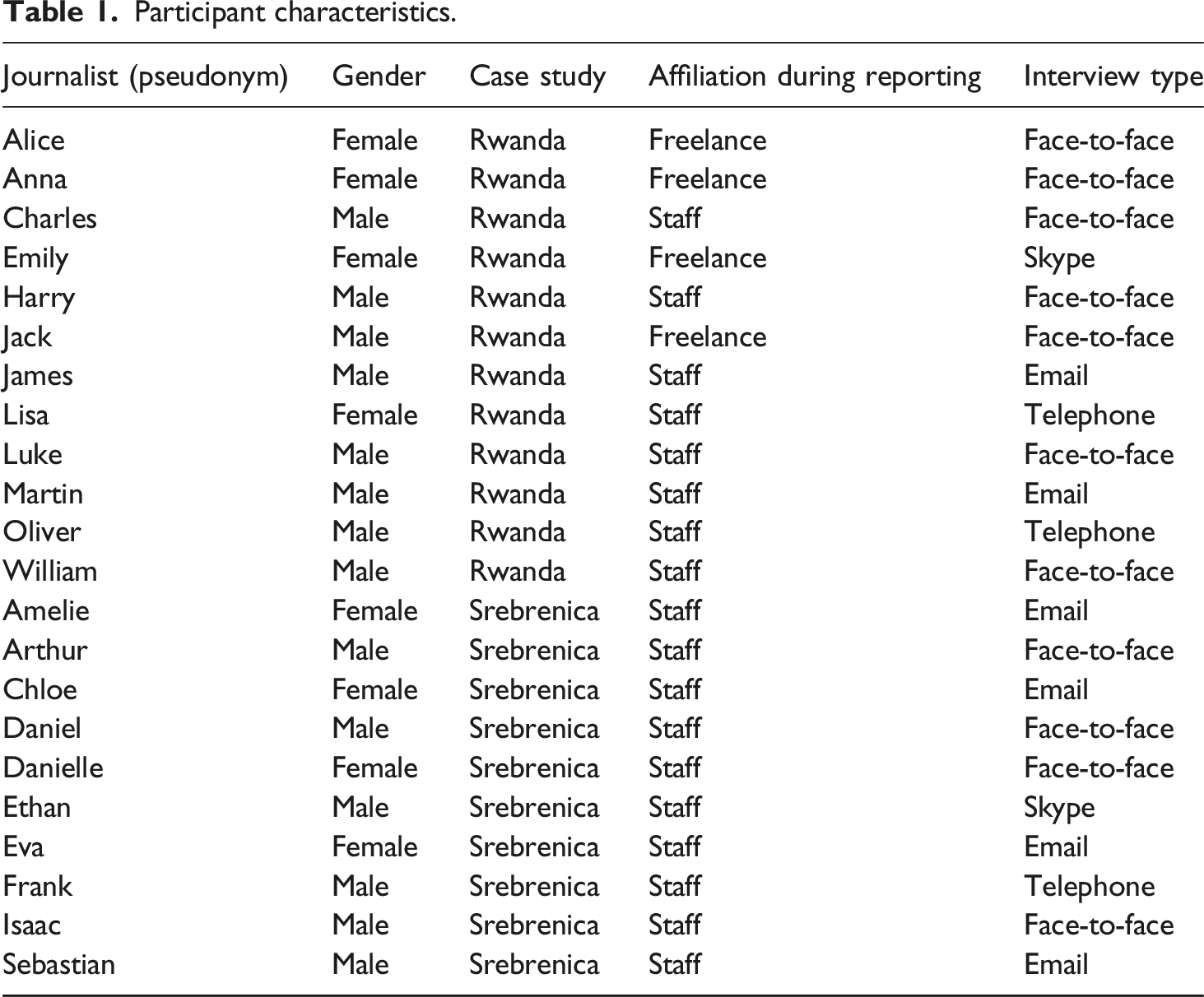
Life history interviews were qualitative and semi-structured in nature and were conducted between May 2014 and March 2015. The majority of these interviews were conducted face-to-face but some participants completed interviews via Skype, telephone or email.
Each interview utilised the same interview schedule and questions related to assignment to the genocide; reporting during the genocide; and the writing and editing processes that followed. Interview questions were chronological so that journalists spoke about their experiences prior to the genocide, reporting during the genocide, and after the genocide. Journalists were asked about their emotional conceptualisation of events, how they dealt with these events, and their interactions with victims and perpetrators. This provided cues for the journalists to elaborate on their experiences as much as they felt comfortable.
Interviews were recorded and transcribed verbatim before being selectively coded. Codes were first derived in tandem with an analysis of the literature and newspaper reporting from that time. Codes were revised using the constant comparative approach in accordance with interview data (Corbin and Strauss, 2007).
Results
It was evident that a collection of intersecting practical, professional and emotional experiences journalists had when reporting on Rwanda and Srebrenica influenced this reporting. The following three themes identify key challenges these individuals manoeuvred whilst reporting. This demonstrates the importance of acknowledging context when analysing reporting and promotes the consideration of implementing ‘pragmatic objectivity’ (Cohen, 2010) in this type of reporting.
(In)accessibility
A key theme which emerged from interviews was the (in)accessibility of each genocide. First, accessibility was a practical challenge for journalists to physically reach the story. In Rwanda, because Western news organisations were not invested in personnel in Africa in the 1990s so few journalists were there when the genocide began. As James reasoned, these were ‘forgotten conflicts’ so physical access was limited and very dangerous once violence broke out. Oliver explained that to gain access, ‘journalists had to had to do so pretty bravely, whether you went in with the RPF or even more dangerously.’ Emily, for instance, ‘snuck onto a flight’ to Kigali and then joined a convoy evacuating foreign nationals. For Anna, who was one of the few that was in Rwanda at the time, access was hindered by the ‘soldier outside my house telling me to get back in. And there was a roadblock at the end of the road… but I had to drive through, so I drove through checkpoints with bodies everywhere and men with machetes.’ On the other hand, UK involvement during the Bosnian War and its European location meant more accessibility and journalistic presence in the region. However, journalists were barred access to Srebrenica once it fell to the Bosnian Serb army in July 1995 which created gaps in knowledge, as Sebastian recalled: ‘What was complex and challenging was the inability to quickly piece together the puzzle of what had really happened in Srebrenica, which was more than 50 km away and out of bounds.’ Physical inaccessibility also meant that journalists had different interactions with victims: in Rwanda they witnessed first-hand violence whereas in Srebrenica they spoke with women, children and elderly victims who left Srebrenica as well as the group of men who escaped Srebrenica - the ‘ghost army’ (Isaac).
It is through interactions with victims that this inaccessibility can be further conceptualised as an emotional challenge for these journalists who were unable to emotionally comprehend the extremity of violence. As James explained, ‘the events of the early 1990s unfolded so swiftly and dramatically. Nobody really understood what was happening… not the journalists, not the diplomats, the spooks, the aid workers or the participants themselves.’ In Srebrenica, the brazenness of the attack on Srebrenica, a ‘so called UN safe haven… areas that were supposed to be protected’ (Amelie) was unexpected. As Daniel explained: Not only did we not anticipate the fall of Srebrenica, we did not anticipate Ratko Mladić ordering the execution of 8000 men… Even though the Bosnian War had been brutal and horrendous and genocidal up to that point, we did not anticipate him doing that.’ Equally, journalists struggled to comprehend what they saw or heard from victims. In Rwanda, Anna acknowledged: ‘I was in shock and… could not really believe the evidence before my eyes.’ In Tuzla, Eva described her disbelief towards survivors from Srebrenica: ‘After WWII we all thought that massive massacres were not possible. This is why I initially refused to believe stories survivors were telling me that described executions. I honestly thought they were traumatized and that they had mixed up stories about massacres in WWII with events in Srebrenica.’ These variations on the theme of ‘inaccessibility’ incorporate practical and emotional challenges and demonstrate the overlap of each.
Furthermore, interviews revealed the absence of mechanisms available for these journalists as they dealt with such situations, even for those with previous experience reporting during conflcit. It is here that these individuals engage with emotional labour to maintain professionalism and manoeuvre through the practical and emotional challenges of their job. However, the management of emotions cannot always be sustained in certain situations and moving forward we begin to see the emotional fallout because of these challenges. For example, Daniel ruminated on this consequence: [Y]ou do feel pretty shaken up because you haven’t properly anticipated, you haven’t expected something that in retrospect perhaps should’ve been expected… I don’t know if I ever really recovered on the story because having failed to anticipate that, I don’t know whether you feel some kind of responsibility? Or guilt?... That level of extermination and vengeance. And again maybe that’s failure of imagination, a failure of anticipation, a failure to really understand the nature of the conflict.
As we will see, these emotional responses arguably only become more complicated and contradictory as we consider the moral position of journalists as they reported.
The moral imperative to report
Another theme which emerged in interviews was the moral imperative associated with reporting on Rwanda and Srebrenica. Interviews revealed that these journalists wanted their reporting to influence the audience into action. This follows Tait, (2011) explanation of ‘bearing witness’ in which journalists serve to mobilise public interest by using emotion to generate feeling and subsequent action from the audience. As Lisa said, there was a ‘conviction I think journalists have, that you have this story that needs to be told.’ Journalists reported on Rwanda and Srebrenica then in a way that would ‘attract attention and a response’ (James). As Martin further explained in relation to Rwanda: [A]s the killings became more evident we felt more like we were on some sort of moral crusade. Our only way of helping victims was to get the story out… We could not let the West pretend it was not happening and thereby avoid calling it a genocide.
Reporting on Srebrenica, Eva embodied this moral positioning as she felt, ‘if I tell the truth about this, I will make the world be a better place.’ Chloe echoed this sentiment as she eloquently described the power of a journalist as, ‘reporting that can galvanize audiences, politicians and others into the kind of action that could end wars and bring perpetrators to justice.’
To forge this connection with the audience that might prompt international response meant ‘bring[ing] out the humanity of people’ (Alice). As Jack explained: ‘You’ve got to try and relate what you’re experiencing to your public and unless you’re representing real people in real situations, how can the reader possibly start to really understand?’ This is relatable to Tait, 2011: 1233 concept of ‘response-ability’ whereby journalists attempt to move their audience to action by sharing responsibility for suffering through affective appeals. Journalists used explicit verbal narratives as a professional tool to convey the horror and connect the audience in a way that might prompt intervention. As Jack recalled from reporting in Rwanda: ‘You’d say, “the pile of corpses” and probably it comes across as being a bit glib, but what you can’t really convey is everything that goes with it.’ For those reporting on Srebrenica, the smell was not of death but the ‘all-pervading stench of stale human sweat’ (Arthur). Ethan explained that this was, ‘[a] really good way of translating to a reader who had probably nothing in their life to compare to this experience, what it means to be a refugee in Bosnia. You’re all en masse, the smell of sweat, shit, and piss.’ Providing this immediacy to the victims and their stories for the audience meant incorporating emotion within this reporting to forge connection. In the case of Srebrenica, Isaac explained that: You wanted to try to write it in a way to try to evoke the pain of what these people were feeling. It was all very emotional… the aim is to give the person who is reading the same sense as you are feeling there. And so that’s where to the extent you have skills, why you’re paid your money, is to convey a sense of what it’s like to be there and what you feel. I think everyone there wanted to convey, this is really happening, and to break down that separation that “oh, that’s something going on over there.”
For Danielle this meant describing the extreme emotion she witnessed through victims: ‘[T]hese women would fall on these people screaming.’ Victims were ‘exhausted, frightened, hungry, desperate’ (Amelie). Journalists engaged their audience using emotion in their reporting, reminiscent of Wahl-Jorgensen (2013) findings that journalists outsource emotional labour through reporting because they cannot include their own emotions. Journalists utilised this emotional discourse as a professional tool to appeal to audiences and connect them in this suffering as they joined in collectively ‘bearing witness’ to events.
This graphic coverage of genocide has been criticised though for contributing to the lack of intervention through emphasis on disfigured and disembodied corpses (Harting, 2008; Moeller, 1999; Thompson, 2007). This critique resides alongside debates around Western media consumption of foreign bodies, specifically in the way that continued negative representations of Africa may lead to disengagement by the public (See Sontag, 2003; Mbembe, 2001). Regardless, for those on the ground like Martin, the extreme imagery of what was occurring in Rwanda needed to be publicised: ‘I do not think we invaded their privacy and disrespected them but used the shock nature of the images to drive home what was happening and stop people wanting to sweep it under the carpet as governments at that time wanted to do.’ Emily explained that it conveyed that killings were purposeful and targeted: [It] wasn’t collateral damage, it wasn’t an accident of war, or the wrong thing falling in the wrong place. It was the point of the whole thing. And we really needed to drive that point home to get politicians in faraway capitals to take different decisions.
Some journalists argued it was more political not to include these shocking reports since, as Harry argued this ‘was where those extreme words were perfectly justified.’ Previous criticism of Western reporting (Bouris, 2007; Schimmel, 2011; Vujnovic, 2009) has overlooked the professional practice of appealing to and connecting the audience with suffering to elicit action and response. As Martin argued: ‘At the beginning people could say they did not know but by the end we were there and reporting it every day, so no one could deny what was happening.’ Whether this knowledge and understanding will translate compassion into action, however, is notoriously more complex (Campbell, 2014).
The journalists in this study did not make explicit appeals for action by their audience in the way Tait (2011) refers in her article. Instead, they relied on writing what they saw in graphic detail which kept them within the confines of their professional role to report on what they saw. They tread the line of moral positioning on these events, but without overstepping towards ‘advocacy’ journalism. Nevertheless, their use of emotion presents complexity given the professional expectation towards objective practices in journalism. As Emily explained, ‘[a]s a print reporter you’re encouraged to be objective… And to not become part of the story. To allow other people’s emotions to come through, not your own.’ This shows their focus on professionalism, as Lisa further described how journalists were constantly, ‘trying to remain objective, not to get too attached and emotional, but to report it accurately.’ Nevertheless, emotionality and professionalism cannot be so clearly demarcated. Instead, emotion may be more of a cooperative part of reporting, working in tandem with journalists’ sense of professionalism (Knight, 2020; Wahl-Jorgensen, 2013). For example, Jack explained that he was thinking about what he felt and how to put it into words to help convey the scenes he was witnessing, but it is ‘a professional process… The emotion is very definitely channelled and compartmentalised.’ Chloe echoed this as she described how reporting can ‘press emotional buttons in others.’ Similarly, Harry argued, ‘I think you’ve got to take the reader to what you’re seeing and without ramming it down their throat, what you’re feeling as well.’
Arguably this introduced complications for these journalists given the continued debate on emotion in reporting and notions of a ‘journalism of attachment.’ As part of this discussion of intervention, journalists deliberated on the notion of a ‘journalism of attachment’ (Bell 1997: 8). As Sebastian aptly reflected in his interview ‘Is the journalist only the transmitter of news or an active agent, preferably a do-gooder?’ Isaac acknowledged that, ‘I don’t think when people wrote they thought, “right, this will bring Western intervention”, but they felt convinced that if people really knew what was happening and what was being done to people then it would cause some intervention.’ Journalists were divided about a ‘journalism of attachment’ in respect to their reporting on Rwanda and Srebrenica. Some, like Luke and Daniel, disagreed with what they considered ‘advocacy journalism’ citing there was no need to take a side because it was their job to report what they saw. As Anna reasoned: ‘[y]ou should have a journalism of finding out what’s going on and making judgments… it’s [not] a journalism of attachment to try and bring out the horror and emotion of the situation.’ After all, Daniel explained, ‘[t]he whole idea that journalism can somehow be objective is just a misunderstanding of the word “objective.”’
Whilst these journalists may not have agreed on whether their reporting demonstrated a ‘journalism of attachment’, they all agreed that it was impossible to cast ‘balance’ on either side during genocide. This demonstrated the moral positioning of these journalists in denying objective practices that might create balance and thus a ‘false equivalence’ (Frank) where ‘one side was the aggressor’ (Danielle). As Ethan emphasised: [J]ournalists should [not] feel restricted from casting opinion or picking out a moral judgment in a scenario. Otherwise one goes to every massacre site and says, ‘oh, what we don’t know is that the guys who did this suffered themselves somewhere else.’ Then it gets into a very dangerous sort of altering moral equivalence which is never really going anywhere.’
This opposes critique by Bouris (2007) that UK reporting focused on balancing both sides when reporting on the genocide in Srebrenica. Emotion was acknowledged within the confines of professionalism as William reflected on reporting in Rwanda: ‘When I see a church full of bodies? Children, women, hacked. Of course you have attachment, I would agree that you should… but I wrote what I saw.’ This demonstrates the complications and contradictions associated with this moral imperative felt by journalists. As Thompson (2007) argues, journalists have the power and responsibility to report and should use this to make a difference especially in situations where others are not willing. However, they are still constrained by their professional role. This was demonstrated in the way that these journalists continuously tread the line of professionalism and ‘writing what they saw’, even if it read more as writing what they felt. This coincides with Cohen (2010) tactical use of judgement by journalists through ‘pragmatic objectivity’.
Intersections of emotional labour and the emotional effects of reporting
The final theme that emerged from interviews was the intersection of emotional labour with the moral imperative to report on these cases of genocide, and the cumulative effect this had on these individuals. Sebastian recalled that he ‘kept wishing there was something I could do to help but could not think of anything other than doing my job, telling their story to the world.’ Reporting in these circumstances meant witnessing incredible suffering which these journalists compartmentalised to do their job. For instance, in Rwanda, Charles reflected he was driven by ‘wanting to do justice for these people. A really strong sense that my god, these people could not have suffered worse. And wanting to be in the position where the horror of what they experienced was known… for the world to see.’ This spoke to the strength of the moral imperative that these journalists had to tell this story and prompt a response to it. In some cases, this also arguably demonstrated an attachment to the story by these journalists which meant that they positioned their reporting in a way that tread the line of professionalism without the need to adhere to certain objective practices. In this way, emotion becomes part of ethical reasoning for situations which cannot be accounted for within their traditional professional remit (Stupart, 2021).
As we have seen, reporting on Rwanda and Srebrenica exposed journalists to extremely graphic scenes and witness testimonies and interviews revealed how emotionally challenging these encounters were. For instance, smell was consistently emphasised as part of this experience. Reporting from Rwanda, Jack described how the smell of dead bodies was ‘pervasive’: It’s one of the most disturbing aspects because probably none of us had been in that situation where we’d experienced that before at such a level… It was extreme and it was very, very difficult… You can write about it, but you can never really convey that, because it seeps into your being and your clothes and it’s just awful.
Luke recalled that, ‘All of the water sources had bodies in them. So if you had a cup of tea it stank of corpses. We didn’t wash because it made us smell of corpses.’ Journalists explained that descriptions in their reporting were not sensationalised but represented what they experienced, revealing the extent of the scenes they manouevred through physically and emotionally in their professional role. For example, Alice explained the distinctive smell of a dead body: Immediately when you smell it, you know exactly what it is… So, although it does seem a bit clichéd, that is exactly [what it was]… you’d be driving through a field and suddenly you’d just get hit by this smell and then you’d stop the car and get out and there would be a body by the side of the road.
The emotional effect of this reporting also became clear where journalists discussed the emotional fallout of their reporting experience. As Luke argued, there was ‘nothing more horrifying than the murder of a million people in 3 months [in Rwanda]. So that should leave you with profound questions and a good deal of scar tissue. I mean if you weren’t rattled by it then you’re a psychopath.’ This emotional fallout also deepened for those journalists who acknowledged anger towards the lack of international intervention of organisations like the UN. William recalled he ‘felt quite cross that the UN hadn’t done more and more properly [in Rwanda]. One… hoped that one’s reports would spur some sort of action and do some good. And spur the UN into extending more aid and so on.’ When this intervention did not materialise, Ethan recalled the anger he felt towards organisations like the UN: ‘I felt moved to some degree to the incredible plight of these people… I recall feeling some anger towards a system that had collectively failed the Bosnians in what was supposed to be a safe-guarded enclave.’ Similarly, Martin explained he felt ‘[a]nger at the UN for having run away on orders, anger at the West for failing to react, anger at neighbouring countries for not coming in.’
This emotion was magnified as journalists voiced their scepticism towards the academic critique that labelled Western reporting of these genocides as reductionist, biased and contributed to a lack of Western intervention. In interviews, they were defensive that this retrospective critique was unfair and benefited from hindsight. As Alice reflected on her time in Rwanda: I wasn’t bumping into academics… And so they blame the messenger and say “you’re reductionist, you’re stereotyping this, it’s much more complicated than that.” It may be more complicated in its causes but its effects are extremely primitive, brutal, and horrific. So yes, we can talk about causes being complex but when it reaches this stage, it’s very simple. And you’re being stopped at a checkpoint and being asked what your ethnic identity is. And killed… That is very reductionist.
Luke echoed this tone as he urged critics to: ‘[C]ome with me. Live on water that’s full of dead bodies. Get the flea infections that I got from the massacred thousands. Get the jiggers, get the malaria, then tell me [that].’ This again reveals the attachment taken on by these individuals as part of their role and the emotional effect of this profession because of the moral imperative to report and prompt action.
As shown, some of these journalists in this study exhibit residual feelings of anger, failure and/or responsibility. These findings arguably mimic previous research that has shown journalists that engage in conflict exhibit higher incidences of trauma symptoms and Post-Traumatic Stress Disorder than other journalists do (see Feinstein, 2006). More recently introduced, the concept of moral injury has begun to be used in relation to journalists that report on conflict to explain lasting effects on their conscience because of witnessing these traumatic events and in some cases where they harbour feelings of guilt, inadequacy, or even responsibility (Feinstein et al., 2018). In this case, journalists openly acknowledged the emotional fallout they retained from reporting on Rwanda and Srebrenica but were simultaneously defensive of their reporting under critique. Arguably this may demonstrate their usage of their professional role as a defence mechanism to help alleviate negative emotional effects, such as the incidence of moral injury or other trauma symptoms.
Discussion
Interviews with journalists that reported on Rwanda and Srebrenica revealed a set of themes which embodied the tensions they faced when reporting on these events. These tensions were related to the practical and emotional inaccessibility of this reporting for journalists, the journalists’ moral imperative to report, and the intersection of emotional labour as part of the cumulative emotional effects of this work. This article argues that previous academic critique has overlooked these challenges when making generalisations that Western reporting was reductionist, biased and contributed to the lack of intervention to stop the violence.
This article contributes to the ongoing debate about journalistic role and performance and in doing so, aligns itself with Hanitzch and Vos (2017) and their reconceptualisation of this role as part of a dynamic, discursive process open to renegotiation and reinterpretation through time and different spaces. Journalists incorporate their experiences and motivations within the discursive construction of their role. In this study, journalists were overwhelmingly in favour of a moral imperative to “get the story out” in a way that would engage audiences by bearing witness and promoting response (Tait, 2011), but still tread the professional line of delivering facts and information over emotion. Arguably Bell, (1997)'s concept of a ‘journalism of attachment’ redraws the traditional boundary lines of a journalist’s role and edges it more towards that of a ‘do-gooder.’ Some journalists in the present research argued this edges towards ‘advocacy journalism’ though, and debates remain as to whether ‘attached’ journalism emphasises a moral positioning which is dangerous for Western journalists who remain outsiders in these conflicts (Von Oppen, 2009).
As Maier et al. (2016) explain, there is no method to guarantee that an audience will react and respond in the way journalists may wish they do. It is difficult to turn emotional response into action and journalists are not the sole arbiter of war and conflict. Journalists can be limited in the performance of their role, even when they push against this, as Wrong (2017) argues in her defence of Western journalists in Africa. Nevertheless, it is important to continue interrogating how the Western media reports foreign stories, especially those from the Global South. I argue though that this must be done with the added context of journalists’ experiences, as part of the consideration of the complex interplay of media imagery, discourse, and knowledge production of the news and its dissemination.
In considering the practical, professional, and emotional challenges of journalists, the present findings add to previous research on emotion in journalism (Knight, 2020; Wahl-Jorgensen, 2013, 2020). Journalists were refreshingly candid when reflecting on their reporting and acknowledging the challenges they faced when reporting on Rwanda and Srebrenica. The overlap between the challenges these journalists experienced complements previous discussions related to the contradictions and complexities within the job role of a journalist; between what is expected of them in a professional sense by themselves and their wider occupation, and what they experience within these intensely emotive situations. This research has wider implications for the industry of journalism and the expectations placed on journalists to be ‘objective.’ The journalists in this study demonstrated a more fluid version of objectivity that can be considered as more ‘pragmatic objectivity’ (Cohen, 2010). This creates space for emotion as part of professional reasoning in situations where ethical boundaries are questioned.
As the production of digital media increases and social media remains at the forefront of connectivity, we have witnessed an affective shift which has created space to examine emotion within journalism. For instance, the ongoing crisis in Ukraine has highlighted the public interest in journalists’ personal experiences of (see Elliott, 2022; Gryvnyak, 2022). Yet there are still tensions in incorporating emotions into journalism during conflicts, especially those of the journalist, when BBC’s Lyse Doucet argues, ‘there’s enough emotion in war already without adding more’ (Calkin, 2022: para 29). In re-examining the previous critique of reporting of Rwanda and Srebrenica this article adds to these debates and provides the opportunity for future work that foregrounds narratives of journalists’ experiences and interrogates the role of emotion in journalism.
Footnotes
Declaration of conflicting interests
The author(s) declared no potential conflicts of interest with respect to the research, authorship, and/or publication of this article.
Funding
The author(s) received no financial support for the research, authorship, and/or publication of this article.
