



Abstract
Concerns about the disproportionate levels of online gender-based abuse experienced by female journalists when compared to their male counterparts have attracted sizeable scholarly attention in the last few years. Extant studies have highlighted that female journalists experience online forms of harassment such as name calling, body shaming, trolling, verbal abuse, sextortion, non-consensual sharing of intimate images, manipulation of photos, cyberstalking, doxing, hacking, receiving unwanted, offensive sexually explicit emails or messages, and inappropriate advances on social media platforms, in the line of duty. Although these findings are true in some of the newsrooms in the global North, there is a disconcerting absence of systematic studies looking at the experiences of female journalists in selected newsrooms in Africa in general and Namibia in particular. This article seeks to fill this lacuna by empirically investigating the extent to which online gender-based violence is deep-seated social problem in selected Namibian newsrooms. It deploys the intersectional approach to analyze the online gender-based violence experienced by female journalists in Namibia. Drawing our data from interviews with female journalists in selected Namibian newsrooms, overall, our findings suggest that cases of online gender-based violence against female journalists are still negligible when compared to other contexts, it is happening, nonetheless. This emerging phenomenon is largely underreported. Furthermore, it is occurring in an environment devoid of legislative, institutional, and newsroom-specific mechanisms aimed at ensuring the safety of female journalists. Namibian female journalists are facing unique online gender-based violence, which contributes immensely towards self-censorship and retreating from the public sphere.
Keywords
Introduction
The thorny issue of online gender-based violence (OGBV) against female journalists has been a topic of major concern for policy makers and media advocacy organizations in the last decade. As Waisbord (2022b, n. p) captures it eloquently, “the safety of [female] journalists is one of the most formidable challenges for press freedom and democracy around the world”. Although the pressing issue of safety and welfare of female journalists has attracted scholarly attention especially in conflict-ridden settings, there is an increasing acknowledgement that digital technologies are double-edged swords. On the one hand, they help journalists conduct their craft with efficiency and effectiveness required in deadline-oriented working spaces. On the other hand, these digital technologies expose [female] journalists to various forms of ‘dark forms of participation’ (Quandt, 2018). These ‘dark forms of participation’ include gendered disinformation campaigns meted out on female journalists by colleagues, audiences, public figures, news sources, strangers, and anonymous trolls on digital platforms (UNESCO, 2021). This type of violence poses a threat to diversity in the media, as well as equal participation in democratic deliberation (UNESCO, 2021). Waisbord (2022b, p. 1) aptly captures this dark side of digital technologies as follows: “The push for digital publicity made journalists more exposed to attacks amid rising digital hate and the populist demonization of the news media”. Instead of only liberating journalists from the shackles of analogue ways of doing things, it has also introduced unintended consequences for the profession. The safety and well-being of female journalists has not been spared. In the case of gendered disinformation campaigns, these often lead to the silencing and retreating of female journalists into the private sphere.
Online gender-based violence (OGBV) refers to targeted harassment and prejudice through technology against people, disproportionately women, based on their gender (UNESCO, 2021). This definition dovetails with the Association of Progressive Communications’ argument that OGBV consists of any type of violence that are committed, abetted, or aggravated, in part or fully, by the use of information and communication technologies (ICTs), such as mobile phones, the internet, social media, and email. The definitional boundaries of this emerging phenomenon are still to be settled. However, studies have started to surface highlighting its importance as an area of scholarly interest. At a global level, UNESCO in collaboration with the International Center for Journalists (ICFJ) commissioned a study, which found that 73% of the women journalists surveyed have experienced online violence while doing their job (UNESCO, 2021). This finding corroborates earlier studies, which foregrounds global trends in online violence against women journalists and the impact on their well-being, their work and press freedom at large (Posetti et al., 2021). All these studies highlight that female journalists are confronted by a combination of offline and online attacks. Unlike their male counterparts, female journalists are subject to specific threats. These technology-facilitated threats manifest via stigmatization, sexist hate speech, gender trolling, revenge pornography, cyber-flashing and identity theft and impersonation. This ‘invisible pandemic’ became more evident during and after the COVID-19 crisis, when virtual working became the ‘norm.’
In view of the foregoing, this study sought to answer the following questions: What are some of the major forms of OGBV that female journalists in selected Namibian newsrooms face whilst gathering, distributing, and engaging with news content, sources, and audiences? How have female journalists in selected Namibian newsrooms responded to this scourge? What kind of mechanisms have newsrooms in Namibia put in place to ensure the safety and security of female journalists in the digital age? In the section that follows, we briefly review relevant literature.
Literature review
Extant studies suggest that female journalists across the world are increasingly subjected to OGBV (IFJ, 2018; UNESCO, 2021; Waisbord, 2022b). For instance, a recent report by the International Federation of Journalists reveals that a total of 64% female journalists have experienced online gender-based violence. These attacks vary from gender trolling; sexist comments; cyberbullying; hate speech; and body shaming. Gender trolling is characterised by attacks, which are coordinated by various perpetrators, gender-based insults and malicious language among others (Carlson and Witt, 2020; Mantilla, 2013). Research also points to the fact that social media platforms have become avenues through which digital attacks against female journalists manifest themselves (UNESCO, 2021). Female journalists have also reported cases of name calling and body shaming on social media platforms (Chen et al., 2020). These include terms such as “fat,” “whore,” “sell-out,” and “ugly.” Whilst the phenomenon of gender-based violence against female journalist predates the digital age, the situation has become much more accentuated with the advent of digital technologies (UNESCO, 2021). Because of anonymity, mass self-communication and instant feedback associated with the digital age, journalists are increasingly communicating with their news sources and audiences across space and time (Mabweazara and Mare, 2021). This has exposed them to various forms of ‘dark forms of participation’ (Quandt, 2018).
Besides technological disruptions, the COVID-19 pandemic also led to a situation where newsrooms began to over dependent on digital journalism to produce, distribute and engage with their advertisers, news sources and audiences (Posetti et al., 2021; Santos and Mare, 2021a). Undeniably, platforms like Facebook, TikTok, Instagram, Twitter and YouTube offer journalists timely news production and dissemination channels. However, the problematic aspect with such newsmaking practices is their ability to expose female journalists to an array of online attacks compared to their male counterparts (Chacar, 2017). This has been well expressed by the UNESCO’s 2020 global survey, which reveals alarming online experiences of female journalists with spill-over tendency into the real-world lethal effects (Posetti et al., 2020). Most of the incidents occurred in the workplace were perpetrated by male bosses and co-workers (Posetti and Storm, 2018). Studies further indicate that most of these online attacks are never reported, even though the majority of female journalists were aware of their psychologically effects (Carlson and Witt, 2020). Many women expressed fear of repercussions that reporting such abuse could have on their professional and personal lives (Chacar, 2017). Given the multi-faceted nature of digital attacks against female journalists, researchers suggest that the issue should be tackled at a multi-level online governance and not just as a personal safety level.
Notwithstanding these global studies on digital attacks faced by female journalists, research on technology-facilitated GBV in Africa remains surprisingly scarce. This means that the safety and welfare of African female journalists in the digital age is understudied and undertheorized. Practical interventions are often made based on empirical evidence from the global North. Therefore, our study represents one of the few to empirically document digital attacks faced by female journalists in African newsrooms.
Contextualizing patriarchy and gender-based violence in Namibia
Like most African countries, gender roles and division of labour in Namibia are influenced by patriarchal cultures and practices. Patriarchy refers to a “system of relationships, beliefs, and values embedded in political, social, and economic systems that structure gender inequality between men and women” (Nash, 2020, n. p) in Namibia, the teething issue of ‘triple jeopardy’ (discrimination, inequality, and gender-based violence) against women has its roots in traditional culture, Christianity, and colonialism (LaFont, 2007). The arrival of Christianity as a religious doctrine in Namibia from Britain, Germany, and Finland between 1806 and 1870 contributed to the horizontal inequality between men and women in many ways. This partly because “the Christian doctrine affirmed patriarchal system, which set well with the Ovambo men, many of whom easily converted to Christianity and became baptized” (Haufiku, 2019, p. 35). This doctrine supported the Ovambo (a collective name of eight different sub-tribes) culture which empowers men to dominate women in various socio-economic, political, and professional activities (Haufiku, 2019). The Ovambo men also “have a cultural mandate to discipline their women and children who disrespect them or question their authority” (Haufiku, 2019: p. 7). In this cultural context, gender-based violence is rationalized using cultural scripts and religious texts (LaFont, 2007).
In a nutshell, the combination of traditional culture, colonialism, and Christianity further accentuated the gap between those percieved as powerless or voiceless (women) and the powerful (men). As Haufiku (2019) opines, it was mostly through this gendered division of labour that women were regarded as ‘inferior’, and ‘second class citizens’. This deadly concoction of toxic masculinities anchored in paternalistic and patronizing value systems of male supremacy has contributed immensely towards the normalization of gender-based violence in post-apartheid Namibia (Melber, 2020). Ellis (2020, n. p) rightly asserts that “patriarchal aspects of Namibia’s national culture are often explicitly linked to violence and to the intersectional nature of oppression”. This explains the reason why women’s voices in the public sphere are generally suppressed in Namibia. Although there are no statistics of gender-based violence prior to the dawn of independence, anecdotal evidence suggests that cases of GBV have are on the increase in the post-apartheid Namibia (Ellis, 2020; Haufiku, 2019).
The government has identified gender-based violence as the form of a ‘shadow pandemic’ in Namibia (Melber, 2020). Although gender equality frameworks were promulgated to discourage gender-based violence and to emancipate women from ‘triple jeopardy’ in post-apartheid Namibia (Amathila, 2012, p. 256), efforts by the government to combat this social ill are being resisted by deep-seated cultural practices and prejudices (Haufiku, 2019). Even the much-vaunted legal framework meant to combat sexual and gender-based violence has been found wanting in most cases. Unsurprisingly, between 7 and 12 October 2020, a wave of anti-sexual and gender-based violence protests rocked Namibia under the banner of #ShutItAllDown movement. The organizers of these protests indicated that they targeted to stop the spread and continuation of physical and sexual violence against women.
Theoretical lenses
Our study borrows theoretical insights from the intersectionality approach, which has its roots from the racialized experiences of minority ethnic women in the United States of America, as articulated by Kimberlé Crenshaw in 1989. It “goes further to recognize that for many women of color, their feminist efforts are simultaneously embedded and woven into their efforts against racism, classism, and other threats to their access to equal opportunities and social justice” (Samuels and Ross-Sheriff, 2008, p. 5). In this study, we seek to unpack the experiences of female journalists in selected Namibian newsrooms through multi-dimensional lenses of gender, professional status and ethnic identities as they intersect resulting in online gender-based violence. This allows us to comprehensively analyze the multiple vulnerabilities of female journalists in post-colonial societies like Namibia.
Our approach to studying female journalists’ experiences of online gender-based violence in Namibia acknowledges that this group is located at the intersection of many sources of domination, resulting in multi-dimensional online attacks. Female journalists disproportionately encounter attacks in the online space when the perpetrator openly or covertly threaten them in their journalistic engagements. The violence they encounter is unique from what their male counterparts face because females are targeted based on their gender, sexual orientation, professional class, and social status. The intersectionality approach is more relevant as it proposes that “gender cannot be used as a single analytic frame without also exploring how issues of race, civil status, history, and social class, in particular, come to bear on one’s experience as a woman” (Samuels and Ross-Sheriff, 2008, p. 5). It further brings to light analytical explanation of the ways in which heterogeneous groups (such as females) experience multiple forms of discrimination or subordination, which structure the relative positions of women in the workplace (Crenshaw, 1991). As professionals whose mandate is to act as a watchdog against wrongdoings in power dynamics within societies, online attacks on female journalists are not only acts of gender-based violence, but also violation of press freedom (Zviyita and Mapudzi, 2021). The attribute of misogyny, which manifest through gender-based violence, result in males dominating females through gender trolling and sexual harassment (Crenshaw, 1991). This analytical toolkit enables us to analyze how multiple social categories intersect at the micro level of individual experience to reflect multiple interlocking systems of privilege and oppression at the macro, social-structural level (Crenshaw, 1991). This explains the importance of understanding the patriarchal context which shapes and influences multiple levels of domination and subordination.
Methodological approach
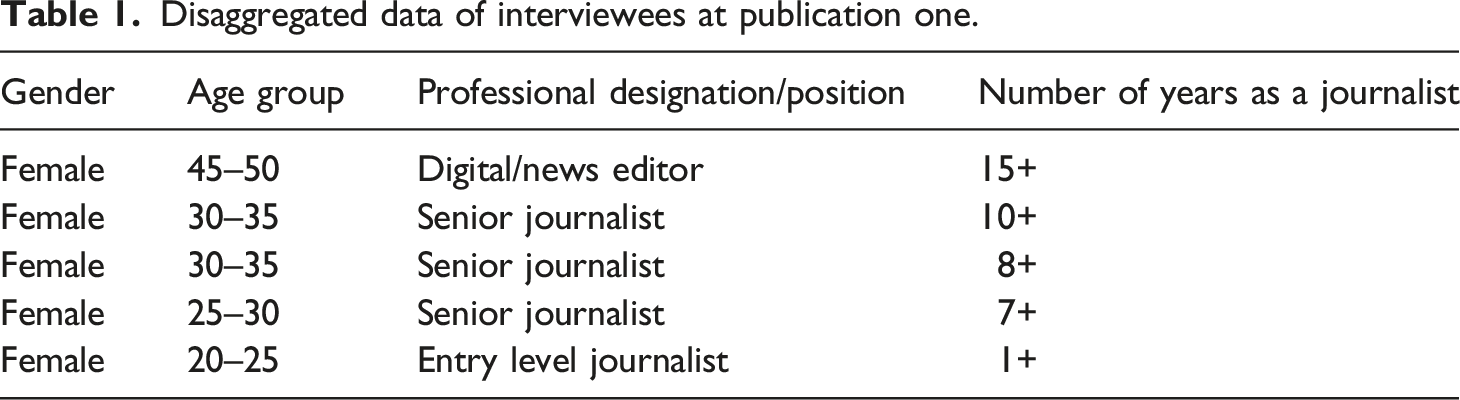
Disaggregated data of interviewees at publication one.
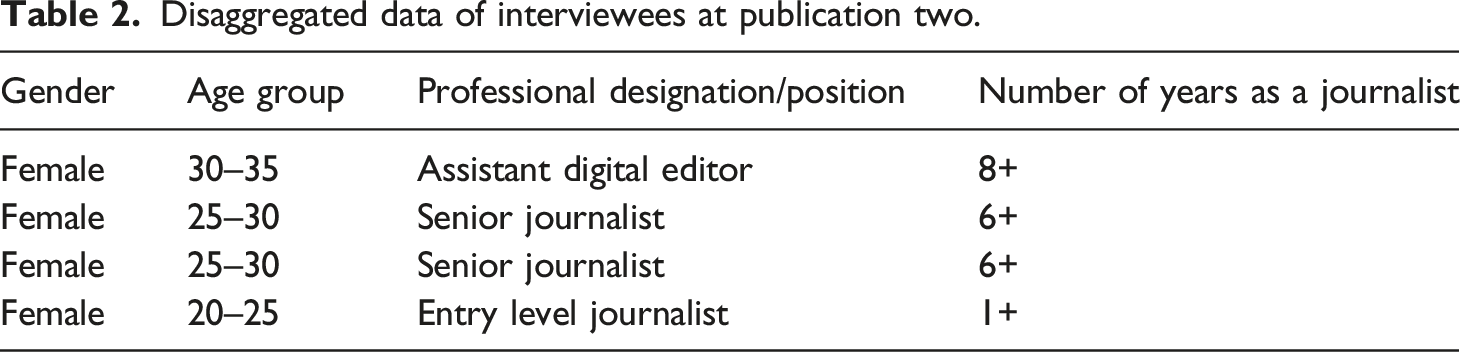
Disaggregated data of interviewees at publication two.
Disaggregated data of interviewees at the publication three.
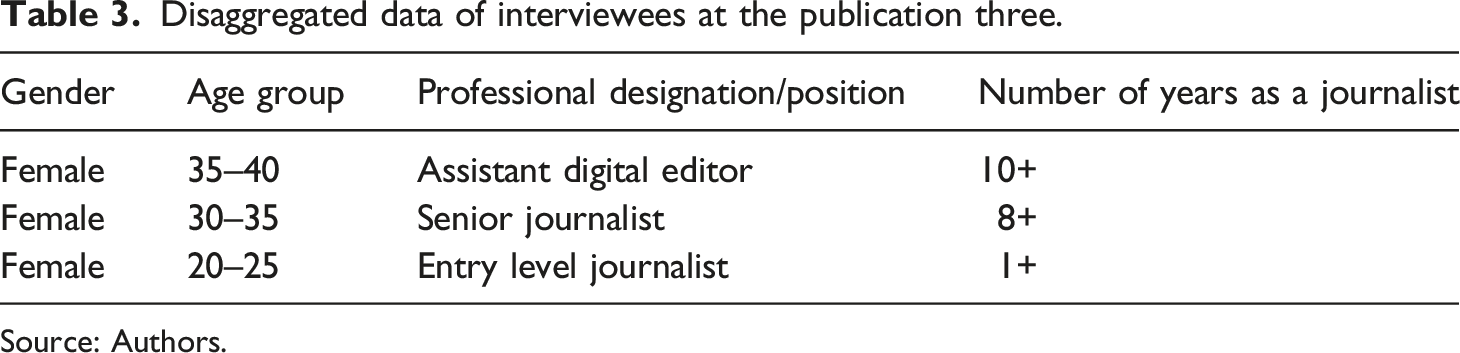
Source: Authors.
In terms of the number of female journalists at each newsroom, The Namibian has a total of nine; the New Era has six; and the Namibian Sun has four. Purposive and convenience sampling techniques were used to recruit 12 female journalists in Namibia. The sampling procedure was not only informed by their gender, but also their professional designation and social status in the journalistic field. Due to the sensitivity of the topic, snowball sampling method was also employed to obtain referrals from key informants. Initially, we intended to conduct face-to-face interviews, but our participants opted for digital interviews. Given its encryption capabilities, WhatsApp was chosen as the best medium of communication by our participants. It enabled us to safeguard their privacy and confidentiality. Consequently, a blend of WhatsApp voice notes and audio calls were used to conduct interviews. Data were analyzed using thematic analysis, which involves systematic procedures such familiarization with data, generating initial codes, identifying themes, reviewing themes, and naming the themes before writing the findings. In this case, coding afforded us the opportunity to categorize data which was pertinent to our research questions into themes. Such classification of data did not only help us to identify themes, “but also enabled detailed comparison and classification prior to the subsequent analytical steps” (Vaismoradi et al., 2016, p. 103). In line with ethical guidelines, we ensured that informed consent was obtained. We also protected all the data gathered through password protection known to the researchers only.
Findings and discussion
Major forms of online gender-based violence against female journalists in Namibian newsrooms
Our study found that female journalists are exposed to multiple forms of online gender-based violence owing to their gender, profession, and visibility in the public sphere. This ‘triple vulnerability’ at the level of gender, profession, and visibility in a patriarchal context where women are expected to be confined in the private sphere creates a cocktail of various forms of OGBV. It emphasizes the triple vulnerability of OGBV faced by female journalists in post-colonial societies. We discuss the implications of these forms of online gender-based violence in the sections that follow.
Gender trolling
While we acknowledge that the integration of social media platforms in the operations of Namibian newsrooms afford journalists’ the opportunity to do live broadcasts and interact directly with audiences and news sources (Mabweazara and Mare, 2021), however, this digital turn exposes female journalists to OBGV. With the increased uptake of digital journalism(s), digital attacks against female journalists have escalated. Namibian female journalists’ online newsmaking practices expose them to gender trolling. This refers to “patrolling gender boundaries and using insults, hate, and threats, of violence and/or rape to ensure that women and girls are either kept out of or play subservient roles in male-dominated arenas” (Mantilla, 2013, p. 568). One female journalist at The Namibian had this to say: I cover most of our social media content, that’s what I do… A lot of gender-based attacks are happening there and it hurts me a lot because these are the people that we don’t know, who just feel like troll on females (female journalist, The Namibian).
The intersection of toxic masculinities and traditional culture exposes female journalists to a wide array of gender trolling. This unfortunately ends up discouraging them from executing their professional duties. Our findings clearly indicate that even though all journalists are not immune from experiencing online attacks, female journalists are the major victims of this scourge because of their gender, sexual orientation, and professional status. Anonymous perpetrators hiding behind fake online identities were identified as a cause for concern. Some of the responses were as follows: Men would immediately speak out and defend themselves on social media. The same cannot be said for women because they become anxious and afraid that the response might be used against them further (female journalist, Namibian Sun). We all experience online threats as journalists [including males], but the disturbing part of it, if you go through the comment section on our social media pages, bullies like to make funny of female journalists and call us all sorts of hate speech for no apparent reason (female journalist, New Era).
What is concerning from our findings is that although all journalists are not immune from trolling, females are affected in a unique way due to their gender, sexual orientation, and professional identities. Whether the trolls are anonymous or not, their agenda is often motivated by patriarchal and sexist ideas. In Namibia, we found that female journalists in selected newsrooms endured multiple online vulnerabilities on the basis of their gender, professional status, and racial and ethnic identities. Even with the respectable first position ranking in media freedom out of 54 countries in Africa (Reporters Without Borders, 2021), Namibian female journalists are not immune to negative impact of technology-facilitated attacks. This form of cyber-misogyny used to intimidate and silence female journalists is not unique to Namibian newsrooms (UNESCO, 2021). In a recent study on OGBV in Zimbabwean newsrooms, Ndlovu and Khupe (2023) have shown that female journalists occupy a vulnerable position in an online environment characterised by interactivity and proximity to news sources and audiences. They found that female journalists are “more exposed to online attacks such as gender trolling and cyberbullying” (Ndlovu and Khupe, 2023, p.95). Although we used context-specific case studies, our findings can easily be generalized in other postcolonial contexts because of similar socio-cultural specifics.
Sexual harassment
With the fear of being exposed to the COVID-19 disease, female journalists were left with limited option but to engage their audiences and news sources through social media. While using social media to carry out their professional duties, female journalists observed that they are exposed to unwelcome sexual advances by mostly males. Seeking sexual favors from female journalists on the account of their social status is a form of sexual harassment. It further complicates their professional mobility and private lives. Some female journalists said: It’s very common [am not trying to normalize it though] for me to receive texts [from my male sources] after working hours, even mid-night requesting to go out for drinks and so forth. I am a single mom, I think my male sources know it, that’s why they have the audacity to do that… and with the nature of my job, you can’t ignore your sources when you know that tomorrow you also want to call the person for more information on your story (female journalist, The Namibian). For me, I have never been directly asked… yeah, but sometimes what happens when I go for face-to-face interviews [with male sources], I’ll get affectionate comments about my dressing, my looks bla bla and the person will be looking at you with a ‘taking eye’ and I feel uncomfortable you know… When you get to the office, the same person [male source] will WhatsApp you saying, ‘you are beautiful… I like the way you dress (female journalist, New Era).
Knowing fully that journalists rely on news sources of information in their profession, this culture of sexual harassment puts female journalists in an uncomfortable position. Our findings also revealed that there is non-consensual sharing of intimate videos on WhatsApp especially groups by male sources, as noted below: I don’t have a problem with my sources who want to share other messages that are not work-related. I have issues with people who are not ashamed of sending me nude [intimate] images and videos. This has happened to me not once, not twice, but several times- from people that I know…. My fellow journalists from other organizations… (female journalist, The Namibian).
What is evident from the above is how some Namibian female journalists experience sexual harassment from their peers in the industry. Female journalists find themselves at the intersection of sexual harassment and racial discrimination by their male counterparts, news sources and audiences. For instance, coloured female journalists are often stereotyped for morally loose and uncultured. There are also ethnic stereotypes amongst Namibians that follow female journalists online as noted by one of our responded who said: At my previous workplace, my supervisor and the majority of colleagues were Hereros…… they didn’t like me because I am Oshiwambo speaking (female journalist, New Era).
Consistent with the intersectionality approach, our findings demonstrate that Namibian female journalists find themselves at the intersection of many sources of vulnerabilities in the digital sphere. They are often targeted not only because of their gender, but ethnicity too.
Threatening messages
Besides gender trolling and sexual harassment, female journalists indicated that they also receive threatening messages on social media platforms. This is not unique to female journalists as their male counterparts are also exposed to it. Threatening messages are meant to intimidate the target and cause one to suddenly feel afraid or nervous. They have a chilling effect as they tend to obscure female journalists’ voices from reporting critical economic issues, thereby undermining the watchdog role of the media, as noted below: For most investigative reports that I cover, it’s not easy my dear. I receive SMSs, WhatsApp voice messages and calls [of male voices] from anonymous people, some threatening to deal with me if I continue to follow up on the stories (female journalist, The Namibian). For a lot of hard-hitting stories especially the ones that include investigating criminal activities are difficult to cover. At one point I was scrutinized, questions like “who I am?” “Where I am from?” from ghost accounts were popping in my inbox [on Facebook] and these are endlessly, but our fellow male journalists can easily navigate through because they are men (female journalist, Namibian Sun).
These advances by mostly male perpetrators to intimidate and hinder female journalists from conducting their professional duties are acts of OGBV in the Namibian context. Owing to their tenuous position in a patriarchal society, the above experiences have the potential to limit female journalists’ ability to act as the ‘watchdogs’ of society. Furthermore, threatening messages might silence female journalists thereby inhibiting them from covering public interest issues. This practice is not only detrimental to the targeted female journalists, but also their families (Zviyita and Mapudzi, 2021).
Female journalists’ responses to online gender-based violence in Namibia
Most newsrooms in Namibia have no organizational social media guidelines to inform the operations of hybrid media organizations in the digital age. This exposes journalists to various forms of digital attacks. Even though platform companies like Facebook, Twitter, Google, YouTube and so forth have reporting mechanisms in cases of OGBV, our participants indicated that they preferred dealing with such infringements at an individual level. They also felt the laws and law enforcement agencies were not capacitated enough to deal with digital attacks. As a result, most female journalists have devised their own individualized responses ranging from blocking of perpetrators to self-censorship.
Blocking of perpetrators
Some female journalists in selected Namibian newsrooms have resorted to blocking the perpetrators on their social media accounts in an effort to circumvent continued attacks. As professionals guided by the Code of Ethics and Conduct for Namibian print, broadcast, and online media, some of the participants indicated that they did not engage in revenge OGBV. This was captured in the following quotes: Our standard operation procedure is very straightforward on such issues. If it’s work-related, we are not allowed to participate in cyberbullying through revenge, but to report to the editor in case of a serious matter. But for the sack of maintaining peace, I block contacts even if I know the person (female journalist, The Namibian). As a professional, I don’t retaliate bullies on social media. For me, one thing I do is to block them and move on (female journalist, The Namibian).
It is evident from the above quotes that female journalists understand their ethical obligations in the digital age, even though their news sources, counterparts and audiences often transgress these ethical guidelines. The avoidance strategy is motivated by ethical guidelines of their profession, as indicated by female journalists at New Era: I don’t like to argue with female trolls to create drama, otherwise people may not know the difference between a ‘fool’ and not, that’s why blocking such people is the best option for me (female journalist, New Era).
Our findings highlight that female journalists in selected Namibian newsrooms are struggling to air their voices in the digital space. Thus, the tactic of blocking the perpetrator is a short-term solution that does not address the structural underpinnings of OGBV. Structural factors require multidimensional interventions in order to address OGBV.
The absence of specific social media guidelines and policies in Namibian newsrooms makes it easier for OGBV to rear ugly head in the digital ecosystem. This is what one of our respondents said: There isn’t any specific policy given when it comes to social media or digital content. A lot of it, we just follow the rules that have been set for traditional media and try to contextualize it for digital. I can’t say to you here is the guideline for digital media (female journalist, The Namibian).
It was also evident from our findings that newsrooms, policy makers, media advocacy organizations, and the Office of the Media Ombudsman are reluctant to implement social media guidelines and policies in the digital age. Participants felt that the current policy vacuum creates a fertile ground for the spread of OGBV.
Self-censorship
It was found that OGBV experienced by female journalists in Namibia has forced some of them to self-censor for the fear of retribution. This on its own is a violation of freedom of expression and press freedom. Furthermore, it widens up the existing gap of horizontal inequality at the level participation between male journalists and female journalists as professional members of the Fourth Estate (Ross et al., 2020). Some of our participants noted that: Once information is thoroughly verified, I am allowed to post on our social pages, but mmm I limit sharing ‘sensitive’ issues that I cover, unless if my editor insist so (female journalist, The Namibian). Sometimes you can see that it’s a witch-hunt game. Haters with an agenda of fault finding can pull you down, so I told myself to play it safe. Whatever I post, I do it with discretion otherwise I may end up in trouble (female journalist, New Era). I think patriarchy is a pyramid scheme which relies on the silence of a woman. Male journalists would immediately speak out and defend themselves on social media. The same cannot be said for us females because we are afraid that the response might be used against them us, and that is why self-censorship becomes an option in this case (female journalist, Namibian Sun).
Clearly, passive forms of resistance and avoidance tactics against OGBV are increasingly becoming the norm in most newsrooms. Some female journalists explained that they have resorted to limiting their social media engagements and commenting on what is considered ‘sensitive’ content. Threatening messages from male voices always seek to assert dominance, as noted by their female journalists’ avoidance tactics. This has been well observed by Links (2008) who concurs that women in Namibia, if not everywhere, are subject to paternalistic societies. As female journalists are challenged to silence their voices in the digital space, they are fulfilling the agenda of their offenders, who usually find audiences in the comment section. This chimes with Mabweazara and Mare (2021) observation that “audiences, which until recently were imaginary figures in the minds of journalists, now clearly manifest themselves online in various forms, including commenting directly on stories…” (p. 1). In this case, misogynistic online attacks can create a chilling effect that silences women voices in the media, hence a deterrent to press freedom (Ferrier and Garud-Patkar, 2018). Although, there are media advocacy organisations with gender-sensitive programmes, there are no interventions aimed at safeguarding the safety and security of female journalists in Namibia. There are no support systems for victims of OGBV in Namibia, which makes it difficult for female journalists to seek psycho-social and legal support.
Mechanisms aimed at strengthening the safety and security of female journalists in Namibian newsrooms
Our study also showed that there is urgent need to strengthen institutional, legislative, and newsroom-specific mechanisms to ensure the safety for female journalists in Namibia. While we acknowledge that some steps have been taken by supranational and regional organisations towards the safety of female journalists against OGBV (Posetti et al., 2020), there are still gaps in Namibia on gender specific measures in this regard (Zviyita and Mapudzi, 2021). These findings corroborate extant studies, which have highlighted the need to develop gender-sensitive interventions to combat online and offline abuse. This dovetails with Waisbord (2022b, n. p) argument that “literature continues to demonstrate that violence is a sprawling problem, and the challenges for implementing effective, sustainable solutions to confront a multidimensional problem, with local and national particularities”. Even though some female journalists subjected to online abuse get peer support, our findings point to inadequate organizational support in selected newsrooms. There is an urgent need to come up with regulatory and legislative frameworks to strengthen female journalists’ offline and online safety mechanisms.
Newsrooms interventions and organizational structures
In a patriarchal society such as Namibia, newsrooms ought to be pro-active as far as the safety of female journalists is concerned. With the normalization of digital journalism in Namibian newsrooms, the need for holistic organizational support structures focusing on the safety of journalists has become imperative. This goes a long way in ensuring a balanced scale of participation between male journalists and female journalists in telling public narratives without fear of being trolled, sexualized, and subjected to hate speech. Some of our respondents had this to say: Women’s safety and security at work specifically need strengthening all round. This can be done by empowering more women to know their rights and also their responsibilities as women to keep themselves safe from any harm, be it physical or online (female journalist, New Era). Currently, we don’t have clear policy on the safety of female journalists when it comes to online bullies, I suggest that there is… need to come up with clear policies on emotional and psychological support in case of traumatic experiences (female journalist, New Era). For sexism, I would say our newsroom authorities must play a pro-active role to ensure our safety because male colleagues are still very sexist, which is normally reflected on how they respond to female journalists compared to their male counterparts (female journalist, Namibian Sun).
Whilst the digitization of journalism offers journalists a lot of advantages, lack of clear organizational policies on how to combat OGBV often hinders newsmaking practices in many ways. It significantly undermines press freedom. It pushes journalists to avoid publishing newsworthy stories for fear of public backlash in digital platforms. Our participants expressed that there is need for newsrooms to come up with gender-sensitive policies at an organizational level. However, newsroom-specific interventions have their own limitations. In this regard, Henrichsen and Shelton (2022, n. p) have argued that “lack of personal experience (by those in managerial positions) with harassment, which may inform the hands-off approach some managers take with employees who experience abuse.” Participants in our study observed that there is urgent need to set up psycho-social support desks in newsrooms to assist female journalists who are victims of OGBV.
Legislative interventions to curb online gender-based violence in newsrooms
Our study found that there are no legislative frameworks to guide security agencies on prosecuting digital attacks against female journalists. Existing laws have structural weaknesses that hinder female journalists from reporting OGBV cases. The absence of legislative frameworks that can be used to deal with OGBV against female journalists has instilled fear in them such that they are reluctant to open up about this sprawling problem. Some of our participants chronicled it as follows: We mostly report to MPUN [Media Professional’s Union of Namibia], which aim to protect journalists from unfair labour practices. But it’s not a well-established body to assist female journalists who encounter issues of gender-based violence (female journalist, New Era). In Namibia, our Constitution protects journalists' fundamental rights to free speech, press freedom (which includes the right to collect and disseminate news), and the right to assemble. Even though these laws apply to all journalists, but the harassment and abuse female journalists face, particularly online, is never the same as the male face (female journalist, Namibian Sun).
It can be deduced from the foregoing quotes that there is a lack for appropriate legal frameworks that can be used to curb OGBV in the Namibian media landscape. The situation is worsened by the fact that female journalists in Namibia are not organised into safety unions hence lack a collective voice in cases of OGBV. Although there is the Editors Forum of Namibia (EFN) and Media Professional’s Union of Namibia (MPUN), interviewees noted that these bodies have not done much to promote and safeguard the safety and security of female journalists. This is corroborated by Mare and Mare (2022) who argue that EFN has a limited mandate. It focuses on promoting the interests of editors and professional standards rather than representing the interests of journalists. This means that safety and security issues facing female journalists are not given due attention by the existing professional unions.
Some of our participants suggested the need to re-visit legislative interventions by national policy makers in order to adequately address this ailing issue. Here is what they said: The laws exist. Perhaps strengthening them would be the way to go (female journalist, Namibian Sun). What would help is the finalization of the internet bill (female journalist, The Namibian). I suggest that the Office of the Media Ombudsman must play a very critical role to resolve gender-based issues against female journalists in a lawful manner (female journalist, The Namibian).
Thus, despite the current legal measures to combat digital attacks against journalists, our findings highlight the urgent need for the passage of data protection, cyber-crimes, and protection of personal information laws in Namibia. As already pointed, there is need to address the prejudices of traditional culture and toxic masculinity ideology that permeates the Namibian social fabric. The Namibian parliament must also move with speed to draft laws that promote the protection, monitoring and response mechanisms for online safety of female journalists.
Building gender-just and violence-free digital platforms
In an ever-changing technological landscape, it cannot be denied that the integration of social media in newsrooms enables interactivity, speed, and immediate form of journalism than never before (Mabweazara and Mare, 2021). However, it cannot be overstated that they have also facilitated gendered disinformation campaigns against female journalists. Combating teething problems such as bad netiquette on social media require collaborative efforts from platform companies, internet intermediaries and other end-users. Some of our respondents said: Social media companies can play a supporting role by strengthening their fair use policies (female journalist, The Namibian). Social media companies also have a role to play to ensure our online safety through their platforms where some perpetrators are accustomed to using ghost accounts (female journalist, The Namibian). I think normalising good social media etiquette will help promote healthy digital ecosystems (female journalist, Namibian Sun).
In addition, multi-stakeholder efforts from governments, gender ministries and other relevant advocacy groups at national regional and international levels has the potential to arrest the situation. One of the female journalists summed it up: There is need to build collaborative partnerships with international, regional, and local partners aimed at supporting the safety of journalists especially females who are vulnerable to digital activities (female journalist, Namibian Sun).
Because of the invaluable role digital platforms play in the production, distribution, and consumption of journalistic content, creating gender-just and violence-free digital platforms is an urgent matter that requires concerted efforts by different role players. There is lot that can be done by platform companies such as Meta, Byte Dance, Google, and Twitter to address the online GBV against female journalists. One of the approaches is to strengthen their Fair Use Policies through mainstreaming gender-sensitive ideals. The other option is to ensure content moderation is context-specific in terms of language, gender, ethnicity, sexual orientation, race, and other social stratification variables.
Discussion and analysis
Given the socially embedded patriarchal culture and toxic masculinity in the Namibian context, female journalists in selected newsrooms have not escaped the intersecting and multiple forms of vulnerabilities associated with the digital age. Consistent with findings from the 2020 global survey by UNESCO and the International Centre of Journalists (Posetti et al., 2020), this article has shown the scourge of OGBV is slowly but surely becoming an area of huge concern in Namibia. It has demonstrated that female journalists experience multiple layers of domination and oppression, which affect the execution of their professional duties. Our findings dovetails with Ferrier and Garud-Patkar’s (2018) observation that when female journalists preside over editorial positions and report on investigative stories, they often face a number of occupational hazards. In a patriarchal society like Namibia, female journalists often experience sexist remarks, sexual harassment, and revenge pornography by news sources, audiences, and their male counterparts. These misogynistic tendencies are deeply embedded in social history and cultural practices that position males as the dominant social group.
Although journalism as a profession is open to all genders, “men have tended to dominate journalism in virtually every country” (Steiner and Mulupi, 2022, p, 111). Our findings point to a situation where female journalists find themselves sequestered in an intercalary position. Whilst the push to engage with audiences and news sources through online comment sections and social media has been lauded for being mutually beneficial, this article demonstrates that this engagement often produces highly gendered and sexual harassment against female journalists. It has also shown that female journalists working for private press like The Namibian, which is seen as anti-government in its editorial thrust are also targeted by online trolls. As observed earlier, although male journalists also experience harassment and online trolling, female journalists are disproportionately affected by OGBV. They experience sexual insults, derogatory comments about their bodies and sexuality, and rape threats. In line with the intersectionality approach, our findings show that female journalists in Namibia are targeted not only for the content they produce, but also because of their gender, professional status, and ethnic identities. Even though the Namibian constitution protects and safeguards the rights of journalists to collect and disseminate news, female journalists are still at the mercy of online trolls partly due to the beat they report on. In response to this scourge, female journalists have devised strategies for dealing with the online gendered attacks such as blocking the offenders on their social media accounts and to self-censor. This buttresses Waisbord (2022b) assertion is that digital attacks are “…the continuation of misogynistic forces to silence determined silence critical journalism and other forms of public expression (n. p). These strategies disrupt the routinized practice of ‘participatory journalism’ as they limit how much women can interact with the audience and news sources in mutually beneficial ways without being attacked or sexually harassed (Chen et al., 2020; Waisbord, 2020).
Unlike newsrooms in the global North, our study has observed most Namibian newsrooms have no social media guidelines and policies to deal with OGBV. The three studied newsrooms have no specific organizational support mechanisms for female journalists subjected to online abuse. This means that female journalists subjected to OGBV have to report their cases to law enforcement agencies. Unfortunately, this is problematic because the current laws have limited appreciation of new forms of harassment in the digital age. The Office of Media Ombudsman has no reporting mechanisms for female journalists to file complaints. Although the Media Practitioners Union of Namibia (MPUN) was launched in 2020, female journalists subjected to online abuse have limited access to peer support because the association is still at an infant stage. With regards to implications for policy or improvement, this study has noted that a combination of interventions are needed. These include legislative interventions, strengthening of security measures at all national and international levels and building healthy digital ecosystem. This supports Martin’s (2018) argument that OGBV must be tackled at a multilevel rather than just a personal safety issue, with better support from employers, peers, and legal and political institutions.
Conclusion
Our study has highlighted that OGBV has started to rear its ugly head in the Namibian media context. It has shown that female journalists in Namibian newsrooms are experiencing OGBV in the form of gender trolling, receiving threatening messages and sexual harassment. This phenomenon is rarely treated with the urgency it deserves because of the deep-seated culture of silence and underreporting. While it is widely acknowledged that the digitization of newsrooms has the potential to help journalists focus on tasks requiring critical thinking and investigative skills, this article has argued that these processes are also laden with ‘dark forms of participation’ (Quandt, 2018). Our article has made three important findings. Firstly, it has shown that OGBV against female journalists is slowly but significantly affecting their professional duties. Female journalists are often targeted on social media platforms by trolls and ‘wicked actors’ on the basis of their gender, racial, ethnic, and professional identities. Secondly, we have demonstrated that female journalists have devised their own individualized responses to OGBV. These responses include blocking of perpetrators, ignoring the threats and self-censorship. These strategies dovetail with what Hirschman (1970) calls voice and exit strategies. His typology shows the various ways in which social actors react to situations. By exiting the toxic digital ecosystem, female journalists can choose to leave or hide from social media. Through voice, they can confront their tormentors through naming and shaming antics. Thirdly, our article has underscored that there is urgent need to strengthen institutional, legislative, and newsroom-specific mechanisms to ensure safety and security for female journalists in Namibia in the digital age. Foregrounding the differences as well as similarities in terms of the manifestations of OGBV in the Global North and South, this article has shown that this phenomenon is context-dependent. This suggests that solutions to OGBV in Namibia will require a deeper appreciation of contextual dynamics at play.
Footnotes
Declaration of conflicting interests
The author(s) declared no potential conflicts of interest with respect to the research, authorship, and/or publication of this article.
Funding
The author(s) received no financial support for the research, authorship, and/or publication of this article.
