



Abstract
Boy bands have long been disparaged in music journalism, in part because of their association with teenage and prepubescent girls who are their primary fans. This study uses media stereotypes of musicians and their fans to see how the interplay of age and gender among these two constituencies is associated with negative stereotyping in music journalism. This study fills a gap in scholarship with a quantitative comparison of how modern boy bands and their fans are stereotypically portrayed compared to non-boy bands and their fanbases in a generalizable way. A content analysis of UK and U.S. music journalism from 2010 to 2015 finds that young women music fans continue to be stereotyped, and that boy bands are diminished through stereotypes that are gendered feminine, most prominently about their age and youth, authenticity of the music, and innocent sexuality. However, the boy bands were not diminished through feminine tropes more closely aligned with women fans, such as with the use of emotional language. Being young and male does not automatically mean marginalization and stereotyping, however – the young men in the non-boy bands were consistently referred to in non-stereotypical ways.
Introduction
In the early 2010s, many middle- and secondary-school girls fell in love with One Direction. With their catchy music and charming personalities, the five felt like friends. Fans kept up with their news, bought merchandise, attended concerts, participated in the fan community on social media, and read fanfiction. Yet, many of these same young women underplayed their obsession — liking One Direction wasn’t cool. One Direction fans were seen in a belittling and condescending light that was perpetuated within the mainstream discourse surrounding the band, including how the news media portrayed both the band and its fans. The UK newspaper The Guardian described fans’ “hormonal reaction” to Harry Styles’ “frothy hair” (Sullivan, 2012, 2) in a piece that was full of similar stereotypical terms.
This study examines media stereotypes of musicians and their fans in U.S. and UK music journalism to see how the interplay of age and gender among these two constituencies is associated with stereotyping. By comparing how boy bands and their fans are stereotypically portrayed compared to non-boy bands and their fanbases, this study shows that being young and male does not automatically mean marginalization and stereotyping – the young men in the non-boy bands were consistently referred to in non-stereotypical ways. However, they were not associated with young female fans the way the boy bands were.
We propose that the bands were stereotyped in part because of the combination of their age and their fanbase’s age and gender. We argue that a multifaceted connection of social identities of different individuals can create an associational effect leading to stereotypes. We discuss how this combinatory effect of affiliated but separate individuals can apply to other domains than music journalism. Additionally, we extend our knowledge of stereotyping in journalism by studying it in a way that is generalizable, expanding on qualitative work.
While some stereotyping may be intentional, we believe that most music journalists do not intend to stereotype others, yet negatively toned and stereotypical writing on boy bands and their fan culture persists. For example, this partial sentence about the Jonas Brothers in The Guardian captures multiple stereotypes: “… these laddish indie idiots know five chords, have girlie haircuts and can fake a conversation about football in a passable Manc accent …” (Wells, 2010: 4). In most cases, we believe stereotypical writing results from implicit schemas journalists have developed. This study measures the scope of this issue within UK and U.S. music journalism through a quantitative content analysis of how journalism stories describe English-speaking boy bands as compared to their non-boy band equivalents. By using a stratified, random sample, it is generalizable. In addition, it examines how the fans of modern boy bands are depicted compared to fans of similar bands with fans of different genders and ages.
This study is important because the way journalists write about musicians matters. To dismiss or ridicule artists with young female fans perpetuates a cultural hierarchy. While media-perpetuated stereotypes of boy bands may seem less important than stereotypes of women or racial and ethnic minorities, they are nevertheless alienating and stigmatizing, perhaps more so because they seem so innocuous. These stereotypes have the ability to marginalize a wider swath of society – from teenage girls, to boys who don’t fit the macho mold, to gay men – and impact society’s notions of gender identity, acceptance and tolerance, and the power of youth (Gregory, 2019). In the case of stereotypes conveyed by the media, the meanings affect the self-esteem, behavior, and perspective of those who read them (McLeod, 2002). Most importantly, these portrayals continue to be handed down as natural, perpetuating the damage, and doing a disservice to future generations.
Literature review
“Boy band” is a genre that seems deceptively self-explanatory: A musical group made up of young men. Typically, boy bands also have groundings in rock and pop — it would be unlikely for a heavy metal band of four men in their early 20s to be labeled a boy band, even though it fits the initial criteria (Sherman, 2020). Groups like Backstreet Boys, New Kids on The Block and One Direction are obvious. Early boy band prototypes include the Monkees, and some music journalists also point to the Beatles as the original boy band (Geffen, 2020), while others balk at giving the Fab Four that label (Unterberger and Lynch, 2018). While the music plays some part in characterizing boy bands, a larger definition emphasizes the fanbase, which aligns with the Merriam-Webster definition of “a small ensemble of males in their teens or twenties who play pop songs geared especially to a young female audience.” Female teenage fans are notorious in rock circles as markers of bad taste (Coates, 2003), although it frequently turns out they have good taste after all, as evidenced by the success of Harry Styles, formerly of One Direction. Along with the age of the members, and the genre of music, the definition, and thus the stereotypical portrayals of these bands in the media are complicated by the fanbase’s age and gender. This study aims to help fill that gap by uncovering the extent of the stereotypes associated with these concepts. We also propose that various social identities of the bands and their fans – age and gender – overlap and contribute to stereotyping in media. That is, when these identities of individuals who are associated with each other interact, they can result in stereotypes that might not exist otherwise. Our proposal is that this occurs between individuals or groups who are related in some way, rather than within a single individual or group. We expand upon this below.
Stereotyping and schema theory
To understand the phenomena of stereotypes music journalists employ about boy bands and how they are intertwined with stereotypes of young, female fans, we turn to schema theory, which says that people gain information about the world from previous experience, that is then reduced to simplified, standardized, and, in some cases, derogatory, models (Fiske and Taylor, 1984). Schemas are not inherently bad but are necessary to help people cope with a deluge of information (Graber, 1988). Schemas become detrimental when they are negative, overgeneralized, and lead to prejudice, in which case they become stereotypes. One of the ways that stereotypes are formed is by media portrayals.
Media stereotypes “consist of recurring messages that associate” people with “traits, behaviors, and values generally considered undesirable, inferior, or dangerous” (Entman and Gross, 2008 97). Stereotyping has been shown to occur automatically, without a person’s conscious intent (Devine and Monteith, 1999). Even people who try not to be prejudiced rely on stereotypes without being aware of it (Hughes and Baldwin, 2002). This includes journalists, who are advised by codes of ethics to avoid stereotyping (Society of Professional Journalists, 2018; National Union of Journalists, 2011), yet much research shows that news content perpetuates stereotypes. Media content tends to reflect the dominant white, male culture of the industries, and research shows that journalists may explicitly or implicitly repeat stereotypes. Such journalism can intensify stereotypes and helps define what society deems as appropriate (Iyengar, 1991).
Stereotyping studies are most often concerned with the oppression of women, minorities, and lower classes – not white males – and rightly so, for that is where injustices dominate. However, harms from stereotyping are indefensible for any group, even if their privilege seems to make it more culturally acceptable, thus it is also important to study groups such as boy bands and their fans.
Boy-band literature
As noted by many researchers (see Gregory, 2019 for a review), there is a dearth of studies about boy bands from a critical perspective, but quantitative work is even more limited. Gregory (2019) offers an extensive look at boy bands from a qualitative perspective, pointing out that studies have largely overlooked information boy bands convey about gender identity. A few (Jamieson, 2007; Moos, 2013) have addressed gender in boy bands. More central to our purpose is Duffett’s (2012) exploration of how negative, shorthand themes illustrate the way critics write about boy bands. Below we review these and other works pertinent to our focus, organized according to the most common concepts in this literature. Not all these stereotypes are inherently negative but are all related to ideas of femininity and work in tandem with further associating boy bands with their fans. The stereotypes of boy bands we found consistently include their age or youth, feminine descriptors, innocent sexuality, and authenticity, explained below.
Age and youth
An essential part of how boy bands are constructed is right there in the name: “boy.” Sustained images of youthfulness make boy bands seem harmless and “convey promises of a suspended utopia in which the playfulness of childhood is carried over into adult life” (Hansen, 2018 196). Part of the appeal to a young girl is that the members’ youth make them seem more accessible, intimate, and relatable. Vulnerability also plays a part, with fans expressing desires to take care of younger, baby-faced members (Gregory, 2019).
Looks skew toward the prepubescent and feminine, with members clean-shaven faces and lean builds rather than muscular forms. This type of male sex symbol is sensitive, not afraid to express emotions, soft-skinned, thin, youthful (which implies a lack of body and facial hair, and boundless energy, as well as a certain coy naïveté). He is, in a word, androgynous, embodying traits which are traditionally perceived as masculine and feminine (Jamieson, 2007 245). Based on the literature consistently identifying age and youth as a hallmark stereotype of boy bands, we propose:
Feminine descriptors
Linked with youth is androgyny, or a melding of the feminine with the masculine. Since their inception, boy bands have been associated with femininity. Part of what made the Beatles’ ascent so groundbreaking was how the band catered to a female audience, embracing femininity rather than the more masculine modes of rock. The band sang romantic — but not carnal — sentiments (“I Want to Hold Your Hand”) and engaged in “girl talk,” further strengthened by the group’s propensity for covering girl-groups like the Marvelettes (Feldman-Barrett, 2021). The Beatles’ “subsequent rejection of romantic pop illustrates how music coded as feminine is all too readily jettisoned in the pursuit of authentic masculinity” (Gregory, 2019: 26). Even the band members’ longer hair, uncommon for the time, emphasized their unconventional masculinity. Several scholars have highlighted how boy bands have manufactured, innocent masculinities designed to appeal to young girls and their families (Jamieson, 2007; Hansen, 2018). The presence of this stereotype manifests in the use of descriptions more often associated with women, such as “vulnerable,” “delicate,” “gentle,” etc.
Based on this literature, we propose:
Innocent sexuality
While we can understand boy-band sexuality as an extension of the gendered descriptors described above, there are a few new ideas in this, notably innocence (Abate, 2017). Frith and McRobbie (1990) differentiate between domineering “cock rock,” as music that emphasizes male sexuality, and vulnerable “teenybop,” targeted at young girls that represents nonthreatening sexuality. In cock rock, the aggressive construction of masculinity manifests as a sexual iconography that is threatening to girls who have been taught to understand sex as something intimate and loving. In contrast, boy-band sexuality is transformed into a spiritual yearning carrying only hints of sexual interaction. Terms such as “wholesome,” “innocent,” “pure,” and “chaste” abound. While boy bands have a reputation for being innocent and lovelorn, a predisposition to talk about their sexuality – or lack thereof – persists. Thus, we propose:
Authenticity
Deviating from notions of gender, we turn to stereotypes about the music itself. A common refrain is that boy bands do not make “real” music (McLaughlin and McLoone, 2014). We can understand this concept of “real” music in terms of authenticity, defined as “whatever is not false or not an imitation. Presumably, this makes real whatever does not fit those profane categories” (Strand, 2014: 60). Yet authenticity is not so neatly defined as a clearly observable, objective dichotomy. Authenticity can be viewed as individuality, authorship, honesty, identity, and integrity, and can change over time (Weisethaunet and Lindberg, 2010).
Several scholars note that the dichotomy between authentic/inauthentic is gendered (Hansen, 2018; Klein, 2020). As Moos notes, “The interconnections between music, masculinity, and ‘(in)authenticity’ become particularly apparent when boy bands are being stigmatized as not being ‘grown’ or ‘real’ bands” (3).
Opposition to commercialization is another tenet of authenticity — fears over a group “selling out” are paramount. In the music industry, selling out referred to literally selling all the tickets to a live show until the 1950s. By the 1970s, its pejorative meaning – a condemnation or betrayal of principles – overtook its complimentary one (Nicolay, 2017). It is a thin line for bands to walk: they must garner enough success to draw fans, but not enough to be accused of prioritizing charts over artistry. As critic and musician Franz Nicolay says, “musicians for the next few decades found themselves in the paradoxical role of having to self-consciously manage perceptions of their authenticity” (2017: 13).
It complicates the portrait of boy-band authenticity by acknowledging that many boy bands are undeniably corporate entities (Stahl, 2002). Boy-band history changed when five solo singers auditioning for The X-Factor were invited to combine forces, becoming One Direction. The Wanted was formed through a nine-month-long audition process. The Monkees, the first manufactured boy band, were fabricated to imitate the Beatles. Yet presenting an authentic image was still of the utmost importance. Authenticity is also a key characteristic of successful boy-band reunions (Lobert, 2012), or the evolution of individual members to respected solo artists (Banks, 2020).
The quest for authenticity is not limited to boy bands. Music journalist Joel Selvin summed up the rock-and-a-hard-place crisis the Rolling Stones faced: “They needed to rise above such common commercial concerns or risk losing important face in the underground. Of course, they were doing it for the money, but they couldn’t be seen as doing it for the money” (Selvin, 2016: 50). Despite the ubiquity of “selling out,” we propose that it will be overwhelmingly represented in negative authenticity stereotypes about boy bands:
Fan culture
Fans have become a ubiquitous concept in popular culture. Someone might be a fan of a certain television show, celebrity, or even a cereal brand. “Fan” can simply refer to someone having a strong interest in a person or thing. In music, someone is likely to be a fan of many artists, based on their familiarity and enjoyment of a handful of songs.
Fan communities go beyond those whose interest is merely casual. A key part of the distinction includes not just identifying as a fan of an artist, but having that status contribute significantly to identity. Members of fan communities are more passionate and involved — they know every song in an artist’s discography, and participate in more fan activities beyond listening, such as going to concerts, buying merchandise, talking to other fans, and reading fan magazines.
However, when it comes to fans, being a teenage girl comes with a whole host of connotations not afforded other fans. As Grady (2021) says, “To be a teenage girl is to simultaneously be pop culture’s ultimate punching bag, cash cow, and gatekeeper” (5). Things didn’t start out this way; the Beatles had a close relationship with their female fans and took them quite seriously (Feldman-Barrett, 2021).
For young female fans today, there is a notable prevalence of “bedroom culture,” meaning that it’s common for them to listen to music, hang posters, discuss artists, etc. in domestic spaces like their bedrooms and those of friends, rather than a public sphere (McRobbie and Garber, 1990). Because bedroom culture is more secluded, it has connections to how female fans have long been systematically dismissed and reduced by other fans and dominant music discourses. Those who engage in public behaviors, such as being a frequent concertgoer, and collecting records, become the dominant image of a fan – and these behaviors are typically more associated with male fans (Hill, 2014). Young women participating in bedroom culture don’t have the same visibility and thus get left out of the conversation or are viewed as not a “real” fan.
Another key aspect of online fandom is writing and consuming fanfiction, where fans create their own stories about artists. Websites like Wattpad and Tumblr make it easy for readers to find, follow, and support their favorite writers. Fanfiction often involves fans inserting themselves into a story as a romantic interest for an artist or pairing up band members that they wish were in a romantic relationship. Exploring sexuality through fanfiction has overwhelmingly positive effects for young female fans; they have expressed becoming more comfortable with their own sexualities and more accepting of others’ sexualities through their experiences consuming fanfiction (Meggers, 2012). Many fans speak positively of the bonds and friendships they form over a shared passion and find their online fan communities to be sources of joy (Barber and Callaghan, 2010).
In music communities, two stereotypes have persisted since the 1960s: the teenybopper and the groupie (Coates, 2003). Compared to groupies, teenyboppers have closer ties to traditional boy-band fandoms. At first, teenybopper was just a way to refer to fans of youth-oriented entertainment, but the label grew to become increasingly disparaging and associated with adolescent femininity (Coates, 2003). While idol-worship is common for intense music fans of all genders — think of a young male rock fan covering his room with posters of Black Sabbath — “teenybopper” is used indiscriminately for female fans. The term grew beyond mere demographics into having strong associations with stereotypical feminine traits, especially overblown emotions (Coates, 2003).
While the groupie became notorious for hypersexuality and the teenybopper equated to virginal desires, the two stereotypes are further linked because of their immaturity when compared to the “true” rock and roll fan. At its core, this immaturity comes from a perceived lack of taste and appreciation; neither the teenybopper nor the groupie is really in it for the music like a real fan (Coates, 2003). Both stereotypes involve seeking out a band because of how attractive they are and expressing a desire to be in a personal relationship with the band member (even if it is explicitly a fantasy). It is commonly considered that the teenybopper thinks the band members are cute and is mindless enough to consume whatever entertainment is marketed at her. Thus, when it comes to the fans themselves, we predict:
This study is interested in documenting differences in music journalism stereotypes about boy bands compared to non-boy bands and fans of both groups to see if there is an interaction between the musicians and fans. We posit that a multifaceted connection of social identities of these linked individuals can result in a compounding effect, leading to harmful stereotype perpetuation that might not otherwise occur. In this case, when pop bands of young men are associated with young, female fans, they are written about differently in terms of stereotypes than similar bands of men without such fans.
Methods
This quantitative content analysis used a stratified random sample of journalistic articles including reviews, interviews, features, and Q&As, about boy bands and non-boy bands published between January 1, 2010 and December 31, 2015. While the 1990s were the heyday of boy bands, studying journalistic output from 25 years ago does not allow an updated look at stereotyping in music media. Thus, we select years when there was a resurgence of boy-band popularity (Hecht et al., 2021). This affords us a better look at the phenomena than simply using the most recent years of coverage, when boy-band popularity was not as strong.
The sample size of 210 stories was determined by a G*Power analysis for a Multivariate Analysis of Variance to correct for multiple tests with power of 0.95 and error of 0.05. The total N was stratified by whether the group was a boy band or non-boy band, with an equal number of stories per group – 105 per band type. We counted how many times each stereotype was mentioned, resulting in interval data. The 210 stories were randomly sampled from five publications: the New York Times, Billboard and Rolling Stone in the U.S., and the Guardian and the Times in the UK, described below. First, we introduce the bands chosen for analysis.
Boy bands
This study was limited to all male, English-speaking bands because including non-Western boy bands such as BTS, or bands with women members would necessitate deeper exploration of gender and racial intersections. We excluded supergroup NKOTBSB because it was formed by joining two legacy acts (New Kids on the Block and Backstreet Boys) that dated from the 1980s and early 1990s, and may be described differently because of nostalgia and additional history. Also, the bands must have gained popularity between the mid-2000s or the start of the study timeframe to have the boy bands and non-boy bands be as similar as possible to minimize the impact other differences might have. To determine which bands were covered most, all stories about bands from 2010 to 2015 in the five media outlets were examined, and the names and number of stories about bands meeting these requirements collected. The bands with the most articles were chosen, provided they had at least five articles in at least two different publications. Those bands were: One Direction. In 2010, five teenage hopefuls auditioned for the U.K. reality singing show The X-Factor. The group did not win the show, but judges decided to combine them into one band (Sherman, 2020: 139). The next five years saw the band release five back-to-back albums, obliterating music industry records and earning hundreds of accolades (Wikipedia, 2020).
The Jonas Brothers are a pop-punk, instrument-playing trio that brothers Kevin, Joe and Nick Jonas began in 2005 (Chmielewski, 2008). Their third album A Little Bit Longer peaked at number one on the Billboard 200 and received critical praise. The album placed 40th on Rolling Stone’s “Best 50 Albums of 2008” list.
The Wanted, also started in 2005, in the UK This British-Irish dance-pop group were put together through an extensive 9-month audition process, soon to be marketed as One Direction’s rival (Sherman, 2020 135).
Big Time Rush started out as a TV show about a teen boy band on Nickelodeon, that also launched an actual boy band of the same name. They were voted “Best Boy Band in the World,” over One Direction and The Wanted by Parade magazine’s 2012 poll (Parade, 2012).
5 Seconds of Summer is an Australian boy band that played instruments and skew close to the Jonas Brothers’ pop-punk (Sherman, 2020 156–157). Simon Cowell and One Direction supported and financially invested in 5SOS (Halperin, 2014).
Non-boy bands
Because age is a defining feature of boy bands, to have close comparisons with the non-boy bands, the front man for each non-boy band needed to be under 35 years old; this age was chosen so the bands skewed younger without placing unnecessary constraints on what bands could be included. The average age for all the non-boy band members in 2010 was 26.5 years old. The same criteria as above was used. They were:
Vampire Weekend, an American indie rock band that first gained acclaim in 2008 with its debut album, which was noted for incorporating world music influences. The group’s third album Modern Vampires of the City (2014) won the Grammy Award for Best Alternative Music Album.
Arctic Monkeys, an English rock band released its debut album, Whatever People Say I Am, That’s What I’m Not in 2006, which became the fastest selling debut album in British music history and earned the group a Mercury Prize. The band gained U.S. success quickly after.
Two Door Cinema Club, a Northern Irish indie pop band whose debut album Tourist History received positive reviews and had moderate success in the UK, peaking at number 24 on the UK Albums Chart and winning the 2010 Choice Music Prize for Irish Album of the Year.
Imagine Dragons, an American pop and rock band had a breakout year in 2012 with the release of its debut album Night Visions. The album peaked at number two on the Billboard 200.
Phoenix, a French indie pop and rock band hit mainstream success with its acclaimed fourth studio album Wolfgang Amadeus Phoenix in 2009. The album appeared on many publications’ best album lists.
Bombay Bicycle Club, an English indie rock band formed when all the members were in secondary school; it was not until 2008 that they committed full-time to music, having just turned 18.
MGMT, an American pop and rock band released its debut album Oracular Spectacular in 2007 to positive reviews; the album was NME’s number one album of 2008 and later received recognition in the 2012 edition of Rolling Stone’s “500 Greatest Albums of All Time” list.
Media
Because the bands were based primarily in the UK and U.S., media outlets chosen include two mainstream newspapers in the UK, one in the U.S., and two U.S. music magazines. Additional music-specific outlets, like Pitchfork and Stereogum, were considered, but did not cover boy bands sufficiently during the time period, if at all. The outlets were:
TheGuardian.com, an online UK news outlet of international recognition. It is owned by the Guardian Media group and contains nearly all the content from the company’s two print newspapers, the Guardian and the Observer, as well as additional, web-exclusive work. The publication was ranked the second most popular online newspaper in the UK in 2014, with more than 5 million readers per week (Hollander, 2013).
The Times, the online presence of the British daily national paper first founded in 1785, is considered “quality” press, a British designation for papers distinguished by seriousness (Preston, 2012). Along with the Daily Telegraph, both publications are often considered the “big three” of British newspapers.
The New York Times, long considered the newspaper of record in the U.S. and an internationally respected daily. The paper has a robust and reputable arts section that covers a wide range of genres. As of May 2020, the paper had a total of 6 million digital and print subscribers (Tracy, 2020).
Billboard magazine, founded in 1884. Considered by some as the king of music-chart magazines (Radel, 1994), Billboard is perhaps best known for its charts updated weekly of the most popular songs and albums in different genres by sales and streaming.
Rolling Stone magazine, founded in 1967. The magazine was first known for its coverage of rock music and its success is often considered one of the leading factors in the U.S. developing a mainstream rock criticism (Rodriguez, 2012). Rolling Stone is still best known for its music and entertainment coverage, with reputable end-of-year “Best of” lists and “500 Greatest” lists.
The articles were obtained by searching each band in databases and digital sites. Articles shorter than 250 words were eliminated because they did not focus on the bands enough to warrant coding.
Measures
Words, phrases, or complete sentences that represented the mutually exclusive stereotype categories were counted for the number of times each appeared. They are: Age or youth was coded if the story gave a number for a band member’s age or a descriptor such as young, immature, youthful, teen, childlike, boys, etc. While giving the band member’s age is not inherently negative, the other mentions almost always were. For example, the members of One Direction were described as “lolloping around like foals loosed in the men’s department of H&M,” and Harry Styles as “the 17-year-old alpha puppy” (Empire, 2012: 4–5). Another says Joe Jonas stands out in a restaurant “because most of the other diners were, you know, adults” (Ryzik, 2011: 1).
Feminine descriptors were coded if inherently feminine terms including vulnerable, delicate, gentle, sweet, chatty, perky, intimate, etc., were used. For instance, Nick Jonas’ voice is feminized as “sweet but not lithe, loud but not powerful” (Caramanica, 2012: 8).
Innocent sexuality was coded if the music or artist was described negatively with a lack of sexuality including terms like wholesome, innocent, pure, modest, naïve, chaste, etc. An album review of One Direction’s Take Me Home says it is, “… concerned with pitching harmless romance at its pubescent audience” (Petridis, 2012: 5). Harry Styles is described as “a Romantic poet as imagined by a Japanese school girl” (Empire, 2015: 7). Another calls the Jonas Brothers “the ultimate cock block” (Wells, 2010: 9).
Authenticity was coded if the story described a band’s music as a false or inaccurate representation of the members, produced for financial gain or fame rather than personal self-expression, being controlled by its label, having an emphasis on commerciality, sticking to a formula, and if members did not play instruments or write their own songs. This included terms such as conformity, one-dimensional, unoriginal, bland, generic, etc. One example describes Zayne Malik as having left One Direction “to make ‘real music’” (Empire, 2015: 3). Another says the Jonas Brothers, “know five chords” (Wells, 2010:4).
Fans was coded if the story referenced fans or fan behavior with a negative connotation including using fan stereotypes such as groupies and teenyboppers, trivializing or ridiculing fans, describing fans as having bad or immature taste, perceiving fans to like a band for sex appeal or unserious reasons, describing fans as obsessive, hysterical, frivolous, silly, or unable to control their emotions. A One Direction concert review says, “It is the hive-mind battle-cry of teenage girls scenting boy-flesh” (Empire, 2012: 1). Another describes fan reactions as “high-decibel hysteria” (Ryzik, 2011: 2).
Two coders – one independent, and one author – trained for two-and-a-half weeks in daily sessions lasting 2 h each. Disagreements were resolved with discussion and clarification of operational definitions. Agreement was achieved on stories not included in the sample, representing about 20% of the sample. Krippendorf’s alphas were: Age/youth 0.862; Feminine descriptors 0.892; Innocent sexuality 0.879; Authenticity 0.841; Fans negative 0.800.
Results
Frequencies and percentages of articles about boy bands and non-boy bands.
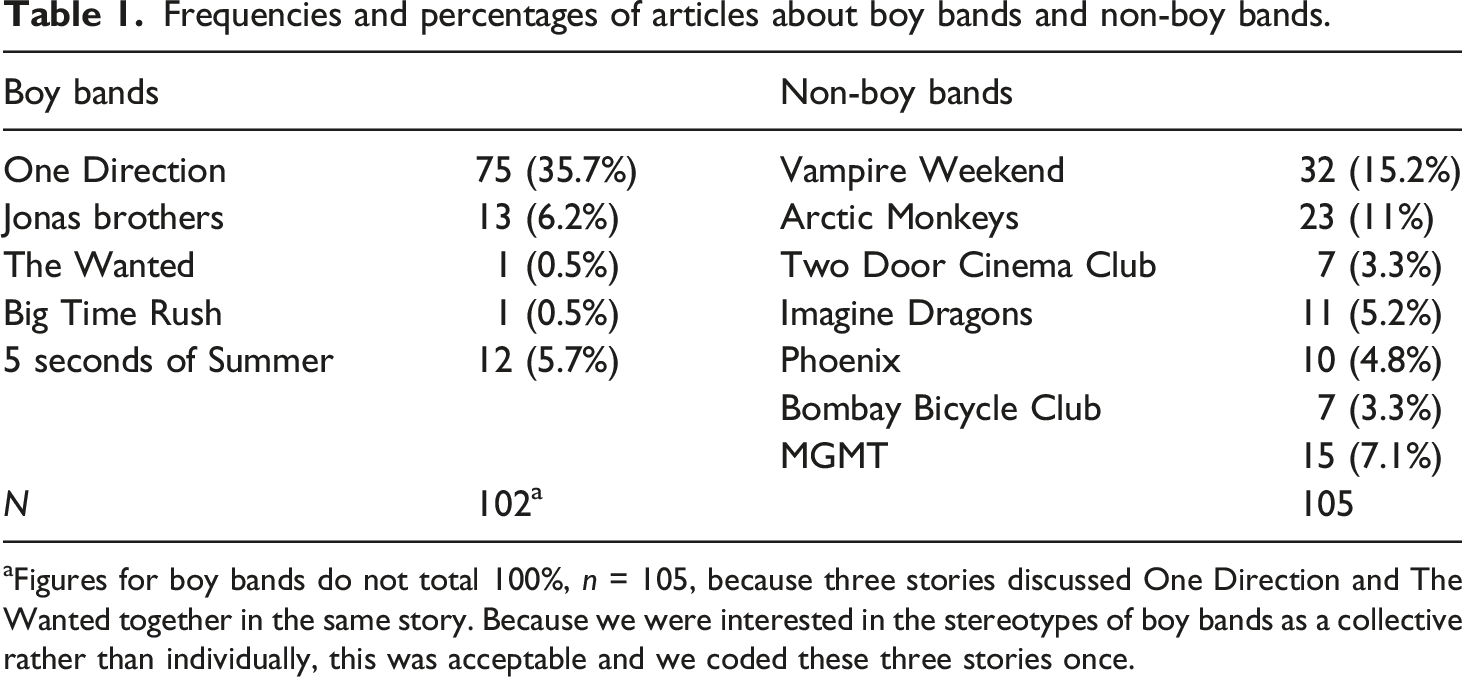
aFigures for boy bands do not total 100%, n = 105, because three stories discussed One Direction and The Wanted together in the same story. Because we were interested in the stereotypes of boy bands as a collective rather than individually, this was acceptable and we coded these three stories once.
A multivariate analysis of variance, which corrects for tests of multiple dependent variables, showed there were significant differences between types of bands (Wilks’ Lambda = 0.732, F = 14.92, df = 5, p < 0.001). With the omnibus test significant, we interpreted the individual tests to answer the hypotheses:
The first hypothesis predicting stories would stereotype boy bands in terms of age and youth significantly more than non-boy bands was supported (F = 13.43, df = 1, p = 0.001, η2p = 0.061; Boy band M = 1.96, SD = 2.43; Non-boy band M = 0.93, SD = 1.55). On average, boy bands were described in terms of their age and youth about twice as often as non-boy bands.
The second hypothesis predicting stories about boy bands would stereotype them using feminine descriptors significantly more than non-boy bands was not supported (F = 0.37, df = 1, p = 0.55; Boy band M = 0.17, SD = 0.17; Non-boy band M = 0.13, SD = 0.13). Instead, they were described about the same way.
The third hypothesis predicting boy bands would be described using innocent sexualized stereotypes more than non-boy bands was supported (F = 13.05, df = 1, p = 0.001, η2p = 0.06; Boy Band M = 0.81, df = 1.90; Non-boy Band M = 0.12, df = 0.43).
The fourth and final hypothesis about the bands, predicting that stories about boy bands would be significantly more likely to use negative authenticity stereotypes more than non-boy bands was also supported (F = 8.23, df = 1, p = 0.005, η2p = 0.04; Boy band M = 1.02, SD = 1.73; Non-boy band M = 0.44, SD = 1.14). Stories about boy bands had more than twice as many negative authentic stereotypes than stories about non-boy bands.
The fifth hypothesis, concerning fans, was supported; stories use significantly more negative fan stereotypes for boy bands (F = 42.38, df = 1, p < 0.001, η2p = 0.17; Boy band M = 1.79, SD = 2.61; Non-boy band M = 0.11, SD = 0.40). Stories about boy bands used about 16 times more negative fan stereotypes than stories about non-boy bands, with a mean of nearly two negative fan mentions used per boy-band story.
We conducted an exploratory analysis in response to a question from an anonymous reviewer regarding differences in stereotyping between publications in the U.S. and UK On four of the five variables, there were no significant interactions between the two countries and the stereotype categories; however, the UK publications were significantly more likely to portray the boy-band fans stereotypically (F = 5.93, df = 1, p = 0.016; U.S. M = 1.10, SD = 1.161; UK M = 2.44, SD = 3.06).
Discussion
This study found that boy bands are stereotyped significantly more than their non-boy band equivalents in U.S. and UK music journalism on four of the five categories studied, including their fans. Using a content analysis that is generalizable across five major music news sources in the UK and U.S., boy bands between 2010 and 2015 were diminished by stereotypes about their age, authenticity, sexuality, and fans, compared to non-boy bands. The only category that showed no significant differences between the two types of bands was in the use of feminine descriptors such as gentle or sweet. This represents cause for some small celebration that music journalists are not literally describing boy bands as “girly,” and not calling their members “delicate” or “sweet” more often than non-boy band members. Rather, they were diminished with more subtle stereotypes, for example, being portrayed with innocent, non-threatening masculinities designed to appeal to young girls and their families. Additionally, boy bands are inherently feminized in other ways, such as with talk about inauthenticity as musicians.
However, it is the last finding that is most disturbing. The fans of these boy bands – impressionable, teenage girls – were stereotyped significantly more than were the fans of non-boy bands. That “good gray lady” the New York Times described how shrieking teenage girls made “their lung power known.” In a piece on One Direction, the Times of London wrote about “hormones running high” and fans who were “desperate for a red-carpet glimpse” fainted and insulted each other. We find the most insidious dehumanization is not in the direct way that boy bands are written about, but in how their fans are. Stereotypes associated with young female fans are less obtrusively translated to how the bands themselves are depicted. Teenybopper stereotypes, like being prone to hysteria and overblown emotions, and the proliferation of online fandom for modern boy bands diminishes and marginalizes these musicians in comparison to non-boy bands and their fans. This is perhaps the least surprising result yet most destructive. Common patterns emerged throughout the boy-band stories – mentions of obsession and hysteria, dehumanizing descriptions of screaming, hyper-focus on the most extreme fan behaviors, accusations of hormones running high. Fans screaming at a One Direction show were not described as exhibiting perfectly normal concert behavior, but rather “a carnivorous squeal … the hive-mind battle-cry of teenage girls scenting boy-flesh” (Empire, 2012: 1). Other animalistic comparisons cropped up. One concert review of a One Direction show in Australia draws comparisons with a cult: “Hysteria has followed them since they arrived in the country, and this concert served as a mass outpouring of delirium. The crowd, almost entirely comprised of teenage girls, was absolutely wired, fanatical” (Brandle, 2012: 8). In line with Proctor (2016), this suggests that there is a continued problem with music journalism portraying female fans as a monolith of extreme behavior without the necessary nuance of positive aspects of fan culture. And those stereotypical ideas spill over onto the descriptions of the bands themselves.
There are some categories that we would expect to be used regularly for both boy bands and non-boy bands, especially those that are common in journalistic practices. For instance, when answering a reader question about why journalists often describe a subject, including their age, ProPublica Illinois reporters explained that “characters are frequently boiled down to fundamentals that help us identify them and put them in context,” (Jaffe and Mills, 2019: 3). If that were true universally, then we would expect to see age reported for non-boy bands about as often as for boy bands; however, that is not the case. Another argument against including additional mentions of age disproportionately in stories about boy bands is that age and youth is right there in the name “boy band.” However, considering how the members of all five boy bands were in their late teens or early 20s, and the non-boy band members were predominantly in their 20s also, there were no astronomical differences in age. This is unlikely to explain the overwhelming use of age and references to youth in stories about boy bands compared to non-boy bands. We suggest that it is the combination of characteristics of the fans that interacts with the characteristics of the bands that lead to significantly more stereotypical writing.
Conclusion
Based on this study, we propose that stereotyping results when two or more categories of people are linked that interacts in a combinatory effect. In this case, the age of the band members and the age and gender of the fans results in stereotyping at greater rates. We propose such stereotyping might not have occurred had the young men in these bands had more diverse fans. Similarly, if these same young women were fans of bands with slightly older men, such as Imagine Dragons or Vampire Weekend (and surely some must be), they would not have received such stereotypical coverage. Instead, it is the compounding of characteristics of two categories of people that contributes to the stereotypical disparity, not unlike the effect that one particle has upon another in physics. This phenomenon can be seen in stereotyping of other categories of people – young women who date or marry significantly older men are called “gold diggers;” older women who date or marry significantly younger men are “cougars.” These same women would not be so stereotyped except for their association with a specific category of men. Another example is how different stereotypes exist for men and women executives and lower-level workers who are involved in romantic relationships at a company (Devine and Markiewicz, 1990). When a male boss and female secretary were romantically involved, the stereotypes were different – and less negative – than when the boss was female and the subordinate was male.
One limitation of this study is that it is correlational. No causal statements are intended in our observations above. Future studies should employ experiments with fictional bands and fans, systematically varying their ages and genders, to determine if these characteristics have the proposed effects. Another limitation is that this study focuses exclusively on English-speaking boy bands and their portrayal in U.S. and UK media. The international rise of K-pop boy bands over the last decade have made these groups just as worthy of examination. Given the inevitable intersection of race and gender, we excluded them to make this study manageable. However, such a study could further contribute to the stereotyping literature.
In addition to theoretical development, this study has practical applications. Referring to tired stereotypes about teenage girls as a “shriek show” (Brandle, 2012: 1) and being crazy simply for expressing themselves is not good quality journalism. Most of the dismissive and marginalizing language used toward boy bands and their fans found in this study, whether intentionally malicious or not, is outright misogynistic. Rather than intent, it is more likely that implicit stereotypes play a role in shaping how music journalists write about boy bands. However, all it takes is a hard look at one’s own output, plus a concerted awareness, to begin the process of eliminating these destructive patterns. Implicitly upholding stereotypes signals to audiences that it is acceptable to do the same. Accordingly, such portrayals directly harm fans.
This study focused on when a category was found in excess in contrast with similar other musicians not labeled as boy bands, to the point of diminishing these bands’ accomplishments and their fans. It becomes a problem when journalists repeatedly reference ideas like hysteria as an automatic go-to concept for boy-band fans without considering the underlying meaning or giving balanced portrayals. Do not fans at “cock rock” concerts also exhibit tears and wake up hoarse? To improve, journalists must be self-conscious and work to undo these biases instead of writing on autopilot.
Footnotes
Declaration of conflicting interests
The author(s) declared no potential conflicts of interest with respect to the research, authorship, and/or publication of this article.
Funding
The author(s) received no financial support for the research, authorship, and/or publication of this article.
