



Abstract
This article discusses how the performance of leading European news media evolved between 2010 and 2020 regarding normative expectations of liberal democracies, focusing on the role of digital journalism. The rise of platforms, news media crisis and consolidation of digital journalism in the 2010 decade challenge established discourses on the normative roles of news media. It is unclear to what extent media performance may have changed, especially outside the United States. This article draws on 2010 and 2020 data from the Media for Democracy Monitor (MDM) to compare the performance of news media in Austria, Finland, Germany, the Netherlands, Portugal, Sweden, Switzerland and United Kingdom. It argues that leading news media in these countries have had an overall similar contribution to democratic roles as before the 2010 decade. However, there are uneven developments, as digital journalism has strengthened the watchdog dimension while failing to attract younger audiences for the news industry. Additionally, countries with stronger public media ownership performed fairly better, indicating that technology alone is not the main factor to fulfil democratic expectations.
Introduction
News media have often being regarded as cornerstones of liberal democracies, bearing the responsibility to provide citizens with reliable information on current affairs and hold the powerful accountable. Whereas some empirical evidence indicates that they indeed contribute to democracies, there is also literature that contests the general claim, pointing to the malfunctioning of the media in highly commercialised systems and denouncing a certain US-centrism in that approach. Furthermore, the digitalisation in the 2010 decade brought new developments for the news media, such as the rise of digital intermediaries, further challenges to the economic sustainability of an important part of the industry, and the consolidation of professional journalism online. It is not clear, however, to what extent the fulfilment of democratic roles by news media is changing under these conditions, especially in contexts beyond the US.
This article aims to contribute to this discussion by comparing the performance of leading news media in eight European countries – Austria, Finland, Germany, the Netherlands, Portugal, Sweden, Switzerland and the United Kingdom – drawing on data from the 2010 and 2020 waves of the Media for Democracy Monitor (MDM). This project sets out to periodically assess the contribution of news media to democracies by analysing media structure conditions against the background of normative roles. The article pays special attention at the role of digital journalism in both the continuities and changes of their performance. It argues that, in most of these European countries, leading news media seem to contribute as much to democratic roles as they were doing before the 2010 decade. However, this overall finding hides uneven developments, as digital journalism has strengthened functions of the watchdog dimension, but still seems unable to capture younger audiences for the news industry. Furthermore, countries with stronger public media ownership performed fairly better than others with a more liberal approach even if all have experienced similar technological developments, suggesting that technology alone – including the digitalisation of professional news – is not the most important factor for improving democratic performance.
News media and democracy: A contested field
The history of news media is also a history of normative roles they play in liberal democracies. American and European philosophers of the early modernity, such as Thomas Jefferson, John Stuart Mill, Immanuel Kant and Georg Hegel, believed a solid democracy should be built on the premises of freedom of information, at that time embodied by the print newspaper (Pickard, 2020; Zelizer, 2013). These ideas were refined throughout the 20th century, especially in the United States, sustaining that democracies depend on an informed citizenry, and news media should provide citizens with the conditions to exercise their democratic duties.
A landmark in this tradition was the publication of the Hutchins Commission report (1947), which claimed for social responsibility of the press. Since then, several attempts were made to define the precise roles media should play in democracies and establish the grounds on which media performance should be judged. Still in the 1950s, Siebert et al. (1956) offered a more systematic approach in the scholarly classical Four theories of the press. More recently, Denis McQuail (2009: 125–127) proposed a model for democratic roles of news media in liberal democracies consisting of four categories: (1) monitorial, (2) facilitative, (3) radical and (4) collaborative. In the monitorial role, the media are responsible for providing democracies with information about current and recent events, keeping people well-informed to make reasonable choices, either in electoral processes or in daily participation in public affairs. In the facilitative role, the media should mediate different interests in democracies, helping to create a public framework beyond individual rights. The radical role asserts that the media should strive for the exposure of wrongdoings, inequality and the potential of change. Finally, the collaborative role refers to the collaboration between news media and the state, which might be necessary in times of crisis and state of emergency.
The question about which media roles are relevant depends on the underlying concept of democracy. Democratic theory usually groups most models in liberal or republican traditions, whereas the former is considered a minimalist perspective, focusing on the exercise of power by elected representatives, and the latter is maximalist, whose main feature is the participation of citizens in the whole decision-making process (Cunningham, 2002; Held, 2006). Accordingly, a liberal democracy should expect the media to focus on freedom of information and make public wrongdoing of powerholders. A republican democracy, on the other hand, should require the media to provide a forum for debate, inspiring citizens to engage in civic life.
Despite eventual divergences and even contradictions between these traditions and their corresponding media roles, Diamond and Morlino (2004) defend the need to consider both liberal and republican elements of democracy in a common framework. Liberal traditions highlight freedom, whereas equality is emphasised in the republican models, but ultimately both freedom and equality depend on one another. Diamond and Morlino still suggest accountability (or control) as a third crucial dimension, which makes sure that both freedom and equality are fully realised. In their ‘Democracy Barometer’, Bühlmann et al. (2012) also plead for an integrated approach around these three concepts, considering that existing liberal democracies have grown too complex to accommodate a merely minimalist concept.
McQuail’s roles can be related to these three core principles of democracy. The monitorial role refers both to freedom and control, imparting information and monitoring powerholders. The facilitative role is connected to freedom and to equality, ensuring that all groups in society are free to communicate and engage in a common framework. The radical role is directly related to control, enforcing accountability. Finally, the collaborative role can be referred to equality, promoting public governance.
On this basis, the original MDM framework proposed that the three principles of democracy can also be translated into dimensions of news media roles in democracies, namely inform citizens (freedom), hold powerholders accountable (control) and promote a forum for the different groups of society (equality) (see Figure 1 and Tomaz and Trappel, 2022). McQuail’s roles translated into democratic communication dimensions. Source: elaboration by the MDM team (Tomaz and Trappel, 2022).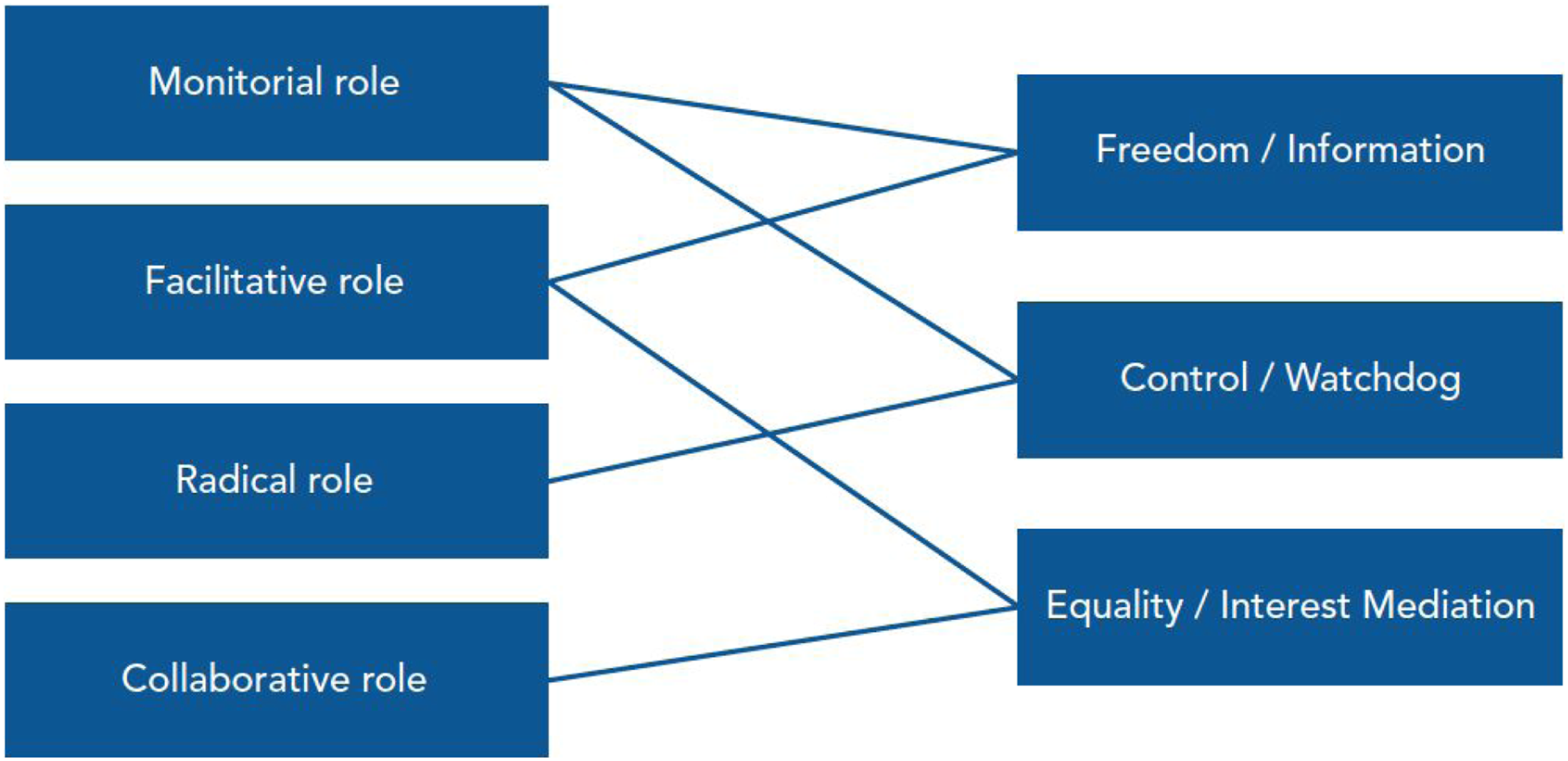
While the dimensions ‘Freedom/Information’ and ‘Equality/Interest mediation’ are more consensual, ‘Control/Watchdog’ is subject to challenges. For example, in her model of media roles for democracy, Müller (2014) proposes only two functions. The vertical function basically refers to widespread access to and provision of political information, which reflects the ‘Freedom/information’ dimension. The horizontal function asks for diversity of political viewpoints, matching ‘Equality/Interest mediation’. She sees no need of a media function for the third dimension of democracy, control. Responsiveness and accountability would rather be preconditions for the actual fulfilment of the early two functions. Indeed, her model incorporates watchdog roles in the vertical function. However, it is also possible to argue that the watchdog function should be assessed in a more specific way. It could, for instance, remain underperformed even when the media enjoy and enhance freedom of expression.
Scholarly literature has produced several empirical pieces supporting claims that media can fulfil such important roles in democracies. An independent press has been correlated to less corruption, higher turnout and less polarisation, among others (Brunetti and Weder, 2003; Shaker, 2014; Darr et al., 2018; Kübler and Goodman, 2019). Nonetheless, the idea of a mutually strengthening relation between news media and democracy remains contested basically by two types of arguments: the malfunctioning of actual news media and the mistaken premises of the argument. The malfunctioning arguments usually indicate that commercialisation makes the media serve the owners’ and advertisers’ interests, which are basically profit, perverting their public-oriented goals (Baker, 2004; Pickard, 2020). On the other hand, the arguments on mistaken premises are diverse. Hanitzsch and Vos (2018), for instance, argue that the scope of news media is much broader than democracy, and it is reductionist to focus on the so-called democratic roles. Another strand of argument points out that normative theories of journalism emerged actually from a very specific business necessity of the American 19th-century news industry (Nerone, 2013). In this sense, some conclude that the intrinsic association between media and democracy is a very western perspective, even US-centred (Zelizer, 2013).
News media normative roles in the age of digitalisation
Much of this discussion, including the original MDM normative framework, relies on a context before the 2010 decade. Since then, however, digitalisation introduced new elements for normative roles of news media. In its early phase, the idea that information on public affairs would be produced and distributed mostly by users was influential and appeared to be a real possibility, but digital technologies evolved differently. First, despite the surge in user-generated content, social media and other digital platforms emerged as new intermediaries, increasingly playing a ‘curation role’ in the promotion or moderation of content, including news (Johnson, 2020; Mazzoli and Tambini, 2020). Gradually, they have become major avenues in many countries for consumption of news and information on public affairs, making news producers dependent on these intermediaries for reaching the public and, especially in the case of smaller companies, generating revenue (Nieborg and Poell, 2018; Nielsen and Ganter, 2017). Historically, the advertising-driven business model provided the economic sustainability of much of the professional journalism, but this revenue source is drying out as advertising flows to the internet, mostly feeding intermediaries such as Google and Facebook instead of content producers (Simpson, 2015; Enberg, 2019).
Under these conditions, the democratic performance of news media should be strongly under threat. Making this point as early as in the beginning of the 2010s, Curran (2011) concluded that fewer resources were leading even big media companies to cut jobs in the newsrooms, shortening time and money for coverage and burdening remaining staff with a multitude of tasks. As a result, the core activity for holding the powerful accountable and sustaining democracy, namely investigative journalism, has been undermined because of decreasing revenues. In fact, the Pew Research Center indicates that newsroom employment in the US dropped by 26% between 2008 and 2020 (Walker, 2021). Decrease in funding also threatens with so-called ‘news deserts’, that is, whole neighbourhoods, cities and regions outside the coverage of professional reporters (Abernathy, 2018). The growing role of platforms as content organisers and wreckers of media markets appears prominently in EU policymaking since 2020 as justification for pieces such as the Digital Services Act (DSA), the Digital Markets Act (DMA) and the European Media Freedom Act (EMFA).
Some argue, though, that this financial crisis of ad-based news media has begun before the platforms, even before the internet (Pickard, 2020; Winseck, 2019). In addition, the platform-caused crisis discourse is often based on the US context, and scholars in other countries either challenge the idea of crisis or point to other causes (historical and political) rather than present-day and technological ones (Brüggemann et al., 2016; Sjøvaag and Ohlsson, 2019). Still in the early 2010s, Nerone (2013) pointed out that the media are thriving outside the US and western world, and the crisis was pretty much one of a certain narrative of journalism, exactly the discourse based on normative roles to uphold liberal democracies. Winseck’s (2020) later findings on the growth of the overall media economy combined with the shrinking of the economic importance of journalism seem to back Nerone’s early observations.
Furthermore, professional journalism and established news brands continue to anchor public debate (Müller, 2014; Hardy, 2014; Benkler et al., 2018). With the internet, incumbent media brands saw an opportunity to distribute content production costs across a broader consumer base and, this way, consolidate their market positions. In fact, already by the end of the 2000s, scholars documented how internet content was tending to concentrate on legacy brands (Hindman, 2009). Further work, especially from the perspective of political economy of the internet, has found that much of internet content is provided by media organisations, as user-generated content can hardly outcompete professional range and quality (Hardy, 2014; Jakubowicz, 2015). Digital news has become even more journalism by traditional news brands, if not even more concentrated.
Indeed, when originally developed, in the 2000s, the MDM theoretical framework was set to measure the democratic performance of news media as traditional journalistic brands, called leading news media, qualitatively defined and selected on the basis of (1) market share and (2) agenda-setting (citation and/or recommendation by other news services) (Trappel, 2011). Therefore, in the MDM, digital journalism is seen in the context of a bigger, professionalised media landscape.
Considering the historical developments above, this approach retains all its relevance. Media owners, editors and practitioners continue to resort to media roles in democracy to justify their business and, very often, public support and funding for their operation (Mahone et al., 2019; Pickard, 2020). The need to assess these claims is even more important since policymakers are increasingly corresponding to this discourse. The EMFA, proposed in September 2022, justifies its approach with the argument that independent media in general, and ‘in particular news media’, are deemed ‘essential for a healthy civic sphere and for economic freedoms and fundamental rights, including equality […] essential for our democratic societies and economies’ (European Parliament and Council of the European Union, 2022: 1).
Some efforts help to fulfil the gap, assessing journalism and news media across several countries and contributing to an understanding beyond the US context. It is the case of the Worlds of Journalism. However, it works with a different theoretical framework less focused on the fulfilment of normative expectations (Hanitzsch and Vos, 2017). The Media Pluralism Monitor has a framework of media roles that is much closer to the MDM and monitors countries in an ongoing basis, but its aim is rather to assess risks than the actual performance of leading news media (Centre for Media Pluralism and Media Freedom, 2022).
This article proposes to make a specific contribution, using MDM data to analyse the structural conditions of leading news media in several European countries before and after the 2010 decade with regard to normative criteria, focusing especially on the role of digital journalism. Hence, the research questions: 1. How has the performance of leading European news media evolved after the 2010 decade with regard to normative criteria? 2. What is the specific contribution of digital journalism to this performance?
Method
In the MDM, the three dimensions of news media roles for democracy are measured with empirical indicators, which are applied to a sample of leading news media in the analysed countries. In the dimension ‘Freedom/Information’, seven indicators refer to reach and consumption of leading news media, diversity of news sources, rules for editorial decisions, autonomy of editorial staff from ownership and funding sources, and procedures on news selection and processing. Ten indicators in the dimension ‘Equality/Interest Mediation’ refer to media concentration, diversity of news formats, availability of minority and alternative media, costs of access to the media, existence of self-regulation mechanisms, and levels of citizen participation in media governance and content. In the dimension ‘Control/Watchdog’, nine indicators assess the level of independence of news media, transparency of data, journalists professionalism, training and security, the existence of independent media councils, and financial resources for investigation, making a total of 26 indicators (see Annex 1 for the full list). 1
The assessment of each indicator is mainly qualitative, but translated into a 0–3 point scale (0 = no major criteria for good performance are met; 3 = all or almost all criteria are fulfilled; see Figure 2 for an example). A country can achieve a maximum of 78 points (26 * 3). Example of operationalisation of MDM indicators. Source: excerpt from the MDM 2020 research manual (Trappel and Tomaz, 2021).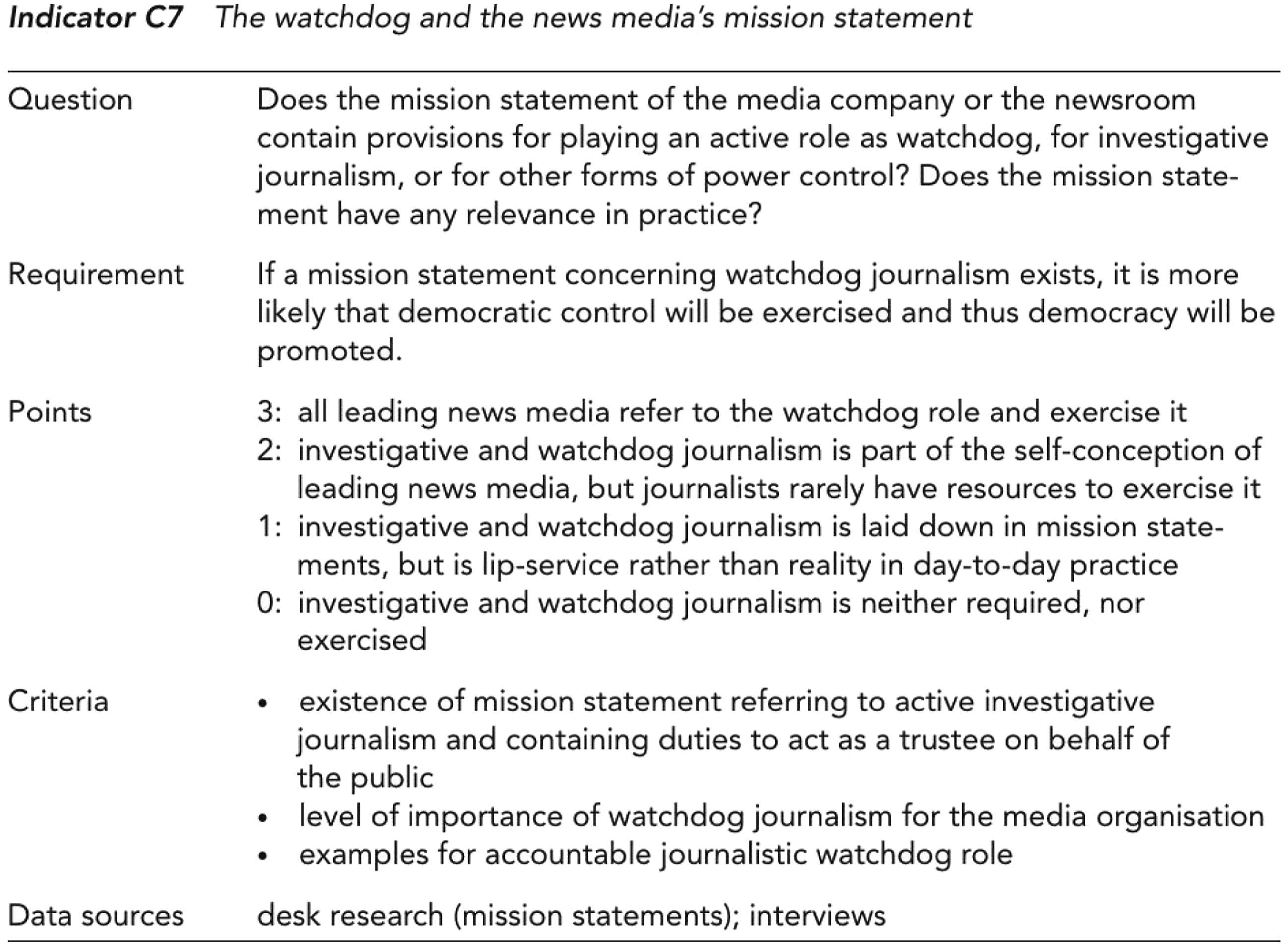
Eight European countries are present in the 2010 and 2020 MDM waves, allowing for longitudinal comparison, namely Austria, Finland, Germany, the Netherlands, Portugal, Sweden, Switzerland and the United Kingdom. 2 This selection includes Northern, Central, and Western media systems, considering the types proposed by Brüggemann et al. (2014). According to their clustering, Central countries (in this selection: AT, CH, DE, UK) show strong public broadcasting, strict ownership regulation, and low press subsidies. Northern countries (FI, SE) are characterised by highly professional journalism, inclusive press market, powerful public broadcasting, and generous press subsidies. Western countries (NL, PT) share a much lower level of public broadcasting and press subsidies. The typology by Brüggemann et al. (2014) still proposes the Southern cluster of countries with high degree of political parallelism and the least professional journalism, but none of these countries were in both MDM waves. Eastern European countries could not be analysed as well.
A network with research teams in each country was established to collect data. After data collection, they gathered together to compare the findings and fine-tune the grading, strengthening comparability. Throughout the project, it has been agreed that all research participants, among which this author, could freely use data gathered by colleagues to produce original research output for journal articles and book chapters, as long as the whole project would be mentioned. 3
For the news media sample, each country team selected newspapers, TV, radio, and online-only news outlets, considering the national contexts (e.g. Germany and Austria, with above average newspaper readership, had more media in these category, while the Netherlands included more online-only media, following the high use of online for news). The online versions of newspapers, TV and radio outlets were included. Each country also selected national and regional/local news media. The teams assessed their sample based on (1) secondary data from European and national reports and surveys, and (2) semi-structured interviews with editors and reporters from the news media sample and at least one extra interview with a key stakeholder such as a representative of journalists’ unions, a member of regulatory authority and/or academic scholars (2010: n = 67; 2020: n = 94; see Annexes 2 and 3 for the full media sample, main sources of secondary data and number of interviews per country). This way, the MDM sought to ensure a fair and balanced view of the media that shape public opinion in the analysed countries.
Interviews of the 2010 wave were conducted between fall 2009 and winter 2010, in the aftermath of the 2008 financial crisis, most of them in person, the remaining per telephone and few per email. The 2020 wave was partially affected by the COVID-19 pandemic, but most of the data collection and interviews had already taken place in the beginning of 2020, before lockdowns and the dramatic decline in media revenues (interviews occurred between September 2019 and April 2020). In the grading meetings, the researchers concluded that the data mostly reflected the reality before the pandemic.
Despite the existence of some MDM publications, no scholarly work based on these data has addressed so far the role of digital journalism in the continuities and changes of European media after the 2010 decade. Considering the theoretical background outlined above, which refers to news media roles in democracy and changes provoked by digitalisation as mostly US-centred, this further publication on the MDM should provide a unique contribution to research on the history of European digital journalism.
Findings and discussion
An overview of the quantitative cross-country and cross-indicator comparisons already points out some relevant findings. Considering the total amount of possibly achievable points (n = 78), European news media performed mostly stable between 2010 and 2020, scoring 70.4% of the total of points against 68.1% 10 years ago (see Annex 1). Grading of 72% of all indicators countrywide remained the same (n = 150), while 17% pointed to a better performance (n = 36) and 11% reflected a deterioration (n = 22). Therefore, in this European sample, not only the performance of leading news media has not worsened, as the crisis discourse might suggest, but the MDM data even suggest a slightly positive trend.
This overall performance, however, hides very uneven both cross-country and cross-indicator developments. Actually, five countries reached higher points, all coming from the Central and Northern clusters: Austria (from 56% to 64%), Finland (from 69% to 76%), Germany (from 72% to 76%), Sweden (from 77% to 79%) and the United Kingdom (from 72% to 77%). On the other hand, three countries finished 2020 with worse scores than a decade ago: Portugal (from 63% to 59%), Switzerland (from 62% to 59%) and the Netherlands (from 74% to 73%). More than one-third of the indicators changed in Austria, the Netherlands and the UK. Anyway, the facts that more countries improved their scores and that this improvement is stronger than the few worsening cases confirms the positive trend, especially for those countries with a strong public service orientation (Central and Northern media systems).
In the following, this article moves to the qualitative assessment of these indicators in order to gain a more granular understanding of the continuities and changes.
Continuities
The dimension ‘Freedom/Information’ was the single one with less changes: almost 80% of the indicators remained equal between 2010 and 2020. The geographical availability of news media remained extremely high, reaching all points as in 2010. Besides retaining most of the availability of legacy media infrastructure such as TV, radio and print, all countries have increased internet availability. From the perspective of the production of news and local coverage, despite closures of regional newspapers, other formats such as national sheets, TV, radio and, to a lesser extent, digital native news brands still cover roughly all areas of their countries. This is the case even in bigger ones such as Germany. Taking into account the whole news media offer, these countries still do not face a real problem with the growth of news deserts, as it is the case in the US (Abernathy, 2018; Pickard, 2020).
Another continuity in the freedom to inform concerns the existence of protections for the newsrooms against internal (owners and management) and external (advertisers and sponsors) influence. Only Austria had a significant change, with the increase of rules against internal influence and the decrease of protection against external influence. In most countries, formal separation vis-à-vis ownership and management is still the rule. An issue to be observed is that more media organisations, especially in Germany, the Netherlands and Switzerland, have adopted a model where editors-in-chief participate in the management board or are publishers, posing a risk for that protection. Finland, on the other hand, had in 2010 three relevant news media with editors-in-chief as publishers, and 10 years later none anymore, maybe anticipating the failure of this experiment. With regard to independence from advertisers and sponsors, the story is more complicated. Austria, Portugal, and Switzerland suffer more, as they deal with few advertisers in smaller or highly concentrated media markets. This pressure has only gotten worse with the crisis of the ad-based business model of news. Some journalists point out, for example, an increase in paid content. However, the MDM data indicate that newsrooms did not face more direct intervention in 2020 than one decade ago, as it could be expected (Ferrer-Conill, 2016). They live with more or less the same protections and challenges as before.
In the other dimensions measured by the MDM, media concentration also had less changes than expected. In 2010, this market was already extremely concentrated in most countries (these indicators scored among the worse in that wave), and continued to be at a similar level after 10 years. The most used digital news in these countries have indeed concentrated on companies predating the platforms and even the commercial internet of the 1990s. In some countries, such as Austria, not a single relevant news outlet has a digital-only operation. The increase of online offer by public service media in almost all countries in the sample contributed to the consolidation of the digital news market. However, in this fight of titans, and considering the whole of the media offer, concentration did not actually increase, as the number of big companies sharing the gross of the national and regional markets did not shrink. The exception is the Dutch market, where levels of media concentration increased even more following mergers in the radio market (takeover of Sky Radio by Talpa Network in 2017, reflecting an increase of CR3 by 13.8% in 10 years) and further audience concentration both in the newspaper market (Mediahuis and DPG Media owning most newspapers) and in digital journalism (with the dominance of the DPG Media news website nu.nl, which by the end of 2019 was the only Dutch news website in the top-10 list of the most visited websites, see Commissariaat voor De Media (2019)).
Changes
While many normative aspects of news media performance remained stable, and digital journalism to a certain extent even contributed to it, the MDM data also point to some important changes, in which digital journalism seems to have instilled much more special properties. The leading news media in these eight countries have experienced a significant change in their performance in three relevant areas, which will be addressed separately: the watchdog role, public participation and the reach of the audience.
Strengthening of the watchdog role
The dimension ‘Control/Watchdog’, which performed much worse than the others in 2010, presented the biggest improvement among the three dimensions (from 65.5% to 70.8%). This has been mostly driven by better performance in the indicators ‘The watchdog and the news media’s mission statement’ and ‘Watchdog function and financial resources’. After 10 years, more newsrooms have a mission statement that underscores the investigative nature of the journalistic work, and journalistic staff feels the relevance of this role in the daily practice. News staff argue that there is more clarity in the newsrooms that the news business depends on investigative reporting.
Most journalistic staff in the MDM sample sees no reduction in financial resources available to investigation. If 10 years before, shortly after the 2008 economic crisis, the interviewed journalists were way more cautious and pessimist with regard to the availability of the economic means for their role as watchdogs, now they still complain, but many recognise to have at their disposal the necessary means for any investigation. In many cases, they even report the existence of more resources. In Sweden, a journalist says: ‘This is a good time for investigative reporters’. Even in poorer countries, with smaller media markets, such as Portugal, there is a similar feeling among staff, where TV journalists, for example, report the existence not only of enough resources, but also of longer format pieces (e.g. 10–15 min) to publish their stories.
This is not true, however, with regard to smaller newsrooms, especially in local journalism, and the gap seems to increase. Digital-native news brands have not been able so far to fill this gap, just as predicted in the literature (Levy and Picard, 2011; Nielsen, 2015). A success story, however, comes from the Netherlands, where local media are benefiting from subsidy funds for independent investigation, such as the Dutch Journalism Fund and the Investigative Journalism Fund. The latter allocates more than 75% of its budget to regional or local news media (Vandenberghe & d’Haenens, 2021: 293).
Another reason for the stronger performance of the journalistic watchdog role was the emergence of data journalism as an investigative strategy, including alliances between media outlets to analyse data and report on findings. Most newsrooms either have dedicated editorial divisions for data journalism or hire or equip a sizeable amount of regular reporters with digital skills for this kind of reporting. The existence of specific training for newsrooms is mentioned by media staff from Finland, Germany, the Netherlands, Sweden and Switzerland. Swiss TX Media provides a three-week-in-service training at the Columbia University. Data journalism is seen as part of a broader use of digital skills that includes new strategies for data analysis. These trainings still reach mostly young and men journalists, what has been a matter of criticism by many reporters (including TX Media reporters). Some also complain about the lack of clarity concerning the selection criteria for specialised training. However, most newsrooms see a progress since 2010, when digital skills were already considered essential for the journalistic work but newsrooms had little to no support to develop them.
Finally, newsrooms often mentioned increasing collaboration with concurrent media to analyse digital data, especially via partnership with the International Consortium of Investigative Journalists (ICIJ). An example was cooperation in the context of the Panama papers. Broadening the scope, many newsrooms in European countries mention a slow, but steady pace leading to sharing of (economic and knowledge) resources, what is remarkable considering the dominance of the liberal paradigm of the marketplace of ideas in the conceptualisation of the role of journalism and news media (Ananny and Kreiss, 2011; Nerone, 2013).
More participation, but not necessarily online
A second area where leading news media have a clearly different performance is citizen participation. The involvement and participation of citizens in news production has been praised in the scholarly literature as an attempt to reduce news media’s reliance on elite sources (Scott et al., 2015). Many have expected the media, and the overall news production, to become more participative with further digitalisation of societies. The MDM data show that this prediction has a point, but not exactly as thought. The indicator ‘Participation’ made the second biggest leap in the quantitative assessment of the eight countries (from 58% to 75% of the total points). Even so, some online possibilities such as comments sections are scaling back.
In 2010, most newsrooms reported increasing efforts to open up stories to readers’ comments and to integrate user-generated content, even if not giving up editorial control. This has dramatically changed. Many newsrooms decided to completely close their comments sections. When comments are allowed, they have become restricted to subscribers or registered users and are strongly moderated. This trend towards less participation via comments has been strongly commented by staff in Finland, Germany, the Netherlands, Sweden and the United Kingdom, but is nearly widespread.
Multiple interviewees said that users are still encouraged to provide content, especially photographs and videos from events not immediately covered by reporters, but no leading news provider in the analysed countries relied on content provided by non-professional staff. As already observed above, influential digital news continues to be mostly professional journalism, often provided by non-digital native brands.
However, as said, this does not mean that overall participation of citizens in the process of news production decreased, it is only that its form is not the expected one. Actually, there is evidence of more participation in most countries. In Austria, newsrooms such as ORF’s (public service broadcaster), Standard’s (national quality newspaper) and Salzburger Nachrichten’s (local quality newspaper) have adopted regular public dialogue sessions. German ZDF (public service broadcaster), Die Zeit (weekly newspaper), Spiegel (magazine) and Stern (magazine) occasionally open their newsrooms to the public or organise events to meet their audiences. During the 2017 elections, the daily Süddeutsche Zeitung created the online ‘Democracy Lab’ to stimulate readers to discuss challenges for society. Furthermore, this media outlet employs an instrument to allow readers to decide which issue journalists should investigate. The Finnish public broadcaster Yle also organises public sessions and has even founded a ‘Head of Audience Dialogue’ to promote participation. Editors involved in these initiatives explain that, despite their rejection to user-generated content, the internet made their newsrooms aware of the need of more contact with the public.
In addition, editors often agree that social media work as a forum between journalists and audiences, providing useful feedback for the newsrooms. Many newsrooms use these tools to become aware of stories they should cover, and several interviewees report relying on Twitter to get feedback and keep informed about activism by a broader scope of civil society organisations. In these cases, even if indirect, digitalisation contributed to more participation.
Increasing gaps in news media reach
Finally, the reach of leading news media has had a consistent decline or, at least, a tendency of fragmentation in generation gaps. The Netherlands, Sweden, Switzerland and the UK have been downgraded from 2010. No other indicator of the MDM instrument has seen as many countries with a negative trend.
Fragmentation of audiences with the internet is an old concern among theorists of the public sphere (Mutz and Martin, 2001: 111), turned popular by concepts such echo chambers and filter bubbles. Although this topic is often considered an issue of audience, normative theories assume that news media should ensure that the public is well informed. If news media claim to fulfil democratic roles, they should accordingly reach citizens and stimulate their news use. The MDM data show that they have lost some ability to do so, and the digital transition of traditional brands avoided it to get worse.
All countries point out a high, but declining reach of leading news media. In most of them, however, the main brands retain (and often even increase) their dominant position in the news market with digital offers. Germany has very high levels of reach of traditional media in part because 63.6% of the population above 14 years old are unique readers of the respective online versions (BDZV, 2020). In Finland, newspapers have seen a 40% decline in circulation in this decade, but Helsingin Sanomat increased readership by means of digital subscriptions. 76% of the Finnish population follows online services of traditional media companies (Reunanen, 2019). In Austria, quality newspapers benefited the most of this trend, while in Sweden tabloids gained space. It is clear, therefore, that the digital operations of established news brands have become crucial for keeping or even increasing their reach within the national markets. Only the Netherlands seems to lag behind in this trend, having a single online news service with high reach.
The real problems for the news industry begin with the fact that social media increasingly become the main source of news for younger generations. In the UK, 56% of younger audiences (16–24 years old) use social media to access news, while 22% prefer websites and apps of the news brands (Ofcom, 2019). In Austria, among 18–24-year olds, 36% declare social media to be their main news source, and only 13% go the brands’ websites and apps (Gadringer et al., 2019). Sweden has strikingly 69% of their 16 to 29-year-old citizens using social media as their main news source (Newman et al., 2019).
Finally, in the 2010 data, news avoidance does not appear a single time in interviews nor secondary data. It was simply no concern among leading news media in these eight countries. In 2020, though, several interviews mentioned this problem. In addition, the Reuters Institute Digital News Report measures this dissatisfaction, which reached 35% of the population in the UK after the never-ending coverage of the Brexit, while Portugal, Austria, and Netherlands had nearly 30% of the population actively avoiding news (Newman et al., 2019: 26).
Although some important research results contest fragmentation by taking into account the whole media repertoire of the news audience (Dubois and Blank, 2018; Fletcher and Nielsen, 2017), the MDM data point to increasingly different patterns of news use, suggesting that overlap might be a contingent condition. Moreover, news avoidance increases in the Western countries (Netherlands and Portugal), and even Northern countries, with the overall best performance in normative criteria, fear this upward trend.
Final remarks
After the 2010 decade, with consolidation of platforms and professional digital journalism, the European leading news media have a similar performance with regard to democratic roles. In most countries, there is actually a slightly positive trend. In general, the Northern and Central countries of this sample – which have in common high presence of public media ownership and high professional standards – fare better than the Western ones. All of them display increasing presence of digital journalism mostly performed by news brands predating the internet. Furthermore, the roles related to the watchdog function improved significantly, with more awareness on the need of investigative work and certainty about its budget. Data journalism is crucial for these results. News production has also become more open to the participation of citizens, although in this aspect digital journalism resembles legacy media more than expected in 2010.
However, the influence of leading news media is declining in several European countries, as younger generations are turning rather to social media to get their news. In addition, local journalism continues to bleed, rarely benefiting from the positive aspects mentioned above. These results suggest that, if a vibrant local news environment has to be created, it will require more than simply reproducing online the traditional model of news.
Therefore, any narrative of a single development in the performance of leading news media in Europe with regard to core normative expectations is overstated. Although the overall performance is stable, many uneven developments among the countries and across the different roles hinder a narrative of a single tendency in Europe, including on the role of digital journalism. This also suggests that, as important as technology can be in the media industries, the performance of news media concerning democratic attributions still relates mostly to other structural factors, such as the models of media ownership and regulation as well as the cultural practices and values related to professionalisation.
Supplemental Material
Supplemental Material - European news media in the decade of digitalisation: Persisting democratic performance with uneven developments
Supplemental Material for European news media in the decade of digitalisation: Persisting democratic performance with uneven developments by Tales Tomaz in Journalism.
Footnotes
Acknowledgements
The author would like to thank all MDM researchers who participated in the data collection in their respective countries. The author also expresses his gratitude to the reviewers, who provided helpful and constructive comments on the original manuscript.
Declaration of conflicting interests
The author(s) declared no potential conflicts of interest with respect to the research, authorship, and/or publication of this article.
Funding
The author(s) received no financial support for the research, authorship, and/or publication of this article.

Supplemental Material
Supplemental material for this article is available online.
Notes
Author biography
References
Supplementary Material
Please find the following supplemental material available below.
For Open Access articles published under a Creative Commons License, all supplemental material carries the same license as the article it is associated with.
For non-Open Access articles published, all supplemental material carries a non-exclusive license, and permission requests for re-use of supplemental material or any part of supplemental material shall be sent directly to the copyright owner as specified in the copyright notice associated with the article.
