




Abstract
During times of crisis, the press plays a crucial role in communicating and negotiating the crisis. Considering Germany’s strong economic role in the EU, the German (media) perspective on European economic policy issues has a major influence on Europe. In 2018, Italy’s debt crisis posed the risk of a new euro crisis and a domino effect on other countries. Contrasting views of how to resolve economic crises opposed each other, with the Maastricht criteria at the center. Despite high debt, the Italian government pursued a Keynesian policy by increasing the deficit to stimulate economic growth. The European Commission, however, insisted on neoliberal policies and compliance with the criteria. This study discusses the (non)emergence of a European public sphere through the economic policy framing of the Italian sovereign debt crisis. Using quantitative content analysis, the relative prevalence of frames rooted in competing economic policy paradigms (neoliberal/Keynesian) in press coverage is examined. The results show that the neoliberal paradigm and the call for austerity dominate coverage, indicating a possible European public sphere. However, the biased media framing in favor of the European Commission’s and German government’s interests partly contributes to strengthening the nationalistic perspective on this European issue. Overall, the press failed to present the issue in a solution-oriented and pluralistic manner.
Keywords
Introduction
The mass media play a crucial role in communicating an (economic policy) crisis, as they form a public sphere in which information, opinions and interpretations are not only conveyed but publicly deliberated and discussed. As an essential source of (economic policy) information for citizens in Germany (Sommer and Schneller, 2021), providing citizens with pluralistic information about relevant European issues is the responsibility of the mass media. Thus, reasonable discourse among recipients will be encouraged to form opinions freely, the European level will be visible in debates, and certain paradigms will not become normalized (Conrad and Oleart, 2020; Kay and Salter, 2014; Statham, 2010).
However, the German mass media often fail to meet this requirement for plurality, resulting in a bias of issues and actors (e.g., Boomgaarden and Semetko, 2012). In particular, German economic policy reporting tends to be biased towards the paradigm of neoliberalism and its narratives (e.g., Arrese, 2018 for the European sovereign debt crisis; Krüger et al., 2021; Otto et al., 2021 for the Greek sovereign debt crisis).
Identifying media bias is critical not only for its content, but also for its impact on recipients' knowledge, attitudes, opinions, and decisions (Eberl et al., 2017). Following Entman (2010), biased coverage of one perspective results in distorted information for the recipient, who (unconsciously) attaches greater importance to that perspective’s frame of reference.
Considering the origins of the neoliberal bias in economic policy reporting in Germany is imperative. It is common for policy in Germany to be shaped by ordoliberalism, an ideology rooted in neoliberalism – the predominant ideology among key decision-makers in western nations (Krüger et al., 2021; Kay and Salter, 2014). Ordoliberalism emphasizes comprehensive privatization, deregulation, and reduction of social services, while requiring a state regulatory framework to maintain and achieve market regulation and ensure optimal consumer provision, so-called order-based policy (Ordnungspolitik).
Several economists and theorists attribute the foundation of austerity policies to ordoliberalism (Young, 2017). From this perspective, it is essential to strictly comply with European regulations such as the Stability and Growth Pact (SGP) when dealing with European economic crises. Indebted European countries living beyond their means should be held accountable for their policies. Costs cannot be transferred to other member states. Opposing camps (Keynesian) – primarily southern European countries such as Italy – call for a more flexible interpretation of European fiscal rules and reject austerity measures. It is evident that ordoliberalism played a significant role in the euro crisis through rule-based regulatory policy as well as the rejection of joint liability by the German government (Young, 2017).
However, the spread of neoliberalism in politics and science has increasingly blurred the boundaries between the original (German, Austrian, French, American) schools of thought (Ptak, 2009) – and the press is dependent upon ongoing political elite discourse and ideological orientations in science (Krüger et al., 2021). Economic policy journalism typically simplifies (or must simplify) complex issues by reducing somewhat abstract ordoliberal concepts or its distinction from neoliberalism to concrete neoliberal policy options (Hoffmann and Russ-Mohl, 2021).
Neoliberalism and Keynesianism become visible in public discourse through frames. Within the paradigms, the mass media select certain information when communicating, making some information more salient and thus more compelling than others.
Given the bias of European policy toward neoliberalism (e.g., Arrese, 2018), the framing of the German media is particularly pertinent when it comes to Europe-wide economic policy issues or crises, such as the Italian sovereign debt crisis in 2018 or the Italian dispute with the European Commission over compliance with the SGP. Having signed the Maastricht Treaty and the SGP 30 years ago, the EU member states ensure sound public finances by coordinating fiscal policies. There has been intense debate regarding the SGP’s compliance – EU member states have repeatedly violated it. Following a clearly negative bias in German reporting on Greece in 2015 on the central question of whether Greece can incur more debt despite its high overall debt (Otto et al., 2021), it was Italy in 2018 that triggered an intense (media) discussion with the European Commission.
The newly formed coalition of Lega and the Five Star Movement aimed to stimulate Italy’s economy through debt-financed spending by introducing a basic income, lowering the retirement age, and simplifying the tax system. Facing a total debt of 130 percent, the coalition intended to increase the new debt already promised by the previous government. The European Commission rejected Italy’s budget draft for the first time in history and intended to initiate deficit proceedings against Italy, resulting in extensive media coverage. Particular attention was drawn to the leadership of the governing parties, namely Matteo Salvini (Lega), with his “rough and very direct style” (Ignazi, 2018: 4) and Luigi Di Maio (Five Star Movement).
In spite of this, Italy, long considered a pro-European country, suffered a severe economic crisis following the euro crisis and experienced a significant rise in Eurosceptic parties (Bobba and Seddone, 2018). The Italian government’s budget dispute with the European Commission was a central topic in economic policy reporting (Grasse and Labitzke, 2018) and regarded as a major threat – headlines such as “Rome’s Playing with Fire” (Süddeutsche Zeitung) and “Italy’s Blackmail” (Handelsblatt) dominated German media coverage.
In retrospect of the conclusion of the Maastricht Treaty, scholars have become increasingly interested in the emergence of a European public sphere. Their general consensus is that the mass media provide a valuable forum for discussing European issues. Furthermore, they agree that the Europeanization of public communication is an integral part of the European identity and integration process, particularly in times of crisis.
Due to the opposing views rooted in neoliberalism and Keynesianism 1 regarding a highly relevant economic policy issue, the Italian budget dispute with the European Commission is an ideal case study. It is important to explore the role of German media regarding possible media bias in the public sphere in light of prevailing neoliberalism in the EU and Germany’s leading role. This study examines which economic policy orientation dominates German news coverage, how German media frame the Italian sovereign debt crisis, and to what extent German media framing provides insight into the degree of Europeanization of the German economic policy public sphere.
The (European) public sphere, the mass media, and framing
Having a public sphere is fundamental to any democratic society since it enables information and opinion exchange. Among the most influential theories on the public sphere is Habermas (1962), whose (further developed) approach has greatly influenced academic dialogue on the subject.
Through public debate and rational argumentation, citizens are able to exchange opinions and influence the political process in the public sphere (Habermas, 1962). Habermas recognizes the mass media as a significant influencing factor in the public sphere, which is subject to normative requirements, such as providing a diversity of political viewpoints (Habermas, 1992). Due to fundamental criticism – e.g., Gerhards and Neidhardt (1990) regarding Habermas' testability and the fact that, according to Habermas' tradition of deliberative democracy, discourse is conducted rationally – Gerhards and Neidhardt (1990) do not assume that consensus is achieved by deliberating factual arguments, but rather by interpreting issues (framing).
Framing has been particularly useful for understanding how the mass media construct different realities (Gamson and Modigliani, 1989). Media framing has been a significant subject of research in the past years (e.g., Gamson and Modigliani, 1989; Matthes, 2007, 2014; Semetko and Valkenburg, 2000). The research on frames in communication studies was mainly shaped by Entman (1993): “To frame is to select some aspects of a perceived reality and make them more salient in a communicating text, in such a way as to promote a particular problem definition, causal interpretation, moral evaluation, and/or treatment recommendation for the item described.” (Entman, 1993: 52).
Framing focuses on selection and salience: Framing primarily means emphasizing certain aspects of a topic and neglecting or omitting others.
The mass media thus communicate through a selection of certain information. The selected aspects are considered important by the recipient – the more frequently the recipient is confronted with them, the more important they become in his/her consciousness, and the more strongly they shape his/her interpretation (Matthes, 2014: 67).
Based on Entman (1993) and Matthes (2007, 2014), frames consist of different frame elements: • The problem definition is at the center of a frame and defines the topic and the relevant actors (negative or positive). • The causal interpretation of the problem is understood to mean cause(s) traced back to a situation or relevant actor. • The moral evaluation refers to evaluations of the responsible actor and/or their policies. The evaluation facilitates the contextualization of the topic. • The treatment recommendation suggests solutions and/or concrete policy options to solve the problem or to maintain the situation.
The individual frame elements may be linked to produce a logically consistent horizon of meaning that appears repeatedly in journalistic contributions (Matthes, 2014). Thus, the press can exert (consciously or unconsciously) political influence over public opinion through framing by controlling the publication of information to a certain extent (Entman, 2003; Habermas, 2006).
It is crucial to consider the question of Europeanization when addressing (the framing of) European issues in the public sphere. Europeanization remains a fuzzy but multidimensional concept in literature, with most scholars comparing national spheres of different European countries in order to examine the Europeanization of national public spheres. Some of them support the assumption that a transnational European sphere is developing (e.g., Barth and Bijsmans, 2018 regarding press coverage in Germany and Britain of the Maastricht Treaty in the '90s; Koopmans and Statham, 2010), while others disregard the emergence of such a sphere and suggest instead a re-nationalization of public spheres, especially when austerity policies are dictated in times of crisis (see Risse, 2014).
Some studies focus solely on the Europeanization of the German media and partly confirm (e.g., Koopmans and Erbe, 2004 for specific policy fields) and partly reject (e.g., Gerhards, 2000) the emergence of a European sphere. Research often cannot provide clear evidence for or against the Europeanization of public spheres since, depending on the criteria used, scholars arrive at different results, even within a study (e.g., Koopmans and Erbe, 2004).
The attitude of the respective EU country toward Europe is generally regarded as essential to the Europeanization process. While the German public sphere is among the most open to European integration and is very Europhile (Pfetsch, 2005), Italy’s attitude is increasingly shaped by Euroscepticism.
According to Risse (2014), Euroscepticism is closely associated with the politicization of EU issues. 2 On the one hand, politicization can reinforce Eurosceptic narratives within countries and conflicts in Europe, thus leading to a de-Europeanization of public spheres. Galpin and Trenz (2017) argue that the media’s commonly known negativity bias is stronger in EU reporting and thus plays into the hands of Eurosceptic parties to spread their European understanding. On the other hand, politicization in a democracy is necessary for the unfolding of a vibrant European public sphere and can foster a transnational communication community. Increased critical voices and greater visibility of Eurosceptic actors in national media can enhance the visibility of European issues and accelerate the Europeanization process (Bijsmans et al., 2018). Based on Bobba and Seddone’s (2018) study on how Eurosceptic actors and economic crises affect news coverage of the EU, they argue that especially since the global financial crisis, EU affairs have become more visible in national media. Additionally, EU institutions have been increasingly questioned, which can also be attributed to the rise of Eurosceptic parties.
In this study, the concept of Europeanization refers to the process by which EU affairs/actors become increasingly visible, politicized, and contested in domestic media (Statham and Trenz, 2013). Several scholars have distinguished between vertical Europeanization, or the extent to which EU actors are present in national spheres, and horizontal Europeanization, or the extent to which actors from other member states are present in national spheres (Koopmans and Erbe, 2004). As defined by Koopmans and Erbe, top-down Europeanization occurs when European actors intervene in national policies or debates for common interests whereas bottom-up vertical Europeanization occurs when national actors communicate with European actors and/or address European issues.
As part of this study, the communication between the conflict parties is concretized by examining their attributions of responsibility. Thus, not only can actor presence be observed in reporting, but also the extent to which actors are addressed. As a result of this conceptualization, certain topics or aspects of topics are selected for public debate, highlighted, and framed. Therefore, the actual direction of Europeanization depends on the way issues are framed as well as the degree to which political leaders and in particular the media in Europe give Eurosceptic parties and actors a voice in relevant European debates (Risse, 2014).
Performance requirements
The press plays a significant role in providing citizens with information. Around 27 million people used traditional print media in 2018 as their primary source of information (Sommer and Schneller, 2021). In a democratic environment, citizens must be informed about central institutions and their actions (Gerhards, 2000).
As a result of journalism’s democratic role and the original function of the press as a marketplace of ideas, which aimed to guide the public sphere in a democratic direction, reporting should be pluralistic (Conrad and Oleart, 2020; Harjuniemi, 2021): To promote a pluralistic democratic society, the mass media should convey essential different worldviews. It is therefore important for reporting to discuss economic policy issues based on different ideologies rather than declare certain paradigms or ideas unchallengeable.
Since the mass media are a public arena for contestation – democracy and plurality require conflicts between different normative viewpoints (Conrad and Oleart, 2020) – times of crisis and social turbulence offer the mass media a chance to critically question the status quo within a country and purposefully report in ways that can assist in uniting EU interests (or further segmenting the Union).
According to Entman (2003), the mass media must convey a balance of perspectives, which also refers to frame parity. The mass media should report on two (or more) interpretations roughly equally and thus provide at least one counterframe, a complete alternative narrative of problem, cause, evaluation, and solution, to the dominant frame(s). Otherwise, media framing can help normalize a particular paradigm within a country into being presented as the only correct perspective – as Kay and Salter (2014) have revealed for the BBC’s media framing of the UK government’s neoliberal austerity agenda in the 2010 Comprehensive Spending Review. One-sidedness influences the formation of citizens' opinions (Entman, 2003: 418) and media power or a media bias emerges (Entman, 2007).
Journalists who do not report objectively insert their ideological views into the reporting and thus influence the distribution of power. Following Entman it is essential to distinguish between slant and bias. News is considered slanted if reporting emphasizes a certain perspective in a political conflict and ignores others. If the mass media consistently frame slanted toward a specific ideology, interest, or party seeking power and governance legitimacy, media coverage is considered biased. Entman suggests using the term media bias only when coverage is persistently slanted and concerns the most influential media. Eberl et al. (2017) argue that media bias can be best defined through its opposites, objectivity or/and balance. It is considered unbiased coverage when the mass media consider all (political) perspectives and do not strongly favor or oppose a particular political party or viewpoint. 3
Overall, only limited research has been conducted on media framing or media bias in the public sphere that deal with the paradigms of the European debates on austerity and the Maastricht Treaty. This study calls into question whether the German media select topics, actors and perspectives that enable the opening of national discourse and thus also transnational perspectives on issues.
The notion of a European public sphere becomes particularly visible in times of crisis. The debt crisis of the EU’s third-largest economy and the subsequent escalation with the European Commission established a precedent for future non-compliance with the SGP – due to economic crises, recessions, and other economic policy orientations.
As the engine of the EU, Germany is regarded as its economic powerhouse. According to research (Ojala and Harjuniemi, 2016), Germany’s stance on austerity and its ordoliberal frame have a significant influence on European public framing during times of crisis. As opposed to austerity and common debt, Italy has long advocated for the opposite. A media analysis of the Italian sovereign debt crisis raises potentially significant questions regarding the German media’s framing – either favoring or hindering the Europeanization of the public sphere – and its role as driver and legitimator of neoliberal narratives in economic policy crises.
The purpose of this study is to bridge the theoretical and practical perspectives of framing and the (European) public sphere in order to illuminate the role of the mass media and its power in the selection of topics in relevant European conflicts.
Research questions
The study aims to analyze German press coverage of the budget dispute between the Italian government and the European Commission in 2018 by examining the articles in the German national dailies and the magazine. This paper opts for analytical sub-questions: 1. Does the neoliberal or the Keynesian paradigm dominate the coverage of the Italian sovereign debt crisis? 2. Which neoliberal and Keynesian issue-specific media frames can be identified for the Italian sovereign debt crisis? 3. To what extent supports or impedes the German media’s framing a Europeanization of the public sphere on the Italian sovereign debt crisis?
Research design
The investigation period runs from May 18 to December 31, 2018, thus deliberately targeting coverage of the government Conte and the publication of its government program, the negotiations with the European Commission, and the ultimate agreement between the Italian government and the European Commission regarding Italy’s budget deficit for 2019. The objects of investigation are journalistic articles of the national dailies Frankfurter Allgemeine Zeitung, Handelsblatt, Süddeutsche Zeitung, die Welt, die tageszeitung, BILD and the magazine Der Spiegel.
The selection of different media based on their type and positioning in the political right-left spectrum and different journalistic forms of presentation creates a representative German public arena. In the analysis, no distinction is deliberately made between neutral and opinion-oriented journalistic forms, or between media with different political orientations. A first reason stems from a theoretical distinction between journalistic framing and media framing (and media frames imply journalistic frames). When studying media frames, the question is not so much about the individual journalist’s skills, but rather what the overall media landscape offers recipients and how recipients are framed within that landscape. Second, investigating a single aggregated media agenda comprised of different media outlets is consistent with current research (e.g., Herfroy-Mischler and Friedman, 2020; Ophir et al., 2021).
The articles were accessed via online databases or archives. The search term "Italy" was used to collect data on all articles related to the Italian viewpoint (full coverage survey). As a database, 541 articles with a clear thematic reference to the budget dispute were identified.
Quantitative content analysis is used as method of analysis. It offers the major advantage of analyzing a large data set based on qualitatively elaborated variables. Also, it provides reliable information and allows generalized conclusions to be drawn (see codebook for detailed information on the methodology, coding process, statistical procedure, variables).
Based on the large body of European public sphere research, this paper methodologically deviates from previous research: it focuses on the issue-specific framing of a relevant European topic, tracing the Europeanization of the German national public sphere, i.e. whether European debates are presented and framed in the German media in a way that enables European actors to be heard, to be represented beyond national bias, and to be adequately discussed in public discourse.
For the development of the frame variables, this study adopts a deductive-inductive approach. First, the root categories (frame elements) are adopted from Entman, before the concrete Keynesian and neoliberal variables within the root categories are inductively generated from 15 percent of the articles and recorded in a category system and codebook.
Neoliberal and Keynesian sample variables of each frame element.
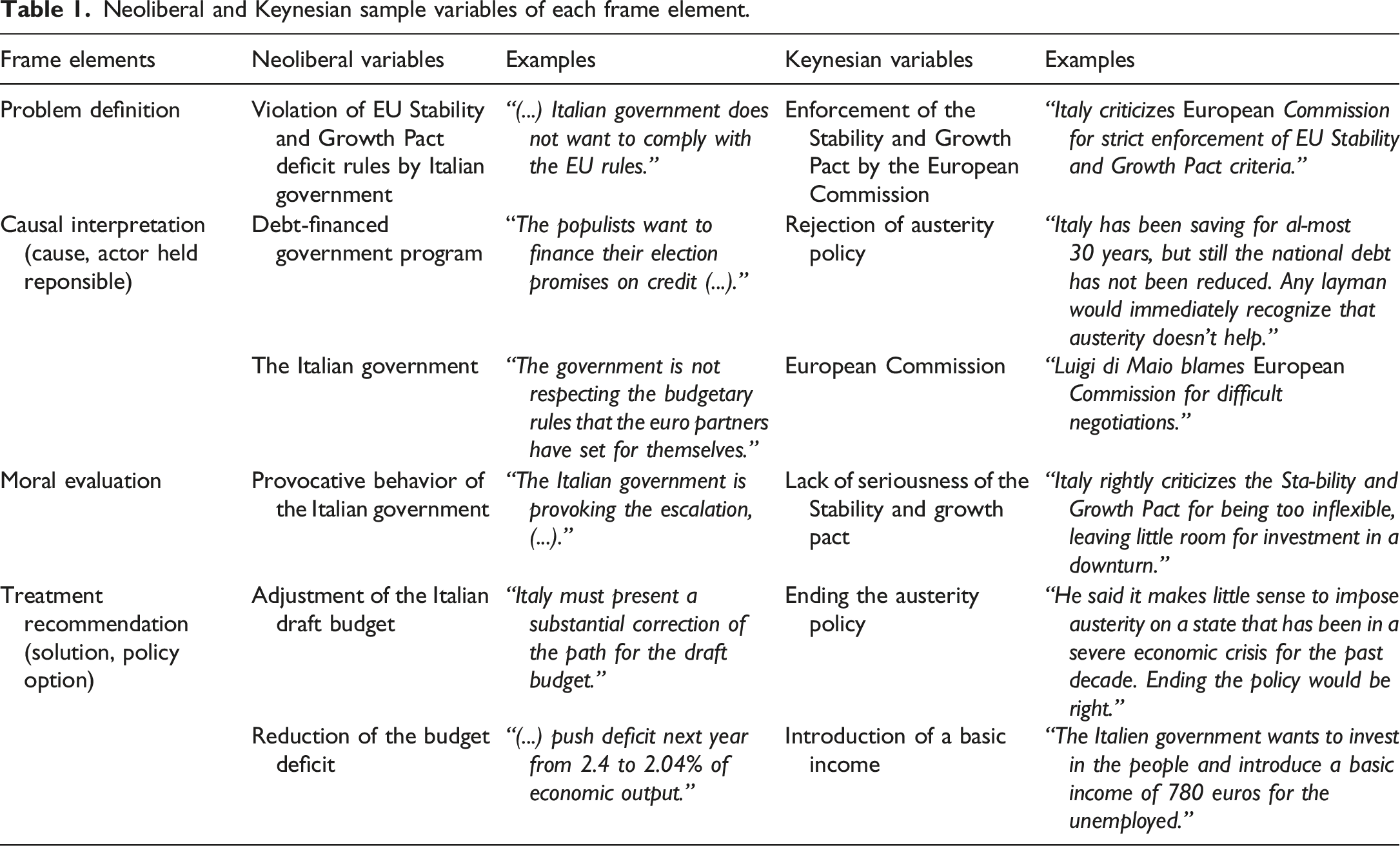
From a neoliberal perspective, the Italian government’s plan to violate deficit rules by presenting a government program to be financed by high new debt is problematic. Consequently, the Italian government is urged to adjust the draft budget for 2019, thus reducing the planned deficit from 2.4 percent to 2.04 percent. As a dispute ensues, the Italian government’s behavior is described as provocative. The main diagnosis from a Keynesian perspective is to strictly enforce deficit rules. By introducing, e.g., a basic income, the Italian government rejects austerity policies and aims to increase debt. Meanwhile, the seriousness of the Stability and Growth Pact is being questioned.
Coding is carried out by six trained coders using a predefined codebook. After some coding training, two pilot coding tests are carried out with a time lag. The second pilot coding test with 24 identical articles revealed an acceptable Krippendorff’s alpha inter-coder reliability coefficient of 0.792 (Krippendorff, 2018: 241).
First, the frequencies of the concrete variables within the respective frame elements are considered with each other using cross-tabulations. In a second step, all frame element variables are simultaneously included in the analysis and statistically tested using multivariate logistic regression (logit model).
In research, there are a few regression-based methods for evaluating media frames statistically (see Matthes, 2007 for an overview). In this study, a combined approach is employed. The logit with the central frame element problem as the dependent variable is an appropriate method to examine the presence of media frames, as it corresponds to the conceptual framework of frames as well as its coding process. From a statistical standpoint and given that media frames are understood as specific, distinctive patterns of a text consisting of several selectively chosen elements, the objective is to identify superrandom 4 (significant) correlations of a problem variable with different variables for causal interpretation, moral evaluation, and treatment recommendation (predictor variables) (Marcinkowski, 1999).
The method used does not suggest that certain frame elements trigger the appearance of the problem (causality) – rather, it “proves” that certain frame elements occur in conjunction with each other and with the problem itself. When predictor variables have such a substantial impact on the probability of occurrence, they are interpreted not as the cause of a particular problem, but rather as a typical pattern of the frame in question (Marcinkowski, 1999).
Thus, the (crucial) question can be answered by logit analysis: How strong is the correlation between the problem and its related elements? This provides insights into how the German mass media framed the debates and the possible degree of Europeanization of the German public sphere. If the individual models show statistically significant, positive coefficients of the respective concrete variables, this entirety of variables are interpreted as an issue-specific media frame. To create a coherent frame, not all frame elements must be present (Matthes, 2014).
Results
Descriptive results
The issue was generally quite salient in German media coverage. On average, the mass media published about two articles per day on the European debates between the Italian government and the European Commission.
The articles examined outline two contrasting problem definitions: The neoliberal problem reflects the view of the European Commission, the violation of the SGP – the Keynesian problem refers to the Italian view: the "enforcement of the SGP by the European Commission". Of these, articles with the neoliberal problem perspective dominate each month. In total, 95 percent of all articles (514 articles) stress the neoliberal problem definition, while only about 5.5 percent (30 articles) express the Keynesian perspective.
Causal interpretation
In approximately 90 percent of all articles, neoliberal causes are discussed, whereas Keynesian causes are mentioned to a lesser extent, in 24 percent.
The analysis shows a range of causes from a neoliberal perspective with the planned budget deficit as the primary cause for exceeding the fiscal criteria, being named in nearly 80 percent of all articles. An average of 21 percent mention the debt-financed government program and the three main (costly) policies – basic income, pensions, and tax reforms. From a Keynesian perspective, the main arguments for increasing the deficit are the threat of recession in Italy (14.4 percent), the rejection of austerity policies (7.6 percent), and the need to reform the SGP (5 percent).
In almost every article (99.4 percent), actors are attributed responsibility. Different actors are held responsible for the problems. The Italian government is seen as responsible in 90 percent of the articles and therefore the main actor from a neoliberal perspective – Matteo Salvini and Luigi Di Maio in just under 30 and 21 percent of the articles. Meanwhile, the European Commission is considered the culprit in all articles on the Keynesian problem.
Moral evaluation
The evaluations in the articles from a neoliberal (European Commission’s, German government’s) perspective dominate reporting, being mentioned in 74 percent of all articles. These primarily include provocative Italian behavior (55.5 percent), an uncompromising attitude by Italy (26.4 percent), and an overly pessimistic assessment of Italy’s economic situation (18.1 percent).
In just 12 percent of all articles, these evaluations are made exclusively from a Keynesian (Italian government’s) perspective, such as the lack of seriousness of the SGP (8 percent) and worse treatment of Italians in comparison to other states (4.3 percent).
Treatment recommendation
In 53 percent of all articles, solutions are presented from a neoliberal perspective, in only 34 percent Keynesian solutions are presented. While an adjustment of the draft budget dominates from a neoliberal perspective (51 percent), from the Keynesian perspective the main solution is to end austerity policies (30 percent).
In terms of concrete policy options, the dominance of the economic policy orientation changes: Keynesian policy options (pension and tax reforms) and avoiding a deficit procedure are mentioned in just under 30 percent of the articles, while neoliberal policy options (initiation of an excessive deficit procedure, reducing the budget deficit) are mentioned in 26.2 percent of the articles.
Economic policy framing in the German public sphere
Following are the results of the frame analysis for the neoliberal and Keynesian paradigms. Individual problem definitions are utilized as the dependent variables in each model. According to Bortz and Döring (2006), issue-specific frames are defined as containing all highly or very significant elements. The significant, positively correlated predictor variables are part of the media frame and are highlighted in green in the following tables. 5
Logistic regression model: The neoliberal problem definition “violation of the Stability and Growth pact” (dependent variable) and frame elements.
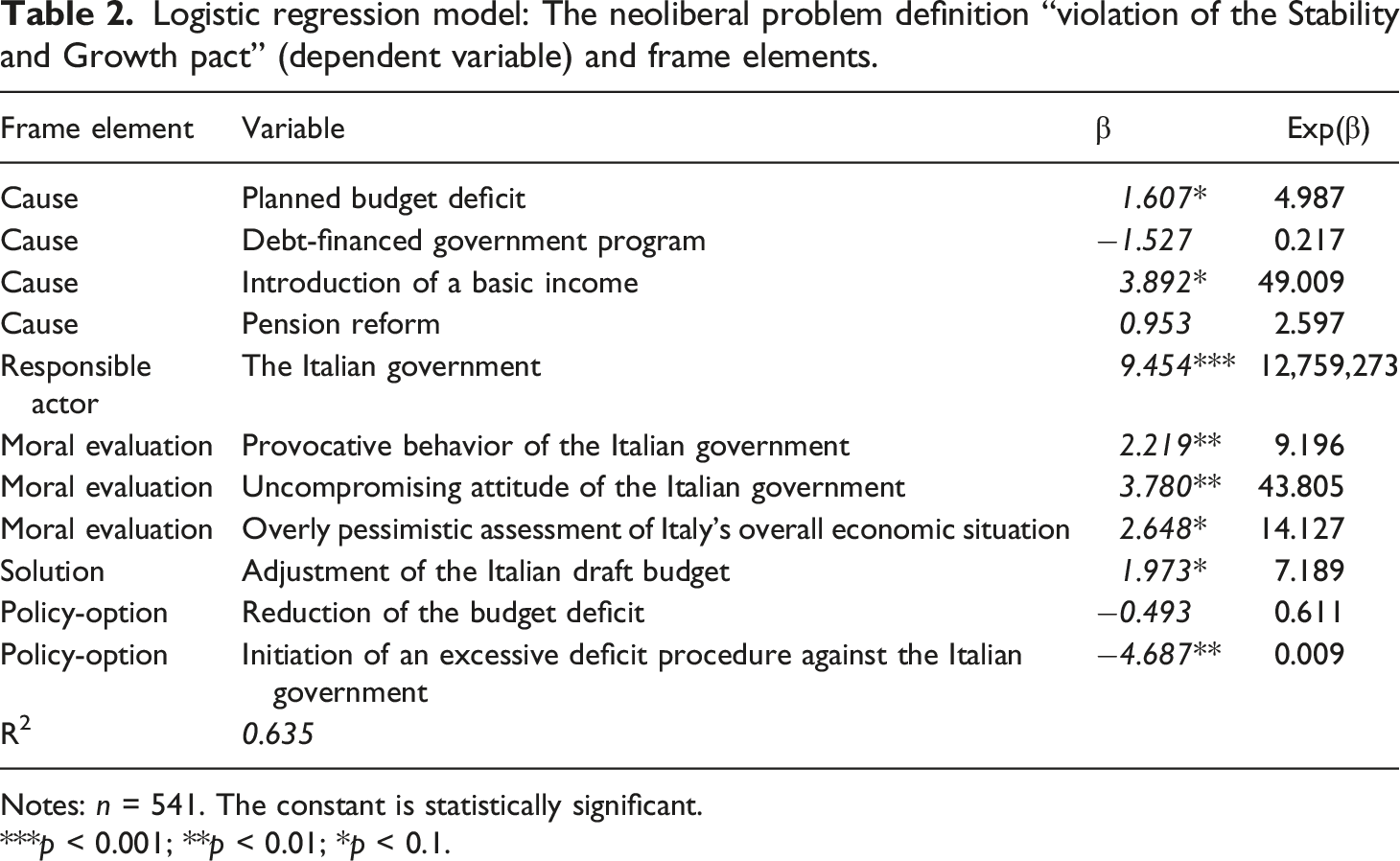
Notes: n = 541. The constant is statistically significant.
***p < 0.001; **p < 0.01; *p < 0.1.
According to the analysis, German mass media have increased their attention to these specific frame element variables. The controversy has therefore not only focused on Italy’s planned deficit, but also on the actors' rhetoric and communication. In the taz, Italian actors demonstrate polemical and populist behavior, such as “There’s a letter from Brussels? All right, we're waiting for Santa Claus” 6 (Salvini, 2018 cited in Braun, 2018). The Italian government’s provocative communication fueled the debate. E.g., the Italian government’s response to the European Commission’s recommendation to initiate an excessive deficit procedure attracted high media attention in November. Through statements such as in the taz: “I demand respect for the Italian people, and I demand that they don't make me run the 100-meter race with ski boots on my feet.” (Salvini, 2018 quoted from Braun, 2018) or in Der Spiegel: “And whoever criticizes the Italian way … will still be surprised. Within a few weeks, Italy will be revolutionized.” (Conte, 2018 cited in Bartz et al., 2018), the Italian government publicly expressed confidence in its change of political direction.
Logistic regression model: The Keynesian problem definition “enforcement of the Stability and Growth Pact by the European Commission” (dependent variable) and frame elements.
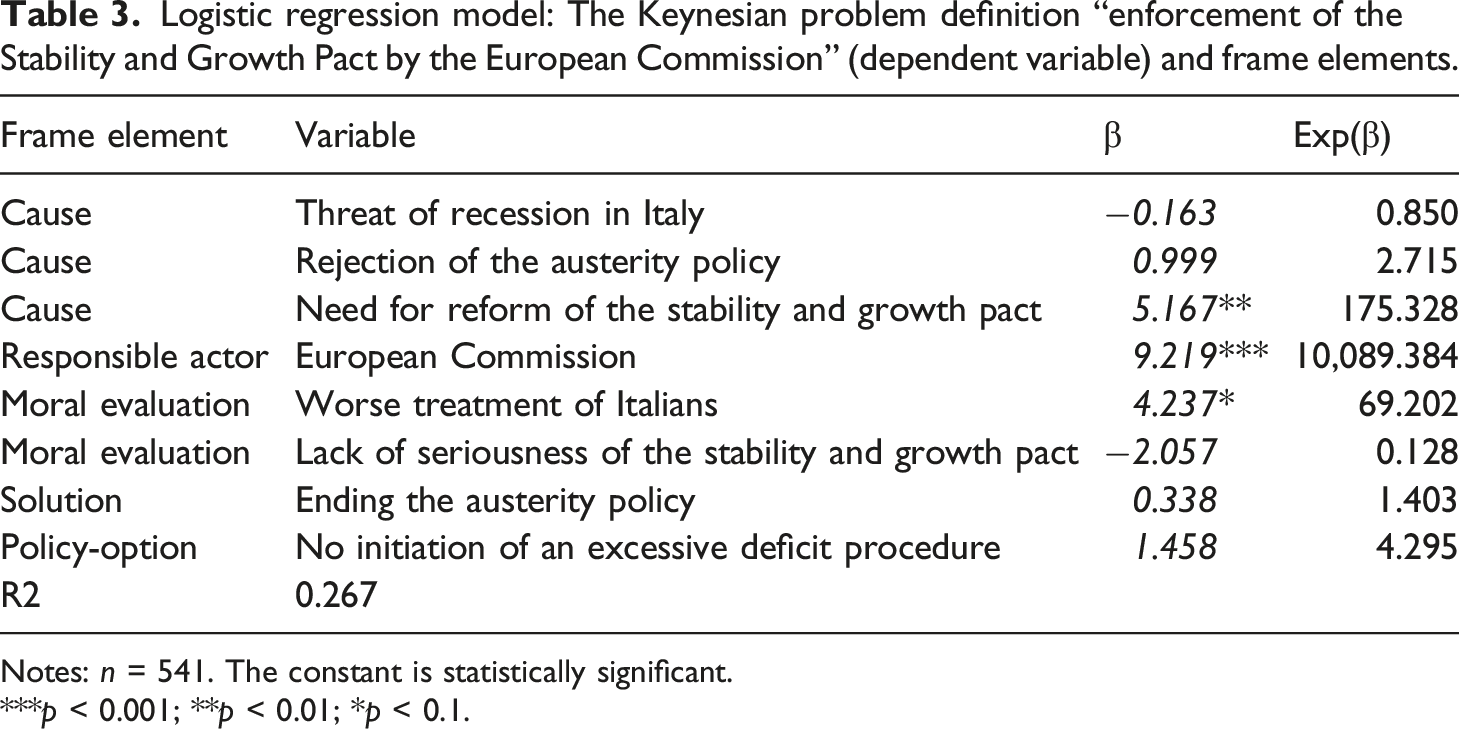
Notes: n = 541. The constant is statistically significant.
***p < 0.001; **p < 0.01; *p < 0.1.
Essentially, the frame analysis results reflect on the one hand the Italian perspective, which was primarily influenced by the perceived inflexibility of the SGP. On the other hand, the analysis reveals that the Italian government often chose not to engage in constructive, solution-oriented dialogue with the European Commission, but instead focused on a negative evaluation of the SGP. (Former) European parliamentarians such as Sven Giegold also agreed with this perspective: “Italy correctly criticizes the Stability Pact for being too inflexible, leaving little room for investment in a downturn” (Giegold, 2018 cited in Crolly, 2018).
Discussion
The press has a large impact in Germany. The most influential national dailies and the magazine selected provide the majority of economic policy information for the German population. The mass media choose who, what opinions and interpretations of issues they report on and can thus influence the emergence of a European public sphere. It is relevant to critically examine this role of the mass media and the entrenched neoliberal mainstream in Germany that fuels (economic policy) conflicts on a European level.
In Germany, economic policy issues are primarily reported from a neoliberal perspective. This dominance catalyzes a media bias against other economic policy views in the European conflict studied: The neoliberal paradigm dominated coverage of the Italian sovereign debt crisis. Consistent with Entman, from May to December 2018, coverage of the most influential press in Germany was consistently slanted toward the European Commission’s and German government’s interests. Therefore, the German media failed to report in a paradigmatically pluralistic manner in 2018.
These findings complement observations on neoliberalism in German media by Krüger et al. (2021). The authors note that neoliberalism dominates ongoing elite political discourses in Germany and that those who counter such neoliberal arguments have significantly less chance of being heard because of well-resourced and respected neoliberal think tanks.
Moreover, the findings align with those of Kay and Salter (2014), who show that the neoliberal paradigm dominated reporting of the British government’s economic policies. The authors advance the idea that the mass media did not provide pluralistic political deliberation but instead created a fake public sphere, in which the criteria of rationality according to Habermas are absent from a consensus created by opinion-forming institutions under the guise of public interest (Kay and Salter, 2014: 768).
According to the frame analysis, the individual frame elements aggregate to form certain superordinate frames that represent specific patterns of interpretation for recipients. Neoliberal views were presented within more complex contexts of meaning that identified causes, evaluations, and suggested solutions to the problems. Media coverage, on the other hand, rarely linked Keynesian criticism of austerity with recommendations for action but emphasized responsibility attributions. Thus, a certain frame parity or balance desired by Entman (2003) cannot be observed, but an absence of effective counterframing to the dominant neoliberal frames.
Considering that populist, Eurosceptic (government) parties pose a significant challenge to economic policy journalism, the press has emphasized attributions of responsibility and evaluations consistent with research findings regarding Euroscepticism. As soon as populist actors engage in public discourse, the negativity of reporting increases (Bobba and Seddone, 2018), particularly of EU reporting (Galpin and Trenz, 2017).
According to the study, two conclusions can be drawn regarding the Europeanization of the public sphere in light of media framing.
On the one hand, the Italian sovereign debt crisis was a prominent topic in the German media – which is in line with research findings that European issue salience has increased significantly in the domestic media since the mid-1990s (Koopmans and Statham, 2010; Risse, 2014). In almost every article, responsibility was attributed to actors. As part of their response to national actors, European actors threatened sanctions against Italy for failing to meet fiscal criteria or sought legitimacy from Germany (top-down Europeanization). Besides, a weak variant of horizontal Europeanization occurred in that the German media reported on the Italian national political events (cf. Koopmans and Erbe, 2004) – signs of Europeanization.
On the other hand, findings confirm that the nationalistic viewpoint manifested itself in framing. Considering that Italy was the keyword of the articles, it is apparent that media coverage depicted the Italian crisis as a bipolar conflict between the European Commission and the Italian government. As argued by Bijsmans et al. (2018), the increase in EU-critical voices has resulted in greater exposure of the European issue. Even so, the politicization and increased visibility of Eurosceptic actors reinforced Europhile narratives in the German public sphere and presented Eurosceptic actors as a source of debate that transcended political rationality.
In general, the conflict was presented from an entirely neoliberal and thus nationalistic perspective. A clear media bias toward the perspective of the European Commission was evident, as the Italian perspective was rarely conveyed, and the Italian government was increasingly evaluated. Research has shown that the media’s nationalism is responsible for the re-nationalization of European issues (Gerhards, 2000; Risse, 2014).
Taking all the above into account, the issue salience, and the high extent of attributions of responsibility argue for Europeanization. However, the neoliberal framing of the issue suggests a strong nationalistic view.
However, this study has some limitations and therefore provides new research opportunities. Traditional mass media are losing their influence over the public sphere as a result of digitalization and social media, leading to an ever-increasing segmentation of the media and fragmentation of the public sphere along common interests. Although the mass media studied here represent the German quality (and tabloid) press, they do not always represent a unified national space. Future studies need to examine the increasing segmentation and framing from the opposing political camps, as well as media coverage in both countries, in terms of a possible Europeanization of the same issue in both countries at the same time.
This study further assumes that the mass media are free to determine how they report and who may comment. It is relevant to consider other factors for framing choices in this case, including the editorial line of the medium, the journalist’s own interests, social structures and agendas, journalistic framing (for example, through interviews), frame sponsors, the adoption of frames from competing elites, or the pure reflection of political realities.
Conclusion
The role of key economic policy paradigms can be identified in the frames uncovered in press coverage, which provide information on the Europeanization of the national public sphere. This study reveals a dominance of neoliberal economic policy views in German coverage of the Italian sovereign debt crisis.
As a result of this study, there are no unequivocal arguments either for or against the Europeanization of the German public sphere. In their national editorial agendas, the German media placed a high value on European debates and actors. However, the mass media consistently framed the issue slanted in favor of the European Commission and its austerity agenda. As part of the German media’s issue framing, a lot of attention was paid to evaluations and attribution of responsibility to Eurosceptic Italian actors.
Assigning responsibility means not offering solutions but aiming for a fixed situation. Concerning the question posed initially, the German media did not select topics and perspectives that encouraged an opening of the national discourse. European actors were not portrayed beyond national bias. The press offered only limited information for informed choice, and coverage tended to emotionalize. Generally, the press focused on one perspective of the conflict and did not provide a solution-oriented, pluralistic, and balanced view of the issue.
It is necessary to criticize this clear dominance of monocausal coverage, as well as the consequent absence of an integrated (Keynesian) interpretation of Italian positions.
The press can be viewed as a mirror of reality, but it can also create different versions of reality in accordance with interests, social structures, and agendas. Nevertheless, it has the responsibility of listening to different opinions and actors to enable the free formation of opinion through pluralistic reporting and to facilitate a holistic view of controversial European economic policy debates.
Pro-Europe vs. anti-EU conflicts can be observed anywhere these days. Given the challenges the European Union faces in 2022 – e.g., the global pandemic COVID-19, economic crises, Brexit, Poland, and Hungary in the question of European values and rule of law, dealing with war as in Ukraine – a European public sphere is more necessary than ever. If we move in the opposite direction, we must ask ourselves whether this is due to nationally led discussions and a lack of openness to plurality.
This study has contributed to capturing quantitatively the degree to which Europeanization of the German public sphere occurs and extending the existing literature on framing in press coverage, filling a research gap associated with issue-specific framing during European (economic and political) conflicts/crises. In this regard, it is capable of making significant contributions to theory and methodology. This study introduces a new, combined framework for exploring Europeanization through framing by developing issue-specific frames in a deductive-inductive approach, contextualizing them in the economic policy paradigms, and testing them using multivariate logistic regression. Future research should build on this existing base.
Footnotes
Declaration of conflicting interests
The author(s) declared no potential conflicts of interest with respect to the research, authorship, and/or publication of this article.
Funding
The author(s) disclosed receipt of the following financial support for the research, authorship, and/or publication of this article: This work was supported by the Otto-Brenner Foundation under Grant [number 2020–225].
Data availability statement
The data that support the findings of this study are available from the corresponding author upon reasonable request.
