



Abstract
In this article we focus on one important event related to the Greek dimensions of the so called refugee crisis in Europe. This event took place during late February and March 2020 and is known as the Evros events that occurred when Turkey decided to open its European borders to the refugees. Greece responded by closing its land borders with Turkey, and by halting the asylum application process. The area surrounding the Evros River in Greece became heavily policed by the Greek police and the EU’s Frontex border police, further aided by various citizen militias consisting of Greek and other EU nationals. This research analyzes the newsmedia coverage of the specific incident through a qualitative frame analysis on news articles written by five Greek newspapers that have different political affiliations. The analysis then answers a two-fold research question: how did the Greek press frame the Evros events, and how did these frames contribute to the public debate around migration in the country.
Introduction: the “refugee crisis” in Europe: Political and media-related aspects
The so-called refugee or migrant crisis in the European Union (EU) (2014–2016) is a polyvalent “crisis” that concerns various events, and includes different definitions over what constitutes it, the challenges it poses, and how it should be dealt with (Triandafyllidou, 2018: 200). The use of the term crisis in this context is problematic as it entails highly negative connotations towards the refugees and the migrants, which may legitimize exceptional, anti-migration measures (Krzyżanowski et al., 2018: 3; Sajjad, 2018; Serafis et al., 2021a). The process of entering the EU nowadays, can be very dangerous for non-Western citizens. In 2020, the year that this study focuses on, 1773 migrants died while trying to enter Europe (OCHA, 2020). Due to its geographical location, Greece has been a major entry point to the EU, however, a growing number of refugees have been stranded in Greece as a result of the Dublin regulations and the EU-Turkey deal that stipulates that ‘irregular’ migrants can be returned from the EU to Turkey in exchange for Syrian refugees (Rygiel et al. 2016). The “refugee crisis” has thus been a central issue for EU policy-makers, that have followed a “fortress Europe” (Webber, 2018: 99) policy framework, which is highly restrictive, criminalizes migration, breaks human rights conventions, torments the migrants (Webber, 2017), and criminalizes solidarity towards them (Fekete, 2018).
Scholars (Baker et al., 2013; Boukala, 2019; Wodak, 2015; Yilmaz, 2012) have noted a growing xenophobic, anti-migrant, and anti-Muslim in particular, sentiment to occur in the West from the 2000s onwards. This is associated with enduring orientalist legacies, recontextualized in an environment marked by high uncertainties. The global economic crisis that started in 2008, and the intensification of neoliberal austerity policies that followed the crisis (Davidson and Saull 2017: 708) has, among other things, also meant the rise of the far Right in Europe and elsewhere too. It is argued that neoliberal society allows an ideological opening to racism “grounded on a collective socio-economic insecurity that helps facilitate a revival of pre-existing racialized imaginaries of solidarity, as nationalist ideological tropes have been utilized by political parties committed to implementing neoliberal policies as a way of mobilizing a ‘democratic’ constituency for it” (Davidson and Saull 2017: 716). Anti-Muslim and xenophobic tendencies further fuel the rise of the far Right, articulated in public discourses that stress security, health, and cultural threats, while foregrounding essentialist nativist, religious, patriarchic, and middle-class identity constructions (Sajjad, 2018: 54; Bitschnau, Lichtenstein and Fahnrich, 2021). The liberal democratic establishment of Europe proved to be more attentive to regressive demands and discourses, stressing restrictive measures, as it could not concede to progressivist social demands (Mondon and Winter, 2020: 122). Popular discontent towards the grim realities of neoliberal society has been diverted by the far Right across the EU towards emerging scapegoats, such as leftist protesters, and migrants and refugees fleeing war and poverty (Koutouza 2019: 230). Greece reflects these tendencies, especially in the authoritative neoliberal policy framework of the current (2022) government of Nea Dimokratia, elected in July 2019 under nationalist and anti-immigrant agendas (Mylonas, 2020).
Migration has received extended publicity by media across the world (Berry et al., 2015; Musolff, 2017; Viola and Musolff, 2019 Serafis et al., 2021a; Serafis et al., 2021b). The mainstream publicity over migration in the EU has ranged between debates related to policies to address this issue as a “crisis”, and the allocation of responsibility among different states, to the culminating of moral panics over the threats that presumably the refugees pose to the EU (Serafis et al., 2021b; Avraamidou et al., 2021; Taylor, 2014). The causes of migration have been largely misrepresented, by the media and different institutional voices (Webber, 2018: 103). A largely negative coverage of this “crisis” has been noted by various scholars (Titley, 2019; Galantino, 2020; Krzyżanowski, 2020; Serafis et al., 2021b), silencing the migrants and representing them as a threat (Eberl et al., 2018), publicly normalizing racist discourses, and legitimizing discriminating policies against the refugees. The media generally approach the refugee/migration issue through a Europeanist lens, both from progressive/liberal and conservative dimensions (Avraamidou, 2020). At its best, Europeanism victimizes the refugee; in all its versions, Europeanist discourses cannot avoid racializing the refugees and reducing their humanity (Chouliaraki and Zaborowski, 2017; Sajjad, 2018).
Research questions, data, and method of analysis
In this article we focus on one important event related to the Greek dimension of the “refugee crisis”. The “Evros events” occurred when Turkey opened its European borders to the refugees on February 28, 2020, closing them again on March 18, 2020. At that time, refugees attempted to enter Greece, in order to reach the EU. Greece responded by closing its land borders with Turkey, and halting the asylum application process. The Evros border in Greece became heavily policed by the Greek police and Frontex, further aided by various citizen militias. The “Evros events” received great publicity, and were instrumentalized by nationalist and far-right politicians and citizen groups through social media, to mobilize anti-migrant public sentiments, as well as anti-Turkish ones (Avraamidou et al., 2021). Additionally, the “Evros events” reflected the lasting tensions between Greece and Turkey, connected with nationalist, and politico-economic antagonisms associated with the Greek-Turkish border sovereignty (Özkırımlı and Sofos, 2008).
This research discusses the “Evros events” as a major moment in the “refugee crisis”, understood as a media event politically used to advance Greek nationalism, boost Mitsotakis’ government that was under fire at the time for trying to establish closed migrant holding camps in Greece, and strengthen its position in the EU as Europe’s border guardian. Qualitative frame analysis allows us to provide in-depth insights to a purposive sample of data analyzed, associating the findings with relevant critical literature (De Vreese, 2005). Therefore, this paper addresses a two-fold research question: how did the Greek press frame the Evros events, and how did these frames contribute to the public debates around migration in the country?
Articles from five daily newspapers were analyzed. The selected newspapers cover a large segment of mainstream political opinion in Greece along the Left-Right spectrum, as they exhibit different forms of political parallelism to class, ideology, and/or political party. Kathimerini is the country’s largest conservative daily, it is owned by the Alafouzos group, and has traditionally supported liberal and conservative political standpoints (Kostopoulos, 2020a). Ta Nea is the highest selling newspaper in Greece. However, it faced significant hardship during the economic crisis and was acquired by Alter Ego Media owned by Evaggelos Marinakis in 2017 (Kostopoulos, 2020b). Ever since it has adopted a centrist and center-right wing editorial stance. Efimerida ton Sintakton (EFSYN) is a cooperatively owned newspaper of progressive political orientation, founded in 2012 by a group of journalists working for Eleftherotypia, which closed during the Greek economic crisis (Iosifidis and Boucas, 2015). Dimokratia is a daily tabloid founded in 2010; though it proclaims a center-right orientation, it is often seen as hosting far-right views and is owned by the Media Investment Center Company (Εστία Επενδυτική Μέσων Μαζικής Ενημέρωσης Α.Ε.), which publishes tabloid and religious newspapers. Finally, Rizospastis is the official newspaper of the Greek Communist Party (KKE). Rizospastis is the only newspaper included in this study that is officially associated with a party, however, it represents an alternative viewpoint to the case and concerns a party that has a significant parliamentary presence.
Articles published by these newspapers between January 01, 2020 and March 31, 2020 were collected from their websites by using the following keywords: “Έβρος” (Evros), “πρόσφυγες” (refugees), “προσφυγική κρίση” (refugee crisis), “μετανάστες” (migrants). The time frame includes the 2 months that the events lasted, as well as the previous month of rising tensions in the area. Beyond March 2020 the events exit the spotlight, due to the onset of the pandemic that led to a border shut-down. Kathimerini generated 132 related articles, Ta Nea 112, EFSYN 117, Dimokratia 30, and Rizospastis 70.
A qualitative frame analysis was conducted on the articles and Van Gorp’s (2007) approach that reconstructs frame packages was selected, as it allows the dissection of political and cultural meanings attached to the frames. Entman’s (1993) definition of frame functions was employed to identify reasoning devices. The reasoning devices located were ‘causal attribution’, which looks for the cause of a problem, ‘treatment recommendation’, which looks for solutions, ‘moral evaluation’ that assigns moral judgements, and ‘problem definition’, which identifies the central topic of the frame. Various framing devices were also uncovered that pointed to the same core idea, and each frame was bound together under the heading of a central organizing theme. Each framing package was represented in a matrix and the central idea of the frame package was used as a heading.
The reconstructed frame packages were then micro-analyzed, focusing on their constituting elements, in order to bring forward the cultural and political meanings of each frame. Furthermore, a macro-analysis, through a comparison of the frames of each newspaper, evaluated what kind of debate on migration was fostered by the Greek press. This analysis addresses the research question, as it sheds light on how the press framed the events and brings forward the range of opinions represented through the press and its contribution to public debates around migration.
Findings
News frames of Dimokratia
Frames Found in Dimokratia.
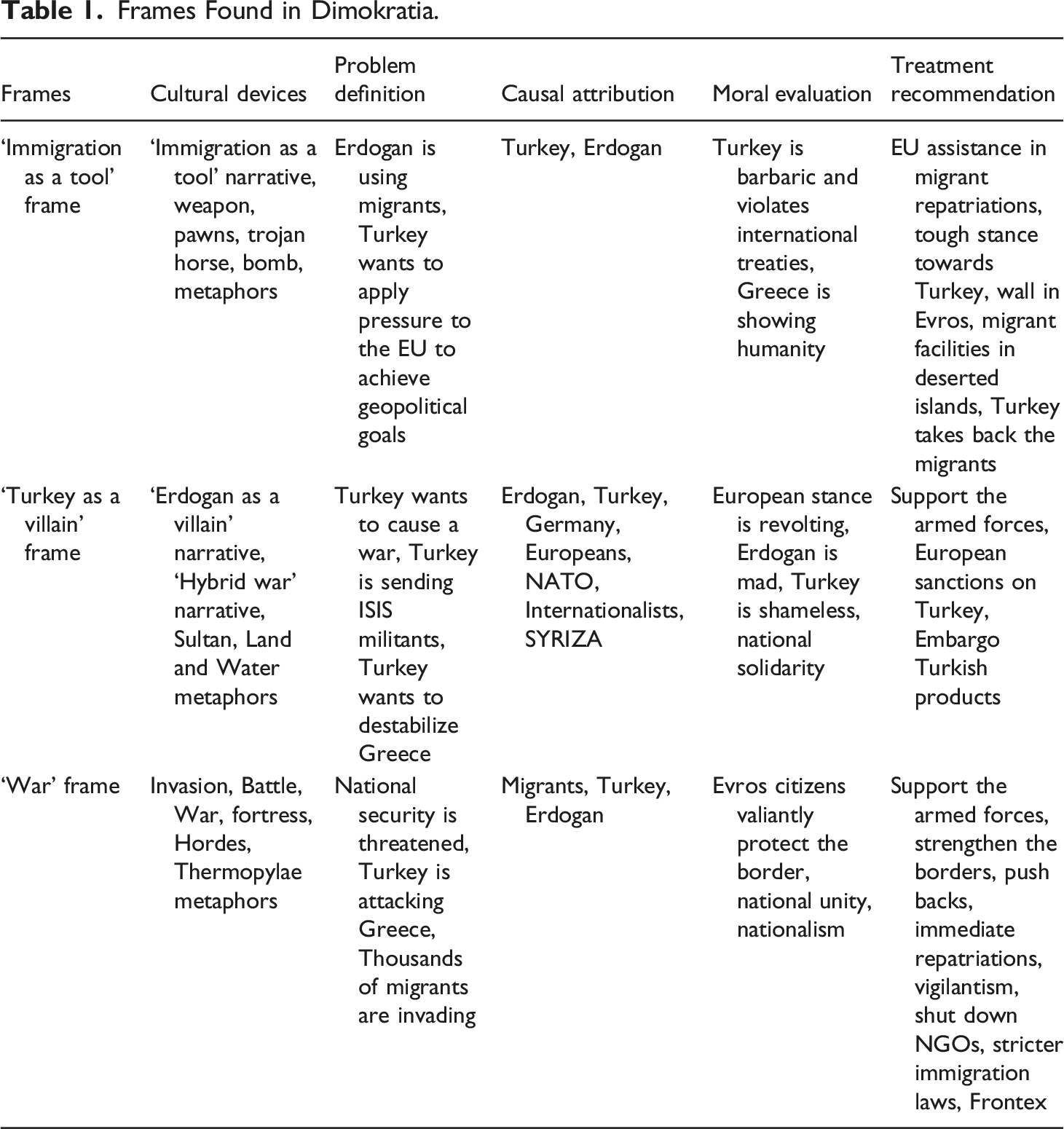
The ‘Turkey as a villain’ frame shifts the focus to Turkey. The migrants disappear and the events are framed as a clash between Greece and Turkey: ‘There is, therefore, a danger that Ankara will “construct” an incident with the migrants and cause a heated incident, which will, with the tension that exists, evolve in a Greek-Turkish crisis’ (Dimokratia, ‘A wall of steel in the Aegean’, March 08, 2020). This frame focuses on Turkey and the stance of NATO and the EU. Turkey is represented as an aggressive power that is escalating tensions, in order to destabilize Greece and cause an incident or even a full-scale war. At the same time the frame takes aim at the stance of the allies of Greece for not adopting a harsher stance towards Turkey.
Finally, the ‘War’ frame places the migrants in the role of the intruder and frames the events as a battle in an undeclared war. The representation of immigration as an invasion, has been common for the Greek Right (Boukala, 2021: 334). The cultural devices of the frame describe the migrants as ‘invading hordes’, and Evros as the legendary ‘Thermopylae’ where 300 Spartans fought against a Persian army invading from the East. The connotations of such a simile are clear enough. Additionally, the frame is rife with sensationalist metaphors that represent the events as a national epic: ‘The same slogan we are calling now celebrating the – we are hoping – end of tolerance of the Greek authorities, against the threatened enslavement of our Homeland by the guided hordes of illegal migrants’ (Dimokratia, At last, end it!, March 03, 2020). The frame identifies Turkey and the migrants as the culprits that are threatening Greece’s national security, while calling for a stark reaction from the Greek armed forces, stricter immigration laws, illegal push backs and vigilante actions against the migrants.
News frames of Rizospastis
Frames Found in Rizospastis.
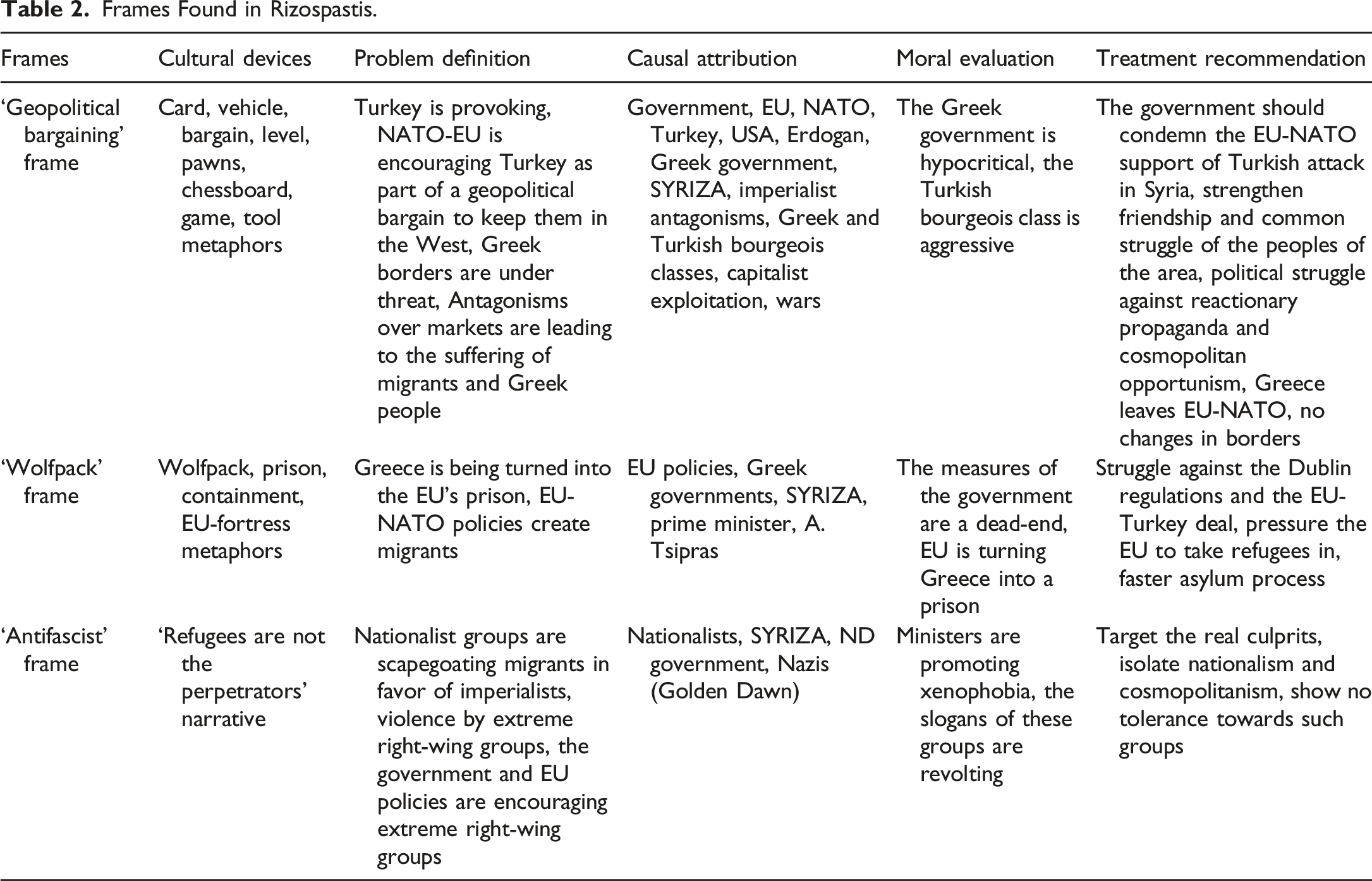
The ‘Wolfpack’ frame is taking aim specifically at the EU, NATO, the EU-Turkey deal, and the Dublin regulations. The migrants are represented within a victim frame as they are suffering the impacts of the actions of NATO in their home countries, and of the policies of ‘fortress Europe’: ‘These last developments, with the boxing in of thousands of refugees and migrants in the Aegean islands and the Greek-Turkish borders in Evros, confirm once more, that it’s the policies of the EU and of NATO, that the Greek governments have adopted loyally, that is to blame on the one hand for the destruction of countries and the uprooting of people and on the other hand for the boxing in of the uprooted ones on islands and borders’ (Rizospastis, ‘On the developments on the Refugee issue and the measures of the government, March 07, 2020’). Greece is framed as a ‘prison of souls’ due to EU policies and the complicity of the Greek governments. However, no agency is assigned to the migrants as the solutions revolve around the struggle of the Greek working class against the EU policies, and political actions that can resolve the issue by taking the refugees in the EU.
Finally, the ‘Antifascist frame’ focuses on the far Right-wing militias that gathered from European countries to take vigilante action against the migrants. This frame combats the stereotype of the migrant ‘intruder’, pointing instead towards far Right-wing violence as a scapegoating mechanism that conceals the failures of imperialist and capitalist policies. The frame calls upon the government to reign in these groups, and at the same time rallies working class people to unite with the migrants and struggle against nationalism: ‘This is what various nationalist groups are putting forward, by taking advantage of the situation that is taking place in Evros and in the islands. They are hitting “the saddle and not the donkey” (Greek colloquialism), meaning that they are taking aim at the refugees and migrants and are leaving outside of criticism the imperialist alliances of NATO and EU, that are causing imperialist interventions and wars. They are taking aim at the result and not at the cause’ (Rizospastis, ‘It’s about an illegal migrant invasion’, March 14, 2020). In that sense, this frame looks at the “crisis” as a symptom, rather than an issue in and of itself, and therefore manages to address the deeper systemic issues surrounding the incidents.
Main frames of Efsyn
Frames Found in Efsyn.
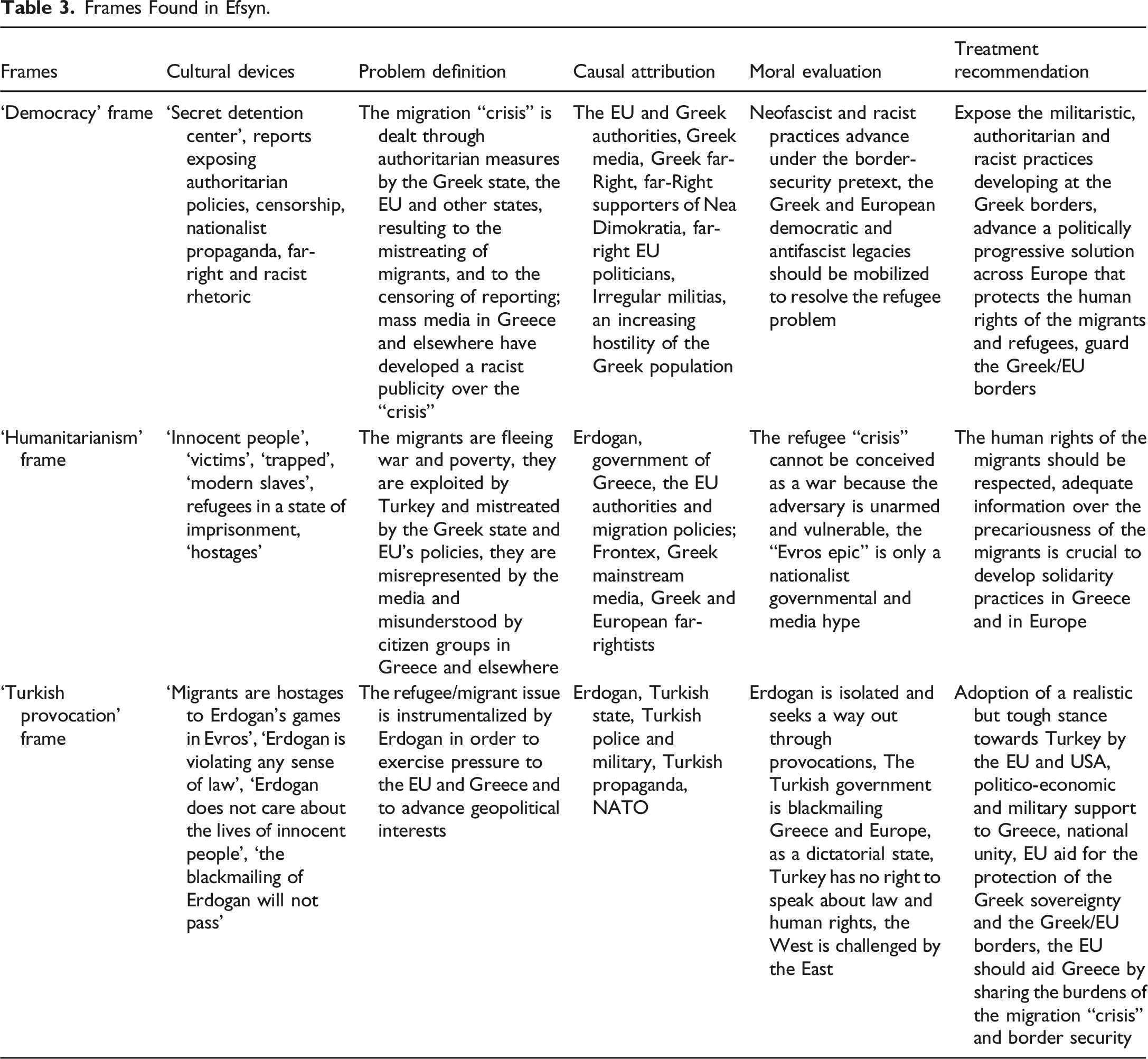
The “humanitarian” frame presents the migrants as tormented humans fleeing war and poverty. In that sense, the migrants become “toys” in Erdogan’s political games, are mistreated by the Greek state and EU’s policies, and are misunderstood and wronged by citizens: “Thousands of desperate people remain trapped in Evros. They are victims of Turkish propaganda, but also of the actions of the Greek government. Images of shame emerged in the port of Thermi with attacks on asylum seekers, journalists and politicians” (Editorial “Trapped in Evros - Persecuted in Mytilene” 01.03.2020). Specific attention is paid to the treatment of the migrants by the Greek and Turkish governments, the EU, and Greek and European citizens. The humanitarian frame falsifies the media and government-related discourses over an “Evros epic”, arguing that the “crisis” cannot be conceived as a war episode because the adversary is unarmed and vulnerable. The humanitarian frame foregrounds solidarity practices as central in resolving the “crisis”.
In the “Turkish provocation” frame a tension is escalating in the Greek border, mainly triggered by Turkey: “Erdogan is opening the borders and sends the victims of war and misery to Greece to put pressure on the war-weary Turkish public opinion, and to blackmail Europe… The elected dictator Erdogan has imposed a permanent state of ‘emergency’ in his country and is treating dissidents in the same way as he is treating the refugees'' (Costas Douzinas, “State of emergency” 16.03.2020). The migrant issue is instrumentalized by Erdogan in order to exert pressure to the EU and advance geopolitical agendas. The Turkish provocation frame is underlined by a national unity stance, also expressed by the major Greek political parties. Condemnation of Turkey is also expressed by EU officials in the European parliament, and during their visits in Evros. Here, along with a democratic and humanitarian stance, the solution to the “crisis” will also come from the adoption of a tough stance towards Turkey by the EU, which should aid Greece in securing the Greek/European borders, while sharing the burdens of the “crisis”.
Main frames of Kathimerini
Frames Found in Kathimerini.
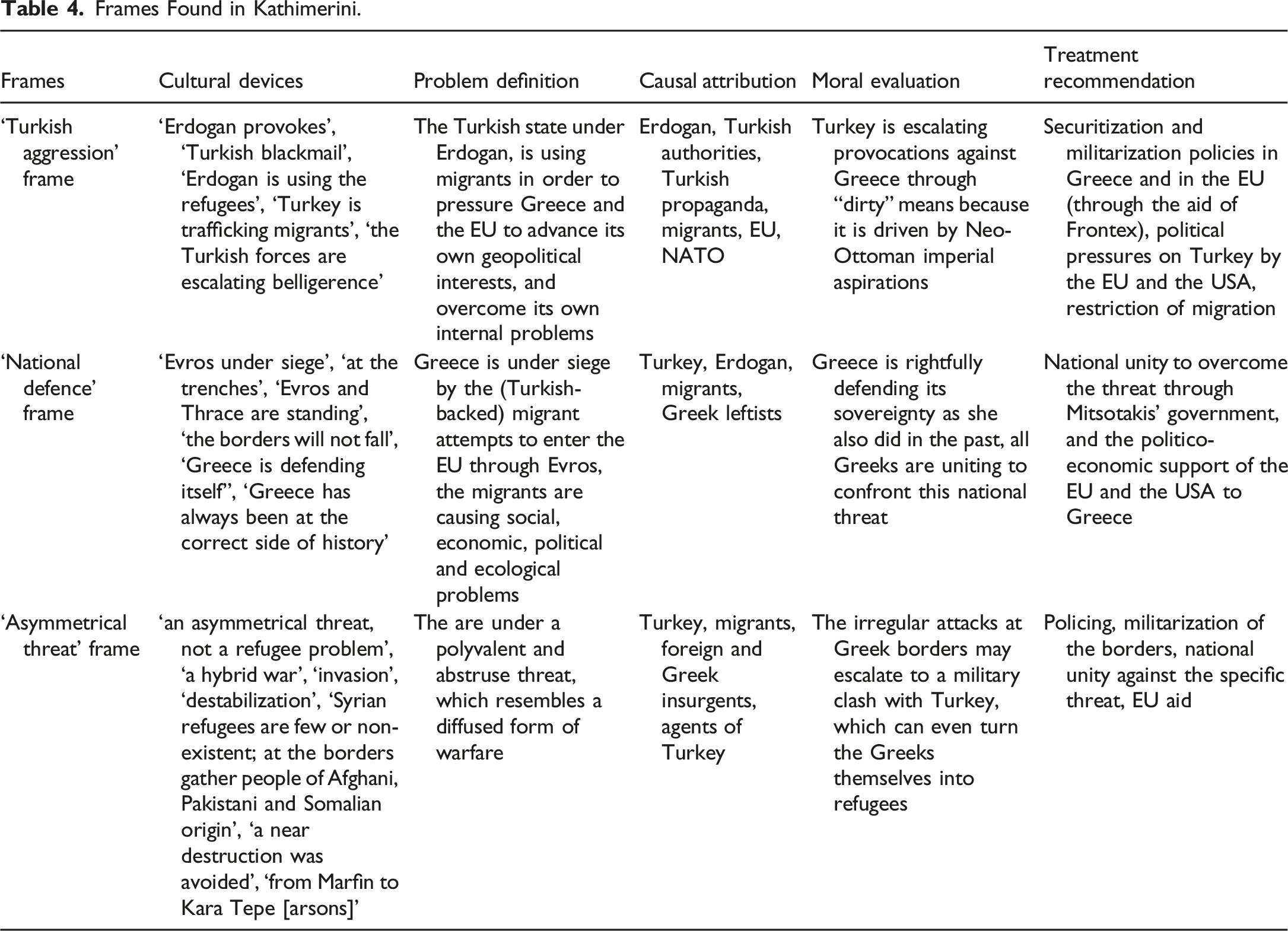
According to the “national defence” frame, Greece is under siege by the (Turkish-backed) migrants. Greece is therefore defending its borders, and Europe. For this reason, the EU must fully support Greece. Furthermore, as important politico-economic interests lay in Greece the US should also support the security of the Greek borders. More crucially, all Greeks are united against national threats: “‘Evros’ was a rare moment of solidarity and unity. We needed it after ten years of humiliation [the author here refers to the ‘Greek crisis’ years]. We brought out our good selves and positively surprised our friends and opponents, who thought that we were much softer” (Alexis Papachelas, “The virus of division” 11.03.2020). Greece is framed as peaceful and hospitable, but under threat due to its geostrategic position. The threat to Greek sovereignty unites all Greeks and is victoriously repelled by the heroic efforts of the military and border police, aided by patriotic local inhabitants of Evros. Additionally, the defence of Evros’ border from the migrants marks a success story for the government. Greece can use the opportunity to strengthen its own geopolitical position, in military, political, economic and symbolic terms. Thus the “national defence” frame establishes a national-based, unanimous approval of Mitsotakis’ government and its securitization policies towards the migrants, in stark contrast to the ways that the Syriza-led government dealt with the same “crisis” in the past (Boukala and Dimitrakopoulou, 2018: 192).
The “asymmetrical threat” frame presents the borders to be under a polyvalent threat, which resembles a diffused form of warfare: “… one realizes that the problem is no longer a refugee and immigrant problem. It is an asymmetric threat on the eastern borders of Greece, which are also the borders of Europe. This is a directed attempt of illegal invasion by thousands of people, which threatens our national territory by people who do not hesitate to use open violence to enter the Greek territory. It is an attempt by Turkey to use desperate people to advance its geopolitical plans and divert attention away from the horrific situation in Syria” (George S. Bourdaras, “K. Tasoulas: The issue has ceased to be a refugee, Greece faces an asymmetric threat” 05.03.2020). Organized by Turkey, the threat is expressed through constant attempts to cross the border illegally by masses of “individuals”. These people are, for the greatest part, not refugees fleeing the war of Syria, but a multitude of different backgrounds; they exercise various forms of violence, incite calls for insurgency, perform coordinated attacks to break the police blocks and intrude the Greek borders; moreover, they can destabilize Greece and Europe amidst the COVID-19 pandemic. These irregular attacks are also connected with the possibility of a military episode between Greece and Turkey, something that can turn the Greeks themselves into refugees. Therefore, the Greek government and citizens, with the help of the EU, are doing their utmost to secure the borders of Greece/Europe. The framing devices are terms and phrases like “an asymmetrical threat, not a refugee problem”, a “hybrid war”, or “invasion”. This frame portrays the events as an incident that could have escalated into a tragedy for Greece, but was contained by the sharp mobilization of the Greek authorities and develops a moral panic against the migrants by undermining their humanity. Militarization is legitimized as ‘the only solution’ towards this threat.
Main frames of Ta Nea
Frames Found in Ta Nea.
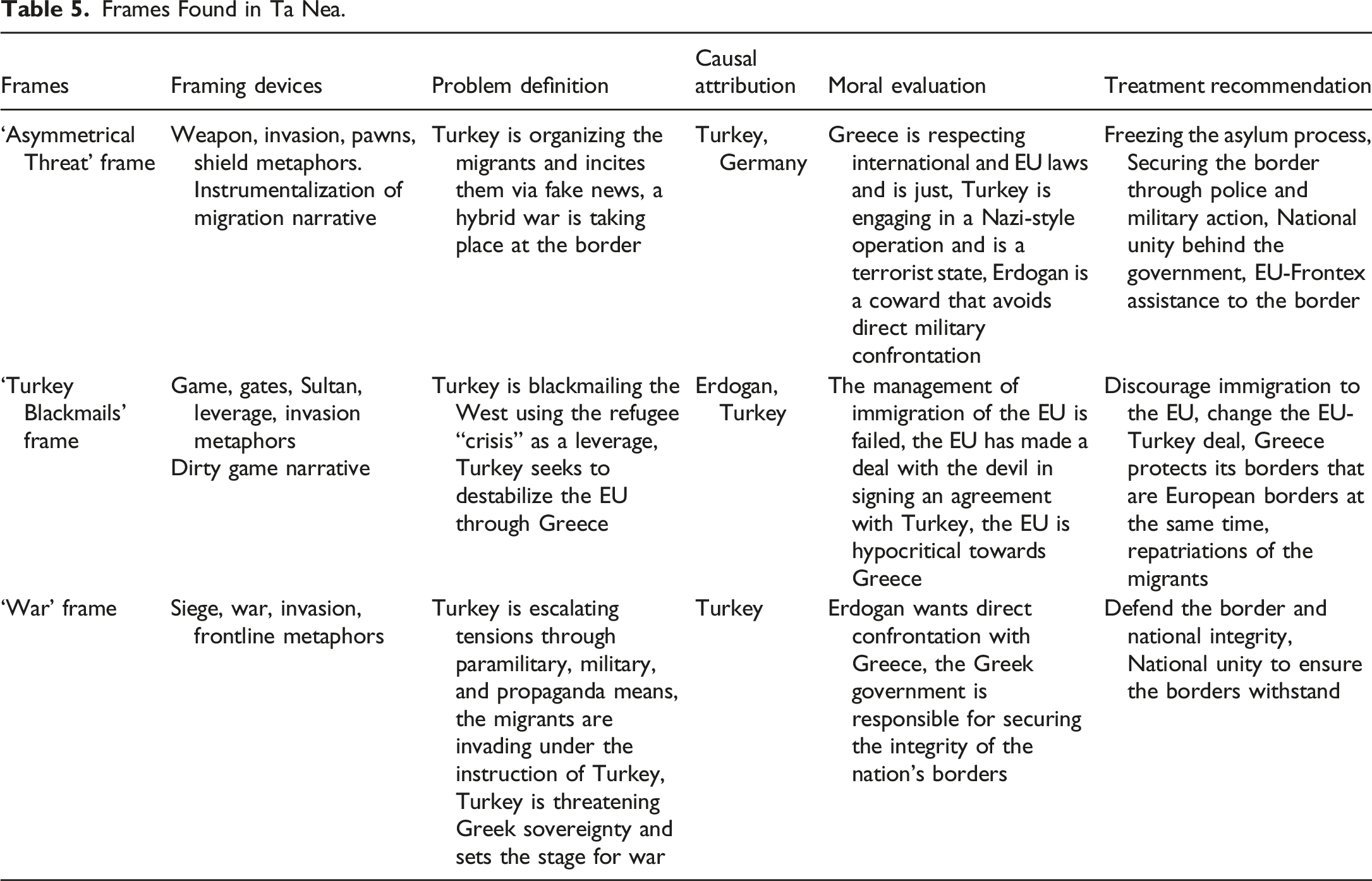
The ‘Turkey Blackmails’ frame places Greece as one cog in a wider geopolitical negotiation between Turkey and the West. The events are framed as Erdogan’s attempt to export the crisis he is facing at home with the casualties suffered by the Turkish army’s attack on Idlib. At the same time the opening of the border is viewed as an attempt to pressure EU into more money and support to Turkey: ‘The decision of his country is a direct violation of the agreement he made in 2016 with the European Union to curtail refugee flows. The goal seems to be to pressure the EU and NATO into supporting the new military operation of Turkey in Idlib’ (Michalis Mitsos, ‘Tayip Erdogan opens up the gates’, 29.02.2020). The frame also takes aim at the EU however, as its migration policies are understood as what gave Erdogan the opportunity to use immigration as leverage. Therefore, the frame stresses the importance of defending the border, but also suggests stricter migration policies in order to discourage mobility towards the EU.
The ‘War’ frame sidesteps the events and suggests that they are a small part of a larger escalation by Turkey that could potentially result in a direct military confrontation between the two countries: ‘Now, everyone has finally realized that Turkey wants a war. Nobody doubts that anymore… Turkey has gone off for a long time from the level of a possible “accident”, or that of a “local” event. Turkey wants war. And it will get it’ (Georgios Malouchos, ‘Greece is not afraid’, 14.03.2020). The migrants are framed as intruders that are under the instruction of Turkey as a ‘siege ram’ that would provide the opportunity to enact a full-scale invasion of Greece under the pretext of a humanitarian mission, in the same manner as Idlib. The frame uses war metaphors to stress the urgency of the events and presents them as a national defence against a foreign intervention. The government is responsible for the defence of national integrity, and a national unity that supersedes ideological divides is called for as a solution to this existential threat to the nation. However, it should be noted that some quotes that counter the frame as ‘exaggerations of the government’, mainly coming from opposition politicians are also carried by the newspaper.
Discussion
The high attention given by all investigated newspapers to the so-called migration issue confirms its socio-political importance, and the public construction of migration as a problem (Lecheler et al., 2019: 694). The ‘Turkish threat/provocation’ idea emerges as a prevalent frame in four out of the five newspapers studied, legitimizing nationalist and militaristic discourses and politics in Greece. The centrist and conservative newspapers (Dimokratia, Ta Nea, Kathimerini) reproduce the discourse of Turkey as an ontological threat to Greece, recontextualized in the refugee “crisis” context. The refugee/migrant attempts to enter Greece are seen to be orchestrated by Turkish geopolitical ambitions. The threatening non-European Other produced by the far right and the extreme centre in the EU (Mondon and Winter, 2020) thus combines both Turkey and Muslim migrants in the “Evros events” context. The rightist Dimokratia denies agency and even humanity to the migrants and disputes the structural issues of migration. The centrist Kathimerini and Ta Nea recognize some structural issues but stress the role of Turkey in the events, reducing the migrants to “Edogan's pawns”. The leftist Efsyn also stresses the role of Turkey under Erdogan, which is framed as a rogue state that does not comply with international law. Nevertheless, Efsyn maintains the structural characteristics of migration and emphasizes the humanitarian dimension of the “crisis”. It therefore too expresses a Eurocentric perspective, like other “centrist” and progressivist media on this issue (Avraamidou, 2020: 489). While also paying considerable attention to the “migration issue”, the communist Rizospastis follows a different analysis, where issues of class are stressed in the understanding of both the “crisis” and the geopolitical conflicts that occur over it. For Rizospastis, Turkey is indeed using the refugees but this is done within a global capitalist framework, where different bourgeois governments compete. Along with the Greek state, NATO and the European Union member states, Turkey also strives for its bourgeois interests.
The centrist and conservative press sees the possible coming of a war through the refugee “crisis” and Turkey’s use of the migrants, with migration framed as an orchestrated invasion. This war is asymmetrical and requires exceptional securitization measures and a prolonged state of emergency. The migrants appear as non-European others, following the hegemonic discourses on migration found in EU countries towards Muslims in particular (Boukala, 2019). Furthermore, the liberal and right-wing press amplify Mitsotakis’ government anti-migration stance and ND’s far-right turn, sustaining a moral panic towards migration, legitimizing far-right logics and agendas in the Greek public sphere (Mylonas, 2020). This ontological threat to the Greek nation, legitimizes nationalistic rhetoric, securitization policies, and the intensification of police and military practices (Boukala, 2021: 337).
Efsyn is critical towards exceptional measures and nationalistic and war rhetorics. Nevertheless, it focuses on European values to address the migrants’ plight and legitimize philanthropy, despite the fact that the legacies of Eurocentrism are central in enduring practices of racialization, and the destruction of other (e.g., “non-European”) worlds (Azoulay, 2019: 19). Through a Eurocentric stance, Efsyn stresses in essentialist terms the democratic foundations of Greece and Europe as the grounds to deal with both the “crisis” and Turkish aggression. Either way, the progressive Eurocentrism expressed by Efsyn legitimizes the publication of investigative reporting on the abuses perpetrated by the Greek state against migrants, and exposing the nationalistic practices occurring by Greek and European neo-fascists. Eurocentrist signifiers emerge as empty signifiers (Laclau, 1996) articulated to express some conditional pro-migrant positions stressing universal humanitarianism. To this regard, Efsyn advances a patriotic stance that requires a progressive understanding on how to deal with the specific issue.
Overall, the EU, the USA and NATO are emphasized by Dimokratia, Kathimerini, Ta Nea and Efsyn as important denominators for the refugee “crisis” resolution and the containment of Turkey. All four newspapers argue that the Greek borders are EU borders and that the refugee “crisis” is also an EU crisis that should be dealt with the help of the EU. Kathimerini maintains that Greece has shown hospitality to foreign victims but the current migrant influx is unsustainable. Additionally, the conservative press celebrates the leadership of the Mitsotakis administration for a supposedly effective overcoming of this “crisis” and emphasizes the necessity for national unity around the government. Efsyn stresses the democratic dimensions that should lead such interventions, respecting the human rights of the migrants. Rizospastis foregrounds a patriotic position as well, opposing NATO and EU-orientated imperialism, and the EU migration laws which transformed Greece into the EU’s migrant prison.
Conclusions
Frame analysis was employed to analyse the representation of the “Evros events” in Greek newspapers. The sets of frames reconstructed were compared in order to reveal the contribution of the press in democratic debate around migration. The centrist and conservative press represented these events as a “national epic”, where “all Greeks” united to defend Greece’s borders against the migrants and Turkey; EU, USA and NATO help is crucial in this regard; Greece should use the opportunity to strengthen its geopolitical position and it should also toughen its border policies further to prepare for the worse in the future; here the metaphors of ‘war’ and ‘asymmetric threat’ are central to legitimize such emergency policy pretexts. The framing of the conservative press is reflecting the “fortress Europe” (Webber, 2018:99) policy framework that consists of restrictive stances towards migration. At the same time such framing sets up migrants and refugees as a scapegoat that diverts attention from the failures of neoliberal policy in the country by focusing on a constructed external threat to the security of the Greek people that stems either from the migrants themselves, or from Turkey. This negative type of coverage is congruent with similar research conducted in different Western contexts (Titley, 2019; Galantino, 2020; Krzyżanowski, 2020).
The Left-wing press stresses the structural dimensions of migration and the humanitarian and class aspects of it. Τhe center-left Efsyn maintains a progressive Eurocentric perspective, emphasizing the “migration problem” as a European issue, while advocating for a humanistic treatment of migrants, based on European democratic traditions. Rizospastis maintains the impossibility of resolving the problems associated with the “crisis” through the Western liberal-capitalist political framework, highlighting working-class organization as the solution, and echoing discourses of solidarity between migrant and European workers as a condition for the emergence of agency from below.
As the current (2022) ND administration follows an increasingly neoliberal authoritarian course, the Right-wing media discourse is much more publicly influential than the Left-wing one, and therefore the frames circulated in the Left-wing press fail to have an important impact in public discourses around migration. In such a historical and socio-political setting, the migrants become a useful tool for liberal and conservative governments to divert public discontent over the economy and the mounting of social problems. In this specific case the ND government used the events to galvanize its constituents by presenting a “tough stance” on migration that is legitimized by nationalist imperatives, and by diverting critique over its repressive policies. The mainstream media’s role is thus propagandistic, allowing the conservative and neoliberal Greek government to effectively contain critique, protest, opposition, and solidarity.
Footnotes
Declaration of conflict interest
The author(s) declared no potential conflicts of interest with respect to the research, authorship, and/or publication of this article.
Funding
The author(s) received no financial support for the research, authorship, and/or publication of this article.
