




Abstract
Pass the Mic is a project focusing on women of colour in Scottish news, established by Talat Yaqoob. In 2020, funding from the Joseph Rowntree Charitable Trust enabled us to undertake original research to investigate the representation of women of colour in Scottish news, providing baseline evidence for Pass the Mic’s ongoing work with media partners and women-of-colour writers. Focusing on media produced in Scotland with a national audience, we conducted two periods of media monitoring (November 2020, May 2021) to investigate where and how women of colour are represented in Scottish news. Situating this study relative to existing media monitoring projects, we discuss the methodological challenges of codifying gender and race in news. Whilst our finding that women of colour are under-represented in Scottish news is not surprising, in considering how women of colour are represented we point to the tensions of visibility for women of colour, the limited construction of their expertise, and the marginalisation of women of colour’s opinions within stories about Scotland, including when these stories explicitly address racial in/equality.
Introduction
Pass the Mic is a project focusing on women of colour in Scottish news, established by Talat Yaqoob. The project started as an online database of women-of-colour experts which, at the time of writing (June 2022), includes more than 170 women of colour whose expertise spans everything from child development to social enterprise, the film industry to international politics. 1 In 2020, funding from the Joseph Rowntree Charitable Trust enabled the expansion of Pass the Mic through a year-long writers’ group with 30 women-of-colour experts and seven media partners, 2 providing training, networking and paid publishing opportunities in news media. 3 The JRCT funding also supported research to establish baseline information about where and how women of colour appear in mainstream Scottish news. That research is the focus of this paper.
From the outset, this was conceived as an activist intervention in Scotland’s news media landscape, aligned with the feminist tradition of using media monitoring research to challenge gender inequities in representation and employment. Whilst never losing sight of its activist intent, this paper situates the research process and findings in relation to scholarship on gender, race and news media. We begin by outlining key findings from existing media monitoring work whilst pointing to gaps relating to the intersection of gender and racial marginalisation in news media. We then detail how we went about the study and discuss some of the challenges of coding gender and race, before summarising our findings. In many ways, these findings are unsurprising, pointing, as they do, to the enduring under-representation of women of colour. Nevertheless, they are important in two key ways. First, they provide concrete evidence to be used with news media partners to demonstrate the need for continued action. Second, they help us to identify patterns of representation which merit further investigation. Of particular significance here is our finding that women of colour are much more likely to be seen than heard in Scotland’s news media, and the questions we raise about how racism is handled as a topic of news.
Monitoring gender, race and ethnicity in the news
Media monitoring is a tool for gender advocacy, enabling campaigners to highlight women’s marginalisation and trivialisation in news content and production (Gallagher, 2001). The largest longitudinal study of gender and news is the Global Media Monitoring Project (GMMP) which provides a snapshot of where women appear in the news globally every 5 years. The 2020 report confirmed that the rate of progress remains painfully slow, with women making up 40% of reporters (Macharia, 2021: 6) and 25% of news subjects and sources in the highest-profile news stories globally (ibid: 4). 4
On the production side, there is a long history of scholarship identifying ways in which the newsroom, and journalists’ socialization within it, are gendered (Ross et al., 2016). The National Council for the Training of Journalists’ (NCTJs) Diversity in Journalism study found that women made up 53% of the journalism workforce in the UK (Spilsbury, 2021: 2). However, Byerly argues that even in situations where women have risen into decision making roles there is a manifestation of “male superiority” in news cultures (2013: 18). A 2015 survey of 700 UK journalists (Thurman et al., 2016) found that whilst women made up a relatively high proportion of the profession, they were less well renumerated than men and under-represented in senior positions. Studies like the GMMP which are based on media content offer a different angle, demonstrating women journalists’ continued marginalisation in the top news stories, even when that is not matched in national employment statistics, as in the UK (Ross, 2021).
The 2015 survey of UK journalists also found that UK journalism, “has a significant diversity problem in terms of ethnicity, with black Britons […] under-represented by a factor of more than 10” (Thurman et al., 2016: 7). The NCTJ’s 2021 study used data from the Labour Force Survey to demonstrate that journalism is “whiter” than the labour force overall: 92% of journalists are from white ethnic groups, compared to 88% of UK workers (Spilsbury, 2021: 2). Douglas (2021) notes that there is frequently a disconnect between expressed organisational commitments to diversity and the experiences of black and brown journalists in the UK. Echoing this, a 2022 exposé of the BBC documented the “exodus” of women of colour from the broadcaster, with one commenting that the newsroom “has a significant issue” with women of colour (Yossman and Ravindran, 2022). We know less about where journalists of colour’s bylines appear in news media, though (as existing scholarship on women journalists shows) this can provide evidence of relative importance and seniority. Moreover, whilst there is compelling evidence about the position of women and people of colour employed in journalism, there is less research – globally - which considers how gender and race intersect in employment opportunities and experiences (Meyers and Gayle, 2015).
Structural inequalities within the news industry should be a source of concern in and of themselves. There is, however, a question as to whether they shape content. The GMMP has consistently found that women reporters are more likely than men to use women subjects and sources, with a gap of five to seven percentage points on female source selections (Macharia 2021: 7). These findings are not broken down by race but, in their work on television coverage of US Presidential campaigns, Zeldes and Fico (2005) found that staff diversity – in relation to gender and race – was related to more diverse news sources. However, this finding was only partially replicated in their later research (Zeldes and Fico, 2010; Zeldes et al., 2012) leading them to conclude that greater newsroom diversity does not guarantee source-use diversity. Reviewing the field, Meyers and Gayle (2015: 293) argue, “increasing the numbers of minority or women journalists only minimally affects news content”. Therefore, whilst projects to increase the participation of marginalised groups in the media workforce are often related to campaigns to improve media representation, their goals are distinct. This is recognised in the design of Pass the Mic where the writers’ group focuses attention on access and opportunities for commentators and journalists; whilst the media monitoring project explores where and how women of colour are represented in the news.
Focusing on the gender dimensions of news content, previous research has documented how male-defined news selection criterion marginalise women-oriented issues and topics, whilst women continue to be significantly under-represented as sources (Ross et al., 2016: 825). The marginalisation of women is most notable in the most valued news sectors, such as politics and government (Macharia, 2021: 13). Of course, politics and government are themselves male dominated. However, the role of news media in reflecting and/or perpetuating that reality is debatable (Haraldsson and Wängnerud, 2019). There is evidence from a range of contexts of women’s under-representation in political news in comparison to their representation in related legislatures, including in the UK and the Republic of Ireland (Ross et al., 2016). Political parties and other established organisations are likely to bear some responsibility for this: for instance, in GMMP 2020 (Macharia, 2021: 17) the role in which women were least well represented - spokesperson (22%) - was that over which media organisations had least control. However, women did not fare much better as experts (24%) or news subjects (24%).
As with the production context, research mapping representation has tended to be attentive to single axes of oppression. Nevertheless, GMMP 2020 offers some evidence of intersectional inequalities. Reflecting their varying populations and histories, regions placed different emphasis in their coding of minority and historically marginalized groups. However, there were some patterns: first, minority and historically marginalized ethnic and racial groups were likely to be underrepresented in the news relative to their appearance in the population; second, women were likely to be more underrepresented within this group than in the general samples; and third, their presence was concentrated in a small range of spectacular stories, for instance in crime (UK and Republic of Ireland) or celebrity (Malta) news (Macharia, 2021: 28–29). This suggests that visibility can be a double-edged sword. In a different context, Ward (2017) found that BAME women candidates in the 2010 UK General Election enjoyed a “visibility advantage” when compared to white female candidates. However, their coverage was exceptionally negative and focused on ethnicity and gender. Gershon’s (2012) study of the 2006 midterm elections in the US did not find that minority women had this “visibility advantage” – the very opposite – but similarly found that minority women received the most negative coverage (also Amnesty, 2018).
Quantitative approaches to media content are most useful in identifying broad patterns in large samples. Where groups are numerically small, these approaches may not get much further than identifying absence and pointing to patterns which bear further scrutiny. This is not, however, to dismiss the practical and political urgency of being able to quantify representational marginalisation and in the remainder of this chapter we do just that.
The Pass the Mic study
News media sample.
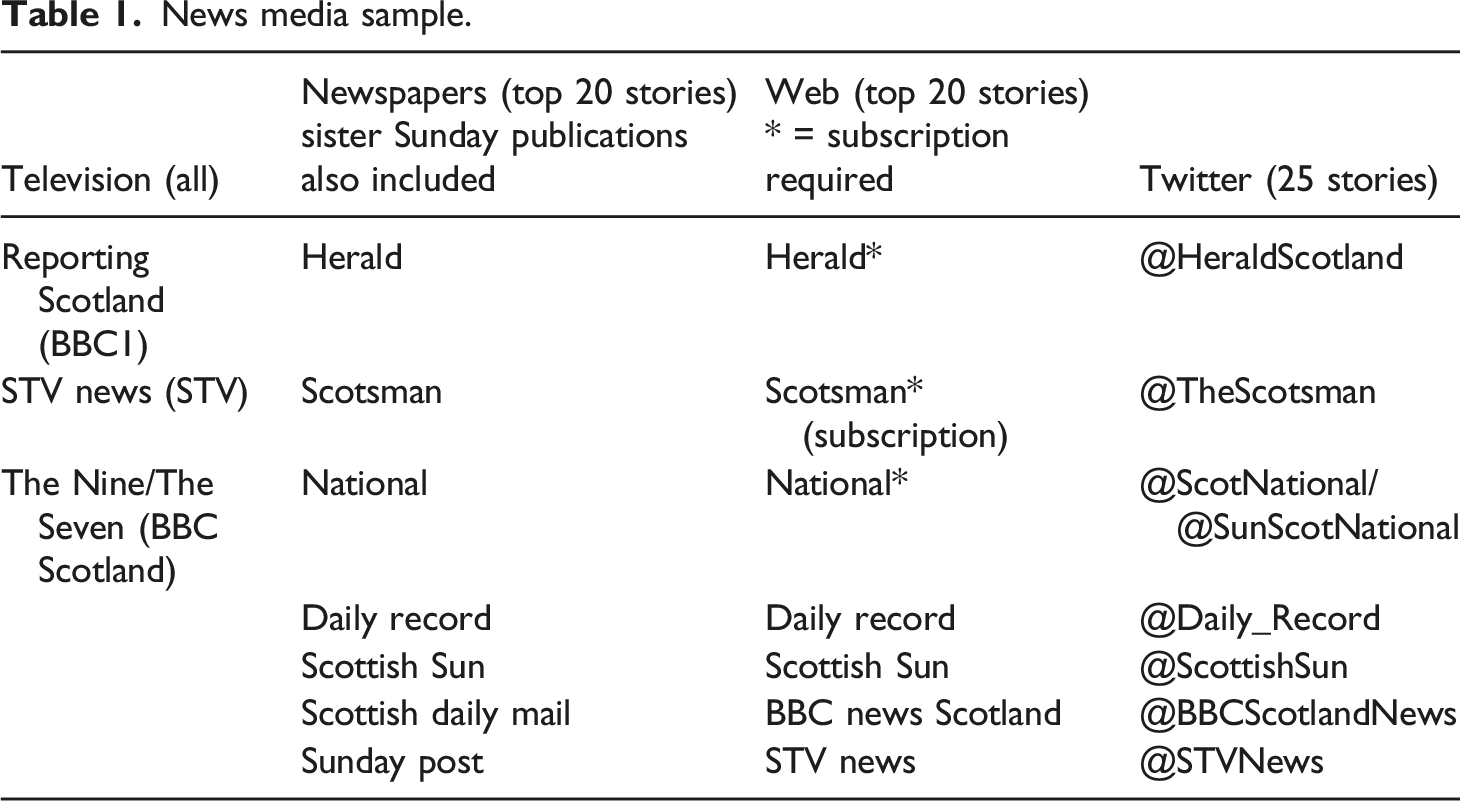
Methodology guides for both periods were developed collectively by the authors (Yaqoob et al., 2021), adapting the GMMP’s coding framework (GMMP, 2020). The first period was intended to provide baseline data from a “routine” news week. For television, all news stories in each programme were coded. For newspapers and web content the top 20 stories were coded each day. For twitter, we captured data daily at 6p.m. and included all tweets from the prior 12 hours, up to a maximum of 25 tweets per account (not including retweets, replies or comments). We did not include editorials, advertising or sports stories unless these were presented as news, i.e. within the main news bulletin, or front pages of a newspaper. However, we did include opinion and commentary in our press sample: particularly important given Pass the Mic’s work to develop content by women-of-colour experts. In our first sample, 8.7% of newspaper stories were commentary; in period two, 11.1%.
We coded every journalist/anchor/reporter and person mentioned in every news story, paying attention to gender, whether they were a person of colour, their occupation, function in the story and whether they were quoted or photographed. We were more comprehensive in our approach than many existing studies (e.g. GMMP, 2020: 24), coding even people who were mentioned in passing as we wanted a holistic sense of how Scottish news constructs its world. In the 6964 stories coded, we identified 7568 journalists and 23,705 people in the news, making this the most substantial monitoring study of Scottish news, unique in its focus on gender and race.
Across all media, we coded basic story-level information including topic and geographical scope. Due to the continuing dominance of COVID-19, we followed the approach of GMMP 2020 and first coded whether a story was about COVID-19, before then coding its primary topic. In our first period, 39.3% of stories were about COVID; this dropped to 14.9% in May 2021. In both sample periods, politics and government was the most popular news topic with 32.8% (November) and 51.4% (May) of stories falling into this category. Even in the routine news period, this figure is high compared to global studies: since 2005, the percentage of global news focusing on politics and government as measured in GMMP has been between 24% and 28% (Macharia, 2021: 13). However, this is not surprising: Scottish politics is notoriously marginalised in UK-wide reporting, and – along with sport - is the subject through which the Scottish media mark their difference from UK news. As Scotland was led by a female First Minister, Nicola Sturgeon, at the time of the study, it is unsurprising that Scottish news had a higher proportion of women politicians (33.7% of all politicians in November; 34.7% in May) than the GMMP which found just 20% of politicians were women (Macharia, 2021: 17).
For geographical scope, we differentiated between Scottish-specific (local or national), UK-focused, and foreign/international stories. Of the 3121 stories coded in November, 92.4% were from the UK, with specifically Scottish news making up 71.5%. Unsurprisingly, given the inclusion of papers which share content with London, newspapers had less Scottish content than other media (54.8%). The Scottish-based teams Pass the Mic is working with have little control over London-produced content. We therefore undertook a second round of monitoring focusing specifically on Scottish stories, selecting a period to coincide with the Scottish Parliamentary elections on 6 May 2021. We defined a “Scottish” story as one set in Scotland or which included reporting from a Scottish angle. So, for example, a story about Westminster politics was included if it involved Scottish politicians or if implications for Scotland (local or national) were mentioned. We made some minor amendments to our schedule in the second period (Boyle and House, 2021), including a question as to whether a story was about the Scottish election: 43.4% of all stories were.
The challenges of codifying gender and race in the news
For each of the 31,273 people coded (journalists and people in the news) we noted gender and whether they were a person of colour. For people in the news, we additionally coded: occupation and story function (using GMMP categories); whether they were photographed or directly quoted; and the use of racial markers and religion.
Coding gender and whether someone is of colour can be tricky as this is not always obvious from the story. In GMMP, the emphasis is on visibility and coders work with what is in the news story itself. However, the emphasis of Pass the Mic is slightly different – our concern is with inclusion rather than only visibility. Therefore, if this information was not obvious in a news item, we did an internet search for public individuals writing or appearing in stories. In most cases, this allowed us to code gender and race: for instance, with reference to public online profiles which used pronouns, photographs or biographies. Of course, this should not be taken as a definitive statement of identity. However, it is more expansive than the approach taken in other studies and has allowed us to recognise people of colour who may not have been obviously marked in this way in a story (e.g. a CEO referred to by name but not explicitly identified as a person of colour within the story). This still left some “do not knows”: where, for example, a story had no byline or where a quote was attributed to “a source” or private individual (e.g. a neighbour). We also coded if someone was explicitly referred to as trans or non-binary. Reflecting global patterns (Macharia, 2021: 33), the number of people in this category was exceptionally small – two (0.02%) in November, and seventeen (0.13%) in May. Whilst none of the 19 trans or non-binary individuals were people of colour, it is impossible for us to arrive at any conclusions about trans representation from such a small sample. This highlights the limits of a quantitative approach for investigating statistically-small communities: scholarship on trans representation in the news has tended to track trans representation specifically rather than measure trans presence in general news samples (see Capuzza, 2019).
As our concern is specifically with racial in/equalities, rather than related but not synonymous questions relating to nationality, migration or refugee status, we used the category “people of colour”. The term “people of colour” originated in the US and is typically used to refer to anyone who is not white. In a UK context, “Black” was historically used in a similar way, to denote “a political identity under which empire’s unaccounted for children could unite” (Okolosie 2018: xi). “Black” is used quite differently in the US to centre African-Americans. These differing terminological trajectories speak to the legacies of slavery and colonialism, as well as to subsequent patterns of immigration (Collins and Bilge, 2016) which it is beyond the scope of this article to delineate. The political and analytical value and limitations inherent in both terms have been contested, with the possibilities for coalition building to challenge endemic structural oppression balanced against the costs of failing to account for important differences between racialised communities and the discrimination associated with colourism (Bryan et al., 2016: 257–260), including in Scottish policy contexts (Liinpää, 2013). Moreover, Kalwant Bhopal (2018: 29) reminds us that there are “different shades of whiteness” which cannot be accounted for in either of these formulations. However, whilst there are many white minority ethnic communities in Scotland, the discrimination they face is not on account of being white. For our purposes, “of colour” enables us to gather baseline data about the representation of marginalised communities (recognising also that some of these communities are numerically small in Scotland) whilst demonstrating the representational dominance of whiteness. Throughout this article, we use “race” as a shorthand to keep racism in view, and “white” to indicate the racial category which is privileged in contemporary Scotland. 7
This still leaves us with a challenge when comparing our media sample with the population it represents. The 2011 census revealed that 86% of the population in England and Wales was white; 7.5% were from Asian ethnic groups; 3.3% from Black ethnic groups; 2.2% mixed/multiple ethnic groups; and 1.0% other ethnic groups (Office for National Statistics, 2020). Scotland was considerably less diverse: only 4% of the population was not white (Scotland’s Census, 2011). But, Scottish news is never just about Scotland, not least given the range of powers reserved to Westminster and the largely-shared media landscape.
We should therefore expect that proportions of people of colour in Scottish news should be considerably higher than in the population.
Where are women of colour in Scottish news? Findings and discussion
Gender, “race” and the news (November 2020).
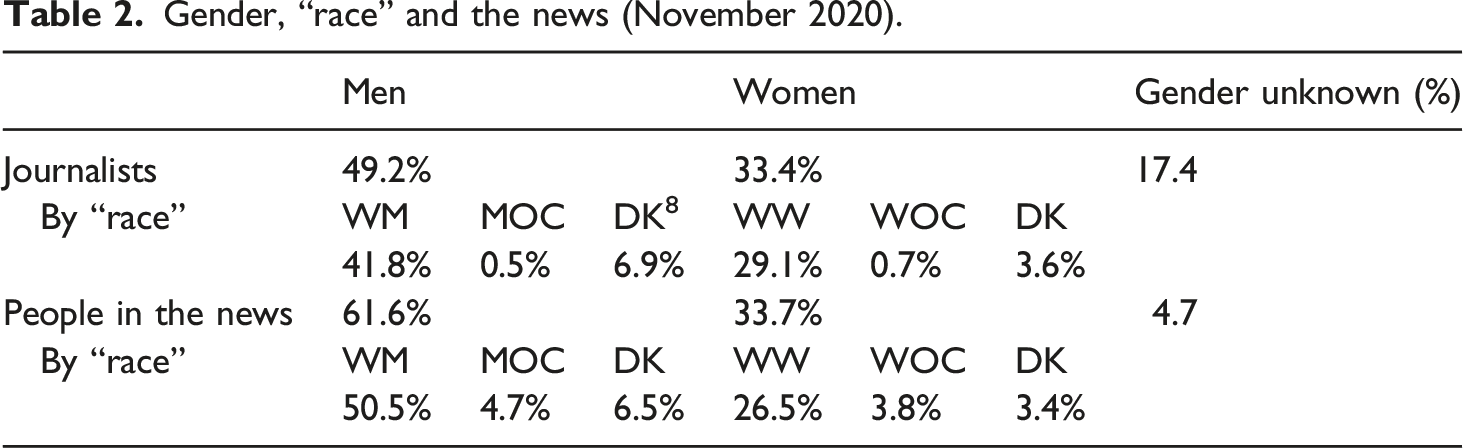
Within our newspaper sample, white men were particularly over-represented in commentary: 65.3% of commentary articles were written by men (compared to 46.1% of news articles), with only 3 (4%) of commentary articles written by people of colour, all in The National.
The most visual medium - television - had the highest proportion of both white women (35.1%) and women of colour (4.5%) and, mirroring other studies (Macharia, 2021: 39), this visual emphasis was carried through to newspaper, twitter and web stories where women were more likely than men to be photographed (Figure 1). People of colour were less likely to be quoted than their white counterparts and, whilst white men were more likely to be quoted than photographed, this pattern was reversed for all women and people of colour (Figure 1). The difference between being photographed and quoted was most marked for women of colour: 45.7% of women of colour were photographed (the highest proportion of any group), and just 27.6% were quoted – a difference of nearly 20 percentage points. This suggests that the “decorative excess” Patricia Holland (1998: 32) identified as a characteristic of women’s presence in the tabloid press may apply to women of colour across all news media. Indeed, it is notable that – relative to their overall presence in the sample (3.8%) – women of colour were over represented among celebrities: 10.8% of all celebrities were women of colour. “At a glance” women of colour may seem to be relatively visible, particularly in the tabloids with their emphasis on celebrity news. But it is still white men who are the agents, whose words dominate and shape the events reported. Percentage of people photographed and quoted by gender and “race” (press, twitter and online: November 2020).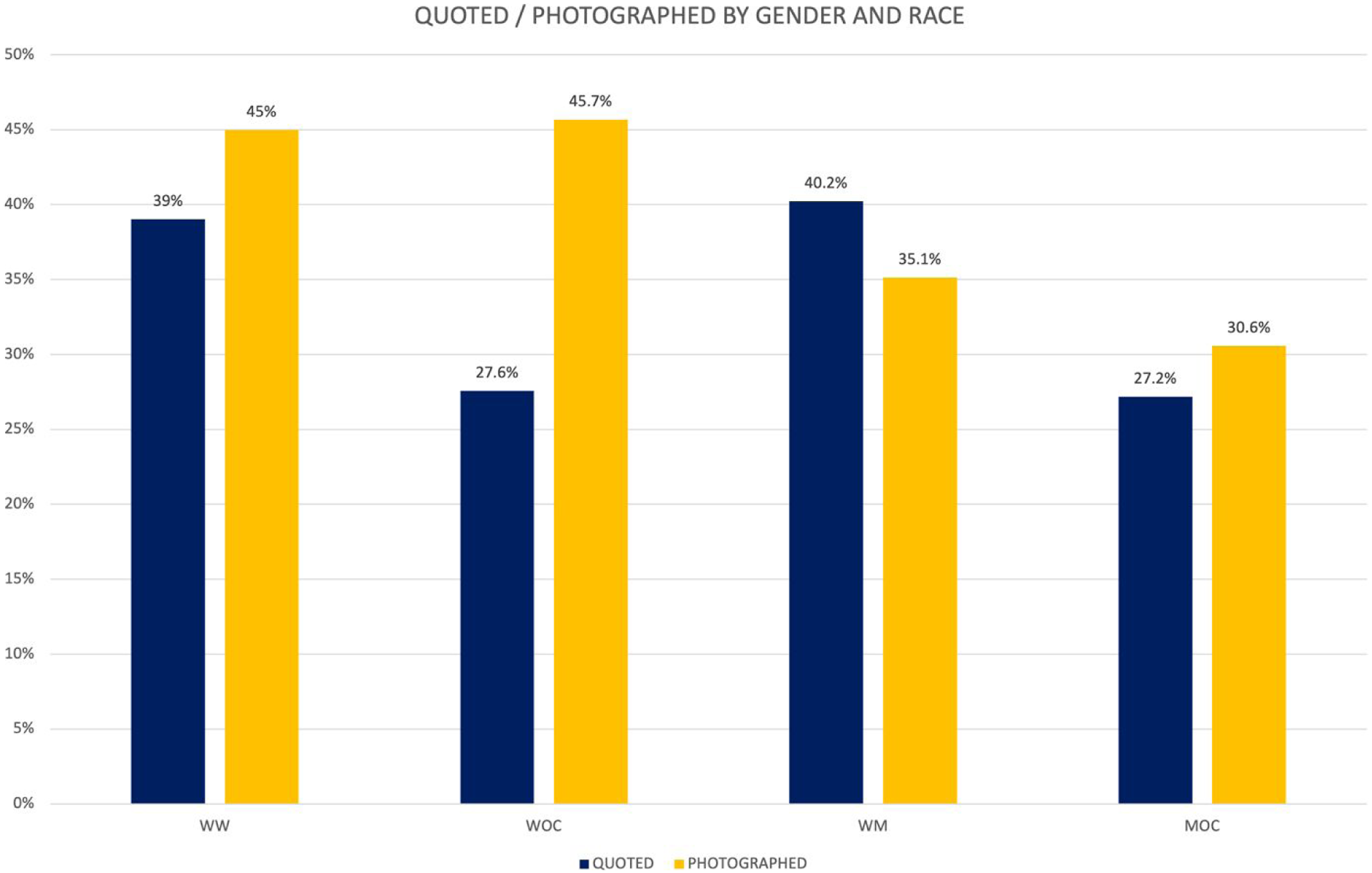
Those women of colour who do make it into the news seem to be hyper-visible. Other researchers have documented the costs that might be associated with this visibility for women of colour, and the misogynist and racist scrutiny and surveillance this can generate. In the UK, media treatment of Meghan Markle has been a particular flash point in recent years (Ducey and Feagin, 2021) and there were traces of this in our study. On Monday 9 November, a number of papers reported that a wreath sent by Prince Harry was not laid at the cenotaph on Remembrance Sunday. Notably, whilst Harry and various royal “sources” were quoted in these stories, Meghan was not. She was, however, photographed with Harry at Los Angeles National Cemetery. But the very conditions of her visibility were rendered suspicious. This was described as a “private” event, but we were also told they were “accompanied by one of their favourite photographers LA-based Lee Morgan” (English, 2020: 4). Moreover, Piers Morgan, a vocal critic of Meghan, weighed in accusing the couple of “trying to steal headlines from the real royals doing their duty back home” (in Ridley and Wilkinson, 2020: 4). For the tabloids in particular, Meghan always seems to be associated with the more negative half of the real/fake, home/away binaries, and this is difficult to disaggregate from her “outsider” status as an American woman of colour in the British royal family.
Functions of people in the news (November 2020).
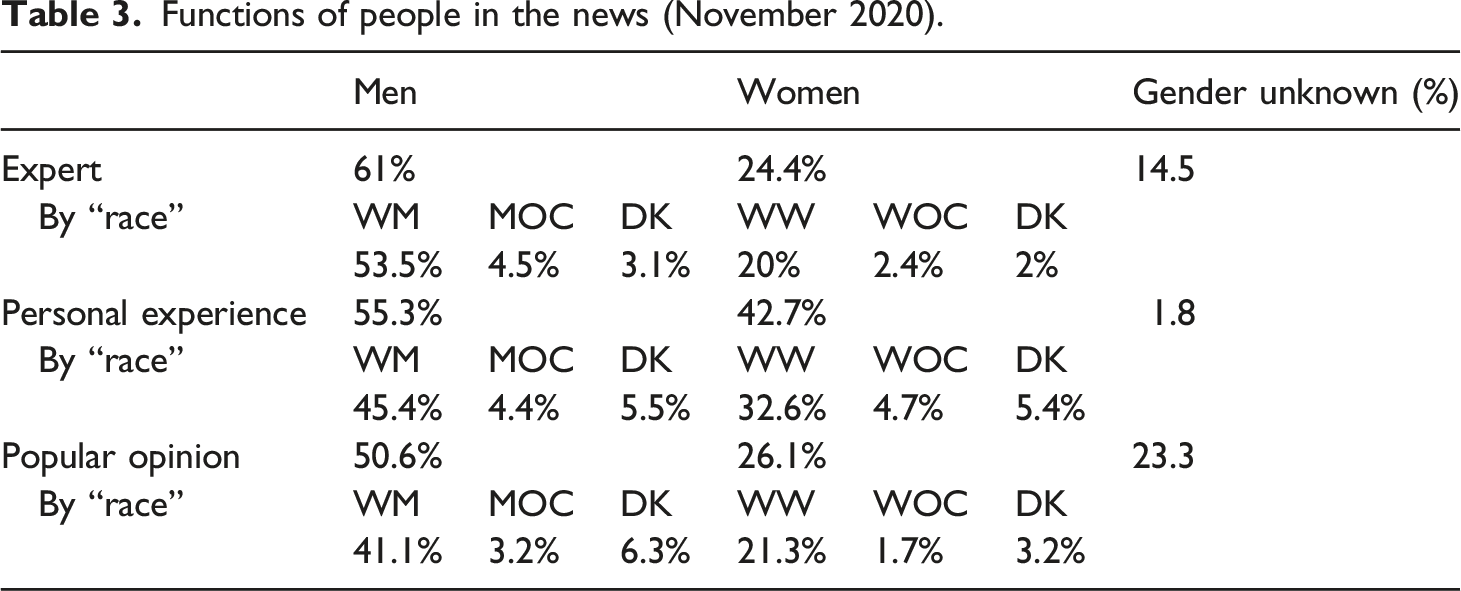
To understand this finding it is useful to reflect on one of the major stories of the week. Scotland’s men’s football team won a crucial Euros qualifier on 12 November, taking them to their first major tournament in over 20 years. This led to a far greater presence of sport as news than might have been expected, making sense of the dominance of men in the popular opinion category - a finding not replicated in our May study (see Boyle et al., 2021), or in other research on the gendered use of news sources (Macharia, 2021: 35). Although all news outlets featured extensive build up and post-match coverage, there were no women of colour featured in these stories raising questions about how national identity is constructed in and through sport in Scotland. Whilst we did not code sports pages, there is increasing evidence of the male-domination of sports journalism (Women in Journalism, 2022) and sports-coverage (Jenkin, 2020) in Scotland, although this work has not been attentive to race. Interestingly, our second sampling period coincided with a sports media Twitter boycott against online hate (1–3 May 2021). For UK-wide media organisations this impacted sports-specific accounts, however the Scottish Sun’s news account participated, demonstrating the centrality of sport to their content. In UK-coverage this boycott was linked to Black Lives Matter, but in the Scottish press the emphasis was on the impact on (white) men’s mental health (e.g. McCarthy, 2021). This suggests a certain reluctance to deal with racism in Scotland – at least in relation to the general population - which we discuss in relation to election coverage below.
However, the most striking finding from our November study was that only one in four women of colour in Scottish news appeared in stories about Scotland, even though Scottish stories made up more than 70% of our sample.
For this reason, we decided to undertake a second, slightly-longer, period of monitoring, focused specifically on Scottish stories. We deliberately selected an “atypical” period coinciding with the Scottish Parliamentary elections to enable us to concentrate on news about/in Scotland. Nevertheless, some patterns remained consistent. The May sample similarly demonstrated the dominance of white men as journalists, particularly within newspaper commentary (60% of commentary writers were men), and the virtual invisibility of people-of-colour journalists (0.5%, n = 21). We found that expertise remained both gendered (60.4% of all experts were men) and racialised (only eight women-of-colour experts appeared in the election period), and that women of colour were still marginalised in relation to those news functions where other studies have identified women in greater numbers, making up just 2.7% of people offering personal experience and 1.5% of popular opinions.
The continued visual emphasis on people of colour and marginalisation of their speech (Figure 2) was particularly striking given the context. The 2021 Scottish Parliamentary election saw more people-of-colour candidates than any previous Scottish election and had political parties taking action to tackle under-representation within their candidate lists (Duffy, 2020). The outcome was the election of the highest proportion of people of colour in the Parliament’s 22-years history (n = 6, 4.5%), including the first women-of-colour MSPs (SNP’s Kaukab Stewart and the Scottish Conservatives’ Pam Gosal) (Peace, 2021). Yet, the only two candidates of colour to appear with any regularity in the run up to the election were Scottish Labour Leader Anas Sarwar and the SNP’s Humza Yousaf (then Cabinet Secretary for Justice). This is unsurprising given the dominance of men in election news and the emphasis on party leaders in election reporting (Deacon and Harmer, 2019). Indeed, party leaders made up 25.2% of all people in this sample, 23.4% of those quoted and 36.7% of those photographed. This led to a Sarwar-effect: the proportion of people of colour in stories about Scotland rose from 5% in November (before Sarwar became Scottish Labour leader), to 8.1% in the election period. Sarwar accounted for 40.9% of all references to people of colour, and was responsible for 46.1% of all quotations attributed to people of colour. Percentage of people photographed and quoted by gender and “race” (press, twitter and online, May 2021).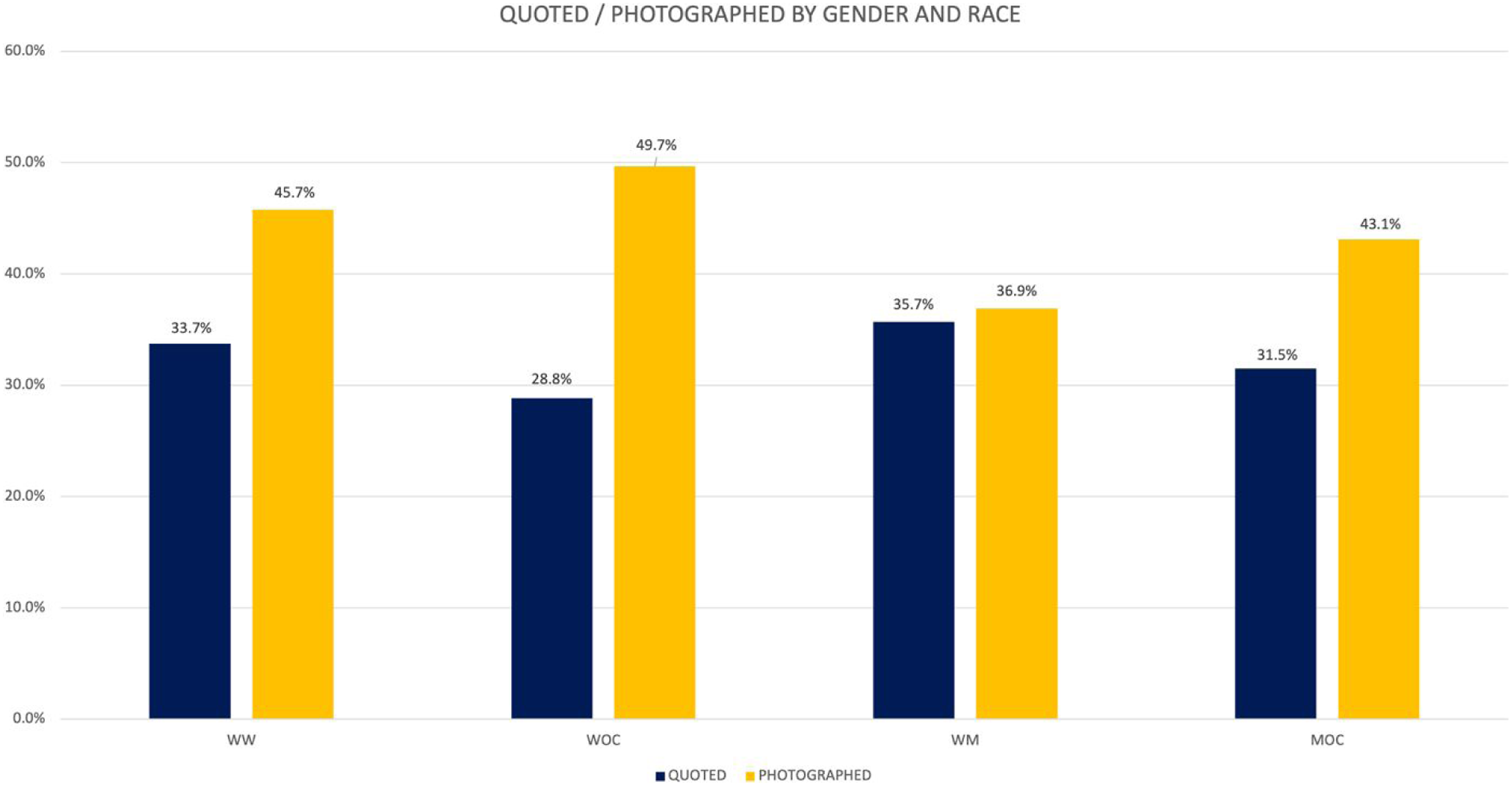
Despite the election of the first women of colour MSPs, the proportion of women-of-colour politicians decreased, from 3.1% of all politicians in November (which included non-Scottish news, such as commentary on the aftermath of the US election), to 2.1% in our Scottish news sample in May. Kaukab Stewart – widely (and accurately) tipped to become the first woman-of-colour MSP - appeared only once in pre-election stories. On election day, Gosal was the subject of a story in the Scottish Daily Mail (Watson, 2021) which focused on her experiences of racism. Notably, there were no stories in our sample which discussed what Stewart or Gosal stood for politically: rather, Stewart and Gosal were the story. The best reporting of this kind not only noted the historic nature of their election but put this in a broader context. For instance, a multimedia package on the BBC Scotland webpage (BBC, 2021) included a video fronted by Talat Yaqoob featuring Stewart and Gosal alongside Aisha Mir (Scottish Liberal Democrats), Deena Tissera (Scottish Labour) and Nadia Kanyange (Scottish Greens). All spoke of their experiences as women-of-colour candidates, discussing the lack of role models, bias in selection processes, implicit and explicit racism. This allowed for a discussion of racism in Scotland, outside of party politics.
However, in the context of a Parliamentary election, that none of these women were asked to talk about their party’s policies is striking. Apart from Stewart and Gosal, the SNP candidate Roza Salih – who was photographed with the First Minister on election day - was the woman-of-colour candidate appearing most frequently in our sample. 9 Salih was also the subject of a short article in the Scottish Daily Mail (Anon, 2021), highlighting her opposition to the monarchy. This was a rare example of a woman of colour’s political views being presented: yet Salih was not quoted and her position was presented as an extreme one, rejected by the article’s only source, a white, female, Conservative candidate.
The pictures of Sturgeon with Salih and, later, with the newly-elected Stewart, were politically strategic, cohering with the First Minister’s focus on the potential of a socially-progressive Scotland. Indeed, Sturgeon was central to 48 of the 110 stories (43.6%) about racial in/equality which we coded: the day before the election, Sturgeon’s confrontation with racist candidate Jayda Fransen 10 was widely reported, as was her statement against racism and in celebration of diversity in her constituency acceptance speech. Ironically, this may suggest a certain reluctance to deal with racism in Scottish media, which we also identified in the marginalisation of Black Lives Matter content in reporting of sports-media’s Twitter boycott. In the Sturgeon stories, racism is not completely avoided, but rather recast as a story about “good” white people denouncing racist extremists. People of colour are barely visible in these stories, and structural issues are sidestepped.
It is significant that the First Minister used her platform to make explicitly anti-racist statements. But, as media stories, they are not uncomplicatedly positive. For instance, Sturgeon’s appearance with Stewart meant that many of the leading stories on this historic win centred a powerful white woman’s perspective. On 9 May, the Sunday Post carried a full front-page picture of Stewart, but the headline made the First Minister’s response its focus. Notably, and in keeping with the patterns identified in our study overall, Stewart was not quoted (Aitken, 2021). Similarly, in the Scottish Sun, the significance of Gosal’s election was commented on by former leader of the Scottish Conservatives, Ruth Davidson (who is white), not Gosal herself. This story, headlined “Historic firsts in Holyrood” exemplifies patterns observed in the wider sample: it is accompanied by three photographs, two of which are of women of colour (the third is of the Parliament’s first wheelchair-using MSP, Pam Duncan-Glancy); and includes quotes from three white women (Sturgeon, Duncan-Glancy and Davidson) and just one woman of colour (Stewart) (Archibald, 2021). In our entire sample, we found only two stories – both from the BBC – which offered commentary from a woman of colour, other than Stewart and Gosal themselves, on this historic first. Both involved Pass the Mic founder Talat Yaqoob and one also included a woman-of-colour student offering her personal opinion (Reporting Scotland, 9 May).
In the context of our finding that women of colour were more often seen than heard, it is difficult to escape the conclusion that women-of-colour candidates were used by the Scottish media for their decorative value and not treated as political actors. When we spoke with Stewart in August 2021, she told us that since her historic election she had been approached for media comment only twice, both in relation to constituency matters. These requests are entirely legitimate. However, the limited terms of engagement suggests that journalists “go to the same faces” on national stories. Indeed, Scottish news continues to lag behind Scottish public life in its representation of women in politics per se and women of colour in particular. The challenge now is to ensure that women like Stewart and Gosal are used as sources on a range of issues, not simply when the focus is on their experiences as women of colour.
Conclusion
These findings highlight the marginalisation of women of colour in Scottish news media as both journalists and people in the news and, in particular, in stories about Scotland. Whilst we accept that this – to some extent – reflects the position of women of colour in the Scottish population, this is not the only issue. Women of colour are too often used for their decorative value: disproportionately seen rather than heard from, and rarely used as experts or to offer personal opinion. That these findings are consistent across two differently-constructed samples makes them particularly persuasive.
Both of our sample periods included stories about firsts for women-of-colour politicians: the elections of Kamala Harris as Vice President of the US, and the first women-of-colour MSPs. We are not suggesting that women of colour only have expertise to offer in relation to stories about women of colour. Far from it. But that women of colour remained marginalised even in stories about them suggests how far the media still has to go in rectifying the “male, pale, stale” default. This is an area in which our media partners can intervene. The willingness of some of Pass the Mic’s media partners to review and discuss these findings and to commit to developing women-of-colour expertise (Yaqoob, 2022) is a step in the right direction. But journalists and researchers cannot achieve this in isolation. In our initial sample, 20.1% of all people in the news spoke on behalf of a party or organisation (during the election this fell to 16.6%). Therefore, press offices also have an important role to play in improving media representation.
This study also points to a number of areas requiring further research. The number of newspaper commentary pieces in this study is too small to enable robust conclusions (n = 199). However, a student placement with Pass the Mic has provided further evidence of white male dominance in commentary writing in Scotland. Focusing on the three national papers which publish the most commentary (The National, Scotsman and Herald), Zinat Aboli looked at all commentary published over a 6-week period in Spring 2022: of 837 published commentary pieces, 574 (68.6%) were written by white men, and only 13 (1.6%) by women of colour, including two regular women-of-colour columnists, The National’s Tasmina Ahmed-Shiek and The Scotsman’s Ayesha Hazarika. More than a third (35.7%) of all commentary pieces were attributed to writers not on the permanent staff of the paper: of these only four (1.3%) were women of colour (Aboli, 2022). This is a reminder that if we want to see more women-of-colour commentators in Scottish news it is not just about changing employment practices, but also challenging how news organisations think of expertise. The broader Pass the Mic project continues to work on this, with a new opinion writers group for 2022 opening up spaces for 25 more women of colour on paid commissions for media partners. 11
Secondly, whilst focusing on “women of colour” has allowed us to gather baseline data, there is a need to understand how different communities are represented. Given the small numbers, and the geographical concentration of Scotland’s communities of colour, this will involve a different approach to sampling and examining representations in local media may be fruitful. Looking specifically at sports coverage will also be valuable given the importance of sport to the “Scottishness” of Scottish news. A consideration of who is included in, and excluded from, mediated constructions of Scottish national identity would also need to consider news stories about race and racism. Our discussion of Sturgeon’s anti-racist stance on the campaign trail suggests that there may be a tendency for stories to emphasise Scotland’s purported intolerance of racism rather than racism per se, and this is worth investigation.
More broadly, there is a need to expand analysis beyond mainstream news to consider other genres where we know from our work with women-of-colour experts it has – at times – been easier for them to achieve prominence, including vlogs for BBC Scotland’s The Social (https://www.bbc.co.uk/programmes/p039wndg), and factual programming on Scotland-specific television channels (BBC Scotland and Alba). Beyond mainstream channels, online-only Scottish news outlets may offer opportunities for women-of-colour writers not reflected in the current research (Hill, 2019). In the UK more widely, platforms like Media Diversified (https://mediadiversified.org/), gal-dem (https://gal-dem.com/), Amaliah (https://www.amaliah.com/) and Burnt Roti (https://www.burntroti.com/) have been created by and for women of colour or “marginalised communities” in response to exclusionary practices within mainstream media. The journalists who launched these platforms cite the narrow and stereotypical portrayal of women of colour and the exclusion of important conversations around justice, intersectionality and racism as reasons for developing their own space (Aroesti and Greenwood, 2019). Whilst these platforms are groundbreaking, their reach in Scotland seems limited and further research into women of colour’s news consumption in Scotland is needed. Moreover, the existence of these spaces does not negate the necessity of working with – and for – the mainstream media, to ensure the voices of women of colour are heard all across Scotland’s public sphere.
Finally, further qualitative research to evaluate the experiences of women of colour in Scotland’s media, as well as those involved in Pass the Mic, can be undertaken to understand more about exclusionary practices and challenge media on the inequality that persists. This is particularly important as initial feedback from the women of colour involved in Pass the Mic has suggested that many felt they were not fully supported in their writing and that their media partner saw the project as a short-term “diversity gesture” rather than an opportunity to build new contacts, engage with, and make long-term investments in, women-of-colour contributors, and challenge structural biases (Yaqoob, 2022).
In addition to offering an agenda for future research on women of colour in Scottish news which offers reflections on the value (as well as limitations) of a quantitative approach to analysing media content, we hope this article will contribute to a continuing conversation in Scotland’s news media organisations and among Scotland’s news consumers about how our news media can better represent the communities it serves.
Footnotes
Declaration of conflicting interests
The author(s) declared no potential conflicts of interest with respect to the research, authorship, and/or publication of this article.
Funding
The author(s) disclosed receipt of the following financial support for the research, authorship, and/or publication of this article: This work was supported by the Joseph Rowntree Charitable Trust.
