



Abstract
This article discusses how the evolution of media industry in Canada affects the construction of identities and careers in digital journalism. It is based on 17 in-depth interviews with professionals working in Canadian Anglophone and Francophone media. Based on an interactionist theoretical approach, this article underlines how journalists negotiate their career project in a scenario of precariousness and deterioration of the job market in Canadian journalism. In this regard it highlights the strategies of resistance and resilience adopted by some interviewees in contrast to the international discourses that aim to restructure their practices and identities. This results in a conservative approach to adapting to the professional identity in digital journalism – which in fact translates into segmentation and diversification of the status that comes with this profession.
Introduction
Journalism has gone through a number of changes in recent years, with professional identity being the object of attention of several researchers in the field (Cohen, 2019; Örnebring, 2009; Sherwood and O’Donnell, 2018). Most studies tend to focus on the crisis with media company business models and their effects on the profession, particularly the large degree of precariousness in employment (Cohen et al., 2019). This includes a decrease in the number of job openings and/or flexible employment contracts, with a rise in temporary contracts or freelance positions (Salamon, 2016, 2020; Mckercher, 2013). The studies also address increased workloads or accumulation of tasks in media companies (Ternes et al., 2018; Harro-Loit and Josephi, 2020). Deteriorating working conditions for newsroom journalists is also discussed in these studies, with reports of organizational violence against journalists (Waisbord, 2019).
This scenario has particularly affected careers, forcing a number of journalists to leave journalism and seek other types of employment in the communication and culture sectors (Viererbl and Koch, 2021). In fact, journalism has become a short-lived career, often seen as the first step in an individual’s larger professional trajectory (Josephi and Oller Alonso, 2021).
As such, individuals who are just starting out in journalism find it difficult to plan out their careers due to a feeling of uncertainty regarding their future. Goyanes and Rodríguez-Gómez (2021: 54) coined the term presentism to define this situation, which is: “a sociological construct unambiguously related to journalism working conditions and the emotional response by which news workers manage and mitigate job-related uncertainty by focusing on the present”. The difficulties journalists face to remain in the profession can have a negative effect on the way they represent their identity and, as a result, they end up questioning their commitment to journalism, a cardinal principle of the profession (Cohen et al. 2019; Örnebring and Möller, 2018).
While working conditions have been progressively getting worse, the introduction of digital technologies has also had a strong effect on how careers and identities are shaped. Due to the constant demand for innovation, media companies have had to invest in new practices (data journalism, newsgames, fact checking, etc.), while more and more journalists are opting to work outside the conventional newsroom as entrepreneurs, self-employed media workers, or in independent journalism projects (Josephi and O’Donnell, 2022; Deuze and Witschge, 2018).
These findings suggest a sweeping pluralization of the career in response to organizational insecurities (Josephi and O’Donnell, 2022; Davidson and Meyers, 2016), including the occurrence of de-professionalization, re-professionalization, and stability in digital environment movements (Meyers and Davidson, 2016). Based on these premises, this article proposes to explore the ramifications of these recent changes in the profession, those being the effects of precariousness and the opportunities that digital media provide for building one’s career in journalism. In short, it focuses on how journalists shape, resist, or adapt to these processes and what their consequences are from a professional identity viewpoint.
A qualitative study was conducted to support this approach which analyzed the trajectories of 17 Canadian digital journalists. Canada was chosen as the research setting due to its relative absence of national studies on journalism career and by its geographical and cultural proximity to the United States, making it an ideal space in which to observe the evolution and trends of Western journalism professional identity.
Research context
The journalism profession in Canada got a relatively late start. It was only in the 1960’s and 1970’s when the first university courses in journalism and the first professional journalist associations were created. Canadian journalism is an open profession, meaning one does not need specific formal requirements to enter the workspace. This led to a more practice-based professional culture where journalists got their training in newsrooms.
The coexistence of two language communities has led to relatively separate labor markets where journalists rarely venture outside their linguistic space of origin. Furthermore, studies suggest important differences in the way newsworkers from these two communities represent their practices and social roles, often drawing on models of journalism from other Anglophone and Francophone countries (Bonin et al., 2017; Pritchard and Bernier, 2010).
Despite these local differences, the Canadian media market is highly concentrated, a process that started in the 1980s (Demers 2003) and intensified with the introduction of digital technologies (Brin and Soderlund, 2010; Demers and Le Cam, 2012). This concentration is also the result of the federal government’s policy to encourage the creation of national champions as a way of protecting the sector in a highly competitive global market. According to the Canadian Media Concentration Project (2020), the media conglomerates Rogers, Shaw and Quebecor accounted for 56.4% of revenue across the network media economy. Part of the revenue from cross media operations comes from synergy gains and staff reduction (Brin and Soderlund, 2010).
State of the job market
The concentration of the sector combined with the changes that have affected the media business model help to explain the recent transformations in the labor market. Ever since the economic crisis in 2008 there has been a significant reduction in the number of professionals employed in newsrooms, coupled with deteriorating working conditions (Bernier and Barber, 2012). The Canada Public Policy Forum (2017) estimates that 12,000 jobs in the news media sector have been cut over the last few decades, while data from Statistics Canada show that the number of employed journalists between 2001 and 2017 dropped by 9.6%, from 12,965 to 11,700 (before the crisis, in 2006, this number reached 13,320) (Skelton, 2018).
The nature of jobs has also changed: between 1987 and 2016, the number of journalists hired as freelancers increased from 5% to 17% of the total group, thus leading to a significant drop in permanent contracts. Some of these jobs in conventional media were relocated into digital born media (Wilkinson, 2019), journalism startups, independent journalism projects (Carbasse, 2019) or jobs in the advertising, marketing and public relations sectors (Cohen et al., 2019; Wilkinson, 2019).
This is the context in which Canadian journalists build their careers and negotiate their expectations about the profession within the possibilities offered by a media industry in crisis. A finer understanding of these processes of identity building in journalism is the object of this study, which seeks to describe and analyze the careers of digital journalists based on the following research question: How have the structural changes to the work space affected these digital journalists’ career choices, and how do they adapt and give meaning to their careers in this context?
Investigating this object allows us to describe the evolution of the media industry in Canada, and also to understand how these changes affect, at a micro-sociological level, the construction of journalistic identities. Using a qualitative exploration of the life stories of a sample of newsworkers, this study seeks to identify resistance to these changes, with the construction of discourses of identity permanence. It also intends to shed light on the segmentation and emergence of new identities, practices, and careers for the professionals in this group.
Professional identity in journalism
Social identities are built through interactions. On a micro-sociological scale, this process occurs in the way journalists permanently negotiate their status and roles with other actors (peers, sources, audiences, etc.) who participate in the social act of news production. In this performative dimension of professional identities, journalists guide their practices and mobilize aspects of their ideologies in order to manage these relationships, dividing tasks within the workspace.
At the same time, journalistic identities are part of a profession that historically presupposes a set of social and symbolic attributes which guarantee social recognition and group cohesion (Ruellan, 1993; Sherwood and O'Donnell, 2018). Building these identities is a way in which individuals can enter and remain in the workspace, and development the necessary skill sets to work in the field. On one hand, this social dimension of identity is constituted through a continuous process of reaffirmation, adaptation and transformation of social status through interactions. Dialectically, this social identity provides stability to managing interactions (Ferrucci and Vos 2017).
This tension between stability and change in the construction of the identity explains the idea of journalism as a professional territory with relatively open borders, whose territory evolves and expands as new practices are introduced (Ruellan, 1993; Carlson, 2019). In addition, the diversity of practices and statuses resulting from this process allow us to place journalism as an heterogeneous profession composed of a wide range of segments. Therefore, the question “what is a journalist” is not very relevant from the point of view of the interactionist sociology of the professions. Instead, studying the changes to journalistic identity requires an understanding of the forms of insertion, permanence, and self-realization in the workspace, which will be operationalized here through the concept of careers.
Journalism careers
A career can be defined as a sequence of movements from one position to another in an organizational system, carried out by any individual working within that system (Becker, 1973). This sequential element of careers functions as a mechanism for predicting professional life; it allows the individual to anticipate the conditions of the job market and reconnect the professional element to his or her family and personal life. Careers are also modalities of self-assessment (Becker, 1973; Cohen and Mallon, 2001), it is a mobile perspective in which the person sees their life as a whole, and interprets the meaning of its various attributes, actions and things that happen. When describing their trajectories, actors reconstruct their biography and lend a certain consistency to the set of choices that have led them to their current situation.
In fact, engaging in a career is hardly conscious or calculated; it depends on a myriad of decisions that, individually, may not necessarily be vital but, over time, have a considerable effect on one’s professional path. Thus, these individual stories “describe the complex, baggy, sometimes contradictory, often circuitous accounts of their career that people construct in the course of research conversation” (Cohen and Mallon, 2001: 50). The analysis of career choices showed that individual motivations are constantly adapting to interactional situations and the structure of the labor market itself.
Careers are also collective and institutional mechanisms. They reveal historical forms of the division of labor and the processes of labeling and hierarchizing professional statutes, and the positions considered successful or unsuccessful within a given organizational system (Strauss, 1997).
The study of journalistic careers helps us to understand the relationships that journalists establish with media organizations, professional groups, the labor market and the society to which they belong. This allows us to break from the simple categories of the interviewees and develop mechanisms for objectifying these trajectories thus widening the scope of understanding the modalities of engagement and remaining in the journalism profession.
The process of aggregating a set of careers allows us to look at situations of interaction and identify which choices are recurrent in trajectories and allows us to look at the way in which those choices are recognized (or labeled) by a collective, which represent the “phases” or “time arcs” of a career (Becker, 1973). Thinking about career stages involves objectifying a set of inductive data that can identify and group together the different moments of a trajectory.
Methodology
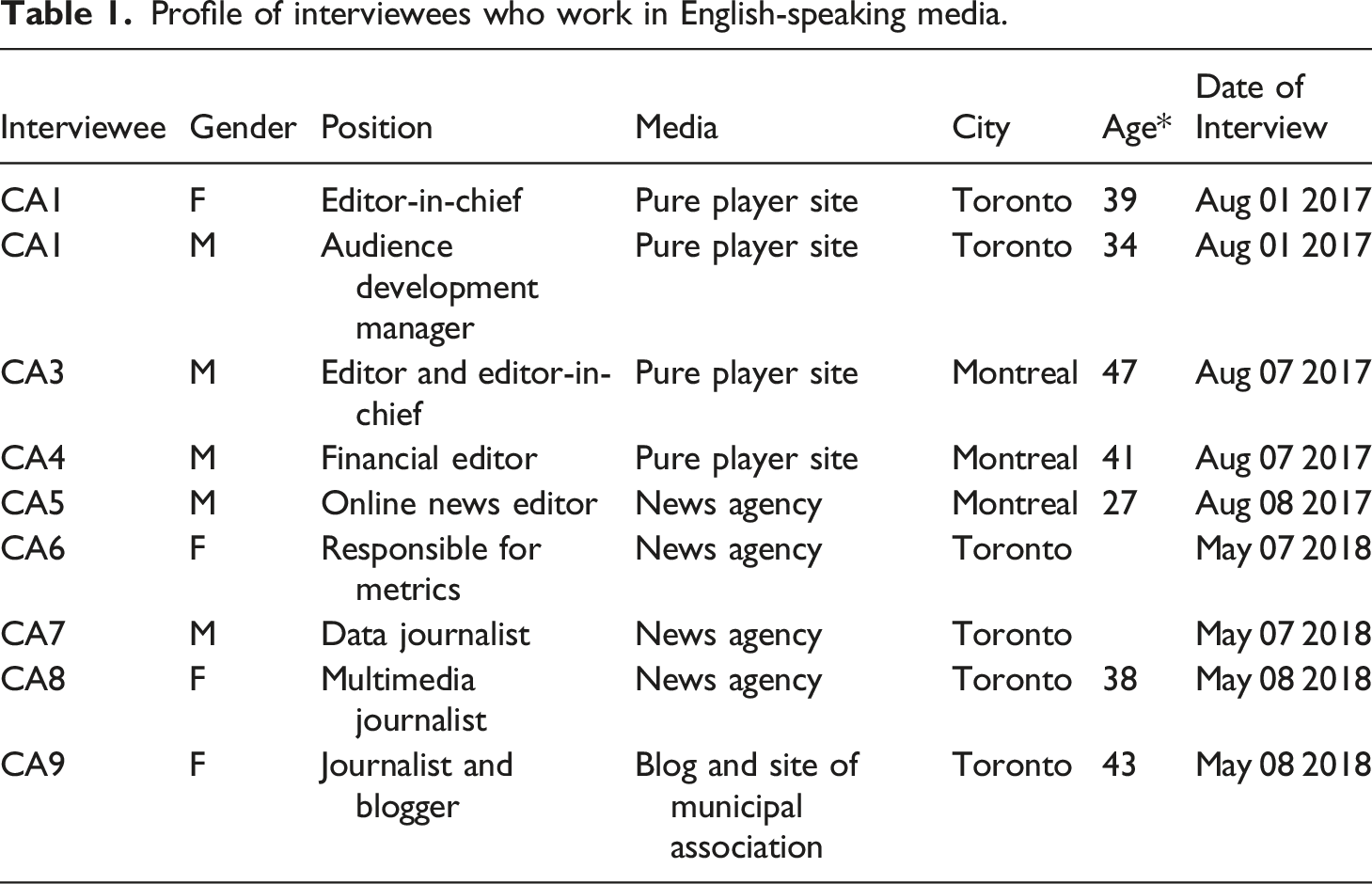
This study involved conducting biographical and in-depth interviews with 17 Canadian digital journalists in the cities of Montreal, Ottawa, Quebec and Toronto. For the purpose of this study, digital journalist is defined as an autonomous professional or a professional employed by a media company to: (1) Produce or manage the content of websites from exclusively digital journalistic companies (“pure players”); (2) Work on the digital versions of public or private media organizations (“legacy media”); (3) Mainly produce digital content in integrated newsrooms.
Profile of interviewees who work in English-speaking media.
Profile of interviewees who work in French-speaking media.
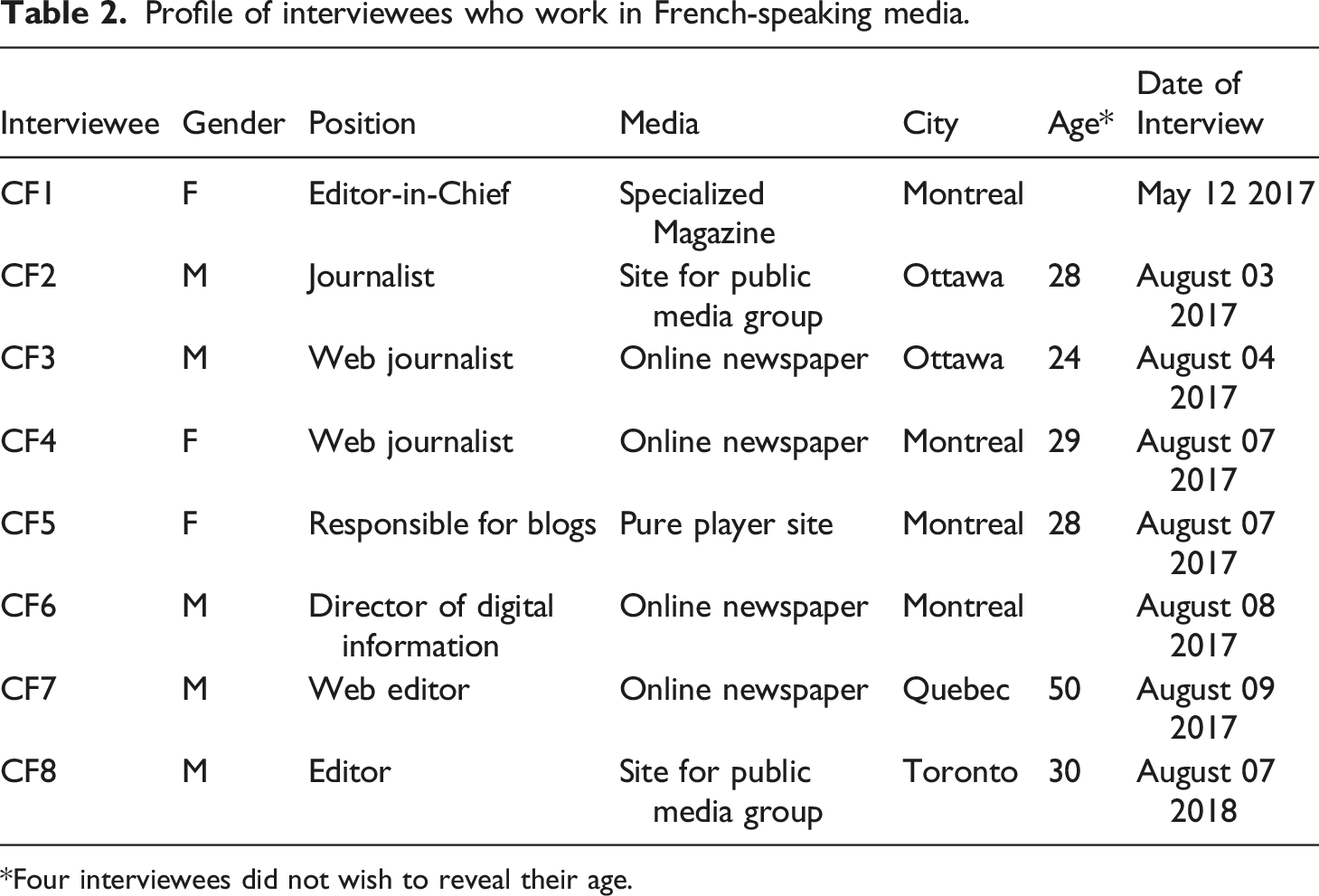
Four interviewees did not wish to reveal their age.
The respondents were interviewed about their choice of profession, their training periods and internships, entry into the labor market, job changes, promotions within the same news company, certain aspects of their personal lives, their career assessments and future plans. Every journalist was encouraged to describe and explain their choices in order to help understand the motivating force behind their career projects.
All interviews were analyzed individually as stories. They focused on how each respondent attributed meaning to his/her personal life trajectory. Analyzing these career choices shows how individual motives are constantly adapting according to the interactions and the structure of the labor market. The findings were then organized into analytical induction tables to be qualitatively aggregated (Becker, 1973). The data set allowed us to reinsert the individual paths of the interviewed journalists into a broader context of the reshaping labor market and the media sector in Canada. To structure the analysis, the different career arcs were reconstructed by gathering recurrent choices observed in the interviewees’ trajectories
Results
Training and internships
The analysis reveals a wide range of higher-education training. Despite a strong focus in the fields of journalism, media and communication, some interviewees entered the profession with backgrounds in International Relations (CA6), Musical Arts (CA7), Political Science (CA8, CF2), and Biology (CF7). Some of these interviewees had taken supplemental training in journalism and media after entering the profession. Only six interviewees had a Master’s level degree (CA3, CA4, CA5, CA8, CF3, CF7).
There is somewhat of a duality to the interviewees' discourse, in the way they assess their training in journalism and how it has impacted their career. Some of them hold a kind of “ideological suspicion” (Frith and Meech, 2007) in relation to the training capacity of institutions, while others seem to offer positive opinions of their training, particularly when learning about the practice of journalism.
With the exception of CA8, who holds a Master’s degree in virtual reality, none of the interviewees had specific university education in computing or information technology, although a fair number of journalists showed a personal interest in the subject early on (CA2, CA7, CF8): “I kept up-to-date with some online skills, like, obviously, you know, I was comfortable with computers, I was comfortable with the Internet, knew what it was. I wasn’t really aware of what, you know, skills you would need to become an online journalist” (CA2). Other interviewees took short-term training after entering the labor market (CA5), participated in academic or professional discussions on digital journalism (CA2), or were self-taught (CA6, CF1).
What’s more, when describing their academic paths, almost all interviewees (with the exception of CA2 and CA5) said they started to plan their careers in the field of digital journalism after entering the job market. Most of them chose journalism as a career based on what they believed the profession would be like, mainly working with standard practices (reporting and polling) and offline media. In this regard, most of the interviewees mentioned a somewhat rapid process of discovering digital over the course of their careers, as illustrated by the following statement from CA6: “So, it’s been also very interesting to see, um, I found myself gravitating towards social media because I was already kind of had my two feet in it and decided to keep doing it”.
Their training periods also involve a number of stints in university and community media, or volunteer work in journalism and communication (CA3, CA5, CA7, CF1, CF2, CF3 and CF6). As a result, some of the interviewees highlight these experiences as what led them to work in the profession, or as a kind of advantage that would help them later on when they enter the profession:
“At university I was the sports editor for two years, and I was the editor-in-chief of the school newspaper for one year. And then in college I worked—uh, I cold-called the [newspaper’s name] and I told them I wanted a job, and they hired me as an intern. So that was cool. That was when I decided I wasn’t going to be a sports journalist anymore” (CA4).
Some interviewees mentioned the internships they realized throughout their trajectories. However, there are important variations in the pedagogical framework and in the way this type of practice is inserted in careers. In some cases, internships are integrated into the syllabus of journalism courses as a part of the training and a form of preparing one to enter the labor market (CA1, CA5, CA7, CA8, C9 and CF4). “My first job was weekend and night reporter at the local TV station in Ottawa. I did during my school a one-week internship at the station. And then, every summer they hired students to work and so that’s how I got my first job to do the work experience for the school” (CA1). There are other cases where internships are precarious and flexible forms of work (paid or unpaid) that journalists do after entering the labor market (CA4, CA6, C9 and CF2). These cases are, of course, a part of the paths and strategies of the interviewees for entering the profession, while the increase in certain forms of hiring interns could be considered an important indicator of the precariousness of the labor market.
Entering the profession
There is an important difference from a generational point of view when it comes to entering the labor market. On one hand, journalists who entered up until the mid-2000’s (CA1, CA3 and CF8) experienced rapid career stabilization right after their training period and obtaining their first job. With respect to the other journalists (CA2, CA5, CA6, CA7, CF1, CF2 CF4, CF5 and CF6), this period was marked by a number of jobs that were temporary, freelance or part-time.
The cases of CF2 and CF4 illustrate this scenario quite well. After graduating from journalism, CF2 applied for an internship at four different newspapers; one of them offered him a six-month contract in New Brunswick. Upon completion of the internship, he was offered a four-month contract by the same newspaper. He then moved to Montreal, where he worked for a suburban newspaper. Shortly thereafter, he was offered an 8-day contract at the same New Brunswick newspaper he had worked at before, replacing a licensed journalist who had left due to health problems. He then received a new temporary contract which lasted until Christmas. He was then given a permanent, part-time contract which then led, finally, to full-time employment as an office manager for provincial affairs.
A similar experience was reported by CF4 who, after completing an internship in Montreal, was hired on as a freelancer which then led to a number of temporary contracts. “There were no positions available, they hired me during the summer break for one week to replace someone (...). I worked like this for two weeks, I was hired as a journalist, but after that, I had to get my foot in the door. They needed secretaries [newsroom] and editors. I did this for a few months” (CF4). It was only after six years later that she managed to obtain a permanent contract of employment with this newspaper
These experiences reveal the fluid nature of one’s entry into the profession (Standaert, 2016), marked by an increasing number of obstacles, testing and training periods, and the construction of hybrid systems of dialogue between universities and internships. As a result, journalism has become a more precarious and less accessible career field to everyone (Deuze and Witschge, 2018). In fact, even if precarious, unstable or temporary contracts were offered at other points in their careers (the case of CF1, discussed below), they appear as a structural characteristic of the professional insertion of journalists in the Canadian labor market
In a way, this long period of insertion can be seen as a negotiation process – in the interactionist sense of the term – which heavily favors employers. On one hand, young journalists, after their training period, seek out to acquire a set (even if fragmented) of professional experiences in order to present potential employers with a portfolio highlighting qualities such as versatility, interest and persistence. This game involves developing other strategies for acquiring/increasing skills: being bilingual (CA3), mastering digital tools (CA2, CA3, CA5, CA8 and CF3), and building a network of contacts (CF5 and CF6): “I found myself gravitating towards social media because I already kind of had my two feet in it and decided to keep doing it. Now I can say I’ve been working directly with social media for at least… more than five years […]. Like when I talk to other people… like how long you’ve been working in social media, and I say more than six or seven years, and they go, ‘Really?’ You know, is that possible? And I’m like, ‘Absolutely’. Social media’s been around since the early 2000s in some form if you choose to look at it that way. Uh, and I’ve been involved, directly involved with a lot of that since then (CA2).
Employers on the other hand use this instability to extend the evaluation period; they utilize a type of low-cost labor and, in a way, anticipate processes of adaptation and socialization of young journalists to media organizations (Standaert, 2016). At the same time, this context of a highly competitive labor market allows employers to increase the number of skills they require their employees to have, as shown in the following (almost naïf) statement from a pure player site manager: “I love [hiring] serious people who speak French and English and have a good knowledge of everything on the web, on social media, the Internet, etc. I also look for people who can multitask, work with video, edit, have a general culture, and who are curious, etc. They also need to show an interest in the content” (CA3)
Career mobility
When analyzing the trajectories of the interviewees after entering the profession, we observed cases of journalists who had only one long-term job in their careers (CA8, CF3, CF4 and CF7) and cases of some who worked in five (CA3, CA4 and CA5) or even nine (CF1) media outlets. Most of the interviewees, however, had had between two and three jobs, which suggests a career that tends to somewhat stabilize after entering the profession.
Literature on this subject suggests that cases of extreme career mobility are related to a disorganized labor market and an increased flexibility of labor relations, and the feeling of uncertainty that comes with it (Goyanes and Rodríguez-Gómez, 2021). This type of situation applies to CF1’s trajectory. For professional reasons (conflicts in the newsroom and disagreeing with the editorial policy of some media companies) or personal reasons (moving to a different country to be with her husband, motherhood, needing to reconcile family life and work), this journalist’s trajectory consists of a number of flexible employment contracts (scholarships, internships, freelance, temporary contracts) which gradually led her towards independent journalism. “I saw how common it is for journalists to not get paid in the culture of media companies […]. And I find it a little depressing, the only way they can get paid well is to start a new company.” At the time of the interview, she was co-founder and co-owner of a specialized independent website.
In other cases (CA3, CA4), these roving careers may be related to fluctuations in the labor market in recent decades when the creation of new media or the opening of new jobs offered new opportunities to journalists who had already built a reputation in the profession. In this sense, changing jobs was seen as a possible career advancement/promotion.
Lastly, the case of CA5, CF5 and CF6 presents another type of trajectory, one which is closer to what specialized literature calls boundaryless or protean careers (Hoekstra, 2011). This particular interviewee reports frequent job changes as a way to learn more about newsrooms and acquire a new set of skills and abilities, while also keeping up with the evolution of the technological environment and digital journalism. This is what CA5 explains: “We also see this in start-ups, people don't stay long. When your project ends, you go somewhere else… I have a hard time seeing myself in the [same] job for more than ten years if the project doesn’t change. Here [at my current job], what I want to do with social media will be finished in three years' time […]. So, with social media, I've already finished my apprenticeship. Can I learn something else? No? Okay, so I'm going to go somewhere else. Yes, it may be partly a matter of ego, but I prefer to work in a more flexible media.” (CA5).
The interviewees report little mobility between English and French linguistic communities. In general, the interviewees consider them to be “totally separate” labor markets (CF8). Our analysis reveals only three cases of Francophone journalists who migrated over to English media, either due to having bilingual family backgrounds (CA3) or having studied in English-speaking educational institutions and Anglophone universities (CA5 and CA8).
The relative job stability of most of the interviewees (15 of them held full-time positions at the time of the interviews) may give the false idea that the precariousness and declining working conditions was something that only affected them when they were starting their careers, when entering into the labor market. However, this is in contrast to the market trend revealed in some studies which detected an increase in the number of cases of resignations after having already entered the profession, and throughout the entire journalism trajectory (Örnembring and Möller, 2018; Cohen et al., 2019; Josephi and O’Donnell, 2022). Recognizing this situation and the current state of the job market in the media sector generates a feeling of insecurity and uncertainty among the interviewees: “I feel like sometimes that it’s even pressure we put on ourselves, because a lot of times the media in Canada, they don’t have the money to kind of upgrade to the latest in structure, or to the latest whatever it is […] Like it’s more of a self-imposed pressure, I think. Just to kind of keep up, because everything changes so quickly, right, and if you don’t keep up with it, then you are left behind personally and then you become unemployable” (CA6).
At the same time, these statements reinforce similar findings on the fluid nature of the industry (Deuze and Witschge, 2018; Cohen et al., 2019). It increasingly makes journalists responsible for finding and securing their work, for self-financing their skills, self-promoting, and guiding their careers and practices towards entrepreneurship (Örnebring 2009; Mckercher 2013; Sherwood and O’Donnell, 2018) which, in a way, puts a strain on the group’s professional identity (Davidson and Meyers 2016).
Discussions and conclusions
A precarious profession
The interviews show how these professionals develop strategies for building and adapting their careers in the face of precariousness in the profession. As a result of labour changes in post-Fordist capitalism and the emergence of the so-called “new economy” (Salamon, 2016; Standaert, 2016), precariousness affects the media industry in three ways: it reduces the number of jobs available; it deregulates employment contracts and increases irregular forms for hiring journalists; and it introduces low wages (Salamon, 2020). The interviews confirm this scenario. This phenomenon is particularly apparent when observing and analyzing the generation gap among the interviewees. Indeed, the second half of the 2000s was a turning point which would lead to a labor market retraction in Canada, significantly affecting how careers are shaped. This results in different trajectories for journalists who entered the job market before, and after, this period of deteriorating working conditions. According to our findings, precariousness exists in the following ways: (a) Difficulties in entering the profession. This occurs by increasing the number of requirements necessary for entering the job market, both in terms of required skills (Reyes-de-Cózar, 2022) and pre-entry barriers, such as internships (Standaert, 2016). The interviews also revealed a recurrence of precarious work contracts that precede career stabilization, a situation which journalists themselves naturalize (Snyder et al., 2021). (b) Increased movement in careers, motivated by instability or insecurity in relation to the labor market. This finding suggests a reconfiguration of the very notion of career. There is a relative decline in the organizational model where the individual makes choices with the objective of remaining or advancing in the newsrooms structure. This is now replaced by more flexible career models (Davidson and Meyers, 2016; Reyna, 2021), structured from performing tasks, projects, or even by adopting the logic of (self) entrepreneurship (Salamon 2020; Josephi and O’Donnell, 2022). (c) Due to the difficulties of building trajectories that favor a work-family balance (Grönlund and Öun, 2018; Snyder et al., 2021), forcing journalists to mostly prioritize the professional side of their careers. “Becoming a journalist was based on the assumption that you had to make personal sacrifices and investments in your career that may have consequences on your family life” (Örnebring and Möller, 2018: 1057). Statements from CA1, CF1 and CF2 especially allude to these situations. (d) Due to the loss of affective attachment to the profession. This is observed in the way the interviewees express a feeling of disillusionment in relation to prospective goals in journalism, as illustrated by this statement by C4: “I don’t really have any career plans. I turned 40 a year and a half ago, and my attitude is that I don’t know where the industry is going and I’m just trying to build my own life. I’ve been in this business for a long time, saved up some money, and I’m trying to build a home life for myself and my wife, start a family, you know, that’s my priority now”. Now, if passion is an important element that a journalist considers for entering and remaining in journalism, and it helps relieve the stress and sources of suffering arising from work (Lelo 2019), then the feeling of uncertainty and pessimism expressed by some interviewees could potentially explain the increased numbers of journalists who leave the profession previously described in other studies (Cohen et al., 2019; Reinardy, 2011).
The interviews suggest an internalization of the current conditions of the workspace, both with regard to digital practices and to the deteriorating conditions under which journalism is being performed. It is in this sense that they begin to plan and negotiate strategies to adapt their careers to the changes that occur in the job market.
Responses to precariousness
Some interviewees resist the precariousness and changes in the media ecosystem (Cf. Salamon, 2020, 2016). For them, working with digital media is a way to survive in the profession (CA4, CA9 and CF4). These journalists have spent most of their careers working in offline media and demonstrate a certain attachment to an ideal and a set of values associated with journalism. They may even resist the introduction of new practices, highlighting elements of their professional autonomy and the mastery of canonical forms of journalism (Francoeur, 2021).
Journalists can also create more flexible expectations, adapting their careers to the constraints of the workspace. (CA6, CF2, CF3, CF5, CF7 and CF8), by building professional profiles that they can then add several layers of knowledge and skills to, thus demonstrating their versatility and availability in relation to employers' expectations. In this regard, they developed a limited number of digital skills and managed to develop a multitask profile. On the one hand, this type of strategy expands the possibilities of employment and increases the demands of permanence in the media market. Yet on the other hand, this means journalists are more easily susceptible to accumulation of tasks and work overload.
Other interviewees forge their careers by integrating the new practices and from global hubs of innovation in journalism. They tackle the labor market instabilities by building an “innovative” profile which, at times, gives them the opportunity to work in relatively specialized niches such as data journalism and immersive journalism (CA7 and CA8), making any “necessary” changes in order to survive the media business model in the digital market (CA2, CA5, and CF6).
Another option is to redirect their careers towards management positions in media companies or create journalistic start-ups. In these cases, some interviewees (CA1, CA3 and CF1) had built a reputation in a previous career that made it possible for them. They justify their positions of employment in digital media by having acquired a set of management skills and a specific knowledge of the news industry’s business model.
Literature shows that investing in entrepreneurial journalism projects has been a recurring response to the organizational insecurities of the job market (Meyers and Davidson, 2016; Salamon, 2020; Deuze and Witschge, 2018) and a way of rebuilding or further strengthening the autonomy and creativity of newsworkers (Carbasse, 2019) in the face of deteriorating labor relations in media companies. Despite the discourses that tend to underline the potentially revitalizing nature of journalism start-ups, redirecting one’s career towards independent media seems to be more associated with a desire to return to a more conventional and idealized model of journalism (Chadha, 2016).
The journalistic identity reshaped
Changes in the work space and the introduction of digital tools in newsrooms are thought to be disruptive to journalism in terms of building one’s identity (Cohen, 2019). The interviews suggest a strong tension between the change and permanence that underlie the processes of negotiating journalistic identities.
When describing their careers, their practices, and their representations about the profession, the interviewees referred to aspects of continuity when speaking about their identities (Sherwood and O’Donnell, 2018). They also defended the stability of practices and roles, often citing having to master specific skills in order to maintain their journalistic autonomy in the face of external threats: audiences, metrics, platforms (Ferrucci and Vos, 2017; Francoeur, 2021).
This viewpoint is particularly present in situations where journalists are encouraged to introduce innovations in their practices. Even though discourse proclaims constant improvement and the acquisition of new skills as requirements for one to succeed in the profession, a considerable number of interviewees still claimed they prefer to adhere to principles such as self-education and informal socialization in newsrooms as effective strategies for entering and remaining in the labor market. Some interviewees even expressed a certain distrust around discourses that aim to restructure their practices and identities, particularly those originating in the academic space and the management and HR sectors of media companies.
On the other hand, strategies for adapting or even reconverting careers as a result of the constraints imposed by the labor market suggest efforts to reconcile some stable traits of journalistic identity with elements of change that reflect the structure of newsrooms. The interviews suggest, however, that the impacts of reshaping these identities cannot be generalized for the entire group. The data reveals a more conservative process of change in identities expressed by the emergence of new segments within the professional group. There is a progressive separation from the more “innovative” status of digital journalism for those who still adhere to more stable elements of identity.
This process of career segmentation in digital journalism seems to be anchored around the conventions that exist between three social spaces: the media and journalism, the digital environment, and the worlds of management and entrepreneurship. This seems to explain how some of the “innovative” or “entrepreneurial” careers observed in this study seem to express new forms of identity negotiation in journalism, starting with the increased number of interlocutors who journalists interact with over the course of their careers: actors in marketing, IT, social networks and platforms, the international centers of innovation in digital journalism (The New York Times, The Guardian, Online News Association). This segmentation seems to broaden and bring variety to journalistic careers (Meyers and Davidson, 2016) by expanding on the possibilities of a heterogeneous professional identity without radically altering more stable aspects of the ideology upheld by the group.
These findings suggest the emergence of transnational digital journalism identity (Hellmueller and Konow-Lund, 2019). This hypothesis is based on the dynamics of circulation of innovations and on the way in which the labor market has been structured in recent years, especially the so-called “mature” media systems (Europe and North America), which have been most affected by the “crisis” of the journalism business model and its effects on the working conditions of journalists (Josephi and O'Donnell, 2022; Salamon, 2020). For that reason, certain findings about the emergence of new career segments observed in Canadian journalism can be generalized to other countries in the Global North.
Contributions and limits
This study sought to underline the effects of precariousness on the construction of careers in digital Canadian journalism, contextualizing and strengthening indicators previously pointed out by other studies on the subject (Salamon 2020; Cohen, 2019; Cohen et al., 2019; Reinardy, 2011). In addition, we were able to map the dynamics of innovations from other countries and how they affect the shaping of careers and the job market in Canadian. In this regard, the segmentation presented here is related to the level that the Canadian media system integrates with the global journalistic industry and its sensitivity to international discourses on innovation – especially in digital media.
This article focused on identity construction in journalism and showed there to be a resistance and resilience on the part of the interviewees, a contrast to the enthusiastic manner in which some techno-determinist discourses tend to discuss changes in the profession. In fact, the current stage of change to practices in newsrooms shows a pluralization of careers and identities in journalism, expressed by the segmentation processes within the profession. At the same time, the interviews suggest a certain circumvention on the part of Canadian digital journalists to deal with the progressive deterioration of working conditions. This study presents evidence that the changes to the job market as of the second half of the 2000s have changed the forms of entry, mobility, and permanence in the profession, making journalism less accessible and generating a shared feeling of pessimism regarding the future of the profession.
These findings suggest that there may be a strong movement towards the dispersion of journalism practices in the near future which would blur the boundaries between the media, the marketing sector and the digital technologies sector. In other words, the lines that separate journalists from other types of content producers (e.g. community mangers, media activists, digital influencers.) may become increasingly blurred. The future of the profession will therefore depend (partly) on how journalists will appropriate values from their identity in order to ensure their social legitimacy in times of change.
These findings were based on a limited number of cases and produced in a specific national context. In addition, the interviews conducted in 2017 and 2018 could not take into account the effects that the Covid-19 pandemic would have on the labor market. Even though the crisis in the sector has been partly mitigated thanks to recent federal and provincial funding for media organizations, the pandemic has slowed down recovery in the sector and compounded the pressure on journalists due to increasing workloads and the speed at which information is being produced (Lacroix and Carignan, 2020). All this suggests the need to update the field of research in order to discuss more recent adaptations in the identities and careers of Canadian journalists.
Footnotes
Acknowledgements
The author wishes to thank François Demers who read and commented the first version of this manuscript and both reviewers for their insightful comments. He also would like to thank Marc-François Bernier, Renaud Carbasse, Felix Deschênes and Greg Nielsen for their support with the field research.
Declaration of conflicting interests
The author(s) declared no potential conflicts of interest with respect to the research, authorship, and/or publication of this article.
Funding
The author(s) disclosed receipt of the following financial support for the research, authorship, and/or publication of this article: Conselho Nacional de Desenvolvimento Científico e Tecnológico, Pq Schoolarship.
