




Abstract
While research on news avoidance has surged in the last couple of decades, we are still at a scholarly shortage in terms of understanding and theorizing the relationship between social class and the inclination to tune out on the news. In addressing this gap, we rely on a mail-back survey with ten thousand Swedes to study how social class predicts the likelihood of avoiding news from different digital outlets. Results show that people at lower social positions, measured as their relative lack of cultural and economic capital, are significantly more likely to avoid online news. A lack of cultural capital predicts total news avoidance online, avoiding online public service news and the “quality news,” while it lessens the likelihood of avoiding “popular news” online. Lacking economic capital predicts total news avoidance online and avoiding the “popular news.” We conclude the article with three cultural sociological lessons for the study of news avoidance. We call for sensitivity in regard to (1) the multi-dimensional character of social inequality, (2) the symbolic value of different types of news genres and outlets, and (3) social inequality in the normative problematizations of news avoidance.
Introduction
The last couple of decades have witnessed an increased scholarly attention to news avoidance. Across the world a growing number of people are “tuning out” on the news (Newman et al., 2019; Strömbäck et al., 2013). From a normative point of view this is troubling since news consumption has been linked to political participation and knowledge (Aalberg and Curran, 2012). When less people get informed about current affairs, as reported by professional journalism, we could be facing a burgeoning democratic deficit (Skovsgaard and Andersen, 2020).
While research has identified links between socio-economic status and news avoidance (e.g., Toff and Palmer, 2019), we are still at scholarly shortage in terms of understanding of how social class may shape the likelihood of avoiding news, especially in regard to the avoidance of news from different types of digital outlets. This constitutes an unfortunate gap since social class has been shown to predict a range of cultural tastes and distastes, including news preferences (Bourdieu, 1984; Clarke, 2014; Lindell, 2018; Lindell and Hovden, 2018). Adding social class to the understanding of digital news avoidance implies sociologizing a field of study hitherto characterized by theorizing at the media systemic and/or individual levels (Lindell, 2020). As such, our endeavor links the widespread worries over a burgeoning democratic deficit resulting out of increased news avoidance to questions of precarity and peoples’ life conditions.
To help remedy this gap we study the extent to which social class predicts news avoidance in the digital realm. Our study is set in Sweden—a highly “wired” society where 9 out 10 citizens use internet on a daily basis (Internetstiftelsen, 2021) where, at the same time, social inequality has been increasing at a fast pace since the 1980s (Therborn, 2020). As such, our case is one wherein nearly all citizens have the potential capacity to consume online news, but where deep-seated social structures mediated through what Bourdieu (1990) refers to as habitus may generate structural inequalities in terms of who is exposed to what kinds of journalism, and who is socially predisposed to avoid certain news outlets. Thus, studying the avoidance of nearly omnipresent online news in Sweden makes for a pertinent testing ground for the contention that social class (still) shapes the way people maneuver in the media landscape. We rely on a large-scale representative mail-back survey (N = 10,068) deployed Sweden to answer the following research questions.
RQ1: To what extent does social class position predict a complete avoidance of digital news?
RQ2: To what extent does social class position predict the avoidance of different types (“quality news,” “popular news,” and “public service news”) of digital news?
Avoiding the news: Surveying the field
In the existing body of research, the link between social inequality and news avoidance largely remains unexplained. For instance, Karlsen et al. (2020) find that educational level explains growing gaps between news avoiders and news seekers, yet education is never understood in relation to social inequality and as constitutive of a social class position (see also Dahlgren, 2019; Edgerly 2021; Ksiazek et al., 2010; Lee and Yang, 2014; Strömbäck et al., 2013; Trilling and Schoenbach, 2013; Toff and Palmer, 2019). Rather than social class, common explanatory variables of news avoidance include the media system (Karlsen et al., 2020; Toff and Kalogeropoulos, 2020), individuals’ levels of political interest (Dahlgren, 2019; Strömbäck et al., 2013; Strömbäck, 2017), gender (Toff and Palmer, 2019), or emotions and mental states (Edgerly, 2021; Buneviciene et al., 2021; Villi et al., 2021; ). Correspondingly, the relationship between social inequality and news avoidance is seldomly theorized despite connections being made empirically.
The studies that explicitly focus on the relationship between social inequality and news avoidance suggest that people at lower and more precarious social positions are more prone to avoid news (Lindell, 2018; Lindell and Hovden, 2018; Toff and Palmer, 2019). A study by Lee et al. (2016) also displays how people with low educational levels are less inclined to pay for news, opting for free news sources or alternative means to access news. Lack of habit and access is generally identified as the reason for avoiding the news. One of the main focus points in previous research, however, is that people without political interest are more likely to avoid news, both intentionally and unintentionally (Dahlgren, 2019; Damstra et al., 2021; Edgerly, 2021; Urman, 2019). Again, this group usually consists of women with low levels of education and participation in society. Indeed, previous studies showcase a “gender gap” in news consumption (e.g., Knobloch-Westerwick and Alter, 2007; Benesch, 2012; Toff and Palmer, 2019). There are, of course, also groups of men who avoid news, this is commonly explained with reference to their political attitudes rather than their lack of habit and access to news. People with populist attitudes tend to distrust news media, choosing to reject and intentionally avoid news, opting for alternative sources (Schulz, 2019; Štětka et al., 2021). It seems, however, that women are overrepresented when it comes to both intentional and unintentional news avoidance.
Age is another variable that is frequently explored in studies on news consumption and avoidance (e.g., Ghersetti and Westlund, 2018). Studies show that older people are less inclined to consult digital news media (e.g., Bergström, 2017). Common findings in the field attribute this to a combination of disinterest and lack of the necessary digital skill to access digital news (Autenrieth et al., 2021; Lee and Yang, 2014; Villi et al., 2021).
The concepts news fatigue and information overload have emerged as a result of the so-called high-choice media environment (Gurr and Metag, 2021; Kormelink and Gunnewiek, 2021; Song et al., 2017; Toff and Kalogeropoulos, 2020), in which audiences have a broad variety of news sources to choose from. These concepts have been deployed to understand certain aspects of news avoidance, showing how avoidance is not only a result of disinterest or lack of access, but also an inherent trait in the contemporary high-choice media system.
While we are mainly concerned with how social class predicts the likelihood of digital news avoidance the state of the field suggest that age, gender and levels of political interest are key variables in explaining the inclination to avoid the news. As such, we pose the following three hypotheses:
H1: Women are more likely than men to avoid online news.
H2: Older people are more likely than younger people to avoid online news.
H3: Politically uninterested people are more likely than politically interested people to avoid online news.
In sum, various indicators of social class have sporadically been studied in the literature, but first and foremost as control variables in quantitative research (e.g., Karlsen et al., 2020), or as part of broader, intersectional, research designs in qualitative research (e.g., Toff and Palmer, 2019). As a consequence, previous research is lacking in terms of theorizing the links between social class and news avoidance. In the next section we attempt to address this gap.
Social class and news avoidance
Existing empirical studies on news avoidance suggest that social class position such as educational and income levels predict news avoidance (and news consumption). It is, however, rare that previous research theorizes why social class would constitute a good predictor in the first place. Thus, we seek to add to the literature on news avoidance on two counts. First, in order to properly study the potential impact of social class on news avoidance, we need to include several measurements of social class. Second, we need to theorize why we should expect social class to matter in the first place. The sociology of Pierre Bourdieu helps us in this two-fold endeavor.
For Bourdieu (1984, 1996), class position in modern and differentiated societies is set by access to material and symbolic resources, primarily economic capital (e.g., material assets measured as income, assets, land, or property) and cultural capital—a resource that can be institutionally sanctioned (such educational credentials), embodied (such as mannerisms passed down from family or learnt from peers) or objectified (such as cultural goods) (Bourdieu, 1986). A range of empirical studies, including Bourdieu’s own investigations, have delineated a two-fold structure of the social space wherein social agents are positioned according to their volume and the structure of their capital (Coulangeon and Duval, 2015). This pattern has been shown to apply to our case, Sweden, as well (Lindell, 2018; Lindell and Hovden, 2018).
When it comes to the question regarding why one should expect social class to matter for how people relate to the news and journalism, we turn to one of Bourdieu’s main contributions to sociology—the so-called homology thesis (Rosenlund, 2015). This amounts to the observation that class positions tend to correspond to a set of dispositions manifested in lifestyle choices and preferences (Bourdieu, 1984). A class position tends to inculcate an agent into certain practices and preferences. In other words, “objective” positions in the social space tend to create a certain class habitus—a “subjective” way of maneuvering in the social world that is shared by people at similar class positions. This is to say that class positions (set by upbringing, educational levels, wealth, etc.) socialize agents into certain lifestyles, and that such lifestyles tend to reinforce the social structures that produced them to begin with (Bourdieu, 1984, 1996). Through this lens news and journalism are approached as cultural goods that social agents are differently equipped to appreciate, consume and make sense of (Lindell, 2018). Previous studies have shown that less resourceful groups are more likely to feel disconnected from the world of journalism (Clarke, 2014; Lindell, 2020) whereas news, especially the so-called “quality news,” is catered (oftentimes explicitly via market segmentation) to and appreciated by agents at more affluent positions since they give the reader much more than the “personal” opinions he needs; they acknowledge his dignity as a political subject capable of being, if not a subject of history, then at least the subject of a discourse on history. (Bourdieu, 1984: 446)
It should thus not come as a surprise that a range of studies conducted in different countries identify correlations between educational and income levels and news consumption (Bergström et al., 2019; Karlsen et al., 2020; Strömbäck et al., 2013). Neither should we be surprised over the fact that social differences are more pronounced in digital news consumption compared to “analogue” consumption (Kalogeropoulos and Nielsen, 2018). Selective exposure is more prominent in the online environment (Tewksbury, 2005) and as such socially shaped individual preferences become more clearly reflected in online news exposure. In light of the fact the previous research has established links between various indicators of socio-economic status, and that social inequality in news consumption is more clearly accentuated in the online environment we should expect that a general lack of economic and cultural capital is associated with an increased likelihood of avoiding online news. We expect such class-based differences to exist alongside previously documented variations between men and women, the old and the young, the politically interested and the uninterested.
H4:Individuals who are relatively poor in economic and cultural capital are more likely to avoid online news. Out of the two main forms of capital (cultural and economic capital) that divide contemporary societies previous research suggest cultural capital is the more important predictor when it comes to news preferences and practices (Lindell, 2018; Lindell and Hovden, 2018). Economic capital is not necessarily a barrier to accessing online news. Public service news, for instance, is available freely to all Swedes with access to the internet (which is about 95% of the population). Additionally, many (especially young people) consider free-to-use social media as their main news source (Newman et al., 2021). Cultural capital, on the other hand, amounts to a symbolic mastery connected to the consumption of the “right kinds” of culture (Bourdieu, 1984). As such we pose the following hypothesis.
H5: Lack of cultural capital is more important than economic capital in predicting news avoidance online. News, however, is not a monolith, and approaching news avoidance with a crude measurement of “total news avoidance” (e.g., Blekesaune et al., 2012; Strömbäck et al., 2013; Edgerly, 2021) misses fine-grained differences and the fact that different cultural goods are imbued with different symbolic value. Still, the focus on total news avoidance is common (Skovsgaard and Andersen, 2020) mainly because it allows the study of people that are completely disconnected from journalism. However, given the amount of scholarly effort that has gone into explaining the qualitative differences between various news outlets, not least between public service media and commercial media (Curran et al., 2009) and between “hard news” and “soft news” (Reinemann et al., 2012) we should also pay attention to the avoidance of various types of news. It is, nonetheless, true that the Swedish and the Nordic media markets are characterized by omnibus papers with wide reach—even the so-called “popular press” publishes culture debate and political commentary and are thus less “tabloid oriented” in comparison to their counterparts in other countries and media systems (Gustafsson and Rydén, 2010; Syvertsen et al., 2014). Despite this relatively unique feature of the Nordic media system previous studies have identified class-related patterns in the consumption of news from different outlets, and that people rich in cultural capital are more prone to prefer so-called “quality press” and distaste the “popular press” (Ohlsson et al., 2017). Additionally, the skepticism toward public service media is more widespread among individuals in relative dispossession of cultural capital (Lindell, 2018; Lindell and Hovden, 2018). As such, we pose the following hypotheses.
H6: Lack of cultural capital is more important than economic capital in predicting the avoidance of online “quality news” and public service news.
H7: Lack of cultural capital is negatively related to the avoidance of the “popular press” online.
Data and method
In order to study the likelihood of avoiding online news we used the nation-wide mail-back Society, Opinion, Media (SOM) survey of 2019 1 which has been carried out annually since 1986 by the SOM Institute at the University of Gothenburg. On 9 September 2019 the survey was distributed by post (although respondents could choose to answer online) to 21,000 randomly selected Swedes between the ages of 16 and 85. On December 15, 10,068 respondents had answered the survey, resulting in an answering rate of 48% (Falk et al., 2020). Analyses conducted by the SOM Institute indicated that the data represented the Swedish population well (Falk et al., 2020).
Our dependent variable—news avoidance—is a much debated one. In their literature review Skovsgaard and Andersen (2020) distills four main ways in which news avoidance has been approached empirically. The first approach is open-ended and identifies clusters in samples and proceeds to label the group consuming the least news as “avoiders” (e.g., Ksiazek et al., 2010). A second strategy relies on a pre-defined cut-off point in relation to average news consumption (e.g., Strömbäck, 2017), while a third approach uses an absolute cut-off point (for instance, no news consumed at all for a week) (Blekesaune et al., 2012). Finally, the fourth approach amounts to letting respondents agree or disagree that they are news avoiders (Kalogeropoulos, 2017). In this study, we drew on what Skovsgaard and Andersen terms the third approach—we used an absolute cut-off point. We, quite simply, refer to people who never consume news from a given outlet as “news avoiders” in relation to that specific outlet. This implies that we are dealing with complete news avoidance in relation to a given outlet, and not “relatively low news consumption” or respondents’ self-identification as a news avoider. This strategy suggests that we need to complement our measurements in order to move beyond avoidance of news from specific outlets in order to also be able to capture overall news avoidance online. For this purpose, we used the item “I never consume news online.” Below we describe the dependent variables in detail.
In order to address the fact a large portion of previous research does not differentiate between different types of news we studied the likelihood of avoiding news from different online news outlets. To this end we focused the national quality morning paper with the biggest reach (Dagens Nyheter [www.dn.se]), the online tabloid paper with the widest reach (Aftonbladet [www.aftonbladet.se]) and two public service news outlets (Swedish Radio [www.sr.se] and Swedish Television [www.svt.se]). These outlets share the ambition to reach nation-wide audiences. Dagens Nyheter and Aftonbladet are the biggest news outlets in their respective category, both reaching wide audiences, which makes for an ample testing ground for the contention that specific demographic segments are more likely to avoid certain types of news outlets. The outlets chosen have, furthermore, different journalistic profiles which, we argue, is key to understanding news avoidance in a high-choice media landscape. Dagens Nyheter is a national morning paper with in-depth journalistic coverage and cultural debate—a “quality paper” using a paywall model that is consumed first and foremost by relatively affluent and metropolitan groups in society (Gustafsson and Rydén, 2010; Ohlsson et al., 2017). Aftonbladet.se is an evening paper with a “popular” or “soft” (Reinemann et al., 2012) profile (including an abundance of graphical contents, extensive sports contents, “clickbaits” and sensationalism) with a majority of its content available for free. Aftonbladet reaches a majority of the Swedish population on a weekly basis (Gustafsson and Rydén, 2010). Swedish Radio and Swedish Television are public service broadcasters with explicit, and regulated, ambitions to reach all citizens. Their online domains produce original and re-packaged content available for free.
The survey questions were posed as follows: “How often do you consume news from the following sources online?”. These questions provided a six-point answering scale ranging from “daily” to “never.” Since we were concerned with the likelihood of completely avoiding the news from a specific outlet the measurements were transformed into binary variables were one category (1) indicated complete avoidance and the other (0) indicated some consumption. 26,4% of respondents (n = 2457) completely avoided news from Aftonbladet.se, 48,1% (n = 3857) avoided Dagens Nyheter online, 40,1% (n = 3209) avoided Swedish Radio online and 30,9% (n = 2519) avoided Swedish Television online.
Apart from outlet specific news avoidance we also studied general news avoidance on the internet with the following question “I never consume news online” (agreed/not agreed). 12,2% (n = 1210) of respondents answered that they never consumed news online.
As for the independent variables, three variables were used to study social class (as conceptualized as access to symbolic and material resources that affect people’s life-chances [Bourdieu, 1984, 1986]). University degree constitutes an institutionally sanctioned cultural/scholastic capital and was a binary variable that separated the 33% of the respondents with a degree (coded as “0”) from the 67% of the respondents without a university degree (coded as “1”). Annual household income is a way to measure economic capital. This variable separated the 76% of respondents in households earning more than 301,000 SEK/year (coded as “0”) from the 24% who earned a maximum of 300,000 SEK/year (coded as “1”). Social class background captures an embodied and inherited cultural capital and was measured with the question “If you would describe the home that you grew up in, which alternative would fit best?” where the alternatives included “working class home,” “farmer home,” “entrepreneurial/self-employed home,” “white-collar home,” and “upper white-collar home.” The variable was re-coded in order to study differences between the 28% who had grown up in (upper) white-collar homes (coded as “0”) and the 72% who had grown up in other types of homes (coded as “1”).
Three control variables were included in the models. Gender (male = 0 [48%], female = 1 [52%]), age—a continuous variable ranging from 16 to 85 (M = 52, SD = 19) and political interest (politically interested = 0 [64%], not politically interested = 1 [36%]). These variables have previously been shown to explain news avoidance (Edgerly, 2021; Strömbäck et al., 2013; Toff and Palmer, 2019) and as such it was crucial to control whether social class explains news avoidance when these factors were held constant.
This study design allowed us to probe into the underexplored area of outlet specific news avoidance in the online realm in relation to social class. The study is not, however, without its limitations. For one it is based on self-reports. Oftentimes respondents self-reported news consumption is “immensely inflated” (Prior, 2009). We might expect, however, that it is easier for respondents to report non-consumption of a specific outlet—which is studied here—than it is to reliably estimate the exact frequency of one’s consumption (this is, however, an empirical question). Turning to our other dependent variable—self-reported total avoidance of all news on the internet—things get more complex since one may not always be aware of one’s exposure to news when moving about in the online realm (Tewksbury et al., 2001). This variable may perhaps best be treated as the fourth category of approaching news avoidance delineated above (Skovsgaard and Andersen, 2020)—implying the study of self-identification rather than actual practices. In terms of independent variables, data prevented us from using more/other social class variables. Previous studies (Lindell, 2018; Lindell and Hovden, 2018) have illustrated the merits of using a wide-range of social class variables to get at the multi-dimensional nature of social differentiation. While the SOM data includes other variables (such as type of education and individual monthly incomes) these were included only in different sub-questionnaires.
Results
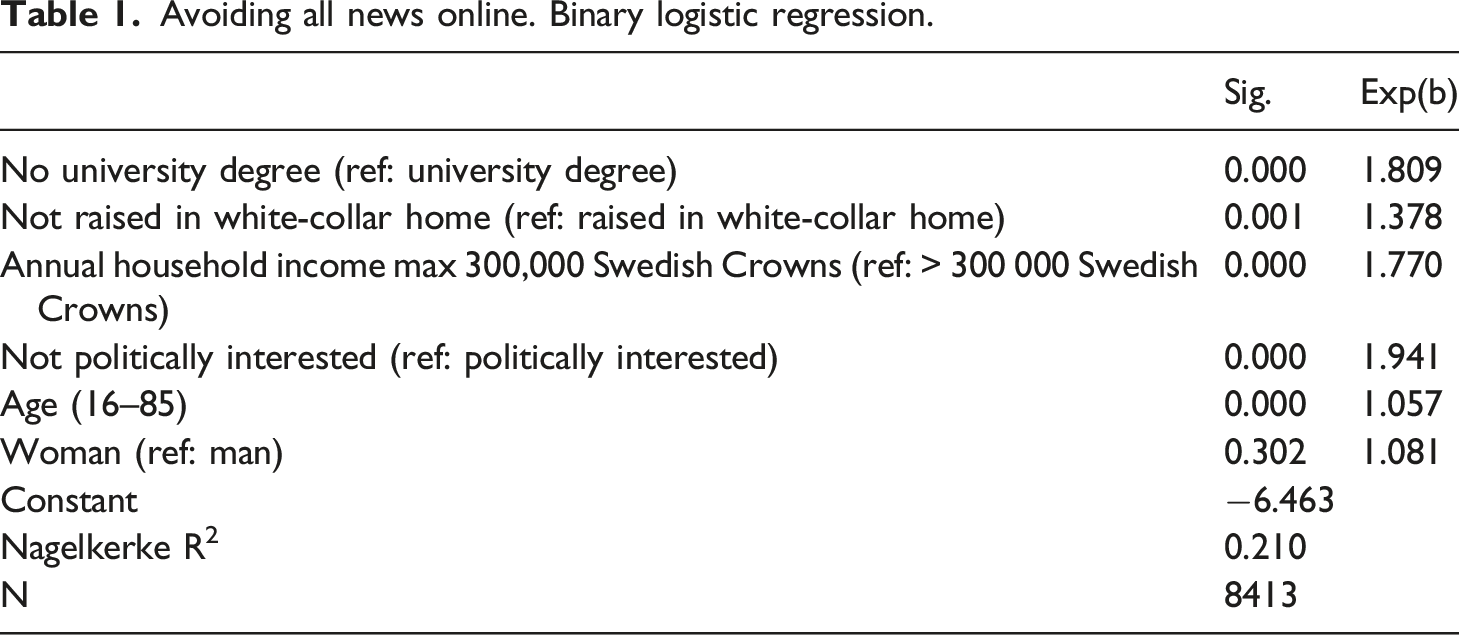
We used binary logistic regression analyses to estimate the extent to which the likelihood of avoiding online news increased at lower social positions (lack of cultural and economic capital) when controlling for age, gender and political interest.
Avoiding all news online. Binary logistic regression.
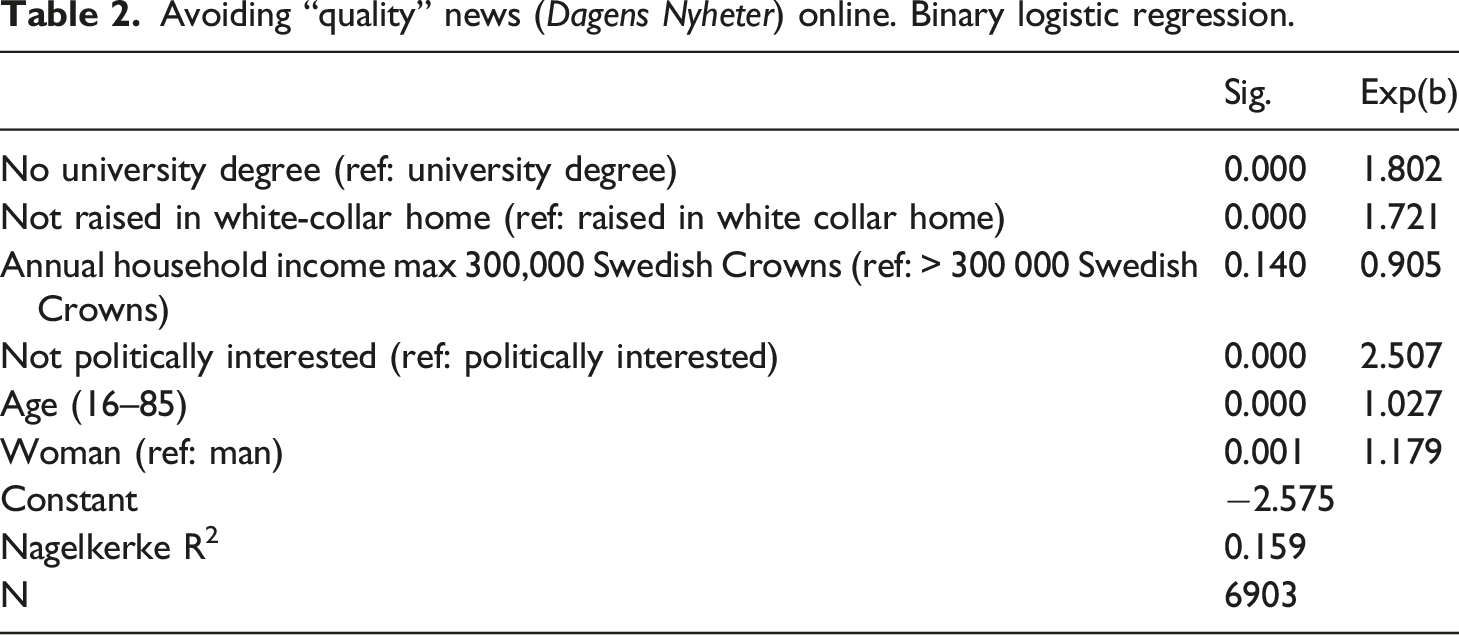
Avoiding “quality” news (Dagens Nyheter) online. Binary logistic regression.
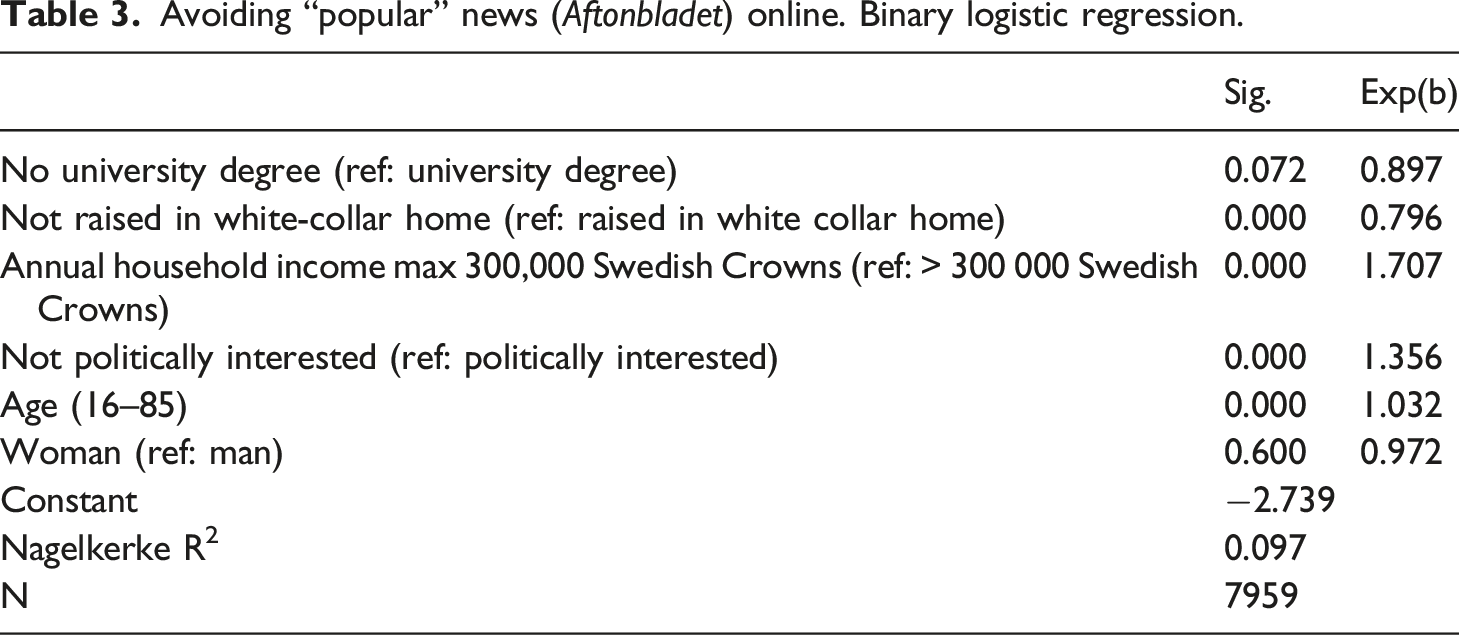
Avoiding “popular” news (Aftonbladet) online. Binary logistic regression.
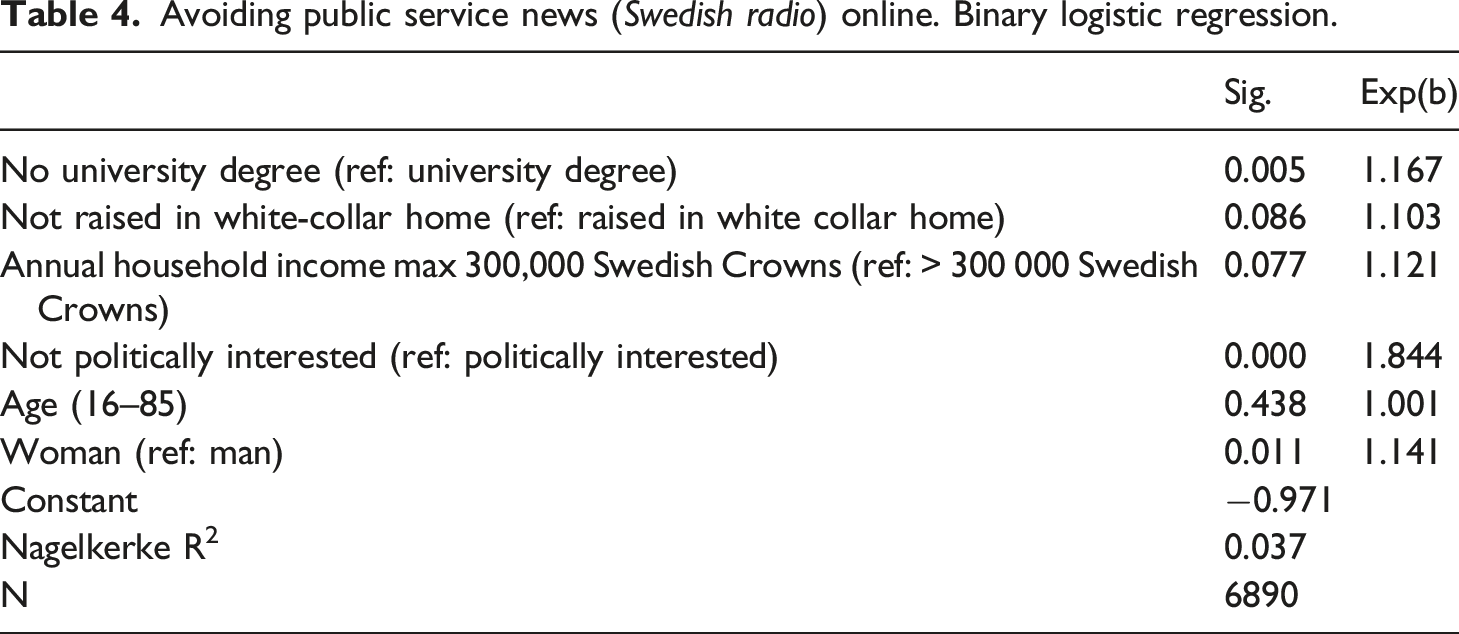
Avoiding public service news (Swedish radio) online. Binary logistic regression.
Avoiding public service news (Swedish television) online. Binary logistic regression.
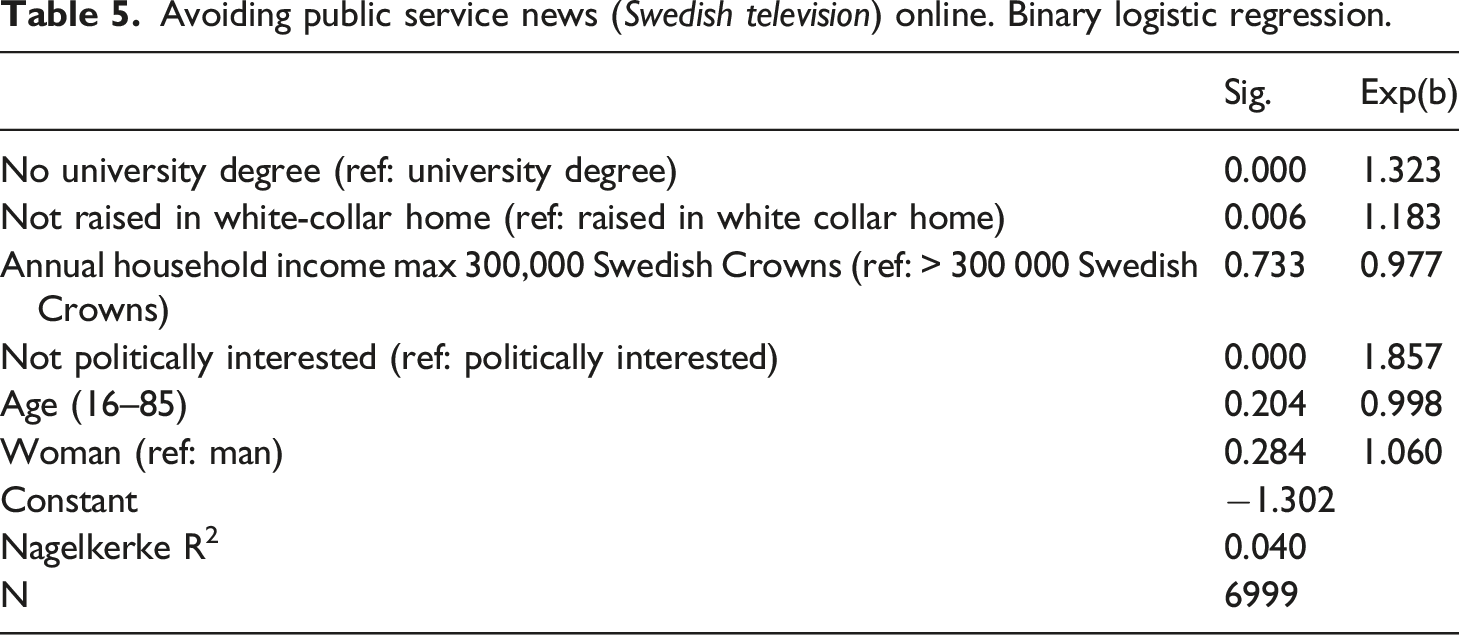
However, lacking both a university degree and the embodied cultural capital linked with being raised by parents at high positions in the labor market predicts the avoidance of Swedish Television online (Table 5). Lacking economic capital is not linked to an increased likelihood of avoiding Swedish Television. This aligns with previous studies showing a relationship between cultural capital and the taste for public service media (Lindell, 2018; Lindell and Hovden, 2018), which is an interesting observation when put in relation to public service media’s regulated ambitions to reach all strata of society, for free, online.
Conclusions
Older age predicts a total avoidance of online news, and the online editions of both the tabloid and quality press. Old age does not, however, predict avoiding the online versions of public service media. H1 is thus only partially supported.
Gender (woman) predicts the total avoidance of online news, avoiding the online editions of the “quality press” (albeit with a very small effect size) and Swedish Radio online. As such, H2 is partially supported.
Political disinterest is, like in many previous studies (e.g., Strömbäck et al., 2013), the most consistent independent variable in this study, as it predicts complete news avoidance online and, naturally, the avoidance of all individual outlets studied here. H3 is thus supported.
Turning to the first research question and the connected hypothesis our results suggest that regardless of Swedish news audiences’ ages, genders and their levels of political interest, their social class matters at the extent to which they avoid online news. A relative lack of both material and symbolic resources predicts the tendency to avoid online news. H4 is thus supported.
The second research question asked about the relationship between social class and the avoidance of different types of online news outlets. We hypothesized (H5) that cultural capital would be more important than economic capital in explaining online news avoidance. In terms of total news avoidance, we fail to find support for this contention since both forms of capital predicted total news avoidance online. We also hypothesized that a lack of cultural capital would be more important than lack of economic means when explaining avoidance of the online editions of Dagens Nyheter (“quality press”) and public service media (H6). This was supported. Despite the fact that the Dagens Nyheter is put behind a paywall (which requires economic means to pass) it is cultural capital and the symbolic mastery connected to the possession of it that presents itself at the barrier of entry, not monetary means. Finally, we hypothesized that people lacking cultural capital would be less likely to avoid the “popular press” online (H7). This was partially supported as people with more affluent social class backgrounds (embodied-inherited cultural capital) were more likely to avoid Aftonbladet, whereas educational level (scholastic capital) was not statistically significant.
Discussion and three cultural sociological takeaways
In Sweden, 9 out of 10 citizens use the internet every day (Internetstiftelsen, 2021) and as such a vast majority of citizens are potential consumers of digital news. Yet this study has showed that deep-seated social structures in terms of social class positions matter for the likelihood of avoiding digital news altogether, and for avoiding news from specific outlets. As such, this study adds to the understanding of news avoidance, where social class as a predictor has largely been under-theorized or even contested (e.g., Edgerly, 2021: 12). In using a representative mail-back survey with over ten thousand Swedes we have shown that social class, in terms of individuals’ access to economic and particularly cultural capital, explains the avoidance of different types of online news outlets, even as we control for variations in age, gender and levels of political interest.
Through a Bourdieusian lens (1984) the observed overlaps, or homologies, between social position and cultural dispositions in the shape of news avoidance are the results of habitus. Upbringing and socialization under certain social circumstances produce a system of durable dispositions and preferences that manifest in tastes and distastes—in our case the rejection of online journalism. It should be noted, however, that we have not been able to control for cognitive and emotional factors that have been shown to explain news avoidance (Edgerly, 2021; Villi et al., 2021). While variables such as “low news self-efficacy,” “lack of knowledge” about news and journalism, and “finding news irrelevant” have been understood as predictors for news avoidance (Edgerly, 2021), we might hypothesize that such factors are themselves hinged upon social class positions since cultural confidence and the perceived “relevance” of journalism have been shown to connect to more affluent positions in the social space (Bourdieu, 1984; Lindell, 2018, 2020).
Apart from the overall conclusion that social class matters at the extent to which different people avoid online news, we draw from our findings three cultural sociological lessons that can inform future research.
Lesson 1: We need to rely on a multi-dimensional understanding of social inequality. We have shown that a multi-dimensional lens on social class that differentiates between various forms of capitals (Bourdieu, 1986) reveals different facets of social inequality in news avoidance. Lacking cultural capital links to the taste for “popular news,” while it generates distaste toward (and subsequent avoidance of) public service media’s online outlets (see also Ohlsson et al., 2017), while the relative lack of economic capital does not increase the likelihood of avoiding public service media and the “quality press.” On the broader level, this links to previous studies that have unearthed anti-elite sentiments at lower class positions (e.g., Gidron and Hall, 2017; Nieminen, 2019). We learn thus, that we should refrain from treating social class position in a uni-dimensional manner (as sometimes done via the notion of “socio-economic status” [see e.g., Bergström et al., 2019]) since different capitals have different social functions. Future research using more detailed data than we have had at our disposal should attempt to differentiate even more between various forms of capital and take seriously their social functions.
Lesson 2: We need to differentiate between what kinds of news outlets and genres that are avoided. While studies on overall news avoidance have generated important insights regarding the increasing tendency to completely disconnect from the news (e.g., Blekesaune et al., 2012; Strömbäck et al., 2013; Edgerly, 2021), they remain unable to recognize that different people avoid different types of news for different reasons. As we have seen, avoiding the “popular news” is qualitatively different compared to the avoidance of public service news—the two types of outlets are avoided by different segments in the social space. This implies that we should recognize that different cultural goods are socially imbued with different value (Bourdieu, 1984). A sensitivity toward the character, and also the quality, of various news outlets also circumvents the crude notion that “more news” equals “better democracy” or “more informed citizens.”
While we stress the importance of studying avoidance of different news outlets, we have not studied ways in which news are avoided or consumed—that is, the mode of appropriation, which a growing concern in cultural sociology (e.g., Jarness, 2015; Daenekindt and Roose, 2017). This view suggests that it is “possible to love the same things differently and to love different things in the same way” (Ariño Villarroya and Llopis-Goig, 2021: 4). We call on future qualitative research to not only differentiate between various news outlets but also recognize that it is possible for people to avoid the same news outlet for different reasons, and to avoid different news for the same reason.
Lesson 3: We need to place social inequality at the center of normative discussions on news avoidance. In a broad sense journalism sets out to establish social relations between citizens and society (Sjøvaag, 2010). The observed growth in the number of people that “tune out” from the world of news (Strömbäck et al., 2013) is indicative of a broader contemporary withdrawal from the relations between citizen and society, individual and collective. Sociologists have referred to this kind of opting out from social relations as the “negative bonds” that emerge as the “prime form of choice” in hypermodernity (Kaun, 2021: 4; Illouz, 2019). As shown in this study, people at more precarious positions in society seem more prone to withdraw from the individual-society relations promoted by journalism. As such journalism is yet another societal institution, like, for instance, the educational system (see e.g., Morris et al., 2016), where people at less privileged positions lag behind due to a mismatch between habitus and structural expectations. This should lead scholars of news avoidance to pay more attention to the broader socio-cultural trends that characterize contemporary social life.
Diagnoses on the “unmotivated” and “politically uninterested” news avoider that is “less informed” (Skovsgaard and Andersen, 2020; Strömbäck et al., 2013) should be supplemented with an expanded normative horizon and analysis concerned with what news avoidance is the symptom of. We should, in other words, be wary of the fact that the “negative bonds” between citizens and journalists are emerging at social positions characterized by a lack of social resources, and that such negative bonds stem not only from peoples’ individual motivations and abilities but also from precarious life conditions.
Footnotes
Declaration of conflicting interests
The author(s) declared no potential conflicts of interest with respect to the research, authorship, and/or publication of this article.
Funding
The author(s) received no financial support for the research, authorship, and/or publication of this article.

Note
Author biographies
Johan Lindell is Associate Professor in Media and Communication Studies at Uppsala University, Sweden. His research interests include media use and social inequality, media systems and fields of media and cultural production. He has previously published his research in, for instance, New Media & Society, European Journal of Communication, Media, Culture & Society, Poetics and Communication Theory.
Else Mikkelsen Båge holds a bachelor’s degree in Media and Communication Studies from Uppsala University, Sweden. She is currently a master’s student in the international master’s program in the social sciences specializing in Digital Media and Society at Uppsala University. Mikkelsen Båge is currently writing her master’s thesis on media trust among youth and working as a research assistant at Södertörn University, supervised by Professor Anne Kaun, in a project focusing on automated decision making.