




Abstract
This paper explores the relationship between memory, journalism and numbers. It does so through a case study that examines how the Colombian news media reported on a particular figure during a peace negotiation: the 220,000 people who died because of the armed conflict in Colombia. The number was produced by the National Centre for Historical Memory in 2013 in a comprehensive report about the ravages of the Colombian conflict (1958–2012). Following a mix-method approach – a quantitative content analysis and a thematic analysis of the news articles – we find that the way in which journalists reported on the figure contradicts two key aspects of the report. While the report rejects an ‘official memory’ of the conflict for one that is more open to political and social debate, one characterised less by ‘closed truths’, the news reports treated the number as a fact and very rarely provided a form of contestation to it. Moreover, while the report emphasises the need for clarification over distortion and concealment when constructing memory, the news articles misrepresented those accountable for the casualties: Fuerzas Armadas Revolucionarias de Colombia (FARC) was consistently positioned as the main illegal armed organisation responsible for the death toll. This representation ran counter to the findings from the report that emphasised the way paramilitary groups, rather than guerrilla groups (e.g. FARC), were more responsible for the killings. Considering our findings, we argue that an adherence to accuracy by journalists is more desirable than a practice of vagueness in the contribution to memory formation in post-conflict contexts.
Introduction
In July 2013, a comprehensive report was published by The National Centre for Historical Memory (NCHM, Spanish acronym) about the Colombian armed conflict (1958–2012). It provided estimates for the levels of sexual violence, the amount of children recruited into war, the number of people displaced, the scale of kidnappings, the prevalence of antipersonnel mines and the scope of kidnappings (Historical Memory Group, 2013: 33–34). Its most iconic statistic, however, was the claim that 220,000 civilians and combatants had been killed from 1958–2012. This figure was both more specific than the oft cited ‘hundreds of thousands of people have been killed’ (Kryt, 2012) and much higher than the ‘70,000’ dead referred to by certain media organisations (Brodzinsky, 2013). Partly due to this, the number was widely reported by the news media in Colombia during the peace process (2012–2016) between the Colombian government and FARC (Armed Revolutionary Forces of Colombia, Spanish acronym).
The importance of this number within news media coverage during a peace negotiation period means that we use this figure as a case study for our article. It is used to explore the relationship between memory, journalism and numbers – an area sorely under studied in contemporary literature. Our research is guided by two main research questions, both of which solely focus on identifying how the number was used in news reporting, rather than addressing the issue of why journalists employed the 220,000 figure in the way they did: 1. To what extent did journalists critically engage with the statistic? a. To what extent did journalists provide context around the 220,000 figure? b. To what extent did journalists contest the 220,000 statistic? 2. How did the figure relate to discourses of responsibility during the peace negotiations?
To answer the questions, we employ a mixed-method approach: a quantitative content analysis of how the figure was reported by the news media and a thematic analysis of the news articles. Our findings show that journalists treated the number as a fact, indicated in how the news reports uncommonly referred to the source and details about the figure, and, most importantly, they very rarely provided a form of contestation. Moreover, the news reports misrepresented those accountable for the casualties: FARC was consistently positioned – often through the omission of information – as the main illegal armed organisation responsible for the death toll.
When contrasting these results with how the NCHM produced and communicated the figure, we can see that the news reports contradict the purpose of the report. The report was aimed at constructing a memory of the conflict that was characterised less by ‘closed truths’ of what happened in the past and more by a collective discussion about a ‘reality anchored in our present’. Such an approach rejected an ‘official memory’ of the conflict for one that was built on ‘open social and political debate’ that incorporated ‘the differences, the contradictions, their positions and their responsibilities’ (Historical Memory Group, 2013: 16). This clearly clashes with how journalists treated the number of the 220.000 death as a fact.
As part of this vision, the report talks of two key aspects. The first concerns responsibility – it was aimed at breaking from the ‘reductionist visions of violence’ that talked of ‘the good guys and the villains’ by recognising the ‘complexity of what we have experienced’. In doing so, it acknowledged the way that society as a whole, and not just military organisations, were participants in the conflict through ‘consent, silence, support and indifference’. But it also resisted the ‘we are all guilty’ narrative that ignored the way certain actors and organisations were more at fault than others. To guide these discussions of responsibility, the report rested on the second aspect – the need for clarification over ‘distortion, concealment and oblivion’. (Historical Memory Group, 2013, p.16). The clarification over concealment aspect was not achieved through the reporting of the figure in the news media as the articles misrepresented those accountable for the casualties.
The following section, then, outlines the relationship between journalism, memory and numbers that we use as an analytical framework to explain our work. We mainly highlight that numbers do not just reveal and measure phenomena, but they also serve to portion responsibility to certain actors and organisations, all crucial elements in the memory work of journalism.
Literature review on journalism, memory and numbers
As Zelizer (2016: 6060) explains, contemporary notions of collective memory sees ‘a kind of history-in-motion, one that reconfigures rather than retrieves information, sees the past in the present rather than as colonized and separate’. Thinking of journalism through the same paradigm we can see how news coverage: ‘[e]xpertly blends references to old and new, remembered and experienced, familiar and strange in ways that make the distinction between past and present less relevant than ever before' (Zelizer, 2016: 6061).
For Kitch (2008), this makes journalism a vital component of collective memory. In her advocacy for elevating journalism in memory studies, she argues that journalism is a primary source of information about the past. Given the regularity in which people engage with this information, and the constant production of it by the news media, journalism becomes an important site of a sort of everyday form of memory by weaving ‘together the little moments’ (Kitch, 2008: 313). Therefore, journalists are ever-present in the process of judging what is worthy of remembering and knowing about (Kitch, 2008: 311–312).
Whilst important as an everyday site of memory formation, the role of the news media is the most apparent in the coverage of specific events that have sharp emotional and cultural significance (Edy and Daradanova, 2006; Zelizer, 1992). Not only do journalists play a role in forming early memories of such events, they also draw on existing ideas of the past to make sense of these unfamiliar events. This process is what Barbie Zelizer (1993) refers to as ‘double time’: when journalists ‘speak in both the present and past, connecting the here and now with a certain there and then’ (Zelizer, 2016: 6061).
When approaching journalism as memory, it is much more common for academics to focus on the qualitative nature of representations of the past and present. Most prominently, these include a focus on narrative ((El Guabli, 2017)) and images ((Zelizer, 2002)). What is covered less often, and in less detail, is the role of the quantitative. This is reflective of a broader bias within memory studies. Using numbers to represent victims, for instance, is often associated with an anonymity inherent in the process of quantifying, counting and amalgamating individuals. In fact, many argue that it is imperative of ‘good’ memory work to take these statistics and reveal the people behind them through images and narratives about their lives (Brennan Moran, 2020). This is not to say, nonetheless, that memory studies are entirely devoid of numbers. Looking across memory studies as a whole, but also across journalism-specific memory studies, we can see the different ways the quantitative functions.
Within memory studies, numbers are often used rhetorically to establish the scale of a particular event of process being remembered (Arnold-de-Simine, 2013: 82; Morse, 2018: 390; Ryan, 2010: 154). For example, Jacobs (Jacobs, 2008: 212) emphasises the need to explore the representation of women in Auschwitz’s death camp museum by pointing to ‘the large numbers of women who were incarcerated there’. In this capacity, numbers serve as the rationale for this particular site of memory studies: ‘this is how many people died, so we need to remember this event’. However, this notion of scale can be a site of controversy too.
Perhaps the most iconic figure of memory studies – the deaths of six million Jews during the Holocaust – is an active site of tension in regards to memory formation. This occurs most brutally in narratives that seek to contest the ‘six million’ figure in order to downplay the significance of the Holocaust (Lipstadt, 2012), but it also feeds into the remembrance of other horrors too.
In her novel Beloved, Toni Morrison refers to the ‘sixty million or more’ who died through the slave trade. Such a vague figure emerged from the distinct lack of data to actually estimate the number of people who died during this colonial project. But, for others, this number served a specific role in relation to the Holocaust. They argued that ‘sixty million or more’ represented the multiplication of ‘six million’ by 10. In doing so, they argued, the atrocity of the slave trade was being lifted above the horrors of the Holocaust (Arnold-de-Simine, 2013: 207; Mandel, 2002).
But the role of numbers to emphasise scale is not just confined to memory studies, it is also crucial to the work of journalists and campaigners. One of the most famous examples centres on the communication of the Iraq Body Count (IBC) during the Iraq War (2003–2011). The IBC used information from cross-checked news media reports, hospital records, morgue documentation, NGO reports and official figures to determine how many civilians had died during the war. From March 2003 to March 2005 (the first 2 years of the conflict), the IBC estimated that the number was at 24,865 civilian deaths (IBC, 2005). This figure, and subsequent statistics, was used across the media when reporting on the conflict (Clark, 2005). Whilst this number was considered too high by some, later estimates put forward a figure that was even larger. In 2006, a survey of 1849 households was conducted and placed the number of excess deaths due to the war at 654,965 people (Burnham et al., 2006).
Here, we can start to see the power of numbers in journalism and memory: the way they can reveal a hidden reality of suffering and draw our attention to its magnitude. But numbers do not just reveal and measure phenomena, they also portion responsibility to certain actors and organisations.
When we return to the example of the Iraq War, we can see how the work of IBC and The Lancet operated in direct opposition to the US government. During the War in Vietnam, the US government would release daily ‘body counts’ of the Vietnamese as indicators of the success of their military campaign. The widespread disdain for such a tally seemed to influence their communication policies during subsequent conflicts in Iraq (1991) and Afghanistan (2001–2002). Norris (1991) argues that the suppression of the body count by The Pentagon during the First Gulf War (1991) was part of a wider media censorship strategy. This approach seemed to continue into the US bombing of Afghanistan between 2001 and 2002, with General Tommy Franks explaining ‘you know, we don’t do body counts’ (Broder, 2003). Therefore, when the USA and the UK invaded Iraq in 2003, the USA stuck to their information suppression policy regarding body counts (Kuttab, 2007).
Therefore, we can see how the IBC worked against an institutional attempt to obscure the numbers of people who died during the conflict by fastidiously documenting civilian deaths (Lauterbach, 2007). This can be observed in more contemporary efforts to document the dead during conflicts too. I AM SYRIA (2018) documented that 16,913 civilians were killed in Syria during 2017, with the Syrian Regime Forces accounting for just over half of these deaths (n = 8736) and Russian Forces responsible for around a quarter (n = 3967).
But this relationship between revealing, counting and responsibility is not always done by one organisation. Sometimes the ones who reveal and count do not apportion responsibility. Heller and Pécoud (2019) provide an excellent analysis of the politics of counting migrant deaths in Europe. They explain how the International Organisation for Migration (IOM), who began counting migrant deaths in 2013, resisted saying who was responsible for these deaths. This was countered by in the report Death by rescue: The lethal effects of the EU’s policies of nonassistance produced by the Forensic Oceanography project. This document connected the high number of deaths with the decisions taken by European states, in particular Italy’s movement to the Triton operation in 2014 (Heller and Pecoud, 2019: 492–493). Here, we can see how the counting of deaths and the claims of responsibility are highly political. In fact, this reflects the broader notion that quantification is a political act.
An instructive model of how politics functions within quantification comes through the ‘life-cycle’ of a number put forward by Dorling and Simpson (1999). They argue that for a number to exist in the first, it must be demanded into existence (Dorling and Simpson, 1999). We can see examples of this when governments ask for certain data to be produced to address a societal problem or the way academics will design research projects around gathering and analysing data about a certain important issue. Therefore, there is often a specific purpose tied to the number itself – otherwise they would be a ‘tool without a clientele’ (Merry, 2016).
Once the number is needed, a series of technical processes are conducted to turn the social world into numbers. Whilst the resulting data is often presented as ‘unambiguous and objective’ (Merry, 2016: 5), the actual practice of quantification involves a series of decisions in how to quantify something. The messy and open-ended reality is labelled by specific definitions, organised into man-made categories and analysed according to sets of rules within statistics or data analysis. The resulting data often reflects these different decisions more than the specific reality that is trying to be represented (Glasman, 2020; Hesselmann and Schendzielorz, 2019; Louikissas, 2019; Merry, 2016; Randall et al., 2011).
After these processes of quantification, the data (or number) is communicated to a wider audience – often by the actor or organisation who asked for the number to be created in the first place. This means that the communication of numbers can be seen as a set of rhetorical strategies geared towards specific goals (Aviles, 2016; Lawson and Lovatt, 2020). For others, it involves seeing the quantitative underpinning broader discourses that sustain structures of power or provide misleading conceptions of society (Lugo-Ocando and Lawson, 2018; Redden, 2018).
As journalists are principally concerned with communication, the role of the news media often falls into this stage of the ‘life-cycle’. Despite the close relationship between the quantitative and politics (as shown above), journalists often fail to critically engage with the numbers they use. This means they tend to reproduce the quantitative discourses that they receive from their sources (Cushion et al., 2017; Lugo-Ocando and Faria-Brandão, 2016; Lugo-Ocando and Nguyen, 2017). Even the more quantitatively adept journalists, often referred to as data journalists, almost always rely on data that is publicly available. In doing so, they all too often treat the definitions, categories and classifications underpinning datasets as a matter of fact rather than a ‘matters of concern’ (Latour, 2004).
Whilst there is a clear political role of numbers in counting, revealing and apportioning responsibility in collective memory, this process is considered problematic by others in the field. They emphasise the importance of forgetting in the context of post-conflict transition and reconciliation. Instead of focusing on revealing hidden truths and being precise in their details, many argue that post-conflict contexts are better served by ambiguity and vagueness. This allows society to become more cohesive through a sort of collective forgetting (McGrattan & Hopkins, 2017; Rieff, 2016). For these scholars, an over-emphasis on numbers revealing, documenting and portioning responsibility in post-conflict contexts risks harming the goals of reconciliation. How, then, can we account for this notion of vagueness in our study?
When we place this notion within the context of the Colombian conflict, we can see how specificity and vagueness are more complicated than an either or choice. Some aspects of the conflict, and the organisations involved, are documented by the news media in detail, whereas others are left indeterminate. This form of representation has constructed a somewhat distorted version of the conflict that emphasises the responsibility of certain armed groups over others. This narrative should be considered particularly important for how the public remember the conflict due to the unique role the media play in constructing collective memory (Edy & Daradanova, 2006; Kitch, 2008; Zelizer, 2016).
Research on the Colombian conflict
(García-Marrugo, 2013, 2021) argues that there is a significant difference between the reports of guerrilla and paramilitary actions by the Colombian press: the representation of the actions of the paramilitaries can be characterised by vagueness, while the representation of the actions committed by guerrilla groups are frequently more explicit. She highlights how this occurs within news reports through the use of differentiated and undifferentiated terms. When attacks occurred by guerrilla groups, the specific organisations responsible were differentiated (e.g. FARC carried out the attack), whereas attacks by paramilitaries were more likely to be reported in indifferentiated terms (e.g. an armed group carried out the attack). In line with this, García-Marrugo (2013: 440) explains that even when paramilitaries are described using more differentiated terms, these terms ‘collocate more frequently with expressions denoting low certainty, casting doubt over the authorship of the crimes’. Those low certainty expressions include terms as ‘seemingly’, ‘alleged’, or ‘presumably’ that are used in instances such as ‘people were murdered by an armed group, presumably a paramilitary one’.
Taking stock of both studies, we can see the risks of vagueness in the Colombian armed conflict. The lopsided nature of vagueness has resulted in a systematic concealment of responsibility and legitimation of violence of paramilitary groups in the press (García, 2008, 2012; Pardo, 2005, 2007). Indeed, García-Marrugo (2013) points out that according to two different polls (Ipsos-Napoleón Franco, 2007; Urtak, 2010), paramilitary groups were seen as minor agents in the conflict by a significant percentage of Colombians. This perception runs counter to the evidence, as shown by the NCHM report, that paramilitary groups have been responsible for most of the deaths throughout the conflict.
Whilst ambiguity and forgetfulness are important processes to help society heal in post-conflict contexts, we need to be aware of how vagueness for some actors and not for others provides an inaccurate narrative. It is within this limited yet interesting scholarship that we position our study of the 220,000 figure from the NCHM report. We start from the point that numbers are important in memory construction, particularly around issues of documentation, scale and responsibility, and how these concepts are relevant in a Colombian context, where vagueness worked to construct inaccurate ideas around responsibility during the peace process between the Colombian government and FARC.
The findings of our paper look to contribute to the broader literature on memory, journalism and numbers but also more specifically to the work of Garcia-Marrugo who has further demonstrated the concealment of responsibility and legitimation of violence of paramilitary groups in the press (as shown above). Particularly, our paper highlights the way in which journalists positioned FARC as the main illegal armed organisation responsible for the death toll, even though the report from the NHCM emphasised that paramilitary groups, rather than guerrilla groups (e.g. FARC), were more responsible for the killings. This is in line of how the press in Colombia has overlooked the paramilitaries’ responsibility in the conflict.
Methodology
The content collected for this analysis was part of a larger project concerning the news media coverage of the most recent peace process between the Colombian government and FARC. The data collection started from the date that the peace negotiations were publicly announced (26 August 2012) until the date on which the final peace agreement was approved and ratified by the Colombian Congress (02 December 2016). The articles were collected from four news media websites: El Tiempo, El Espectador, Semana and La Silla Vacía. These news outlets were selected because they were considered to be the most politically relevant and influential. According to the largest opinion leaders’ poll in Colombia (1812 respondents that included senators, politicians, and CEO’s), the most consulted media are: El Tiempo (27%), Semana magazine (22%) and El Espectador (19%) (Cifras y Conceptos (2018): 44). The fourth news outlet selected, La Silla Vacia, is consulted less by opinion leaders (14%) but represents one of the most independent of the large news outlets in Colombia. They describe themselves as a ‘media outlet that rather than pertaining to the power seeks to reveal how it operates’ (La Silla Vacía, 2021).
To gather content from these news outlets, the word ‘FARC’ was used in the search log of each website (within the aforementioned timeline 1 ). To retrieve all these articles, the program R was used to screen scrape. This resulted in a large number of articles (n = 54,532). An initial inspection of this corpus identified that the scraping process had also collected some irrelevant articles (e.g. ‘letters from the readers’) and repeated news stories. These news items were deleted. In addition, all the content from La Silla Vacía that did not belong to the chosen timeframe (see note one for details) was also removed from our corpus. This left a total of 47,233 articles.
These articles where then filtered in R using a classifier of 37 key words within the first 150 words of each news article. These 37 key words were chosen after doing a random close reading of articles from each media outlet to document the different ways in which they referred to the peace dialogues. This process reduced the total number of articles from 47,233 to 17,688. A pilot test that consisted of reviewing 1 week of coverage for each year of the timeline was then conducted to prove the validity of this approach.
It is from this corpus that we searched for the occurrence of the 220,000 deaths statistic. Using R studio to search for the occurrence of this figure, our initial results found the number in 255 articles but this was reduced to 245 articles after manually reviewing all of them, and finding that 10 articles were using the same figure in other contexts (e.g. 220,000 hectares of land).
When we had collected the 245 articles, we conducted a quantitative content analysis. This approach is a useful method to quantify content in terms of predetermined categories in a systematic and replicable manner (Bryman, 2012: 289). To guide the development of our codebook and coding manual (see Appendix I for details), we followed the guidelines as set out by Krippendorff (2018).
Our quantitative content analysis was deliberately limited to focus on specific elements of the text in relation to the use of the 220,000 statistic. It focused on manifest elements within the news articles, meaning a variable had to be explicitly articulated for it to be coded. The codebook contained six variables: the article ID, the number of references to 220,000 in the text, identification of a source, articulation of details about the statistic, the presence of contestation and the use of ‘certainty markers’. The reliability of these variables were tested through Krippendorff’s inter-coder reliability conducted on 10% of the total sample (n = 26). All variables achieved a score of 0.8 or higher using Krippendorff’s ALPHA.
This type of quantitative content analysis that focuses on specific instances of statistics has been used to good effect elsewhere (Tasseron and Lawson, 2020). The findings from this examination were complemented by a thematic analysis conducted to the entire corpus as this is a suitable method to identify, analyse and report patterns (themes) within data (Braun and Clarke, 2006). Our aim with this approach was to identify how the figure of 220,000 deaths was used by journalists to attribute any kind of responsibility to the different actors involved in the Colombian conflict.
We followed Braun and Clark’s (2006) phases to conduct a six-step approach for the thematic analysis: (1) manually inspected our entire corpus to (2) start generating some initial codes. These initial codes allowed us to identify that news media reports were indirectly using the figure of 220,000 to attribute more responsibility to the guerrilla group FARC. Following this, we (3) organised the codes into potential themes that we (4) refined afterwards by examining again our news corpus. Afterwards, we (5) defined and named the three main themes that emerged from our examination in relation to the notion of responsibility. For the final stage of the thematic analysis, we (6) selected the most compelling extract examples 2 to illustrate each of these themes. The findings from these two textual analyses – quantitative content analysis and thematic analysis – were then combined to answer our two research questions in the following section.
We acknowledge, however, that our study has some limitations worth mentioning here. For instance, since the corpus from which we extracted the news articles is entirely about the peace negotiation between the Colombian government and FARC, other news stories that may have solely focused on discussing the figure of the 220,000 deaths or the report itself are not part of the corpus we examined. This is relevant as we recognise that there may be differences in the way journalists treated the figure in stories that only reported on the number (compared to stories about the peace negotiation that included the number). However, since we are primarily interested in the way the figure functioned within this specific context of the peace process – how it contributed to misrepresent those accountable for the casualties, for example – we believe that this limitation does not interfere in the validity of our findings.
Using the figure as fact
Our quantitative content analysis provides some broad explanations regarding the 220,000 figure in news media reports. The statistic was first used in our corpus in July 2013 (when the report was published) and was consistently used until the end of our sample in November 2016 (Figure 1). In other words, the figure was a mainstay in reporting by journalists during this time period. But certain years saw the 220,000 statistic used more frequently – over half of the articles that referred to this statistic occurred in 2015. The significance of this is discussed in a later section. Number of articles – per month – that included the figure of 220,000 deaths.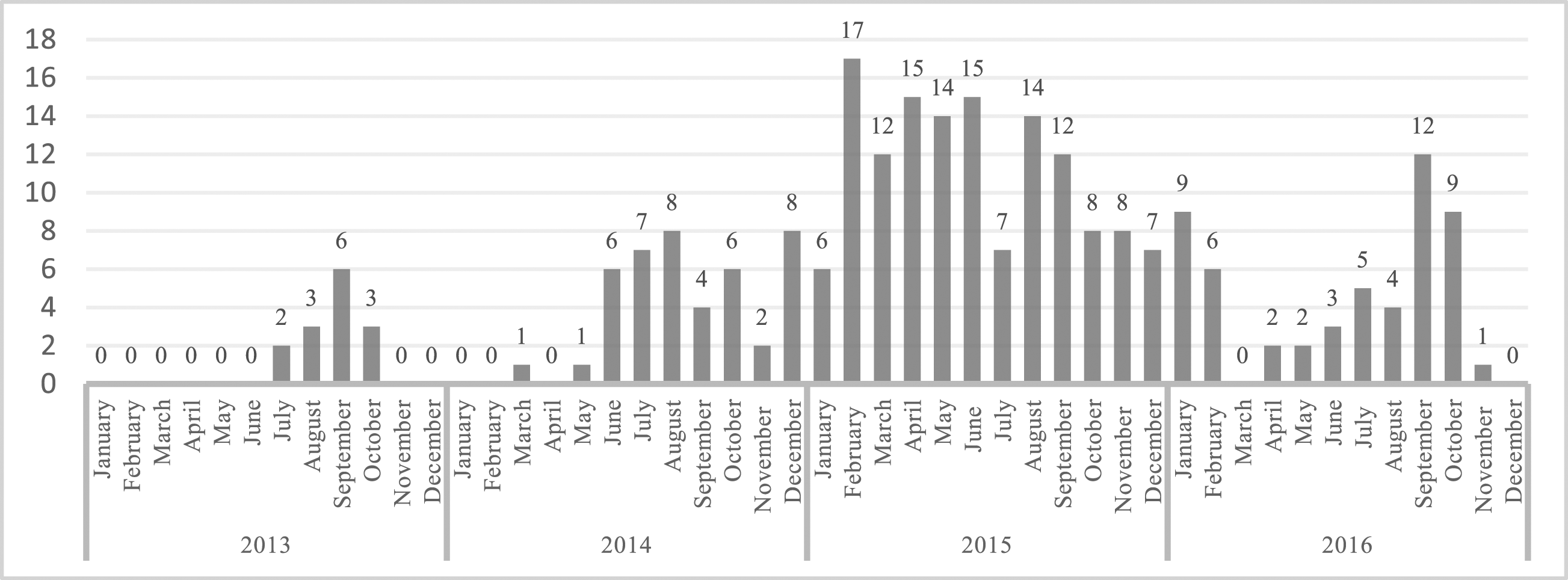
Whilst it is clear that the number itself plays an important role in reporting, how was the figure reported? Our content analysis provides some quantitative answers to this question. It pointed towards the way journalists would often only use the number once in an article. In fact, only two news articles referred to the number twice in the article. The relatively limited used of this number was accompanied with a tendency to report the number as a standalone fact. We can observe this practice across four distinct elements of our content analysis.
First, the number was generally used without referring to the report that it came from. Only 12.2% of the articles refer directly to the source of the number. When we examine the use of a source by year, we can see how the source was referred to more often in 2013 (21.4%) and 2014 (39.5%) than 2015 (0.7%) and 2016 (13.2%). In fact, during 2015 – the year that saw the number used the most – the source was only mentioned in one article (Figure 2). Number of articles – per month – that mentioned the source of the 220,000 deaths figure.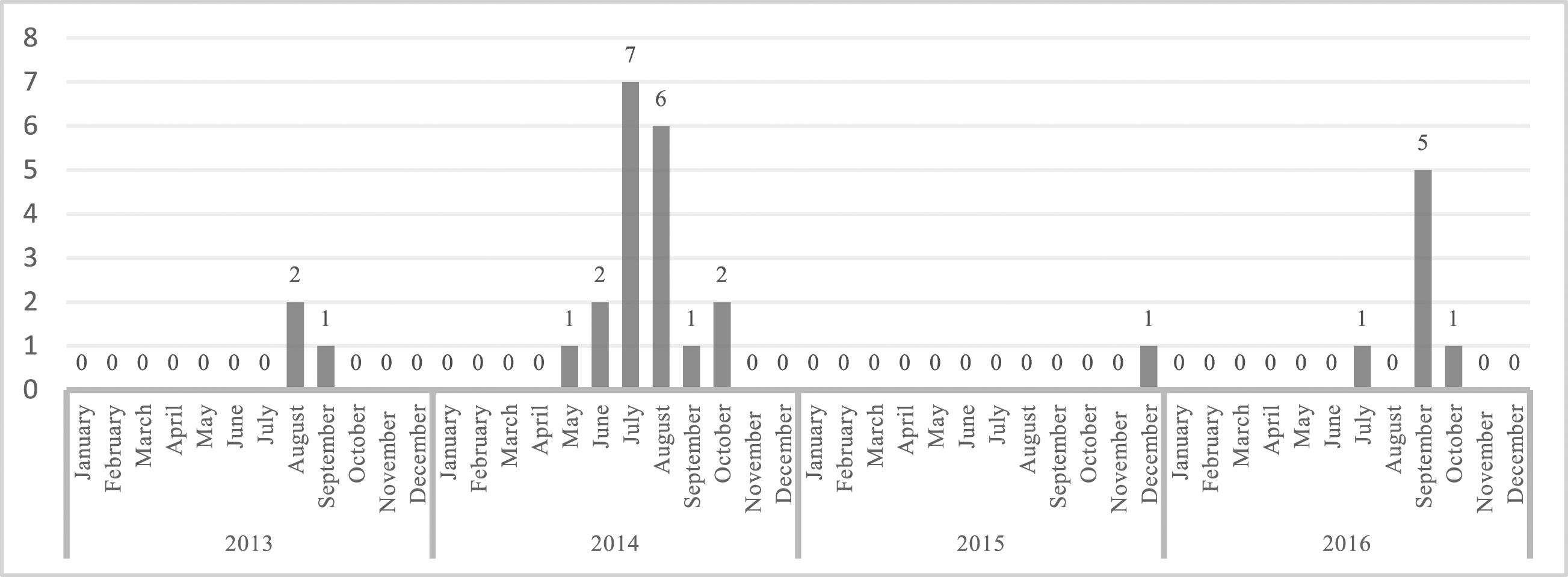
Second, only a small number of journalists who cited the report would refer to details about the number. In fact, only two articles map out details of how the 220,000 figure was constructed statistically. Most of the time, journalists would refer to the source without any further details. We can observe this practice in the extracts below: The 50 years of armed confrontation in Colombia have left 6.5 million victims, including 5.7 million displaced, Currently the subject of debate is the recognition and reparation of the victims of a conflict that in five decades has left more than 6.5 million affected,
Providing statistics without any details of how those statistics were produced is a common practice within journalism (Cushion et al., 2017). In doing so, journalists may recognise that the number comes from somewhere – in this case the data from the National Center for Historical Memory – but they do not address the way this figure has been produced. This means that journalists may nod to the contingent nature of this figure but would rarely interrogate the finer details of its construction.
Whilst referring to a source was uncommon and referring to details from the report was very uncommon, providing some form of contestation of the number was extremely uncommon. Only one article across the entire corpus of 245 pieces provided some form of critique of the number. The lack of reference to sources, details or contestation means that the number was most often treated as an undisputed fact by journalists. This can be most readily observed in the use of ‘certainty markers’ (Van Witsen, 2020). This way of attaching a language of certainty to numbers was observed in 53.1% of the articles. Examples can be identified below: (…) the endorsement mechanism of an eventual agreement to end an The president also thanked Washington for its commitment to the peace process in his country to end
Here we can see how certainty markers do not need to be expansive or hyperbolic – for example, ‘definitely this many people died’ [definitivamente esta cantidad de personas murieron]. It also operates in more banal and subtle ways through the use of ‘has left’ [ha dejado] and ‘that left’ [dejó] when talking about the number of people who had died. Furthermore, the remaining 46.9% of articles did not include any ‘uncertainty markers’ – for example, ‘may have left 220,000 dead’ [puede haber dejado 220,000 muertos] or ‘could have left 220,000 dead’ [podría haber dejado 220,000 muertos]. Instead, they adopted a common journalistic norm of referring to figures with qualifiers, such as ‘at least’ [por lo menos] or ‘around’ [apróximadamente]: Colombia is experiencing an armed conflict in which (…) The Colombian conflict, which began as a peasant uprising more than half a century ago,
Across the whole corpus we can see how journalists use a language of certainty over uncertainty. Whilst they do nod to estimations through the use of ‘around’ or ‘at least’, they are not providing any substantial detail or context to the report. The lack of this type of interrogation becomes more important when we consider the level of certainty involved in this number. To outline this, we can return to the source of the number itself.
The 2013 report refers to the figure multiple times from page 20 to page 32. When the document articulates the figure, it is keen to stress the way this number is an approximation of the numbers of those killed during the armed conflict between 1958 and 2012 (Historical Memory Group, 2013: 20, 32). In explaining why this figure is an estimate, they provide detailed explanations regarding how this number was constructed. The process is worth outlining in full here.
To arrive at the figure of 220,000 the analysis drew from three sources. They combined two existing sources on the number of civilian deaths: the 166,069 civilian deaths from 1985–2013 on the Single Registry of Victims (RUV, Spanish acronym) and the 11,238 victims from 1958 to 1984 recorded through the Institute of Political Studies and International Relations (IEPRI, Spanish acronym) review of Colombian newspapers. These were added to the Historical Memory Group’s research into combatant deaths, which document 40,787 combatants killed from 1958 to 2012. Added together, these three numbers result in the approximate figure of 220,000 deaths (Historical Memory Group, 2013, p.32, p.32)
The report itself is keen to stress that these three sources have issues of reliability. The first extract below refers to the problems of relying on interviews with paramilitaries to establish the number of people who have died and the second extract highlights the issue of variation in the data provided by RUV: The confessions of the paramilitaries in the free versions before the Justice and Peace Unit from the Attorney General’s Office recorded 25,757 homicides as of 1 December 2012, which exceeds the figures documented up to that time. In such confessions, the underreporting is evident, and it is even more so if one takes into account that many homicides and other crimes have not yet been confessed by their perpetrators. All the figures provided by the RUV for this HMG report are subject to variation due to the normalization and standardization process derived from its implementation.
In light of this, we can consider the way this statistic is much less certain that it appears when reported by journalists. This practice of omission, or erasure, is not necessarily a deliberate act by the reporters. Rather, it seems that the number was quickly established as a ‘fact’ within news media discourse and was articulated as such by those reporting. This factuality then underpinned a discourse that emerged around the number regarding responsibility. This was not necessarily an explicit discursive act, yet was often achieved subtly. Much like the previous section, it emerged from a process of omission of information. This process largely served to attribute responsibility to FARC. This can be observed in three ways.
FARC and responsibility
First, journalists inaccurately claimed that the peace negotiations between the Colombian government and FARC sought to finish the entire armed conflict that led to 220,000 deaths. We can see how this was articulated in two extracts below: In addition to the [peace] process with FARC, FARC and the Colombian government have so far reached consensus on three out of the six points of
Both extracts misleadingly position the progress of the peace negotiations between FARC and the government as achieving the end of the whole conflict that left 220,000 dead. This excludes the role that other groups played in the armed conflict: right-wing paramilitaries, criminal gangsters and another left-wing insurgency groups. In fact, in the first extract we can see how the 220,000 figure is only associated with the peace negotiations with FARC and not with the exploratory discussions with the ELN (although they have also been part of the conflict and contributed to the death toll). Whilst one explanation is more explicit than the other, they both serve to position FARC as the only illegal armed organisation involved in the killings.
This is further entrenched when we consider the second theme. Here, we can observe how the news media omit the participation of other illegal actors in the armed conflict when referring to the 220,000 figure: The sensitive matter of the victims of the long-standing Colombian conflict will be the fourth issue that the government and the guerrilla group will debate after having already reached three partial agreements. The Colombian government and FARC agreed to suspend the peace dialogues a month ago due to the second round of the presidential elections (….) the time has come to discuss the situation of the victims, one of the most sensitive issues, given that,
Whereas the first theme centred on explicitly divorcing FARC from other organisations, this theme ignores the existence of these other organisations altogether. In this context, the number is used somewhat generically through a loose association between the conflict and the peace negotiations. In doing so, the reader is presented with the idea that FARC may be the only illegal actor responsible due to the linkage with the peace negotiations, which are specifically with FARC.
When other actors are acknowledged as part of the armed conflict, illustrative data about their responsibility is omitted from the reporting. We can examine this in the extracts below: (…) the long conflict of more than 50 years that the country has experienced, which has officially left at least 220,000 dead and 5.3 million displaced people, and in which other leftist guerrillas, right-wing paramilitaries and military forces have also participated
13
The Colombian armed conflict, the longest on the continent, has confronted leftist guerrillas, right-wing paramilitaries, military forces and drug gangs for more than 50 years, and has left at least 220,000 dead, according to official figures
14
Both extracts make it clear that other organisations were involved in the protracted conflict, but they do not recognise the level of responsibility of each group involved. In doing so, it positions FARC as equally responsible as other organisations for the 220,000 deaths. When we take these three themes together, we can see how FARC was consistently positioned – often through subtle language – as the main illegal armed organisation responsible for the death toll. This seems particularly important when we return to the report.
Whilst reporting of the 220,000 figure seems to have gone hand-in-hand with emphasising the responsibility of FARC, the original report itself was keen to stress the different types of violence attached to each non-government group in the conflict. The report states: ‘the paramilitaries kill more than the guerrillas, while the guerrillas kidnap more’ (Historical Memory Group, 2013: 35). Whilst they do not portion responsibility for the 220,000 deaths between these two groups, they do document the proportion of massacres and ‘targeted killings’ 15 [asesinatos selectivos] committed. Between 1980 and 2012, they explain that approximately for every massacre by guerrillas there were three by paramilitary forces. Furthermore, from the documented ‘targeted killings’ the trend is similar as 8903 were committed by paramilitary groups while 3899 were guerrilla victims. Whilst the majority of massacres and ‘targeted killings’ can be attributed to paramilitary groups, just over 90% of kidnappings from 1970 to 2010 were committed by guerrilla factions. (Historical Memory Group, 2013: 36-37).
In light of the details from this report, we can observe how the association of 220,000 deaths with FARC is highly misleading. Whilst the report does not directly portion responsibility for the 220,000 people who have died, it does clearly argue that the modus operandi of paramilitary groups and guerrilla organisations are different. They explain that the aims of guerrilla groups, as backed up by empirical evidence, centre on kidnapping, whereas paramilitary groups are geared towards killing civilians and combatants. As highlighted earlier, for every massacre by guerrilla groups between 1980 and 2010 there were three conducted by paramilitary organisations. By excluding this context, journalists implicitly and explicitly tie the figure of 220,000 deaths with the actions of FARC.
Conclusion
This article used a single numerical case study – 220,000 deaths during the Colombian conflict (1958–2012) – to explore the role of numbers in the memory work of journalism. The study was guided by two key research questions. The first centred on the way journalists critically engaged with statistics. To answer this question, we developed two sub-research questions that focused on acts of contextualisation and contestation.
To evaluate whether news articles contextualised the number, we used a quantitative content analysis to focus on the attribution of a source and the provision of details about the figure. Only 12.2% of the articles in our corpus included a statistical source, whereas providing details about the number was even less common, only occurring in two articles (0.8%). If contextualisation was uncommon, contesting the number itself was even more rare. In fact, only one article across the entire corpus contained a challenge to the figure. This lack of contextualisation and contestation was then reflected in the use of relatively banal ‘certainty markers’, such as ‘has left 220,000 people dead’ and ‘that left 220,000 victims’.
Such an emphasis on certainty – either directly through certainty markers or indirectly through a lack of a context or contestation – ignores the level of uncertainty involved in the production of the 220,000 statistic. As the original report emphasises, the number emerges from the combination of three different sources regarding military and civilian casualties that themselves contain a considerable degree of uncertainty. Such a contrast – between the certainty in news reports and the uncertainty in the number itself – emphasises the need for journalists to critically engage with the numbers they use.
The need for such criticality was further highlighted in the answer to the second research question that revolves around discourses of responsibility. As well as involving a considerable degree of uncertainty, the report also highlighted which organisations were more to blame for these deaths. According to the records (Historical Memory Group, 2013: 35), paramilitary groups killed more people during the conflict, whereas guerrilla groups conducted more kidnappings. The news media reports, however, consistently positioned FARC (a guerrilla group) as responsible for the 220,000 deaths. This was done in three distinct ways: 1) FARC was positioned as the only actor responsible for the deaths, 2) FARC was depicted as if it were the only illegal actor responsible FARC for the death toll and 3) FARC was presented as equally responsible for the casualties. Combined, these presented a misleading picture of who was responsible for the deaths of 220,000 people.
These findings have wider ramifications for the role of numbers in journalism, memory and post-conflict situations. The use of the 220,000 figure involves neither the adoption of specificity or vagueness – the tension point at the centre of much literature on memory and conflict (McGrattan and Hopkins, 2017; Rieff, 2016). Instead, specificity and vagueness were deployed in articles simultaneously. Through a lack of contestation and contextualisation, and the adoption of ‘certainty markers’, the pieces were very specific in their use of the 220,000 figure. At the same time, the articles were often misleadingly vague in how they associated the number with FARC’s responsibility for those who died.
This emphasises the way that lopsided uses of specificity and vagueness can actually be harmful during and after a peace negotiation process when responsibility for such emotive acts are misleadingly ascribed to one organisation. In other words, the processes of reconciliation that takes place in these types of contexts can be negatively impacted if society is exposed, through the news media, to a distorted version of the conflict and those involved.
In light of this, we argue that an adherence to comprehensive accuracy by journalists is more desirable than either a combination of specificity and vagueness or total vagueness. We can turn to our corpus for an excellent example of this work by Maria Jimena Duzán in an opinion column for Semana: [I]n 2013, the Center for Historical Memory for the first time dared to give an official death toll from the conflict since 1957 and said it was 220,000.
Such a critical engagement with the statistic provides an archetype for normatively ‘good’ coverage of post-conflict and peace negotiations. There is a clear recognition that this figure is statistically better than previous counts, but Duzán is also keen to emphasise the uncertainty of the figure itself. Perhaps this level of contestation, however, is an unrealistic goal for other journalists using the 220,000 figure. Instead, we argue that some form of contextualisation is needed so the statistic is less likely to be attached to narratives that over-emphasise the responsibility of FARC. For this to be better understood, future research needs to consider news production. Existing research provides some general explanatory frameworks, for example, the political-economy of churnalism (Davies, 2008), but this has to be interpreted through a specific examination of the Colombian media context. In doing so, the need for contextualising the 220,000 figure (and other numbers) can be set within realistic expectations from the Colombian news media.
Footnotes
Acknowledgements
The authors thank Dr Katy Parry and Dr Matthias Revers for their constructive comments to earlier versions of this article.
Declaration of conflicting interests
The author(s) declared no potential conflicts of interest with respect to the research, authorship, and/or publication of this article.
Funding
The author(s) disclosed receipt of the following financial support for the research, authorship, and/or publication of this article: the corresponding author is under a scholarship funded by the School of Media and Communication from the University of Leeds as part of his Doctoral degree.
