



Abstract
This research explores the processes of framing civilian (as opposed to military-related) missingness in Israel. The people who have been left behind, and particularly the missing persons’ loved ones, seek to frame missingness stories in such a way as to make them newsworthy. However, civilian missingness lacks both cultural scripts and an end to the stories. Thus, I argue, those left behind must use meta-narratives to assert the newsworthiness of these stories. Based on narrative ethnography, I explore two kinds of framings that are used, both reflecting an acceptance of the life/death dichotomy. The first framing (“the child of us all”), is collective in form, and derives from stories with a wide cultural resonance such as cases of missing soldiers. The second framing (“it can happen to anyone”), which highlights individualism, borrows from a common framing of missing persons in the US, particularly about missing young white women. Ultimately, both framings generally fail to achieve wide resonance in Israel. Together with the failure to achieve an ontological solution, I argue, missingness might then be constructed as a stable category. This category has the potential to be a subversive one, creating new cultural scripts that challenge meta-narratives as well as the distinction between life and death.
Introduction
Daniel Minivitzky was last seen in October 2014, in Tel Aviv. A few months later, his family established a voluntary association, named Bil’adeihem (“Without Them”). The association seeks to raise public awareness of an unrecognized phenomenon in Israel: civilian missingness (as opposed to military missingness). The first public activity of the association, staged a few days before Passover 2015, was a “Passover meal of the missing” (see Figure 1). The performance took place in Tel Aviv’s Rabin Square, a symbolic location for Israeli demonstrations and gatherings. A long table was set in the square in preparation for the meal, probably the most family-oriented event in the Jewish-Israeli calendar. Each chair carried a picture of a different missing person. Not far from the table, sitting under a sun umbrella, two employees (anonymized here) of the public relations firm responsible for the campaign proudly told me about “the massive media exposure” they expected from the event. One said that he “had initiated and promoted the establishment of the association” because the public relations firm “had already exploited media attention about Daniel Minivitzki’s story to the fullest.” Daniel’s parents had already been featured extensively in the media, and now they had nothing else to offer. The story was no longer “news.” The establishment of the association was thus needed in order to maintain the story’s profile in the media. In the heart of Rabin Square, with its sense of collective “togetherness”, Daniel Minivitzky’s missingness had become newsworthy again. The Passover meal of the missing.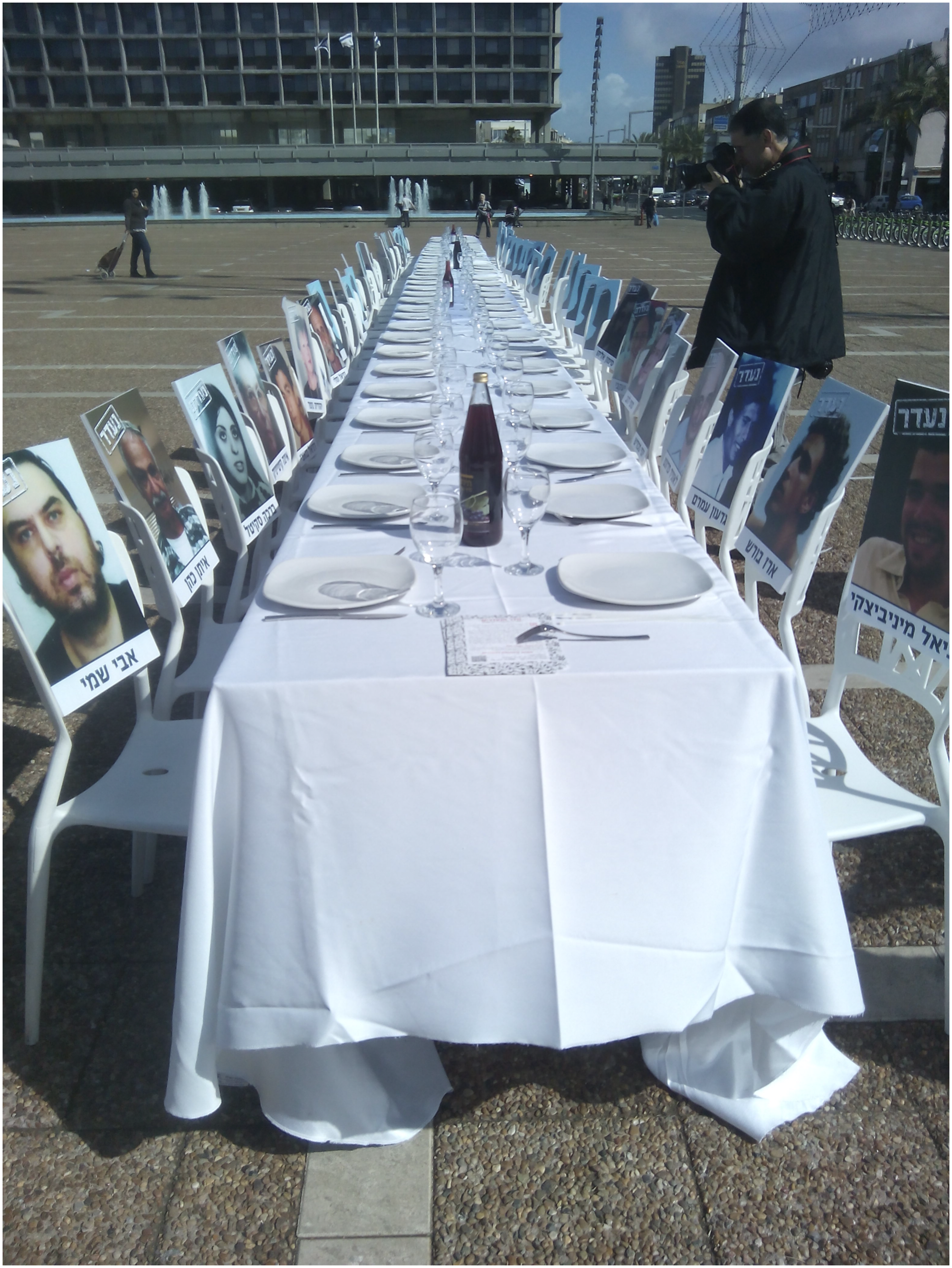
This was Bil’adeihem’s first attempt to bring the media’s attention to the phenomenon of missingness. However, the people left behind (all the social actors affected by missingness, in particular the missing persons' loved ones) face two major challenges in this task: First, missingness stories lack an end that would bring a solution to the question of life and death. Without such an end, the newsworthiness of these stories is limited (Kaplan, 2008; Tenenboim–Weinblatt, 2008). Second, civilian missingness in Israel lacks the cultural scripts that provide familiar narratives and guides to action (Kaplan, 2008; Katz, 2021). How, then, do those left behind negotiate the framing of missingness stories? How can they make these stories newsworthy and socially recognized?
This paper argues that given these two problems, those left behind must make use of two kinds of meta-narratives to create a sense of certainty in the social acceptance given to the story: (1) A collective one, relying mainly on stories of missing soldiers (referred to in this article as “the child of us all”); (2) A meta-narrative that emphasizes individualism, drawing from missingness stories from the US (referred to in this article as “it can happen to anyone”). However, this paper’s findings suggest that both framings fail to achieve empirical credibility and resonance. As a result of this failure, this study argues, the collective action frames that construct civilian missingness as a social category in its own right may be developed. These frames, which can be formed through social movements such as Bil’adeihem, undermine existing meta-narratives, as well as the binary distinction between life and death.
Literature review
Framing in the absence of cultural scripts
The concept of “framing” is often used to analyze the construction of social, political, and symbolic meaning for stories and images in the media and public space. Frames, Goffman (1974) argues, allow individuals to locate, understand, identify, and classify events in their lives and in the world. Thus, they provide and formulate interpretations of reality, organizing the experiences and subsequent guide to action. This guidance is often developed by way of cultural scripts, which provide “exemplary plots” or “key-scripts” based on real or fictional narratives with a cultural resonance (Spector–Mersel, 2006). These scripts offer a temporal connection between the familiar past, the present at a given historical moment, and the uncertain future, such that they reflect the hegemonic social expectations attached to every “plot.”
What happens, however, when there are no ready-made stories for specific circumstances? Studies have shown how the lack of appropriate cultural scripts can influence the construction process of personal agency, social roles, and social categories. Thus, for example, Reiheld (2015) analyzes pregnancy miscarriage as a condition that has no known cultural scripts and therefore does not produce clear social roles. Miscarriages are usually silenced; outside an immediate social circle, it is difficult to identify women who have suffered from the experience. The lack of cultural scripts precludes the possibility of actively making connections, establishing identities, and building social and community support systems. Another study examined how transgender people imagine their parenting and negotiate parental identity in relation to their transgender identity (Von Doussa et al., 2015). In the absence of cultural scripts relating to transgender parenting, they had the social freedom to locate their imagined parenthood outside normative cultural scripts, with practices such as step-parenthood or co-parenting. Thus, their parenthood imaginations range from accepting these hegemonic scripts to undermining them. Spector–Mersel (2006) examines the temporal and aging dimensions of “masculinity” as a hegemonic script, analyzing how “masculinity” is a flexible concept which changes along the course of a man’s life. However, hegemonic masculinity scripts come to an end mid-life, so that in the last stage of life—old age—there are no cultural scripts of masculinity to reference, and older men are required to face the challenging process of constructing an acceptable and legitimate self-identity. Old men, in Spector-Mersel’s words, are a “different story” (2006: 78).
In the case of missing civilians in Israel, the lack of cultural scripts is well-exemplified by comparing them to soldiers declared missing while serving in the Israeli army. Currently, there are four soldiers officially declared as missing in Israel; the army operates an established and well-resourced unit dedicated to tracing them. While these four missing individuals stimulate public resonance, solidarity, and identification (Kaplan, 2008), most of Israel’s 580 long-term missing civilians have no cultural status whatsoever. A small unit in the Israeli police, with limited resources, is the only official unit dealing exclusively with missingness in the civilian sphere.
The lack of cultural scripts doubles the uncertainty of those left behind; not only in relation to the fate and whereabouts of the missing, but also in relation to the behaviors and social roles expected of them. Their loss is ambiguous, in that there are no established norms that they can adopt, and they must construct their own way of coping and mourning (Boss and Yeats, 2014; Parr et al., 2016). However, cultural scripts also have a limiting element, through constituting the repertoire of roles and behaviors expected of the individual in certain circumstances. Hence, in the absence of cultural scripts there is also a subversive element at play, since this lack may force the emergence of new norms and new cultural models (D’Augelli, 1994).
These new cultural models may be shaped through dynamic framing processes, that include different perspectives and actors involving in distinct stages, such as frame-building (in which frames emerge), and frame-setting (in which media frames and audience predispositions interplay) (De Vreese, 2005). Framing, therefore, is a multi-sited process; the scholarly approach to conceptualizing the process is thus varied, and even inconsistent (De Vreese, 2005). That said, the focus of this study is not on the news framing itself, but rather on the attempts of different actors (most of them not journalists) to frame their stories as newsworthy. While this is usually an early stage of the frame-building process, it nonetheless incorporates presumptions about the media, and about broader cultural tropes.
Missingness, newsworthiness, and meta-narratives
Media frames largely determine the boundaries of legitimate public discourse, that is, the appropriateness level of the media stories that describe and make sense of the occurrences (Entman, 1993). Hence, longing for media coverage by those who seek to impose a particular framing, such as those left behind, is clear. But individuals and social movements rarely have control over how the media presents their stories, their claims, and the framing that they seek to advance (Benford and Snow, 2000). Communication researchers point to the way that media frameworks operate—according to accepted criteria, including the criteria employed in making decisions about the “newsworthiness” of a story (O'Neill and Harcup, 2009). Galtung and Ruge (1965) offer a dozen characteristics that would increase the likelihood of a story receiving news coverage. These include, on the one hand, the story’s clarity and suitability vis-à-vis the cultural expectations of the recipients; and, on the other hand, its unusualness. Thus, a media story at its best is the extraordinary story that illustrates the ordinary; for example, when it comes to good and evil and other dichotomous distinctions like life and death. A “good” story, then, is a linear and clear story. Ambiguity, for its part, threatens a story’s newsworthiness.
Tenenboim–Weinblatt (2008) shows how media is based on positivist ideology, through its aspiration for closure, for sense-making, and for order, and particularly through acceptance of the binary distinction between life and death. This distinction is taken for granted; the news consequently rejects ambiguity and aspires for complete solutions. Since the meaning of stories is structured mainly in relation to how they end, the lack of an end complicates the whole story (Tenenboim–Weinblatt, 2008).
In the absence of a clear closure and with the significant ambiguity that characterizes them, missingness stories do not lend themselves to media coverage. Admittedly, the advent of new media, led by digital social networks, has created new opportunities for constructing missingness as “news,” increasing public awareness of such cases (Jeanis et al., 2021). But even the use of the new media does not obviate the desire for broad coverage in the traditional media.
Indeed, some stories of missing persons have become large-scale media events (Jeanis et al., 2021; Slakoff and Fradella, 2019), despite the contrast between the seemingly endless nature of such stories, and the positivist perception of a media story as a clear story with a beginning, middle, and end. Opposing forces of closure and lack of closure act as part of what Zelizer (2004: 213) calls “the contradictory impulses” of the press. Many of the stories are ongoing, not condensed into a single item. As such, the media develops techniques for actively preserving the newsworthiness of a story and its coverage despite the lack of closure. Thus, the media has the power to use mechanisms of “elastic newsworthiness” to construct and maintain the visibility of a story despite its' open-endedness (Tenenboim–Weinblatt, 2013).
However, these mechanisms are not applied to all instances of people going missing; research has shown how coverage is influenced by “ideal victim” type, characterized by variables such as race, ethnicity, economic status, and others pivotal social factors (Jeanis et al., 2021; Slakoff and Fradella, 2019). In Israel, it is the missing soldier that reflects the figure of the “ideal victim” at its strongest (Kaplan 2008).
Therefore, this study argues that those left behind seek to frame missingness stories in a way that links them to existing meta-narratives. The first framing that this article discusses is a national one, termed here as “the child of us all.” To illustrate this, Tenenboim–Weinblatt (2008) analyzes media coverage of the captured and presumed missing Israeli soldier Ron Arad as a special case, where the media kept the story alive as “news,” despite its lack of closure, for many years, using various techniques. Tenenboim–Weinblatt shows how coverage of Arad’s absence constructed it as a mythical story, further establishing its newsworthiness. These continuing stories can encourage news consumers to speculate and interpret on outcomes, thus, strengthening their involvement in the journalistic story, while the mythical construction of the story reinforces accepted cultural meta-narratives.
These coverage techniques were also called into play in the disappearance of Malaysia Airlines Flight 340 in March 2014 (Sonnevend, 2018). The long-lost traces of the plane forced the media to take narrative action to keep the story in the news despite the lack of new events. In this case too, a national framing was created, according to which the Malaysian plane and its passengers “belonged to all of us.”
A second possible framing presented by those left behind rests on individualism, termed here “it can happen to anyone.” This framing is inspired by the social perceptions of missingness, mostly that of children, in the United States. To a large extent, this framing process began after the disappearance of six-year-old Etan Patz, last seen in 1979 near his Manhattan residence. As part of his parents’ efforts to trace him, his photograph was widely circulated on milk cartons, shopping bags, and buses across the US (Parr and Fyfe, 2012). Fritz and Altheide (1987) argue that it was media coverage at the time that led to the establishment of “missing children” as a social problem. Thus, the construction of a cultural script that terrorized parents, through the possibility of the abduction of their children, was completed.
Another example reinforcing the notion that “it can happen to anyone” relates to “the missing white woman syndrome” (Slakoff and Fradella, 2019; Sommers, 2016; Stillman, 2007). This concept refers to the media coverage of missing young white females as innocent victims, and consequently to their overrepresentation in the media compared to other missing persons. These cases can be portrayed as crimes stories and sources of entertainment (Slakoff and Fradella, 2019), as well as “every parent’s worst nightmare” (Stillman, 2007: 492)—a framing that makes these stories newsworthy. Beyond the presumption that white lives are more valuable, this skewed coverage creates the impression that white women go missing more frequently than other populations (Slakoff and Fradella, 2019). Moreover, it can create a sense of threat among the audience, the sense that indeed “it can happen to anyone.”
Methods
This study, conducted between 2015 and 2019, explored the processes of constructing narratives relating to civilian missingness in Israel. I conducted a narrative ethnography—an approach in which the researcher seeks to be present at different stages of the narrative construction process, with an acute awareness of the myriad layers of social contexts (Gubrium and Holstein, 2008). This methodology does not seek to trace one’s story, but rather to follow the stories that others tell about the event in question, about themselves, and about their common social worlds. In this way, the researcher can identify different possibilities for the process of constructing a narrative, but without the pretension of mapping a particular story and its evolution over time.
A significant part of the narrative ethnography conducted in this research is concerned with Bil’adeihem. I participated in activities of the association, including meetings, public events, and lobbying activities, from its establishment in 2015 onwards. I also took part in various kinds of searches for missing persons, and closely followed media coverage of missingness stories (both in mainstream and social media).
In addition, I conducted 33 in-depth interviews with key actors. Twenty two of these were with family members of long-term missing persons (between one and more than 40 years). I chose to interview people whose relatives were still missing, so that their narratives emerged from a sense of ambiguity and uncertainty, rather than being told in retrospect. I sought to analyze stories with as much variability as possible in the following aspects: duration of missingness, age, type of family relationship, cultural background, gender, and general circumstances of the case. Seeking maximum variations in the sample was not intended to produce any statistical generalization, but rather to examine as varied a range of cultural logics as possible (Zussman, 1992). Recruitment of participants benefitted from the support of the Bil’adeihem association, and from media reports of missing persons.
A further 11 interviews were conducted with other actors with a role in the meaning making processes of “missingness”: three police officers; three people responsible for running voluntary associations; a private investigator, an employee of Israel’s national forensic institute, a journalist, an activist with Bil’adeihem, and a public relations professional advising the association. Selection of these participants took place during the narrative ethnography, according to their role in the “narrative environments” produced in the storying process (Gubrium and Holstein, 2008).
Interviews lasted between 45 min and 3 hours, and were conducted in a place chosen by the interviewees, usually their homes. Following the principles of the narrative approach, interviewees were first asked to tell their story about missingness; the semi-structured interview took place only after this. Informed consent forms were completed by all the interviewees; pseudonyms have been used throughout the text to ensure confidentiality. The research was given ethical approval by the ethics committee of the Ben-Gurion University of the Negev.
The analysis process combined holistic and thematic readings of the data, attending to both content and form (Chase, 2007). During the analysis, the themes and frames proposed in this article were identified by the author as having a dominant internal logic, and were refined through a constant return to the theoretical literature and the empirical materials.
Findings
Targeting the media
For the families of missing persons, engaging with the media with a view to securing coverage of their story is a common practice, second only to filing a complaint with the police. As such, it is both a part of cultural script of coping with missingness, and a response to the lack of sufficient cultural scripts. The families of the missing yearn for media coverage, hoping both for public help in tracing the missing, and for the reassurance from the knowledge that there is interest in their story. Many of the interviewees described contacting the media as a survival instinct, as a necessary action within the helplessness resulting from the uncertainty and paucity of cultural scripts.
Many of the families of the missing also use social networks to reach the public and to ask for their help in tracing their loved ones. Some even open Facebook pages dedicated to the absence and searches. However, even this channel does not replace the appeal to traditional communication channels, where families almost always encounter barriers. The families of the missing abound with stories about the ways in which the various media outlets rejected them. Here, for example, Miriam: “One of the people in charge of the news [...] told me, ‘This is not juicy enough. Do you know how many missing persons there are in Tel Aviv?’”; Orna: “They said it was not their business. [...] My mother is not newsworthy”; Vered: “With these words [the journalist] replied to us: ‘I’m sorry, your story is not interesting, not spicy enough, I do not see how I can finish it so it does not interest me’”; Amir: “[They] said that they are not interested in this story, because as they understand it, it is not clear if there is an end to the story.” The families of the missing are given the clear message that their story is not newsworthy; they do not meet the threshold conditions for the news.
Varda and Shuki Minivitzky, whose son Daniel has been missing since 2014, sought to change the degree of newsworthiness attached to stories of missing persons in Israel. To this end, they founded Bil’adeihem, with the support of a large public relations firm. This firm initiates, leads and advises (pro bono) most of the association’s public and media activities—thus, media strategies have guided the organization since its inception.
At a meeting of the association, attended by family members of the missing, a session was dedicated to Omri, a representative of the public relations firm. Omri gave a presentation guiding the families on how to market their stories, explaining that “we can’t fight it, this is what the media wants.” The main message was that in order to keep the missing in the media, they must stop being “missing” and start being “stories.” This means, among other things, that the media presence of the missing is reliant upon someone who knows how to tell the story and to make it “news.” “It is less important that it would be the closest person to the missing,” Omri said.
In this way, the association acted not only to seek the public’s help in finding missing persons, but also to make their stories newsworthy and thus to construct a cultural script of missingness. However, the way of constructing such cultural scripts and achieving cultural resonance is, for the most part, through the adoption of hegemonic frames. Two of these frames formed the basis for many of the stories of the missing: “the child of us all,” and “it can happen to anyone.”
“The child of us all”
To a large extent, this framing rests on Israeli militarism, which makes it easy to create a deep identification with missing soldiers and their families (Kaplan, 2008). The “Passover meal of the missing,” described at the beginning of this paper, illustrates this framing. Through the symbolic use of the Passover table and its cultural meanings, the empty chairs, and in a place laden with symbolism like Rabin Square, Bil’adeihem sought to bring the missing civilians closer to the status of missing soldiers, to make them “our” missing in the broadest sense of the word.
Anat, employed by the public relations firm supporting Bil’adeihem, recounted their debates about how to frame the stories: “We had a very big dilemma about whether to go for a campaign that is very similar to Gilad Shalit’s ‘The child of us all’ campaign.” Gilad Shalit is an Israeli soldier who was kidnapped by Hamas militants in Gaza in 2006. The massive public campaign for his release, underscored by the support of huge number of citizens, is still etched in the Israeli collective memory. According to Anat, Shalit is the most prominent symbol of those who are perceived as “the child of us all,” and thus serves as a model for the ideal framing for missing civilians.
A similar comparison was also suggested by former Army Chief of Staff, Benny Gantz, who spoke at Bil’adeihem’s official launch event about the day Shalit returned to Israel: My friend, the American Chief of Staff at the time, told me “What a beauty that you belong to an army where every soldier is counted.” [...] In a similar way I think I can determine that everyone is counted. [...] And the fact that sometimes things are created bottom-up and now comes this blessed initiative [the Bil’adeihem association] is fine. It can work that way.
Gantz recognizes the significant gaps between the cultural status of Shalit and that of the missing civilians. Yet, he suggests that Bil’adeihem build on the existing meta-narrative of missing soldiers. This “bottom-up” initiative is an effort to impose the national meta-narrative on the case of missing civilians as well. At a later stage, Gantz hints, the state will also act accordingly. It is “fine,” he states in relation to the order of things. The establishment of the association is therefore framed as a key step on the way to accepting missing civilians as the “children of us all.”
The families of the missing also use narrative justifications designed to frame the missing civilians as the “children of us all.” Missingness stories often open with a description of the missing person’s military service; sometimes, the speakers hint at a link between the military service and their absence. Bella, whose brother has been missing for 5 years, said “[My brother] served in the army in a secret position, and after his discharge, a mental problem broke out.” Orna, whose sister has been missing for 3 years, connects her sister’s missingness with the army through her sister’s son: “Her son died heroically in the army, he served in a combat unit for 3 years. She gave her son to the state and her [second] son now serves.” These narrative justifications are intended to frame the state as obligated to trace their missing loved ones.
But the more the missing civilians are portrayed as “children of us all,” the more the state’s failure to care for them becomes clear. From the people who have been left behind, one hears harsh criticism of the state and the police. Hence, framing the missing as “children of us all” means framing national failure. Thus, the next step in these framing efforts is in creating protest and collective struggle.
In one of Bil’adeihem’s meetings, the founders presented a new report about missingness in Israel, authored by the Israeli parliament research center. An activist with the association commented: People are surprised to hear how many missing persons there are, and our goal is to make a lot of noise. We’re trying to be in the media all the time. This report is not for publication yet. The findings are serious, it is amazing, and we have to know how to market it. We have a bomb in our hands, we have to think about the circumstances in which it should be exploded.
The association’s activists expected to use the so-called “serious findings” of the report to attract the media and to maintain the newsworthiness of the missing persons phenomenon. But their expectations were disappointed. The media did not rush to “explode the bomb”; the activists discovered that missing civilians are considered a private problem rather than a national one.
Among other things, the report points to puzzling discrepancies in the numbers reported by the police and by the Institute of Forensic Medicine of anonymous corpses found in Israel, and to alleged failures in the expected connection between those corpses and missing civilians. Subsequently, Bil’adeihem initiated a demonstration outside the National Institute of Forensic Medicine, an institute whose work is associated with so-called collective bereavement and especially with terrorist attacks and the identification of disaster victims. The Facebook invitation to the protest stated We found out that there have been 529 missing persons since the establishment of Israel, and 923 buried anonymous corpses!!! Before I found this out, I thought it was only my son who was missing. You should know that the media does not report about every corpse that is found. Corpses are found all the time. We can assume that among those 923 anonymous corpses, some are of our beloved missing persons. And it is awful! Horrible uncertainty. We want answers! Please, come to support me, us. The media will also be there.
This Facebook post highlights the potential answers that supposedly await the families of missing persons in the forensic medicine institute—solutions that might free at least few of the families from their horrible uncertainty—and the relationship between those solutions and the presence of the media. However, the media coverage of missing civilians remained marginal; as a result, the pursuit of collective framing was perceived as a failure.
This failure is evident in the story of Michal, whose father has been missing for nearly 20 years, and who compares herself to the daughter of the missing soldier Ron Arad: As a little girl, I was terribly jealous of Ron Arad’s daughter. Because everyone talked about her father, everyone knew who her father was and cared about him, and I felt like no one was talking about my dad. [...] Of course I do not compare [my father to Ron Arad] for a moment, her father was a war hero. [...] Everyone knew why her father had disappeared, everyone remembered him as a hero.
Michal’s story illustrates her experiences as a child of a missing person, looking at the meaning that accompanies Ron Arad’s absence. Arad’s cultural status repeatedly etched into Michal’s flesh her father’s culturally inferior status, and consequently her place in comparison to Arad’s daughter. To this day, Michal is careful not to criticize this gap (“Her father was a war hero”). Accepting the cultural gap as justified undermines the credibility of the framing that the missing civilians are “the children of us all.” If there is no room for comparison between civilians and missing soldiers, then there is no empirical credibility (Benford and Snow, 2000), and consequently no resonance, for this framing.
Hence, those left behind are faced with the possibility of another framing, one that can reverse the idiosyncrasy of missingness, instead presenting it as a threatening routine.
“It can happen to anyone”
Following the attack on the World Trade Center towers in New York in 2001, the New York Times published daily mini-obituaries, called “Portrait of Grief” (Edkins, 2011). Such obituaries often appear in the press, especially when celebrities and public figures die. In this way, their deaths are framed as a collective loss and their lives are framed as extraordinary. But the portraits of grief following the 9/11 case were different. They dealt with the “ordinary,” placing emphasis on the similarities between the victims. Through the framing that the victims were “like us” and the sense that “it could have happened to anyone,” these portraits presented the American “cultural ideal” (Edkins, 2011: 29). In this way, an individual story that has collective concern can be framed, by creating identification on an individual basis and not on a collective basis. The routinization of the exception may produce a sense of threat, like that from circulating photographs of missing persons on milk cartons in the US.
Anat, from the public relations firm working with Bil’adeihem, expanded on the logic behind this kind of framing: We need to create some sense of empathy. [...] It can come from a place of “I can be in this situation.” As is often done for the elderly, or for car accident victims. From a place of, not exactly pity but a desire for a kind of identification with the poor, with the weak. As is done in struggles like that of Holocaust survivors, like that of the disabled.
The public relations firm’s mission, Anat said, is to create public “empathy” for the missing and their families. To this end—and given the failure of the attempt to frame the missing as “children of us all”—the missingness stories should evoke a sense of personal identification among the public. This can be the result of personal concern (“I could be in this situation”) or of an elusive emotion, that Anat defined as “identification with the poor.” In both cases, despite the collective campaign to a particular social category, the aim is to create identification on the individualistic level, an empathy with the subject of the story.
How can missingness be framed as a category of this kind? For Shimon, whose father has been missing for about 20 years, the answer is clear: [Bil’adeihem] had to make a stand against [the state]. They had to shake the country like the disabled, who are closing the roads. [...] Look at the disabled, they cry about their disability. I’m crying about my uncertainty. The disabled have quiet, they know that even if they don’t eat bread now, so they will eat it in the morning, do not eat tomatoes now, they will eat it tomorrow. What about me?
In his pain, Shimon aims to show why the families of the missing are “poor” or “weak,” to use Anat’s words. The pain of the families of the missing lasts indefinitely; there is no “bread” or “tomato” that can bring them relief. However, if it is not enough that the uncertainty is so painful, there is also their inability to secure any degree of public identification, such as that received by people with disabilities. In the absence of a struggle similar to that of people with disabilities, missingness is not perceived as a social category that can be identified with. This, according to Shimon, must be Bil’adeihem’s main goal.
Any attempt to frame missingness as an event that can happen to anyone requires fighting the engrained prejudice that those who have gone missing are usually experiencing mental health issues. Jenny, a journalist who wrote a series of articles about missingness, fully understood the difficulty inherent in the basic notion that “in this small country of ours there should be no such thing, [and therefore] everyone starts from the premise that [the missing] are all dumb, that they were all drugged, that they were all suicidal.” Because of this starting point, which places missingness at a very low level of newsworthiness, Jenny framed missingness as something that “can happen to anyone”: In all my articles [about missing persons], the people there had no psychiatric history. [...] Because [if they did] then the audience would tend to underestimate them. [...] I did not go completely with the head on the wall. I had to bring something that would make the audience interested.
The choice of framing therefore determines the selection of missingness stories to be covered, and not just the way in which they are covered. Although Jenny chose a topic that is not “newsworthy,” she did not go “completely with the head on the wall,” as she puts it. In other words, what enabled the extensive coverage she offered was her framing of the missing as everyday people without a “psychiatric history.” Only in this way, she claims, will the audience be able to take an interest in the story, feel empathy, and understand that even in this “small country of ours,” people do go missing.
This way of thinking also guided Dalia, whose son Dori has been missing for almost 3 years: The picture [we chose to present in the media] to get empathy is a picture of him in which he actually smiled. Not a picture like he was recently, that he would not look good. He had a mental problem in recent years. But we did not want to create antagonism, that people would say “another mentally ill person who ran away”. [...] The public relations firm guided us how to talk, first, not to lie, and on the other hand, to put the emphasis on the good things. Because when the public sees this picture of him smiling, then everyone says “what a nice guy”.
Following the public relations firm’s guidelines, Dalia sought to inspire empathy for her son’s story. However, this was not empathy for the sake of empathy per se, but an attempt to provoke it in order to break through what appeared to be a barrier to media coverage of the story. The picture presented to the public, of Dori as a smiling person, frames his story as one that “can happen to anyone,” even to “nice guys.” His “mental problem” could impair this framing, and thus it was hidden. To achieve newsworthiness and secure sympathetic coverage from the media, those left behind feel that they must portray the missing as “ideal victims.” While the ideal victim stereotype is mainly attributed to factors such as gender, race, and ethnicity (Slakoff and Brennan, 2020), Jenny and Dalia focus on the state of mind of the missing person at the time they went missing as a central factor in framing a story as newsworthy.
However, the association’s members soon encountered a problem in framing missing persons in this way. As Anat, from the public relations firm, described The problem was that when you look at the stories, [...] many disappear with a mental background, many disappear in all sorts of such situations and this place of producing empathy through the media, it’s harder. And we had a lot of dilemmas around this thing, because to produce this message that “it could happen to you too”, and to me for that matter – that I’m going to get up one morning and find out that someone in my family has gone missing – I’m not sure we could sell this story.
According to Anat, a “mental background” is perceived as a sufficient explanation for missingness; the recipients of the story do not feel threatened enough to engage empathetically, as opposed to the consumers who sees the photograph of a missing person on a milk carton in the US. That is why Jenny wanted to emphasize the stories of the “normative” missing persons; that is why Dalia wanted to reveal to the public only the “smiling” side of her son; and this is why Anat considered importing the American model to Israel. But Anat encountered a problem: a large proportion of missing persons in Israel have what she described as a “mental background”—a term that includes a wide variety of people and circumstances of missingness, what Anat calls “all sorts of such situations.” “I’m not sure we could sell this story,” Anat states, and thus accepts the seemingly dichotomy of mental health as another aspect of the good/bad and innocent/complicit dichotomies often linked to the question of newsworthiness (Slakoff and Brennan, 2020). Therefore, the framing of “it can happen to anyone” has no empirical credibility; it
Framing missingness as a social category
Some few years after the establishment of Bil’adeihem, Anat feels that their campaign had failed: “We really understood that we just have no ability to raise question marks in many stories. They kind of terminate today in a dead end.” After many attempts, by both the public relations firm and by the families of the missing, to frame the stories of the missing as collective stories or as stories that convey a threatening personal message, the missingness stories still have a basic problem that prevents them from becoming newsworthy: they lack closure. In the absence of an end, the stories remain in a “dead end,” as Anat puts it, hinting at the death of the story—even if the question of the death or life of the missing person remains open.
Media coverage of missingness stories construct civilian missingness as a temporary category, the solution to which must be revealed in the telling (Katz and Shalev Greene, 2021). The temporality of the category adopts the binary distinction between life and death, framing searches for the missing as a “question of life and death.” But there are also those who challenge this framing. Keren, whose brother is missing, described the tone of the discourse in the WhatsApp group for the families of the missing who are members of the association: When people write “let’s hope they come back, let’s hope we see them”, I say to myself “slim chance”. Of course, I’m not saying this to anyone. They have to make their own considerations, when to say, “it probably won’t happen”.
Keren does not participate in the attempts to construct the category of missingness as temporary. Because of the “slim chance” of locating the long-term missing persons, she has given up the hope that others seek to hold on to. Missingness, as Keren perceives it, is not temporary and there is no “solution” that will change it. But is an acceptable cultural script of permanent missingness possible, given the positivist media that demands solutions, and the longing of missing families for media coverage of their stories?
The Bil’adeihem association may be the one to push for the framing of missingness as a category in itself, a permanent category that challenges common frames and cultural scripts. This potential is evident in the words of Orna, whose sister has been missing for 3 years: “Since the association was established, I'm there. I go to all their meetings, [...] at least to make [my sister’s] disappearance known. At least someone sees her picture. At least someone talks about her, that she is missing.” “That she is missing,” Orna says, to stress the name of the category, and thus to illustrate its realness and its seemingly permanent character. Without a grave, without a ceremony and without social legitimacy to mourn her sister, no one even “sees her picture.” In constructing the category of missingness as permanent lies the potential to restore her sister’s humanity, to remember her again, to name and legitimize her status.
Through Bil’adeihem, families of the missing may construct their narrative. Vered, whose father has been missing for 4 years, says They [members of the association] are really the people who give you some kind of frame for your title of a missing person’s family. [...] You do not feel alone now, that it is very important for me. And you have this hope that you will help someone else. Really, I do not feel today that the association can give a solution to my father’s story, and that he will be found suddenly. [...] But it does give me the power to explain to others.
The importance of the association, according to Vered, is not in promoting a “solution” to her father’s story, or in locating other missing persons. Instead, the association has the power to offer a “frame” for the “title.” In this way, the association may constitute a collective identity that constructs a new category; It takes the personal problem out of its idiosyncrasy, and constructs a category that demands social recognition.
Recently, the association began to lobby for a law to regulate the status of missing persons in Israel. For the first time, the association is operating independently of the public relations firm and its initiatives in seeking to construct another, permanent category of civilian missingness. Thus, from the failure of framings that integrate civilian missingness into conventional meta-narratives, from the positivist media rules, and from the binary distinction between life and death, a subversive category of missingness may emerge.
Discussion
This paper uses the phenomenon of civilian missingness in Israel as a means of exploring framing processes and efforts to generate newsworthiness in cases of uncertainty, ambiguity, and the lack of cultural scripts. The findings of this study show how families of the missing yearn for media coverage of their loved ones' stories—only to discover that different criteria limit the news value potential of these cases (Kaplan, 2008; Tenenboim–Weinblatt, 2008). However, the notion of “elastic newsworthiness” (Tenenboim–Weinblatt, 2013)—which on the one hand rejects endless stories, but on the other hand develops techniques for preserving the coverage of such stories (so long as this coverage reflects hegemonic meta-narratives)—enables the coverage of missingness cases as large-scale events (Jeanis et al., 2021; Slakoff and Fradella, 2019). Hence, the families left behind often turn to culturally acceptable meta-narratives, using the two frames presented in this article: a collective frame, as in the cases of missing soldiers; and routinizing threatening stories on an individual basis, as can be seen in the US. However, both frames failed the empirical credibility test. This failure stems mainly from what the missing civilians are not: they are far from the “ideal victim” type (Jeanis et al., 2021; Slakoff and Fradella, 2019)—because they are suffering from mental health issues, for example, or simply because they are civilians and not soldiers serving the country (Kaplan, 2008).
This paper, therefore, contributes to the literature about media and newsworthiness by pointing to “ideal victims” criteria and how it influences the news value of missingness stories in Israel. But the key contribution can be seen in considering the subversive potential of these ambiguous cases with limited newsworthiness. This potential, to challenge accepted meta-narratives, is discussed in the research literature exploring cases that lack cultural scripts (D'Augelli, 1994; Reiheld, 2015; Spector–Mersel, 2006; Von Doussa et al., 2015). While cultural scripts play an important role in providing certainty and meaning, they also have a limiting element that produces conformity. The lack of cultural scripts is thus a possible starting point for the creation of new and subversive social categories. To date, the literature has dealt with this subversive potential mainly on the margins of other theoretical claims. The present paper seeks to present this theoretical claim as a central issue in its own right.
But to construct a subversive frame and a new social category under circumstances of uncertainty is almost an impossible task for individuals. This requires the collective action frames of social movements such as Bil’adeihem, working on the construction of missingness as a category in itself, providing recognition to those left behind. This new category threatens the binary distinction between life and death, and the pursuit of an ontological solution in the spirit of this distinction.
This paper does not suggest a chronological evolution of the missingness perception, which begins with adopting meta-narratives and their accompanying assumptions about the life-death distinction and ends by undermining them. From their first day onward, Bil’adeihem has moved dynamically between adopting and undermining these assumptions. This study claims that Bil’adeihem has the potential to construct cultural scripts of civilian missingness. This takeaway brings an important message to those left behind: you are not alone. And as missingness is increasingly recognized as a social category, so too the families of the missing are able to construct narratives that reflect their authentic lived experience, rather than seeking a framing that may give their experience resonance. A change in the legislation, regulating the status of missingness (as Bil’adeihem suggest), could contribute significantly to the coping possibilities of those left behind. But mostly, this research calls for a diverse and inclusive media, able to help in scripting new cultural scripts of missingness, using familiar techniques from coverage cases that lack closure.
Research about media coverage of missingness is still in its infancy, particularly so outside the US, UK, and Australia. As a preliminary research study focusing on the Israeli case, this paper naturally has several limitations. It does not present a systematic analysis of media coverage about missing persons in Israel, and does not consider in detail important contributory aspects such as gender, race, and ethnicity. Further research is also needed to explore assumptions about mental disabilities and missingness, and the impact of these on media coverage. A comparative research perspective would also be useful for examining differences and similarities between countries.
Footnotes
Acknowledgments
I wish to thank Sara Helman for her contribution to this study and to the anonymous reviewers for their helpful comments.
Declaration of conflicting interests
The author(s) declared no potential conflicts of interest with respect to the research, authorship, and/or publication of this article.
Funding
The author(s) received no financial support for the research, authorship, and/or publication of this article.
