



Abstract
Election coverage is often assumed to be different to everyday political coverage. We argue that this depends on political institutions. In majoritarian countries, where elections choose governments, election coverage should decisively move towards political competition and away from policy. In consensual countries, where coalitions are based on policy negotiations, there should be a less pronounced shift towards political competition and away from policy. To test this argument, we use an automatic coding system to study 0.9 billion words in Die Welt for 12 years and in the Financial Times for 30 years. The results support our institutional hypothesis.
How do the media change their political coverage around elections? We argue that the extent to which, and the way in which, the media change their coverage around elections depends on fundamental features of national political institutions and the role they create for elections. In majoritarian systems, elections are overwhelmingly competitions. Thus, the media will increase their coverage of political competition at the expense of policy. In consensual systems, policy negotiations and election results jointly determine government formation, so there should be less of a difference between these two types of election coverage. The literature on media framing of politics has tended to focus on aggregate comparisons across countries or long-term change within countries. Here, we add a relatively new perspective, which aims to look at how the regular rhythms of political coverage vary cross-nationally.
In the next section, we present our theory in the context of the wider literature on political journalism. We then go on to discuss our case selection in terms of medium, country and newspaper. This is followed by a description of our automatic content analysis. We then test our theory with time series analysis for each election. Our conclusion points to further opportunities in this research agenda.
Theory and literature
There are many ways of thinking about how media coverage of politics varies. The simplest is perhaps to look at the proportion of space given to politics (McMenamin et al., 2013). Others are to look at the ratio of soft to hard news (Scott and Gobetz, 1992), episodic stories versus general thematic frames (Iyengar 1991), interpretive journalism (Salgado and Strömbäck 2012), personalisation (Langer 2011) and, of course, the tone of the news (Soroka 2014). Many studies also look at how the amount, type and tone of content are distributed among political parties (Hopmann et al., 2012) and between the sexes (Shor et al., 2015). In this article, we focus on the distinction between political competition and policy (Strömbäck and Kaid, 2008). These two ways of covering politics are at the heart of the debate about the mass media’s relationship with democracy. Capella and Jamieson (1997) argue that the media focus on the game of politics to the detriment of the substance of policy issues is at the root of voter cynicism and disengagement. We think of political competition as referring to the strategy of political campaigning,. . . the horserace and battle for voters,. . . the images of politicians. . . political power as a goal in and of itself, or. . . politicians and persons rather than as spokespersons for certain policies (Cappella and Jamieson, 1996: 74; McMenamin et al., 2013: 175; Rafter et al., 2014).
Policy, by contrast, refers to coverage of issues or issue positions
Comparative research on political journalism generally assumes a hierarchical model in terms of the event, media-organisational, media-system and political-system levels (De Vreese, Esser, and Hopmann 2017: 23–25). The individual level is also a potential influence, but scholars have reached a consensus that individual journalists are highly constrained by their own media organisation and the wider media and political systems (Shoemaker and Cohen 2006). The event level refers to a temporary situation, such as an economic crisis, an election or a corruption scandal. The media-organisational level emphasises news producers and targets contrasts between different types of medium and how they are owned. The media-system level has been the focus of much interesting research, but there is a bewildering range of characteristics that are candidates for systemic status, and it is difficult to separate the media from other social systems and cultures. Nonetheless, many think that three sets of interlocking norms and institutions make up a media system: the political system and regulation, the media market, and professional norms and routines (Hallin and Mancini, 2004: 67–8).
Political news is a co-production between politicians and journalists (Gans 1979). There are many political variables that could impact on media coverage (De Vreese, Esser, and Hopmann 2017: 30–32). By political system, we mean the central tendency of its principal institutions, not specifically how it relates to the media. Like most others we think of this latter relationship as part of the media system (Blumler and Gurevitch 1995, 62). In consensual political systems, many actors – partisan, institutional and civil society – have an important role in policy-making. By contrast, in majoritarian democracies decisions tend to be centralised in an executive controlled by one party. In consensual countries, elections rarely lead to a clear turnover in power. Often, policy-oriented coalition negotiations, rather than elections, bring about shifts in power. On the other hand, in majoritarian systems, elections can transfer power to a totally different set of actors. Therefore, election coverage in majoritarian elections is likely to be much more ‘game oriented’ than coverage in consensual countries, which would be more policy-oriented. A small literature investigates this hypothesis (Dimitrova and Kostandinova, 2013; O’Malley et al., 2014: 411–12; Breen et al., 2019: 7; De Vreese et al., 2017: 31).
Our argument concerns the interaction of the political system and event levels. It is a dynamic theory of political institutions and political news. It is widely accepted that news content changes during election campaigns (Van Aelst and De Swert, 2009). We go beyond this to posit that the extent and nature of shifts in content over time reflects the majoritarian or consensual nature of political institutions. The political timetable is associated with bigger changes in political reporting in majoritarian systems than in consensual systems. The political timetable is also associated with different changes in political reporting across the two systems. Here, we will focus on national elections. A majoritarian election is a winner-take-all event and the result is very sensitive to minor swings in support.
the more majoritarian a political system, the greater the shift towards political competition in an election campaign. In a consensual election, the changes in seat shares tend to be proportional to changes in vote shares. If no single party is likely to win a majority, the government will be decided by policy negotiations among parties. We concentrate on macroeconomic policy, for the theoretical reasons that it is an area for which governments are consistently held to account (Lewis-Beck and Stegmaier, 2000), can immediately influence spending through fiscal policy (Hübscher and Sattler, 2017), and which relates directly to the left-right divide between parties. Macroeconomic policy also has an important methodological advantage because economic statistics can provide good cross-national proxies for the salience of this policy area.
the more consensual a political system, the greater the shift towards macroeconomic policy debate in an election campaign. Since the shift to political competition is so great in majoritarian systems, policy debate may be crowded out at election time.
there is less coverage of macroeconomic policy in majoritarian systems during election campaigns, compared to normal time. The literature on journalistic routines provides an important link between the political institutional, media system and event levels in general and in the specific case of elections. Here, we take inspiration from the work of Bennett (1990, 1996) to examine possible causal mechanisms. According to Bennett, the first rule of political reporting is ‘the imperative to build a story line … upon official or at least authoritative viewpoints’ (Bennett, 1996: 376). This rule is implemented through ‘beats’ focused on the institutions of representative democracy. So, there are parliamentary correspondents, presidential reporters, etc. Other beats focus on policy sectors, such as crime, economics and agriculture. These are also, albeit less tightly, tied to institutions. The institutions are executive departments, such as finance, transport and the environment, rather than representative bodies. Those on the parliamentary beat are more likely to frame political content as political competition rather than policy debate, just as those on the environment beat are more likely to frame content as a policy debate rather than political competition. Nonetheless, representative institutions are ultimately there to make policy decisions on behalf of the people and government departments are the agents of elected politicians. So, regardless of beat there is often a choice of frame to be made between political competition and policy. The extent to which beats are associated with political competition or policy should vary across political systems, especially in relation to the institutions of representative democracy. In majoritarian countries, the legislature is a theatrical arena of political competition. Governments with clear majorities write legislation, which is then passed with few amendments after a ritualistic debate. Consensual countries have working parliaments, in which parties and parliamentarians collaborate and negotiate relatively quietly to develop legislation. So, a parliamentary correspondent in a consensual country should use a policy frame more often than her counterpart in a majoritarian country. The predominance of the two frames should also vary across time within a system. When an annual budget is being presented, those on political beats, following the politicians’ lead, will tend to write about policy. When an election campaign is underway, policy writers will tend to frame their subject as part of the electoral campaign, again following politicians’ lead. Bennet’s second rule of political reporting is the ‘indexing rule’. He argues that the amount of coverage given to a story depends on the level of elite conflict: the more the elites disagree, the more journalists will write. By contrast, journalists pay little attention to mass opinion (Bennett, 1990: 103). In thinking about indexing and policy frames, we are probably going beyond Bennett’s ideas and using them as a springboard for our own theorising. The indexing rule would seem to work very well for political competition. Indexing would also seem to be a reasonably good predictor of policy stories. Nevertheless, the relationship is probably not as strong as for political competition, partly because conflict is likely to change the frame from policy to political competition. Where there is a conflict among elites about policy a story is more likely to be newsworthy. However, policies may also garner coverage because there are important changes in ordinary people’s lives, regardless of whether the policy in question has been contested by elites or introduced by consensus. Indexing is likely to be a powerful norm in all free media systems, but it maps better on to systems that work through conflict, rather than consensus. If we took indexing to be the only relevant predictor of news coverage, there would be little policy coverage in consensual systems because of the relatively low levels of overt and ritualistic conflict in policy-making institutions. In such systems, policy coverage is not abandoned and must, therefore, be operationalised and underpinned by other journalistic norms. The simplest such norm is the aforementioned first rule: political journalists in consensual systems will organise themselves in a way similar to the political system on which they report. There may also be a mechanical and practical dimension to the different choices of frame across majoritarian and consensus systems (Van Aelst and De Swert, 2009:155). Their logic may be adapted to our subject. In a consensual system, there might be a practical journalistic constraint on increasing the political competition frame during an election campaign. Newspaper articles are short and do not read well if too many names are discussed. It is, therefore, easier to report political competition in a relatively centralised majoritarian system than it is in a more complicated consensual system. This in turn suggests that the policy frame is relatively more straightforward for journalists in consensual systems. Therefore, it is reasonable to conjecture that the text within reports about political competition reflects practical journalistic constraints. Conjecture: The more the politicians’ names in political competition reports, the greater the tendency to frame elections as policy. In the next section, we introduce the two cases we study to investigate these hypotheses and the conjecture.
Case analysis
Medium and content shifts around elections.
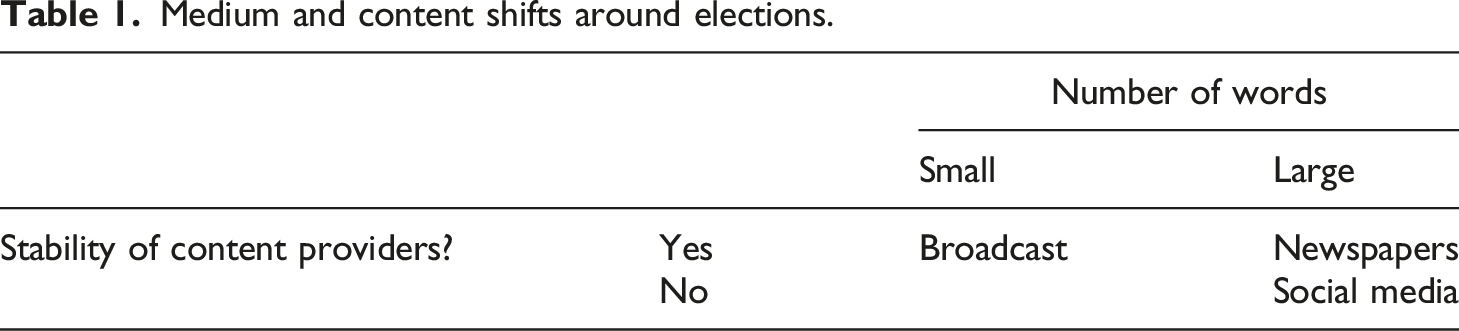
We consider our two newspaper cases in terms of the political-system, media-system and media-organisation levels. We do not consider the event level independently of the political-system level. We study three to seven elections across the two cases. We see different types of elections as indicative of different types of political systems.
Germany has had coalition governments since 1961. German governments have also been constrained by a powerful upper house, the reservation of many policy areas to the Länder, a strict constitutional court and a tradition of corporatist policy-making. Since 2000, when our Die Welt sample begins there has been some useful variation of election results. In 2001, the Social Democratic – Green coalition was narrowly re-elected. 2005 produced a ‘Grand Coalition’ of the Social Democrats and the permanently allied Christian Democrats and Christian Socials (CDU-CSU). In 2009, the CDU-CSU formed a government with the liberal Free Democrats. There were no full turnovers, but rather a change of coalition partners in 2005 and 2009. The politics of the United Kingdom is a majoritarian archetype. There were some constitutional reforms under Labour and a coalition between the Conservatives and Liberal democrats in 2010. Nevertheless, the other 28 years include relatively unconstrained single-party governments. There were turnovers in 1997 and 2010.
Brüggemann et al. developed Hallin and Mancini’s approach to media system classification to produce a grouping with stronger empirical validation. They place the United Kingdom and Germany in a central cluster. The distinguishing features of the central group are strong public broadcasting, strict ownership regulation of broadcasting and low press subsidies. This type of analysis is designed to capture enduring cross-country differences, not intra-country dynamism, so it is not clear that it implies anything about shifts in content around elections. Nonetheless, since the United Kingdom and Germany are in the central cluster, we might expect the United Kingdom and Germany to behave similarly to each other (Brüggemann et al., 2014, 1056–1057).
Finally, we consider the organisational level. Die Welt was founded by British occupying forces in Hamburg in 1946. It is a quality newspaper with a circulation of about 270,000 in 2006 in the middle of the German dataset and claims to represent a ‘liberal cosmopolitan’ worldview. However, it is almost universally regarded as conservative, in line with the politics of Axel Springer, the controversial journalist and businessman, who took over the paper in 1953. Die Welt’s archive, dating back to 2000, is the longest archive of any German newspaper on Nexis UK. Our sample ends in 2012, the last year which we had permission to download at the time the dataset was compiled. The Financial Times (FT) was founded in 1888. It has become a global paper, as well as a British one. While providing a financial and economic emphasis, it maintains a substantial coverage of British politics, as well as more general features. Unsurprisingly, it supports free markets and has often supported the Conservative Party. However, it has also supported the Labour Party, for example, in the 1992 general election. The UK edition of the paper had a circulation of 326,000 in 1997, close to the middle of the Financial Times dataset. Its archive is accessible via Nexis UK back to 1982. The FT should be less dynamic than other UK papers because of the need of professionals for financial and economic information and an international perspective. We find it hard to conjecture why Die Welt would be more or less dynamic than its competitors in Germany. We do not claim that these papers somehow represent their media systems or newspaper markets, but rather that they present a good test of the dynamism of content around elections. The next section explains how we conducted our content analysis.
Content analysis
We use supervised learning, according to which a computer induces an automatic classifier from a sample of manually coded texts. Supervised learning must meet three conditions to be meaningful. First, the categories must be valid measures of theoretical concepts. Second, humans should be able to reliably reproduce each other’s coding. Third, the computer should be able to reliably reproduce the humans’ coding. We address each challenge in turn. More details on our method can be found in a complementary methodological publication (Courtney et al., 2020).
We coded articles into macroeconomic policy news, microeconomic policy news, other policy news and political competition, although we only use macroeconomic policy and political competition in this paper. Figure 1 shows the decision tree we used. In coding policy news, we followed the Comparative Policy Agendas project, which is a large, collaborative manual coding project that has been ongoing for over two decades (John 2006). We followed their definition of policy news as requiring some explicit reference to policy-makers or advocacy of policy change. We only coded policy news, so news about macroeconomic performance is not included. In classifying political competition, we followed the literature on framing of election coverage (Courtney et al., 2020). Human coding decision tree.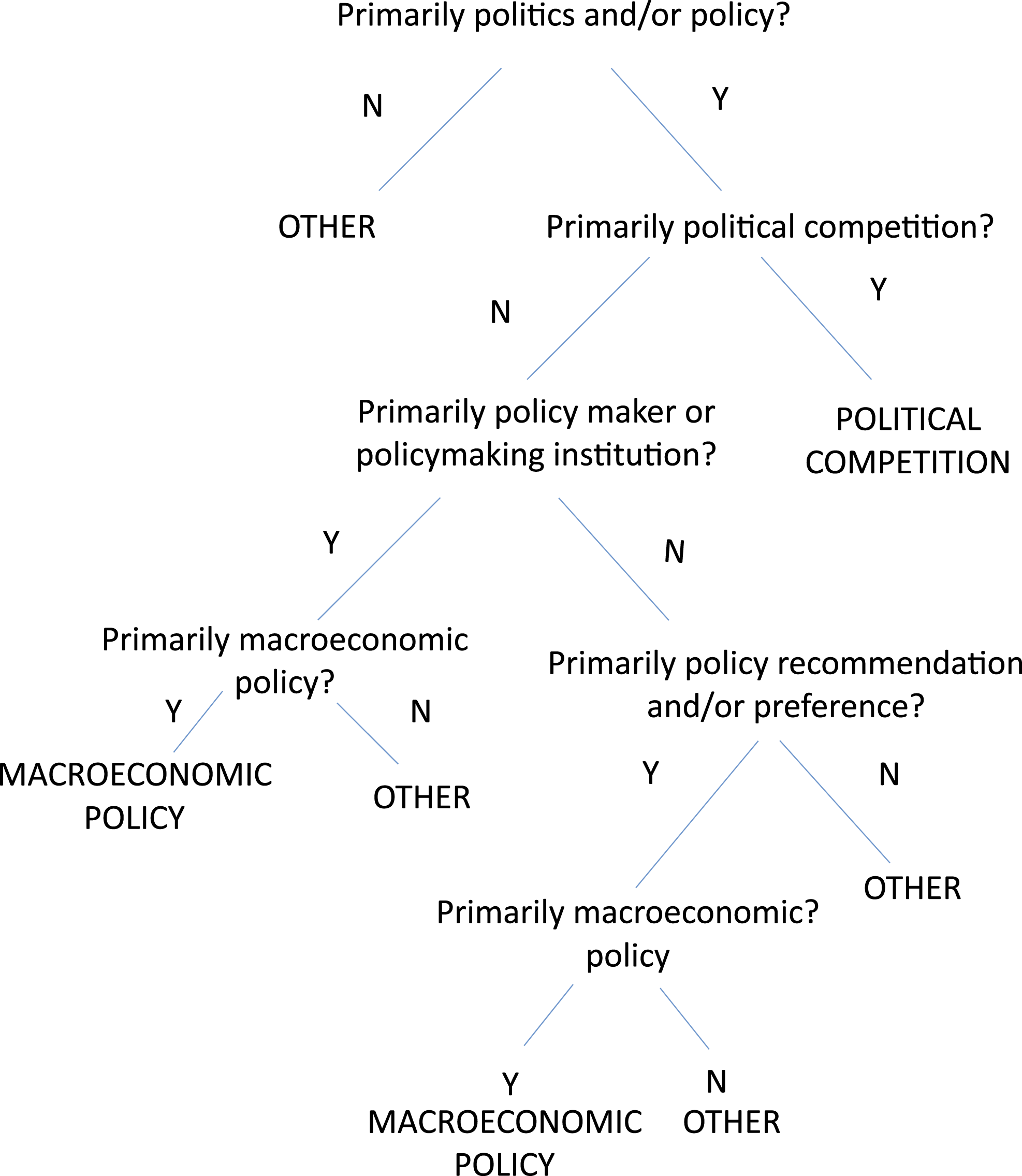
If the human input is unreliable, it is unclear what, if anything, algorithms are learning to reproduce. The small number of categories we coded reflects our determination to produce reliable data. Our level of analysis was also driven by reliability. Paragraphs are easier to code reliably, partly because a whole newspaper story will often contain multiple topics. We used Krippendorff’s alpha to assess our performance. We achieved 0.75 for the FT and 0.79 for Die Welt, both very close to the conventional score of 0.8 for highly reliable coding. 1 The coding of content from Die Welt was done on the basis of Google-translated text. Elsewhere we (Courtney et al., 2020, 210) and other authors (De Vries et al., 2018; Lind et al., 2021) show that Google-Translated texts produce very similar results to texts coded directly from the original language. With a satisfactory level reliability, the team proceeded to code 3901 paragraphs independently.
We then developed an automatic classifier that could reproduce our coding. This involves a training set of manually coded paragraphs and a separate test set of manually coded paragraphs. We focused the classifier precisely on the data we are interested in by constructing separate classifiers for each category of interest (macroeconomic policy and political competition). Each classifier generates a probability that a paragraph will be associated with the topic of interest. 80% of category i paragraphs drawn from our manually coded paragraphs were used as training data and 20% as test data. In the training set, half of the articles are coded as category i and half as not category i. The 50 per cent that are not category i are drawn from a larger pool of paragraphs reserved for training and are randomly selected from that pool. In the test set, paragraphs come from a separate pool of paragraphs amounting to 20% of our manually coded paragraphs and are unseen before classification begins.
The classifier was trained to recognise either category i or anything else and was tested on the paragraphs not included in the training data. The algorithm outputs the equivalent of a probability for each category. The resulting news category variables are the mean probability of all paragraphs in category i on day t. Thus, a single paragraph may have a high probability of being associated with more than one category but the mean probability on day t is an indicator of the proportion of a given newspaper that consists of a particular news category. More precisely, we use the mean probability of all paragraphs in category i on day t as an estimate of the emphasis of the newspaper on category i on day t.
Classifier performance by category.
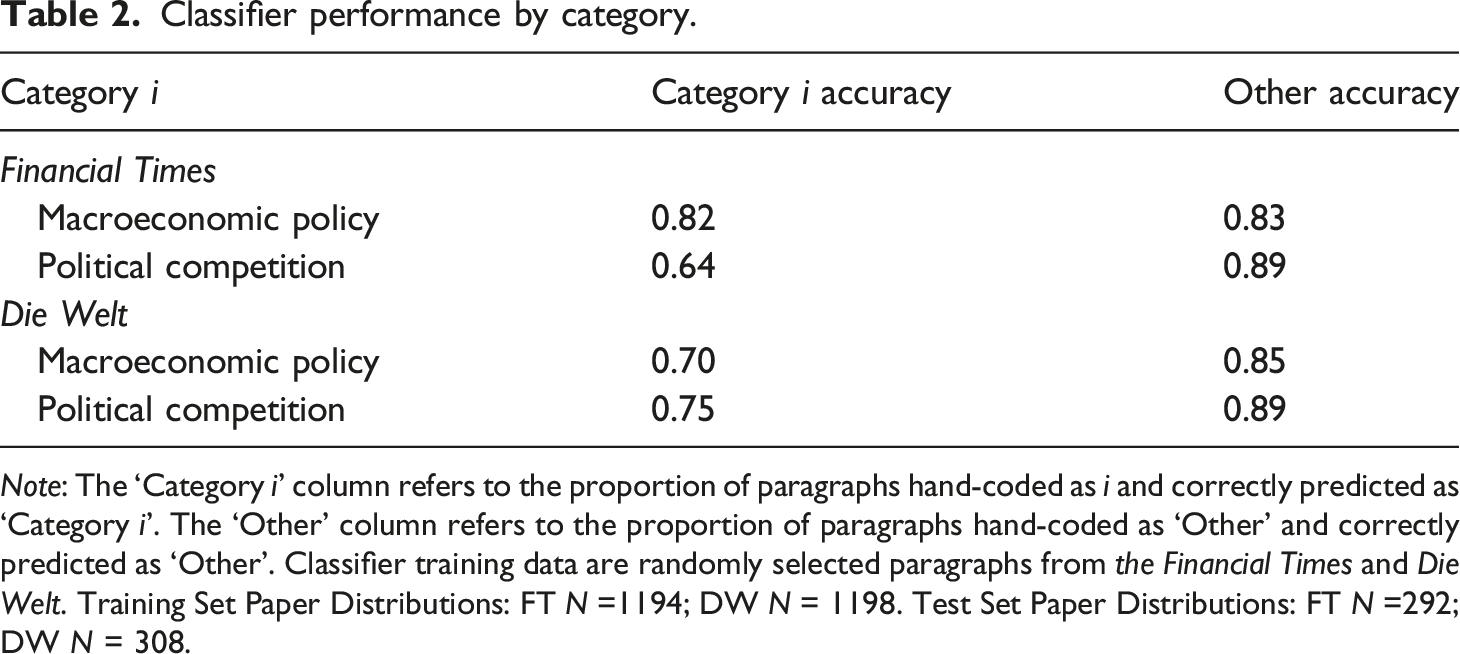
Note: The ‘Category i’ column refers to the proportion of paragraphs hand-coded as i and correctly predicted as ‘Category i’. The ‘Other’ column refers to the proportion of paragraphs hand-coded as ‘Other’ and correctly predicted as ‘Other’. Classifier training data are randomly selected paragraphs from the Financial Times and Die Welt. Training Set Paper Distributions: FT N =1194; DW N = 1198. Test Set Paper Distributions: FT N =292; DW N = 308.
Our papers are quality dailies with excellent international coverage. Thus, we need to identify the country to which the paragraph relates. This is a named entity recognition task. First, we constructed a dictionary of proper names of politicians, institutions and offices for 20 rich countries. For Germany, there were 114 entries and 182 for the United Kingdom. For example, if at least one of the UK entities is mentioned in a paragraph, the paragraph is assigned a UK entity code. We developed and applied a multi-gram check to take account of the different lengths of named entities. For example, ‘Westminster’ (1-g) or ‘David Cameron’ (2-g), should trigger a UK classification. We check each combination of adjacent words against the dictionary up to 6 g. As ‘David Cameron’ is a 2-g observation in the dictionary, single gram checks of ‘David’ and ‘Cameron’ would not trigger a UK code (Type I error) but does prevent any instance of ‘David’ triggering a UK code (Type II error). 2
A full account of the classifier has been published elsewhere (Courtney et al., 2020). We now move on to describing how we use our data to investigate our theory.
Statistical Analysis
We will first test our hypotheses by inspecting the evolution of framing in the months before each election in our dataset. Then, we will move on to statistical modelling. The STATA code and data are available on Zenodo: https://zenodo.org/record/5564897#.YWWfJBrMKUk
In Figure 2, which presents the UK series, we see a remarkable consistency across the seven elections and 27 years. Virtually regardless of political and economic context, political competition coverage increases markedly as the election approaches and macroeconomic policy coverage declines. There does appear to be a slight trend of a sharper turn towards political competition over time. Before all elections, political competition is running at almost exactly one quarter of the Financial Times content. In 1987, it rises to 30% and in 1992, 1997 and 2001 to about 35%. In 2005, it almost reaches 40% and in 2010 it breaches the 40% level. We do not observe any difference between the type of election. The dynamics of the coverage of the famously close elections of 1992 and 2010 do not appear very different to the landslides of 1997 and 2001. With the exception of 1997, there is a clear hump for macroeconomic policy that lasts a few days. This is the annual budget, which was presented by the Chancellor of the Exchequer to parliament in March or April. Coverage of politics in the Financial Times prior to general elections in the United Kingdom. Lowess smoothed daily means (bandwidth = 0.2).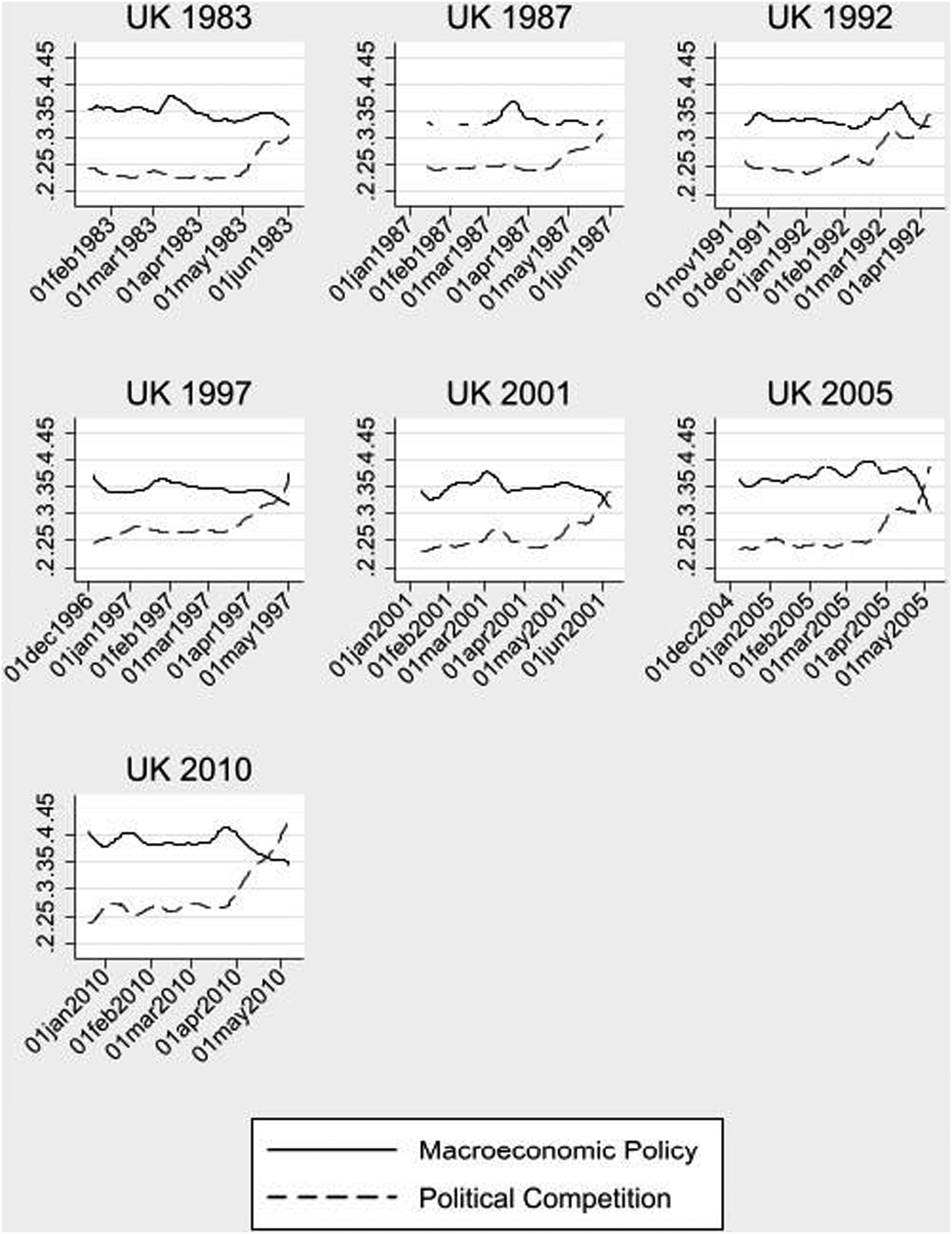
Figure 3 presents the same measure on the same scale for Germany. The elections of 2002 and 2009 exhibit similar patterns. In the months before the election, both political competition and macroeconomic policy are stable and each account for one quarter of the coverage in Die Welt. Beginning in the last month before the election, there is an increase in the proportion of political competition, until it reaches between 30 and 35 per cent at election time. At first sight, 2005 looks odd. Political competition hit 30% in May and continued at this elevated level before dipping during the holiday season to recover gradually to almost 30% in the campaign period. This pattern makes sense in the unusual context of this election. German elections are normally held every 4 years in late September. In May 2005, the government lost the last of its seats in the upper house of the federal parliament, which it perceived as a situation in which it was unable to govern effectively. In response, it engineered the loss of a confidence vote in the lower house and an early federal election (Schmitt and Wüst 2006). This explains the jump in political competition in May, as Die Welt reported on this extraordinary situation. The 2002 and 2005 elections were close and, in both cases, the CDU lost sizeable leads during the campaign. It was not obvious which coalition or chancellor would result from these two elections. In 2009, it was clear that Angela Merkel would be returned as chancellor since the CDU/CSU had a commanding lead over the SPD. So, the patterns of the three elections do not appear to be related to how close the elections were. Of course, given that there are seven elections for the United Kingdom and three for Germany, we are much more confident that the pattern for British elections outside our sample will look like the graphs above than we are that out-of-sample German election will look like 2002 and 2009. Coverage of politics in the Die Welt prior to federal elections in Germany. Lowess smoothed daily means (bandwidth = 0.2).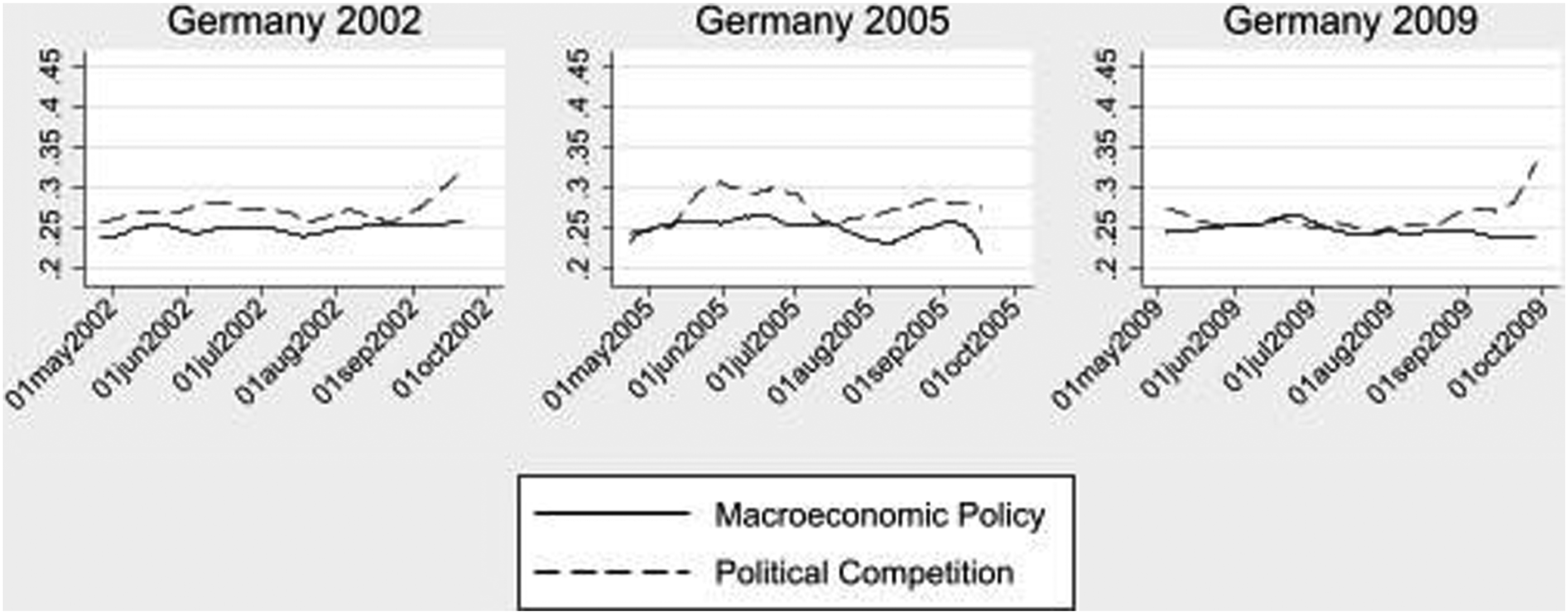
We will now proceed to test the same ideas with a statistical model. In the United Kingdom, the election campaign period is from when parliament is dissolved to the election. In our dataset, this was on average 26 days. There is no official campaign period in Germany. German elections are usually held in late September and many Germans take their main holiday in August. Therefore, a ‘campaign’, defined as a period of unusually intense political activity, media scrutiny and public engagement, is also about 26 days in Germany and we use this period in our analysis. As well as this period of outright electioneering, there is a more gradual build-up, as parties and the media plan for the end of a parliamentary term. We measure this by counting the number of days since the previous election. We also include its square, in case its relationship with media content is non-linear. As noted above, some elections are much more competitive than others. We measure the closeness of the election by the monthly mean of the absolute difference in predicted vote share between the two traditional big parties in each country – Labour and the Conservatives in the United Kingdom and the CDU-CSU and the SPD in Germany. We call this variable Lead. The UK poll series is from ICM and the German from Forsa. Of course, this two-party approach is more limited in the case of Germany where coalitions are central to election campaigns. Nevertheless, we have already shown that the context of elections does not appear to have an effect on the dynamics of political coverage that we study.
The nature of political debate and media coverage may depend on the extent to which the economy is perceived to be doing well. Of course, this is particularly appropriate for macroeconomic policy coverage. We measure economic perceptions using the OECD’s consumer sentiment surveys. These are monthly surveys, so we lag by 1 month. We also interpolate it from the beginning to the end of each month, so that there is no unrealistic step from day to day, followed by an equally unrealistic stasis. Since this variable is non-stationary, we enter its first difference into our equations. 4 Finally, we enter a dummy for August, known by the media in some countries as the ‘silly season’, as the absence of the political class on their holidays makes it difficult to come up with serious stories. In the United Kingdom, all schoolchildren are on holidays until the end of August, but in Germany, where holidays vary by state, many children return to school for some or all of August.
The dependent variable is the mean daily probability that a paragraph is political competition or macroeconomic policy. This is an excellent estimate of the proportion of news in either category. Since it is bounded by zero and one, we employ a logit transformation of the dependent variable. We use an autoregressive–moving average model (ARIMA) with one autoregressive term and one moving-average term for the United Kingdom. 5 For the German models, we include two autoregressive and moving average terms, lags one and six in each case. 6 The standard errors of the coefficients are semi-robust.
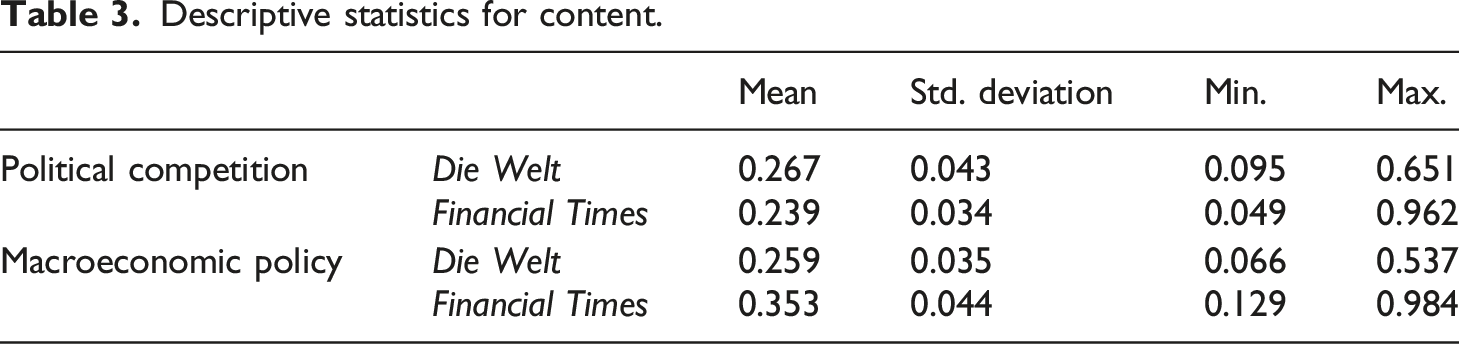
Descriptive statistics for content.
Modelling political competition and macroeconomic policy.
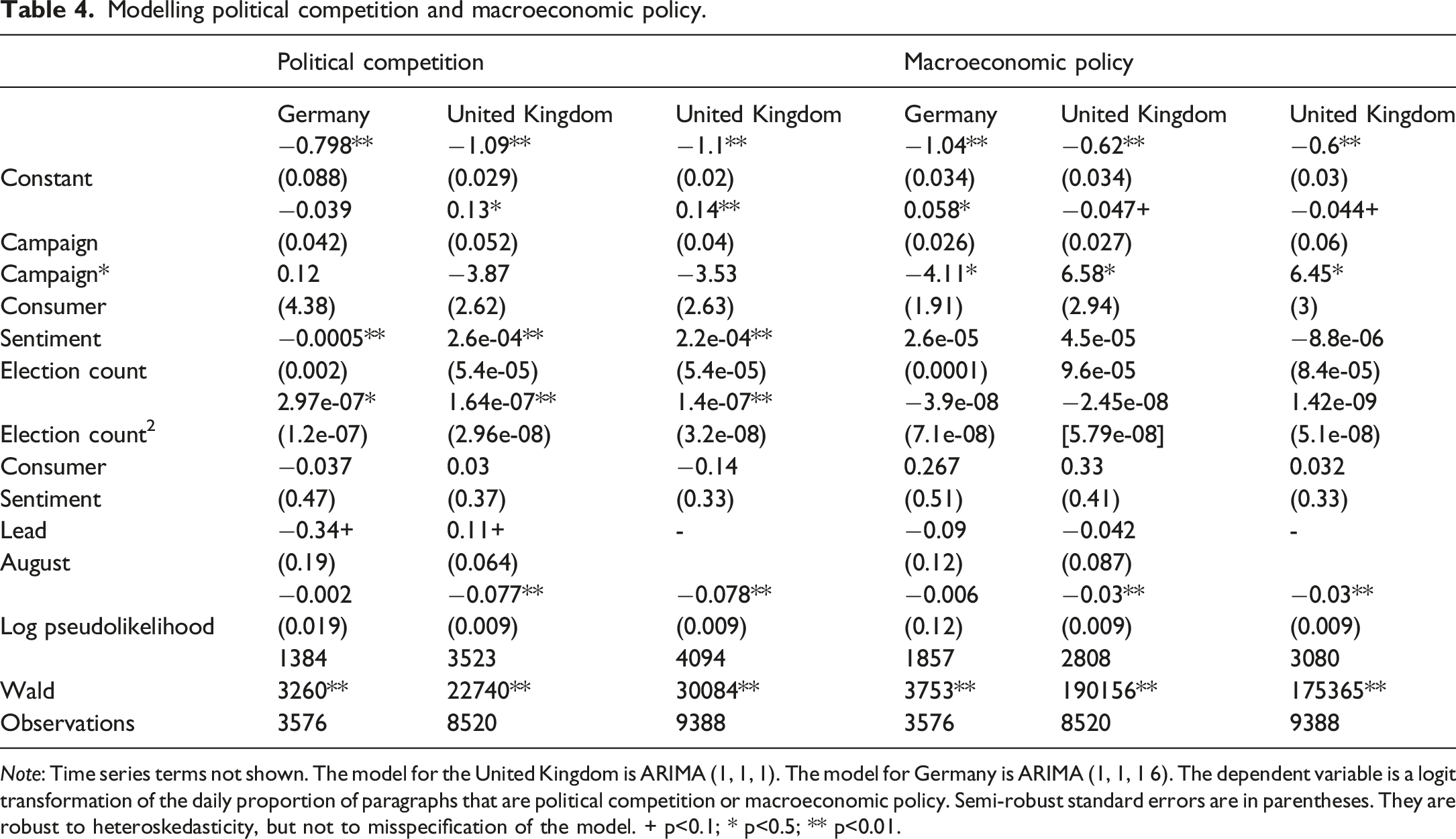
Note: Time series terms not shown. The model for the United Kingdom is ARIMA (1, 1, 1). The model for Germany is ARIMA (1, 1, 1 6). The dependent variable is a logit transformation of the daily proportion of paragraphs that are political competition or macroeconomic policy. Semi-robust standard errors are in parentheses. They are robust to heteroskedasticity, but not to misspecification of the model. + p<0.1; * p<0.5; ** p<0.01.
The election count matters for political competition: the closer the election the greater the proportion of political competition news. The election count has a much stronger effect in Germany: the range over the whole electoral term is over one-third greater than in the United Kingdom. In the United Kingdom, there is a build-up to an election and then a jump in political competition as the election is called. In Germany, there is a steeper build-up, but no jump in the few weeks before the election. We suppose that these differences in the ‘shape’ of the change in political coverage go some way to reconciling the somewhat different implications of the graphs and the statistical models for Die Welt. The election count does not appear to matter for macroeconomic policy news, but there is a noticeable boost in macroeconomic policy news during the campaign in Germany, as well as a possible decrease in the United Kingdom. August does not have an effect on political content in Germany, possibly because many people are back at work and one-in-four Augusts are full of political speculation about federal elections. In the United Kingdom, there is a marked ‘silly season’ effect. Unsurprisingly, the August decrease in political competition coverage is much greater than the reduction in macroeconomic policy news.
Finally, we conduct an empirical probe of the mechanical conjecture. The German election of 2009 and the UK election of 2010 constitute a potentially insightful comparison. They were both held at times of intense financial and economic crisis across Europe and this regularly intruded on the election coverage. The UK election of 2010 has a special advantage for comparison with a consensual system since it was the only election in recent times that has resulted in a coalition and, indeed, the possibility was central to most of the campaign. The German federal election overlapped with election campaigns in Thuringia, Schleswig-Holstein, Saarland, Saxony and Brandenburg. A lot of detail on political competition had to be squeezed onto the front page in a short period. The salience of coalition in the United Kingdom and the multiplicity of elections in Germany make these two elections least likely cases for large differences between election coverage due to conjunctural factors. In both countries, a change in government was expected and occurred. However, in the United Kingdom, the single-party Labour government was expected to be replaced by the Conservatives, while in Germany, the expectation was that the governing Christian Democratic Union-Christian Social Union would exchange their Social Democratic partners for the Free Democrats.
In order to measure the mechanical constraint, we use the Hirschman–Herfindahl index (HHI), which is a measure of both inequality and fewness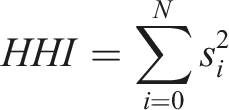
Table 5 shows the mean HHI scores for policy and political competition paragraphs across the two elections. (1) Contrary to our conjecture, the FT has a lower HHI for political competition. (2) Contrary to our conjecture, the two papers are close together for political competition, but Die Welt’s coverage of macroeconomic policy is more concentrated than the FT’s. (3) The data corroborates our conjecture here: policy paragraphs are much more concentrated compared to political competition in Die Welt. Therefore, it is relatively easier for Die Welt journalists to write simple paragraphs about policy than it is for FT journalists. Concentration of paragraphs on politicians. Note: Cell entries are the Hirschman–Herfindahl index conducted on mentions of politicians on front pages only. Coding articles without politicians’ names as if only one was mentioned does not substantially change the results.
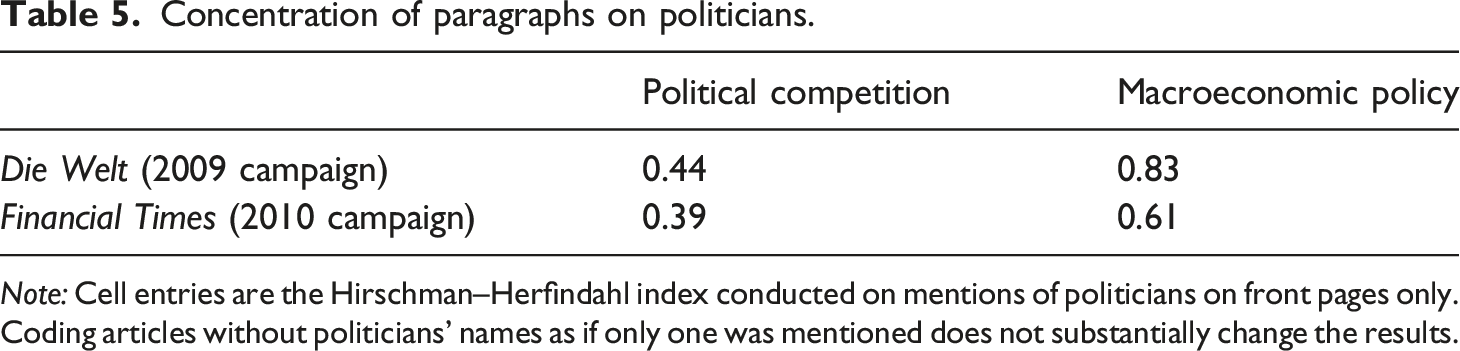
This empirical probe suggests that there is not a mechanical effect behind the different dynamics of election coverage in the two newspapers. Although Die Welt’s journalists may find it easier to write about policy, this is not because writing about political competition is complicated by more names than in the FT but rather because in Die Welt policy paragraphs are more concentrated on fewer names.
Conclusions
The logic of political institutions influences the dynamics of political news. Elections mean different things in different political systems and are therefore covered differently. We have argued that some of this difference is predictable and can be attributed to the classic distinction between majoritarian and consensus democracy. Our argument does not seek to dismiss existing work on the determinants of political news coverage but rather to make the case for isolating the impact of an additional, powerful variable. Cross-national dynamism constitutes an important and interesting research agenda to complement the more dominant emphases on national continuity in the media systems literature and shared commercial and cultural pressures in the literatures on globalisation and technological change.
We suggest three ways to extend our work. First, we need to see whether similar patterns are found in other newspapers. Our arguments are supported by a population study of the coverage of two newspapers, albeit on the basis of relatively few elections in Germany. Nevertheless, we maintain that this political-institutional logic should apply to other papers and other national contexts. Second, we can study other media. We hypothesise that broadcast and social media will be more dynamic than newspapers because of space restrictions in the broadcast sector and the entry of temporary contributors onto social media. While newspapers have traditionally closely tracked political institutions, political debate on social media can often be a parallel universe to official discourse. Nonetheless, when social media engages with an election, it cannot but be influenced by the nature of different political institutions. Therefore, it is probable that its dynamics should vary cross-nationally in a similar way to the two newspapers studied here. Third, the causal mechanism could be explored. Here, as indicated earlier, we see potential to take inspiration from Bennett’s work on journalistic routines. How do journalistic routines vary between majoritarian and consensual countries? In particular, how do media organisations treat authoritative sources and to what extent do they index political conflict? How do these routines change at election time?
Fourth and last, intra-national variation is potentially fascinating. Variations across outlets may be driven by the size of their political content. Tabloid newspapers offer very little content compared to quality newspapers. Therefore, the jump from something to nothing may look similar across political systems. Variations across elections may be a particularly productive avenue of research. The central tendency of political systems is relatively stable, but it can and does change, sometimes relatively suddenly and this is often crystallised in an election, where the collapse or surge of a party implies a shift in the logic of government and politics. Does the media mirror such changes or does it lag behind them? If the media follows changes, how is this expressed qualitatively? If its framing does not reflect structural change, how is this tension managed in the presentation of political content? This provides a link to fundamental debates about the relative autonomy of the media from other social and cultural structures.
Footnotes
Declaration of conflicting interests
The author(s) declared no potential conflicts of interest with respect to the research, authorship, and/or publication of this article.
Funding
The author(s) received no financial support for the research, authorship, and/or publication of this article.
