



Abstract
In this article, I enquire into the ways that journalists understand their identities and values now that social media dominate the routines of networked newsrooms. My approach is grounded on a Discourse Theory framework within which journalism emerges as a symbolic practice constituted through the discourse of its practitioners. Drawing additionally on pragmatic sociology, I understand journalists as reflexive practitioners who discursively attribute value to various orders of worth in order to evaluate their own identities. Taking the British news organisation The Guardian as my case study, my analysis of 10 newsroom interviews demonstrates how journalists develop a series of evaluations in order to identify themselves. My findings confirm a shift in the ways that journalists evaluate themselves, which is today associated with a new valorisation of networking. This shift towards networking, however, does not destroy long-standing journalistic values. It is ultimately their institutional identities that journalists re-invent through social media, and it is according to their institutional expertise that they evaluate themselves as professionals. In conclusion, I argue that, whilst journalists reaffirm their disdain for the financial rewards of the market, by embracing social media networking they expose themselves to the influence of capitalist markets.
Keywords
Introduction
Social media have been systematically introduced into newsrooms across the world roughly a decade ago (Lewis and Molyneux, 2018). Their uptake by the journalists has been mostly justified as a long overdue participatory invitation to news audiences now turned news producers (Singer et al., 2011). Arguably, social media infuse journalistic ethics with the values of participation, transparency and openness (Phillips, 2010). Transparent journalistic practice is conceived as mutually beneficial for journalists and audiences who can forge relationships of reciprocity and collaboration (Lewis et al., 2014). Today, social networking platforms are a ubiquitous feature of everyday journalism and the ability to construct a social media identity is considered a vital journalistic capacity (Molyneux et al., 2018).
Nevertheless, journalists frequently criticise social media, particularly insisting on their role in the toxification of the public sphere (Ward, 2019) and the dissemination of misinformation and disinformation (Tandoc et al., 2019). The 2016 US election marked a milestone, after which journalists buttressed their critique with investigations of social media practices (Carlson, 2018). By undertaking such investigative work in line with long-standing journalistic conventions journalists enact their core values of objectivity, impartiality (Olausson, 2017) and public service (Vos and Thomas, 2018a), thereby anchoring themselves in their professional identities (Grubenmann and Meckel, 2017).
It is this ambivalence in the ways that journalists approach social media, which seems entwined with their personal attachment to newer and older values, that I explore in this article. Whilst ambivalent journalistic negotiations of social media are nothing new (Lewis, 2012), I find that their investigation acquires a renewed urgency in the conditions of present-day journalism. How do journalists understand their values and identities, now that social media dominate the routines and activities of fully networked newsrooms?
In my view, researchers have thus far examined the relationship of social media with the journalistic identity and values by largely emphasising either the continuities or the shifts of journalism. In this article, I seek to transcend this antinomy and illuminate the dialectics of journalistic continuity and change. I do so by grounding myself on a dialectical understanding of language (Chouliaraki and Fairclough, 1999), according to which I accept that when journalists speak they do not merely represent what they do, but they actively identify themselves. This perspective is enriched by a view of journalists as reflexive practitioners, that is, as ones who are capable of critically evaluating the conditions of their practice (Boltanski, 2011). Seeing how evaluation is an integral component of reflexive identification, I investigate current journalism by taking seriously what the journalists say.
I sought to locate my research in the real world setting of institutional journalism, the newsroom. I selected to study The Guardian as a leading case of a legacy journalistic organisation that has fully incorporated social media in their news production. I conducted a series of narrative interviews with Guardian journalists, inviting them to talk about their experience with social media. I have subsequently conducted a Critical Discourse Analysis (CDA) (Chouliaraki and Fairclough, 1999) of the interviews. In the main body of this article, I present and discuss the main findings of my analysis: I identify the values to which the journalists commit, the principles that they consider antagonistic and their conceptions of who can be considered a good journalist. I conclude with a reflection on my findings where I seek to explain the journalists’ ambivalent stances vis-à-vis social media and offer my understanding of how social media influence the ways in which journalists identify and evaluate themselves.
Journalistic values between continuity and change
From a review of the relevant literature, I select key articles from two broad strands of research on the relationship between social media and the values with which journalists identify.
The first strand focuses on how social media change the journalists’ relationships to themselves, hybridising the ways in which they identify and the values to which they commit (Witschge et al., 2019). As Vos and Craft (2017: 1516) find, journalists today routinely appeal to transparency ‘as a standard by which to judge journalistic practice’. Transparency is conceived as the replacement of the professional ethos of objectivity (Hedman, 2016) and is associated with a logic of participatory openness to networked communities (Lewis, 2012). This new ethos revitalises the journalists’ accountability to audiences (Karlsson, 2011) and their sense of honesty and respect for others (Singer and Dorsher, 2011). As this reconfiguration suggests, newer and older values co-exist in journalism (Hermida, 2012) with the distinction between them increasingly blurring (Hujanen, 2016). Effectively, journalists hybridise institutional and networked norms in order to construct their identities (Barnard, 2016). This is evident in the ways that journalists identify themselves on social media drawing on their personal, organisational and professional characteristics (Holton and Molyneux, 2017). Journalists often refer to this identificational process as self-branding, a practice that allows them to increase their influence and visibility (Brems et al., 2017).
In this strand’s view, the spotlight falls on the individual journalists who use social media in order to build the reputation and followship that will allow them to either compete entrepreneurially in a precarious field or prove their worth as good representatives of the organisation and journalism more widely. In my view, this understanding of journalistic action could be productively complemented by a more critical understanding of the role of social media in the reproduction of capitalist economies (van Dijck, 2013).
From another perspective, journalism in the era of social media tends more to the reproduction of existing practice than to its abandonment (Ryfe, 2019). Journalists have normalised social media such as Twitter into existing norms and routines (Lasorsa et al., 2012). As Lowrey (2017) puts it, the digital networking logic that social media represent is not fully legitimate in journalism. Against the ‘interactive journalism’ of social media, which journalists denounce as part of market driven organisational strategies (Witschge and Nygren, 2009), they are keen to emphasise the professional values of their occupation, such as objectivity (Wiik, 2014), public service (Vos and Thomas, 2018b) and authority (Perdomo and Rodrigues-Rouleau, 2021). The need to respond to audience demands contrasts with the occupational values of autonomy and self-regulation (Andersson and Wiik, 2013) and undermines the quality and integrity of news (Weaver and Willnat, 2016). Even new players in the field seem willing to be perceived as professional journalistic entities (Tandoc and Jenkins, 2017).
Whilst this body of scholarship registers the technological shifts of journalism, it largely paints a picture of continuity. Journalists here reactively protect their professional boundaries and strategically defend their interests by foregrounding their institutional values. In my view, a more productive examination of practice would entail an expanded understanding of journalistic reflexivity that recognises the journalists’ critical capacity.
The two strands of existing research that I identified offer nuanced accounts of the journalists’ ambivalence between stasis and change. I contend, however, that in order to understand both what changes and what remains the same in journalism, we should first, adopt a critical perspective on social media networking, and, second, recognise journalistic reflexivity. Hence, I propose that we must look at current journalism from the perspective of the journalists, taking them seriously as reflexive practitioners who are capable of moral discourse and critique.
Evaluation, reflexive identification and the economies of worth
In order to recognise the critical capacity of journalists, I draw upon pragmatic sociology (Boltanski, 2011). This perspective allows me to understand that journalists raise themselves to reflexivity when they negotiate their disputes with others. Disputes are resolved by agreements on the moral principles that are articulated in what Boltanski and Thévenot (2006) conceptualise as polities.
It is by thinking in terms of the polities that we can understand the various journalistic values as different species of worth. Polities are conceived as historical structures of meaning that form around a plurality of economies of worth (Chiapello and Fairclough, 2002). The principles that regulate the distribution of worth affirm the personal rights to dignity by connecting their confirmation with the affirmation of several conceptions of the common good. As per Boltanski and Thévenot’s (2006) typology, we can talk about seven polities and their associated types of worth. The polity of inspiration valorises creativity. The industrial polity values efficiency in the application of means to ends. The domestic polity refers to traditional modes of organisation where seniority is respected. In the polity of fame, the opinions of others bestow worth as recognition. In the polity of the market, the pursuit of profit is considered moral behaviour. The civic polity values collectivity including organisation in political groups. In the connectionist polity, activity is of utmost importance, as actors move from one project to the next, traversing networks and developing connections. This hybrid polity comes from the articulation of the artistic and market polities, and furnishes capitalism with its justifications, as its ‘new spirit’ (Boltanski and Chiapello, 2005). I understand evaluation, then, as the process by which journalists draw on the various polities in order to attach themselves to particular types of worth.
It is by additionally drawing upon Critical Discourse Analysis (CDA) (Chouliaraki and Fairclough, 1999) that I further specify the relationships between evaluation, identification and critique. I refer to discourses as the historically given ways of representing various practices, such as that of journalism. The articulation of a particular discourse entails the organisation of the elements of a practice in relations of equivalence, against other, excluded practices. In this sense, critique is an inextricable aspect of discursive articulation: to confirm a particular way of action is to simultaneously criticise another competing way. It is in articulation that individuals act: they identify with a subject position of a particular discourse and commit to particular types of worth.
Hence, I claim that the discursive act of evaluation is an important component of the journalists’ reflexive process of identification. Insofar as there exists a plurality of conceptions of worth, who is a good journalist might be construed and evaluated in different ways.
Research questions
Following the conceptualisation of evaluation as the discursive process by which journalists identify themselves, I formulate my overarching research question in this way:
How do journalists evaluate themselves?
In order to unpack the ways in which the journalists evaluate their worth, I pose three subquestions.
How do journalists articulate various types of worth?
How do journalists exclude different principles?
How do journalists construe worthy subject positions?
In order to answer the dynamic ‘how’ questions of this thesis, I followed a methodology that facilitated an in-depth understanding of journalists’ practical knowledge.
Methodology
I designed this research as a case study in order to examine journalistic practice in the real-world context of a news organisation. Case studies are valuable when we are interested in understanding in depth the practical knowledge of actors situated in specific contexts (Flyvbjerg, 2001). Contrary to the idea that generalisations can be weakly supported by the exposition of cases, case studies allow for the analytical, (rather than formal) generalisation that entails reflection on the workings of practices in order to make logical inferences and offer propositions (Yin, 2015). Towards this end, it is the study of paradigmatic cases that is most productive, insofar as they emerge from and constitute the practice to which they belong (Mills et al., 2010: 646). In my view, The Guardian, an internationally acclaimed British news organisation, is a paradigmatic case of current journalism. A pioneer of operationalising social media in newsroom routines, The Guardian produces journalism that influences the profession well beyond its immediate national context.
I constructed this case study by interviewing some of The Guardian’s journalists. I selected the potential participants in a purposive way (Gaskell, 2000), ensuring that they practise journalism exclusively for The Guardian. Through an examination of online resources (lists and databases of British journalists, Twitter profiles and the Guardian’s website) I was able to identify 79 suitable candidates.
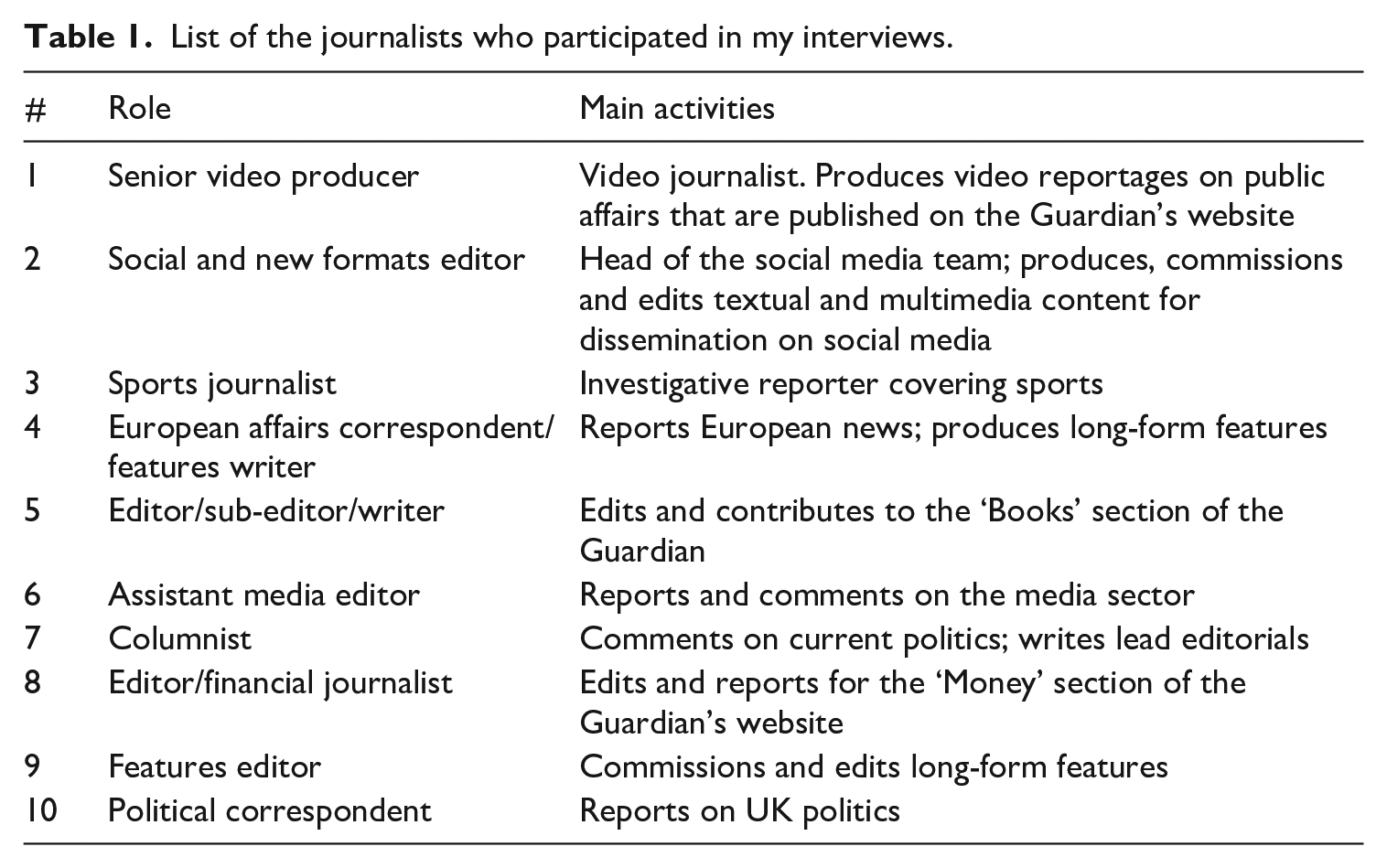
I conducted narrative interviews (Kartch, 2017) with the 10 Guardian journalists who responded positively to my request. In our conversations, I invited them to reflect on and narrate their experiences with social media. The journalists that I interviewed were active in a number of journalistic beats and positions (Table 1). As the literature suggests, in qualitative studies such as this, the average number of interviews ranges between 6 (Guest et al., 2006) and 15 (Brinkmann, 2013). The interviews took place from October to December 2016.
List of the journalists who participated in my interviews.
Following a CDA methodology in order to analyse the interviews, I first identified a series of texts where identificational meanings were prominent. These were statements where the journalistic ‘I’ seemed to be implicated in explicit evaluations, commitments to what should be done, or value assumptions (Fairclough, 2003). I then analysed these texts by paying attention to their lexical, grammatical and semantic relations. Looking at the speakers’ vocabulary, I related the textured subjects and process verbs with the figures and activities of the various polities. Focusing on the grammatical relations between clauses and sentences (parataxis, hypotaxis) I identified discursive relations of difference and equivalence. Concentrating on the participants and processes of modalised clauses, I noticed the types of action that my interlocutors deemed desirable. I thus traced several common patterns of meaning across excerpts from various interviews, which I considered to be the various discourses on which the journalists draw in order to evaluate themselves. I unpack these discourses as I discuss analytically excerpts from the various interviews. I selected the excerpts in terms of the clarity and succinctness of their meanings. In each of the sections that follow, I locate first the polities that seem to be mobilised in the journalistic evaluations. I then focus on how each discourse is consolidated, by looking at how other types of worth are excluded. Finally, I concentrate on how journalists construe worthy journalistic action.
Discourses of journalistic evaluation
Authority
In the first discourse that I identify, authority, the worth of the domestic polity, is of utmost importance. Authority is construed here as already attached to persons with experience or seniority in some journalistic hierarchy. These figures of authority are respected as serious and measured journalists.
In the following excerpt, where a senior columnist talks about his approach to social media, we see how authority refers to existing journalistic hierarchies and traditional values.
I think the main thing I would say is to be careful not to getting to saying things that you can’t defend. Because I think you can undermine your authority up to the extent you have any by saying off the top of the head daft things which is fine if you’re you know a celebrity just sort of shooting from the hip but you know our trade is supposedly. . . authority and trustworthiness and objectivity and all that stuff. (Journalist 7)
Authority needs to be preserved insofar as an individual either ‘has any’ or does not; it refers to an established order. Given that ‘objectivity’ and ‘trustworthiness’, values that come from the industrial polity, are part of the journalistic tradition, they are articulated in equivalence with authority. Additionally, this traditional stance seems to be understood against the ‘daft’ approach of ‘celebrities’. Allow me to disambiguate this suspicion of popularity by turning to another excerpt, where the meanings of this exclusion are clearer.
In the following quote, a features writer acts as the representative of The Guardian when he denounces the production of entertaining social media news.
We don’t go in for the kind of skateboarding cat videos you know. We tend to avoid stuff that will pull in massive numbers of clicks just because it’s funny. We try to remain a reasonably serious organisation. (Journalist 4)
The phrase ‘cat videos’ refers generally to viral social media content, with which competitors such as BuzzFeed are arguably identified (Tandoc and Jenkins, 2017). Serious, authoritative news organisations are defined against this practice of sharing entertaining, ‘funny’ news. It seems then that the notion of popularity that is antithetical to traditional authority resonates with the demands of consumerist audiences. As the phrase ‘massive numbers of clicks’ suggests, it is more specifically the quantified popularity of network traffic that is rejected.
How is then the worthy journalist of the traditionalist discourse supposed to act? As the senior columnist argues next, by continuing to behave with reserve and humility, even whilst partaking in new activities that are dominated by different principles.
I think so many journalists of my time are kind of. . . they take a stance they have an attitude they are. . . in a sense they regard themselves as protagonists in something or other. I’m cautious about that but I think it’s quite good to use Twitter to be slightly humble sometimes if you got something wrong say it, if you’ve seen something idiotic, if you’ve seen somebody saying something daft, you know, without being rude. . . (Journalist 7)
The speaker here identifies himself against the other journalists ‘of my time’ who have ‘an attitude’, and a ‘stance’, and ‘they regard themselves as protagonists’. From the moral perspective of the domestic polity to claim the spotlight is considered selfish behaviour. ‘Good’ conduct is to be ‘humble’ when admitting mistakes. Even when the circumstance requires the confrontation of objectionable stances one should not be ‘rude’.
Overall, I find that this is a discourse that aims to confirm the journalistic relations they are, by claiming that this has always been the state of affairs. Tradition should be upheld, the journalists here seemingly argue, and hierarchies of authority should be respected, even as new activities enter the daily practice. Whilst similar attitudes of resistance are not new, I argue that in the current conjuncture, resistance is rooted in the need for a stable identity in the face of change. The journalists above seem to experience change as destabilising the inveterate values that shape their identity as persons with specific backgrounds and experiences – they confirm what feels familiar. Among the familiar meanings, I discern the imperative to exclude the market from interfering with the criteria of journalistic worth, an influence that traditionalists find to be lurking behind the logic of social media popularity. The following discourse similarly turns against this logic, although journalists here show even more ambivalent stances vis-à-vis social media.
Distinction
The second discourse that I identify draws on the polity of public opinion in which worth is measured in terms of the opinions of others. Oriented towards others as they are, their audiences and peers, journalists here grapple with contrasting conceptions of recognition. On the one hand there is the idea of popularity measured in online traffic, which journalists reject on account of its affinity with the market. On the other, there is the recognition conferred by their peers, and the reward of distinction, which is what they ultimately prioritise.
In the first excerpt, an editor of long form features explicitly identifies prestige as the species of worth that holds together the journalistic field.
so much of this business is about that right, is sort of about how we describe these things, how do we, how do we create systems of value and esteem and prestige and kind of you know merit in in any kind of journalism but I think especially in the kind of more reflective, more literary, more narrative kinds of journalism is totally about a sort of subjective judgement of a given community. (Journalist 9)
The ‘business’ of journalism, for this speaker, primarily refers to processes of evaluation and ‘systems of value’, which distribute recognition as ‘esteem’, ‘prestige’ and ‘merit’. Whilst these ‘systems’ regulate the entire field, they are ‘especially’ relevant to a ‘community’ of journalists who practise a more ‘reflective’, ‘literary’, ‘narrative’ type of journalism. These ‘systems’ are not structures imposed or inherited since they have to be ‘created’ by the arbitrary ‘subjective judgement’ of the very community that will uphold them. Hence, the principle that unites the journalistic community is that of recognition by others – specifically by peers. This mode of evaluation is problematised when other actors suggest different rationales for the assessment of journalistic worth, such as the quantified reach of online articles.
The Guardian journalists have access to a proprietary system of online metrics called Ophan. For the columnist who speaks next, the increasing emphasis on metrics should be tempered, so that it does not undermine the integrity of Guardian journalism.
And we employ a lot of people who sit there drawing conclusions from these numbers and the problem there is not that that’s not worth doing, it is worth doing. The problem is if they simply say well it’s not popular enough we should be doing stuff that gets more traffic, well I mean of course you should but on that basis we should run pornography. (Journalist 7)
What this rejection of the metric systems reveals, is, in my view, a clash between two different conceptions of recognition: the journalistic logic of distinction, according to which recognition is bestowed upon the self by peers, and the networked logic of popularity, according to which recognition can be statistically established. The latter logic seems to be excluded in the excerpt above as informing a managerial strategy of control, which, as other research also finds, increases the rationalisation (Petre, 2018) and commodification of journalistic practice (Hanusch and Tandoc, 2019).
Whilst social media metrics are unacceptable measures of worth, social media as forums of public debate can contribute to the purposes of the subject of this discourse, the distinguished journalist, as the features editor suggests next.
I need to be constantly attuned to what’s happening in social media, to what’s happening elsewhere in this world of public argument in order to make sure that my sort of three big things I do every week are as fine-tuned as possible to kind of like what the zeitgeist requires, or what’s my special way to contribute to it. (Journalist 9)
What the ‘zeitgeist requires’ is up to the journalist to construe subjectively, as he interprets the various public conversations on social media. The outcome of this interpretative process is a distinct, ‘special way’ of ‘contributing’ ‘the three big’ stories of the week to the conversation. It is then by assuming a distinctive position in the public dialogue that one gains recognition as a good journalist.
Let me reiterate that, according to this discourse, journalists are doubly oriented towards the opinions of their audiences and their peers, although it is ultimately recognition by the latter group that they seek. These journalists do not consider themselves at odds with their audiences; they rather reject their managers’ representations of audience behaviour. Whilst social media as metrics of prestige seem unacceptable, as forums of public conversations they contribute to the journalists’ knowledge of public opinion. The discourse that I discuss next similarly seeks to expel external influence on journalistic evaluation. Its optic, however, is quite different as it views the worthy journalist first and foremost as an autonomous professional.
Work
The idea that reportage is journalistic work par excellence was frequently brought up by my interlocutors regardless of their own role in The Guardian. This is one of the propositions of a discourse that views journalism in terms of the industrial polity, as work performed by professionals. Good professional journalists produce ‘hard news’ in an objective and impartial way, regardless of their position or affiliation with a news organisation. To engage in the journalism of social media is considered of low status, insofar as it is determined by a foreign logic, that of networked popularity. Algorithmically enforced, with its ever-shifting priorities hidden, this is the logic of the big tech companies that move to take over journalistic functions.
In the quote that I discuss first, journalistic work is paradigmatically associated with the position of the reporter. Surprisingly, this is performed by a journalist with mainly editorial duties, who looks after the ‘Books’ section of the Guardian’s website.
the job title that I’ve always wanted but not often had is reporter. And that’s, that is kind of the thing I admire most in journalism. It’s the aspect of. . . the work which is just sort of going out into the world, collecting facts and arranging them in a sensible order. The very unshowy kind of craftsman or artisan work, you know what I mean, just reporting. (Journalist 5)
The reporter is the subject most worthy of ‘admiration’ in journalism, whose ‘work’ requires the specialised skills of a ‘craftsman’ or an ‘artisan’. Reporting is defined as a particular chain of activities: to ‘collect facts’ from the ‘world’, and ‘arrange them’, in a ‘sensible order’. This representation of reporting seems to refer to objectivity (Schudson, 2001) – a core value of the industrial polity. It is, then, by upholding technocratic standards of work that journalists are able to defend their professional jurisdiction.
The industrial worth of work becomes fully meaningful against an excluded polity, which I identify as connectionism. This polity of digital networking is represented by Facebook in this excerpt from an interview with a media editor.
Facebook makes some of the choices that previously ten newspaper editors and five tv show editors would have made each day [. . .] Your algorithm makes the decisions, someone built the algorithm, you have principles, you have guidelines about what can be shown and what can’t. (Journalist 6)
Facebook is endowed with ‘decision’ making power, founded on the ‘principles’, and ‘guidelines’ that are encoded in its ‘algorithm’. What these principles and guidelines actually dictate is unclear; the point is that Facebook lacks transparency. Johnson and Kelling (2018) consider this point part of a boundary-setting journalistic strategy, by which Facebook is included in journalism and evaluated according to its standards. I would counter that this critique completely excludes Facebook from the journalistic field as a non-journalistic entity with financial interests, which classifies journalistic content on the grounds of an opaque set of ever-shifting priorities.
The industrial conception of journalistic worth unifies the profession by foregrounding the good work of individual journalists. As a political correspondent suggests next, all journalists, regardless of their affiliation, can rise in worthiness, insofar as they produce ‘strong news’.
there’s always been good journalists and bad journalists and again there’s the social media effect it just kind of magnifies it. [. . .] you can have people like the Canary or Breitbart who are for most part being journalists but they’re coming at it with very much an agenda. [. . .] their aim would be to kind of create a splash make something go viral [. . .] But even within those there can be a real mixture so for example Buzzfeed obviously is well known for doing listicles you know 40 things you didn’t know about xyz, but also does a lot of very very strong news (Journalist 10)
The argument here is that the introduction of social media into journalistic practice has only solidified the traditional division between ‘good and bad journalists’. The new entrants to the field, whilst ‘for the most part being journalists’, practise a journalism of lower standards. The leftist website ‘Canary’ and the alt-right ‘Breitbart’ breach the objectivity norm with their ‘agenda’. What unites them is their logic of making a ‘splash’, going ‘viral’. Nevertheless, the possibility of positive evaluation remains open. To the extent that the new entrants publish ‘strong news’, these organisations and their journalists appear to operate within a ‘mixture’ of paradigms. As other research also finds, media such as BuzzFeed indeed seek to differentiate themselves by both challenging and upholding the professional standards of the field (Stringer, 2018).
Autonomy, objectivity, public service and membership in a news organisation are some of the ‘core’ values (Deuze, 2005) of the professional journalistic identity, the hegemonic journalistic subject (Carpentier, 2005). My analysis above confirms the continuing relevance of these values and shows how they hinge on the industrial worth of work. Professional work is construed against the connectionist worth of networked popularity, which characterises low-status media with sensationalist priorities or political agendas. Furthermore, to embrace the logic of social media is to hand over to the big technological companies vital journalistic functions, thus endangering the profession’s autonomy from the market.
The professional journalists share their denunciation of the connectionist type of worth with the traditionalists and those who seek distinction. Thus, against the connectionist worth of networked popularity, there forms an alliance of three types of worth: professional work, traditional authority and distinction. But it is time now to turn to the major antagonist of the three discourses that I have discussed so far, the connectionist worth of networked popularity.
Networked popularity
A hybrid type of worth, networked popularity refers on the one hand to the connectionist imperative for activity in the form of projects of network engagement. But insofar as these are journalistic projects where the opinions of others are important, another polity is activated, that of public opinion. Social media are the space where journalists vie for networked popularity as they come to know their audiences’ preferences and opinions, in direct interactions with them or through the granular data of their online behaviour.
As someone who covers the media sector, the journalist whom I quote next considers himself a specialist. In seeking to consolidate his reputation on social media, he seemingly articulates the polity of public opinion with the connectionist polity, thus staking his evaluation on the hybrid type of worth that I call networked popularity.
as a journalist you’re very much a source of information, especially if you’re a specialist. And so you need to have a good reputation as providing that service. And part of that is tweeting about things that are interesting that other publications published or tweeting about events that are interesting and maybe make it into an article. You know it’s a fully rounded kind of I am providing an information service to people who care about the things I write about. (Journalist 6)
To be a ‘specialist’, as a ‘source of information’ is to provide a ‘service’, the speaker argues. ‘Part’ of this activity happens on Twitter where one finds and disseminates information from other ‘publications’ or tweets ‘about events’. Presumably the other part of this service is distilling this activity ‘into an article’. The beneficiaries of the ‘service’ are the ‘people who care’ about this information, those interested in the media. It is trust in one’s ‘reputation’, a relationship of recognition built with connectionist activity, that enables the further development of more relations and the consolidation of a good professional reputation. Thus, for this journalistic subject, to develop relationships with networked communities, as part of a service, is simultaneously worthy as identity (brand) building activity. Let us now see how this connectionist discourse responds to the attacks made on it by the discourses that we have discussed earlier.
Contrary to the negative perceptions of analytics that we have encountered earlier, the journalist whom I quote next, an editor of financial news, finds that these metrics contribute to the quality of journalistic work and reduce the journalists’ overall workload.
when I started on the website we didn’t have the sort of tools for measuring traffic, you didn’t find out until the next month how many people have read the piece, so you were really making decisions in the dark, but there was nothing else to do so you’d write, I used to write a lot more when I started I used to write 6 or 7 news pieces a day cause we really thought that that’s what people wanted. Now we kind of realise that’s not the case. (Journalist 8)
The ‘tools for measuring traffic’ allow journalists to have a better idea of what ‘people want’. Insofar as journalists can interpret the data, they no longer ‘make decisions in the dark’. As a result, they can reject the intensification of content production, as Usher (2018) has also shown. What the journalist seems to argue is that the data, rather than determining editorial decisions, are always subject to the journalists’ interpretation. Once examined, they can in fact confirm agreements between audiences and journalists over the latter’s expected role, as Zamith (2018) also reports.
It seems, then, that the journalists who draw on the connectionist discourse respond to the critiques of the professional journalists by confirming established journalistic standards. Whilst a tension between ‘old’ and ‘new’ is identified in this discourse, what is excluded as old, in this case, is an earlier phase of connectionist practice. During that period of bad practice, network connections were treated as objective data, leaving little room for their interpretation by the journalists. Nonetheless, this articulation of the newer connectionist logic with older journalistic conceptions of worth creates a tension that journalists have to negotiate when they engage on social media.
As we have seen, the connectionist journalists invest their individual energies in projects of self-identification. With this type of action, they are now in the position to reconstruct online both the personal and professional facets of their identities, as the social media editor who speaks in the following excerpt finds.
I feel that I could probably grow the account. . . faster and more stratospherically if I just really focus on just being- I go through these periods of focus where every tweet I’ll do should be informative or useful but I sort of also quite enjoy being the class clown, so it’s kind of jokes. (Journalist 2)
On the one hand, this journalist feels that he should ‘focus’ on being ‘informative or useful’ on Twitter, which entails posting ‘about journalism and media and technology’, as he has told me earlier. On the other, a more personal kind of tweeting is also possible, where he gets to make ‘jokes’, but this seems less rewarding. Indeed, as other research confirms, journalists on social media perceive a tension between the professional/organisational/institutional aspects of their identity and what feels more personal (Hermida, 2013). Whilst for some this ambiguity may be less problematic (Hedman and Djerf-Pierre, 2013), others experience a pressure to represent themselves as professional members of a news organisation (Holton and Molyneux, 2017). This journalist elects to emphasise his professional identity, a choice that is consistent with the logic of the platform if he is to ‘grow the account faster’.
In summary, networked popularity is the type of worth that refers to the articulation of the polities of connectionism and public opinion. It is accrued by individual journalists in their projects of identity building as they develop relations with others on networks such as social media. Networked popularity may be quantifiable but, at least for journalists, the statistical data of user behaviour are always subject to interpretation. As journalists construct their online identities in networked relations with others, their individual action is conducive to organisational and institutional strategies. It seems, then, that for journalists on social media the institutional aspect of their self-identities seems to coexist and often prevail over the more personal.
Concluding reflections
In this article, I explored how journalists evaluate themselves, now that social media are a dominant feature of their practice. I view evaluation as integral to identification, the process by which individuals construct their self-identities in terms of an array of subject positions. The various types of identity are construed as the subjects of particular discourses, which individuals enact in the various social contexts that these discourses represent and constitute (Chouliaraki, 2008). As a discursive process, identification entails evaluation, that is, the articulatory attachment of worth to the self and others. For the various types of worth, actors draw upon the polities, the general discourses that form around principles for the distribution of worth (Boltanski and Thévenot, 2006). Following a CDA methodology (Fairclough, 2003) in order to analyse data from 10 interviews with Guardian journalists, I have found that my interlocutors construe four types of worth, in order to evaluate who is a good journalist.
The first discourse draws from the domestic polity in order to suggest that authority is the traditional journalistic type of worth. Authority appears as already attached to journalists with seniority. The second discourse draws on the polity of public opinion in order to construe worth as distinction in the journalistic field. The third discourse offers a professional understanding of worth as journalistic work characterised by objectivity and ‘hard news’. Finally, networked popularity is the connectionist type of worth that journalists accrue when they engage in self-branding projects on social media.
Considering the critiques that the journalists articulate, I identify an alliance between the discourses of authority, work and distinction. This alliance is founded on a rejection of networked popularity, which the three allied discourses associate with social media self-branding, the quantification of journalistic production and the production of entertaining online news. In contrast, the discourse of networked popularity is not positioned radically against the alliance of the professional types of worth. The journalists who value networked popularity seek to confirm their institutional allegiance, albeit taking it upon themselves to build their reputations as good practitioners online. Indeed, in their critique, they share some of the concerns of professional journalists when they emphasise their interpretive agency over the quantification of their work as network traffic. Thus, a common thread seems to connect all journalistic discourses of evaluation. It refers to a shared concern with the subordination of journalism to the techno-business complex that brings together journalists with different understandings of worth into a front against market heteronomy.
Most of the worthy journalistic subjects that the discourses offer seem to be well-known figures of institutional journalism. I have identified (a) the professional journalists who invest their labour in the production of hard, impartial news; (b) the leading journalists who compete for the recognition of their peers and (c) the traditional journalists who respect hierarchies of authority. All three types of journalists have incorporated social media in their practice according to their ideas of worth. The professionals instrumentalise social media for their purposes but, beyond this function, they view them as determined by other practices (business and technology) which undermine their professional jurisdiction. The journalists who seek distinction appreciate social media as forums of public conversation, but mistrust them as measures of their worth. For the traditionalists, principles are all that matters, even when active on social media. But even the newer kind of journalists, those who value networked popularity, seek to represent themselves in terms of autochthonous standards of professionalism and distinction. Overall, the journalistic identity, in terms of the various principles according to which an individual’s worth is measured, exhibits a strong tendency towards continuity.
Social media, as I have shown in this article, have indeed induced change in journalism. More specifically, they have ushered into journalism a new logic of evaluation according to which journalists vie for networked popularity. This form of worth does not seem to refer to principles of civic duty, but rather to the dominant logic of capitalist markets, what I understand as connectionism. Connectionist journalists are flexible individuals who approach life and work as a series of projects around which they relate with others on socio-digital networks. Connectionism does not destroy existing practice. The long-standing principles of journalistic evaluation, that is, distinction, work and authority, persist. Moreover, it is their professional identities that journalists seek to reconstruct with their social media self-branding. At the heart of this tendency towards continuity lies the journalists’ deep-seated disinterest in profit, the worth that is specific to the market. Thus, I claim that contemporaneous journalism harbours a major contradiction: whilst journalists vehemently disavow the financial rewards of the market, by competing for networked popularity, they expose themselves to the influence of capitalist markets. Understanding how this contradiction is negotiated at the level of actual journalistic practice in other news organisations would constitute the productive pursuit of future case study research.
Footnotes
Declaration of conflicting interests
The author declared no potential conflicts of interest with respect to the research, authorship, and/or publication of this article.
Funding
The author(s) received no financial support for the research, authorship, and/or publication of this article.
