



Abstract
Gender imbalances in news coverage have been traced back to overarching societal structures and the characteristics of media companies, newsrooms and journalists. However, studies have rarely considered if and how journalistic resources can act situationally as drivers of gender imbalances. We investigated how often and in which contexts women are represented in Swiss news media articles between 2011 and 2019 (n = 77,427) by combining manual and automated content analysis on a large scale. We looked at representation in general and the dependence of topic and media type, in addition to the influence of two resource-related features of news content: the source and the format. The study showed clear gender imbalances, which were heavily dependent on the topics in the news coverage. We found that when journalists relied on original reporting instead of news agencies and used contextualizing formats women were more frequently mentioned in the news. Our results, therefore, suggest that resources can situationally determine the representation of women in the news.
Introduction
Demands for equal opportunities, social movements, private initiatives and governmental policies have promoted and improved gender equality in society over the last decades (Inglehart et al., 2002; Krook and Norris, 2014; Pološki Vokić et al., 2019). However, large imbalances remain and are mirrored in the news media. Research shows that women are clearly underrepresented in news coverage (Len-Ríos et al., 2005; Shor et al., 2015; Sjøvaag and Pedersen, 2019) especially in specific sections such as politics (Humprecht and Esser, 2017), business (Greenwald, 1990) and sports (Cooky et al., 2015). Women are also less frequently cited as sources (Mitchelstein et al., 2019; Zoch and Turk, 1998), interviewed as part of stories (Kroon Lundell and Eriksson, 2010) and quoted as experts on scientific topics in news coverage (Niemi and Pitkänen, 2017).
Research on gender imbalances in media coverage has engaged media and journalism scholars for several decades (e.g. Davis, 1982; Greenwald, 1990; Potter, 1985; Zoch and Turk, 1998). An adequate representation of women in news media coverage is undeniably of high relevance in mediated societies. As a mirror of society, news media transport and (re)produce existing images, stereotypes and role models of social groups (e.g. Bligh et al., 2012; Cheryan et al., 2013; Goodall, 2016; Jerald et al., 2016). Consequently, how women are represented in the media also influences how people perceive women and their roles in society. Thus, imbalances in media representation ‘may reinforce long-standing gender status beliefs and serve as manifestation of these beliefs’ (Shor et al., 2015: 961).
The gender imbalance in news media coverage has been attributed to overarching societal structures (e.g. Shor et al., 2015), such as the underrepresentation of women in leading positions in politics, the economy and science, in addition to the cultural hegemony exerted by males (Len-Ríos et al., 2005). Also, journalism itself produces structures that favor gender imbalances in the news. Scholars have identified procedures in news media companies and newsrooms as drivers of the underrepresentation of women in news coverage (e.g. Sjøvaag and Pedersen, 2019).
However, the news media not only mirrors societal structures but also exerts influence on society by selecting, presenting and framing news in different ways. Visibility in the news is shown to come with advantages on the individual level, as it, for instance, increases the likelihood of politicians being elected (e.g. Kovic et al., 2017). The representation of female politicians in news media coverage can also influence whether they are nominated or recruited by party elites (Lühiste and Banducci, 2016). The representation of women in news media, thus, can influence gender imbalances on a societal level.
The interdependence of societal structures and journalism is reciprocal and can be understood as a structure-agency relation, as Giddens (1984) conceptualized in his structuration theory. Giddens (1984) assumes that individuals actions depend on social structures in terms of rules (e.g. codified law, norms) and resources (e.g. power, financial resources). Human agents also shape social structures through their actions (Giddens, 1984). The actions of actors, in our case the news media organizations or individual journalists, are therefore not solely predetermined by societal structures. Journalists can act as autonomous agents who either contribute to maintaining structures through routinized actions or form and change structures, usually through non-routinized actions which are costly and require resources (den Hond et al., 2012). Under this assumption, it seems worthwhile to investigate if and how journalistic resources affect gender imbalances in news coverage. We assume that gender imbalances in the news can be the result of a lack of resources like time and finances.
Digitization has transformed the organizational structures of media organizations, resulting in declining economic and social resources for journalism (Blumler, 2010; Franklin, 2014). Despite abundant literature on gender imbalances in the news media, studies on how resources situationally affect the representation of women have rarely been considered. Recent studies have, however, already highlighted the lack of time as a restraint for journalists when selecting sources. Niemi and Pitkänen (2017), for instance, show that journalists have very little time to pay attention to gender when selecting their sources. Our research argues that the representation of women in news media depends on journalistic resources, or more precisely, the time to investigate, contextualize and write an article. This approach complements prior research on gender imbalances from a situational perspective. We argue that a journalist can act differently depending on the resources she or he can invest to cover a story. In daily business and under pressure, even progressive journalists with a high awareness of the issue of gender imbalances might have to opt for the most readily available expert to contextualize a news story instead of being able to pay attention to a balanced share of voices among women and men in the long run.
Our longitudinal and comprehensive study combined manual and automated content analysis to investigate how visible women were in Swiss news media between 2011 and 2019 and how features of journalistic content affected this visibility. First, we provide an overview of the media representation of women and men in Switzerland and analyze differences in the coverage of politics, the economy, culture, sports and soft news. Second, we investigated the effect of news agency content and format as indicators of journalistic resources. Third, we compared the representation of women and men in media types, which typically differ in how they allocate their resources. We argue that journalistic resources are an underestimated but important factor of influence on gender imbalances in news media coverage. The current economic crisis of journalism, thus, threatens to counteract the recent slight progress in gender representation in the news, which we identified in our analysis.
Conceptual framework
Structuration theory by Giddens (1984) has been used to explain individual and organizational action in the dependency of societal structures (for an overview, see den Hond et al., 2012; Falkheimer, 2007) and has also been applied to news organizations (Hofstetter and Schoenhagen, 2016; Larsson, 2012; van Rooyen, 2013). One of the most appraised and also criticized elements is the core of structuration theory, the duality of structure (den Hond et al., 2012). Giddens rejects a dualistic view of structure and agency and assumes that both notions are interconnected. Structures, as recursively organized sets of rules (e.g. codified law or norms) and resources (e.g. financial resources), are continuously reproduced and transformed by social agents. Thus, they do not exist independently from human activity and do not completely determine these actions. Social structures, therefore, influence how individuals or organizations act and vice versa. Accordingly, structures at the same time limit and empower agents (Giddens, 1984).
Giddens (1984) emphasizes both reproduction and transformation of social structures through the activities of agents. Agents continuously monitor their own actions as well as their physical and social context (van Rooyen, 2013). On one hand, agents will develop routines to deal with their social lives and cope with complexity (van Rooyen, 2013). Such routinized actions lead to the reproduction of existing social structures. On the other hand, agents can reflect their actions. Such reflexive, non-routinized actions can transform social structures (van Rooyen, 2013). However, reflexivity is a costly action and requires allocative and/or authoritative resources (Giddens, 1984). With regard to the news industry, Hofstetter and Schoenhagen (2016: 48) specify that ‘allocative resources refer to the control over economic goods such as money, staff and production facilities, whereas authoritative resources refer to the control over people made possible not only by an employee’s position within a company but also by its credibility or trustworthiness, competencies, expert knowledge, relationships, etc’.
We use the concepts of structure and agency as a theoretical lens whereby news media and journalists are conceptualized as agents and gender imbalances as a cluster of structures in society. The dual notion of news media as a place where prevalent structures in society are mirrored and at the same time as an actor with capabilities to shape such structures lies at the core of our research. We argue that media coverage is influenced by structures in society and therefore mirrors and reproduces prevailing inequalities and their temporal development, such as male dominance in politics, the economy and sports. The news media or journalists as actors, however, are not unilaterally influenced by structures but can also shape and change these structures when they act in a reflexive way and have enough resources (Hofstetter and Schoenhagen, 2016).
Reflexivity indicates the capability of an agent to shape the environment. A low level of reflexivity and high routinization would result in an individual that is shaped largely by the environment. A high level of reflexivity and low routinization would, in turn, result in individuals actively shaping the environment according to their beliefs and ideas (van Rooyen, 2013). The ability of agents to act in a reflexive manner is primarily determined by their resources. We argue that this applies to journalistic procedures as well. When news companies invest resources in their coverage and give journalists the opportunity for in-depth investigation, news media will not only mirror society, but will also be able to change existing structures. Such reflexive action can lead to less pronounced gender imbalances, given that news media are aware of and want to change these imbalances. In turn, when news media engage in routinized actions, the prevailing structures in society and journalism will be represented in the news. Regarding the representation of women, routinized actions lead to maintained or pronounced gender imbalances.
Social structures as a precondition for gender imbalances in news media
Gender imbalances are present in many parts of society and are mirrored in news media coverage (Len-Ríos et al., 2005; Shor et al., 2015; Sjøvaag and Pedersen, 2019). Studies that analyze the representation of women in news coverage with manual content analysis (Humprecht and Esser, 2017; Len-Ríos et al., 2005; Niemi and Pitkänen, 2017; Zoch and Turk, 1998), at a large scale with computational methods (Ali et al., 2010; Shor et al., 2015) or by combining both approaches (Sjøvaag and Pedersen, 2019) are unanimous in their diagnosis. Independent of the countries of investigation, they all show a substantial gender imbalance in news coverage and typically find that women account for approximately one-fourth of all mentions compared to men (e.g. Ali et al., 2010; Shor et al., 2015; Sjøvaag and Pedersen, 2019). We do not expect that this will be different in Switzerland or has changed recently and, thus, formulated the following hypothesis:
H1.1 Women will be less represented in news coverage than men.
Under the premise that societal structures shape news media coverage, recent improvements in gender equality in different realms should also lead to closing gender imbalances in the news media. However, there are few up-to-date longitudinal studies about the representation of women in news media. An exception is the Global Media Monitoring Project (GMMP) by Ross and Carter (2011) and Ross et al. (2018), which describes how women have been represented in the news media of the UK, Scotland, Wales and the Republic of Ireland since 1995. The results indicate a slightly positive improvement in the visibility of women in news coverage. In addition, a comparative study of online news in six Western countries indicates that gender balance in media coverage increases depending on the country-specific progress of gender equality (Humprecht and Esser, 2017). A study by Lühiste and Banducci (2016) supports this finding and concludes that gender equality on the societal level is positively related to gender balance in the news media, and vice versa (see also Shor et al., 2015). Due to progress in gender equality in Switzerland over the last few years (see section on the Swiss context), we assume that the gender imbalance has become less pronounced over time and that the representation of women, independent of the coverage of men, has improved as well. Thus, we hypothesized the following:
H1.2. The representation of women and men in coverage will have become more equal over time.
H1.3. Over time, the representation of women in coverage will have increased.
Previous research shows that the degree of gender imbalance is dependent on the topic of the news. Women have been shown to be underrepresented in political and economic news coverage and have been more present in coverage of health, social issues and entertainment (Armstrong and Gao, 2010). The reporting on politics, which is often at the centre of research on gender imbalances in the news, has been dominated by gender inequalities as well (Gidengil and Everitt, 2003; Johnstonbaugh, 2018; Kahn, 1994; Kahn and Goldenberg, 1991; Lühiste and Banducci, 2016; Meeks, 2012; Ross et al., 2012). During the 2010 British General Election, for instance, women candidates were mentioned less frequently in news stories than men, and women candidates were mentioned and quoted more often due to their gender rather than their political expertise (Ross et al., 2012). Also, in Switzerland, during the 2019 national elections, female politicians were featured as candidates less often and less visible in news media coverage than their male colleagues (Digital Democracy Lab, 2019).
Very strong gender imbalances have also been shown for sports and business news. A large-scale quantitative study of English-language online news outlets from 99 countries showed that male overrepresentation was especially high in sports and business news, whereas the gender imbalance was lowest in news on fashion and the arts (Flaounas et al., 2013). In a longitudinal study, Cooky et al. (2013: 203) showed that the share of women’s sports on US TV had never been as low as in 2020, indicating that sports continued to be made ‘by, for and about men’ (see also Cooky et al., 2015; Messner et al., 2016). In summary, gender bias in the news media becomes particularly clear when comparing news in the areas of politics, the economy or sports with soft news or culture (North, 2014; Sjøvaag and Pedersen, 2019). We thus formulated the following hypotheses:
H2.1 The representation of women will be higher in coverage of soft news and culture than in coverage of politics, the economy and sports.
H2.2 The representation of women and men will be more equal in coverage of soft news and culture than in coverage of politics, the economy and sports.
Journalistic resources as a condition for gender imbalances in news media
Journalism scholars often analyze gender imbalances in the dependency of an organization or newsrooms (Niemi and Pitkänen, 2017), the individual journalist (Usher et al., 2018), the media system (Sjøvaag and Pedersen, 2019) or a combination of those factors (Humprecht and Esser, 2017). The current state of research about gender bias in the news media indicates that modern society’s male dominance is reproduced in the course of the practices of news organizations (Armstrong and Gao, 2010). Newsrooms are still male-dominated, with the result that decisions about what is newsworthy represent a male perspective (Ross and Carter, 2011). Therefore, news media are considered to reproduce structural inequalities, not only because imbalances at the societal level exist but also because of imbalances in the newsrooms themselves (Santos et al., 2018).
The above-mentioned studies typically measure influencing factors at a given point in time. This may be a result of the choice of research method (e.g. surveys) or data availability, such as at a yearly rate (e.g. as provided by the news companies themselves). These measures imply that an organization or journalist will act in a predetermined way, regardless of situational factors. Differing from studies that model the representation of women in the news as a function of rather fixed factors on the level of the organization or newsroom (e.g. share of female reporters) or the individual level (e.g. male or female journalists), we assume that the same organization or individual can act differently, for instance, when deciding whom to cite as an expert in a news story. Our main argument is that resources also situationally define the actions and decisions of journalists. More resources allow journalists, for instance, to investigate an event more accurately and contextualize the story with additional sources or experts.
In times of scarce resources, news agencies are important content providers for journalism (Nicholls, 2019; Welbers et al., 2016) and heavily shape news media coverage (Boumans et al., 2018; Lewis et al., 2008). Scholars have articulated concerns that the dominant roles of agencies lead to a potential lack of diverse viewpoints, as they are ‘not only providing the “raw material” but actually selecting and telling a considerable part of the daily news stories’ (Boumans et al., 2018: 1781). Although news agencies emphasize a diversity of sources (Segbers, 2009), they usually do not provide in-depth and time-intensive research (Hagen, 2013). Instead, their business model relies on fast and reliable information about newsworthy events (Lorenz, 2017). Because of their broad spectrum of customers with different editorial alignments, news agencies have also developed specific quality standards regarding objectivity and neutrality (Grüll, 2009). However, following the structural crisis of the news media, many national news agencies are struggling (Rantanen, 2019), and journalists working in news agencies suffer from high time pressure and poorly staffed newsrooms (Lorenz, 2017; Surm, 2020). In Switzerland, the only large news agency, Keystone-SDA, has lost many customers and has had to severely cut their staff (Bühler, 2020).
Because of diminishing resources and a business model which relies on the provision of information on newsworthy events, we expect that news agencies mirror existing structures in society. Therefore, we argue that when relying on news agency content, news media are more likely to reproduce existing societal structures. News agencies are therefore structure-preserving agents. We, in turn, suppose that journalists will invest more time in providing and selecting additional sources or perspectives when they do not rely on news agency content. We expect that in coverage based on news agency content, women will be less represented than in original reporting from journalists, so-called editorial coverage. Consequently, the representation of women and men will also be less equal in coverage based on agency content. Accordingly, we created the following hypotheses:
H3.1 The representation of women will be higher in editorial coverage than in agency-based coverage.
H3.2 The representation of women and men will be more equal in editorial coverage than in agency-based coverage.
Within editorial coverage, different formats allow journalists to steer the representation of actors, sources and experts. In regular reports, events are often covered in a descriptive way as part of the daily business. Such non-contextualizing formats can therefore be described as structure-preserving formats. More resource-intense formats, such as interviews, portraits and opinion pieces, are usually not produced within a few hours like ordinary reports. In interviews and portraits, the selection of individuals to feature is an elementary part of the format, which is usually reflected upon. Due to more resources (in this case, especially time), contextualizing formats are less likely to preserve structures. We, therefore, expect that the gender imbalance is less pronounced in contextualizing formats and especially in person-centred formats. We thus formulated the following hypotheses:
H4.1 The representation of women will be higher in contextualizing formats than in non-contextualizing formats.
H4.2 The representation of women and men will be more equal in contextualizing formats than in non-contextualizing formats.
Media types are considered important structural antecedents of news content (Strömbäck and van Aelst, 2010) and have also been investigated in research on gender imbalances (Humprecht and Esser, 2017; Sjøvaag and Pedersen, 2019). Media outlets have different production routines and editorial profiles that require different resource allocations (Udris et al., 2020). Sjøvaag and Pedersen (2019) show that gender imbalances are slightly more pronounced in outlets with high publication frequency. In our case, the media types of subscription media and tabloids include outlets with high publication frequency, whereas the Sunday press only publishes one edition per week. Therefore, journalists for Sunday papers usually will have more resources available, for instance, to search for interview partners or investigate additional aspects of a story. Subscription media, the Sunday press and tabloids also differ in terms of their editorial profiles. In Switzerland, subscription media and the Sunday press offer higher quality reporting than tabloids (Bachmann et al., 2021) and, thus, will most likely invest more journalistic resources to ensure this quality. With regard to media types, we created the following hypotheses:
H5.1 The representation of women in subscription media will be higher when compared to tabloid media but lower when compared to Sunday papers.
H5.2 The representation of women and men in subscription media will be more equal when compared to tabloid media but less equal when compared to Sunday papers.
The Swiss context
As in most Western countries, gender equality in Switzerland is comparably high, even though it is not one of the top-ranked countries. According to the Global Gender Gap Report 2020 (World Economic Forum, 2020), Switzerland ranks 18th. Awareness of the issue of gender equality in Switzerland has certainly risen in the last few decades. This has led to some improvement over time, for instance, in the political system. Over the last national elections in 2011, 2015 and 2019 (which coincide with the period of our study), the share of women increased from 27 percent to 39 percent in the national parliament and from 25 percent to 29 percent in the cantonal parliaments (Swiss Federal Department for Statistics, 2019). In both cases, however, much improvement happened after the 2019 elections, which were labelled as a ‘female election’ by the press and commentators. Despite this improvement, gender gaps persist in most parts of society. Men are dominant in leading positions in the economy, such as CEO positions of Swiss companies (Swiss Elite Observatory, 2021). Moreover, men also dominate in entertainment and sports. Men’s football and ice hockey, for instance, receive regular airtime, whereas women’s sports play a marginal role.
Media companies in Switzerland have reacted to gender imbalances and implemented initiatives for more equal representations of women in newsrooms in addition to their coverage (e.g. Ringier, 2020). However, the actual implementation of such initiatives is a matter of resources. Given the economic realities that news media companies are facing, gender equality may not be the highest priority for them. Like most media markets in Western countries, news media in Switzerland must cope with declining revenues from subscriptions and advertising (Vogler, 2020). As the small Swiss media market is segmented into language region sub-markets, financing is becoming even more difficult. Overall, Switzerland can be characterized as a small and disrupted media market with worsening working conditions and sinking resources for journalists.
Methods
Like Sjøvaag and Pedersen (2019), we applied a combination of manual and automated content analysis to investigate the representation of women in the news media. We used a large manually annotated dataset from an ongoing research project on news coverage in Switzerland (fög – Forschungszentrum Öffentlichkeit und Gesellschaft, 2020). Our analysis covered the period from 2011 to 2019. The sample consisted of 77,427 news articles from 16 Swiss news outlets in the German language. This unique dataset provided us with the opportunity to combine manual and automated content analysis on a relatively large scale.
The media sample considered printed and online subscription media (n = 9), tabloids (n = 4) and the Sunday press (n = 4) (see Supplemental File). The media sample considered the outlets with the highest reach for each media type (fög – Forschungszentrum Öffentlichkeit und Gesellschaft, 2020). It included outlets with liberal, conservative and neutral (no pronounced) political stances and was representative of the media landscape of the German-speaking region of Switzerland (cf. Jandura and Udris, 2019). For daily newspapers and news websites, the full coverage of a randomly selected artificial week was analyzed for each year. For the Sunday press, the full coverage of four editions was investigated per year. The news articles were retrieved from the Swiss media database (SMD).
We used three manually coded variables from the original project. The variables were available for all 77,427 news articles. First, the article’s main topic was encoded, distinguishing between politics, the economy, culture, sports and soft news (Krippendorff’s alpha = 0.90). Soft news included news items on celebrities, human interest and other entertainment-centred stories. For the definition of soft news, we relied on the work of Curran et al. (2009) which also included sports as part of soft news. However, we analyzed sports separately for this study because of its relevance to the question of gender imbalances, as reflected in a distinct strand of research (e.g. Cooky et al., 2015). Second, we retrieved the information if the article was based on a news agency report or written by a journalist (alpha = 0.85). We relied on self-declaration in the news articles. Finally, the format of the article was encoded (alpha = 0.84). The coders distinguished between reports, person-centred formats (interviews and portraits) and opinion pieces (commentary, reviews and editorials). Intercoder reliability was evaluated with a random sample of dataset articles (n = 525 unique articles). The three coders hired for the project each coded the full sample of articles.
We then structured the dataset automatically by using lists of the 2500 most frequent female and male first names of Swiss residents in 2018. The lists were provided by the Swiss Federal Department for Statistics (2019). A very similar approach was chosen by Sjøvaag and Pedersen (2019), who combined lists of around 2500 names of women and men with automated name entity recognition. We used a more simplistic approach. By comparing all the media articles with the two lists, we automatically identified media articles with mentions of females and males. As names of people are capitalized in the German language, we also capitalized the names on our lists. We applied minimal text cleaning and only removed digits, punctuation and special characters. As the focus of our analysis was the representation of women in the media and not female authorship, we also extracted the names of journalists, which were listed in the main body of the news articles for some media outlets. For this purpose, we designed a regular expression that deleted all names following the capitalized German word ‘Von’, which indicates the authorship at the beginning of the text. The automated analysis was performed in R Studio with a self-programmed procedure.
For every news article we computed a binary variable that indicated if at least one of the names on the female list was found in the text. The same measure was calculated for mentions of male names. We saw an advantage in the binary measure, as it does not account for multiple mentions of the same name in the same text and is less influenced by certain formats, for instance, sports reporting, which is characterized by many mentions of names. We thus considered the binary measure more conservative and robust and advantageous when comparing news articles in media types or formats of very different length. We used the binary variables to predict the likelihood of a woman (or man) to appear in a news article, then used these to calculate the share of articles with at least one mention of a woman (or man) compared to the total coverage.
We also calculated the ratio of the shares for women and men to show how balanced the representation of the two groups was for our dimensions of analysis (years, topic, source, format and media type). Values smaller than one indicated that women were less visible than men; values larger than one would show that women were more visible than men.
We checked the validity of the procedure by manually coding a random sample of 200 dataset articles. For both variables, we identified true and false positives in addition to true and false negatives. Precision (women = 0.83; men = 0.89), recall (women = 0.79; men = 0.88) and accuracy (women = 0.86; men = 0.83) of the automated coding were satisfactory (Powers, 2011). We did not limit our validation to the names on our list but also included mentions of any male or female name as well as persons not mentioned with a full name, which could be the case when people were only mentioned by their function and last name (e.g. Chancellor Merkel) or with stage names or similar aliases (e.g. Lady Gaga). Thus, we provided a measure for the overall validity of our approach for finding the occurrences of women and men in Swiss media articles.
In addition, we also checked if the most frequent names changed over the years and, thus, we would find disproportionately fewer mentions of individuals in the earlier years of our dataset. The used list was compiled in 2018. The Federal Department for Statistics also provided the corresponding list for the year 2015. We calculated the overlap between the two lists, which both contained the 2500 most frequent male and female names. The overlap was very high, as 96 percent of the names occurred on both lists. Therefore, we did not consider the use of the list from 2018 to be a problem for the validity of our analysis.
Results
Our results showed a clear quantitative imbalance in the representation of women and men in the coverage of the Swiss news media. A total of 36 percent of all media articles in our sample mentioned at least one female individual. In contrast, 71 percent of all news stories mentioned at least one male individual. Consequently, news articles featuring women were less frequent in direct comparison to articles featuring men with a ratio of 0.51, which supports our Hypothesis 1.1.
The visibility of women measured against the total coverage increased over time. The share of news articles mentioning at least one woman rose continuously from 33 percent in 2011 to 39 percent in 2019 (see Supplemental Material). However, the representation of men also increased from 69 percent to 73 percent, indicating a growing personalization of news coverage. Nevertheless, the ratio between articles with mentions of women and men increased from 0.48 to 0.54. This result supports Hypothesis 1.2 and shows that the gender gap in Swiss news media became less pronounced over time.
As a robustness check for our analysis, we compared the total amount of mentions of women to mentions of men, which is used as a primary measure in many studies on gender representation in the news (e.g. Sjøvaag and Pedersen, 2019). This was possible because our automated analysis captured the amount of all mentions. The analysis showed that women made up 23 percent of all mentions. The share increased from 21 percent in 2011 to 25 percent in 2019. Therefore, the analysis of mentions showed a clear but also slightly narrowing quantitative gender gap in the coverage of the Swiss news media. These results further support our Hypotheses 1.1 and 1.2.
To statistically test our Hypothesis 1.3, we calculated a binary logistic regression model with our binary variable, indicating if a woman was mentioned in a news article or not, as the dependent variable (see Table 1). As a benchmark, we calculated the same model for the representation of men. The effect sizes were reported as odds ratios (ORs). As we can see in Table 2, the year, which was entered as a continuous variable, led to a more likely representation of women in the media (OR = 1.02; p < 0.001). The odds ratio indicated that the likelihood of women being represented in news coverage increased by 2 percent each year. We thus can confirm Hypothesis 1.3, which suggested that the representation of women would increase over time. The likelihood for men barely increased (1%) over the years (OR = 1.01; p < 0.042). The effects sizes for women and men indicate that the gender gap in Swiss news media, although still strong, has been slightly reduced over time.
Binary logistic regression predicting mentions of women and men (n = 77,427).
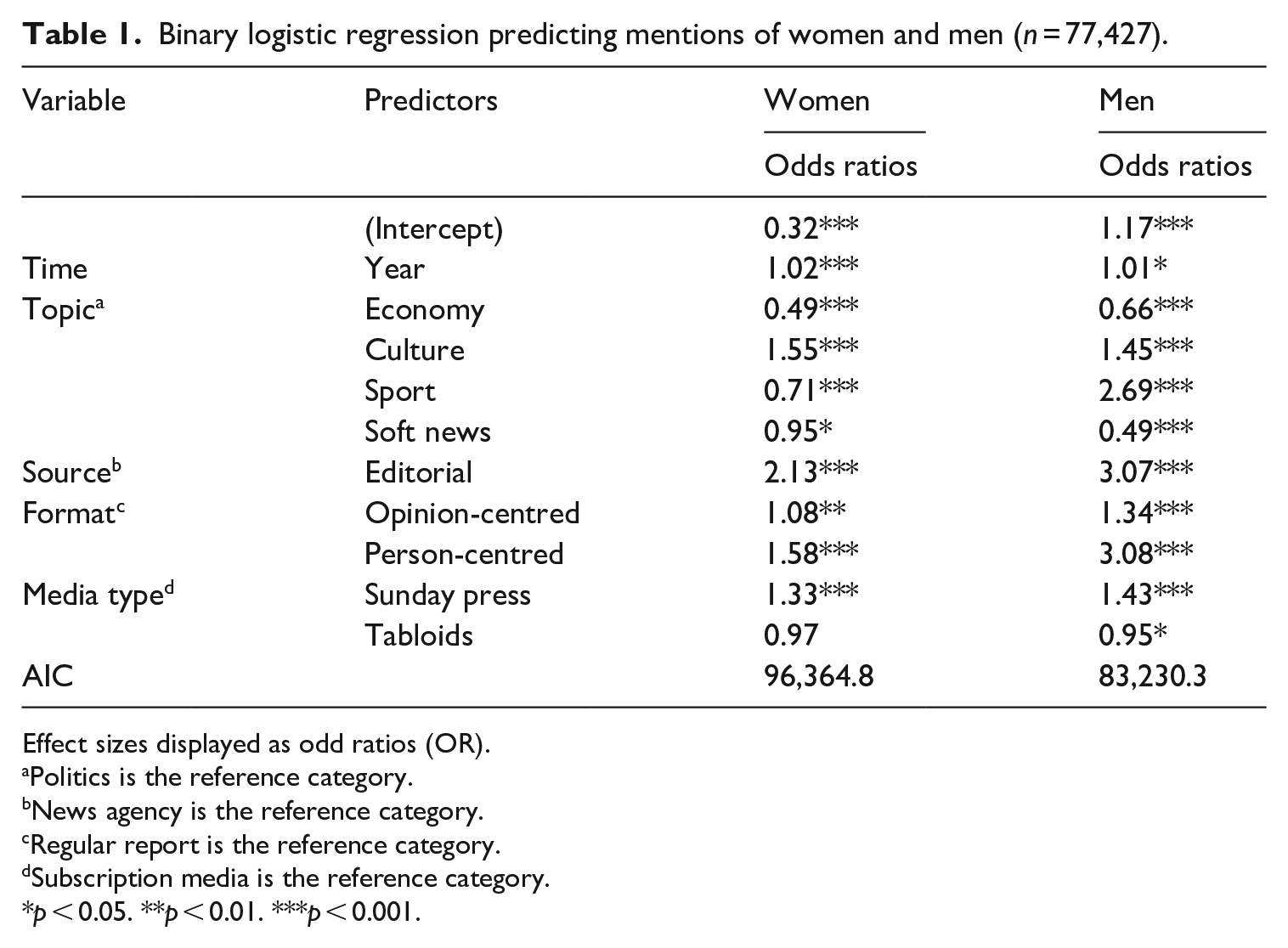
Effect sizes displayed as odd ratios (OR).
Politics is the reference category.
News agency is the reference category.
Regular report is the reference category.
Subscription media is the reference category.
p < 0.05. **p < 0.01. ***p < 0.001.
Shares of articles with mentions of women/men and women to men ratio (n = 77,427).
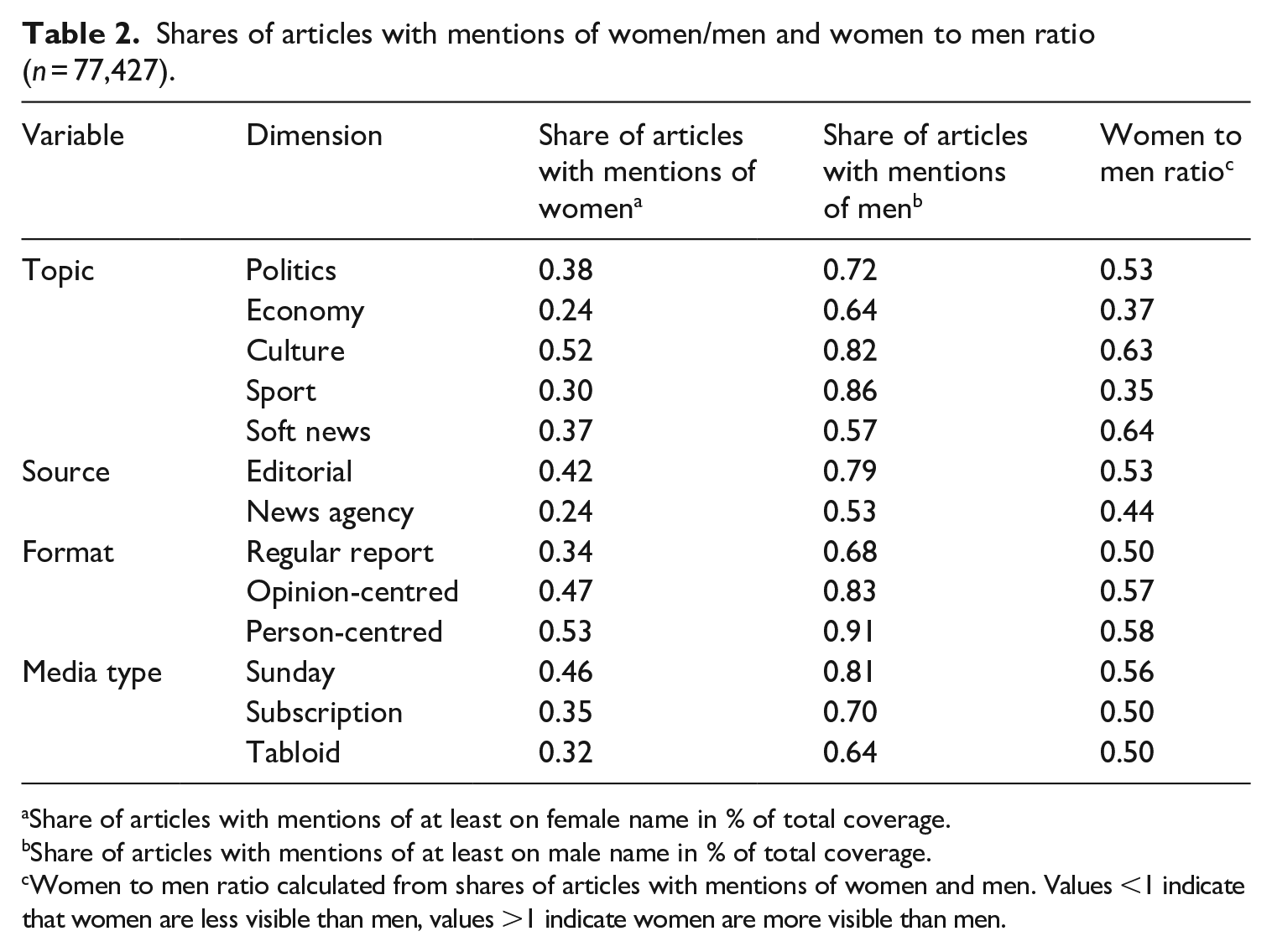
Share of articles with mentions of at least on female name in % of total coverage.
Share of articles with mentions of at least on male name in % of total coverage.
Women to men ratio calculated from shares of articles with mentions of women and men. Values <1 indicate that women are less visible than men, values >1 indicate women are more visible than men.
In addition to the mere quantity of representation, our study also looked at the effects of four features of journalistic content on the representation of women and men: the main topic in the news articles, the source of coverage, the format used for presentation and the media type. We again used the binary logistic regression model to test if our variables had an influence on the representation of women regardless of the representation of men (see Table 1). To assess the extent of the gender imbalance, we used the ratio between articles with unique mentions of women and men (see Table 2).
Topic
The share of articles with mentions of women differed per topic and was higher in coverage of culture (52%) than in coverage of politics (38%), soft news (37%), sports (30%) or the economy (24%). Compared to news on politics, which was the reference category, women, thus, were less likely to be mentioned in news on economics (OR = 0.49; p < 0.001) and sports (OR = 0.71; p < 0.001) but more likely to be mentioned in news on culture (OR = 1.55; p < 0.001). Only marginal differences were observed in comparison to soft news (OR = 0.95; p = 0.022). These results mostly support Hypothesis 2.1. We also saw clear differences in gender representation per topic. The ratio between unique mentions of women and men was higher in the coverage of culture (0.63) and soft news (0.64) than in news on politics (0.53), the economy (0.37) and sports (0.35), which corresponds with Hypothesis 2.2.
Source, format and media type
The share of articles with unique mentions of women is higher in editorial coverage (42%) than in agency-based coverage (24%). Thus, when we looked at the source of coverage, the model indicated that women are more likely to be mentioned in editorial coverage than in agency-based coverage (OR = 2.13; p < 0.001). Hypothesis 3.1, thus, was confirmed. Gender representation also differs per source. The ratio of women to men was higher in editorial coverage (0.53) than agency-based coverage (0.44), which corresponded to the assumption of Hypothesis 3.2.
The format influences the representation of women as well. The share of articles with unique mentions is higher in person-centred (53%) and opinion-centred formats (47%) than in regular reports (34%). Compared to regular reports, women are thus more likely to be represented in opinion-centred (OR = 1.08; p < 0.003) and person-centred articles (OR = 1.58; p < 0.001). This confirms our hypothesis 4.1. Gender representation also differs per format. As assumed in our hypothesis 4.2, the ratio between men and women is higher in opinion-centred (0.57) and person-centred formats (0.58) than in regular reports (0.50).
The media type as well influences the representation of women. The share of articles with unique mentions of women is higher in the Sunday press (46%) than in subscription media (35%) or tabloids (32%). Compared to the subscription media, women are thus more likely to appear in the Sunday press (OR = 1.33; p < 0.001) but almost equally likely to be covered in tabloid media (OR = 0.97; p = 0.090). This only partially lends support to our hypothesis 5.1. Gender representation also differs per media type. As assumed in hypothesis 5.2, the ratio of women to men is highest for the Sunday press (0.56). However, contrary to our expectations there was no difference between subscription media (0.50) and tabloids (0.50).
Discussion and conclusion
Our study showed a substantial quantitative gender gap in the coverage provided by the Swiss news media and confirmed previous work on the representation of women in the news media (Shor et al., 2015; Sjøvaag and Pedersen, 2019). The news media coverage still mirrored inequalities in societal structures, with women being massively underrepresented in all the areas examined. Our study also confirmed the expected patterns of a smaller gender gap in reporting on culture or soft news and a very pronounced gap in news on sport, the economy and politics, which correspond to existing research (e.g. North, 2014; Sjøvaag and Pedersen, 2019). However, we also showed that the representation of women has improved to a slightly higher extent than the representation of men. Thus, the quantitative gender imbalance in the Swiss news media has been reduced since 2011.
We used Giddens’ (1984) structuration theory as a lens for our analysis and modelled gender imbalances in the news media as an outcome of structure-agency relations. First, we accounted for structural factors on the societal level and assumed that recent improvements in the status of women in society influenced their representation in the news. Many initiatives and projects for equal representation of women in the news industry were introduced in the last few years in Switzerland. These examples can be seen as initial efforts by media companies to transform social structures through reflexive action. In general, voices regarding equal rights for women and men became louder at the societal level, for example, via protests such as the Swiss women’s strike. It can be assumed that these societal changes have led to an increase in reporting on women – as shown empirically in this study. Future studies could further investigate this assumption by combining data on media content with data on the structural representation of women in society.
Second, we analyzed the influence of situational, resource-related factors on the content level of gender imbalances. When journalists relied on news agency content, women were less represented and the gender gap was more pronounced. News agencies were thus structure-preserving agents, which echoes scholarship that articulated concerns about the negative effects of news agencies on the diversity of voices in the news (Boumans et al., 2018). The use of resource-intensive contextualizing formats delivered similar results. In opinion-centred and person-centred formats women were more likely to be featured and the gender gap less pronounced than in regular reports. On the one hand, this may be the result of increased awareness for gender equality among journalists, which would lead to a more careful selection of sources or individuals to be covered. On the other hand, the result might also reflect the increased influence of women in many parts of society. As person-centred formats like interviews and opinion pieces often focus on elites or influential individuals, these results might also be driven by the increased share of women in politics in Switzerland (Swiss Elite Observatory, 2021).
Our study suggests that journalistic resources can be important for closing gender imbalances in the news. However, in their everyday work, journalists will most likely not regularly reflect on the influence of resources. An individual journalist’s decision on which expert to quote, which topic to cover, and which actors to prioritize is probably driven by factors such as time pressure, the availability of sources, editorial strategies and organizational routines (e.g. Shor et al., 2015). Resources are a possible constraint for exactly these factors. This means that a financially well-equipped editorial office can allow journalists to circumvent these constraints.
Our analysis once more showed that media types were important structural antecedents of news content (Strömbäck and van Aelst, 2010). Regarding media type, we found that in the Sunday press, the representation of women is higher than in subscription media and tabloids. These findings again suggest that resources matter, as the Sunday press offers higher quality in their reporting, which implies investing resources. No clear differences were found between tabloids and subscription media, indicating that the daily production routine might be an important resource-related constraint for gender representation in media of different types (Sjøvaag and Pedersen, 2019).
From a normative perspective, it is difficult to determine the ‘right’ share of women to men in media coverage. Most studies on news bias regarding gender representation assume that an equal representation of women and men is desirable, as it reflects the gender distribution in society (e.g. D’Heer et al., 2020). However, in her study on media coverage of Danish researchers, Wien (2014) concluded that even though men were covered much more than women, there was no gender gap because the representation reflected the gender distribution of researchers at Danish universities. These two positions show that the news media are confronted with contradictory demands when it comes to the representation of social groups. On the one hand, the media should cover relevant news and events or topics, regardless of which social groups are represented (Ferree et al., 2002). This would suggest that even strong gender imbalances are acceptable if they mirror gender distributions in specific areas of society. On the other hand, the media are also seen as advocates for underrepresented social groups and are expected to question existing power structures and raise awareness of the problems of underrepresented social groups. Thus, the media must make a tradeoff between covering the most important and relevant actors and providing minorities and underrepresented groups access to coverage.
From a theoretical point of view (Giddens, 1984), journalism is not the only area that has a challenge to reduce social (gender) inequalities through its own practices to change social structures. Change must also happen on the societal level. Due to the duality of structure and agency, the news media can help to establish new structures, in terms of breaking the existing routines, when they provide women a reasonable share of voice and cover them more equitably or even with more emphasis. This is possible when journalists have enough time for research, for instance, to deliberately research quotes from women. Also, the gender gap is not the only imbalance to consider in news media coverage. Additional factors like race, sexual orientation and socioeconomic status also often influence how people are covered in the media (Heider, 2008; Moscowitz, 2010).
From a methodological stance, our study again highlights the fruitful combination of manual analysis with automated procedures. As stressed by Sjøvaag and Pedersen (2019), this allowed in-depth analysis of the news article content as well as expanding the scale of the research. In addition, content-related information allowed us to account for situational differences in the news production process. This was an added value in comparison to studies that have used single data points (e.g. the financial resources of a media company or attitudes of journalists) as proxies. Further research could ideally also combine both factors, for instance, content-related data and survey responses. Such research would allow us to understand which factors on the actor’s level influence gender imbalances in news coverage. Studies could analyze the effect of resource-related factors, such as time pressure, the availability of experts or personal networks, in combination with attitudinal factors, such as the prioritization of gender-related questions or political stance, on the representation of women in the news.
A further limitation follows our choice to use a binary variable as the main measure, which has advantages and disadvantages. The binary variable naturally controls for different lengths of news articles in which more names may occur. It thus enables us to better compare different formats and media types. A short piece in a tabloid with only one mention of a name is incorporated in the analysis the same way as a long piece with many mentions of names. The binary measure is, therefore, not sensitive to distortion by certain types of coverage, like sports reporting with very frequent name usage. In turn, the binary variable is not able to discern further disbalances in longer pieces. It is also conservative in the sense that it underestimates imbalances. The longer the news piece, the more likely several sources occur and the more likely we would find one representative of both genders in the article. However, as we use a large and diverse set of articles, we evaluate the binary measure as the best choice.
The focus on quantitative representation and general content-related information was a further limitation of our study. We showed how often and in which contexts women were represented in the news media but did not analyze how women were represented in news coverage and how these representations differed from men. Typical questions concerning the representation of gender in the news media, for example, whether women are quoted as sources or experts rather than as objects of coverage (e.g. Mitchelstein et al., 2019; Niemi and Pitkänen, 2017), or whether women are framed with different attributes (Bligh et al., 2012), would require additional manual analysis. Such qualitative features of news coverage are important aspects of gender imbalances, especially when considering the role of the news media in (re)producing existing images and stereotypes of women (e.g. Cheryan et al., 2013; Goodall, 2016).
Gender equality has certainly become a more pressing issue in newsrooms and media organizations. From a practical point of view, the focus on resources implies measures at the individual and organizational level to ensure gender equality in the news. On the individual level, this means ensuring time and financial resources to do more in-depth research, to overcome established working practices and to question organizational routines. It could also include raising awareness of the issue of gender equality in the journalistic profession, for instance, in journalism training. However, outsourcing the issue of gender representation to individual journalists only is not sufficient. The organizational level is likewise important, as the allocation of resources and editorial strategies in media organizations set guidelines for the work of journalists. In Switzerland, the first steps to ensure the equal representation of women and men in media coverage were taken by media companies. For instance, the private media company Ringier, which is the leading company in the Swiss tabloid market, and the public service broadcaster SRG SSR use the representation of women as a (soft) performance indicator for their news content. This is a first step towards establishing the equal representation of women as an indicator of media quality.
Given the importance of resources for gender representation, the economic crisis of news journalism threatens to counteract the slight positive development in the representation of women. We conclude that the observed gender inequalities in news media coverage are not very likely to close rapidly soon or will possibly even remain. Combining measures at the individual and organizational level is thus indispensable to further reduce gender imbalances in times of scarce resources.
Supplemental Material
sj-xlsx-1-jou-10.1177_14648849211036309 – Supplemental material for Situational effects of journalistic resources on gender imbalances in the coverage of Swiss news media: A longitudinal analysis from 2011 to 2019
Supplemental material, sj-xlsx-1-jou-10.1177_14648849211036309 for Situational effects of journalistic resources on gender imbalances in the coverage of Swiss news media: A longitudinal analysis from 2011 to 2019 by Daniel Vogler and Lisa Schwaiger in Journalism
Footnotes
Funding
The author(s) disclosed receipt of the following financial support for the research, authorship, and/or publication of this article: The project was supported by the Kurt Imhof Stiftung für Medienqualität, Zürich, Switzerland.

Supplemental material
Supplemental material for this article is available online.
Author biographies
References
Supplementary Material
Please find the following supplemental material available below.
For Open Access articles published under a Creative Commons License, all supplemental material carries the same license as the article it is associated with.
For non-Open Access articles published, all supplemental material carries a non-exclusive license, and permission requests for re-use of supplemental material or any part of supplemental material shall be sent directly to the copyright owner as specified in the copyright notice associated with the article.
