



Abstract
Journalistic autonomy is a prerequisite for the public function of journalism. Although most journalists in Western democracies indicate particularly low political or economic influences on their work, there is evidence that recipients assume that journalism is driven primarily by political and economic interests. These perceptual discrepancies can be problematic as perceived influences on journalistic work are known to reduce recipients’ media trust. Hence, this study addresses the extent to which recipients perceive influences on journalistic work, how their perceptions differ from that of journalists, and which variables explain recipients’ perceptions. A representative online survey of German recipients (n = 1000) and the representative sample of German journalists of the Worlds of Journalism Study (n = 775) demonstrate that recipients perceive stronger influences on journalistic work than journalists do, especially in regard to politics and economics. Furthermore, recipients who display higher levels of anti-elitism, selective exposure and media literacy assume stronger influences on journalistic work.
Journalistic autonomy is considered the core element of its professionalization (Donsbach and Patterson, 2004). It is the result of institutionalized self-regulation mechanisms (e.g. journalists’ associations) and financial independence from the state (van Dalen et al., 2011). Hence, journalistic autonomy as a ‘wide latitude of judgement in carrying out occupational duties’ (McDevitt, 2003: 156) is understood as a prerequisite for journalism to fulfil its public duty of providing independent information and controlling elitism (McQuail, 2013). In this regard, journalists in most Western democracies are privileged: They operate under conditions that enable them to perform a controlling function and are legally protected in conducting their work. Thus, they possess an overall high degree of professional independence. Nevertheless, journalists do not work in a vacuum: As they operate within media organizations and newsrooms, they may face insufficient financial resources or influences from higher-level editors, and both can be perceived as restrictive (Hanitzsch et al., 2010).
Although journalists indicate that, in Germany for example, influences from political and economic spheres have the lowest impact on their work compared to those emerging from newsrooms or professional norms (Hanitzsch et al., 2019), recipients assume the opposite, perceiving journalism as driven primarily by political and economic restrictions (Bayerischer Rundfunk 2016; Prochazka and Schweiger, 2016). Such perceptual discrepancies can be highly problematic for journalism as a public good. Because journalistic independence is considered a factor for acceptable media performance, major influences perceived by recipients could ultimately diminish trust in news media through decreased satisfaction with its performance (Donsbach et al., 2009; Ladd, 2012). However, as long as such discrepancies go unrecognized, journalists can neither clarify the allegations nor adapt to expectations to increase satisfaction.
Despite these implications for democracy, a systematic comparison of recipients’ and journalists’ perceived influences is, thus far, missing (also see Abdenour et al., 2021). The same holds true for individual characteristics that may explain the recipients’ perceptions. Thus, this study extends the existing literature in two ways: First, we address the extent to which recipients perceive influences on journalistic work compared to journalists to determine how their perceptions differ. Second, we investigate which political and media-related characteristics explain the recipients’ perceptions. To do so, we focus on Germany as a long-established democracy with comparatively minor perceived political and economic influences on journalistic work by journalists themselves (Hanitzsch and Mellado, 2011). Thus, the seemingly significant discrepancies in the perceptions of recipients and those of journalists make Germany an interesting case.
Comparing perceived influences on journalistic work
Which factors, if any, shape journalistic autonomy and what journalists, in turn, perceive as influences on their work have been a focus of research for decades. Most prominently, the Hierarchy of Influences Model (Shoemaker and Reese, 2014) considers objective influences on journalistic work. The model differentiates five nested levels of influences. The inner circle refers to individual characteristics of journalists; this is followed by the level of work routines, and then the organizational level (e.g. media management). Political and economic influences mark the extra-media level, while the outer level refers to the system (e.g. legal frameworks). These objective influences are necessary for understanding and evaluating journalistic work in a respective country. However, studies have demonstrated that they do not accurately reflect the perceptions of journalists (Hanitzsch and Mellado, 2011) and that it is, consequently, rather the journalists’ perceptions of such influences that guide their actions (Reich and Hanitzsch, 2013). In detail, Hanitzsch et al. (2010) found that journalists perceive political, economic, organizational, procedural and professional influences as well as influences from reference groups as relevant to their work, although to varying degrees (Hanitzsch et al., 2019). Yet there is evidence that recipients view them very differently what is shaping their evaluation of journalistic quality or even media trust (Fawzi and Mothes, 2020; Prochazka and Schweiger, 2016). Recipients have naïve ideas about ‘what journalism is, what it does and what it ought to do’ (Nielsen, 2016: 846) and, therefore, evaluate journalistic work based on, for instance, normative quality criteria (Hasebrink, 2011). This corresponds to a variety of findings on how recipients assess journalistic quality and what characteristics shape their perceptions (Urban and Schweiger, 2014). However, how recipients in particular view influences on journalistic work has not yet received much attention (see, however, Prochazka and Schweiger, 2016). Accordingly, few findings on consumers’ viewpoints of perceived influences on journalistic work can be compared with the comprehensive evidence regarding journalists’ perspectives.
From the viewpoint of journalists, political and economic influences include the impact of political actors as well as advertising clients and profit orientations of media organizations (Hanitzsch et al., 2010). Regarding political influences, German journalists are much less likely to see their work influenced by politicians than they are to report shaping policy themselves. Stronger political influences are indicated only to a limited extent, for example, when media competition is high (Baugut et al., 2017). In an international comparison, journalists attributed a clear influence on their work to political factors (Hanitzsch et al., 2019), whereas journalists in German-speaking countries reported experiencing relatively few political constraints (Lauerer and Keel, 2019). Moreover, German journalists reported moderate but, in recent years, increasing economic influences, with the highest restrictions, relatively speaking, experienced in magazines, private television and online media. In addition, audience research represents the strongest type of economic influence in Germany, followed by profit expectations and advertising considerations (Lauerer and Keel, 2019). Still, compared to other countries, perceived economic influences on journalistic work are rather low in Germany (Hanitzsch et al., 2019).
By contrast, recipients understand journalism as being driven by political and economic influences. A representative survey on behalf of a German public service broadcaster revealed that only 40 percent assume that news media are independent of politics or the economy (Bayerischer Rundfunk, 2016). Moreover, regarding economic influences, two-thirds of Germans were found to suspect that benevolent reporting and the acquisition of PR materials is exchanged for advertising purchases (Donsbach et al., 2009). Thus, the perceptions of the recipients of journalism should deviate strongly from those of German journalists.
From journalists’ perspectives, organizational influences include those of their higher editors and media owners (Hanitzsch et al., 2010). For instance, around 40 percent of German journalists view their supervisors as most influential in this category. Yet, in an international comparison, organizational influences in Germany were seen as moderate (Lauerer and Keel, 2019). The same holds true for procedural influences, such as a lack of time for research, professional influences, journalism ethics and influences of reference groups (Hanitzsch et al., 2019). Regarding recipients’ perspectives, however, systematic findings on these types of influences on journalistic work are rare.
Thus, the existing literature indicates that recipients suspect that political and economic influences affect journalistic work, with only marginal research on other influences. In terms of their extent, however, these influences as perceived by recipients seem to deviate from journalists’ viewpoints. Hence, we ask:
RQ1a: To what extent do recipients and journalists perceive influences on journalistic work?
RQ1b: To what extent do recipients’ perceptions differ from those of journalists?
Characteristics explaining perceived influences on journalistic work
As previously stated, recipients’ perceptions of influences on journalistic work appear to differ from the views of journalists, which could be related to lower satisfaction with media performance and less media trust (Donsbach et al., 2009). Therefore, we examine how recipients arrive at their perceptions of factors that shape journalistic work. To investigate this, we refer to literature on media performance evaluations. Accordingly, we view the perception of influences on journalistic work as component of such evaluations (Prochazka and Schweiger, 2016). Thus, recipients’ perceptions of influences on journalistic work can be explained by characteristics known to shape the media performance evaluation. One reason may be that media performance ratings can be formed by experiences with journalistic work in the course of direct (e.g. media use) and indirect (e.g. exposure to media criticism) media use (Fawzi, 2020; Prochazka and Schweiger, 2016).
Another reason may be that individual political and economic characteristics can explain media performance evaluation. According to culturalist theories, which have proven useful in this regard (Hanitzsch et al., 2018), political orientations, namely political attitudes and value orientations, developed through socialization shape performance ratings of institutions as they determine the standards of evaluation (van der Meer, 2017). Because we see journalism as a social institution, we assume that political and economic characteristics explain media performance ratings and, thus, perceived influences. Additionally, institutional theories argue that past experiences with institutional performance shape current evaluations (Mishler and Rose, 2001). Based on this, following Tsfati and Ariely (2014), we assume that recipients comprehend that democracy depends, to some extent, on journalism adequately fulfilling its public duty. Thus, it is plausible that recipients blame news media for their lack of satisfaction with political performance as they might have inadequately fulfilled their control function.
Hence, we suggest that individual political and economic as well as media-related characteristics can predict influences on journalistic work as perceived by recipients. By drawing on both strands of research, we now elaborate what these influences might look like.
Political and economic characteristics
Initially, we focus on political orientations and experiences with political performance. First, drawing from research on political performance (Rohrschneider, 1999), the more congruency recipients see between their political attitudes and values, and those seemingly represented by journalism, the more likely they are to be satisfied with media performance, including lower presumptions of influences. Correspondingly, political extremity is shown to be associated with lower performance ratings and higher perceived influences on journalistic work (Fawzi, 2019). Moreover, individuals with populist anti-elitist values, accounting for one-fifth of the German population (Vehrkamp and Merkel, 2020), might see their values in conflict with those of journalism and politics (Hanitzsch et al., 2018). To be precise, recipients holding these orientations tend to assume that journalism and politics are united social elites and, thereby, they are critical or even dismissive of their achievements (Fawzi, 2019). As such, they might be especially prone to assuming that political and economic elites have strong influences on journalistic work.
Secondly, we follow the assumption rooted in institutional theories that recipients suspect that journalism plays a role in political performance (Tsfati and Ariely, 2014). Hence, lower levels of satisfaction with political performance and political trust, reflecting ‘performing in accordance with the normative expectations held by the public’ (Miller and Listhaug, 1990: 358), might be associated with seeing political and economic influences on journalistic work (Ariely, 2015). Moreover, dissatisfaction with political performance is often linked to citizens’ perceiving their economic situations as deficient and holding societal institutions responsible for this (Mishler and Rose, 2001). Specifically, this so-called relative deprivation describes a state of actual or perceived lack of some desirable tangible good to which one feels entitled, compared to others (e.g. economic resources, political participation) (Rippl and Baier, 2005). Building on this, recipients experiencing relative deprivation with regard to political or economic resources may blame journalism for inadequately controlling political decision-making, which they attribute to political restrictions (Tsfati and Ariely, 2014).
Yet, there are few joint findings in regard to what respect political and economic characteristics predict perceived influences on journalistic work by recipients and explain potential perceptual differences compared to journalists. Thus, we ask:
RQ2a: To what extent do individual political and economic characteristics explain recipients’ perceived influences on journalistic work?
RQ2b: To what extent do individual political and economic characteristics explain differences between recipients’ and journalists’ perceptions?
Media-related characteristics
Media-related characteristics might be particularly significant for recipients when evaluating influences on journalistic work. Regarding direct experiences with media performance (Prochazka and Schweiger, 2016), a frequent use of (quality) news media positively predicts satisfaction with media performance and trust, whereas using tabloid or non-mainstream media (e.g. user-generated content or alternative media) reduces satisfaction (Fawzi and Mothes, 2020; Hopmann et al., 2015; Johnson and Kaye, 2015). Thus, one could assume that recipients who frequently use (quality) mainstream media perceive journalistic work to be more independent, while using tabloid media may be associated with more perceived political influences on (quality) journalism (Fawzi, 2019). Relatedly, using non-mainstream media might be accompanied by the assumption that journalists working for mainstream media are subject, to a greater extent, to influences of social elites (Tsfati and Cappella, 2003).
Moreover, studies have indicated that recipients who hold strong political opinions deem journalistic content that is consistent with their opinions to have higher journalistic quality than content that contradicts their views (Fischer et al., 2008). Furthermore, they tend to see balanced reporting as biased against their views (‘hostile media perception’). Therefore, recipients’ selective exposure to mainly opinion-consistent content might enhance their perception that balanced reporting is more strongly biased against their views and, thereby, more prone to influence (McLeod et al., 2017).
Regarding indirect experiences with media performance, studies on media literacy have demonstrated that knowledge about journalistic norms improves media performance ratings and reduces hostile media perceptions (Vraga et al., 2012). Yet knowledge about media ownership can reduce news credibility, favouring a more critical stance on media performance (Ashley et al., 2010). Furthermore, exposure to media criticism in user comments decreases perceived journalistic quality (Dohle, 2018; Kümpel and Unkel, 2020) and may, therefore, enhance perceived influences. Correspondingly, as recipients can criticize news media with the aim of ‘correcting’ perceived grievances (Rojas, 2010), engagement in media criticism might be positively associated with perceived influences on journalistic work.
Because of the dearth of findings about how media-related characteristics explain perceived influences on journalistic work by recipients and perceptual differences compared to journalists, we ask:
RQ3a: To what extent do direct and indirect media-related characteristics explain recipients’ perceived influences on journalistic work?
RQ3b: To what extent do direct and indirect media-related characteristics explain differences between recipients’ and journalists’ perceptions?
Method
Samples
We conducted an online survey that aimed to represent the German population over 18 years of age. Data collection was conducted by the survey institute Dynata in 2019 (response rate: 49%). Respondents were financially compensated by the survey institute for their participation. After omitting participants who completed the questionnaire faster than one-third of the median completion time (n = 101), the final quota sample comprised n = 1000 (49% female, average age 50 years, SD = 15.23, 38% higher education).
In addition, we used the representative sample of German journalists gathered during the second wave of the Worlds of Journalism Study (WJS, 2019). Data collection took place between 2014 and 2015 via online and telephone interviews (combined response rate: 34.8%; Lauerer and Hanitzsch, 2019; Steindl et al., 2017). The sample comprised n = 775 journalists (40% female, average age 46 years, SD = 10.50, 98% higher education).
Measures
We measured the perceived influences on journalistic work by asking the recipients: ‘How much do the following persons or institutions influence the work of journalists?’ Similarly, journalists were asked: ‘Please tell me how much influence each of the following has on your work’. Using 5-point scales ranging from 1 = not influential to 5 = extremely influential (WJS, 2019), recipients and journalists 1 rated the following influences: ‘censorship’; ‘politicians’; and ‘business people’ (political influences); ‘interests of advertisers or the advertising department’; ‘profit expectations’; and ‘audience research’ (economic influences); ‘colleagues and supervisors of journalists’; ‘owners or managers of news organizations’; and ‘financial pressure and time pressure’ (organizational and procedural influences); ‘guidelines for good journalistic work or journalism ethics’; ‘media laws and regulation’; ‘personal values and beliefs of journalists’; ‘competing news organizations’; and ‘feedback from the audience’ (professional influences and reference groups) (Hanitzsch et al., 2019).
A political extremity measure was created from an 11-point left-to-right scale by totalling the scale points with the smallest up to the largest distance to the midpoint (1 = low extremity to 5 = high extremity; M = 1.78, SD = 1.20) (Hanitzsch et al., 2018).
We inquired about populist anti-elitism (5-point scales, 1 = does not apply to 5 = fully applies) by ‘members of parliament very quickly lose contact with the people’; ‘politicians are corrupt’; ‘politicians make decisions that harm ordinary people’; ‘politicians care what people like me think’; ‘there is a great gap between the people and the politicians’; ‘people like me have no influence over what the government does’; ‘the differences between the people and the so-called elite are much greater than differences among the people’; and ‘politicians talk too much and act too little’ (α = 0.80, M = 3.84, SD = 0.85) (Fawzi, 2019; Schulz et al., 2017).
To measure political performance evaluations (5-point scales, 1 = not satisfied at all to 5 = fully satisfied), recipients reported their satisfaction with ‘the achievements of politics’; ‘the current economic situation’; and ‘how democracy works’ (α = 0.85, M = 2.67, SD = 1.05) (Fawzi, 2019).
Subjective relative deprivation (5-point scales, 1 = does not apply to 5 = fully applies) was indicated by the statements ‘only the others can benefit from the advantages offered by this society’; ‘I never get what I deserve’; ‘the government does not do enough for people like me – others are always favoured’; ‘however you twist and turn it, we are among those people who never get a break’; ‘the streets in my neighbourhood are in less good condition than in many other quarters’; ‘people like us have to wait longer if we want something from the state than many others’; and ‘I am worried about the future prosperity in Germany’ (α = 0.90, M = 3.04, SD = 0.99) (Rippl and Baier, 2005).
Additionally, we inquired about political trust in ‘federal government’; ‘parliament’; and ‘political parties’ (5-point scale, 1 = no trust to 5 = very high trust; α = 0.93, M = 2.47, SD = 1.08) (Hanitzsch et al., 2018).
We included quality media use (5-point scales, 1 = never to 5 = daily) with the following categories: ‘public service broadcasting’; ‘national newspapers or news magazines’; ‘local newspapers’; and their ‘online offers’ (α = 0.73, M = 3.20, SD = 1.06). For tabloid media use, we asked about ‘private broadcasting’; ‘tabloids’; and their ‘online offers’ (α = 0.66, M = 2.45, SD = 1.02). For non-mainstream media use, we included ‘comments from other Internet users in social networks or forums’; ‘sites or channels of social media actors’; ‘sites or channels of politicians, political movements, activists, parties’; ‘media offerings that describe themselves as alternatives to traditional media’ (α = 0.86, M = 3.20, SD = 1.06).
Selective exposure was explored using the following statements (5-point scales, 1 = does not apply at all to 5 = fully applies): ‘I avoid media offerings that express views other than my own’; ‘I mainly use media and news that match my own attitude’; ‘I mainly use contributions or user comments on the Internet that are in line with my own attitude’; ‘I do not find any use in reading opinion papers that represent views other than my own’; and ‘If I have to choose between two opinions, I choose the one that is closer to my opinion’ (α = 0.82, M = 2.76, SD = 0.89) (Tsfati, 2016).
Media literacy (5-point scales, 1 = does not apply at all to 5 = fully applies) was rated by the following statements: ‘I am well-informed about the tasks that journalism in democracies should fulfil’; ‘I am well-informed about how journalists work’; and ‘I find it easy to distinguish between advertising and editorial content’ (α = 0.73, M = 3.30, SD = 0.86). Exposure to media criticism (5-point scales, 1 = does not apply at all to 5 = fully applies; M = 2.93, SD = 1.23) and criticizing news media (M = 2.44, SD = 1.27) were measured by ‘I often read media-critical articles or user comments’ and ‘I often criticize the media in personal conversations, user comments, or letters to the editor’ (Eveland and Shah, 2003).
We controlled for sociodemographic variables and generalized social trust in ‘most people’ (5-point scale, 1 = no trust to 5 = very high trust; M = 3.03, SD = 1.01).
Results
Perceived influences on journalistic work
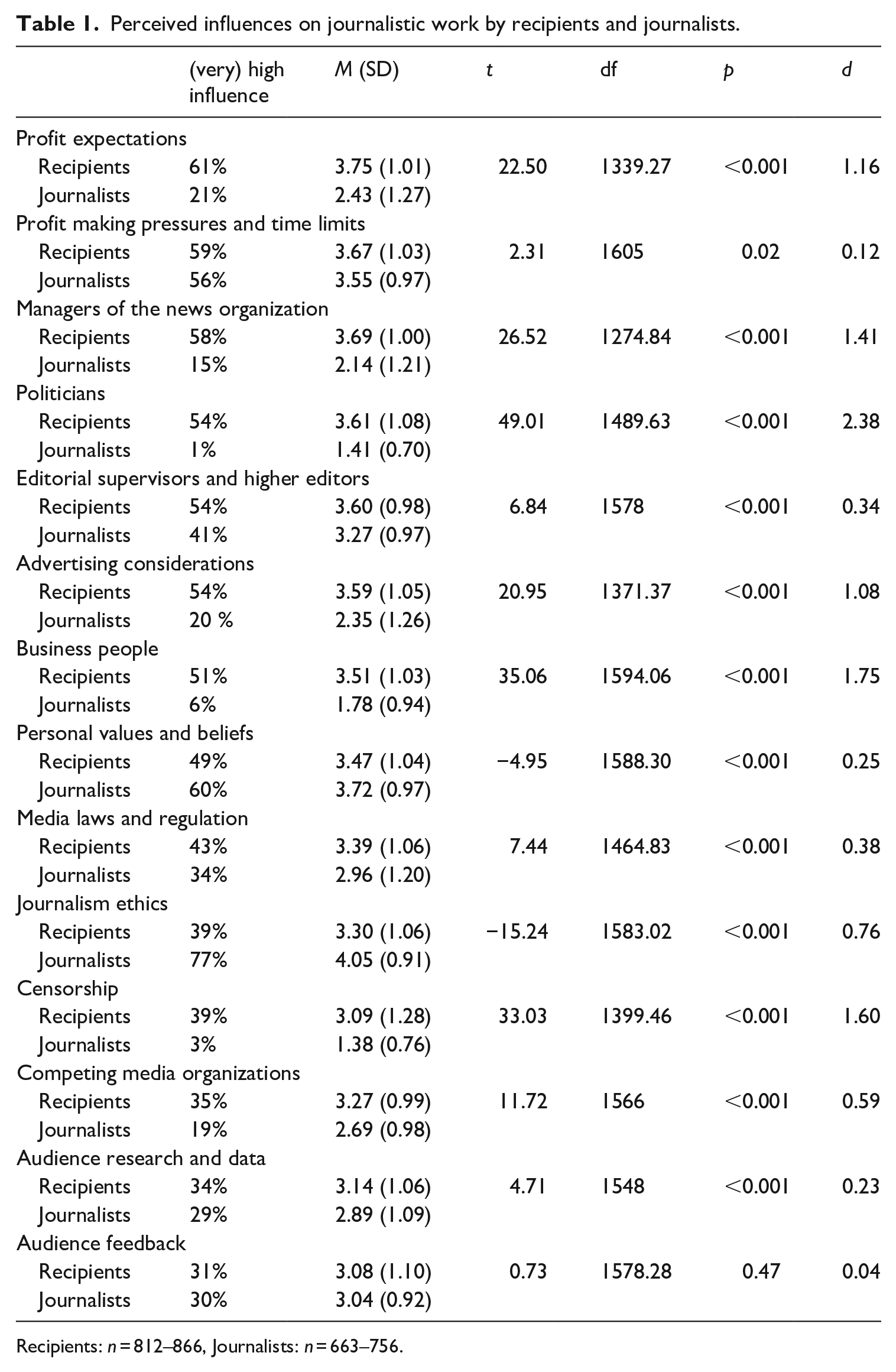
Regarding RQ1a, more than 50 percent of German recipients perceived (very) high political and economic, procedural and organizational influences on journalistic work (Table 1). Profit expectations, limited resources and managers of news organizations represented the top three influences, followed by influences emanating from politicians, higher-level editors, advertisers and business people. Yet about 40 percent still deemed professional influences, as well as censorship, to strongly shape journalistic work. The bottom three influences proceeded from reference groups and audience research.
Perceived influences on journalistic work by recipients and journalists.
Recipients: n = 812–866, Journalists: n = 663–756.
In comparison, over 50 percent of German journalists perceived that the highest impacts were from professional (e.g. journalism ethics) and procedural (e.g. limited resources) influences. Around one-third of the journalists detected (very) strong organizational influences (e.g. higher editors) as well as influences from the audience or audience research. About one-fifth perceived economic influences, influences from competing news media, and media managers. The bottom three influences were mostly political, each with far <10 percent approval.
When comparing recipients’ perceptions with those of German journalists (RQ1b), it was first evident that presumptions of (very) strong influences on journalistic work were more widespread among recipients. Secondly, recipients and journalists saw journalistic work as being influenced by diametrically different factors: While journalists emphasized professional and organizational influences, recipients perceived economic, political and organizational influences (Prochazka and Schweiger, 2016).
Characteristics explaining recipients’ perceived influences on journalistic work
To explain what political and economic as well as media-related characteristics shape recipients’ perceived influences on journalistic work (RQ2a, RQ3a), we conducted linear OLS regression analyses utilizing recipients’ perceived influences as dependent variables (Table 3). Beforehand, we conducted an explanatory factor analysis (EFA) to identify an underlying structure in recipients’ perceptions (Reich and Hanitzsch, 2013) and to reproduce the intercorrelations of said indicators with a smaller number of latent dimensions (Tabachnick and Fidell, 2013). This data-driven approach allowed us to determine the suitable number of common factors and to investigate the relationships between the indicators and various latent dimensions. Using oblique rotation based on the notion that the latent factors representing the perceived influences on journalistic work are likely to be interrelated (Brown, 2015), a two-factor solution demonstrated the best fit. Indicators with factor loadings equal or >0.45 were included (Comrey and Lee, 1992; Tabachnick and Fidell, 2013). Hence, we differentiated elite-related (α = 0.91, M = 3.53, SD = 0.80) and performance-related influences (α = 0.77, M = 3.25, SD = 0.83) (Table 2).
Exploratory factor analysis of recipients’ perceived influences on journalistic work.
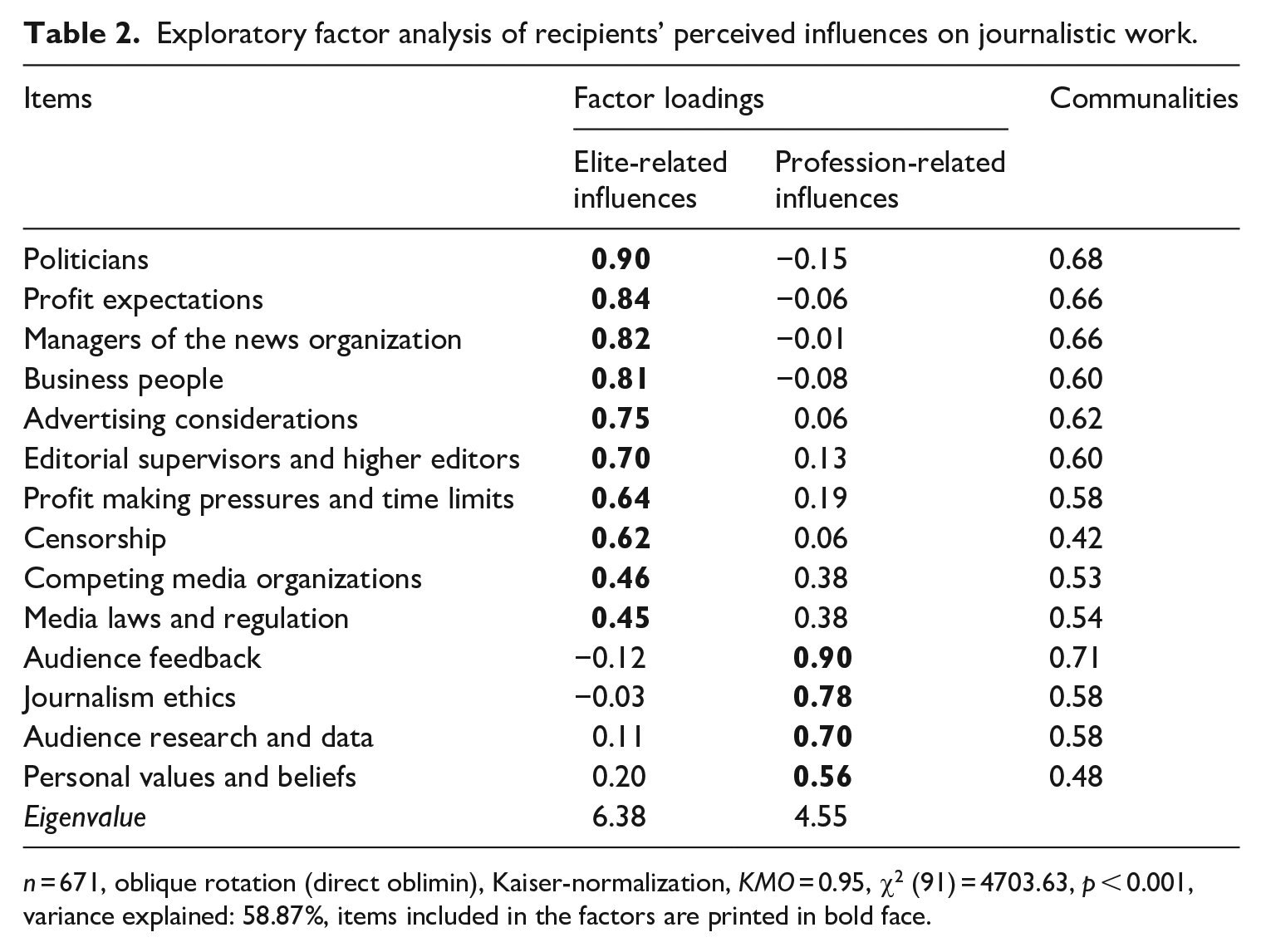
n = 671, oblique rotation (direct oblimin), Kaiser-normalization, KMO = 0.95, χ2 (91) = 4703.63, p < 0.001, variance explained: 58.87%, items included in the factors are printed in bold face.
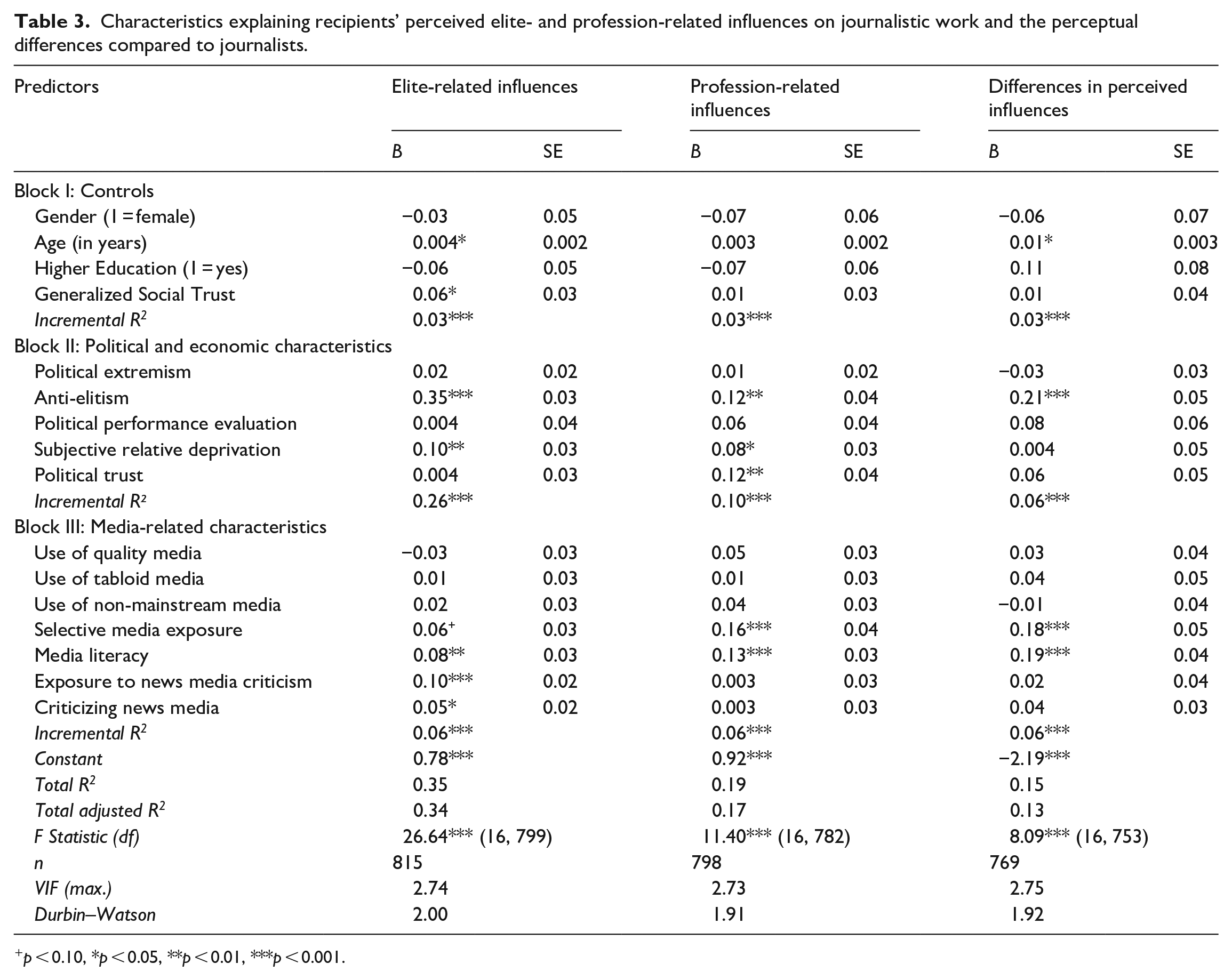
The approval of populist anti-elitist values (B = 0.35, SE = 0.03, p < 0.001) and a subjective relative deprivation (B = 0.10, SE = 0.03, p = 0.001) positively predicted the perception that journalistic work is strongly shaped by political and economic elites. Media literacy also enhanced the perception of elite-related influences on journalistic work (B = 0.08, SE = 0.03, p = 0.01). The same was true for exposure to media criticism (B = 0.10, SE = 0.02, p < 0.001) and engaging in media criticism (B = 0.05, SE = 0.02, p = 0.02). In addition, older recipients (B = 0.004, SE = 0.002, p = 0.02) and those with higher generalized social trust perceived elite-related influences to a greater extent (B = 0.06, SE = 0.03, p = 0.01).
Regarding performance-related influences, subjective relative deprivation (B = 0.08, SE = 0.03, p = 0.02), anti-elitist values (B = 0.12, SE = 0.04, p = 0.002) and political trust were positively associated (B = 0.12, SE = 0.04, p = 0.002). Furthermore, recipients with higher media literacy presumed performance-related influences more strongly (B = 0.13, SE = 0.03, p < 0.001) as well as those scoring high on selective media exposure (B = 0.16, SE = 0.04, p < 0.001).
Overall, individual political and economic characteristics shaped recipients’ perceptions to a higher extent (RQ2a) than media-related characteristics (RQ3a). Moreover, the characteristics considered explained over 30 percent of the variance in perceived elite-related influences but only 17 percent of the variance in the performance-related influence perception.
Characteristics explaining perceptual differences
Lastly, we examined factors explaining the perceptual differences in influences on journalistic work between recipients and journalists (RQ2b, RQ3b). For that purpose, we conducted another linear OLS regression analysis using the same independent variables (Table 3). To account for perceptual differences, we calculated a balance index. First, we subtracted the mean values as displayed in Table 1 for each influence variable perceived by journalists from the respective perception of each individual recipient. The fact that recipients perceived stronger influences than journalists with regard to almost all sources and almost always showed higher mean values also affirmed this direction in the formation of the balances. Thus, the values of these balances were ranging from −5 to 5 with values below (or above) zero, suggesting that recipients suspected lower (or higher) influences than journalists and values equalling zero suggesting equally perceived influences. Second, we calculated a mean value index of these balances ranging from −5 to 5 as well, which indicated the degree of deviation between the viewpoints of recipients and journalists regarding the influences on journalistic work (M = 0.78, SD = 1.04).
Characteristics explaining recipients’ perceived elite- and profession-related influences on journalistic work and the perceptual differences compared to journalists.
p < 0.10, *p < 0.05, **p < 0.01, ***p < 0.001.
The results suggested that support for anti-elitist values (B = 0.21, SE = 0.05, p < 0.001) and selective media exposure (B = 0.18, SE = 0.05, p < 0.001), but also media literacy (B = 0.19, SE = 0.04, p < 0.001), favoured recipients’ views of stronger influences on journalistic work more than for journalists. Moreover, older recipients presumed stronger influences than journalists did (B = 0.01, SE = 0.003, p = 0.03).
Discussion
In democracies, journalistic autonomy is a prerequisite to journalism’s ability to fulfil its public duty (McDevitt, 2003). While journalists do perceive various influences on their work as restrictions to autonomy (Hanitzsch et al., 2019), recipients’ views of journalism seem to entail much stronger influences (Donsbach et al., 2009). As systematic comparisons between their viewpoints are lacking, this study is one of the first to systematically link the perceptions of both. In doing so, we followed the conceptual framework of perceived influences on journalistic work by Hanitzsch et al. (2010; Hanitzsch and Mellado, 2011) and transferred it to the recipients’ perspectives. In general, we found a perceptual gap regarding the influences on journalistic work viewed by recipients compared to journalists; restrictions perceived by recipients turned out to be elite- or profession-related and explained by political and media-related characteristics. More specifically, the results provided systematic support that recipients perceived stronger influences on journalistic work than journalists did. Political and economic factors especially were viewed as influential, while German journalists, by contrast, emphasized professional and organizational influences. Thus, in line with previous studies, we found diametrically different viewpoints on influences on journalistic work among recipients compared to journalists. These discrepancies held not only for political and economic influences but also for the remaining forms of influences that have not been systematically studied before.
These survey data do not allow an evaluation of which assessment is correct, but they do elicit a discussion of possible causes. First, this perceptual gap might result from divergent experiences with media performance by recipients and journalists. While journalists report on their everyday work, recipients make estimations and form opinions based on an outside perspective. Thus, their views might stem from news coverage or media criticism in personal discussions or online. Here, a large part obviously gets the impression of strong political and economic influences – and even censorship. Second, the perceived influences might be prone to perceptual biases for both groups: Normatively, independence is a key feature of journalism. Thus, journalists consider influences on their work sensitively and are inclined to underestimate the extent to which other sources shape their work (e.g. due to social desirability). Recipients, however, might remember particularly negative examples of strong restrictions (Baumeister et al., 2001) and, thus, might be prone to overestimate influences on journalistic work. Third, journalists and recipients may differ in their expectations. Through newsroom socialization, journalists might develop a realistic sense of restrictions to which their work is subject (Lauerer and Keel, 2019); recipients, lacking such direct experience, may have higher expectations of journalistic independence, which is certainly desirable for a democratic society. Therefore, studies should purposefully include the expectations of both regarding influences on journalistic work in order to compare these with the perceived status quo (Fawzi and Mothes, 2020; Loosen et al., 2020).
Furthermore, our results suggested that recipients distinguished two groups of influences on journalistic work: elite- and profession-related influences. Recipients primarily viewed journalistic work as more prone to elite-related influences with higher levels of support for populist anti-elitist values, a perceived deprivation of economic and political resources relative to other citizens (exposure to) media criticism, and media literacy. In contrast, higher presumptions of profession-related influences were accompanied by higher levels of political trust, selective exposure and media literacy as well as support of anti-elitism and subjective relative deprivation to a lesser extent. Overall, the differences between recipients and journalists became more distinct as recipients displayed higher levels of anti-elitism, selective exposure and media literacy. This suggests that recipients with higher media literacy were more critical of journalistic work (Ashley et al., 2010). These findings also align with research showing that populist anti-elitist stances and dissatisfaction with political performance are associated with lower levels of media performance evaluation (Fawzi, 2019; Obermaier, 2020). Therefore, this study is one of the first to systematically demonstrate which characteristics of recipients explain a perception of influences on journalistic work. Overall, this perception depended mostly on political orientations and on satisfaction with the political performance. Additionally, it was mainly indirect experiences with journalistic work (e.g. media criticism) that predicted how much journalistic independence recipients ultimately confirmed.
Limitations and future research
These results are subject to limitations. First, as noted above, influences on journalistic work as viewed by journalists might demonstrate social desirability bias. As independence is a highly valued professional norm, journalists may strive to meet expectations and underestimate influences on their work. However, as Lauerer and Keel (2019) noted earlier, journalists’ answers in German-speaking countries are rather similar, but there are differences when compared to the rest of the world. Additionally, findings from content analyses indicate that – despite these similarities among German-speaking countries – there are differences in news-reporting strategies that might be traced back to different political systems (Esser and Umbricht, 2013). And while there are already larger research projects comparing journalists’ attitudes with their news products (Mellado, n. d.), future research should combine survey data of journalists and recipients with content-analytical or reconstructive data on reporting and media use in order to rule out potential perceptual biases. Moreover, future research should address these questions comparatively as differences among journalists and recipients might have cultural and political explanations (e.g. regarding the implementation of democracy).
Second, comparing our online representative sample of German citizens to the WJS sample for Germany, we contrasted rather divergent sample sizes. Also, there are a few years between the survey of the journalists (as the WJS Germany was conducted in 2014/2015 and our survey of recipients was conducted in 2019). During these years, controversial discussions of presumed influences on journalistic work under the keywords ‘fake news’ and ‘lying press’ have taken place in Germany. Nevertheless, as representative surveys among journalists are extremely difficult to realize, the WJS data represent the most current findings. More importantly, comparing the waves of the WJS, perceived influences on journalistic work on the part of journalists have remained comparatively stable over recent years (Hanitzsch et al., 2019; Reich and Hanitzsch, 2013). Therefore, we chose to rely on these data.
Third, we were interested in comparing journalists’ and recipients’ perceived influences on journalistic work. However, future studies should also include the normative expectations of both groups to formulate statements about the extent to which the perceived state actually deviates from the standard of choice. Moreover, as existing literature suggests that perceived influences on journalistic work could reduce trust in news media (Donsbach et al., 2009), follow-up studies should investigate this association using panel data.
Fourth, while we show that various factors explain recipients’ evaluations, future research should examine the factors shaping journalists’ views besides those directly linked to their professional existence. Although journalists report high levels of trust in their own profession (Steindl, 2019), what roles their media consumption, exposure, or even dealing with media criticism play remain unclear. Additionally, their view of audience expectations might be interesting: What influence do public debates or suspension from political events, as faced in many countries around the world, have on their adherence to journalistic norms (Tsfati, 2004)?
Implications
Overall, these findings have important consequences for the analysis of the journalist–recipient relationship as opposed ideas of journalistic work collide between both groups. With regard to journalism research, this study illustrates that it is fruitful to systematically compare the perceptions of recipients with those of journalists. It has also proven useful to combine considerations from journalism research with those from political communication to explain the perceptions of journalism on the part of recipients. Moreover, because journalism has a public duty, it is important for journalists to be aware of recipients’ perceptions and evaluations of their work. Research shows that a majority of recipients expect journalists to be independent from politics and economics, and to act as the public’s watchdog (Fawzi and Mothes, 2020; Loosen et al., 2020). Against the backdrop that recipients who do not perceive these expectations as being adequately met have less trust in the media (Prochazka, 2020), a low perceived autonomy of journalists may further amplify lower levels of media trust among these recipients. This emphasizes the significance of journalists’ reflecting on why the majority of recipients do not consider the media to be autonomous. Journalists need to make their work more transparent and to ensure balanced, unbiased and critical reporting that includes a variety of sources and positions. In times of disinformation and a rise in populist actors, independent media help to structure the flood of information and hold political and economic elites accountable.
Footnotes
Funding
The author(s) received no financial support for the research, authorship, and/or publication of this article.
