



Abstract
This article examines British newspaper coverage of Muslims during the first wave of the Coronavirus crisis. A well-established trajectory of research shows that Muslims are negativized in mainstream media representation in the UK. However, it became obvious from the outset of the pandemic, that ethnic minority key workers were disproportionately affected by Coronavirus. This, alongside high levels of support for NHS staff, had the potential to challenge and shift established narratives about Muslims as questions of structural discrimination became the subject of news media discourse. This article examines whether these events were able, even momentarily, to disrupt dominant narratives about Muslims in the UK or whether the pandemic provided further opportunity for Othering discourses to be perpetuated. In the context of a tumultuous political landscape, where the politics of immigration have been linked to the politics of austerity, Muslims have been scapegoated as a threat to the nationalist project. In this context, the identifier ‘Muslim’ is only deemed relevant if it signifies ‘difference’, or to distinguish between good versus bad Muslim/immigrant. Hence, in the context of the reporting of Coronavirus, racist discourses have been reshaped as Muslim key workers are distinguished in the reporting from other Muslims. We examine how these representational practices play out through an analysis of four British newspapers (The Sun, Daily Mail, The Telegraph and The Mirror) over a months’ coverage at the peak of the crisis (April, 2020).
Keywords
Introduction
A well-established trajectory of research demonstrates that the UK’s news media represents Muslims within a narrow and largely negative framework (Ahmed and Matthes, 2017; Baker et al., 2013; Poole, 2019; Khiabany and Williamson, 2012). This has been exacerbated in a period of tumultuous politics characterized by the rise of populism using racialized immigration narratives to bolster a nationalist project. Pro-Brexit propaganda seized on the refugee crisis as an opportunity to further normalize right-wing narratives claiming that migrating Muslims represent both a security and cultural threat. However, racist discourse has a flexibility that enables it to stretch over new situations and can, thus, be understood as a ‘floating signifier’ (Lentin and Titley, 2011). Different racialized communities are targeted by mainstream media and the state in ways that ebb and flow historically. Racist narratives can become disrupted by protest movements and other historical events, leaving right-wing politicians and media grasping to readjust racist ideologies. This paper investigated whether the second shockingly abnormal event of the last decade (following Brexit), the Covid crisis, destabilized what have become dominant narratives about Muslims. As it became obvious that ethnic minority hospital staff and communities were being disproportionately affected by the Coronavirus, alongside the UK media’s more widespread recognition of NHS staff, we asked, have we witnessed the emergence of an alternative framework of reporting on Muslims or will the contours of racist ideologies reshape and reanimate old ideas of ‘good immigrant’ versus ‘bad immigrant’ as Muslim key workers are distinguished in the reporting from other Muslims? This article addresses these questions by analysing the reporting in four UK newspapers (Daily Mail, The Telegraph, The Sun and The Mirror) over a months’ coverage at the initial peak time of the crisis (April, 2020). The findings demonstrate a typology of dominant narratives namely: (Lack of control) and islamophobia abroad; (an absence of) heroes and victims; ‘good’ and ‘bad’ Muslims; massification and horror; community building versus scapegoating, all of which will be discussed by this article in more depth.
Context (political landscape)
It is essential to understand the reporting of Muslims in Britain during the Covid pandemic in 2020 in the context of prevalent anti-Muslim racism in the UK and across Europe, the wider racist political climate amplified by the ‘hostile environment’ in the UK introduced by Theresa May as Home Secretary in 2012, and vigorously pursued by successive Conservative administrations, the spread and legitimation of racist ideas through the Brexit campaigns, the ongoing political and media scapegoating of migrants, linking migration to Muslims, and a worrying growth and normalization of extreme right-wing politics across Western countries (Farris, 2017; Khiabany, 2017). The way that Muslims and Islam are reported in the UK media is shaped by the immediate political environment and the historical circumstances that produced it.
Anti-Muslim racism is not immutable, but rather adapts and stretches over new situations, including the new context of the pandemic. Since 9/11 anti-Muslim racism has taken on the contours of progressivism by aligning with what are considered to be the great advances of modernity while denying them to Muslims (human rights, free speech, equality on questions of gender and sexuality, and personal freedom); more recently anti-Muslim discourse has also increasingly borrowed from older forms of bogus anti-capitalism to portray the interests of ‘native’ workers (the left-behind) in opposition to migrants and Muslims (Khiabany, 2017). In the case of the former, politicians and media pundits construct Muslims as anathema to Liberal Western values in an effort to justify war, invasion and occupation abroad (Kumar, 2012) and the pursuit of authoritarian, racist policies at home, which, alongside an unwavering attachment to the failed project of neoliberalism and the miseries it brings, has encouraged the significant growth of the latter (Fekete, 2019).
Today in the UK there is a crucial link between the issue of the welfare state, the politics of austerity (which are to be renewed with vigour in subsequent years as inadequate government responses to the pandemic damage economic growth, for which the public sector, workers, and the poor will be expected to pay) and overlapping attacks on multiculturalism, immigration and anti-Muslim racism. For a number of years, the future of the welfare state and the question of immigration have been linked foci of key policy debates in western democracies and their combination has produced a toxic atmosphere – from the EU referendum in Britain and the rise of Trumpism in the US (which looks set to outstay Trump himself) – immigration has been targeted as a central issue, where concerns over a “demographic crises” (Huntington, 2004) justify the exclusion of migrant and other ethnic minority populations from citizenship and basic rights. This is not a product of Trump and Brexit – but the other way around.
In fact, for two decades the regulation of the economic crisis and immigration has been managed through the production of states of emergency (Williamson and Khiabany, 2011). Since 9/11 the issue of immigration has been tied to national security to justify the racial profiling of and discrimination against Muslims. From 2008, however, we have witnessed the emergence of a renewed state of emergency, not as a result of the threat of terror (although that is still present) but through the construction of a threat of scarcity, where (often ‘Muslimized’) migrants are scapegoated for deficiencies in welfare provision that are a result of cuts and underfunding – migrants are depicted as free-loaders, criminals and terrorists. In this period the future of the welfare state is linked explicitly to the issue of immigration, and populations deemed ‘alien’, to a weaponized and homogenized notion of “our way of life” (Khiabany and Williamson, 2012). New Labour and Conservative politicians alike have blamed an ‘excess’ of cultural diversity on a whole manner of issues whose roots lay elsewhere and pursued a policy of ‘integrationism’ which Kundnani (2007) argues ‘normalised anti-Muslim political culture’ (p. 29). Mainstream commentators on the left and right of the political spectrum followed suit and attacked Muslims and migrants for failing to ‘integrate’, essentializing diverse populations, and blaming multiculturalism.
One of the central functions of anti-migrant and anti-Muslim racism since 2008 then, has been for these groups to take the blame for a deteriorating welfare system. However, it is now widely understood that austerity is not just a set of fiscal and financial strategies (Pantazis, 2016) but also a deeply ideological set of policies with specific gendered and raced effects which are enacted by appealing to racist and sexist ideas. By linking myths of the past (such as the myth of ‘national unity’ disrupted by ‘alien cultures’ accompanied by the myth of ‘over spending’) to the present (‘too much diversity’ and a need to ‘balance the books’) to imagining a future that can be secured through exclusion, a vision arises which merges the politics of austerity with the politics of immigration. This vision necessitates the exclusion of certain people from participating in the national economy, either in the form of jobs or welfare.
Anti-immigration policy as austerity policy enables political parties and mainstream media to give the state of emergency a post-racist and radical disguise. On the one, hand anti-immigration measures and sentiments are presented as an economic necessity, rather than racism; at the same time such measures are presented as radical policies with an aim to ‘empower native workers’. In much of the recent anti-immigration propaganda, the strong correlation between poverty, unemployment and ethnicity has been conveniently hidden. The fact that the majority of those who died in Grenfell tragedy in 2017 were Muslims of North African and African descent and that 3 years on some of the survivors are still in temporary accommodation is a reminder that those who suffer most from austerity are also those who are blamed for its ravages (see Downing and Dron, 2020 for a discussion on counter-narratives on Grenfell). The ideological narrative that whites are ‘deserving’ of welfare and social assistance rather than non-white, who are perceived as culturally deficient and condemned for their failure to integrate, has led to a pervasive welfare chauvinism (Balch, 2016).
This is the context which shapes the production of news about Muslims in the time of Covid. However, the health crisis precipitated by Covid-19 had the potential to shed light on certain manifestations of British life that might have disrupted the racialized construction of Muslims outlined above. This study is UK-based, but it is applicable to a wider European context (Downing, 2019). It became clear when a grassroots campaign to ‘clap for the NHS’ in March 2020 took hold across the UK, that a core shared British value is that public healthcare is a social good, as symbolized in the deep affection for the NHS. It also became clear that, rather than a drain on welfare systems, Muslims and immigrants made up a significant proportion of the frontline healthcare workers fighting the pandemic and saving lives. Tragically, the numbers of healthcare workers from ethnic minority groups dying of Covid-19 is also high, a reality that the right-wing news media in the UK cannot so easily dismiss. The welfare ‘state of emergency’ brought about through decades of underfunding (Hellowell and Pollock, 2009) but twinned with an anti-Muslim and anti-immigrant discourse, was now having to adjust ideologically, with a new Covid-19 state of emergency, where a cash-strapped NHS struggled to cope with the ill and the dying. The cronyism of Boris Johnson’s Conservative government, committed to a failing neoliberal project and backdoor healthcare privatization (squandering billions of pounds on untendered private sector contracts that failed to deliver) (Thaker, 2020) has been partially obscured by government ministers who joined the weekly clapping for ‘our’ NHS while continuing to outsource and privatize services and by simultaneously developing new discursive registers for victim blaming and ‘othering’ sections of the population.
The development of racist discourse is often tied to key trigger points (Golding, 1982) when the political and media establishment define events/issues in a manner which produces knowledge that further entrenches the normalization of racism. The news reportage analyzed below identifies three such trigger points amid news media looking to reassert hegemonic understandings of race, migration and welfare: (1) the ‘massification’ of Muslims, particularly in discussions of burials, (2) the creation of a moral panic over the construction of Muslims as refusing to social distance – particularly during religious festivals, (3) and a reconfiguration of ‘good’ and ‘bad’ Muslims to acknowledge their role in the NHS while continuing to construct Muslims in general as atavistic, violent and un-British.
Methodological approach
A standard approach to qualitative textual analysis examining ideology and structure was used to establish dominant or preferred meanings (Hall, 1992). Using a Foucauldian (1980) approach to discourse, it is possible to establish the ‘regimes of truth’, where explanations offer a particular view of the world within established power relations. The discursive practices of newspapers (as powerful institutions) can therefore reveal the norms and values of dominant groups in relation to the management of minority communities. In this way, researchers can identify the way discourse is reproduced and constructed in the media, legitimizing values and creating an environment in which discriminatory practices and policies become acceptable. This article employs techniques of critical discourse analysis that offer a systematic way of analysing media texts (Fairclough, 1995). In this study we focused on both the composition of articles and sentences, as well as lexical choices, but also attended to the use of sources, and forms of categorization and address. Forms of address use words and phrases to address audiences as implied readers. A direct address, for example, (using the pronoun ‘you’) often intends to include and exclude by creating an ‘us and them’ mentality. Overt forms of address were particularly evident in articles that sought to comment on and control behaviours around lockdown rules. By examining some of the linguistic features and structures of texts, it is possible to identify ideological assumptions in an article and thus its intended meaning. These interpretative frameworks are normalized and appear common-sensical, and through their circulation help construct and shape realities. However, these ideas (and hegemonies) are also contested and an analysis of multiple texts allows us to examine the competing discourses at play, and therefore the differing priorities of various groups at a particular moment in history.
We chose to focus on legacy media forms (newspapers) due to their continued influence on discursive news environments. Their impact on the news agenda across a hybrid media environment is evident in the many stories that emerge from traditional news forms which are circulated on social media. This sample included a conservative broadsheet, middle market and tabloid newspaper as well as a more left of centre tabloid to examine a range of perspectives. 1 We searched for all articles containing the words Coronavirus OR Covid AND Muslim(s) OR Islam using both the Nexis newspaper database and the newspapers’ websites during a peak month in the Coronavirus pandemic (30/3-30/4/2020). Neither of these sources are 100% reliable in guaranteeing a complete sample but combining these approaches increases the chances. Searching for related content that did not use the term Muslim or Islam was more difficult and involved manual browsing to identify the names of victims. Once the name of Muslim victims were identified, we could search for articles with these names in the database. These articles are not included in the quantitative summary below but were used as a point of comparison to articles that were clearly marked as Muslim stories. The sample period was influenced by when key victims were identified, starting at the point when the first Muslim doctor died. The sample was limited due to the qualitative approach but, as all articles were analysed in this time period, can be said to be representative of coverage in the peak of the first wave of Coronavirus in the UK.
All articles were analysed for the themes of content; we were particularly interested in new significant themes, particular to Coronavirus content. This produced a typology of dominant narratives relating to heroes and victims, community building versus scapegoating (good vs bad Muslims), control vs discrimination, images of horror and massification. These will be outlined in more detail below.
While each article was read in full, we often present headlines here as evidence of the macro-proposition of the articles. 2 While not always written by the article’s author, they do summarize and provide an interpretive framework for the reader, guiding their understanding in a particular direction. Headlines can also simplify an article’s arguments along editorial lines and are especially significant in the age of social media whereby many people only scan headlines and images before scrolling on, and are an important part of how a story is constructed, retold and remembered (Papacharissi, 2018).
The newspapers: Context
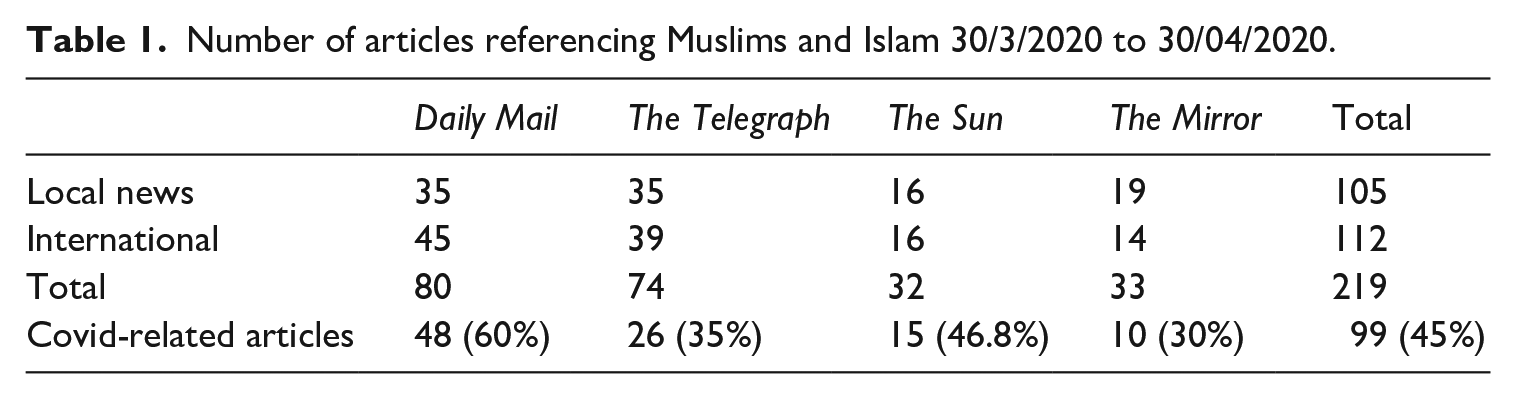
A search using the terms ‘Muslim(s)’ and ‘Islam’ within the sample dates of 30 March to 30 April 2020 retrieved 219 articles of which 99 (45%) were Covid related (determined by a manual analysis). These were fairly evenly split between home and international news (54:45) with a greater proportion of home news, a reflection of news reporting on Covid more generally which Cottle (2020) argues is a result of ‘global myopia’, viewing the pandemic through national lenses as a public health crisis rather than as part of wider global bio-technical economic processes. The levelling of home and international coverage of Muslims is part of a long-standing trend whereby domestic news has progressively grown, particularly after 9/11 and the London terrorist attacks of 2005 (Poole, 2019). Table 1 shows that the Daily Mail has a disproportionate focus on Muslims in general but also in relation to Covid, while The Mirror has the least Covid-related articles. Given that the Daily Mail’s reporting is the most problematic and The Mirror’s the most supportive, this is already suggestive of standardized frameworks in operation. Terrorism continues to be a significant focus in press representations of Islam, with the most occurrences (51) as a topic of coverage after Covid. Over half of these articles appeared in The Telegraph (24) and mostly were about terrorism abroad (37). Ramadan is also a significant topic given its timing (23 April to 23 May 2020) but was largely reported in relation to Covid, as will be explored in more depth below.
Number of articles referencing Muslims and Islam 30/3/2020 to 30/04/2020.
International news coverage: A neo-orientalist framework
With honourable exceptions, such as the late Robert Fiske, international news reporting and knowledge production in the West can be understood as a form of projection, focusing on injustice and oppression elsewhere while ignoring Britain’s historic colonial role in institutionalizing national and ethnic divisions and tensions abroad (Said, 1978). Deepa Kumar argues that Islamophobia is a subset of Orientalist ideology, less a scholarly discipline and more a ‘common sense’ ideology of racism rooted in practices tied to imperialism (Kumar, 2017: 51). This manner of framing international politics also contributes to the racialization of populations at home (Khiabany and Williamson, 2012).
The framework for reporting international news about Muslims and Islam in the pandemic looks very familiar: Terrorism, extremism, tensions between the US and Iran, and Saudi Arabia’s penal system. Stories about Coronavirus abroad consisted of two main topics, an obsessive focus on approaches to social distancing in Muslim countries (including speculation on the status of the annual Hajj to Mecca), and discrimination. The latter included articles attacking China for their role in the spread of Covid (mentioning the incarceration of the Uighur Muslims as part of their condemnation), and reports on Indian’s treatment of the minority Muslim population during the pandemic. Such reportage is situated in Islamophobia (a subset of ‘Orientalist’ ideologies) which depend on strategies of western superiority, bringing into play, as Said (1978: 8) argues, ‘a battery of desires, repression, investments and projections’. It is common for news to report on discrimination elsewhere in the world, working as a form of positive self-representation, distracting audiences from domestic problems (Eide et al., 2008). The Daily Mail reports, for example, that ‘India’s minority Muslim population is also bearing the brunt of inflamed tensions. The country’s health ministry pinned the blame of the virus on an Islamic seminary, which sparked a wave of violence’ (Elsom, 2020). These stories, while highlighting prejudice towards Muslims, also project violence and conflict onto non-Western countries, obscuring Britain’s violent colonial legacy and its role in contemporary post-colonial conflicts. The Sun’s Kavanagh (2020) also comments on China’s brutal incarceration of a million Uighur Muslims in “re-education” camps as ‘a blot on the civilized world’. Meanwhile, images of the mass gathering of Muslims, particularly in the build up to Ramadan, proliferate. The Telegraph reports that ‘Pakistan’s government has struggled to enforce social distancing rules at mosques and religious gatherings’ (Farmer, 2020) while The Sun describes how ‘THOUSANDS of Muslim men are seen attending a packed Friday prayer service despite concerns of the new coronavirus outbreak (original emphasis) (Lock, 2020)’. Both articles are illustrated by images of a mass prayer gathering. Although The Mirror’s domestic reporting is more supportive of British Muslims, half of its international coverage focuses on terrorism including two articles that warn that the ‘pandemic could spark terrorism’ (Hughes, 2020: 8). This wider representational framework should be considered when examining coverage of British Muslims, particularly given the journalistic practice of structuring pages (both in print and online) of articles that are perceived to be linked (partly so readers can use hyperlinks to access related articles).
A debate about equalities or traditional hero narratives?
It quickly became apparent that the first casualties of Covid working in the NHS were from a minority ethnic background. Four of the first doctors to die in the UK were also Muslims, followed by another four doctors and two nurses in the coming weeks. The alarming and disproportionate death rate amongst ethnic minority populations was quickly noted and debated by mainstream media. 3 Although this debate initially focused on ‘racial’ and cultural differences, the scale of the issue forced the media to discuss structural inequalities. Such reportage is not a consequence of media plurality, but rather demonstrates the contradictions that face news media during times of crises, whose ‘usual’ explanations, as Freedman (2009: 12) puts it, are ‘found wanting’ when confronted by unprecedented circumstances. Newspapers need to maintain both legitimacy and circulation amongst readers politically engaged by a new climate. The increased visibility of sources and voices from ethnic minorities was a notable disruption to news as normal, and alongside coverage that appeared to offer a genuine recognition of the NHS and its staff, and other key workers, where ethnic minority populations are overrepresented, had the potential to disrupt what have become fairly standardized tropes about Muslims in the UK. The everyday contribution of Muslims (and more widely ethnic minorities and immigrants) to the social and economic fabric of UK society, which has largely been ignored by mainstream media, could have been redressed. However, the impact of the overwhelming accumulation of stories about Muslims as irreducible other was not undone here, not least because the Muslim identity of the doctors and nurses was left largely unremarked upon.
While it should be noted that the press regulator’s (IPSO) Editor’s code of practice stipulates that any references to ethnic and religious identity should be avoided ‘unless genuinely relevant to the story’ (12.2) (this regulation is regularly flouted in ‘opinion pieces’ (Petley, 2006)), it is noteworthy to examine those instances when the signifier ‘Muslim’ is considered not to be of significance in press discourse. The lack of reference to the religious identity of the casualties of Covid is a striking absence in these press reports and speaks volumes about the ideological function of the signifier ‘Muslim’; the culturalization and racialization of religion is a central trope in contemporary Western racist discourses, which are no longer simply couched in terms of superiority and inferiority but on the basis of assumed cultural difference. Amrit Wilson points out that populations that were once identified by language or geography are now identified above all else by their religion (Wilson, 2007: 31). Fortier (2008) argues that this ‘taxonomic shift’ in Britain is now the site for marking difference (p. 5). Cultural racism has become the norm and acts as a functional equivalent where biological forms of racism are seen to be outmoded (Banton, 2004). Islamophobia is an example of this. However, Muslimness, unable to function as a marker of difference in this context, is rendered irrelevant.
Of the eight cases where Muslim NHS workers died in this sample, references to their religious identity were minimal and incidental, and only in four cases. This was only included when mentioned by a source (usually towards the end of an article) or was identifiable through another religious signifier such as the headscarf worn by Muslim nurse Areema Nasreen. For example, following the death of Dr Abdul Mabud Chowdhury, The Telegraph and Daily Mail both included a quote from the Muslim Doctors Association, the single reference to his religious affiliation. And in a story that grabs the media’s attention of two brothers dying in the same intensive care unit just weeks after their father, the only clue to their Muslimness is through a reference to the Islamic Mosque Society for Wales (Burrows, 2020). It is not the intention of this article to suggest that religion should be a central aspect of reporting, thus essentializing Muslims by reducing them to a singular aspect of identity, overriding intersectional aspects of this. However, by demonstrating the contexts in which the signifier is and is not applied can show how it operates discursively to apply racialized meanings. For example, coverage of these Muslim key workers is in contrast to the first reported Covid-related death of a Sikh doctor, Manjeet Riyat, whose identity is a central part of the story which describes ‘the principle of ‘seva’ which means ‘selfless service’ and is one of the tenets of the Sikh faith’ (Chaudhary et al., 2020). Areema Nasreen received the most coverage of anyone identified as ‘Muslim’ by the press. Alongside several reports about her, she is also mentioned in each newspaper’s regular updates on, and tributes to, NHS workers dying from Covid (such as The Telegraph report, Lyons et al., 2020). All newspapers quote her aspirations to be a nurse and, The Telegraph, to influence those from Muslim backgrounds, saying “I would like to think that I could inspire others; particularly within Muslim communities” (22 March 2020). As part of a process of retaining legitimacy in the face of huge public outpourings of gratitude for the NHS, these articles emphasize the positive qualities of these health workers including quotes from family and friends about their sacrifice and dedication, and in doing so, reveal the tensions that confront news media in times of crisis, facing contradictory dynamics in new situations (Freedman, 2009). But the reports reinforce a common dualism of aggressor/victim and borrow from an ideological tradition of separating out ‘good’ from ‘bad’ Muslims, which is predicated on the extent to which Muslims distance themselves from the (ideologically constructed) assumed inherently violent tendencies of Islam (Kundnani, 2008). While it is strikingly different to see Muslims celebrated as heroes rather than demonized in articles such as the Daily Mail’s ‘They came to join the NHS and made the ‘ultimate sacrifice’: Syrian GP becomes the 10th doctor from overseas who has died of coronavirus’ (Tingle, 2020), such sentimentalized hero narratives not only omit reference to Muslim identity, but stand in for critical approaches to racial equality and discrimination by implying exceptionalism (upon which the good/bad Muslim-migrant dichotomy depends). By referring to nationality, these health care workers were clearly marked individually as hero-immigrants, while ignoring the collective contribution that migrants make to the UK, further reinforcing that binary. In addition, these more ‘positive’ stories were set alongside two related articles in the Daily Mail on the same day that reanimate the ‘otherness’ of Muslims by incorrectly suggesting the number of deaths amongst Muslims are low because they may be protected by cultural practices (described as the ‘Muslim lifestyle’) such as handwashing and lack of Muslim women in employment (Blanchard, 2020; Williams, 2020). And those articles that were critical of the government over lack of PPE drew on the authority of doctors while also omitting their Muslim ethnicity/religion – ‘Doctor, 53, who warned Boris Johnson about ‘urgent’ need for more protective equipment for NHS workers dies from coronavirus after 15 day battle’ (Pyman, 2020).
The erasure of Muslim identity in the recognition of NHS staff contributes to a negative set of associations of Muslims by omission, underlying which are the racialized politics of integrationism which condemns multiculturalism. For instance, Liddle (2020) whose column in The Sun regularly demonizes Muslims (Khiabany and Williamson, 2008), duplicitously celebrates this ‘loss of identity’ since the virus began, using a direct form of address to state ‘we’re all this together – identity politics simply causes unnecessary divisions between us’. In doing so, he also erases the unequal impacts of the pandemic.
From stories of kindness to images of horror
‘Positive’ narratives about Muslims, supported initially by stories about community initiatives (such as food bank donations) and volunteering (such as setting up and volunteering in temporary morgues), gave way to macabre and sensationalist imagery of a buildup of coffins at mosques, accompanied by language such as ‘chilling’, ‘distressing’ and ‘sobering’ (Patel, 2020, this article contains 13 images, mostly of coffins.) Massification is a key aspect of this narrative, where quoting numbers contributes to the wider media panic about the pandemic: ‘dozens of coffins stacked on top of each other’ inside the ‘makeshift morgue’ which can hold ‘150 bodies’ (Patel). However, these stories also demonstrate the high number of deaths within the Muslim population and Muslim civic character: One source states ‘We volunteers are giving our spare time to help my brother who’s the director of the funeral service’ (Patel). However, the morbid interest in death is also evident in a misleading story on ‘mass graves’ which ran in all newspapers except The Mirror, ‘Mass graves for up to 10 bodies are being dug in Muslim cemetery where 13-year-old Ismail was buried as Islamic community is devastated by coronavirus pandemic’ (Chaudhary, 2020). These graves, dug at Eternal Cemetery (for Muslims), were actually ‘pre dug rows with individual chambers with each burial conducted separately of a known individual’ NOT mass graves where often multiple people who are often unknown to each other are buried together (Muslim Council of Britain, personal communication, 2020). Coverage sensationalized this event by repeating the term ‘mass graves’ with all its associations of inhumanity, barbarity, disposability and medievality. Complaints about the report, including a statement from the cemetery, led to the term being replaced in The Telegraph but not in The Sun and Daily Mail. However, two subsequent Telegraph articles asserted ‘Council spends £150,000 so Muslim graves can face Mecca’ (4 June) and ‘Council graveyard 'charges Muslims less for burial plots’ (24 July), reinforcing longstanding tropes about Muslim/migrants as scroungers. This coverage suggesting a lack of humanity of Muslim’s treatment of other Muslims also feeds into, and racializes, a wider discourse associated with the pandemic – of growing disaster and devastation and even the possible breakdown of civility or society. Again, the Daily Mail’s article uses ten images, demonstrating the significance of visual frames in communicating horror and encouraging reactions of shock.
Moral panic: Controlling the Muslims
A new and important trope is developing in the reporting of Muslims during the Covid pandemic – blaming Muslims for the spread of Coronavirus. This links back to the notion that Muslims won’t follow ‘our’ rules, pushed by politicians and the media alike, but which is brought up to date in the context of the crisis precipitated by Covid-19. This is a trigger point in the news media that undermines more balanced accounts of Muslims.
A disproportionate focus on Muslims (compared to their proportion of the UK population) is a common feature of press representation of Muslims, linking ‘fears’ about Muslims with fears about the pandemic. This overrepresentation is almost immediate during the Covid pandemic as images of groups of people congregating around mosques and women in hijab accompanied Covid-related stories, implicating Muslims in spreading the virus (an image of worshippers attending a mosque in Leeds is a widely cited example, Marashli, 2020). The media ‘panic’ around social distancing reached a peak just before Ramadan, at the end of this sample, which saw numerous stories and appeals to Muslims to behave according to the regulations, with little evidence that they were flouting the rules more than other sections of the population (and in contrast to coverage before Diwali and Hannukah later in 2020). This builds on historical scripts about a lack of integration (adherence to UK rules) and draws on far-right narratives that circulated on social media at the start of lockdown which used images of pre-lockdown gatherings of Muslims (which The Telegraph reported on, 30 March). These stories focused on both the UK and abroad, repeatedly raising the question, will Muslims adhere to social distancing rules? For example, there were recurring reports on the dilemma for Saudi Arabia in keeping Mecca open for Hajj, ‘Saudi Arabia tells Muslims to delay plans to visit the kingdom’s holiest cities for Hajj amid coronavirus fears’ (Butler, Daily Mail, 1 April). Such articles used direct forms of address; this one begins, ‘All Muslims intending to travel to Islam’s holiest sites to perform the hajj should delay making plans this year due to the coronavirus pandemic, a senior Saudi official has said’, demonstrating the attempt to contain ‘the threat’ (of Muslims spreading the virus). The articles are accompanied by images of mass prayer (symbolizing difference) captioned as ‘A thronging crowd of Muslim worshippers’. On the 14 April, the same newspaper cautions its readers, ‘Medic warns Ramadan could lead to rise in coronavirus cases when UK’s 3 million Muslims celebrate holy month’ (Williams, 2020). This article also provides an example of a wider practice of using high-profile figures, often Muslims, to urge Muslims to stay at home during Ramadan. When Matt Hancock (Health Secretary) ‘praises Britain’s 2.6 million Muslims for following social distancing rules despite start of Ramadan’ (Dathan, 2020), he presented himself as the reasonable face of Government, willing to tolerate difference in the face of the deemed negative actions of the Other, but now needing to take tough action (tolerance gone too far). Outside of the time frame of this research, Hancock’s approach was to harden as the crisis deepened. Hancock put 4.6 million people into lockdown 3 hours before the start of Eid-al-Adha claiming via Twitter that Muslims were not ‘abiding by social distancing rules’ (30 July). In this way, attention was diverted from inadequate track and trace systems for which Hancock was personally responsible while Muslims were further scapegoated. This trigger saw a spike on far-right social media networks blaming Muslims for the spread of Coronavirus, while the DHSC refused to publish the evidence that led to the lockdown and to Hancock’s comments (Halliday and Kitty, 2020).
These reports are accompanied by numerous links to articles providing information about Ramadan for the perceived ordinary reader. While this provides some important contextual knowledge, it is a further example of the obsession with Islam, and Muslims as ‘object(s) of public debate’, and reinforces and explains ‘their’ difference (Titley, 2019: 70). These articles demonstrate a culturalist position (Kundnani, 2014), signalling overt religiosity and cultural practices as evidence of the social (and so health) threat that Muslims pose, and through constant attentiveness to their potentially regressive behaviour, they are also contextualized by reminders of the other threat, to national security, ‘Coronavirus lockdown could be good news for terrorist recruiters, police warn’ (Evans, 2020). We are again reminded of the need for surveillance measures to manage and contain this ‘problem’ community who are constantly required to prove their ‘willingness’ to integrate.
‘Good’ and ‘bad’ Muslims: Integration and racialization
This framework of representation reinforces the dualism present in press coverage of Islam which differentiates between those who appear to have liberal values (in line with Government policy and dominant norms) and dissenters, labelled ‘extremists’. The NHS victims provide evidence of the first, deserving Muslims who contribute to British society, such as the surgeon Sameer Mallick who was applauded for shaving his beard off for the first time in 17 years to avoid contagion saying ‘All religions teach you that you have to save the lives of others and you have to do what it takes, so that’s what I’ve done”, thus proving his readiness to integrate (Sheridan, 2020). Other examples of ‘integrated’ Muslims are sports stars such as Sadio Mane (Liverpool footballer, The Sun, 8 April), whose religiosity is linked to acts of kindness, and the England cricket team celebrated as ‘multicultural winners’ (Morgan, 2020). Positive representation is common for sports stars; sport has traditionally been viewed as an appropriate occupation for ethnic minorities (harking back to ideas about ‘natural’ racial differences) but has more recently become a platform from which players can highlight racial inequalities. But Morgan’s article congratulates sport for bringing people together with a common goal, (rather than say addressing racism) and thus reinforces the good/bad Muslim binary, and is indicative of a political environment whereby Muslims must overcompensate to be deserving of their place in Western societies, conferring on them a conditional acceptance that functions to manage their behaviour (Jackson, 2018).
The Mirror: Sympathy in the ‘good/bad’ binary
The Mirror, a left-leaning tabloid with ties to the UK Labour movement, provides a slightly different discursive approach in its representation of Muslims so is worth treating separately. Although it covers similar topics: Ramadan during Covid, celebrity stories, far-right activity, hero-migrants and stories on jihadis, the tone is more sympathetic. For example, it presents issues through the experience of Muslims themselves, through columnists such as Saira Khan, or reader’s letters, with their experiences of fasting in ‘Food for thought’, ‘For me personally, Ramadan is a time of reflection, peace and tranquility when all Muslims are equal, and we can appreciate how precious family life is.’ (28 April). This experience of ordinary Muslims offers a perspective that is usually absent from press coverage, normalizing Muslims. Other Muslim voices highlight positive attributes: In ‘CORONAVIRUS CRISIS: HOW THE FUTURE COULD UNFOLD Experts look at world after coronavirus’ (6 April), one expert is Harun Khan, Secretary General of the Muslim Council of Britain, who talks about the sacrifice and collective effort to help those in need (bear in mind that the Muslim Council of Britain has become the primary Muslim source for the UK press, essentializing Muslims and homogenizing the diversity of Muslim views). The newspaper’s few reports appealing to people to stay in during lockdown appear to be directed towards protecting ethnic minorities rather than scaremongering. And some of its coverage of NHS victims foregrounds religious identity, ‘Thank you to the four heroes Dr Alfa Saadu, Dr Habib Zaidi, Dr Adil El Tayar and Dr Amged El-Hawrani, who are the first brave, dedicated NHS doctors to die from Covid-19….. All were Muslim and all gave their lives serving our NHS.’ (Wynne-Jones, 2020). It is interesting that the forms of address in these articles were much more inclusive, speaking to rather than about Muslims. Some reports also discuss racial equality with reference to Muslims although, as with most tabloid newspapers articles, these lack depth; In ‘Ethnic minority communities are harder hit’, (10 April), the fact that the first four doctors were Muslims is clearly marked. In reporting on Trevor Philips’ appointment to lead the investigation into the high number of deaths among ethnic minority groups, The Mirror highlights his ‘form for dismissing the well-documented consequences of structural racism’ and directly asks ‘How can he do justice to the living and the immigrants among the NHS dead who had come out of retirement to save lives despite the societal inequalities that impacted the health service?’ (Lewis, 2020). However, while these articles present a ‘moderate’ face of Islam, by sitting, as they do, among the more familiar articles on terrorism, ‘Most wanted ISIS Brit’ held’ (Hughes, 2020), they fall into the trap of the good/bad dualism discussed above, which ultimately reinforces the conflation of moderates and extremists and underpins a sense of Muslims’ collective responsibility for extremism. However, The Mirror clearly provides more room for ordinary Muslim voices than other newspapers and highlights positive attributes of Islam, offering an alternative to the representational norm.
Wider coverage: Terror and atavism
Reporting about Muslims in the UK at the height of the first wave of the Covid-crisis presents a largely binary framework peppered with some fairly neutral factual reports, mostly in The Mirror. But these sit within a wider framework that reinforces the proposition that Muslims represent both cultural difference and a security threat. Terrorism continues to be a recurring topic, in relation to British Muslims and ‘foreign’ Muslims alike. Stories about negative cultural practices prevail (honour killing, conversion). The few more diverse representations (such as ‘Religion goes digital’ The Telegraph, 10 April) are located among reports on British jihadis on trial or returning from Syria, terror alerts, counter-terrorism measures, and the narrow international framework discussed earlier. There are some stories about discrimination, particularly relating to the far-right, a common strategy of locating explicit racism outside the mainstream. There are very few stories that normalize Muslims outside celebrity tabloid news. Later coverage (falling outside this sample) reinforces this framework, for instance a story that ran across all of the newspapers (except The Mirror) in June 2020, ‘Exclusive: Half of all UK’s imported Covid-19 infections are from Pakistan’ (The Telegraph, 26 June). When challenged by PHE and advocacy groups, the newspapers subsequently changed their headlines to ‘Covid-19 infections in June’. But the manipulation of data to implicate Muslims in spreading the virus, had by this time already contributed to a new trope to the circulation of anti-Muslim propaganda.
Of course, the decision by journalists to use the identifier ‘Muslim’ is politically sensitive, of which most are aware. Munnik’s (2015) interviews with journalists in Scotland (15) shows that while its usage was controlled (amongst these participants) to avoid reducing people to a faith identity, there was also a level of improvised decision making when identifying a ‘Muslim story’, and most of these decisions were made without the input of Muslims. When deciding on appropriate use of the term Muslim, journalists quoted ‘relevance’ as the leading criteria for inclusion. But Munnik identified a gap between situations in which the identifier is considered relevant by the journalists, in relation to professional norms, and the ways the term was operationalised on a daily basis, observing that the boundaries for its usage became wider in the latter. While most of the stories he analysed could be categorized as ‘religious’ or ‘ethnic’ (often conflated) some could be described as ‘social’ where use of the term was harder to justify (stories about social issues that happen to involve Muslims such as education or governance). This led Munnik to conclude that journalists have normative conceptions of what is a ‘Muslim story’ based on a ‘socio-religious’ definition of Muslims, which are shaped by wider social and political discourses. And while these journalists shied away from what might be seen as an ‘egregious’ use of the identifier, they agreed that ‘exceptional profiling’ was practised in some news outlets (107). Meanwhile, the press regulator IPSO, acknowledged that its guidelines needed updating and planned to do so in 2019 but in 2020 these remain unchanged, leaving inadequate guidance in place (Munnik, 2020).
Conclusion
It appeared initially that the Covid crisis might provide an opportunity to challenge norms and reframe news discourses about Muslims in the UK; coverage which generally cast healthcare workers as ‘heroes’ (another binary which needs unpacking) included Muslim healthcare workers and seemed to offer the potential to shift heavily sedimented negative coverage of Muslims in the UK. However, the signifier ‘Muslim’, so heavily imbued with negative connotations and functioning to signify ‘otherness’ in the UK news media, was often left unremarked up on the Covid coverage; its absence a reflection that the meaning of ‘Muslim’ is still anchored to an ‘us and them’ binary in the UK press. The coverage ultimately reinforced the hegemonic representational framework that has developed since 9/11 by drawing on and reworking wider longstanding tropes in which marginalized groups are ‘othered’, subject to moral panics, and accused of refusing to integrate.
These findings should be interpreted in the context of a political landscape that has become increasingly hostile to immigration, where Muslims, alongside other ethnic groups, have been subject to racist exclusionary practices in the construction of nationalist boundary-making. The politics of austerity have been recast as ‘scarcity’ and linked to the politics of immigration, which scapegoats Muslims/immigrants (as a drain on public resources) in the implementation of cuts to economic/welfare policies. The ‘positive’ stories of Muslim NHS workers left intact the perspective of Muslims and immigrants as a resource-draining ‘other’ because the coverage was situated in the ‘good/bad’ binary, in which honourable exceptions (who integrate) were in contrast to a negative general construction of Muslims. Despite a recent shift to examine institutional racism in the context of Covid and the Black Lives Matter movement, (which has managed to impact on discursive constructions on racism and commitments to equality) media narratives largely omitted Muslims from these discussions, their raced identities reconfigured to conveniently fit with essentialized ideologies about different ethnic groups. The fact that a large number of the victims of Covid-19 were Muslims was largely obscured, in an interpretative framework where ‘Muslim’ as an identifier is irrelevant unless it signifies ‘difference’, while public discussion ignored the reality that Muslims experience disproportionate structural disadvantage in the UK. 4 Such representational absence demonstrates the ideological containment of Muslims in media coverage; what constitutes a ‘Muslim story’ is now well-established and any disruption to this norm can be contained within the binary representational framework demonstrated here. As austerity measures bite in the recession following the Coronavirus pandemic, the British news media is likely to ramp up exclusionary politics linked to anti-immigration discourse and continued attacks on Muslims, who are the ‘suspect’ communities through which racist discourses continue to be legitimized.
Footnotes
Funding
The author(s) received no financial support for the research, authorship, and/or publication of this article.
