




Abstract
This study reviews how Thai and Chinese journalists talk about power and truth in relationship to their Fourth Estate role through examining twenty qualitative interviews. Adding to a previous study similarly looking at US and UK journalists it finds that, like their western counterparts, truth is heavily fetishized, being an ideal that journalists admittedly can never reach. However power relations are discussed quite differently, showing how the divergent power structures of the four countries create very different discourses of the power of journalists which are not fetishized to the same extent. This article thus finds that there are limitations to the universality of Žižek’s concept of ideology as fetishistic disavowal (that is, being able to actively admit the limitations of one’s profession as long as one still performs it) in the realm of comparative journalism.
Introduction
Journalistic professionalism is often viewed as an ideal that developed in western countries, specifically the USA and the UK, and was then exported to or imported by newly developing news media organizations and institutions around the world. The extent to which this adaptation of western values has been ‘successful’ or not remains an open question, largely due to the variance in different media systems’ internal structure. The political system, political parallelism of media organizations, where and how journalists are educated, varying legal protections for journalists, cultural differences, journalistic routines and many other factors have all been viewed as variables that make news media systems diverse and difficult to compare (i.e. Curran and Park 2005; Hallin and Mancini 2004, Hallin and Mancini 2012; Hearns-Branaman 2011, 2015; McChesney and Herman 2001).
To limit these variables we need to focus on specific aspects of journalistic professionalism and narrow the range of news media systems under investigation. This article acts as a follow up to Hearns-Branaman (2014), which examined the professionalism of US and UK journalists through the lens of the concept of fetishistic disavowal. The findings of that article will be compared with additional data gathered from interviews with political journalists working in Bangkok, Thailand, and Beijing, China. By comparing the previous findings with new data we can better see to what extent professionalism is consistent and what might cause variances in the discourses used by journalists when talking about power.
Influences on journalistic professionalism
As examined in Hearns-Branaman (2011, 2014, 2016), the discourses that American and British journalists use to talk about their Fourth Estate role in relationship to power and the truth are highly problematic. Power is discussed as being something highly inter-personal, and journalists frequently cite the lack of control over their product by the lack of direct interference by their bosses and government officials (Hearns-Branaman 2011: 185–221, 2014). More abstract, structural and systematic influences in their job, such as the socialization of journalists through rewards, punishment and other means, are not part of their discourses. Furthermore, journalists tend to fetishize and idealize aspects of their work, what Žižek (1989 [2008], 2006) calls fetishistic disavowal, including writing the perfect story, perfect journalist, and perfect relationship between themselves and politicians. At the same time they admit that such perfection cannot be reached, and it is in this way professionals like journalists can be motivated to try to achieve unachievable goals (Hearns-Branaman, 2011, 2014, 2016). We can therefore see that, in the Anglo-American tradition at least, the ideological and epistemological underpinnings of the Fourth Estate ideals are very shaky and deserve a sustained critique.
Professionalism and Journalism
In Hearns-Branaman (2014), I argue that the existing paradigms concerning journalistic professionalism need to be adjusted, drawing from Nordenstreng’s (1998) typology of critiques of journalistic professionalism. The first critique concerns journalism’s contention that professional ideals were developed in a positive way in order to fight journalism’s previously disreputable reputation of the Yellow Press era. The second addresses journalism’s efforts to be included as a profession like other middle-class occupations that emerged in the 19th Century, that the ideals were developed as part of self-regulation in the same way medical, legal, and others developed their ideals, standards of conducts, and ethics (see Freidson, 1983, 1986). As McChesney says, this allowed journalists to argue that they can be objective and ‘sublimate their own values,’ in order for the audience to be able to ‘trust what they read and not worry about who owned or worked on the newspaper’ (McChesney, 2004: 64). Lastly is the critique that journalistic professionalism was adopted simply as ‘camouflage’ or a rhetorical device, and thus a gap between these ‘high ethical principles’ and the often low standards for ethical ‘practice’ persists (Nordenstreng, 1998: 128).
Hearns-Branaman (2014) argues that this gap between stated professional standards and journalism’s inability to reach those standards is not a shortcoming of journalism, it is how journalistic professionalism functions properly. This ‘fundamental antagonism’ (Žižek, 1997 [2008]: 11) in journalism, between journalists as performing a public service function (with the attendant responsibility for ethical behaviour and objectivity) and journalists serving the political-economic interests of their employers, is not something that needs to be resolved, nor can it be resolved. This has, when discussing ideology in general, been termed by Žižek (1989 [2008]) as ‘fetishistic disavowal,’ in that actors ‘know very well what they are doing, but still, they are doing it’ (pp. 24, 25). This is a move away from outdated notions of ideology as ‘false consciousness’ in which people are only able to act against their own self-interest because they lack knowledge about why they are doing what they are doing.
Fetishistic disavowal
While some, like Schudson (2005), criticize control theories because they are ‘entirely inconsistent with what most journalists in democratic societies commonly believe they are doing’ (p. 177), I have argued the opposite, that ‘it is this inconsistency between beliefs and actions that is the key to ideology because such gaps serve as a motivating factor for journalists, and this can be explained by the concept of ideology as fetishistic disavowal’ (Hearns-Branaman, 2014: 31).
It derives from two sources, the first being psychoanalytic theory in which the Real is the foundational basis for our desires, and the Symbolic is our perpetually unsuccessful attempt via language to come to terms with the Real by unendingly seeking those desires (Homer, 2005; Žižek, 2006). It is not to repress or hide the Real, but to use the gap between the Real and the Symbolic as motivation. The second is from Sloterdijk’s (1987) idea of ideology as cynicism, or as he terms it, ‘enlightened false consciousness’, in that our consciousness ‘has learnt its lessons in enlightenment, but it has not, and probably was not able to, put them into practice’ (p. 5). Žižek combines them together to posit that ideology functions by giving people unachievable goals to reach, but ones that they admit cannot be reached. This contraction is productive and people actually work harder towards goals they cannot reach as long as they admit to themselves they cannot.
In the previous study (Hearns-Branaman, 2014), fetishistic disavowal was discovered in three discursive strategies deployed by US and UK political journalists. These are idealizing (1) news as a mirror of reality, (2) unbiased journalists and stories, and (3) lack of government interference. In each case, journalists were found to uphold the ideal as an aspiration while admitting that it was unreachable.
Yet it cannot be assumed that professionalism has developed and works in the exact same way in different news systems around the world. We thus need to attempt to replicate the findings by exploring journalistic discourses in other countries.
Other professionalism contexts
This study will explore professionalism in the People’s Republic of China (PRC) and the Kingdom of Thailand. They are chosen for this study due to their unique characteristics and the contrast they provide with the USA and UK, which are discussed below.
Professionalism in Chinese journalism
The basic notion of why PRC media cannot function as ‘professional’ in the western ideal lies in the fact that news media organizations are either directly controlled by or licensed by Propaganda Departments at various levels of the Chinese Communist Party and its provincial and local affiliates. Yet, at the same time, market forces have been changing Chinese journalism for over 30 years, and applying a pure ‘authoritarian’ or ‘party press’ model no longer works as well.
While, for example, reporting on corruption in certain businesses and politicians occur, it is usually at the behest of those in control of these media units attacking their enemies or rivals and thus is constrained to being either an attack-dog for the Communist Party or the site of inter-elite, intra-party struggle (see, e.g. de Burgh, 2003; Hearns-Branaman 2015; Lee et al., 2006; Pan and Chan, 2003; Zhao, 2008 and many others). As this is broadly the same as most criticisms of the limits US and UK news media, just in the specific political-economic context of the PRC, I argue that it deserves some direct comparison with discourses of the Anglo-American system. Furthermore, other studies have argued that ‘Objectivity and balance have become main news values and ideologies to Chinese journalists’ (Zhang, 2014: 2), and it remains to test this notion further. Lin (2010) argues that mainland Chinese journalism contains elements of Western-style professionalism along with party journalism and the Chinese literati tradition, in that Western professionalism has been localized and a transition towards complete Western professionalism is not inevitable.
Zhou and Zhou (2016) produced a country report based on the Worlds of Journalism survey data, finding the vast majority of Chinese journalists agreed that they ‘should always adhere to the codes of professional ethics, regardless of situation and context’ with 91.8% (Zhou and Zhou, 2016: 2). Further findings showed ‘a limited degree of professional autonomy’ (Zhou and Zhou, 2016: 3), ‘more than half of the respondents admitted their work was influenced [. . .] by their personal values and beliefs’ with 58% (Zhou and Zhou, 2016: 4). Questions about objectivity and bias were not included, other than to say journalists ‘found it most important to report things as they are’ with 83.8% Zhou and Zhou, 2016: 1).
Yet the concept of fetishistic disavowal has yet to be applied to Chinese journalism studies. These journalists could face it in the same was as their US and UK counterparts, or feature other permutations, such as a consequence between their split allegiances for (often Western) professional ideals learnt in school and the different daily pressures they face due their role as the mouthpiece of the party.
Professionalism in Thai journalism
Research into Thai journalism and professionalism is very limited. This might be because, as McCargo (i.e. 2000, 2003, 2012) notes, the Thai media system is constantly in flux as constant political and governmental changes re-arrange and re-structure Thai media continually. Furthermore, partisanship of Thai newspapers, for example, can be mixed, with different sections of the same paper having different political allegiances to individuals, businesses, politicians and political parties (McCargo, 2000). McCargo (2012) goes on to argue that due to this instability and the unique characteristics, Thai media cannot be integrated into or explained by models of European or North American journalism, such as that of Hallin and Mancini (2004). Thus McCargo argues that Thai media cannot be part of the ‘Fourth Estate’ in the same way that the US or UK media is.
Thailand was also included in the Worlds of Journalism study, surveying 374 journalists, producing country report (Benjarongkij and Boonchutima, 2017). It found that 88.7% of journalists said it was important ‘to report things as they are,’ 58.5% saying ‘personal values and beliefs’ influenced them, ‘Editorial policy, journalism ethics, information access, and owners of the news organization were reported by three quarters of the interviewed journalists as the most significant of extremely or very influential factors’ (Benjarongkij and Boonchutima, 2017: 1–3). In the end, Thailand seems to have a professional journalism culture similar to Western countries, yet the unique and unstable political situation in Thailand causes it to be unable to be subsumed in models used to describe western news media.
Comparative journalism
Many studies of journalists have tended to be more quantitative in nature, confined to specific countries alone, or involving only countries in Western/Central Europe and/or North America. As mentioned, the Worlds of Journalism project (see Hanitzsch, 2007, 2011; Hanitzsch and Mellado, 2011; Mellado et al., 2012) involved quantitative surveys with journalists in over 18 countries, providing a large amount of quantitative data that is continuing to produce research.
The major limitation to these studies is the closed nature of questions in such surveys. While this makes systematic quantitative analysis much easier, it does not allow the respondents to have much influence on the framing of the answer or to respond outside of the range selected by the researchers. Furthermore, exactly why the journalists respond in the way they do is unable to be answered by the survey alone, nor can we interrogate the accuracy of their responses, that is, how it actually reflects their daily practices and experiences. If a majority of journalists respond that, for example, they adhere to professional norms, it does not mean that they actually do, only that in the context of a survey that is the kind of answer they are expected to give.
Studies by Patterson (1998) and Donsbach and Patterson (2004) and Lichter et al. (1990) are more dynamic in their approach, combining surveys, interviews and experimental activates, such as giving practical scenarios to journalists to see how they would respond. This gives a much richer range of data to draw from than surveys alone. However, they are limited in scope, Lichter et al. only dealing with American journalists, Patterson only with US, UK, German, Italian and Swedish journalists, and thus their scope for wider comparison is limited to a Western context.
We can thus see that much comparative media studies of a qualitative nature is limited to Western countries. Therefore, there exists a need to integrate more countries into a comparative study, especially one of a qualitative nature, that deals with issues of professionalism and objectivity of journalists.
Thailand represents a news media system in an unstable democracy with some level of professionalism, yet it is professionalism tempered by political parallelism of the news media outlet and the journalists. PRC news media, as part of the state propaganda apparatus, puts journalists in a more precarious position of balancing the dual roles of party mouthpiece and as parts of a for-profit media system. Despite of, or perhaps due to, the political and social differences of Thailand and the PRC with the USA and the UK, they need to be compared by examining the discourses that these news media professionals use to talk about issues of truth and power in their jobs. In this way we can see to what extent the discourses are universal and how there could be a counter-discourse emerging from non-Anglo-American nations.
Methodology
While it is certain that political-economic influences of the news media are important to study and, as Fuchs (2010: 45–50) argues, Western corporations do, on the aggregate, have a dominance in the political-economy of the world’s media systems, news media in countries like Thailand and the PRC, due to the political-economic reasons discussed in the previous sections, cannot be explained by his analysis. Instead, I argue that we need to examine the super-structural discoursal expressions demonstrated by subjects in their capacity as representing media institutions, grounded as they are in their specific political-economic bases. As Fairclough argues, ‘institutions construct their ideological and discoursal subjects’ in that ‘they impose ideological and discoursal constraints upon them as a condition for qualifying them as subjects’ (Fairclough, 1995: 39). Thus, we need to examine ways of interpreting the talk of the interview subjects and the different ways in which we can elicit talk from them.
Following Alvesson (2002), the nature of the interview situation will be taken into account when framing the questions because this unnatural circumstance cannot be cancelled or bracketed out by any method. Acknowledging that the other half of the interview will consist of a scholar is important as the responses could be aimed at defending the journalistic field from the probing out an outsider no matter their personal feelings. Furthermore, as Gans notes, when researching external influences on journalists, a major empirical issue is that ‘Surrender to pressure is viewed as an act of cowardice and a sign of powerlessness, and those who must surrender are loath to discuss it’ (Gans, 1979 [2004]: 251), especially when faced with a member of another field like academia. Thus, similar questions are asked in different ways and they are presented with arguments given from different fields (i.e. journalists, politicians) in order to allow some measure of comparison of the results.
The interviewee’s responses are viewed as statements made from a certain position that tries to accomplish something, and therefore the analysis acts to turn inside out the journalists’ attempts to close meaning down and fix its position (Alvesson, 2002: 67; Eagleton, 1991: 195; Potter and Wetherell, 1987: 34). The focus was more on the way in which they answered the question (see Coward and Ellis, 1977: 41), and less on what they said, thus conceptualizing their responses as ‘discursive strategies’ functioning for specific purposes. The interview answers were analysed in a systematic way and the categories for analysis, the discursive strategies, are grounded in and emerged from the responses the journalists gave and not any categories previously in mind of the researcher (Baudrillard, 1978 [1985]; Charmaz, 2006: 186, 187; Glaser and Strauss, 1967; Philo, 2007: 189). The questions themselves, which do come from the mind of the researcher, provide enough structure that the analysis can be done in a systematic way. The discursive strategies revealed by the analysis do not, and cannot, indicate the ‘real’ thoughts or ‘beliefs’ of the interview subjects, but instead the conceptual categories they use when talking about that subject.
Interview method and procedures
In the first stage of the project, a mix of journalists from elite US and UK broadcast and print news media institutions were recruited (see Hearns-Branaman, 2011, 2014, 2016). The distinction between ‘new media’ and ‘legacy media’ journalists was not taken into consideration as all of the news media outlets have versions both online and over the air or in physical print, and none of the ones included in this study were online-only. For this stage, lists of the major news institutions in the capitals of Thailand and China, and the relevant news staff, were drawn up in collaboration with local research assistants. In the end, ten candidates from each country were interviewed from at least three different organizations. The national news organizations to be approached include a wide spread of differing ownership and political orientation (in the case of Thailand only as the PRC media have a highly singular political perspective) and audience orientation (populist vs. elite, both Thailand and PRC) respective to each country.
For China, journalists 21st Century Business Herald, People’s Daily, Xinhua News Agency and broadcast outlets CCTV-2, CCTV-7 and China Radio International were interviewed in July and August, 2013. For Thailand, journalists from print media outlets Post Today, Thairath, Khaosod, Matichon, and Daily News and broadcast outlets ASTV Manager and The Nation were recruited and interviewed in March and April, 2015. The latter was delayed due to the military coup that took place a year earlier in May, 2014. All respondents were anonymized and indicated only by the code of their news outlet, with only basic biographical data provided here to ensure anonymity (see Appendices I and II).
The interview schedule was translated into both Thai and Chinese in order to help facilitate the interviews. Interviewees were also asked to sign a Participant Consent Form, also translated into Thai and Chinese. Interview facilitators in both Bangkok and Beijing were hired to organize and conduct the interviews. The questions were be translated as closely as possible to the corresponding languages. Subsequent to the interviews being conducted, the interviews were transcribed in the native language verbatim and then translated into English in collaboration with the PI, the facilitators and translators.
The transcripts were analysed in a similar fashion to previous stages of this study (Hearns-Branaman 2011, 2014, 2016). Particular attention was paid to ‘new’ discursive strategies these new groups of journalists use to talk about professionalism.
Limitations of methods
Conducting a research project of this nature faced several challenges, many of which cannot be overcome. Qualitative methods, such as interviews, need to be conducted in the native language of the journalists and then translated into English for analysis and presentation, which presents problems of translatability of certain terms, such as ‘bias’ and ‘balance,’ problems that were absent in the first part of the project. There was also be the potential that my analysis of the interview transcripts in English will be my interpretation of the interpreters’ interpretation of the journalists talk, thus being one more step removed than for un-translated interviews. However, these limitations are insurmountable and thus are only noted for context.
Secondly, as in the first stage, the project is limited to examining elite discourse of elite journalists working the capital cities of each country. While this is done to maintain consistency, it does not give non-elite and local voices any say. Some scholars of Chinese media, for example Zhao (2010) and Hu et al. (2013) argue that this localist perspective is the major advancement that need to be made in Chinese media studies. This criticism, however, cannot be remedied at this stage of the project, although future stages may contain further interviews with local journalists for all countries involved. The important thing to maintain is that the results are of elite journalists at agenda-setting news media institutions and to not say they represent journalism in general. This is important to examine precisely because of their elite and agenda setting nature, whether or not it filters down to the local levels.
Also, as I have noted elsewhere about this project, ‘Thai journalists still seem to be stuck in the discourse prevalent before the [2014] military takeover, talking about power and journalism not as it existed during the spring of 2015 but in a manner frozen in amber from an era that no longer existed’ (Hearns-Branaman, 2020). The sensitivity of the political situation, even after a year of military rule, seemed to cause the journalists to refer to the previous, pre-coup political structure of Thailand.
Findings
The findings are presented here to explore the biggest differences and similarities in the results from journalists’ discourse in China and Thailand. Schudson argues that there is a ‘cultural environment’ that journalists ‘can draw on’ and also ‘the set of ideas, concepts, values that they have access to, find attractive, and can convey convincingly to themselves and others’ (Schudson, 2001: 166). Thus comparing their answers to similar questions can better highlight the cultural differences. This analysis will focus on the concept of fetishistic disavowal developed in my previous work (Hearns-Branaman, 2011, 2014, 2016).
News as a mirror
News as a mirror of reality is reliable metaphor used by journalists when defending the objectivity of their work (Hearns-Branaman, 2011, 2014, 2016). The results of that study, that journalists fetishize an ideal of truth that they admit cannot be reached, are largely reflected in this study as well.
For Chinese respondents, few agreed fundamentally with the ‘mirror’ metaphor, with many wanting to add other elements to it. This mirror-plus discursive strategy is evident in two, saying it is ‘a coloured mirror, a funhouse mirror’ (CCTV1) and ‘a funhouse mirror, not a flat one’ (CRI2), CCTV2 noted that the mirror ‘is not absolutely transparent.’ Others give the metaphor only slight support, or is ‘basically correct’ (XH2) or that it is not ‘exactly correct’ (PD1).
Others disagreed more strongly, saying the mirror metaphor was not correct. PD2 said ‘news only reflects a certain dimension of reality’ and thus ‘you cannot say it is a mirror,’ while PD3 simply noted ‘I do not agree.’ PD1 was more nuanced, arguing that it is impossible to be a mirror because the ‘media function to construct reality.’
Many pointed out the inherent biases of journalists, saying ‘you report news from your own position, your perspective is not complete, you just can see the tip of the iceberg’ (XH1), while CRI1 argued that ‘since journalists have their own emotions on the inside [. . .] they bring a stance coloured by the glasses they wear,’ a sentiment echoed by CRI1 noting that ‘reporters will cover events according to the judgement from their values.’
In the end, unlike UK and US respondents of the previous study, none fetishized news-as-a-mirror as an objective they should reach, none argued it was the best way to do journalism and they should strive to reach it.
We can see the fetishization of truth more strongly in the Thai journalists’ responses, holding the mirror metaphor as the ideal yet noting how it cannot happen. For example, TR1 said that their ‘duty’ is to ‘reflect the truth to society,’ yet this is ‘limited according to social contexts’ and the ‘readiness of the organization that we are in’ to defend journalists from lawsuits. NTV2 says that the ‘basic principle’ is that ‘news must be presented with the most accurate facts and without distortion,’ but then argues this cannot happen in the ‘current situation’ (i.e. the post-2014 coup environment) and also because facts will be mixed with journalists’ own ‘personal views.’
Many journalists admit more readily that the ‘truth’ they report is heavily influenced by their news organizations’ political orientation. AM1 notes that ‘news is the fact informer, notifying about events that happened,’ yet they also say which factors are emphasized would ‘depend on what policy or viewpoint news organizations prefer to report.’ TR1 argues that the mirror metaphor is ‘theoretically true’ but that ‘over the past 10–20 years’ this has become a lot weaker, due to the influence of ‘social media’ and ‘news consumers’ wanting ‘compact, short, quick and trendy content,’ amongst other unnamed influences. KS1: ‘nowadays we report on things that the people are highly interested in, we over-emphasize that.’
Other journalists blamed the current media environment under the military junta, three implicitly and one explicitly. TR1, DN1 and NTV2 said that ‘right now’ Thai media cannot reflect reality, while MTC1 explicitly noted that currently ‘facts are reflected under the limitations of’ the military junta.
Others argue about the relative nature of truth, influenced by the political and other . . . DN2 says that ‘we must understand that there are multiple sets of truth, Yellow Truth, Red Truth,’ and thus agrees that ‘news is a truth-reflecting mirror, but it could be any group’s truth.’ PT1 gives a similar answer, that we have to consider ‘whose truth’ we are talking about, the ‘truth of journalists or the truth of the owner, or common people’s truth’ because ‘these sets of truth are different.’
Like the UK, US and Chinese journalists, many Thai ones adjusted the mirror metaphor. Some said it more ‘reflects the state of social phenomena’ than reality (PT1), that ‘it would a mirror that partially reflects’ (MTC1), or that the ‘media’s duty is both as a mirror reflecting social images’ and ‘as a lamp which gives guidance to society,’ in the end saying ‘it is a mirror, but not a perfect one’ (DN1)
Thus, all journalists surveyed have similar impressions of the truth-giving role for media. Those who agree do so with caveats, arguing for a mirror-plus or noting the political context. This clearly shows the influence of fetishizing of truth as an ideal that cannot be reached but yet still motivates the Thai journalists. Yet Chinese journalists do not seem to fetishize truth to the same extent as their US and UK counterparts did in the previous study (Hearns-Branaman, 2014). This finding is similar to Zhang, who found that Chinese journalists ‘point out the limitations of objectivity and they think objectivity is an unattainable norm in practice’ (Zhang, 2014: 9).
Biased journalists and news stories
British and American journalists often fetishized the presence of unbiased journalists and unbiased news stories (Hearns-Branaman, 2014). This was more implicit in their answers than the above statements regarding the mirror metaphor. For Chinese and Thai journalists this exists to a similar extent, although, of course, the examples and the political context is different.
Question B1 and B2 asked journalists to discuss recent stories they thought were biased or unbiased, while B6 asked about the ‘inherent liberal bias’ of journalists because ‘they are educated and middle class and tend to support the more liberal political parties,’ a view that is more prevalent in the US and UK. While the previous article (Hearns-Branaman, 2015) only included B6 about liberal bias, this article will also include B1 and B2 to give additional context because the ‘liberal bias’ discourse is not highly explanatory in China and Thailand.
Many PRC journalists advocated Pragmatic ways of telling bias, that is when there was a lack of balance or plurality. One said to see if a journalist is biased we should ‘look at a journalist’s choices, if it reflected only one side or both sides, or if both sides were given a chance to speak’ (CRI1) while another said, ‘How to tell if there’s no bias? I feel this can only be done by reading and watching more on your own’ (PD1).
They gave many examples of cases where journalists pandered to public opinion. This included when a city inspector [cheng guang] was killed by a street peddler and when the children of army and government officials are involved in crimes. The majority denounce anti-elite, anti-government bias, for example one saying the media is ‘biased by the influence of public opinion’ (PD1). The majority are also quite concerned with the internet spreading rumours and the undue influence that has on them, in that they are pressured to treat these rumours as stories when they feel they lack news value.
Only one fetishized truth, saying that ‘News without bias? I think this is our ultimate goal’ (PD3). Whether or not the media can actually be unbiased is not mentioned, however.
For liberal bias, six of the Chinese journalists agreed with the statement, starting, for example, ‘people always tend to strengthen the class they belong to, or they will even expand their space using some media’ and that ‘this tendency originates from their ideology’ (CCTV1), while CCTV2 noted that since Chinese ‘people who major in journalism are middle class’ they therefore ‘prefer liberalism,’ and PD2 agreed that ‘the education background and the class which individuals belong to will affect their views,’ while not stating explicitly that these views are ‘liberal.’
Two respondents had more nuanced answers, noting the special context in which Chinese journalists operate. PD1 said that ‘in China, this statement is not correct’ for all journalists, as salaries are generally low and journalists working in big cities like Beijing or Guangzhou have a low standard of living. They added they ‘disagree with the so-called liberalism preference among journalists’ due to the ‘complex situation’ in China, in that some journalists were ‘born in 1980s or 1990s’ while those ‘who control the main power in media were born in 1950s or 1960s,’ implying the generational gap in ideology does not allow such generalizations. XH1 is more candid about the political situation, arguing that personal political bias is not relevant because China is a one-party state and thus ‘what the Party says goes, you only have the Chinese Communist Party’s point of view.’
Only one journalist presented a fetishized view of personal bias, stating ‘A journalist from an ideal perspective should not have their own political viewpoints, but it is very difficult to behave like this, as journalists are also human’ (CRI1).
Thai journalists reacted similarly, positing many instances and ways in which stories can be biased. One said ‘It is not like the Prime Minister said something so you support the Prime Minister and the Prime Minister said something bad so then you twist it to be good.’ Another noted that ‘It was clear in the period of [. . .] the political colour war in Thailand that each media had clear bias on the issues [. . .],’ referencing the symbolic colours, red and yellow, of different political groups. A journalist from Khao Sod lamented their paper’s Red Shirt orientation, saying ‘We were like this because the managers ordered us to do so, although we do not like that, but we have to do it because we are their subordinates.’ In these kinds of statement is the implicit idea that in a different political environment these biases, pro-junta or pro-Yellow/Red-shirt, would not exist and journalists could report in an unbiased way.
Others suggested the content of the stories themselves give away bias, that ‘every side should have a chance to explain [i.e. their position],’ and if that diversity does not exist you have bias. One from Matichon said you should ‘not let any side to be overweight,’ noting that while their paper ‘is viewed as it leaning towards the Pheu Thai party,’ they believe the criticism is unwarranted because ‘we also publish what the Democrat Party is saying.’
In the end, the fetishization of the perfect journalist and perfect story were present in not only the previous UK and US study but also in Thai and Chinese contexts as well. This shows professional ideas of individual behaviour are easier to maintain no matter the political-economic-media system in which journalists operate. A likely explanation is that personal goals for doing their job well are more universal for such professions and does not highly correlate to their respective media systems.
Government influence
The UK and US respondents (Hearns-Branaman, 2014) expressed their view of power in a very interesting way. The quote presented to the respondents was ‘journalists enter into all manner of secret alliances with politicians [. . .] surrendering any claim to genuine independence and often bolstering rather than scrutinising those in government or aspiring to government’ (Price, 2010: 7). When asked about this governmental influence in their jobs, all US and UK respondents, except one, said that it was not present. The reasons they gave indicated they viewed power as something done directly to them. However, news media operations have layers of power, and so governmental influence often operates indirectly on them. As we will see below, the differing power structures in China and Thailand lead the journalists to talk about power in completely different ways and not fetishizing it like they did for the former questions.
When asked about close relationships between journalists and politicians compromising journalists, most Chinese journalists readily agreed, calling the question’s statement ‘reasonable’ (CRI1), the situation ‘normal’ (XH1) and ‘very common’ (CCTV2). PD1 says that ‘this is definitely against the ethics of journalism and professional ethics, but it can happen, there is no way to stop it.’
Many point to the fact of that the government owns the media: ‘In China, most media are controlled by the CCP’ and thus ‘the media cannot report events with objectivity’ (CRI2). Others said ‘it is just a form of supervision from the government’ (CCTV2) and that ‘news media is the tool manipulated by the government’ and therefore ‘I never believe the information given by the government is absolutely real and honest’ (CRI1).
PD2 disagreed, saying that politician’s statements cannot be taken at face value, that ‘if the politician’s actions are consistent with what they said they would do, then they can be believed,’ while XH3 was unsure, simply suggesting that ‘it might be affected by the politics and economics factors.’
For the Thai respondents, every single one agreed that this close relationship happens, most of their answers explaining the nuances behind this phenomenon and providing caveats. Six journalists noted that the relationship should be close, but not too close. Similar to the previous study, where exactly that line is located is not discussed in detail, being something that is more implicit.
DN2 argues that for lower positions, such as field reporters, ‘they have to be close to the news source to get inside information’ but this situation is ‘dangerous’ as being ‘too close’ would tempt them to work with their sources for ‘mutual benefit.’ AM notes the same, casting those politicians and journalists who are too close as ‘bad,’ as ‘politicians could help journalists to grow rich’ and the politicians would use the journalists as ‘public relations.’ TR nots that this occurs ‘in every society, especially in the West,’ yet is very generally, only saying that journalists and politicians ‘take care of and sympathize with each other.’ NTV2 seems to lament that kind of relationship, noting that in order to get ‘exclusive news’ journalists need to be ‘embedded in the political parties’. PT says that journalists are more passive and would ‘protect’ their sources facing a scandal or investigation by ‘not asking questions’ and ‘not investigating,’ yet this can lead to suspicions from the editors who would ‘investigate their own journalists’ if they do not report stories other news outlets are reporting.
KS, AM, DN2 and DN1 all note such mutually beneficial relationship can range from the politicians simply buying a meal for the journalists to the politician exploiting the relationship to plant stories of questionable validity.
Three journalists note a specific kind of mutual benefit, that of political parallelism (see Hallin and Mancini, 2004). DN2 notes that ‘some journalists assigned to report on a certain party became too close, and they ended up quitting and applying to be an MP for that party.’ DN1 gives specific examples of when journalists working for politically-aligned news organizations would hide embarrassing information and activities of their allied political party. MTC says that their news organization tries to get around this my randomly assigning reporters to cover certain parties, while noting that eventually they will become ‘associated’ with a party because that’s how ‘they get the news.’
Only two journalists specifically mention the negative implications of relationships like that. NTV1 warns against it, saying that if journalists become politicians ‘tools’ then it would be the beginning of ‘journalists being afraid to investigate the truth.’ MTC gives a similar warning, that a too close relationship would influence the journalists to ‘not date to write negative news or do a deep investigation.’
Three noted examples of specific people or roles that are less corruptible than others. DN1 said that ‘it is different for Somjitt, a Channel seven journalist, who always treats issues seriously.’ NTV2 similarly noes that there are ‘embedded journalists’ who are ‘neutral’ and ‘regularly investigate the government’s authority.’ NTV1 gives a caveat, that even though there is cooperation, journalists ‘have to present it according to the truth.’
Thus, Chinese and Thais more readily admit this kind of relationship than their UK and US counterparts. The political context of Thailand, that of extensive political parallelism in Thai media, however, causes several big differences. Journalists in China can only be politically parallel to one party (see Hearns-Branaman, 2015), while in Thailand political parallelism is not necessarily based on the media outlet but also journalists themselves (McCargo, 2000, 2003), and there were (before the 2014 military coup) two major parties or factions. Thus the situation in Thailand is more complicated and nuanced than in China. Yet there is little to no indication given, such as with the UK and US journalists, that their fellow reporters can rise above this bias, with only a couple of respondents pointing towards exceptions to the rule. This shows that fetishistic disavowal concerning power relationships is less strong in unstable democracies (Thailand) and one-party states (China) than multi-party democracies like the USA and UK.
Summary and conclusion
As we have seen, many similarities and differences exist between these groups of journalists. Generally speaking, journalists fetishize truth in journalism, working towards their ideal, objective news story. They also hold a concept of the ideal journalist, but to a much more limited extent with the Chinese respondents. Contrarily, the differing internal political structures of these countries leads to very different talk regarding power structures in which the news is embedded. As PRC journalists work for the government, they cannot truly separate their ownership influences form their governmental ones. This also coheres to my previous findings (Hearns-Branaman, 2015), that traditional Fourth Estate roles are exceedingly complicated when journalists are also government employees. By contrast, in Thailand, with a history of political instability, ever-changing power structures in the political field, and a very partisan media, journalists have become accepting of their need to maintain relationships with politicians, a necessity for their job. Some lament the journalist-politician relationship, but they do not wish it could be an ideal structure, thus differentiating them from Western journalists.
Professional ideals for journalism, born in the West, dominate the way in which journalistic performance around the world is evaluated. Yet, as has been argued (Hearns-Branaman, 2014), such professional ideals are a ‘mask’ that journalists wear to hide the contradictions inherent in their work, the contradiction between the ‘public service’ and informational roles of journalists and the nature of journalism as a field as beholden to capitalist interests (i.e. the making of profit for the news media organization) and embedded in the power structures of the society in which they operate. While this has great explanatory power for journalists in the USA and the UK, it does not entirely function in other political-economic contexts like Thailand and China
In conclusion, the findings of my previous research (Hearns-Branaman, 2011, 2014, 2016) are only partially replicated by the interviews with Thai and Chinese journalists. This is mostly because of the differing political structure in each country and threatens the applicability of the Fourth Estate concept outside of the US and UK contexts. At the same time, the fetishization of truth, professionalism and power seems to be widespread, if not completely dominant, despite the differing political structures. To get a broader picture, more interviews with more journalists in different countries with different political structures needs to be conducted.
Footnotes
Appendix
PRC respondents.
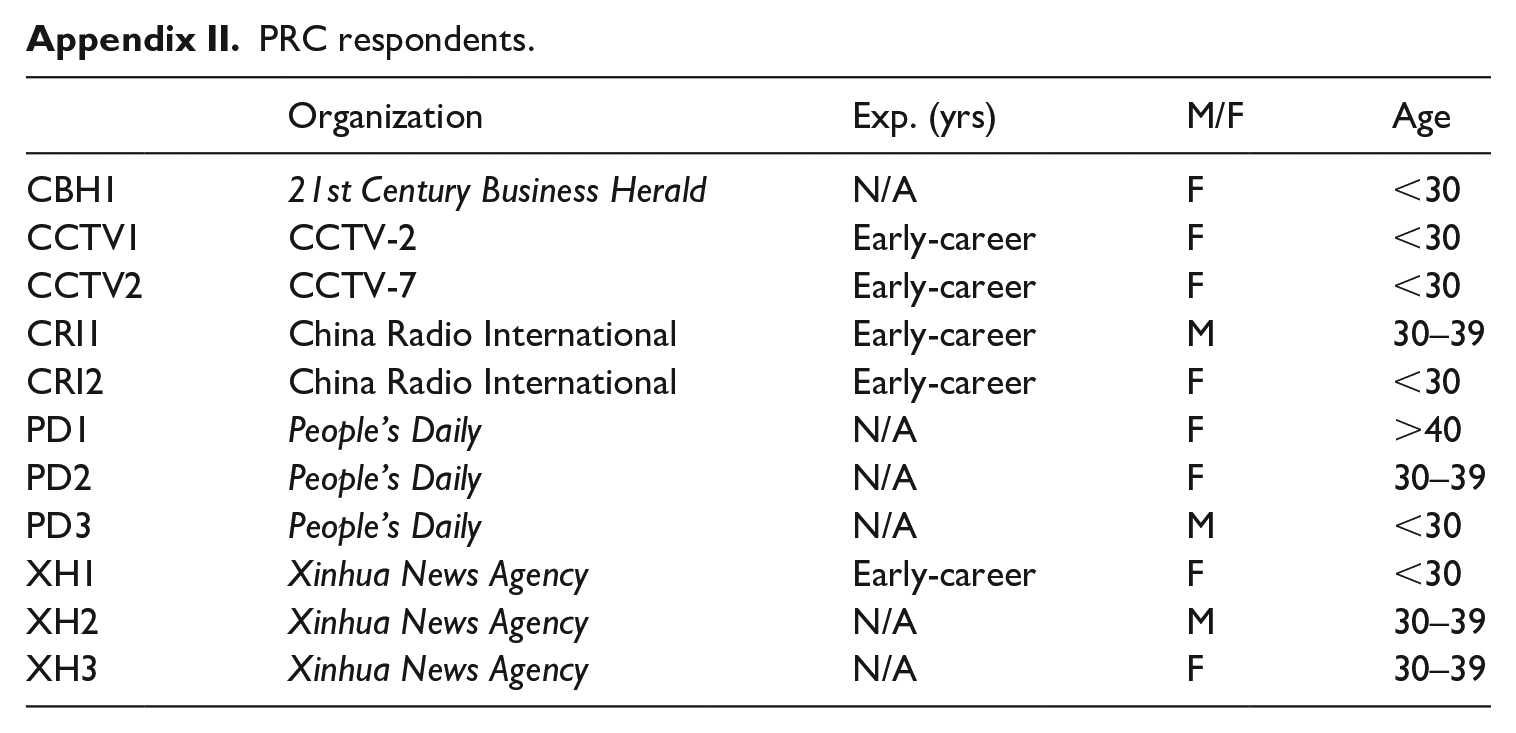
| Organization | Exp. (yrs) | M/F | Age | |
|---|---|---|---|---|
| CBH1 | 21st Century Business Herald | N/A | F | <30 |
| CCTV1 | CCTV-2 | Early-career | F | <30 |
| CCTV2 | CCTV-7 | Early-career | F | <30 |
| CRI1 | China Radio International | Early-career | M | 30–39 |
| CRI2 | China Radio International | Early-career | F | <30 |
| PD1 | People’s Daily | N/A | F | >40 |
| PD2 | People’s Daily | N/A | F | 30–39 |
| PD3 | People’s Daily | N/A | M | <30 |
| XH1 | Xinhua News Agency | Early-career | F | <30 |
| XH2 | Xinhua News Agency | N/A | M | 30–39 |
| XH3 | Xinhua News Agency | N/A | F | 30–39 |
Acknowledgements
Thanks is given to the research assistants for this project: Hu Yemeng, Yu Qian, Waramet Lavanavanija and Wiratchai Pongkoh. Special thanks is given to Jane Singer for comments on an earlier draft of this paper.
Funding
The author received no financial support for the research, authorship, and/or publication of this article.
Declaration of Conflicting Interests
The author(s) declared no potential conflicts of interest with respect to the research, authorship, and/or publication of this article.
