




Abstract
In this article, we investigate the challenge of hybrid media events of terrorist violence for journalism and analyse how news organizations manage epistemic modes in such events. Epistemic modes refer to different ways of knowing, which are managed by newsrooms through journalistic and editorial practices. We draw from an empirical study of terrorism-related news production in the Finnish Broadcasting Company (Yle). Our data consist of thematic interviews (N = 33) with Yle journalists, producers, and content managers and newsroom observations (14 days) conducted at Yle. The study investigates the data through a grounded theory approach with the aim of creating a theoretical understanding of knowledge production in hybrid media events. The results are drawn from a qualitative content analysis and close reading of the interview data, with the other data sets informing the core analysis. The article identifies seven epistemic modes of relevance to news production in hybrid media events: not-knowing, description, rumoring, witnessing, emotion, analysing and perpetrating. The modes are analysed in relation to three dimensions of crisis reporting: immediate sense-making, ritualizing and transformation back to normalcy. The article finds that although particular epistemic modes are typical to certain dimensions of reporting hybrid, disruptive media events, both the modes and the dimensions also are also merged and intermixed. This condition together with growing amounts of problematic epistemic modes of rumoring, emotion and perpetrating challenge journalists’ epistemic authority in reporting hybrid media events involving terrorist violence.
Keywords
Journalist epistemologies in crisis
Journalists today are facing an increasing challenge of global terrorist violence. Terrorism aims at moral and political instability by adapting extreme communication means to attract attention and visibility in the global media environment (Kraidy, 2018; Nossek, 2008). Terrorist violence as highly mediatized and spectacular breeds the transformation of attacks into media events, which unravel in a hybrid media environment and are ingrained in the affordances and technologies available. We call them hybrid media events (Sumiala et al., 2018; see, e.g. Chadwick, 2013; Kraidy, 2005; Laaksonen, 2017; Sumiala and Valaskivi, 2018). This condition of hybrid global communication in violent media events calls for reconsideration of the position of journalists in reporting and sense making (cf. Katz and Liebes, 2017; Seeck and Rantanen, 2015). In the existing literature of crisis and disaster journalism, reporting in disasters is typically divided into three key phases: immediate sense making, ritualizing and transformation back to normalcy (Thorbjørnsrud and Figenschou, 2018: 335). Special scholarly interest has been given to the ritual role and related affective labour of journalists promoting solidarity and unity in society in the face of major terrorist threat and horror (Riegert and Olsson, 2007; Wahl-Jorgensen, 2019). As Thorbjørnsrud and Figenschou (2018: 336) argue: ‘Through the stories they construct, and voices they select, journalists create room for public rituals, sorrow and support that galvanize the master narrative in a phase of consensus journalism’.
The present-day terrorist incidents in hybrid media environment can rarely be considered linear activities. Instead, they are characterized by simultaneity, accelerated communication and participation of multiple actors (Sumiala et al., 2018). As a result, the order of the three phases of journalistic practices in reporting such events are merged and intermixed, circumstance that has profound epistemic consequences for news production (Carlson, 2020: 235–240). The immediate sense making, meanings, rituals and affects associated with hybrid media events of terrorist violence multiply and are difficult, if not impossible, to control by professional journalism. This type of multiplication and intensification of communication occurs both in terms of time (communication temporally close to the event), scale (range of actors taking part in knowledge production) and space (in geography and in various platforms). As a result, hybrid media events involving terrorist violence provoke a particular type of information disorder from the point of view of journalism (Cottle, 2014). A terror attack and its aggressive mediation in the hybrid media environment create pressure for fast reporting, symbolic management and dealing with an abundance of sources. At the same time an exceeding amount of circulating material cannot be considered fact-based or accurate, as a large proportion is non-factual and/or affective, and includes disinformation, manipulation, circulating rumours, gossip, trolling, and commenting with different motivations and modes of address.
In this article, we analyse how a news organization manages knowledge production during hybrid media events involving terrorist violence. In recent years, epistemology has received increased scholarly interest in response to the transformations within journalism such as digitalization, emerging forms of data journalism, the acceleration of the news cycle, diminished human resources, financial pressure and forms of audience participation (Ekström et al., 2020; Ekström and Westlund, 2019b). This article applies the concept of epistemic modes to identify different ways of knowing, which are communicated by various actors in the production and circulation of a hybrid media event. Different text types (text, images, videos and memes) can be used to express meanings within each mode.
Epistemology refers to the legitimation of claims about knowledge and truth (Lewis and Westlund, 2014). It points to the nature and boundaries of human knowledge about the world and the determination of truth in the process of representation. A fundamental issue in epistemology concerns the work of legitimizing certain types of information as knowledge relative to others. (Lewis and Westlund, 2014: 452). This article contributes to an emerging subfield called epistemologies of digital journalism (Ekström and Westlund, 2019b: 260) by considering how the epistemic authority of journalism is managed in relation to different ways of knowing. In short, our study illuminates the epistemological work that newsrooms carry out in participating in hybrid media events involving terrorist violence and the related heightened attention and information circulation. Although the information disorder occurring in a hybrid media event is challenging for news production, it is also a situation that aids in the construction of the epistemic authority of journalism. Epistemic authority is here defined as the ability of journalists to legitimate their output as valid knowledge about the external world (Carlson, 2020: 232).
The empirical research context of this article is the Finnish Broadcasting Company (Yle). Yle is the national public service broadcasting company in Finland. It has a large regional news network and is the main newsroom in Helsinki. Following the global change of media production trends, Yle has also converged news production for different media outlets into a centralized newsroom that serves online, television, and radio and maintains an active social media presence. The company has developed specific strategies and technological tools to meet the requirements of fast reporting in acute news events. Thus, a detailed analysis of its news operation offers an illuminating case for studying the ensuing heightened attention and accelerated news production in the context of hybrid media events involving terrorist violence (See Sumiala et al., 2018).
Grounded theory approach
The methodological process of this study utilizes data gathered through field work in order to identify, develop and integrate concepts (Corbin, 2017: 301). As part of this approach, the concepts from which the theory was constructed were derived from data collected during the research process as well as in theories of hybrid media events (Sumiala et al., 2018) and news reporting on terrorism (Olsson, 2009; Steensen et al., 2018; Van der Meer et al., 2017). The extent of the different data in this research coincides with that of a grounded theory approach, where data sets may include interviews, observation, documents, videos, memoirs, letters and any other source deemed appropriate by the researcher (Corbin, 2017: 301).
Data and analysis
Data for this study were gathered through a variety of methods: (1) semi-structured thematic interviews with newsroom personnel; (2) observations of newsroom workflows and practices; (3) observations of terrorism-related news production; and (4) reflective accounts from newsroom personnel on three cases of terrorism-related news production. The data were gathered in Yle’s main newsroom in Helsinki in May and December of 2018 and through phone interviews in March of 2019.
(1) The primary data in this article consist of semi-structured thematic interviews (N = 33) with Yle journalists, producers and content managers who had previously been involved with terrorism news reporting. The interview guide touched upon (a) what kind of experiences each interviewee had in terrorism news reporting, (b) the organizational practices at play in these situations and (c) changes, challenges and ethical dilemmas in terrorism news reporting as perceived by the interviewees.
(2) The data included three newsroom observations (14 days) at three different Yle Current Affairs news departments. The observation data included written notes, photographs and recorded staff meetings as background information. The data also included discussions with Yle newsroom personnel (15–30 minutes) which were summarized into written notes. The observation period informed the data collection in the interviews and contextualized the analysis of the interviews.
(3) The data included observations of terrorism-related news production within the newsroom (Liège, 29th of May 2018 1 and Strasbourg, 12th of December 2018 2 ) and following terrorism news reporting in the media on these cases.
(4) The data included reflective accounts from newsroom personnel on three cases of terrorism-related news production (Liège and Strasbourg in 2018 and Christchurch in 2019) which were gathered both in the newsroom and through phone discussions. These reflections included discussions with journalists, producers, content managers, social media editors, visual editors and technical staff and chiefs of different departments which were summarized into written notes.
The newsroom observation illuminated the epistemic structure of the newsroom: the way different departments worked as separate units but also how news production was coordinated by content managers and department producers. The newsroom observations also helped understand the roles of different professionals in the newsroom, the technological infrastructure of the news organization and the journalistic routines at place in everyday reporting.
The researcher’s presence at the newsroom also helped identify suitable interviewees and to understand their role within the news organization. The interviewees were identified through a snowball method: The research theme was introduced at departments’ morning meetings which produced several informants and these interviewees also referenced other suitable people within the organization. Most of the interviews were conducted in separate conference rooms (29) but some opted to do the interview in the newsroom or the cafeteria (4). The duration of the interviews varied from 13 to 61 minutes.
There has been only one event determined as a terrorist attack in Finland (The Turku attack in 2017), but most of the events discussed in the data happened at a geographical distance to the news organization. The terrorist attacks which occurred during the research period were mostly handled as regular breaking news events, and out of the cases studied here, only the Christchurch attack created a hybrid media event of global scale. Because the interviews were made at a considerable temporal distance from actual attacks and their reporting, this meant that the interviewees sometimes commented on their memories of the events being blurry and forging together. However, the data are adapt for identifying epistemic modes and the repetitive practices of managing knowledge production in hybrid media events.
The interviews were transcribed and coded on Atlas.ti, a qualitative analysis software. 3 An initial analysis was conducted through a code list based on our interview themes and relevant theoretical concepts. The code list was refined and supplemented as the coding proceeded, with one code centering specifically on epistemic modes. Coding the interview data enabled us to refine the research problem, and the subsequent questions emerging from the data were: (1) Which epistemic modes are relevant for news production on terrorist attacks; (2) how were problematic epistemic modes managed by the news organization and (3) how do journalists construct epistemic authority in hybrid media events involving terrorist violence.
Seven epistemic modes
The analysis resulted in seven epistemic modes: not-knowing, description, rumoring, witnessing emotion, analysing and perpetrating. The modes were derived by recognizing text segments which included (a) a mention of any information or knowledge forms prevalent in a terrorism news reporting and (b) mention of journalistic practices connected to information or knowledge forms. These text segments were then further analysed to identify different ways of knowing and communicating about perceived reality. The epistemic modes were identified in reflection with research literature on forms of knowledge production in journalism.
In what follows, we present in detail the seven epistemic modes in relation to the three dimensions of crisis reporting in disruptive media event: immediate sense making, ritualizing and transformation back to normalcy (Thorbjørnsrud and Figenschou, 2018). Immediate sense making refers to instant information gathering and sharing – a type of situation awareness – produced by journalists; ritualizing refers to the expressions of sorrow, empathy, solidarity and unity through journalism; and transformation back to normalcy refers to journalism taking up it’s regular reporting and critical watchdog role after the attack. We prefer to call these phases dimensions, because whilst there is a certain temporal sequence to them, they are also overlapping and coincidental as are the epistemic modes. The epistemic modes are summarized in relation to the different dimensions in Figure 1.
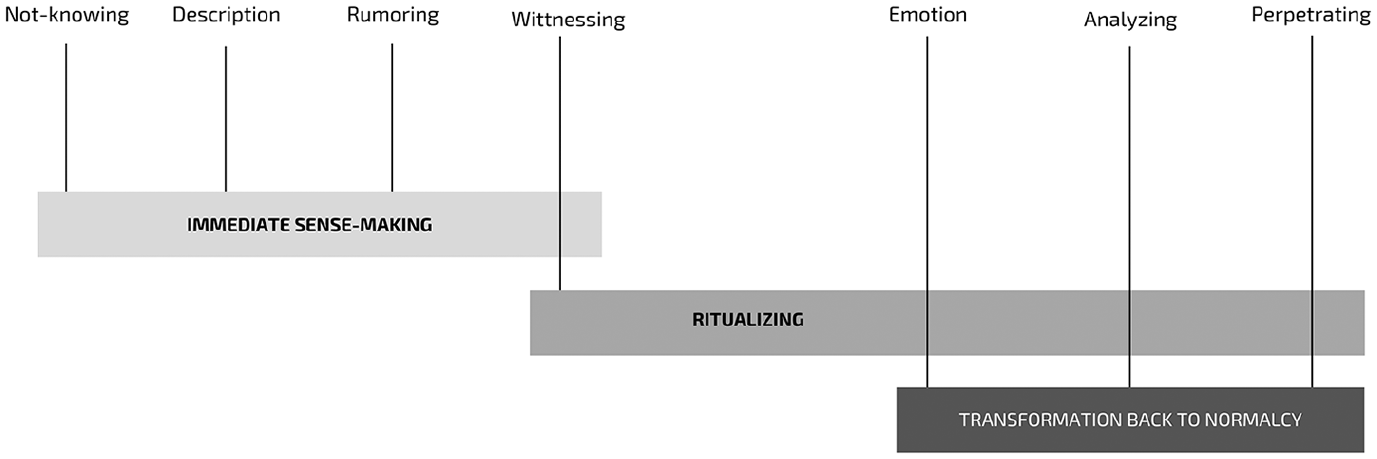
Epistemic modes in relation to the dimensions of terrorism news reporting.
Not-knowing
Not-knowing as an epistemic mode is provoked by the disruption of normalcy, where one knows that something is happening but there is often confusion about the reach of an event and its consequences (Seeck and Rantanen, 2015: 173). Not-knowing is prevalent in the journalistic dimension of immediate sense making. In the interviews, this was expressed as an anticipation and confirmation phase in the newsroom at the beginning of a hybrid media event (I6, I19 4 ). Journalists could recognize the implications of a possible act of terrorist violence, although the situation was still in a state of uncertainty, and it was challenging to obtain verified information from the scene (I22). The mode of not-knowing came up acutely in the accounts of journalists who were news anchors and journalist experts in live broadcasts: their knowledge of the progression of the events was minimal (I14, I16, I26) and they had to repeat whatever facts they had and also comment on the information that was yet unverified (I15, I23). Foreign correspondents also often experienced the mode of not-knowing (I5, I7, I22) on the actual scene of the attack when they had to rely on the Yle newsroom for latest updates (I3, I5). The challenge of the newsroom is to be able to function as an epistemic authority in a mode of not-knowing, and therefore the performance of witnessing enables sense-making even though there is little information to relay.
Description
The epistemic mode of description means narrativizing the chain of events. The mode of description concentrates on the ‘what,’ ‘when,’ and ‘who’ of the event: what exactly has happened; is the event ongoing; and who is the perpetrator. In reporting the first stages of terrorist attacks abroad, Yle relies heavily on international news, foreign newspapers, official Twitter accounts of the local police and government officials, and descriptions from verifiable social media sources (I12, I17, I19, I23). Verified information is also collected from trusted and known sources, such as foreign and national officials, news agencies and major news outlets. Description is a way of immediate sense-making in the event and it is performed in relation to the mode of not-knowing. The aim of the news organization is to take control of the event in epistemic terms, to verify information in order to be able to relay confirmed facts. Through journalistic practices of knowledge acquisition and verification, not-knowing is turned into description (and later on analysing). Because of the difficulty and slowness in confirming information as facts, the descriptive mode is often represented as a repetition of the same information over and over on live broadcast. The ability to modify information online facilitates the possibility to publish facts immediately, but the Yle interviewees underlined that publishing reliable information is their most important goal in these situations.
Rumoring
Rumoring is one way of immediate sense-making, an attempt at interpretations of the event from different viewpoints. Rumours invariably flourish in disasters of different sorts, where unusual events break the routine of life and lead to the formation of rumours (Shibutani, 1966: 32–35). Rumoring is abundant when there is still little confirmed information of the event (I6, I11, I17, I23). The hybrid media environment affords the rationalization and speculation taking place in online communities during and in the aftermath of a terror attack. A typical rumour after a terror attack is the claim that the perpetrators shouted ‘Allahu Akbar.’ 5 Further, reports on multiple attacks, differing victim numbers and reports of several perpetrators are recurring rumours (I6, I7, I8, I9, I14). Rumoring is also visible in different conspiracy theories, which often blossom in online discussions around the hybrid media event. 6 Rumoring begins in the chaotic first stage of the event when the epistemic mode of not-knowing is still prevalent. The news organization uses the epistemic modes of description and analysing to respond to rumoring. For instance, the newsroom may publish articles rebutting circulating rumours to fortify the line between verified facts and rumours.
Witnessing
The mode of witnessing is present in the dimension of immediate sense-making. Witnessing is experienced through one’s own senses; it is active, performed and embodied (Howie, 2015: 507). Peters (2001: 710) writes that ‘The witness is authorized to speak by having been present at an occurrence,’ emphasizing that witnessing involves an epistemological gap whose bridging is fraught with difficulty. In the context of hybrid media events, witnessing is also mediated and performed in, by, and through the media (Frosh and Pinchevski, 2014). According to our data, the epistemic mode of witnessing was actualized: (1) in accounts/videos/pictures published by eyewitnesses themselves in social media (and the incorporation of this material by the news outlet); (2) through reporters interviewing people positioned as witnesses; and (3) reporters acting as witnesses themselves, often foreign correspondents who had been dispatched to the scene (I6, I7, I10, I14, I17, I21). Witnessing is ingrained in the news production process through the use of eye-witness accounts, on-scene reporting and social media material (I7, I10). Being at the scene or relaying eye-witness testimonies is also a way of communicating emotion about the event. In terms of the different dimensions of crisis reporting, the possibility to report directly from the scene is a way of relaying information and aiming to make sense of the event by being present. At the same time offering a live access to the scene is a ritual performance of giving audiences access to ‘important’ events (Seeck and Rantanen, 2015: 167).
Emotion
Emotion refers to the affective dimension of hybrid media events (Sumiala et al., 2018). The epistemic mode of emotion is situated most prominently in the ritualizing dimension of journalism, where shock, horror and condolences as well as collective grief are expressed through media. This mode is prevalent in attacks of massive scale but emotion is also present as an epistemic mode in terrorist attacks which are reported as regular breaking news. In our data the epistemic mode of emotion was expressed in news reporting on the fates and stories of victims, survivors, and rescue workers, by conveying statements from state officials and condolences from foreign state leaders as well as by publishing images of people from the scene in various emotional states (I10, I12, I26). Emotion was also relayed through accounts from correspondents at the scene (I7, I17). In our understanding, the epistemic mode of emotion is integrally tied to witnessing, this means that eye-witnesses and people affected by the event are needed to express this mode. The epistemic mode of emotion is especially important in the ritualized expressions of sorrow, empathy and solidarity (Thorbjørnsrud and Figenschou, 2018: 339). The news organization facilitates the expression and communication of emotions in a ritualized and organized manner: showing grieving people and flowers, candles and teddy bears lay at the scene, interviewing survivors and in some cases publishing memorial pieces on the victims.
Analysing
The epistemic mode of analysing in prevalent in the dimension of transformation back to normalcy. The purpose of analysing is to provide a deeper understanding of the reasons behind the event and it serves the purpose of rationalizing the event (cf. Valaskivi et al., 2019). The mode of analysing is teeming with established and well-spoken experts: military experts, terrorism researchers, and connoisseurs of the area and its culture and religion. This is often done by using established domestic sources, which may imply an overreliance on military sources and state officials (I10, I21). Analysing is a mode reinforced by the newsroom itself as journalists perform as experts in live broadcasts and as journalists write commentary on the event and its reasons (I7, I10). Analysis connects the event to history, to the political, social, and religious contexts of the event and the perpetrators (see Edy, 1999). The attack is also associated with previous violent attacks interpreted as terrorism. This history frames questions asked and assumptions of the social, religious, and political contexts and reasoning in explaining the attacks. Analysing contextualizes the hybrid media event in the larger societal field by contemplating the possible reasons behind the attack and expressing solutions and political means through which similar events could be prevented in the future. Analysis is integral to bringing consensus and order to the event. However, the demands of live coverage and the accelerating speed of circulation in hybrid media events narrow the possible interpretative frames and sometimes leads to instant conclusions that later prove to be hasty (cf. Sumiala et al., 2018, 2019; Valaskivi et al., 2019). One dimension of analysing is also blaming, which is the attempt to find the parties responsible for the attack. This came up as users invoking blame on Yle’s social media page and became visible in the reporting on the Christchurch attack. 7
Perpetrating
The epistemic mode of perpetrating is a mode expressing the view of the person or persons who committed the act of terrorist violence. The perpetrator mode is present in the ritualizing dimension of news reporting, because depending on the cultural background of the attacker, different communicative strategies are used to construct solidarity and normalcy (see Thorbjørnsrud and Figenschou, 2018: 340). The mode of perpetrating is also present in the transformation back to normalcy dimension of crisis journalism, once the attack has been named a terrorist act. In order to label an act of violence as terrorism, the news organization needs to recognize particular social, religious, or political factors behind the act, in contrast to violent acts that are linked to an individual’s mental health. In the case of Finland, there is a historical tendency to avoid labelling an act of public violence as terrorism, especially if the act takes place within the country. Attacks and acts of violence taking place outside of the country are more frequently called terrorism, in particular, when a connection to jihadism can be made (Malkki and Sallamaa, 2018). Our interviewees underlined that they wait for local official sources to name attacks as terrorism (I8, I10, I23). The naming of a violent attack as terrorism is an integral way of constructing normalcy in relation to the attack: the normalcy that supposedly existed before and shall exist after the attack and also the normalcy of us versus them (the attacked culture vs terrorist ideology).
We acknowledge that the seven epistemic modes identified in this study are, to some extent, present in all news production taking place in the hybrid media environment. The conditions of a hybrid media event, however, intensify these modes and create epistemic challenges for news production. Because news organization are familiar with these different epistemic modes, they have constructed journalistic practices to manage these modes in disruptive media events. For instance, our interviewees mentioned that the Yle news organization had reflected upon major terrorism news event reporting within the organization and had created a strategy for reporting on terrorist attacks At Yle. The terrorism reporting practices had been constructed after 9/11 and renewed in relation to the string of terror attacks in Europe in recent years. The news organization also had drills of major news events in order to prepare for the epistemic sense-making process, specifically in the first chaotic stage of reporting. The interviewees mentioned that fast and vast reporting was previously utilized during the European terror attacks, partly because digital media technology made it possible. This, in turn, has created some of the problematic issues with reporting hybrid media events. News competition and the fast pace of reporting seem to require the production of the above-identified modes almost as an automated logic, with no time to question or reformulate ways of knowing about acts of terrorism. In the following, we discuss how journalists manage news reporting in relation to the most problematic epistemic modes.
Discussion – Constructing epistemic authority amid rumoring, emotion and perpetrating
Of the seven epistemic modes, interviewed journalists expressed three as particularly challenging for news production during hybrid media events involving terrorist violence: rumoring, emotion and perpetrating were considered difficult to deal with in relation to maintaining journalistic authority in knowledge production.
Rumoring is the first problematic mode. As pieces of unconfirmed information on a terror attack, for example, rumours, start circulating on social media, news media outlets struggle to verify information (I16, I6). Our interviewees mentioned that social media for instance the comments sections of Yle’s Facebook page challenge the journalistic control of knowledge (I31, I16). Previously, journalists’ authority was based on ‘being there’ and ‘telling there’ (Usher, 2020: 250), but the hybrid media environment has afforded this authority over place to everyone with a mobile phone. This blurs hierarchies of knowledge production. In epistemological terms this relates to the rise of ‘I-pistemology,’ a cultural process whereby hegemonic knowledge from official institutions and experts is challenged and even replaced by the authoritative position of individuals’ personal experience and opinions (Van Zoonen, 2012). Witnessing – that is, sharing personal experiences and opinions of the violent event – becomes problematic for news production when individuals or instances spread fabricated or unverifiable information or create one-sided descriptions of the events and, thus, stir fear and panic among audiences. The informants commented that social media also directs journalists’ attention and resources toward rumours that might turn out to be false.
Because of these problematic effects, rumoring has had to be confronted by Yle journalists. For instance, journalists wrote news pieces aimed at correcting facts and counteracting spot-on false statements that were being circulated online (I17, I32). Our interviewees expressed that confronting rumours was integral to the newsroom process by publishing facts; through this action, they were able to prevent fear-mongering within the media event (I15, I23, I33). Rumoring was also muted by not opening comments sections on terrorism-related news stories on the Yle news site. Furthermore, our data demonstrate that journalists used the mode of not-knowing to balance and confront rumoring during hybrid media events involving terrorist violence. This was applied in live broadcasts by repeating whatever little information that journalists had on the event as well as pointing out the facts about the violent event that were unknown at the time (I23). In fact, the communication of not-knowing can be seen as a way of constructing epistemic authority within the hybrid media event. The presence of journalistic news production in hybrid media events counteracts the circulation of rumours and disinformation, a practice through which the authority of journalism to relay facts is performed.
A second problematic mode in the process of journalists’ knowledge production of hybrid media events involving terrorist violence was emotion. As discussed earlier, the epistemic mode of emotion is key in hybrid media events for communicating shock, fear, bravery, heroism, unity, compassion, as well as anger and hate. This mode is also integral in the journalistic ritualization of the event. The emotions surfacing after terror attacks are an elemental part of terrorism-related news reporting: interviewing eye-witnesses, visualizing grieving by showing flowers and stuffed animals at the site of the attack, and sharing stories of heroism on the scene (I6, 10, I12, I26). Yle also interviewed psychologists and crisis experts to assist audiences in dealing with the emotions spurred by the event (I23, I24). A section of the audience often reacts to terrorism-related news reporting in an angry manner, blaming certain religious or cultural groups for the attack and news reports for concealing the facts about the terrorist attack (I9). Consequently, we observed a type of institutionalized resistance (Wahl-Jorgensen, 2013: 131) to certain expressions of negative emotions in terrorism-related reporting. This could be interpreted as affective discipline (Rantasila 2020; Valaskivi et al., 2019), which is utilized in news production to contain (socially) undesirable expressions of emotion by controlling discussions and containing the circulation of emotion.
In our data, affective discipline seemed to appear in two ways in relation to the hybrid media events involving terrorist violence. First, news production seemed to discipline the emotional expression of the journalists. In fact, the journalists themselves claimed that they did not delve into the mode of emotion in the reporting situation because of the need to work effectively and professionally in the acute news situation (I2, I4, I15, I19, I33). Wahl-Jorgensen (2013) argues that emotional expression is heavily policed and disciplined within journalism. Journalists are restricted in their own emotional expression, and as such, they rely on the outsourcing of emotional labour to non-journalists (Wahl-Jorgensen, 2013: 130). Almost all our interviewees who had experience in crisis reporting situations mentioned that it was an adrenaline-packed and exciting event but that personal emotions were nonexistent at the time of reporting (I6, I7, I15, I19, I23, I26). However, the emotional practices of crisis reporters are believed to lie at the core of the paradox of the traditional commitment to objectivity/detachment and the witnessing of other people’s suffering (Kotišová, 2017). A few of our interviewees mentioned that an emotional impact could surface after the acute reporting, on the anniversary of the event, or even in dreams (I5, I11, I15, I19).
Secondly, affective discipline could explain the practice of Yle disallowing audience comments on their stories on crime-related stories or accidents. According to our interviewees, this is both a legal and resource-related issue. Online commenting on news stories is minimized both because of the mass of unwanted aggressive and racist commentary that terrorist attacks often activate and because staff resources are tied to reporting on the event itself. However, during terror attacks, Yle does direct resources into moderating its Yle Facebook page, where commenting remains open (I19). Here, the interviewees mentioned that in addition to deleting comments and reporting inappropriate comments on Facebook, the moderators bring an epistemic authority to the discussion: they may check facts, ask for sources on certain claims, and remind audience members to keep their commenting suitable (I4, I21). Although the Yle interviewees implied that, during hybrid media events, they aim to stay connected to audiences by following online discussions and reacting to commentary online, they also expressed that the news organization had to restrict and control emotions expressed in a hostile or racist manner in the aftermath of the events. The ability of audiences to communicate emotions through social media creates friction in the shared ritualized expressions of sorrow, empathy, solidarity and unity, which journalists aim at managing through the above-mentioned measures.
Third, a particularly problematic epistemic mode for journalists was that of the perpetrator. Journalists struggled to strike a balance between the simultaneous need to provide information about the perpetrator and contain the circulation of the perpetrator’s ideology and aims (I1, I8, I9, I23). Especially individual attacks with Islamist connections have previously received excessive attention in relation to the scale of the attacks (I3, I8, I11, I18). This problematic reaches all the way to the perpetrator potential trial, which is often the last phase of the terrorism news reporting process. For instance, in Norway, the news media were restricted from covering Breivik’s explanation of his reasons behind the attack (Frey, 2013: 60).
In our data it came up that journalists relied on the mode of perpetrator in order to shed some light on the motivations of the offender, as in the case of the Christchurch attacks. This was carried out by investigating the perpetrator’s social media accounts, social connections, and other possible online material. Journalists regulated the attention given to the perpetrator mode and, thus, performed epistemic authority on their own platforms. However, regulating attention is difficult in a hybrid media environment because the message of the perpetrator is also echoed through other epistemic communities that are activated during a hybrid media event. These communities can glorify as well as condemn the terrorist act by circulating the perpetrator’s posts and materials. For the interviewed journalists, this circulation presented a challenge because rumoring and hateful comments were sometimes published on the platforms of news outlets, which in turn had to be controlled and moderated (I9, I23). Thus, the epistemic mode of perpetrator is interconnected with that of rumoring. The perpetrator mode is also problematic in the hybrid media environment because of the ability of the attacker to spread their views online even on the news outlets’ platforms. Figenschou and Thorbjørnsrud (2017: 948) note that the terror attack by Breivik resulted in the Norwegian news media restructuring and professionalizing control of online debate fora. Terrorists using participatory platforms for planning attacks impelled news organizations to rewrite their role in terrorism-related news production.
Our study shows that journalists are conscious of their role in the circulation of meaning, even if they recognize that in a hybrid media environment, information and images circulate regardless of the publication decisions of traditional media outlets. The interviewed journalists pointed to a recent development change toward downscaling terrorism-related news production: not using the full potential of the news apparatus for every attack (I1, I3, I6, I8, I11, I19, I21) (see Uusitalo and Valaskivi, 2020). The main change to terrorism-related news production has been the critical consideration of the perpetrator’s epistemic mode (I3, I8, I21). In practice, there is an effort to report only minimally on the perpetrator’s point of view in order to avoid glorifying and giving attention to the offender. To exemplify, in the Christchurch terrorist attack in 2019, the perpetrator created a live feed of the massacre on Facebook. The affordances of the hybrid media environment were thus used to commit violent acts and communicate the perpetrator’s viewpoint. The reaction of news production to this in Finland, however, was restrained, and the news organization carefully avoided publicly amplifying the perpetrator’s voice. In reporting the Christchurch attack, journalists were also cautious about reporting details of the perpetrator’s manifesto so as not to validate it. This can be seen as an attempt to direct and manage the circulation of meanings and influence the formation of the hybrid media event.
Problematic epistemic modes are present in all three dimensions of crisis reporting. Rumoring is problematic for the immediate meaning-making dimension but also for creating ritualized expressions of solidarity and unity and for transformation back to normalcy: online epistemic communities may have different interpretations of the event and communicate emotions which contest the consensus of national unity, for instance. The perpetrator mode is present in ritualization of solidarity and unity, whilst it also creates problematic emotional outbursts in online environments. Despite the problematic modes, the three dimensions of crisis reporting form a powerful script which epistemologically steers a news organization’s reporting of hybrid media events.
Conclusions
News journalism is among the most influential knowledge-producing institutions in modern society and is associated with reputable claims of providing relevant, accurate and verified public knowledge on a daily basis (Ekström and Westlund, 2019a). In violent media events, news media also have the role of creating unity and consensus during the disruption of perceived normalcy. However, the hybrid media environment and related media events have profoundly complicated the previously one-directional communication between professional production and public reception of violent media events (Katz and Liebes, 2017). The proliferation of media channels, information and knowledge paradigms and the circulation of meaning complicate the formation of the epistemic authority of journalism (Carlson, 2020: 231–238).
News journalism is one of the knowledge institutions with a special claim and relation to ‘truth,’ despite growing audience distrust in news organizations in recent years (Van Zoonen, 2012: 57–60). The challenges of acquiring knowledge in a hybrid media environment – characterized by infoglut (cf. Andrejevic, 2013), speed, and new forms of knowledge – merge with the problematic of trust. This has generated a historically new dilemma for democracy, where the grounds for establishing and legitimizing ‘truth’ have become destabilized (Dahlgren, 2018: 22–23). In the broader picture, this may contribute to the ‘epistemic crisis’ of news media. Steensen (2018: 185) maintains that discourses of disinformation and the general datafication of society render dubious the ways in which journalism assesses sources and information in its production of knowledge.
Our research found that especially three epistemic modes remained problematic in the news work of the interviewed journalists (i.e. rumoring, emotion and perpetrator). These modes present epistemic contests (Carlson, 2020: 240–242), where journalistic knowledge production is contested and sometimes undermined. This also challenges the dimensions of journalistic crisis reporting; immediate sense-making, ritualization and transformation back to normalcy are all contested at different points of reporting by the presence and significance of different epistemic communities on social media. As Simon Cottle states, disasters are epistemologically constituted in and through local and global flows of media and communications through online networks. This results in ‘a new cacophony of voices and views’ circulating and infusing disasters communications, both helping and challenging official claims and goals. (Cottle, 2014: 17.) At the same time, social media platforms are invaluable sources of information for journalists in the early phases of immediate sense-making, often offering the first snippets of information on what has happened. Social media outlets, especially Twitter, have been adopted by journalists as a mechanism for user-generated content, as news organizations gather eyewitness reports in real-time, at least if the information can be verified (Hermida, 2012: 663).
Our research on epistemic modes in the news production of hybrid media events involving terrorist violence provides new empirical knowledge on the ways in which journalists manage modes of knowing in such acute situations. We have also discussed how these epistemic modes are situated in relation to three dimensions of crisis reporting. As our study demonstrates, the seven above-identified modes are highly context-driven, complex and intertwined with each other. As practices in and of journalistic news production on terrorism, the seven epistemic modes are best described as heavily connected to the hybrid media environment in which they come to exist. In the reporting of a hybrid media event involving terrorist violence, these modes provide journalists with the means to navigate in an acute state of information disorder, make choices in such situations, and allow to follow certain shared conventions. The modes help journalists to orchestrate such events, anchor meanings, and bring order to situations of chaos and confusion. Nevertheless, some of these modes, namely rumoring, emotion and perpetrating, also appear highly problematic and challenging for journalists in the news production of hybrid media events involving terrorist violence, forcing them to constantly negotiate and try to strike a balance between different expectations (e.g. the need to disseminate information and not serve the goal of the perpetrator) associated with producing news in such situations. These issues were also critically reflected in the interviews and mirrored against the recent history of terrorist media events.
From this perspective, epistemic modes play an important, though ambiguous, role in managing not only ways of knowing but also in outlining the epistemic authority of journalists in the different dimensions of news production of hybrid media events involving terrorist violence. We hope to have demonstrated that this authority is anything but solid, simple and straightforward in such situations. Instead, it appears to be highly intersectional, in-between and under constant flux – in a word, hybrid. We argue that there is a need to conduct more research on how such hybridization of journalistic authority might influence the issue of journalistic ‘truth’ in the news production of hybrid media events involving terrorist violence in the kinds of hybrid media environments in which we live today.
Footnotes
Declaration of conflicting interests
The author(s) declared no potential conflicts of interest with respect to the research, authorship, and/or publication of this article.
Funding
The author(s) disclosed receipt of the following financial support for the research, authorship, and/or publication of this article: The article was funded by the Academy of Finland (Funding decision No. 326642, Hybrid Terrorizing, HYTE research consortium).
