




Abstract
The article investigates how the regional newspaper Nordlys facilitates public debate in the Arctic region of Norway. In 2014, Nordlys launched Nordnorsk debatt, a new development of the traditional letters to the editor, offering possibilities for audiences to comment and participate in public debates online. The article is based on a study of 883 opinion pieces posted on this website in 2017 and 2018. We analyse the individuals who access Nordnorsk debatt; we identify role and formal positions of the participants, and what issues they engage in. We also discuss how Nordnorsk debatt might contribute to dialogue and diversity in the regional public debate. We find an increasing engagement over the 2 years and a variety of issues brought into public discussion. Although the debate forum has a broad scope of participants, the analyses suggest that it is primarily a forum for the elites. Despite this, even if grassroots representatives do not dominate the agenda, their opinion pieces are mostly shared and disseminated.
Introduction
Journalism and civic participation are closely interlinked, as the news media are regarded as important for democracy and public debate (Ahva et al., 2015; Ihlebæk and Krumsvik, 2015; Nielsen, 2015), and democracy requires open access to public institutions and resources for knowledge (Heikkilä and Kunelius, 1998: 73). Technological changes have opened new channels for audience participation (Ahva and Wiard, 2018; Josephi, 2016), establishing audience-inclusive perspectives on the functions of news media as crucial (Peters and Witschge, 2015: 20). One the one hand, new channels and new arenas can be seen to strengthen democratic values and contribute to diversity in public participation. One the other hand, one might argue that the public sphere becomes more fragmented and political deliberation poorer in the digitised mediated landscape, where common frames of references vanish (Sunstein, 2007).
Local media fuel dialogue and deliberative democracy, facilitating the local or regional public sphere where citizen participation has become vital (Ali, 2017: 7). In the European context, Norway stands out with its characteristically decentralised press structure and a high-volume newspaper readership (Høst, 2019). The context of local communities appears as a fruitful ground for assessing participatory journalism and its democratic potential – both online and offline – as local traditional newspapers are often seen as being naturally close to citizens, allowing them to engage and foster community integration (Ahva and Wiard, 2018: 65).
Participation in journalism encompasses a variety of activities (Ahva and Wiard, 2018; Carpentier, 2011, 2015). The traditional letters to the editor section in newspapers conveys to readers the possibility to comment and express opinions on several issues of collective interest. However, the Internet has radically transformed the scope of participatory opportunities, and the newspaper industry has expanded its participatory services online (Ihlebæk and Krumsvik, 2015: 472). Thus, the news media are fulfilling several purposes, including facilitating public discourse, promoting civic engagement and providing a forum in which diverse voices can be heard (Nielsen, 2010: 22; Silva, 2012: 250) . Being a part of the democratic-corporatist model, the Norwegian media system is, among others, characterised with a surviving advocacy tradition that considers the media important for different social groups to have a voice and for diverse ideologies to be communicated (Hallin and Mancini, 2009).
In this paper, we explore audience participation through a case analysis of the regional newspaper Nordlys, published in the Arctic part of Norway. In 2014, Nordlys launched a website called Nordnorsk debatt, consisting of both opinion pieces from the audience (letters to the editor) and columns written by columnists. This innovative venture represents a development of the traditional genre of letters to the editor, offering new digital tools for citizens to comment and participate in in the same public sphere as columnists. The purpose of this paper is to explore the participating potential in the mediated public through the research question: What characterises access to Nordnorsk debatt, and how does this arena contribute to dialogue and diversity in the regional public debate? Based on a content analysis of opinion pieces from the audience, we will discuss who gets access, which perspectives and parts of society they represent and what issues the audience engage in. Further, we analyse the sharing of opinion pieces on Facebook. In a previous study, we conducted an analysis of the editorial columns of Nordlys (Mathisen & Morlandstø, 2016). Our purpose in this article is to further elaborate the similarities and differences between the content made by the columnists of Nordlys and the audience and discuss how this contribute to diversity in local debate.
This article is organised as follows: First, we explore the theoretical ground included in elaborating the concept of participation and connecting it to diversity in the public sphere. Before discussing our findings, we explore the Norwegian media context and present the data and methods used.
Democracy and participation
Theoretically, this study is rooted in institutional theory (Allern and Blach-Ørsten, 2011; Cook, 1998), emphasising that the news media fulfil distinct needs in society, circulating information, enabling public debate and organising the public sphere. Institutional theory underlines news media as societal institutions fulfilling a public role within democracy (Nielsen, 2015). The public discourse, managed by the news media, implies that a common space of political and cultural conversations and experiences are available for citizens (Gripsrud, 2017: 42). This common space constitutes the public sphere: a communicative space where a society organises discussions. The public sphere is a virtual structure with real consequences for, and genuine connections with, the political and material realities within which society exists (McNair, 2018: 159).
Democracy is often being paired with the concepts of diversity. Media diversity describes the idea that content available should reflect the varieties of user preferences, identities and ideologies that exist in society (Sjøvaag and Kvalheim, 2019: 296). One of the pillars in the Nordic media model is press subsidies aiming to sustain diversity, to secure public debate in smaller communities and to provide locally relevant source of information (Syvertsen et al., 2014). A diversity of voices in the mediated agenda is seen as a democratic prerequisite. The more variety of perspectives are represented on the mediated agenda, the more diversity.
Democracy demands that citizens have access to an arena for public discussion to take place, and within a local context, citizens require a local public sphere (Hess and Waller, 2017: 8). Through opinion journalism and letters to the editor, newspapers can contribute to shaping and articulating public opinion (Wahl-Jorgensen, 2008: 70). Citizens are regarded as social and political agents who may become part of society and the public sphere through opportunities that journalism offers for public debate, self-representation and co-deciding (Ahva, 2017: 146; Carpentier, 2011: 67). However, the public are not generally considered a space or sphere but are a result of publishing and constant public action (Heikkilä and Kunelius, 1998: 76).
Digital technologies provide ‘myriads of possibilities for the readers to participate in the debate and to interact with the news or the publication’ (Hermida, 2011: 14). These increased possibilities might strengthen democratic values (Josephi, 2016). A Swedish study on citizen opinion writers concludes that the writers aim to influence citizens and society and that their practices enable them to grow as participating citizens (Larsson, 2014: 88). However, scholars also describe a more fragmented public sphere in times of digitisation, where the shared frames of reference disappear, and political deliberation becomes poorer (Sunstein, 2007).
Participatory journalism refers to a variety of practices – implicating the active role of audience and citizens – that connect the concept to the public sphere (Ahva and Wiard, 2018; Borger et al., 2013; Carpentier, 2011, 2015). However, the concept of participation has remained somewhat vague because of its diverse usage (Carpentier, 2015: 9). Participation is tied to citizenship and how citizens are represented in public (Ahva et al., 2015). In several works, Heikkilä and Kunelius (1998) and Ahva et al. (2015) discuss participation based on the three steps of access, dialogue and deliberation. Participatory practices should first provide access for citizens to gain visibility in journalism and pay attention to citizens as public actors (Ahva and Wiard, 2018: 67). Access leads to the question about who gets in (Ahva et al., 2015), who is qualified to be (re)presented in journalism, and in what capacity or role they are represented (Heikkilä and Kunelius, 1998: 71). After gaining access, the possibilities of dialogue emerge, and this takes us a step further. Dialogue is about how to produce exchange and two-way communication with decision-makers, experts or political opponents (Ahva et al., 2015: 157). Dialogue refers to the idea of discussion, debate or conversation taking place inside the space created by journalism, and that journalism is presumed to open a forum for public debate (Heikkilä and Kunelius, 1998).
The third step is deliberation, shifting focus to the efficacy of participation beyond the immediate mediated interaction and the possibility to make a difference (Ahva et al., 2015; Ahva and Wiard, 2018). Deliberation is tied to representative democracy and emphasises the idea that ‘citizens can play a role in the formation of public opinion and decision-making’ (Ahva and Wiard, 2018: 67).
Carpentier (2011, 2015) discusses a similar three-step model of participation, using the concepts access, interaction and participation. Carpentier’s model places participation both as the third step and as the outcome of the process. In further analysis, we will lean on Heikkilä and Kunelius (1998) and Ahva et al.’s (2015) concept of access, as we primarily measure who is accessing Nordnorsk debatt, as well as identifying in what role and capacity they do so. Second, we will discuss how this arena contribute to dialogue and diversity in public debate.
Regarding participation, the letters to the editor is considered a vital way to connect the audience to the institution of journalism, making it possible for readers to comment and express opinions (Silva, 2012: 250; Wahl-Jorgensen, 2007).The opinion pieces under study in this article might be placed within this traditional genre. According to McNair (2000: 108, 109), the letters fulfil three different functions: direct representation in the public sphere of citizens, providing a space in which debate can take place between citizens, and a means of communicating public opinion to politicians. The genre has strong historical roots, being a cornerstone of the newspaper’s role and central to the success and identity of early newspapers (Wahl-Jorgensen, 2007). However, the digital media environment surpasses this possibility (Borger et al., 2013: 125), and the newspapers have actively expanded participatory services online due to both democratic ideals and financial motivations. However, the digitalisation has also created massive challenges when it comes to editorial practices and moderating (Ihlebæk and Krumsvik, 2015).
Nielsen (2010) states that letters to the editor constitute a participatory potential of mediated public debate. However, he also underlines that it represents a fragmented and an as yet integrated institution ‘. . .for understanding for whom letters might facilitate participation’ (Nielsen, 2010: 25). Based on a study of Danish letters to the editor, he finds that 75% of the writers are men, 23% are formal representatives, and 77% ordinary citizens. Further, he finds that young adults, retired people and unemployed individuals are under-represented. The latter corresponded with a US survey and resulted in Reader et al. (2004) concluding that people who write letters to the editor are older, wealthier and better educated than the average citizen. Nielsen (2010: 33, 34) concludes that the letters represent the role of newspapers as facilitators of vertical political communication and discursive contention between citizens and representatives.
The Norwegian media context – and Nordlys
A distinct characteristic of the Norwegian media landscape is the decentralised press, consisting of 223 editions being mostly local and regional (Høst, 2019). Further, both newspaper circulation and readership have been comparatively high (Høst, 2019) and this diverse press structure characterises Nordic countries (Hallin and Mancini, 2009; Syvertsen et al., 2014). The local press in Nordic countries remains of key importance, particularly in Norway and Finland (Syvertsen et al., 2014: 55), described as the backbone of the Norwegian media structure (Høst, 2019). This diversity is vital in securing public debate in smaller communities. It also reinforces local identity and supplements the national news arena (Syvertsen et al., 2014: 70).
In this decentralised mediated landscape, Nordlys appears as a typical Norwegian regional newspaper. Nordlys is published in the town of Tromsø 1 in the northern part of Norway and is the largest newspaper in the region. Distinct opinions from a regional viewpoint have always been its vital aim (Christensen and Tjelmeland, 2002: 392) . During the party-press Nordlys was a labour newspaper. After the decline of the party press, opinion-based journalism and the facilitation of public debate in the northern region became important to legitimise the institutional role of the press (Christensen and Tjelmeland, 2002: 467ff).
In 2014, Nordlys launched its commentary innovation Nordnorsk debatt online: a website part of nordlys.no containing opinion-based content such as editorial columns and letters to the editor. It aimed to facilitate debate in the regional public sphere (Mathisen & Morlandstø 2019a). The website publishes several letters to the editor from the audience every day and each one with a comments field beneath. A Facebook account is needed to submit opinion pieces and the website shows how many shares on Facebook each contribution has. The newsroom receives about 70 opinion pieces each week and publishes 80% of them, while the rest are refused. 2 Refusal is mainly due to political extremism or mass-distributed texts without any regional anchoring. When submitted, the opinion pieces are read and moderated by the debate editor before being published. The newsroom does not follow any strict procedure for moderating the comments beneath the articles; however, out of experience they close the comments field for some topics (for example, Sami issues). 3 All audience contributions and comments are open as the newsroom does not allow anonymous participation.
Nordnorsk debatt is connected to a general rise of opinion-based or interpretative journalism. Commentary journalism is described as a rapidly growing genre (Esser and Umbricht, 2014), also in the regional Norwegian media (Author, YYYY). By establishing Nordnorsk debatt, Nordlys connected opinion-based journalism with opinions from the audience, aiming to stimulate, facilitate and increase regional debate by creating a debate arena with low entrance. The editor-in-chief highlights the democratic potential of Nordnorsk debatt, stating that ‘the more who participate in public debate, the better it is’ (Mathisen & Morlandstø 2016). Opinions also stimulate sharing and social media discussions that generate online traffic, making opinion pieces and debate important contributions to the branding of the media company (Krebs and Lischka, 2017).
Data and method
To answer the research question; what characterises access to Nordnorsk debatt, and how does this arena contribute to dialogue and diversity in the regional public debate?, our methodological approach covers a content analysis of opinion pieces from the audience. As we perceive Nordnorsk debatt to develop and exceed the traditional genre of letters to the editor, we will use the concept of opinion piece from the audience further in the article. The study sample takes 883 articles from January, February and March in 2017 and 2018. The content analysis has been chosen as it can help draw a picture of audience participation on the website. We will discuss the following variables: who is participating, which roles/titles participants have, which part of society they represent, and what issues the audiences engage in. In addition, we will analyse the occurrence of the sharing of articles, to discuss the dissemination and reception of opinions in the regional public sphere.
We have previously conducted a content analysis of the opinion-based journalism (columns) on the same website, in January, February and March of 2015, 2016 and 2017 (Mathisen & Morlandstø 2019a). The empirical data for the former content analysis covers a total of 244 signed editorial columns. Later in the text, we draw attention to our previous study by comparing the editorial content with contributions from the audience.
Heikkilä and Kunelius (1998) and Ahva et al. (2015) discuss the concepts related to participating in journalism as solely theoretical. Our ambition is to investigate these concepts empirically by analysing access to the mediated debate and how the participation contributes to dialogue and diversity in the public sphere. However, a study of the dialogue to its full potential would require analysis of two-way communication between groups of citizens and between the newsroom and the audience. The impact of deliberation may only be assessed by broadening the scope of methods and analysis to other contexts (other media, policy-making documents, etc.), which is beyond the ambition of this study. Taking these objections into account, we still find these referred conceptual discussions valuable to support insights in audience participation.
A limitation of this study is that it relies on a single case study. Further, our data contain the submitted opinion pieces, whereas comments in the comments field beneath the posts are excluded. The strength, however, is a thorough case study of audience participation on the website over a period of 2 years. Further, even if we have not analysed the comment fields, we can identify the sharing of opinion pieces between audiences. This provides us with important information on the reception and dissemination of opinions in the regional public sphere. In addition, the comparison between audience participation and columnists from our former study will also enable us to discuss similarities and differences between professional columnists and citizens.
The authors have coded half of the submitted articles each and conducted a reliability test by reading 10% of the coded material. The reliability score is from 86% to 90% for the different variables, which is satisfactory in relation to general reliability requirements (Krippendorf, 2004).
Roles and topics
In total, 883 opinion pieces from different audiences were published on the website in January, February and March of 2017 and 2018. The number of opinion pieces increases substantially from the first year to the next (390 to 493, respectively). Undoubtedly, Nordnorsk debatt represents access to the public sphere by letting citizens bring forth voices and viewpoints. The concept of access refers to who is getting in, who are the participants on this debate forum, and in what capacity or role they are represented.
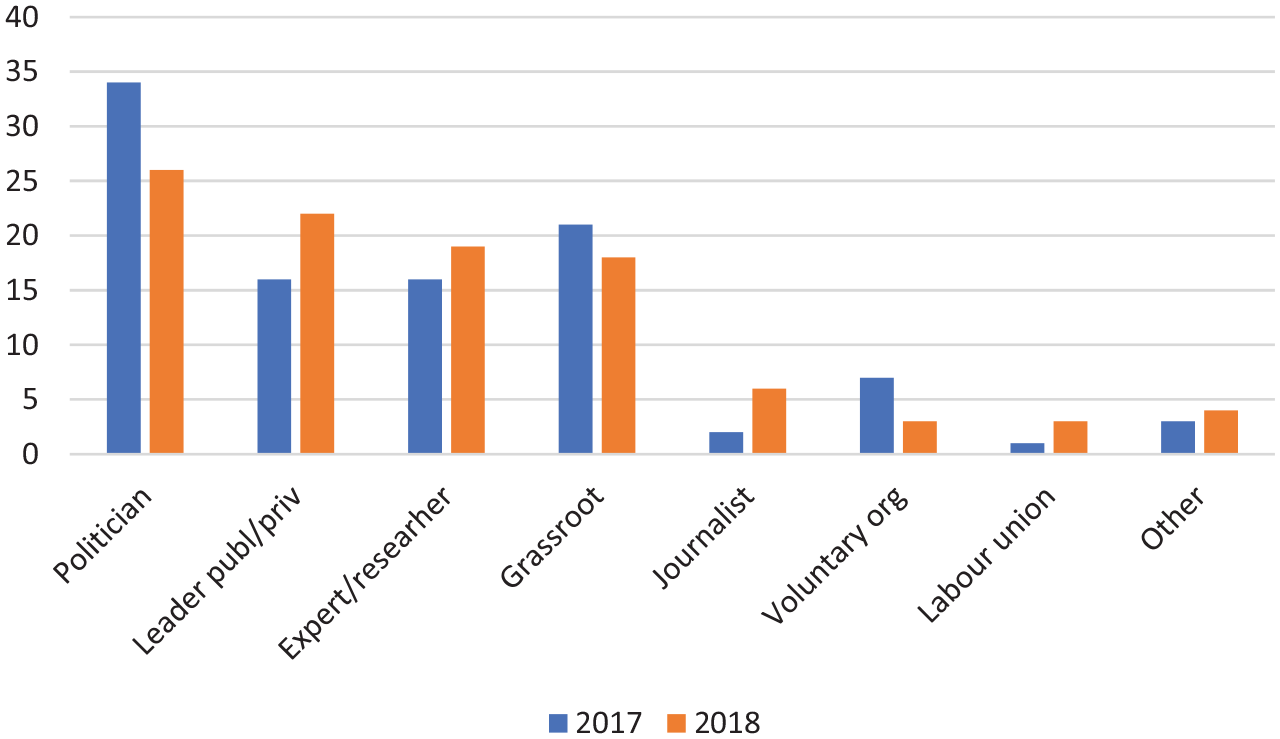
We first separated young people (children and students) and pensioners from adult actors. We found that young people and pensioners participate to a much lesser degree than others (1%, N = 11 and 7%, N = 59, respectively). This finding corresponds with other studies of participation in letters to the editor (Nielsen, 2010; Reader et al., 2004). Further, we find that 29% of participants on Nordnorsk debatt are women and 71% are men, which is approximately the same as Nielsen (2010) found in his Danish study (25% women and 75% men). In Figure 1, we have separated the roles or formal positions of the participating audiences.
The roles of participants in 2017 and 2018 (%).
In a democratic perspective one might argue that the more voices heard in public debates, the better, as it would reflect a diversity of user preferences and identities (Sjøvaag and Kvalheim, 2019: 296). As can be seen in Figure 1, most of the participants are elite individuals: politicians, 4 leaders in the private and public sectors, and experts/researchers. At the same time, we find that on average, over these 2 years, 19% of participants represent ordinary women and men – grassroots people. Even if we identify a slight decrease of grassroots participants in 2018, approximately one in five participants represent the grassroots community. They raise their voice in the public sphere through engagement not related to any formal position or role. This corresponds with former studies, concluding that journalism prefer elite sources. Yet, local and regional press more often interview grassroot voices than more prominent national media outlets (Mathisen Morlandstø 2019b). Wahl-Jorgensen (2008: 75) states that the opinion pages in national British newspapers are viewed as the elite opinion; however, this is contrasted by local and regional newspapers that offer a space for ordinary people to voice their concerns. This might lower the entry for grassroots people in local and regional publications such as Nordlys, making it more likely for them to participate in a local and regional public sphere over a national one.
Still, on average for the 2 years, almost 70% of participants on Nordnorsk debatt represent some sort of elite position, as they act out formal roles and positions in society as leaders, experts or politicians, and the share of leaders and experts increased from 2017 to 2018. Nielsen (2010) found the opposite in a Danish study of letters to the editor, where 77% of participants were ordinary citizens.
Low participation from voluntary organisations (NGOs) is also worth reflecting upon. As Wahl-Jorgensen (2007: 41) argues, a letter to the editor is an opportunity for activist groups and social movements to have their say. However, these voices do not seem to take an active part in the debates on Nordnorsk debatt, and their participation substantially reduces from 2017 to 2018.
These findings make it reasonable to question whether this Arctic debate forum has simply become an arena for the powerful elites in society. When launching Nordnorsk debatt, the editor stated that they wanted more female and youth participants on the debate sites (Author, YYYY). Three years later, we observe a low presence of these groups. Nordlys enables access, the first step as described by both Ahva et al. (2015) and Heikkilä and Kunelius (1998), however, very little actual participation by women and young people. Of course, as elites represents power and decision-making, it is reasonably that they take active part in public debate. A debate dominated by grassroot voices could also provide the elites the possibility to simply ignore grassroot-viewpoints on this platform. When grassroot and elite voices coexist in the same public space, they must relate to each other, and it contributes to diversity of voices participating in the public debate.
From an institutional perspective, the news media is organising the public sphere, which makes it relevant to elaborate the topics that are set on the agenda.
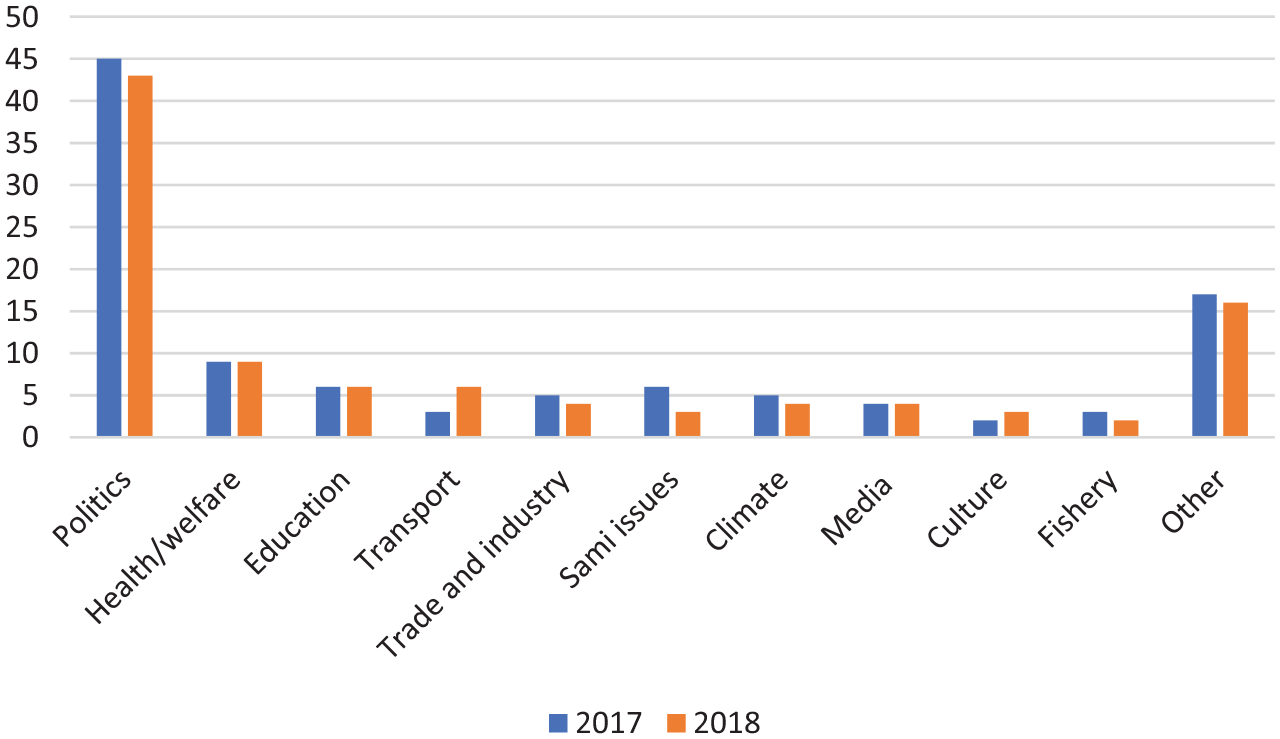
As can be seen in Figure 2, politics dominates the agenda and is remarkably larger in number than other topics. Politics is defined as opinion pieces discussing political parties, politicians and matters in ongoing political treatment to be decided by political authorities. Politics has always been a vital part of public debate, and the institutional role of the news media is about mirroring and encouraging opinion-making: a role tied to the political public (Mathisen & Morlandstø 2016; Graham, 2013). Further, the letters to the editor section is an important arena to communicate public opinion to politicians (McNair, 2000). Regarding this, a large amount of political issues on the agenda is not a surprising result. The mediated public sphere conveys an important possibility for extended dialogue between citizens and politicians, between the ruled and the decision-makers.
Topics addressed by the public in 2017 and 2018 (%).
Further, we found that health/welfare, education, transport, trade and industry are topics that, on average for these 2 years, are set on the agenda in approximately 5% of the articles. Sixteen percent of the debate articles are other topics than those listed in Figure 2. However, none of these other topics makes up more than 2% each, and they contain topics such as immigration, crime, working conditions, the oil industry, defence, regionalisation, family life, and tourism.
To summarise, we can state that the audience places a variety of topics on the agenda, and support diversity. Nordnorsk debatt becomes an arena where a diverse range of topics are discussed in the public sphere and brought into the opinion-making process. Apart from the fact that the share of political matters is declining somewhat in 2018, Figure 2 shows posts about transport that increases at the expense of trade and industry, Sami issues and climate from 2017 to 2018. It is difficult to identify the reason for this, but the debates often follow the news agenda set by the newsrooms (Mathisen Morlandstø 2016).
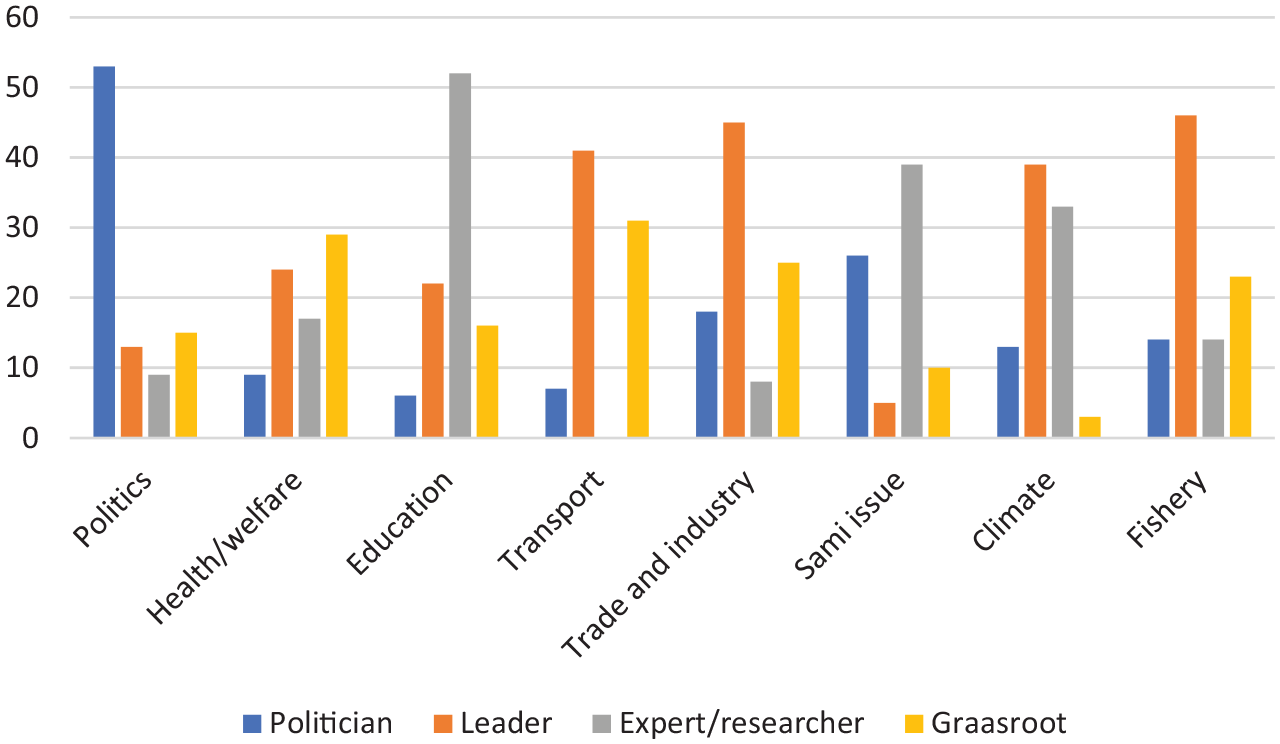
To shed light on audience participation in the public sphere, it is of interest to elaborate on the kind of topics the different groups of participants engage in. Figure 3 shows what topics the politicians, the leaders, the experts and grassroots representatives set on the agenda most often.
Topics addressed by different groups of participants (percent).
Figure 3 shows some differences worth reflecting upon. We see that grassroots representatives are more concerned with topics such as health and welfare, education, transport, trade and industry, and fisheries, especially when compared to the politicians. We also conclude that the leaders more often want to discuss topics such as transport, trade and industry, climate, and fisheries than other participants. The expert/researcher group discuss education far more often than the other groups, and engage in Sami issues and climate topics as well. Not surprising is that politicians are the main group wanting to put political issues on the agenda. Following this, we underline that the more varied the participation, the more diverse the topics brought forward to discuss in the public sphere.
Through the innovation of Nordnorsk debatt, Nordlys is undoubtedly offering access in a new, digital arena. The public sphere, managed by the news media, implies a communicative space where society organises discussion (Gripsrud, 2017), and Nordlys constitutes such a communicative space with increased participation from 1 year to the next. From a democratic perspective, participation from a diverse range of voices is vital, giving different groups access to the public sphere, and bringing a diverse range of topics to the agenda. Nordlys aims to stimulate regional public debate with low barriers for citizens to participate. However, those represented are mostly powerful elites, which constitute a limitation of who want this access, and thus might also be characterised as an unrealised democratic potential.
Dialogue and diversity
The second step of Heikkilä and Kunelius (1998) and Ahva et al. (2015) is dialogue, which is concerned with journalism’s role in facilitating dialogue. We will discuss how Nordnorsk Debatt might facilitate dialogue and diversity in the regional debate, and start with a more thorough elaboration of the large category of political topics. Further, we will identify what kind of political topics the audiences put on the debate agenda when politics is the case, and compare to the topics raised by the columnists in our former study.
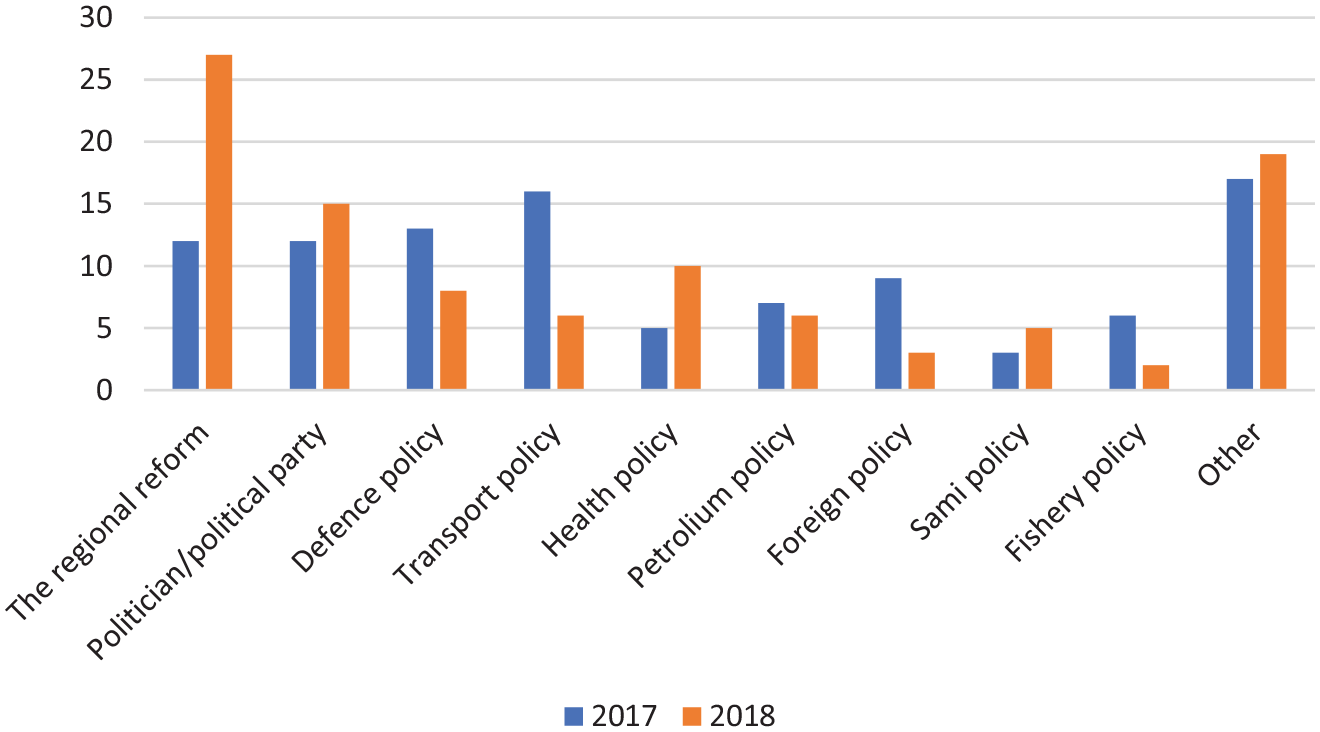
According to Figure 4, the political topic attracting the most attention over these 2 years was the regional reform: where the government decided to reorganise Norway into fewer and larger counties. This provoked both support and protest, conveying deep tensions in several parts of the country. In the northern region, the discussion was loaded, and the conflict lines were deep between those who wanted to sustain the existing three counties (Troms, Finnmark and Nordland) and those arguing for a move to two or one big, arctic region. The columnists of Nordlys made a clear stance, arguing for the latter. This political battle is reflected on Nordnorsk debatt – both by the columnists (Mathisen & Morlandstø, 2019a: 82) and, as we can see in Figure 4, by the audience. On average, over the 2 years, 20% of the opinion pieces from the audience about politics, focused on this reform, with increasing engagement in the second year when the political decision had to be made.
Political topics addressed by the public in 2017 and 2018 (%).
We also see that engagement surrounding politicians/political parties and health policy increases from 2017 to 2018. The latter is primarily related to a decision by the city council in Tromsø about reorganising the local health care service, which evoked citizen engagement before the resolution was made. The large civic engagement related to both the regional reform and the health care might be examples of how audiences are enabled to express themselves, to protest or agree, and thus to take part in the dialogue (Ahva et al., 2015) with other citizens, columnists and politicians, before the final decision is made. Like this, Nordlys facilitates vertical political communication, where citizens and representatives are given discursive contention (cf. Nielsen, 2010). In line with McNair (2018), Nordlys offers a space to communicate public opinion to politicians, which also enables participants to influence citizens and society (cf. Larsson, 2014).
The other increased topic from 2017 to 2018, namely the politicians or political parties, is the second largest political topic among the audiences. Our previous study also show that when commenting politics, politicians and political parties was the largest category among columnists (Mathisen & Morlandstø, 2019a: 82). Scholars have discussed how political journalism and columnists favour political games, struggles and scandals, rather than mere political issues (Allern and Pollack, 2012), which also seems to be the case when audiences and citizens engage in the public sphere. However, we also see the audience engage in political issues such as defence, transport, petroleum and foreign policy, 5–10% for each political topic, even if the number of topics decreases from 2017 to 2018. Further, Sami policy and fishery contain about 3%. Even if these policy areas do not constitute a large amount of the content in total, they contribute to broaden the scope of topics.
Turning into topics in general, we see that politics is the topic both columnists and audiences most often write about. Forty-one percent of the editorial columns from 2015 to 2017 are about politics, while the audience put politics on the agenda in 43% of their contributions. Regarding differences, audiences and columnists give attention to different topics. After politics, the audience are mostly debating health and welfare, education, transport, Sami issues and the climate. Except politics, the columnists are mostly concerned with trade and industry, media, and culture and sport. Based on these differences, we might conclude that when the audience are let access on Nordnorsk debatt, the scope of topics discussed in the regional public sphere are broadened. Thus, audience participation contribute to diversity on the mediated agenda. As a new digital debate arena, Nordnorsk debatt facilitates the possibility of dialogue between different groups of participants.
Shares and distribution
In the digitised media landscape social media enables dialogue. To further investigate the interactive aspect of participation, we will elaborate the sharing praxis: the degree to which opinion pieces are shared on Facebook between citizens, whose opinion pieces are shared, and which issues are most shared.
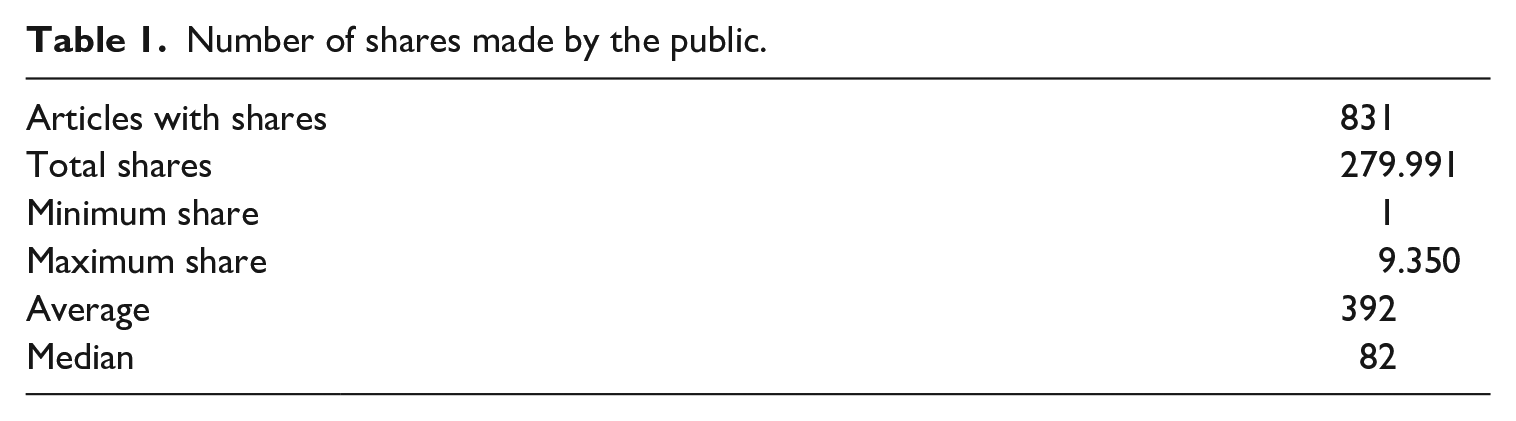
As shown in Table 1, almost all of the published opinion pieces on Nordnorsk debatt in 2017 and 2018 are shared on Facebook. The total amount of opinion pieces with more than one share is 831, 5 and almost 280.000 clicks are related to opinion pieces produced by the audiences. Table 1 also shows that the average number of shares is 392. This is relatively high and is caused by a few articles with a high number of shares. This is also illustrated by the median value of 82, which tells us that there are just as many articles with fewer as there are with more than 82 shares.
Number of shares made by the public.
As shown in Figure 1, access on Nordnorsk debatt is dominated by the elites, with an average 70% of the articles. However, which of these groups of participants sees the highest number of shares?
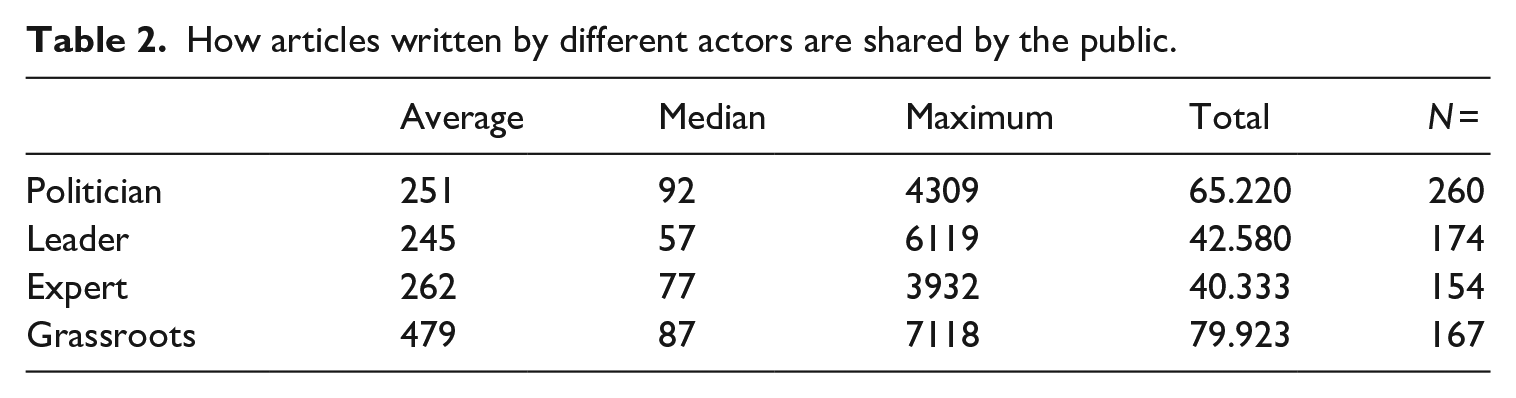
As can be seen in Table 2, the average shares of the grassroots authors are close to double the elite authors’ average shares (479 to 250, respectively). The total shares for the grassroots representatives are almost 80.000, unlike approximately 40.000 for experts and leaders. Political authors see a total share of 65.220. This implies that even if the grassroots participants do not dominate the agenda, their views, arguments and perceptions receive a high range when they first participate. Thus, their views might be likely to impact upon opinion-making processes in society.
How articles written by different actors are shared by the public.
In Figure 2, we saw that political issues dominate on Nordnorsk debatt, and Figure 4 identifies which part evokes the most engagement. Not surprisingly, politics dominates with respect to shares. Which political issue do the audiences share the most?
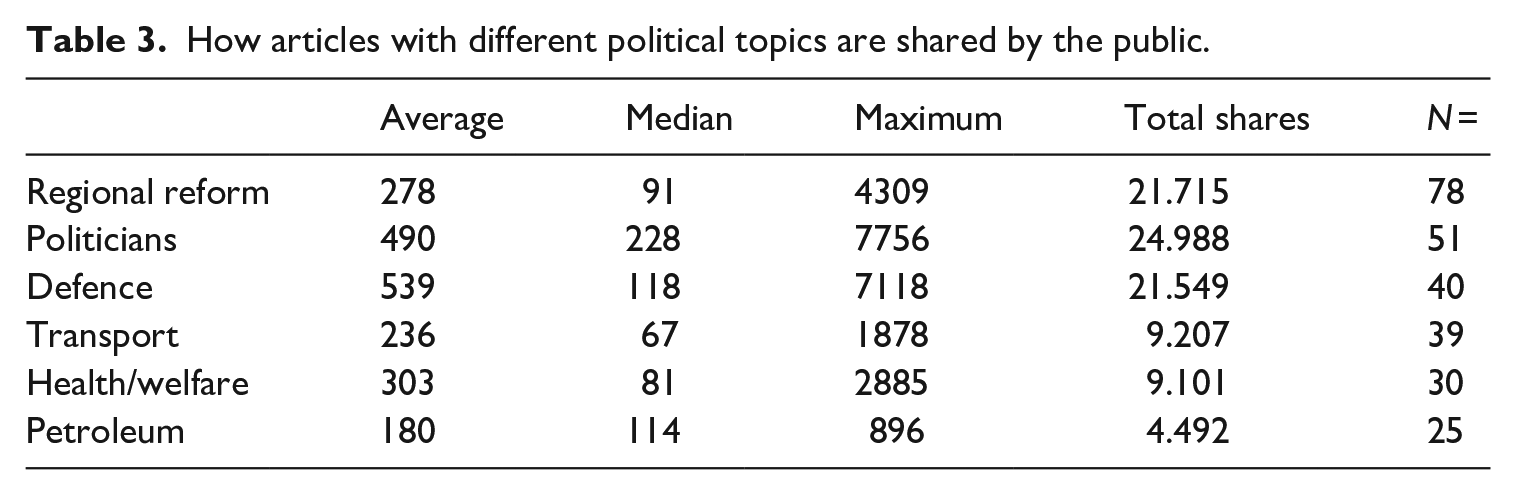
In Table 3, we can see that opinion pieces about politicians or political parties gain the highest number of shares – the second largest topic in Figure 4. Secondly, the most controversial political discussion in this period, regional reform, received the second most shares. The third most shared political topic is related to defence politics. In the northern part of Norway, defence policy sees attention not least because of the closeness of the country’s border to Russia. As Table 3 shows, the shares of defence topics are high, both in the average share and the median value. We can argue that such activity related to ongoing political decision-making processes is an expression of dialogue between political, editorial and grassroots people in the regional public sphere. Sharing on social media also constitutes exchange, as a high range of sharing might enhance civic attention and engagement in a specific case or topic. Thus, following Ahva and Wiard (2018: 67), citizens can play a role in the formation of public opinion through the sharing practice.
How articles with different political topics are shared by the public.
Conclusion
In this article, we have explored the research question: What characterises access to Nordnorsk debatt, and how does this arena contribute to dialogue and diversity in the regional public debate? Being a societal institution, news media are enabling public debate and organising the public sphere (Allern and Blach-Ørsten, 2011; Cook, 1998). With the innovative venture Nordnorsk debatt, Nordlys encouraging citizens to express themselves in the same digital sphere as columnists. As activities increased from 2017 to 2018, we state that Nordnorsk debatt enabled the first participatory step of access, in terms of Heikkilä and Kunelius (1998) and Ahva et al. (2015). Increased participation might suggest barriers have been lowered and that citizens are more likely to take part in public debates at a regional level. On Nordnorsk debatt, individuals argue, exchange viewpoints, protest and support a variety of matters and thus extend the dialogue.
Our analysis concludes that the elites dominate, as most participants on the platform hold formal positions associated with societal power. This finding indicates limited participation and that the platform favours those individuals who are already powerful. Of course, there might be several explanations. For politicians, public debate is at the core of their political work by holding a position that demands them to be active in public debate. Experts and researchers are expected to share their knowledge by taking part in public debate. However, from a democratic perspective, the potential dialogue between the elites and grassroots people is of significant value, and in which the institutional role of the news media is anchored. Elites discussing with each other might encourage fragmentation (Sunstein, 2007) more than the democratisation of the public sphere (Josephi, 2016), the same goes whether grassroot are discussing with each other. However, when elites and grassroot voices coexist in the same digital sphere, as Nordnorsk debatt offers the possibility to, it contributes to diversity of voices participating in the debate.
However, we have found that different groups of participants engage in different topics. We also found that the audience differ to a certain degree from columnists, by prioritising other topics. Diverse participation broaden the public discourse, bringing forth a larger variety of topics to be discussed and becoming the essence of an opinion-making in the public sphere. This might encourage diversity related to topics raised in public debate.
We also find that both the regional reform and local decisions about how to organise health services in the municipality of Tromsø evoke citizen engagement. In both these cases, the access has enabled citizens to express themselves about these specific issues, with the potential to impact on the final political decision. The public sphere is a virtual structure connected with the political and material realities in which society exists (McNair, 2018). Access to Nordnorsk debatt enables participants to influence citizens and society (cf. Larsson, 2014) and to be part of vertical political communication (cf. Nielsen, 2010) in the regional public sphere.
Turning back to the fact that it is mostly the elites discussing topics on Nordnorsk debatt, opinion pieces written by grassroots representatives still gain a significant higher number of shares on Facebook than those written by politicians and others. Further, we find that opinion pieces about the regional reform are the most likely to be shared. This indicates that when individuals from the grassroots level do participate, their arguments and views are more widely spread than elite utterances, thus impacting upon the wider opinion-making processes in society. The sharing practice on social media also conveys an aspect of dialogue, allowing citizens to foster community integration (Ahva and Wiard, 2018). However, we conclude that due to limited presence of group of participants, there seems to be an unrealised democratic potential of Nordnorsk debatt, securing variation and higher access by grassroots representatives. Still, the views of grassroots participants are more widely spread and shared in social media.
We have mainly studied access. Further research of participation is needed to analyse both the second step of dialogue and the third step of deliberation more thoroughly (Ahva et al., 2015; Heikkilä and Kunelius, 1998). Regarding dialogue, a study of the comments field beneath the opinion pieces would be of value. Regarding deliberation, research about how citizens debate in the digital newsroom and how these debates affect political solutions is needed, for instance, through an analysis of political documents.
Even if our analysis is limited to one single case, the conclusions might be of transferrable value and indicate that digital debate arenas with low entrance might contribute to dialogue and diversity in public debate, regarding both which voices that participate, which topics they bring in, and who’s viewpoints that are shared in social media. The increased participation sees the need that citizens have for a common space. In a fragmented digitised media environment traditional media still seems to be of importance for participation and public debate.
Footnotes
Funding
The author(s) received no financial support for the research, authorship, and/or publication of this article.
