




Abstract
The 2018 Skripal poisonings prompted the heavy securitisation of UK-Russian relations. Despite the ensuing tight coordination between the Russian government and state-aligned television, this article argues that in today’s mediatised environment – in which social and political activities fuse inextricably with their own mediation – even non-democracies must cope with the shaping of global communications by media logics and related market imperatives. With a range of media actors responding to events, and to each other, on multiple digital platforms, no state could assert full narrative control over the Skripal incident. Counterintuitively, Russian journalists’ journalistic agency was enhanced by mediatisation processes: their state sponsors, seeking to instrumentalise reporting, delegated agency to journalists more attuned to such processes; yet commercial imperatives obliged them to perform independence and professional credibility. These competing forms of agency clashed with one another, and with that of the audiences engaging in real time with the journalists’ outputs, ultimately undermining the Russian state’s efforts to harness news coverage to its political and security goals. The article concludes that in today’s global communications environment, mediatisation substantially constrains the ability of non-democracies to micro-manage journalists’ treatment of major events relating to national security.
On 4 March 2018, Russian-British double-agent Sergei Skripal and his daughter Yulia were found slumped on a bench in Salisbury. Eight days later, Theresa May announced that it was ‘highly likely that Russia was responsible’ for poisoning the Skripals using a nerve agent, in ‘an indiscriminate and reckless act’ (May quoted in BBC, 2018). As one BBC journalist noted, her statement ‘sounded like. . . if not a prelude to war, certainly like the onset of a serious international crisis’ (Urban, 2018: 248). The poisoning, which later took the life of a local resident, Dawn Sturgess, produced contradictory statements from state-affiliated actors on both sides, as the UK and Russia promoted their preferred narratives. In September 2018, CCTV footage emerged of two Russian suspects later identified through open-source journalism as Russian military intelligence (GRU) agents, who denied their guilt in an interview on Russia’s state-funded international broadcaster, RT. The battle of narratives highlighted the crucial role of the media in contemporary global politics.
This role is widely recognised in academic literature, feeding into a growing body of work on what is often termed ‘information war’ between Russia and ‘the West’. The ‘information-war’ literature foregrounds three interconnected features of Russian media operations. One is the supposedly distinct nature of the Russian media system, in which media communication flows differ from those in democratic polities (Hoskins and Shchelin, 2018: 251). Second, this distinctiveness, it is argued, arises from the effectiveness with which the Russian state, implicitly understood to be a single actor and usually equated with ‘the Kremlin’, manipulates to its own advantage ‘the abundance, connectivity and complexity of information’ (Hoskins and Shchelin, 2018: 251; see also Pomerantsev, 2015). Third, priority is accorded to publics responding to the Kremlin’s message as intended (McIntosh, 2015: 299; Paul and Matthews, 2016). Overall, academic literature implies an effectively coordinated, hierarchically-structured propaganda machine, with the Kremlin as the chief puppeteer of an ‘army’ of state-funded broadcast and on-line actors, including trolls and bots (Hoskins and O’Loughlin, 2015: 1321; Meijas and Vokuev, 2017: 1032; Paul and Matthews, 2016; Pomerantsev and Weiss, 2014: 31).
Missing from the ‘information-war’ account is full recognition of the transformative effects of mediatisation – ‘a process through which core elements of a social or cultural activity. . . assume media form’ (Hjarvard, 2004: 48). The term highlights a more pervasive presence of the media in every aspect of people’s life today, thus being different from the much older phenomenon of mediation, that is, the situation when the media is the most important source of information and channel of communication between governments and citizens (Strömbäck, 2008: 229–231). The dynamics of mediatisation, which are inevitably transnational and include an ever-increasing range of media actors, cannot be instrumentalised as envisaged by proponents of information-war accounts. Indeed, the age of mediatisation is characterised by a complex system of transnational assemblages of actors operating within the hybrid media environment (Chadwick, 2013). State-affiliated broadcasters operate amongst a wider range of actors communicating a range of opinions in record speed through digital media technologies (Hoskins and O’Loughlin, 2010). This contested space accommodates a degree of individual agency, allowing journalists to exploit ‘instances of interaction involving diverse news creators’ (Chadwick, 2013: 74), and the temporary affiliations of media actors. At times such alignments support state-endorsed narratives; at others, they reflect various market-driven imperatives associated with mediatisation (Strömbäck, 2008).
Recognising the impact of mediatisation on Russian media coverage of the Salisbury poisoning, we challenge ‘information-war’ accounts in three ways. First, we suggest that the distinctiveness of the Russian media ecology has been overstated, leading to the misplaced assumption that Russia can be analysed as an isolated outlier, immune to mediatisation effects. Second, ignoring mediatisation leads scholars to inflate the levels of state coordination in Russia’s media campaigns and to underappreciate the agency of individual actors, including Russian state-affiliated journalists, and the digitally-empowered audiences who have become media actors in their own right. Finally, it produces exaggerated accounts of state-funded media executives’ effectiveness at ‘arresting’ chaotic global information flows, and ‘harnessing’ them to influence multiple publics (Hoskins and O’Loughlin, 2015).
We provide a corrective to such portrayals of Russia’s media system, highlighting the journalistic agency within it, and address the following questions: How does mediatisation shape Russia’s state-media-publics relationship? What role do participatory online audiences play in this process? What does this environment mean for the agency of individual journalists, and for Russian news-making?
Mediatisation phases and media events
The concept of mediatisation captures the state of contemporary societies where ‘the media have penetrated the fabric of politics, war. . . and even everyday life, to the extent that they no longer “mediate” events external to them but have fused with those events.’ (Hutchings, 2019: 5). The fact that non-democratic states like Russia are not immune to global mediatisation trends is intuited by perceptive scholars and journalists (Galeotti, 2018; Pomerantsev, 2013) who, however, do not explicitly deploy this concept. It is only recently, then, that a few analyses have emerged of how mediatisation plays out in the Russian context, particularly in relation to the role of audiences and their interaction with ‘traditional’ media outlets in the production of mediated narratives (Bodrunova et al, 2017; Hutchings, 2019; Kalinina and Menke, 2016; Zassoursky, 2016).
The lacuna is unsurprising. Mediatisation scholars tend to foreground media independence as a precondition for mediatisation (Strömbäck, 2008: 233–234), and even promote its potential for deepening democracy (Couldry, 2008), whereas most Russian media research focuses on political control. However, in a global media environment, mediatisation trends do impact non-democratic states, albeit in specific ways. Our examination of mediatisation in the Russian context allows us to highlight similarities and differences in the functioning of media systems in democratic and non-democratic contexts.
Under the conditions of mediatisation, politics becomes increasingly ‘dependent in its central functions on mass media’ and is ‘continuously shaped by interactions’ with them (Mazzoleni and Schulz, 1999: 205). Strömbäck’s theory of mediatisation traces four phases of change in the balance between the political and media logics shaping political communication. Media logic entails news-production according to journalistic criteria, commercial imperatives and technological conditions, prioritising audience interests. Political logic, however, requires the needs of political institutions and the political system to be placed centre stage (Strömbäck, 2008).
At Strömbäck’s first phase of mediatisation, the mass media begin constituting the main communication channel between citizens and politicians. At Phase II, the media cease unconditionally mediating the messages preferred by political actors. It is at this point that commercial imperatives assert themselves in a context when the battle for people’s attention takes precedence over traditional journalistic norms and values (Strömbäck, 2008: 237–240). Landerer goes further, redefining mediatisation itself as ‘the predominance of audience-oriented market logic in political actors’ behaviour in day-to-day decision-making processes’ (2013: 240). At Strömbäck’s third phase, political and social actors must adapt to a fully marketised media logic rather than the reverse (2008: 238). In the fourth phase, ‘more or less consciously [political actors] allow media logic’ and its accompanying commerce-driven standards of newsworthiness to ‘become a built-in part of the governing process’ (Strömbäck, 2008: 239–240).
The case of Russia shows that, even when political control over influential media (e.g. broadcasters) remains much higher than Strömbäck suggests in his democracy-based description of Phases II–IV, the existence of at least partially free internet and social media, as well as citizens’ access to foreign news outlets, provide conditions under which non-democratic politicians have to adapt to the ever increasing mediatisation of politics. State-sponsored journalists, meanwhile, are drawn ever more into the orbit of commercial imperatives and their associated professional norms which do not always coincide precisely with the needs of the state. Furthermore, digitally-empowered audiences increasingly evade control, as ordinary citizens become media actors, and the content of online communications is impossible to subject to comprehensive censorship.
Despite the constraints, non-democratic politicians attempt to harness the process of mediatisation to their advantage, for example, by using new media technologies to flood online space with contradictory messages, so that audiences are confused as to what narrative to believe. In fact, from Vladimir Putin’s first presidency, his government’s engagement with the media has been based on the assumption that ‘the mediated realities replace . . . a belief in objective realities’ (Strömbäck, 2008: 240) that Strömbäck associates with Phases III and IV (Tolz and Teper, 2018). Importantly, however, Strömbäck distinguishes Phase III, when, like Putin, politicians still perceive media as ‘a strategic tool’ external to them (2008: 239), from Phase IV when they ‘internalise’ media logic which ‘colonises’ politics, and when instrumentalisation breaks down under the weight of self-contradiction. Equally important is Strömbäck’s recognition that several phases may be in operation simultaneously, and that ‘different institutional actors in a society’ may attain ‘different phases’ at any one time (2008: 241). This, we argue, describes the situation pertaining in Putin’s Russia, and Strömbäck’s model informs our analysis throughout.
Strömbäck was writing before the Internet, let alone social media, had become a central driver for the mediatisation not just of politics, but of everyday life. Phase IV effects and the severe constraints they place on political instrumentalisations of media therefore makes the situation of current Russian journalists (particularly those at the helm of influential state-sponsored media organisations) markedly different from that of their predecessors in the Soviet, and even recent post-Soviet periods. The Kremlin appreciates that journalists are often better placed than politicians to decide how particular political positions should be framed and in what formats they should be presented to the public. As Tolz and Teper (2018) show, even the most controlled media outlets in non-democratic states – broadcasters – are given leeway to experiment. Therefore, regular meetings between representatives of the Russian presidential administration and media executives tend to resemble brain-storming sessions, rather than fora for communicating top-down instructions (Pomerantsev, 2013).
Assertions that belief in the power of ‘mediated realities’ encourages the Kremlin and its media machine to dispense with facts altogether (Pomerantsev, 2015) are, as we will show, implausible. It is one thing for the Kremlin covertly to use websites of uncertain provenance, bots and trolls whose real identities are hidden in order to systematically disseminate fabricated stories. However, this approach is not an option for state-affiliated broadcasters if they want to meet market objectives and maintain or expand audiences. Even if broad journalistic autonomy – the ‘latitude journalists have within the operational routines of reporting’ (Reich and Hanitzsch, 2013: 135) – is limited, journalists who have higher positions in the institutional hierarchy or are star presenters are able to exercise agency by making important editorial choices in the coverage of specific stories. As our analysis shows, Russian broadcasters need to maintain credibility, keeping their narratives believable and, thus, ‘sellable’.
In discussing the concept of credibility in the media, defined as news needing ‘not just [to] be seen’, but ‘believed’, Vultee argues that credibility (or believability) is ‘constructed between journalists and audiences’ (2010: 14). Journalists are aware of this and when audiences clearly signal scepticism about a particular narrative, a response strategy is quickly designed to preserve audience loyalties and market shares. Thus, mediatisation facilitates two related, but sometimes conflictual, forms of enhanced journalistic agency: the agency afforded to reporters by state sponsors adopting Phase III strategic, media-instrumentalisation logics; and that necessitated by the internalisation of commercial media logics of professional credibility and competitiveness characteristic of Phase IV. The tensions generated when these two forms of agency clash form a key component of our analysis.
State-led missions to harness mediatisation are often compromised by the multi-actor, global reach of ‘media events’, which blur boundaries between major news stories and their mediations. Media event theory originally referred to the closely managed co-production and oversaturation by states and media of ritual occasions (Dayan and Katz, 1994), and was expanded to include ‘disruptive’ events like terror attacks or natural disasters in an acknowledgement of the fact that media events reveal political cleavages as much as shared values (Hepp and Couldry, 2010; Katz and Liebes, 2007). Within an increasingly networked communications environment, the role of audiences as co-producers of media events grows, diminishing the controlling influence of individual states and the dominance of their preferred narratives (Hepp and Couldry, 2010: 24). Therefore, state-affiliated media no longer operate as mere tools to maintain state power or negate temporary challenges to it arising from unanticipated ‘disruptions,’ and the success of state-preferred narratives becomes uncertain.
Domestically, Russian state-sponsored broadcasters have attempted to limit this uncertainty whilst exploiting public interest in disruptive media events, by repackaging long-existing problems as new, disruptive occurrences whose sudden but pre-planned oversaturated coverage makes them easier to strategically manage (Tolz and Teper, 2018). But what happens if a genuinely unexpected disturbance to Russian state equilibrium occurs, triggering over-saturated coverage within a global system in which mediatisation’s logics are fully internalised? Such was the case with the Salisbury incident which was immediately turned into a major media event in the UK. Despite a two-day delay, the Russian side ultimately had no choice but to respond similarly.
Case selection and methods
The transnational media event that developed around the Skripal poisonings was inevitably dominated by narratives of security. Derived from a war context, securitising narratives claim to identify an existential threat to a particular object, demanding rule-breaking approaches to dealing with that threat (Waever, 2011). In security matters, state actors play a crucial role, as they deploy emergency powers and attempt to exert control over the message that is communicated to citizens. Yet citizens must be convinced of the need for such an emergency response, rendering the media framing of the chosen issue critical to securitisation (Gillespie, 2007: 275). Russian state reliance on media articulations of its preferred message and, crucially, the impact of this message on audiences, is thus particularly exposed in the context of security-related media events. Mediatisation works hand-in-hand with burgeoning security discourses, just as it converges with dominant market logics. The fact that the Salisbury poisoning occurred at this three-way intersection makes it a particularly instructive case study.
Our empirical data consist of the outputs of two broadcasters: Russia’s Channel 1 and RT, which were allotted key roles in disseminating Kremlin-preferred interpretations of the Salisbury poisoning to domestic and foreign audiences. Channel 1 is partly owned and funded by the Russian government and partly by Kremlin-loyal private enterprises; RT is a Russian government-funded international broadcaster. We deploy a socio-narrative approach to the news-making dynamics of the Salisbury media event, focusing on how the narratives that drive inter-state conflicts playing out across the global mediasphere are co-constructed by media and state actors, as well as audiences, through ‘processes of collaboration, consensus and coercion’ (Harding, 2012: 292).
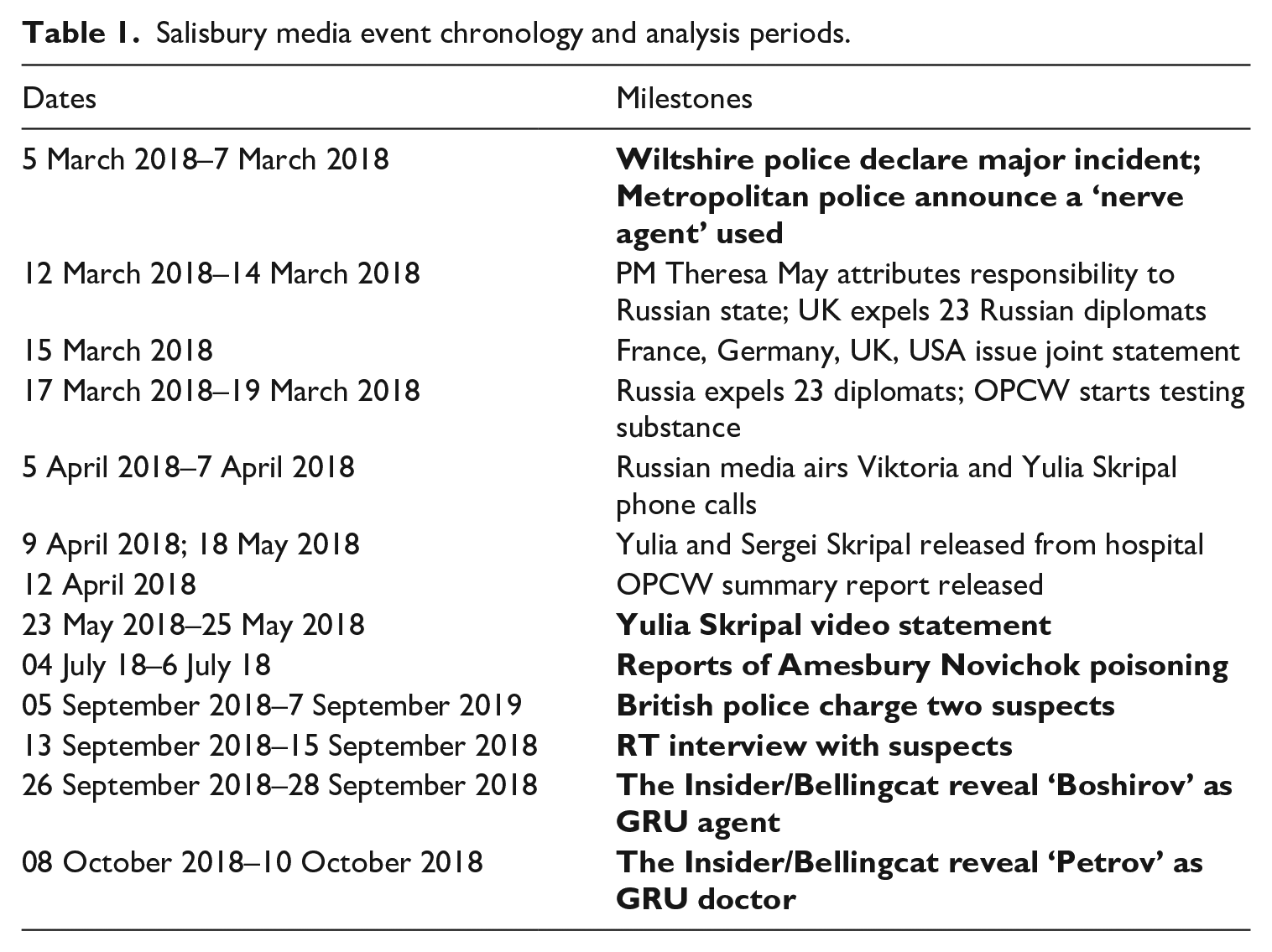
Our analysis incorporates daily news bulletins of Channel 1 and RT in the three-day spans around 13 major developments (Table 1), plus analysis of web stories published within 3-day spans of seven of these (indicated in bold). 1 We also analysed all of the broadcasters’ relevant current affairs broadcasts across the analysis period (using the search terms ‘Skripal’ and ‘Novichok’). We interrogated audience responses by analysing over 600 comments made on a selection of videos that these broadcasters uploaded to YouTube around key developments in the case, focusing particularly on responses to RT’s interview with the suspects. Here we collected comments within the first two hours following the video’s uploading when, for some reason, RT did not switch off the comments section, and when there was little sign of state-affiliated bot or troll manipulation since the overwhelming majority of comments were utterly disdainful of RT and of the Kremlin. Comments were coded inductively according to their main themes which arose from a collaborative analysis of social media comments (Chatterje-Doody and Crilley, 2018).
Salisbury media event chronology and analysis periods.
The power of media logic
The initial framing of the Salisbury incident by both Russia and the UK was as a major security threat. While the UK Foreign Secretary described the poisoning as the first use of chemical weapon on European soil since WWII (Johnson, 2018), his Russian counterpart accused Britain of attempting to destabilise the international order and Channel 1 reporters called the UK’s position a ‘declaration of war’ (Vremya pokazhet, 7 March 2018; 13 March 2018). For both sides such framings were politically expedient. In Russia, the presidential election campaign was underway, and claims about heightened security threats and Western Russophobia could potentially bolster Putin’s position. For the UK, the incident helped burnish the prestige of a government tarnished by its handling of Brexit, whilst enhancing cooperation with the EU.
However, during the 6 months from the first announcement of the poisoning to the release of images of the suspects, there was an information vacuum at the heart of the event, something noted by Independent journalist, Mary Dejevsky, who argued plausibly that ‘both the UK and Russia know more than they have told’ (Dejevsky, 2018). As the Russian government denied responsibility, it, too, obviously refrained from providing Russian media with specific information. The UK government and intelligence services occasionally drip-fed insights. As a result, the incident turned into a media-driven interpretation hotspot rife with speculation, rumour and conspiracy theories. This confusion rendered the crisis a classic example of mediatised foreign policy-making (Esser and Strömbäck, 2014: 13–19), for which traditional approaches based on ‘principled deliberation’ were rejected in favour of media logic with its focus on the unique and the sensational, and on journalists’ role in shaping the public discourse.
Russian broadcasters adopted three approaches derived from the affordances of the mediatised public sphere: media-centricity, a mirroring effect and a meta-level subversion of the very conventions of public engagement with international disputes. Rather than attempting to win a long-term battle of ideologically-driven narratives as during the Cold War, state-affiliated media outlets operating under conditions of heightened mediatisation seek short-term gains related to the traction of individual stories within the hybrid media system. This accorded Russian journalists additional levels of agency, as interpretative frames were co-produced by broadcasters and the Russian Foreign Ministry in accordance with their ability to grab attention of media audiences.
Media-centricity
Media-centricity – focusing coverage of a story on its treatment by other media outlets and bringing outlets or journalists themselves to the forefront of the story – was a key feature throughout the Salisbury crisis. Actions by both states were consistently taken with their subsequent mediation in mind, such as the Russian state-sanctioned telephone conversations between Yulia Skripal and her cousin Viktoria; Yulia’s video interview facilitated by British Intelligence; and the hoax telephone call to Boris Johnson by Kremlin-friendly pranksters.
Russian broadcasters began covering Salisbury 2 days after the first reports in the UK media; Channel 1’s and RT’s initial reactions on 6 March 2018 were limited to summaries of BBC News coverage (RT News, 6 March 2018; Vremya, 6 March 2018). Much subsequent Russian coverage continued to amount to cross-reporting and critiquing UK (and other Western) media narratives. Virtually every Channel 1 talk show from March to September started with a critical survey of UK media. RT reporters argued that the poisoning was a media-driven story in which media speculations had no bearing on what actually happened. On 12 March, an RT reporter introduced a new frame – ‘media frenzy’: ‘[A]mid the media frenzy over the poisoning. . . the attacks today are discussed at the very highest level in Britain’. (RT News, 12 March 2018). The same day, on Channel 1’s evening news programme, Vremya, the Russian presidential spokesman also mentioned ‘UK media frenzy’, contrasting ‘hysterical’ Britain and calm, rational, fact-seeking Russia. The media-centricity was regularly visualised through screenshotted UK news headlines on Channel 1 and RT studio screens. The constant dearth of new developments in the case made such media-centricity even more inevitable.
Media outlets and individual journalists themselves were inexorably sucked into the drama, with a rapidity, and in a manner, over which states exercised limited control, demonstrating that the affordances of Phase IV mediatisation readily mutate into hazards. Thus, RT was forced extensively to cover UK regulator OFCOM’s investigation into its alleged impartiality breaches during the Salisbury crisis, as well as attacks on it as Putin’s ‘propaganda network’ by British MPs (RT News, 18 April 2018; 05 July 2018). On 7 March 2018, Channel 1’s news anchor was drawn involuntarily into a global media story when he opened the main news bulletin with a veiled warning to anyone who contemplated betraying Russia (Vremya, 7 March 2018). This was splashed across Western media prompting the anchor to later report sardonically on his unexpected status as international ‘celebrity’ (Vremya, 12 March 2018).
The mirroring effect
Media-centricity transforms narratives into reverse mirror images of one another (Hutchings and Miazhevich, 2009). This was particularly evident on the Russian side, as broadcasters systematically inverted the meanings of British accounts. For example, the murders of Russian defectors in the UK, regularly referred to by British outlets, were repeatedly cited with ironic undertones by Channel 1 and RT as they strove to neutralise their implications for Russia’s Salisbury narratives. The Russian broadcasters acknowledged potentially Russia-incriminating elements in the British accounts, simultaneously refuting their connection to the Russian state and according the accounts ‘Russophobic’ meaning (Vremya and Vremya pokazhet, 7 March 2018; Worlds Apart, 1 April 2018). Such responses were hastily improvised to bolster narratives whose rapid global remediation and constant need for recalibration reflects the profoundly mediatised environment that generated them. They must be distinguished from the well-honed, selective ‘mimesis’ techniques practiced by Soviet propagandists (van Herpen, 2016) safe in the knowledge that their audiences had minimal access to the broader messaging strategies of their opponents.
The most important ‘mirroring’ narrative centred on mutual claims that the ‘mediated reality’ created by reporting of the Salisbury poisoning had no bearing on ‘objective reality’. UK media persistently levelled this allegation against Russian outlets (Harding, 2018) which applied it in turn to UK and other Western media. An RT journalist adopted this line in the channel’s very first Salisbury report. ‘It is remarkable that with so few facts, the mystery of what’s made Sergei Skripal ill has captured the hearts and minds of journalists in the UK’ (RT News, 6 March 2018). Channel 1, which delayed the start of its detailed Salisbury coverage, first articulated this narrative a week after the incident, with Vremya’s anchor claiming: ‘This is a noisy campaign which appears to be specifically organised for [UK] newspapers and television’ (11 March 2018). The same day, the Russian Foreign Ministry made a similar assertion: ‘We have not received a single piece of evidence. Instead, we are just watching reports on [UK] television’ (quoted on Vremya, 11 March 2018); Putin himself asserted that he ‘found out about it [the poisoning] only from the mass media’ (Vremya, 19 March 2018).
In another gesture characteristic of a fully mediatised operating environment, Vremya’s anchor exhibited an intuitive meta-level grasp of media logic’s market imperatives, asking of The Sun’s Salisbury coverage: ‘Is this a tabloid newspaper method to increase sales?’ (4 July 2018). An RT reporter, meanwhile, commented: ‘You can see why it’s a big story. It’s got all the hallmarks of a Le Carré spy novel’ (RT News, 6 March 2019). To reinforce the narrative of UK media’s market-driven construction of a fake, ‘mediated reality’ Russian broadcasters frequently invoked a SKY TV spy-thriller, ‘Strike Back’, featuring a stand-off between British and Russian agents. Channel 1 and RT incorporated clips from the thriller into news reports, buttressing their claims that accusations against Russia were media fakery (RT News, 18 March 2018; Pust govoryat, 5 April 2018). The most self-consciously provocative reverse mirroring of UK media coverage was the claim made by a participant in a Channel 1 talk show that this reflected a ‘mediated reality’ whose production was tightly controlled by British politicians. ‘I want to tell the viewers . . . Do not think that there is media freedom in the UK. All newspapers cover the story in the same way. This can never happen by itself. [Their] press is tightly controlled by politicians’ (Pust govoryat, 5 April 2018).
Redefining the rules of the game
The tendency to subvert the adversary’s media discourse through meta-level intuitions of its logics and conventions is characteristic of Phase III strategic approaches to mediatisation, as in Russian broadcaster engagement with UK tabloid media. BBC World News’s ‘Beyond 100 Days’ programme, which is more tabloid in its sensibilities than news broadcast on BBC 1, and whose intensely commercialised operating environment sometimes prompted departures from strict BBC impartiality norms, was occasionally included in critical surveys of Western coverage. Most references, however, were to tabloids like MailOnline, The Sun, Daily Express and The Mirror. In part, this is because their engagement in wild speculations offered a clearer target, and in part because of Russian broadcasters’ greater affinity with UK tabloid irreverence than with BBC propriety.
After the first 2 days, engagement with the BBC was restricted to strategically planned initiatives such as the interviews given by Putin, Viktoria Skripal and RT’s chief editor Margarita Simonyan. By contrast, in its daily output, Channel 1 and RT mounted a sustained dialogical, and hyper-irreverent, confrontation with the UK tabloids and it is here that Russia’s attempt to subvert the rules by which political and diplomatic crises are normally discussed began. The approach baffled UK politicians and journalists; on the BBC’s Newsnight, Evan Davis began asking perplexedly of the Russian refusal to adopt an appropriate tone ‘Why are they not taking it seriously? What is their game?’ (6 April 2018). Russia’s strategy, however, matched RT’s long-term self-positioning as an alternative to the mainstream media not only in content (its reporting of neglected stories), but also in style (its adoption of the colloquial register and of mocking humour associated with tabloids and social media). RT rationalises this approach by contrasting the ‘artificial’ impartiality of ‘hypocritical’, mainstream Western broadcasters, and its own ‘authentic’ appreciation of the impossibility of objectivity and acknowledgement of the role of emotions and strong political preferences among audiences (Chatterje-Doody and Crilley, 2019).
RT journalists used their well-honed skills to lead the Russian state’s discursive response to UK accusations. Ironically, however, this meant that whilst Channel 1 reporters could afford the provocative indulgence of blaming UK, US and Ukrainian politicians or intelligence services for the attack (Vremya, 5 April 2018 and 4 July 2018; Vremya pokazhet, 12 March 2018), RT, operating in an OFCOM-regulated environment, was more circumspect, relying on a less brazen form of mocking sarcasm towards accusations against Russia. Meta-level exploitation of the rules of discursive propriety associated with Phase III mediatisation here encounters the less pliant, hyper-networked media environment characteristic of Phase IV.
Nonetheless, RT’s irreverence intensified in the third of our identified periods (17–19 March 2018) which followed the expulsion of Russian diplomats. Thenceforth, its coverage contained pre-prepared entertainment packages that included bizarre emojis seemingly contrived to manipulate audiences’ emotive responses to Salisbury (RT News 18 March 2018). Humorous stories about bad-taste attempts by businesses to market ‘Novichok’-named products appeared as news items on RT’s website between April and July (RT, 2018b, 2018c, 2018d). RT gave headline billing to a hoax phone call to UK Foreign Minister Boris Johnson during the Salisbury crisis, in which Kremlin-friendly Russian pranksters, Lexus and Vovan, posed as Armenia’s prime minister (RT, 2018f).
Both Channel 1 and RT strove to mobilise digital tools to their advantage by selectively citing tweets, Facebook and blog posts that chimed with the Russian position, even though, from the early stages, opinion polls in the UK indicated high levels of blame for Russia (YouGov, 2018). In apparent coordination with the Russian Foreign Ministry, RT began using hashtags in its twitter communications that mocked the UK position, such as #Russiadidit and #highlylikely, adopted by Foreign Minister Lavrov on the same day (RT News, 16 March 2018). This illustrates the subordination of political to media logic as envisaged at mediatisation Phase III, which, however, still permits politicians to reassert a degree of control.
Indeed, speaking on the BBC, a number of political observers watching the ‘battle of narratives’ around the Salisbury poisoning claimed that the Russians put the UK on the ‘back foot’ (BBC News, 5 April 2018). The Newsnight moderator argued: ‘Information seems to come out of the British only after it’s been raised by the Russians. If it is a propaganda war, it’s not felt as though the British are winning. . .’ A leading political analyst participating in the same programme agreed that Russian propaganda is played ‘like an orchestra . . . They are really good at it’ (6 April 2018). However, this widely-held view was shattered thanks to the roles of non-state actors and audiences in the co-production of media events - a quintessentially Phase IV mediatisation phenomenon.
Digital (mis)appropriations, non-state actors and unreliable audiences
Much scholarship has focused on how Russian digital media users unwittingly reinforce Kremlin-preferred narratives (Gaufman, 2015; Meijas and Vokuev, 2017; Szostek, 2018). This trend dominated the early stages of the Skripal story. Later developments, however, demonstrated the limits of any state’s ability to impose their preferred narratives on audiences. While online audience commentators and twitter users lend themselves to selective quotation and manipulation, these actors are not always pliable and can directly threaten mainstream broadcaster narratives. The complex assemblages of actors operating within the hybrid media environment (Chadwick, 2013), can both enhance and challenge the predominance of state-preferred narratives, accelerating the diffusion of agency and creating alternative centres of power offering only transient opportunities for state co-option. As the last stage of the Salisbury-poisoning story demonstrates, this presents heightened dangers to non-democratic governments.
A complex inter-braiding of domestic and international allegiances and audiences informed RT’s interview with the Salisbury suspects. The Kremlin’s initial concern was to keep domestic audiences onside with its hedged account attributing blame to British intelligence, or to other foreign actors. In turn, RT offered more nuanced versions of counter-accusations than those aired on domestic television. Initially, RT’s English-speaking audiences seemed to endorse the Russian line: the 60 videos on RT’s YouTube ‘Skripal’ playlist were viewed more than 1.6 million times, receiving 32,000 upvotes compared with 4200 down-votes. On one video, 73 percent of audience comments referred to a British state conspiracy (Crosstalk, 13 March 2018). Comments on audiences’ forums can be manipulated, of course, and the impact of Russian trolls and bots on those has been widely discussed elsewhere (Jamieson, 2018). However, coordinated Russia-sponsored interventions in these forums might not be as comprehensive, let alone efficient, as is often surmised. RT’s handling of on-line reactions to its interview with the Salisbury poisoning suspects offers a compelling example.
On 5 September 2018, the UK media, with reference to the pain-staking investigative work of UK and Russian ‘citizen journalists’ (Tolz, 2018), reported the identification as suspects of ‘Ruslan Boshirov’ and ‘Aleksandr Petrov’ via CCTV images (the timing of whose release, like that of the Yulia Skripal video, reconfirmed the British security services’ influential media management role). A week later, Putin announced that Petrov and Boshirov had been found, and that they should contact the Russian media. On 13 September, RT released a YouTube video interview, available simultaneously in Russian and with English subtitles (RT, 2018g, 2018h). The interview was conducted by Simonyan, RT’s editor-in-chief, who maintains close Kremlin ties (Seddon, 2016). The interviewees’ answers to Simonyan’s questions elicited universal contempt. 74% of comments analysed in response to RT’s English-language YouTube video of the interview challenged the suspects’ claims. Some English-speaking viewers stated that the interview had changed their opinion of the whole affair: ‘Not a very convincing interview at all . . . I wasn’t doubting the Russian government until I saw this interview’.
The interview also failed with domestic audiences, vitiating RT’s reputation as an agile instrument of the Russian state. In an implicit acknowledgement that it was now impossible credibly to deny Russia’s culpability, Channel 1 allotted minimum coverage to Simonyan’s interview and the revelation of the interviewees’ true identity. Its talk shows, which, in the previous 6 months, reported on the Salisbury case virtually every day, even in the absence of any specific news, ignored this vital development. Indeed, only 6% of the top 100 comments responding to the Russian-language YouTube interview were explicitly hostile to the UK, whilst over 70% ridiculed the suspects and/or Russia. Echoing many on-line comments, one user declared: ‘Until today I perceived this Skripal story as Britain’s provocation. But once I saw these two idiots, my view was shaken.’ Another aptly observed: ‘By posting this video and not disabling comments you’ve dropped yourselves right in the shit.’ Such scepticism filtered into audience perceptions of RT, with 19% of the comments analysed specifically criticising the channel or Simonyan, whose attempts to protect her journalistic identity misfired.
As the interview debacle indicates, online communities and citizen journalists can assume disproportionate importance to national broadcasters, forming complex assemblages with them, and compounding their anxieties over their precarious hold on their most committed audiences. Following the disintegration of the state-endorsed narrative, Putin was forced to alter his own messaging protesting Russia’s innocence, as he branded Skripal a treacherous scumbag (podonok) undeserving of concern (Financial Times, 2018). RT’s continued use of mocking sarcasm, for example, by claiming that the main damage caused by the interview was to Salisbury’s image as a tourist destination (2018a) and its sale of t-shirts bearing inscriptions derived from Simonyan’s exchanges with the suspects, barely improved the credibility of its collapsed narrative with audiences.
The incident underscores a dilemma faced by all states and journalists operating in Phase IV environments. On one hand, the greater the information gaps created by the withholding or slow release of key facts during media events, the more control states exert over their favoured broadcasters. Moreover, temporary alignments with one or more of the multitude of non-state media actors now populating the hyper-networked mediasphere can authenticate the narrative preferences of the states involved (Russia’s with Lexus and Vovan embarrassing the UK’s Foreign Secretary; the UK’s Bellingcat revealing the suspects’ identities). Yet because broadcasters now act within that same environment, the larger the information gaps, the greater the likelihood that diverse other actors will fill them with revelations or speculations, liable to divert state narratives.
Mediatisation and journalistic agency
As mediatisation progresses to its later phases, another set of tensions arises between the political logic of the state actors striving to appropriate it and the increasingly commerce-driven media logic that journalists of all hues are obliged to follow. This was not, however, immediately apparent in Russia’s strictly managed approach to the Salisbury incident. Irrespective of what individual Russian journalists personally thought, they were compelled to embrace the official narrative denying Russia’s culpability. Yet a closer look reveals different levels of agency accorded to Channel 1 and RT journalists, with the agency of latter being significantly more extensive than of the former. Channel 1 took almost a week to report on the case in significant detail. Throughout its Salisbury output, Channel 1’s journalists directly blamed actors other than Russia, polemically and systematically endorsing the Russian Foreign Ministry’s line. A covert example of journalistic agency was apparent in Channel 1’s decision abruptly to cease coverage once Simonyan’s interview had backfired. 2 This was in contrast to Russia’s fully state-owned channel Rossiya, which continued its assertions of Russian innocence throughout the rest of September (60 minutes, 13 September 2019; Vecher s Vladimirom Solov’evym 13 September 2018; Rossiya-24 Novosti 17 September 2018).
RT, however, operates in a different legislative-commercial environment from Channel 1. It competes for audiences as part of a wide package of international media outlets, including Western mainstream media, and RT management is acutely aware of its audiences’ media consumption habits (Seddon, 2016). For this reason, it provided detailed accounts of the unfolding events more promptly than Channel 1. Moreover, even though the channel was sanctioned by Ofcom for breaches of impartiality, RT’s journalists tended to avoid directly assigning blame to the UK or other non-Russian actors. Instead such assertions were usually delegated to external interviewees. RT was also highly pro-active in framing the official Russian position through its trade-mark sarcastic humour when refuting the UK government’s claims.
Intuiting the need to protect their professional credibility in a media environment dominated by narratives hostile to Russia, certain RT journalists were far bolder than their domestic counterpart in signalling ambiguity towards official narratives. In her interview with the father of the assassinated Russian defector Aleksander Litvinenko, Oksana Boyko, RT’s star presenter, explicitly invoked evidence pointing to Russia’s responsibility for the assassination. She challenged Walter Litvinenko’s assertions that his son was killed by US intelligence services (Worlds Apart, 1 April 2018) bolstering that challenge via a visual performance of scepticism regarding her interviewee and a studied distance towards the official Kremlin ‘script’ for her task in bringing him to the attention of anglophone audiences. In a context where Western media constantly linked the Litvinenko and Skripal cases, Boyko’s hedged challenge to Walter Litvinenko’s assertions had implications for her interpretation of the Salisbury poisoning. Significantly, Ofcom found no impartiality breach in Boyko’s interview (Ofcom 2018) which, however, contrasted with Litvinenko’s appearance on Channel 1, where his claims were unquestioningly endorsed (Pust govoryat, 05 April 2018). When appearing on UK media, RT journalists distanced themselves from the Russian line still further. Facing a hostile panel and studio audience on BBC Question Time (15 March 2018), RT journalist Afshin Rattansi openly acknowledged the possibility that the Kremlin ordered the poisoning (also reported by RT, 2018e).
Like Boyko, Simonyan used verbal tone and facial expression to relay her scepticism about her interviewees’ claims. When asked about her interview with the suspects on Channel 1’s Vremya, she refused to confirm that she believed them, insisting that ‘as a journalist I only believe what I see myself’ (Vremya, 13 September 2018). On the day of the interview, she further attempted to re-perform her identity as an inquisitive, truth-seeking journalist in a BBC Newsnight phone interview (13 September 2018). However, she dramatically hung up when the presenter Kirsty Wark, questioned RT’s status as a professional media organisation. Simonyan’s angry exit appeared to be motivated less by Wark’s sudden aggression (Simonyan is accustomed to rebutting Western criticism of RT) than by how this tactic undercut her performance of an identity she presumed to share with ‘a fellow professional’.
These examples suggest that Russian broadcasters performed distance from the Kremlin-sponsored narrative at the point when the credibility of their outlets and/or specific journalists were overtly at stake. This was particularly apparent on RT, whose overall output, contrary to widespread perceptions, is not universally tendentious and includes some quality programming, such as Boyko’s Worlds Apart. RT management has internalised media logic’s commercial imperatives more completely than its domestic counterparts, recognising that without examples of credible journalism, its already modest audience would be eroded. Its star presenters enjoy a degree of editorial autonomy not normally associated with it. Sam Delaney, a British political satirist given his own RT show, commented that he was ‘astounded by the freedom’ he was given (2018). The degree of agency available to journalists traditionally depends on their positions in the organisational hierarchy (Reich and Hanitzsch, 2013). Thus, Simonyan is RT’s editor-in-chief. However, the examples of Boyko, a high-profile presenter, Rattansi, who worked for the BBC and CNN and is entrusted to represent RT when it is invited to appear on UK media fora, and Delaney, whose alternative comedy reinforces RT’s image as a maverick disruptor, indicate that ratings, audience shares, USPs and brand values now assume equal importance to bureaucratic rank in the distribution of agency.
Conclusion
The reporting of the Salisbury poisoning appeared to indicate a reversion to classic media event mode; on the Russian side in particular, the incident’s heavily securitised context prompted a tightly coordinated collaboration between government and state-aligned television in which journalistic agency was subordinated to political mandates. However, closer scrutiny of the mediatised environment in which the Salisbury crisis unfolded reveals that such an account does not fully capture the dynamics of coverage. The growing dominance of media logic and market imperatives within the Russian media system and wider global communications environment complicates the state’s efforts to mobilise television outlets for its political and security goals. Moreover, contrary to the stipulations of much mediatisation theory (Brommesson and Ekengren, 2017: 4), the internalisation by political actors of media logic does not require key national media to be independent. Neo-authoritarian states’ broadcasters operate within this globally connected environment in which multiple independent media providers and non-state actors respond differently to the same events and to each other.
Contemporary mediatisation accords a growing range of media actors extensive access to digital platforms. This decreases state control of news narratives during security crises like Salisbury, obliging them to respond to a proliferation of transnational rumours. Combined with the global circulation of news flows facilitated by digitisation, this in turn means that media events are effectively co-produced by multiple actors and outlets of diverse provenance, making it impossible for single states to maintain control of the narrative trajectories of such events.
When analysing the far-reaching, contradictory influence of the global media environment on journalistic agency, especially in neo-authoritarian states, we should acknowledge tensions and relationships between different phases of mediatisation. On one hand, states like Russia operating within Phase III mode recognise the value of delegating a degree of agency to preferred broadcasters better placed to exploit the new affordances and logics offered by social media than government operatives; they continue to perceive the media environment as a ‘strategic tool’ capable of serving their interests and of informing their own behaviour to beneficial effect; Foreign Ministry officials thus internalised RT’s meta-level intuition of the rules of conventional media discourse, adopting a tabloid-like, hyper-irreverent stance towards them, and towards received modes of diplomatic engagement – much to the bemusement of their opponents.
On the other hand, the accelerated pace and unprecedented reach attained by the circulation of competing narratives compromised the ‘reverse mirroring’ strategy according to which Russian broadcasters strive to utilise media-centricity to their advantage by provocatively inverting the meanings of the attacks on their veracity. This pushes them constantly onto the back foot, pointing to the preponderance of media logic over political logic symptomatic of Phase IV; Putin himself was forced dramatically to change his account of the Salisbury affair following the RT interview debacle. Phase IV, however, also brings with it a second form of enhanced agency specific to state-aligned journalists working within it: that derived from the commercial mandates placed upon international broadcasters. It is this that accounts for the distancing practices adopted by RT journalists required to cleave closely to the Kremlin line; and for the concern with audience credibility and professional reputation exhibited by RT executives and presenters who, as in the example of Simonyan’s hubristic decision to conduct the notorious interview, and her equally unwise sortie into BBC terrain, are as liable to derail as to advance state messaging strategies.
Indeed, through its catastrophic interview, RT ultimately fell victim to the competing agency of the audiences whom it wanted to convince of the unreliability of the UK position and who form part of the complex assemblages of media actors rendering Phase IV of the mediatisation process ever more resistant to state co-option. Thus, media events like Salisbury appear to represent a greater risk for neo-authoritarian broadcasters than for their counterparts in democratic states, because, in the context of transnational media events, sceptical digitally-empowered audiences can ensure that fabricated narratives unravel. The interview’s reception, Russian and international, confirms this insight, challenging perceptions of a fully controlled, hierarchically structured propaganda machine honed for ‘information war’. Kremlin aspirations notwithstanding, Russian broadcasters are subject to the complex vagaries of the same digital news-making environment as their western counterparts.
Footnotes
Declaration of Conflicting Interests

Funding
The author(s) received no financial support for the research, authorship, and/or publication of this article.