




Abstract
Research on economic and financial journalism has left important questions unanswered. Most notably, what exactly are the mechanisms leading up to the well-documented negativity bias in economic news reporting, and to what extent are structural constraints, previously identified in research on financial news production, also relevant in the context of mainstream economic news that reaches out to a broad and lay audience? This study seeks to address these questions by conducting in-depth interviews with 12 economic journalists working for Dutch news outlets (print, online, and television). The findings suggest that negativity is driven more by news values than by journalistic role conceptions, as many interviewees refer to the abrupt temporal dynamics typical of negative events. Furthermore, journalists indicate that gatekeeping processes are increasingly influenced by audience preferences, as indicators such as aging readerships and number of clicks are carefully monitored.
Research has shown how economic news is not a mere reflection of economic reality, but instead is characterized by structural biases, most notably the tendency to overreport negative stories (Soroka, 2006). Most of this research relies on longitudinal data, comparing trends in the real world with news trends over time, and less scholarly attention has been devoted to the underlying mechanisms. It therefore remains an open question why negative economic events are more readily covered in the news (e.g. Harcup and O’Neill, 2001) or why negative aspects are favored in a discursive construction of news values by journalists (e.g. Caple and Bednarek, 2016).
A different strand of research looks into the journalistic routines that shape the production of financial news. Again, coverage is found to be biased, most notably by the absence of truly critical perspectives that challenge the dominant neoliberal paradigm (e.g. Knowles, 2018). Several reasons are identified: A lack of technical expertise among journalists leading to source dependency (Manning, 2013), journalistic considerations regarding the financial literacy of their audiences, and increasing institutional pressures making investigative journalism a risky undertaking (Doyle, 2006). Different from aggregate-level research on economic news and economic reality, this – mostly qualitative – scholarship centers on the mechanisms driving the production of news.
While both traditions offer important insights, they have not fully benefited from each others’ conclusions, as the first focuses mainly on mainstream economic journalism, while the second is predominantly interested in the construction of financial news in specialized outlets. This leaves two questions unanswered. First, while the literature offers some explanations for the negativity bias in economic news, few scholars have verified these conclusions by discussing them with journalists responsible for this output. Second, the question remains to what extent the structural constraints identified in financial journalism are also applicable to the production of mainstream economic news.
This study aims to build a bridge between both research traditions by putting the knowledge from the field of financial journalism to those who report about the economy for a broad and non-specialized audience. We have conducted in-depth interviews with 12 economic journalists working in the Netherlands. Interviewees were asked to reflect on the findings of a quantitative content analysis showing how Dutch economic news is negatively biased and to reflect on the applicability of conclusions from work on financial journalism. The findings are likely to be most valid in contexts that resemble the Dutch one, in terms of media system (Brüggemann et al., 2014) and journalistic culture (Deuze, 2002: 135–136).
Economic news and economic reality
The media’s tendency to systematically devote more attention to negative compared to positive economic trends has been confirmed by a substantial amount of empirical research. Comparing economic news with real economic figures, scholars have identified this type of bias in newspapers (e.g. Soroka, 2006) as well as on television (Harrington, 1989).
Several explanations exist that account for the excessive presence of negative news. The first one refers to the functions ascribed to journalists in modern democracies. Being considered ‘the fourth estate’ (e.g. Schultz, 1998), the media should monitor and control the misuse of political power. To the extent that journalists see themselves as such watchdogs, they tend to be more responsive to negative events compared to positive ones, as their professional focus is more on tracing wrongdoings than it is on highlighting successes. Most often studied in the realm of political journalism, evidence suggests that such role conceptions indeed have an impact on the news that is produced (e.g. Skovsgaard et al., 2013) and that they tend to be similar within a national context (Van Dalen et al., 2012).
The question remains to what extent the watchdog ideal is applicable to economic journalism. Kalogeropoulos et al. (2015) compare business news with political news and conclude that journalists fulfill a watchdog role in both areas. However, interview-based studies with financial journalists indicate that only a minority of them envision such a role for themselves (e.g. Tambini, 2010) and of those that do, only some manage to bring the associated investigative activities into practice (Strauß, 2018). Related is the idea of news functioning as a burglar alarm for citizens. In this view, journalists decide which issues or trends require immediate attention and should be brought to the public. As a consequence, it is logical and even desirable that coverage is ‘intensely focused, dramatic, and entertaining’ (Zaller, 2003: 122), as these warnings should attract widespread attention.
Another angle from which negativity can be explained is news values theory. News values refer to the relative impact of characteristics of news stories – ‘news factors’ – on the selection of stories (Kepplinger and Ehmig, 2006). Journalists act as gatekeepers, continuously judging the newsworthiness of real-world events. News values serve as a system of criteria journalists can rely on. Originally proposed by Galtung and Ruge (1965), classical examples of news values are references to negativity, unexpectedness, and cultural proximity. When these criteria are met, events are more likely to be selected as news. In addition to this causal model of newsworthiness in which news values are inherent features of external events, Staab (1990) proposes a functional model of newsworthiness. To legitimize coverage, news values can also be ascribed to events by journalists. In this view, the negativity bias in economic news could be the result of journalistic choices – making news more negative – to sell a story to their readership.
From a psychological perspective, the journalistic propensity to overemphasize negative events is not so much related to the profession but is the result of a general human inclination toward the detection of threats (Baumeister et al., 2001). People tend to assign greater weight to negative as opposed to positive information because they care more about a loss in utility than they care about a gain in equal magnitude (Soroka, 2006). Yet another psychological perspective points to the role of social validation, especially for journalists who work with ambiguous external realities (Donsbach, 2004). The tendency to index their reporting based on the work and (expected) judgments of their peers, may reinforce inclinations of economic news coverage toward negativity, especially in situations in which a lot of uncertainty is perceived about the actual state and developments of the economy.
In addition, there is some work on the moderating impact of context. When outlets have a clear ideological signature, their economic coverage might become more critical once the incumbent (government/president) is of the opposing political party (Larcinese et al., 2011). Salgado and Nienstedt (2016) examine the moderating role of ideology in the European context. They study Euro crisis coverage in center–left and center–right leaning newspapers across 10 European countries including the Netherlands. Evidence for ideology as moderator is limited: News coverage is contingent on national frames rather than on ideological orientations at the outlet level. Furthermore, Boukes and Vliegenthart (2017) find that popular and regional newspapers tend to cover the economy more negatively than quality and specialized outlets tend to do so.
Of course, the mechanisms driving negativity are not mutually exclusive. A journalist can perceive negativity as a prominent news value because she feels she needs to ring the burglar alarm. And the human inclination to overvalue negative information might only become stronger when working in a profession that seeks to inform the public about power abuse. This study’s purpose is to ask Dutch journalists to reflect on the negativity bias their profession produces and to examine the degree to which these most dominant explanations in the literature resonate among them. Therefore, the first research question is as follows:
RQ1. How do Dutch economic journalists explain the negativity bias in economic news reporting, reflecting on the dominant explanations in the literature?
The construction of financial news
A mostly qualitative strand of research looks into the construction of financial news. This type of journalism reaches out to an audience that takes a professional interest in financial information. Financial newspapers bring only financial and economic news, in contrast to mainstream media in which the economy is only one topic among many.
Several studies have taken the 2007–2009 economic crisis as a point of departure, examining why the financial press was not able to foresee this unprecedented turmoil (e.g. Manning, 2013). Others have investigated how the crisis was covered in terms of diagnosis and possible prognoses (Arrese and Vara-Miguel, 2016; Berry, 2015; Damstra and Vliegenthart, 2018; Knowles et al., 2017). Scholars conclude that financial journalism tends to be uncritical, especially during boom phases, when journalists become too optimistic and lack skepticism (e.g. Knowles, 2018). But also during times of economic distress, financial journalists have not been able or willing to fundamentally question and challenge the dominant neoliberal paradigm (e.g. Knowles, 2018; Usher, 2017).
The literature points to a number of structural constraints that shape the production of financial news and relate to uncritical output. First, financial markets have become increasingly complex and journalists lack the required expertise to fully understand the processes and products they write about (e.g. Knowles, 2018; Schiffrin, 2015). As a consequence, financial journalists turn to experts in the field for information, consultation, and interpretation, which puts them in a position of elite-source dependency (e.g. Tambini, 2010). Because these sources are often part of the financial system, their influence on the financial news agenda does not foster critical coverage. The ties connecting financial journalists to financial experts are typically close, which is illustrated by financial corporations advertising in financial outlets and by professional transfers from journalism to finance or vice versa (Butterick, 2015; Schiffrin, 2015). Dyck and Zingales (2003) find evidence for such corporate influences on financial journalists, influences that are most prominently present during stock market booms when reporters buy into the companies’ spin. The rise of the public relations industry, protecting the interests of large financial corporations, adds another hurdle for journalists who seek to critically cover the financial industry (Mair, 2009). Reviewing decades of British financial journalism, Davis (2018) concludes that the content of news has been steered increasingly toward the interests of the financial elites rather than to those of the public.
Another constraint related to the complexity of the financial world – this time from an audience perspective – is the necessity to consider levels of financial or economic literacy among news consumers. As one of few studies comparing the production of financial news for specialized outlets with the production of economic news for mainstream media, Doyle (2006) observes a difference between these two types of journalism. Whereas financial journalists consider their public as relatively literate on economic issues, journalists working for mainstream media must tailor their stories to their audience in terms of comprehensibility. In order to capture and sustain their attention, economic news must be accessible but also entertaining (Clark et al., 2004), which inevitably comes at the expense of more critical, in-depth analyses that are key to investigative journalism. Furthermore, journalistic attention is focused on those topics that are perceived to be of interest to (and understood by) the public at large (Doyle, 2006: 448). Such tangible topics often lie in the realm of personal finance, such as housing prices, pensions, or interest rates.
Finally, institutional pressures put further strains on the production of critical and investigative financial news. Over the past decades, traditional outlets have undergone a crisis (Blumler, 2010): Newspapers have seen declining readerships and have faced increasingly insecure subscription and advertisement revenues. Being commercially driven enterprises, newspapers are in fierce competition with each other over readers and subscribers, and these pressures are felt in the newsroom (Strauß, 2018). In such a context, ‘the huge investment of energy and the uncertain outcome associated with investigative reporting’ (Doyle, 2006: 443) ensure that these projects receive funding only on an occasional basis, if they receive funding at all (Knowles, 2018; Tambini, 2010). Furthermore, in order to produce efficiently, the journalistic profession witnesses increasing specialization in terms of function and focus (Schifferes, 2011). Normally, within one editorial team, the journalist specialized in the labor market does not write about the policy of central banks. This has made it more difficult for journalists to have a complete picture and to offer a truly critical perspective on the financial system as a whole.
Again, these mechanisms are not mutually exclusive; they are closely connected and often reinforce each other. Time constraints make journalists even more dependent on readily available sources as they lack the resources to dive into topics themselves. The competition over subscribers incites journalists to report in an entertaining, seductive style in order to appeal to a broad and big audience. With this study, we want to verify the applicability of the literature on financial journalism to the practices of mainstream economic news production. Therefore, the second research question reads as follows:
RQ2. To what extent are the structural constraints identified in the production of financial news in specialized outlets also applicable to the practices of economic news production in Dutch mainstream media?
Data and method
In 2018, we conducted 12 semi-structured interviews with economic journalists in the Netherlands. The media landscape in the Netherlands is characterized by historically partisan newspapers, which have largely evolved into internal pluralism. In practice, only moderate tendencies toward an economic left- or right-leaning orientation are present. Their business models are subscription-oriented and ownership is quite concentrated (Swart et al., 2017). On television, the public broadcaster dominates in terms of information provision, guaranteeing impartial news coverage in its newscasts and a diverse range of voices in the rest of the programming. The Dutch media market is small, also due to language barriers, resulting in a lack of foreign readership, which may be an important difference compared to English-language countries and outlets.
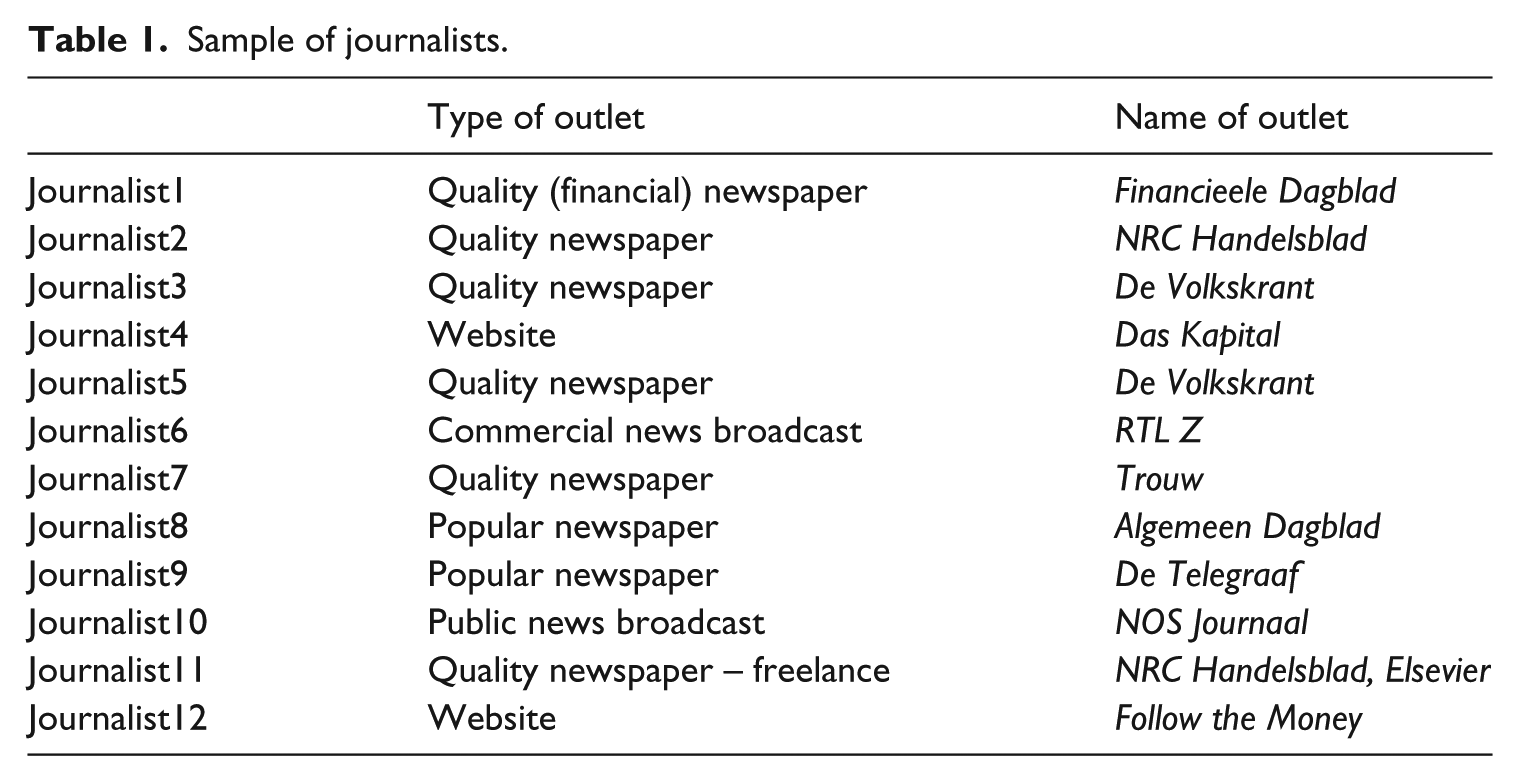
In order to identify the relevant interviewees, we examined economic news (2008–2018) in Dutch outlets (print, online, and television). A list was made of the most prominent reporters and journalists who had been covering the economy for at least a number of years. About 80 percent were willing to collaborate with us; the ones that did not want to get interviewed said they were too busy or had principle objections. We recruited journalists working for mainstream quality newspapers (NRC Handelsblad, de Volkskrant, Trouw), mainstream popular newspapers (Algemeen Dagblad, De Telegraaf), public television broadcasts (NOS Journaal), commercial television broadcast (RTL Z), and online news outlets (Das Kapital, Follow the Money). In addition, we spoke to one journalist working for a quality newspaper with a financial profile (Het Financieele Dagblad). Table 1 provides an overview of the sample.
Sample of journalists.
The interview guides were semi-structured. 1 Each interview started with the presentation of a graph depicting the negative correlation between the amount of economic news in Dutch newspapers and real economic trends over time (Figure 1). Journalists were asked to reflect upon this figure from the perspective of their professional experience. We then presented the most common academic explanations for this negativity bias and asked for verification. Other questions dealt with possible moderators of news reporting such as the role of ideology. Finally, we discussed the structural constraints identified in financial journalism, and asked to what degree similar constraints affect the production of mainstream economic news. All interviews were conducted face-to-face, most of the time in journalists’ offices or in nearby cafes, and twice at journalists’ homes (Journalist10 and Journalist11). Afterwards, the interviews were transcribed by the first author of this article and analyzed using the coding procedure proposed by Corbin and Strauss (2015).
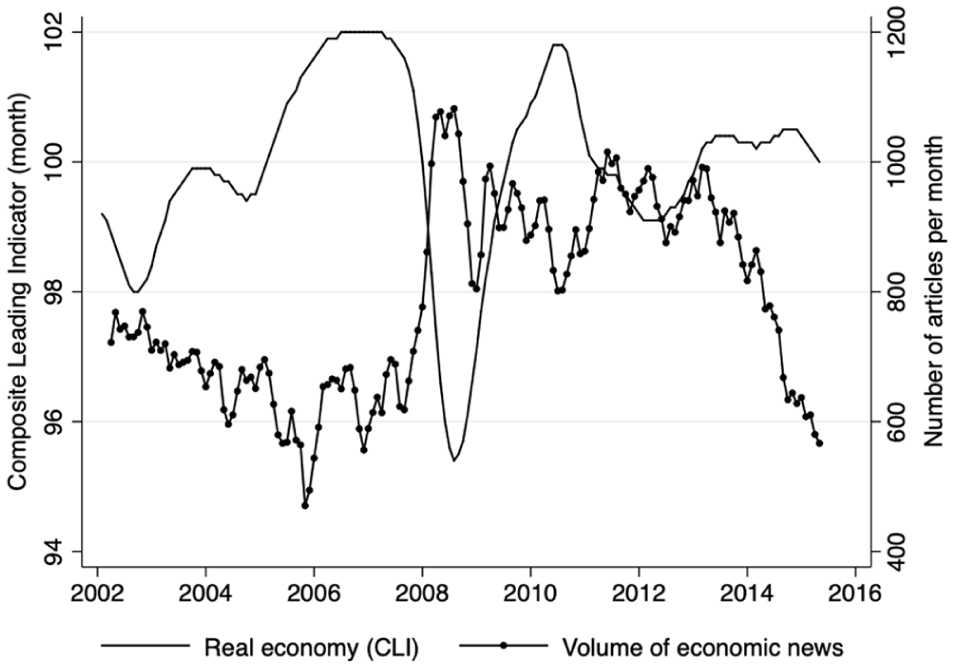
Real economy and volume of economic news.
Results
About negativity
All journalists can identify with the negative correlation between real-world economic trends and the volume of economic news, as depicted in Figure 1. Several interviewees stress that the preoccupation with negative trends is not unique to economic news reporting; instead, the good news no news adage is key to the profession as a whole. As Journalist7 puts it, ‘Only bad news is news. You are not going to write about how peace in Holland is still maintained’. At the same time, most interviewees indicate that the valence of news stories is often a topic of debate in the newsroom. Too much pessimism is deemed undesirable, as it may come at the expense of a readable and attractive news product.
In line with results from earlier interview-based work (e.g. Tambini, 2010), the notion of journalists acting as watchdogs is only partially confirmed. Some of the interviewees see the disclosure of wrongdoings as the essence of their profession and think, indeed, that the watchdog role may explain the overrepresentation of negative news: ‘It is the most difficult and the most important aspect of the job. While journalism is also about informing people [. . .] the most important aspect to me is the provision of a critical check on power’ (Journalist7). And Journalist12: ‘It is a driving force, even during prosperous times because then the foundation is laid for the next crisis’. Others disagree, stating that checking on power in the realm of the economy is substantially different from the more traditional idea of holding political power accountable. The economy is seen as an ‘abstract force’ that is largely impersonal (Journalist1): Like everybody else, economic journalists follow and watch ‘major economic processes’ (Journalist8), without feeling and being capable of controlling ‘economic events’ (Journalist4). As Journalist10, working for the main public news broadcaster, puts it: ‘No, I am not capable of doing that. I am too small, and also not intelligent enough. I cannot do that, I cannot overlook the big picture. I have no idea what is happening right now in the interstices of high-frequency trading.’
This alleged lack of power is illustrated by the fact that all interviewees say they have no idea whether a new crisis might happen in the foreseeable future. Even those journalists who appreciate the watchdog ideal do not consider themselves in a better position to judge the likelihood of a crisis occurring than any other lay person would be. This (feeling of) inability seems to be an extra factor explaining the gap between holding and practicing a role conception, a factor not often considered by previous work (but see Mellado and Van Dalen, 2014).
In line with news values theory (Galtung and Ruge, 1965; Harcup and O’Neill, 2001) most interviewees agree that negativity triggers news selection. The question remains why negativity is a criterion for newsworthiness. A number of journalists argue that it has to do with the typical temporal dynamic of negative events: ‘Negative news is often unexpected. Companies collapse, people get fired, share prices fall. In such circumstances, there is a lot to report about. When share prices go up quickly, we would also write about it but that does not happen often. Such trends tend to be gradual and slow while collapses are always sudden.’ (Journalist2)
In a similar vein, Journalist5 explains, ‘Negative developments are easy to interpret and they are more often abrupt. Whereas positive trends are continual. Such developments are very hard to capture when working with tight deadlines’. One could argue that it is through the typical combination of negativity with unexpectedness – another classical news value – that negative stories are so often selected. The abruptness of shocks fits well within the 24/7 news production machinery that is marked by scoops and deadlines, which allows positive trends, occurring slowly and gradually, to remain out of sight.
Negativity biases are not confined to journalists. They also exist on the level of the news outlet, as most room and visibility are given to negative items: ‘I usually write about the stock market, which is the section in the back of the paper. Unless the share prices drop, then my stories hit the headlines and I end up on the front page’ (Journalist1). This quote resembles Usher’s observation from 2010, when, as a result of the ‘flash crash’, business news was designated for The New York Times front page (Usher, 2017: 371–372). One could also speak of a negativity bias on the level of the profession as the interviewees describe how the 2007–2009 crisis catapulted economic journalism to a place in the spotlight. Before 2007, the economy was generally perceived as a rather stodgy topic and economic journalism as a solid but not so exciting discipline. Both perceptions changed dramatically when the crisis broke out: ‘From that moment on, everyone understood how essential and fundamental the economy actually is’ (Journalist3). At the same time, economic journalists were heavily criticized for not foreseeing the crisis, and subsequently, most of them say that they have become even more sensitive to negativity in order to avoid the risk of overlooking a crisis again. Illustrating the cognitive aspect of negativity as a news value, several journalists mention their critical coverage of the Dutch housing market that is blossoming at the time of data collection. In spite of climbing house prices, their news reports still deal with the few negative aspects they can think of: The minority of people who do not manage to sell their house (Journalist3), the difficulties for newcomers who want to buy a house (Journalist8), or the mental stress for those who succeed in buying a house (Journalist11).
While all explanations discussed above implicitly assume that journalists lead the audience in determining what is important, a recurring theme is the reverse relationship: When the economy goes down, the topic becomes more relevant to people, which makes them hungry for information. As a response to this greater demand for news, journalists start producing more: ‘When things go well, people ask me to write one story about it. When things go wrong, they ask me to write ten stories about it, they keep on asking what is going on’ (Journalist8). This higher demand for information and interpretation is closely related to the increased obtrusiveness of the economy in times of distress. Journalist6, working for a commercial broadcast company, says: ‘People lose their jobs or see their stocks collapse. They worry about prices in the supermarket or at the local corner shop. Yes, of course journalists follow the audience, and sometimes this might be too much, but it also seems like a natural mechanism to me.’
In sum, the negativity bias identified in longitudinal research (Damstra and Boukes, 2018; Soroka, 2006) is fully agreed on by journalists. They are aware of the tendency to overreport negative events, as the example of the housing market illustrates. This preoccupation is not so much inspired by the societal role journalists envision for themselves (watchdog, burglar alarm), but rather by the typical features of negative news, most notably in terms of temporal dynamics. In addition, there is a higher demand for information when things go wrong. News consumers, but also editorial managers and peers, ask for more information and interpretation in times of distress. Also, negative coverage is often rewarded, as it is given a more prominent place in the news product.
Context variation
The assumption of ideology having an impact evokes resistance. All journalists underscore how their outlets are no longer affiliated with political parties and that they aim to report in a balanced way, not favoring any political stance. At the same time, as inter-outlet competition is strong, newspapers raise their profile by carefully selecting issues and themes. Commercial motives are at the heart of this process, as Journalist9 explains: ‘Left right orientations . . . I wish it were that simple. It has become more complex over the years. Yes, of course, we see different profiles. But these are not primarily inspired by politics or parties. Instead, it is all about our readership. In order to serve and extend our audience, we need to focus on certain issues. People may say we are right-wing; but this is not inspired by politics, it is the formula that makes us identifiable to readers.’
In a similar vein, Journalist7 states: ‘We will not write in more positive terms when the government is left-wing. That is why I disagree with the whole idea of left and right. It is too easy. We try to distinguish ourselves by finding our niches. One of these niches has been sustainability, and of course we consider it important, but it is also very much about having a profile that is distinctive from the others.’
The linkage between negativity and popular outlets is not endorsed. None of the interviewees indicate that quality newspapers report more positively than the popular ones. However, there are clear differences in terms of style. First, tabloids bring a lot of short economic news items while quality outlets focus on fewer longreads. Second, popular outlets tend to be less balanced. Although this classification is mainly voiced by journalists working for quality outlets, Journalist8 also indicates that exaggeration is key to his profession: ‘Nuance can be difficult, yes indeed. Reality shows that, in the end, the darkest scenarios do not often materialize. However, when you bring the news and write a story, you don’t choose the least far-reaching scenario, that is not how it works.’
Apart from structural context factors, substantial variation in the tone of news is related to individual-level factors: ‘Some journalists just have a very negative outlook on the world. They seem to be driven by showing off how well they see through all these processes, which is also a way to sell their stories’ (Journalist10). And not only tone, but also the selection of issues is to some extent the result of individual-level considerations: ‘In my newspaper, I try to give room to deviant perspectives. I brought stories about inequality, which is not a theme typical for our newspaper. I doubt whether that would have happened if it weren’t for me. I don’t think so. I choose such an issue, but that is solely based on my personal experience and seniority.’ (Journalist9)
Structural constraints shaping economic news production
Lack of expertise and source dependency
In order to qualify for the profession of economic journalist, journalism skills outweigh economic knowledge. Most interviewees received a training in journalism and did not obtain a degree in economics or any related fields. Expertise in newsrooms varies: ‘We do have two or three people that have a fundamental understanding of economic processes and who can write about it in a readable way. Most media do not have such people and must therefore rely on external experts’ (Journalist2). The observation that most media lack such experts is confirmed by the experiences of other interviewees: ‘Right now, we don’t have any real economists anymore, although we did hire one recently. However, the editorial department considered his writing not good enough. Honestly, I fully disagreed. They want journalists who can write a bit about everything, but we should invest in experts instead. I immediately notice a lack of expertise when someone who usually covers social security writes a piece about the housing market. The result is a shaky product.’ (Journalist3) ‘I am the only one here who is actually able to read a balance sheet. I mean . . . that is ridiculous. I voiced my concerns more than once; the situation is absurd, especially considering the fact that we are dealing with the largest newspaper of the Netherlands here.’ (Journalist8)
The subsequent source dependency is undisputed, but not all interviewees consider it problematic. ‘There is no need for journalists to have knowledge of everything, as long as they know the right people who do have the relevant information. Such as academics’ (Journalist7). Journalist11, similarly: ‘As a journalist you don’t need to be an expert. You consult experts, who can be academics, financial specialists or whomever, that is part of your job. In fact, not being an expert comes with the benefit of a certain distance, which often results in a clearer view’. Key to not being captured or used by sources is the journalistic routine of balancing views. All journalists mention this strategy in order to warrant a certain degree of objectivity. Academics are generally seen as reliable and willing outsiders with minimal corporate interests. While a diverse array of perspectives is highly valued by all interviewees, they also admit that some voices are more easily heard than others. Activists especially are distrusted: ‘There is a risk that those putting forward arguments that fall outside the dominant paradigm are less often heard, while their arguments may be worth listening to’ (Journalist1).
Economic literacy of the lay audience
Translating economic information into easily accessible news content is for many the biggest challenge of their work. Economic terms such as bonds, coverage ratios, or quantitative easing are carefully circumvented, as content needs to be simplified and jargon eschewed: ‘We choose not to use any technical terms anymore in order to increase the overall clarity. This may come at the expense of nuance, as we also do not concentrate on details or numbers. However, bringing the news in an accessible way is how we try to make many readers a little wiser.’ (Journalist5)
Striking a balance between veracity and accessibility is not an easy undertaking. ‘These are often difficult choices. You simplify the content to the point that what you write might not be entirely correct anymore, but it does, at least, still cover the essence’ (Journalist8). Journalist9, similarly: ‘I would say translation is the most important part of my job. I do so by choosing a perspective that I feel is most relevant to my audience, and sometimes I choose a perspective that is most understandable to them. Last week, for example, I had a scoop about pension system plans. On the front page, however, we presented the news as being about old-age pensions, as this is much more concrete, understandable, and relevant to our readers. In the next pages, I could explain and describe the other aspects of the plan’.
Related to the above is the frame, what is in it for me? News items are much better received when economic information is presented in terms of pocketbook consequences. Even ‘hard’ economic issues are often linked to the consequences they may have for people’s own financial situation. This sometimes leads to discussions with chief editors when journalists select issues which cannot be related easily to people’s pocketbooks: ‘Of course, I can write how stock markets, through investments made by pension funds, in the end also have an influence on people’s own finances. However, I don’t want to present all economic news in this frame. Stock markets are also interesting in and of themselves or as an indicator of the general economic situation.’ (Journalist8)
In a similar vein, well-known consumer brands and stock agencies receive a lot of coverage, as these are deemed most interesting to readers: ‘You have those listed companies no one has ever heard of. Bloodless and boring . . . who cares? You won’t write about them, unless they have all sorts of scandals going on. But Ahold, HEMA or V&D,
2
yes, that is a different game, and news about them always receives a lot of clicks.’ (Journalist4)
The selection of issues is co-shaped by audience recipience, which is constantly measured. For print media, the aging readership is one incentive: ‘We write about unemployment among the elderly, their position on the job market, and pensions policies. All newspapers do so because all newspapers have these aging readerships. You just know that this is at the heart of readers’ interest’ (Journalist9). For online media, the number of clicks is key: ‘The argument that an article has been read by many is often used to write another article about the same topic or company’ (Journalist1). Journalist7, similarly: ‘It is one of the main advantages of online journalism. You learn which issues are important to people. If news about bonuses is well received, you may write another piece about bonuses, but from a new and fresh perspective’. The reception of online content (e.g. number of clicks) is carefully monitored and information gets internally distributed in terms of ‘best-read articles of the day’. However, the subsequent impact of this information differs across outlets. Journalists working for quality newspapers stress that news recipience should not drive the selection of news: ‘We try not to look at these lists too much [. . .] These lists are only one factor among many more that steer the selection of news’ (Journalist5). Or: ‘We know that our company items are not well read, at least not online. They probably do better in print. At least that is what you hope for. But even if these articles would barely be read in print either, we still wanted to bring them, as to offer a full and complete news product’ (Journalist7). For popular outlets, the role of recipience is slightly different: ‘When I write about a topic three times but no one is reading these pieces, I drop the topic as it is deemed irrelevant’ (Journalist8) This audience influence has changed the interaction between journalists and readers: ‘The negative view is that we only deliver what people want to read. The positive view is that we have a much better understanding of the issues our readers care about. If they find a topic interesting, we can produce more news about it. You can still set a certain agenda, but readers determine the relevant issues. What is the point of forcing issues upon our readers they are not interested in?’ (Journalist9)
The online platform for investigative journalism takes the interaction with readers one step further. Most readers are dues-paying members and Journalist12 considers them valuable sources of knowledge. Readers are encouraged to participate in expert panels and to pitch topics that they think deserve journalistic attention, initiatives that have further equalized the relationship between journalists and their audience: ‘The bonds are quite tight, and readers are much more engaged than before. But they also are very outspoken; if they disagree with the content, they are quick to terminate their contracts’.
Institutional pressures
Institutional pressures have led to a more competitive working environment. Traditional newspapers especially face increasing competition from each other as well as from online data services. Over the years, the same amount of work is carried out by fewer people and the nature of the job has changed. Journalists must have a varied set of skills at their disposal. Bigger news stories are published in print as well as online, launched on social media, announced by digital newsletters, and preferably, accompanied by short visual clips or podcasts. As a result, journalists face numerous deadlines within a regular working day and need to be familiar with the use of different formats. As Journalist5 puts it: ‘Previously, there were three basic forms: news, interview, and background story. Today, there is a multitude of forms: longreads, five questions, short chapters, scrolly telling, graphic novels, graphs, podcasts, visuals, and so forth. And each form has its own pace. Previously, you made one story every day. Today, the short item needs to be finished by 7AM, the explanatory story by the end of the day, the big story by the end of the week and the investigative story by the end of the month. You work in four different paces and with a multitude of forms. That makes the journalistic profession much more complicated than it was.’
For most quality newspapers, investigative journalism has become a selling point by which readers are attracted, and despite cutbacks, there is still some funding available for those with a good idea. The production of short news items is less of a priority: ‘Newspaper journalism is not doing well. If you want to stand out, you need to work hard. Because websites already bring the news, we need to bring something else’ (Journalist7). Also, for popular outlets, priorities have changed: ‘We quit with investigative journalism because it got too expensive. [. . .] We only invest in digital news as our main aim is to become the biggest news website of the Netherlands’ (Journalist8).
Discussion
With this study, we wanted to obtain a better understanding of the mechanisms driving mainstream economic news production. More specifically, we examined the most prominent explanations for the negativity bias in Dutch economic news reporting (RQ1) and we tested the relevance and applicability of structural constraints identified in financial journalism (RQ2). The small sample size and case study design of this study do not allow for one-on-one generalizations beyond the Dutch context; conclusions may differ as the weight of influencing factors may vary (e.g. Reich and Hanitzsch, 2013). Despite this limitation, this case study has generated some clear and thought-provoking findings.
Regarding the mechanisms driving the negativity bias in Dutch economic news reporting (RQ1), the findings validate existing ideas but also extend our knowledge beyond the boundaries of what we hypothesized. Starting with the validation, the idea of a negativity bias is met with general approval. Whereas the democratic function of journalists and accompanying role conceptions (watchdog, burglar alarm) are partially recognized, not much power is assigned to this explanation for news being systematically skewed to the negative, mainly due to the inability to genuinely bring such roles into practice. Instead, typical features of negative events, especially a temporal dynamic characterized by sudden shocks, make them more likely to get covered as they fit well within the hasty and high-pressure production process. This explanation squares nicely with news values theory (Galtung and Ruge, 1965), as both negativity and unexpectedness are classical news values. At the same time, journalists are able to overcome the apparent determinism of news values, as they indicate to have assigned news value to trends or events by highlighting or magnifying the negative aspects (e.g. Caple and Bednarek, 2016). The housing market example – blossoming, but still provoking negative coverage – is illustrative in this regard.
Different from what was hypothesized, all interviewees refer to an increasing reciprocal relationship between journalists and news consumers. It is repeatedly mentioned that higher news volumes in times of economic downturn are not so much the result of autonomous journalistic considerations, but rather of higher public demands. Demands that are eagerly met, as the public is as much a lay audience that needs to be informed and educated, as it is a mass of (potential) customers that need to be charmed and satisfied.
The conclusions from research on specialized financial journalism are to a high degree applicable to the production of mainstream economic news (RQ2). The lack of expertise on the side of journalists is acknowledged but not necessarily perceived as problematic. Instead, the economy is seen as ‘unknowable’ because the phenomenon is too abstract, too big, and too complex to be fully comprehended. This might also explain why the watchdog role is not embraced wholeheartedly, as holding power accountable in the economic domain is considered not feasible for individual journalists. Simplifying economic news to make it easily digestible is at the heart of economic journalism. Different strategies are employed to appeal to the public: framing in terms of what’s in it for me?; focusing on well-known consumer brands; selecting the most concrete and appealing issues; no use of jargon, technical details, numbers, and nuance; (de)prioritizing investigative projects; and applying a wide variety of attractive formats. These considerations of audience preferences and economic literacy are further reinforced by institutional pressures. Similar to financial journalism, and probably true for the profession as a whole, is economic journalism shaped by heightened competition and increasing output demands. In order to survive, outlets need to offer a product that is easily identifiable, accessible, and attractive.
The impact of the online environment on the interaction between journalists and audiences is hard to overestimate. While there is some inter-outlet variation in the importance attached to news recipience (e.g. number of clicks, visibility on social media), the fact that the numbers of reads are constantly measured and distributed make journalists fully aware of the (lack of) popularity of their news products. Not seldom, this awareness results in a different process of news selection as the main criterion becomes visibility. Thus, while journalists still set the public agenda and research shows how their impact on public perceptions continues to be considerable, scholars also need to account for the reverse relationship of public preferences leading journalistic choices (Ragas et al., 2014). This observation resembles Deuze’s (2005) claim that the journalistic ideal of serving the public is shifting, as it moves from a primary top-down meaning to an increasingly bottom-up application. In a context of declining readerships, the increased importance of audience feedback comes with inevitable advantages – speed, inclusiveness, comprehensiveness, and the public notion in ‘most read articles’ (Lee and Tandoc, 2017). At the same time, to maintain their primacy on storytelling, journalists also need to bring news regardless of audience interest.
Apart from the challenges discussed above, the changing information environment presents some opportunities as well. The rise of data journalism could facilitate investigative practices as data become more easily accessible. Cross-national collaborations on complex topics carry the potential of uncovering global economic power structures that are much more difficult to address from a national context. However, in order to allow economic journalists to use the changing circumstances to their benefit, it is paramount that they are given the time and resources to look at larger issues rather than being absorbed by the event-centered focus typical of the daily news cycle. This also implies that outlets should stop prioritizing generalist journalism over specialist journalism, as specialized knowledge is indispensable to critically assess economic power structures – both nationally and cross-nationally. Investing resources in mainstream economic journalism would require a major turnaround, because in a profit-driven media market like the Dutch one, it is far from self-evident.
Supplemental Material
interview_script – Supplemental material for The making of economic news: Dutch economic journalists contextualizing their work
Supplemental material, interview_script for The making of economic news: Dutch economic journalists contextualizing their work by Alyt Damstra and Knut De Swert in Journalism
Footnotes
Funding
The author(s) disclosed receipt of the following financial support for the research, authorship, and/or publication of this article: This project has been funded by a VIDI grant (project number: 016.145.369) from the Netherlands Organization for Scientific Research awarded to Prof. R. Vliegenthart.

Supplemental material
Supplemental material for this article is available online.
Notes
Author biographies
References
Supplementary Material
Please find the following supplemental material available below.
For Open Access articles published under a Creative Commons License, all supplemental material carries the same license as the article it is associated with.
For non-Open Access articles published, all supplemental material carries a non-exclusive license, and permission requests for re-use of supplemental material or any part of supplemental material shall be sent directly to the copyright owner as specified in the copyright notice associated with the article.
