



Abstract
Amidst the financial crisis affecting UK newspapers, one area of optimism is their online overseas audiences. These foreign visitors often outnumber their domestic equivalents, and some newspapers have made the ‘long-distance’ market a key component of their commercial strategies. Overseas news audiences are, however, under-researched, an omission this study aims to help remedy via an investigation into the audiences for 7 UK newspaper brands (and a public-service broadcaster) across 10 countries using data from a leading source of Internet audience measurement, Comscore. The study uses an innovative, multidimensional model (derived from work by Zheng et al.) to analyse audience engagement across the dimensions of visibility, popularity, depth, loyalty and stickiness. The results reveal that there are significant differences in how audiences behave from country to country, dependent on language and culture. The study has implications for how news organizations serve their overseas audiences and suggests new directions for research into audiences for globalized online journalism.
Keywords
Introduction
After decades of dwindling circulations and the post-millennial retreat in revenues, one glimmer of hope for newspapers – in the United Kingdom at least – is the potential for large overseas audiences for their digital editions. Over the past few years, UK news brands have started to become more focused on the long-distance market for their product. For example, in 2013 The Guardian announced it would launch a digital edition in Australia (Sweney, 2013). The Daily Mail too has expanded down under, launching an online operation in 2014 (Greenslade, 2013), 4 years after starting a similar initiative in the United States. The Independent established a US office in 2015 (Olaoye, 2015), and, upon its 2016 announcement of an end to printed distribution, its management said they would like to ‘take advantage’ of its new online-only status to achieve its ‘global ambitions’ (Sweney and Johnston, 2016). The talk of global ambitions is not unique to The Independent. In 2006, The Guardian outlined its aim of being the ‘world’s leading liberal voice’, something it believed it was ‘on the verge of’ achieving 4 years later (The Guardian, 2010).
There has, however, been relatively little research into long-distance audiences for online news in general, or the overseas audiences for UK news brands in particular, even among scholars primarily interested in global journalism. At a more fundamental level, there is also a lack of even the most basic contemporary data, for example, on the proportions of overseas traffic received by UK news brands. Only occasionally are such data reported in the popular or trade press (see, for example, Olaoye, 2015).
This article aims to help fill the gaps in our knowledge by analysing audiences for UK news sites in a number of different countries using a model that considers audiences and their behaviour across a number of different dimensions, including size, loyalty and attention. In doing so, we attempt to move beyond research that is solely media- or user-centric (Webster and Ksiazek, 2012). Using data from the UK’s Audit Bureau of Circulations (ABC) and from Comscore, we find, first, that the overseas online audience for our sample of major UK news brands is larger than their online domestic audience. Second, using the additional measures of depth, loyalty and stickiness, we can see that overseas audiences – though often larger – are less attentive than domestic audiences. Third, we can see that differences in attentiveness vary by country, with countries that share a language and have close cultural ties with the United Kingdom (e.g. Australia and the United States) providing more attentive audiences than those that only have close cultural ties (e.g. France, Italy, Spain and Germany) or those that share neither language nor close cultural ties (e.g. Japan and Brazil). Our findings show the continued importance of global audiences for news brands, but also highlight the limitations of current research methodologies when it comes to understanding transnational news use.
Literature review
Certain elements of journalism and the news industry have long been global. Throughout the 20th century, foreign reporting was a core component of serious news coverage, many large news organizations maintained overseas newsrooms, and wire agencies such as Reuters and the Associated Press spanned the globe. However, the emergence of a subfield of journalism studies examining the relationship between journalism and globalization is a more recent, mainly post-millennial, phenomenon.
Early interventions examined how journalism and news media systems function in different countries (e.g. Hallin and Mancini, 2004), and asked whether journalism reflected ‘how people . . . in different parts of the world are interrelated’ (Berglez, 2008). Since then, the study of global journalism has expanded to address – among other things – whether news coverage has become more global in scope (e.g. Van Leuven and Berglez, 2016), and the education, practices and beliefs of journalists working in different countries (e.g. Hanitzsch et al., 2019). Others have raised serious questions about the potential impact of globalizing forces on journalism (Hafez, 2007).
Perhaps surprisingly, there have been relatively few studies connecting global journalism and audience behaviour (Widholm, 2019), with the focus of research into global journalism having primarily been on what we might call the ‘production’ rather than the ‘consumption’ side. This is an important omission, given that journalism largely exists within the context of its audience, meaning that audience behaviour can potentially shape, and be shaped by, a more global form of journalism.
During much of the 20th century, most people consumed news solely from domestic television channels, radio stations and newspapers (Athique, 2016). Newspaper publishers in particular were constrained by the logistics of print distribution, leading them to focus on serving national audiences or, in the case of the local press, regional populations (Brock, 2013). Broadcast news was also mostly localized to a particular country or region. This first began to change in the latter part of the 20th century when satellite technology enabled channels like CNN to broadcast news coverage across the world (Chalaby, 2005). More recently, widespread access to the Internet has again created opportunities for overseas news consumption to grow. The Internet has dramatically reduced international distribution costs for publishers old and new, allowing them to make their content available worldwide. At the same time, the cost of accessing information from overseas news sources has also been lowered, and search engines, social media and news aggregators make it easier than ever to find new sources of information (Fletcher and Nielsen, 2018).
Although the underlying structure of international news access has changed considerably in the past two decades, we know little about how global news audiences have responded. Webster and Ksiazek (2012) distinguish between ‘media-centric’ and ‘user-centric’ approaches to measuring news use. The media-centric view takes media outlets as the unit of analysis, typically producing ‘reach’ figures for outlets at a particular point in time. When we look at media-centric lists of the most widely used news sources in a particular country, the lists, in most cases, are heavily populated with domestic outlets. The reach of almost all overseas outlets is small (Newman et al., 2019). Even in a country such as Sweden, where many people can speak a foreign language, the top 10 most popular online news sources are Swedish (Newman et al., 2019: 111). Of course, there are exceptions. In Australia, the BBC and BuzzFeed News make the top 10 (Newman et al., 2019: 133), and in Austria – which neighbours a much larger country sharing the same language – there have long been sizable audiences for German television brands (Fletcher et al., 2015). But, in general, the media-centric view strongly suggests that transnational news consumption is marginal.
The user-centric approach, however, offers a somewhat different picture. A recent study of news use in Sweden by Widholm (2019) found that around a quarter of the population engages in some form of transnational news use, with the proportion rising to nearly half for younger people. Users of overseas news tend to be highly educated, urban, very interested in politics and born abroad, but Widholm nonetheless argued that ‘transnational news consumption is no longer restricted to a specific elite segment of society, which has been a common argument in scholarly debates around the globalization of news’ (Widholm, 2019: 1472).
Although such studies indicate who is more likely to access news from overseas, there is at present little published research describing how they actually behave as they are doing it. On one hand, we might expect overseas audiences to be particularly motivated, heavy and loyal consumers, given that they are typically drawn from the most interested and educated groups within each country. On the other hand, they may have only a very weak connection with the news source itself, and little lasting interest in news coverage focused on a different country. Thurman (2007) interviewed British online editors and executives about their attitudes to visitors from overseas. One editor characterized overseas visitors as ‘fickle’, consuming fewer pages per month than readers from the news sites’ home market. In the case of The Guardian, its UK readers read 3.6 times more pages a month than their American cousins. The editors and executives he spoke to had mixed feelings about the presence of overseas online audiences. Although some saw a modest short-term benefit in terms of advertising revenues, there was general agreement that the international reader had less long-term value and was more difficult to monetize. Nevertheless, even in 2004, when most of the interviews for the article were conducted, some publishers had ‘an eye to the US market’, having online advertising sales staff in the United States, and creating content for American visitors.
Thurman (2007) also estimated that international users made up a surprisingly high proportion of the total number of users, an average of 75 per cent, with 36 per cent coming from the United States. UK news brands relied to differing degrees on American visitors, with one – The Independent – getting nearly three-quarters of its monthly online audience from the United States, while only about 1 in 10 of the visitors to Dailymail.co.uk originated stateside.
Despite such occasional analyses of transnational news use, most research on journalism’s audiences focuses on national populations, a legacy, perhaps, of the fundamentally domestic nature of media use during the 20th century, but also a consequence of the fact that most of the data collected on the audiences for news brands – by, for example, Joint Industry Committees (JICs) – are focused on domestic markets. Such a circumstance is problematic because today, even if the proportion of people within each country who regularly access foreign news is small, these proportions, when grouped together, can add up to large overseas audiences for specific news outlets – larger even than their domestic audiences. This ultimately means that a domestic user-centric approach could cause researchers to arrive at a very different understanding of news audience behaviour than that granted to publishers via the data they collect about how people navigate their websites and apps. This, in turn, could make it harder for journalism scholars to make sense of changes to journalistic practice and content that are rooted in shifts towards a more globalized audience.
Research questions
This study moves beyond the domestic user-centric approach, and looks again at the online overseas audiences for UK news brands, drawing on a wider range of usage metrics to better understand their news consumption habits. As discussed, even basic up-to-date information about the overseas traffic to UK news brands is scarce. Therefore, in order to establish general trends, our first research question asks:
RQ1: What proportions of online unique browsers and page impressions do UK news brands get from overseas?
Our second research question looks beyond the numbers of unique browsers and page impressions to additional measures of attention. Because ‘overseas’ is a blanket term, covering many different markets, we will analyse audiences for UK news sites in a number of different countries. Thus far, research has focused on the US audiences for UK newspaper brands. However, given that Americans share a language and cultural history with the United Kingdom, their behaviour may not be typical of overseas audiences more widely. This leads us to our main research question:
RQ2: What is the size of online audiences for UK news brands in a sample of different countries, and how frequently and deeply do they visit and for how long?
Methodology
In order to answer RQ1, we analysed data from the UK’s Audit Bureau of Circulations (ABC). The ABC collects and audits data on web traffic on behalf of a number of publishers. Their data, which are only available via subscription, have the advantage of originating from the server logs of the publishers themselves. They are, therefore, a census of web traffic rather than a survey of a limited sample of users. For these reasons, the ABC data are ideal for establishing general trends.
However, because the ABC data amalgamate overseas visitors into a single category, they cannot show differences between individual foreign markets. Furthermore, unique browsers represent devices not people. Therefore, an individual from overseas visiting a UK news brand via his or her PC, smartphone, tablet computer and laptop could be counted four times. In addition, the ABC data do not give us any information about market reach, the loyalty of audiences (i.e. how frequently they visit), the depth of their visits or how much time they spend visiting. These are all important metrics if we are to build a more complete picture of overseas audiences.
In order to answer RQ2, we analysed data from Comscore – an analytics company that collects data on people’s Internet use by combining online user panels and server-side measurement. Specifically we used their ‘MMX Multi-Platform’ product. Comscore’s presence in 75 countries worldwide meant we were able to source data about the audiences for UK news brands in a range of countries. Because Comscore’s methodology incorporates panels of known Internet users in each country (Comscore, 2013), numbers of unique visitors (people) are measured rather than, as is the case with the ABC data, unique devices. Furthermore, because each individual’s Internet use is tracked over time, Comscore’s data reveal information about the frequency, depth and length of visits. Comscore’s country panels are ‘weighted and projected’ (Comscore, 2013) in an attempt to make them representative of the entire population of Internet users. This means that the data also include estimates of the reach of online entities within each country. Once a Comscore panellist has registered, and downloaded the company’s monitoring software, the measurement and reporting processes are automatic. This is advantageous because there is evidence that individuals underestimate their use of websites and apps when asked to recall their behaviour (Pellegrini et al., 2015: 10). The underestimation of online consumption via recall could, theoretically, be especially pronounced if respondents are asked about their usage of overseas news brands, with which they may be relatively unfamiliar.
The Comscore data provide a wide range of metrics, within which there is some information redundancy. For this reason we have adopted Zheng et al.’s (2012) ‘multidimensional model of web attention’, which allows us to analyse international audiences for UK news brands in a succinct yet comprehensive manner.
A multidimensional model of web attention
Zheng et al. (2012) identified four major quantifiable indicators of online traffic: unique visitors, visits, pages viewed and time spent. They explained that ‘these four basic measures can be reported at different levels of analysis’ (per Market, per Site, per Person, per Visit and per Page), resulting in a ‘wide range of metrics of Web attention’.
They explored relations among the four indicators at four of the five levels of analysis (per Site, per Person, per Visit and per Page) for 179 news and information websites. 1 After correlating ‘10 primary measurement rubrics’, 2 they ‘found high correlations among metrics on the same level . . . [but that] the correlations among measures across different levels of analysis are not nearly as strong’.
Because of the stronger correlations among metrics within the same level, and weaker correlations among metrics across levels, they were able to reduce the number of measures in their final model by selecting ‘one measure at each of the five levels of analysis (per market, per site, per person, per visit, and per page)’. The measure chosen for each level of analysis was derived from this hierarchical structure: Market > Site > Person > Visit > Page. In this structure the Market level is higher than the Site level because several sites exist in the market, the Site level is higher than the Person level because several people can visit a single Site and so on. The measure chosen at each level of analysis was the highest available at that level. For example, at the Site level the highest measure is Total unique audience.
We replicated Zheng et al.’s (2012) correlation analysis for all news brands in our sample using our data for 10 countries (see Table 1). We also found that there were strong and significant correlations between measures on the same level of analysis and weaker correlations between measures across different levels of analysis. For example, on the Site level we found that there was a strong and significant correlation between Total visits and Total views (r = 0.987, p < 0.01) whereas there was a weak correlation between Minutes per visit (the Visit level) and Total visits (the Site level) (r = 0.182, p < 0.01). 3
Correlations between metrics by level.
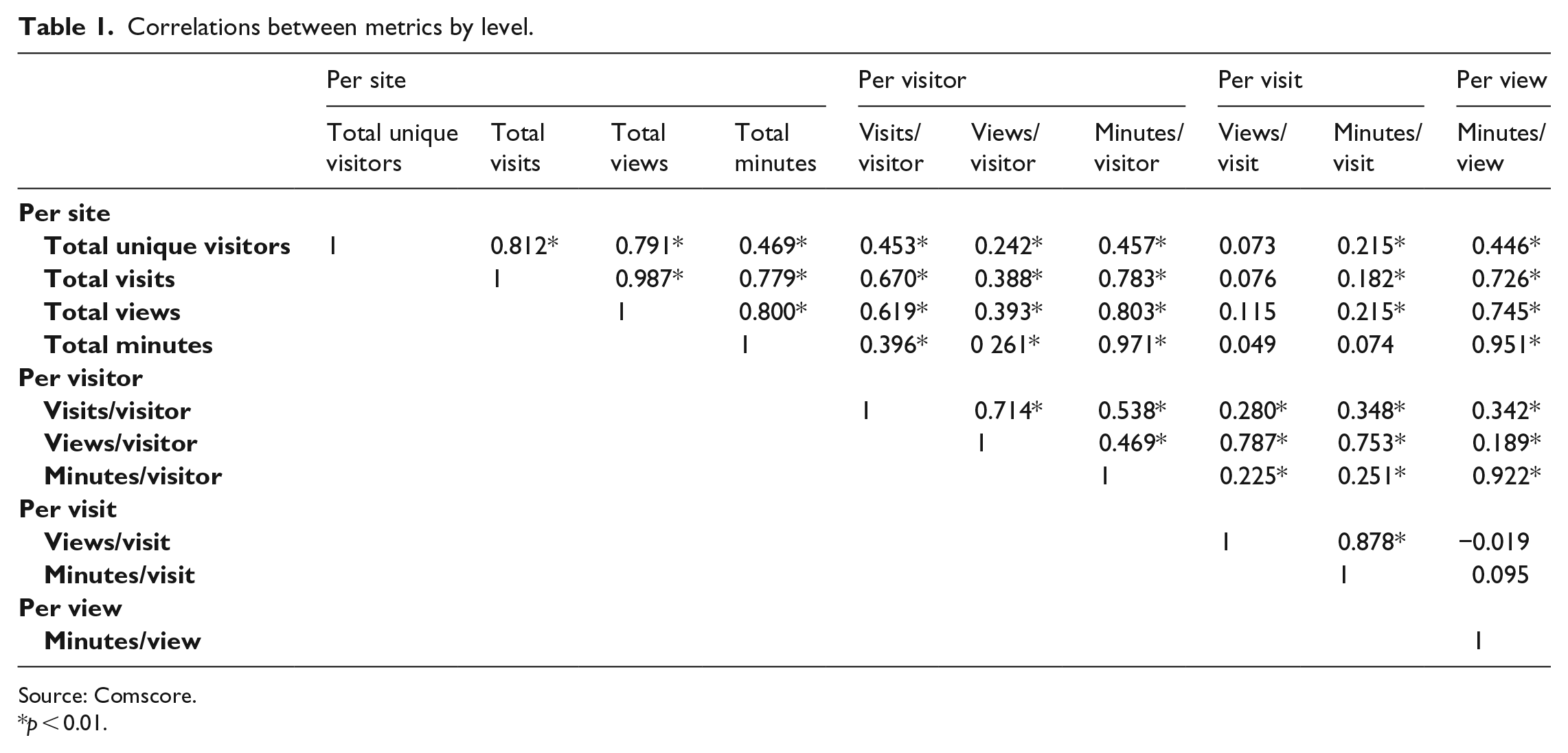
Source: Comscore.
p < 0.01.
Because our correlation analysis mirrored Zheng et al.’s (2012) results, we also decided to base our analysis of the overseas audiences for UK online news brands on five representative metrics, one for each level of analysis: Reach (the Market level), Total unique visitors (the Site level), Visits per visitor (the Visitor level), Views per visit (the Visit level) and Minutes per view (the Page level).
As suggested by Zheng et al. (2012: 165), each of these metrics describes a construct of attention: ‘Reach’ describes visibility, ‘Total unique visitors’ describes popularity, ‘Visits per visitor’ describes loyalty, ‘Views per visit’ describes depth and ‘Minutes per view’ describes stickiness.
Sampling
We constructed our sample of UK news brands to include ‘quality’ brands (The Guardian, The Telegraph and The Independent), those from the ‘tabloid’ end of the market (The Sun and The Mirror) and those traditionally considered to be mid-market (The Express and The Mail). The sample also included BBC News Online (which has a public-service broadcaster ‘parent’). 4 The brands chosen occupy seven of the top 16 positions in the list of news brands with the highest weekly online reach in the United Kingdom (Newman et al., 2017: 55). Of some of the other brands in that list, the Huffington Post (4th), BuzzFeed (7th), MSN News (8th) and Yahoo! News (13th) were excluded because they are international brands of American origin and this study’s focus is on the overseas market for UK news brands. ‘Websites of local newspapers’ (5th) were also excluded because this category aggregates the use of multiple sources, and the websites of local newspapers are unlikely to have overseas reach.
The sample of countries was constructed to include a mix: some that share a common language and/or culture with the United Kingdom (the United States, Australia and Canada), some with geographical, economic and/or political and cultural ties to the United Kingdom, but without a common native tongue (France, Germany, Italy and Spain) and some that are rather removed from the United Kingdom culturally, linguistically and geographically (Japan and Brazil).
The 4 months sampled (January, March, June and September 2016) were spread out over the year to help smooth out any seasonal differences.
Results
RQ1: What proportions of online unique browsers and page impressions do UK news brands get from overseas?
The results show that high proportions of the monthly unique browsers visiting UK newspaper brands come from outside the United Kingdom (see Figure 1). For MailOnline the proportion is around 70 per cent and has been since at least April 2015. Although the most recent data for The Guardian are from September 2016, at that time 70 per cent of its browsers were also from outside the United Kingdom. The Independent too has a high proportion of overseas browsers: 73 per cent for the last month data were available (January 2018), a number that has been on a gradually rising trajectory. At The Telegraph the proportion was steady at around 60 per cent until June 2017 (the last month for which data are available). At The Sun the proportion is 45 per cent, having risen significantly since the title removed its paywall at the end of 2015 (Thurman and Fletcher, 2018). In sum, the majority – an average of 63 per cent – of monthly browsers come from outside UK newspapers’ home market and the proportions have been on a rising trajectory at two titles.
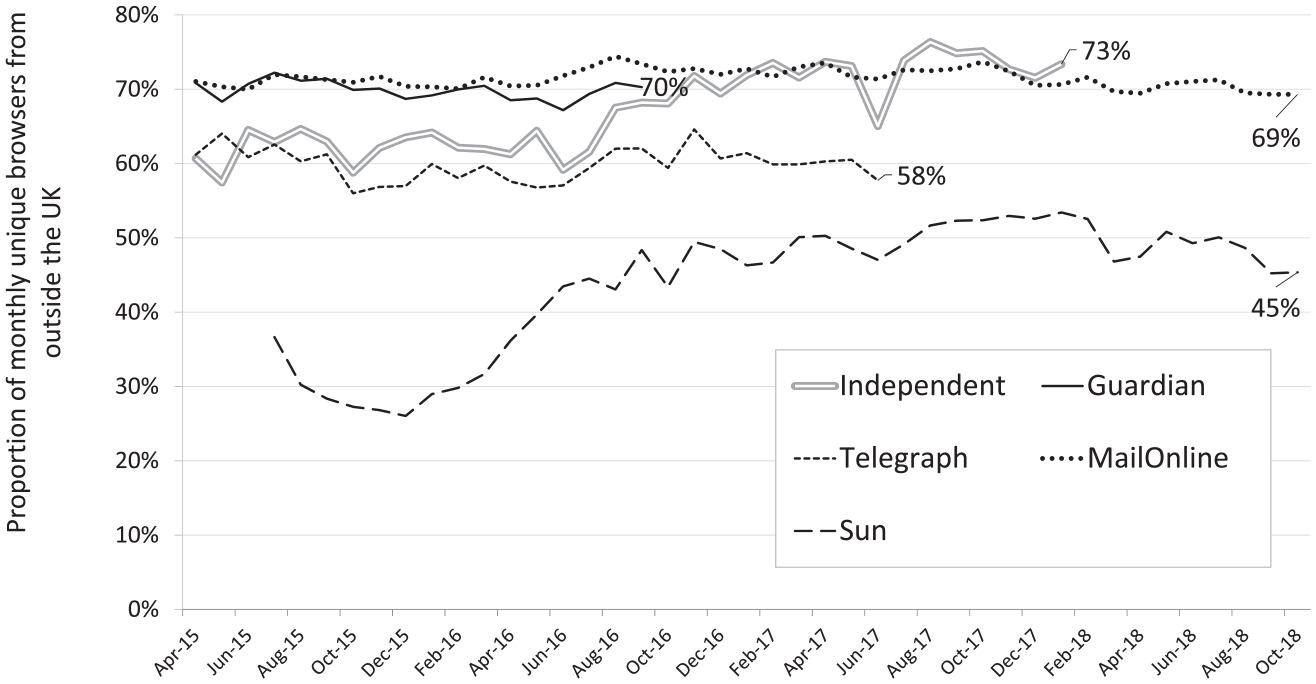
Proportion of monthly unique browsers coming from the ‘rest of the world’ (as opposed to the United Kingdom) at five UK newspaper brands, April 2015–October 2018.
Looking at the proportion of monthly page impressions from outside the United Kingdom reveals a slightly different picture (see Figure 2). The proportions are lower. The ABC data reveal that, on average, overseas visitors view over 2.5 times fewer pages than visitors from the United Kingdom (an average of 6 per month against 17.5). However, for a more nuanced analysis of the behaviour of the overseas audience, and differences between individual countries, we must examine the results of our second research question.
RQ2: What is the size of online audiences for UK news brands in a sample of different countries, and how frequently and deeply do they visit and for how long?
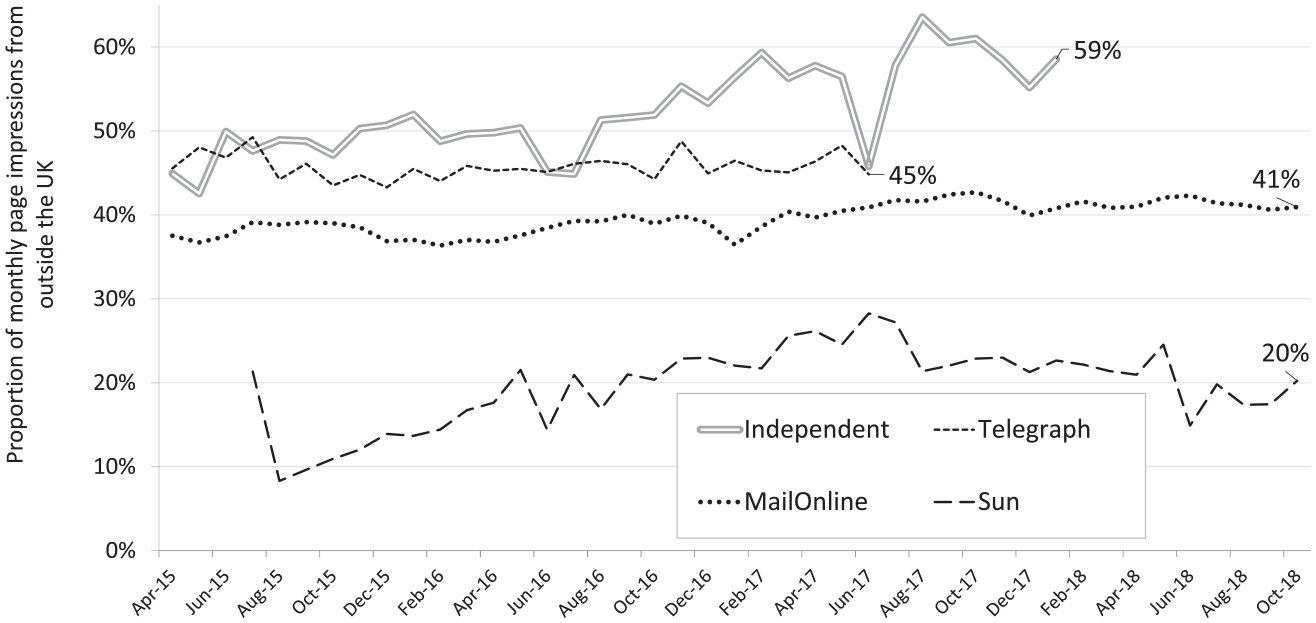
Proportion of monthly page impressions coming from the ‘rest of the world’ (as opposed to the United Kingdom) at four UK newspaper brands, April 2015–October 2018.
The size of a brand’s online audience can be measured in absolute or relative terms. In Zheng et al.’s (2012) model, popularity (which we measure by Total monthly unique visitors) denotes absolute size, and visibility (measured by Reach) denotes relative size in the market. We start by analysing the visibility of UK news sites in different countries.
Visibility
As expected, all UK news brands perform best in their home markets. BBC News Online has the largest monthly reach within the United Kingdom (56.6%). It is followed by MailOnline (50.9%) and The Guardian (48.8%). The least successful is The Sun with a monthly reach of 18.6 per cent. 5 The news brands reach an average of just under 40 per cent of the UK’s digital population in a typical month. The brands have the smallest reach in Brazil and Japan. MailOnline reaches roughly 1 out of 100 Internet users a month in those countries, and The Express and The Sun no more than 1 out of 1000. The most successful brands in these difficult markets are again BBC News Online, The Guardian and MailOnline (all with between 0.5% and 1% monthly market reach). The average market reach of the UK news brands in both the Brazilian and Japanese markets is 0.4 per cent (see Table 2).
Average monthly online reach (%) of 8 UK news brands in 10 countries, 2016.
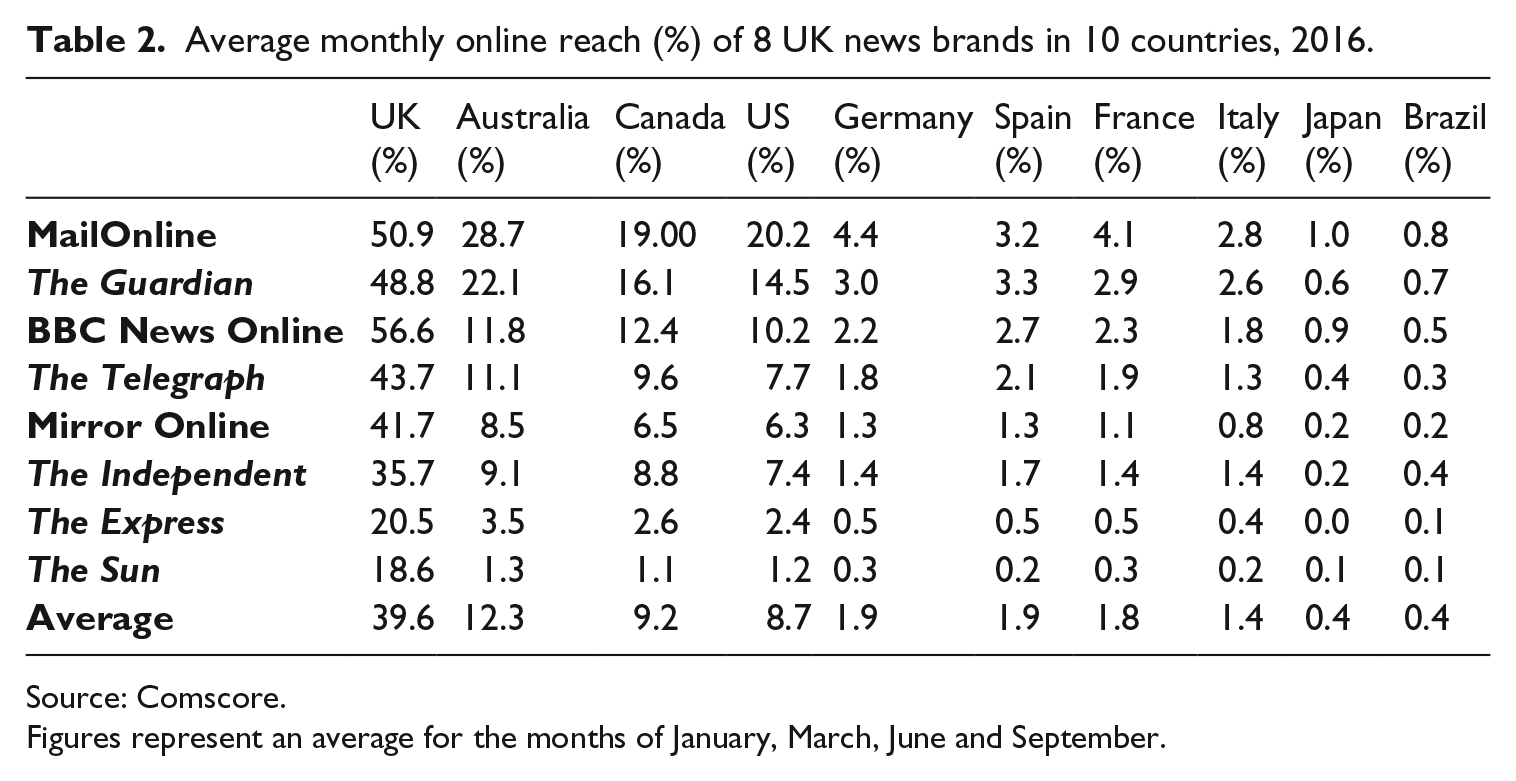
Source: Comscore.
Figures represent an average for the months of January, March, June and September.
UK news brands’ reach among the continental European countries, however, is better. The monthly average reach in Germany, France, Spain and Italy is between 1 and 2 per cent. The three top news brands in these markets are again MailOnline, The Guardian and BBC News Online, and the least successful again the mid-market Express and the tabloid Sun (both under 1 per cent monthly market reach; see Table 2).
As expected, there are huge differences in the digital population reached in foreign markets depending on the first language spoken there. MailOnline, for example, has a reach of 28.7 per cent in Australia, 20.2 per cent in the United States and 19 per cent in Canada, but only 4.4 per cent in Germany. The average overall reach is 12.3 per cent in Australia, 9.2 per cent in Canada and 8.7 per cent in the United States. These three countries are the most reached markets by UK news sites after the United Kingdom itself. Again, the tabloid Sun performs relatively poorly in these markets (about 1% reach in each), whereas MailOnline and The Guardian perform best. Notably, BBC News Online (11.8%) lags behind The Guardian (22.1%) in the Australian market.
Figure 3 shows differences in monthly reach in the English-speaking countries (Australia, Canada and United States) and the non-English-speaking countries (France, Germany, Italy, Spain, Brazil and Japan). For example, MailOnline reaches about eight times more people in the English-speaking countries (22.6%) than it does in the non-English-speaking countries (2.7%). The tabloid news brands in the sample (Mirror Online and The Sun) have relatively narrow reach in the overseas markets regardless of the language spoken.
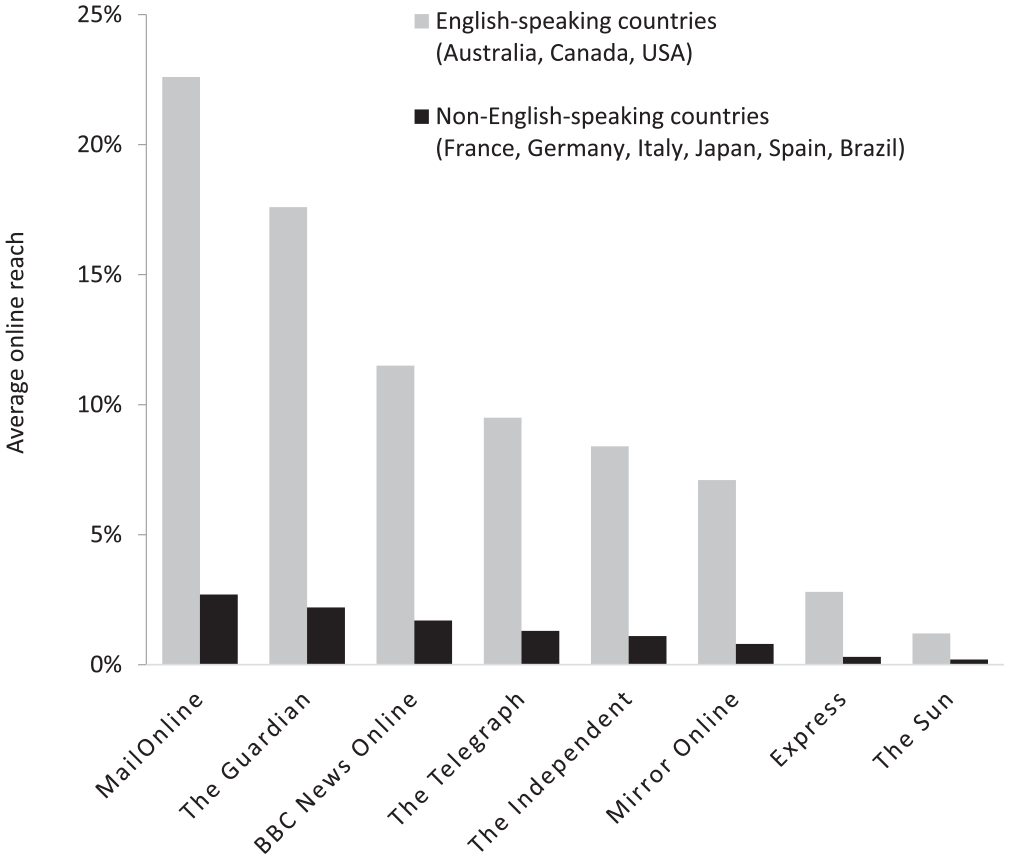
Average online reach of UK news brands in a selection of English- and non-English-speaking countries, 2016.
It is not possible, however, to anticipate the performance of all news brands by the format of their parent. The mid-market MailOnline, for example, performs best of all the sites in terms of reach, while the other mid-market newspaper brand, The Express, is the second-worst performer in both English-speaking countries and non-English-speaking countries (2.8% in the former and 0.3% in the latter). The Guardian, one of the three ‘broadsheet’ news brands in the sample, has the second-highest monthly reach in foreign markets (17.6% in English-speaking markets and 2.2% in non-English-speaking markets), while another broadsheet news site, The Independent, has only average performance. 6
Popularity
We can now dig a little deeper into these numbers by examining measures of popularity, loyalty, depth and stickiness. With regard to popularity, the greatest numbers of online monthly unique visitors to UK news brands are from the United States, an average of 22,565,400 per site. The United Kingdom comes a close second with 19,763,170. Canada and Australia are in the third and fourth places with around 2.5 million. France comes next with 836,330, followed by Italy and Spain with between 500,000 and 600,000. Then Brazil with 408,710, and Japan in the last place. Japan sends an average of 337,210 monthly unique online visitors to each UK news brand (see Table 3).
The size and loyalty of online audiences from 10 countries for 8 UK news brands a and the depth and length of their visits, 2016.
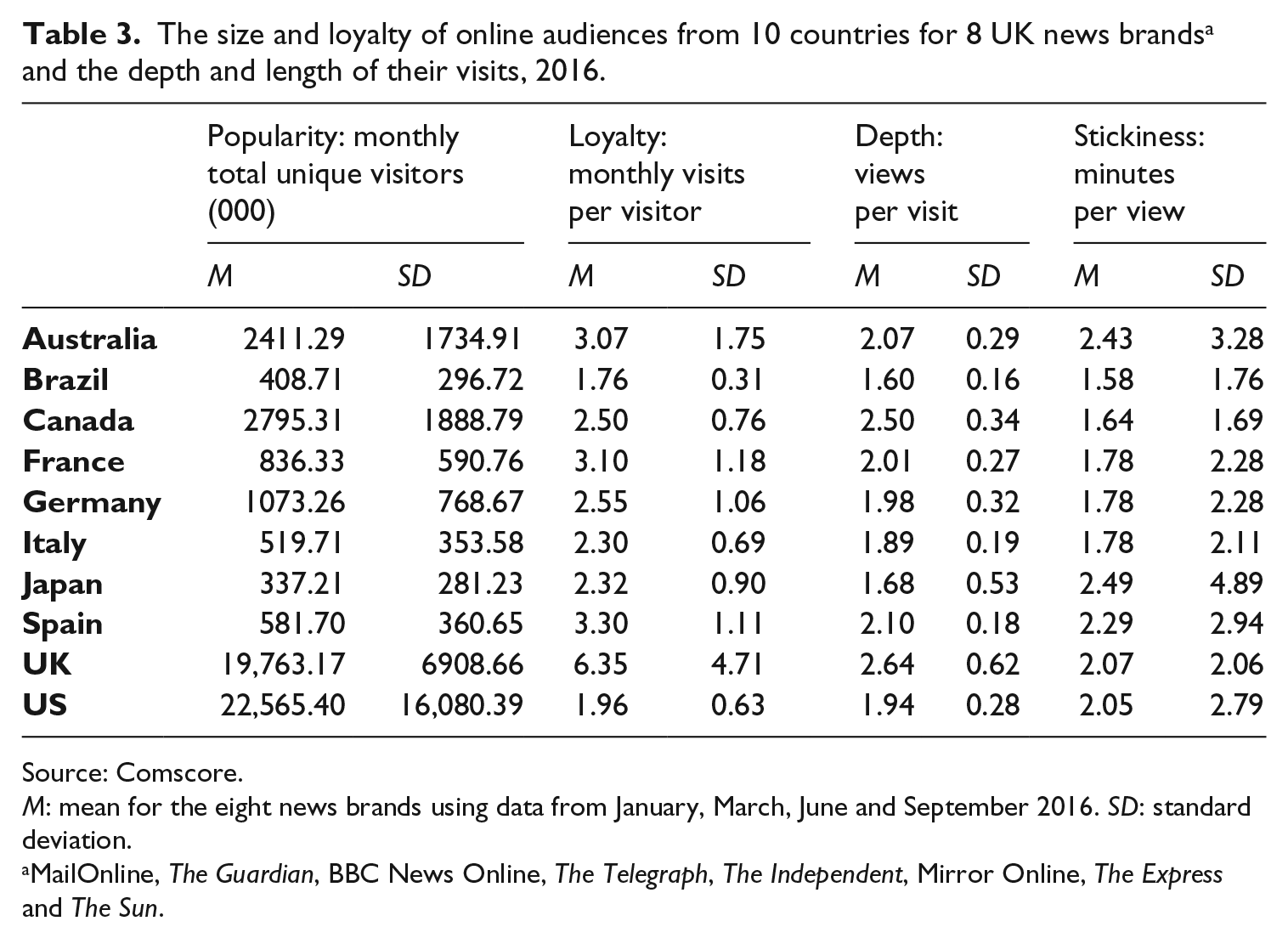
Source: Comscore.
M: mean for the eight news brands using data from January, March, June and September 2016. SD: standard deviation.
MailOnline, The Guardian, BBC News Online, The Telegraph, The Independent, Mirror Online, The Express and The Sun.
Loyalty
As the results of our first research question suggest, readers from the news brands’ home market, the United Kingdom, are the most loyal. On average they visit over 6 times per month (M = 6.35; SD = 4.71). Despite the high reach in the United States and the large number of ‘total unique visitors’, American readers are not very loyal (M = 1.96; SD = 0.63). They are only slightly more loyal than the Brazilians (M = 1.76; SD = 0.31). Spanish (M = 3.30; SD = 1.11) and French (M = 3.10; SD = 1.18) readers have similar loyalty to audiences from non-UK English-speaking countries such as Australia (M = 3.07; SD = 1.75) and Canada (M = 2.50; SD = 0.76; see Table 3).
Depth and stickiness
UK readers explore the deepest, clocking up the most views per visit (M = 2.64; SD = 0.62). By contrast, Brazilians register only 1.6 views per visit on average (SD = 0.16). The depth of visits from readers in Japan is similarly superficial, with 1.68 views per visit (SD = 0.53). However, readers from Japan view pages for a relatively long time. At almost 2.5 minutes per view, they are the stickiest of all the readerships (M = 2.49; SD = 4.89). Second on the dimension of stickiness, and foremost among the English-speaking countries, is Australia (M = 2.43; SD = 3.28), followed by Spain (M = 2.29; SD = 2.94). In the United Kingdom, visitors average about 2 minutes per view (M = 2.07; SD = 2.06; see Table 3).
Standardized mean differences
In order to highlight the differences between the individual markets in the dimensions of absolute audience size, reader loyalty, and visit depth and length, standardized mean differences are displayed in Figures 4 to 6. The news brands’ strong performance in their home market is evident. Clearly visible too are the huge number of absolute visitors from the United States (Figure 4), the very sticky Japanese (Figure 5) and Australian (Figure 4) visitors, and the loyal Spanish (Figure 6), Australian (Figure 4) and French (Figure 6) visitors. But the radar charts display less palatable truths as well. For example, the brevity of Canadian audiences’ views (see Figure 4), the shallow visits of Japanese audiences (Figure 5) and the general lack of attention paid by Brazilian visitors (Figure 5).
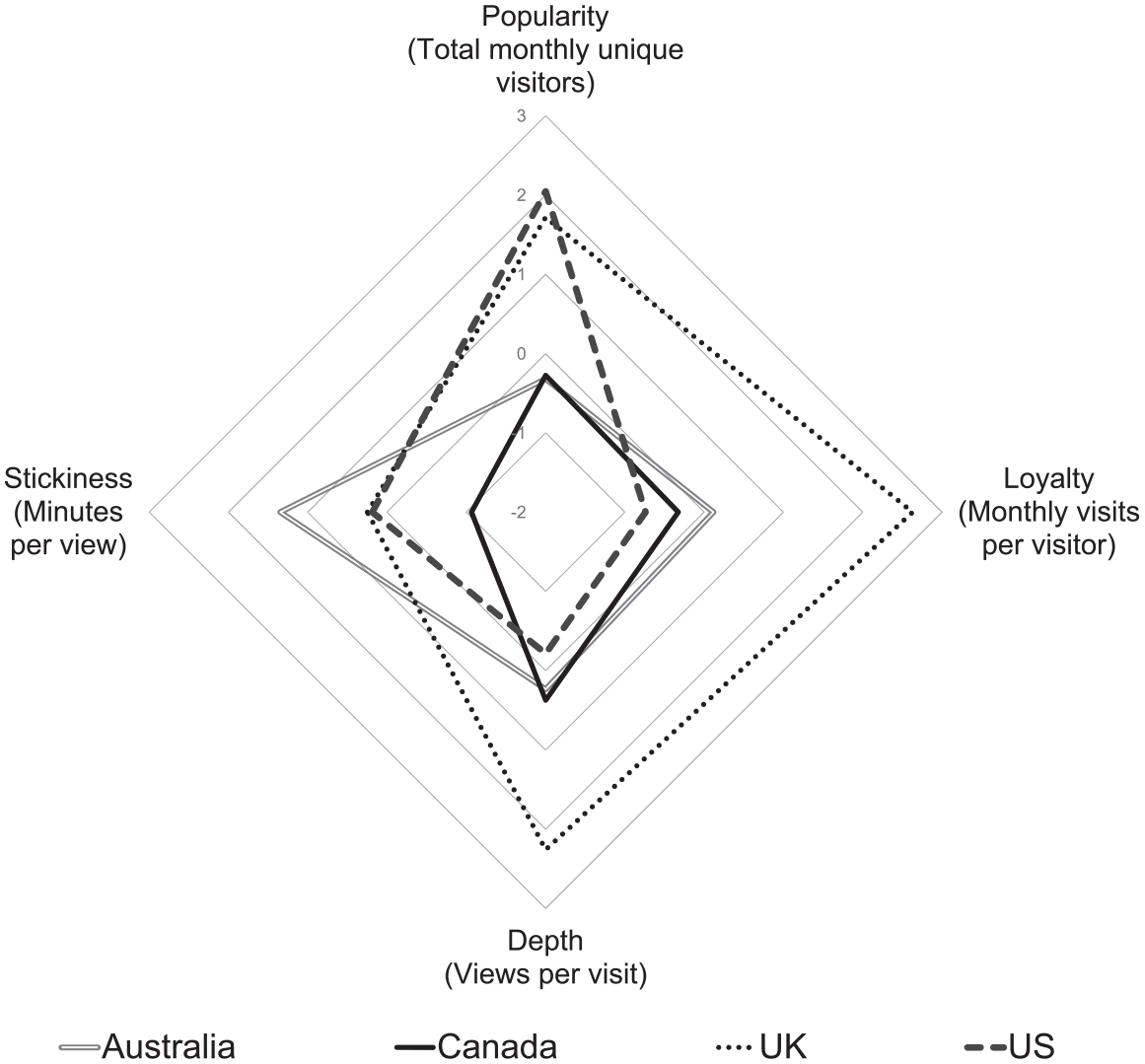
Standardized mean differences in visit depth and length and in the size and loyalty of online audiences from four English-speaking countries for eight UK news brands (MailOnline, The Guardian, BBC News Online, The Telegraph, The Independent, Mirror Online, The Express and The Sun), 2016.
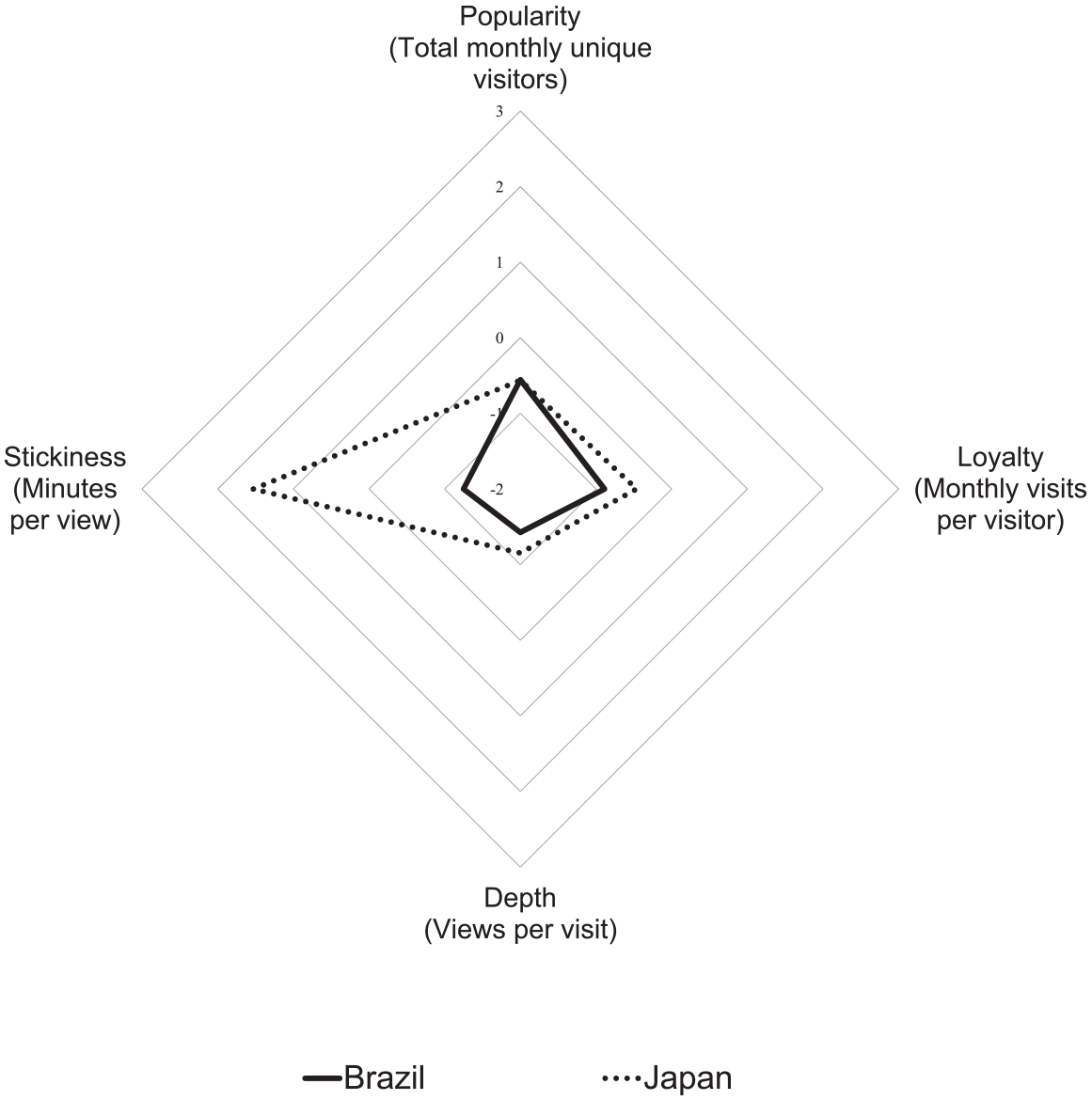
Standardized mean differences in visit depth and length and in the size and loyalty of online audiences from Brazil and Japan for eight UK news brands (MailOnline, The Guardian, BBC News Online, The Telegraph, The Independent, Mirror Online, The Express and The Sun), 2016.
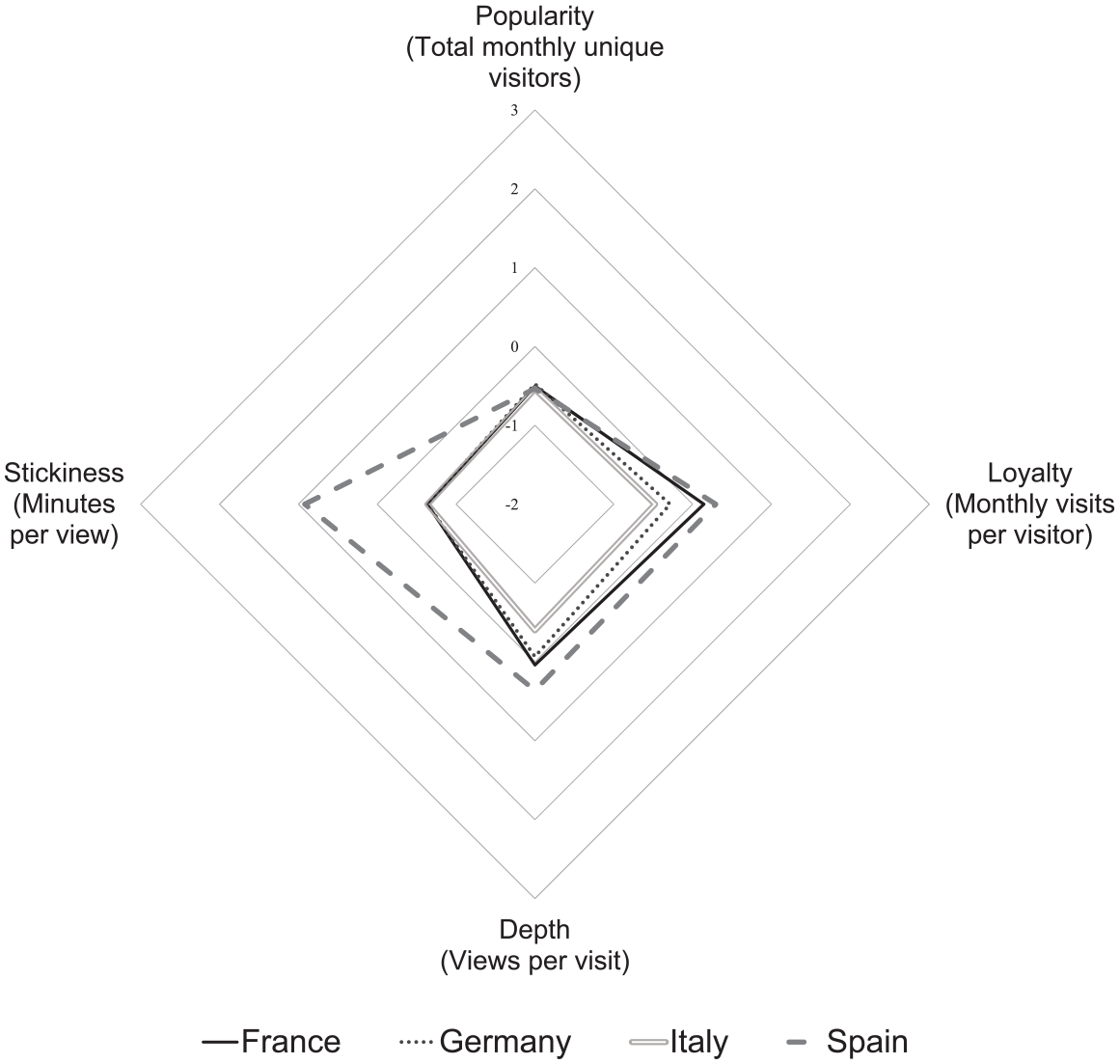
Standardized mean differences in visit depth and length and in the size and loyalty of online audiences from four continental European countries for eight UK news brands (MailOnline, The Guardian, BBC News Online, The Telegraph, The Independent, Mirror Online, The Express and The Sun), 2016.
Discussion
International news audiences have long been overlooked by media and communication researchers, even as the study of global journalism has grown. But, as online news consumption becomes more central, and the financial crisis in the newspaper industry deepens, international audiences could become more and more important for publishers. This is particularly true for news outlets based in countries like the United Kingdom, where there is clear potential for audience growth in countries with a shared language and culture. In response, news audience researchers – and journalism researchers more broadly – must consider the international dimension if their understanding of audience behaviour and journalistic practices and content is to keep pace with changes in the industry.
This is especially important in light of how audience measurement has become integral to newsroom practices, and ever more sophisticated metrics are being developed to understand audience behaviour. Many news organizations have moved beyond understanding their audiences solely in terms of their size, developing measures of loyalty and engagement, and even aiming, in the future, to measure less readily quantifiable outcomes such as societal impact (Cherubini and Nielsen, 2016).
Our aim, therefore, was to move beyond the domestic user-centric approach to generate a more holistic picture of the consumption of online news brands by their international audiences. The results show that UK news brands attract a significant number of international visitors but that the attention those visitors pay to content differs in character. In general terms we can see that audiences from Australia and the United States tend to be more attentive, probably because they share a language and culture with the United Kingdom. Moderately attentive are audiences from France, Germany, Italy and Spain, who do not share a language with, but are geographically close to the United Kingdom. Then, least attentive of all, are audiences from Japan and Brazil, who share neither language with nor have such close geographic ties to the United Kingdom. These differences are likely to be linked to content preferences, with factors such as culture, common history and political or religious involvement influencing news consumption (Gasher and Klein, 2008; Wall and Bicket, 2008).
Within this general pattern, there are some notable exceptions. For example, although MailOnline reaches 19 per cent of the Canadian digital population (see Table 2), the attention paid by the Canadian audience is moderate compared with other countries (especially non-English-speaking countries such as Germany (see Table 3). Similarly, the online reach of UK news brands in Brazil is much the same as in Japan (see Table 2). However, the Japanese audience lingers much longer on pages (see Figure 5). Among English-speaking countries too, there are differences. Although UK news brands have similar levels of online reach in Canada, the United States and Australia, an analysis of attention exposes big differences in usage patterns. Australian visitors spend a relatively long time on each page and their visits are relatively frequent (see Figure 4), while Canadian readers spend only a little longer than the Brazilian visitors (see Table 3). The US audience, although large, is not very loyal and its visits lack depth and length (see Table 3). Of course, some of the differences we see will likely have some rather mundane causes, of little interest to either journalists or academics. For example, the ‘stickiness’ of the Japanese audience may be down to the fact that it takes individuals longer on average to read news published in a writing system that differs from that of their native language.
There are also differences between the brands in terms of how much attention they attract from abroad. Some of these differences can be partly explained by whether they are tabloid, mid-market or broadsheet publications. Broadsheet newspapers receive more international attention than tabloids. This may be because they appeal more to those who are highly interested in the news, who are turning to UK outlets for alternative coverage and perspectives on international events. Other studies have shown that an important factor for the US audience visiting UK news sites has been a ‘loss of faith’ in their domestic news providers, which have failed ‘to provide news that adequately challenges authority’ (Wall and Bicket, 2008: 164). That said, some brands clearly defy what we might expect, given their market positioning. For example, the mid-market MailOnline attracts much more attention than the mid-market Express, especially in the English-speaking countries. This may be because the MailOnline has developed an online editorial strategy that departs somewhat from its print edition in that it is focused on entertainment and celebrity – news topics that may transcend national borders particularly well.
This leads us to an important question, namely, does increased transnational news consumption always indicate more global journalism? An increased focus on topics like entertainment and celebrity might succeed in attracting readers from overseas, but how much will this kind of coverage really contribute to global journalism’s ambition to ‘investigate how people and their actions, practices, problems, life conditions etc. in different parts of the world are interrelated’ (Berglez, 2008)? Moreover, increases in transnational news consumption are not necessarily a response to changes in journalistic content. It could simply reflect, for example, changes in the behaviour, or size, of the British diaspora. Some of those accessing UK news outlets from overseas are likely to be permanent UK residents who are temporarily abroad. Others will have spent at least some time in the United Kingdom in the past. Chyi and Sylvie (2001), for example, revealed that about half of the long-distance audience for US news sites were former residents or part-time residents. Finally, it is also unclear whether overseas expansion from outlets like The Guardian, which has launched US and Australian online editions within the past 5 years, actually contributes towards global journalism. If the coverage they provide is very similar to that offered by existing domestic outlets, then the fact that the parent edition is overseas may not be particularly relevant. Future studies could investigate this using content analysis.
An important limitation of our study is that we were not able to use the data to see what individual UK news stories people from overseas were accessing. Data on article-level consumption may speak of some of the more speculative explanations described above. They would also help explain some of the motivations behind international news access. For example, they could show whether international audiences are primarily turning to UK outlets because they want to read stories about events that have happened in the United Kingdom, as opposed to a British take on international events, or because it no longer matters very much where international news originates. Each of these scenarios have very different implications for whether we think increased transnational news consumption indicates a more globalized journalism.
We may also question whether any increase in transnational news consumption represents a fundamental change in audience behaviour. Although international audiences may be increasingly important for UK news outlets in the short term, they may become more marginalized, as there appears to be a global move away from business models that rely on achieving ‘scale’ towards models that are based on paywalls and subscriptions (Simon and Graves, 2019). People may be willing to access news from overseas outlets while it is freely available, but would they be willing to pay for it?
Footnotes
Authors’ note
Neil Thurman is also affiliated to University of London, UK.
Declaration of conflicting interests
The author(s) declared no potential conflicts of interest with respect to the research, authorship and/or publication of this article.
Funding
The author(s) disclosed receipt of the following financial support for the research, authorship and/or publication of this article: This research was supported by a research grant from the Volkswagen Foundation (A110823/88171), with additional support from Google UK as part of the Digital News Initiative (CTR00220).
